

Is Electrical Work Physically Demanding for Older Learners? What Adults Need to Know (UK)

- Technical review: Thomas Jevons (Head of Training, 20+ years)
- Employability review: Joshua Jarvis (Placement Manager)
- Editorial review: Jessica Gilbert (Marketing Editorial Team)
- Last reviewed:
- Changes: New comprehensive article addressing physical demands of electrical work for adults aged 35 to 60+, covering sector-specific physical requirements, recovery time challenges, peak demand periods during NVQ phase, employer expectations, long-term viability strategies, myth corrections with evidence, and honest assessment of age-related physical considerations without medical advice
Executive Snapshot
Physical demands of UK electrical work vary significantly by sector and career stage, with critical distinctions affecting older learners aged 35 to 60+ considering entry or retraining.
Sector variability is substantial. Domestic installation and commercial first fix involve high-intensity lifting, overhead work, kneeling, work at height. Facilities maintenance and testing/inspection roles present moderate to low physical demands focusing on diagnostic work, methodical assessment, less manual labor. Industrial maintenance varies by plant environment but often includes heavy equipment and extreme temperatures. Specialist pathways (EV charging, solar, fire alarms, BMS) present mixed demands depending on specific discipline.
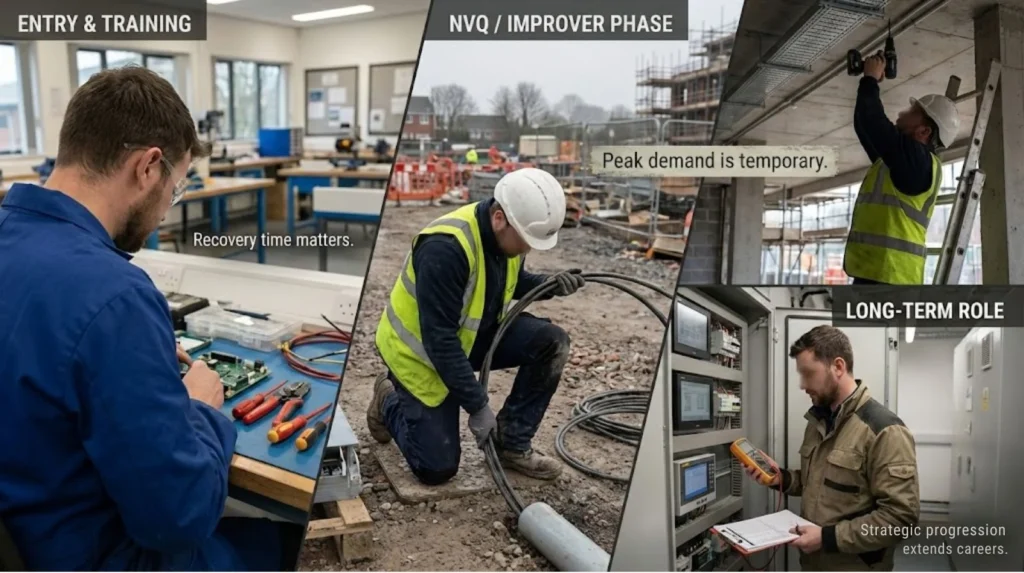
The “NVQ Wall” represents peak physical demand. The improver phase between completing Level 2 and Level 3 diplomas and achieving NVQ Level 3 qualification is the most physically intense period. Requires 12 to 24 months consistent site work building portfolio evidence through carrying equipment, pulling cables, site clearance, sustained manual tasks under supervision. College training is workshop-based with controlled environments. Real site work for NVQ evidence introduces full physical reality including pace, weather exposure, awkward access.
Recovery time, not strength, is the primary age-related challenge. Most adults aged 40 to 60 can perform required lifting (cable drums up to 25kg, consumer units, tools) and physical tasks. However, recovery from repetitive strain (kneeling causing bursitis, overhead drilling causing shoulder inflammation, sustained ladder climbing) takes 48 to 72 hours for older workers versus overnight recovery for younger workers. When working five days weekly, insufficient recovery accumulates into chronic pain potentially forcing career exit.
UK skills shortage increases older learner viability. Estimated 33,000 electrician shortfall by 2027 creates employer demand for mature career changers. Reliability, safety awareness, professional communication valued alongside technical capability. Age concerns diminish when workers demonstrate consistent performance and workplace maturity. However, shortage doesn’t eliminate physical job requirements or modify task demands based on age.
Long-term career viability requires strategic role selection. Older learners succeeding sustainably typically progress toward specialist testing and inspection (2391 qualification), Building Management Systems (BMS programming and diagnostics), supervisory coordination, or maintenance roles emphasizing fault-finding over heavy installation. Adults entering at 45 or 50 should plan 10 to 15 year career trajectory toward reduced physical load rather than assuming indefinite first fix capability.
Modern UK site practices reduce some traditional physical strain. Movement toward podiums and MEWPs (mobile elevated work platforms, scissor lifts) over traditional ladders reduces work-at-height injury risk. Manual Handling Operations Regulations 1992 require employers to provide mechanical aids (cable jacks, material lifts) for heavy loads. However, these mitigations don’t eliminate core physical demands of installation, pulling cables, accessing confined spaces, sustained standing.
Site mobility matters as much as task performance. Physical demands include traveling to varied sites, driving vans loaded with tools and materials, navigating construction environments with uneven ground, temporary stairs, awkward access points. Capability to independently access lofts, crawl spaces, plant rooms, work in confined spaces without assistance is employment requirement. Not about raw strength but sustained mobility across diverse environments.
Understanding where physical demand genuinely peaks, which sectors suit mature bodies long-term, and how strategic progression manages age-related recovery needs determines whether older adults successfully retrain and sustain electrical careers versus investing time and money into qualification they cannot physically maintain. For comprehensive context on the UK electrician qualification pathway from Level 2 through Gold Card including all technical and workplace requirements, see our detailed guide.
Electrical Work Is Not One Job
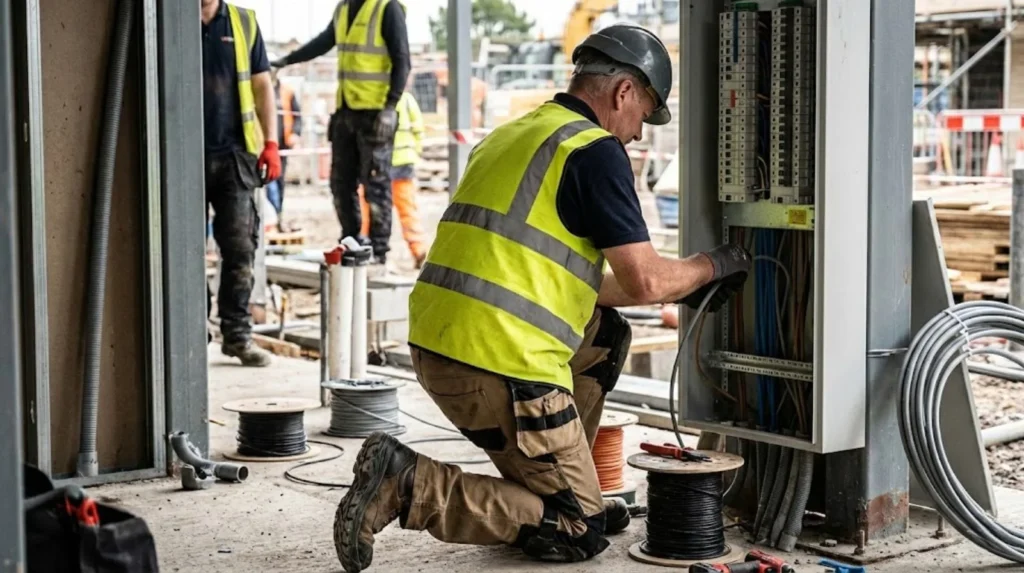
Understanding physical demands requires distinguishing six primary sectors with distinct task profiles, work environments, and strain patterns.
Domestic Installation
Residential property work including house rewires, consumer unit upgrades, additional circuits, fault repairs. Typical physical tasks: lifting cables and materials (up to 25kg routinely), overhead wiring for lighting circuits, extensive kneeling in lofts installing cables through insulation (often 40°C+ summer temperatures), ladder work accessing ceilings and first-floor areas, crawling in confined underfloor spaces, chasing walls for cable runs creating dust and vibration exposure.
Work pace: Deadline-driven with fixed-price quotas creating pressure for speed. Often solo work or small teams. Site conditions: Indoor predominantly, variable property access (narrow stairs, low ceilings, cluttered spaces), occasional weather exposure during extensions or external work. Physical intensity: High sustained manual demand with repetitive strain from kneeling, overhead reaching, awkward positions.
Commercial Installation
Office buildings, retail premises, light industrial units involving containment systems (cable tray, cable basket, steel conduit), first fix rough wiring, second fix terminations. Typical physical tasks: carrying and installing tray sections and containment (steel conduit 3-meter lengths requiring two-person lifts), sustained overhead arm work installing ceiling grid systems, pulling large cable sets through containment, crouching for underfloor cabling, scaffolding and ladder use, MEWP operation.
Work pace: Project timelines with coordination between trades. Team-based work requiring communication and lifting assistance. Site conditions: Mix of indoor and outdoor work, noise from power tools and other trades, access via temporary stairs and platforms, dusty conditions during construction phase. Physical intensity: High volume with heavy repetitive tasks, overhead strain, coordination demands.
Industrial Maintenance
Factory environments, plant rooms, manufacturing facilities, motors and heavy machinery, fault-finding during breakdowns, planned shutdowns. Typical physical tasks: Lifting heavy equipment and motor components (50kg+ occasionally requiring team lifts), accessing confined spaces within machinery, sustained standing for diagnostic work, working in noisy environments requiring hearing protection, exposure to temperature extremes (foundries, cold stores, outdoor substations).
Work pace: Reactive during breakdowns creating high-pressure emergency response. Planned during scheduled maintenance allowing methodical approach. Site conditions: Noisy, potentially hazardous (chemicals, moving machinery, high voltage), extreme temperatures common, shift patterns including nights and weekends. Physical intensity: Variable, heavy when handling equipment but often lower-paced than continuous installation work.
Facilities and Planned Preventive Maintenance (PPM)
Building maintenance roles in hospitals, schools, office complexes, shopping centers involving emergency lighting testing, fire alarm checks, socket testing, fault response. Typical physical tasks: Tool carrying throughout buildings (10 to 15kg tool bag), ladder work for lighting access, fault isolation and diagnosis, minimal heavy installation, extensive walking between locations, standing for testing procedures.
Work pace: Scheduled maintenance routes with on-call reactive element. Generally lower pressure than installation work. Site conditions: Indoor controlled environments predominantly, occupied buildings requiring professional behavior, occasional heights for lighting but typically IPAF training for powered access. Physical intensity: Moderate with emphasis on sustained mobility and standing rather than heavy lifting.
Testing and Inspection Focus
Specialist work via 2391 qualification conducting Electrical Installation Condition Reports (EICRs), periodic inspections, verification testing. Typical physical tasks: Visual examination of installations, testing with multifunction testers and instruments, removing socket and switch covers for termination inspection, limited physical intervention beyond access, methodical documentation and report writing.
Work pace: Systematic and methodical, driven by thoroughness not speed. Report-based outcomes requiring precision. Site conditions: Varied properties (domestic, commercial, industrial) but assessment rather than installation focus. Indoor primarily with desk-based report completion. Physical intensity: Low to moderate, primarily standing and methodical movement, tool use less strenuous than power tool operation.
Specialist Pathways
EV charging installation: Ground excavation for cable routes, kneeling for ducting installation, drilling for wall-mounted chargers, some height work for commercial installations. Medium to high physical demand blending installation with technical commissioning.
Solar PV installation: Roof work at height requiring scaffolding or IPAF competence, lifting panels (15 to 20kg each), drilling roof fixings, weather-dependent outdoor work. High physical demand with specialist height work training essential.
Fire alarm systems: Overhead cable runs for detection devices, ladder work for ceiling-mounted equipment, panel wiring and programming. Medium physical demand with technical focus.
Building Management Systems (BMS): Panel wiring, sensor installation, primarily technical programming and commissioning work. Lower physical demand emphasizing diagnostics and computer-based configuration.
Joshua Jarvis, our Placement Manager, explains the site mobility dimension:
"Physical demands include travel to varied sites, often requiring driving vans loaded with tools and materials, navigating construction environments with uneven ground, stairs, temporary access. Some older workers have mobility limitations from previous injuries or health conditions affecting site navigation. Employers need people who can move independently around sites, access lofts, crawl spaces, plant rooms without assistance. Not saying older workers cannot do this, but physical capability for site mobility matters as much as task performance itself."
Joshua Jarvis, Placement Manager
Physical Demand Matrix
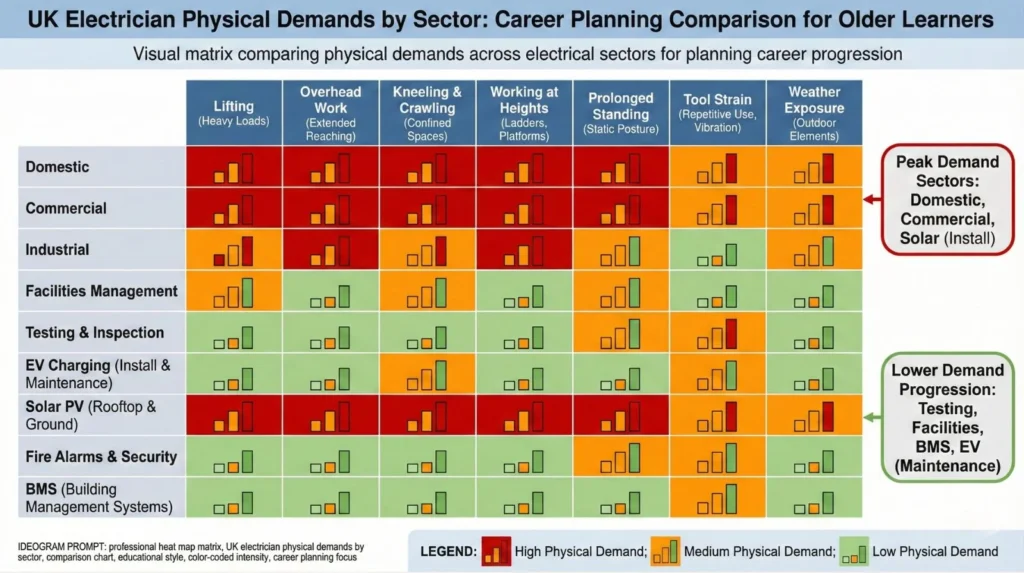
Understanding sector-specific physical requirements helps older learners identify suitable career paths and realistic expectations.
| Sector | Lifting/Carrying | Overhead Work | Kneeling/Crouching | Work at Height | Sustained Standing | Tool/Hand Strain | Temperature/Weather |
| Domestic Installation | High – Cables, units up to 25kg daily | High – Ceiling wiring frequent | High – Lofts, underfloors extensive | Medium – Ladders frequent | High – 8+ hours on feet | Medium – Drilling, wiring repetitive | Medium – Some outdoor exposure |
| Commercial Installation | High – Tray, containment materials heavy | High – Suspended ceilings continuous | Medium – Underfloor access regular | High – Scaffolding, MEWPs | High – Site navigation extensive | High – Fixing, repetitive installs | Medium – Indoor/outdoor mix |
| Industrial Maintenance | High – Motors, plant items 50kg+ | Medium – Panel work overhead | Medium – Machinery access confined | Medium – Platforms occasional | High – Maintenance shifts long | High – Fault-finding tools intensive | High – Factory extremes common |
| Facilities/PPM | Medium – Tools, spares 10-15kg | Medium – Lighting access regular | Low – Bench-level predominantly | Low – Occasional only | High – Patrols, standing diagnostics | Medium – Testing meters moderate | Low – Controlled buildings |
| Testing/Inspection | Low – Meters, light tools only | Low – Visual checks primarily | Low – Access panels minimal | Low – Minimal requirement | Medium – Site visits walking | Low – Instrument use precise | Low – Indoor focus |
| EV Charging | Medium-High – Cables, chargers 20kg+ | Medium – Wall mounting installations | High – Ground ducting kneeling | Medium – Commercial heights | High – Installation full days | Medium – Drilling, fixing regular | High – Outdoor predominantly |
| Solar PV | High – Panels 15-20kg repetitive | High – Roof mounting continuous | Medium – Roof surface working | High – Scaffolding, roof work | High – Outdoor full installation | Medium – Drilling, fixing tools | High – Weather-dependent exposure |
| Fire Alarms | Medium – Cables, panels 10-15kg | High – Ceiling detection devices | Medium – Panel access moderate | Medium – Ladders frequent | High – Installation days long | Medium – Cable runs, terminations | Low – Indoor predominantly |
| BMS/Controls | Low – Light panels, sensors | Low – Sensor installation minimal | Low – Panel bench-level | Low – Rare requirement | Medium – Programming standing | Low – Computer-based focus | Low – Indoor control rooms |
Scale Definitions:
Low: Occasional requirement, limited duration, minimal strain
Medium: Frequent requirement, moderate duration, manageable strain with proper technique
High: Constant or intensive requirement, extended duration, significant cumulative strain
Key Observations:
Domestic and commercial installation present the highest cumulative physical demands across multiple categories. Older learners targeting these sectors must realistically assess capability to sustain high-intensity work over 12 to 24 month NVQ evidence period and beyond.
Testing and inspection, BMS/controls, and facilities maintenance present the lowest physical demands while maintaining skilled electrical work. These sectors suit older learners prioritizing career longevity over 10 to 15 years rather than peak earning through intensive installation.
Specialist pathways vary significantly. Solar PV and EV charging maintain high demands similar to general installation. Fire alarms present moderate demands. BMS work offers lower physical intensity with higher technical focus.
Strategic progression from higher-demand sectors (domestic/commercial installation during NVQ phase) toward lower-demand roles (testing, facilities, supervisory) represents common successful trajectory for older workers extending careers.
What Changes With Age (Without Stereotypes)
Age-related physical considerations for electrical work differ from common assumptions, requiring evidence-based understanding.
Recovery Time, Not Strength
Thomas Jevons, our Head of Training with 20+ years experience, clarifies:
"Strength isn't the issue for older learners. Most adults can lift 25kg cable drums or carry consumer units without difficulty. The problem is recovery time from repetitive strain. Kneeling in lofts installing cables all day creates bursitis. Overhead drilling for hours causes shoulder inflammation. Younger workers recover overnight. Adults over 40 often need 48 to 72 hours for the same recovery. When you're working five days weekly building NVQ evidence, insufficient recovery accumulates into chronic pain forcing people out."
Thomas Jevons, Head of Training
HSE data indicates older workers have lower injury rates than younger workers, attributed to increased caution and safety awareness developed through life experience. However, when musculoskeletal injuries do occur, recovery periods are statistically longer. Rotator cuff inflammation from sustained overhead work, knee bursitis from prolonged kneeling, lower back strain from repetitive bending all require extended healing time.
The critical distinction: performing the physical task once isn’t problematic. Performing it repeatedly five days weekly over 12 to 18 months without adequate recovery creates cumulative strain. Younger workers bounce back overnight. Older workers carrying strain forward daily accumulate injury forcing career abandonment despite initial capability.
First Fix Versus Second Fix Suitability
First fix work, the rough-in installation stage, involves heaviest physical demands: drilling masonry and steel for containment, pulling cables through long conduit runs, installing heavy tray systems, working in incomplete structures without finished access. Fast-paced, deadline-driven, sustained manual labor.
Second fix work, the termination and commissioning stage, involves precision tasks: connecting accessories to installed cables, programming systems, testing circuits, fault diagnosis. Still physically demanding (standing, reaching, dexterity) but emphasizes patience, systematic approach, accuracy over brute force and speed.
Older learners often report first fix work unsustainable long-term whilst excelling at second fix work leveraging mature learner strengths: methodical thinking, attention to detail, willingness to follow testing procedures precisely. Adults entering trade should realistically plan 2 to 3 year pathway through first fix building NVQ evidence, then progression toward second fix, testing, or maintenance work matching physical capability sustainability.
Work at Height Considerations
Balance, vertigo, fear of heights can become more pronounced with age. Additionally, physical consequences of falls increase (bone density reduction, slower healing, higher complication rates). UK construction sites increasingly adopt safer access methods: podiums providing stable working platforms, MEWPs (scissor lifts, boom lifts) offering protected work positions, stricter ladder use restrictions under Work at Height Regulations 2005.
These changes benefit all workers but particularly older entrants. IPAF (International Powered Access Federation) training for MEWP operation is now standard requirement on commercial sites. Older workers comfortable with IPAF platforms but hesitant on ladders can manage work at height through powered access, reducing traditional ladder climbing strain.
However, height work cannot be entirely eliminated. Domestic installation still requires ladder access to lofts, commercial work involves scaffolding navigation, specialist roles (solar) demand roof work. Older learners with genuine height limitations should realistically assess whether electrical work suits them, as avoiding heights entirely while building comprehensive NVQ evidence is extremely difficult.
Pace Versus Precision
Speed on fast-paced commercial sites often disadvantages older workers versus younger colleagues. Younger workers move faster, work longer without fatigue, recover quicker between intense periods. However, older workers typically make fewer mistakes, follow safety procedures more diligently, communicate more professionally with clients.
Employers facing skills shortages increasingly value reliability and accuracy over raw speed. Sites prefer electricians who complete work correctly first time (reducing costly corrections) and never create safety incidents (avoiding HSE involvement and insurance claims). Mature workers offering these attributes despite slower pace often succeed where faster but less reliable younger workers fail.
The reality: some fast-paced commercial environments genuinely won’t suit older workers despite competence. However, many employers, particularly in domestic, maintenance, and testing sectors, prioritize precision and professionalism matching older learner strengths.
Technology and Dexterity
Electrical work increasingly requires tablet/smartphone use for digital certification (ECS cards, test certificates, EICR software), communication (WhatsApp groups for site coordination), and documentation (photos for portfolio evidence). Older workers unfamiliar with technology face learning curve but generally adapt with training.
Fine motor control for small terminal connections, screw manipulation in confined consumer units, delicate sensor installation remains essential. Age-related arthritis or reduced dexterity presents genuine barriers. Cannot be overcome through determination alone. Older learners should honestly assess capability to manipulate small components in dimly lit confined spaces, as this skill is non-negotiable for qualification.
Where Physical Demand Peaks: The Pathway Timeline
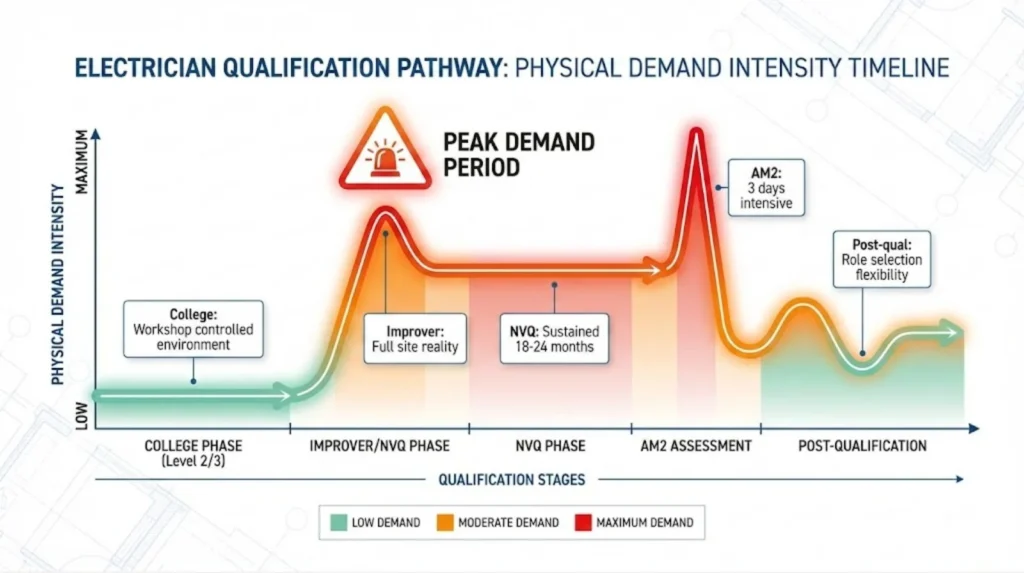
Physical intensity is not constant throughout the electrician pathway. Understanding where demands spike helps older learners prepare realistically.
Level 2 and Level 3 Diplomas (College Phase): Low Demand
Duration: 9 to 18 months part-time or 3 to 6 months full-time depending on study mode.
Physical profile: Workshop-based practical exercises at bench height in controlled training environments. Wiring practice boards, containment installation at comfortable working positions, tool use without time pressure, no real site conditions. Standing for practical sessions but breaks available, minimal heavy lifting (practice materials lighter than site equipment), no weather exposure, no actual construction site access required.
This phase suits older learners building confidence and technical knowledge without full physical demands. Many adults complete Level 2 and Level 3 successfully whilst maintaining sedentary office careers, studying evenings and weekends. The comfort of this phase can create false expectations about site work physical reality.
Improver and Mate Phase (Entry-Level Site Work): Maximum Physical Demand
Duration: Variable, often 12 to 24 months depending on NVQ evidence gathering speed.
This is the peak physical demand period for older learners. Transition from college workshops to real construction sites introduces full manual labor reality. Entry-level workers (improvers, mates) provide support to qualified electricians, which translates to: carrying equipment and materials to work areas repeatedly, pulling cables through installed containment, site clearance and rubbish removal, holding ladders, fetching tools, drilling preparation holes, chasing walls for cable routes.
The “grunt work” phase serves two purposes: building NVQ portfolio evidence through assisting qualified work, and demonstrating reliability and work ethic to employers. Cannot be avoided or minimized. Every qualified electrician passed through this phase. For older workers, this represents the reality test. Can you sustain heavy manual labor five days weekly over 18+ months whilst your body adapts?
Site conditions include: unfinished buildings without heating or cooling, dusty and noisy environments, temporary facilities (portable toilets, no canteen), weather exposure for external work, early starts (7am to 7:30am common), physical exhaustion by week’s end.
Older learners who underestimate this phase or expect immediate access to less physical work based on age/experience frequently drop out. Those who accept 18 to 24 months physical apprenticeship as necessary qualification stage typically complete successfully.
NVQ Level 3 Evidence Gathering (Concurrent with Improver Phase): High Sustained Demand
Duration: 12 to 24 months from starting NVQ enrollment to portfolio completion.
Physical demands remain high as NVQ evidence requires documented proof of actual work across diverse tasks: containment and cable installation, testing and inspection procedures, fault-finding and repair, system commissioning. Cannot gather this evidence through desk work or light duties. Must perform physical installations, access confined spaces, work at heights, use power tools extensively.
Assessor visits occur during site work, observing tasks being performed. Portfolio photographs must show real installations in progress. Cannot fake or simulate NVQ evidence. The qualification is specifically designed to prove workplace competence, which means full physical engagement with electrical work.
For older workers, this period tests sustained physical capability over extended duration. Initial fitness might suffice for weeks or months, but 18+ months sustained manual work reveals whether recovery capacity supports long-term career or whether cumulative strain becomes unsustainable.
AM2 Practical Assessment: High Intensity, Short Duration
Duration: 2.5 to 3 consecutive days at NET assessment centers.
Physical demands concentrated into short period: standing and working 8+ hours daily for three consecutive days, installing containment and wiring circuits in timed conditions, conducting testing procedures under time pressure, fault diagnosis requiring sustained concentration whilst fatigued, precision termination work in confined assessment booths.
Older candidates often report Day 3 as particularly challenging. Cumulative fatigue from Days 1 and 2 affects precision, speed, and mental clarity when fault-finding assessment demands peak performance. Younger candidates typically recover each evening. Older candidates carry fatigue forward.
However, the short duration makes AM2 manageable even for those struggling with sustained site work. Three days of intensive effort is achievable. 18 months of sustained site work is different threshold entirely. Some older workers can “push through” AM2 despite acknowledging they cannot sustain full-time installation work long-term.
Post-Qualification Phase: Variable, Self-Managed Demand
Duration: Career length, potentially 10 to 30+ years depending on entry age and longevity.
Once holding ECS Gold Card and qualified status, workers gain agency over role selection. Can choose lower-demand sectors (testing, maintenance, facilities), progress toward supervisory positions coordinating others, develop specialist niches emphasizing technical skill over manual labor (BMS programming, design, project management).
Initial post-qualification employment often maintains high physical demands as newly qualified electricians prove competence and build experience. However, 5 to 10 years post-qualification typically offers progression opportunities reducing physical load for those strategically planning career development.
Older workers entering trade at 45 or 50 should explicitly plan this trajectory: accept high physical demand through NVQ phase (2 to 3 years total including training), establish qualified status, then progressively shift toward lower-intensity work extending career to normal retirement age.
For additional context on how physical demands compound with other adult responsibilities, see our guide on managing training demands alongside full-time work and family commitments during the qualification pathway.
What Employers Expect From Older Career Changers
UK electrical contractors facing skills shortages evaluate older candidates differently than younger apprentices, with specific expectation patterns.
Reliability and Punctuality
Critical priority. Older workers expected to demonstrate consistent attendance, arriving 15 minutes early for 7am starts, managing own transport reliably regardless of weather. Employers value maturity bringing understanding that site delays affect entire project teams and client relationships. Younger workers sometimes struggle with consistency. Mature workers expected to model reliability.
Not “advantage” of age but base expectation. Failure to meet this standard more damaging for older candidates than younger ones, as reliability is assumed to be mature worker strength.
Safety Mindset and Compliance
Essential requirement. Must demonstrate strict adherence to safe isolation procedures (prove dead, lock off, test again), risk assessment participation, PPE compliance without supervision. Employers expect older workers to understand consequences of shortcuts and prioritize safety over speed.
HSE enforcement and insurance implications make safety compliance non-negotiable. Older workers with professional career backgrounds understand legal and financial ramifications. Employers value this maturity but cannot compromise on physical capability to perform safe isolation procedures, which requires accessing switchgear, isolators, sometimes in awkward locations or at height.
Professional Communication
Valued capability. Ability to communicate effectively with clients, building occupants, other trades, site management. Explaining work clearly, managing expectations, professional appearance and behavior. Many older career changers bring customer service or corporate communication skills translating well to client-facing electrical roles (domestic installation, commercial maintenance, facilities management).
Particularly valued in domestic work where client interaction is constant. However, communication skills don’t reduce physical job requirements. Employers need professional electricians who can also perform physical work, not professional communicators unable to perform electrical tasks.
Physical Adaptability
Practical assessment. Employers don’t expect older workers to match younger speed but do expect completion of required physical tasks without complaints or accommodations from day one. Traveling to varied sites, accessing difficult locations (lofts, plant rooms, confined spaces), carrying tools and materials, working full days without excessive breaks.
Skills shortage means employers more willing to hire mature workers but doesn’t eliminate physical job requirements. Sites need work completed. If older worker cannot perform required tasks at acceptable (not maximum) pace, employment won’t continue regardless of other strengths.
Flexibility for Site Travel and Hours
Common requirement. Electrical work often involves traveling 30 to 60 minutes to sites across region, early starts for commercial work, occasional overtime for project deadlines, flexibility for shutdown work (industrial maintenance). Employers expect commitment to varied locations and schedules.
Older workers with family commitments sometimes resist travel or inflexible about hours. This reduces employment opportunities even in shortage market. Employers understand family responsibilities but need workers meeting site schedule demands.
Willingness to Learn and Accept Feedback
Critical in apprenticeship/improver roles. Older workers sometimes struggle accepting instruction from younger qualified electricians or resist feedback based on feeling mature professional experience makes them above entry-level direction. However, improver roles are entry-level by definition. Must accept supervision and instruction regardless of age.
Employers hire mature workers for reliability and professionalism, not ego. Those demonstrating humility and genuine learning attitude succeed. Those expecting immediate authority based on age fail.
Technology Competence
Increasingly essential. Must demonstrate capability with tablets for digital certification (ECS card apps, test certificate software), smartphones for site communication (WhatsApp groups standard on many sites), photography for portfolio evidence. Not expecting IT expert level but functional competence with common tools.
Younger workers native to technology have advantage here. However, older workers willing to learn adapt successfully. Those refusing engagement with technology disadvantage themselves severely.
Dexterity and Fine Motor Skills
Non-negotiable physical requirement. Must demonstrate ability to manipulate small terminals, screws, cable connections in confined consumer units, often in poor lighting. Arthritis, reduced finger dexterity, tremor present genuine barriers. Cannot be overcome through determination or accommodated through workarounds.
Employers assess this during trial periods or practical testing. Older candidates unable to perform delicate termination work cannot progress regardless of other strengths.
Employers in shortage market overlook age concerns when candidates demonstrate competence and value. However, shortage doesn’t eliminate physical requirements, modify task demands, or excuse performance gaps. Older learners succeeding understand they must meet job requirements whilst offering additional maturity and reliability, not request accommodations based on age.
Myths vs Reality
Common assumptions about physical demands and age require evidence-based correction.
Myth: “I’m too old to start becoming an electrician”
Reality: Age itself is not disqualifying factor. Adults successfully enter electrical trade in their 40s, 50s, and occasionally 60s. UK skills shortage (estimated 33,000 worker shortfall by 2027) creates opportunities for mature entrants. However, “not too old” doesn’t mean “age irrelevant.”
Physical adaptation is required. Recovery time from repetitive strain increases with age. Peak demand period (improver phase, 18 to 24 months building NVQ evidence) tests physical capability authentically. Strategic progression toward lower-intensity roles (testing, maintenance, supervisory) typically necessary for long-term viability rather than assuming indefinite high-intensity installation capability.
Success requires realistic assessment of physical capability to sustain manual work through qualification phase, acceptance of 2 to 3 year entry-level physical demands despite age, and strategic career planning toward roles matching sustainable physical capacity long-term. Many adults manage this successfully. Not appropriate to claim “too old” universally, but equally inappropriate to dismiss age-related physical considerations.
Verdict: Partially true. Age creates genuine physical challenges requiring honest assessment and strategic planning, but many adults succeed with realistic expectations.
Myth: “Electrical work is physically lighter than plumbing or other trades”
Reality: Physical demands vary by trade sector and role within trade. Generalizations are unhelpful. Plumbers handle heavy boilers, bathtubs, soil pipes requiring sustained lifting. Electricians don’t handle these items specifically. However, electricians pull 25mm² SWA cable (armored cable approximately 15kg per meter), install 3-meter steel conduit lengths, work extensively at height on ladders and scaffolding, kneel in confined lofts, access tight plant rooms.
Both trades report high musculoskeletal strain rates. HSE injury statistics show electrical workers experience shoulder injuries from overhead work, knee problems from kneeling, back strain from lifting. Plumbers report similar patterns. Neither is objectively “lighter.” Both demand sustained physical capability.
Specific role selection matters more than trade comparison. Testing and inspection electrician (EICR work) is physically lighter than domestic plumber installing bathrooms. However, commercial electrician installing containment is comparable to or exceeds plumber physical demands. Comparing “electrician” to “plumber” as monolithic categories is meaningless.
Verdict: False. Physical demands are comparable between trades with variation by specific sector and role within each trade, not meaningful difference at trade level.
Myth: “Maintenance work isn’t physically demanding”
Reality: Facilities and maintenance roles involve sustained standing and walking (8+ hours daily), tool carrying (10 to 15kg bags repeatedly), ladder work for lighting access, accessing plant rooms via stairs and confined entries. Less intensive than continuous installation work but not sedentary or light physical demand.
Additionally, reactive maintenance creates unpredictable physical demands: emergency call-outs requiring immediate response regardless of fatigue, fault-finding under pressure in awkward locations, working in occupied buildings with time constraints. Planned preventive maintenance is methodical but still requires full day physical presence performing testing, inspections, minor repairs.
Lower demand than domestic or commercial installation, but “maintenance isn’t physical” is false. More accurate: maintenance is moderate physical demand emphasizing sustained mobility over peak strength, suitable for older workers unable to sustain installation intensity but still physically capable of full working days.
Verdict: False. Maintenance involves moderate sustained physical demands including standing, walking, ladder work, tool use, though lower intensity than heavy installation.
Myth: “Testing and inspection roles are an easy exit from physical work”
Reality: EICR testing requires methodical approach over speed but involves physical components: removing socket and switch covers repeatedly throughout property, moving furniture to access sockets, accessing distribution boards sometimes in confined cupboards, sustained standing and movement throughout testing process (4 to 8 hours per property inspection), carrying testing equipment, ladder work for high-level checks.
“Easy” is inaccurate. Testing is lower intensity physically but demands sustained mobility, dexterity for equipment operation, ability to access varied locations. Additionally, 2391 qualification requires theoretical knowledge of testing procedures, calculations, BS 7671 regulations, creating intellectual demand alongside physical work.
Testing suits older workers better than installation due to methodical pace, lower repetitive strain, emphasis on precision over speed. However, it’s not escape from physical work entirely, just shift toward more manageable physical profile. Must still access lofts, crawl spaces, work at heights occasionally, stand for extended periods.
Verdict: False. Testing involves lower but not negligible physical demands with methodical work pace suiting mature learners, not “easy” escape from physical requirements.
Myth: “You can avoid site work completely and still become qualified”
Reality: NVQ Level 3 requires workplace evidence from actual electrical installations. Cannot be completed through college workshops, simulated environments, or desk-based work. Must perform real containment installation, cable pulling, testing procedures, fault-finding on live sites with assessor observation and portfolio documentation.
Some older workers hope to minimize physical demand through classroom-focused routes or rapid theory completion then transition directly to testing roles. However, achieving initial NVQ qualification demands site evidence across installation, testing, and maintenance tasks. Testing-only roles require existing qualified status first.
Strategic minimization possible: target employers offering varied work including testing and maintenance alongside installation, build NVQ evidence through mixed portfolio emphasizing less physical elements where possible, complete qualification efficiently then transition toward preferred sectors. However, cannot eliminate site work phase entirely whilst meeting NVQ evidence requirements.
Verdict: False. Site-based installation work is mandatory for NVQ qualification completion, though strategic evidence gathering can emphasize less intensive tasks where portfolio requirements permit.
For comprehensive context on age-specific challenges and realistic pathways, see our guide on becoming an electrician over 40 covering financial, educational, and employment considerations alongside physical demands.
Practical Risk Management (Non-Medical)
Physical demands can be managed through UK-compliant workplace practices without medical intervention or fitness prescriptions.
Manual Handling Compliance
Manual Handling Operations Regulations 1992 require employers to assess lifting tasks and provide mechanical aids where loads exceed safe limits. For electrical work: cable jacks for heavy cable drums, material lifts for containment to working height, trolleys for tool transport, team lifts for items exceeding 25kg.
Older workers should never “hero lift” to prove capability. Using provided aids is professional practice, not weakness. Employers violating manual handling requirements create liability. Workers have right to refuse unsafe lifts and request proper equipment.
Practical application: assess load before lifting, plan route avoiding obstacles, bend knees not back, keep load close to body, team lift for anything awkward or heavy, use mechanical aids proactively. These principles apply regardless of age but particularly protect older workers from cumulative strain.
Work at Height Protection
Work at Height Regulations 2005 establish hierarchy of controls: avoid height work where possible, use collective protection (scaffolding, podiums) before individual protection (harnesses), use equipment preventing falls before mitigating consequences.
Older workers should prioritize: IPAF training for MEWP operation (scissor lifts, boom lifts providing stable protected platforms), podium towers for fixed-position work, proper scaffolding for extended tasks, ladder use only for brief access where alternatives unavailable.
Refusing unsafe height work is legal right regardless of employer pressure. Skills shortage means workers have options. Employers demanding unsafe practices should be avoided. However, refusing all height work eliminates electrical career viability. Must accept appropriate height work with proper protection.
PPE and Ergonomic Tools
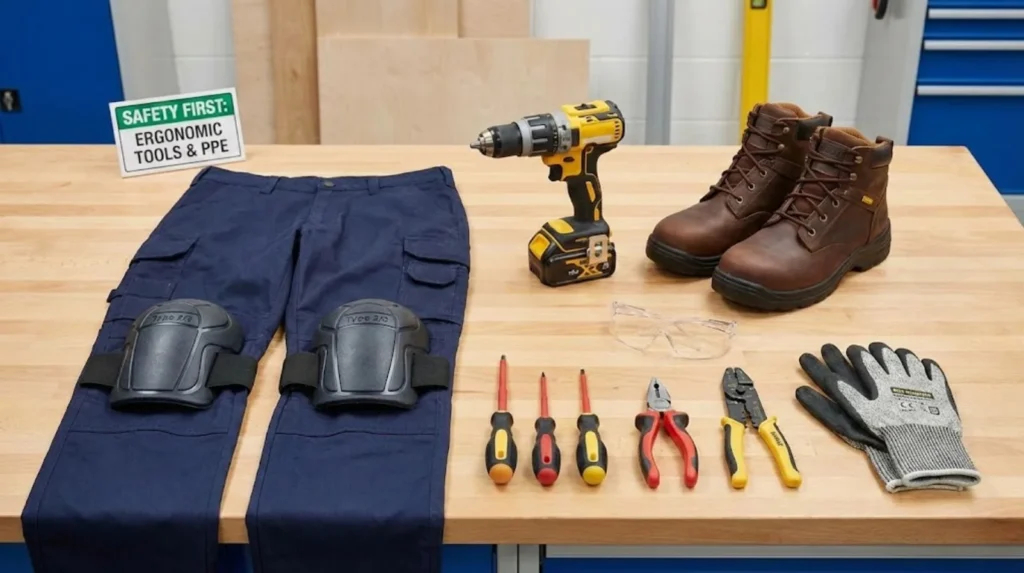
Proper equipment reduces physical strain: Type 2 or 3 knee pads embedded in work trousers (better than strap-on pads causing circulation issues), safety boots with proper arch support and cushioning (not cheapest option), gloves appropriate for task, ergonomic tool handles.
Power tool selection: 18V cordless tools with high-quality sharp bits reduce force required for drilling and cutting, anti-vibration features protect hands and wrists, proper tool maintenance ensures efficient operation reducing user effort.
Investment in quality PPE and tools reduces cumulative strain. Older workers should prioritize ergonomic equipment as health protection, not luxury. Employers may provide basic PPE meeting minimum standards. Workers investing in superior personal equipment protect long-term physical capability.
Pacing, Planning, and Task Rotation
Rushing creates more physical strain than workload itself. Mistakes requiring rework double physical effort. Proper planning reduces wasted movement: measure twice cut once, organize materials before starting, plan cable routes minimizing pulls, stage work logically.
Where possible, rotate between physical tasks: alternate kneeling work with standing tasks, break up overhead work with ground-level activities, mix installation with testing or documentation. Some roles and sites permit this flexibility. Others demand sustained single-task focus.
Older workers should advocate for sensible pacing without demanding special treatment. Completing work correctly first time, finishing without safety incidents, maintaining consistent output over weeks benefits employers more than maximum speed creating quality issues or injuries.
Recovery and Rest Periods
Legal breaks (20 minutes per 6-hour shift under Working Time Regulations 1998) are minimum. Older workers may need additional brief pauses for recovery, particularly during peak physical tasks. Where employer culture permits, taking brief tool-down moments reduces cumulative strain without significantly affecting productivity.
Between shifts: adequate sleep (7 to 8 hours minimum), proper hydration during work (dehydration increases injury risk), nutrition supporting physical recovery. Weekend rest is essential. Older workers considering overtime should honestly assess whether additional income justifies reduced recovery impacting long-term physical capability.
Site Risk Assessment Participation
Electrical workers entitled to participate in workplace risk assessments under EAWR and general health and safety legislation. Older workers identifying specific physical challenges should communicate with supervisors and contribute to assessment process.
Not demanding accommodations based on age but identifying genuine safety concerns applicable to all workers: awkward access requiring better lighting or positioning, repetitive tasks benefiting from rotation, manual handling needing mechanical aids. Framing concerns as site safety improvements rather than personal limitations typically gains cooperation.
Data Gaps and What We Can't Prove
Transparency about research limitations maintains credibility and manages expectations.
UK Injury Rates by Electrical Sub-Sector
HSE publishes electrical incident statistics aggregating all electrical workers. However, granular breakdown by sector (domestic vs commercial vs industrial vs testing) is not publicly available. Cannot state definitively: “Domestic electricians have X% higher injury rate than testing specialists” with verified data.
Anecdotal evidence from trade forums and practitioner reports suggests domestic and commercial installation have higher physical injury rates (particularly musculoskeletal disorders) than testing and maintenance roles. However, formal statistical verification is lacking.
Older Learner Dropout Rates
No centralized UK data tracks dropout rates specifically for adults aged 40+ entering electrical training versus younger cohorts. City & Guilds, NET, and Institute for Apprenticeships publish overall completion statistics but don’t segment by entry age or reasons for non-completion.
Training providers and placement managers report observationally that older learners drop out disproportionately during improver phase when physical demands peak, but this remains anecdotal without systematic study. Cannot quantify precisely how many 40+ learners abandon qualification due to physical strain versus other factors (financial, time, family, employment access).
Employer Age Preference Surveys
General attitudes toward older apprentices exist in HR literature showing positive employer sentiment toward mature workers’ reliability and experience. However, electrician-specific recruitment data examining whether contractors prefer younger versus older candidates, controlling for competence and qualification level, is unavailable.
Some evidence suggests age bias exists in improver hiring (employers preferring younger workers perceived as more flexible and lower long-term wage costs), but comprehensive survey data quantifying this bias in electrical sector specifically is lacking.
Long-Term Health Outcomes
HSE tracks construction industry health data showing musculoskeletal disorders are leading cause of work-related ill health. However, longitudinal studies following electricians specifically from qualification through career comparing health outcomes by entry age don’t exist in public domain.
Cannot state: “Electricians entering trade at 45 have X% higher arthritis rates at 60 than those entering at 25” with verified research. Intuitive assumption exists that later entry compressed into higher physical intensity over shorter period might create different health trajectory, but unproven.
Sector Transition Patterns
Trade career progression data showing how many electricians transition from installation to testing or maintenance roles, at what career stage, and whether age influences these transitions is not systematically tracked by industry bodies.
Observational evidence suggests older workers progress toward lower-intensity roles faster than younger workers, often within 5 to 7 years post-qualification versus 10 to 15 years for younger workers. However, this is based on placement manager experience and forum discussions, not formal tracking.
These gaps limit precision in quantifying physical risk and success rates for older learners. Guidance relies on HSE general construction data, practitioner observation, trade forum discussions, and training provider experience rather than comprehensive age-segmented research. Older learners should approach electrical training aware that definitive age-specific outcome data doesn’t exist, requiring personal physical assessment and realistic expectations based on available evidence.
Physical demands of electrical work vary substantially by sector, career stage, and role selection rather than representing single uniform challenge. Adults aged 35 to 60+ successfully enter and sustain electrical careers through realistic assessment of where physical intensity peaks, honest evaluation of recovery capacity distinguishing sustainable from unsustainable physical patterns, and strategic progression toward sectors matching long-term capability.
The improver phase building NVQ Level 3 evidence represents peak physical demand requiring 18 to 24 months sustained site work performing manual tasks under supervision. This period authentically tests whether older bodies can sustain electrical career long-term. College training (Level 2 and Level 3 diplomas) is workshop-based with manageable demands, creating false comfort about site work reality. Adults completing diplomas successfully whilst maintaining sedentary careers then transitioning to full-time site work experience sharp physical adjustment many underestimate.
Recovery time from repetitive strain (kneeling causing bursitis, overhead work causing shoulder inflammation, sustained standing and lifting) increases with age. Older workers needing 48 to 72 hours recovery after intensive physical days struggle when working standard five-day weeks building NVQ portfolios. Younger workers recovering overnight accumulate less cumulative strain. This distinction determines long-term viability more than raw strength or initial task capability. Can you sustain recovery pattern required for 12 to 24 month NVQ evidence phase without developing chronic pain forcing career abandonment?
UK skills shortage (estimated 33,000 worker shortfall by 2027) creates opportunities for mature entrants employers might dismiss in saturated markets. Reliability, safety awareness, professional communication valued alongside technical capability. However, shortage doesn’t eliminate physical job requirements, modify task demands based on age, or excuse performance gaps. Older workers must meet physical standards whilst offering additional maturity benefits, not request accommodations replacing physical capability with other attributes.
Long-term success requires planning progression from higher-demand installation work during qualification phase toward lower-intensity roles matching sustainable physical capacity: specialist testing and inspection (2391), facilities and planned maintenance, Building Management Systems, supervisory coordination. Entering trade at 45 or 50 with assumption of performing intensive installation work to 65 or 70 is unrealistic for most bodies. Strategic 10 to 15 year trajectory establishing qualified status then transitioning toward less physical specializations extends viable careers.
Honest physical self-assessment precedes training investment. Can you kneel repeatedly for extended periods? Tolerate sustained overhead drilling and cable pulling? Work at heights on ladders and platforms? Navigate construction sites with uneven ground and temporary access? Recover adequately between working days? Drive to varied sites carrying tools? These questions demand realistic answers, not optimistic assumptions. Physical limitations don’t make electrical career impossible but do require strategic sector targeting and honest timeline expectations.
Call 0330 822 5337 to discuss electrical training pathways realistic for older learners considering physical demands alongside qualification requirements. We’ll honestly assess whether physical capability matches sector you’re targeting (installation vs testing vs maintenance), explain where demand genuinely peaks during 18 to 24 month improver and NVQ evidence phase requiring sustained site work, clarify which sectors offer lower long-term physical intensity whilst maintaining skilled electrical employment, outline progression strategies moving from qualification-phase installation work toward sustainable specialist roles, and provide realistic expectations based on placement manager experience working with hundreds of mature career changers. No false reassurances about physical demands. No dismissal of age-related recovery challenges. Just evidence-based guidance on sectors and progressions matching realistic physical assessment whilst recognizing that skills shortage creates genuine opportunities for mature workers approaching training strategically.
References
- Health and Safety Executive (HSE) – Electrical Safety – https://www.hse.gov.uk/electricity/index.htm
- Health and Safety Executive (HSE) – Manual Handling Operations Regulations 1992 – https://www.hse.gov.uk/pubns/indg143.htm
- Health and Safety Executive (HSE) – Work at Height Regulations 2005 – https://www.hse.gov.uk/work-at-height/the-law.htm
- Electricity at Work Regulations 1989 (EAWR) – https://www.hse.gov.uk/pubns/books/hsr25.htm
- National Careers Service – Electrician Job Profile – https://nationalcareers.service.gov.uk/job-profiles/electrician
- Electrotechnical Certification Scheme (ECS) – Card Types and Requirements – https://www.ecscard.org.uk/
- Joint Industry Board (JIB) – Training and Grading – https://www.jib.org.uk/
- National Electrotechnical Training (NET) – AM2 Assessment – https://www.netservices.org.uk/am2/
- City & Guilds – 2365 Electrical Installation Diplomas – https://www.cityandguilds.com/
- City & Guilds – 2391 Inspection and Testing Qualification – https://www.cityandguilds.com/
- City & Guilds – 2357/5357 NVQ Electrical Installation – https://www.cityandguilds.com/
- Institute for Apprenticeships – Installation and Maintenance Electrician Standard (ST0152) – https://www.instituteforapprenticeships.org/
- ONS – Annual Survey of Hours and Earnings (Electrician Wages) – https://www.ons.gov.uk/employmentandlabourmarket/peopleinwork/earningsandworkinghours
- HSE – Statistics on Workplace Injuries – https://www.hse.gov.uk/statistics/
- Working Time Regulations 1998 – https://www.gov.uk/maximum-weekly-working-hours
- International Powered Access Federation (IPAF) – Training Standards – https://www.ipaf.org/
- Elec Training – UK Electrician Skills Shortage Analysis – https://elec.training/news/uk-electricians-shortage-why-demand-for-skilled-workers-has-never-been-higher/
Note on Accuracy and Updates
Last reviewed: 21 December 2025. This page is maintained; we correct errors and refresh sources as workplace health and safety regulations, qualification requirements, skills shortage data, and industry practices change. Physical demand matrix reflects practitioner observation and HSE general construction data, not electrical-sector-specific injury statistics (unavailable at granular level). Older learner success rates based on placement manager experience and training provider feedback, not centralized dropout tracking. Employer expectations reflect December 2025 UK shortage market conditions potentially changing if labor supply improves. Manual handling and work at height guidance aligns with current HSE regulations and legal requirements. Next review scheduled following significant regulation changes, major industry practice shifts affecting physical demands, or availability of age-segmented electrical sector research data.

Guaranteed Work Placement for Your NVQ
No experience needed. Get started Now.
Prefer to call? Tap here
Guaranteed Work Placement for Your NVQ
No experience needed. Get started Now.
Prefer to call? Tap here