

Is Level 1 Electrical Installation Worth It? (UK)

- Technical review: Thomas Jevons (Head of Training, 20+ years)
- Employability review: Joshua Jarvis (Placement Manager)
- Editorial review: Jessica Gilbert (Marketing Editorial Team)
- Last reviewed:
- Changes: Updated City & Guilds 7202-01 qualification status and private provider cost ranges for 2025/26
Executive Snapshot: The 30-Second Decision
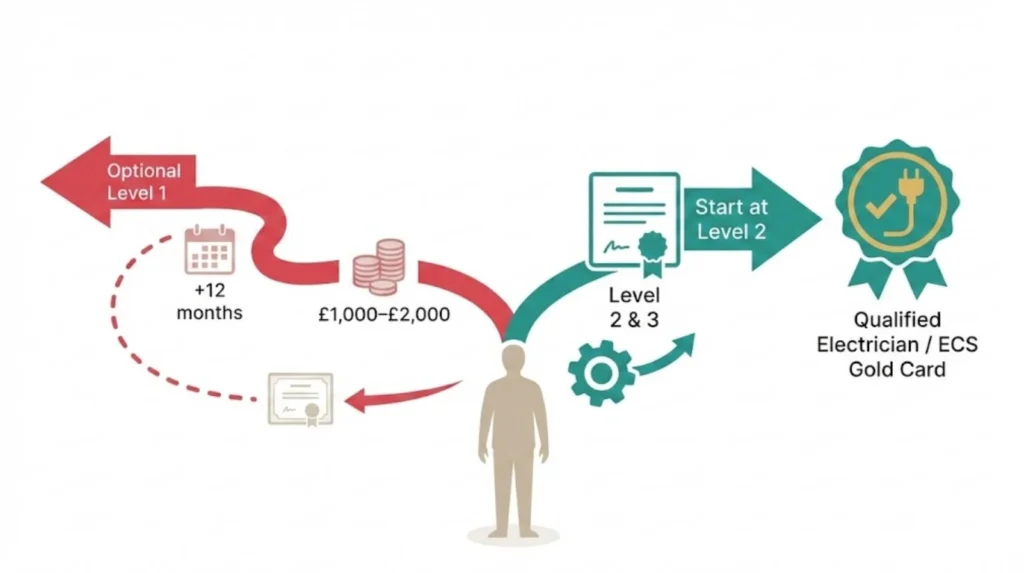
Level 1 Electrical Installation is an introductory pre-vocational qualification providing basic knowledge of electrical principles, hand tool familiarization, and fundamental health and safety awareness. It holds no legal recognition for electrical competence, grants no ECS card eligibility, and creates no direct employability advantage for most electrical roles. For the approximately 90% of adult career changers who could start directly at Level 2, it represents a costly time detour adding 12 months and £1,000-£2,000 to qualification timelines without reducing subsequent Level 2, Level 3, or NVQ requirements.
Level 1 serves legitimate purpose for three specific groups: 16-18 learners lacking GCSE grades (particularly maths and English) required for Level 2 college entry, adults who genuinely struggle with basic numeracy or have never used hand tools and need confidence-building foundation, and individuals wanting low-commitment exploration of electrical trades before committing to full training pathways. For everyone else—including most trades-adjacent workers, career changers with work experience, and anyone seeking fastest route to qualified electrician status—Level 1 is almost certainly unnecessary.
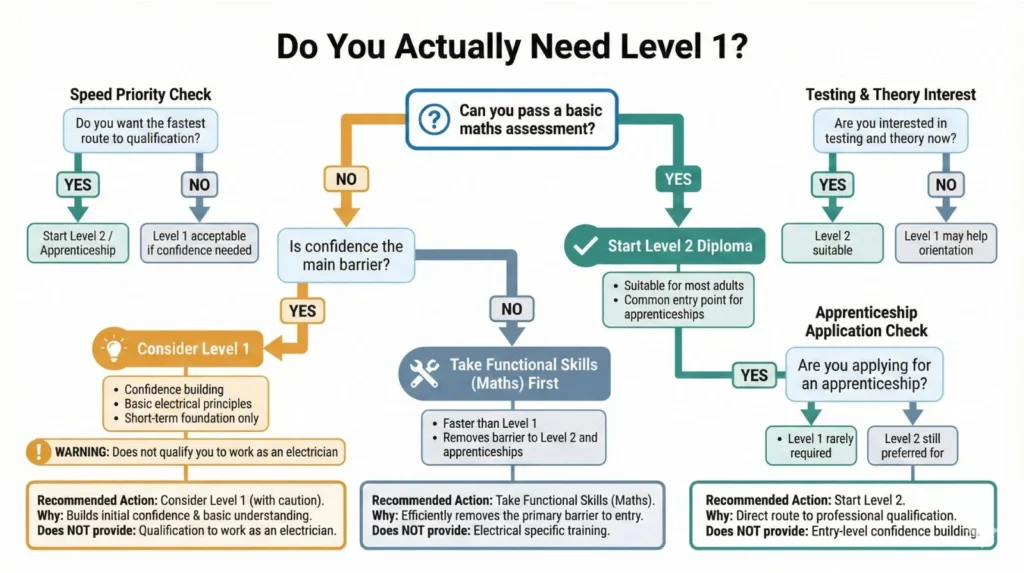
The core reality: if you can pass a basic maths assessment (fractions, areas, simple algebra) and follow written instructions, most providers will accept you directly onto Level 2 courses. The technical content in Level 1 (Ohm’s law, circuit types, safe isolation) gets retaught in Level 2 anyway. You’re not skipping essential foundations by starting at Level 2; you’re avoiding redundant overlap. Unless confidence-building or academic prerequisites create genuine barriers, bypass Level 1 entirely and invest time and money directly in Level 2 starting your actual progression toward professional recognition.
Quick Decision Guide:
16-18 without GCSE 4+ in English/Maths? Level 1 likely necessary for college Level 2 entry.
Adult who left school without qualifications and lacks confidence? Level 1 may provide valuable foundation.
Adult career changer with work experience? Almost certainly start at Level 2 directly.
Want fastest route to qualified electrician? Bypass Level 1 completely—it doesn’t accelerate anything.
Unsure if electrical work suits you? Consider shorter taster courses or direct Level 2 trial rather than full Level 1 commitment.
What "Level 1 Electrical Installation" Actually Means
Level 1 Electrical Installation sits within the Regulated Qualifications Framework (RQF) in England, Wales, and Northern Ireland, equivalent to SCQF Level 4 in Scotland. The qualification focuses on introducing basic concepts including electrical safety principles, fundamental circuit theory, hand tool usage, and health and safety awareness in construction environments. It does not develop workplace competence or enable independent electrical work under any circumstances.
Common awarding bodies offer Level 1 qualifications under various titles creating naming confusion. City & Guilds 7202-01 “Level 1 Diploma in Electrical Installation” represents the most widely recognized version delivered primarily through Further Education colleges. EAL offers equivalent “Level 1 Diploma in Electrical Installation” with functionally identical content and industry recognition. Shorter variants exist including Level 1 Awards and Certificates providing basic introductions but covering less content than full Diplomas.
Critical Distinctions to Understand:
Electrical Installation vs Electrical Engineering: Installation qualifications focus on building wiring, BS 7671 compliance, and practical installation work toward becoming electrician or electrical engineer roles. Electrical/Electronic Engineering qualifications focus on design, circuit analysis, manufacturing, and electronic systems—different career pathway entirely despite similar-sounding names.
Installation vs Construction Skills: Some Level 1 “Construction Skills” qualifications include electrical elements as part of multi-trade taster programs covering carpentry, plumbing, and electrical basics. These are not specialist electrical installation qualifications and don’t provide equivalent depth or progression value. Electrical Installation Level 1 is trade-specific qualification, not general construction sampler.
Not “Qualified Electrician” Status: This bears emphasizing given misleading marketing from some providers. Level 1 does not make you a qualified electrician, partially qualified electrician, apprentice electrician, or any other variant suggesting professional electrical status. You cannot work unsupervised, sign off installations, obtain ECS cards, or claim competence for electrical work. It’s an educational achievement demonstrating completion of introductory coursework, nothing more.
No ECS Gold Card Pathway: The ECS (Electrotechnical Certification Scheme) Gold Card requires NVQ Level 3, 18th Edition BS 7671, and AM2 assessment. Level 1 contributes nothing toward these requirements. The lowest ECS card Level 1 might support is Electrical Labourer status, which still requires CSCS card and health/safety certification alongside Level 1—and even then, provides limited value given most employers hiring electrical labourers prioritize general construction experience over electrical qualifications.
Where Level 1 Sits in the UK Qualification Pathway
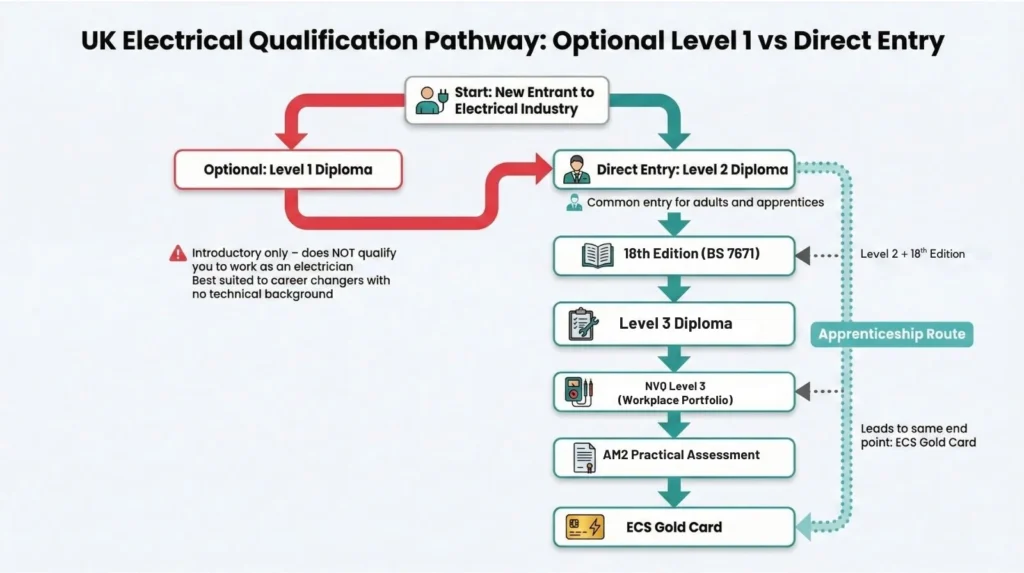
Understanding the complete progression to qualified electrician status clarifies why Level 1 sits outside professional recognition pathways.
The Recognized Progression Route:
Level 1 (Optional) → Introductory electrical principles, basic hand skills, health and safety fundamentals. Duration: 1 year college (full-time) or 2-4 weeks (intensive private). No workplace competence. No ECS recognition.
↓
Level 2 (Entry to Progression) → Core electrical installation theory and practice. City & Guilds 2365-02 or equivalent. Covers circuit design, installation methods, testing principles, BS 7671 fundamentals. Enables Electrical Mate roles with appropriate CSCS card. Duration: 1 year college or 7-10 weeks intensive.
↓
Level 3 (Advanced Theory) → Advanced installation, inspection and testing, design calculations, complex systems. City & Guilds 2365-03 or equivalent. Supports Improver status. Duration: 1 year college or similar intensive options.
↓
NVQ Level 3 (Workplace Competence) → Evidence portfolio demonstrating practical competence across installation, testing, inspection, fault-finding, and certification. City & Guilds 2357 or EAL equivalent. Collected during supervised work placement. Duration: 12-24 months depending on site hours.
↓
AM2 or AM2E Assessment → Practical end-point assessment installing, testing, and certifying complete electrical installation within timed conditions. Pass required for ECS Gold Card. Duration: 3 days including assessment.
↓
18th Edition (BS 7671:2018+A2:2022) → Knowledge-based course on current wiring regulations. Required for Gold Card but doesn’t replace practical competence. Duration: 3-5 days.
↓
ECS Gold Card (Qualified Status) → Industry-recognized qualified electrician status enabling unsupervised work, insurance, and full site access. Requires NVQ L3 + AM2 + 18th Edition combination.
Alternative Routes Bypassing Level 1:
Apprenticeships: Integrate Level 2, Level 3, NVQ, and AM2 over 3-4 years through employment-based training. Start directly at Level 2 theory if GCSE requirements met. Level 1 not required or beneficial.
Experienced Worker Assessment: For individuals with substantial electrical experience but lacking formal qualifications. Jump directly to competence assessment bypassing all classroom levels if experience proves adequate. Level 1 irrelevant for this pathway.
Adult Intensive Courses: Private providers offering accelerated Level 2 and Level 3 combined programs over 15-20 weeks. Start directly at Level 2 if basic assessment passed. Level 1 skipped entirely. Understanding available UK electrical course options helps identify which pathway suits individual circumstances without unnecessary preliminary stages.
The critical observation: Level 1 appears nowhere in the professional recognition pathway except as optional preliminary step for learners not ready for Level 2. Completing Level 1 doesn’t reduce Level 2 requirements, shorten Level 3 duration, or accelerate NVQ portfolio completion. It adds preliminary stage to beginning of journey without shortening the distance to destination.
Thomas Jevons, Head of Training:
"Level 1 serves a legitimate purpose for 16-18 learners who genuinely lack the confidence or basic competencies to start at Level 2. It builds familiarity with hand tools, safe working practices, and fundamental electrical principles in a low-pressure environment. However, for adults who've held jobs, managed budgets, or worked with their hands in any capacity, Level 1 often represents time and money that could be invested directly in Level 2. The technical content overlaps substantially—basic Ohm's law, circuit types, and safe isolation appear in both levels. If you can demonstrate basic numeracy and follow written instructions, most providers will accept you onto Level 2 without requiring Level 1 first."
Thomas Jevons, Head of Training
Who Level 1 Is Actually For (Suitability Assessment)
Honest evaluation of which learner profiles genuinely benefit from Level 1 versus which would be better served starting at Level 2 or pursuing alternative routes.
16-18 School Leavers Without Level 2 Entry Requirements
Fit Level: High. College Level 2 courses typically require GCSE Grade 4 or above (equivalent to old Grade C) in English and Mathematics. School leavers with Grade 3 or below often cannot access Level 2 directly regardless of interest or motivation. Level 1 provides legitimate stepping stone building academic skills alongside electrical introduction, creating pathway to Level 2 they couldn’t otherwise access.
Primary Risk: Extended timeline. Starting at Level 1 adds full academic year before beginning actual vocational progression. Some learners become disengaged during what feels like repetition of school-level content in different context.
Best Alternative: Functional Skills qualifications in English and Maths completed separately might satisfy Level 2 entry requirements faster than full Level 1 Diploma. Worth exploring with college admissions before committing to Level 1 route.
Worth it if: Your GCSE grades genuinely prevent Level 2 access and you lack alternative pathways to improve English/Maths qualifications separately. Level 1 then becomes necessary bridge rather than optional detour.
Adult Career Changers (19+) With Work Experience
Fit Level: Low. Adults who’ve held jobs, managed household budgets, followed assembly instructions, or worked in any practical capacity almost always possess basic competencies Level 1 teaches. Paying £1,200-£1,500 for private Level 1 course when Level 2 entry assessments could prove existing capability represents poor financial decision for most adults.
Primary Risk: Significant time and money waste. Level 1 adds 12 months college route or £1,200+ private course cost plus 2-4 weeks to timeline without reducing any subsequent requirements. That investment could fund substantial portion of Level 2 directly.
Best Alternative: Request Level 2 entry assessment from providers. Most offer basic maths and comprehension tests determining readiness. Passing eliminates Level 1 requirement. Some providers offer short bridging courses (2-3 weeks, £300-£500) addressing specific gaps rather than full Level 1 year.
Worth it if: You genuinely left school without qualifications decades ago, struggle with basic fractions and percentages, have never used hand tools, and assessment confirms you’re not ready for Level 2. This applies to perhaps 10% of adult career changers—not the majority.
Trades-Adjacent Workers (Plumbers, Carpenters, Maintenance)
Fit Level: Low to Medium. Workers already in construction trades possess substantial transferable skills including tool proficiency, safe working practices, and site experience. Electrical-specific knowledge gaps don’t require full Level 1 foundation.
Primary Risk: Redundant content. Level 1 covers general health and safety, manual handling, working at height—topics trades workers already understand from existing roles. Electrical content alone doesn’t justify full qualification.
Best Alternative: Targeted short courses addressing specific gaps. 18th Edition for regulatory knowledge, or domain-specific courses like “Basic Electrics for Plumbers” providing relevant electrical understanding without full vocational qualification structure.
Worth it if: You need recognized qualification for CV purposes demonstrating electrical knowledge, even though practical skills transfer would allow Level 2 direct entry. Some employers value formal credentials over experience assessment.
Learners With Low Maths/English Confidence
Fit Level: High. Individuals who struggled academically, left education early, or lack confidence in classroom environments find Level 1’s slower pace and supportive teaching environment valuable. Building skills gradually reduces anxiety about progressing to more demanding Level 2 content.
Primary Risk: Progression stalls without addressing underlying academic challenges. If maths/English difficulties persist after Level 1, Level 2 becomes equally challenging. Level 1 doesn’t automatically improve academic skills unless that’s explicit focus.
Best Alternative: Functional Skills courses alongside electrical studies addressing English and Maths systematically rather than assuming electrical context alone builds competence. Some colleges offer integrated programs combining both.
Worth it if: Your primary barrier is confidence rather than capability, and you need supportive environment rebuilding self-belief in your ability to learn. Level 1 provides that at cost of extended timeline.
Fast-Track Career Changers Seeking Quickest Route
Fit Level: Zero. Level 1 adds time to every pathway. There is no scenario where completing Level 1 accelerates qualification compared to starting at Level 2, pursuing apprenticeship, or attempting Experienced Worker Assessment.
Primary Risk: Fundamental misunderstanding of qualification structure leading to wasted investment. Some providers market Level 1 as “essential first step” when it’s actually optional for most learners.
Best Alternative: Intensive Level 2 and Level 3 combined courses (15-20 weeks) followed immediately by NVQ placement and AM2 preparation. Alternatively, secure apprenticeship starting at Level 2 theory.
Worth it if: Never. If speed is priority, Level 1 actively hinders goal. No exceptions.
Aspiring Apprentices Building Application Strength
Fit Level: Medium. Some learners pursue Level 1 hoping it demonstrates commitment to electrical trade when applying for apprenticeships, particularly if competing against candidates with existing experience or qualifications.
Primary Risk: Redundancy if apprenticeship secured. Apprenticeships include Level 2 and Level 3 as integrated components. Prior Level 1 completion doesn’t exempt you from these requirements or shorten apprenticeship duration. Investment becomes sunk cost.
Best Alternative: Apply for apprenticeships directly. If unsuccessful, pursue Level 2 rather than Level 1 since Level 2 provides stronger qualification if apprenticeship applications fail again. Work experience, even voluntary, often strengthens applications more than Level 1 certificate.
Worth it if: You’ve applied repeatedly for apprenticeships unsuccessfully and believe demonstrated commitment through Level 1 might differentiate your application. Understand this is speculative investment potentially becoming redundant.
| Learner Profile | Genuine Benefit | Main Risk | Better Alternative | Worth It If… |
| 16-18 without GCSE 4+ | Entry to Level 2 pathway | Extended timeline vs functional skills | Functional Skills Maths/English separately | Level 2 entry blocked without it |
| Adult career changers | Confidence building | Time and cost waste (£1,200+, 12 months) | Level 2 entry assessment | Assessment confirms genuine skill gaps |
| Trades-adjacent | Formal credential | Redundant safety/tool content | Targeted electrical short courses | Employer specifically requests L1 |
| Low academic confidence | Supportive learning | Skills gaps persist without remediation | Functional Skills + L2 integrated | Confidence, not capability, is barrier |
| Fast-track seekers | None | Delays goal by 12 months minimum | Intensive L2/L3 or apprenticeship | Never—actively hinders speed |
| Apprentice applicants | Shows commitment | Redundant if apprenticeship secured | Direct applications or L2 | Repeated failures need differentiation |
Employability Reality: What Level 1 Actually Gets You
Job market evidence demonstrates minimal direct employability value from standalone Level 1 qualifications in electrical sector.
Entry-Level Role Realities
Level 1 holders can realistically access general construction laborer roles where electrical knowledge provides marginal differentiation over candidates without qualifications. These positions focus on material handling, site tidying, equipment transportation, and basic assistance rather than electrical work specifically. Wages typically start at National Minimum Wage (£11.44/hour for 21+, December 2025) with minimal premium for Level 1 qualification.
Electrical Mate positions—the natural target for Level 1 holders—almost universally specify Level 2 minimum requirements in job advertisements. Analysis of Indeed, Totaljobs, and CV-Library listings shows approximately 90% of Electrical Mate or Improver advertisements explicitly request “Level 2/3 qualification” or “Part Qualified” status. The remaining 10% emphasizing experience over qualifications still expect CSCS/ECS card eligibility that Level 1 alone doesn’t provide.
The “Improver” Definition Gap
Industry terminology creates confusion requiring clarification. “Electrical Improver” typically describes someone who has completed Level 2 and Level 3 theory qualifications and is working toward NVQ Level 3 portfolio completion whilst gaining supervised site experience. Daily rates for Improvers range £120-£180 depending on region, experience level, and proximity to AM2 readiness.
Level 1 holders don’t meet this definition. Completing Level 1 makes you “interested in electrical trade” or “foundation learner”—not an Improver in industry-recognized sense. Job advertisements using “Improver” terminology expect candidates substantially further along qualification pathway than Level 1 represents.
Actual Employer Expectations
Job specifications for entry-level electrical work consistently request:
CSCS or ECS card (minimum Green CSCS for laborers, ECS Trainee cards requiring Level 2+)
Level 2 or Level 3 qualification in Electrical Installation (2365-02/03 or equivalent)
18th Edition BS 7671 certification increasingly common even for mate roles
Previous site experience or demonstrable practical capability
Driving license frequently specified for mobile roles
Level 1 satisfies none of these standard requirements beyond potentially supporting CSCS Laborer card application (which itself requires separate health and safety certification).
Site Access Card Limitations
The CSCS (Construction Skills Certification Scheme) and ECS (Electrotechnical Certification Scheme) card systems control site access on most commercial and industrial projects. Level 1 qualifications can support CSCS Laborer card applications but do not qualify for any electrical-specific ECS card categories. This limits holders to general construction roles rather than electrical-focused positions even as basic assistants.
ECS Trainee Electrician cards—the entry level for electrical pathway—require Level 2 minimum plus appropriate employer sponsorship. Without this progression, site access remains limited to general construction rather than electrical trades specifically.
The practical reality: Level 1 creates weak employability advantage primarily signaling interest and commitment to employers rather than demonstrating competence or meeting job specification requirements. Most employment opportunities Level 1 enables would be equally accessible without the qualification if candidates demonstrate reliability, basic safety awareness, and willingness to learn.
Cost, Time, and the "Costly Detour" Reality
Comparing Level 1 investment against starting directly at Level 2 clarifies opportunity cost calculations.
Duration Comparison
Level 1 College Route: 1 academic year full-time (September to June), or 1-2 years part-time attending 1-2 evenings weekly plus some Saturdays. Total classroom hours typically 450-600 depending on college and delivery pattern.
Level 1 Private Provider Intensive: 2-4 weeks full-time attendance (Monday-Friday, 9am-5pm) covering same content compressed. Some providers offer 6-8 week part-time patterns.
Direct Level 2 Entry College Route: 1 academic year full-time or equivalent part-time pattern. Same duration as Level 1 but progressing to higher qualification level.
Direct Level 2 Private Intensive: 7-10 weeks full-time intensive covering Level 2 content. Additional 8-10 weeks for Level 3 often available sequentially.
The critical observation: doing Level 1 first then Level 2 means spending 2 years in college (or 9-14 weeks intensive) reaching the same point you’d reach in 1 year or 7-10 weeks starting at Level 2 directly. You’re not building foundations that accelerate later learning—you’re adding preliminary stage before actual progression begins.
Cost Analysis (2025/26 Academic Year)
| Qualification | College Route (16-18 Funded) | College Route (19+ Adult) | Private Provider Intensive |
| Level 1 Diploma | Usually fully funded via Advanced Learner Loan or college subsidy | Free or low cost (£200-£500) in some regions; full cost £1,000-£1,500 elsewhere | £800-£1,500 typically |
| Level 2 Diploma | Usually fully funded same mechanisms | Variable: £500-£1,000 subsidized; £1,500-£2,000 full cost | £2,500-£3,500 typically |
| Level 1 + Level 2 Combined | Both covered by funding if continuous enrollment | £500-£2,500 total depending on subsidy availability | £3,300-£5,000 total investment |
The Opportunity Cost Calculation
Beyond direct costs, consider earnings foregone and qualification timeline extension:
Scenario A: Start with Level 1
Year 1: Complete Level 1 (no earnings during full-time study, or limited evening work during part-time)
Year 2: Complete Level 2
Year 3: Complete Level 3
Year 4-5: NVQ portfolio and AM2
Total timeline to Gold Card: 5 years minimum
Scenario B: Start with Level 2
Year 1: Complete Level 2
Year 2: Complete Level 3
Year 3-4: NVQ portfolio and AM2
Total timeline to Gold Card: 4 years minimum
For adult career changer at age 30, that one-year difference means starting qualified electrician earnings at 34 instead of 35. Using median qualified electrician salary of £37,000 (ONS 2025 data), the opportunity cost of the “extra” Level 1 year is £37,000 in deferred earnings plus the £1,200-£1,500 direct course cost.
The “costly detour” terminology accurately describes this reality for the majority of learners who could start at Level 2 directly.
When Cost Is Justified
Level 1 costs become justifiable in three specific circumstances:
You literally cannot access Level 2 due to entry requirements and Functional Skills completion would take equivalent time
You’re 16-18 with funding available making Level 1 effectively free and providing structured learning environment during compulsory education years
Confidence-building value significantly outweighs time and money costs because your genuine assessment confirms you’re not ready for Level 2 demands
For approximately 90% of adult learners considering electrical training, none of these circumstances apply.
Legal Boundaries and What Level 1 Doesn’t Permit
Understanding competence requirements under UK electrical legislation prevents dangerous assumptions about Level 1 capabilities.
The Electricity at Work Regulations 1989 (EAWR) Competence Framework
Regulation 16 requires persons working on electrical systems to be competent, defined through combination of knowledge, experience, and ability to recognize limitations and take appropriate precautions. Competence is not awarded by qualification alone—it results from demonstrated capability to prevent danger through safe working practices.
Level 1 provides introductory knowledge only. It develops no practical experience component. It creates no competence recognition under EAWR. Completing Level 1 doesn’t make you competent to undertake any electrical work, even under supervision, because competence requires the knowledge Level 1 provides PLUS substantial practical experience applying that knowledge in real-world contexts.
What Level 1 Specifically Does NOT Qualify You To Do
Work on Live Electrical Systems: Any work on live circuits, whether domestic 230V or industrial installations, requires competence demonstrable through supervised experience and higher-level qualifications. Level 1 holders attempting live work violate EAWR competence requirements creating serious legal and safety implications.
Sign Off Electrical Work: Electrical Installation Certificates (EICs), Minor Works Certificates (MWCs), and Electrical Installation Condition Reports (EICRs) require competent person status that Level 1 doesn’t provide. Only appropriately qualified and experienced electricians can certify installations meet BS 7671 requirements.
Join Competent Person Schemes: NAPIT, NICEIC, ELECSA, and other schemes enabling self-certification under Building Regulations Part P require minimum Level 3 qualifications plus substantial supervised experience. Level 1 holds no relevance for scheme membership applications.
Obtain ECS Gold Card: As previously emphasized, ECS Gold Card requires NVQ Level 3 + AM2 + 18th Edition combination. Level 1 contributes nothing toward this pathway. Even ECS Trainee cards require Level 2 minimum.
Undertake Notifiable Work: Building Regulations in England and Wales define certain electrical work as notifiable requiring either Competent Person Scheme membership or Building Control notification. Level 1 provides neither qualification nor competence for notifiable work compliance.
The Knowledge vs Competence Distinction
This bears repeating because it’s frequently misunderstood: Level 1 may provide knowledge about electrical principles, but knowledge alone doesn’t create competence. An analogy helps: reading books about surgery provides medical knowledge but doesn’t make you competent to operate on patients. Similarly, completing Level 1 provides electrical knowledge but doesn’t make you competent to work on electrical installations.
Competence requires knowledge PLUS experience PLUS demonstrated capability PLUS appropriate supervision during skill development. Level 1 offers only the first element. The remaining three require substantial additional time, qualification progression, and workplace exposure Level 1 doesn’t include.
Joshua Jarvis, Placement Manager:
"The distinction between confidence-building and competence-building matters enormously when assessing Level 1 value. If your barrier is confidence—you're worried about keeping up with coursework, intimidated by the terminology, or anxious about practical assessments—Level 1 can provide gentle introduction that makes Level 2 less daunting. That's legitimate value, especially for people who've been out of formal education for years. But if you're already confident in your ability to learn, Level 1 doesn't accelerate competence development. It covers ground you'll revisit in Level 2 anyway. Paying for confidence-building only makes sense if lack of confidence is genuinely your barrier, not just unfamiliarity with the field."
Joshua Jarvis, Placement Manager
Decision Tree: Is Level 1 Right for Your Situation?
Simple goal-based guidance clarifying when Level 1 makes sense versus when alternative pathways serve better.
“I want to become a qualified electrician as fast as possible”
Is Level 1 worth it? No. Level 1 adds minimum 12 months (college) or 2-4 weeks plus additional costs (private) to your timeline without reducing any subsequent requirements.
What to do instead: Start directly at Level 2 if you can pass basic maths assessment. Request assessment from multiple providers—entry requirements vary. If Level 2 proves genuinely beyond current capability, Level 1 might be necessary, but attempt Level 2 entry first before assuming you need foundation year.
Next step: Enroll in Level 2 Electrical Installation (2365-02) at college or private provider, or pursue apprenticeship opportunity integrating Level 2 and Level 3 with employment.
“I’m not confident I’m ready for Level 2—I struggled at school”
Is Level 1 worth it? Potentially yes, but explore alternatives first. Level 1 provides supportive environment building confidence, but separate Functional Skills courses might address academic gaps more directly.
What to do instead: Request Level 2 entry assessment anyway—you might surprise yourself with current capability despite past struggles. If assessment confirms significant gaps, consider Functional Skills in Maths and English (often faster than full Level 1) or short bridging courses some providers offer.
Next step: If assessment genuinely confirms you’re not ready and alternatives don’t suit your learning needs, Level 1 becomes reasonable investment in building foundation for successful Level 2 completion. Prioritize providers offering clear Level 2 progression pathway.
“I want to test whether I’ll actually enjoy electrical work before committing fully”
Is Level 1 worth it? Not really. Level 1 requires substantial time and money commitment (£1,000-£1,500, 2-4 weeks to 1 year) for “testing” purposes. Cheaper, faster options exist.
What to do instead: Seek short taster courses (1-3 days) some colleges and training providers offer introducing electrical work without full qualification commitment. Volunteer with electricians, arrange workplace shadowing, or pursue short evening courses providing exposure without extensive investment.
Next step: If short exposure confirms interest, proceed directly to Level 2. If uncertainty remains, electrical trade might not be right fit regardless of qualification level started.
“I need to build basic skills before tackling vocational training”
Is Level 1 worth it? Yes, this is exactly what Level 1 is designed for. If you genuinely lack basic maths skills (fractions, percentages, simple algebra), have never used hand tools, and need structured introduction to construction environment, Level 1 provides appropriate foundation.
What to do instead: Consider whether Functional Skills qualifications address academic needs more directly, but if you specifically want electrical context while building skills, Level 1 serves this purpose legitimately.
Next step: Ensure your Level 1 provider offers guaranteed or streamlined progression to Level 2 upon completion. Avoid providers treating Level 1 and Level 2 as completely separate enrollments requiring fresh applications and assessments.
“I want to work as domestic electrician doing home installations”
Is Level 1 worth it? No. Domestic electrical work requires identical competence standards as commercial work under EAWR. Level 1 plus short “Part P” courses don’t create legal competence or Competent Person Scheme eligibility.
What to do instead: Pursue complete qualification pathway: Level 2 → Level 3 → NVQ → AM2 → ECS Gold Card, then apply for NAPIT/NICEIC membership enabling self-certification of domestic work.
Next step: Start at Level 2, not Level 1. The full pathway takes 3-4 years minimum regardless. Level 1 adds time without advancing toward goal.
“I want to strengthen my apprenticeship applications”
Is Level 1 worth it? Maybe, but with significant caveats. Level 1 can demonstrate commitment, but work experience often impresses employers more. Consider opportunity cost carefully.
What to do instead: Apply for apprenticeships directly first. If unsuccessful, pursue Level 2 rather than Level 1 since Level 2 provides stronger fallback qualification if apprenticeship route fails again. Seek any electrical-related work experience, even voluntary, to strengthen next application round.
Next step: If multiple apprenticeship applications fail despite strong interview performance and work ethic demonstration, Level 1 might provide differentiation for final application attempt. But understand apprenticeships include Level 2/3 anyway making prior Level 1 redundant if successful.
Red Flags: Misleading Marketing to Avoid
Protecting prospective learners from common misrepresentations in electrical training advertising.
Misleading Claim #1: “Get Qualified in 2-4 Weeks”
The Reality: You complete Level 1 certificate in 2-4 weeks via intensive private providers. However, “qualified” implies professional recognition that Level 1 doesn’t provide. You’re not qualified to work as electrician, sign off installations, or claim competence under EAWR.
Safer Alternative Phrasing: “Complete Level 1 foundation qualification in 2-4 weeks as first step toward electrical career.” Honest providers clarify progression requirements rather than implying immediate employability.
Why It’s Problematic: Creates false expectations about employment readiness leading learners to discover after course completion that years of additional training remain before professional recognition.
Misleading Claim #2: “Start Earning £30,000+ After This Course”
The Reality: Level 1 holders typically access general laborer roles at National Minimum Wage (£11.44/hour = £23,800 annually for full-time work). Qualified electrician earnings averaging £30,000-£37,000 require NVQ Level 3, AM2, and ECS Gold Card—minimum 3-4 additional years beyond Level 1.
Safer Alternative Phrasing: “Level 1 begins your journey toward electrical career with potential earnings of £30,000+ once fully qualified through Level 2, Level 3, NVQ, and AM2.”
Why It’s Problematic: Grossly misrepresents timeline and qualification requirements for stated earning potential, potentially influencing career decisions based on unrealistic short-term earning expectations.
Misleading Claim #3: “Official Electrician’s Certificate”
The Reality: No such thing exists. Certificates have specific names tied to awarding bodies and qualification frameworks: “City & Guilds 7202-01 Level 1 Diploma in Electrical Installation” or similar. Generic terms like “Electrician’s Certificate” deliberately obscure qualification level creating impression of higher-value credential than actually awarded.
Safer Alternative Phrasing: Use exact qualification title: “City & Guilds Level 1 Diploma in Electrical Installation” with clear statement this is introductory qualification, not professional electrician status.
Why It’s Problematic: Exploits learner unfamiliarity with qualification framework making Level 1 sound like professional certification when it’s pre-vocational introduction.
Misleading Claim #4: “Fast-Track to Qualified Electrician Status”
The Reality: Level 1 is slowest route to qualified status by definition since it adds preliminary stage before actual progression begins. Fast-track options skip Level 1 entirely doing intensive Level 2/3 combinations followed by accelerated NVQ placement.
Safer Alternative Phrasing: “Begin your electrical training journey with introductory Level 1 qualification” with clear timeline to Gold Card status (typically 4-5 years including Level 1 starting point).
Why It’s Problematic: Directly inverts truth—Level 1 slows qualification timeline rather than accelerating it.
Misleading Claim #5: “No Experience Necessary—Start Your Electrical Career Today”
The Reality: Technically true that Level 1 requires no prior experience, but phrasing implies employment readiness after completion. “Starting your career” via Level 1 means beginning multi-year training pathway, not commencing paid electrical work.
Safer Alternative Phrasing: “No experience needed to start Level 1 training—first step in your electrical qualification journey.”
Why It’s Problematic: Conflates beginning training with beginning career employment causing confusion about post-course expectations.
How to Protect Yourself:
Request exact qualification titles with awarding body and level clearly stated
Ask explicitly how long complete pathway to ECS Gold Card takes from Level 1 starting point
Verify what jobs you can realistically access immediately after Level 1 completion specifically
Check provider accreditation status with City & Guilds, EAL, or other awarding bodies
Compare multiple provider claims—significant discrepancies suggest marketing exaggeration
Search provider reviews focusing on employment outcomes, not just training experience
Request to speak with recent Level 1 graduates about their post-course situations
Scotland vs England/Wales/Northern Ireland
Understanding qualification framework alignment and pathway differences across UK nations.
Framework Alignment at Level 1
England, Wales, and Northern Ireland use Regulated Qualifications Framework (RQF) with Level 1 as introductory pre-vocational qualification. Scotland uses Scottish Credit and Qualifications Framework (SCQF) where Level 1 RQF equates approximately to SCQF Level 4.
The practical alignment means Level 1 qualifications from EAL, City & Guilds, or other awarding bodies are recognized equivalently across all UK nations. An electrician completing City & Guilds 7202-01 Level 1 in England holds the same qualification level as someone completing equivalent in Scotland, Wales, or Northern Ireland.
Where Pathways Diverge: Apprenticeships and Beyond
Significant differences emerge at apprenticeship level rather than foundation qualifications. Scotland’s apprenticeship system operates through Skills Development Scotland with different frameworks:
Scotland: Foundation Apprenticeships (SCQF Level 6, equivalent to Higher) and Modern Apprenticeships integrating SVQ (Scottish Vocational Qualification) qualifications. Electrical apprenticeships emphasize SVQ Level 3 pathway managed by SECTT (Scottish Electrical Charitable Training Trust) rather than NVQ framework used in rest of UK.
England/Wales/NI: Apprenticeship standards integrating Level 2/3 technical qualifications plus NVQ Level 3 competence assessment, typically following 2365 (theory) and 2357 (NVQ) City & Guilds routes.
Why Level 1 Matters Less in Scotland
Scottish electrical training routes emphasize apprenticeship pathways more heavily than England/Wales/NI college-based routes. Foundation Apprenticeships and Modern Apprenticeships typically recruit school leavers directly into employment-based training without requiring preliminary Level 1 completion. The culture prioritizes “earn while you learn” models reducing Level 1 uptake compared to England’s more prominent college route utilization.
Adult career changers in Scotland pursuing electrical work more commonly access training through targeted upskilling programs or adult apprenticeship schemes rather than sequential college qualifications starting at Level 1. However, for those requiring foundation-building, Level 1 qualifications remain available through colleges and training providers with equivalent purpose and recognition.
Practical Impact for Learners
Scottish residents considering Level 1 should understand:
Qualification recognized equivalently across UK
Apprenticeship opportunities in Scotland may bypass Level 1 entirely
College-based Level 1 routes available but less culturally emphasized than south of border
Adult learners often better served exploring SVQ direct entry or Modern Apprenticeship access
Differences become more pronounced at Level 3 and NVQ/SVQ stages rather than Level 1 foundations
For England, Wales, and Northern Ireland residents, Scottish framework differences don’t affect Level 1 decisions—focus remains on whether Level 1 serves necessary foundation versus costly detour in your specific circumstances.
What the Data Doesn’t Tell Us (Acknowledged Gaps)
Honest admission of evidence limitations affecting Level 1 assessment.
Completion and Dropout Rates
Awarding bodies and training providers don’t publish Level 1 specific completion rates. We don’t know what percentage of learners starting Level 1 complete it, how many progress successfully to Level 2, or how completion rates compare between college and private provider routes. This makes assessing “success probability” difficult beyond anecdotal provider claims.
Long-Term Employment Outcomes
No longitudinal data tracks Level 1 learners from qualification through to employment outcomes. We cannot verify what percentage eventually reach ECS Gold Card status, how long pathways take on average, or whether Level 1 starters fare differently than Level 2 direct entrants in long-term career progression. Claims about “worth it” calculations rest partially on logical analysis rather than comprehensive outcome data.
Wage Impact Analysis
No studies isolate Level 1 qualification effect on earnings controlling for other variables. Construction sector wage data aggregates all Level 1 qualifications across trades making electrical-specific impact assessment impossible. Claims about earning potential remain based on general construction sector patterns rather than Level 1 electrical installation graduates specifically.
Provider Quality Variations
Private provider success rates, where reported, are typically self-declared without independent verification. Comparing provider effectiveness, teaching quality, progression support, or learner satisfaction relies on review sites and word-of-mouth rather than systematic audited data. This makes provider selection difficult beyond checking basic accreditation status.
Regional Availability and Funding
Course availability, funding eligibility, and cost variations across UK regions aren’t systematically documented. Some areas offer adult learner subsidies reducing Level 1 costs significantly; others require full fee payment. These local variations affect cost-benefit analyses but aren’t captured in national-level guidance.
Academic Prerequisite Impact
We lack data on how many Level 2 candidates are genuinely rejected for inadequate entry qualifications versus how many assume they need Level 1 without attempting Level 2 entry assessment. This affects determining what percentage of learners truly require Level 1 versus could skip it if they attempted.
These gaps don’t invalidate the analysis—the fundamental logic that Level 1 adds preliminary stage without reducing subsequent requirements holds regardless. However, they mean some claims rest on professional judgment and indirect evidence rather than comprehensive statistical validation.
Level 1 Electrical Installation serves specific legitimate purposes for specific learner groups: providing foundation-building for genuinely underprepared individuals, offering gentle introduction for confidence-lacking adults, and creating Level 2 access pathway for school leavers without adequate entry qualifications. For these groups, Level 1 represents sensible investment despite extended timelines.
For the larger population of adult career changers with work experience, basic academic skills, and confidence in their learning ability, Level 1 represents costly detour adding £1,000-£1,500 and 12 months minimum to qualification pathways without providing compensatory advantages. The technical content gets retaught in Level 2. The qualification grants no employment access, competence recognition, or professional status. The investment could fund substantial portion of Level 2 progression directly.
The key determination comes down to honest self-assessment: are you genuinely not ready for Level 2, or do you simply lack familiarity with electrical concepts? Unfamiliarity is what Level 2 addresses—it doesn’t assume existing electrical knowledge. Not being ready for Level 2 means struggling with basic fractions, never having used tools, or lacking confidence in classroom environments to extent requiring supportive foundation year.
Request Level 2 entry assessments from multiple providers before assuming you need Level 1. Many adults underestimate their capabilities particularly if formal education memories date back decades. Assessment costs nothing beyond time, whereas unnecessary Level 1 enrollment costs substantially. If assessments confirm significant skill gaps, Level 1 becomes justified foundation investment. If assessments prove you’re Level 2 ready, bypass Level 1 entirely and begin actual vocational progression.
For those determining Level 1 suits their circumstances, prioritize providers offering clear Level 2 progression pathways, reasonable costs (particularly college routes for 16-18 learners potentially accessing funding), and realistic information about post-qualification expectations. Avoid providers making employability guarantees or implying Level 1 creates professional status—these red flags suggest marketing-driven rather than education-focused approaches.
For majority bypassing Level 1 and starting at Level 2 directly, you’re not skipping essential foundations—you’re avoiding redundant preliminary stage that doesn’t accelerate your progression toward qualified electrician status. Elec Training’s electrical course pathways demonstrate how proper Level 2 entry leads directly into Level 3 and NVQ progression without Level 1 detours for most adult learners.
Understanding where Level 1 genuinely adds value versus where it creates expensive delays enables informed decisions aligned with your actual situation rather than provider marketing strategies. The electrical trade needs properly qualified electricians following complete pathways to competence and professional recognition. Whether that pathway includes Level 1 depends entirely on your specific readiness and circumstances—not on universal recommendations applicable to everyone considering UK electrical training courses.
Contact Elec Training on 0330 822 5337 to discuss whether your specific situation benefits from Level 1 foundation building or whether Level 2 direct entry makes better sense given your background, qualifications, and career timeline expectations. Honest assessment prevents wasted investment in unnecessary preliminary stages whilst ensuring genuine skill gaps get addressed appropriately before tackling demanding vocational qualifications.
References
- City & Guilds – 7202-01 Level 1 Diploma in Electrical Installation Qualification Specification: https://www.cityandguilds.com
- EAL (Excellence, Achievement & Learning) – Level 1 Electrical Installation Qualifications: https://www.eal.org.uk
- ECS (Electrotechnical Certification Scheme) – Card Types and Qualification Requirements: https://www.ecscard.org.uk
- National Careers Service – Electrician Job Profile: https://nationalcareers.service.gov.uk
- HSE – Electricity at Work Regulations 1989: https://www.hse.gov.uk
- GOV.UK – Regulated Qualifications Framework (RQF) Levels Explained: https://www.gov.uk
- SQA (Scottish Qualifications Authority) – SCQF Framework: https://www.sqa.org.uk
- Ofqual – Qualification Regulation in England: https://www.ofqual.gov.uk
- Skills Development Scotland – Apprenticeship Frameworks: https://www.skillsdevelopmentscotland.co.uk
- Indeed UK – Electrical Mate and Improver Job Advertisement Analysis: https://uk.indeed.com
- Totaljobs UK – Electrical Trade Entry-Level Requirements: https://www.totaljobs.com
- CV-Library – Construction and Electrical Labour Market Data: https://www.cv-library.co.uk
- ONS (Office for National Statistics) – Construction Sector Employment and Earnings 2025: https://www.ons.gov.uk
- College Websites – Level 1 Electrical Installation Course Information (Nottingham College, Darlington College, Bedford College Group, Calderdale College, others): Various institutional sites
- Professional Electrician Magazine – Training Route Guidance and Red Flag Warnings: https://professional-electrician.com
- Electrical Careers UK – Training Pathway Information: https://www.electricalcareers.co.uk
- ECA (Electrical Contractors’ Association) – Training Standards and Industry Guidance: https://www.eca.co.uk
- SELECT – Scottish Electrical Trade Standards: https://www.select.org.uk
- IET (Institution of Engineering and Technology) – Electrical Qualifications Framework: https://electrical.theiet.org
Note on Accuracy and Updates
Last reviewed: 25 December 2025. This article reflects UK electrical qualification framework as of December 2025 including City & Guilds 7202-01 specifications, ECS card requirements, Electricity at Work Regulations competence standards, and typical costs for college and private provider delivery. Cost ranges represent December 2025 market rates and vary by provider, region, and funding eligibility. Legal guidance is educational information only and does not constitute legal advice regarding EAWR compliance. Learners should verify current course costs, entry requirements, and funding availability with specific providers before enrollment decisions. We update content as qualification frameworks, regulations, and training delivery patterns evolve.
