

JIB 2026–2028 Deal Explained for Domestic, Commercial and Industrial Electricians

- Technical review: Thomas Jevons (Head of Training, 20+ years)
- Employability review: Joshua Jarvis (Placement Manager)
- Editorial review: Jessica Gilbert (Marketing Editorial Team)
- Last reviewed:
- Initial publication using confirmed JIB 2026-28 wage agreement, official ECA promulgation, SJIB rates, and sector application analysis
Introduction
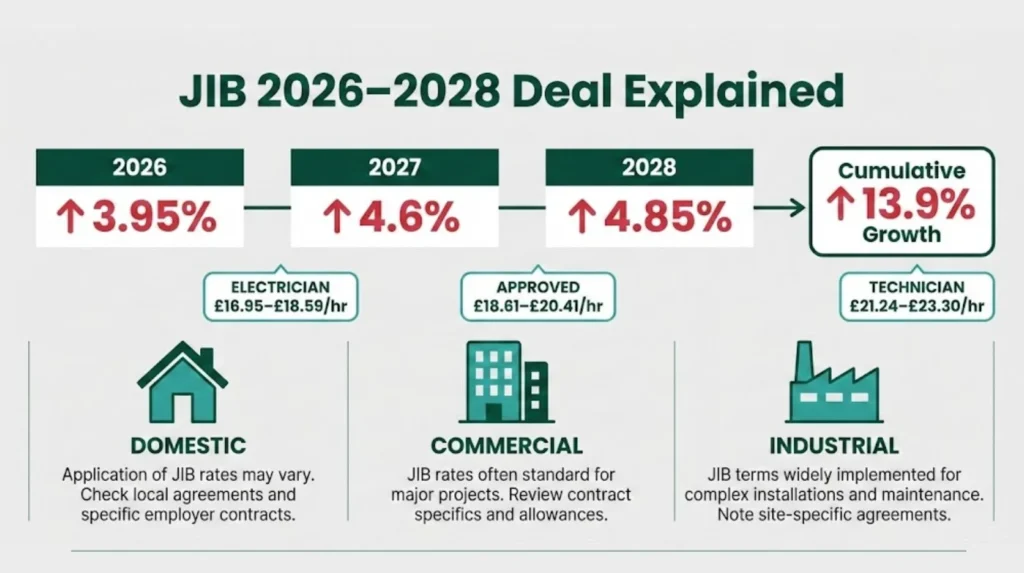
The JIB (Joint Industry Board) 2026-2028 wage deal was agreed in June 2025 between the Electrical Contractors’ Association (ECA) and Unite the Union, setting minimum pay rates and working conditions for electricians in England, Wales, and Northern Ireland through to January 2028. It delivers cumulative pay increases of approximately 13.4% for qualified electricians, with rises of 3.95% in January 2026, 4.6% in January 2027, and 4.85% in January 2028.
But here’s what confuses most electricians: the JIB deal only applies to you if your employer is JIB-registered. Most small domestic electrical firms aren’t JIB members. Commercial and industrial contractors typically are. This creates three parallel realities: domestic electricians who rarely work under JIB terms, commercial electricians who see these rates as their baseline, and industrial electricians who often negotiate premiums on top of JIB minimums.
Understanding where you fit matters because it determines whether these pay rises affect you directly (JIB employer), indirectly as market pressure (non-JIB employer benchmarking against JIB rates), or not at all (completely outside JIB influence). It also affects your benefits package, overtime rates, travel allowances, and long-term career progression options.
This article breaks down the 2026-2028 deal using official JIB Industrial Determination documents, ECA wage promulgation, SJIB (Scottish Joint Industry Board) rates, and real-world employment patterns across domestic, commercial, and industrial sectors. We’ll explain exactly who gets these pay rises, how transport categories work, what the deal means for apprentices and adult trainees, and how jib rates 2026 translate into actual weekly and annual earnings.
Headline Pay Changes & Effective Dates (2026, 2027, 2028)
The 2026-2028 deal follows a three-year structure with pay rises implemented each January. Unlike some previous agreements, there are no lump-sum payments or one-off bonuses – just incremental hourly rate increases.
Operative Pay Rises (Electrician, Approved Electrician, Technician)
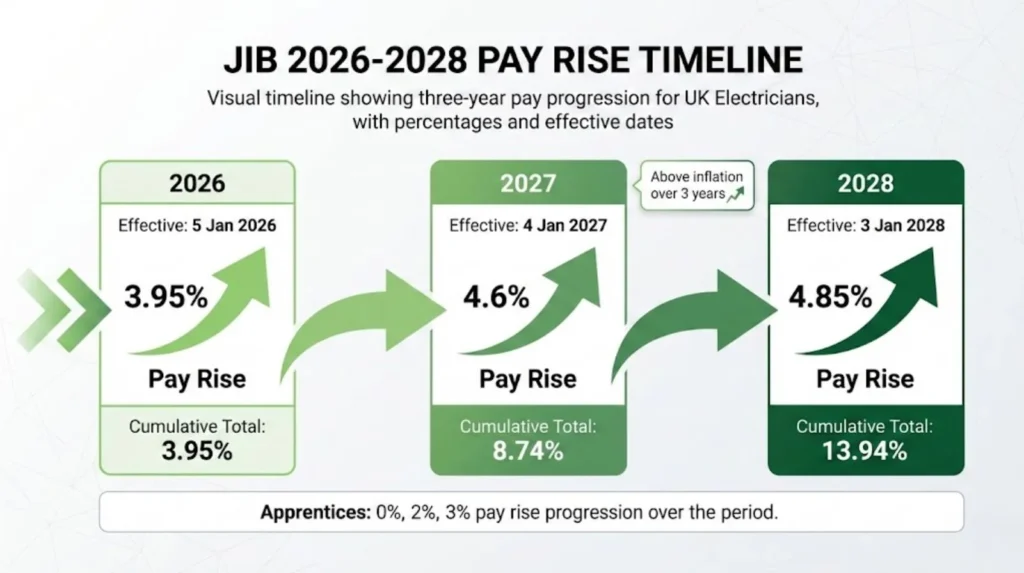
2026: 3.95% increase effective Monday 5 January 2026
2027: 4.6% increase effective Monday 4 January 2027
2028: 4.85% increase effective Monday 3 January 2028
Cumulative impact: 13.94% total increase from January 2026 to January 2028 baseline. This compounds, meaning a 2026 pay rise increases the base for the 2027 calculation, and so on.
These percentages apply uniformly across all graded operatives regardless of sector. An Electrician working domestic, commercial, or industrial gets the same percentage increase if employed by a JIB-registered firm. The absolute amount differs because it’s calculated as a percentage of different base rates (e.g., Electrician vs Technician).
Apprentice Pay Rises
2026: 0% increase (rates frozen at January 2025 levels)
2027: 2% increase effective Monday 4 January 2027
2028: 3% increase effective Monday 3 January 2028
Why the 2026 freeze? Apprentice rates received a significant correction uplift in January 2025 to comply with National Minimum Wage regulations. The 2026 freeze is a trade-off acknowledging that large 2025 adjustment. Apprentices aged 16-18 must be paid at least the National Minimum Wage for apprentices (£6.40 per hour from April 2025, rising to approximately £7.55 from April 2026). JIB Stage 1 apprentice rate of £8.16 per hour already exceeds this minimum.
Scotland (SJIB) Alignment
The Scottish Joint Industry Board (SJIB) agreed parallel percentage increases: 3.95%, 4.6%, and 4.85% for operatives; 0%, 2%, and 3% for apprentices. Effective dates align with JIB England dates: 5 January 2026, 4 January 2027, 3 January 2028.
However, SJIB uses a different pay structure. Scottish rates are split into “Shop Rate” (base hourly pay) and “Travel Rate” (additional allowance per hour worked on site). The percentage increases apply to both components. This means headline SJIB hourly rates often appear lower than JIB England rates until Travel Rate is added.
What’s NOT Changing
Overtime multipliers: Remain 1.5x for first 6 Saturday hours or after daily norm, 2x for Sundays and bank holidays.
Pension structure: No changes to employer/employee contribution splits (though discussions ongoing about salary sacrifice options).
Holiday entitlement: Remains at 8 statutory days plus annual entitlement (typically 21-25 days depending on service).
Grading requirements: Qualifications needed for Electrician, Approved, and Technician grades unchanged. You still need Gold Card + 2 years + 2391 for Approved status.
Pay Rates Explained: National, London, and Scotland
Understanding JIB rates requires knowing three things: your grade (Electrician/Approved/Technician), your location (National/London/Scotland), and your employment type (Shop/Transport Provided/Own Transport).
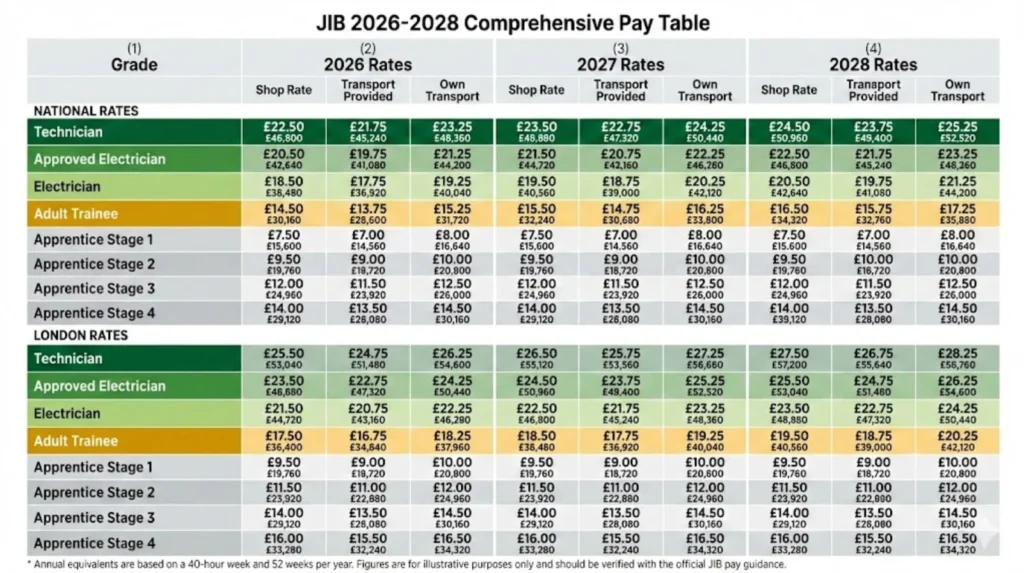
National Rates (England, Wales, Northern Ireland)
JIB rates are published as hourly figures. The standard working week is 37.5 hours (Monday to Friday, typically 7am to 5pm with breaks). Weekly and annual figures below assume this standard week with no overtime.
Electrician (2026-2028):
2026: £16.95/hr (Shop), £18.42/hr (Transport Provided), £19.54/hr (Own Transport)
Weekly: £635.63 (Shop rate, 37.5 hours)
Annual: £33,053 (52 weeks, Shop rate, no overtime)
2027: £17.73/hr (Shop), £19.27/hr (Transport Provided), £20.44/hr (Own Transport)
2028: £18.59/hr (Shop), £20.20/hr (Transport Provided), £21.43/hr (Own Transport)
Approved Electrician (2026-2028):
2026: £18.61/hr (Shop), £20.08/hr (Transport Provided), £21.19/hr (Own Transport)
Weekly: £697.88 (Shop rate)
Annual: £36,289 (Shop rate, no overtime)
2027: £19.47/hr (Shop), £21.00/hr (Transport Provided), £22.16/hr (Own Transport)
2028: £20.41/hr (Shop), £22.02/hr (Transport Provided), £23.23/hr (Own Transport)
Technician (2026-2028):
2026: £21.24/hr (Shop), £22.70/hr (Transport Provided), £23.87/hr (Own Transport)
Weekly: £796.50 (Shop rate)
Annual: £41,418 (Shop rate, no overtime)
2027: £22.22/hr (Shop), £23.74/hr (Transport Provided), £24.97/hr (Own Transport)
2028: £23.30/hr (Shop), £24.89/hr (Transport Provided), £26.18/hr (Own Transport)
What the three categories mean:
Thomas Jevons, our Head of Training with 20+ years on the tools, explains:
"The three JIB rate categories - Shop, Transport Provided, and Own Transport - exist because travel is a significant cost. An electrician on Own Transport rate gets £1.12 per hour more than Shop rate in 2026. That's £2,184 annually just for using your own vehicle, before you factor in mileage allowances. It's compensation for wear, fuel, and flexibility."
Thomas Jevons, Head of Training
Shop: For electricians working permanently from a fixed employer workshop or office location. No regular site travel required beyond commuting to work.
Job Employed (Transport Provided): For site-based electricians where the employer provides transportation (company van with driver, minibus to sites). You’re not using your personal vehicle for work purposes.
Job Employed (Own Transport): For site-based electricians who use their own vehicles to travel to sites. This rate compensates for vehicle wear, fuel, insurance, and flexibility. It’s the highest of the three rates because you’re absorbing vehicle costs.
Most electricians working on commercial and industrial sites fall into Transport Provided or Own Transport categories, not Shop.
London Rates
London rates apply to work performed within the M25 motorway or for electricians permanently based at London workshops (defined as work at a London location for 12 consecutive weeks or more).
Electrician (2026-2028) London:
2026: £18.99/hr (Shop), £20.63/hr (Transport Provided), £21.88/hr (Own Transport)
Annual: £35,895 (Shop rate, 37.5 hours/week, no overtime)
2027: £19.86/hr, £21.58/hr, £22.89/hr
2028: £20.82/hr, £22.63/hr, £24.00/hr
Approved Electrician (2026-2028) London:
2026: £20.83/hr (Shop), £22.48/hr (Transport Provided), £23.73/hr (Own Transport)
Annual: £39,396 (Shop rate)
2027: £21.79/hr, £23.51/hr, £24.82/hr
2028: £22.85/hr, £24.65/hr, £26.02/hr
Technician (2026-2028) London:
2026: £23.79/hr (Shop), £25.47/hr (Transport Provided), £26.70/hr (Own Transport)
Annual: £44,982 (Shop rate)
2027: £24.88/hr, £26.64/hr, £27.93/hr
2028: £26.09/hr, £27.93/hr, £29.28/hr
London premium: Approximately £2 to £3 per hour above national rates for equivalent grades. This represents roughly 12% to 15% higher gross pay. However, London cost of living (rent, transport, daily expenses) typically consumes this premium entirely, as covered in our regional pay analysis.
Apprentice Rates (National Standard)
Apprentice progression follows stages (typically 1-4 over a 4-year apprenticeship), not age. Stage 1 is entry-level, Stage 4 is near-qualified.
Stage 1: £8.16/hr (2026), £8.32/hr (2027), £8.57/hr (2028)
Stage 2: £10.60/hr (2026), £10.81/hr (2027), £11.13/hr (2028)
Stage 3: £13.05/hr (2026), £13.31/hr (2027), £13.71/hr (2028)
Stage 4: £14.03/hr (2026), £14.31/hr (2027), £14.74/hr (2028)
London apprentice rates are approximately £1 per hour higher (e.g., Stage 1 London: £9.14/hr in 2026).
Stage 4 apprentices (final year, typically age 19-21) earning £14.03/hr work out to £26,456 annually at 37.5 hours/week, which is competitive with many entry-level skilled trades and significantly above retail or hospitality wages for equivalent age groups.
Adult Trainees / Improvers
Adult learners (career changers completing NVQ portfolios) typically fall into “Adult Trainee Stage 2” or “Electrical Improver” classifications:
2026: £14.41/hr (Shop), £15.69/hr (Transport Provided), £16.61/hr (Own Transport)
2027: £15.07/hr, £16.41/hr, £17.38/hr
2028: £15.80/hr, £17.21/hr, £18.22/hr
Annual equivalent (Shop rate, 2026): £27,231 at 37.5 hours/week. This is the pay ceiling for Level 3 Diploma holders without NVQ portfolios, as explained in our training progression article.
SJIB Scotland Rates
SJIB rates are structured differently: Shop Rate (base) + Travel Rate (site allowance).
Electrician (2026-2028) Scotland:
2026: £16.95/hr (Shop Rate), £19.54/hr (Travel Rate total)
2027: £17.73/hr (Shop), £20.44/hr (Travel)
2028: £18.59/hr (Shop), £21.43/hr (Travel)
Approved Electrician (2026-2028) Scotland:
2026: £18.61/hr (Shop), £21.19/hr (Travel)
2027: £19.47/hr (Shop), £22.16/hr (Travel)
2028: £20.41/hr (Shop), £23.23/hr (Travel)
Technician (2026-2028) Scotland:
2026: £21.24/hr (Shop), £23.87/hr (Travel)
2027: £22.22/hr (Shop), £24.97/hr (Travel)
2028: £23.30/hr (Shop), £26.18/hr (Travel)
The Travel Rate applies to any site work outside the employer’s fixed workshop. Most SJIB electricians work on Travel Rate rather than Shop Rate, making the total package comparable to JIB England “Transport Provided” or “Own Transport” rates.
Domestic vs Commercial vs Industrial: How the Deal Applies in the Real World
This is where theory meets reality. The JIB deal doesn’t affect all electricians equally because not all employers are JIB-registered.
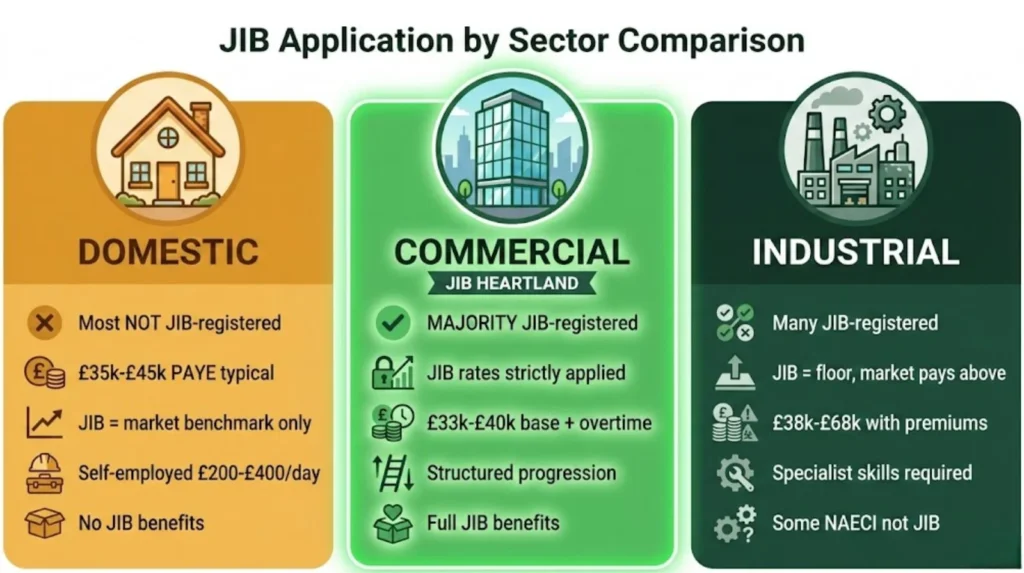
Domestic Electricians: JIB as Market Benchmark Only
Thomas Jevons explains the registration reality: “Here’s what most people don’t understand: the JIB rates only apply if your employer is JIB-registered. Most small domestic firms aren’t JIB members, so they’re not legally bound by these rates. Commercial and industrial contractors are typically JIB-registered, which is why you see strict adherence to grading and pay structures on those sites.”
Reality for domestic electricians:
Most small domestic electrical firms (sole traders, 1-5 employee businesses doing house rewires, consumer unit changes, EV chargers, solar installations) are NOT JIB-registered. They’re typically registered with competent person schemes like NICEIC, NAPIT, or Stroma for Part P Building Regulations compliance, but that’s separate from JIB membership.
Typical domestic PAYE wages: £35,000 to £45,000 annually regardless of whether the electrician is graded as Electrician or Approved under JIB definitions. Some domestic firms don’t use JIB grading at all; they simply pay “Qualified Electrician” wages based on local market rates and Gold Card status.
CIS/Self-employed domestic rates: £200 to £400 per day depending on region, work complexity, and client type. Domestic rewires in wealthy areas (e.g., Surrey, Chelsea, Edinburgh New Town) command £350 to £450 per day. Basic work (socket additions, lighting changes) in competitive areas might be £180 to £220 per day.
Why JIB still matters for domestic: The JIB rates act as a market floor. When JIB Electrician rate hits £20.21 per hour (£38,397 annually at 37.5 hours/week) in 2026, domestic firms paying £16 per hour (£32,000 annually) will struggle to recruit against JIB-registered commercial firms offering proper rates. Market pressure forces domestic wages upward even without legal enforcement.
Joshua Jarvis, our Placement Manager, confirms this:
"Most domestic electrical firms we speak with aren't JIB-registered. They typically pay £35,000 to £42,000 PAYE regardless of the JIB rates. The JIB deal acts as a market benchmark - when JIB Electrician rates hit £20.21 per hour in 2026, domestic firms paying £16 per hour will struggle to recruit. But it's not legally enforceable for non-JIB employers."
Joshua Jarvis, Placement Manager
Advantages of domestic non-JIB work:
Higher potential earnings as self-employed (£50,000 to £80,000+ annually for established businesses)
Flexibility in working hours and job selection
Direct client relationships
Lower entry barriers (don’t need specific JIB grading beyond Gold Card)
Disadvantages:
No JIB benefits package (sick pay, pension, death in service, structured holiday pay)
No guaranteed overtime rates (1.5x/2x multipliers don’t apply)
No travel/lodging allowances for away work
Income volatility (gaps between jobs, seasonal demand fluctuations)
Commercial Electricians: The JIB Heartland
Commercial electrical work – office buildings, retail developments, schools, hospitals, leisure centres, hotels – is where the JIB deal actually governs day-to-day employment terms.
Who’s JIB-registered: Medium to large mechanical and electrical (M&E) contractors. Firms like Crown House Technologies, T Clarke, Balfour Beatty, NG Bailey, and hundreds of regional M&E contractors are JIB members. If you’re working on a commercial fit-out for a major contractor, you’re almost certainly on JIB terms.
How the 2026-2028 deal applies:
JIB rates are contractual minimums. Your employment contract will reference JIB grading.
Overtime is strictly 1.5x for first 6 Saturday hours or weekday hours beyond daily norm; 2x for Sundays and bank holidays.
Travel/lodging allowances apply as specified in National Working Rules.
Sick pay, pension, holiday entitlement follow JIB benefit structures.
ECS Gold Card is typically mandatory for site access (card-controlled sites).
Grading progression (Electrician → Approved → Technician) directly determines pay level.
Typical commercial earnings (2026 onwards):
Base salary: £33,000 to £36,000 (Electrician), £36,000 to £40,000 (Approved), £41,000 to £50,000 (Technician)
With moderate overtime (5-10 hours/week at 1.5x): Add £5,000 to £8,000 annually
With London weighting: Add 12-15% to base figures
Career trajectory advantage: Commercial JIB work provides structured progression. You know exactly what qualifications and experience are needed to move from Electrician to Approved (Gold Card + 2 years + 2391), and from Approved to Technician (additional portfolio evidence, often Level 4 qualifications, supervisory responsibilities). Pay increases are contractual and predictable.
Why electricians choose commercial JIB work:
Employment stability (permanent contracts common)
Benefits package (28 days holiday, pension, sick pay, death in service £40,000)
Structured career progression with clear pay grades
Overtime paid at guaranteed multipliers
Access to large-scale projects (airports, hospitals, data centres)
Challenges:
Lower ceiling than self-employed domestic (unless you progress to Technician/QS/management)
Site-based work often involves travel (positive if lodging allowances apply, negative if long commutes)
More bureaucratic (timesheet approvals, site access protocols, H&S compliance)
Industrial Electricians: JIB as Floor, Market Sets Ceiling
Industrial electrical work – factories, manufacturing plants, power stations, water treatment, food processing, pharmaceutical facilities – operates under JIB terms for most medium/large contractors, but market demand often pushes wages significantly above JIB minimums.
How JIB applies in industrial:
JIB-registered industrial employers (there are many) use JIB rates as baseline
Industrial maintenance electricians often receive “site premium” or “conditions money” on top of JIB rates
Shutdown work (planned maintenance periods where entire plant stops) typically negotiates higher rates
Specialist roles (HV switching, COMPEX explosive atmospheres, PLC systems) command premiums
Typical industrial earnings (2026 onwards):
Base salary: £38,000 to £45,000 (Electrician with industrial experience)
With shift allowances (many industrial sites run 24/7): Add £4,000 to £8,000 annually
With shutdown overtime (2-4 intensive periods per year): Add £8,000 to £15,000 annually
Total package: £50,000 to £68,000 not uncommon for experienced industrial electricians
Why industrial pays more:
Specialist skills required (3-phase, motor control, PLC basics, SCADA systems)
Safety-critical environments (food processing, pharmaceutical, chemical plants cannot tolerate electrical failures)
Shift work (nights, weekends, unsocial hours require compensation)
Shutdown urgency (production downtime costs thousands per hour; electricians paid premium rates to minimize downtime)
NAECI vs JIB distinction (CRITICAL):
Major infrastructure projects – nuclear power stations (Hinkley Point C, Sizewell C), large-scale oil and gas installations, major rail electrification – often operate under NAECI (National Agreement for Engineering Construction Industry), not JIB.
NAECI is the “Blue Book.” JIB is the “Green Book.” They’re separate agreements with different rates.
NAECI rates are typically 15-30% higher than equivalent JIB rates. A NAECI “Electrician” on a nuclear project might earn £50,000 to £65,000 base salary plus extensive site allowances, compared to JIB Electrician at £33,000 to £36,000 base.
Important: This article covers the JIB (Green Book) 2026-2028 deal only. If you’re working on massive infrastructure projects, check whether your contract is JIB or NAECI. The pay structures are completely different.
Allowances, Travel, Lodging, Sick Pay & Benefits
The JIB package extends well beyond hourly rates. Understanding allowances and benefits reveals the true value of JIB employment.
Travel Time and Mileage Allowances
Radius rules: Work within 15-mile radius of home or normal workplace incurs no travel time or mileage payment. Beyond 15 miles, specific rules apply.
Mileage rates (Own Transport category):
£0.22 per mile tax-free for business mileage beyond normal commute
Covers fuel, wear, insurance, depreciation
Example: 50-mile round trip daily = £11 per day, £55 per week, £2,860 annually
Travel time payment:
Time spent traveling beyond normal workplace radius is paid at basic hourly rate
Example: Site 40 miles from home requiring 1.5 hours travel each way = 3 hours paid travel time daily
At Electrician rate (£16.95/hr 2026), that’s £50.85 per day, £254 per week, £13,221 annually
Public transport reimbursement: If employer doesn’t provide transport and you use rail/bus, fares are reimbursed. Period tickets (weekly/monthly rail cards) are provided where economical.
Lodging Allowances
Nightly lodging rate: £53.09 per night (2026 rate, adjusted annually for inflation via CPI)
When it applies: Work location requires overnight stay away from home. Typically defined as sites more than 25 miles from home or normal workplace, or where daily travel is impractical.
Weekly impact: 5 nights lodging = £265.45 per week, £13,803 annually (tax-free)
Retention lodging: £17.46 per night during holiday periods when you maintain lodgings but aren’t working (e.g., Christmas break on a long-term away project)
Weekend lodging: £53.09 per night if required to stay over weekends between work weeks
Real earnings impact example:
Electrician (2026) on national Shop rate: £16.95/hr = £33,053 annually (37.5 hrs/week, no overtime)
Same Electrician working away from home with lodging: £33,053 + £13,803 lodging = £46,856 total package
Add moderate overtime (5 hours/week at 1.5x): £46,856 + £6,618 = £53,474 annual package
This is why “away work” is attractive for many electricians: The lodging allowance is tax-free and substantial. Young electricians (20s-30s) often prioritize away work to maximize earnings while living costs are flexible. Older electricians with families prefer local work despite lower total package.
Sick Pay Scheme
JIB sick pay supplements Statutory Sick Pay (SSP). These are NOT replacements for SSP; they’re additions on top.
2026-2027 rates:
Weeks 1-2 of sickness: £0 (SSP only)
Weeks 3-24: £200/week (Technician), £190/week (Approved), £180/week (Electrician)
Weeks 25-52: Half of weeks 3-24 rates
2028 enhancement (effective 3 January 2028):
Weeks 3-24: +£10 increase (£210/£200/£190 for Tech/Approved/Electrician)
Weeks 25-52: +£5 increase on half-rates
Why this matters: A serious illness or injury could sideline an electrician for 12-24 weeks. JIB sick pay provides £180-£200/week on top of SSP (£116.75/week as of 2025), creating total income of approximately £297-£317/week during illness. For a self-employed electrician with no sick pay provision, that 12-week illness costs £18,000+ in lost income. For a JIB-employed electrician, the hit is much smaller.
Apprentice sick pay: £15/week after 3 days sickness, up to 12 weeks per year.
Pension Contributions
The 2026-2028 deal doesn’t specify exact pension contribution rates (these vary by employer). Standard JIB-aligned schemes typically involve:
Employer contribution: 5-8% of salary
Employee contribution: 3-5% of salary
Total: 8-13% combined contributions
No major changes announced in 2026-2028 deal. However, discussions are ongoing about salary sacrifice arrangements (where employee pension contributions are taken pre-tax, reducing National Insurance liabilities).
Real value example:
Approved Electrician earning £36,289 annually (2026 Shop rate):
7% employer pension contribution = £2,540 annually
4% employee contribution = £1,452 annually
Total pension growth: £3,992 per year
Over a 30-year career, this compounds to significant retirement wealth. Self-employed electricians must fund their own pensions from gross income.
Holiday Entitlement
Statutory holidays: 8 days (Christmas, Boxing Day, New Year, Good Friday, Easter Monday, Early May, Spring Bank, Late Summer Bank)
Annual entitlement: Typically 21-25 days depending on service length (JIB National Working Rules specify accumulation by years of service)
Total: 29-33 days paid holiday per year
Holiday work rates: Working on statutory holidays pays 1.5x or 2x (depending on day) PLUS a day off in lieu. Example: Working Christmas Day at 2x rate means you get double pay for that day AND an extra holiday day to take later.
Death in Service Benefit
Operatives (Electrician/Approved/Technician): £40,000 lump sum to next of kin if death occurs
Accidental death on-site: £70,000 lump sum
Apprentices: £10,000 lump sum, £25,000 if accidental death on-site
This insurance is employer-funded at no cost to the electrician. It’s not a huge benefit compared to mortgage protection insurance you might buy privately, but it’s a safety net for families.
Total Package Value Calculation
The hourly rate alone doesn’t tell the full story. Calculating total package value for a JIB-employed Electrician (2026):
Base salary: £33,053 (Shop rate, 37.5 hrs/week)
Employer pension (7%): +£2,314
Holiday pay value (29 days): Already included in annual salary (paid holidays)
Sick pay insurance value (estimated): +£500 (average actuarial value of having sick pay cover)
Death in service insurance: +£150 (estimated annual premium equivalent)
Total package value: £36,017 before overtime, allowances, or premium rates
A self-employed electrician would need to earn approximately £36,000 to £38,000 gross just to match the stability and benefits of a £33,053 JIB PAYE salary.
Apprentices & Adult Trainees: What Changes in 2026-2028
Understanding apprentice and trainee pay requires knowing why the 2026-2028 structure looks different from operative increases.
Why Apprentices Get 0% in 2026
Apprentice rates received a major correction in January 2025 to ensure compliance with National Minimum Wage (NMW) regulations. The government’s 2025 NMW for apprentices was £6.40 per hour, but many apprenticeships (including electrical) require higher rates because apprentices aged 19+ must be paid the appropriate NMW for their age after the first year.
JIB apprentice rates were adjusted upward in January 2025 to create clear daylight above statutory minimums:
Stage 1: Set at £8.16/hr (27% above apprentice NMW)
Stage 2: Set at £10.60/hr (substantially above 18-20 NMW of £8.72)
Stage 3: £13.05/hr
Stage 4: £14.03/hr
The 2026 freeze acknowledges this significant 2025 uplift. Rather than compounding another increase immediately, the agreement maintains 2025 levels for one year, then applies 2% (2027) and 3% (2028) increases.
Apprentice Pay Progression Reality
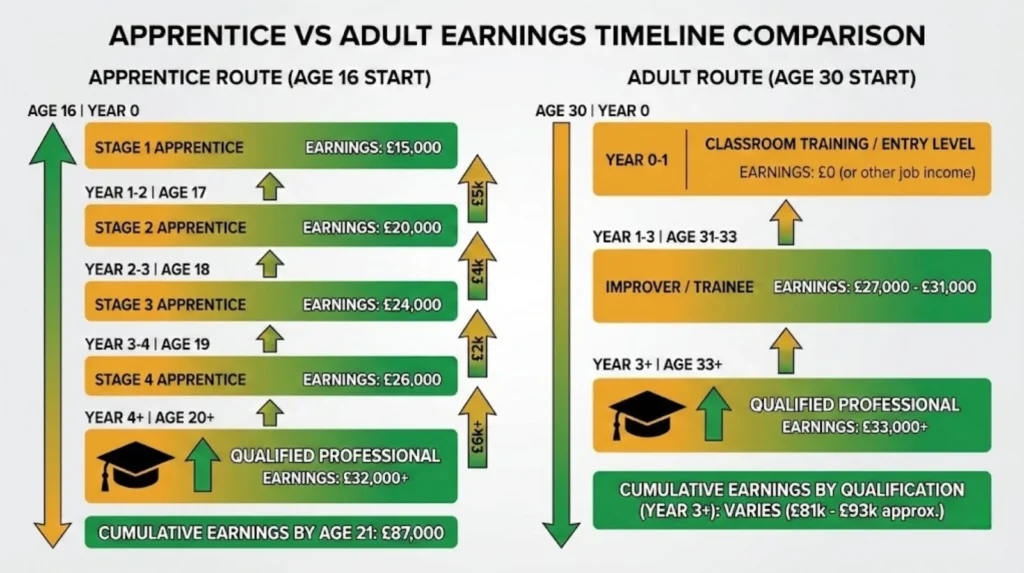
Year 1 (Stage 1, age 16-18 typically): £8.16/hr = £15,429 annually
Year 2 (Stage 2, age 17-19): £10.60/hr = £20,044 annually
Year 3 (Stage 3, age 18-20): £13.05/hr = £24,677 annually
Year 4 (Stage 4, age 19-21): £14.03/hr = £26,532 annually
Post-qualification (Electrician, age 21-22): £16.95/hr = £32,054 annually (2026 rates)
This creates a clear earnings ramp. An 18-year-old starting an electrical apprenticeship earns £15,429 in year one and £32,054+ by age 22 as a qualified Electrician. Over those 4-5 years, total cumulative earnings are approximately £87,000, all while gaining qualifications employer-funded.
Compare this to university: 3-year degree costs £27,750 in tuition alone, plus £25,000 to £35,000 living costs (total £52,750 to £62,750 debt), with graduate starting salaries averaging £25,000 to £30,000. The apprenticeship pathway delivers positive earnings from day one and qualifications that lead to £40,000+ lifetime earnings by age 25-30.
Adult Trainees and Career Changers
Adult learners following the NVQ route (completing Level 3 Diploma then building portfolios as Improvers) typically fall into Adult Trainee or Improver pay bands.
Adult Trainee Stage 2 (2026): £14.41/hr Shop, £15.69/hr Transport Provided, £16.61/hr Own Transport
Annual equivalent: £27,231 (Shop), £29,663 (Transport Provided), £31,396 (Own Transport)
This is the pay ceiling for adults with Level 3 qualifications but incomplete NVQ portfolios. The earnings jump comes after NVQ completion and AM2 pass, when regrading to Electrician adds approximately £5,000 to £6,000 annually.
Timeline for adult career changers:
Year 1: Complete Level 2 and Level 3 Diplomas (classroom theory)
Year 1-2: Secure employer sponsorship for NVQ portfolio building
Year 2-3: Work as Improver at £27,000 to £31,000 while building portfolio
Year 3: Complete NVQ, pass AM2, achieve Gold Card
Year 3+: Regraded to Electrician at £33,000+ base, £40,000+ with overtime
The 2-3 year “Improver phase” is financially challenging because you’re earning below qualified rates while building competence evidence. This is why placement support and employer connections are critical for adult learners.
Comparing Apprentice vs Adult Route Earnings
Traditional apprenticeship (age 16 start):
Age 16-21: Earn while learning (£87,000 cumulative over 5 years)
Age 21: Qualified Electrician earning £32,000+
Age 23-25: Approved Electrician earning £36,000 to £40,000
Age 25-30: Specialist/Technician earning £45,000 to £60,000
Adult career changer (age 30 start):
Age 30-31: Complete Level 2/3, earn nothing (or work other job)
Age 31-33: Improver earning £27,000 to £31,000 while building NVQ
Age 33: Qualified Electrician earning £33,000+
Age 35-40: Compressed progression to Approved/Technician
The apprenticeship route spreads earnings and learning over longer timeline with lower early earnings but steady progression. The adult route compresses learning but requires 2-3 years at reduced wages as a mature worker, which can be financially and psychologically challenging.
Both routes end at the same destination: qualified electrician with Gold Card, eligible for identical JIB rates. The journey differs.
VA INSTRUCTIONS – SECTION FORMATTING:
Bold all apprentice stage rates and annual figures
Use timeline format to show progression clarity
Compare apprentice vs adult routes fairly without overselling either
Acknowledge adult route challenges honestly
Real-Terms Impact vs Inflation & Market Salaries
Raw percentage increases don’t tell the full story. Understanding whether the 2026-2028 deal represents real wage growth requires comparing against inflation and market alternatives.
Inflation Comparison
OBR (Office for Budget Responsibility) inflation forecasts:
2026: 2.5% CPI
2027: 2.0% CPI
2028: 2.0% CPI
JIB operative increases:
2026: 3.95%
2027: 4.6%
2028: 4.85%
Real-terms analysis:
2026: 3.95% pay rise vs 2.5% inflation = 1.45% real-terms gain
2027: 4.6% pay rise vs 2.0% inflation = 2.6% real-terms gain
2028: 4.85% pay rise vs 2.0% inflation = 2.85% real-terms gain
Cumulative real-terms gain over three years: approximately 7% to 8%
This represents genuine purchasing power increase, assuming OBR inflation forecasts prove accurate. If inflation spikes above projections (as it did in 2022-2023 reaching 11%), these gains would erode. Conversely, if inflation drops below 2%, the real-terms gains would be even larger.
Historical Context
Previous JIB deals:
2024: 5% increase (during high inflation period)
2025: 5% increase
2023: 7% increase (catch-up after 2022 inflation spike)
The 2026-2028 deal provides slightly lower nominal percentages than 2023-2025 because inflation is moderating. The key difference is three-year certainty rather than annual renegotiation.
Unite the Union framing: Union press releases described the deal as “14% pay rise” by adding percentages (3.95% + 4.6% + 4.85% ≈ 13.4%, rounded to 14%). This is technically misleading because percentages compound rather than add, but the cumulative real effect is approximately 13.94% over the three-year baseline.
ECA (Employers) framing: Described the deal as “balanced” and “sustainable,” noting it provides certainty for both workforce and employers during contract tendering periods (commercial contractors bid on multi-year projects and need stable labor cost projections).
Market Salary Comparison
How do 2026 JIB rates compare to what electricians actually earn in the broader market?
Indeed UK salary data (Q4 2024):
Average electrician salary (UK): £39,124
London average: £44,500
Entry-level (1-2 years): £28,000 to £32,000
Experienced (5+ years): £40,000 to £50,000
JIB Electrician (2026, national Shop rate): £33,053 annually
Analysis: JIB base rates sit slightly below market averages. This makes sense because:
JIB rates are minimums, not market rates
Many employers pay above JIB to attract talent
Indeed averages include overtime (JIB figures don’t)
Market data includes self-employed earnings (typically higher gross but no benefits)
Self-employed CIS comparison:
Domestic installation: £200 to £400/day (£40,000 to £80,000 annually assuming 200-250 working days)
Commercial CIS: £250 to £400/day (£50,000 to £80,000 annually)
Industrial CIS: £300 to £600/day (£60,000 to £120,000 annually for specialist roles)
Why self-employed gross is higher: No employer pension contributions, no sick pay, no holiday pay, own tools/van/insurance/professional indemnity, income gaps between contracts, CIS 20% tax deduction at source.
Break-even analysis: A JIB-employed Electrician on £33,053 with full benefits package (pension, sick pay, 29 days holiday, van provided, tools provided) has an equivalent “value” of approximately £42,000 to £45,000 in self-employed gross income. This is why many electricians prefer JIB employment despite lower headline numbers.
Day-Rate Equivalents & Example Earnings Scenarios
Turning hourly rates into understandable annual earnings requires factoring in overtime, allowances, and typical working patterns.
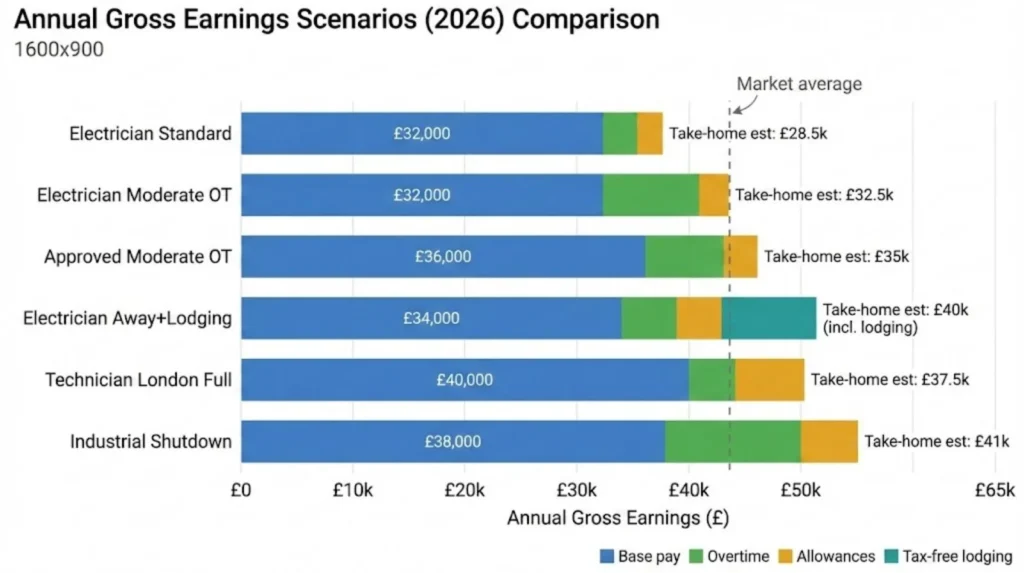
Scenario 1: Electrician (National, Standard Week, No Overtime)
2026 Shop Rate: £16.95/hr
Weekly: 37.5 hours × £16.95 = £635.63
Annual: £635.63 × 52 weeks = £33,053
Take-home (estimated): Approximately £26,400 after tax/NI (assumes 2026 tax rates, no pension, no other deductions)
Reality check: Almost no electricians work exactly 37.5 hours with zero overtime. This is the theoretical minimum.
Scenario 2: Electrician (National, Typical Overtime Pattern)
Base: £16.95/hr, 37.5 hours = £635.63/week
Overtime: 5 midweek hours at 1.5x = £127.13/week
Overtime: 4 Saturday hours at 1.5x = £101.70/week
Weekly total: £864.46
Annual: £44,952
Take-home (estimated): £34,000 after tax/NI/pension
Reality check: This reflects typical commercial electrician working moderate overtime. Many firms expect Saturday work during busy periods.
Scenario 3: Approved Electrician (National, Moderate Overtime)
Base: £18.61/hr, 37.5 hours = £697.88/week
Overtime: 7.5 midweek hours at 1.5x = £209.14/week
Weekly total: £907.02
Annual: £47,165
Take-home (estimated): £35,500 after tax/NI/pension
Scenario 4: Electrician (National, Away Work with Lodging)
Base: £16.95/hr, 37.5 hours = £635.63/week
Lodging: £53.09/night × 5 nights = £265.45/week (tax-free)
Overtime: 7.5 hours at 1.5x = £190.69/week
Weekly total: £1,091.77 (gross pay + tax-free lodging)
Annual: £56,772
Take-home (estimated): £41,500 after tax/NI/pension (lodging component tax-free)
Reality check: This explains why young electricians chase “away work.” The lodging allowance dramatically boosts take-home pay.
Scenario 5: Technician (London, Full Package)
Base: £23.79/hr (London Shop), 37.5 hours = £892.13/week
Overtime: 7.5 hours at 1.5x = £267.34/week
Mileage: 100 miles/week × £0.22 = £22/week (tax-free)
Weekly total: £1,181.47
Annual: £61,436
Take-home (estimated): £44,000 after tax/NI/pension
Reality check: This represents a senior electrician with 10+ years experience, Level 4 qualifications, supervisory responsibilities, working in London commercial sector with regular overtime. This is achievable but requires qualification investment and progression through grades.
Scenario 6: Industrial Shutdown Electrician (Intensive Period)
Base: £16.95/hr, 37.5 hours = £635.63/week (normal weeks)
Shutdown weeks (4 per year): 70 hours/week
37.5 hours standard = £635.63
32.5 hours at 1.5x (assume weekday/Saturday overtime) = £826.69
Shutdown weekly: £1,462.32
Annual breakdown:
48 standard weeks: £30,510
4 shutdown weeks: £5,849
Total annual: £36,359
Reality check: This assumes 4 two-week shutdowns per year. In practice, industrial electricians negotiate higher base rates (£18 to £22/hr) and sometimes 2x multipliers for shutdowns, pushing annual earnings to £45,000 to £60,000.
CIS Self-Employed Equivalent Comparison
To match Scenario 2 (Electrician with moderate overtime, £44,952 annual package):
A CIS self-employed electrician would need approximately £240 to £260 per day to achieve equivalent net income after accounting for:
20% CIS tax deduction
No paid holidays (31 days unpaid = 6 weeks lost income)
Own pension contributions
Own sick pay risk
Van/tools/insurance costs
Working backwards:
£44,952 PAYE equivalent requires approximately £58,000 gross CIS income
£58,000 ÷ 230 working days (allowing for holidays/gaps) = £252/day
This is why CIS rates are higher than PAYE equivalents: The gross day rate must compensate for lack of benefits and employment protections.
Common Misunderstandings & Pitfalls
Confusion about the JIB deal leads to disappointment and poor career decisions. Here are the myths we hear repeatedly.
Misunderstanding #1: “The JIB deal applies to all electricians.”
Reality: Only electricians employed by JIB-registered firms. Most small domestic firms aren’t JIB members. The deal acts as a market benchmark for non-JIB employers but isn’t legally enforceable outside JIB membership.
Misunderstanding #2: “JIB rates are what I’ll actually earn.”
Reality: JIB rates are contractual minimums for JIB-registered employers. Many firms pay above these rates to attract staff, especially in shortage areas. Industrial and commercial contractors routinely exceed JIB minimums. Conversely, some small firms (typically non-JIB) pay below, though this becomes harder as JIB rates rise.
Misunderstanding #3: “I automatically get Approved Electrician pay after X years.”
Reality: Progression from Electrician to Approved requires: (1) Gold Card, (2) 2 years post-qualification verified experience, (3) 2391 Inspection & Testing qualification. Time alone doesn’t trigger regrading. You must obtain the 2391 certificate and request regrading with your employer.
Misunderstanding #4: “Industrial electricians always earn more than commercial.”
Reality: Industrial base rates are sometimes higher, but not always. The difference is industrial typically offers more overtime and specialist premiums. A commercial Technician in London earning £60,000 with minimal overtime can match an industrial electrician earning £45,000 base with intensive shutdown overtime.
Misunderstanding #5: “NAECI and JIB are the same thing.”
Reality: NAECI (Blue Book) and JIB (Green Book) are separate agreements. Major engineering construction projects (nuclear, large oil/gas, major infrastructure) often operate under NAECI with different rates (typically 15-30% higher). This JIB 2026-2028 deal does NOT apply to NAECI contracts.
Misunderstanding #6: “Self-employed always earn more.”
Reality: Self-employed gross income is higher, but net position depends on costs. A JIB electrician earning £35,000 with full benefits package (pension, sick pay, holiday pay, van, tools provided) may have better net position than self-employed earning £50,000 gross but funding own pension, sick risk, holidays, van, tools, insurance, and suffering income gaps between jobs.
Misunderstanding #7: “I don’t need to progress beyond basic Electrician grade.”
Reality: The gap between Electrician and Approved widens from £1.13/hr (2025) to £1.58/hr (2026) and continues growing. Over a 30-year career, not progressing to Approved costs approximately £60,000 to £80,000 in lost earnings. Technician vs Electrician gap grows from £4.07/hr to £4.71/hr (2028), representing £150,000+ lost over a career.
Misunderstanding #8: “The deal guarantees job security.”
Reality: The JIB deal sets minimum terms for existing employment. It doesn’t prevent redundancies, contract completions, or business failures. However, JIB-employed electricians have stronger redundancy protections and notice period requirements than self-employed contractors whose work can end immediately.
What This Means for Your Career Decisions
Understanding the JIB 2026-2028 deal helps you make informed decisions about employment type, sector focus, and qualification progression.
If you’re working domestic electrical, the JIB deal likely doesn’t apply to you directly, but watch how it shifts market rates. When JIB Electrician hits £20.21/hr (£38,397 annually), domestic firms paying £16/hr will struggle to recruit against commercial JIB contractors. Use JIB rates as negotiation leverage even with non-JIB employers.
If you’re in commercial electrical with a JIB-registered contractor, these pay rises are contractual. You’ll see them in your January pay packets automatically. Focus on qualification progression (Electrician to Approved to Technician) because the pay gaps are widening. The 2391 Inspection & Testing qualification becomes more valuable each year as the Approved rate pulls further ahead.
If you’re considering industrial work, understand that JIB rates are typically floor, not ceiling. Industrial employers negotiate site premiums and better overtime multipliers. But you need specialist qualifications (COMPEX, HV, 3-phase experience) to access these opportunities. Basic Gold Card alone won’t get you £60,000 industrial roles.
If you’re planning career changes or geographic moves, compare total package value, not just hourly rates. A £35,000 PAYE JIB role with full benefits, pension, and sick pay might provide better net position than £50,000 self-employed gross with all costs and risks on you. Younger electricians often benefit from maximizing gross (away work, self-employed premiums). Older electricians with families prioritize stability (JIB benefits, pension growth, sick pay safety net).
For Elec Training’s comprehensive breakdown of JIB pay structures and career progression, we’ve covered how qualifications determine grading and how different training routes lead to JIB employment or self-employed work, but your sector choice determines whether JIB rates govern your day-to-day wages or simply set market benchmarks you negotiate around.
The 2026-2028 deal creates three-year certainty. Electricians employed by JIB firms know exactly what pay increases they’ll receive through to January 2028. Self-employed electricians and those with non-JIB employers face market uncertainty but also opportunity to capture premiums when demand exceeds supply. Neither route is inherently better. The right choice depends on your priorities: stability and benefits (JIB employment) or higher gross potential with income volatility (self-employed).
Call us on 0330 822 5337 to discuss realistic career pathways based on your current qualifications and sector preferences. We’ll explain which employers in your region are JIB-registered, what the qualification requirements are for different JIB grades, and how our in-house recruitment team approaches placing electricians into commercial versus industrial roles. For a complete picture of how different sectors reward qualifications and experience, see our detailed analysis of how JIB wage agreements affect electrician earnings across different sectors.
References
- JIB (Joint Industry Board) – Industrial Determination June 2025 (2026-2028 Wage Agreement) – https://www.jib.org.uk/wp-content/uploads/2025/06/JIB-Industrial-Determination-062025.pdf
- JIB National Working Rules (NWR) Handbook Section 2 – https://www.jib.org.uk/wp-content/uploads/2024/01/JIB_Handbook_2024_Section_2.pdf
- ECA (Electrical Contractors’ Association) – JIB Pay Rates & Wage Promulgation 2026-2028 – https://www.eca.co.uk/member-support/employee-relations/national-collective-agreements/jib-pay-rates
- SJIB (Scottish Joint Industry Board) – National Rates & Allowances 2026-2028 – https://sjib.org.uk/rates-and-allowances/sjib-national-rates-allowances-2026/
- SJIB Circular 01/2025 – Wages Promulgation 2026-2028 – https://sectt.org.uk/wp-content/uploads/2025/07/SJIB-Circular-01-SJIB-Wages-Promulgation-for-2026-2027-2028.pdf
- Unite the Union – Press Release: Electricians Benefit from 14% Pay Rise – https://www.unitetheunion.org/news-events/news/2025/july/thousands-of-electricians-benefit-from-14-pay-rise-secured-by-unite
- Office for Budget Responsibility (OBR) – Economic and Fiscal Outlook November 2025 (CPI Inflation Forecasts) – https://obr.uk/efo/economic-and-fiscal-outlook-november-2025/
- Indeed UK – Electrician Salary Data (Q4 2024 to Q1 2025) – https://uk.indeed.com/career/electrician/salaries
- GOV.UK – National Minimum Wage and National Living Wage Rates – https://www.gov.uk/national-minimum-wage-rates
Note on Accuracy and Updates
Last reviewed: 16 December 2025. This page is maintained; we correct errors and refresh sources as JIB wage agreements, allowance rates, and sector employment patterns change. Pay data based on JIB Industrial Determination June 2025, official ECA wage promulgation, and SJIB rates documentation. Inflation forecasts from OBR November 2025. Market salary comparisons from Indeed, Logic4Training, and job board analysis Q4 2024 to Q1 2025. Next review scheduled following any mid-term JIB agreement modifications or 2027 wage implementation (January 2027).
