

JIB Apprentice Rates Explained: Electrical Apprentice Pay in 2026

- Technical review: Thomas Jevons (Head of Training, 20+ years)
- Employability review: Joshua Jarvis (Placement Manager)
- Editorial review: Jessica Gilbert (Marketing Editorial Team)
- Last reviewed:
- Changes: Initial publication explaining JIB apprentice pay structure effective 5 January 2026 including four-stage progression (Stage 1 £8.16/hour £15,912 annual, Stage 2 £10.60/hour £20,670 annual, Stage 3 £13.05/hour £25,448 annual, Stage 4 £14.03/hour £27,359 annual), zero nominal increase 2026 following substantial 2025 corrections (Stage 1 +26%, Stage 2 +21%), London premiums (+£0.98-1.69/hour), statutory minimum wage interactions for adult apprentices aged 21+ requiring top-ups (National Living Wage £12.21-12.71/hour creating £4.05-4.55/hour employer costs Stages 1-2), progression requirements based on competence milestones not calendar time, take-home reality after deductions and tool costs, and completion jump to Electrician (£35,841 annual, +31% over Stage 4)
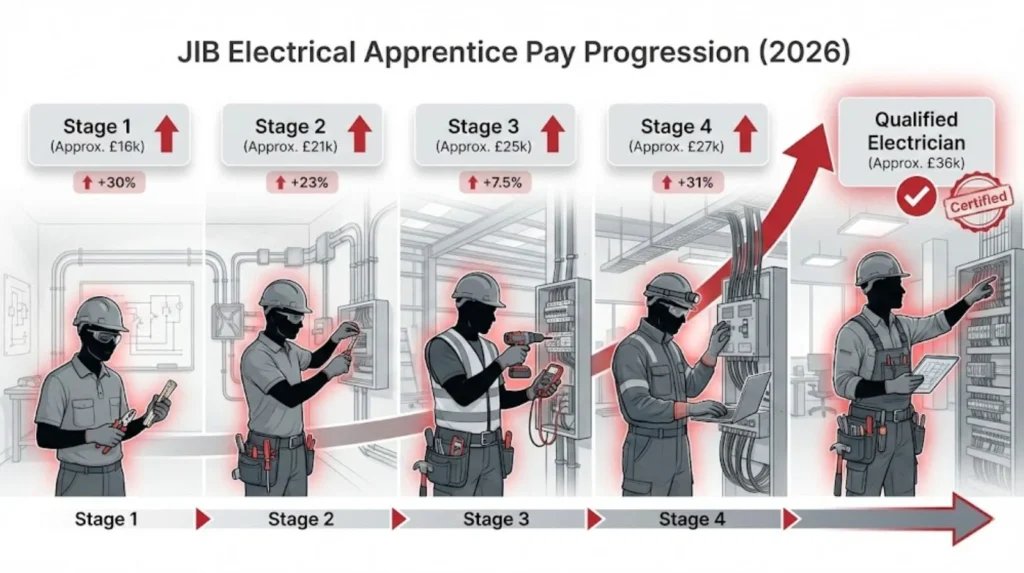
The jib apprentice rates for 2026 establish four-stage progression structure defining minimum wages for electrical apprentices employed by Joint Industry Board member firms across England, Wales, and Northern Ireland, with rates ranging from Stage 1 at £8.16/hour (£15,912 annually at standard 37.5-hour weeks, entry-level first year apprentices beginning electrical training with basic installation competence development) through Stage 2 at £10.60/hour (£20,670 annually, +30% increase reflecting intermediate circuit work and NVQ progression), Stage 3 at £13.05/hour (£25,448 annually, +23% for advanced systems installation and Level 3 completion), to Stage 4 at £14.03/hour (£27,359 annually, +7.5% for final year apprentices approaching AM2 practical assessment and qualification completion ready for Electrician grading).
These 2026 apprentice rates remain frozen at 2025 levels creating zero nominal increase for trainees while graded operatives receive 3.95% rise, representing strategic pause following substantial 2025 corrections where Stage 1 jumped approximately 26% (£6.48 to £8.16) and Stage 2 rose 21% (£8.76 to £10.60) making current freeze employer cost absorption period before resuming modest progression in 2027 under three-year 2026-2028 industrial determination. Understanding apprentice compensation requires distinguishing between gross hourly rates quoted in JIB tables versus take-home reality after tax, National Insurance, and pension deductions plus significant tool investment costs (£500-800 first year for personal hand-tool kit, additional £300-500 over training for specialist equipment) and travel expenses often partially uncompensated (JIB covers mileage beyond 15 miles from employer base, apprentices absorb costs within that radius), reducing £306 weekly Stage 1 gross to £260-280 actual available income for rent, food, and transport budgeting.
This article explains what qualification pathways through four-year electrical apprenticeship combining classroom theory at college with on-site practical experience, NVQ Level 3 portfolio development demonstrating installation competence across diverse projects, and AM2 practical assessment deliver in terms of annual earnings progression (125% growth from £15,912 Stage 1 entry to £35,841 Electrician completion over 3.5-4 years), why stage progression depends on demonstrated competence milestones rather than automatic calendar-based increases (failing college modules or incomplete logbooks can delay advancement to higher pay bands), how London premiums add £0.98-1.69/hour (£1,911-3,295 annually) compensating capital-area living costs but covering only partial differential, what statutory minimum wage interactions mean for adult apprentices aged 21+ where National Living Wage requirements (£12.21-12.71/hour from April 2026) override JIB Stage 1-2 rates creating mandatory employer top-ups costing £7,900-8,900 annually, and why completion incentive (Stage 4 £27,359 jumping to Electrician £35,841 = +£8,482 annually, 31% increase) matters substantially more than annual percentage increases during training when evaluating long-term earning potential.
2026 Apprentice Rate Structure: Four Stages Explained
Complete Rate Table (National & London)
| Stage | National TP | London TP | Weekly (Nat) | Annual (Nat) | Stage Requirement |
| Stage 1 | £8.16/hr | £9.14/hr | £306.00 | £15,912 | Entry level, Year 1 |
| Stage 2 | £10.60/hr | £11.88/hr | £397.50 | £20,670 | Year 2, intermediate competence |
| Stage 3 | £13.05/hr | £14.62/hr | £489.38 | £25,448 | Year 3, advanced installation |
| Stage 4 | £14.03/hr | £15.72/hr | £526.13 | £27,359 | Final year, AM2-ready |
Key differences from graded operatives:
Zero 2026 increase (graded operatives received 3.95%)
Frozen at 2025 levels following substantial corrections
Resume progression 2027 (2% scheduled under industrial determination)
London premiums:
Stage 1: +£0.98/hour (£1,911 annual)
Stage 2: +£1.28/hour (£2,496 annual)
Stage 3: +£1.57/hour (£3,062 annual)
Stage 4: +£1.69/hour (£3,295 annual)
What Each Stage Represents
Stage 1 (£8.16/hour, £15,912 annual):
First year apprentices beginning electrical training
Basic installation competence under close supervision
Learning fundamental circuits (lighting, power, radial)
Typical tasks: Cable pulling, conduit bending, first-fix installation
College attendance: 1-2 days weekly covering theory and practical basics
Stage 2 (£10.60/hour, £20,670 annual, +30% over Stage 1):
Second year with intermediate circuit complexity
Greater autonomy in standard installation tasks
Typical tasks: Second-fix accessories, consumer unit installation, basic testing procedures
NVQ portfolio building with photographic evidence and assessor sign-offs
College progression through Level 3 units
Stage 3 (£13.05/hour, £25,448 annual, +23% over Stage 2):
Third year completing advanced installation systems
Working toward NVQ Level 3 completion
Typical tasks: Distribution boards, complex circuits, inspection support
Preparing for verification competence and testing responsibilities
Reduced college attendance (block release or evening classes)
Stage 4 (£14.03/hour, £27,359 annual, +7.5% over Stage 3):
Final year approaching completion
AM2 practical assessment preparation
“At Work Apprentice” status with near-Electrician capability
Typical tasks: Full installation sequences, quality checking, junior mentoring
Portfolio finalization for NVQ submission
Why Zero Increase in 2026 (Context Matters)
2025 Correction Background
Stage 1 progression:
2024: £6.48/hour (£12,646 annual)
2025: £8.16/hour (£15,912 annual)
Increase: +£1.68/hour (+26%, +£3,266 annually)
Stage 2 progression:
2024: £8.76/hour (£17,101 annual)
2025: £10.60/hour (£20,670 annual)
Increase: +£1.84/hour (+21%, +£3,569 annually)
Stage 3 progression:
2024: £11.03/hour (£21,539 annual)
2025: £13.05/hour (£25,448 annual)
Increase: +£2.02/hour (+18%, +£3,909 annually)
Stage 4 progression:
2024: £13.50/hour (£26,370 annual)
2025: £14.03/hour (£27,359 annual)
Increase: +£0.53/hour (+4%, +£989 annually)
Strategic Pause Explanation
The 2026 freeze represents:
Employer cost absorption – 2025 increases added £3,000-4,000 annual costs per apprentice for Stages 1-3, requiring SME electrical contractors to adjust budgets, pricing structures, and training capacity planning before additional increases
Multi-year wage progression – Industrial determination covers 2026-2028 with planned resumption 2027 (2% scheduled) and 2028 (TBC), distributing substantial corrections across multiple years rather than compounding annually
Completion incentive preservation – Keeping focus on qualification achievement rather than annual percentage increases, maintaining £8,482 jump from Stage 4 to Electrician (31% increase) as primary financial incentive for completion
Stage Progression: Competence Not Calendar Time
What Triggers Advancement
Apprentices progress to next stage upon meeting all three requirements:
1. Time served minimum
Typically 12 months per stage
Cannot accelerate below this regardless of competence
2. College completion
Satisfactory attendance (usually 90%+ requirement)
Passing module assessments and theory examinations
Completing practical assessments at training centre
3. Site competence demonstration
NVQ portfolio evidence with photographic documentation
Assessor sign-offs confirming practical capability
Employer confirmation of readiness for next stage complexity
Common Progression Delays
Failed college modules:
Retakes required before stage advancement
Can extend time on lower rate by 3-6 months
Particularly problematic for theory-heavy units (circuit calculations, regulations)
Incomplete NVQ portfolios:
Missing photographic evidence
Insufficient range of installation types documented
Assessor feedback requiring additional evidence submission
Employer assessment concerns:
Safety incident flags
Persistent quality issues requiring rework
Attendance or attitude problems
Impact: Apprentice can remain Stage 1 (£8.16/hour) for 18-24 months if struggling academically or behaviourally, rather than automatic progression to Stage 2 (£10.60) after 12 months.
Take-Home Reality: Gross vs Net Pay
Stage 1 Apprentice Monthly Budget (Under 19)
Gross weekly: £306.00
Gross monthly (4.33 weeks): £1,325
Deductions:
Income tax: £0 (under £12,570 personal allowance threshold)
National Insurance: Minimal (£5-15 monthly, near lower earnings limit)
Pension (5% auto-enrolment): £66
Total deductions: ~£70-80 monthly
Additional costs:
Tool investment (Year 1): £42-67 monthly (£500-800 spread over 12 months)
Travel within 15-mile radius: £60-100 monthly (not JIB-compensated)
Meal costs (college days): £20-40 monthly
Total additional costs: £122-207 monthly
Net available income: £1,325 – £80 – £165 (average costs) = £1,080 monthly
This represents actual spending money after deductions and necessary work-related expenses, substantially less than £1,325 gross figure families often budget around.
Stage 3 Apprentice Monthly Budget (Age 19+)
Gross weekly: £489.38
Gross monthly (4.33 weeks): £2,119
Deductions:
Income tax: £120 monthly (annual £25,448 exceeds £12,570 allowance, 20% on excess)
National Insurance: £115 monthly (12% on earnings above primary threshold)
Pension (5%): £106
Total deductions: ~£341 monthly
Additional costs:
Tool investment (Years 2-3): £25-42 monthly (£300-500 specialist additions)
Travel: £60-100 monthly
Meal costs: £20-40 monthly
Total additional costs: £105-182 monthly
Net available income: £2,119 – £341 – £144 (average costs) = £1,634 monthly
Thomas Jevons on Tool Costs
Thomas Jevons, Head of Training at Elec Training, explains investment reality:
"Apprentices often underestimate tool investment requirements. While employers provide major equipment, apprentices build their own hand-tool kit - multimeters, screwdrivers, pliers, wire strippers, knockout punches, levels, tape measures. Quality basics cost £500-800 first year, adding specialist tools (benders, crimpers, torches) another £300-500 over training. That's £1,000-1,300 from apprentice wages eating into take-home during Years 1-2 when pay is lowest."
Thomas Jevons, Head of Training
The Progression Incentive: Why Completion Matters More Than Annual Increases
Joshua Jarvis, Elec Training’s Placement Manager, explains the value proposition
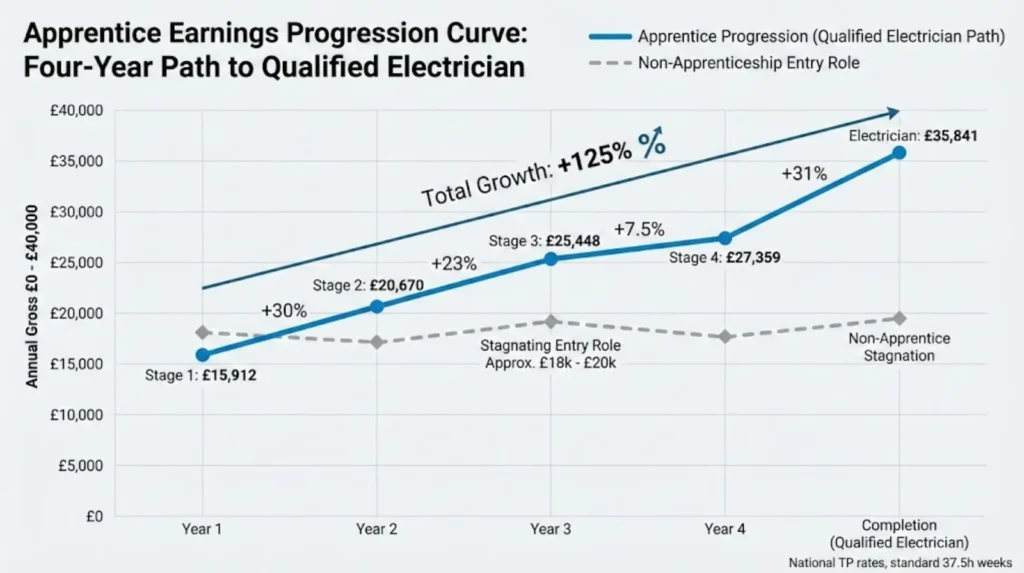
"When apprentices ask whether the pay is 'worth it,' I show them the progression curve: £15,912 Year 1 (Stage 1), £20,670 Year 2 (Stage 2, +30% increase), £25,448 Year 3 (Stage 3, +23%), £27,359 Year 4 (Stage 4, +7.5%), then £35,841+ upon completion (Electrician, +31%). Total earnings growth from entry to completion: 125% over 3.5-4 years. That's extraordinary income acceleration compared to non-apprenticeship entry-level roles where pay stagnates."
Joshua Jarvis, Placement Manager
Year-by-Year Earnings Growth
Year 1 baseline: £15,912 (Stage 1)
Year 2 increase: £20,670 (+£4,758, +30%)
Equivalent to 7-8 years of 4% annual increases compressed into single stage advancement
Year 3 increase: £25,448 (+£4,778, +23%)
Another 5-6 years of typical wage growth compressed into stage progression
Year 4 increase: £27,359 (+£1,911, +7.5%)
Smaller increment reflecting near-completion status
Completion jump: £35,841 (+£8,482, +31%)
Largest single increase in entire electrical career pathway
Exceeds 6-7 years of 4% annual increases compressed into qualification achievement
Total 4-year growth: £15,912 → £35,841 = +£19,929 (+125%)
Comparison to Non-Apprenticeship Entry Roles
Retail assistant/warehouse operative:
Entry: £18,000-20,000
Year 2: £18,500-20,500 (+2-3%)
Year 3: £19,000-21,000 (+2-3%)
Year 4: £19,500-21,500 (+2-3%)
4-year growth: ~8-10%
Office junior/admin assistant:
Entry: £19,000-21,000
Year 2: £19,500-21,500 (+2-3%)
Year 3: £20,000-22,000 (+2-3%)
Year 4: £20,500-22,500 (+2-3%)
4-year growth: ~7-9%
Electrical apprentice:
Entry: £15,912
Year 2: £20,670 (+30%)
Year 3: £25,448 (+23%)
Year 4: £27,359 (+7.5%)
Completion: £35,841 (+31%)
4-year growth: 125%
Despite lower entry pay (£15,912 vs £18,000-21,000 comparators), apprentices overtake non-apprenticeship roles by Year 3 (£25,448 vs £19,000-22,000) and finish substantially ahead at completion (£35,841 vs £19,500-22,500), creating £13,000-16,000 annual income advantage that compounds throughout 40-year working life.
Adult Apprentice Complexity: National Living Wage Interactions
Statutory Wage Floor for 21+ Apprentices
From April 2026, National Living Wage rises to £12.21-12.71/hour for workers aged 21+ (exact rate pending final Treasury confirmation).
Impact on JIB apprentice rates:
Stage 1 (£8.16/hour):
Adult aged 21+: Must receive £12.21-12.71 (NLW overrides JIB)
Employer top-up required: £4.05-4.55/hour
Annual additional cost: £7,900-8,900 per adult Stage 1 apprentice
Stage 2 (£10.60/hour):
Adult aged 21+: Must receive £12.21-12.71 (NLW overrides JIB)
Employer top-up required: £1.61-2.11/hour
Annual additional cost: £3,140-4,120 per adult Stage 2 apprentice
Stage 3 (£13.05/hour):
JIB rate exceeds NLW requirement
No top-up needed
Standard £25,448 annual applies
Stage 4 (£14.03/hour):
JIB rate exceeds NLW requirement
No top-up needed
Standard £27,359 annual applies
Employer Perspective
Hiring 18-year-old Stage 1 apprentice:
Pay: £8.16/hour (£15,912 annual)
Total employment cost: ~£18,000 including NI, pension, training
Hiring 25-year-old Stage 1 apprentice:
Pay: £12.21-12.71/hour (£23,841-24,810 annual)
Total employment cost: ~£27,000-28,000 including NI, pension, training
£9,000-10,000 more expensive than younger apprentice
This cost differential explains why many small employers prefer younger apprentices despite government funding (£18,000 apprenticeship levy support unchanged since 2018, eroded 15% in real terms), limiting adult career-changer training capacity particularly in SME firms with tight margins.
JIB Member Firms vs Non-JIB Employers
JIB Apprenticeship Benefits
Guaranteed stage progression:
Structured advancement tied to competence milestones
Cannot be arbitrarily held on lower rates if requirements met
Proper training oversight:
Regular assessor visits
Portfolio development support
AM2 preparation structured into work patterns
Benefits from day one:
Sick pay (£15/week Stages 1-2, increasing with progression)
Employer pension contributions (5-10%)
Holiday pay (22 days + 8 bank holidays)
Clear pathway to qualification:
Employer committed to completion
NVQ assessment arrangements
Time allocated for college attendance
Non-JIB Apprenticeship Risks
Statutory minimum only:
Some domestic firms pay exactly £8.00/hour (April 2026 apprentice minimum)
No guaranteed progression structure
May remain £8.00/hour for entire 3-4 years
Limited training support:
“Learn on the job” approach without structured oversight
Minimal college time (block release only, unpaid travel)
Portfolio development left to apprentice initiative
No benefits guarantee:
Sick pay often statutory minimum only
Pension contributions minimal or delayed
Holiday arrangements informal
Qualification uncertainty:
Some firms take apprentices as cheap labour without completion intention
Assessment arrangements unclear
May need to self-fund AM2 preparation course (£600-1,200)
Recommendation: Strongly favour JIB member firm apprenticeships for career security and proper qualification pathway, despite potentially slightly lower hourly rates than “street” firms quoting inflated wages without structured progression.
Common Questions for Apprentices and Families
“Is £15,912 enough to live on independently?”
Realistic assessment: Difficult in most UK areas without additional support.
Monthly net (Stage 1): ~£1,080 after deductions and work costs
Average UK rent: £600-900 (room in shared house), £800-1,200 (studio/1-bed)
Remaining after rent: £180-480 monthly for food, utilities, transport, clothing, social
Options:
Live with family paying minimal board (£200-400/month)
House-share with multiple apprentices splitting costs
Partner/spouse with income contributing to household
Part-time work weekends (though exhausting alongside 37.5-hour week + college)
Reality: Most Stage 1-2 apprentices require family support or shared accommodation. By Stage 3-4 (£25,448-27,359), independent living becomes viable.
“Can my child earn more doing overtime?”
Yes, overtime available but not guaranteed:
JIB overtime rates:
Time-and-a-half (1.5×) after 37.5 hours weekdays
Double-time (2×) Saturday afternoons, Sundays, bank holidays
Stage 1 overtime value:
1.5×: £12.24/hour
2×: £16.32/hour
10 hours weekly OT: +£4,896 annually (£15,912 → £20,808)
However:
Overtime not guaranteed (depends on project demands)
Apprentices often last priority for OT (qualified electricians get preference)
College commitments limit availability
Fatigue risks when combining long hours with study
Realistic expectation: Occasional overtime during busy periods (Christmas, end of financial year), not consistent weekly pattern.
“When will pay rise above statutory minimum?”
Stage 1 (£8.16) vs Apprentice Minimum (£8.00): Already £0.16/hour above (£312 annually)
Adult apprentice 21+ impact: NLW (£12.21-12.71) substantially exceeds JIB Stages 1-2, creating immediate advantage for adult career changers at entry stages
Progression timeline:
Year 2 (Stage 2): £20,670 substantially above any statutory minimum
Year 3 (Stage 3): £25,448 competitive with many entry-level professional roles
Year 4 (Stage 4): £27,359 approaching qualified electrician minimums
“Is 4 years too long for training?”
Career perspective comparison:
University degree:
Duration: 3-4 years
Cost: £27,000-40,000 debt
Graduate earnings: £22,000-28,000 entry (many fields)
Payback period: 10-20 years
Electrical apprenticeship:
Duration: 3.5-4 years
Cost: Zero (earn while learning, £88,000-92,000 total across 4 years)
Qualified earnings: £35,841 minimum, £38,000-45,000 typical with OT
Payback: Immediate (never in debt)
Plus: Apprentices accumulate 3.5-4 years work experience alongside qualification, entering job market as experienced operatives, not graduate trainees.
“What happens if they fail AM2?”
Apprentice remains Stage 4 (£27,359) until pass:
Cannot advance to Electrician grading (£35,841)
Must retake AM2 assessment (£600-800 exam fee)
Employer may support retake or apprentice self-funds
Additional preparation courses available (£400-800)
Timeline impact:
First-time pass: Complete on schedule
One retake: 3-6 month delay
Multiple failures: May remain Stage 4 indefinitely or leave industry
Pass rates: Approximately 75-80% first attempt, 90%+ within 2-3 attempts with proper preparation
JIB apprentice rates for 2026 establish four-stage progression structure (Stage 1 £8.16/hour £15,912 annual, Stage 2 £10.60 £20,670, Stage 3 £13.05 £25,448, Stage 4 £14.03 £27,359) frozen at 2025 levels creating zero nominal increase following substantial prior-year corrections (Stage 1 +26%, Stage 2 +21%) representing strategic employer cost absorption before resuming modest progression in 2027 under three-year industrial determination. Advancement through stages depends on demonstrated competence meeting college completion, NVQ portfolio evidence, and site capability requirements rather than automatic calendar-based increases, meaning apprentices failing modules or falling behind documentation can remain lower pay bands longer than typical 12-month per-stage timeline, though statutory minimum wage protections ensure adult apprentices aged 21+ receive National Living Wage (£12.21-12.71/hour from April 2026) overriding JIB Stages 1-2 rates through mandatory employer top-ups costing £3,140-8,900 annually.
Take-home reality requires understanding gross pay represents starting point before income tax, National Insurance, and pension deductions plus significant work-related costs including tool investment (£500-800 first year for personal hand-tool kit, additional £300-500 over training for specialist equipment), travel expenses within 15-mile radius of employer base (not JIB-compensated), and meal costs during college days, reducing £306 weekly Stage 1 gross to approximately £260-280 actual available income (£1,080-1,200 monthly) necessitating family support or shared accommodation for independent living until Stage 3-4 progression raises earnings to £25,448-27,359 where solo financial viability improves substantially. London premiums add £0.98-1.69/hour (£1,911-3,295 annually) for M25-area work but cover only partial living cost differentials averaging £8,000-12,000 higher for capital accommodation, transport, and general expenses.
The fundamental value proposition centers on extraordinary earnings progression (125% growth from £15,912 Stage 1 entry to £35,841 Electrician completion over 3.5-4 years) compared to non-apprenticeship entry-level roles stagnating at 7-10% growth over equivalent periods, with largest income jumps occurring Stage 1 to Stage 2 (+30%, £4,758 annually equivalent to 7-8 years of typical wage increases compressed into single advancement), Stage 2 to Stage 3 (+23%, £4,778 annually), and particularly completion jump from Stage 4 to Electrician (+31%, £8,482 annually representing 6-7 years of conventional pay rises achieved through qualification completion). This acceleration means apprentices earning £3,000-6,000 less than retail, warehouse, or office comparators at entry (£15,912 vs £18,000-21,000) overtake by Year 3 (£25,448 vs £19,000-22,000) and finish with £13,000-16,000 permanent annual advantage at qualification plus zero student debt versus £27,000-40,000 university borrowing alternative, making apprenticeship highest-ROI education pathway for trade-oriented learners when total lifetime earnings and debt-free status considered.
Call us on 0330 822 5337 to discuss qualification pathways through four-year electrical apprenticeship combining classroom theory covering BS 7671 Wiring Regulations, circuit design, and electrical principles with on-site practical experience building installation competence across domestic, commercial, and industrial projects, NVQ Level 3 portfolio development demonstrating capability progression through photographic evidence and assessor verification with realistic expectations about annual earnings (£15,912-27,359 during training, £35,841+ upon Electrician qualification), progression requirements (college module completion, site competence demonstration, portfolio evidence submission) determining stage advancement timing rather than automatic calendar progression, take-home budgets after deductions and work costs (tool investment £1,000-1,300, travel expenses, meal costs), and how our in-house recruitment team helps secure JIB member firm apprenticeship placements offering structured training oversight, guaranteed stage progression, proper qualification pathways, and employment security superior to non-JIB “street” firms potentially paying marginally higher rates without commitment to completion or career development.
References
- JIB (Joint Industry Board) – Industrial Determination 2026-2028 with apprentice rate tables – https://www.jib.org.uk/wp-content/uploads/2025/06/JIB-Industrial-Determination-062025.pdf
- JIB – Apprentice rates announcement 2025 explaining stage structure and progression – https://www.jib.org.uk/news/jib-apprentice-rates-2025/
- JIB – New wage agreement 2026-2028 context – https://www.jib.org.uk/news/new-wage-agreement-from-2026-to-2028/
- GOV.UK – National Minimum Wage and National Living Wage rates 2026 – https://www.gov.uk/national-minimum-wage-rates
- GOV.UK – Tax and NI thresholds 2025-2026 – https://www.gov.uk/guidance/rates-and-thresholds-for-employers-2025-to-2026
- Electrical Contractors’ Association (ECA) – JIB apprentice pay guidance for member firms – https://www.eca.co.uk/news/2024/dec/new-apprentice-pay-rates-to-come-into-effect-january-2025
Note on Accuracy and Updates
Last reviewed: 5 January 2026. This page is maintained; we correct errors and refresh sources as JIB Industrial Determinations, apprentice progression criteria, and statutory minimum wage rates change. 2026 JIB apprentice rates (Stage 1 £8.16, Stage 2 £10.60, Stage 3 £13.05, Stage 4 £14.03 National Transport Provided) sourced from JIB Industrial Determination 062025 effective 5 January 2026 showing zero nominal increase from 2025 levels (graded operatives received 3.95%). 2025 correction data (Stage 1 +26% from £6.48, Stage 2 +21% from £8.76) verified from 2024-2025 JIB rate comparison. London premiums (Stage 1 +£0.98, Stage 2 +£1.28, Stage 3 +£1.57, Stage 4 +£1.69) confirmed from official rate tables for M25-area work. National Living Wage 2026 projection (£12.21-12.71/hour for 21+) based on Low Pay Commission recommendations pending final Treasury confirmation April 2026; adult apprentice top-up calculations (£3,140-8,900 annual for Stages 1-2) subject to final NLW announcement. Stage progression requirements (college completion, NVQ portfolio evidence, site competence) sourced from JIB Handbook apprenticeship sections and assessor guidance. Take-home calculations use UK tax rates 2025-2026 (personal allowance £12,570, basic rate 20%, NI 12% above primary threshold); actual net pay varies by individual tax codes, pension contribution rates, student loan repayments. Tool cost estimates (£500-800 first year, £300-500 specialist additions) based on industry standard hand-tool kit requirements and typical market pricing for quality equipment. Overtime rates (time-and-a-half 1.5×, double-time 2×) confirmed from JIB National Working Rules. Completion jump calculation (Stage 4 £27,359 to Electrician £35,841 = +£8,482, +31%) uses 2026 Electrician National TP rate. Next review scheduled following 2027 JIB determination publication (typically July-August) for second-year apprentice rate increases (2% scheduled) and any progression criteria updates.
