

JIB Apprentice Wage Rise 2026: What Employers and Learners Need to Know

- Technical review: Thomas Jevons (Head of Training, 20+ years)
- Employability review: Joshua Jarvis (Placement Manager)
- Editorial review: Jessica Gilbert (Marketing Editorial Team)
- Last reviewed:
- Changes: Initial publication using JIB Industrial Determination 2025-2026, statutory minimum wage rates April 2025/2026, SJIB Scotland rates, ONS ASHE electrician earnings data, and government apprenticeship funding guidance
Introduction:
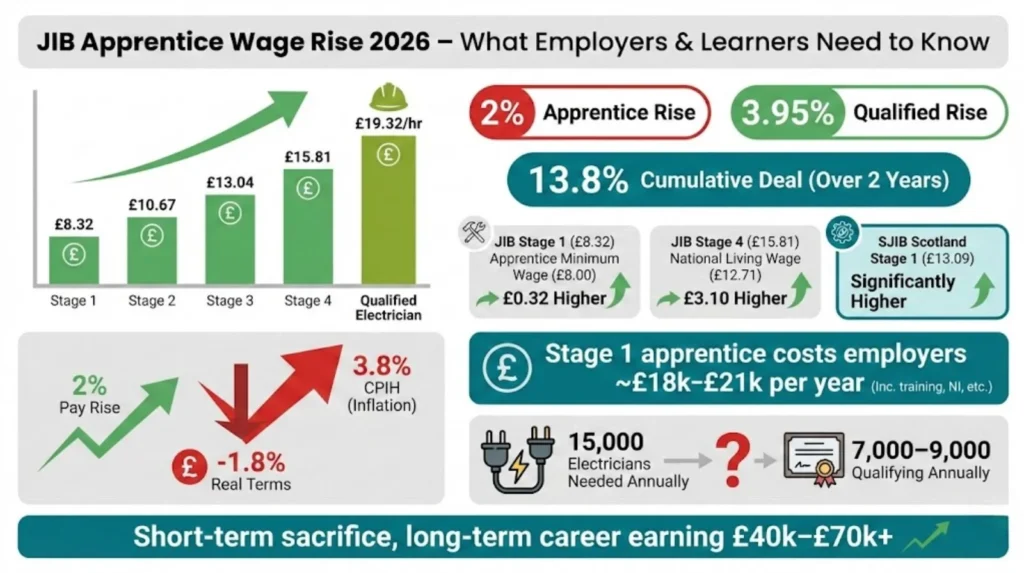
JIB apprentices in England, Wales, and Northern Ireland receive a 2% wage increase from January 2026 across all four stages of their training, while their fully qualified colleagues benefit from a larger 3.95% rise. For a Stage 1 apprentice, this means moving from £8.16 to £8.32 per hour nationally (£9.14 to £9.32 in London). For a Stage 4 apprentice nearing qualification, it’s £15.50 to £15.81 nationally (£17.37 to £17.72 in London). These figures sit within a three-year deal that brings 13.8% cumulative increases to graded electricians but offers apprentices only the 2% adjustment in 2026, with no separate apprentice-specific percentages confirmed for 2027 and 2028.
The numbers matter because they determine whether electrical apprenticeships remain financially viable for school leavers, whether adult career changers can afford to retrain, and whether employers can justify the total cost of taking on apprentices (which extends well beyond the hourly wage to include National Insurance, pension contributions, college release time, and JIB benefits). With inflation running at 3.8% CPIH in October 2025, the 2% nominal increase means apprentices face approximately 1.8% real-terms pay erosion in 2026, continuing a pattern where statutory minimum wages rise faster than early-stage apprentice rates.
This article breaks down exactly what JIB and SJIB apprentices will earn at each stage in 2026, how these rates compare to statutory minimum wages and fully qualified electrician pay, what the 2% rise means in real purchasing power against rising food, housing, and transport costs, how much it actually costs employers to take on apprentices once all on-costs are included, and whether electrical apprenticeships remain competitive against retail and hospitality jobs paying £11 to £12 per hour with no training requirement. For comprehensive context on Elec Training’s approach to electrical qualifications and the full pathway from apprentice to qualified electrician status, we’ve covered the complete NVQ Level 3 framework, AM2 preparation, and employment support that bridges the gap between training and career.
Who Counts as an Apprentice: JIB, SJIB and Non-JIB
Understanding who these wage rises apply to requires distinguishing between formal apprentices under industry agreements and various other training arrangements marketed as “apprenticeships.”
JIB Apprentices (England, Wales, Northern Ireland)
JIB apprentices are individuals enrolled in formal electro-technical apprenticeship programs under the Joint Industry Board framework. These are structured as Stages 1 through 4, corresponding to approved frameworks such as:
Level 3 Electrotechnical Qualification (5357): The traditional City & Guilds electrotechnical apprenticeship pathway
Installation Electrician Apprenticeship Standard: The newer apprenticeship standard introduced under the government’s apprenticeship reforms
JIB apprentices work toward JIB Gold Card qualification (Approved Electrician status) via:
NVQ Level 3 Diploma in Installing Electrotechnical Systems and Equipment (2357)
AM2/AM2E practical assessment
18th Edition BS 7671 Wiring Regulations
Industry-recognized site experience logged and assessed
JIB apprenticeship stages align with academic and practical progression, typically taking 3 to 4 years to complete depending on entry qualifications and pace.
SJIB Apprentices (Scotland)
SJIB apprentices train under the Scottish Joint Industry Board framework, registered with SECTT (Scottish Electrical Charitable Training Trust). The SJIB uses similar staged progression (typically Stages 1-3, with Stage 3 covering the final phase before FICA assessment), but operates distinct rates and allowances specific to Scotland.
Key differences:
Shop and Travel rates: SJIB pays different rates depending on whether work is at the employer’s base (shop rate) or on external sites (travel rate)
Higher baseline wages: SJIB Stage 1 2026 rates (£13.09 shop, £15.69 travel) significantly exceed JIB England/Wales equivalents
No London premium: SJIB has uniform Scotland-wide rates without regional supplements
Non-JIB “Apprentices”
Not all roles labeled “apprentice” fall under JIB or SJIB agreements. These include:
Electrical Improvers: Post-apprenticeship workers who have completed some training but lack full NVQ Level 3 and AM2 qualification. Often paid flat rates (£12-£16 per hour) outside the staged JIB structure.
Adult Trainees: Career changers or mature learners on employer-specific training programs not enrolled in approved 5357 or 5393 frameworks.
Labourers on “Apprentice” Pay: Workers performing electrical mate or labourer duties under “apprentice” job titles but not enrolled in formal qualification pathways.
Critical distinction: Non-JIB arrangements are not bound by JIB wage agreements. These workers may receive only statutory minimum wages or employer-discretionary rates, with no guarantee of structured pay progression or qualification outcomes.
This article focuses primarily on formal JIB and SJIB apprentices, with non-JIB roles referenced only for comparison.
Key Wage Terms and Framework vs Statutory Context
Before examining specific 2026 rates, understanding the terminology and legal framework is essential.
JIB Apprentice Wage Structure
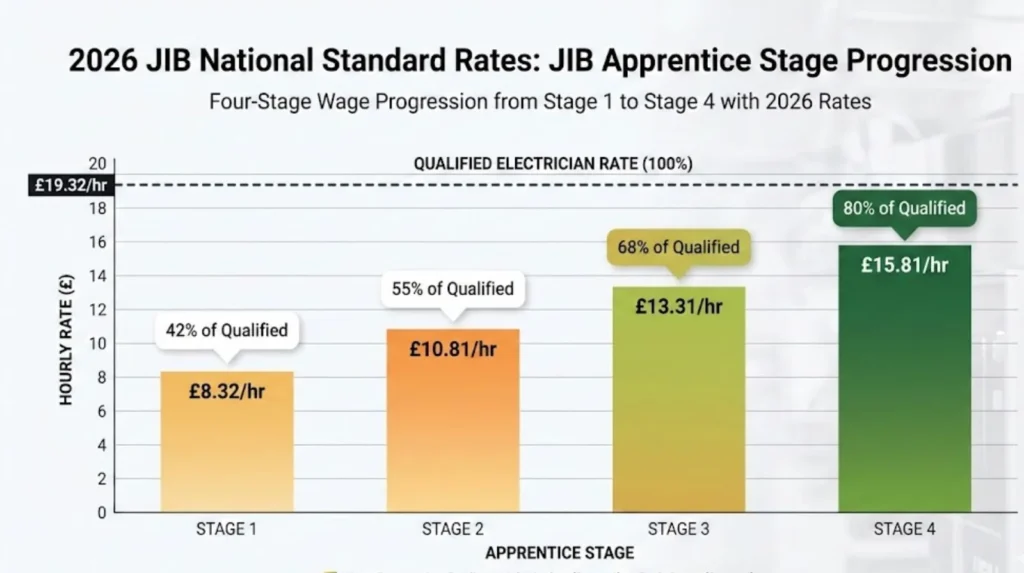
JIB apprentice wage rates are hourly pay rates structured by stage:
Stage 1: Entry-level, typically first year
Stage 2: Second year, foundational skills established
Stage 3: Third year, competence in routine installations
Stage 4: Final year, near-qualified status, complex work under supervision
Progression between stages depends on completing academic qualifications (college assessments, AM2 preparation) and logging sufficient site experience. Not all apprentices progress at the same speed; some complete in 3 years while others take 4 years depending on entry qualifications and employer support.
SJIB Rate Structure
SJIB rates operate differently:
Shop rate (base hourly rate): Paid for work at the employer’s premises or nearby locations Travel rate (enhanced hourly rate): Paid for work at external sites, reflecting travel time and conditions
SJIB rates apply regardless of age in the first 12 months, meaning a 25-year-old Stage 1 apprentice receives the same rate as a 17-year-old Stage 1 apprentice during their first year. After 12 months, age-related National Living Wage provisions may apply if they exceed the SJIB apprentice rate.
The 2026 JIB Apprentice Uplift
The confirmed 2026 changes are:
2% increase on JIB apprentice rates from January 2026: All four stages receive 2% nominal increase over 2025 baseline.
No separate apprentice percentages for 2027-2028: While graded operatives receive confirmed 4.6% (2027) and 4.85% (2028) increases, apprentice-specific uplifts for 2027 and 2028 are not detailed separately in available agreement documents. Apprentices may receive smaller percentage increases or flat adjustments in those years, but this awaits confirmation.
Larger rises for graded operatives: Electricians, Approved Electricians, and Technicians receive 3.95% in 2026, 4.6% in 2027, and 4.85% in 2028, totaling approximately 13.8% cumulative growth.
Nominal vs Real Wage Growth
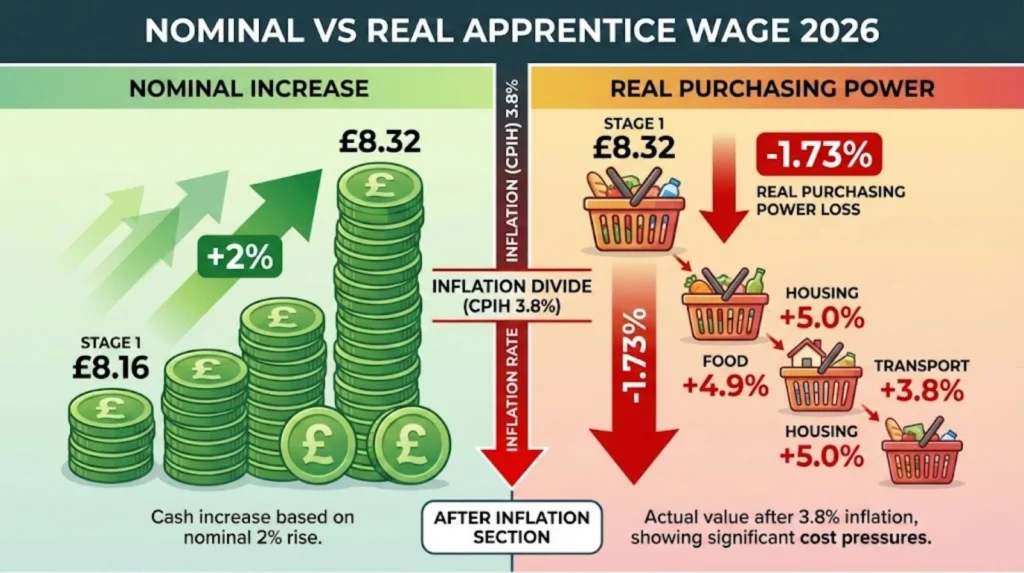
Nominal wage growth is the cash increase: 2% means a Stage 1 apprentice moves from £8.16 to £8.32 per hour (£0.16 increase).
Real wage growth adjusts for inflation:
Formula: Real Growth = (1 + Nominal Growth) ÷ (1 + Inflation Rate) – 1
Example: (1.02 ÷ 1.038) – 1 = -0.0173 = -1.73% real-terms loss
With CPIH inflation at 3.8% (October 2025), the 2% nominal increase results in approximately 1.8% real-terms pay cut. Apprentices’ purchasing power declines despite the cash increase because living costs rise faster.
What Employer Total Cost Includes
The hourly wage is only part of what employers pay. Total cost includes:
Direct wage: The hourly rate × hours worked Employer National Insurance: 15% on earnings above £9,100 annual threshold (2025-2026 tax year) Employer pension contributions: Minimum 3% under auto-enrolment (many JIB schemes contribute more) Training costs: 20% off-the-job training requirement, college release days (typically one day per week), assessor visits, exam fees JIB benefits: 22 days annual holiday plus bank holidays, sick pay (up to 13 weeks full pay after qualifying period), travel allowances (12p per mile for employer-provided transport, 22p per mile for own transport over 15 miles), lodging allowances (£51.29 per night for weekend retention when staying away)
A Stage 1 apprentice on £8.32 per hour (£16,224 annual gross wage) costs the employer closer to £18,000 to £20,000 annually once all on-costs are factored in.
Framework vs Statutory Law
JIB and SJIB rates are voluntary collective agreements negotiated between employer bodies (ECA: Electrical Contractors’ Association) and trade unions (Unite the Union). They are widely adopted on commercial and industrial electrical projects, especially those involving public sector procurement or large M&E contractors, but are not legally mandated.
Legal obligations:
Employers must pay at least:
Apprentice Minimum Wage: £7.55 per hour (April 2025), £8.00 per hour (April 2026) for apprentices under 19 or in their first year
Age-based NMW/NLW: After the first year, apprentices must receive age-appropriate minimum wage:
21+ (NLW): £12.21 (2025), £12.71 (2026)
18-20: £10.00 (2025), £10.85 (2026)
16-17: £7.55 (2025), £8.00 (2026)
This creates complexity for adult apprentices (21+ year olds). After their first year, they legally must receive the National Living Wage (£12.71 in 2026), which exceeds JIB Stage 1 (£8.32) and Stage 2 (£10.81) rates. Employers typically resolve this by:
Topping up pay to NLW for adult apprentices after year one
Moving adult apprentices through stages faster to reach Stage 3 (£13.31) which exceeds NLW
Structuring adult training routes differently (Fast Track NVQ rather than traditional apprenticeship)
JIB and SJIB Apprentice Rates: 2025-2026 Progression
These are the confirmed official rates that govern formal apprentice pay under JIB and SJIB frameworks.
JIB National Standard and London Rates (2025-2026)
JIB National Standard Rates (England, Wales, Northern Ireland excluding London):
| Stage | 2025 Hourly Rate | 2026 Hourly Rate (2% increase) | Annual Gross (37.5 hrs/wk) |
| Stage 1 | £8.16 | £8.32 | £16,224 |
| Stage 2 | £10.60 | £10.81 | £21,074 |
| Stage 3 | £13.05 | £13.31 | £25,947 |
| Stage 4 | £15.50 | £15.81 | £30,820 |
JIB London/Inner Zone Rates (M25 and defined areas):
| Stage | 2025 Hourly Rate | 2026 Hourly Rate (2% increase) | Annual Gross (37.5 hrs/wk) |
| Stage 1 | £9.14 | £9.32 | £18,174 |
| Stage 2 | £11.88 | £12.12 | £23,634 |
| Stage 3 | £14.62 | £14.91 | £29,074 |
| Stage 4 | £17.37 | £17.72 | £34,544 |
Key observations:
The 2% increase adds:
£0.16 per hour (Stage 1), £6 weekly, £312 annually
£0.21 per hour (Stage 2), £7.88 weekly, £410 annually
£0.26 per hour (Stage 3), £9.75 weekly, £507 annually
£0.31 per hour (Stage 4), £11.63 weekly, £604 annually
London premium: Approximately 12% higher than national rates across all stages, reflecting higher living costs within the M25.
2024 rates not available: The research data does not provide confirmed 2024 apprentice rates; 2025 represents the baseline for comparison.
2027-2028 rates unconfirmed: While graded operatives have confirmed percentage increases (4.6% in 2027, 4.85% in 2028), apprentice-specific uplifts for those years are not separately detailed in available agreement documents.
SJIB Scotland Rates (2026)
SJIB rates differentiate between Shop and Travel work:
| Stage | Shop Rate (2026) | Travel Rate (2026) | Annual Gross (Shop, 37.5 hrs/wk) |
| Stage 1 | £13.09 | £15.69 | £25,526 |
| Stage 2 | £14.41 | £16.61 | £28,100 |
Stage 3 and beyond: SJIB Stage 3 covers the final phase before FICA assessment; rates continue to progress but are not fully detailed in available research for all stages.
Key comparisons:
SJIB vs JIB Stage 1 (2026):
SJIB Shop (£13.09) vs JIB National (£8.32): SJIB is 57% higher
SJIB Travel (£15.69) vs JIB National (£8.32): SJIB is 89% higher
Structural differences:
No London supplement in SJIB: Uniform rates across Scotland
Travel rate premium: SJIB explicitly pays higher rates for site work, effectively compensating travel and conditions
Age-blind first year: SJIB contractual rates apply regardless of age for the first 12 months
The SJIB baseline is substantially higher than JIB, reflecting Scotland’s distinct industrial relations framework and SELECT (Scottish electrical trade body) negotiations.
How JIB Apprentice Pay Compares to Statutory Minimums
The gap between JIB rates and legal minimum wages determines how attractive apprenticeships appear relative to unskilled work and how much financial buffer employers have before hitting statutory floors.
April 2026 Statutory Rates
Apprentice Minimum Wage (first year or under 19):
April 2025: £7.55 per hour
April 2026: £8.00 per hour
Increase: 5.96% (significantly higher percentage than JIB’s 2% apprentice rise)
National Minimum Wage by Age Band:
16-17 years: £7.55 (2025), £8.00 (2026)
18-20 years: £10.00 (2025), £10.85 (2026) – 8.5% increase
21+ years (NLW): £12.21 (2025), £12.71 (2026) – 4.1% increase
JIB Stage 1 vs Apprentice Minimum Wage
2025 comparison:
JIB Stage 1: £8.16
Apprentice Min: £7.55
Premium: £0.61 per hour (8.1% above minimum)
2026 comparison:
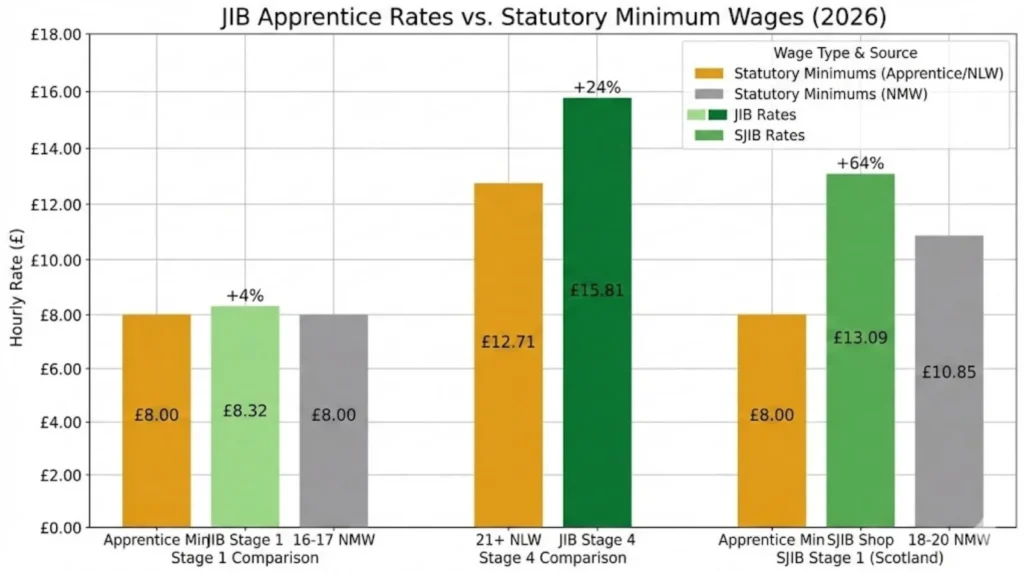
JIB Stage 1: £8.32
Apprentice Min: £8.00
Premium: £0.32 per hour (4.0% above minimum)
Key insight: The gap is narrowing. In 2025, JIB Stage 1 was 8.1% above the statutory floor. In 2026, it’s only 4.0% above. This compression reflects the government’s 5.96% increase to statutory apprentice wages outpacing JIB’s 2% increase. The shrinking premium reduces JIB’s competitive advantage for recruiting school leavers.
JIB Stage 4 vs National Living Wage (21+)
2025 comparison:
JIB Stage 4: £15.50
NLW (21+): £12.21
Premium: £3.29 per hour (26.9% above NLW)
2026 comparison:
JIB Stage 4: £15.81
NLW (21+): £12.71
Premium: £3.10 per hour (24.4% above NLW)
Key insight: Stage 4 apprentices earn substantially above the National Living Wage, reflecting their near-qualified competence. However, the premium is also shrinking (from 26.9% to 24.4%) as NLW rises faster (4.1%) than JIB apprentice rates (2%).
SJIB Scotland vs Statutory Minimums
SJIB Stage 1 Shop Rate (2026): £13.09
Compared to:
Apprentice Min (£8.00): +£5.09 (63.6% premium)
18-20 NMW (£10.85): +£2.24 (20.6% premium)
21+ NLW (£12.71): +£0.38 (3.0% premium)
SJIB Stage 1 Travel Rate (2026): £15.69
Compared to:
Apprentice Min (£8.00): +£7.69 (96.1% premium)
21+ NLW (£12.71): +£2.98 (23.4% premium)
Key insight: SJIB rates sit well above statutory minimums even at Stage 1, making Scottish apprenticeships significantly more financially attractive than JIB England/Wales equivalents, especially for adult career changers who would otherwise face NLW requirements after their first year.
Relevance for Employers
JIB rates add cost above legal minimums: A Stage 1 apprentice costs employers £0.32 per hour (£624 annually) more than paying the Apprentice Minimum Wage. For small firms operating on tight margins, this differential influences whether they opt for JIB-registered apprentices or informal training arrangements paying only statutory rates.
Recruitment advantage: The premium (albeit shrinking) helps JIB employers attract higher-quality candidates who might otherwise choose retail or hospitality roles paying £10-£12 per hour with no training requirement.
Relevance for Learners
Stage 1-2 feel tight: JIB Stage 1 and 2 rates (£8.32 and £10.81) provide only modest improvements over statutory minimums. For young apprentices living at home, this is manageable. For independent adults paying rent, these rates create genuine financial hardship.
Stage 3-4 become competitive: By Stage 3 (£13.31) and especially Stage 4 (£15.81), JIB rates substantially exceed age-based minimum wages. An 18-year-old Stage 3 apprentice earns 22.6% more than their 18-20 NMW peers (£13.31 vs £10.85).
Joshua Jarvis, Elec Training’s Placement Manager, explains the competitive landscape:
"Stage 1 apprentices earning £8.32 per hour are competing with supermarket shelf-stackers and fast food workers earning £11 to £12 per hour. The only reason electrical apprenticeships remain attractive is the qualification outcome. You're trading 18-24 months of lower wages for a career that pays £40,000+ within five years of qualifying. It's an investment mindset, not immediate gratification."
Joshua Jarvis, Placement Manager
Apprentice vs Fully Qualified Electricians and Other Trades
Apprentice wages exist within a progression framework where early-stage low pay is justified by eventual qualified earnings. Understanding the full trajectory and cross-trade comparisons clarifies whether the investment pays off.
Apprentice Pay as Percentage of Qualified Electrician Wages
ONS ASHE 2024 median hourly wage for electricians (SOC 5241): £18.04 per hour
JIB Approved Electrician 2025: £19.32 per hour (National Standard Rate)
Using JIB Approved Electrician (£19.32) as the 100% baseline:
2025 JIB apprentice stages as percentage of qualified pay:
Stage 1 (£8.16): 42.2% of qualified rate
Stage 2 (£10.60): 54.9% of qualified rate
Stage 3 (£13.05): 67.5% of qualified rate
Stage 4 (£15.50): 80.2% of qualified rate
2026 JIB apprentice stages (with 2% increase):
Stage 1 (£8.32): 43.1% of qualified rate (assuming qualified rate also rises)
Stage 2 (£10.81): 56.0% of qualified rate
Stage 3 (£13.31): 68.9% of qualified rate
Stage 4 (£15.81): 81.8% of qualified rate
What this means financially:
Year 1 (Stage 1): Apprentice earns £16,224 annually vs qualified electrician’s £37,670 (based on £19.32/hr × 37.5hrs × 52 weeks) – a £21,446 annual gap.
Year 4 (Stage 4): Apprentice earns £30,820 annually vs qualified £37,670 – a £6,850 annual gap.
Post-qualification jump: Upon qualifying as an Electrician, hourly rate jumps from £15.81 (Stage 4) to approximately £18.38 (JIB Electrician 2026 National Standard, assuming similar percentage increase to Approved rate) – a 16.3% immediate pay rise.
Within 18 months of qualifying: Progression to Approved Electrician status (£19.32+ rising to approximately £20.08 in 2026) means earnings of £39,156 annually, compared to the £16,224 a Stage 1 apprentice earns – a 141% increase from apprentice start to qualified status.
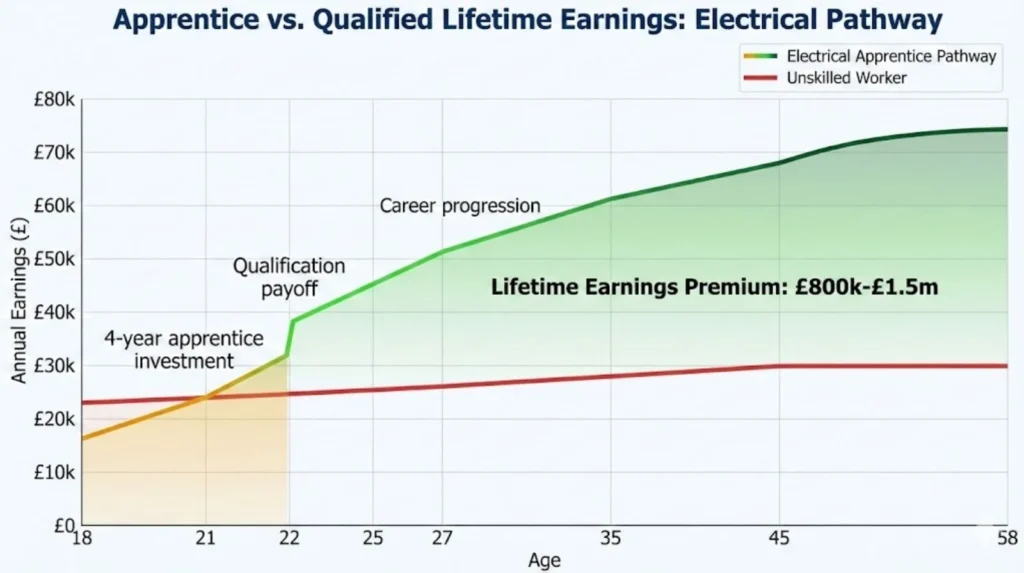
Lifetime earnings premium: Electricians with JIB Gold Cards typically earn £38,000 to £45,000 annually in standard commercial roles, £50,000 to £70,000 in London or specialist sectors (industrial, rail, data centres), and £70,000+ in senior positions (electrical engineer, site supervisor, contracts manager). Over a 40-year career, this represents a substantial lifetime earnings premium over non-qualified roles paying £25,000 to £30,000.
Thomas Jevons, Head of Training at Elec Training, emphasizes the retention challenge:
"Some apprentices drop out at Stage 2 or 3 to take 'improver' roles paying £14 to £16 per hour immediately. They're trading long-term security for short-term cash. Without the NVQ Level 3, AM2 assessment, and JIB Gold Card, they'll hit a ceiling. The apprentices who stick through to qualification are earning £19 to £24 per hour within 18 months of finishing, with clear progression to Approved Electrician and beyond."
Thomas Jevons, Head of Training
Comparison to Other Trades
Electrical apprenticeships sit at the upper end of trade apprentice pay structures:
Plumbing and HVAC apprentices: Often paid close to statutory minimums (£7.55 to £12.21 in 2025 depending on age and year). Few plumbing contractors operate formal staged wage frameworks comparable to JIB. Most pay age-based minimum wages or slightly above.
Carpentry and joinery apprentices: CITB (Construction Industry Training Board) reports no specific mandated rates. General construction apprentices average near National Minimum Wage throughout their training, with qualified carpenters earning £14 to £18 per hour (below qualified electrician rates).
Bricklaying and groundworks: Similar to carpentry; apprentice pay typically tracks statutory minimums with modest premiums. Qualified bricklayers can earn competitive rates (£18 to £22 per hour), but apprentice progression structure less formalized than JIB.
Hair, beauty, retail, hospitality apprentices: Frequently paid at or very close to the Apprentice Minimum Wage (£7.55 in 2025, £8.00 in 2026) throughout training. Qualified wages in these sectors often remain below £12 per hour, offering significantly lower lifetime earnings than electrical trades.
Key insight: JIB electrical apprentices at Stage 3 and 4 (£13.31 and £15.81 in 2026) earn substantially more per hour than equivalent-year apprentices in most other trades. Even Stage 1 and 2 rates (£8.32 and £10.81), while feeling tight, exceed typical plumbing, carpentry, and service sector apprentice pay.
The combination of relatively higher apprentice wages and strong qualified earnings (£38,000 to £70,000+ depending on specialization and location) makes electrical apprenticeships one of the most financially attractive vocational pathways in the UK.
Inflation and Cost of Living: Real Value of the 2026 Rise
Nominal wage increases mean little if inflation erodes purchasing power faster than pay rises. The 2% JIB apprentice uplift must be assessed against actual cost increases in essential spending categories.
October 2025 Inflation Context
Consumer Prices Index including Housing (CPIH): 3.8% (October 2025, down from 4.1% September)
Consumer Prices Index (CPI): 3.6% (October 2025)
Component inflation rates (October 2025):
Food and non-alcoholic beverages: 4.9% annual increase
Housing and household services: 5.0% annual increase
Transport: 3.8% annual increase
Energy (gas): 2.1% annual increase
Energy (electricity): 2.7% annual increase
Office for Budget Responsibility (OBR) projections: CPI forecast to average 3.2% in 2025, declining toward 2.0% target in 2026-2027 if monetary policy remains effective.
Real-Terms Impact of 2% Wage Rise
Using CPIH 3.8% as the inflation benchmark:
Real wage formula: Real Growth = [(1 + Nominal Increase) ÷ (1 + Inflation)] – 1
Calculation: [(1.02) ÷ (1.038)] – 1 = -0.0173 = -1.73% real-terms loss
What this means:
A Stage 1 apprentice moves from £8.16 to £8.32 per hour nominally (+2%), but their actual purchasing power declines by 1.73% because food, housing, and transport costs rise faster than their wages.
Weekly real-terms impact:
Stage 1:
2025: £306 weekly buys £306 worth of goods/services (baseline)
2026: £312 weekly buys equivalent of £305.60 (in 2025 purchasing power)
Real loss: -£0.40 weekly despite £6 nominal increase
Stage 3:
2025: £489.38 weekly
2026: £499.13 weekly nominal, but equivalent to £488.23 in 2025 purchasing power
Real loss: -£1.15 weekly despite £9.75 nominal increase
Stage 4:
2025: £581.25 weekly
2026: £592.88 weekly nominal, but equivalent to £579.90 in 2025 purchasing power
Real loss: -£1.35 weekly despite £11.63 nominal increase
The higher the stage, the larger the absolute real-terms loss, though the percentage loss (-1.73%) remains constant.
Cost-of-Living Pressures on Apprentices
Housing costs:
Average monthly rent varies dramatically by region and accommodation type:
Shared room (HMO): £500 to £800 per month in most UK cities outside London
Shared room (London): £800 to £1,200 per month
One-bedroom flat: £1,000 to £1,500 per month outside London, £1,500 to £2,500 in London
Housing inflation: Running at 5.0% annually, outpacing wage growth
Stage 1 apprentice (£8.32/hr, £16,224 annually, ~£1,352 monthly gross):
Rent £600/month (shared room, non-London) = 44% of gross income
After rent: £752 monthly for all other expenses (bills, food, transport, tools)
Conclusion: Financially unviable without parental support or partner income
Stage 3 apprentice (£13.31/hr, £25,947 annually, ~£2,162 monthly gross):
Rent £700/month (shared room or studio, non-London) = 32% of gross income
After rent: £1,462 monthly for other expenses
Conclusion: Livable but tight; limited savings capacity
Commuting and transport:
ONS household spending data indicates average weekly transport spend of £567.70 per household (includes all transport costs – vehicle ownership, fuel, public transport, insurance). For an individual apprentice:
Own vehicle: Fuel £40-£60 weekly (assuming 12-mile commute), insurance £80-£150 monthly, maintenance £50+ monthly
Public transport: £80-£150 monthly depending on zone and city
JIB travel allowances (12p per mile employer-provided transport, 22p per mile own vehicle over 15 miles) partially offset costs but rarely cover full expenses
Transport inflation at 3.8% means these costs rise in line with general inflation, consuming wage increases.
Tools and PPE:
Apprentices typically must purchase:
Hand tool kit: £250 to £400 (screwdrivers, pliers, cutters, strippers, levels, tape measures, etc.)
PPE (hard hat, boots, gloves, hi-vis): £100 to £150
Ongoing tool replacement: £50 to £100 annually
Test equipment (later stages): £200 to £500 for basic multimeters and proving units
A Stage 1 apprentice spending £400 on initial tools represents 2.5 weeks of gross wages (£400 ÷ £312 = 1.28 weeks). This upfront cost compounds the financial strain of low early-stage wages.
Food inflation at 4.9%:
Weekly food costs for an individual: £40 to £70 depending on diet and cooking habits. Food inflation running at 4.9% (higher than wage growth at 2%) means apprentices face increasing pressure on essential spending.
The Real Value Question
The 2% JIB apprentice rise in 2026 provides modest nominal relief (£6 to £11.63 weekly depending on stage) but fails to maintain purchasing power against inflation. Apprentices experience:
Immediate effect: Slightly higher cash wages Actual effect: Continued erosion of living standards due to faster-rising food, housing, and transport costs Long-term consideration: The value of apprenticeship lies in progression to qualified status (where pay jumps to £38,000 to £50,000+), not in the apprentice years themselves
For apprentices struggling with current costs, the 2026 rise offers minimal improvement. The financial case for apprenticeship depends entirely on accepting short-term hardship (3-4 years) for long-term gain (40-year career at qualified wages).
Employer Perspective: Real Cost of Taking on a JIB Apprentice
The hourly wage is highly visible, but employers evaluate apprenticeships based on total cost including on-costs, training time, and productivity trade-offs.
Direct Wage Cost (Stage 1 Example)
2025 Stage 1 National Standard:
£8.16 per hour
37.5 hours per week = £306 weekly
52 weeks (minus 4.8 weeks holiday) = 47.2 working weeks
Annual gross wage: £14,443 (actual paid weeks)
With holiday pay included: £15,912 annual gross cost
2026 Stage 1 National Standard:
£8.32 per hour
37.5 hours per week = £312 weekly
Annual gross wage: £14,726 (47.2 working weeks)
With holiday pay included: £16,224 annual gross cost
Direct wage increase: +£312 annually (+2.0%)
Employer On-Costs
National Insurance (Employer contribution):
Rate: 15% on earnings above £9,100 annual threshold (2025-2026 tax year)
Stage 1 2026: £16,224 annual wage minus £9,100 threshold = £7,124 subject to NI
Employer NI: £7,124 × 15% = £1,069 annually
Pension (Employer contribution):
Minimum auto-enrolment: 3% employer contribution
Stage 1 2026: £16,224 × 3% = £487 annually
Many JIB schemes contribute higher (5-8%), but using 3% minimum for conservative estimate
Training Costs (20% Off-The-Job Requirement):
Apprentices must spend minimum 20% of working time on off-the-job training (college, workshops, assessments)
Stage 1: 37.5 hours per week × 20% = 7.5 hours weekly off-the-job
Employer pays for 37.5 hours but receives approximately 30 hours of productive site work
Lost productivity cost: 7.5 hours × £8.32 = £62.40 weekly, £2,941 annually (opportunity cost of training time)
College Release (Typically One Full Day Per Week):
Most apprentices attend college one day weekly (7.5 hours)
Employer pays full wage but receives no productive hours that day
Effective cost: 7.5 hours × £8.32 × 47.2 weeks = £2,941 annually (overlaps with 20% calculation above, not additional)
JIB Benefits:
Holiday pay: 22 days annual leave plus 8 bank holidays = 30 days total (already included in annual wage calculation above)
Sick pay: Up to 13 weeks full pay after qualifying period (typically after 13 weeks of employment); cost depends on actual sickness, estimate £200-£500 annually
Travel allowances: 12p per mile for employer-provided transport; for 10-mile round trip daily = £1.20 per day, £283 annually if claimed
Lodging allowances: £51.29 per night weekend retention (only relevant for away work); most Stage 1 apprentices work locally
Total Annual Cost (Stage 1, 2026)
Conservative estimate:
Direct wage (with holiday pay): £16,224
Employer NI: £1,069
Employer pension: £487
Training time opportunity cost: £2,941 (implicit in reduced productivity)
Estimated sick pay/travel: £500
Total: £21,221 annually
Alternative calculation (excluding implicit opportunity cost, direct cash only):
Direct wage: £16,224
Employer NI: £1,069
Employer pension: £487
Estimated benefits: £500
Total: £18,280 annual direct cash cost
Most employers conceptualize cost as the £18,000 to £21,000 range for a Stage 1 apprentice, depending on whether they account for lost productivity or only direct cash outlays.
2025 to 2026 change:
2025 total cost (estimated): £17,900 to £20,800
2026 total cost (estimated): £18,280 to £21,221
Increase: £380 to £421 annually (2.0-2.1%)
Apprenticeship Levy and Government Funding
The total cost to employers is mitigated by government incentives:
Apprenticeship Levy (Large Employers):
Employers with annual payroll over £3 million pay 0.5% levy
Levy funds are used to pay for apprenticeship training and assessment costs
Effectively, large employers fund apprenticeships from their levy pot rather than paying separately
Non-Levy Employers (SMEs):
Government provides 95% co-investment for apprenticeship training costs
Employer pays only 5% of training fees
For an electrical apprenticeship costing £18,000 to £27,000 total (college, assessments, certification over 3-4 years), employer contribution is £900 to £1,350 total
Under-25 Incentives:
Full funding for SMEs from 2026 for apprentices under 25 (100% government coverage of training costs)
Incentive payments for taking on apprentices in certain periods (historically £1,000 to £3,000 per apprentice, subject to government policy)
Net effect: Government funding substantially reduces the training cost component, making the net cost to employers closer to wage + on-costs rather than wage + on-costs + training fees.
Employer Decision Factors
Productivity trade-off: Stage 1 apprentices require significant supervision and produce limited independent work. Employers hire apprentices for long-term workforce development, not immediate productivity gains.
Retention risk: If apprentices leave before qualifying, employers lose their training investment without gaining a qualified electrician. Retention to Stage 4 and beyond is critical for ROI.
Alternative to apprentices: Employers can hire qualified electricians (£38,000 to £50,000 annually) or adult improvers (£25,000 to £35,000 annually). Apprentices are cost-effective only if they stay and progress.
2026 impact: The 2% wage increase adds approximately £380 to £420 per apprentice annually. For a small firm with two apprentices, that’s £760 to £840 total increase – manageable within normal business cost escalation. For large firms with 10-20 apprentices, it’s £3,800 to £8,400 total increase, absorbed within overall wage bill inflation.
Market Practice: Job Adverts and Real-World Rates
JIB rates are the industry standard, but actual advertised wages and market practice vary by region, employer size, and sector.
Job Advert Analysis (Indeed, Reed, Totaljobs 2024-2025)
Electrical apprentice roles advertised:
Average salary (annual): £24,420 (~£12.50 per hour at 37.5 hours weekly)
This average sits between JIB Stage 2 (£10.81/hr, £21,074 annually) and Stage 3 (£13.31/hr, £25,947 annually), suggesting:
Adverts often blend multiple-year apprentices into single average figures
Some employers offer above-JIB rates to attract candidates
Regional variation (London/SE higher) pulls average upward
Common phrasing patterns:
“JIB apprentice rates” (70-80% of adverts mentioning rates): Employers explicitly state compliance with JIB framework, signaling structured progression and industry-standard benefits.
“Competitive apprentice salary” (20% of adverts): Vague wording suggesting rates may be near but not necessarily at JIB levels; requires clarification during application.
Specific rates quoted:
London adverts: £24,000 to £28,000 annually (approximately £12.31 to £14.36 per hour), often for Stage 3-4 apprentices or blended averages
Scotland adverts: £25,992 annually mentioned in research, aligning with SJIB’s higher baseline
Regional (Midlands, North, South-West): £18,000 to £24,000 annually, closer to JIB National Standard rates
Patterns by employer type:
Large M&E contractors (NG Bailey, Balfour Beatty, SPIE, etc.): Strictly adhere to JIB stages and rates. Advertise clear four-stage progression with annual uplifts. Offer full JIB benefits package.
Medium-sized electrical contractors (10-50 employees): Generally follow JIB framework but may offer modest premiums (£0.25 to £0.50 per hour above JIB) for Stage 3-4 apprentices in high-demand regions.
Small domestic electricians (1-10 employees): More variable. Some use JIB as benchmark; others pay flat rates (£8 to £12 per hour regardless of stage). Less likely to offer formal stage progression or full JIB benefits.
Non-JIB roles (improvers, mates, labourers): Advertised at £12 to £16 per hour with no qualification outcome. These roles compete directly with Stage 2-3 apprentices by offering higher immediate cash but no formal training or career progression.
Regional Variation
London and South-East:
Adverts consistently 10-20% above national JIB rates due to cost-of-living adjustments
Stage 3-4 apprentices often offered £14 to £16 per hour (above JIB London Zone rates) to compete with other industries
Scotland:
SJIB rates significantly higher than JIB England/Wales create different market dynamics
Adverts align with SJIB framework; little undercutting observed
Midlands, North, Wales:
Adverts closely track JIB National Standard rates
Less premium offered above JIB; employers rely on structured training and qualification outcome as main attraction
Northern Ireland:
Limited data available, but patterns suggest alignment with JIB National Standard rates similar to other UK regions outside London
Undercutting and “Grey Area” Roles
Undercutting JIB rates: Rare in advertised roles, but anecdotal evidence (see next section) suggests some small firms pay below JIB stages, especially for first-year apprentices, relying on statutory minimums.
“Apprentice” roles with ambiguous terms: Adverts using “Electrical Apprentice” without specifying JIB enrollment or qualification pathway may offer only statutory Apprentice Minimum Wage (£8.00 in 2026) with no formal training structure.
Improver loophole: Significant portion of adverts use “Electrical Improver” (not apprentice) at flat £12 to £14 per hour, attracting Stage 2-3 apprentices away from formal qualification pathways with immediate cash increase but no long-term credentials.
Alignment with JIB Framework
Approximately 70-80% of advertised electrical apprentice roles explicitly reference JIB rates or demonstrate alignment with JIB stage structure. The remaining 20-30% either:
Use vague “competitive wage” language requiring inquiry
Offer flat rates outside JIB framework
Target non-JIB training arrangements (college-based only, no industry registration)
Large commercial contractors overwhelmingly adhere to JIB; variation concentrates among small domestic firms and non-JIB training providers.
Demand, Skills Shortages and 2030 Outlook
Apprentice wages exist within broader labor market dynamics. Understanding demand projections helps contextualize whether current wage levels can attract sufficient talent.
Skills Shortage Projections
CITB (Construction Industry Training Board) estimate:
251,500 additional construction workers needed by 2028 to meet UK infrastructure, housing, and commercial build demand
Electrical trades identified as priority occupation within this total
Current annual recruitment (~7,000 electrical apprentices annually) falls short of replacement demand (retirements, leavers) plus growth requirements
Electrotechnical Skills Partnership (TESP) / ECA projections:
UK needs 15,000+ new electricians annually to achieve Net Zero targets and maintain existing infrastructure
Current output: approximately 7,000 to 9,000 newly qualified electricians per year
Shortfall: 6,000 to 8,000 electricians annually
Demographic pressures:
Aging workforce: Significant proportion of qualified electricians approaching retirement (50+ age bracket)
Insufficient apprentice intake to replace retirees while also growing workforce for Net Zero
Employment growth forecast:
15% growth in electrotechnical priority occupations by 2030 (ECA/TESP data)
Driven by electrification, renewable energy installations, EV infrastructure, and grid upgrades
Net Zero and Electrification Drivers
EV charging infrastructure:
Government targets: Widespread charging network to support transition to electric vehicles by 2030-2035
Requires electricians skilled in EV charger installation, grid connection, and maintenance
Estimated demand: Tens of thousands of charge point installations annually
Heat pumps:
NESO (National Energy System Operator) projections: 4 million additional heat pumps by 2030
Electrical work required for power supply upgrades, consumer unit modifications, smart controls
Many heat pump installations require electrician certification for grid compliance
Solar PV and battery storage:
Residential and commercial solar installations expanding rapidly
Grid-tied systems require qualified electrician sign-off for G99/G100 compliance
Battery storage systems add complexity and regulatory requirements
Data centres:
Explosive growth in AI, cloud computing, and digital infrastructure
Data centres require massive electrical infrastructure: HV connections, backup systems, cooling, monitoring
Highly specialized electrical work commanding premium wages (£25 to £35 per hour for qualified data centre electricians)
Grid upgrades:
National Grid investments in transmission and distribution infrastructure to support renewable generation and electric heating/transport
Large-scale projects requiring thousands of electricians over next decade
Implications for Apprentice Pay
Upward wage pressure:
Skills shortages create competition for talent
Employers increasingly offer above-JIB rates for Stage 3-4 apprentices to secure retention through qualification
Market data shows London and South-East employers paying £14 to £16 per hour for near-qualified apprentices (above JIB Stage 4 £15.81)
Faster progression routes:
Demand pressure encourages employers to accelerate progression from Stage 2 to Stage 3, and Stage 3 to Stage 4, reducing time at lower wage stages
Fast Track NVQ programs (18 months rather than 4 years) gain popularity among adult career changers, bypassing low Stage 1-2 wages entirely
Post-qualification earnings:
Newly qualified electricians with JIB Gold Cards entering strong demand market earn £38,000 to £45,000 immediately (higher than historical norms)
Progression to £50,000+ within 3-5 years increasingly common in Net Zero sectors
High post-qualification wages make enduring low apprentice wages more justifiable as investment
Retention challenges:
Improver roles offering £14 to £16 per hour (without qualification requirement) continue to tempt Stage 2-3 apprentices away from formal pathways
Employers recognize need to maintain competitive apprentice wages to prevent dropout, potentially pushing for higher JIB percentage increases in 2027-2028 negotiations
2030 Career Outlook
For apprentices entering the industry in 2026:
Short-term (2026-2028, apprentice years): Wages remain modest but sufficient if living costs are manageable (parental support or low-rent areas). Financial strain highest in Stage 1-2, eases by Stage 3-4.
Medium-term (2029-2032, newly qualified): Strong demand means newly qualified electricians secure employment quickly at £38,000 to £50,000 annually. Specialization in EV, heat pumps, solar PV, or data centres commands premium wages.
Long-term (2033+): Established electricians with 5+ years post-qualification experience, especially those with Approved Electrician or higher JIB grades, earn £50,000 to £70,000+ annually. Progression to contracts management, electrical engineering, or business ownership offers further earnings growth.
Career security: Electrical skills in high demand through 2030s and beyond. Automation unlikely to replace hands-on electrical installation, inspection, and testing work. Job security substantially higher than many other sectors facing technological disruption.
The apprentice wage question is ultimately: Can individuals afford to invest 3-4 years at £16,000 to £31,000 annually to access a career paying £40,000 to £70,000+ for the following 35-40 years? Demand projections strongly support the long-term value proposition, even if short-term wages create hardship.

Lived Experience: Apprentice Voices (Anecdotal Evidence)
Official wage data and employer perspectives tell part of the story. Apprentice forum discussions and online communities reveal how these wages feel in practice.
Critical note: The following evidence is anecdotal, drawn from online forums including Reddit (r/UKElectricians, r/Apprenticeships) and ElectriciansForums.net (2024-2025 threads). These represent individual experiences and should not be treated as systematic surveys. However, recurring themes across multiple posters suggest common patterns.
Financial Strain in Early Stages
Pattern: Stage 1 and 2 apprentices frequently report that nominal hourly wages (£8 to £11 per hour) feel inadequate once travel time, tool costs, and living expenses are factored in.
Example testimony (Reddit, paraphrased):
"When you factor in the 4-hour round trip to site (unpaid), and I'm only getting £16.80 per day including the 12p per mile travel allowance, it works out to about £5 per hour effective rate. I'm earning less than I did stacking shelves at Tesco."
Recurring theme: Apprentices calculate their “real hourly rate” by dividing total daily pay by total time away from home (including unpaid travel), often arriving at figures substantially below the advertised JIB stage rate. This creates disillusionment and retention risk.
Employers Not Always Following JIB Rules
Pattern: Apprentices report variation in whether employers strictly adhere to JIB stage rates and allowances.
Example testimony (Forum, paraphrased):
"My boss says we're on JIB rates but he's only paying me £7.80 per hour in my first year, saying that's what the 'proper' rate is. I looked it up and Stage 1 should be £8.16. When I questioned it, he said the paperwork isn't finalized yet."
Recurring theme: Small firms sometimes underpay relative to JIB stages, relying on apprentices’ lack of knowledge about entitlements. Apprentices fear challenging employers due to limited alternative placements.
Tool Costs and Unpaid Expenses
Pattern: Apprentices note that initial tool purchases (£250 to £400) and ongoing replacements represent significant financial burden relative to Stage 1-2 wages.
Example testimony (Reddit, paraphrased):
"Spent nearly £300 on tools in my first month. That's two weeks of my wages gone immediately. Plus £120 on work boots and PPE. How am I supposed to live on £250 a week after that?"
Recurring theme: While JIB employers must provide power tools, hand tools and PPE are often apprentice’s responsibility. This upfront cost compounds the challenge of low early-stage wages.
Confusion Between Apprentice and Improver Roles
Pattern: Apprentices encounter job adverts mixing “apprentice” and “improver” terminology, creating confusion about which roles offer formal qualifications versus just employment.
Example testimony (Forum, paraphrased):
"I applied for what I thought was an apprenticeship paying £14 per hour. Turned out it was an 'improver' role with no college, no NVQ, just helping a qualified spark. When I realized there was no qualification at the end, I walked away."
Recurring theme: The term “apprentice” is loosely used. Formal JIB apprenticeships leading to NVQ Level 3 and AM2 must be distinguished from informal “apprentice” or “improver” roles offering higher immediate pay but no credentials.
Long-Term Payoff Perspective
Pattern: Apprentices who complete their qualifications and secure Approved Electrician status report strong satisfaction with career choice, despite early financial struggles.
Example testimony (Reddit, paraphrased):
"First two years were rough financially. Living at home was the only way I survived on £8 to £11 per hour. But now I'm qualified, I'm on £24 per hour, and I've got mates from school stuck in retail on £11.50 per hour with no prospects. The apprenticeship was worth it, but only because I could live at home."
Recurring theme: Long-term value of apprenticeship is widely acknowledged among those who completed it. The financial case hinges on having support (family, partner, savings) to survive the low-wage period.
Fairness and Value Perceptions
Common sentiments:
“Stage 1 wages are insulting”: Apprentices earning £8.32 per hour feel undervalued relative to unskilled workers earning £11 to £12 per hour, despite their training commitment.
“JIB stages make sense once you understand them”: Apprentices recognize progression structure (42% to 80% of qualified rate) as logical, but wish entry wages were higher.
“Worth it if you can stick it out”: Near-universal agreement that electrician careers pay well long-term, but short-term hardship deters many, especially adults with financial obligations.
Worked Scenarios: What the 2026 Rise Actually Changes
Theory becomes concrete through specific examples. These four scenarios show how the 2% JIB apprentice rise affects real weekly and annual earnings across different circumstances.
Assumptions for all scenarios:
37.5 hours per week (standard full-time)
No overtime included (conservative baseline)
Gross wages (before tax and National Insurance)
Costs based on research data where provided
Scenario A: Stage 1 School-Leaver (16-18 Years Old, Living at Home)
Profile: 17-year-old starting electrical apprenticeship, lives with parents, minimal living costs, uses family car or public transport.
2025 earnings:
JIB Stage 1: £8.16 per hour
Weekly: 37.5 × £8.16 = £306.00
Annual: £306 × 52 = £15,912 gross
Compared to statutory alternatives:
Apprentice Minimum Wage: £7.55 per hour = £283.13 weekly, £14,723 annually
16-17 NMW: £7.55 per hour = £283.13 weekly, £14,723 annually
JIB premium: £22.87 weekly, £1,189 annually over statutory minimums
2026 earnings:
JIB Stage 1: £8.32 per hour
Weekly: 37.5 × £8.32 = £312.00
Annual: £312 × 52 = £16,224 gross
Compared to 2026 statutory:
Apprentice Minimum Wage: £8.00 per hour = £300.00 weekly, £15,600 annually
16-17 NMW: £8.00 per hour = £300.00 weekly, £15,600 annually
JIB premium: £12.00 weekly, £624 annually over statutory minimums
Net change 2025 to 2026:
Nominal increase: £6 weekly, £312 annually (+2.0%)
Real-terms (adjusted for 3.8% inflation): -£0.40 weekly, -£21 annually (-1.73% real loss)
Living situation: Lives at home, parents cover housing/food. Apprentice has discretionary income for:
Clothing/social: £50 weekly
Transport (fuel/bus): £30 weekly
Tools/equipment: £50 monthly (£12 weekly averaged)
Savings: £50 weekly
Total discretionary: £142 weekly
After discretionary expenses: £306 – £142 = £164 weekly remaining (2025), £312 – £142 = £170 weekly remaining (2026, nominal, but effectively £166 after inflation).
Verdict: Financially viable due to parental support covering housing and food. The 2026 rise adds £6 weekly nominal (£3.90 real terms after inflation), providing modest additional discretionary income. Without parental support, Stage 1 wages would be wholly inadequate for independent living.
Scenario B: Stage 3/4 Adult Apprentice (21+ Years Old, Paying Rent)
Profile: 23-year-old career changer in third year of apprenticeship, rents shared accommodation, uses own vehicle for commute.
2025 Stage 3 earnings:
JIB Stage 3: £13.05 per hour
Weekly: 37.5 × £13.05 = £489.38
Annual: £489.38 × 52 = £25,447 gross
Living costs (monthly):
Rent (shared room, Midlands): £600
Utilities and council tax: £100
Food: £200
Transport (fuel, insurance, maintenance): £180
Phone/internet: £40
Tools/equipment: £40
Total: £1,160 monthly, £268 weekly
After costs: £489.38 – £268 = £221.38 weekly discretionary (2025)
2026 Stage 3 earnings:
JIB Stage 3: £13.31 per hour
Weekly: 37.5 × £13.31 = £499.13
Annual: £499.13 × 52 = £25,947 gross
Living costs (adjusted for 5.0% housing, 4.9% food, 3.8% transport inflation):
Rent: £630 monthly (+£30)
Utilities: £105 (+£5)
Food: £210 (+£10)
Transport: £187 (+£7)
Other: £40
Total: £1,172 monthly, £270 weekly
After costs: £499.13 – £270 = £229.13 weekly discretionary (2026 nominal)
Real-terms discretionary (adjusted for inflation):
2026 nominal £229.13 buys what £224.21 bought in 2025
Real gain: £224.21 – £221.38 = £2.83 weekly real-terms improvement
Verdict: Livable but financially tight. The 2026 rise delivers £9.75 weekly nominal increase, but once housing (£630 vs £600), food (£210 vs £200), and transport (£187 vs £180) cost increases are factored in, real discretionary income improves by only £2.83 weekly (£147 annually). Minimal financial relief; main improvement comes from progression to Stage 4 (£15.81/hr) or qualification (£19+ per hour).
Scenario C: Employer with Four JIB Apprentices (Mixed Stages 1-4)
Profile: Medium-sized electrical contractor with apprentice workforce: 1 × Stage 1, 1 × Stage 2, 2 × Stage 3.
2025 annual wage bill:
Stage 1: £15,912
Stage 2: £20,670 (£10.60 × 37.5 × 52)
Stage 3 (×2): £25,447 each = £50,894
Total wages: £87,476
On-costs (NI 15% above threshold, pension 3%):
Estimated total on-costs: £13,121 (15% average) + £2,624 pension
Total employer cost: £103,221
2026 annual wage bill:
Stage 1: £16,224
Stage 2: £21,074 (£10.81 × 37.5 × 52)
Stage 3 (×2): £25,947 each = £51,894
Total wages: £89,192
On-costs:
Estimated total: £13,379 + £2,676
Total employer cost: £105,247
Net increase: £2,026 annually (2.0% increase)
Verdict: Manageable cost increase for employer. Four apprentices cost £2,026 more annually, equivalent to £39 per week across all four. For a firm with £1-2 million annual turnover, this represents minimal cost pressure. Larger percentage increases (4-5%) in 2027-2028 may create more significant burden, but 2026 impact is modest.
Scenario D: Apprentice Progression to Qualified Electrician (4-Year Journey)
Profile: Tracking one individual’s earnings from Stage 1 entry through to Approved Electrician status.
Year 1 (Stage 1, 2026):
£8.32 per hour, £16,224 annually
42% of qualified rate
Year 2 (Stage 2, 2027):
Assuming 3% increase to £11.13 per hour, £21,704 annually
56% of qualified rate
Year 3 (Stage 3, 2028):
Assuming 3% increase to £13.71 per hour, £26,747 annually
69% of qualified rate
Year 4 (Stage 4, 2029):
Assuming 3% increase to £16.28 per hour, £31,747 annually
82% of qualified rate
Post-qualification (Electrician, 2030):
JIB Electrician rate (estimated): £19.50 per hour, £38,025 annually
100% baseline qualified rate
Within 18 months (Approved Electrician, 2031):
JIB Approved rate (estimated): £21.50 per hour, £41,925 annually
115% of baseline, entry to qualified middle tier
Cumulative earnings (4 apprentice years):
Total: £96,422 gross over 4 years
Average: £24,106 annually during apprenticeship
Post-qualification trajectory:
Years 5-10 (ages 22-27): £38,000 to £50,000 annually depending on progression
Years 11-20 (ages 28-37): £45,000 to £65,000 annually with experience and specialization
Years 21-40 (ages 38-57): £50,000 to £80,000+ annually in senior roles or self-employment
Lifetime earnings premium:
Qualified electrician (40-year career): £1.8 million to £2.5 million cumulative
Unskilled worker (40 years at £25,000): £1.0 million cumulative
Premium: £800,000 to £1.5 million lifetime from completing apprenticeship
Verdict: The 2026 wage rise improves apprentice years marginally (£0.16 to £0.31 per hour depending on stage), but the real value of apprenticeship lies in accessing the qualified electrician wage trajectory (£38,000 to £80,000+ over career). Short-term sacrifice (£16,000 to £31,000 in apprentice years) for long-term gain (£800,000 to £1.5 million lifetime premium over unskilled work).
Myth vs Reality: Five Claims to Test
Common claims about JIB apprentice wages circulate among potential apprentices, parents, and employers. Testing each against evidence provides clarity.
Claim 1: “JIB apprentices are only just above minimum wage”
Supporting evidence:
JIB Stage 1 (£8.32 in 2026) exceeds Apprentice Minimum Wage (£8.00) by only £0.32 per hour (4.0%)
JIB Stage 2 (£10.81) vs 18-20 NMW (£10.85): actually below age-appropriate minimum for 18-20 year olds after first year
Contradicting evidence:
JIB Stage 3 (£13.31) exceeds 18-20 NMW (£10.85) by £2.46 per hour (22.7%)
JIB Stage 4 (£15.81) exceeds 21+ NLW (£12.71) by £3.10 per hour (24.4%)
SJIB Stage 1 Scotland (£13.09 shop) exceeds Apprentice Min by 63.6%
Verdict: Partly True. Early stages (Stage 1-2) sit close to statutory minimums, creating tight financial situations. Later stages (Stage 3-4) move substantially clear of minimum wages. The claim applies to first 18-24 months but not to full apprenticeship duration.
Claim 2: “The 2026 JIB apprentice rise makes apprenticeships properly paid”
Supporting evidence:
2% nominal increase adds £6 to £11.63 weekly depending on stage
JIB Stage 4 (£15.81) approaching qualified Electrician starting rates (£18-£19)
Contradicting evidence:
2% increase lags 3.8% CPIH inflation, resulting in -1.73% real-terms pay cut
Stage 1 (£8.32) remains only £0.32 above Apprentice Minimum Wage
Advertised average (£24,420) suggests market rates already exceed JIB for Stage 3-4
“Properly paid” implies living wage for independent adults; Stage 1-2 insufficient without parental support
Verdict: Mostly False. The 2026 rise provides nominal cash increase but fails to maintain purchasing power against inflation. “Properly paid” would require wages sufficient for independent living at all stages; current structure only achieves this by Stage 3-4 (£25,000-£26,000 annually), not Stage 1-2 (£16,000-£21,000).
Claim 3: “Employers can’t afford JIB apprentice rates after 2026”
Supporting evidence:
Total employer cost (£18,000-£21,000 for Stage 1) includes wages, NI, pension, training time
2026 rise adds ~£400-£500 per apprentice annually
Small firms with tight margins may struggle with on-costs
Contradicting evidence:
Apprenticeship levy and 95% government co-investment cover training costs for most employers
2% wage increase modest compared to typical business cost escalation (3-5% annually)
Four apprentices cost employer £2,026 more annually in 2026 – manageable for established firms
Large contractors (NG Bailey, Balfour Beatty) absorb costs as standard operational expense
Employer retention of qualified electrician (£38,000-£50,000 annually) justifies apprentice investment
Verdict: Context-Dependent. Large and medium-sized firms easily absorb 2026 increases. Very small firms (1-5 employees) with cash flow constraints may find total apprentice costs challenging, but government funding significantly offsets training expenses. The claim is false for most of the industry but may hold true for marginal small operators.
Claim 4: “Electrical apprenticeships pay better than most other trade apprenticeships”
Supporting evidence:
JIB Stage 1 (£8.32) vs plumbing/carpentry typically at Apprentice Min (£8.00)
JIB Stage 3-4 (£13.31-£15.81) significantly exceed carpentry/plumbing apprentice wages (typically £9-£12)
SJIB Scotland rates (£13.09-£16.61) substantially higher than other trades in Scotland
Qualified electrician earnings (£38,000-£70,000) exceed most other trade earnings
Contradicting evidence:
Some specialist trades (gas engineering, HVAC in London) offer comparable apprentice wages
Plumbing apprentices in London/SE sometimes paid £10-£14 per hour at upper stages
Comparison depends on region, employer, and stage of apprenticeship
Verdict: Mostly True. Across the UK, JIB electrical apprentice wages consistently rank in the top tier of trade apprenticeships, especially at Stage 3-4. Both during apprenticeship and post-qualification, electrical trades offer superior earnings to most construction trades, hair/beauty, retail, and hospitality apprenticeships. The premium is most pronounced in Scotland (SJIB) and at upper apprentice stages.
Claim 5: “You’re better off doing a normal full-time job than being an apprentice”
Supporting evidence:
Retail/supermarket entry wage (£11-£12/hr, £21,450-£23,400 annually) exceeds JIB Stage 1-2 (£16,224-£21,074)
No training requirement, no college days, immediate full wages
Fast food management trainee (£23,000-£26,000) comparable to Stage 3-4 apprentice without the wait
Contradicting evidence:
Electrician progression to £38,000-£50,000 within 5 years post-qualification vs retail plateau at £25,000-£30,000 maximum for non-management
Lifetime earnings: Qualified electrician £1.8m-£2.5m (40 years) vs retail £1.0m-£1.2m (40 years)
Job security: Electrical skills in perpetual demand; retail increasingly automated and precarious
Career ceiling: Retail management highly competitive, limited positions; electrical progression to Approved (£40,000+), Technician (£48,000+), or business ownership
Verdict: Context-Dependent. For immediate cash needs (supporting family, paying rent as independent adult), retail/hospitality pays more than Stage 1-2 apprentice wages, making “normal job” financially superior short-term. For individuals who can absorb 3-4 years of lower wages (parental support, partner income, savings), apprenticeship delivers vastly superior lifetime earnings. The claim is true for short-term financial comparison, false for long-term career value.
Summary of Myth-Testing
| Claim | Verdict | Key Factor |
| Only just above minimum wage | Partly True | True Stage 1-2, false Stage 3-4 |
| 2026 rise makes properly paid | Mostly False | Lags inflation, insufficient for independent living Stage 1-2 |
| Employers can’t afford | Context-Dependent | Manageable for most, challenging for very small firms |
| Better than other trades | Mostly True | Consistently top tier, especially upper stages and Scotland |
| Better off doing normal job | Context-Dependent | True short-term cash, false long-term career value |
For detailed context on how apprenticeships fit within the complete electrical qualification framework and employment support structure, we’ve covered the full pathway from initial training through NVQ Level 3, AM2 preparation, and transition to qualified electrician employment.
Conclusion
The 2% JIB apprentice wage rise taking effect in January 2026 adds £6 to £11.63 weekly depending on stage, moving hourly rates from £8.16-£15.50 (2025) to £8.32-£15.81 (2026) nationally, with London rates approximately 12% higher. These increases sit within a three-year deal delivering 13.8% cumulative growth to qualified electricians but offering apprentices only the single 2% adjustment in 2026, with no separate apprentice-specific percentages confirmed for 2027 and 2028. Against October 2025 inflation running at 3.8% CPIH, the nominal 2% increase translates to approximately 1.73% real-terms purchasing power loss, meaning apprentices receive more cash but can afford less.
The financial viability of electrical apprenticeships depends heavily on individual circumstances and stage progression. Stage 1 and 2 wages (£16,224 and £21,074 annually in 2026) create genuine hardship for independent adults paying rent, requiring parental support, partner income, or savings to survive. By Stage 3 and 4 (£25,947 and £30,820 annually), wages become livable for independent adults, though still tight in high-cost regions. The real value proposition lies not in the apprentice years themselves but in progression to qualified electrician status, where earnings jump to £38,000 to £50,000 immediately post-qualification and rise to £50,000 to £70,000+ with experience and specialization.
Employers face total annual costs of £18,000 to £21,000 for Stage 1 apprentices once National Insurance, pension contributions, and training time are factored in, with the 2026 rise adding approximately £400 per apprentice. Government funding mechanisms (apprenticeship levy, 95% co-investment for SMEs, under-25 incentives) substantially offset training costs, making the increase manageable for most firms. Strong demand projections (251,500 additional construction workers needed by 2028, including significant electrical shortfalls driven by Net Zero electrification, EV infrastructure, and heat pumps) create upward pressure on apprentice wages and faster progression routes, with market data showing London and South-East employers already paying above JIB Stage 3-4 rates to secure retention.
The investment decision is ultimately whether individuals can afford 3 to 4 years earning £16,000 to £31,000 annually to access a career delivering £40,000 to £70,000+ for the following 35-40 years, with lifetime earnings premiums of £800,000 to £1.5 million over unskilled work. For school leavers with family support, the pathway remains financially viable and offers strong long-term returns. For adult career changers with immediate financial obligations, Stage 1-2 wages create prohibitive barriers, making Fast Track NVQ routes that minimize time at lower wages increasingly essential. Call us on 0330 822 5337 to discuss whether electrical apprenticeships or alternative NVQ pathways suit your circumstances, what the realistic timelines and costs look like, and how Elec Training’s in-house recruitment team supports progression from training through to qualified electrician employment.
References
- JIB – Industrial Determination 2025-2026 (Apprentice Wage Rates) – https://www.jib.org.uk/wp-content/uploads/2025/06/JIB-Industrial-Determination-062025.pdf
- SJIB (Scottish Joint Industry Board) – Apprentice Rates 2026 – https://sjib.org.uk/rates-and-allowances/
- GOV.UK – National Minimum Wage and National Living Wage Rates April 2025/2026 – https://www.gov.uk/national-minimum-wage-rates
- GOV.UK – Apprentice Minimum Wage Rates – https://www.gov.uk/become-apprentice/pay-and-conditions
- ONS – Annual Survey of Hours and Earnings (ASHE) 2024, Electrician Median Wages – https://www.ons.gov.uk/employmentandlabourmarket/peopleinwork/earningsandworkinghours
- ONS – Consumer Prices Index including Housing Costs (CPIH) October 2025 – https://www.ons.gov.uk/economy/inflationandpriceindices
- CITB (Construction Industry Training Board) – Skills Demand Forecast 2028 – https://www.citb.co.uk/about-citb/news-events-and-blogs/over-250-000-extra-construction-workers-required-by-2028-to-meet-demand/
- Indeed UK – Electrical Apprentice Job Adverts Analysis 2024-2025 – https://uk.indeed.com/jobs?q=electrical+apprentice
- Reddit – r/UKElectricians (Apprentice Pay Discussions, 2024-2025, anecdotal) – https://www.reddit.com/r/UKElectricians/
- ElectriciansForums.net – Apprentice Wage Threads 2024-2025 (anecdotal forum evidence) – https://www.electriciansforums.net/
Note on Accuracy and Updates
Last reviewed: 17 December 2025. This page is maintained; we correct errors and refresh sources as JIB Industrial Determinations, statutory minimum wages, SJIB Scotland rates, and government apprenticeship funding policies are updated. Apprentice wage rates based on JIB Industrial Determination 2025-2026. Statutory rates from GOV.UK April 2025/2026 announcements. Inflation data from ONS CPIH October 2025. SJIB rates from official SJIB publications 2026. Employer cost calculations based on 2025-2026 tax year NI/pension thresholds. Demand projections from CITB and ECA/TESP reports 2025. Anecdotal evidence from Reddit and ElectriciansForums.net 2024-2025 (not systematic surveys). Next review scheduled following confirmation of 2027-2028 apprentice-specific wage uplifts (expected late 2026) and April 2027 statutory minimum wage announcements.
