

JIB Electrician Rates Explained What Each Rate Means in Practice

- Technical review: Thomas Jevons (Head of Training, 20+ years)
- Employability review: Joshua Jarvis (Placement Manager)
- Editorial review: Jessica Gilbert (Marketing Editorial Team)
- Last reviewed:
- Changes: Initial publication explaining JIB electrician rate structures including Electrician (£18.80), Approved Electrician (£20.38), and Technician (£22.96) grades for 2025-2026, clarifying difference between base rates and actual earnings through overtime premiums, allowances, and employment status, addressing common misconceptions about JIB participation requirements and take-home pay calculations
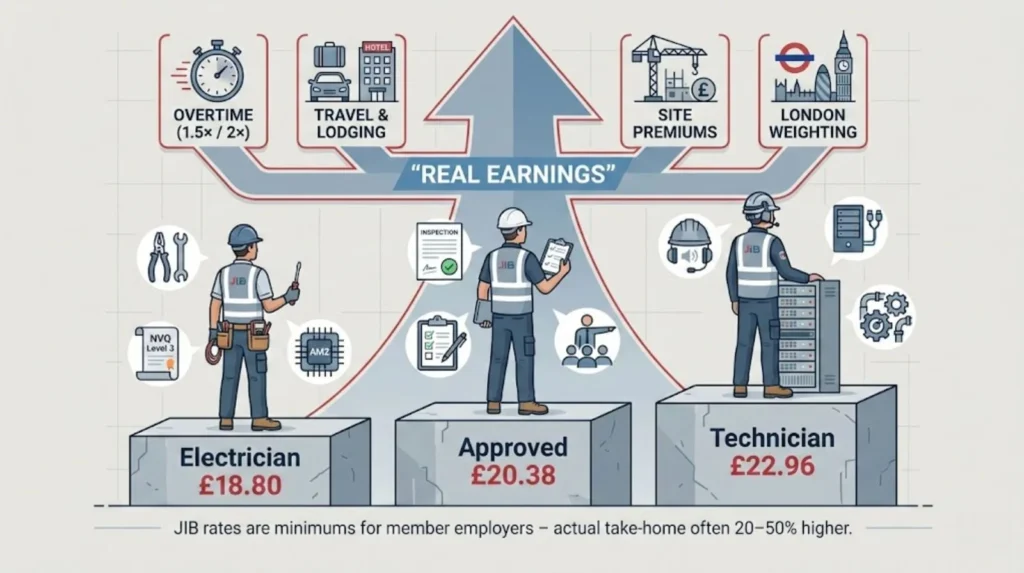
JIB electrician rates represent the minimum hourly wages for qualified electrical operatives working under Joint Industry Board collective agreements in England, Wales, and Northern Ireland, but understanding what these rates actually mean requires distinguishing between the headline hourly figure (the “floor” that participating employers cannot legally pay below), the employment framework creating those minimums (collective bargaining between Electrical Contractors’ Association employers and Unite the Union members applicable only to JIB member firms), and the real-world take-home earnings electricians experience after accounting for overtime premiums at time-and-a-half or double-time, travel allowances compensating distance beyond 15 miles from employer base, lodging payments for working away from home, shift premiums for night work, and regional uplifts like London weighting adding £2-3/hour to base rates.
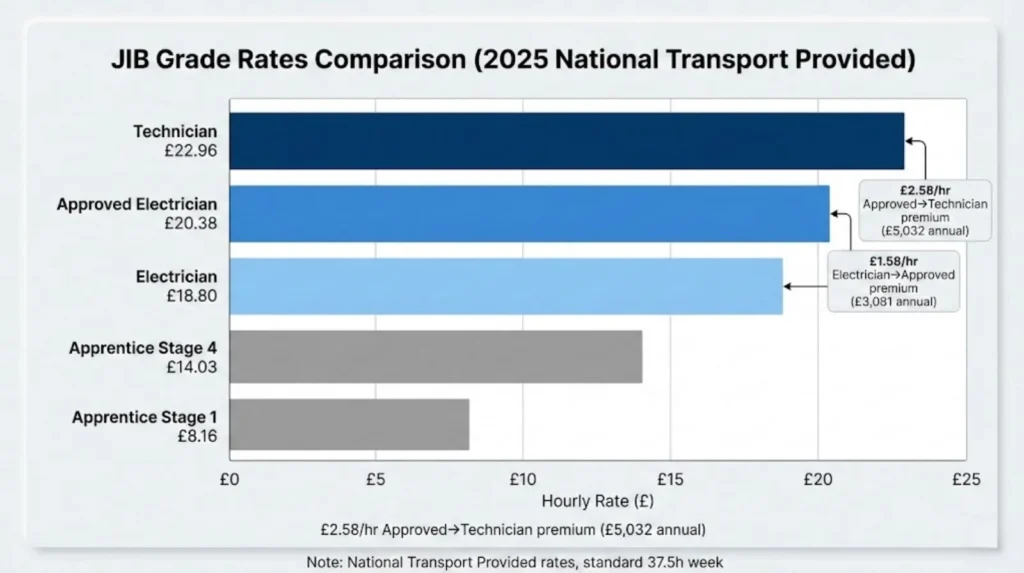
The three core graded rates matter most for qualified electricians understanding career earning potential: Electrician at £18.80/hour representing newly qualified operatives holding NVQ Level 3 and AM2 assessment competent in standard installation and maintenance work, Approved Electrician at £20.38/hour (+£1.58 premium) requiring minimum two years’ experience plus inspection and testing qualifications like City & Guilds 2391 enabling certification of electrical installations and supervision of small teams, and Technician Electrician at £22.96/hour (+£2.58 over Approved) demanding five years as Approved Electrician plus Level 4 technical qualifications and supervisory experience for senior site oversight and complex system integration roles. These jib electrician rates 2026 establish baseline compensation but actual annual earnings vary substantially between £36,000-50,000+ depending on working patterns (standard 37.5 hours versus 45-50 hour weeks common in commercial construction and industrial maintenance), employment status (PAYE employees with benefits versus CIS contractors negotiating higher gross rates without holiday pay or sick leave), and sector demand (specialist areas like data centres and infrastructure projects routinely paying £3-5/hour above JIB minimums through site premiums and market competition).
This article explains what JIB electrician rates actually cover in practical terms, how they translate into weekly and annual gross pay before overtime and allowances multiply effective earnings substantially, why two electricians both on the same headline rate can experience vastly different take-home outcomes depending on employment structure and working patterns, and what these minimum rates don’t include that makes the difference between £18.80/hour appearing on a contract and £25-30/hour landing in a bank account after a typical working week on a busy commercial site with travel time, overnight stays, and extended hours pushing standard rate calculations into territory that looks nothing like the headline figure employers quote during recruitment conversations.
What JIB Rates Actually Are (And Aren't)
JIB rates are minimum hourly wages established through collective bargaining between the Electrical Contractors’ Association (representing employers) and Unite the Union (representing workers), creating a contractual floor that participating employers cannot legally pay below while remaining compliant with National Working Rules Agreement obligations covering employment terms, holiday entitlement, sick pay, pension contributions, and dispute resolution procedures for graded electrical operatives.
They’re NOT Statutory Minimums
Unlike National Minimum Wage (£11.44/hour for 21+) or National Living Wage (£12.21/hour for 21+) which apply to all UK employers by law regardless of industry or participation, JIB rates only bind JIB member firms who have voluntarily signed up to the collective agreement and employ graded operatives under those specific terms. This means:
A domestic electrical firm that never joined the JIB can legally pay whatever they negotiate with their electricians – could be £15/hour, could be £25/hour, completely independent of JIB determinations. They’re not breaking any law as long as they meet statutory minimum wage.
A commercial contractor who is a JIB member MUST pay at least the JIB rate for each graded operative – an Electrician cannot receive less than £18.80/hour base rate, an Approved cannot receive less than £20.38/hour, regardless of project profitability or economic conditions.
They’re Voluntary Participation
JIB membership is concentrated in large-scale commercial contractors, industrial maintenance firms, infrastructure projects, and public sector electrical work where unionized workforces and multi-employer sites make standardized rates practical. Many small and medium electrical businesses (particularly domestic installers, light commercial fit-out firms, and specialist contractors) operate entirely outside the JIB framework, using market rates negotiated individually with electricians based on local supply and demand rather than collective bargaining outcomes.
They’re Base Rates Only
The headline JIB rate – £18.80/hour for Electrician, £20.38 for Approved, £22.96 for Technician – represents payment for standard 37.5-hour working week (typically Monday-Friday, 7.5 hours daily with 30-minute unpaid meal break). It does NOT include:
Overtime premiums: Time-and-a-half (1.5×) after 37.5 hours weekdays, double-time (2×) after 8pm or weekends
Travel allowances: 22p/mile non-taxable + 12p/mile taxable for distances over 15 miles from employer base
Lodging payments: £51.29/night for overnight stays working away from home
Shift premiums: +1/3 additional pay for night shifts (typically after 8pm-6am patterns)
Regional uplifts: London weighting built into higher zonal rates (£21.06 Electrician, £22.64 Approved, £25.22 Technician)
Site bonuses: Project-specific premiums offered by employers on high-priority work
Thomas Jevons, Head of Training at Elec Training, explains the crucial distinction:
"When people see '£18.80/hour Electrician rate,' they often think that's what they'll actually earn per hour. That's the base rate for a 37.5-hour standard week. Real earnings come from overtime premiums - time-and-a-half after 37.5 hours makes your £18.80 become £28.20/hour, double-time on Sundays makes it £37.60/hour. Add travel allowances, lodging payments for working away, and shift premiums for night work, and your effective hourly rate can be £25-30/hour even on an £18.80 base. The rate is the floor, not the ceiling."
Thomas Jevons, Head of Training
The Three Core Graded Rates Explained
Electrician Grade: £18.80/Hour (National TP 2025)
Who qualifies: Newly qualified electricians holding NVQ Level 3 in Electrotechnical Installation (or recognized equivalent like City & Guilds 2365 Level 3) plus successful AM2 practical assessment demonstrating competence in safe isolation, wiring systems, installation procedures, and basic testing under BS 7671:2018+A2:2022 Wiring Regulations requirements.
What the rate assumes: Independent capability to install, maintain, and repair electrical systems without direct supervision across domestic, commercial, and industrial settings. Competent in containment systems (trunking, conduit, cable tray), circuit wiring (lighting, power, distribution), equipment installation (consumer units, distribution boards, switchgear), and fault-finding using standard test equipment (multimeters, insulation testers, continuity testers).
Typical responsibilities:
General electrical installation on construction sites and maintenance in operational buildings
Running cables, terminating connections, installing accessories (sockets, switches, lighting)
Basic testing and recording results on installation certificates
Supervising apprentices and junior operatives
Following work instructions and technical drawings
What the rate does NOT include:
Signing off Electrical Installation Certificates (requires Approved status with inspection/testing qualifications)
Complex system design or modifications without supervision
Supervisory responsibility for teams (Approved/Technician territory)
Specialist work like high voltage, instrumentation, or advanced controls without additional certification
Annual earnings at standard hours: £18.80 × 37.5 hours × 52 weeks = £36,660 gross (approximately £28,000 take-home after tax, National Insurance, and standard pension contributions)
Annual earnings with typical overtime: Adding 7.5 overtime hours weekly at time-and-a-half = £43,785 gross (approximately £33,000 take-home), common pattern in commercial construction during installation phases
Approved Electrician Grade: £20.38/Hour (+£1.58 Premium)
Who qualifies: Electricians with minimum two years’ experience in the Electrician grade plus additional qualifications enabling inspection, testing, and certification of electrical installations – typically City & Guilds 2391 Inspection and Testing or equivalent demonstrating competence in periodic inspection procedures, test instrument use (insulation resistance, continuity, earth loop impedance, RCD testing), and completing Electrical Installation Condition Reports (EICRs) identifying code 1/2/3 defects.
What the £1.58/hour premium buys: The additional £3,081 annually (at standard 37.5 hours) reflects:
Legal responsibility for signing off electrical work as compliant with BS 7671
Advanced technical knowledge of testing procedures and fault diagnosis
Capability to design and modify installations within competence scope
Supervisory skills for leading small teams (2-4 electricians plus apprentices)
Client-facing responsibilities including technical discussions and compliance explanations
Typical responsibilities:
System design for standard installations (lighting layouts, power distribution, circuit calculations)
Certification of electrical installations via EICRs and installation certificates
Leading installation teams on medium-complexity projects
Technical problem-solving and fault-finding on existing systems
Liaison with building control, architects, and main contractors on compliance matters
Annual earnings at standard hours: £20.38 × 37.5 × 52 = £39,741 gross (approximately £30,000 take-home)
Annual earnings with overtime and allowances: 45-hour weeks (7.5 OT at 1.5×) plus typical travel/lodging on infrastructure project = £48,000-52,000 gross (approximately £36,000-38,000 take-home), common in industrial maintenance and commercial construction
Technician Electrician Grade: £22.96/Hour (+£2.58 Over Approved)
Who qualifies: Approved Electricians with minimum five years’ experience at Approved level plus NVQ Level 4 or higher technical qualifications (HNC/HND in Electrical Engineering, specialist certifications in high voltage, instrumentation, programmable logic controllers, or equivalent) demonstrating advanced technical expertise and supervisory capability for complex multi-disciplinary projects.
What the additional £2.58/hour premium buys: The £5,032 annual increase over Approved status (at standard hours) reflects:
Senior technical expertise for complex systems (HV, automation, building management, data networks)
Project oversight coordinating multiple trades and subcontractors
Safety leadership including risk assessments and method statements
Technical design work requiring engineering calculations and system integration
Budget and programme management responsibilities
Typical responsibilities:
Site supervision on major projects (data centres, substations, manufacturing facilities)
Complex fault diagnosis on integrated systems (SCADA, fire alarms, access control)
Technical liaison with consulting engineers and design teams
Mentoring and developing Electricians and Approved Electricians
Quality assurance and compliance verification across entire installations
Annual earnings at standard hours: £22.96 × 37.5 × 52 = £44,772 gross (approximately £33,000 take-home)
Annual earnings with full package: 48-hour weeks, responsibility money (+£1-2/hour site premium), lodging, and performance bonuses on major infrastructure = £55,000-65,000 gross (approximately £40,000-46,000 take-home), typical for Technicians on high-value industrial or infrastructure projects
What Makes Two Electricians on Same Rate Earn Differently
Two electricians both employed as Approved Electricians at the £20.38/hour JIB base rate can experience vastly different annual earnings – one taking home £30,000 while the other banks £42,000 – based entirely on working patterns, employment status, sector placement, and how employer compensation packages structure overtime, allowances, and benefits beyond the headline hourly figure.
Factor 1: Working Hours Pattern
Electrician A (Standard Hours Only):
Works consistent 37.5-hour weeks on domestic and light commercial projects
Minimal overtime (occasional Saturday mornings at time-and-a-half)
Annual gross: £39,741 (£20.38 × 37.5 × 52)
Take-home: £30,000 after tax/NI
Electrician B (Regular Overtime):
Works 45-hour weeks consistently on commercial construction (7.5 OT hours at 1.5× = £30.57/hour)
Base: £20.38 × 37.5 = £764.25/week
Overtime: £30.57 × 7.5 = £229.28/week
Weekly total: £993.53
Annual gross: £51,663
Take-home: £38,000 after tax/NI
Difference: £8,000 take-home purely from consistent 7.5 weekly overtime hours (20% time increase = 27% earnings increase through premium multiplier)
Factor 2: Travel and Lodging Allowances
Electrician A (Local Work):
Lives 8 miles from employer base, travels to sites within 15-mile radius
No travel allowance triggered (under 15-mile threshold)
Works from home each night
No lodging payments
Electrician B (Working Away):
Placed on infrastructure project 80 miles from home
Travel allowance: 80 miles × 2 (return) × 5 days × 22p non-taxable = £176/week (£9,152 annual)
Lodging allowance: £51.29/night × 5 nights = £256.45/week (£13,335 annual)
Weekly addition: £432.45 tax-free/reduced tax
Annual addition: £22,487 on top of base pay
Difference: £22,487 additional gross income from working away (though offset by living expenses, time away from family, and personal travel costs)
Factor 3: Employment Status (PAYE vs Contractor)
Electrician A (PAYE Employee):
JIB Approved rate: £20.38/hour
Benefits included: 22 days holiday + 8 bank holidays (5.8 weeks paid), employer pension 7-10%, sick pay, employment protections
Annual gross at 37.5h: £39,741
Holiday value: £4,456 (5.8 weeks × £768.45 weekly)
Pension value: £2,782-3,974 (7-10% employer contribution)
Total package value: £47,000-48,000
Electrician B (CIS Self-Employed):
Quotes £25/hour (£5 above JIB to compensate no benefits)
No holiday pay (30 days unpaid = 6 weeks = -£7,500 opportunity cost)
No employer pension (must fund own = -£3,000-4,000 annual)
No sick pay (any illness = lost income)
Annual gross at 37.5h: £48,750
After holiday/pension adjustments: £38,000-39,000 effective
Joshua Jarvis, Elec Training’s Placement Manager, explains the contractor parity calculation:
"Self-employed contractors often reference JIB rates when pricing their labour, but they should be adding 25-35% on top to reach parity with PAYE employees. Why? Because JIB employees get 22 days holiday plus 8 bank holidays (that's 5.8 weeks paid time off), employer pension contributions (typically 7-10%), sick pay, and employment protections. Contractors get none of that. If you're CIS self-employed quoting £20/hour because that's near the JIB Approved rate, you're effectively working for less than a PAYE electrician once you account for unpaid holidays and no benefits."
Joshua Jarvis, Placement Manager
Combined Impact Example
Approved Electrician on infrastructure project (all factors):
Base: £20.38/hour National rate
Hours: 45/week (7.5 OT at 1.5×)
Allowances: Travel £176/week + Lodging £256/week
Site premium: Employer adds £2/hour for specialist project
Weekly breakdown:
Standard hours: £20.38 × 37.5 = £764.25
Overtime: £30.57 × 7.5 = £229.28
Site premium: £2 × 45 = £90
Travel: £176
Lodging: £256.45
Total weekly: £1,515.98
Annual gross: £78,831 Take-home: Approximately £55,000-58,000 (after tax/NI but including tax-efficient allowances)
This demonstrates how £20.38/hour base rate becomes £33.69 effective hourly rate (£78,831 ÷ 2,340 hours) when realistic working patterns, allowances, and premiums apply on busy projects.
Common Confusions About JIB Rates
“JIB Rates Apply to All UK Electricians”
Reality: JIB rates only bind JIB member employers who voluntarily participate in the collective agreement. Many electrical firms – particularly small domestic installers, specialist contractors, and maintenance companies – operate entirely outside JIB framework, negotiating wages individually based on market conditions, skills shortages, and local competition rather than collective bargaining outcomes.
“My ECS Gold Card Means I Get JIB Rates”
Reality: Your ECS (Electrotechnical Certification Scheme) card proves your qualification grade – Gold Card shows you’re qualified to NVQ Level 3 and AM2 standard for Electrician, or inspection/testing qualified for Approved status. It does NOT compel any employer to pay JIB rates unless they’re a JIB member firm. Non-JIB employers can see your card, acknowledge you’re qualified, and still negotiate whatever wage they want.
“Approved Electrician is Just a Job Title”
Reality: Approved Electrician is a formal JIB grade requiring:
Minimum two years’ experience as graded Electrician
Inspection and testing qualifications (City & Guilds 2391 or equivalent)
Application to JIB for grade assessment with evidence submission
Formal grading approval before the £1.58/hour premium applies
You cannot simply call yourself “Approved” and demand the higher rate – you need JIB grading confirmation.
“Hourly Rate × 2,000 Hours = Annual Pay”
Reality: This calculation (£20.38 × 2,000 = £40,760) is completely wrong for JIB employment because:
JIB standard is 37.5 hours/week = 1,950 hours annually (not 40 hours = 2,080 or 2,000 rounded)
Holiday pay is included in annual calculation (JIB employees get 22 days + 8 bank holidays but are paid for 52 weeks)
Overtime hours are paid at 1.5× or 2× premiums, not straight time
Allowances (travel, lodging, shifts) add non-hourly income not captured in simple multiplication
Correct annual calculation: £20.38 × 37.5 × 52 = £39,741 base (before overtime/allowances add 20-50%)
“JIB Guarantees Overtime”
Reality: JIB National Working Rules discourage systematic overtime, treating it as emergency/temporary measure for genuine project urgency rather than permanent working pattern. Overtime availability depends entirely on:
Employer project pipeline and deadlines
Sector patterns (commercial construction offers more than domestic work)
Seasonal variation (March-October busier than winter months)
Economic conditions (booms = plentiful overtime, recessions = strict 37.5 hours)
Don’t budget household expenses assuming permanent overtime – use base 37.5-hour calculation as reliable foundation.
“Non-JIB Always Pays Less”
Reality: Non-JIB employers often pay more than JIB minimums in high-demand sectors because:
They’re competing with JIB firms for qualified electricians in tight labour markets
Specialist sectors (data centres, infrastructure, industrial automation) offer premiums for niche skills
Agency and contract roles routinely exceed JIB rates by £3-7/hour gross (though without benefits)
JIB provides security floor, not market ceiling.
What JIB Rates Mean for Career Decisions
Understanding JIB rates helps electricians at different career stages make informed decisions about qualification pathways from initial NVQ Level 3 electrical training through AM2 practical assessment, inspection and testing qualifications, and employment choices balancing security versus market flexibility when evaluating job offers, planning qualification investments, or considering self-employment versus PAYE employment structures.
For Newly Qualified Electricians
Electrician grade (£18.80/hour = £36,660 annual base) provides:
Clear baseline for evaluating first job offers (anything below £36,000 suggests employer paying under JIB minimums or pro-rata for part-time/seasonal patterns)
Security knowing JIB employers cannot reduce pay below minimums during quiet periods
Structured progression pathway (2 years + 2391 qualification = Approved grade = £3,081 annual increase)
Decision framework:
JIB member firm offers: Security, benefits, clear progression, but potentially lower gross than non-JIB market rates
Non-JIB firm offers: Potentially £2-4/hour higher gross, but no guaranteed minimums, benefits vary, progression unclear
For Experienced Electricians Considering Approved Status
Investment required:
City & Guilds 2391 course: £1,200-1,800 (1-2 weeks classroom + practical assessment)
Two years’ experience minimum (opportunity cost: working as Electrician while building experience)
Return on investment:
Immediate: £1.58/hour increase = £3,081 annual (at 37.5h standard)
With overtime: £1.58/hour base + overtime premiums = £4,000-5,000 annual increase
Career options: Supervisory roles, complex installations, certification responsibilities
Payback period: 6-12 months of higher earnings covers course costs, then permanent £3,000+ annual increase continues for entire career
For Self-Employed Electricians Pricing Labour
JIB as benchmarking tool:
Approved rate £20.38/hour + 30% = £26.50/hour minimum CIS quote to reach PAYE parity
Calculation: Add 22% for lost holiday pay (5.8 weeks), 8% for lost pension, plus buffer for sick pay risk and admin time
Market positioning: Specialist skills (solar, EV, automation) justify £30-35/hour; standard domestic work clusters £22-28/hour
Risk assessment:
Higher gross rates offset by: No paid holidays (£4,500-5,000 annual cost), no sick pay (any illness = lost income), own tax/accounting responsibilities (£500-1,500 annual), irregular income patterns
Benefits: Flexibility, potential for higher peak earnings, business growth opportunities
JIB electrician rates establish minimum hourly wages (Electrician £18.80, Approved £20.38, Technician £22.96 for 2025-2026 National Transport Provided) applicable only to participating member employers and graded operatives, providing security floor rather than market ceiling while actual take-home earnings vary substantially (20-50% higher) once overtime premiums, travel and lodging allowances, shift payments, and regional uplifts multiply baseline calculations. Two electricians on identical headline rates experience different annual outcomes based on working patterns (37.5-hour standard weeks versus 45-50 hour patterns common in commercial construction and industrial maintenance), employment status (PAYE with holiday pay and pension versus CIS contractors needing 25-35% premium to reach parity), and sector placement (specialist areas like data centres and infrastructure routinely paying £3-5/hour above minimums through site premiums and market competition for scarce skills).
Understanding rates as minimums not maximums protects electricians from under-pricing labour when self-employed, enables informed evaluation of job offers comparing base rates against total compensation packages including benefits worth £5,000-8,000 annually, and clarifies qualification investment returns where Electrician to Approved progression delivers permanent £3,081 annual increase (at standard hours, more with overtime) that exceeds 8-9 years of typical 4% annual pay rises compressed into single qualification completion. The rate is always the floor establishing what participating employers cannot legally pay below while remaining JIB-compliant, but ceiling is determined by market forces, skills shortages, negotiation capability, and how essential your particular expertise proves to employers competing for qualified electrical operatives in high-demand sectors and geographic areas where supply constraints push actual wages substantially above collective bargaining minimums.
Call us on 0330 822 5337 to discuss how qualification pathways from NVQ Level 3 completion through AM2 assessment, inspection and testing qualifications enabling Approved grade progression, and specialist training in solar, EV charging, or industrial automation position you for roles where actual earnings substantially exceed JIB minimum rates through market premiums, what realistic timelines look like for moving from Electrician to Approved status delivering permanent £3,081 annual income step-change, and how our in-house recruitment team helps learners secure JIB member firm placements or high-paying non-JIB roles where specialist skills command £25-35/hour gross versus £18-23/hour JIB minimums. No hype, no unrealistic guarantees – just practical guidance on navigating qualification investments and employment decisions where understanding rates as security floor rather than earning ceiling makes the difference between £36,000 and £55,000 annual take-home on similar base rate foundations.
References
- JIB (Joint Industry Board) – JIB Handbook 2025 with wage rates and grade definitions – https://www.jib.org.uk/wp-content/uploads/2025/01/JIB-Handbook-2025.pdf
- JIB – National Working Rules Agreement explaining standard hours, overtime, and allowances – https://www.jib.org.uk/
- Electrical Contractors’ Association (ECA) – Member guidance on applying JIB rates – https://www.eca.co.uk/member-support/employee-relations/national-collective-agreements/jib-pay-rates
- Electrotechnical Certification Scheme (ECS) – Grading and card requirements – https://www.ecscard.org.uk/
- Unite the Union – Construction sector JIB information – https://www.unitetheunion.org/
Note on Accuracy and Updates
Last reviewed: 5 January 2026. This page is maintained; we correct errors and refresh sources as JIB rates, National Working Rules, and employment practices change. 2025-2026 rates confirmed from JIB Handbook 2025 published January 2025 showing Electrician £18.80/hour, Approved Electrician £20.38/hour, Technician £22.96/hour National Transport Provided. Overtime premiums (time-and-a-half 1.5×, double-time 2×), allowances (travel 22p+12p/mile, lodging £51.29/night), and regional uplifts (London +£2.26-2.58/hour) sourced from JIB National Working Rules Agreement 2025. Take-home pay calculations use standard UK tax rates (basic 20%, higher 40%) and National Insurance (12% up to upper earnings limit, 2% above) applicable 2025-2026 tax year; actual net pay varies by individual circumstances including tax codes, pension contributions, student loan repayments. Employment status comparisons (PAYE vs CIS contractor) use typical benefit values (holiday pay 12.07% of gross, employer pension 7-10%, sick pay statutory minimum) as illustrative examples; actual packages vary by employer. Market pay premiums (non-JIB rates £3-5/hour above minimums in high-demand sectors) based on job advertisement analysis and industry recruitment patterns 2024-2025; regional and sector variation significant. Grade progression requirements (Approved requiring 2 years + 2391, Technician requiring 5 years + Level 4) confirmed from JIB grading criteria; actual assessment timelines depend on evidence submission and approval processing. Next review scheduled following 2026 JIB wage determination publication (typically July-August) for rate updates and any structural changes to allowances or grading criteria.
