

JIB Gold Card Pay – What You Earn Once Qualified

- Technical review: Thomas Jevons (Head of Training, 20+ years)
- Employability review: Joshua Jarvis (Placement Manager)
- Editorial review: Jessica Gilbert (Marketing Editorial Team)
- Last reviewed:
- Changes: Initial publication following JIB 2025 rate confirmation and 2026-2028 wage agreement analysis

Introduction
The JIB Gold Card is the UK electrical industry’s most recognised credential. Pass your NVQ Level 3, complete your AM2 assessment, and you’re officially a qualified electrician. But here’s what the training ads won’t tell you upfront: your Gold Card doesn’t come with a fixed salary attached to it.
JIB pay rates for 2025 put a qualified Electrician at £17.68 to £18.80 per hour depending on whether your employer provides transport. That’s the official baseline, the safety net, the foundation. But walk onto any commercial site in London and you’ll see agency workers on £26 per hour CIS standing next to JIB employees on £18.80 PAYE, both doing near-identical work.
So what do you actually earn once qualified? The honest answer is: it depends on your route (PAYE vs CIS), your region (London vs Midlands), your grade (Electrician vs Approved vs Technician), your sector (domestic vs commercial vs industrial), and how much overtime you’re prepared to work. Let’s break down the real numbers, the trade-offs, and what newly qualified electricians can realistically expect in 2025 and beyond. If you want the detailed guide to JIB Gold Card earnings and qualified electrician pay expectations, we’ve covered the full progression pathway there, but this article focuses specifically on pay once you’ve got that card in your hand.
The Official JIB Pay Rates for 2025
Let’s start with the official numbers. As of 6 January 2025, JIB rates for graded operatives are:
Electrician: £17.68/hour (transport provided) or £18.80/hour (own transport)
Approved Electrician: £19.32/hour (transport provided) or £20.38/hour (own transport)
Technician: £21.84/hour (transport provided) or £22.96/hour (own transport)
These rates came with a 5% increase in January 2025, following a 7% rise in January 2024. The difference in rates based on transport provision reflects travel costs. If you’re driving yourself to site, you get the higher rate plus mileage allowance for distances over 15 miles (22p per mile).
Alongside hourly pay, JIB workers receive sick pay during weeks 3 to 24 of illness: £200 per week for Electricians, £210 for Approved, £220 for Technicians. You also get access to private healthcare through Bupa, pension contributions, and death-in-service benefit of £40,000.
Other allowances include lodging at £51.29 per night (tax-free) if you’re working away, and responsibility money for Approved Electricians ranging from 50p to £2.00 per hour depending on the level of supervision you’re providing. Overtime is paid at 1.5x for evenings and Saturdays, and 2x (double time) for Sundays and bank holidays.
Critical point: these rates only apply if your employer is a JIB signatory (typically ECA member firms or Unite-recognised contractors). Plenty of electrical firms in the UK are not JIB registered and pay whatever the local market accepts, sometimes higher, often lower, rarely with the same benefits package.
Future JIB Pay Increases (2026-2028)
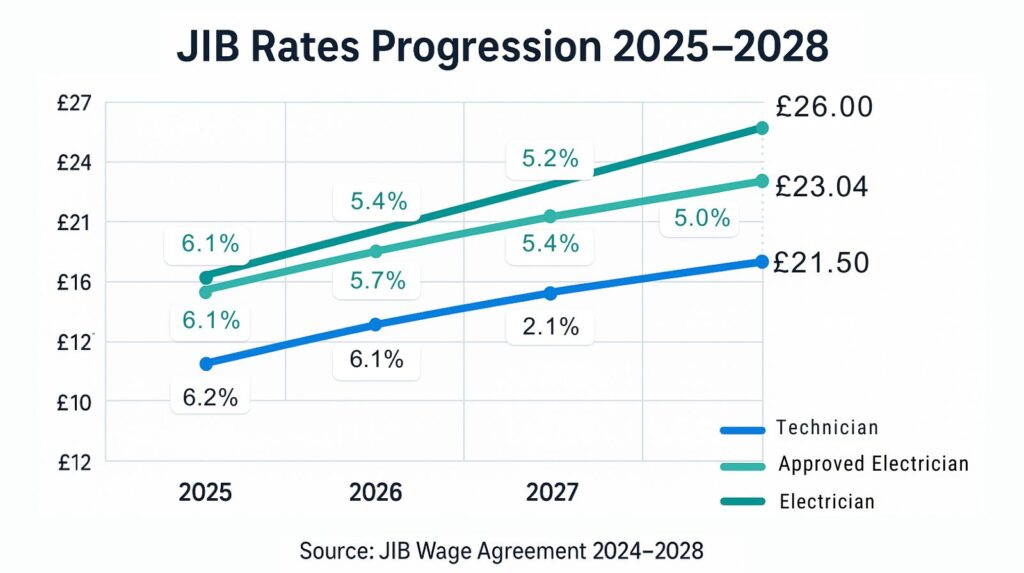
The good news is that pay rises are already locked in. The JIB wage agreement covering 2026 to 2028 confirms:
January 2026: 3.95% increase across all grades
January 2027: 4.6% increase
January 2028: 4.85% increase
Additionally, sick pay for operatives increases by £10 per week during weeks 3 to 24, meaning Electricians will receive £210 per week, Approved Electricians £220, and Technicians £230.
Based on current 2025 rates, an Approved Electrician on £20.38/hour will see their rate rise to approximately £21.06 in 2026, £21.97 in 2027, and £23.04 in 2028 (assuming compounding increases and own transport rate). These aren’t inflation-linked, they’re fixed percentage rises agreed between the ECA and Unite union, so they provide certainty even if inflation drops or economic conditions shift.
For someone completing their NVQ and AM2 in 2025, this means your baseline pay will increase by roughly 14% cumulatively over the next three years without needing to change grade or employer.
Real-World Earnings vs Official JIB Pay
Here’s where things get complicated. JIB rates are the baseline, but real-world electrical work operates on multiple payment models simultaneously, and they don’t all align neatly.
Agency CIS (Construction Industry Scheme): Most London agencies offer £24 to £28 per hour. Regional agencies outside London typically offer £22 to £24. These are gross rates before 20% CIS tax deduction. Critically, you receive no holiday pay, no sick pay, no pension contributions. When a project ends, your income stops immediately.
Direct employment (non-JIB PAYE): Many smaller electrical contractors mirror JIB rates but don’t provide the benefits package. An Approved Electrician might be capped at £18.50 per hour flat rate with basic statutory holiday and no private healthcare.
Industrial and commercial projects: Data centres currently command £25 to £32 per hour due to security clearance requirements and shift patterns. Commissioning engineers (typically Technician-grade equivalent work) can pull £35 to £45 per hour, especially on complex installations requiring design input and testing sign-off.
Specialist roles: Inspection and testing roles, where you’re providing your own multifunction tester and working independently, command £250 to £350 per day. Solar and EV installation work currently carries a premium due to skills shortages, though this is gradually normalising as more electricians gain these qualifications.
Domestic new-build price work: Some housing site electricians work on “price-per-plot” rather than hourly rates. Fast, experienced workers doing first and second fix can earn £400+ per day, but this comes with significant risk. If materials are delayed or you need to return for rectifications, you’re not earning. One bad week can wipe out a month’s premium.
The complete analysis of electrician salaries from trainee through to JIB-approved status covers the full qualification pathway, but the earning reality once qualified comes down to risk tolerance. CIS offers higher headline rates but zero income security. JIB PAYE offers lower rates but consistent pay, holiday cover, and sick pay.
Regional Differences
Pay rates aren’t uniform across the UK. London commands the highest rates but also the highest costs.
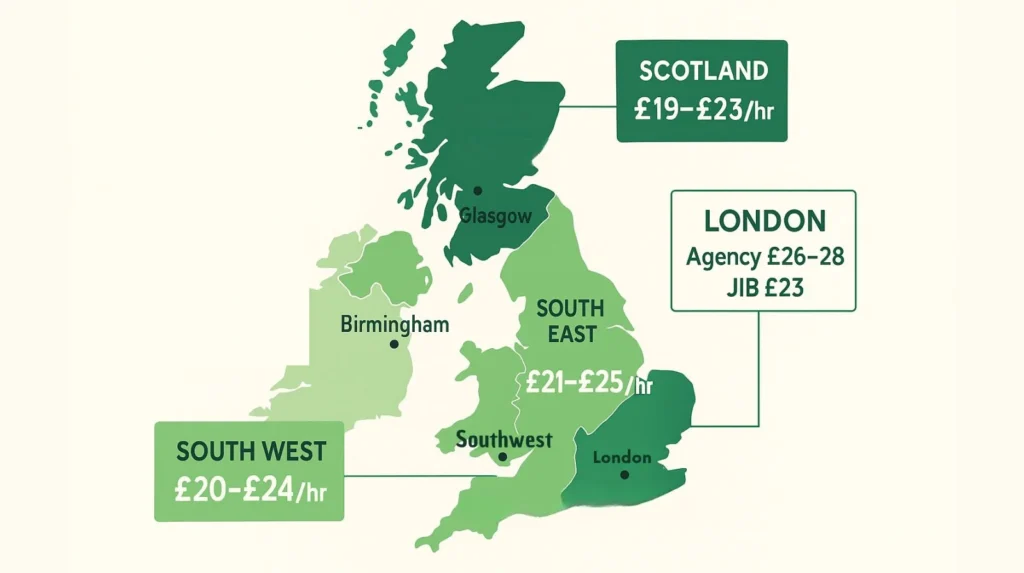
London and M25 ring: JIB rates include approximately 12% to 15% London weighting, pushing Approved Electrician pay to around £23 per hour for JIB workers. Agency rates consistently hit £26+ due to demand, but congestion charges (£15 per day) and ULEZ (£12.50 per day) significantly impact net earnings if you’re self-employed and your client doesn’t cover these costs. Accommodation is expensive if you’re working away.
Scotland (SJIB): Scottish JIB rates align almost perfectly with UK-wide rates due to cross-border agreements. Technicians earn £21.84, Approved £19.32, Electricians £17.68 as standard. The difference is cultural: lodging work is more common in Scotland due to remote Highlands projects, so the £51.29 per night lodging allowance gets used more frequently.
Midlands and Northern England: Commercial work here tends to stick closer to JIB baseline rates. Domestic new-build sites often use piece-work payment models. There’s less “over-the-top” agency inflation compared to London. A £22 per hour role in Birmingham is often more financially attractive than £28 in London once you account for living costs.
South West: Based on contractor feedback, daily rate work dominates in this region. £300+ per day rates are common for experienced electricians on 8-hour shifts (effectively 6 hours of actual site work after setup and travel). Holiday lets, barn conversions, and rural properties drive demand.
What Job Ads Actually Offer
Job boards paint a rosier picture than the contracted reality. Here’s what “Electrician – Gold Card” roles actually mean when you read the fine print:
Permanent PAYE roles advertised at £36,000 to £42,000: These figures almost always include expected overtime. The contracted hours might be 37.5 per week at £19 per hour (£37,050 annually), with the advertised £42,000 assuming you’ll work an additional 5 to 10 hours per week at 1.5x overtime rate. If you don’t work the overtime, you don’t get the advertised salary.
Maintenance electrician roles at £40,000 to £48,000: These include call-out rotas. One week in four, you’re carrying the emergency phone, responding to breakdowns at 2am, and working weekends. Call-out standby typically pays £150 to £250 per week just for being available, with a minimum 4-hour pay at overtime rate when you’re actually called out. The headline salary assumes full participation in the rota.
CIS contract roles at £24 to £28 per hour: Job ads highlight “long hours available” or “10 to 12 hour days.” That’s code for: you’ll work extended hours to maximise earnings, but when the project finishes (often with minimal notice), your income drops to zero until the next contract starts.
Electrical supervisor roles (SSSTS qualified) at £50,000 to £55,000: Often salaried positions, which sounds great until you realise salaried means unpaid overtime for paperwork, planning, and site coordination. You might be working 50-hour weeks for what works out to £19.23 per hour.
Inspection and testing roles at £36,000 plus £10,000 bonus: The bonus is tied to hitting productivity targets (number of EICRs completed per month). Miss your targets due to access issues, difficult sites, or thorough inspections taking longer than scheduled, and you lose a significant chunk of that advertised income.
The pattern is consistent: advertised salaries assume maximum availability, extended hours, and hitting all performance metrics. Contracted base pay is often £6,000 to £10,000 lower than the headline figure.
Overtime, Uplifts & Add-Ons
JIB overtime multipliers are straightforward on paper:
Monday to Friday after normal hours: 1.5x your standard rate
Saturday (first 4 to 6 hours depending on agreement): 1.5x
Saturday after cut-off, all Sunday work: 2x (double time)
Bank holidays: 2x plus a day off in lieu
In practice, overtime availability varies dramatically by sector. Commercial fit-out work near project deadlines can offer 10 to 20 hours per week of overtime. Maintenance work has reactive overtime (call-outs) which is less predictable. New-build housing sites rarely offer scheduled overtime, it’s more about working faster on price-per-plot contracts.
Call-out arrangements add another layer. If you’re on the emergency rota, you receive standby pay (£150 to £250 per week) whether you’re called out or not. When the phone rings, most company policies guarantee a minimum 4 hours pay at overtime rate even if the job only takes 30 minutes.
Night shift premiums range from 10% to 20% depending on the contract. Weekend uplifts follow JIB multipliers but some non-JIB firms cap weekend work at 1.5x rather than 2x for Sundays.
The lodging allowance of £51.29 per night is tax-free, which matters if you’re working away from home. However, multiple electricians have noted this rate is tight in 2024-2025, especially in the South where finding decent accommodation for £51 per night is increasingly difficult. You often end up out of pocket or staying in substandard digs.
Thomas Jevons, our Head of Training with 20+ years on the tools, explains:
"According to the JIB grading structure, the real earnings jump comes when you progress to Approved Electrician status. That requires two years post-qualification plus your 2391 Inspection & Testing qualification. The pay difference is only £1.64 per hour, but it's the legal responsibility for signing off EICRs that makes you far more valuable to employers."
Thomas Jevons, Head of Training
Electrician vs Approved vs Technician: Pay & Responsibility
The pay gap between grades is modest, but the responsibility gap is significant.
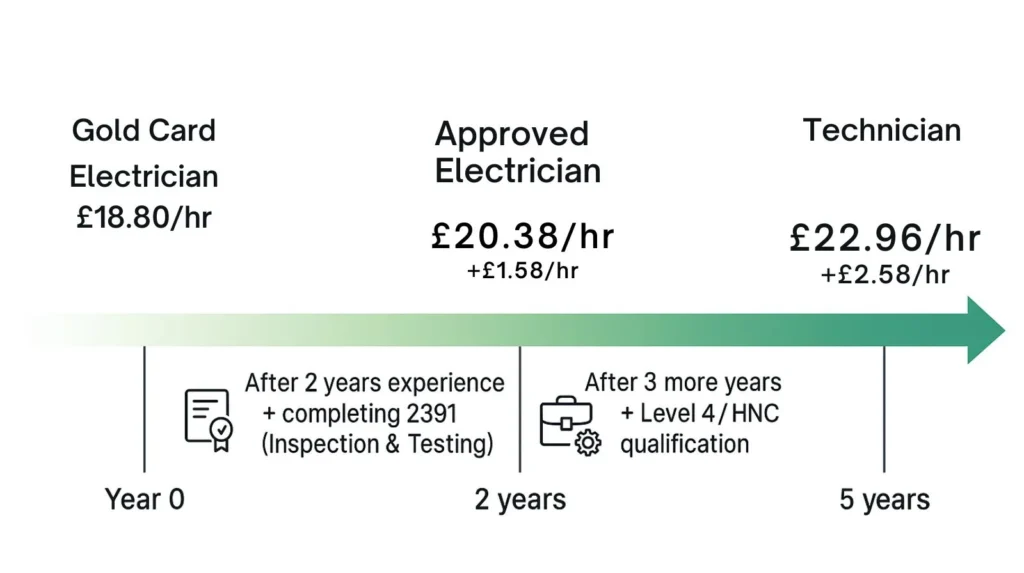
Electrician to Approved Electrician: The jump is £1.64 per hour (based on January 2025 rates with own transport: £18.80 vs £20.38). Over a 37.5-hour week, that’s an additional £61.50 per week, or roughly £3,200 annually. The requirement is two years of post-qualification experience plus completion of your 2391 (or 2396) Inspection & Testing qualification.
The critical difference isn’t just pay. Approved Electricians can legally sign off Electrical Installation Condition Reports (EICRs) as the “Inspector.” Standard Electricians cannot. This makes Approved status essential for testing and inspection work, landlord compliance contracts, and any role requiring independent certification authority. Employers value this significantly more than the £1.64 per hour pay increase suggests.
Approved Electrician to Technician: The jump is £2.52 per hour (£20.38 vs £22.96). Annually, that’s approximately £4,900 additional income. Technician status requires a minimum of 5 years’ experience plus a Level 4 qualification (HNC or equivalent).
Technician work involves design input, complex fault-finding, and significant site management responsibility. Fewer than 10% of electricians hold this grade. The pay reflects that rarity, but the role also carries more accountability for installation design decisions and technical leadership on projects.
In terms of career planning, targeting Approved status within 3 to 4 years of qualifying is realistic and financially worthwhile. Technician status is optional and sector-dependent; industrial and commercial contractors value it highly, domestic installers less so.
Self-Employed Earnings (CIS): The Real Picture
CIS (Construction Industry Scheme) work means you’re technically self-employed but often working alongside PAYE employees doing identical tasks. The payment structure is different, the risks are different, and the headline rates are higher for specific reasons.
Typical CIS rates: £22 to £24 per hour regionally, £24 to £28 in London, with specialist roles (data centres, commissioning) reaching £30 to £32. Some emergency call-out work or very short-term contracts hit £40 to £60 per hour, but these are rare and unsustainable as regular work.
The CIS deduction mechanism: When you’re paid, 20% is deducted at source and sent to HMRC as an advance tax payment. So £23 per hour gross becomes £18.40 per hour net into your bank account. You reclaim overpaid tax through your annual Self Assessment, but the cash flow impact is immediate.
What you lose on CIS: No holiday pay (typically worth 5.6 weeks annually, or roughly 12.07% of your earnings). No sick pay (JIB workers get £200 to £220 per week for weeks 3 to 24). No pension contributions (JIB employer contributions are typically 4% to 5%). No death-in-service benefit.
Hidden costs: Accountant fees (£80 to £120 per month or £20 to £30 per week). Public liability insurance (£300 to £600 annually). Tools and equipment replacement (your responsibility entirely). Van, fuel, and maintenance if required. ULEZ and congestion charges in London (£27.50 per day combined if not covered by client).
Example calculation from contractor data: CIS rate £23 per hour, working 45 hours per week. Gross weekly income £1,035. CIS deduction (20%) is £207. Net into bank: £828 per week. Deduct accountant fee (£25/week), insurance (£12/week), and you’re at £791. A JIB Approved Electrician on £20.38/hour working 37.5 hours takes home approximately £560 to £580 per week after tax and National Insurance, but receives 5.6 weeks of paid holiday (worth roughly £3,100 annually) plus sick pay and pension contributions.
The CIS advantage shows up when work is abundant and you’re consistently hitting 45 to 50-hour weeks. The CIS disadvantage appears immediately when projects end and you have gaps between contracts. Multiple electricians report being caught between Christmas and New Year with zero income for three weeks, which never happens to PAYE workers who receive holiday pay.
One particularly stark example from contractor forums: “Was on £26/hr CIS. Project finished 2 days before Christmas. No pay for 3 weeks. Went back to cards-in [PAYE] for £18/hr just to sleep at night.”
Take-Home Pay Examples
Gross hourly rates don’t translate directly to what hits your bank account. Here are realistic calculations based on January 2025 rates and UK tax code 1257L.
JIB Approved Electrician (PAYE, own transport): Gross hourly rate £20.38. Working 37.5 hours per week gives £764.25 weekly gross, or £3,312 monthly gross. After Income Tax and National Insurance (no pension deduction included), estimated weekly take-home is approximately £560 to £580. This does not account for the value of 5.6 weeks paid holiday (worth £4,280 annually), sick pay provision, or employer pension contributions.
Agency CIS Electrician: Gross hourly rate £23. Working 45 hours per week gives £1,035 weekly gross. CIS deduction at 20% is £207. Net payment into bank is £828 per week. Hidden costs: accountant fee (approximately £20 to £25/week), public liability insurance (approximately £10 to £15/week), potential umbrella company fees if used (£15 to £25/week). These reduce the effective net further. Critically, when work stops, income stops completely.
The comparison becomes clearer when you calculate annual earnings including holiday pay. The PAYE worker on £20.38/hour earning £560/week take-home works 46.4 weeks (after 5.6 weeks paid holiday) and takes home approximately £29,000 annually after tax, plus receives sick pay cover and pension contributions. The CIS worker on £23/hour earning £828/week works 52 weeks (no paid holiday) and takes home approximately £43,056 annually before hidden costs and without any sick pay or pension provision. If they take 4 weeks unpaid holiday, their annual net drops to £39,744. Factor in accountant fees (£1,200/year), insurance (£500/year), and other costs, and the gap narrows significantly, especially when you account for the loss of employment protections.
Joshua Jarvis, our Placement Manager, notes:
"Reliability and communication skills are just as important as technical competence when it comes to securing the better-paid positions. The electricians in our network earning £45k+ aren't just technically brilliant, they can explain a quote to a homeowner, manage their own schedule, and consistently deliver without drama. Employers pay extra for that combination."
Joshua Jarvis, Placement Manager
Progression Timeline: How Pay Increases Over a Career
Pay doesn’t stay static once you’re qualified. Here’s the realistic timeline based on JIB progression requirements and typical career patterns:
Year 0 to 2 (Newly qualified Electrician): You’ve passed your AM2 and hold your Gold Card. You’re on the Electrician rate: £17.68 to £18.80/hour. During this period, you’re logging site experience, building competence across different installation types, and working towards your 2391 Inspection & Testing qualification. Expect to stay at this rate for the full two years unless you move to CIS work or an employer offers accelerated progression.
Year 2 to 5 (Approved Electrician): Once you’ve completed two years post-qualification and gained your 2391, you can apply for Approved status. This lifts you to £19.32 to £20.38/hour. Critically, this grade allows you to sign off EICRs and take independent responsibility for testing and inspection work. Many electricians remain at Approved grade for their entire career; it’s a sustainable, well-paid position with clear legal authority.
Year 5+ (Technician, optional): Technician status requires a minimum of five years’ experience plus a Level 4 qualification (HNC in Electrical Engineering or equivalent). This takes you to £21.84 to £22.96/hour. Technician roles involve design input, complex fault-finding, and site management responsibility. This grade suits electricians who enjoy technical problem-solving and want to progress towards supervisory or project management roles.
Alternative routes: Some electricians bypass formal JIB progression entirely and move into specialist self-employed work (testing, solar, EV charging) where rates are determined by market demand rather than JIB grades. Others move into electrical project management, estimating, or training roles where salaries are negotiated independently of JIB structures.
The compressed adult learner routes (fast-track diplomas taking 3 to 6 months before NVQ) mean you can reach Electrician status within 18 months to 2 years from starting training. From there, the progression to Approved takes a further 2 years, putting you on £20.38/hour approximately 4 to 5 years after beginning your electrical training.
Economic Patterns Affecting Pay
Electrical pay doesn’t exist in a vacuum. Broader economic patterns influence what you can earn and where demand sits.
Renewables boom: Solar installation and EV charging point work currently command premium rates due to skills shortages. Electricians with additional qualifications in these areas are seeing £2 to £5 per hour above baseline rates. This premium will likely normalise as more electricians gain these qualifications, but for now it’s a genuine earnings boost.
Recession impact: When economic downturns hit, commercial new-build slows first. Maintenance roles remain relatively recession-proof because buildings still need emergency repairs and compliance testing regardless of economic conditions. JIB rates provide a safety net during bust periods. During boom periods, agency CIS rates vastly outstrip JIB rates as contractors compete for labour.
Fiscal drag: JIB wage rises (7% in 2024, 5% in 2025, and cumulative 14% from 2026 to 2028) push more electricians into the 40% tax bracket if they work significant overtime. Once your income exceeds £50,270 annually, additional earnings are taxed at 40% rather than 20%. A JIB Approved Electrician on £20.38/hour working 45 hours per week with regular overtime can easily break £50,000 annually, meaning a significant portion of overtime pay is taxed at the higher rate.
London cost-of-living pressure: While London rates are 12% to 15% higher than national rates, housing costs are often 50% to 100% higher. Electricians commuting into London from surrounding areas face daily travel costs (rail fares, ULEZ, congestion charge) that can exceed £30 per day. The higher rate doesn’t always translate to better net financial position after accounting for these costs.
Data centre expansion: The growth in data centres, particularly around London and the South East, is driving demand for electricians with industrial experience, 3-phase installations competence, and security clearance. These roles command £25 to £32 per hour but require specific qualifications and vetting that many domestic-focused electricians don’t possess.
Myths & Misunderstandings
Let’s address the most common misconceptions about Gold Card pay:
Myth: “Gold Card means £50 per hour everywhere.” Reality: JIB baseline rates are £17.68 to £22.96 per hour depending on grade. £50/hour only appears in very specific scenarios: emergency call-out work, short-term specialist contracts, or self-employed rates for complex inspection work. It’s not a typical, sustainable rate.
Myth: “London weighting doubles your pay.” Reality: London weighting adds approximately 12% to 15% to JIB rates. An Approved Electrician might earn £23/hour instead of £20.38/hour. That’s a boost, but it barely covers increased London living costs, let alone doubling earnings.
Myth: “CIS is always better financially.” Reality: CIS offers higher gross rates but you lose 5.6 weeks of paid holiday (worth 12% of annual earnings), sick pay, pension contributions, and job security. CIS works well during boom periods with continuous work. It’s financially devastating during gaps between contracts.
Myth: “You automatically get JIB rates at any electrical company.” Reality: Only firms that are JIB signatories (ECA members or Unite-recognised contractors) are required to pay JIB rates. Many private electrical firms pay market rates, which can be higher or lower depending on local competition for labour.
Myth: “You’ll earn £60k immediately after qualifying.” Reality: £60k annually as a newly qualified Electrician requires either significant overtime (55+ hours per week at Approved rate), moving to high-rate CIS work with zero downtime, or working in specialist sectors like industrial commissioning. Typical first-year earnings for a newly qualified Electrician on JIB rates are £33,000 to £38,000 depending on overtime.
Myth: “Gold Card guarantees employment.” Reality: The Gold Card proves you’re competent to BS 7671 standards and have passed AM2. It opens doors. It does not guarantee a job offer. Employers still assess reliability, communication skills, site experience quality, and your ability to work independently. The card is necessary but not sufficient for employment.

Real Stories From Electricians
Real Stories From Electricians
These anonymised examples from UK electrical forums and contractor networks illustrate real pay experiences:
The travel time advantage: “I’m JIB employed. I drive 2 hours total each day. The tax-free mileage allowance and travel time pay adds nearly £150 tax-free to my weekly wage. Agency guys on site get higher hourly rates, but they’re paying for their own fuel and not getting paid for travel time. When I calculate it properly, I’m taking home more than they are.“
The agency trap: “I was on £26/hr CIS. Project finished 2 days before Christmas. Zero income for three weeks. I went back to cards-in [PAYE] at £18/hr just so I could sleep at night. The extra £8/hr wasn’t worth the stress of wondering when the next contract would start.“
Lodging difficulties: “I work away 4 nights a week. The £51 lodging allowance used to be decent in 2019. In 2024, it’s incredibly tight. I can’t find acceptable accommodation in the South for £51 per night anymore. I’m either paying £20 per night out of my own pocket, or staying in genuinely poor-quality places. The allowance hasn’t kept pace with accommodation inflation.“
The Approved upgrade struggle: “My company dragged their heels grading me as Approved even though I’d done my 2391 and had three years’ experience. I paid for the qualification myself, sent my certificates to JIB directly, got the upgraded card, and told my employer I’d be walking to the contractor next door if they didn’t pay me the Approved rate. They adjusted my pay within a week. Sometimes you have to push for what you’re entitled to.“
Scotland CIS vs SJIB comparison: “Working in Scotland as an electrician coming from Australia. SJIB rate is £16.73 for Electricians in 2023. I’m on CIS at £23 on the same job, working alongside SJIB guys doing identical work. They get holiday pay, I don’t. When the job ends, I’ll be hunting for the next contract while they’ve got job security. Different risk profiles entirely.“
What This Means for Newly Qualified Electricians
If you’ve just passed your AM2 and you’re holding that Gold Card, here’s the realistic picture for 2025 and beyond:
JIB rates form your baseline. Electrician grade is £17.68 to £18.80 per hour. That’s guaranteed if you work for a JIB signatory, and it comes with proper employment protections, holiday pay, sick pay, and pension contributions. It’s not spectacular money, but it’s stable and secure.
Real earnings vary widely based on your route. CIS work offers £22 to £28 per hour but with zero security and significant hidden costs. PAYE non-JIB work often mirrors JIB rates without the full benefits package. Industrial and specialist roles can exceed £30 per hour but require additional competencies and clearances.
Regional variations matter significantly. Working in London offers 12% to 15% higher rates but costs often exceed the pay increase. Working in Scotland, the Midlands, or the South West on JIB rates can leave you better off financially once you account for living costs.
Progression to Approved status is the most important earnings target. The £1.64 per hour pay rise isn’t substantial, but the legal authority to sign off EICRs makes you far more valuable to employers. Targeting Approved within 3 to 4 years of qualifying should be your primary financial goal.
Experience, sector, and overtime drive real income more than the card itself. Electricians earning £45k to £50k+ aren’t doing so purely because of their Gold Card. They’re working overtime, developing specialist skills (testing, industrial, renewables), building reputations for reliability, and often taking on additional responsibilities like supervision or coordination.
The comprehensive resource on UK electrician wages and career progression covers the full qualification pathway and long-term career planning, but the earning reality once you’re qualified comes down to strategic decisions about PAYE vs CIS, which sectors you target, how much overtime you’re prepared to work, and how quickly you progress through JIB grades.
Call us on 0330 822 5337 to discuss the fastest route to qualified electrician status and realistic pay expectations. We’ll explain exactly what you need, how long it takes, and what our in-house recruitment team can do to secure your first placement at appropriate rates for your experience level. No hype about £50/hour earnings. No unrealistic promises about immediate £60k salaries. Just practical guidance from people who’ve placed hundreds of learners with UK contractors and understand what newly qualified electricians actually earn in 2025.
References
- JIB Industrial Determinations – Wages & Operatives 2025 – https://www.jib.org.uk/
- ECA (Electrical Contractors’ Association) – JIB Pay Rate Announcements 2024-2025 – https://www.eca.co.uk/
- Unite Union – JIB Wage Agreement Bulletins 2026-2028 – https://www.unitetheunion.org/
- SJIB (Scottish Joint Industry Board) – National Rates & Allowances 2025 – https://www.sjib.org.uk/
- Office for National Statistics (ONS) – Labour Market Statistics & Regional Earnings Data – https://www.ons.gov.uk/employmentandlabourmarket
- City & Guilds – 2391 Inspection & Testing Qualification Specifications – https://www.cityandguilds.com/
- IET Wiring Regulations BS 7671:2018+A2:2022 – https://www.theiet.org/
- JIB Handbook 2024 – National Working Rules – https://www.jib.org.uk/
- Indeed UK / Reed / Totaljobs – Electrical Job Listings (November 2025 snapshot)
- Contractor network feedback – Elec Training placement data (November 2025)
Note on Accuracy and Updates
Last reviewed: 01 December 2025. This page is maintained; we correct errors and refresh sources as JIB wage agreements, regional pay patterns, and employment market conditions change. JIB rates cited are effective from 6 January 2025. Future wage increases (2026-2028) are based on confirmed ECA/Unite agreements. Next review scheduled following January 2026 JIB rate implementation.
