

JIB Rates 2026 for Electricians: Simple Breakdown by Grade

- Technical review: Thomas Jevons (Head of Training, 20+ years)
- Employability review: Joshua Jarvis (Placement Manager)
- Editorial review: Jessica Gilbert (Marketing Editorial Team)
- Last reviewed:
- Changes: Initial publication providing systematic breakdown of 2026 JIB electrician rates effective 5 January 2026 including Electrician (£18.38/hour National, £35,841 annual), Approved Electrician (£20.08/hour, £39,156 annual), Technician (£22.70/hour, £44,265 annual), apprentice grades (£8.16-14.03/hour frozen at 2025 levels), London premiums (+£2.20-2.77/hour), qualification requirements for each grade, and 3.95% increase context for graded operatives under three-year 2026-2028 industrial determination
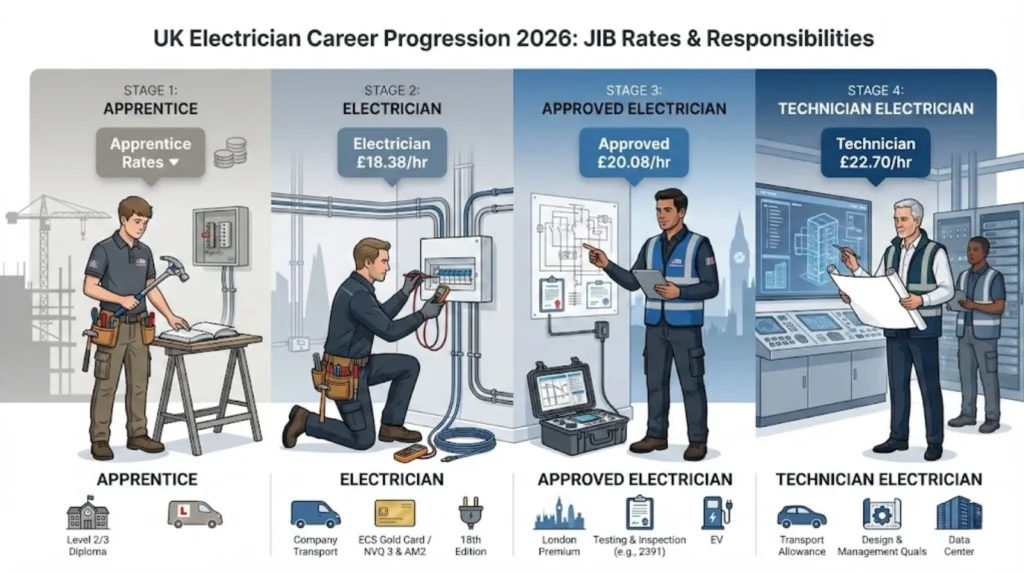
The jib rates 2026 effective Monday 5 January 2026 establish minimum hourly wages for qualified electrical operatives working under Joint Industry Board collective agreements across England, Wales, and Northern Ireland, with three core graded rates defining compensation structure: Electrician at £18.38/hour (£35,841 annual at standard 37.5-hour weeks) representing newly qualified operatives holding NVQ Level 3 and AM2 assessment, Approved Electrician at £20.08/hour (£39,156 annual, +£1.70/hour premium) requiring minimum two years’ experience plus inspection and testing qualifications enabling certification responsibilities, and Technician Electrician at £22.70/hour (£44,265 annual, +£2.62 over Approved) demanding five years as Approved plus Level 4 technical qualifications for senior supervisory and complex system integration roles.
These 2026 rates represent 3.95% increase over 2025 figures (Electrician rose from £17.68 to £18.38, Approved from £19.32 to £20.08, Technician from £21.84 to £22.70) as first year of three-year industrial determination covering 2026-2028 negotiated between Electrical Contractors’ Association employers and Unite the Union, while apprentice rates remain frozen at 2025 levels (£8.16-14.03/hour depending on stage) creating zero nominal increase for trainees following substantial 2025 corrections where Stage 1 rose approximately 26% and Stage 2 rose 21% making 2026 freeze strategic pause for employer cost absorption before resuming progression in 2027. Understanding this grade-by-grade breakdown requires distinguishing between National rates applicable across most of England and Wales versus London rates adding £2.20-2.77/hour premium for M25-area work compensating higher living costs, Transport Provided (TP) versus Own Transport (OT) categories where operatives using personal vehicles receive £1.11-1.17/hour additional allowance partially recovering vehicle costs, and recognizing these are minimum rates establishing floors that JIB member employers cannot legally pay below while actual market wages in high-demand sectors (data centres, infrastructure, specialist industrial) routinely exceed minimums by £3-5/hour through site premiums and competitive positioning.
This article provides systematic grade-by-grade explanation of qualification pathways from apprenticeship through NVQ Level 3 Electrician status, AM2 practical assessment, inspection and testing qualifications enabling Approved progression, and advanced technical certifications leading to Technician grade with transparent breakdown of what each 2026 rate means in weekly and annual terms, what qualification requirements unlock each grade’s compensation level, how London premiums and transport categories modify baseline figures, why apprentices experience zero 2026 increase despite graded operatives receiving 3.95%, and what these minimum rates don’t capture about actual take-home earnings once overtime premiums, travel allowances, lodging payments, and employment status considerations multiply baseline calculations by 20-50% for operatives working extended hours on major projects away from home base.
Quick Reference: 2026 Rates Summary
Before detailed explanations, here’s the complete 2026 JIB rate structure at a glance:
Graded Operatives (3.95% Increase):
| Grade | National TP | London TP | National OT | London OT | Annual (Nat TP) |
| Electrician | £18.38/hr | £20.58/hr | £19.49/hr | £21.89/hr | £35,841 |
| Approved Electrician | £20.08/hr | £22.48/hr | £21.25/hr | £23.85/hr | £39,156 |
| Technician Electrician | £22.70/hr | £25.47/hr | £23.96/hr | £26.93/hr | £44,265 |
Apprentices (0% Increase – Frozen):
| Stage | National TP | London TP | Annual (Nat TP) |
| Stage 1 | £8.16/hr | £9.15/hr | £15,912 |
| Stage 2 | £10.60/hr | £11.89/hr | £20,670 |
| Stage 3 | £13.05/hr | £14.63/hr | £25,448 |
| Stage 4 | £14.03/hr | £15.73/hr | £27,359 |
Key Terms:
TP (Transport Provided): Employer provides company vehicle/arranged transport
OT (Own Transport): Operative uses personal vehicle, receives £1.11-1.17/hr compensation
National: Applies across England/Wales/Northern Ireland outside M25
London: Work within M25 boundary, +£2.20-2.77/hr premium
Annual: 37.5 hours × 52 weeks (includes paid holidays, standard employment)
Electrician Grade: £18.38/Hour (£35,841 Annual)
What the Rate Means
Electrician represents the baseline qualified grade for electrical operatives completing apprenticeship or equivalent training pathways, earning £18.38/hour National Transport Provided (most common category for site-based employment where employers provide company vans or arranged transport to project locations).
Weekly pay (standard 37.5 hours): £689.25
Annual gross (52 weeks): £35,841
Monthly gross (÷12): £2,987
Take-home (after tax/NI/pension): Approximately £27,000-28,000 annually
London premium: +£2.20/hour = £20.58/hour (£40,131 annual)
Own Transport premium: +£1.11/hour = £19.49/hour (£38,011 annual)
London Own Transport: £21.89/hour (£42,691 annual – highest Electrician variant)
Qualification Requirements
To qualify for Electrician grade and the £18.38/hour minimum:
Essential qualifications:
NVQ Level 3 in Electrotechnical Installation (or recognized equivalent like City & Guilds 2365 Level 3)
AM2 practical assessment successfully completed demonstrating competence in safe isolation, wiring systems, and installation procedures
18th Edition BS 7671:2018+A2:2022 Wiring Regulations certification
ECS Gold Card (proves qualification status to employers)
Competence assumptions:
Independent capability to install, maintain, and repair electrical systems following BS 7671
Understanding of circuit design, cable calculations, and protective device selection
Ability to use standard test equipment (multimeters, insulation testers, continuity testers, earth loop impedance testers)
Knowledge of safe isolation procedures and permit-to-work systems
Basic supervisory capability for apprentices and junior operatives
Typical Responsibilities
Electricians at £18.38/hour baseline are expected to perform:
General electrical installation on construction sites (new builds, commercial fit-outs, industrial facilities)
Maintenance and repair work in operational buildings
Cable installation (containment systems, trunking, conduit, cable tray)
Wiring circuits (lighting, power, distribution)
Equipment installation (consumer units, distribution boards, switchgear, control panels)
Basic testing and recording results on installation certificates (under supervision of Approved Electrician for sign-off)
Fault-finding using systematic diagnostic procedures
Following technical drawings, specifications, and work instructions
Supervising apprentices and providing on-the-job training
What Electrician Rate Does NOT Include
The £18.38/hour base excludes:
Signing off Electrical Installation Certificates – requires Approved status with inspection/testing qualifications
Complex system design – modifications beyond standard installations need supervision
Team leadership – supervisory responsibility requires Approved/Technician grades
Specialist systems – high voltage, instrumentation, SCADA, automation require additional certification
Overtime premiums – time-and-a-half or double-time paid separately
Travel/lodging allowances – compensate distance and overnight stays independently
Career Timing to This Grade
Apprenticeship route: 3-4 years (most common pathway)
Start: Apprentice Stage 1 (£8.16/hour)
Progress through Stages 2-4 completing NVQ units
Complete: AM2 assessment + NVQ Level 3 = Electrician status
Adult learner route: 18-24 months (fast-track with intensive training)
NVQ Level 3 completion: 12-18 months with placement support
AM2 preparation and assessment: 2-4 months
Total: Faster than apprenticeship but more intensive study/practice requirements
Approved Electrician Grade: £20.08/Hour (£39,156 Annual)
What the Rate Means
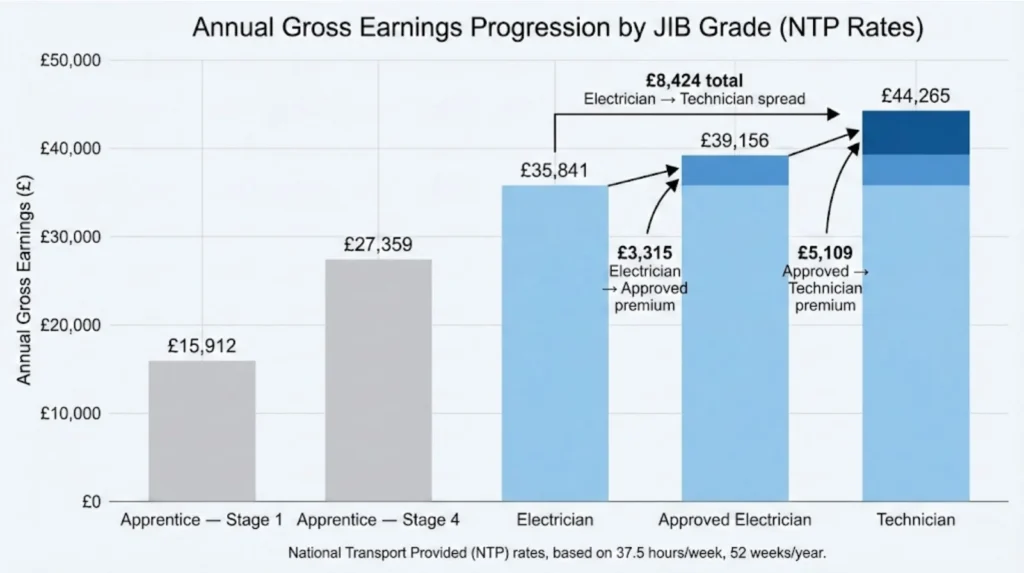
Approved Electrician represents mid-career progression requiring experience and additional qualifications beyond baseline Electrician status, earning £20.08/hour National Transport Provided reflecting premium of £1.70/hour over Electrician (£3,315 annually at standard hours).
Weekly pay (standard 37.5 hours): £753.00
Annual gross (52 weeks): £39,156
Monthly gross (÷12): £3,263
Take-home (after tax/NI/pension): Approximately £29,500-30,500 annually
Premium over Electrician: £3,315 annually (at standard hours), £4,200-4,800 with typical overtime patterns
London premium: +£2.40/hour over National = £22.48/hour (£43,836 annual)
Own Transport premium: +£1.17/hour = £21.25/hour (£41,438 annual)
London Own Transport: £23.85/hour (£46,521 annual – highest Approved variant)
Qualification Requirements
To qualify for Approved Electrician grade and the £20.08/hour minimum:
Essential requirements:
Minimum two years’ experience as graded Electrician (post-qualification, not including apprenticeship)
Inspection and testing qualification: City & Guilds 2391 Inspection and Testing or equivalent demonstrating competence in periodic inspection, testing procedures, and completing Electrical Installation Condition Reports (EICRs)
Formal JIB grading application: Evidence submission and approval process (not automatic after time served)
Proven capability in system design, fault diagnosis, and supervisory responsibilities
Competence beyond Electrician:
Legal authority to sign off electrical installations as compliant with BS 7671
Advanced testing knowledge (insulation resistance, continuity, earth loop impedance, RCD testing, polarity verification)
Coding defects on EICRs (C1 immediate danger, C2 potentially dangerous, C3 improvement recommended)
Designing standard installations within competence scope (lighting layouts, power distribution, circuit calculations)
Supervising small teams (2-4 electricians plus apprentices)
Technical liaison with building control, architects, main contractors
Typical Responsibilities
Approved Electricians at £20.08/hour baseline perform:
System design for standard commercial and industrial installations
Certification of electrical work via EICRs and installation certificates (legal sign-off authority)
Leading installation teams on medium-complexity projects
Technical problem-solving and advanced fault diagnosis
Client-facing discussions on compliance, variations, and technical solutions
Quality assurance and checking work completed by Electricians and apprentices
Risk assessments and method statements for electrical work
Coordinating with other trades on multi-disciplinary projects
Investment Return Calculation
Course cost: City & Guilds 2391 typically £1,200-1,800 (1-2 weeks classroom + practical assessment)
Time investment: 2 years minimum experience as Electrician (opportunity cost working at lower rate)
Annual return: £3,315 at standard hours, £4,200-4,800 with overtime
Payback period: 4-6 months of higher earnings covers course costs
Lifetime value: Permanent £3,000+ annual increase for entire career post-Approved status
This makes Approved progression one of the highest-return qualification investments available to electricians – better ROI than most bachelor’s degrees relative to time and cost.
Technician Electrician Grade: £22.70/Hour (£44,265 Annual)
What the Rate Means
Technician Electrician represents top craft grade requiring extensive experience and advanced technical qualifications, earning £22.70/hour National Transport Provided reflecting additional £2.62/hour over Approved (£5,109 annually) and £4.32/hour over Electrician (£8,424 annually at standard hours).
Weekly pay (standard 37.5 hours): £851.25
Annual gross (52 weeks): £44,265
Monthly gross (÷12): £3,689
Take-home (after tax/NI/pension): Approximately £32,500-33,500 annually
Premium over Approved: £5,109 annually (at standard hours), £6,500-7,500 with overtime
Premium over Electrician: £8,424 annually (doubling Approved premium)
London premium: +£2.77/hour over National = £25.47/hour (£49,667 annual)
Own Transport premium: +£1.26/hour = £23.96/hour (£46,752 annual)
London Own Transport: £26.93/hour (£52,517 annual – highest base rate across all grades)
Qualification Requirements
To qualify for Technician Electrician grade and the £22.70/hour minimum:
Essential requirements:
Minimum five years’ experience as graded Approved Electrician (post-Approved grading, total ~9-12 years from apprenticeship start)
Level 4 or higher technical qualifications: HNC/HND in Electrical Engineering, Advanced Level qualification in electrical principles, specialist certifications (high voltage, instrumentation, programmable logic controllers, building management systems)
Demonstrated supervisory capability: Evidence of leading teams, managing projects, coordinating trades
High-level technical expertise: Complex system integration, design calculations, commissioning procedures
Competence beyond Approved:
Senior technical authority on major projects (data centres, substations, manufacturing facilities, transport infrastructure)
Project oversight coordinating multiple electrical teams and interfacing with other disciplines
Engineering-level design work requiring calculations, load analysis, and system optimization
Safety leadership including risk assessments, method statements, and compliance verification
Mentoring and developing Electricians and Approved Electricians
Budget and programme management responsibilities
Typical Responsibilities
Technician Electricians at £22.70/hour baseline perform:
Site supervision on large-scale projects (commercial developments, industrial plants, infrastructure)
Complex fault diagnosis on integrated systems (SCADA, fire alarms, access control, building management)
Technical liaison with consulting engineers and design teams (interpreting specifications, proposing alternatives)
Quality assurance across entire installations (not just own work but verifying team outputs)
Commissioning and handover procedures for complex systems
Training delivery for internal teams and subcontractors
Specification preparation and tender evaluation for electrical packages
Troubleshooting during commissioning phases requiring deep technical knowledge
Total Compensation Context
Technician grade typically receives additional benefits beyond base £22.70/hour:
Responsibility money: +£1-2/hour site premiums on major projects
Company vehicles: Worth £3,000-5,000 annual benefit (fuel, maintenance, insurance covered)
Enhanced pension: 10-12% employer contribution vs 7-8% for lower grades
Professional development: Funded training, conference attendance, specialist certifications
Performance bonuses: Project completion bonuses, productivity incentives
Total package can reach £55,000-65,000 for Technicians on high-value industrial or infrastructure projects when all elements combined.
Career Timeline to This Grade
Minimum pathway: 10-12 years from apprenticeship start
Years 1-4: Apprenticeship to Electrician
Years 5-6: Experience as Electrician
Years 7-11: Experience as Approved Electrician (5 years minimum)
Year 12: Technician grade achieved with Level 4 qualifications
Some electricians remain Approved throughout careers (perfectly viable path), others pursue Technician for senior supervisory roles and technical specialization.
Apprentice Rates: £8.16-14.03/Hour (Frozen in 2026)
2026 Apprentice Structure
Apprentice rates remain unchanged from 2025 creating zero nominal increase while graded operatives receive 3.95%:
| Stage | National TP | Weekly (37.5h) | Annual | Typical Training Phase |
| Stage 1 | £8.16/hr | £306.00 | £15,912 | Year 1, basic installation |
| Stage 2 | £10.60/hr | £397.50 | £20,670 | Year 2, intermediate circuits |
| Stage 3 | £13.05/hr | £489.38 | £25,448 | Year 3, advanced systems |
| Stage 4 | £14.03/hr | £526.13 | £27,359 | Final year, near-completion |
Why Zero Increase in 2026
Thomas Jevons, Head of Training at Elec Training, provides context:
"Apprentices seeing zero increase in 2026 while qualified grades get 3.95% understandably feel overlooked. But context matters: 2025 saw massive apprentice corrections - Stage 1 rose about 26%, Stage 2 about 21%. The 2026 freeze is a strategic pause letting employers absorb those costs before resuming modest increases in 2027 (2% scheduled). It's not abandonment; it's phased implementation of multi-year wage progression."
Thomas Jevons, Head of Training
Completion Incentive Analysis
Stage 4 to Electrician jump: £14.03 → £18.38 = £4.35/hour increase (+31%)
Annual impact: £27,359 → £35,841 = £8,482 more (standard hours)
Equivalent to: 6.2 years of 3.95% annual increases compressed into qualification completion
This massive completion jump demonstrates that finishing qualifications matters far more than waiting for better apprentice rates during training. Every month faster to AM2 assessment and NVQ completion is worth more than annual wage negotiations.
Adult Apprentice Complexity (21+ Years)
Apprentices aged 21+ create special case where National Living Wage compliance overrides JIB rates:
National Living Wage 2026 (projected): £12.21-12.71/hour for 21+
Impact on apprentice wages:
Stage 1 (£8.16): Employer must top up to NLW (£12.21-12.71) = +£4.05-4.55/hour additional cost
Stage 2 (£10.60): Employer must top up to NLW = +£1.61-2.11/hour additional cost
Stage 3 (£13.05): JIB rate exceeds NLW, no top-up needed
Stage 4 (£14.03): JIB rate exceeds NLW, no top-up needed
Adult apprentices in Stages 1-2 effectively receive 4.1% increase through government NLW policy despite 0% JIB determination, but this makes adult apprentice training expensive for small employers (£8,000-9,000 annual additional costs per Stage 1 adult apprentice).
London vs National: Understanding Regional Premiums
London Rate Structure
London rates apply to work within M25 motorway boundary, adding premiums to compensate higher living costs in capital and surrounding areas:
| Grade | National TP | London TP | Premium | Annual Impact |
| Electrician | £18.38 | £20.58 | +£2.20/hr | +£4,290 |
| Approved | £20.08 | £22.48 | +£2.40/hr | +£4,680 |
| Technician | £22.70 | £25.47 | +£2.77/hr | +£5,403 |
Cost of Living Context
London premium offsets partial living cost differential:
Average London vs Regional cost differences (annual):
Rent: +£8,000-12,000 (Zone 2-4 vs Birmingham/Manchester equivalents)
Transport: +£2,000-3,000 (TfL vs regional bus/car costs)
Food/household: +£1,500-2,500 (London supermarket pricing)
Total: +£11,500-17,500 annual living cost differential
London JIB premium: £4,290-5,403 annually
Shortfall: £6,000-12,000 not covered by hourly premium, requiring additional income through overtime, site bonuses, or accepting higher cost-of-living burden for career opportunity/experience benefits
Geographic Boundaries
London rates apply strictly to M25-area work, not:
❌ Living in London but working outside M25 (National rates apply)
❌ Commuting from outside M25 to London sites (London rates apply)
✅ Work location determines rate, not residential address
Electricians in South-East (Reading, Brighton, Cambridge) often work both sides of M25 boundary, experiencing rate fluctuations based on weekly project locations.
Transport Provided vs Own Transport
Rate Differential
Own Transport (OT) rates add £1.11-1.17/hour compensating personal vehicle use:
| Grade | Transport Provided | Own Transport | Difference |
| Electrician | £18.38/hr | £19.49/hr | +£1.11/hr |
| Approved | £20.08/hr | £21.25/hr | +£1.17/hr |
| Technician | £22.70/hr | £23.96/hr | +£1.26/hr |
Annual value: £2,166-2,458 (at standard 37.5h/52w)
Cost Recovery Analysis
Electricians using personal vehicles incur:
Annual vehicle costs (typical):
Insurance: £800-1,200 (business use policy)
Fuel: £1,500-2,500 (15,000-20,000 miles annually at site travel patterns)
Maintenance/servicing: £600-1,000
Depreciation: £1,500-2,500
Total: £4,400-7,200
OT premium recovery: £2,166-2,458 (covers ~30-50% of actual costs)
Additional travel allowance: 22p/mile non-taxable + 12p/mile taxable over 15 miles from employer base partially compensates remaining vehicle expenses
Many electricians prefer Transport Provided roles with company vans eliminating personal vehicle costs entirely, despite lower base hourly rate (company vehicle worth £3,000-5,000 annual benefit when fuel, insurance, maintenance included).
CIS Contractor Rates vs JIB PAYE
Advertised CIS Rates
Contractor roles (Construction Industry Scheme self-employed) often advertise £25-35/hour seeming to exceed JIB rates substantially, but direct comparison misleads:
Typical advertised rates:
Electrician (CIS): £22-28/hour
Approved (CIS): £28-34/hour
Specialist roles (CIS): £32-40/hour
Joshua Jarvis, Elec Training’s Placement Manager, explains the calculation:
"When comparing JIB Approved (£20.08 PAYE) to advertised CIS contractor roles (£28-32/hour), remember CIS figures are gross before 20% deduction, with no holiday pay, sick pay, or pension. A £28/hour CIS rate becomes £22.40 after deduction, then you lose 5.8 weeks annual holiday worth £5,170, pension contributions worth £2,800-4,000. Suddenly that £20.08 PAYE with full benefits looks much closer to £28 CIS in actual value."
Joshua Jarvis, Placement Manager
True Parity Calculation
JIB PAYE Approved: £20.08/hour
Benefits included:
Holiday pay: 5.8 weeks (22 days + 8 bank holidays) = £5,170 annual value
Employer pension: 7-10% contribution = £2,740-3,916 annual value
Sick pay: Statutory + JIB enhanced = £500-1,000 annual value (average usage)
Employment protections: Dispute resolution, redundancy rights = £500-1,000 value
Total hidden benefits: £8,910-11,086 annually
CIS to reach PAYE parity:
£20.08 PAYE + benefits (£8,910) ÷ 1,950 hours ÷ 0.8 (after 20% CIS deduction) = £28.42/hour CIS minimum
CIS contractors quoting under £28/hour are effectively earning less than JIB PAYE once total compensation compared fairly.
When CIS Makes Sense
Advantages:
Higher peak earnings potential (£35-45/hour for specialist skills)
Flexibility in project selection
Business expense deductions
Potential for business growth (employing others, expanding services)
Disadvantages:
No paid holidays (6 weeks unpaid annually)
No sick pay (any illness = lost income)
Own tax/accounting responsibilities (£500-1,500 annual costs)
Irregular income patterns (feast-or-famine project cycles)
No employment protections
CIS suits established electricians with financial buffers and specialist skills commanding premiums; risky for newly qualified without savings or career changers without business experience.
What These Rates Mean for Career Decisions
Understanding 2026 JIB rates helps electricians make informed decisions about qualification pathways from NVQ Level 3 completion through AM2 assessment, inspection and testing certifications enabling Approved grade progression, and advanced Level 4 qualifications leading to Technician status when evaluating job offers, planning qualification investments, and assessing employment structure trade-offs between PAYE security and contractor flexibility.
For Newly Qualified Electricians
First job offer evaluation framework:
£35,000-36,000 offered = At JIB minimum (£18.38/hour baseline)
£38,000-40,000 offered = Above JIB (+£2-4/hour market premium, competitive offer)
£32,000-34,000 offered = Below JIB (pro-rata part-time, or non-JIB employer under-paying)
Offers below £35,841 require scrutiny unless hours reduced, seasonal patterns, or genuine trainee period with guaranteed increase to JIB rates after probation.
For Electricians Considering Approved Status
Investment decision:
Cost: City & Guilds 2391 course £1,200-1,800 + 2 years’ experience building
Return: £3,315 annual increase (standard hours), £4,200-4,800 with overtime
Payback: 4-6 months of higher earnings, then permanent £3,000+ annual benefit
Career options unlocked:
Supervisory roles
Certification authority
Complex installation projects
Team leadership positions
Higher market value (£24-30/hour non-JIB roles accessible)
Alternative investment comparison:
University degree: £27,000-40,000 cost, 3-4 years, uncertain return
2391 qualification: £1,200-1,800 cost, 1-2 weeks, guaranteed £3,315+ return
Approved progression represents one of highest-ROI qualification investments available to trade workers.
For Experienced Electricians Evaluating Technician Path
Investment required:
HNC Electrical Engineering: £3,000-5,000 + 2 years part-time study
Work experience: 5 years as Approved (opportunity cost)
Specialist certifications: £500-2,000 depending on pathway
Return: £5,109 annual increase over Approved (standard hours), total £8,424 over Electrician
Plus total package benefits:
Company vehicles (£3,000-5,000 value)
Enhanced pensions (additional £1,000-2,000 annual)
Responsibility money (+£2,000-4,000 annual)
Career ceiling: Senior site management, technical authority roles
Not all electricians pursue Technician (many remain Approved throughout careers), but pathway exists for those seeking senior technical/supervisory roles.
The 2026 JIB rates establish minimum hourly wages (Electrician £18.38, Approved £20.08, Technician £22.70 National Transport Provided) applicable only to member employers and graded operatives, with 3.95% increase over 2025 figures representing first year of three-year 2026-2028 industrial determination while apprentices experience zero nominal increase following substantial 2025 corrections (Stage 1 +26%, Stage 2 +21%) making current freeze strategic pause for employer cost absorption before resuming modest progression in 2027. Grade progression delivers substantial income step-changes (Electrician to Approved £3,315 annually, Approved to Technician £5,109 annually at standard hours) exceeding multiple years of annual wage negotiations compressed into single qualification completions, making qualification investment returns superior to waiting for better annual pay rises when planning career income growth over 10-20 year timescales.
London premiums add £2.20-2.77/hour (£4,290-5,403 annually) compensating M25-area living costs but covering only 30-40% of actual London cost differentials (housing, transport, general expenses typically £11,500-17,500 higher annually), requiring electricians to balance higher gross earnings against substantially increased living expenses when evaluating capital-area opportunities. Own Transport categories provide £1.11-1.17/hour additional (£2,166-2,458 annually) partially recovering personal vehicle costs averaging £4,400-7,200 yearly, with many electricians preferring Transport Provided roles eliminating vehicle burden entirely despite lower base rates when company vans and fuel worth £3,000-5,000 annual benefit included.
CIS contractor rates appearing to exceed JIB substantially (£25-35/hour advertised) require fair comparison accounting for 20% CIS deduction, zero holiday pay worth £5,170 annually, absent employer pension contributions worth £2,740-3,916, and missing sick pay/employment protections worth £500-2,000, making £28-30/hour CIS minimum needed to reach parity with £20.08 PAYE Approved including total compensation packages. These minimum rates establish floors that participating employers cannot legally pay below while actual market wages in high-demand sectors (data centres, infrastructure, specialist industrial) routinely exceed minimums by £3-5/hour through site premiums, with qualification progression and skills specialization mattering substantially more for lifetime earnings than annual percentage increases negotiated through collective bargaining when comparing electrician career arc from £35,841 entry (Electrician) through £39,156 mid-career (Approved) to £44,265+ senior status (Technician) representing £8,424 total spread plus enhanced benefits at top grade.
Call us on 0330 822 5337 to discuss how qualification pathways from NVQ Level 3 electrical training through AM2 practical assessment, inspection and testing certifications like City & Guilds 2391 enabling Approved grade progression worth £3,315 permanent annual increase, and advanced Level 4 technical qualifications leading to Technician status delivering additional £5,109 yearly position electricians for market wages exceeding JIB minimums through specialist skills and experience commanding premiums, what realistic timelines look like for moving from newly qualified Electrician to Approved status within 2-3 years post-qualification through structured qualification completion and site experience accumulation, and how our in-house recruitment team helps learners secure JIB member firm placements offering above-minimum rates or high-paying non-JIB roles where market dynamics push actual wages £22-30/hour for qualified electricians with in-demand specializations.
References
- JIB (Joint Industry Board) – Industrial Determination 2026-2028 with complete rate tables – https://www.jib.org.uk/wp-content/uploads/2025/06/JIB-Industrial-Determination-062025.pdf
- JIB – JIB Handbook 2025 Section 4 (Grading definitions and requirements) – https://www.jib.org.uk/wp-content/uploads/2024/01/JIB_Handbook_2024_Section_4.pdf
- JIB – New wage agreement 2026-2028 announcement – https://www.jib.org.uk/news/new-wage-agreement-from-2026-to-2028/
- Electrical Contractors’ Association (ECA) – JIB pay rates guidance for members – https://www.eca.co.uk/member-support/employee-relations/national-collective-agreements/jib-pay-rates
- GOV.UK – National Minimum Wage and National Living Wage rates – https://www.gov.uk/national-minimum-wage-rates
Note on Accuracy and Updates
Last reviewed: 3 January 2026. This page is maintained; we correct errors and refresh sources as JIB Industrial Determinations and National Working Rules change. 2026 rates sourced from JIB Industrial Determination 062025 published June 2025 effective 5 January 2026 showing 3.95% increase for graded operatives (Electrician £17.68→£18.38, Approved £19.32→£20.08, Technician £21.84→£22.70) and zero increase for apprentices (frozen at 2025 levels £8.16-14.03/hour). London premiums (Electrician +£2.20, Approved +£2.40, Technician +£2.77) and Own Transport allowances (+£1.11-1.26/hour) confirmed from rate tables. Annual calculations use standard 37.5 hours × 52 weeks including paid holidays as per JIB employment contracts. Take-home estimates use UK tax rates 2025-2026 (basic 20%, higher 40%) and National Insurance (12% up to upper limit, 2% above); actual net pay varies by tax codes, pension contributions, student loans. Grade requirements (Electrician NVQ Level 3 + AM2, Approved minimum 2 years + 2391, Technician minimum 5 years Approved + Level 4) confirmed from JIB Handbook Section 4 grading criteria. CIS comparison uses typical 20% CIS deduction rate; actual deductions vary if CIS gross payment verification applied. National Living Wage 2026 projection (£12.21-12.71) based on Low Pay Commission recommendations pending Treasury confirmation; adult apprentice top-up calculations subject to final NLW announcement. Next review scheduled following 2027 JIB determination publication (typically July-August) for second-year rates under 2026-2028 agreement and apprentice increase implementation (2% scheduled 2027).
