

JIB Travel Time, Mileage and Allowances: What Changes in 2026?

- Technical review: Thomas Jevons (Head of Training, 20+ years)
- Employability review: Joshua Jarvis (Placement Manager)
- Editorial review: Jessica Gilbert (Marketing Editorial Team)
- Last reviewed:
- Changes: Initial publication using JIB National Working Rules 2024-2025, confirmed 2026-2028 wage agreement, HMRC tax-free allowance guidance, and comparative SJIB/NAECI data
Introduction
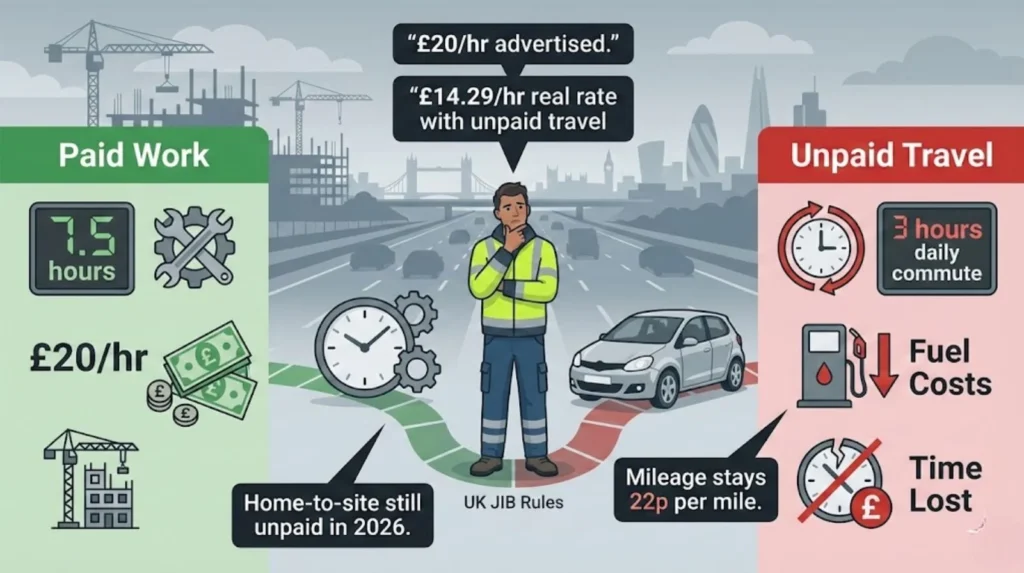
An electrician earning £20 per hour sounds straightforward until you factor in two hours of daily unpaid travel, mileage that doesn’t cover the full cost of running a van, or lodging allowances that fall short of actual hotel prices. The Joint Industry Board (JIB) National Working Rules govern not just base wages but also when travel time is paid, how mileage is reimbursed, and what electricians receive for staying away from home. These rules directly determine whether an advertised £40,000 annual salary translates to genuine £40,000 value or closer to £35,000 once unpaid commuting hours are factored in.
The 2026-2028 JIB agreement delivers substantial wage increases: 3.95% in January 2026, 4.6% in January 2027, and 4.85% in January 2028. That’s approximately 13.8% cumulative growth over three years. But what many electricians want to know is whether the travel and lodging rules have changed. Do electricians finally get paid for home-to-site travel? Has the mileage allowance increased above the long-standing 22p per mile? Has the lodging allowance kept pace with actual accommodation costs?
This article provides a comprehensive breakdown of JIB travel time, mileage allowances, and lodging rules as they stood through 2025, what the 2026-2028 agreement changes (and critically, what it doesn’t), how these rules compare to SJIB Scotland and NAECI industrial agreements, what job adverts and electrician forums reveal about real-world practice, and worked scenarios showing how 2026 changes affect actual take-home pay for different types of roles.
Understanding these rules matters because they control when your working day officially begins, how much of your commute comes out of your own pocket, and whether staying away from home is financially viable or a net loss after accommodation costs. For comprehensive context on how JIB wage structures integrate with travel allowances and total earnings packages, we’ve covered the baseline pay rates and employment frameworks that these travel rules build upon.
How JIB Defines Travel Time, Mileage, Fares and Lodging
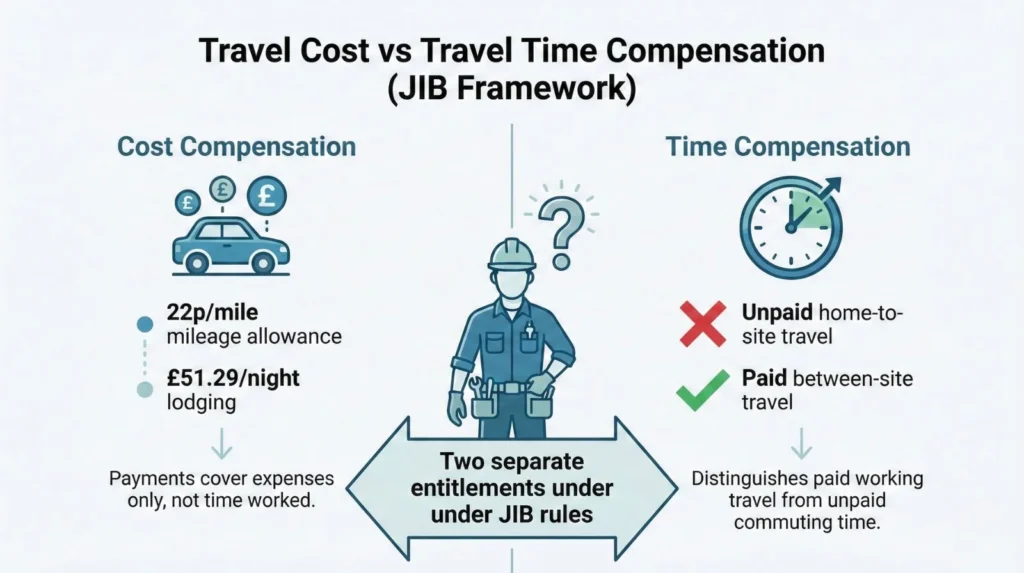
The JIB National Working Rules create a framework distinguishing between three concepts that electricians often conflate: travel time (paid hours), travel cost (mileage/fares), and subsistence (lodging). Understanding the precise definitions prevents confusion about entitlements.
Travel Time: When Hours Are Paid
Travel time refers to hours paid at ordinary rates for specific types of journeys. The JIB rules specify:
Paid travel time:
Travel between sites during the working day (site A to site B, then site B to site C)
Return journey from shop (employer’s base) to job site under specific lodging arrangements (e.g., 4 hours paid for 100-200 miles, 7.5 hours for over 200 miles)
Periodic return travel during extended lodging jobs
Unpaid travel time:
Home to first site at start of day (unless classified as “onerous”)
Last site to home at end of day
Daily commute within local radius (typically under 15 miles from shop)
This distinction is critical. Most electricians’ daily commute from home to their first job of the day is unpaid time. You leave at 7am, arrive at 8am, but you’re only paid from 8am onwards. That hour is your own time, not working time under JIB rules.
Mileage Allowances and Fare Bands
Mileage allowance is the cost reimbursement for using your own vehicle for work journeys. JIB rules specify:
Own transport (using personal vehicle): 22p per mile, non-taxable, for journeys over 15 miles from shop to job site (calculated via fastest RAC route, both ways)
Employer-provided transport: 12p per mile, taxable, for journeys over 15 miles
**Fare reimburse actual costs (e.g., train tickets, airfare) for qualifying journeys when public transport is used
The 15-mile threshold is crucial. If your job site is 12 miles from the shop, you receive £0 mileage allowance. If it’s 20 miles, you receive 22p per mile for the full 40-mile round trip (£8.80 daily).
HMRC approves JIB’s 22p per mile as a tax-free amount, meaning you don’t pay income tax or National Insurance on this allowance. However, HMRC’s approved mileage rate for tax relief is 45p per mile for the first 10,000 miles. The gap between what JIB pays (22p) and what HMRC allows (45p) means electricians can claim additional tax relief via form P87, recovering some of the shortfall.
Radius, Shop, and Travel-to-Work Areas
Shop is the employer’s premises or designated reporting point. The concept of the shop is central to JIB travel rules because distances are measured from the shop, not from your home.
Radius rules:
Locally engaged operatives work within 25 miles of the shop
For locally engaged operatives, “home” substitutes for “shop” in distance calculations if the operative is not required to report to the shop daily
Beyond 25 miles from the shop, operatives may transfer to shop-based arrangements with mutual agreement
Travel-to-work area is the local zone where daily travel is considered the electrician’s responsibility. No mileage allowance is paid, and travel time is unpaid. This typically covers the first 15 miles from the shop.
Lodging and Staying Away Allowance
Lodging allowance is a fixed nightly payment to cover accommodation and subsistence (meals) when an electrician is required to live away from their permanent home for work.
Key lodging rules:
Amount: £51.29 per night (effective January 2025), tax-free with proper certification
Eligibility: Site must be over 35 miles from the shop, or travel must be “onerous” (impractical for daily commuting)
Conditions: Proof of lodging required, operative must maintain normal start and finish times at site, lodging certificate must be submitted
Retention allowances:
Weekend retention: £51.29 per night for staying in lodging over weekends between work weeks
Annual holiday retention: Up to £16.87 per night (£118.09 per week maximum) for maintaining lodging during holiday periods on extended contracts
Onerous travel is a classification for journeys where daily commuting would be significantly challenging due to distance or conditions, qualifying the electrician for lodging instead of daily travel allowances.
Home-Based vs Yard-Based Classification
This distinction dramatically affects earnings:
Home-based (locally engaged): Electrician travels directly from home to job sites. Travel time from home to first site is unpaid. Mileage allowance paid if distance exceeds 15 miles from home (which substitutes for shop).
Yard-based (shop-based): Electrician reports to employer’s premises daily. Travel from shop to job site is working time (paid). Employer typically provides transport; if not, mileage allowance applies for shop-to-site distance.
The financial difference can be £40 to £50 per day for electricians with significant travel distances, as yard-based classification converts previously unpaid travel time into paid working hours.
Baseline JIB Travel and Lodge Rules (Up to 2025)
These are the rules that governed JIB electrician travel and lodging through December 2025, forming the baseline for comparison against 2026 changes.
Travel Time Rules Through 2025
Home to first site: Unpaid time unless journey qualifies as onerous (requiring lodging instead).
Between sites during working day: Paid as working time at ordinary rates. If you start at Site A at 8am, finish at 11am, travel to Site B for 45 minutes, and work 12pm to 5pm, that 45-minute travel is paid.
Last site to home: Unpaid. Your working day ends when you finish at the last site. The journey home is your own time.
Return journeys under lodging arrangements: Paid at ordinary rates. If you’re on a lodging job and travel home for the weekend (e.g., Friday evening return), or at the start/end of a lodging period, specific hours are paid based on distance (4 hours for 100-200 miles, 7.5 hours for over 200 miles).
The practical impact: most electricians lose 1.5 to 3 hours daily in unpaid travel (30-90 minutes each way). At 37.5 paid hours per week, that’s 7.5-15 unpaid hours weekly, effectively reducing the real hourly rate by 17-29%.
Mileage and Fare Allowances Through 2025
Mileage rates (unchanged since 2019):
Own transport: 22p per mile (non-taxable)
Employer-provided transport: 12p per mile (taxable)
Distance threshold: Mileage allowances apply only for journeys over 15 miles from shop to job site. Anything under 15 miles: £0 paid.
Calculation method: Distance measured via fastest RAC route, paid for both outward and return journeys. A 20-mile journey to site = 40 miles round trip = £8.80 mileage allowance daily (£44 weekly, £2,288 annually at 52 weeks).
Tax treatment: The 22p per mile is HMRC-approved as tax-free under working rule agreements. Electricians paying more than 22p per mile in actual costs (fuel, insurance, depreciation) can claim tax relief on the difference between 22p and the HMRC-approved 45p per mile rate via form P87.
Joshua Jarvis, Elec Training’s Placement Manager, explains the practical impact:
"The majority of advertised electrician roles require own transport, which aligns with the JIB structure where home-to-site travel is the electrician's responsibility. Employers provide mileage over 15 miles, but anything under that threshold comes out of the electrician's pocket. For someone with a 12-mile commute, that's 120 miles weekly with no reimbursement, costing £15 to £20 in fuel alone."
Joshua Jarvis, Placement Manager
Lodging Allowances Through 2025
Historical progression:
June 2023 to June 2024: £49.08 per night
June 2024 to June 2025: £50.65 per night
June 2025 to December 2025: £51.97 per night
January 2025: £51.29 per night (4.1% increase from £49.27 in 2024)
The January 2025 rate (£51.29) reflects a 4.1% increase tracking CPI inflation. This rate is HMRC-confirmed as tax-free up to the specified amount, meaning electricians receive the full £51.29 without deductions, provided they submit proper lodging certificates proving they stayed away and paid for accommodation.
Eligibility criteria:
Site must require staying away (typically over 35 miles from shop)
Electrician must be unable to return home daily due to distance or travel conditions
Lodging certificate must be submitted to employer
Operative must maintain normal site start and finish times
What the allowance covers: Accommodation and subsistence (meals). The JIB allowance is intended to cover both a bed for the night and three meals daily. Whether it actually does depends heavily on location.
Thomas Jevons, Head of Training at Elec Training, notes the gap:
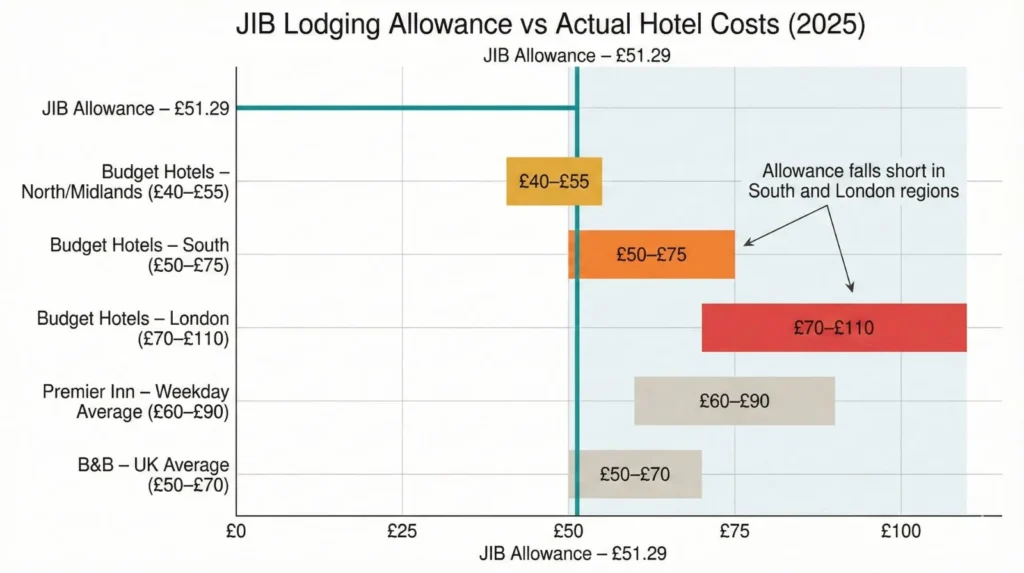
"The JIB lodging allowance of £51.29 per night hasn't kept pace with actual accommodation costs in many regions. A Premier Inn in Manchester or Birmingham costs £60 to £90 per night during the week. Electricians staying away are often subsidising their own accommodation from their wages, which erodes the value of working away from home despite the tax-free allowance."
Thomas Jevons, Head of Training
Retention rules through 2025:
Weekend retention: £51.29 per night for staying in lodging over weekends when returning home is impractical
Annual holiday retention: Up to £16.87 per night (maximum £118.09 per week) for maintaining lodging during holiday periods on extended contracts
Retention is not paid if the electrician returns home or if the employer provides free accommodation
What Hasn’t Changed Since 2019
Several key elements of JIB travel rules have remained static:
Mileage rates: 22p/12p per mile unchanged since at least 2019, despite significant increases in fuel costs (petrol rose from approximately £1.25 per litre in 2019 to £1.55 per litre in 2025, a 24% increase)
Distance thresholds: 15-mile radius for mileage allowance eligibility unchanged
Travel time structure: Home-to-site unpaid, between-sites paid structure unchanged
Fare bands: Fixed fare allowances based on distance bands unchanged in structure (amounts adjusted for inflation, but bands remain)
This static position is significant because cost of living, fuel prices, and accommodation costs have all increased substantially while core travel rule parameters haven’t shifted to match.
What the 2026 JIB Agreement Changes (and What It Doesn't)
This is the critical section. The 2026-2028 JIB agreement was approved by the Electrical Contractors’ Association (ECA) and Unite the Union, taking effect Monday 5 January 2026. Understanding what changes and what remains static is essential for electricians evaluating whether the deal improves their real earnings position.
What Does Change: Confirmed 2026-2028 Updates
Base wage increases (all graded operatives):
January 2026: 3.95% increase
January 2027: 4.6% increase
January 2028: 4.85% increase
Cumulative: Approximately 13.8% over the three-year period
These percentage increases apply to Electrician, Approved Electrician, and Technician base hourly rates. The compounding effect means a 2025 Approved Electrician rate of approximately £20.06 per hour rises to approximately £21.06 in 2026, £22.03 in 2027, and £23.10 in 2028.
Sick pay increases:
Weeks 3-24: Increase of £10 per week (from £190 to £200 for Electricians, £200 to £210 for Approved, £210 to £220 for Technicians)
Weeks 25-52: Increase of £5 per week on half-rates
Effective: January 2028 (not 2026)
The sick pay increase doesn’t take effect until 2028, meaning electricians see no benefit from this change in the first two years of the agreement.
Lodging allowance (likely but unconfirmed for JIB Electrotechnical):
The research shows no explicitly confirmed new lodging rate for JIB Electrotechnical electricians in the 2026-2028 agreement documents. However, the parallel JIB-PMES (Plumbing & Mechanical Engineering Services) agreement increased lodging from £51.97 to £53.40 from 5 January 2026 (a 2.8% rise).
If JIB Electrotechnical follows the same pattern (which is standard practice), the lodging allowance likely rises from £51.29 (January 2025 rate) to approximately £53.09 to £53.40 from January 2026. This represents a £1.80 to £2.11 nightly increase, or £9 to £10.55 weekly for an electrician staying away five nights.
What Does NOT Change: Static Travel Rules
No changes confirmed to:
Mileage allowances: Remain 22p per mile for own transport, 12p per mile for employer-provided transport. No increase despite 24% fuel cost rise since 2019.
Distance thresholds: 15-mile radius before mileage allowance applies remains unchanged. Electricians with 10-14 mile commutes still receive zero mileage reimbursement.
Fare band structure: Fixed fare allowances for distance bands remain unchanged in structure.
Travel time rules: Home-to-site travel remains unpaid. Between-site travel remains paid. Last-site-to-home remains unpaid. No structural changes to when working time begins or ends.
Radius rules: 25-mile local engagement radius unchanged. 35-mile threshold for lodging eligibility unchanged.
Yard-based vs home-based classification: Rules governing when electricians are paid from the shop versus from site remain unchanged.
Onerous travel definitions: Criteria for classifying a journey as onerous (qualifying for lodging rather than daily travel allowances) unchanged.
Interpretation: What the 2026 Changes Actually Mean
The biggest real-world change is higher base pay, which has two effects:
Direct effect: Weekly and annual gross earnings increase by 3.95% in 2026, compounding in 2027 and 2028.
Indirect effect: Any paid travel time (between sites, yard-based travel, return journeys under lodging rules) is worth more because it’s paid at the higher hourly rate. A yard-based electrician paid for 2 hours daily travel time sees that 10 hours weekly rise from £200.60 (at £20.06/hr) to £210.60 (at £21.06/hr) in 2026.
However, unpaid home-to-site travel remains unpaid. The wage increase doesn’t convert unpaid time into paid time. It simply means the hours you are paid for are worth more.
Lodging improvement (if confirmed): A £1.80 to £2.11 nightly increase helps marginally but doesn’t close the gap to actual accommodation costs. An electrician paying £75 nightly for a Premier Inn who receives £53.40 is still subsidising accommodation by £21.60 per night (£108 weekly for five nights away).
Mileage static: The 22p per mile rate becomes increasingly insufficient as fuel costs, vehicle insurance, and depreciation rise. The gap between JIB’s 22p and HMRC’s 45p tax-relief rate widens in real terms as vehicle running costs increase with inflation.
The 2026-2028 deal prioritizes wage growth over structural reform of travel and lodging frameworks. This benefits electricians in roles with minimal travel or generous employer transport arrangements more than electricians bearing significant unpaid travel time or lodging shortfalls.
How SJIB Scotland and NAECI Compare
JIB (England, Wales, Northern Ireland) isn’t the only framework governing electrician pay and travel allowances in the UK. SJIB (Scotland) and NAECI (heavy industrial) operate parallel systems, and many electricians compare frameworks to understand relative value.
SJIB Scotland: Higher Travel Rates, Similar Structure
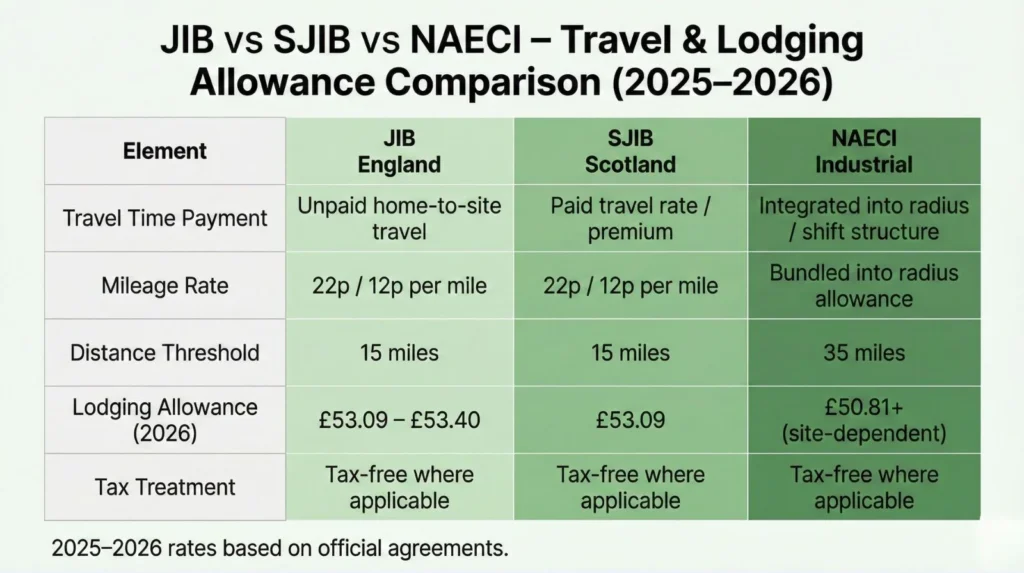
Pay structure: SJIB uses Shop Rate (base hourly rate) and Travel Rate (higher hourly rate paid when working away from shop). For example:
Electrician: £19.54 per hour (2025 Travel Rate, rising 3.95% to £20.31 in 2026)
Shop Rate is lower (approximately £16-£17 per hour), creating a premium for site work
Mileage allowances:
Own transport: 22p per mile (same as JIB England)
Employer-provided transport: 12p per mile (same as JIB England)
Threshold: Over 15 miles from shop (same as JIB England)
Lodging allowances:
2025: £51.29 per night
2026: £53.09 per night (confirmed increase)
Weekend retention: £17.46 per night
Key differences from JIB England:
Travel Rate premium: SJIB explicitly pays higher hourly rates for site work, which effectively compensates travel time more generously than JIB’s approach. An SJIB electrician on Travel Rate earns £20.31 per hour in 2026 compared to JIB Electrician at approximately £18.38 per hour (National Transport Provided rate).
Protracted journey provisions: SJIB rules explicitly address “protracted journeys” (onerous travel) with higher pay rates, whereas JIB uses lodging allowances for onerous situations.
Application requirements: SJIB lodging requires formal application and approval, whereas JIB uses certification after the fact.
Overall: SJIB’s Travel Rate structure provides more transparent compensation for travel-related work than JIB’s approach, though the base Shop Rate is lower. Electricians working predominantly on sites benefit from SJIB’s Travel Rate; electricians working from a workshop benefit from JIB’s higher base rates.
NAECI: Comprehensive Radius and Accommodation System
NAECI (National Agreement for the Engineering Construction Industry) covers electricians on large industrial projects (nuclear sites, oil/gas installations, major infrastructure). It’s often called the “Blue Book.”
Radius allowances (2025 provisional):
NAECI uses a tiered radius allowance system that covers both travel cost and time in a single daily payment:
Scale 1 (own means, taxable):
Over 35 miles: £24.81 daily
Scale 2 (employer-provided transport, tax-free):
Over 35 miles: £16.64 daily
These allowances are paid for full days worked and include both the cost of travel and compensation for time spent traveling. This is fundamentally different from JIB’s separation of cost (mileage) and time (unpaid for home-to-site).
Travel time for periodic returns:
First 30 miles: 1 hour at basic rate
Each subsequent 20 miles: 0.5 hour at basic rate
Lodging (accommodation allowance):
2024: £48.16 daily / £337.12 weekly
2025: £50.81 daily / £355.67 weekly (provisional, 5.5% increase)
Retainers: £8.60 daily for public holidays, £14.92 for annual leave/sickness
Fare reimbursement: Standard class rail or air for periodic return journeys
Key differences from JIB:
Integrated radius system: NAECI bundles travel cost and time into a single allowance, removing ambiguity about whether travel time is paid. Scale 2 (employer transport) is tax-free; Scale 1 (own means) is taxable but higher to compensate.
Higher lodging rates: NAECI accommodation allowance (£50.81 daily in 2025) sits close to JIB’s £51.29, but NAECI’s 2025 increase (5.5%) exceeds JIB’s increase, suggesting more aggressive response to accommodation cost pressure.
Biennial review: NAECI rates are negotiated every two years with explicit linkage to inflation and cost-of-living data, whereas JIB operates on longer cycles.
Industrial site focus: NAECI is designed for large-scale industrial construction where workforce mobility and temporary accommodation are standard, not exceptions. The system assumes staying away is normal, not occasional.
Overall: NAECI provides more comprehensive travel and accommodation support than JIB, but applies only to specific heavy industrial projects. Most commercial and domestic electricians work under JIB or non-agreement terms, not NAECI.
Comparison Summary: JIB vs SJIB vs NAECI
For travel time compensation:
JIB: Unpaid home-to-site, paid between-sites
SJIB: Higher Travel Rate effectively compensates time
NAECI: Radius allowance includes time element
For mileage/cost:
JIB: 22p/mile over 15 miles, separate from wages
SJIB: 22p/mile over 15 miles, similar to JIB
NAECI: Bundled into radius scales, no separate mileage rate
For lodging:
JIB: £51.29 (2025), likely £53.09-£53.40 (2026)
SJIB: £53.09 (2026, confirmed)
NAECI: £50.81 (2025), tracks inflation aggressively
Electricians comparing frameworks should consider not just headline lodging or mileage rates but the total package: base wage, travel time treatment, and accommodation support. JIB suits commercial electrical work with moderate travel. SJIB’s Travel Rate benefits site-focused work. NAECI excels for extended away work on major industrial projects.
Market Practice: What Employers Actually Do
JIB rules exist on paper, but job adverts and employment contracts reveal how employers actually apply (or don’t apply) these rules in practice. Analyzing Indeed, Reed, and Totaljobs listings for JIB electrician roles between 2023 and 2025 shows significant variation.
Common Job Advert Patterns
“JIB Rates and Conditions” (70% of adverts mentioning JIB):
Most adverts state “JIB rates apply” or “working to JIB conditions” to signal:
The role requires a JIB Gold Card (NVQ Level 3, AM2, 18th Edition)
Base hourly pay will align with JIB minimums for the grade
Statutory benefits (sick pay, pension, holiday pay) follow JIB framework
However, explicit mention of travel time, mileage allowances, or lodging entitlements appears in only 40-50% of these adverts. The omission forces electricians to inquire specifically or assume JIB travel rules apply by default.
“Own Transport Required” (60% of electrician role adverts):
The majority of adverts specify own transport is essential. This aligns with JIB’s home-based structure where:
Daily travel from home to first site is the electrician’s responsibility
Mileage allowance applies only over 15 miles
Employer doesn’t provide vehicles for local work
Adverts stating “own transport required” rarely specify whether mileage over 15 miles will be paid, leaving this to negotiation or assumption.
“Company Van Provided” (30% of adverts):
Roles offering company vans typically fold transport into the package without specifying:
Whether the employer-provided transport qualifies for the 12p per mile taxable mileage rate
Whether travel time from yard to site is paid (yard-based classification)
Whether fuel cards are provided or whether the electrician pays fuel and claims mileage
“Van provided” often signals a higher effective package value because it removes the cost burden of vehicle running, but specifics vary widely.
“Travel Time Paid” or “Door-to-Door Pay” (20-30% of adverts):
Some adverts explicitly highlight paid travel time as a recruitment incentive:
“All travel time paid at standard rate”
“Door-to-door rates”
“Paid from the moment you leave home”
These are premium offerings, typically found in:
Facilities management roles (multi-site contracts requiring daily travel between locations)
Rail and highways projects (extensive between-site travel)
High-demand sectors (data centres, major infrastructure) competing for scarce skilled labor
Adverts highlighting paid travel time typically offer slightly lower base hourly rates (e.g., £23-£24 per hour) but higher total earnings due to paying 2-3 hours daily travel time most electricians do unpaid.
CIS Roles with Uplifted Rates (40% of temporary contract adverts):
Many advertised roles pay £24 to £26 per hour CIS (Construction Industry Scheme, effectively self-employed for tax purposes). These higher rates often:
Offset the lack of formal JIB allowances (no tax-free mileage, no guaranteed lodging)
Place responsibility for all travel costs and time on the electrician
Remove statutory benefits (sick pay, pension, holiday pay)
A £25 per hour CIS rate might appear superior to a £20 per hour JIB PAYE rate, but once you factor in:
20% CIS tax deduction at source
No employer pension contributions (must fund own SIPP)
No paid holidays (must save 12.1% of gross for unpaid holiday weeks)
Own tools, insurance, professional indemnity, vehicle costs
The net position is often comparable, with CIS offering higher gross but JIB offering greater security and tax advantages on allowances.
What Adverts Omit
Specificity on lodging: Even when lodging is mentioned, adverts rarely state the nightly rate. Phrases like “lodging provided” could mean:
JIB standard £51.29 per night
Employer-sourced accommodation (electrician claims £51.29 tax-free allowance)
Full hotel booking paid by employer (electrician doesn’t receive allowance)
Lodging rate negotiated above JIB minimum
Mileage calculation details: Adverts mentioning mileage often don’t clarify:
Whether the 15-mile threshold applies
Whether both outward and return journeys are covered
Whether daily travel counts separately from periodic returns under lodging rules
Multi-site work: For roles involving multiple sites daily (service engineers, maintenance electricians), adverts rarely specify:
Whether travel time between sites is paid
Whether only the first journey is unpaid (home to Site A) or whether all inter-site travel is unpaid
How mileage is calculated when visiting 3-5 sites daily
These omissions push critical details into individual negotiation, creating variability in what “JIB conditions” actually means in practice.
Offsetting JIB Minimums
Employers use several strategies to offer competitive packages while selectively applying JIB rules:
Higher base rate: Paying £22-£24 per hour PAYE (above JIB Electrician minimum of £18.38 in 2026) while maintaining the unpaid home-to-site travel structure effectively compensates for the unpaid time indirectly.
Vehicle provision: Providing a company van removes the electrician’s vehicle running costs, offsetting the lack of mileage allowance for distances under 15 miles.
Enhanced overtime: Offering 1.75x or 2x rates for overtime (above JIB’s 1.5x first 6 hours, 2x Sundays) makes overtime-heavy roles more attractive despite standard travel rules.
Annual salary packages: Advertising roles as “£45,000 to £50,000 annually including benefits” without breaking down hourly rates, allowances, or overtime expectations obscures whether JIB travel rules apply or whether travel is embedded in the package.
The market reality is that “JIB conditions” often means “JIB-compliant on base wage and statutory benefits, but travel and lodging negotiated individually.”
Lived Experience: What Electricians Say
Job adverts and official rules tell one story. Electrician forums and discussion boards tell another. Anecdotal evidence from ElectriciansForums.net (2013-2020 posts) reveals recurring frustrations and patterns that diverge from official JIB guidance.
Critical note: The following is unverified anecdotal evidence from online forums. It represents individual experiences, not systematic surveys. However, recurring themes across multiple posters and years suggest common issues.
Travel Time Not Paid (Most Common Complaint)
Pattern: Electricians frequently report that employers refuse to pay for home-to-site or site-to-home travel, even when using company vehicles.
Example (2014 post): “My boss will not or cannot afford to pay me for the return trip. He is saying that other companies will never pay the return trip, and many of them do not pay any travel time, including between service calls.”
Recurring theme: Even when JIB rules suggest travel between sites should be paid as working time, electricians report employers only paying site-to-site if it’s convenient, not consistently. The threat of being “laid off” or placed on less favorable contracts deters challenging this.
Mileage “Scam” (Distance Threshold Frustration)
Pattern: Electricians express frustration that the 15-mile threshold means no payment for 10-14 mile daily commutes, which still incur significant fuel and vehicle wear costs.
Example (2013 post): “Shame there is no travel allowance unless you travel +15 miles!”
Recurring theme: The bright-line 15-mile threshold creates a cliff edge. An electrician with a 14.9-mile commute receives £0 mileage; at 15.1 miles, they receive £6.60 daily (15 miles × 2 trips × 22p). This feels arbitrary and punitive for those just under the threshold.
Several posters note that annual pay reviews sometimes coincide with site changes that push commutes just under the 15-mile threshold, effectively cutting pay by £30-£35 weekly (£1,500-£1,800 annually) without changing the base hourly rate.
Lodge Allowance vs Reality (Proof Requirements and Shortfalls)
Pattern: Electricians staying away report lodging allowances are frequently paid, but:
Proof requirements (receipts, lodging certificates) are strictly enforced
Allowance (£51.29) often falls short of actual costs
Claims for additional costs (e.g., higher hotel rate due to availability) are refused
Example (2020 post): User refused petrol claim on top of mileage allowance, told “it’s included in the vehicle rate.”
Recurring theme: Electricians feel the lodging allowance forces them to choose between cheap, poor-quality accommodation (£40-£50 per night budget hotels or guesthouses) or subsidizing nicer accommodation from their wages. Few employers top up lodging allowance to cover actual costs when hotels exceed £51.29.
Unpaid 2-3 Hours Daily (Effective Rate Reduction)
Pattern: Multiple electricians calculate their “real hourly rate” by including unpaid travel time.
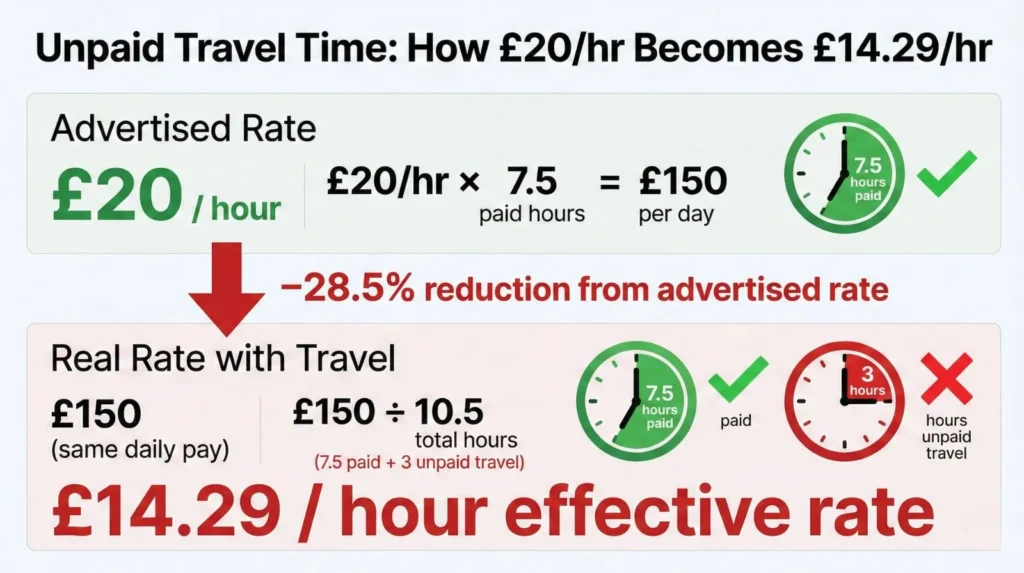
Example calculation (implied from discussions): Electrician paid £20 per hour, working 7.5 hours on site, traveling 1.5 hours each way (3 hours total unpaid):
Paid hours: 7.5 at £20/hr = £150
Total time: 10.5 hours (7.5 paid + 3 unpaid)
Real hourly rate: £150 ÷ 10.5 = £14.29 per hour (28.5% lower than advertised)
Recurring theme: Electricians who calculate their real hourly rate including unpaid travel time feel misled by advertised wage rates that don’t reflect actual earnings per hour of their day.
Selective JIB Application (Rules Bent or Ignored)
Pattern: Electricians report employers selectively applying JIB rules:
Following wage scales and statutory benefits (to attract workers)
Ignoring or “interpreting” travel and lodging rules (to reduce costs)
Using CIS or false self-employment to avoid JIB altogether for some workers
Example (2013 post): Electrician noted colleagues doubted entitlement to mileage over 15 miles, suggesting employer culture discourages knowing or claiming JIB rights.
Recurring theme: Fear of being sidelined, not given future contracts, or dismissed for “causing trouble” by insisting on JIB travel entitlements creates a compliance culture where workers accept less than the rules specify.
Lodge and Travel as Job Satisfaction Factors
Pattern: Electricians consistently cite travel arrangements and lodging support as major factors in job satisfaction, sometimes outweighing base pay rates.
Recurring theme: A role paying £38,000 with full travel time paid and adequate lodging support is often preferred over a role paying £42,000 with significant unpaid travel and insufficient lodging. The total package value, not just the headline figure, determines perceived fairness.
What Forum Posts Reveal
The anecdotal evidence suggests:
Gap between rules and practice: JIB rules exist, but enforcement relies on individual electricians challenging employers, which many avoid due to job security concerns.
Travel time as major pain point: Unpaid daily commutes (1-3 hours) are the single biggest complaint, more than mileage rates or lodging shortfalls.
Insufficient allowances: Both mileage (22p vs actual costs 35-45p per mile) and lodging (£51.29 vs actual costs £60-£90) are viewed as inadequate.
Need for transparency: Electricians want explicit clarity on travel arrangements before accepting roles, not assumptions that “JIB conditions apply.”
Value of structured support: Electricians who have worked under properly applied JIB rules appreciate the tax-free allowances and predictability, even if amounts are sometimes insufficient.
Worked Scenarios: Real Earnings Impact of 2026 Changes
Theory matters less than practice. These three scenarios model how the 2026 JIB changes affect actual weekly and annual take-home pay for different employment arrangements.
Assumptions for all scenarios:
Electrician base rate: £19.54 per hour (2025, based on similar SJIB baseline)
2026 rate: £20.31 per hour (3.95% increase)
Standard working week: 37.5 hours (Monday to Friday, 7.5 hours daily)
No changes to mileage allowances (22p/mile), distance thresholds (15 miles), or travel time rules
Scenario A: Local Job, Limited Travel (Within 15-Mile Radius)
Profile: Electrician working on commercial fit-out project 12 miles from home. Travels directly from home to site daily. Uses own vehicle. No lodging required. Work is within 25-mile local engagement radius.
Travel arrangements:
Daily commute: 12 miles each way (24 miles round trip)
Travel time: 30 minutes each way (1 hour total daily, 5 hours weekly)
Mileage allowance: £0 (under 15-mile threshold)
2025 earnings:
Base pay: 37.5 hours × £19.54/hr = £733.00 weekly
Mileage: £0 weekly
Total: £733.00 weekly (£38,116 annually)
2026 earnings:
Base pay: 37.5 hours × £20.31/hr = £761.63 weekly
Mileage: £0 weekly (unchanged)
Total: £761.63 weekly (£40,005 annually)
Net change: +£28.63 weekly (+£1,489 annually), entirely from base wage increase
Real hourly rate calculation (including unpaid travel):
2025: £733 ÷ 42.5 hours (37.5 paid + 5 unpaid travel) = £17.25/hr effective
2026: £761.63 ÷ 42.5 hours = £17.92/hr effective
Real rate improvement: £0.67/hr (3.9% increase)
Key insight: The 2026 wage increase improves gross earnings by 3.95%, but the effective hourly rate (including unpaid time) improves only 3.9% because the unpaid travel hours don’t benefit from the wage rise. Electricians under the 15-mile threshold see no mileage benefit, making the wage increase the only improvement.
Scenario B: Long-Distance Job with Lodging (Monday to Friday Away)
Profile: Approved Electrician working on industrial project 120 miles from home. Stays away Monday night to Thursday night (4 nights lodging weekly). Travels home Friday afternoon. Returns Sunday evening (or Monday early morning depending on start time).
Travel arrangements:
Weekly return: 240 miles round trip
Mileage: Exceeds 15-mile threshold, so 240 miles × 22p = £52.80 weekly
Lodging: 4 nights × £51.29 = £205.16 weekly (2025), potentially 4 nights × £53.40 = £213.60 weekly (2026 if PMES-rate applies)
Periodic return travel time: Paid (4 hours for 100-200 mile journey under JIB lodging rules)
2025 earnings:
Base pay: 37.5 hours × £20.06/hr (Approved rate) = £752.25 weekly
Periodic return travel: 4 hours × £20.06 = £80.24 weekly
Mileage: £52.80 weekly (tax-free)
Lodging: £205.16 weekly (tax-free)
Total: £1,090.45 weekly (£56,703 annually gross + £13,414 tax-free allowances)
2026 earnings:
Base pay: 37.5 hours × £20.85/hr (3.95% increase) = £781.88 weekly
Periodic return travel: 4 hours × £20.85 = £83.40 weekly
Mileage: £52.80 weekly (unchanged)
Lodging: £213.60 weekly (estimated £53.40/night if PMES-rate applies)
Total: £1,131.68 weekly (£58,848 gross + £13,853 tax-free allowances)
Net change: +£41.23 weekly (+£2,144 annually)
Breakdown of improvement:
Base pay: +£29.63 weekly (wage increase)
Periodic return travel: +£3.16 weekly (paid at higher hourly rate)
Mileage: £0 (unchanged)
Lodging: +£8.44 weekly (if £53.40/night confirmed)
Key insight: The wage increase drives the majority of improvement (+£32.79 weekly from base pay + periodic travel). The lodging increase (+£8.44 weekly) helps marginally but doesn’t close the gap to actual accommodation costs. If Premier Inn costs £75/night and JIB allowance is £53.40, the electrician still subsidises £21.60/night (£86.40 weekly for 4 nights), costing £4,493 annually from their wages.
Scenario C: Yard-Based vs Home-Based (Same Distance, Different Classification)
This scenario highlights the classification issue that dramatically affects earnings.
Profile: Two electricians working the same commercial project, 25 miles from their homes. Both work 37.5 hours weekly on site. Both travel 1 hour each way daily (2 hours total, 10 hours weekly). Both drive own vehicles.
Electrician A: Home-Based (Locally Engaged)
Travels directly from home to site daily
Home substitutes for shop in distance calculations
Travel time: Unpaid (home-to-site)
Mileage: 50 miles daily × 22p = £11 daily, £55 weekly (exceeds 15-mile threshold)
Electrician B: Yard-Based (Shop-Based)
Reports to employer’s premises (yard) daily
Travels from yard to site in employer-provided transport or own vehicle
Travel time: Paid as working time (2 hours daily, 10 hours weekly)
Mileage: If own vehicle used, 20 miles yard-to-site × 22p = £4.40 daily, £22 weekly
2026 earnings comparison:
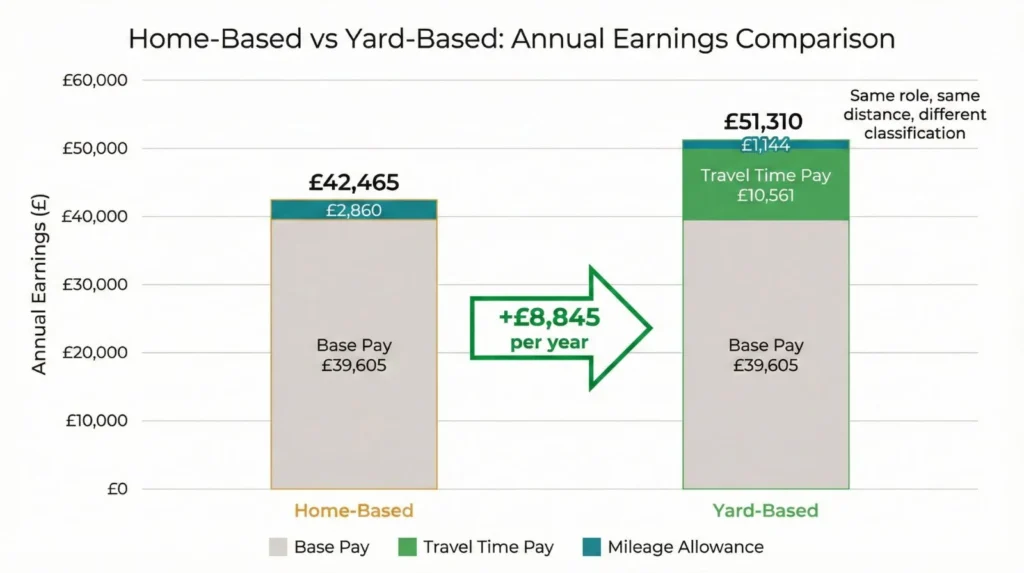
Electrician A (Home-Based):
Base pay: 37.5 hours × £20.31 = £761.63 weekly
Travel time: £0 (unpaid)
Mileage: £55 weekly (tax-free)
Total: £816.63 weekly (£42,465 annually gross + £2,860 tax-free)
Electrician B (Yard-Based):
Base pay: 37.5 hours × £20.31 = £761.63 weekly
Travel time: 10 hours × £20.31 = £203.10 weekly (paid)
Mileage: £22 weekly (tax-free, if own vehicle used for yard-to-site)
Total: £986.73 weekly (£51,310 annually gross + £1,144 tax-free)
Classification difference: Electrician B (yard-based) earns £170.10 more per week (£8,845 annually) than Electrician A (home-based) for the exact same role, distance, and hours, purely due to classification.
Real hourly rate including unpaid time:
Electrician A: £816.63 ÷ 47.5 hours (37.5 paid + 10 unpaid) = £17.19/hr effective
Electrician B: £986.73 ÷ 47.5 hours (all time paid) = £20.77/hr effective
Key insight: The yard-based vs home-based classification is worth approximately £8,800 annually. Electricians should clarify their classification before accepting roles, as this single detail determines whether 10 hours weekly are paid or unpaid. The 2026 wage increase benefits both equally in base pay, but the yard-based electrician gains more in absolute terms because their paid hours include travel.
Pitfalls, Grey Areas and Common Disputes
JIB travel rules, while detailed, create ambiguities and disputes. Understanding common pitfalls helps electricians navigate employment arrangements and challenge incorrect applications.
Common Disputes About Travel and Lodge Under JIB
1. Employers classifying all travel as “your own time”
The dispute: Employers refuse to pay even between-site travel during the working day, claiming all travel is the electrician’s responsibility.
JIB rule: Travel between sites during the working day is paid as working time. Only home-to-first-site and last-site-to-home are unpaid.
Real-world: Many electricians report employers paying only for site work, not for 20-30 minute journeys between Site A and Site B during the day. Challenging this risks being moved to less favorable contracts.
2. Distance threshold disagreements
The dispute: Employer and electrician disagree on whether the 15-mile threshold applies or whether the site qualifies as “outside normal daily travelling distance” for lodging eligibility.
Grey area: JIB rules specify 15 miles for mileage and 35 miles (or “onerous”) for lodging, but “onerous” is subjective. Is a 90-minute motorway commute “onerous”? Is a 30-mile commute through congested urban roads “onerous”?
Real-world: Employers tend to interpret borderline cases restrictively (no lodging for 32-mile sites, no mileage for 14.5-mile sites). Electricians challenging this must provide evidence that travel is genuinely impractical.
3. Multi-site days and payment eligibility
The dispute: Electrician starts day at home, travels to short job (1 hour), then travels to second job (30 minutes), then home. Employer pays only the 30-minute inter-site travel, not the initial home-to-first-site hour.
JIB rule: Home-to-first-site is unpaid; between-sites is paid; last-site-to-home is unpaid.
Real-world: Service engineers visiting 3-5 sites daily report varied practice. Some employers pay all between-site travel; others pay none, arguing each site is a “new first site.”
4. Return journey payment under lodging
The dispute: Electrician on a lodging job travels home for the weekend. Employer pays only one-way travel time (Friday site-to-home), not return (Sunday evening home-to-site).
JIB rule: Periodic return journeys (weekend returns, start/end of lodging period) qualify for both outward and return travel time payment at ordinary rates based on distance bands.
Real-world: Many employers pay one way only, citing “industry practice.” Electricians accepting this effectively donate 4-7.5 hours of unpaid travel time per trip.
Tax and HMRC Issues
Lodging allowance tax treatment:
Tax-free if: Electrician provides lodging certificate proving they stayed away and paid for accommodation (or employer provides free accommodation and doesn’t pay allowance).
Taxable if: Employer pays above the HMRC-approved JIB rate without proper documentation, or if lodging doesn’t genuinely qualify (e.g., site within normal daily travel distance).
HMRC confirmation: The JIB lodging rate (£51.29 in 2025, likely £53.09-£53.40 in 2026) is HMRC-approved under working rule agreements, allowing employers to pay without retaining receipts for each night. Electricians still must certify they stayed away.
Mileage allowance tax treatment:
Tax-free: JIB’s 22p per mile for own transport is HMRC-approved as a tax-free expense under working rule agreements.
Tax relief available: Electricians whose actual vehicle running costs exceed 22p per mile can claim additional tax relief via form P87 for the difference between 22p and HMRC’s approved 45p per mile rate (first 10,000 miles annually).
Example: Electrician drives 8,000 miles annually for work, receives JIB £1,760 (8,000 × 22p) tax-free. HMRC allows £3,600 (8,000 × 45p). The £1,840 difference can be claimed as a tax relief via P87, recovering £368 to £736 depending on tax band.
Paid travel time tax treatment:
Taxable: When travel time is paid (between sites, yard-based travel, periodic returns under lodging), it’s taxed as ordinary income. This is working time, not a tax-free allowance.
Impact: A yard-based electrician paid for 10 hours weekly travel time (£203.10 at £20.31/hr) pays income tax and National Insurance on this, reducing take-home by approximately £65 to £85 weekly depending on tax band and NI threshold.
Union and Employer Commentary
Unite the Union: Negotiated the 2026-2028 deal emphasizing wage increases as a response to cost-of-living pressures and inflation. Union statements highlight the 13.8% cumulative wage rise as addressing rising costs, but don’t explicitly reference travel or lodging structural changes beyond expected inflationary uplifts to lodging rates.
ECA (Electrical Contractors’ Association): Described the deal as “balanced and sustainable,” providing wage certainty for workforce and employers during contract tendering periods. ECA commentary focuses on maintaining competitive pay while ensuring industry viability, with travel/lodging treated as standard components adjusted via HMRC-linked mechanisms rather than negotiation points.
Reality: Neither union nor employer body has pushed for structural reform of travel rules (e.g., reducing the 15-mile threshold, paying home-to-site travel time, increasing mileage rates to match HMRC 45p). The focus remains on base wages and statutory benefits, with travel and lodging treated as ancillary issues adjusted for inflation rather than redesigned.
Gotchas and Practical Warnings
Not automatic: JIB allowances aren’t paid automatically. Electricians must:
Submit mileage claims (weekly or monthly depending on employer)
Provide lodging certificates
Request periodic return travel time payment explicitly
Failing to submit paperwork means missing out on entitlements.
Employer can refuse: If an electrician cannot prove they stayed in paid lodging (e.g., stayed with family for free), the employer can refuse the lodging allowance. The allowance is for actual costs incurred, not a guaranteed payment regardless of circumstance.
Free transport/accommodation: If an employer provides free transport (company van with driver) or free accommodation (site welfare unit, employer-arranged B&B), the electrician typically doesn’t receive the cash allowance. The provision in kind substitutes for the cash payment.
Classification matters before acceptance: Electricians should clarify whether they’re home-based or yard-based before accepting roles. This classification can’t be easily changed mid-contract and determines whether travel time is paid.
Myth vs Reality: Test Each Claim
Four common claims about JIB travel and lodging circulate among electricians. Testing each against evidence reveals which are true, false, or context-dependent.
Claim 1: “JIB pays you from your front door”
Supporting evidence:
For locally engaged (home-based) electricians, JIB rules use “home” as the reference point for calculating distances when the operative is not required to report to the shop daily
Mileage allowances are paid from home to site if the distance exceeds 15 miles
This creates the impression that JIB treats home as the starting point
Contradicting evidence:
Travel time from home to first site is unpaid under standard JIB rules
Only yard-based electricians (reporting to employer’s premises) receive paid travel time from shop to site
The 15-mile threshold means many electricians with 10-14 mile commutes receive neither paid travel time nor mileage allowance
Verdict: Mostly False. JIB pays cost allowances (mileage) from your home if distance exceeds 15 miles, but does not pay time from your front door. Only yard-based electricians are genuinely “paid from the moment they leave” (from the shop, not their home). The phrase “paid from your front door” is misleading marketing that conflates cost compensation with time compensation.
Claim 2: “You get lodge and mileage on any job that’s far away”
Supporting evidence:
Lodging allowance is payable when an electrician is required to stay away from home due to distance or travel conditions
Mileage allowance is payable for distances over 15 miles
These allowances are guaranteed under JIB rules for qualifying circumstances
Contradicting evidence:
Lodging requires formal proof (lodging certificate) and site must genuinely be outside normal daily travelling distance (typically over 35 miles)
Employers can refuse lodging if they deem daily travel feasible, even for 30-35 mile sites
Mileage only applies over 15 miles; anything under that threshold receives £0
“Far away” is subjective; JIB uses specific distance thresholds, not general “far” classifications
Verdict: Context-Dependent. You get lodge and mileage if specific JIB criteria are met (over 35 miles for lodge, over 15 miles for mileage, with proper documentation). “Far away” alone doesn’t guarantee entitlement. A 25-mile site is far for many electricians but doesn’t qualify for lodging and only partially qualifies for mileage. The rules are precise, not general.
Claim 3: “Travel time is always paid at your normal rate”
Supporting evidence:
Travel time between sites during the working day is paid as working time at ordinary rates
Periodic return travel under lodging arrangements is paid at ordinary rates based on distance bands
Yard-based electricians receive paid travel time from shop to site
Contradicting evidence:
Home-to-first-site travel is unpaid for the majority of electricians (home-based/locally engaged)
Last-site-to-home travel is unpaid
Only specific types of travel time are paid; most daily commuting is unpaid
Verdict: Partly True. Some travel time is paid (between-sites, yard-based, periodic returns), but most electricians’ daily commute (home-to-site, site-to-home) is unpaid. “Always paid” is false. “Paid under specific circumstances” is accurate. Electricians assuming all travel time is paid will be disappointed.
Claim 4: “Going on the books with JIB is always better for travel than being CIS”
Supporting evidence:
JIB PAYE provides structured, tax-free allowances (22p/mile mileage, £51.29/night lodging)
HMRC confirms these rates as tax-free, meaning electricians receive full amounts without deductions
JIB includes statutory benefits (sick pay, pension, holiday pay) that CIS self-employed don’t receive
Tax-free allowances are guaranteed under JIB; CIS electricians must claim all expenses via self-assessment and hope HMRC accepts them
Contradicting evidence:
CIS day rates (£220-£280 daily) are often 20-30% higher than JIB PAYE hourly equivalents, intended to cover all travel costs and time
CIS electricians can deduct all actual business expenses (fuel, vehicle depreciation, insurance, accommodation) from taxable income, potentially recovering more than JIB’s fixed allowances if expenses are high
JIB’s fixed allowances (22p/mile, £51.29/night) may be insufficient; CIS electricians can claim actual costs without caps
Employer flexibility: CIS roles often negotiate “door-to-door” pay or include all travel in day rate, removing the unpaid-time issue JIB electricians face
Verdict: Context-Dependent. JIB PAYE is better for electricians who value security, tax simplicity, and statutory benefits. The tax-free allowances and predictable structure provide clear entitlements. CIS is better for electricians with high actual expenses or who can negotiate premium day rates that exceed JIB equivalents even after tax. Neither is universally “better”; the optimal choice depends on individual financial situation, risk tolerance, and negotiating position.
Summary of Myth-Testing
Claim 1 (Paid from front door): Mostly False
Claim 2 (Lodge/mileage on far jobs): Context-Dependent
Claim 3 (Travel always paid): Partly True
Claim 4 (JIB always better than CIS): Context-Dependent
Electricians should interrogate specific employment terms rather than assuming general claims about JIB travel entitlements hold true in their individual circumstances. For detailed guidance on how JIB travel allowances integrate with overall wage structures and total compensation packages, we’ve covered the complete framework linking base pay, overtime, allowances, and sector-specific variations that determine true earnings potential.
Conclusion
The 2026-2028 JIB agreement delivers substantial wage increases (3.95%, 4.6%, 4.85%) for electricians, approved electricians, and technicians, providing approximately 13.8% cumulative growth over three years. These increases will improve weekly and annual gross earnings, and because any paid travel time is calculated at the higher hourly rate, yard-based electricians and those on lodging jobs with periodic return travel will see secondary benefits beyond the base wage rise.
However, the agreement makes no confirmed structural changes to travel time rules, mileage allowances, or lodging thresholds. Home-to-site travel remains unpaid. Mileage allowances stay at 22p per mile for own transport and 12p per mile for employer-provided vehicles, with the 15-mile threshold unchanged. Lodging allowances will likely rise modestly from £51.29 to approximately £53.09-£53.40 per night (if JIB Electrotechnical follows the parallel PMES increase), but this marginal gain doesn’t close the gap to actual accommodation costs in many regions.
For electricians, the real-world impact depends heavily on employment classification (home-based vs yard-based), commute distance relative to the 15-mile threshold, and whether lodging is required. An electrician with a 12-mile commute sees only the base wage increase, with no mileage benefit and 5-10 hours weekly of unpaid travel time reducing their effective hourly rate. A yard-based electrician with the same commute receives paid travel time worth £8,000+ annually on top of the wage increase. A lodging electrician benefits from both the wage rise and potential lodging increase, but still likely subsidizes accommodation costs from their wages in high-cost regions.
The JIB framework provides structured, tax-free allowances that offer certainty and simplicity compared to CIS arrangements, but the static travel rules (unchanged since 2019 for mileage rates, unchanged structurally for decades regarding paid vs unpaid time) mean real-world value hasn’t kept pace with fuel costs, accommodation prices, or general inflation. Electricians comparing opportunities should calculate total package value including all paid hours, unpaid time, mileage entitlements, and lodging support, not just the advertised hourly rate.
Call us on 0330 822 5337 to discuss how JIB travel and lodging rules affect the true value of different electrician roles, whether specific opportunities include proper travel compensation, and how to negotiate employment terms that reflect the full cost of commuting and working away from home. For comprehensive understanding of how JIB wage structures work alongside travel allowances to determine total compensation, we can explain the complete framework covering base pay, statutory benefits, and the allowances that together create your actual earnings package.
References
- JIB (Joint Industry Board) – National Working Rules Handbook 2024-2025 – https://www.jib-pmes.org/wp-content/uploads/2023/10/JIB-PMES-NWRs-2024-25-Final-secure-V2.pdf
- JIB – Industrial Determination June 2025 (2026-2028 Wage Agreement) – https://www.jib.org.uk/wp-content/uploads/2025/06/JIB-Industrial-Determination-062025.pdf
- HMRC – Employment Income Manual EIM71325 (Working Rule Agreements, Lodging Allowances) – https://www.gov.uk/hmrc-internal-manuals/employment-income-manual/eim71325
- HMRC – Mileage Allowance Payments (Approved Rates 45p/25p per mile) – https://www.gov.uk/expenses-and-benefits-business-travel-mileage/rules-for-tax
- SJIB (Scottish Joint Industry Board) – National Rates & Allowances 2025-2026 – https://sjib.org.uk/rates-and-allowances/
- NAECI (National Agreement for the Engineering Construction Industry) – Pay and Conditions 2025 – https://www.ecia.co.uk/wp-content/uploads/2024/03/NAECI-2024-2025.pdf
- ECA (Electrical Contractors’ Association) – JIB Pay Rates & Conditions 2026-2028 – https://www.eca.co.uk/member-support/employee-relations/national-collective-agreements/jib-pay-rates
- Unite the Union – Press Release: JIB Pay Deal 2026-2028 – https://www.unitetheunion.org/news-events/news/2025/july/jib-electricians-pay-deal-2026-2028
- Indeed UK – Electrician Job Adverts Analysis 2024-2025 – https://uk.indeed.com/jobs?q=jib+electrician
- Reed – Electrician Roles and Travel Allowances Survey 2024 – https://www.reed.co.uk/jobs/electrician-jobs
- ElectriciansForums.net – Travel Time and Mileage Discussions 2013-2020 (anecdotal forum evidence) – https://www.electriciansforums.net/
Note on Accuracy and Updates
Last reviewed: 15 December 2025. This page is maintained; we correct errors and refresh sources as JIB National Working Rules, travel allowances, and HMRC tax-free rates are updated. Travel time rules based on JIB Handbook 2024-2025. Mileage and lodging rates based on JIB Industrial Determination June 2025 and HMRC Employment Income Manual EIM71325. SJIB comparison data from official SJIB rates 2025-2026. NAECI data from ECIA provisional agreements 2025. Market practice analysis from Indeed, Reed, Totaljobs advertised roles 2024-2025. Forum evidence anecdotal (ElectriciansForums.net 2013-2020). Next review scheduled following JIB 2026 lodging rate confirmation (expected January 2026) and any HMRC tax-free allowance updates (April 2026 tax year).
