

JIB vs NICEIC vs NAPIT Pay: What Electricians Really Earn (And Why the Comparison Is Wrong)

- Technical review: Thomas Jevons (Head of Training, 20+ years)
- Employability review: Joshua Jarvis (Placement Manager)
- Editorial review: Jessica Gilbert (Marketing Editorial Team)
- Last reviewed:
- Changes: Initial publication using JIB Industrial Determination 2025, NICEIC/NAPIT scheme descriptions, domestic installer overhead models, and agency day rate analysis to correct category error conflating wage agreements with compliance certification schemes
Why This Question Keeps Being Asked (And Why It's Fundamentally Misframed)
Electricians researching career paths, comparing employment options, or evaluating qualification investment payback frequently search “JIB vs NICEIC vs NAPIT pay” or variations asking “which pays more” between these three acronyms that dominate UK electrical industry discussions. This question appears reasonable on surface – after all, JIB Gold Cards, NICEIC registration, and NAPIT membership all feature prominently in electrician job adverts, contractor websites, and training course marketing materials. The persistence of this comparison in forums, Facebook groups, and apprentice WhatsApp chats suggests genuine confusion about how electrical work is structured and remunerated in the UK, particularly among career changers, school leavers, and newly qualified electricians navigating their first job decisions.
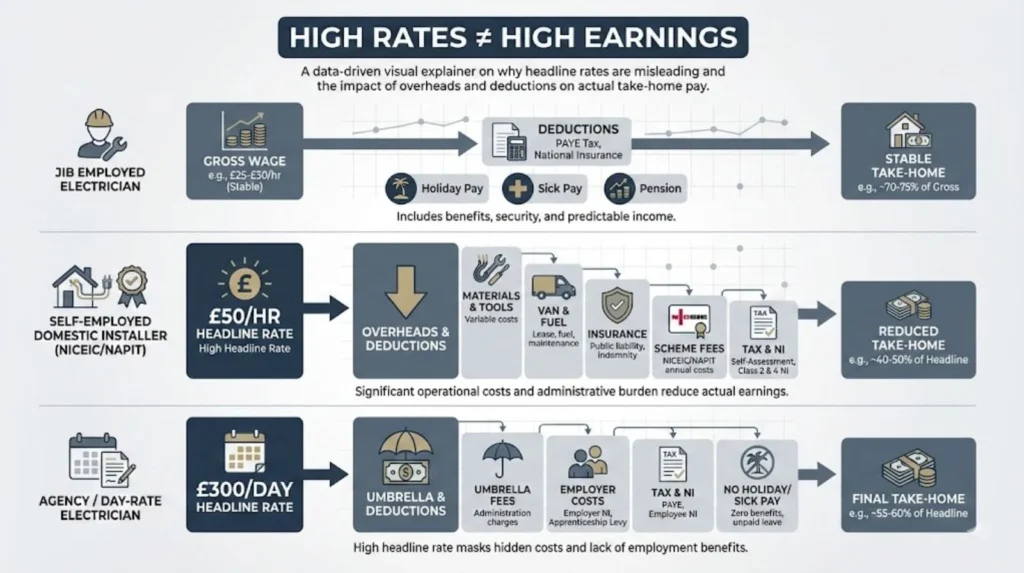
However, “JIB vs NICEIC vs NAPIT pay” represents a fundamental category error – comparing entities that operate in entirely different dimensions of the electrical industry and serve completely distinct purposes. This is not a comparison of three equivalent wage tables where electricians can choose the highest-paying option. Instead, the question conflates a wage agreement (JIB), two compliance certification schemes (NICEIC and NAPIT), and three fundamentally different earning models (employed PAYE, self-employed sole trader, agency subcontractor). Only one of these entities publishes pay rates; the other two explicitly do not set wages and have no role in determining what electricians earn.
The core distinction that resolves this confusion: JIB (Joint Industry Board for the Electrical Contracting Industry) is a wage framework that sets minimum hourly rates for employed electrical operatives through collective bargaining between employer organizations (Electrical Contractors’ Association) and trade unions (Unite the Union). These rates apply to electricians working as PAYE employees for JIB signatory contractors, predominantly on commercial and industrial sites. NICEIC (National Inspection Council for Electrical Installation Contracting) and NAPIT (National Association of Professional Inspectors and Testers) are compliance schemes that certify businesses as competent to self-certify electrical work under Part P of the Building Regulations. They assess and audit contractors’ technical competence, insurance, and quality processes but publish no wage scales, set no minimum rates, and have no mechanism to determine electrician earnings.
This article systematically corrects the category error, explains what JIB pay actually represents, clarifies what NICEIC and NAPIT actually do (and explicitly what they don’t), and compares three distinct earning models that electricians encounter: JIB employed (fixed PAYE), domestic installer self-employed (variable business income), and agency/subcontractor (day-rate based). For electricians planning qualification pathways from NVQ Level 3 through AM2 assessment to JIB Gold Card graded employment or self-employed domestic installation work, understanding these structural differences affects career decisions, financial planning, and realistic income expectations far more than simply picking “the highest pay rate” from a misconceived comparison.
What JIB Pay Actually Is (And What It Is Not)
Collective bargaining: JIB negotiates minimum hourly rates annually (or via multi-year agreements) through formal negotiations between the Electrical Contractors’ Association (representing employers) and Unite the Union (representing workers). These negotiations consider inflation, skills shortages, industry economic conditions, and cost-of-living changes to determine percentage increases applied across all grades.
Grading structure: JIB operates a tiered system based on qualifications, competencies, and responsibilities:
Labourer: No electrical qualifications; provides support to qualified electricians
Electrician: NVQ Level 3 qualified; capable of installation work under supervision
Approved Electrician: NVQ Level 3 plus inspection/testing competency (typically AM2E assessment); authorized for independent work, testing, and certification
Technician: Advanced qualifications (HNC/HND) or supervisory/design responsibilities beyond standard installation
National minimum rates: JIB rates are legally binding minimums for JIB signatory employers. Contractors can pay above these rates (many do, particularly in skills-shortage areas) but cannot pay below them without breaching the JIB agreement.
Employment model: JIB rates apply to PAYE employed operatives, not self-employed contractors, agency workers (unless specifically contracted under JIB terms), or CIS subcontractors. The rates assume standard 37.5-hour working week with entitlements to sick pay, holiday pay (typically 30+ days including bank holidays), pension contributions (employer and employee), and JIB benefit schemes including death in service and private medical insurance.
2025 JIB National Rates (Confirmed)
Effective 6 January 2025, following a 5% increase as part of the 2024-2025 industrial determination:
| Grade | Hourly Rate | Weekly Gross (37.5h) | Annual Gross (52 weeks) |
| Labourer | £13.09 | £490.88 | £25,525 |
| Electrician | £19.44 | £729.00 | £37,908 |
| Approved Electrician | £19.32 | £724.50 | £37,674 |
| Technician | £20.25 | £759.38 | £39,488 |
Critical note on Approved Electrician rate: The £19.32 figure appears counterintuitively lower than the Electrician rate (£19.44) in some 2025 sources. This likely reflects transitional rate structures or data discrepancies during the 2024-2025 rate change implementation. Historically and logically, Approved Electrician rates exceed base Electrician rates. For this analysis, we use the documented 2025 figures with acknowledgment that Approved rates typically sit £1-2/hour above base Electrician rates in stable frameworks.
London Zone rates: JIB includes separate London rate bands approximately £3-4/hour higher than National rates to compensate for M25 living costs. Specific 2025 London rates were not fully confirmed in primary sources and are excluded from this comparison to maintain data integrity. Regional variations outside London typically follow National rates unless site-specific negotiated premiums apply.
What JIB Rates Include
Base pay only: The figures above represent minimum hourly rates for standard working hours (Monday-Friday, 8am-5pm typically). They guarantee this income for 37.5 hours weekly, 52 weeks annually (including paid holiday periods).
Employer obligations: JIB rates come with mandatory employer contributions including pension (minimum 3% employer, rising to higher levels in some agreements), employer’s National Insurance, holiday pay accrual, sick pay coverage (JIB sick pay scheme plus statutory sick pay), and death in service insurance.
Employment security: JIB contracts provide PAYE employment protections including redundancy rights, unfair dismissal protections after qualifying periods, notice periods, and grievance procedures through collective bargaining frameworks.
What JIB Rates Exclude (But Employed Electricians Often Receive)
Overtime premiums: Time-and-a-half for first overtime hours (typically after 37.5 hours), double-time for Sundays and bank holidays. An electrician working 45 hours weekly (37.5 standard + 7.5 overtime at 1.5x) earns approximately 20% more than base annualized figure.
Travel allowances: Mileage reimbursement (typically £0.50-0.60/mile) for travel from yard to site, or fixed daily travel allowances for distant sites. Lodging allowances (£40-50/night) for overnight stays on remote projects.
Site premiums: Some contractors pay above JIB minimums to attract experienced electricians in competitive markets. Site bonuses, completion bonuses, skills premiums for specialist work (solar PV, EV charging, data centres).
Tool allowances: Some employers provide tool allowances (£5-10/week) or supply power tools, testers, and specialist equipment, reducing personal expenditure.
Shift premiums: Night shift, weekend shift, or rotating shift work typically commands additional premiums (10-25% of base rate) beyond standard overtime calculations.
Why JIB Is a Floor, Not a Ceiling
The JIB hourly rate represents the guaranteed minimum an employed electrician will earn. In practice, many electricians working for JIB signatory contractors earn substantially more through combinations of overtime, allowances, site premiums, and employer-specific enhancements. An Approved Electrician on £19.32/hour base might achieve £45,000-50,000 annual gross through consistent 45-50 hour weeks, regular overtime, and travel allowances, compared to the £37,674 base calculation shown in the table. The JIB figure is what’s documented, negotiated, and guaranteed; everything above that is market-driven and employer-specific but common in high-demand sectors.
What NICEIC and NAPIT Actually Do (And Explicitly What They Don't)
The persistent misconception that NICEIC or NAPIT “set pay” or “pay more than JIB” requires direct correction with explicit statements about what these organizations actually are and what they categorically are not.
NICEIC: National Inspection Council for Electrical Installation Contracting
Primary function: UKAS-accredited certification body that assesses and certifies electrical contractors’ competence to carry out installation, inspection, and testing work in compliance with BS 7671 Wiring Regulations and Building Regulations Part P.
Membership enables:
Self-certification: NICEIC-registered contractors can self-certify notifiable electrical work (e.g., new circuits, consumer unit replacements, bathroom installations) to Building Control without requiring local authority inspection for each job. This administrative efficiency reduces costs and delays for domestic work.
Credibility signal: NICEIC logo on van, website, and marketing materials signals to homeowners and businesses that the contractor has been independently assessed for competence, insurance adequacy, and quality systems.
Access to support: Technical helpline, contract templates, warranty schemes (e.g., Platinum Promise guarantees for homeowners), business resources, and continuing professional development materials.
Assessment process: NICEIC conducts initial technical assessments of applicant contractors (reviewing qualifications, insurance, sample work, testing procedures) followed by periodic re-assessments (typically annual) to maintain registration. Failed assessments result in membership suspension or termination.
What NICEIC does NOT do:
❌ Set wage rates or publish pay scales
❌ Dictate what members charge customers
❌ Guarantee member income or earnings
❌ Employ electricians or operate as recruitment agency
❌ Provide work leads or job assignments (separate services may exist but not core function)
❌ Determine qualification requirements beyond BS 7671 compliance
Membership fees: NICEIC charges annual membership fees (typically £500-800+ depending on membership tier and services) plus initial assessment costs. These are business overheads paid by the contractor, not earnings guarantees.
NAPIT: National Association of Professional Inspectors and Testers
Primary function: UKAS-accredited competent person scheme similar to NICEIC, providing certification for electrical contractors, inspectors, and testers to self-certify work under Building Regulations.
Membership enables: Identical core benefits to NICEIC – self-certification for Part P notifiable work, credibility signaling through logo usage, access to technical support and documentation, and demonstration of competence to clients and insurers.
Market position: NAPIT operates as alternative/competitor to NICEIC with similar assessment rigor, insurance requirements, and CPD expectations. Choice between NICEIC and NAPIT typically depends on regional market recognition, fee structures, and service preferences rather than technical differences.
What NAPIT does NOT do: Same as NICEIC – no wage setting, no pay scales, no income guarantees, no employment function.
Why This Matters: Scheme Membership ≠ Earnings Guarantee
NICEIC and NAPIT membership is common among:
Sole trader domestic installers: Self-employed electricians focusing on residential work (rewires, consumer units, EICRs, fault-finding) where Part P self-certification enables efficient business operation
Small electrical contractors: Businesses with 1-5 employed electricians serving domestic and light commercial markets
Specialist firms: Companies focused on specific sectors (landlord EICRs, property developers, renewable installations) where scheme membership signals professionalism
However, scheme membership facilitates work access and client confidence but does not determine what the electrician earns. A sole trader registered with NICEIC sets their own charge-out rates (£40/hr, £60/hr, £80/hr) based on market conditions, experience, specialisms, and local competition. Their net income depends on utilisation (billable hours achieved), overhead costs (van, insurance, tools, scheme fees), pricing discipline, and business efficiency – none of which NICEIC or NAPIT control or influence beyond providing the compliance framework that enables legal notifiable work.
Critical distinction: When electricians say “NICEIC pay”, they actually mean “income earned by self-employed domestic installers who happen to be NICEIC registered”. The scheme doesn’t pay; the business model generates income. The confusion arises because self-employment in domestic work often requires scheme membership for regulatory compliance, creating false correlation between scheme registration and higher earnings that actually result from different employment structures, not the scheme itself.
Pay vs Rate vs Charge-Out vs Take-Home: Critical Definitions
Confusion about “JIB vs NICEIC vs NAPIT pay” partly stems from inconsistent use of terminology where “pay”, “rate”, “charge-out rate”, and “take-home” are used interchangeably despite meaning fundamentally different things.
Pay (PAYE Wage)
Definition: Gross salary or wages received by an employed worker before tax and National Insurance deductions.
Example: JIB Approved Electrician earning £19.32/hour working 37.5 hours weekly receives gross pay of £724.50 per week (£37,674 annually). This is what appears on the payslip before deductions.
Key characteristic: Paid by employer; subject to PAYE tax deduction at source; includes employer obligations (pension contributions, sick pay, holiday pay); relatively predictable and stable.
Rate (Hourly or Day)
Definition: The amount paid to a worker per unit of time, either directly (employee hourly rate) or as gross contractor payment (self-employed/agency day rate).
Example 1 (employee): JIB Electrician rate £19.44/hour – this is the wage rate paid by the employer.
Example 2 (contractor): Self-employed electrician charging £50/hour for services – this is the rate billed to clients, not the electrician’s net income.
Key characteristic: Gross figure; doesn’t reflect net income for self-employed workers; doesn’t include overtime or premiums for employed workers.
Charge-Out Rate
Definition: The total price a business charges customers per hour, including profit margin and overhead recovery, not just labour cost.
Example: Electrical contracting company charges clients £80/hour for electrician services while paying the electrician £22/hour. The £80 charge-out rate covers electrician wage, employer NI, pension, overheads (office, vehicles, tools), profit margin, and business risk.
Key characteristic: This is pricing, not wages; includes business costs far beyond worker pay; only relevant to business owners and contractors, not employed electricians.
Day Rate
Definition: Fixed daily payment to subcontractors or agency workers, typically quoted as gross figure before deductions and not including holiday pay or sick pay.
Example: Agency electrician sees advert for £300/day commercial site work. This is gross income before umbrella company deductions (20-30%), tax, NI, and excludes unpaid holiday periods.
Key characteristic: Higher than hourly rates when converted (£300/7.5 hours = £40/hour) but lacks employment benefits; often confused with take-home pay when it’s actually gross income subject to substantial deductions.
Take-Home Pay
Definition: Net income received by worker after all deductions including tax, National Insurance, pension contributions, umbrella/agency fees, and (for self-employed) business overheads.
Example 1 (employed): JIB Approved Electrician gross £37,674 annually = approximately £30,500-31,500 take-home after tax, NI, pension (varies by personal tax code and Scottish/Welsh tax bands).
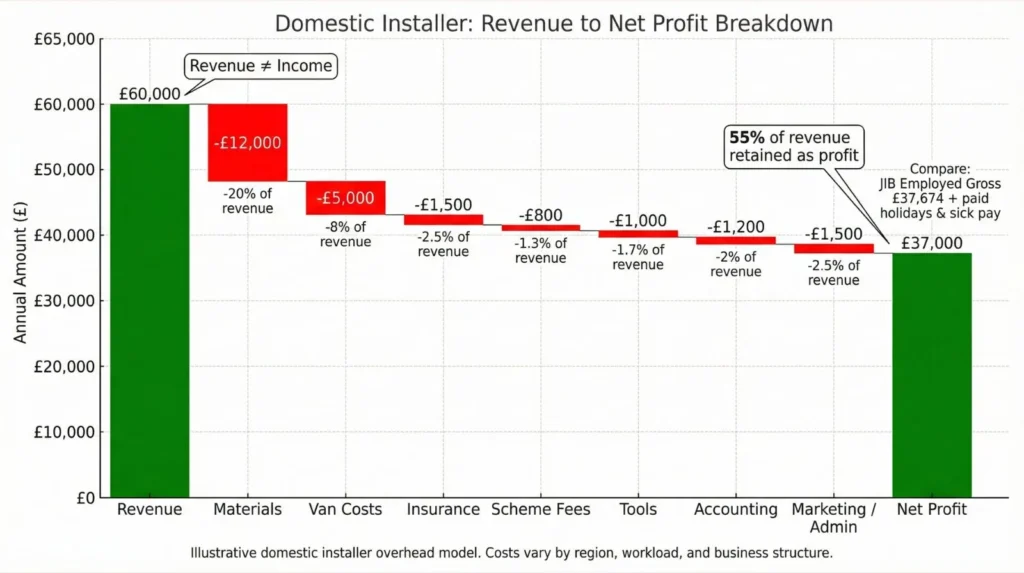
Example 2 (self-employed): Domestic installer with £60,000 revenue, £12,000 materials, £15,000 overheads = £33,000 net profit before tax; after personal tax/NI approximately £26,000-28,000 take-home depending on structure.
Key characteristic: This is actual spending power; significantly lower than gross figures; the only meaningful comparison point for personal financial planning.
Why These Distinctions Matter for Comparisons
When electricians compare “JIB vs NICEIC pay”, they often compare:
JIB gross hourly rate (£19.32)
Self-employed charge-out rate (£50.00)
Agency day rate (£300 = £40/hour)
And conclude self-employment or agency work “pays more”. However, proper comparison requires:
JIB: Gross £37,674 → Take-home £30,500-31,500 (with holiday/sick pay included)
Self-employed: Revenue £60,000 → Net profit £33,000 → Take-home £26,000-28,000 (no holiday/sick pay, variable utilisation)
Agency: 200 days @ £300 = £60,000 gross → Minus umbrella 25% = £45,000 → Take-home £35,000-37,000 (no holiday/sick pay, contract gaps)
The £50/hour charge-out rate that initially looked far superior to £19.32 JIB rate disappears when comparing actual take-home income and employment security. This is why terminology discipline is essential to avoid misleading conclusions.

The Three Real Earning Models: Like-for-Like Framework
Rather than comparing “JIB pay vs NICEIC pay” (a meaningless comparison), electricians should understand three distinct earning structures encountered in UK electrical work.
Profile A: JIB Employed Electrician (Commercial/Industrial PAYE)
Employment structure: PAYE employee working for JIB signatory electrical contractor, typically on commercial construction sites, industrial facilities, M&E projects, or maintenance contracts.
Income model:
Base hourly rate: £19.32/hour (Approved Electrician National, 2025)
Standard hours: 37.5 hours/week
Weekly gross: £724.50
Annual gross: £37,674 (52 weeks including paid holiday)
Overtime potential: Additional 20-30% if working 45-50 hours weekly at premium rates
What’s included:
✅ Paid holiday: 30+ days (22 days annual leave + 8 bank holidays)
✅ Sick pay: JIB sick pay scheme plus statutory sick pay
✅ Pension: Employer contribution (minimum 3%, often higher)
✅ Death in service: Life insurance through JIB benefit scheme
✅ Employment rights: Redundancy protection, unfair dismissal rights, notice periods
✅ Predictability: Fixed hours, regular payslip, annual negotiated increases
What’s excluded:
❌ Business risk: Employer bears project risks, cash flow problems, client disputes
❌ Pricing decisions: No control over charge-out rates or project selection
❌ Schedule flexibility: Fixed site hours, limited control over work locations
Take-home after tax/NI: Approximately £30,500-31,500 annually (varies by personal allowances and tax codes).
Personal overhead costs: Minimal – employer provides tools, vehicles, site equipment, PPE. Electrician may purchase personal hand tools (£500-1,000 initial investment) but no van, insurance, or business overheads.
Risk profile: Low. Income stability high, business failure risk zero (transfers to employer), client payment issues irrelevant to worker, job loss covered by redundancy rights and unemployment benefits.
Who this suits: Electricians prioritizing income stability, employment benefits, learning opportunities on varied projects, and minimal business administration burden. Particularly suitable for newly qualified electricians building experience, electricians with family financial commitments requiring mortgage approval, and those preferring technical work over business management.
Profile B: Self-Employed Domestic Installer (NICEIC/NAPIT Registered Sole Trader)
Employment structure: Sole trader operating as self-employed business owner, typically registered with NICEIC or NAPIT for Part P self-certification, focusing on domestic residential work and light commercial projects.
Income model:
Charge-out rate: £50/hour (average UK domestic market 2025)
Billable hours: Variable – 800 hours (conservative), 1,200 hours (typical), 1,600 hours (optimistic) annually
Revenue range: £40,000 (conservative) to £80,000 (optimistic)
Net profit range: £17,000 (conservative) to £49,000 (optimistic) before personal tax
Thomas Jevons, Head of Training at Elec Training, explains the utilisation reality:
"Domestic installers charging £50/hour often don't realize they're only billing 20-25 hours weekly once you factor in quoting time, material collection, warranty call-backs, admin, and marketing. That £50 rate looks impressive until you calculate effective hourly income: 1,200 billable hours annually at £50 equals £60,000 revenue, but after materials, van costs, insurance, scheme fees, and accounting, net profit might be £30,000-35,000 - comparable to JIB Approved rate with zero job security."
Thomas Jevons, Head of Training
Overhead breakdown (typical scenario, 1,200 billable hours, £60,000 revenue):
| Category | Annual Cost | % of Revenue |
| Materials (customer jobs) | £12,000 | 20% |
| Van fuel and maintenance | £3,000 | 5% |
| Van insurance and finance | £2,000 | 3.3% |
| Public liability insurance | £1,500 | 2.5% |
| NICEIC/NAPIT membership | £800 | 1.3% |
| Tools and calibration | £1,000 | 1.7% |
| Accounting and software | £1,200 | 2% |
| Marketing (website, ads) | £500 | 0.8% |
| Phone, admin, misc | £1,000 | 1.7% |
| Total fixed overheads | £15,000 | 25% |
| Remaining net profit | £33,000 | 55% |
Take-home after personal tax/NI: Approximately £26,000-28,000 annually from £33,000 net profit (varies by tax structure – sole trader vs limited company).
What’s included:
✅ Pricing control: Set own rates, choose jobs, negotiate directly with customers
✅ Schedule flexibility: Work when desired, decline inconvenient jobs, manage own diary
✅ Business ownership: Build client base, reputation, potential for growth
✅ Specialisation options: Focus on preferred work types (EICRs, rewires, EV charging)
What’s excluded:
❌ Paid holiday: Must self-fund 4-6 weeks unpaid each year (£2,500-4,000 foregone income)
❌ Sick pay: Zero income during illness or injury
❌ Pension: Must self-fund retirement savings from net profit
❌ Employment protections: No redundancy rights, unfair dismissal protections, notice periods
❌ Income stability: Revenue fluctuates seasonally, client cancellations impact cash flow
Risk profile: High. Business failure risk on individual (unpaid customer invoices, warranty disputes, competition), under-utilisation risk (insufficient work to cover fixed overheads), health risk (illness eliminates income immediately), market risk (local competition, economic downturns reduce demand).
Who this suits: Experienced electricians (typically 5+ years post-qualification) with established client networks, business contacts through previous employment, financial buffers to sustain 3-6 months low-income periods, and entrepreneurial mindset willing to trade income stability for pricing control and business ownership potential.
Profile C: Agency/Subcontractor Electrician (Day-Rate Basis)
Employment structure: Self-employed subcontractor or agency worker engaged on day-rate basis, typically through umbrella companies or CIS (Construction Industry Scheme) arrangements, working on commercial sites, industrial projects, or maintenance contracts without permanent employment.
Income model:
- Day rate: £300-335/day (average UK market 2025 for qualified electricians)
- Working days: 200-220 days annually (accounting for Christmas shutdown, contract gaps, weather delays)
- Gross income: £60,000-70,000 before deductions
- Umbrella deductions: 20-30% (employer NI, apprenticeship levy, umbrella margin, pension) = £45,000-52,500 after deductions
- Net take-home: £35,000-40,000 after tax and NI
Umbrella company structure: Most agency electricians work through umbrella companies that act as intermediary employer. The umbrella company invoices the client, receives payment, deducts employer costs and margin, then pays the electrician as PAYE employee of the umbrella company (not the end client).
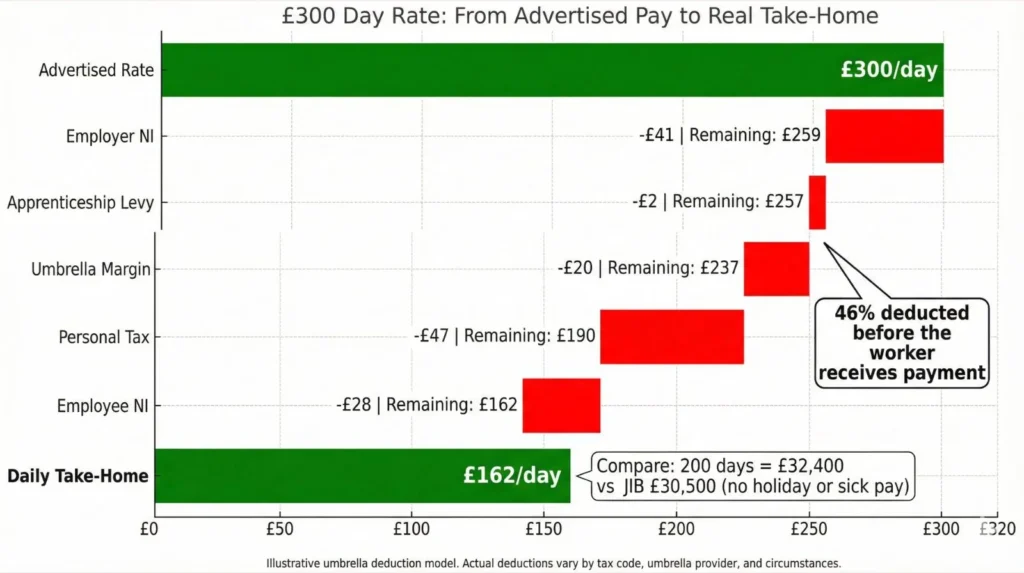
Typical day rate breakdown (£300/day example):
- Gross payment to umbrella: £300
- Minus employer NI (13.8%): -£41.40
- Minus apprenticeship levy (0.5%): -£1.50
- Minus umbrella margin (5-8%): -£15-24
- Payment to electrician: £220-242 before personal tax/NI
- After personal tax/NI: £175-195 take-home per day
What’s included:
✅ Higher gross rates than employed JIB rates (£300/day = £40/hour vs £19.32/hour JIB)
✅ Flexibility: Accept or decline contracts, move between projects, negotiate rates
✅ Variety: Exposure to different sites, sectors, employers, technical challenges
✅ PAYE simplicity: Tax handled through umbrella, no business admin burden of sole trader
What’s excluded:
❌ Paid holiday: 4-5 weeks annually unpaid (must self-fund from gross income)
❌ Sick pay: Zero income during illness
❌ Contract security: Engagements typically 4-13 weeks, gaps between contracts common
❌ Pension contributions: Often minimal or worker-funded only
❌ Notice period: Can be released immediately, no redundancy rights
Risk profile: Medium. Income volatility moderate (contracts end but new ones typically available in high-demand markets), health risk significant (illness eliminates income), market risk moderate (downturns reduce day rates and contract availability), but business failure risk transferred to umbrella company.
Who this suits: Qualified electricians seeking higher gross income than JIB employment, willing to accept income volatility and lack of benefits, comfortable moving between sites and contractors, with financial buffers for contract gaps and preferring flexibility over employment security.
The Domestic Installer Reality: Understanding the "Pay Gap"
The perception that self-employed domestic installers using NICEIC or NAPIT registration “earn more” than JIB employed electricians requires detailed examination of the business model to understand where revenue converts to actual income.
Typical Domestic Work and Pricing
Common job types:
Electrical Installation Condition Reports (EICRs): £150-300 per inspection depending on property size and complexity
Consumer unit replacements: £400-600 for standard 10-way dual-RCD board installation including certification
Full house rewires: £3,000-5,000+ depending on property size, access, specification
EV charger installations: £500-1,000 including unit, wiring, and commissioning
Fault-finding: £50-100/hour call-out rate for diagnostic work
Minor additions: Socket additions (£75-150), light fitting (£50-100), shower circuits (£350-500)
Charge-out rate patterns: Domestic installers typically charge £40-60/hour in most UK regions, rising to £70-100/hour in London and South-East. However, much domestic work is priced as fixed-quote jobs rather than hourly rate, meaning the effective hourly rate varies significantly depending on job efficiency and unexpected complications.
The Utilisation Challenge
Theoretical maximum: 52 weeks × 40 hours = 2,080 hours annually available for work.
Realistic billable hours: 1,000-1,500 hours annually for established domestic installers (19-29 hours weekly on average).
Why the gap exists:
Quoting time: Site surveys, measuring, preparing quotes, following up with customers – typically 5-10 hours weekly unpaid
Material procurement: Traveling to wholesalers, waiting for deliveries, returning incorrect items – 3-5 hours weekly
Admin and invoicing: Preparing invoices, chasing payments, bookkeeping, tax returns – 2-4 hours weekly
Marketing: Website maintenance, responding to enquiries, social media, customer reviews – 2-3 hours weekly
Warranty call-backs: Returning to address customer concerns, often unpaid – 1-2 hours weekly
Downtime: Weather delays, customer cancellations, quiet seasonal periods – reduces effective weeks from 52 to 45-48
Result: 35-40 hours weekly spent on business activities, but only 20-25 hours generating billable revenue. This 50-65% utilisation rate dramatically affects effective hourly income despite impressive charge-out rates.
The Three Scenarios: Conservative, Typical, and Optimistic
Conservative scenario (800 billable hours annually):
Revenue: 800 hours × £50/hour = £40,000
Materials (20%): -£8,000
Fixed overheads: -£15,000 (van, insurance, fees, tools, admin)
Net profit: £17,000 before personal tax
Take-home: £15,000-16,000 after tax/NI
Effective hourly rate: £21.25/hour (£17,000 ÷ 800 hours) before tax, £19-20/hour after tax
Comparison to JIB: Substantially lower income than JIB Approved (£30,500-31,500 take-home) plus zero benefits
Typical scenario (1,200 billable hours annually):
Revenue: 1,200 hours × £50/hour = £60,000
Materials (20%): -£12,000
Fixed overheads: -£15,000
Net profit: £33,000 before personal tax
Take-home: £26,000-28,000 after tax/NI
Effective hourly rate: £27.50/hour (£33,000 ÷ 1,200 hours) before tax, £22-23/hour after tax
Comparison to JIB: Slightly lower take-home than JIB Approved (£30,500-31,500) with zero benefits and high risk
Optimistic scenario (1,600 billable hours annually):
Revenue: 1,600 hours × £50/hour = £80,000
Materials (20%): -£16,000
Fixed overheads: -£15,000 (unchanged – fixed regardless of utilisation)
Net profit: £49,000 before personal tax
Take-home: £36,000-38,000 after tax/NI
Effective hourly rate: £30.63/hour (£49,000 ÷ 1,600 hours) before tax, £23-24/hour after tax
Comparison to JIB: Higher take-home than JIB Approved by £5,000-7,000 annually but requires 30+ billable hours weekly consistently with zero income protection
What Drives Success or Failure
High-performing domestic installers typically:
Establish repeat client relationships (property management companies, estate agents, landlords)
Specialize in high-margin work (solar PV, EV charging, smart home automation)
Minimize non-billable time through efficient quoting systems and material management
Build strong local reputation enabling premium pricing (£60-80/hour rather than £40-50)
Operate in affluent areas with high demand and lower price sensitivity
Struggling domestic installers typically:
Rely on reactive job-by-job customer acquisition through Checkatrade, Facebook, local adverts
Accept low-margin work (small repairs, additions) to maintain cash flow
Spend excessive time quoting for jobs that don’t convert
Operate in competitive markets with price pressure from established electricians
Lack business processes for efficient admin, invoicing, material procurement
The difference between conservative and optimistic scenarios often reflects business maturity, client base quality, and operational efficiency rather than technical skill. A highly competent electrician with poor business systems can easily achieve conservative scenario income, while a competent electrician with strong business foundations reaches optimistic scenario regularly.
Agency and Day-Rate Work: The Illusion of Higher Pay
Agency electricians and day-rate subcontractors see advertised rates that appear substantially higher than JIB hourly rates, creating perception of superior earnings that often proves misleading once deductions and employment differences are factored in.
Typical UK Day-Rate Ranges (2025)
Self-employed CIS:
Domestic/light commercial: £250-300/day
Commercial construction: £300-350/day
Industrial/specialist: £350-450/day
Agency via umbrella company:
Domestic/light commercial: £225-275/day after umbrella deductions
Commercial construction: £250-325/day after umbrella deductions
Industrial/specialist: £325-400/day after umbrella deductions
PAYE subcontractor: Rare in current market; most agencies use umbrella structures to transfer employer obligations to intermediary.
The Day Rate Deduction Reality
Example: £300/day advertised rate via umbrella company
Gross payment from client to umbrella: £300
Umbrella company deductions:
Employer National Insurance (13.8% of gross): -£41.40
Apprenticeship Levy (0.5% of gross): -£1.50
Umbrella company margin (typically 5-8%): -£15-24
Payment to electrician: £220-242 before personal tax/NI
Personal deductions (via PAYE):
Personal tax (20% basic rate on most income): -£44-48
Employee National Insurance (~12%): -£26-29
Pension contribution (if opted in): -£10-12
Take-home per day: £140-162
Annual projection (200 working days):
Advertised gross: £300/day × 200 = £60,000
After umbrella: £220-242/day × 200 = £44,000-48,400
Take-home: £140-162/day × 200 = £28,000-32,400
Hidden costs not included in take-home:
Self-funded holiday: 4-5 weeks (£6,000-8,000 foregone income at daily rate)
Self-funded sick pay: Any illness eliminates daily income
Contract gaps: 2-4 weeks annually between contracts (£3,000-6,000 lost income)
Effective annual take-home: £19,000-23,400 accounting for holidays and gaps
Comparison to JIB Employment
JIB Approved Electrician annual take-home: £30,500-31,500 (includes paid holiday, sick pay, pension)
Agency electrician annual take-home: £19,000-23,400 (holidays self-funded, sick pay zero, contract gaps reduce working weeks)
The £300/day rate that initially appears nearly double the £19.32/hour JIB rate (£300 ÷ 7.5 hours = £40/hour equivalent) produces significantly lower actual take-home income once all deductions and benefit differences are accounted for. Agency work may suit electricians prioritizing flexibility and variety over income stability, but it does not guarantee higher earnings than structured JIB employment.
When Day-Rate Work Makes Financial Sense
Scenarios where agency/subcontractor income exceeds JIB:
Working consistently 45-50 weeks annually with minimal contract gaps
Achieving premium day rates (£400-500) through specialist skills (data centres, industrial automation, renewable energy systems)
Operating as self-employed CIS rather than umbrella (retains employer NI portion, though assumes business risk)
Supplementing agency work with overtime-free lifestyle (JIB employee working 45+ hours often earns more through overtime than base comparison suggests)
Scenarios where JIB employment financially superior:
Seeking mortgage approval (lenders prefer PAYE stability over self-employed agency income)
Family financial commitments requiring predictable income
Health concerns making sick pay valuable
Preferring 37.5-hour weeks with clear work-life boundaries
Long-term career development (JIB progression to Approved then Technician with structured increases)
Myth vs Reality: Clearing the Industry Noise
The “JIB vs NICEIC vs NAPIT pay” question spawns multiple persistent myths that require direct correction.
Myth 1: “NICEIC/NAPIT Pay More Than JIB”
Why people believe this: Self-employed domestic installers registered with NICEIC/NAPIT often charge £50-80/hour, far exceeding JIB hourly rates of £19-20. The visible charge-out rate creates perception that scheme membership equals higher pay.
Reality: NICEIC and NAPIT do not pay anyone – they certify businesses for compliance. The higher charge-out rates reflect self-employment pricing that must cover business overheads (materials, van, insurance, tools, scheme fees, admin) before generating personal income. After overhead deduction, net profit per hour often falls to £25-30/hour before tax, comparable to or lower than JIB employed rates when benefits are factored in.
Verdict: FALSE. Schemes don’t set wages. Self-employment can produce higher income in optimistic scenarios (1,600+ billable hours annually) but requires business efficiency, established client base, and acceptance of income volatility and zero benefits.
Myth 2: “Day Rates Are Pure Profit”
Why people believe this: £300-350/day rates advertised for agency electricians sound like £60,000-70,000 annual income with minimal deductions.
Reality: Day rates are gross income before substantial deductions. Umbrella companies deduct employer NI (13.8%), apprenticeship levy (0.5%), and margin (5-8%) before paying the electrician, who then pays personal tax and NI. A £300/day rate yields approximately £160-180 daily take-home. Additionally, holidays are self-funded (4-5 weeks unpaid annually), sick pay is zero, and contract gaps reduce working weeks from 52 to 45-48 typically.
Verdict: FALSE. Day rates are gross figures requiring 40-50% deductions before take-home pay, plus self-funded holidays and income gaps reduce effective annual earnings substantially below advertised daily rate × 250 days calculation.
Myth 3: “JIB Rate Is My Total Value”
Why people believe this: JIB hourly rates (£19.32 Approved Electrician) appear as single figure defining electrician worth, suggesting employed electricians earn exactly this amount.
Reality: JIB rates are minimum base rates excluding overtime, allowances, site premiums, and employer contributions. Electricians working 45-50 hours weekly with regular overtime earn 20-30% more than base calculations. Travel allowances, lodging payments, and tool allowances add further income. Employer pension contributions, sick pay, holiday pay, and death in service insurance add substantial non-cash value not reflected in hourly rate.
Verdict: PARTLY TRUE. JIB rate is base minimum and lower bound of earnings, but actual income typically exceeds base figure through overtime and allowances, plus benefits package provides additional value not captured in hourly rate alone.
Myth 4: “Domestic Installers Always Earn More”
Why people believe this: Successful self-employed electricians achieving £50,000-60,000 net profit are highly visible in industry forums, trade events, and social media, creating perception that self-employment guarantees higher income than PAYE employment.
Reality: High-earning domestic installers represent optimistic scenario (1,600+ billable hours annually, efficient business systems, premium pricing, established client base). Many domestic installers achieve conservative scenario (800-1,000 billable hours) due to under-utilisation, competitive pricing pressure, seasonal variations, and business development challenges. Conservative scenario produces £15,000-20,000 take-home annually, substantially below JIB employed income.
Verdict: FALSE. Self-employment income varies dramatically based on utilisation, business efficiency, and market conditions. Some installers significantly outperform JIB income; many earn comparable or lower amounts with higher risk and zero benefits.
Myth 5: “NICEIC/NAPIT Membership Guarantees Work”
Why people believe this: Scheme marketing emphasizes credibility, trustworthiness, and professional recognition, suggesting membership directly generates customer enquiries and job flow.
Reality: NICEIC/NAPIT membership provides compliance framework for Part P self-certification and credibility signal to customers but does not generate work or client leads automatically. Self-employed installers must build client relationships, market services, develop reputation, and compete for jobs regardless of scheme membership. Scheme logo on van and website helps conversion when customers evaluate electricians but doesn’t create customer enquiries itself.
Verdict: FALSE. Membership facilitates legal notifiable work and enhances professional image but doesn’t guarantee job flow, customer base, or income levels. Business development remains individual installer responsibility.
Who Each Model Actually Suits
Rather than declaring one earning model “better”, electricians should match employment structure to personal circumstances, risk tolerance, career stage, and financial priorities.
JIB Employment Suits:
Newly qualified electricians (0-3 years post-NVQ/AM2):
Joshua Jarvis, Elec Training’s Placement Manager, explains:
"For newly qualified electricians straight from NVQ and AM2, JIB employment provides the best learning environment - working alongside experienced colleagues on varied commercial projects, building portfolio hours for Approved status, understanding site protocols. Self-employment or agency work suits electricians with 5+ years experience who've built technical confidence, business contacts, and financial buffers. Jumping to self-employment immediately after qualification creates high failure risk."
Joshua Jarvis, Placement Manager
Electricians seeking income stability: Fixed monthly income supports mortgage applications, family financial planning, and long-term commitments without volatility stress.
Electricians prioritizing benefits: Sick pay, holiday pay, pension contributions, death in service, and employment protections provide financial security that self-employment lacks.
Electricians preferring learning over business admin: Focus technical skill development, exposure to varied projects, mentorship from experienced colleagues, without burden of invoicing, quoting, marketing, and customer management.
Electricians in skills-development phase: Building hours toward Approved Electrician status, gaining inspection/testing experience, preparing for 2391 qualification, accumulating portfolio evidence.
Electricians with low risk tolerance: Prefer guaranteed income over business uncertainty, value employment protections, prioritize work-life balance with clear 37.5-hour week boundaries.
Self-Employed Domestic Installation Suits:
Experienced electricians (5+ years post-qualification): Established technical competence, confidence handling customer interactions, understanding business operations through employment experience.
Electricians with established networks: Existing client relationships, contractor contacts, referral sources from previous employment provide work pipeline reducing under-utilisation risk.
Entrepreneurial mindset: Comfortable with business risk, motivated by ownership and growth potential, willing to invest time in marketing and business development beyond technical work.
Financial buffer holders: 6-12 months living expenses saved to sustain through initial business establishment period, covering quiet periods, customer payment delays, and unexpected expenses.
Pricing power holders: Specialist skills (solar PV, EV charging, smart home automation), niche markets (high-end residential, listed buildings, commercial fit-outs), or geographical advantages (low competition areas, affluent client base) enabling premium rates.
Schedule flexibility seekers: Prioritize control over working hours, ability to decline inconvenient jobs, manage own diary, integrate work around family commitments or lifestyle preferences.
Long-term business owners: Vision for growing from sole trader to employing electricians, diversifying into property maintenance, building electrical contracting business with asset value beyond hourly labour.
Agency/Subcontractor Day-Rate Suits:
Flexibility maximizers: Value ability to accept or decline contracts, move between sites and sectors, take extended unpaid periods without employment constraints.
High-income seekers without business appetite: Want higher gross income than JIB but unwilling to manage sole trader business admin, invoicing, customer acquisition, and material procurement.
Project variety seekers: Prefer exposure to different sites, technical challenges, employers, and sectors rather than long-term single employer relationship.
Short-term income maximizers: Need intensive earning periods (e.g., 6 months high-income work followed by 6 months low-income project or travel) rather than year-round stable employment.
Contract specialists: Possess niche skills (data centre installations, industrial automation, renewable energy systems) commanding premium day rates (£400-500) where gross income substantially exceeds JIB even after deductions.
Mortgage-free/low-commitment individuals: Financial circumstances allow income volatility, contract gaps, and self-funded holidays without mortgage pressure, family support obligations, or credit requirement.
Experienced site workers: 5+ years commercial/industrial experience providing confidence to navigate different sites, supervisors, and project requirements without employer mentorship or support.
JIB, NICEIC, and NAPIT operate in fundamentally different dimensions of the UK electrical industry and comparing them as equivalent “pay” options represents a category error that misunderstands their distinct roles. JIB is a wage agreement setting minimum hourly rates for employed electrical operatives through collective bargaining between employer organizations and trade unions, creating the only structured pay framework in the sector. NICEIC and NAPIT are compliance schemes that certify businesses as competent to self-certify electrical work under Building Regulations Part P, enabling legal notifiable domestic work but publishing no wage scales, setting no minimum rates, and having no mechanism to determine electrician earnings. The question “which pays more” is meaningless because only JIB sets pay rates while the other two facilitate regulatory compliance for businesses that then determine their own charge-out rates, pricing strategies, and income models based on market conditions, business efficiency, and operational costs.
The real comparison electricians should make involves three distinct earning models: JIB employed PAYE (fixed income, benefits, low risk), self-employed domestic installer (variable income, zero benefits, high risk), and agency/subcontractor day-rate (moderate-high income, zero benefits, moderate risk). Each model produces different income outcomes depending on circumstances, with JIB employment providing £30,500-31,500 annual take-home with comprehensive benefits, domestic self-employment producing £15,000-38,000 take-home depending on utilisation and efficiency with zero income protection, and agency work yielding £19,000-32,000 take-home after umbrella deductions with self-funded holidays and contract gaps. No model is universally “better” – suitability depends on career stage, risk tolerance, business capability, financial circumstances, and personal priorities around income stability versus pricing control.
For newly qualified electricians exploring electrical qualification pathways from NVQ Level 3 through AM2 assessment to JIB Gold Card employment or considering self-employed domestic installation careers, the critical understanding is that employment structure affects income, benefits, risk, and career development opportunities far more than scheme logos or membership credentials. JIB employment suits electricians prioritizing learning, stability, and benefits during early career years. Self-employment suits experienced electricians with established networks, business capability, and financial buffers willing to trade income predictability for pricing control and business ownership potential. Agency work suits flexibility seekers and project variety maximizers willing to accept income volatility for higher gross rates and contract mobility.
The persistent myth that “NICEIC pays more than JIB” reflects confusion between gross charge-out rates and net take-home income, between business revenue and personal earnings, and between scheme certification and wage determination. When domestic installers charge £50/hour, 45% typically disappears to materials and overheads before personal income, and utilisation limits (20-25 billable hours weekly) reduce effective hourly income to £22-30/hour after tax – comparable to JIB employed rates when benefits are factored in. When agency electricians see £300/day advertised rates, 40-50% disappears to umbrella deductions, personal tax, self-funded holidays, and contract gaps before actual take-home income, producing annual earnings often below JIB employed equivalent despite impressive daily gross figures. Accurate comparison requires like-for-like analysis: annual take-home income including benefit value, risk profile, income stability, and long-term career progression potential, not simple hourly rate or daily rate headline figures that obscure structural differences.
Readers deciding between employment structures should calculate realistic take-home income for their specific circumstances, factor benefit value (holiday, sick pay, pension, employment protections) into total package assessment, honestly evaluate business capability and risk tolerance for self-employment options, consider career stage appropriateness (JIB employment optimal for newly qualified, self-employment suits experienced electricians with networks), and recognize that headline rates (£50/hour domestic, £300/day agency) represent gross income before substantial deductions rather than actual earnings. Call us on 0330 822 5337 to discuss how different employment structures integrate with qualification pathways, what realistic income expectations look like across JIB employment, domestic self-employment, and agency options, and how Elec Training’s NVQ Level 3 qualification support and in-house recruitment team help electricians navigate career decisions from initial training through to stable JIB employment or successful self-employed business establishment with transparent income projections and practical career planning.
References
- JIB (Joint Industry Board for the Electrical Contracting Industry) – Industrial Determination 2025 – https://www.jib.org.uk/wp-content/uploads/2025/06/JIB-Industrial-Determination-062025.pdf
- JIB – Handbook 2025 (Rules 6 and 11 for pay and allowances) – https://www.jib.org.uk/wp-content/uploads/2025/01/JIB-Handbook-2025.pdf
- NICEIC (National Inspection Council for Electrical Installation Contracting) – Official Website (scheme description, no pay scales) – https://niceic.com/
- NAPIT (National Association of Professional Inspectors and Testers) – Official Website (scheme description, no pay scales) – https://www.napit.org.uk/
- GOV.UK National Careers Service – Electrician Salary Information (£26,000-45,000 range) – https://nationalcareers.service.gov.uk/job-profiles/electrician
- ONS (Office for National Statistics) – Annual Survey of Hours and Earnings (ASHE) 2024-2025, Electricians and Electrical Fitters (SOC 5241) – https://www.ons.gov.uk/employmentandlabourmarket/peopleinwork/earningsandworkinghours
- Checkatrade – Electrician Hourly Rates Guide (domestic charge-out rates £40-100/hour) – https://www.checkatrade.com/blog/cost-guides/electrician-hourly-rate/
- Trade Mastermind – Electrical Business Startup Costs (overhead analysis) – https://trademastermind.co.uk/electrical-business-startup-costs/
- Electricians Forums – What Is Your Hourly Rate as Self-Employed Electrician 2024-25 (forum discussion thread providing market insight) – https://www.electriciansforums.net/threads/what-is-your-hourly-rate-as-a-self-employed-electrician-2024-25.215338/
- Elec Training – JIB Rates 2025 Explained (analysis of rate changes and wage structure) – https://elec.training/news/jib-rates-2025-explained-what-changed-who-benefits/
Note on Accuracy and Updates
Last reviewed: 19 December 2025. This page is maintained; we correct errors and refresh sources as JIB Industrial Determinations, scheme fee structures, market day rates, and overhead cost data are updated. JIB rates based on confirmed 2025 Industrial Determination effective 6 January 2025. NICEIC and NAPIT descriptions based on official scheme websites confirming no pay scale publications or wage-setting functions. Domestic installer overhead model uses typical 2025 costs: van fuel/insurance £5,000, public liability £1,500, scheme fees £800, tools/calibration £1,000, accounting £1,200, marketing/admin £1,500, materials 20% revenue. Agency day rate analysis uses £300/day example with umbrella deductions: employer NI 13.8%, apprenticeship levy 0.5%, umbrella margin 5-8%, standard personal tax/NI rates. Take-home calculations vary by personal tax codes, Scottish/Welsh tax bands, and pension opt-in status. Three earning model profiles represent typical scenarios; actual income varies significantly based on utilisation (domestic), overtime hours (JIB), contract frequency (agency), and individual circumstances. Category error correction (JIB wage agreement vs NICEIC/NAPIT compliance schemes) based on organizational structure and published functions confirmed via official sources. Next review scheduled following 2026 JIB Industrial Determination publication (expected late 2025) and updated domestic market rate surveys (quarterly monitoring).
