
The Truth About Minor Electrical Installation Works Courses: Why Beginners Should Skip Them

- Technical review: Thomas Jevons (Head of Training, 20+ years)
- Employability review: Joshua Jarvis (Placement Manager)
- Editorial review: Jessica Gilbert (Marketing Editorial Team)
- Last reviewed:
- Changes: Initial publication addressing MEIWC marketing vs reality for beginners and career changers
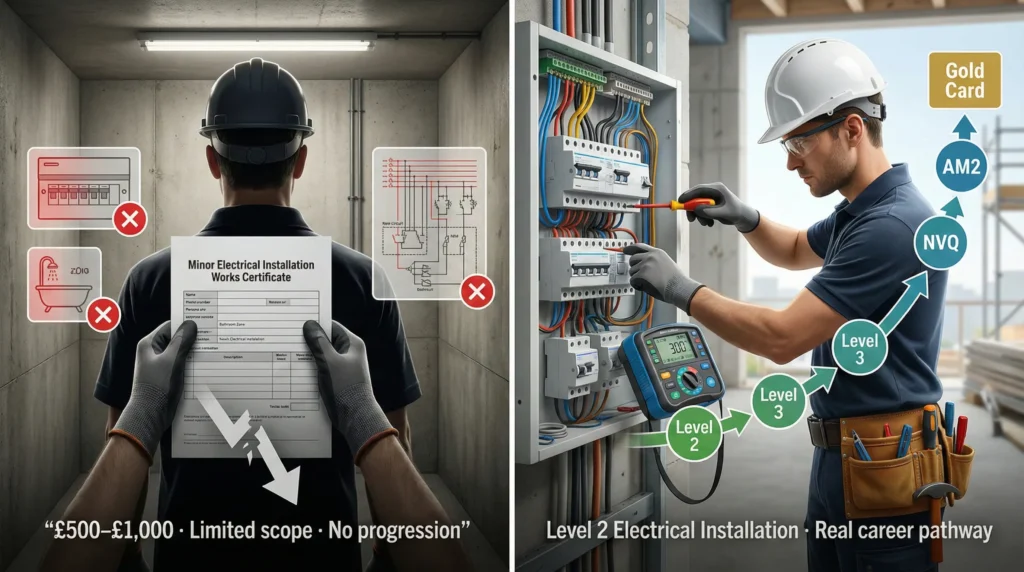
The adverts make it sound simple. Five days, £500-£1,000, walk out calling yourself an electrician. Minor Electrical Installation Works Course. Part P trained. Job done.
Here’s what actually happens: you spend the money, you get the certificate, and then you discover you can replace light switches and add sockets to existing circuits. That’s it. No new circuits. No consumer units. No work in bathrooms. No site employment. No pathway to NVQ Level 3 or ECS Gold Card. You’ve learned to do the tasks that barely pay while missing the qualification that actually opens doors.
If you’re an established plumber who occasionally needs to move a socket for a kitchen installation, the Minor Works course makes sense. You’ve already got a trade, clients, insurance, income. The electrical work is incidental to your main business.
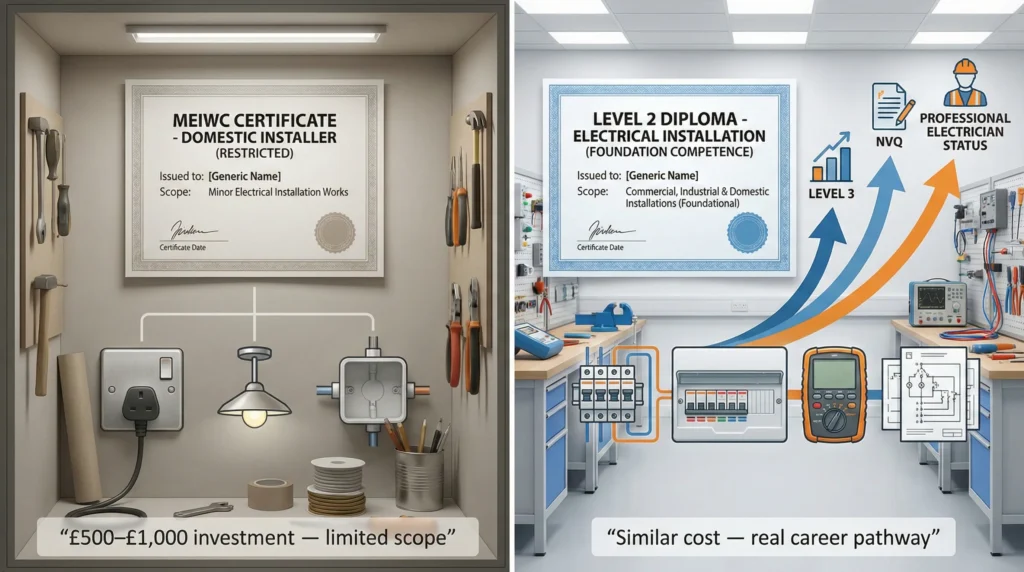
But if you’re a beginner or career changer looking at electrical work as your actual profession? You’ve just wasted money on a dead-end qualification when you should’ve invested in Level 2 (2365-02) for similar cost.
This article covers what the Minor Electrical Installation Works Course actually teaches and what it doesn’t, why it exists and who genuinely benefits from it, why beginners waste money on it when Level 2 is the same price, what employers and contractors actually ask for when hiring, the hidden equipment costs that course adverts don’t mention, and what you should do instead if you want to work as an electrician rather than just hold a certificate that leads nowhere.
What the Minor Electrical Installation Works Course Actually Covers (And What It Doesn't)
The MEIWC is typically a 2-5 day practical course focused on non-notifiable work under Part P of the Building Regulations. Non-notifiable means tasks so basic they don’t require notification to Building Control.
What you learn:
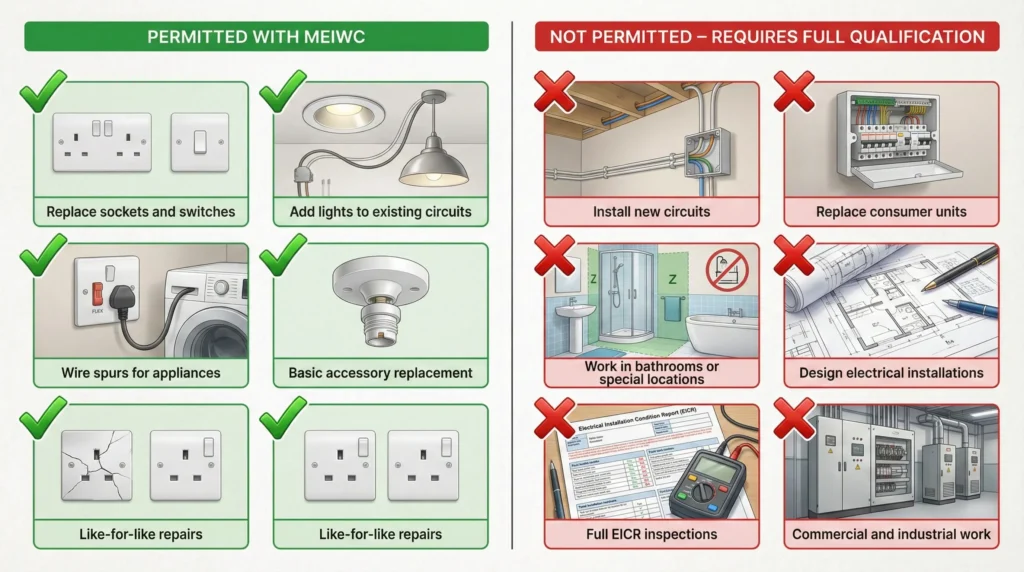
- Safe isolation procedures (proving a circuit is dead before touching it)
- Replacing accessories like sockets, switches, ceiling roses on existing circuits
- Adding lights or sockets to existing circuits (extending a ring final or radial)
- Basic use of a Multi-Function Tester for continuity and insulation resistance
- How to complete a Minor Electrical Installation Works Certificate
What you don’t learn:
- Installing new circuits from the consumer unit
- Replacing or working on consumer units
- Designing electrical installations
- Working in bathrooms or other special locations within 600mm of water sources
- Inspection and testing to full EICR standards
- Fault-finding beyond basic visual checks
- Commercial or industrial electrical work
The course teaches you to do the simplest electrical tasks that exist. These are the jobs apprentices perform under supervision while building their NVQ portfolio. They’re not standalone employment.
Thomas Jevons, Head of Training at Elec Training with 20+ years of experience, explains the limitation:
"The Minor Works course teaches you to replace a socket or add a light to an existing circuit. That's useful if you're a plumber occasionally moving a spur for a boiler. But if you're thinking about becoming an electrician, you've spent £500-£1,000 learning how to do tasks that barely pay. You can't install new circuits, you can't touch consumer units, you can't work in bathrooms. Level 2 costs similar money but actually gets you on the pathway to proper qualifications and work that pays £30,784 median according to ONS data."
Thomas Jevons, Head of Training
Who the Course Was Actually Designed For
The Minor Electrical Installation Works Course makes sense for one specific audience: allied trades who already have an established business and occasionally encounter basic electrical tasks.
Kitchen fitters: Moving sockets to accommodate new units, installing under-cabinet lighting on existing circuits, relocating switches for new layouts.
Plumbers and heating engineers: Wiring spurs for boilers, connecting pumps and controls, installing electric showers within permitted zones.
Carpenters and joiners: Installing downlights on existing circuits, moving switches when fitting new doors, basic repairs when replacing architraves.
Property maintenance workers: Replacing damaged sockets, fixing light fittings, basic fault-finding for landlords without calling an electrician every time.
These professionals share key characteristics: they have existing clients paying them for their primary trade, they have business insurance covering their main work, they need to handle incidental electrical tasks to complete jobs efficiently, and the electrical work is maybe 5-10% of what they do.
For them, spending £500-£1,000 on MEIWC training makes commercial sense. They’re not trying to become electricians. They’re reducing the cost and delay of subcontracting simple electrical tasks.
Joshua Jarvis, Placement Manager at Elec Training, explains who this course actually serves:
"MEIWC makes sense if you're an established plumber or kitchen fitter who occasionally needs to move a socket or wire a spur without calling an electrician every time. You've already got a trade, insurance, clients, income. The electrical work is incidental. But for someone starting from zero looking at electrical as a career? You're investing similar money in a qualification that won't get you site work or move you toward Gold Card status."
Joshua Jarvis, Placement Manager
Why Beginners and Career Changers Waste Money on MEIWC
Here’s where the problem starts. Training providers market MEIWC courses with phrases like “become qualified in 5 days” and “Part P certified” and “start earning immediately.” They don’t explain that you’ve just paid to learn tasks that won’t get you employed on construction sites or in electrical contractors.
The marketing vs the reality:
Marketing claim: “Become an electrician in 5 days”
Reality: You’re certified to perform minor non-notifiable work. You’re not an electrician. Employers won’t hire you. Contractors won’t put you on site. You can’t legally call yourself a qualified electrician.
Marketing claim: “Part P trained means you can work legally”
Reality: Part P defines what’s notifiable under Building Regulations. Being “Part P trained” just means you understand which simple tasks don’t require notification. It doesn’t make you competent to work professionally.
Marketing claim: “Start earning immediately”
Reality: Doing what? Replacing light switches for £20 a job? Adding a socket for £50? You can’t take on full rewires, consumer unit upgrades, new circuit installations, or any of the work that actually pays electricians £22-£26/hour once qualified.
Marketing claim: “Pathway to becoming a qualified electrician”
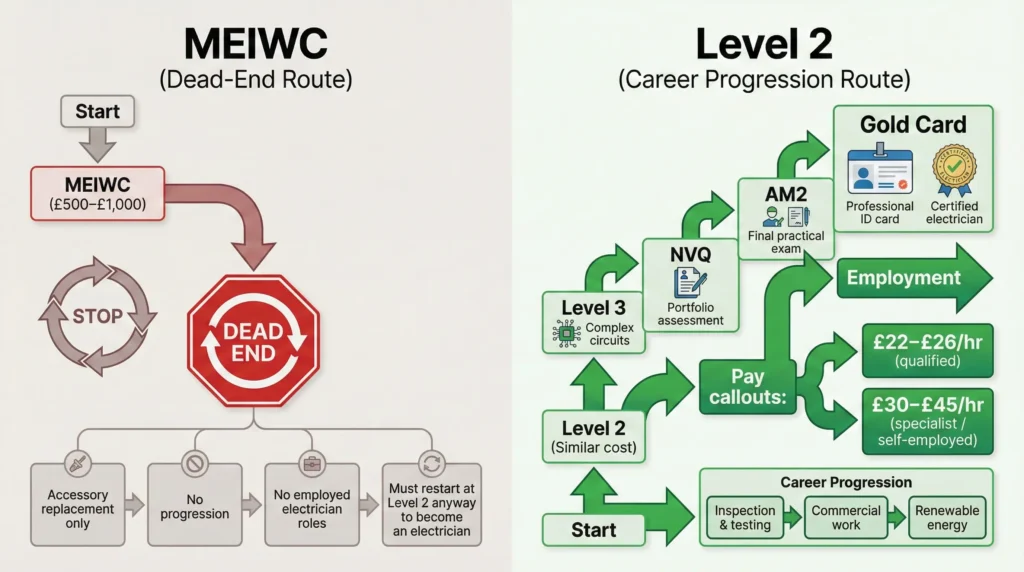
Reality: MEIWC doesn’t credit toward Level 2, Level 3, NVQ, or AM2. It’s a standalone certificate that leads nowhere. You’ll still need to start at Level 2 if you want proper qualifications.
What actually happens after the course:
You can’t get site work. Main contractors require ECS cards, scheme membership, full qualifications. MEIWC alone doesn’t qualify.
You can’t get insurance easily. Most electrical liability insurance requires NVQ Level 3 and scheme membership. MEIWC isn’t enough.
You can’t earn a living. The tasks you’re permitted to do don’t generate enough work to sustain employment. You’re competing with fully qualified electricians who can do everything you can do plus all the work you can’t touch.
You can’t progress. When you realize MEIWC was a dead end and you want proper qualifications, you start again at Level 2. The MEIWC doesn’t count toward anything.
You’ve spent £500-£1,000 plus equipment costs learning to do work that apprentices do for free while building portfolios toward actual qualifications.
The Hidden Equipment Costs Nobody Mentions
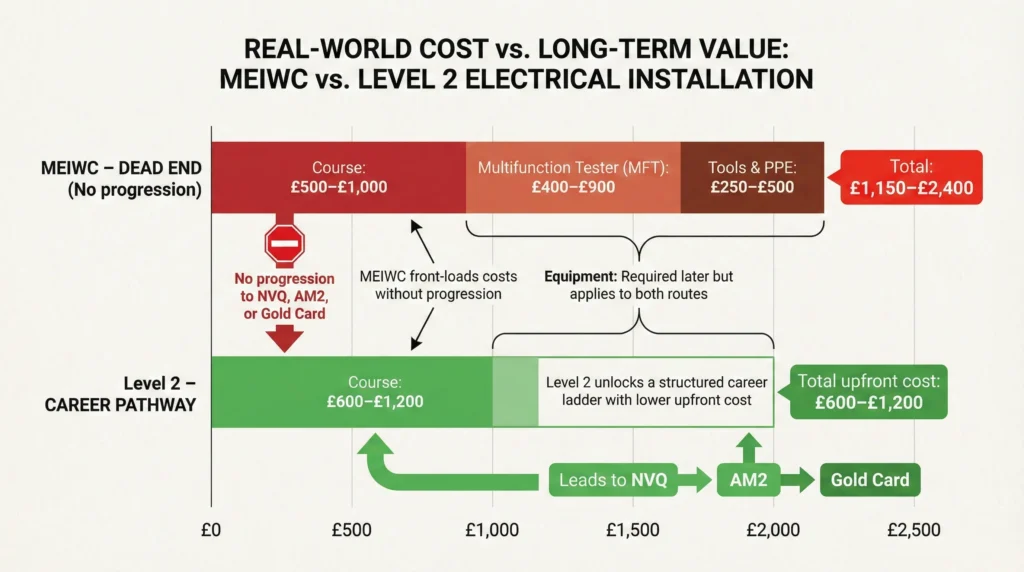
Here’s what MEIWC course adverts don’t tell you: to actually perform the work you’ve been trained to do, you need a calibrated Multi-Function Tester.
BS 7671 requires testing to verify electrical work is safe. You can’t just replace a socket and assume it’s fine. You need to prove continuity, insulation resistance, earth loop impedance, and RCD trip times are within acceptable limits.
Decent Multi-Function Testers cost:
- Entry level (basic testing): £400-£600 (Megger MFT1552, Kewtech KT64)
- Mid-range (comprehensive testing): £600-£900 (Megger MFT1741, Fluke 1664 FC)
- Professional grade (Bluetooth, advanced features): £900-£1,400 (Megger MFT1741+, Fluke 1664 FC+)
Add in the essential accessories: voltage tester and proving unit (£80-£150), basic hand tools if you don’t have them (£150-£300), PPE and safety equipment (£100-£200), and calibration costs (£80-£120 annually to keep your tester legally valid).
Your “£500-£1,000 course” just became a £1,100-£2,600 total investment before you’ve earned a single pound.
Compare that to starting with Level 2 (2365-02). Similar course cost (£600-£1,200 depending on provider), but you’re building toward qualifications that actually lead to employment. When you progress to NVQ and start working, you’ll need the same equipment anyway. But you’ll be earning while you learn, not spending money on kit you can barely use because your qualification is so limited.
For a full breakdown of what electricians actually spend on tools and equipment when starting professionally, including realistic budgets and what you can delay purchasing, read our guide on how much tools, equipment, and a starter van cost for new electricians.
What Employers and Contractors Actually Want
When electrical contractors call us looking for electricians to place on site, they ask for specific qualifications. Nobody has ever called asking specifically for Minor Electrical Installation Works certificate holders.
What they actually ask for:
ECS Gold Card: The industry-recognized proof of full qualification (NVQ Level 3, 18th Edition, AM2 completion). This is the baseline for site access on most commercial and industrial projects.
NVQ Level 3: Workplace competence portfolio demonstrating you can safely perform electrical installation or maintenance work to BS 7671 standards.
18th Edition certification: Current knowledge of BS 7671:2018+A2:2022 Wiring Regulations (soon to be updated to Amendment 4 in October 2026).
Scheme membership: NICEIC, NAPIT, or other competent person scheme registration allowing self-certification of work and providing insurance backing.
2391 Inspection & Testing: For roles involving periodic inspection, fault-finding, or testing responsibilities.
MEIWC appears on exactly zero of those requirement lists. It might be mentioned as “beneficial” for maintenance roles where you’re working under supervision doing basic repairs. But as a standalone qualification for employment? It doesn’t move the needle.
What contractors care about: liability, competence, insurance, and the ability to complete work without constant supervision. MEIWC holders can only do tasks so basic they need supervision anyway. That’s not a selling point when contractors are desperate for qualified electricians who can work independently.
The placement reality: our in-house recruitment team works with 120+ electrical contractors daily. They’re crying out for qualified electricians. The shortage is real. But they want people who can install circuits, test installations, work toward inspection qualifications, and handle the full scope of electrical work. MEIWC doesn’t deliver that.
When you complete Level 2, you’re on the pathway to becoming that person. When you complete MEIWC, you’re qualified to do work that doesn’t solve the skills shortage contractors are facing.
For context on what qualified electricians actually earn once they have proper credentials and how the JIB pay scales reward full qualifications rather than limited certificates, see our breakdown of JIB rates 2026 and the new pay deal.
The Part P Confusion: What It Actually Means
Part P of the Building Regulations causes massive confusion, largely because training providers use it in marketing without explaining what it actually means.
Part P is: a section of the Building Regulations (England and Wales) that requires reasonable provision for electrical safety in dwellings. It sets out which electrical work must be notified to Building Control.
Part P is not: a qualification, a certification, a competency standard, or proof you can work as an electrician.
Being “Part P trained” means: you understand which electrical tasks are notifiable (require notification to Building Control or certification by a registered electrician) and which are non-notifiable (permitted work that doesn’t require notification if done competently).
Being “Part P trained” does not mean: you’re a qualified electrician, you can self-certify all electrical work, you’re competent to perform complex electrical tasks, or employers will hire you for site work.
The confusion comes from training providers using phrases like “Part P certified” or “Part P qualified” to make MEIWC sound more impressive than it is. You’re not “Part P certified.” You’ve taken a course that explains what Part P requires. That’s not the same thing.
What’s actually notifiable under Part P:
- Installing new circuits
- Replacing consumer units
- Work in special locations (bathrooms, showers, saunas, swimming pools)
- Installing solar PV or other generation systems
- Installing EV charging points
What’s non-notifiable (permitted work):
- Replacing accessories (sockets, switches, ceiling roses) like-for-like
- Adding lights or sockets to existing circuits outside special locations
- Minor repairs and maintenance on existing circuits
MEIWC teaches you to do the non-notifiable work. The work that doesn’t require Building Control involvement because it’s so basic. That’s not a pathway to employment. That’s learning to do tasks that barely register as electrical work in professional contexts.
What You Should Do Instead: The Level 2 Route
If you’re a beginner or career changer genuinely interested in becoming an electrician, here’s the honest pathway that actually works:
Start with Level 2 (2365-02) Electrical Installations. This is the industry-recognized first step. It costs similar money to MEIWC (£600-£1,200 depending on provider and location), but it actually leads somewhere.
What Level 2 covers:
- Electrical science and principles
- Installation methods and techniques for circuits
- Inspection and testing fundamentals
- Health and safety including safe isolation
- Understanding of BS 7671 Wiring Regulations
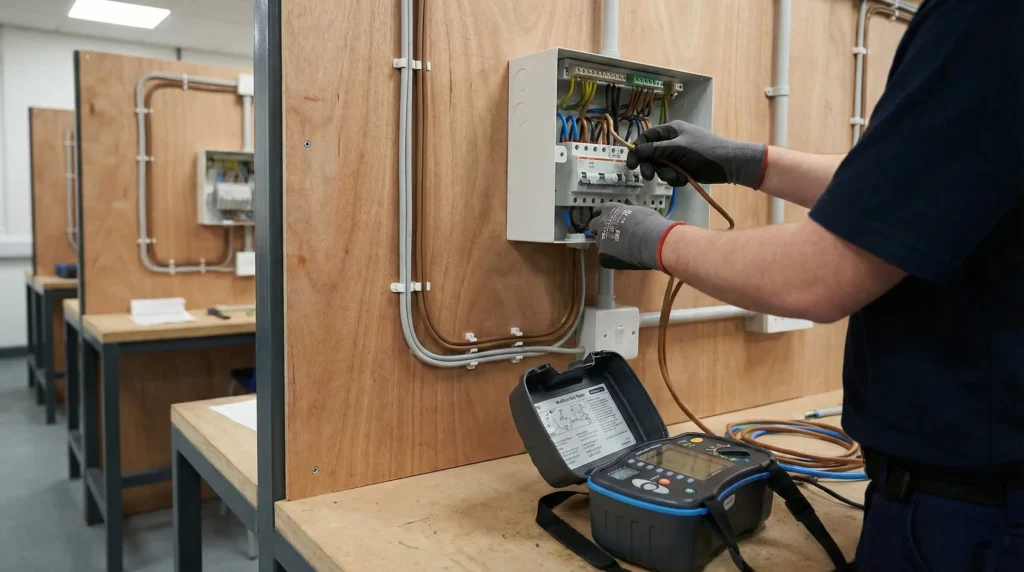
- Practical installation skills on training rigs
Why Level 2 is better than MEIWC:
It’s recognized. Employers, contractors, and the electrical industry understand what Level 2 means. It’s the foundation qualification for the trade.
It progresses. Level 2 leads directly to Level 3, which leads to NVQ, which leads to AM2, which leads to ECS Gold Card. It’s a pathway, not a dead end.
It builds competence. You’re learning proper installation techniques, not just how to replace accessories. You’re understanding why electrical systems work, not just following procedures.
It opens doors. Completing Level 2 allows you to work as an Improver or Electrician’s Mate while building your NVQ portfolio. You can earn while you learn rather than spending money on courses that lead nowhere.
It demonstrates commitment. When you complete Level 2, employers see someone serious about the trade who’s invested in proper qualifications. MEIWC suggests someone who wanted a shortcut that doesn’t exist.
The full pathway from Level 2 looks like this:
Level 2 (2365-02) – 4 weeks, electrical installation fundamentals
↓
Level 3 (2365-03) – 8 weeks, advanced installation and design
↓
18th Edition (2382-22) – 5 days, BS 7671 regulations knowledge
↓
NVQ Level 3 (2357) – 12-24 months, workplace portfolio proving competence
↓
AM2 Assessment – 3 days, practical trade test
↓
ECS Gold Card – Industry-recognized qualified electrician status
↓
Optional: 2391 Inspection & Testing – Career progression
Total realistic timeframe: 18 months fast-track with guaranteed placements (which we provide), or 2-3 years part-time while working.
Total cost: £10,000 for the full NVQ package including AM2 fee and PPE (excluding tools and equipment which you’d need anyway).
Compare that to MEIWC: £500-£1,000 for a certificate that leads nowhere, requires the same equipment costs eventually if you want to work properly, and doesn’t progress toward any recognized qualification.
For detailed information on the NVQ pathway, realistic timescales, and how our guaranteed placement system works to get you the site experience you need for portfolio completion, visit our NVQ Level 3 Electrical course page.
When MEIWC Actually Makes Sense (The Exception, Not the Rule)
To be fair, there are legitimate scenarios where MEIWC is the right choice. Just not for beginners wanting to become electricians.
You’re an established tradesperson in a related field (plumbing, gas, joinery, property maintenance) who encounters basic electrical tasks regularly as part of existing jobs. The MEIWC allows you to handle these without subcontracting, saving time and money on jobs you’re already being paid for.
You work in facilities management or building maintenance where you need basic electrical knowledge to perform repairs and coordinate with contractors. MEIWC gives you enough understanding to assess situations, perform safe minor repairs, and know when to call qualified electricians.
You’re a landlord or property developer managing multiple properties and want to understand electrical compliance requirements. MEIWC helps you supervise contractors, verify work quality, and handle basic maintenance between tenancies.
You’re an apprentice’s parent or career advisor wanting to understand what electrical training involves before committing to full qualifications. MEIWC can be an expensive way to gain that understanding, but at least you’re going in with realistic expectations.
In all these cases, you’re not trying to become an electrician. You have other income sources, other qualifications, other reasons for needing basic electrical knowledge that don’t involve building a career in the electrical trade.
If that’s you, MEIWC makes sense. If you’re a beginner or career changer looking at electrical work as your profession, it’s money wasted that should’ve been invested in Level 2.
The Insurance and Liability Reality
Here’s another aspect MEIWC adverts conveniently ignore: insurance and liability.
Most electrical liability insurance policies require NVQ Level 3 and competent person scheme membership to provide full coverage. MEIWC alone typically isn’t enough for insurers to accept electrical work as a covered activity.
What this means practically: if you complete MEIWC, buy equipment, start doing minor electrical work for payment, and something goes wrong (fire, electric shock, injury), your insurance may refuse the claim on grounds of inadequate qualification and competence.
Trade insurers distinguish between “incidental electrical work as part of your main trade” (covered for allied trades with MEIWC) and “electrical work as your primary activity” (requires full qualifications).
If you’re a kitchen fitter whose insurance covers kitchen fitting and you occasionally move a socket as part of a kitchen installation, your MEIWC certificate might satisfy the insurer that you’re competent for that specific task within your main trade.
If you’re marketing yourself as someone who does electrical work, even minor electrical work, insurers will want to see NVQ Level 3, scheme membership, and evidence of competence beyond a 5-day course.
This is why employers and contractors insist on full qualifications. It’s not just about knowledge. It’s about liability, insurance, and legal responsibility when electrical work goes wrong.
MEIWC might give you knowledge. It doesn’t give you the insurance coverage or legal protection that comes with proper qualifications and scheme membership.
The Bottom Line: Don't Waste Money on Shortcuts That Don't Exist
The electrical industry has a clear qualification pathway. Level 2 → Level 3 → NVQ → AM2 → Gold Card. This exists for good reasons: safety, competence, quality, and professional standards.
MEIWC isn’t part of that pathway. It’s a standalone certificate serving a specific niche (allied trades needing basic electrical knowledge) that’s been marketed to beginners as something it’s not.
If you’re an established plumber, kitchen fitter, or property maintenance worker who needs to handle basic electrical tasks as part of existing work, MEIWC makes sense. You’re not trying to become an electrician. You’re adding a skill to an existing trade.
If you’re a beginner or career changer looking at electrical work as a profession, MEIWC is money wasted. You’ll spend £500-£1,000 plus equipment costs learning to do tasks that won’t get you employed, won’t lead to qualifications, and won’t build toward the career you actually want.
Level 2 costs similar money upfront. But it’s the recognized first step in the industry-standard pathway. It leads to Level 3, NVQ, AM2, Gold Card, employment, and career progression into inspection, testing, commercial work, renewable energy, and specialist roles that pay £30-£45/hour once established.
What we’re not going to tell you:
- MEIWC makes you a qualified electrician (it doesn’t)
- Part P training equals employability (it doesn’t)
- You can earn a living doing minor works only (you can’t)
- It’s a pathway to proper qualifications (it isn’t)
What we will tell you:
- MEIWC is useful for allied trades with existing businesses
- For beginners, Level 2 is the right starting point
- Proper qualifications take 18 months to 3 years
- Our in-house recruitment team secures placements for NVQ learners
- Qualified electricians have genuine job security and career progression
- There are no shortcuts to becoming a qualified electrician
Call us on 0330 822 5337 to discuss the fastest route to qualified electrician status starting with Level 2, not MEIWC. We’ll explain exactly what you need, how long it takes, and what our in-house recruitment team can do to secure your first placement for NVQ portfolio development. No hype. No unrealistic promises. No dead-end certificates. Just the honest pathway from beginner to qualified electrician with proper credentials that employers actually recognize.
References
- Office for National Statistics (ONS) – Employee Earnings in the UK: 2024 (Electrical Installation median salary data) – https://www.ons.gov.uk/employmentandlabourmarket/peopleinwork/earningsandworkinghours/bulletins/annualsurveyofhoursandearnings/2024
- UK Government – Approved Document P: Electrical Safety (Building Regulations guidance) – https://www.gov.uk/government/publications/electrical-safety-approved-document-p
- IET – BS 7671:2018+A2:2022 Wiring Regulations (18th Edition) – https://www.theiet.org/
- City & Guilds – 2365 Level 2/3 Diploma in Electrical Installations Specifications – https://www.cityandguilds.com/
- JIB – Grading and Wage Rates for Qualified Electricians – https://www.jib.org.uk/
- NICEIC – Competent Person Scheme Requirements and Scope of Work – https://www.niceic.com/
- NAPIT – Electrical Competent Person Schemes and Registration – https://www.napit.org.uk/
Note on Accuracy and Updates
Last reviewed: 22 January 2026. This page is maintained; we correct errors and refresh sources as qualification pathways, course costs, and industry requirements change. MEIWC course costs and equipment pricing cited reflect January 2026 market rates from multiple UK training providers. Level 2 pathway information aligns with City & Guilds 2365 current specifications. Next review scheduled following any changes to Part P Building Regulations or electrical qualification frameworks.
FAQs
What is a Minor Electrical Installation Works Course (MEIWC), and what does it actually qualify you to do?
A Minor Electrical Installation Works Course (MEIWC) provides basic training on carrying out minor alterations to existing electrical circuits, such as adding a socket or a light point, in line with BS 7671 requirements. It teaches how to complete a Minor Electrical Installation Works Certificate to record that the work complies with safety standards.
However, it only qualifies you for limited, non-notifiable tasks on existing circuits. It does not allow you to install new circuits or carry out major modifications. To legally self-certify notifiable work under Part P, you must also join a competent person scheme such as NICEIC or NAPIT. This course is not a full electrician qualification and significantly limits your scope of work.
What electrical work is not covered by a MEIWC, even if the marketing suggests otherwise?
A MEIWC does not cover the installation of new circuits, even if they supply only one outlet. It does not allow replacement of consumer units or distribution boards, nor complete rewires or major alterations.
It also excludes work in high-risk locations such as bathrooms or outdoor installations unless additional qualifications are held. Despite some marketing claims, BS 7671 strictly limits MEIWC use to minor additions or alterations on existing circuits where safety is not impaired. Using a MEIWC to certify work outside this scope can invalidate certification and lead to non-compliance with Building Regulations.
Who is a MEIWC genuinely designed for, and when does it make commercial sense?
A MEIWC is designed for allied tradespeople such as plumbers, builders, or maintenance staff who already have trade experience and need to carry out and certify occasional minor electrical works as part of their main role.
It can make commercial sense where small electrical tasks are frequent enough to justify competent person scheme membership, reducing reliance on subcontract electricians. It is also useful in facilities management for basic maintenance tasks. It does not make sense if electrical work is rare, as scheme fees and insurance costs can outweigh the benefit.
If you are a complete beginner, why is MEIWC usually a dead end rather than a career start?
For complete beginners, a MEIWC offers only limited, introductory skills and does not provide a pathway into a full electrical career. It restricts you to minor alterations on existing circuits and does not contribute towards qualifications required for employment.
Most employers require NVQ Level 3 and AM2 for electrician roles. MEIWC does not count towards these and often leaves beginners underqualified and unable to progress. Many people later have to restart with proper Level 2 and Level 3 diplomas, making MEIWC an inefficient and costly detour rather than a stepping stone.
Does MEIWC count towards Level 2, Level 3, the NVQ portfolio, AM2, or the ECS Gold Card pathway?
No. A MEIWC does not count towards Level 2 or Level 3 diplomas, as it is a short course focused on minor works certification rather than core electrical theory or installation skills.
It provides no credit towards an NVQ portfolio, which requires extensive on-site evidence and assessment. AM2 requires full NVQ Level 3 completion and is unaffected by MEIWC. For the ECS Gold Card, NVQ Level 3 and AM2 are mandatory, so MEIWC adds no value to this pathway. It stands alone with no formal progression.
What does “Part P trained” really mean, and why does it not make you a qualified electrician?
“Part P trained” means you have completed training on Part P of the Building Regulations, showing awareness of domestic electrical safety and notification rules. It does not grant the right to self-certify notifiable work unless you also join a competent person scheme.
Part P training alone does not make you a qualified electrician. It does not cover the depth of BS 7671, inspection and testing, or practical installation competence required for professional work. Qualified electricians hold NVQ Level 3 and AM2. Part P is often overstated in marketing and misunderstood by beginners.
What tools and test equipment do you realistically need after MEIWC, and why is this often overlooked?
After completing a MEIWC, you realistically need calibrated test equipment, including a multifunction tester capable of insulation resistance, continuity, and earth fault loop impedance testing. You also need a voltage indicator and RCD tester, alongside standard hand tools.
This is often overlooked because courses focus on theory rather than ongoing professional costs. Proper test equipment can cost hundreds of pounds, and without it you cannot legally certify work. Using inadequate or uncalibrated equipment risks invalid certification and potential liability.
Can you get electrical work insurance with only a MEIWC, and what are the liability risks if you cannot?
With only a MEIWC, you may obtain limited public liability insurance covering minor tasks, but many insurers restrict cover without NVQ Level 3 or scheme registration. Policies may exclude notifiable work or limit claim payouts.
If a claim is rejected due to inadequate qualifications, you may be personally liable for injury, damage, or legal costs. This creates significant financial risk. Always confirm policy exclusions carefully, as MEIWC alone signals limited competence to insurers.
What do employers and contractors actually ask for when hiring electricians, and where does MEIWC fit on that list?
Employers and contractors typically require NVQ Level 3, AM2, and ECS Gold Card status as proof of full competence. They also expect the 18th Edition BS 7671 qualification and relevant site experience.
Inspection and testing qualifications are often valued for senior or testing roles. MEIWC ranks very low or is irrelevant for electrician jobs, as it only demonstrates capability for minor works. It may be acceptable for limited maintenance roles but does not meet expectations for qualified electrician positions.
If someone wants to become an electrician, what is the correct alternative route instead of taking a MEIWC first?
The correct route is an apprenticeship combining paid site work with NVQ Level 3 and AM2. For non-apprentices, start with City & Guilds 2365 Level 2 and Level 3 diplomas to build foundational knowledge.
Then complete NVQ Level 3 through on-site portfolio evidence, followed by the AM2 assessment. Add the 18th Edition BS 7671 qualification for regulatory compliance. This leads to ECS Gold Card eligibility. MEIWC should not be used as a starting point, as it adds no value to this pathway.
