

Mobile Apps for Busy Tradespeople: How Everything Changed in 10 Years (2015-2026)

- Technical review: Thomas Jevons (Head of Training, 20+ years)
- Employability review: Joshua Jarvis (Placement Manager)
- Editorial review: Jessica Gilbert (Marketing Editorial Team)
- Last reviewed:
- Changes: Updated 2026 app landscape, AI integration developments, Making Tax Digital mandatory implementation, subscription fatigue trends, consolidation patterns
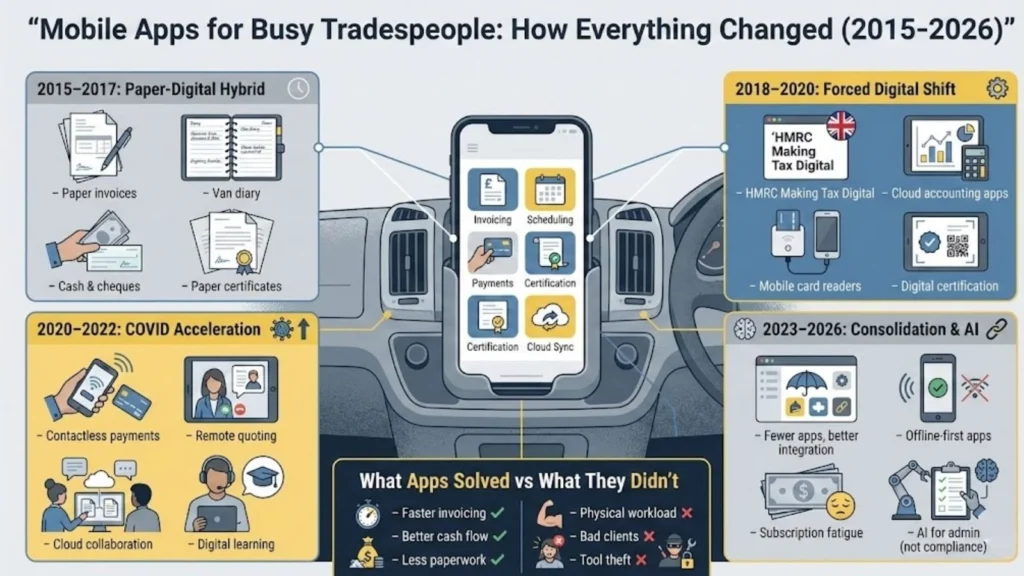
In 2015, if you told a self-employed electrician they’d be running their entire business from a smartphone within a decade, they’d have laughed you out of the van. Apps were for spirit levels and torch features, not serious business administration. Invoices got written on carbon-copy pads. Quotes went out as PDFs emailed from a laptop at home. Certification meant filling out paper test certificates with a pen.
By 2026, that same electrician can’t legally operate without apps. HMRC’s Making Tax Digital mandate requires digital record-keeping. Clients expect instant quotes with approve buttons. Insurance companies want digital certification records. Payment processing happens on-site via mobile card readers. And the spreadsheet tracking jobs, invoices, expenses, and tax submissions runs on cloud accounting software synced across phone, tablet, and laptop.
The shift from paper to digital didn’t happen because apps were convenient. It happened because regulatory pressure (MTD), client expectations (instant everything), and competitive necessity (looking professional) forced tradespeople to adopt technology whether they wanted to or not.
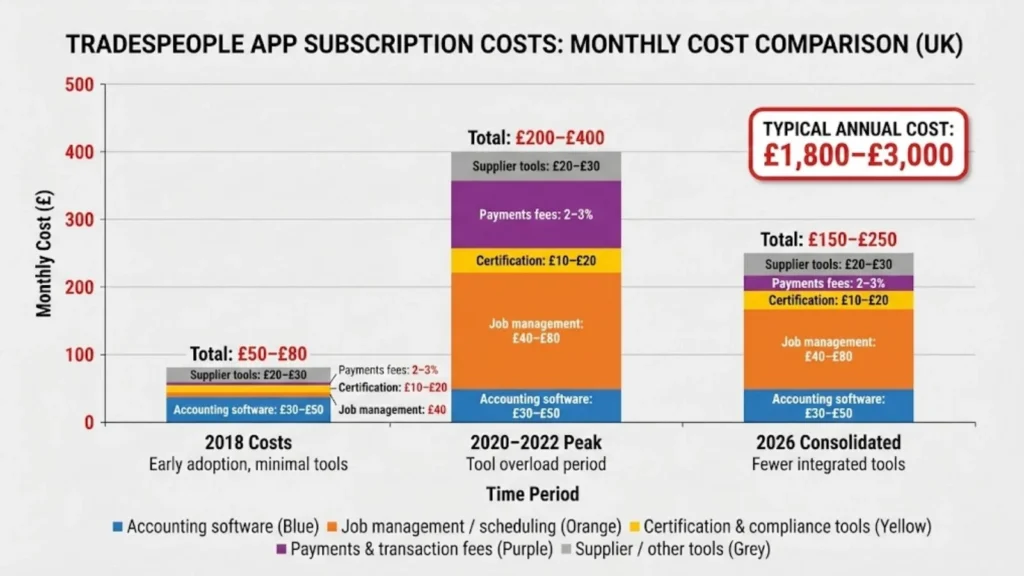
Here’s the thing about this transformation. It solved real problems, faster invoicing, better cash flow, reduced paperwork, instant client communication. But it created new ones, subscription fatigue from paying £200-£400 monthly across multiple tools, app overload from juggling eight different platforms, signal failure rendering expensive software useless in basements, and data lock-in when switching providers.
This article covers how tradespeople used apps in 2015 versus 2026, what changed during the 2018-2020 shift to cloud accounting, how COVID accelerated digital adoption, why 2023-2026 saw consolidation and subscription backlash, which app categories still matter and which to avoid, how electricians differ from other trades in app needs, and the honest reality of what apps solve versus what they don’t.
Let’s start with where we were 10 years ago.
How Tradespeople Used Apps in 2015-2017: The Paper-Digital Hybrid Era
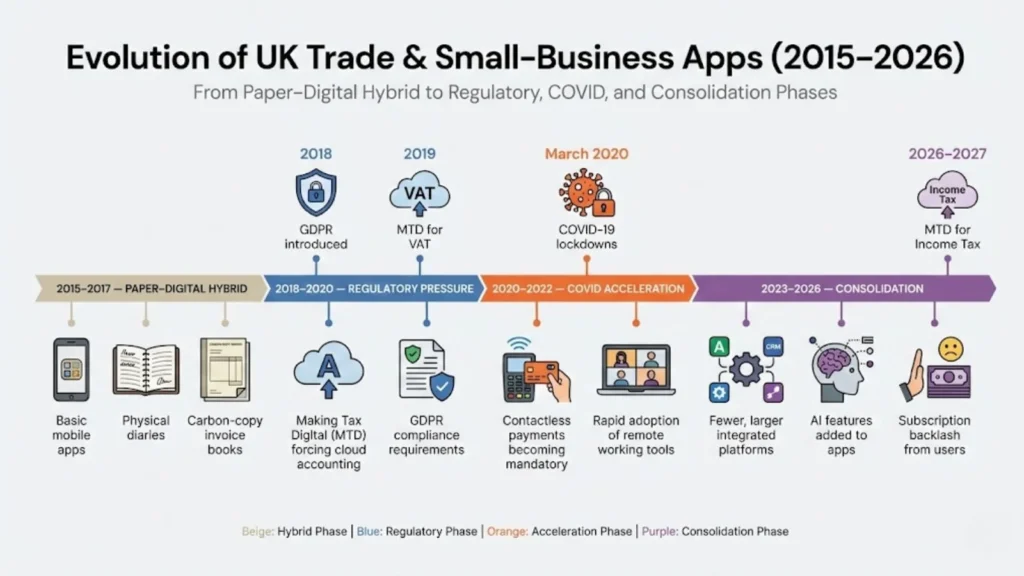
Smartphone adoption among UK tradespeople was rising in 2015, but usage remained basic. Apps were novelties, not operational tools. The typical self-employed electrician, plumber, or carpenter might have had an iPhone or Android device, but their business ran on paper systems with digital tools as occasional add-ons.
What tradespeople actually used apps for in 2015:
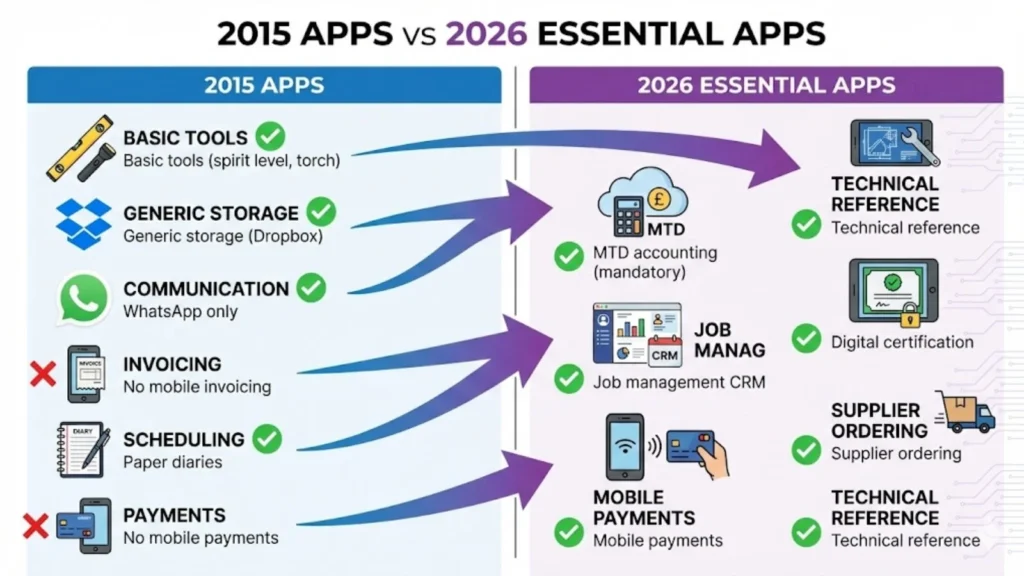
Communication: WhatsApp for quick messages with mates on other jobs, text messaging for client contact, phone calls for everything important. Email existed but checking it on mobile was clunky.
Photos: The smartphone camera replaced the digital camera for site photos, job documentation, and showing clients what needed fixing. Photos got stored in the phone’s gallery or uploaded to Dropbox manually.
Navigation: Google Maps for finding job addresses. This was perhaps the most universally adopted app function, replacing physical A-Z street atlases and printed directions.
Basic Tools: Spirit level apps, torch apps, basic calculator apps. These were gimmicks more than serious tools. A physical spirit level was more reliable, and nobody trusted their phone for critical measurements.
Cloud Storage: Dropbox or Google Drive for storing PDF spec sheets, supplier catalogues, or photos that needed backing up. This required conscious effort to upload files, it wasn’t automatic.
What tradespeople didn’t use apps for in 2015:
Invoicing: Invoices got written on pre-printed pads from office supply shops, or typed up on a home PC using Word or Excel, then printed and handed to clients or posted. Some used basic invoice templates in Excel saved on a USB stick.
Job Scheduling: The diary was a physical book kept in the van. Appointments got written in pen. If you double-booked, you realized when you opened the diary, not when an app sent an alert.
Quotes: Quotes got calculated manually (materials cost plus labour plus margin), written on company letterhead or a quote pad, and delivered as paper or PDF via email from a PC. There was no mobile quoting.
Payments: Cash or cheque on completion, or invoices with “please pay by bank transfer” instructions. Card readers existed for retail shops, not vans. Payment delays of 14-30 days were normal.
Certification: Electricians filled out paper test certificates (EICRs, minor works, installation certificates) using carbon-copy pads. One copy for the client, one for records, one for Building Control if notifiable. Digital certification didn’t exist in mainstream use.
Accounting/Tax: Spreadsheets on home PCs, or shoebox receipts delivered to an accountant once a year. Self-Assessment tax returns got completed on HMRC’s website from a computer, not a phone.
The 2015-2017 period was a hybrid. Smartphones existed and tradespeople owned them, but business operations remained paper-based because:
Connectivity was unreliable: 3G signal was patchy on building sites, basements, rural areas. Apps that required constant internet connection were useless in many work environments.
Apps were desktop-first: Early trade software was built for PCs and poorly adapted for mobile. Tiny buttons, cramped interfaces, constant zooming. It was faster to wait until you got home than struggle with a phone.
Trust in technology was low: Tradespeople worried about losing data if a phone broke or an app company shut down. Paper felt safer because it couldn’t crash or be deleted.
Clients didn’t expect it: Customers were happy with paper invoices and handwritten quotes. There was no competitive pressure to adopt digital tools because nobody else was using them either.
Understanding how broader industry changes and wage negotiations affected tradespeople’s willingness to invest in business tools helps contextualize why early app adoption was slow, cash-strapped sole traders weren’t prioritizing £20-£50 monthly software subscriptions when they could manage with free paper systems.
The Shift: 2018-2020 (Cloud Accounting and Regulatory Pressure)
Between 2018 and 2020, three forces pushed tradespeople toward apps: regulatory requirements, customer expectations, and competitive necessity.
HMRC Making Tax Digital (MTD): The phased rollout of MTD started with VAT-registered businesses in 2019, requiring digital record-keeping and submission of VAT returns via compatible software. Paper records were no longer compliant. This forced thousands of self-employed tradespeople into accounting apps like Xero, QuickBooks, or FreeAgent whether they wanted them or not.
Thomas Jevons, Head of Training at Elec Training with 20+ years of experience, explains the compliance pressure:
"HMRC's Making Tax Digital mandate forced self-employed electricians into accounting apps whether they wanted them or not. By 2026, you can't just keep paper receipts, you need digital records that link to your tax submissions. That regulatory pressure moved apps from optional to mandatory for sole traders, even the ones who hate technology."
Thomas Jevons, Head of Training
MTD for Income Tax Self Assessment extends to all sole traders with income over £50,000 from April 2026 (delayed from 2024), and to those over £30,000 from April 2027. This means the regulatory pressure only increased as the decade progressed.
GDPR (May 2018): The General Data Protection Regulation introduced strict rules about handling customer data. Tradespeople storing client details in unsecured notes apps, spreadsheets, or WhatsApp messages faced potential fines if data was breached or mishandled. This pushed adoption of proper CRM (Customer Relationship Management) systems with encryption and privacy controls.
Customer Expectations Changed: By 2019-2020, clients increasingly expected instant digital interactions. They wanted:
Quotes sent via email or text with clickable approve buttons
Digital receipts emailed immediately after payment
Ability to pay by card on-site, not wait for bank transfers
Live updates on when the tradesperson would arrive
Photos of completed work sent via messaging
Competitors who offered these features won jobs over those still using paper systems. Professionalism became tied to digital capability.
What emerged during 2018-2020:
Cloud Accounting Apps: Xero, QuickBooks, FreeAgent, and Sage became standard tools for self-employed tradespeople. Mobile invoicing was the killer feature, create an invoice on your phone at the job, send it to the client instantly, and they could pay via bank transfer or card within minutes.
Mobile Payment Processors: Square, SumUp, Zettle (PayPal) brought card payment capability to vans. Plug a small reader into your phone, take payment on-site, and the money reached your account within 1-2 business days. This was revolutionary for cash flow.
Job Management Software: Tools like Tradify, ServiceM8, Powered Now, and Jobber started gaining traction. These combined scheduling, quoting, invoicing, and client communication in one platform. They were expensive (£30-£80 per month) but promised to eliminate double-booking and lost paperwork.
Digital Certification Apps: For electricians specifically, apps like EasyCert, Spark Certs, and NICEIC’s Cert Pro allowed digital completion of test certificates. You filled out the form on a tablet, generated a PDF, and emailed it to the client immediately. This replaced carbon-copy pads but required annual subscriptions (£100-£200).
Supplier Ordering Apps: CEF, Screwfix, and Rexel launched mobile apps allowing tradespeople to order parts for next-day delivery or click-and-collect. This reduced trips to trade counters and improved job planning.
What didn’t work well in 2018-2020:
Poor Mobile UX: Many apps were desktop software hastily adapted for mobile. Small buttons, confusing navigation, too many taps to complete simple tasks. Electricians wearing gloves couldn’t operate touchscreens effectively.
Subscription Creep: Tradespeople who adopted multiple tools found themselves paying £150-£300 monthly across accounting, job management, certification, and payment processing apps. The costs added up faster than expected.
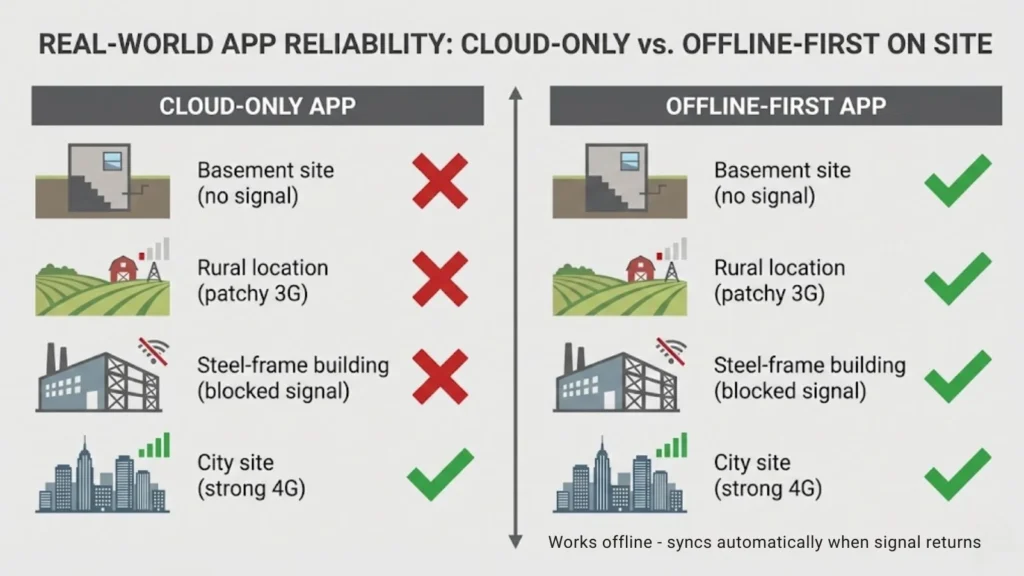
Connectivity Issues: Apps that required constant internet connection failed in basements, steel-frame buildings, and rural areas. Cloud-first architecture meant no offline functionality, rendering tools useless when signal dropped.
Integration Problems: Apps didn’t talk to each other. You’d create a job in your scheduling app, manually re-enter it in your accounting app for invoicing, then separately record materials purchased from the supplier app. Data got duplicated and errors multiplied.
By 2020, tradespeople were using more apps than in 2015, but frustration with complexity, cost, and reliability was building. The pandemic would force the next evolution.
Acceleration: 2020-2022 (The COVID Effect)
COVID-19 didn’t invent digital tools for tradespeople, but it made them essential overnight. When face-to-face interactions became risky and cash payments were discouraged, tradespeople who’d resisted digital adoption had no choice.
What COVID forced into mainstream use:
Contactless Payments: Handling cash became a health concern. Card readers went from nice-to-have to mandatory. Clients expected contactless payment options, and tradespeople who couldn’t offer them lost work.
Remote Quoting: During lockdowns and when clients were isolating, in-person site visits for quotes became difficult. Video calls via WhatsApp, FaceTime, or Zoom allowed tradespeople to assess simple jobs remotely. Clients sent photos and videos showing the problem, and quotes got provided without physical visits.
Digital Learning: With in-person training suspended, electricians needing 18th Edition updates or other CPD shifted to online learning platforms and mobile apps. YouTube tutorials became the go-to for troubleshooting unfamiliar equipment.
Cloud Collaboration: Tradespeople working in teams needed to coordinate jobs without meeting in person. Shared calendars, job notes, and real-time updates via mobile apps replaced morning briefings in the van.
Instant Communication: Clients working from home expected immediate responses to queries. Text messages, WhatsApp, and email communication increased dramatically. Tradespeople who didn’t respond quickly lost jobs to faster competitors.
What stuck after COVID ended:
Integrated Invoicing and Scheduling: Tradespeople who’d adopted all-in-one platforms during COVID (Tradify, ServiceM8, etc.) appreciated the efficiency. Creating a job, scheduling it, completing it, and invoicing it all in one app saved hours weekly compared to juggling separate tools.
Mobile Card Payments: Once clients experienced the convenience of paying by card on-site, they expected it permanently. The friction of bank transfers (finding sort code and account number, remembering to actually transfer money later) meant card payments became the default.
Digital Certification: Electricians who’d switched to digital test certificates during COVID rarely went back to paper. The ability to email certificates instantly, store them in the cloud, and access historical records from anywhere became too valuable to give up.
What didn’t stick after COVID:
Video Quoting: Post-pandemic, most tradespeople reverted to in-person site visits for quotes. Assessing a job properly requires seeing the actual installation, checking access, identifying hidden issues. Video calls worked for emergencies but proved inadequate for accurate quoting.
Overuse of Communication Apps: The initial surge of instant messaging with clients led to 24/7 availability expectations. Tradespeople received messages at 9pm, weekends, even holidays. Many established boundaries by moving client communication into proper CRM systems with business hours controls rather than personal WhatsApp.
Subscription Explosion: During COVID, many tradespeople signed up for multiple trial subscriptions (learning platforms, virtual meeting tools, temporary job boards). Once business normalized, most of these got cancelled. Only tools with clear ROI survived.
The 2020-2022 period proved that digital tools could work for tradespeople when adoption was forced. But it also revealed pain points that would drive the next phase of evolution.
Consolidation: 2023-2026 (Fewer Apps, Better Integration, AI Emergence)
By 2023, the novelty of apps had worn off. Tradespeople had spent three years managing multiple subscriptions, dealing with tools that didn’t integrate, and handling the overhead of digital systems. The market responded with consolidation and simplification.
What defines the 2023-2026 period:
Platform Integration: The winning apps weren’t standalone tools, they were platforms that connected multiple functions. A job management system that automatically pushed invoices to accounting software, synced certification to cloud storage, and integrated payment processing. Fewer apps, deeper integration.
AI-Assisted Features: Post-2023, artificial intelligence started appearing in trade apps. Voice-to-text for generating job descriptions while driving between sites. Predictive scheduling suggesting optimal routes based on job locations and times. Auto-populated quotes based on historical pricing data.
Joshua Jarvis, Placement Manager at Elec Training, explains the AI reality:
"AI-assisted tools for generating quotes from voice notes or scheduling jobs sound revolutionary, but the reality is most electricians don't trust them yet. They're useful for turning messy notes into professional descriptions, but nobody's delegating critical calculations or compliance decisions to AI. It's a productivity booster for admin, not a replacement for expertise."
Joshua Jarvis, Placement Manager
Subscription Backlash: Tradespeople became ruthless about cutting subscriptions that didn’t deliver clear value. The “tool overload” phase of 2020-2022 gave way to lean operation. If an app charged £30 monthly but didn’t demonstrably save 2-3 hours of work, it got cancelled.
Offline-First Architecture: Apps that failed without internet connection were abandoned. The winning tools offered offline functionality with background syncing once signal returned. This was essential for basement work, rural sites, and steel-frame buildings.
Privacy and GDPR Compliance: Tradespeople became more aware of data protection risks. Using consumer apps (WhatsApp, personal Dropbox, unsecured notes) for client data exposed them to ICO fines if breached. Professional tools with encryption and compliance features became standard, especially for electricians storing home addresses and alarm codes.
One-Hub Platforms vs. Specialists: The market split. Small sole traders favored all-in-one platforms (Tradify, ServiceM8) that handled everything adequately. Larger teams with dedicated admin staff preferred specialist tools (Xero for accounting, separate CRM, dedicated certification app) that did one thing exceptionally well.
Free Tiers and Cost Consciousness: After years of subscription creep, tradespeople gravitated toward tools offering capable free tiers or one-time purchase options. Cloud accounting with MTD compliance became table stakes, so providers competed on features rather than basic functionality.
For tradespeople looking to position themselves as digitally competent and professional, understanding how proper business tools integrate with comprehensive training and industry standards helps demonstrate commitment to professionalism beyond just technical skills.
Current state in 2026:
Apps are no longer novelties or even “nice to have” tools. They’re mandatory operational infrastructure. HMRC requires them. Clients expect them. Competitors use them. Insurance companies want digital records. Building Control needs electronic certificates.
The tradespeople succeeding in 2026 aren’t the ones using the most apps. They’re the ones using the fewest apps that accomplish the most functions with minimal overhead.
App Categories That Still Matter in 2026
Not all apps survived the 2015-2026 evolution. Some categories became essential, others faded as integrated platforms absorbed their functions. Here’s what still matters for busy tradespeople in 2026:
1. Accounting and Invoicing (Essential for MTD Compliance)
Why it matters: HMRC Making Tax Digital mandates digital records for VAT and Income Tax Self Assessment. You cannot legally operate as a self-employed tradesperson with paper receipts anymore. Accounting apps also solve the critical problem of getting paid faster.
What good looks like: Cloud-based system with mobile invoicing, automatic bank reconciliation, MTD-compliant VAT/tax submissions, CIS (Construction Industry Scheme) deductions tracked automatically, expense categorization from photos of receipts, real-time profit/loss visibility.
Leading tools: Xero, QuickBooks, FreeAgent (all MTD-approved)
Common pitfall: Choosing non-UK accounting software that doesn’t handle VAT, CIS, or UK tax codes correctly. Also, hidden fees in “free” tiers that charge for MTD submission or limit transactions.
2. Job Scheduling and CRM (Prevents Double-Booking, Centralizes Client Data)
Why it matters: Managing appointments across multiple tradespeople or days without a digital system leads to double-bookings, forgotten jobs, and lost quotes. A proper CRM tracks every client interaction, quote status, and job history.
What good looks like: Calendar view with drag-and-drop scheduling, automated client reminders (text/email before appointment), job notes synced across devices, offline functionality for scheduling on-site, integration with accounting for seamless invoicing.
Leading tools: Tradify, ServiceM8, Powered Now, Jobber
Common pitfall: Over-complicated interfaces with too many clicks to add a job. If it takes more than 30 seconds to schedule an appointment while standing in a client’s hallway, you won’t use it consistently.
3. Mobile Payments (Speeds Up Cash Flow, Meets Client Expectations)
Why it matters: Clients expect to pay by card on-site. Waiting for bank transfers adds 3-14 days to payment timelines. Cash is increasingly rare. Card readers integrated with invoicing systems allow payment before leaving the job, improving cash flow dramatically.
What good looks like: Low transaction fees (1.5-2.5%), no monthly subscription (pay-as-you-go), integrates with accounting software automatically, contactless and chip-and-PIN support, same-day or next-day settlement to bank account.
Leading tools: Square, SumUp, Zettle (PayPal), Stripe
Common pitfall: High transaction fees (3-4%) on cheaper card readers, or monthly subscription fees that only make sense for high-volume businesses. Also, readers that require constant internet connection and fail when signal drops.
4. Compliance and Certification Storage (Critical for Electricians, Gas Engineers)
Why it matters: Electricians must produce test certificates (EICRs, minor works, installation certificates) for every job. Gas engineers need CP12 safety certificates. Digital certification apps speed up completion, ensure compliance with BS 7671 or Gas Safe requirements, provide instant PDF copies to clients, and create cloud backups protecting against lost records.
What good looks like: Pre-populated templates based on regulation requirements, photo attachment for consumer units and installations, digital signatures accepted by insurers and Building Control, automatic cloud backup, easy export if switching providers, offline functionality with later sync.
Leading tools: EasyCert, Spark Certs, NICEIC Cert Pro, Elec Cert Pro
Common pitfall: Apps that hold your historical certificates hostage behind a subscription paywall. If you stop paying, you lose access to your own records. Always verify data export capabilities before committing to a certification app.
5. Supplier Ordering and Parts Management
Why it matters: Running out to a trade counter mid-job wastes 30-60 minutes. Mobile apps from major suppliers allow ordering for next-day delivery or click-and-collect, checking stock availability before traveling, and tracking orders in real-time.
What good looks like: Live stock availability at local branches, order history for repeat purchases, invoice downloads for accounting reconciliation, click-and-collect with ready-in-30-minutes option, account integration for trade pricing.
Leading tools: CEF app, Screwfix app, Rexel app, Wolseley app
Common pitfall: Apps with poor search functionality making it faster to ring the branch than find the part in the app. Also, apps that don’t show trade counter stock, only warehouse availability.
6. Technical Reference and Learning
Why it matters: BS 7671 Wiring Regulations, manufacturer installation guides, cable sizing charts, and fault-finding references need to be accessible on-site. Nobody memorizes everything, and having reference materials on a phone beats carrying heavy books.
What good looks like: Searchable BS 7671 database with hyperlinked regulations, offline access to critical documents, manufacturer spec sheets saved as PDFs, quick reference calculators (voltage drop, earth loop impedance), CPD tracking for annual requirements.
Leading tools: IET Wiring Regulations app, manufacturer-specific apps (Hager, Schneider, etc.)
Common pitfall: Relying on free screenshots or pirated PDFs of regulations instead of official apps that update when amendments release. Outdated regulation references create liability if installations don’t meet current standards.
Categories that faded or consolidated:
Standalone Quote Apps: Absorbed into job management platforms. Rarely needed as separate tools.
Basic Communication Apps: WhatsApp remains for quick messages, but professional client communication moved into CRM systems with business hours boundaries.
Generic Business Tools: Tradespeople stopped using generic project management tools (Trello, Asana) because they lacked trade-specific features like materials markup, CIS tracking, or certification workflows.
For tradespeople wanting to build comprehensive skillsets that include digital competency alongside technical expertise, exploring complete training pathways shows how modern electrical qualification routes incorporate business management and digital tool proficiency from the start.
Apps to Avoid in 2026 (Pitfalls and Red Flags)
Not every app is worth installing. Some categories create more problems than they solve. Here’s what busy tradespeople should avoid:
1. Walled Garden Certification Apps
These are apps that charge subscriptions and lock your historical certificates behind the paywall. Stop paying, lose access to your own records. This creates hostage situations where you’re forced to keep paying even if you switch to a better tool.
Red flag: The app’s terms state certificates remain “licensed” rather than owned. Always verify you can export all data as standard PDFs before committing.
2. All-In-One Platforms That Do Nothing Well
Apps that promise job management, accounting, quoting, scheduling, certification, and payments in one system often fail at all of them. They’re bloated, slow, and lack specialist features needed for trade work.
Red flag: Marketing materials say “everything you need in one app” but user reviews complain about missing features, poor mobile UX, or frequent crashes.
Better approach: Use 2-3 specialist tools that integrate well. One for accounting (Xero), one for job management (Tradify), one for payments (Square). Fewer apps than the all-in-one promises, better functionality.
3. Non-MTD Compliant Invoicing Apps
Simple “invoice maker” apps downloaded from app stores often don’t meet HMRC’s Making Tax Digital requirements. They create invoices but don’t maintain the digital records or provide the API links needed for tax submission.
Red flag: The app is free or very cheap (£2-£5), doesn’t mention MTD compliance, and has no integration with tax submission systems.
Risk: Using non-compliant tools exposes you to HMRC penalties when MTD enforcement begins for Income Tax Self Assessment in 2026-2027.
4. Apps with Poor Offline Functionality
Any tool that requires constant internet connection is useless for tradespeople. Basements, rural sites, steel-frame buildings, thick-walled properties, all have poor or zero mobile signal. Apps that fail when connectivity drops get abandoned within weeks.
Red flag: The app says “requires internet connection” in small print, or users report it stops working in areas with weak signal.
Solution: Only use offline-first apps that save data locally and sync when signal returns.
5. Consumer Apps Repurposed for Business
Using personal Dropbox, WhatsApp, or Google Drive for client data creates GDPR risks. These aren’t designed for business use and lack encryption, privacy controls, or secure deletion when clients request data removal.
Red flag: You’re storing client addresses, alarm codes, or payment details in consumer apps not designed for professional data protection.
Risk: ICO fines up to £17.5 million or 4% of turnover (whichever is higher) for GDPR breaches. Even small sole traders face £1,000-£10,000 penalties for negligent data handling.
6. Subscription-Heavy Tools Without Clear ROI
Apps charging £30-£80 monthly need to demonstrably save time or increase revenue. If the tool doesn’t save at least 2-3 hours monthly or generate extra jobs, it’s not worth the cost.
Red flag: You struggle to explain how the app helps your business when someone asks. If the value isn’t immediately obvious, you’re probably wasting money.
Question to ask: “Does this app save me enough time or make me enough money to justify its annual cost?” If the answer isn’t a clear yes, cancel it.
How Electricians Differ from Other Trades in App Needs
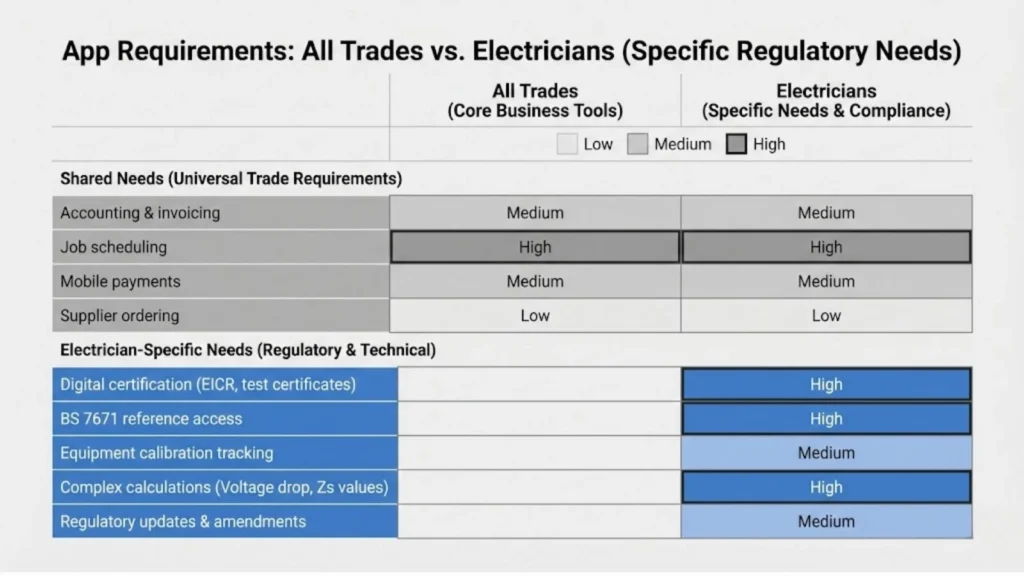
While much of this article applies to all tradespeople, electricians have specific requirements that differentiate them from plumbers, carpenters, or general builders:
1. Certification Intensity
Electricians must produce test certificates for virtually every job (EICRs, minor works, installation certificates). Plumbers occasionally need compliance certificates (Unvented Hot Water, G3). Carpenters rarely need formal certification.
This makes certification apps essential for electricians but optional for most other trades. The time saved by digital certification (5-10 minutes per job) compounds across dozens or hundreds of jobs annually.
2. Regulatory Reference Requirements
Electricians constantly reference BS 7671 Wiring Regulations, cable sizing charts, Zs values, and manufacturer specifications. The regulations update every 3-4 years with amendments in between. Having current references on-site is critical for compliance.
Other trades have standards (building regs for carpenters, water regs for plumbers) but not the same frequency of on-site reference needs.
3. Testing Equipment Tracking
Electricians must track calibration dates for multimeters, insulation testers, and earth loop impedance testers. Test equipment requires annual calibration, and using uncalibrated equipment invalidates certificates.
Apps that track equipment serial numbers, calibration due dates, and send reminders prevent expensive mistakes. Other trades don’t face equivalent equipment certification requirements.
4. Complex Calculation Requirements
Voltage drop calculations, cable sizing, maximum demand, earth fault loop impedance. Electricians perform technical calculations on-site that require precise inputs and outputs. Having calculator apps with BS 7671 formulas built-in reduces errors.
Plumbers have some calculations (pipe sizing, pressure losses) but not the same regulatory precision requirements. Carpenters work to measurements and tolerances but rarely need formula-based calculations.
5. Higher Admin-to-Labour Ratio
Electricians spend proportionally more time on paperwork (test results, schedules of inspections, certification) relative to time on tools compared to other trades. A three-hour rewire generates 30-45 minutes of documentation.
This makes admin-reducing apps (digital certificates, voice-to-text for job notes) more valuable to electricians than trades where paperwork is minimal.
The combination of these factors means electricians benefit more from digital tools than many other trades, but also face higher risks if tools fail (lost certification records, non-compliant documentation, equipment calibration lapses).
What Apps Don't Solve: The Reality Check
Apps transformed administrative efficiency for tradespeople between 2015 and 2026. But it’s important to be honest about what they didn’t solve.
Apps don’t solve client payment problems. Mobile card readers get you paid faster than bank transfers, but they don’t force clients who refuse to pay to actually pay. Apps can automate invoice reminders and track overdue payments, but they can’t collect from bad clients. That still requires phone calls, legal letters, or writing off bad debt.
Apps don’t solve finding consistent work. Job management platforms help you organize the work you have, but they don’t generate new leads. Tradespeople still need to market themselves, build reputations, ask for referrals, and network to fill their diaries. Apps don’t replace business development.
Apps don’t solve physical sustainability issues. Electricians crawling through lofts, kneeling on concrete floors, lifting heavy equipment, this physical toll doesn’t change because you have a smartphone. The wear on knees, backs, and joints by age 50 is the same whether you invoice digitally or on paper.
Apps don’t solve skill gaps or knowledge deficits. Reference apps provide information, but they don’t replace expertise. Knowing which regulation applies requires judgment developed through training and experience. AI can suggest calculations, but it can’t replace understanding why those calculations matter or how to interpret unusual results.
Apps don’t solve tool theft or van security. GPS tracking might help locate stolen equipment, but it doesn’t prevent theft. The same security concerns (locking vans, securing tools, avoiding high-crime areas) apply regardless of whether you manage jobs digitally.
Apps don’t solve subscription fatigue that they create. The consolidation of 2023-2026 helped, but tradespeople still commonly pay £150-£300 monthly across accounting, job management, certification, and payment processing. That’s £1,800-£3,600 annually. Apps supposedly increase efficiency, but they also create ongoing costs that didn’t exist in the paper era.
Apps don’t solve signal failure in buildings. Offline-first architecture helps, but many apps still fail partially in low-signal environments. The promise of “run your business from your phone” breaks down when the phone can’t connect to the internet for cloud sync.
Apps don’t solve poor work-life boundaries. Instant communication via WhatsApp, email, and text means clients expect immediate responses. The 24/7 availability created by smartphones leads to burnout unless tradespeople actively establish boundaries (business hours, auto-responders, dedicated work phones).
The honest reality: apps are tools that improved efficiency in specific areas (invoicing, payments, scheduling, documentation). They didn’t revolutionize the fundamental nature of trade work. You still need to show up, do the physical labour, solve problems on-site, and maintain client relationships. The admin got faster, but everything else stayed the same.
The 10-year evolution from 2015 to 2026 taught tradespeople hard lessons about digital tools:
Lesson 1: Regulatory compliance forced adoption, not convenience. HMRC Making Tax Digital and GDPR requirements made apps mandatory, not optional. Tradespeople who resisted digital tools until 2026 now face legal requirements they can’t avoid.
Lesson 2: Integration matters more than features. Having 8 specialist apps that don’t talk to each other creates more work than 2-3 connected platforms. Data duplication and manual re-entry wastes time that apps supposedly saved.
Lesson 3: Offline functionality is non-negotiable. Apps that fail without internet connection are useless for tradespeople working in basements, rural areas, and steel-frame buildings. Cloud-first architecture failed in the real world.
Lesson 4: Subscription costs compound faster than expected. £30 here, £50 there, suddenly you’re paying £3,000+ annually for software that increases efficiency but also increases overhead. Only tools with clear ROI justify their cost.
Lesson 5: Client expectations changed permanently. Digital quotes, instant invoices, card payments on-site, these became baseline professionalism. Tradespeople using paper systems look unprofessional compared to digitally competent competitors.
Lesson 6: AI is useful for admin, not critical decisions. Voice-to-text for job notes and auto-populated quotes save time. But nobody trusts AI for compliance decisions, safety calculations, or regulation interpretation. It’s a productivity booster, not a replacement for expertise.
Lesson 7: Data ownership matters. Walled garden apps that lock historical records behind subscriptions create hostage situations. Always verify export capabilities before committing to any tool that stores critical business data.
The tradespeople succeeding in 2026 aren’t using the most apps. They’re using the fewest apps that accomplish the most with minimal complexity. Typically:
One accounting platform (Xero, QuickBooks, FreeAgent) handling invoicing, expenses, and MTD compliance
One job management system (Tradify, ServiceM8) handling scheduling, quotes, and client communication
One payment processor (Square, SumUp) integrated with accounting for instant payments
One certification app (if electrician/gas engineer) for digital test certificates
Standard tools (supplier apps, reference materials) as needed
That’s 3-5 apps doing everything, versus the 10-15 apps many tradespeople accumulated during the 2018-2022 expansion phase. Less tool overload, better integration, lower subscription costs, higher productivity.
Apps didn’t eliminate paperwork for tradespeople. They just moved it to screens. But for those who consolidate wisely, choose offline-capable tools, and avoid subscription traps, the efficiency gains are real. Faster invoicing means faster payment. Better scheduling prevents double-bookings. Digital certification reduces liability risks.
The decade from 2015 to 2026 proved that tradespeople can run businesses from smartphones. The question for 2026 and beyond is whether the overhead of managing those digital systems justifies the efficiency they create, or whether we’ve simply traded paper clutter for digital complexity.
References
- HMRC: Making Tax Digital for Income Tax Self Assessment – https://www.gov.uk/government/collections/making-tax-digital-for-income-tax
- HMRC: Overview of Making Tax Digital – https://www.gov.uk/government/publications/making-tax-digital/overview-of-making-tax-digital
- ICO: Data Protection Self-Assessment Checklist for Sole Traders – https://ico.org.uk/for-organisations/advice-for-small-organisations/news-blogs-and-events/news/new-data-protection-self-assessment-checklist-for-sole-traders/
- ICO: Guide to GDPR for Small Organisations – https://ico.org.uk/for-organisations/advice-for-small-organisations/getting-started-with-gdpr/
- UK Government: SME Digital Adoption Taskforce Final Report – https://www.gov.uk/government/publications/sme-digital-adoption-taskforce-final-report/
- ECA: Electrifying Our Future (Net Zero and Digital Tools) – https://www.eca.co.uk/news/2025/feb/electrifying-our-future-eca-s-digital-series-unveils-road-to-net-zero
- FMB: What HMRC’s Making Tax Digital Means for Sole Trader Builders – https://www.fmb.org.uk/resource/what-hmrc-s-making-tax-digital-means-for-sole-trader-builders.html
- FSB: Innovation and Technology Adoption Reports – https://www.fsb.org.uk/resources/reports/innovation
- Xero UK: Small Business Insights and Resources – https://www.xero.com/us/resources/small-business-insights/latest-united-kingdom/
- The Productivity Institute: Digital Tools and SME Productivity – https://www.productivity.ac.uk/
Note on Accuracy and Updates
Last reviewed: 15 January 2026. This page reflects the current state of mobile app usage among UK tradespeople as of early 2026, incorporating MTD implementation timelines, AI tool integration developments, and subscription fatigue trends observed across the industry. App landscapes change rapidly, with new tools launching and existing platforms updating features frequently. We update this content annually to reflect major shifts in regulatory requirements, market consolidation, and technology capabilities.
FAQs
What apps do tradespeople actually use day to day in 2026, and what do they still avoid?
In 2026, self-employed tradespeople commonly rely on apps like Tradify or Jobber for job scheduling and quotes, QuickBooks or Xero for invoicing and basic accounting, and Google Workspace for email and file sharing. Electricians often add iCertifi or EasyCert for certification records. These tools handle admin efficiently on mobile devices.
Many avoid complex CRM systems like Salesforce, seeing them as overkill for solo operations. AI-driven apps for predictive maintenance are often skipped due to unreliable accuracy in real-world scenarios. Overly specialised stock management apps are also avoided if they are not integrated, as they add unnecessary complexity.
What to do next:
List your daily tasks and trial one integrated app like Tradify for a month.
How did UK tradespeople manage quotes, invoices, and scheduling in 2015 compared to now?
In 2015, most tradespeople used paper notebooks for scheduling, manual quotes written on forms, and posted invoices or basic desktop tools such as Excel. Payment tracking relied on phone calls, and double-bookings were common without real-time visibility.
By 2026, mobile apps dominate. Quotes are generated using templates in tools like Powered Now, invoices are sent digitally with payment links, and scheduling syncs automatically across calendars in apps like Jobber. Cloud storage allows access from anywhere, reducing errors and speeding up cash flow.
What to do next:
Digitise one process, such as quotes, using a free trial of QuickBooks.
What changed between 2018 and 2020 that pushed tradespeople into cloud accounting and mobile invoicing?
From 2018, Making Tax Digital for VAT, introduced in April 2019, required businesses over the £85,000 threshold to keep digital records and submit returns using compatible software. This pushed many tradespeople towards cloud accounting tools like Xero.
Then COVID-19 lockdowns in 2020 accelerated the shift. Contactless operations became essential, with mobile apps enabling remote quoting and electronic invoicing without site visits. These habits stuck after restrictions ended.
What to do next:
Check your VAT status and explore Xero’s basic plan if you are nearing the threshold.
What does Making Tax Digital actually require from sole traders, and why does it make apps effectively mandatory?
Under current rules at time of writing, Making Tax Digital for Income Tax Self Assessment starts in April 2026 for sole traders with qualifying income over £50,000, falling to £30,000 in 2027. It requires digital records of income and expenses, quarterly updates using compatible software, and a final annual declaration.
Apps become essential because manual spreadsheets do not integrate reliably with HMRC systems. Tools like QuickBooks automate submissions and reduce errors, though they require initial setup.
What to do next:
Calculate your qualifying income and sign up for HMRC Making Tax Digital updates.
How did COVID-19 accelerate digital adoption for tradespeople, and what habits stuck after restrictions ended?
COVID-19 forced rapid changes. Lockdowns led to remote quoting using tools like Zoom or Jobber, contactless payments, and online scheduling to reduce physical interaction. Many tradespeople adopted cloud tools for the first time to keep operating.
After restrictions ended, habits such as mobile invoicing and digital record keeping remained because they proved faster and more efficient. Electricians, in particular, continued using apps for compliance logs without returning to paperwork.
What to do next:
Review the tools you adopted during COVID-19 and keep one permanent habit, such as digital payments.
Why did “subscription fatigue” hit tradespeople around 2023, and what are typical monthly costs now?
By 2023, many tradespeople were paying for multiple apps covering accounting, scheduling, marketing, and compliance, while living costs were rising. This led to subscription fatigue, with users cancelling tools that overlapped or delivered limited value.
In 2026, typical costs range from £20 to £60 per app per month, depending on features and user numbers. Accounting tools may start lower, while integrated job management platforms like Tradify cost more but replace several separate subscriptions.
What to do next:
Audit your subscriptions and consolidate where features overlap.
What does “app consolidation” mean in practice, and why are fewer, integrated tools winning in 2026?
App consolidation means replacing several standalone apps with one or two integrated platforms that manage quotes, invoicing, scheduling, and basic CRM in one system, such as Jobber or Tradify.
This approach is winning because it reduces subscription costs, cuts duplicate data entry, and shortens learning time. In 2026, economic pressure has made efficiency more important than having specialist tools for every task. For electricians, this also includes built-in certification features.
What to do next:
Identify your top three admin needs and research integrated tools like Powered Now.
What app categories are essential in 2026 for a self-employed electrician, and which are optional?
Essential categories include job management for scheduling and quotes, accounting and invoicing for Making Tax Digital compliance, and certification or compliance apps to manage BS 7671 records. These cover daily admin and legal requirements.
Optional categories include marketing tools, stock tracking for high-volume work, or advanced CRM systems. On-site reference apps are useful but not always daily necessities.
What to do next:
Start with an accounting app if you are not yet ready for Making Tax Digital.
What problems do apps genuinely solve for tradespeople, and what problems do they definitely not solve?
Apps reduce admin workload. Faster invoicing improves cash flow, scheduling tools prevent double-bookings, and digital records support compliance such as Making Tax Digital submissions. For electricians, apps simplify certification and record keeping.
They do not solve physical challenges such as supply shortages, weather delays, or hands-on technical faults. Customer disputes and tool theft still require real-world solutions, and over-reliance on apps without backups can cause problems.
What to do next:
Use apps to fix one clear problem area, such as invoicing, and keep manual backups.
How are electricians’ app needs different from other trades, especially around certification, compliance, and on-site reference tools?
Electricians need specialist apps to manage BS 7671 certification, such as iCertifi or EasyCert, which allow digital creation and storage of electrical certificates. This requirement is heavier than for many other trades.
Compliance obligations under updated EAS requirements also push electricians towards digital record keeping. On-site reference apps provide quick access to electrical calculations and standards, which are critical for safety and accuracy.
What to do next:
Trial a certification app and confirm it fits naturally into your existing workflow.
