10 Years On: How the 2015 Smoke and CO Alarm Law Changed Rental Safety in England 

  • Technical review: Thomas Jevons (Head of Training, 20+ years)
  • Employability review: Joshua Jarvis (Placement Manager)
  • Editorial review: Jessica Gilbert (Marketing Editorial Team)
Diagram showing the UK solar PV installer career pathway, from beginner through full electrical qualification to specialist solar PV installation.
UK solar PV installer pathway highlighting that full electrician qualification comes first, followed by short solar PV specialisation training.

The Electrical Foundation Requirement

You cannot legally or safely become a Solar Photovoltaic (PV) installer without first qualifying as an electrician. There is no legitimate “PV-only installer” pathway bypassing electrical competence requirements. 

Solar PV systems comprise DC (Direct Current) arrays on rooftops generating electricity, feeding inverters converting DC to AC (Alternating Current), then integrating into building electrical installations at consumer unit level. The AC connection work falls under BS 7671 Wiring Regulations requiring circuit design, protective device selection, earthing verification, cable sizing for voltage drop and current-carrying capacity, and initial verification testing identical to adding any final circuit to electrical installation. 

Additionally, DC side work presents unique hazards: string voltages reaching 600V to 1000V, arc flash risks different from AC electrical work (DC arcs lack zero-crossing points making them harder to extinguish), specialized DC-rated protection devices, and live circuits remaining energized even after AC isolation because panels generate voltage whenever light present regardless of isolation status. 

Training providers marketing “3-day solar PV installer courses” or “fast-track renewable energy careers” target existing qualified electricians adding specialization, not complete beginners entering trades. Marketing materials often obscure prerequisite electrical qualifications, creating misconception that solar PV installation represents standalone entry-level career accessible within days. It does not. 

The regulated qualification pathway requires: NVQ Level 3 Diploma in Installing Electrotechnical Systems and Equipment (workplace competence qualification, 12 to 24 months portfolio development), AM2/AM2E practical assessment (final competence gatekeeper, 2.5 consecutive days), 18th Edition Wiring Regulations BS 7671:2018+A2:2022 (current regulatory knowledge including Section 712 addressing PV systems), then Level 3 Award in Installation of Small-Scale Solar PV Systems (PV-specific specialization, 3 to 5 days for qualified electricians). 

For complete beginners, this represents 3 to 4 years minimum timeline becoming qualified electrician first, then 3 to 5 days adding PV specialization. Understanding the complete electrical qualification pathway including NVQ Level 3, AM2 assessment, and 18th Edition certification provides essential foundation context before pursuing solar PV installation career. 

Additionally, domestic solar PV market heavily influenced by MCS (Microgeneration Certification Scheme) company-level certification requirement. Customers installing PV systems to access Smart Export Guarantee (SEG) payments selling surplus electricity back to grid require MCS installation certificate. MCS operates as company certification, not individual qualification, creating employment dependency for electricians wanting domestic PV work or substantial costs establishing company MCS registration independently.

Solar PV installation requires complete electrical circuit design, DC string wiring, inverter integration, AC consumer unit connection, and comprehensive testing - electrical work performed exclusively by qualified electricians holding NVQ Level 3, AM2, and 18th Edition credentials plus PV-specific training

Understanding DC vs AC Competence in Solar PV Work

Solar PV installations uniquely combine DC electrical work (panels to inverter) with AC electrical work (inverter to building electrical installation). Both require electrical competence, but DC presents distinct safety challenges often underestimated by AC-trained electricians. 

DC Side: The Solar Array 

What it comprises: Photovoltaic panels connected in series forming strings generating DC voltage ranging from 200V to 1000V depending on string design and panel specifications. Multiple strings may connect in parallel at DC combiner boxes or directly to inverter DC input terminals. 

Voltage levels: Domestic systems commonly use string voltages 400V to 600V DC. Commercial systems may reach 800V to 1000V DC maximizing efficiency and minimizing cable losses over longer cable runs. 

Arc flash hazard: DC arcs lack the natural zero-crossing point occurring 100 times per second in UK 50Hz AC supply where current naturally passes through zero voltage enabling arc extinction. DC maintains continuous voltage making established arcs significantly harder to extinguish, creating severe burn and fire risks. Arc flash incidents on live DC circuits can sustain until conductors physically separate or melt. 

Live circuit permanence: Solar panels generate voltage whenever exposed to light regardless of AC isolation status. Isolating consumer unit or switching inverter off does NOT de-energize DC side. Firefighters attending building fires with PV arrays face live DC circuits on rooftops even after disconnecting all AC supplies. Safe isolation requires DC isolators rated for DC voltage levels and fault current breaking capacity. 

Cable specifications: DC cables must withstand UV exposure (if external), temperature extremes in roof spaces (potentially exceeding 70°C), mechanical stress from roof structure movement, and moisture ingress. Standard AC cables inappropriate for DC PV applications. Require solar-rated cables with appropriate insulation ratings and conductor sizing for DC current-carrying capacity calculations differing from AC. 

Protection devices: DC-rated fuses, circuit breakers, and isolators essential. AC-rated protection devices cannot safely interrupt DC fault currents. String fuses protect against reverse current from paralleled strings. DC isolators enable safe maintenance isolation. MC4 connectors provide weatherproof DC connections rated for outdoor installation and repeated connection/disconnection cycles. 

AC Side: Grid Integration 

What it comprises: Inverter output connects to building’s AC electrical installation, typically via dedicated circuit from consumer unit or as supply to separate PV consumer unit. This work falls entirely under standard BS 7671 requirements for AC electrical installations. 

Circuit design: Inverter AC output requires appropriately sized cable accounting for voltage drop calculations, protective device selection (MCB or RCBO) coordinated with inverter output characteristics, and integration with existing installation’s protective measures (RCD protection, earthing system compatibility). 

Earthing considerations: PV system earthing must integrate with building’s earthing arrangement (TN-S, TN-C-S/PME, or TT systems). Section 712 addresses specific earthing requirements including equipotential bonding for PV array frames and mounting structures. Earthing verification testing confirms protective measures effectiveness. 

DNO notification: Distribution Network Operator (DNO) notification mandatory for all grid-connected PV systems regardless of size. Systems below 3.68kW per phase use G98 process (simplified connect and notify procedure). Larger systems require G99 process with prior DNO consent before connection. Failure to notify DNO risks grid connection refusal, disconnection, or legal action under Electricity Safety, Quality and Continuity Regulations 2002. 

Building Regulations compliance: PV installation qualifies as “notifiable work” under Building Regulations Part P (England and Wales). Must be certified by Competent Person Scheme (CPS) member (NICEIC, NAPIT, ELECSA, etc.) for self-certification, or notification submitted to Local Authority Building Control with third-party inspection. CPS membership requires company registration, not available to unqualified individuals. 

Why Both Require Electrical Qualification: 

AC integration work obviously requires electrician competence – few dispute this. However, DC work equally demands electrical understanding: circuit design calculations, voltage drop assessment, protection device coordination, cable sizing methodology, testing procedures. Roofing specialists or labourers can physically mount panels and racking under supervision, but DC string wiring, combiner box installation, and inverter connection require electrical competence verifying correct polarity, appropriate protection, and safe isolation procedures. 

Training providers sometimes suggest DC work represents “low voltage solar side” suitable for non-electricians while “only AC side needs electrician.” This dangerously misrepresents DC safety risks and regulatory requirements. Both DC and AC sides require electrical competence, with DC presenting additional specialized hazards requiring PV-specific training beyond standard electrical qualification.

Core Electrical Qualifications Required (The Foundation)

Solar PV specialization builds on complete electrical qualification foundation. No component optional or substitutable. Foundation requirements identical to EV charge point installation pathway. 

NVQ Level 3 Diploma in Installing Electrotechnical Systems and Equipment 

What it is: Workplace competence qualification proving practical electrical installation ability through portfolio evidence gathered over 12 to 24 months on actual electrical work sites under qualified supervision. Awarding bodies include City & Guilds (2357), EAL, SQA (Scotland). 

What it covers: Circuit design and installation, containment systems, wiring techniques, protective devices (MCBs, RCDs, RCBOs), earthing and bonding, three-phase systems, motor control, inspection and testing, certification and documentation, safe isolation, fault diagnosis. 

Why mandatory for PV: Portfolio demonstrates competence in circuit design, protective device selection, earthing arrangements, and testing procedures required for AC integration work. Without NVQ Level 3 foundation, lack baseline electrical knowledge to interpret BS 7671 Section 712 PV-specific requirements or perform DC circuit design calculations safely. 

Assessment: Ongoing portfolio development with quarterly assessor site visits observing installations, reviewing photographic evidence, verifying witness testimonies from qualified supervisors. Cannot be completed classroom-only. Requires electrical employment or guaranteed work placement for site access. 

Typical duration: 12 to 24 months with consistent electrical employment providing diverse installation types for portfolio breadth. 

AM2/AM2E Practical Assessment 

What it is: Final competence gatekeeper assessment conducted at approved centres over 2.5 consecutive days (approximately 16.5 hours total). Currently administered by NET (National Electrotechnical Training). 

What it covers: Timed practical installation tasks, circuit protection, earthing arrangements, inspection and testing, certification completion, fault-finding under examination conditions. 

Why mandatory for PV: Proves ability to perform electrical installations independently to required standard. Solar PV employers expect AM2-qualified electricians capable of working without constant supervision, completing installations efficiently, producing compliant test certificates. 

Scheduling: Must book 3 to 6 months advance. Weekday-only (typically Monday to Wednesday) requiring annual leave. Limited UK assessment centre locations. 

18th Edition Wiring Regulations (BS 7671:2018+A2:2022) 

What it is: Current UK electrical installation standards knowledge qualification. Amendment 2 (A2:2022) represents latest update. 

What it covers: Electrical safety principles, protective measures, special location requirements (Section 712 specifically addresses solar photovoltaic power supply systems), earthing systems, protective device selection, cable sizing, inspection and testing, certification. 

Why mandatory for PV: Section 712 contains PV-specific requirements for DC cable selection, earthing arrangements, overcurrent protection, surge protection, isolation devices. Without current 18th Edition knowledge, cannot interpret regulatory requirements governing PV installations. 

Assessment: Multiple-choice examination (typically 60 questions, 2 hours, 60% pass mark). Open-book format allowing BS 7671 access during exam. 

Duration: 3 to 5 days intensive or 5 to 8 evening sessions. BS 7671 book costs approximately £90 to £120. 

Optional but Highly Recommended: 2391 Inspection and Testing 

What it is: Advanced qualification in inspection, testing, and certification of electrical installations (City & Guilds 2391 or equivalent). 

Why valuable for PV: Solar PV commissioning requires comprehensive initial verification: insulation resistance testing at DC voltage levels (500V or 1000V test voltage), polarity verification for series string connections, earth continuity measurements for array frames, open-circuit voltage measurement, short-circuit current verification, inverter functional testing, AC side integration testing. Electricians holding 2391 already perform these procedures competently with methodology transferring to PV context requiring DC-specific adaptations. 

Employer preference: Job advertisements frequently list 2391 as essential or highly desirable because testing competence distinguishes electricians capable of independent commissioning from those requiring supervision during verification phase. 

For comprehensive breakdown of foundation electrical competence requirements for specialized installation work, see detailed pathway guide covering NVQ portfolio development, AM2 assessment, and 18th Edition regulatory knowledge. 

Qualification pathway diagram showing 3-4 year electrical training foundation from beginner through qualified electrician (NVQ Level 3, AM2, 18th Edition Section 712) followed by 3-5 day PV specialization with DC and AC competence requirements
Solar PV installation requires both DC competence (panel strings, 600-1000V, arc flash safety) and AC competence (consumer unit integration, BS 7671 compliance) - cannot shortcut 3-4 year electrician pathway, PV training assumes electrical foundation

PV-Specific Training (Level 3 Award)

Once qualified as electrician (holding NVQ Level 3, AM2, 18th Edition), PV specialization training typically requires 3 to 5 days intensive course. 

Regulated Qualifications: 

City & Guilds 2922 series: Most common PV qualification pathway. Includes 2922-34 (Installation and Maintenance of Small-Scale Solar PV Systems). Ofqual-regulated Level 3 Award. 

EAL equivalent: Alternative awarding body offering comparable Level 3 PV installation qualifications with similar learning outcomes and assessment methods. 

LCL Awards: Additional awarding body providing Level 3 Award in Solar Photovoltaic Systems recognized by MCS for installer certification. 

Course Content Coverage: 

BS 7671 Section 712 requirements: PV-specific regulations including DC cable selection and installation methods, earthing and bonding for PV arrays, overcurrent protection for DC circuits, surge protection device specifications, isolation requirements for maintenance safety, special location considerations for roof-mounted equipment. 

IET Code of Practice for Grid-Connected Solar PV Systems: Industry best-practice guidance supplementing BS 7671 with detailed technical recommendations for PV system design, installation methodology, testing procedures, commissioning protocols. 

DC circuit design: String sizing calculations accounting for panel specifications (open-circuit voltage, short-circuit current, temperature coefficients), series connection determining string voltage, parallel connection for current summation, shading analysis impact on system performance, inverter input specifications matching. 

Shading analysis: Understanding impact of partial shading on PV array performance, bypass diode operation in shaded conditions, optimum panel orientation and tilt angles, identifying shading sources (chimneys, trees, adjacent buildings), software tools for shading assessment. 

Inverter selection and sizing: Matching inverter DC input specifications to array output characteristics, considering Maximum Power Point Tracking (MPPT) voltage windows, oversizing array relative to inverter capacity for optimized energy yield, understanding inverter efficiency curves, grid synchronization requirements. 

DC protection devices: String fuses or circuit breakers preventing reverse current flow, DC isolators enabling safe maintenance isolation rated for DC voltage breaking capacity, surge protection devices protecting inverter electronics from lightning-induced transients, MC4 connector specifications and installation techniques. 

Installation methodology: Roof survey assessing structural loading capacity, mounting system selection (on-roof, in-roof, flat roof ballasted), weatherproofing cable penetrations through roof coverings, working at height safety procedures, cable routing minimizing voltage drop and visual impact. 

Testing and commissioning: Insulation resistance testing at appropriate DC voltage levels, polarity verification confirming correct series connections, open-circuit voltage measurement per string, short-circuit current measurement, earth continuity testing for array frames and mounting structures, inverter commissioning including grid parameter settings, functional performance verification. 

DNO notification processes: G98 simplified procedure for systems below 3.68kW per phase requiring post-installation notification within specific timescales, G99 prior consent process for larger systems requiring DNO approval before installation, understanding DNO response timescales and approval conditions, completing notification documentation correctly. 

MCS compliance: Understanding MCS MIS 3002 standards for system design and installation quality, documentation requirements for MCS installation certificates, customer handover procedures, warranty and maintenance obligations. 

Assessment Methods: 

Practical observation: Installing PV system components on test rig or simulated rooftop installation demonstrating mounting system installation, DC string wiring, inverter connection, testing procedures, functional commissioning. 

Written examination: Closed-book or open-book multiple-choice test (typically 40 to 60 questions, 90 to 120 minutes) covering Section 712 regulations, IET Code requirements, DC circuit design, shading analysis, inverter specifications, safety procedures. 

Portfolio submission: Some awarding bodies require photographic evidence or installation documentation from workplace PV installations demonstrating real-world competence beyond simulated assessment. 

Course Duration and Cost: 

Duration: 3 to 5 days intensive delivery for qualified electricians. 3-day courses cover core PV installation requirements. 5-day courses provide comprehensive coverage including battery storage integration (EESS – Electrical Energy Storage Systems). 

Cost: £500 to £1,200 depending on course duration, provider, location, whether battery storage included. Additional costs may include £50 to £100 examination/assessment fees, £60 to £90 IET Code of Practice book if not provided. 

Entry Requirements: 

Legitimate PV training providers require proof of electrical qualifications: NVQ Level 3 or equivalent, current 18th Edition certificate, evidence of qualified electrician status (ECS Gold Card typically accepted). Providers accepting students without electrical qualifications deliver inadequate training creating dangerous incompetent installers or misrepresent course as complete qualification pathway. 

Thomas Jevons, our Head of Training, explains foundation electrical requirement:

"Solar PV installation cannot be performed competently without complete electrical qualification foundation identical to any electrical installation work. PV system comprises DC array feeding inverter converting to AC then integrating into building's electrical installation at consumer unit level. AC connection work falls under BS 7671 Wiring Regulations requiring circuit design, protective device selection, earthing verification, cable sizing for voltage drop and current capacity, initial verification testing identical to any final circuit addition. The inverter output represents new electrical supply requiring integration with existing installation's protective measures coordination. Without NVQ Level 3 electrical competence, AM2 practical assessment pass, and current 18th Edition knowledge, installer lacks baseline electrical understanding to interpret BS 7671 Section 712 PV-specific requirements safely. Cannot shortcut to 'PV-only installer' role bypassing electrical qualification pathway."

MCS Certification and the Domestic Market Reality

Installing solar PV systems does not automatically grant access to domestic market or enable customer Smart Export Guarantee payments. MCS certification creates additional requirement beyond electrical qualifications. 

What MCS Certification Enables 

Smart Export Guarantee (SEG) eligibility: Domestic and small commercial customers installing PV systems to sell surplus electricity back to grid require MCS installation certificate as evidence system meets quality standards. Energy suppliers making SEG payments (typically 3p to 15p per kWh exported depending on supplier and tariff) demand MCS certification as condition for export tariff access. 

Consumer confidence: MCS certification signals quality assurance, installation warranty compliance, and professional standards adherence. Many domestic customers specify MCS installer requirement based on internet research or finance provider recommendations. 

Finance and warranty requirements: Some solar panel finance schemes, insurance products covering system performance, and manufacturer warranty terms specify MCS installation as prerequisite. Non-MCS installations may void equipment warranties or prevent finance approval. 

Market access: Domestic solar PV market dominated by customers seeking MCS installations. Non-MCS installers effectively excluded from mainstream domestic market, limiting customer base to commercial installations or customers not requiring SEG payments (rare). 

MCS as Company-Level Certification 

Critical distinction: MCS operates as company certification, not individual qualification. Individual electricians cannot obtain MCS status independently regardless of qualifications held. 

Company requirements for MCS registration: 

Nominated Technical Person: Company must designate individual holding NVQ Level 3 electrical qualification plus Level 3 PV Award as technical lead responsible for installation quality compliance. 

Appropriate insurance: Public liability insurance minimum £2 million (some MCS contractors require £5 million), professional indemnity insurance, employer’s liability insurance if employing staff. 

Quality management system: Documented procedures for design, installation, testing, commissioning, customer handover, complaints handling, warranty administration. 

Annual audits: MCS conducts annual surveillance audits inspecting sample installations, reviewing documentation, verifying technical competence maintenance, assessing customer satisfaction. 

Compliance with MIS 3002: Microgeneration Installation Standard 3002 defines technical requirements for PV system design, installation methodology, commissioning procedures, documentation standards. Companies must demonstrate consistent compliance. 

Company structure: Must operate as limited company or sole trader business (not employed individual). Registration fees typically £1,500 to £3,000 initial setup plus £600 to £1,200 annual membership depending on installation volume. 

Employment vs Self-Employment Pathways 

Employment route (easier for individuals): 

Join existing MCS-certified solar PV installation company as employed electrician. Company’s MCS registration covers installations performed by qualified employees. Individual contributes electrical competence and PV training, company provides MCS infrastructure, insurance, quality systems, marketing, customer acquisition. 

Advantages: Immediate access to domestic market under company MCS registration. No individual responsibility for MCS compliance costs, insurance, audit preparation, quality management systems. Salary or day rate employment (£35,000 to £50,000 annually for qualified PV electricians depending on experience and region). 

Self-employment route (complex and costly): 

Establish limited company or sole trader business, obtain electrical Competent Person Scheme membership (NICEIC, NAPIT, ELECSA), then apply for MCS certification separately. 

Steps required: 

  1. Company formation (limited company or sole trader registration) 

  1. Competent Person Scheme membership (£400 to £800 initial assessment plus £400 to £600+ annual fees) 

  1. Appropriate insurance policies (£500 to £1,500 annually depending on coverage levels and claims history) 

  1. Quality management system development (procedures, templates, documentation) 

  1. MCS application and assessment (£1,500 to £3,000 initial including audit) 

  1. Ongoing MCS membership (£600 to £1,200 annually) 

  1. Annual surveillance audits requiring sample installation availability for inspection 

Total setup costs: £3,000 to £6,000 establishing self-employed MCS-certified installer business, plus ongoing annual costs £1,500 to £3,000+. 

Financial barrier: Self-employment route creates substantial entry threshold compared to employed route where company covers infrastructure costs. Many electricians wanting domestic PV work initially seek employment with MCS-certified companies, transitioning to self-employment later once established customer base and financial capacity support independent MCS registration.

Comparison flowchart showing employment route (company MCS coverage, £35k-£50k salary) versus self-employment route (individual MCS costs £3k-£6k setup plus annual fees) for domestic solar PV market access
MCS certification operates at company level not individual - most solar PV electricians begin employed leveraging company infrastructure, transitioning to self-employment later once financial capacity supports £3k-£6k setup costs plus ongoing annual fees

Employer Expectations and Market Realities

Job advertisement analysis reveals similar employer expectations to EV installation sector: qualified electrician foundation plus specialization training, not standalone PV courses. 

The Gold Card and PV Training Standard: 

Joshua Jarvis, our Placement Manager, explains employer expectations:

"Analysis of UK solar PV installer job advertisements shows similar pattern to EV roles: approximately 85% to 90% require ECS Gold Card as baseline credential plus Level 3 PV Award completion. Employers specify 'qualified electrician with solar PV training,' not vague 'electrical knowledge' or 'PV course certificate.' This signals expectation of NVQ Level 3 workplace competence, AM2 practical pass, current 18th Edition, plus regulated PV qualification from City & Guilds, EAL, or LCL awarding bodies. Candidates holding Level 2 or Level 3 electrical diplomas without NVQ competence and Gold Card cannot meet employer threshold even if completed PV course. Market reality mirrors EV sector: solar PV installation represents specialization for existing qualified electricians, not entry-level position for electrical beginners or standalone career accessible through short course alone."

What Employers Typically Require: 

Essential requirements: ECS Gold Card (or equivalent qualified electrician status), 18th Edition current (Amendment 2 including Section 712), full UK driving license (field-based role requirement), Level 3 PV Award (City & Guilds 2922, EAL, or LCL). 

Highly desirable: 2391 Inspection and Testing qualification, previous PV installation experience (1+ years typically), working at height certification (PASMA, IPAF, or similar), CSCS card for commercial site access, battery storage training (EESS qualification), commercial-scale installation experience (not just domestic). 

Physical requirements: Comfortable working at height on pitched roofs, physical fitness for carrying panels and equipment, outdoor work in various weather conditions, ability to work in confined roof spaces. 

Team Structure in Large Installation Companies: 

Roofing Operatives/Mounting Specialists: 

Role: Physical panel mounting, racking system installation, roof penetration and weatherproofing, cable management on roof structures. Working under supervision of qualified electrician for electrical safety. 

Qualifications: Working at Height certification, CSCS Green Card (construction site access), potentially slate and tile roofing NVQ, health and safety training. 

Salary range: £25,000 to £35,000 annually reflecting physical installation skills without electrical qualification premium. 

Qualified Solar PV Electricians: 

Role: DC string design and wiring, inverter installation and commissioning, AC integration at consumer unit, initial verification testing and certification, customer handover and technical explanation, troubleshooting and fault diagnosis. 

Qualifications: NVQ Level 3, AM2 pass, 18th Edition, Level 3 PV Award, ideally 2391 testing qualification. 

Salary range: £40,000 to £55,000 annually for experienced PV electricians. Lead installers with 3+ years PV experience and battery storage qualifications command upper salary range. 

Career Progression: 

Roofing operative → Electrical apprentice → Qualified electrician → PV-trained electrician → Lead PV installer → Installation team supervisor or self-employment. 

Multi-Skilled Renewable Energy Installer Premium: 

Market increasingly expects combined qualifications across renewable technologies rather than single-technology specialists. 

PV + Battery Storage (EESS): Domestic customers installing solar frequently want battery storage simultaneously for energy independence, tariff optimization (storing cheap overnight electricity), and backup power. Installer offering integrated solar plus battery captures complete project worth £12,000 to £25,000 rather than subcontracting battery portion. 

PV + EV Charging: Homeowners with electric vehicles seek solar PV with EV charger enabling cheap vehicle charging from self-generated electricity. Combined installation worth £10,000 to £18,000 for solar plus charger. 

PV + Heat Pump: Whole-home electrification combining solar generation with heat pump heating replacement. High-value projects £20,000 to £40,000+ requiring multi-skilled renewable energy electrician. 

Commercial integrated systems: Solar arrays with battery storage providing grid services, EV charging infrastructure for fleet electrification, building management system integration, demand-side response participation. 

Salary premium: Electricians holding Level 3 qualifications across PV, Battery Storage (EESS), and EV command day rates £250 to £400 versus single-technology PV-only installer £180 to £250. Employment salary premium £45,000 to £60,000 for multi-skilled versus £35,000 to £45,000 PV-only. 

Employment Types: 

PAYE positions: Solar installation companies (domestic and commercial specialists), renewable energy contractors offering multiple technologies, electrical contractors diversifying into renewables, building services firms serving commercial property portfolios, facilities management companies managing solar portfolios. 

Contract/self-employed: Domestic installers via platforms (Checkatrade, TrustATrader, etc.), subcontractors to larger firms requiring overflow capacity, MCS-certified sole traders serving local residential market, commercial specialists for larger-scale ground-mount or industrial rooftop arrays. 

Reality Check for Career Changers: 

Entry-level “Solar PV Installer” positions for candidates without qualified electrician status effectively non-existent except roofing operative/mounting specialist roles. Advertisements labeled “Solar Installer – No Experience Necessary” typically mean electrical qualification required but PV installation experience not required, or represent roofing operative positions not electrician roles. Career changers from non-electrical backgrounds must complete 3 to 4 year electrician qualification pathway before accessing qualified PV electrician employment. 

Physical Installation Work and Working at Height

Solar PV installation involves substantial physical work and working at height competence often underestimated by electricians expecting primarily electrical tasks. 

Rooftop Work Demands: 

Height exposure: Domestic pitched roof installations typically 6 to 10 meters above ground level. Commercial flat roof installations may reach 15 to 30 meters on industrial buildings or warehouse structures. Some commercial rooftop installations exceed 30 meters on multi-story office buildings requiring specialized access equipment. 

Weather exposure: Outdoor rooftop work occurs in various weather conditions. Wind exposure increases significantly at height. Wet or icy roof surfaces create slip hazards. Summer temperatures in roof spaces can exceed 40°C, winter temperatures drop below freezing affecting manual dexterity. 

Access methods: Domestic installations commonly use scaffolding towers, roof ladders with ridge hooks, or Mobile Elevated Work Platforms (MEWPs). Commercial installations may require scissor lifts, boom lifts, permanent fall arrest anchor systems, or rope access techniques for complex roof geometries. 

Physical demands: Carrying solar panels (15kg to 25kg each) up ladders or scaffolding to rooftop. Lifting panels onto mounting rails. Positioning and securing mounting systems. Working in awkward positions on pitched roofs. Prolonged kneeling, bending, reaching overhead for panel securing and cable routing. 

Working at Height Certification: 

PASMA (Prefabricated Access Suppliers’ and Manufacturers’ Association): Tower scaffold erection and safe use training. Commonly required for domestic installation companies using scaffold towers for roof access. 

IPAF (International Powered Access Federation): Mobile Elevated Work Platform operation certification. Required for commercial installations using scissor lifts or boom lifts. Multiple categories covering different MEWP types. 

Roof work safety: Understanding pitched roof access techniques, ridge ladder use, roof anchor systems, personal fall arrest equipment (harnesses, lanyards, energy absorbers), emergency rescue procedures. 

Employer requirement: Approximately 70 to 80% of solar PV installer job advertisements specify working at height certification or willingness to obtain training. Not always formal PASMA/IPAF requirement, but demonstration of height work capability expected. 

Installation Task Breakdown: 

Roof survey and measurement: Assessing structural capacity, identifying rafter positions, measuring roof dimensions, marking panel layout, photographing existing roof condition. 

Mounting system installation: Fixing roof hooks to rafters through tiles or slates (requires tile/slate removal and replacement), installing mounting rails with correct spacing, leveling rails across roof surface, securing end clamps and mid clamps. 

Panel installation: Lifting panels to roof (team lifting or mechanical aids), positioning panels on mounting rails, securing with clamps, connecting MC4 cables between panels forming strings. 

Cable routing: Running DC cables from roof-mounted panels to inverter location (typically loft space or utility room), drilling through roof covering and roof structure for cable entry, installing cable protection (conduit or trunking) where required, weatherproofing cable entry points. 

Inverter and AC integration: Mounting inverter on internal wall, connecting DC cables to inverter input, installing AC circuit from inverter to consumer unit, integrating protective devices, earthing arrangements. 

Testing and commissioning: Performing verification tests (requires carrying test equipment to roof for DC measurements), functional commissioning, customer demonstration. 

Physical Capacity Requirements: 

Sustained physical exertion: Full-day installations require continuous physical activity (climbing, carrying, lifting, working overhead). 

Age and fitness: Older electricians (50+ years) transitioning to solar PV may find rooftop physical demands challenging compared to lighter domestic electrical work. Fitness assessment important before committing to PV career. 

Manual handling: Team lifting procedures for panels. Understanding weight distribution, grip techniques, communication during coordinated lifts. 

Personal protective equipment: Hard hat, safety boots, harness and lanyard where fall arrest required, gloves for panel handling, high-visibility clothing on commercial sites.

Solar PV installer working at height on rooftop installation demonstrating physical demands including panel handling, mounting system installation, and working at height competence beyond electrical skills
Solar PV installation requires substantial physical work at heights 6-30+ meters including panel lifting (15-25kg each), mounting system installation, roof penetration work, and outdoor exposure - often underestimated by electricians expecting primarily electrical tasks

Complete Pathway Comparison: Beginner vs Existing Electrician

Timeline and requirements differ drastically depending on starting point, mirroring EV installation pathway distinctions. 

Complete Beginner (No Electrical Background) 

Starting point: Career changer from non-electrical employment, school leaver, or adult seeking trade entry. 

Phase 1 – Electrical Foundation (Years 1-4): 

Apprenticeship route (recommended): Electrotechnical Apprenticeship combining Level 2/3 Diplomas, NVQ Level 3, AM2 assessment, 18th Edition. Duration 3.5 to 4 years, wages £15,000 to £18,000 (year 1) progressing to £22,000 to £28,000 (year 4), employer-funded training, guaranteed workplace access for NVQ portfolio. 

Adult learner route (higher risk): Self-funded Level 2/3 electrical diplomas via evening classes or intensive courses, then secure mate/improver employment for NVQ workplace evidence, complete 18th Edition and AM2. Total investment £6,000 to £12,000, timeline 3 to 5 years, requires securing electrical employment for NVQ access creating diploma-completion trap risk without workplace placement support. 

Phase 2 – PV Specialization (Days 1-5): 

Once holding NVQ Level 3, AM2 pass, 18th Edition current (including Section 712 knowledge), and ECS Gold Card: 

  • Enroll in Level 3 Award in Solar PV (City & Guilds 2922, EAL, or LCL) 

  • Complete 3 to 5 day course including practical assessment and examination 

  • Cost: £500 to £1,200 

  • Consider combined PV + Battery Storage course if available (5 days typical) 

Phase 3 – Employment/MCS Access: 

  • Apply for PV installer positions with MCS-certified solar companies 

  • Or if self-employed ambition: Establish company, obtain CPS membership, apply MCS certification (£3,000 to £6,000 setup plus ongoing annual fees) 

Additional recommended: Working at Height certification (PASMA/IPAF), battery storage qualification (EESS), EV charge point training for multi-skilled profile. 

Total timeline beginner to employable PV installer: 3.5 to 4.5 years 

Critical barrier: Securing electrical employment for NVQ portfolio evidence. Without workplace access, pathway stalls regardless of diploma completion. For comprehensive information about the qualified electrician career pathway from beginner through to specialized renewable energy installations, see detailed guide covering apprenticeship routes, adult learner challenges, and workplace access requirements. Elec Training’s guaranteed work placement through 120+ contractor partnerships specifically addresses electrical employment barrier enabling NVQ progression rather than diploma-completion trap outcome. 

Existing Qualified Electrician (Transitioning to PV) 

Starting point: Holds NVQ Level 3, AM2 pass, 18th Edition current, ECS Gold Card, working as qualified electrician (1+ years experience). 

Phase 1 – PV Specialization (Days 1-5): 

  • Verify 18th Edition currency (Section 712 PV requirements included in current edition) 

  • Enroll in Level 3 PV Award (3 to 5 days, cost £500 to £1,200) 

  • Complete practical assessment and examination 

  • Obtain IET Code of Practice for Grid-Connected Solar PV Systems if not provided 

Phase 2 – Additional Certifications: 

  • Working at Height training (PASMA 1 day, or IPAF 1-2 days depending on categories) 

  • Consider Battery Storage qualification (EESS) if offering integrated solutions 

  • EV charge point training if pursuing multi-skilled renewable energy profile 

Phase 3 – Employment/Self-Employment: 

If employed: Discuss PV work addition with current employer. If employer MCS-certified or willing to pursue MCS registration, transition straightforward. If employer not renewables-focused, may need employer change to solar installation company. 

If self-employed: Verify CPS membership current (NICEIC/NAPIT). Apply for MCS certification (£1,500 to £3,000 initial plus annual fees). Market solar PV services to existing electrical customer base. Consider joining renewable energy contractor networks for larger project referrals. 

Total timeline qualified electrician to PV installer: 3 to 10 days training plus administrative processes (MCS application potentially 1 to 3 months processing if pursuing self-employment route). 

Advantage: Existing electrical employment and qualifications remove foundation barriers. PV specialization represents straightforward addition to existing skillset rather than multi-year career change. Can offer solar PV alongside existing electrical services creating diversified income streams. 

Roofing Specialist Route (Limited Scope) 

Starting point: Experienced roofer with slate/tile NVQ, working at height competence, no electrical qualifications. 

Viable role: Roofing operative/mounting specialist in solar PV installation teams. Salary £25,000 to £35,000 performing physical panel mounting, racking installation, weatherproofing under qualified electrician supervision for electrical work. 

Cannot perform: DC string wiring, inverter installation, AC consumer unit integration, testing and certification. These require electrical qualification. 

Progression option: Pursue electrical apprenticeship mid-career combining roofing expertise with electrical competence creating highly valuable dual-skilled installer profile commanding premium wages £40,000 to £50,000+ for combined roofing and electrical capability. 

Critical understanding: Roofing expertise complements electrical competence for PV work, doesn’t substitute for it. Valuable team member role exists, but independent installer or lead electrician progression requires electrical qualification pathway. 

Common Myths About Solar PV Installer Careers

Correcting frequent misconceptions perpetuated by training provider marketing and industry misunderstanding, mirroring EV installer myth patterns. 

Myth: “You can become solar PV installer in 3-5 days from scratch” 

Reality: 3 to 5 day PV courses target existing qualified electricians adding specialization, not complete beginners. Legitimate providers require proof of NVQ Level 3, 18th Edition, qualified electrician status before enrollment. Total pathway for beginners: 3.5 to 4 years becoming electrician first, then 3 to 5 days PV training. 

Verdict: Completely false for beginners. True only for existing qualified electricians. 

Myth: “Solar PV is low voltage and inherently safer than mains electrical work” 

Reality: DC string voltages reach 600V to 1000V, significantly exceeding 230V AC mains voltage. DC arcs harder to extinguish than AC creating severe burn and fire risks. Panels remain live whenever light present, cannot be isolated like AC circuits. Requires specialized DC safety training beyond standard electrical work. 

Verdict: Completely false. PV presents unique high-voltage DC hazards. 

Myth: “MCS is a personal qualification you obtain through training” 

Reality: MCS operates as company-level certification scheme, not individual qualification. Companies undergo MCS registration, audits, quality system assessment. Individual electricians join MCS-certified companies or establish companies obtaining MCS registration independently. Cannot obtain MCS status as individual employee. 

Verdict: False. MCS is company certification, not personal credential. 

Myth: “Roofers can perform DC wiring because it’s outdoor roof work” 

Reality: DC string wiring constitutes electrical work requiring electrical competence. Polarity-sensitive series connections, voltage calculations, protection device selection, cable sizing – all electrical design tasks. Roofers perform valuable mounting and weatherproofing work but require qualified electrician supervision for DC electrical connections. 

Verdict: False. DC wiring requires electrical qualification regardless of roof work context. 

Myth: “Any 18th Edition electrician automatically competent for PV installations” 

Reality: 18th Edition includes Section 712 covering PV requirements, but PV-specific training addresses DC circuit design, shading analysis, inverter selection, string sizing calculations, specialized testing procedures, MCS compliance not covered comprehensively in standard electrical training. Qualified electricians require additional PV training for competent installation work. 

Verdict: False. PV-specific training essential beyond general 18th Edition knowledge. 

Myth: “You don’t need to notify DNO for small domestic systems” 

Reality: DNO notification mandatory for ALL grid-connected PV systems regardless of size. Systems below 3.68kW per phase use G98 simplified process. Larger systems require G99 prior consent. Failure to notify risks grid disconnection, legal action, insurance invalidation. 

Verdict: Completely false. DNO notification universally required. 

Myth: “Solar panels need planning permission” 

Reality: Most domestic roof-mounted solar panels qualify as “permitted development” not requiring planning permission in England, Wales, and Scotland (subject to specific criteria: not exceeding 200mm roof protrusion, not on walls fronting highways, conservation area restrictions apply). Stand-alone ground-mount systems or listed buildings may require permission. 

Verdict: Mostly false for standard domestic rooftop installations. Some exceptions exist. 

Myth: “Solar doesn’t work effectively in UK weather” 

Reality: PV panels generate electricity from daylight, not direct sunlight. Work effectively in cloudy diffuse light conditions common in UK climate. Modern panels achieve 15% to 22% efficiency even in overcast conditions. UK receives sufficient solar irradiance for economically viable PV installations, evidenced by 1.3 million+ domestic systems installed as of 2024. 

Verdict: False. UK climate suitable for productive solar PV generation. 

Myth: “Installation is complicated and takes weeks” 

Reality: Typical domestic installation (10 to 16 panel system, 4kW to 6kW capacity) completed in 1 to 2 days by experienced installation team. Simple roof geometry, good access, standard mounting systems enable efficient installation. Complex installations (multiple roof planes, difficult access, listed buildings) may extend to 3 to 4 days. 

Verdict: False. Straightforward installations complete quickly for qualified installers. 

Myth: “Battery storage always required with solar PV” 

Reality: Battery storage optional addition for customers wanting energy independence, tariff optimization, or backup power. Many PV installations operate without batteries, exporting surplus electricity to grid via SEG payments. Battery adds £4,000 to £8,000+ cost depending on capacity, not always economically justified. 

Verdict: False. Batteries enhance but not required for functional PV system. 

Myth: “SEG payments require MCS for all installations” 

Reality: SEG payments specifically require MCS installation certificate as evidence of quality standards compliance. Energy suppliers making SEG payments demand MCS. Non-MCS installations cannot access SEG export tariffs. MCS effectively mandatory for domestic market participation. 

Verdict: True. SEG requires MCS certification. 

Myth: “PV course alone enables self-employed domestic installer career” 

Reality: Self-employed domestic installers require: electrical qualification (NVQ Level 3, AM2, 18th Edition), PV training, company establishment, CPS membership, MCS certification, appropriate insurance, quality management systems. PV course represents one component of multi-requirement pathway. Cannot operate domestically without company MCS registration. 

Verdict: False. Requires complete electrical qualification plus company MCS infrastructure. 

Myth: “AM2 assessment not required for PV work” 

Reality: AM2 proves electrical competence enabling ECS Gold Card. Employers require Gold Card for PV installer roles. Cannot access qualified electrician employment without AM2 pass. Foundation electrical competence pathway includes AM2 as mandatory component. 

Verdict: False. AM2 essential for electrical competence foundation enabling PV specialization. 

Myth: “Health and safety training optional for PV installers” 

Reality: Working at height certification (PASMA/IPAF or equivalent) commonly employer requirement. CSCS card mandatory for commercial site access. Manual handling training, PPE requirements, emergency procedures all employer expectations. While not legally mandatory for self-employed, practically essential for employability and insurance compliance. 

Verdict: Partially false. Not legal mandate but employer requirement and insurance condition.

Myth versus reality comparison showing training provider marketing claims about quick solar PV installer training contrasted with actual 3.5-4 year electrical qualification requirements plus PV specialization and DC safety realities
Training provider marketing obscures foundation requirement: solar PV installation represents specialization for existing qualified electricians requiring both DC and AC electrical competence, not 3-day entry route for complete beginners

Building Your Solar PV Installer Career

Solar PV installation represents viable specialization for qualified electricians and achievable long-term career goal for beginners willing to commit to complete electrical qualification pathway first, mirroring EV installer pathway structure. 

For Complete Beginners: 

Critical understanding: Cannot shortcut to PV-only installer role. Must qualify as electrician first through 3 to 4 year pathway (apprenticeship recommended, adult learner route higher risk). 

Strategic approach: 

Step 1: Research electrical apprenticeship opportunities in your region. Apprenticeships provide wages throughout training (£15,000 to £28,000 progressing over 4 years), employer-funded qualifications (zero tuition costs), guaranteed workplace access for NVQ portfolio, and qualified electrician status upon completion enabling subsequent PV specialization. 

Step 2: If apprenticeship unavailable, consider adult learner route via Level 2/3 diplomas ONLY if realistic plan exists for securing electrical employment enabling NVQ progression. Elec Training’s guaranteed work placement through 120+ contractor partnerships specifically solves workplace access barrier causing diploma-completion trap for self-funded adult learners. 

Step 3: During electrical qualification years, research renewable energy market developments, follow solar industry news (MCS policy changes, technology advances, DNO processes, SEG tariff updates), identify which electrical contractors in your region perform PV installations as potential future employers. 

Step 4: Upon achieving qualified electrician status (NVQ Level 3, AM2 pass, 18th Edition current including Section 712, ECS Gold Card), immediately pursue Level 3 PV Award (3 to 5 days, £500 to £1,200). Consider combined PV + Battery Storage course for multi-skilled profile. 

Step 5: Target employment with MCS-certified solar installation companies or renewable energy contractors. This provides immediate domestic PV market access under company infrastructure without individual MCS setup costs £3,000 to £6,000. 

Additional development: Obtain working at height certification (PASMA/IPAF), add EV charge point training, consider battery storage qualification (EESS) for complete renewable energy installer profile commanding £45,000 to £60,000 salaries versus single-technology PV-only £35,000 to £45,000. 

Timeline expectation: 3.5 to 4.5 years from complete beginner to actively installing solar PV systems as qualified electrician with PV specialization. 

For Existing Qualified Electricians: 

Opportunity assessment: Solar PV installation represents natural specialization if you already hold NVQ Level 3, AM2, current 18th Edition. Adding PV capability opens renewable energy market sectors (domestic retrofit, commercial rooftop, ground-mount arrays, integrated battery storage projects). 

Quick-start pathway: 

Immediate action: Enroll in Level 3 PV Award (City & Guilds 2922, EAL, or LCL). 3 to 5 day course completion achievable within weeks. Verify Section 712 PV requirements covered in current 18th Edition knowledge (included in Amendment 2). 

Additional certifications: Working at Height training (PASMA 1 day or IPAF 1-2 days). Consider Battery Storage qualification (EESS) and EV charge point training for multi-skilled renewable energy electrician profile. 

Employment route: Discuss PV work addition with current employer. If employer MCS-certified or pursuing renewable energy diversification, transition straightforward. If employer not renewables-focused, consider employer change to solar installation company or renewable energy contractor. 

Self-employment route: If already self-employed electrician with CPS membership (NICEIC/NAPIT), apply for MCS certification (£1,500 to £3,000 initial plus £600 to £1,200 annual). Market solar PV services to existing electrical customer base. Emphasize renewable energy expertise, integrated solutions (PV + battery + EV), MCS certification for SEG eligibility. 

Market positioning: Position as multi-skilled renewable energy electrician rather than single-technology specialist. Combine PV with battery storage, EV charging, heat pump awareness. Integrated offering commands premium rates £250 to £400 per day versus PV-only £180 to £250. 

Timeline expectation: 3 to 10 days training plus administrative processing (1 to 3 months MCS application if pursuing self-employment) from qualified electrician to actively marketing solar PV services. 

The Elec Training Difference: 

Whether complete beginner or existing electrician, workplace access and employment connections determine solar PV career viability. Beginners need electrical employment for NVQ progression. Qualified electricians benefit from MCS-certified employer connections avoiding self-employment setup costs. 

Elec Training’s guaranteed work placement support addresses both scenarios: 

For beginners: 120+ contractor partnerships enable electrical employment securing NVQ workplace access, preventing diploma-completion trap that stalls self-funded adult learners. Foundation electrical qualification pathway must succeed before PV specialization accessible. 

For qualified electricians: Connections include MCS-certified solar installation companies, renewable energy contractors, electrical firms diversifying into renewables – employers actively seeking qualified electricians with PV training or willingness to add specialization. In-house recruitment team making 100+ employer contact calls per learner increases placement probability with employers offering renewable energy career pathways not just general electrical work. 

Call 0330 822 5337 to discuss solar PV installer career planning specific to your circumstances. We’ll provide honest assessment of: realistic timeline from your current position to PV installer status, foundation electrical qualification requirements if beginner, guaranteed placement support availability for NVQ workplace access, existing electrician PV specialization pathways, employer connections for MCS-certified companies performing solar installations, market realities about domestic PV requiring company MCS registration, multi-skilled renewable energy electrician development combining PV with battery storage and EV charging. No overselling “3-day solar installer” shortcuts. No dismissing 3 to 4 year electrician foundation reality. Just evidence-based guidance helping you build legitimate solar PV installer career through proper qualification pathway and strategic workplace access timing. 

References

Note on Accuracy and Updates

Last reviewed: 6 January 2026. This page is maintained; we correct errors and refresh sources as qualification specifications, regulatory frameworks, scheme requirements, and market conditions change. BS 7671 Section 712 requirements reflect 18th Edition Amendment 2 (A2:2022) standards current as of publication; future amendments may introduce additional PV-specific requirements. MCS MIS 3002 standards subject to periodic updates affecting system design, installation methodology, or documentation requirements; verify current version via mcscertified.com before installations. DNO notification processes (G98 for systems <3.68kW per phase, G99 for larger) represent current Energy Networks Association standards; connection thresholds or procedures may change with grid modernization initiatives. Smart Export Guarantee (SEG) tariff rates (3p-15p per kWh cited) vary by energy supplier and change periodically based on wholesale electricity prices and supplier policies; verify current rates before advising customers. Employer market expectations (85-90% requiring Gold Card) based on job advertisement analysis December 2024 to December 2025 across Reed, Indeed, and specialist renewable energy job boards; regional variations exist. Course costs (Level 3 PV Award £500-£1,200, MCS setup £3k-£6k) represent 2024/25 market rates subject to inflation and provider variation. Salary ranges (roofing operatives £25k-£35k, qualified PV electricians £40k-£55k) reflect current market conditions varying substantially by region, employer type, experience level, and multi-skilled capability (PV + battery + EV premium). Working at height certification requirements (PASMA/IPAF) represent employer expectations not legal mandates; specific requirements vary by company and project type. Multi-skilled renewable energy installer trend (PV combined with battery storage, EV charging, heat pumps) reflects current market integration observed in domestic retrofit sector; future technology combinations may evolve with market maturity and policy incentives. Next review scheduled following: BS 7671 amendment publications affecting Section 712, MCS standards updates (MIS 3002 revisions), significant DNO process changes (G98/G99 threshold modifications), qualification framework changes affecting PV pathway, or substantial shifts in employer expectations or MCS company registration costs. 

  • Technical review: Thomas Jevons (Head of Training, 20+ years)
  • Employability review: Joshua Jarvis (Placement Manager)
  • Editorial review: Jessica Gilbert (Marketing Editorial Team)
Diagram showing the UK solar PV installer career pathway, from beginner through full electrical qualification to specialist solar PV installation.
UK solar PV installer pathway highlighting that full electrician qualification comes first, followed by short solar PV specialisation training.

On 1 October 2015, something shifted in England’s private rental sector. Not dramatically, not with fanfare, but quietly. Private landlords became legally required to fit smoke alarms on every storey and carbon monoxide alarms in rooms with solid fuel appliances. The Smoke and Carbon Monoxide Alarm (England) Regulations 2015 aimed to close a gap where private rentals consistently lagged behind social housing in basic fire safety provision. 

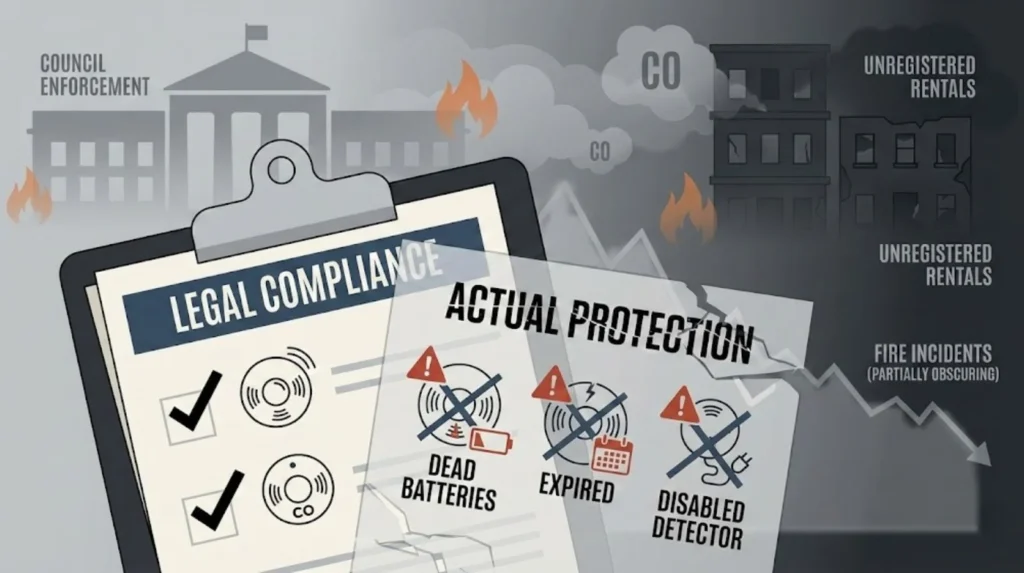
Ten years later, we’ve got enough data to ask the uncomfortable questions. Did the law work? Did it save lives? And perhaps more importantly, what did we learn about the difference between compliance on paper and actual protection in practice? 

The answer, backed by a decade of Home Office fire statistics, English Housing Survey data, and NHS hospital admission records, is more nuanced than “yes” or “no.” The law succeeded in getting equipment onto walls. It failed at ensuring that equipment stayed functional. It closed some gaps and exposed others. And crucially, it revealed that statutory minimums don’t automatically translate to meaningful safety improvements without enforcement mechanisms that actually work. 

What the 2015 Law Actually Required

The regulations weren’t complicated. Private landlords in England had to install at least one smoke alarm on every storey used as living accommodation and a carbon monoxide alarm in any room containing a solid fuel-burning appliance like a wood stove or open coal fire. Alarms needed testing at the start of each new tenancy. Local housing authorities could issue remedial notices for non-compliance, followed by penalties up to £5,000 if landlords ignored the requirement. 

Here’s what the law didn’t do: it didn’t cover social housing (until 2022 amendments), didn’t mandate CO alarms for gas or oil appliances (again, fixed in 2022), didn’t require interconnected alarm systems, and didn’t specify ongoing maintenance beyond that initial tenancy test. It set a floor, not a ceiling. And critically, it relied on complaint-led enforcement rather than routine inspections. 

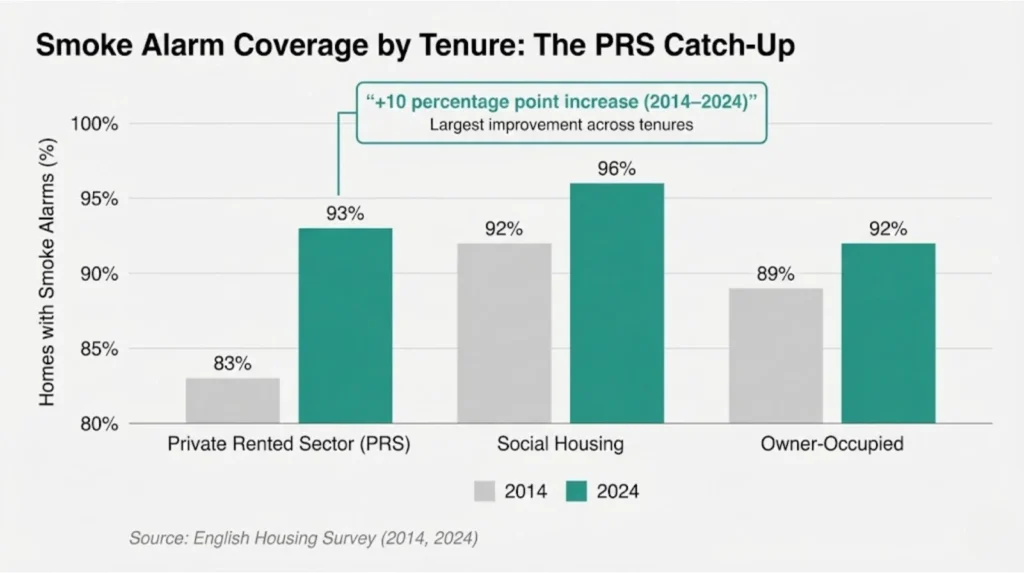
The scope was deliberately narrow. Owner-occupied homes were exempt. Long leases over seven years were out. Licensed Houses in Multiple Occupation already had stricter rules under separate regulations. The 2015 law specifically targeted the private rented sector, where alarm coverage in 2014 sat at 83% compared to 92% in social housing. 

The Data Story: 2010-2025 Trends

Pre-2015 Baseline (2010-2014) 

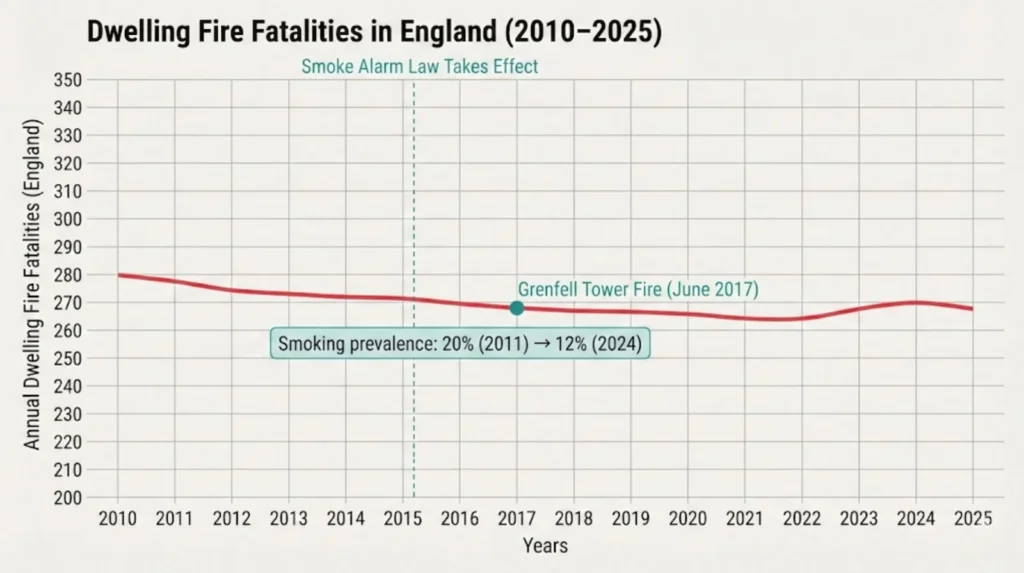
England saw approximately 40,000 dwelling fires annually, with around 250-300 fire-related fatalities and 10,000-12,000 non-fatal injuries each year. Smoke alarm prevalence was 88% overall, but the private rented sector lagged at 83%. Carbon monoxide alarms were rare, present in only 15-20% of homes, mostly where visible risk appliances like wood burners existed. 

Fire incidents showed a steady downward trend throughout this period, driven primarily by declining smoking rates (from 20% in 2011 falling toward 12% by 2024), updated building regulations from 2010, and fire service prevention campaigns. The trajectory was already positive before the 2015 law took effect. 

Post-2015 Changes (2015-2025) 

Dwelling fires declined to approximately 27,000 by 2024/25. Fatalities dropped to around 270 in 2023/24 (309 across Great Britain). Non-fatal injuries fell to roughly 7,000 annually. Smoke alarm prevalence in the private rented sector rose to 93% by 2023/24, effectively closing the gap with social housing (96%) and owner-occupied properties (92%). 

Carbon monoxide alarm coverage increased more slowly. By 2024, surveys indicated 42% of UK homes still lacked CO alarms, with the private rented sector showing better adoption than owner-occupied but falling short of the near-universal smoke alarm saturation. 

The critical observation: there’s no sharp break in the data around October 2015. Fire deaths and incidents continued declining along the trajectory established years earlier. The 2015 law appears to have accelerated equipment installation in the targeted sector without creating a sudden inflection point in harm reduction outcomes. 
Comparison flowchart showing employment route (company MCS coverage, £35k-£50k salary) versus self-employment route (individual MCS costs £3k-£6k setup plus annual fees) for domestic solar PV market access
MCS certification operates at company level not individual - most solar PV electricians begin employed leveraging company infrastructure, transitioning to self-employment later once financial capacity supports £3k-£6k setup costs plus ongoing annual fees

What Actually Worked: Equipment Saturation in Private Rentals

The law succeeded at its primary objective: getting alarms installed in previously under-equipped private rental properties. English Housing Survey data shows private rented sector smoke alarm coverage increased approximately 10 percentage points post-2015, rising from 83% to 93% within five years. That’s roughly 1 million additional rental homes with smoke detection capability. 

For carbon monoxide, the effect was more modest initially. The 2015 requirement only applied to solid fuel appliances, covering a fraction of rental properties. The bigger CO alarm surge came after the 2022 amendments extended the requirement to gas and oil appliances and included social housing. Between 2015 and 2022, CO alarm presence in affected private rentals climbed from an estimated 28% to over 60%, then jumped to 90%+ post-2022 as the scope widened. 

The mechanism was straightforward. By shifting alarm provision from discretionary (“landlords should consider”) to mandatory (“landlords must install”), the law made safety equipment default rather than optional. Landlords integrated alarm checks into tenancy start inventories alongside gas safety certificates and deposit protection documentation. The safety standard became embedded in standard operating procedure. 

Thomas Jevons, Head of Training at Elec Training, observes the practical reality: 

"The 2015 law succeeded at getting alarms onto walls, but what we've learned over ten years is that presence doesn't equal protection. I've assessed properties where alarms were fitted to tick the compliance box, then installed in locations where cooking steam triggers false alarms every week. Tenants disable them within months. The law created a minimum standard, but without guidance on optimal placement or ongoing maintenance requirements, we're seeing a cycle where equipment is present but functionally useless."

This distinction between installation and effective protection runs throughout the decade’s data. 
Comparison flowchart showing employment route (company MCS coverage, £35k-£50k salary) versus self-employment route (individual MCS costs £3k-£6k setup plus annual fees) for domestic solar PV market access
MCS certification operates at company level not individual - most solar PV electricians begin employed leveraging company infrastructure, transitioning to self-employment later once financial capacity supports £3k-£6k setup costs plus ongoing annual fees

Where the Law Fell Short: Maintenance, Enforcement, and the Shadow Sector The Maintenance Gap

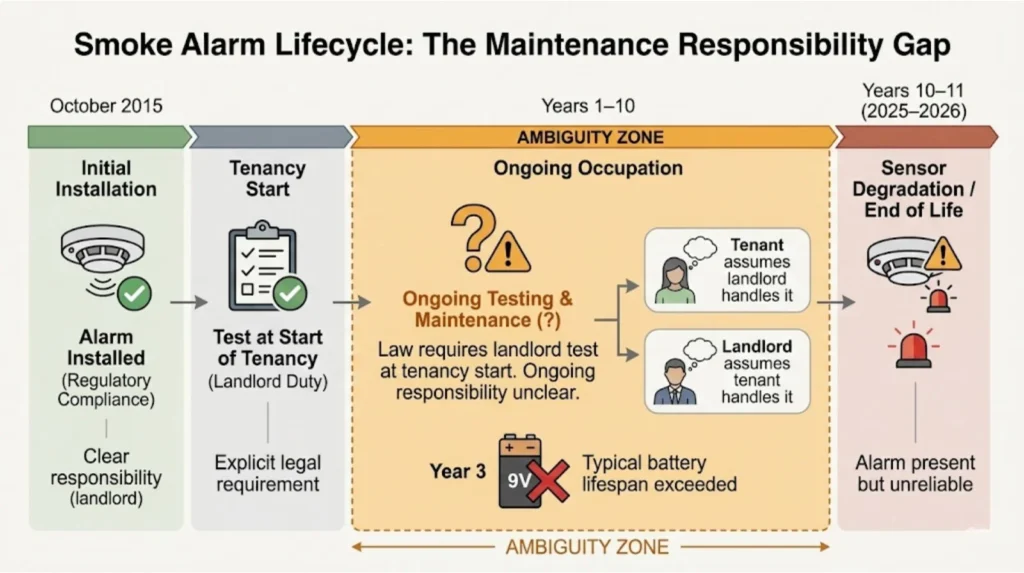
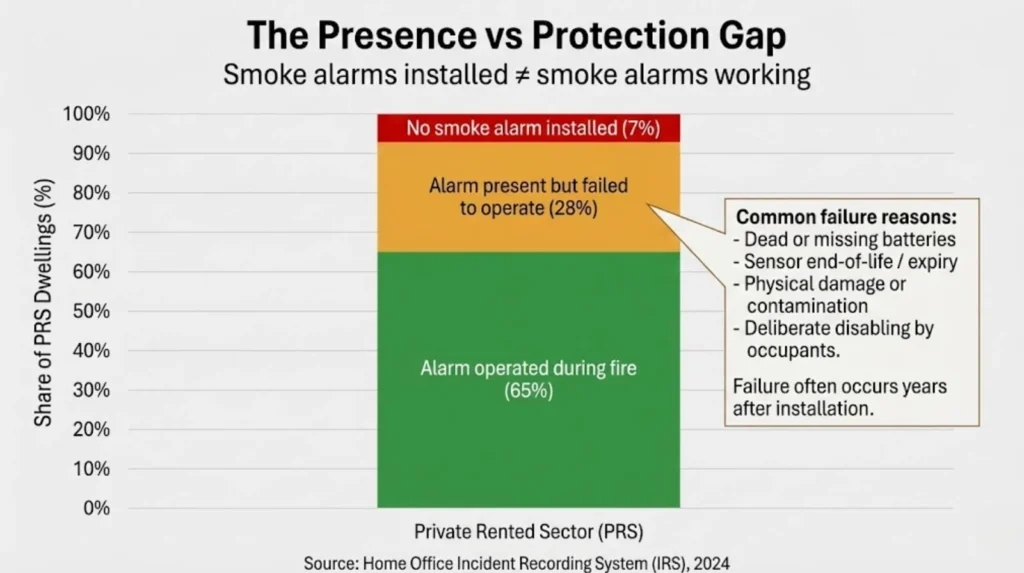
The 2015 regulations require landlords to test alarms at the start of each tenancy. Responsibility for ongoing testing typically falls to tenants, though this isn’t explicitly stated in the law itself. Home Office fire incident data reveals that smoke alarms fail to operate in approximately 28-30% of dwelling fires, often due to missing batteries, expired sensors, or physical damage. 

Most smoke alarms have a 10-year sensor lifespan regardless of battery type. Alarms installed in October 2015 to comply with the new law are reaching expiration now, between 2025 and 2026. The regulations don’t explicitly mandate replacement at the 10-year mark, only that alarms must be “working” at tenancy start. This creates ambiguity: does a 12-year-old alarm with a fresh battery meet the legal requirement? Technically yes, functionally no. 

Electricians working in the rental sector report encountering 2015-era installations that have never been replaced, with landlords unaware that sensor degradation occurs independently of battery life. The “replacement bubble” is here, and many landlords haven’t budgeted for wholesale alarm renewal across their portfolios. 

The Enforcement Reality 

Local housing authorities can issue remedial notices and impose penalties up to £5,000 for non-compliance. In practice, these powers are rarely used. There is no central database of enforcement actions, making national-level assessment impossible, but available evidence suggests councils lack resources for routine inspections. Enforcement is complaint-led, meaning it only occurs when tenants report missing or faulty alarms. 

Vulnerable tenants in insecure housing arrangements, the demographic most at risk from fire and CO poisoning, are least likely to challenge landlords over safety issues. Fear of eviction, language barriers, or simply not knowing their rights creates an enforcement gap that leaves thousands of rental properties technically non-compliant despite the statutory requirement. 

Joshua Jarvis, Placement Manager at Elec Training, highlights the structural problem: 

"The 2015 law only works if properties are visible to local authorities. We place electricians who've worked on unregistered rental properties, sub-lets, informal arrangements, landlords operating below the radar. Those tenants have no recourse. The law created a two-tier system: compliant landlords in the formal market, and an untouched shadow sector where the most vulnerable renters live. Until registration becomes mandatory, statutory requirements only protect people already in relatively secure housing."

Solar PV installer working at height on rooftop installation demonstrating physical demands including panel handling, mounting system installation, and working at height competence beyond electrical skills
Solar PV installation requires substantial physical work at heights 6-30+ meters including panel lifting (15-25kg each), mounting system installation, roof penetration work, and outdoor exposure - often underestimated by electricians expecting primarily electrical tasks

The Pre-2022 CO Gap 

Between 2015 and 2022, carbon monoxide alarms were only required in rooms with solid fuel appliances. Gas boilers, wall heaters, and oil-fired systems were excluded despite contributing significantly to CO poisoning incidents. This left properties with faulty gas appliances unprotected by statutory alarm requirements for seven years. 

Hospital admissions for carbon monoxide poisoning show mild declines over the decade, dropping from an average of 246 per year (2001-2010) to lower levels, but the data is too volatile to attribute changes to the 2015 law specifically. The 2022 amendment closing the gas appliance gap likely had more impact on CO detection than the original 2015 solid-fuel-only requirement. 

The Confounders: Smoking, Grenfell, and Broader Safety Trends

Smoking Decline 

The most significant driver of reduced fire deaths over the past decade has nothing to do with alarm legislation. UK smoking prevalence fell from 19% in 2014 to 12% in 2024, a 7 percentage point drop. Smoking-related fires, particularly those involving upholstered furniture and bedding, are the leading cause of fatal domestic fires. 

Statistical modeling suggests the smoking decline accounts for more harm reduction than alarm installation mandates. This doesn’t mean alarms are ineffective, but it means separating the law’s specific contribution from pre-existing societal trends is statistically difficult without controlled comparisons. 

The Grenfell Effect 

The June 2017 Grenfell Tower fire killed 72 people and triggered a national reckoning on fire safety. The immediate aftermath saw voluntary increases in fire safety awareness and equipment upgrades across all housing tenures, not just private rentals. Fire service data shows a spike in “precautionary” calls and safety checks post-Grenfell that lasted through 2018-2019. 

This complicates evaluation of the 2015 law. Did alarm coverage in private rentals increase between 2015-2017 due to regulatory compliance, or did the 2017-2019 surge driven by Grenfell fear dominate the trend? English Housing Survey data suggests both factors mattered, with steady growth 2015-2017, then acceleration 2017-2019, followed by plateau. 

Building Regulations and Appliance Safety 

The 2010 amendments to building regulations improved fire safety standards for new builds and major renovations, introducing stricter requirements for fire doors, escape routes, and electrical safety. These changes primarily affected new construction, with limited retrofit impact on older rental stock, but they contributed to the overall downward fire incident trend. 

Shifts toward safer appliances also played a role. Declining use of open coal fires, replacement of older gas boilers with modern sealed systems, and increased adoption of electric heating reduced inherent fire and CO risk independently of alarm legislation. 

The 2025 Reality: What We're Left With

Near-Universal Smoke Alarm Coverage (With Caveats) 

Smoke alarm prevalence in English rental properties now sits at 93-96% depending on tenure. The private rented sector caught up with social housing and owner-occupied properties, closing the gap that prompted the 2015 law. This is a genuine achievement. 

The caveat: presence doesn’t guarantee function. Home Office data shows approximately 9-12% of alarms present during fire incidents fail to activate. Causes include dead batteries (still common despite 10-year sealed units), physical damage, poor placement triggering nuisance alarms that lead to deliberate disabling, and sensor expiry. 

Landlords who installed cheap, overly sensitive battery-powered alarms in 2015 to meet minimum compliance often created problems rather than solutions. Kitchenette rentals with smoke alarms positioned too close to cooking areas generate weekly false alarms. Tenants remove batteries within months. The alarm remains visible during inspections, appearing compliant, but provides zero protection. 

Persistent CO Vulnerabilities 

Despite the 2022 expansion to gas and oil appliances, 42% of UK homes still lack carbon monoxide alarms. The private rented sector shows better coverage than owner-occupied properties, but substantial gaps remain. Carbon monoxide poisoning causes approximately 25 deaths annually in England, with hospital admissions significantly underreporting actual incidents due to missed diagnoses. 

The CO alarm adoption curve is roughly 5-7 years behind smoke alarms. It took decades for smoke alarms to achieve near-universal acceptance. Carbon monoxide faces lower public awareness, with many occupants unaware that faulty boilers or blocked flues can produce lethal gas without visible signs. 

The Ongoing Enforcement Deficit 

Ten years into statutory alarm requirements, enforcement remains complaint-led and under-resourced. Local housing authorities issue warnings, remedial notices occasionally surface, but the £5,000 penalty power sits largely unused. National-level enforcement data doesn’t exist in accessible form, preventing systematic evaluation of compliance reality versus reported compliance. 

The shadow private rental sector, estimated at hundreds of thousands of properties operating outside formal registration, remains entirely untouched by the 2015 law. These properties house disproportionately vulnerable tenants, yet face zero statutory oversight. 
Myth versus reality comparison showing training provider marketing claims about quick solar PV installer training contrasted with actual 3.5-4 year electrical qualification requirements plus PV specialization and DC safety realities
Training provider marketing obscures foundation requirement: solar PV installation represents specialization for existing qualified electricians requiring both DC and AC electrical competence, not 3-day entry route for complete beginners

What the Data Can and Cannot Tell Us

Strong Associations 

We can confidently state that smoke alarm coverage in the private rented sector increased post-2015, with English Housing Survey data showing approximately 10 percentage points growth in the targeted tenure. This association is robust and plausibly attributable to the regulatory change. 

We can also state that dwelling fires declined from 40,000 annually (2010-2014) to 27,000 (2024/25), and fire-related fatalities fell from 250-300 to around 270. These are real improvements. 

Weak Causation 

What we cannot prove is direct causation linking the 2015 law to specific lives saved. The fire death decline trajectory began years before 2015 and continued smoothly through the decade without a discernible break point. Confounders including smoking reduction, building regulation updates, the Grenfell safety response, and appliance improvements compete for explanatory credit. 

Statistical methods like difference-in-differences analysis comparing private rentals (targeted by the law) to owner-occupied properties (not targeted) suggest the law had modest positive effects on alarm installation rates, but translating equipment presence into measurable harm reduction remains statistically elusive without randomized controlled data. 

The Near-Miss Problem 

The most significant data gap is the absence of “near-miss” recording. When a carbon monoxide alarm sounds and occupants evacuate before poisoning occurs, or when a smoke alarm provides early warning allowing safe escape before fire service arrival, these events often go unrecorded in national datasets. Fire incident statistics capture attended fires where casualties occur or property damage is significant. The preventive value of alarms, the disasters that didn’t happen, is largely invisible in official statistics. 

Myths vs Reality: 10 Years of Misunderstanding

Myth: The law applies UK-wide. 
Reality: The 2015 regulations apply to England only. Scotland, Wales, and Northern Ireland have separate timelines and requirements. 

Myth: CO alarms were required for gas boilers from 2015. 
Reality: Only solid fuel appliances were covered until October 2022, when the requirement expanded to all combustion appliances including gas and oil. 

Myth: Social housing was always safer. 
Reality: Social housing had no specific CO alarm statutory requirement until the 2022 amendments, despite generally better smoke alarm coverage. 

Myth: The law guarantees safe properties. 
Reality: The law requires minimum equipment. It doesn’t mandate interconnected systems, annual maintenance, or optimal placement. Statutory compliance doesn’t equal comprehensive protection. 

Myth: Enforcement is automatic. 
Reality: Local authorities act on complaints or during inspections. There is no routine checking, and penalties are rarely imposed. 

Myth: Statistics prove the law saved thousands of lives. 
Reality: Fire deaths declined, but smoking reduction, building regulations, and broader safety trends explain much of the improvement. Association is clear, causation is ambiguous. 

Myth: Alarms last forever. 
Reality: Smoke alarm sensors degrade after 10 years. Carbon monoxide alarm sensors typically last 5-7 years. Alarms installed in 2015 need replacement now. 

Myth: Working alarms are guaranteed in all rentals. 
Reality: English Housing Survey data shows 93% coverage in private rentals, meaning 7% still lack smoke alarms. Functionality varies widely even where alarms are present. 

For landlords and electricians working in the rental sector, understanding the gap between statutory minimums and genuine protection matters. The 2015 law established a baseline. Effective fire and CO safety requires going beyond that baseline: interconnected alarms where appropriate, proper placement away from nuisance trigger zones, annual maintenance, and replacement at manufacturer-specified intervals. 

Elec Training provides structured learning on electrical safety compliance for rental properties, covering installation standards, testing procedures, and regulatory requirements. For electricians pursuing the industry benchmark qualification, the ECS Gold Card pathway includes competencies in electrical safety systems. Understanding the broader context of how to become an electrician in the UK helps clarify career routes serving the rental sector’s ongoing safety needs. 

The 2025 Perspective: Qualified Success, Ongoing Vulnerabilities

The 2015 Smoke and Carbon Monoxide Alarm (England) Regulations achieved its core objective: raising equipment provision in the private rented sector to match social housing and owner-occupied properties. Smoke alarm coverage increased approximately 10 percentage points, bringing protection to roughly 1 million additional rental homes. Carbon monoxide awareness improved, though coverage remains lower at around 60% in affected properties pre-2022 expansion. 

The law succeeded by making safety default rather than discretionary. Landlords who previously treated alarms as optional extras now include them in standard compliance checklists. The cultural shift toward viewing tenant safety as baseline landlord responsibility represents genuine progress. 

But a decade of data also reveals persistent gaps. Maintenance remains inconsistent, with alarms frequently non-functional despite being physically present. Enforcement is under-resourced and complaint-dependent, leaving vulnerable tenants in shadow rental markets unprotected. The regulatory focus on equipment installation didn’t adequately address ongoing functionality, creating a compliance system where landlords tick boxes at tenancy start without ensuring continuous protection. 

The broader fire safety landscape shifted dramatically between 2015 and 2025. Smoking prevalence fell sharply, Grenfell triggered sector-wide safety improvements, building regulations tightened, and appliance standards improved. Disentangling the 2015 law’s specific contribution from these overlapping trends is statistically difficult. What we can say with confidence is that equipment provision increased in the targeted sector, alarm presence in rental properties no longer lags behind other tenures, and fire deaths continued declining along a trajectory established before the law took effect. 

The 2022 amendments extending CO requirements to gas appliances and social housing suggest regulators recognized gaps in the original 2015 framework. Whether those amendments deliver measurable harm reduction beyond equipment installation remains an open question for the next evaluation cycle. 

Ten years on, the verdict is qualified success on equipment saturation, inconclusive on direct harm reduction, and ongoing failure on enforcement and maintenance oversight. The law established a minimum standard. Whether that minimum is sufficient depends on whether we measure compliance or actual protection. 

References

Tier 1 (Official Legislation, Government Statistics, National Datasets) 

Tier 2 (Authoritative Institutions and Peer-Reviewed Research) 

Tier 3 (Market Signals, Industry Reports – Labelled) 

Note on Accuracy and Updates

Last reviewed: 9 January 2026. This retrospective analysis reflects data through 2024/25, incorporating Home Office Incident Reporting System statistics, English Housing Survey annual reports (2010-2024), ONS mortality records, NHS Hospital Episode Statistics, and peer-reviewed academic literature on alarm effectiveness. The 2022 amendments extending CO alarm requirements to all combustion appliances and social housing are noted separately as they represent policy evolution beyond the 2015 baseline being evaluated. Enforcement data remains fragmented due to lack of centralised local authority reporting. Fire incident trends are subject to reporting variations, particularly during COVID-19 (2020-2022). Always verify current legal requirements with official government guidance when making compliance decisions. 

Learners are Studying level 2 Electrician Course

Guaranteed Work Placement for Your NVQ

No experience needed. Get started Now.

Prefer to call? Tap here

Learners are Studying level 2 Electrician Course

Guaranteed Work Placement for Your NVQ

No experience needed. Get started Now.

Prefer to call? Tap here

Learners are Studying level 2 Electrician Course

Guaranteed Work Placement for Your NVQ

No experience needed. Get started Now.

Prefer to call? Tap here

Learners are Studying level 2 Electrician Course

Guaranteed Work Placement for Your NVQ

No experience needed. Get started Now.

Prefer to call? Tap here

Enquire Now for Course Information