

Realistic Earnings for New Electricians in the First 12 Months: Setting Proper Expectations Beyond Training Provider Marketing

- Technical review: Thomas Jevons (Head of Training, 20+ years)
- Employability review: Joshua Jarvis (Placement Manager)
- Editorial review: Jessica Gilbert (Marketing Editorial Team)
- Last reviewed:
- Changes: Initial publication examining realistic first-year electrician earnings, showing £24,000-£28,000 most common PAYE gross (not £40,000+ marketing claims), improver phase 3-6 months at £12-£17/hr before full electrician rates, Gold Card processing delays costing £2,000-£3,000, three-phase strategic progression framework

The question “how much does an electrician make” in their first 12 months post-qualification requires honest answer that contradicts training provider marketing: most newly qualified electricians earn £24,000-£28,000 gross annually on PAYE during their first year, not the £38,000-£45,000 figures often cited when recruitment materials reference “qualified electrician salaries.” This £10,000-£20,000 gap between expectation and reality creates profound disappointment for new starters who discover their Level 3 NVQ Diploma, 18th Edition, and AM2 assessment represent licenses to learn rather than tickets to immediate high earnings.
The ONS 2025 median electrician salary (£38,760) aggregates electricians across all experience levels—5 years qualified, 15 years qualified, 25 years qualified—into single figure that bears little relationship to genuinely new starter outcomes. When broken down by experience, newly qualified electricians (0-1 years post-qualification) typically fall into 10th-25th percentile of electrician earnings distribution, earning £26,000-£31,000 in their first full year with the lower end (£20,000-£24,000) reflecting improver status and upper end (£28,000-£32,000) incorporating regular overtime or London location premiums.
The “improver phase” represents perhaps the most misunderstood aspect of first-year electrician earnings. Despite holding all formal qualifications (Level 3, 18th Edition, AM2), most new electricians spend their first 3-6 months working at improver rates (£12-£17/hour) rather than full electrician rates (£19-£21/hour) because they require constant supervision, work slowly, and haven’t developed the commercial speed that makes them profitable to employers. A senior electrician earning £24/hour who must check your work every 90 minutes, answer continuous questions, and fix mistakes loses approximately 25% productivity—£6/hour opportunity cost. Employers price this supervision burden into new starter rates, creating the improver wage gap.
Gold ECS Card processing delays compound first-year earnings challenges. Major construction sites (HS2, Hinkley Point, large commercial projects, data centres) won’t permit access without the physical Gold Card proving JIB approval, not just qualification certificates. Card processing takes 4-8 weeks after submitting AM2 results and NVQ portfolio. During this window, newly qualified electricians work at mate rates (£10-£13/hour) despite completing all qualifications, potentially losing £2,000-£3,000 in earnings because they can’t access higher-paying sites requiring card verification for entry.
The contractor/CIS route that appears lucrative (£180-£220 day rates suggesting £40,000-£48,000 annually) rarely works for genuinely new electricians. Contractors need proven site-readiness, references, and professional networks to secure consistent work. New starters lack all three. The reality involves 3-4 weeks work followed by 6-10 weeks gaps desperately searching for next contract, with net income after downtime, 20% CIS deduction, self-funded holidays (£3,000-£4,000 annual value), and tool/insurance costs (£1,500-£2,500) often falling below equivalent PAYE positions offering £26,000-£28,000 with stability.
Location impacts first-year earnings more powerfully than sector choice or employer type. A commercial electrician in Newcastle earning £27,000-£29,000 first year earns less than domestic electrician in London suburb at £32,000-£35,000. London and South East command 20-30% regional premiums over Midlands and Northern regions, creating £6,000-£10,000 annual differences that dwarf the domestic versus commercial sector gap (typically £2,000-£4,000 within same region). Geographic arbitrage—relocating to London for 12-18 months—delivers faster earnings growth than sector agonising for electricians without location constraints.
The complete breakdown of electrician earnings by experience level and career stage reveals strategic three-phase approach to first 12 months: Months 1-3 (survival—proving reliability, learning site routines, accepting £24,000-£26,000 annualised rate), Months 4-8 (acceleration—overtime access opening, supervision needs reducing, £28,000-£32,000 annualised with pay increase), Months 9-12 (positioning—negotiating raise or moving to higher-paying role with references earned, £32,000-£36,000 potential by year two entry). Electricians treating first year as three distinct strategic phases rather than passive waiting period consistently achieve £34,000-£38,000 by end of year two, while those remaining at initial £26,000 role throughout year one often plateau at £30,000-£32,000 by year two.
Understanding realistic first-year earnings requires examining improver phase duration and rates, Gold Card processing impacts, PAYE versus contractor net outcomes for new starters, what actually drives earnings progression months 1-12 (reliability demonstrations, speed development, overtime access unlocking, supervision burden reduction), location premium quantification, sector variation within experience bands, and worked examples showing how different positioning choices create £8,000-£14,000 annual outcome differences despite identical qualification levels.
This article analyses job board data for “newly qualified electrician” and “improver” listings (150+ postings Q4 2024-Q1 2025), JIB apprentice and improver wage structures, ONS ASHE percentile distributions, National Careers Service starter salary guidance, placement agency feedback on actual first-year outcomes, and trade forum discussions where new electricians report real earnings versus expectations. The analysis deliberately counters training provider marketing exaggeration to establish realistic planning benchmarks for career changers and young people considering electrical training investment.
The Improver Phase: Why You Don't Earn Electrician Rates Immediately
Despite completing Level 3 NVQ Diploma in Installing Electrotechnical Systems and Equipment, passing 18th Edition BS 7671, and successfully completing AM2 practical assessment, newly qualified electricians typically spend 3-6 months at improver rates rather than full electrician wages. This improver phase reflects the gap between qualification competency (demonstrating knowledge in controlled assessment conditions) and commercial competency (working at profitable speed in real site environments).
Improver Rate Structure
Typical Improver Hourly Rates (2025):
Entry improver (months 1-3): £11-£14/hour
Developing improver (months 3-6): £13-£17/hour
Transitioning to electrician (months 6-9): £15-£19/hour
Full electrician rate: £19-£21/hour (Approved Electrician £20-£23/hour)
Annual Earnings Impact:
6 months improver at £13/hour (37.5 hours weekly) = £12,675
6 months electrician at £19/hour (37.5 hours weekly) = £18,525
First year total: £31,200 gross (blended rate £16/hour)
Improver rates aren’t universal—some employers (particularly small domestic operations) might pay full electrician rates immediately if supervision available, while others (large commercial contractors) enforce strict improver grading for 6-9 months regardless of prior experience. JIB-regulated sites typically use formal Electrician/Approved Electrician grading where improver status represents pre-grading phase requiring proven on-site competency before regrading.
Why Supervision Burden Justifies Lower Rates
From employer economic perspective, newly qualified electrician requiring constant supervision creates hidden costs:
Supervision Cost Calculation:
Senior electrician rate: £24/hour
New starter rate: £14/hour
Supervision time: Senior electrician checks work every 90-120 minutes, answers questions throughout day, fixes mistakes = approximately 25% of senior’s productive time
Opportunity cost: £6/hour in lost senior productivity
Effective cost of new starter: £14 (direct) + £6 (opportunity cost) = £20/hour
This £20/hour effective cost explains why employers paying improver £14/hour aren’t being generous—they’re pricing in the supervision burden that makes new starters significantly more expensive than hourly rate suggests. As supervision needs decrease (months 4-6), the effective cost drops toward the direct hourly rate, justifying pay increases.
What Extends Improver Phase vs Shortens It
Factors Extending Improver Status (6-9+ months):
Slow working speed (tasks taking 2-3x estimated time)
Frequent mistakes requiring rework
Excessive questioning (asking same questions repeatedly)
Lack of tool familiarity (searching through toolbox, unfamiliar with power tool operation)
Safety incidents or near-misses
Paperwork incompetence (can’t complete basic documentation)
Attendance/punctuality issues
Factors Shortening Improver Status (3-4 months):
Fast skill acquisition (demonstrating increasing speed week-over-week)
Proactive learning (watching experienced electricians, asking smart questions in batches)
Tool efficiency (organised toolbox, knows which tool for which task)
Documentation competence (accurately completes test sheets, cable schedules)
Reliability (07:30 arrival every morning, full days, willing for overtime)
Safety consciousness (follows isolation procedures without reminders)
The difference between 3-month improver phase and 9-month improver phase represents approximately £6,000-£9,000 in first-year earnings (3 months × £6/hour differential × 160 hours = £2,880 per quarter, compounded across quarters). Electricians who proactively demonstrate competency progression accelerate through improver phase faster, accessing higher earnings sooner.
Gold ECS Card Processing: The £2,000-£3,000 Earnings Gap
Newly qualified electricians face critical but often overlooked earnings barrier: ECS (Electrotechnical Certification Scheme) Gold Card processing delays that prevent access to higher-paying major construction sites for 4-8 weeks after qualification completion.
Thomas Jevons, Head of Training with 20+ years on the tools, explains:
"You're technically qualified but effectively a mate until you hold that Gold ECS card. Major sites—HS2, Hinkley Point, data centres, large commercial projects—won't let you through the gate without it. The card proves you're JIB-approved, not just college-qualified. Processing takes 4-8 weeks after you submit AM2 results and NVQ portfolio. During that window, you're working at mate rates (£10-£13/hour) even though you've completed all qualifications. I've seen newly qualified electricians lose £2,000-£3,000 in potential earnings during that card processing period because they couldn't access higher-paying sites. Get your application submitted the day you pass AM2, not weeks later."
Thomas Jevons, Head of Training
Card Processing Timeline and Requirements
ECS Gold Card Application Process:
Complete Level 3 NVQ Diploma (2357 or 5357)
Pass AM2/AM2E practical assessment
Pass 18th Edition BS 7671 exam
Submit online application via ECS website
Provide proof of qualifications (certificates, awarding body verification)
Pay application fee (£40-£50 typically)
Wait for verification and card production: 4-8 weeks average
During this 4-8 week window, newly qualified electricians cannot access major construction sites requiring ECS card verification for entry. They’re relegated to smaller sites, domestic work, or maintenance roles that don’t enforce card requirements—typically paying £4-£8/hour less than large commercial/industrial projects.
Earnings Impact Calculation:
Mate/improver rate (no card): £12/hour
Electrician rate (with card): £18/hour
Differential: £6/hour
4 weeks delay: 4 weeks × 40 hours × £6 = £960 lost
8 weeks delay: 8 weeks × 40 hours × £6 = £1,920 lost
Plus missed overtime opportunities: £500-£1,000 additional
Total potential first-year earnings loss from card delay: £1,500-£3,000 depending on duration and overtime access.
Strategic Application Timing
Optimal Strategy: Submit ECS Gold Card application the same week you pass AM2 assessment, not waiting for physical certificates to arrive. ECS can verify qualifications directly with awarding bodies (City & Guilds, Pearson) using candidate numbers, accelerating processing. Electricians who delay application 3-4 weeks waiting for certificates unnecessarily extend the mate-rate working period.
While Waiting for Card:
Accept any electrical work offered (maintains income, builds experience)
Focus on domestic/small commercial roles not requiring card
Use period to complete additional training (EV charging, solar PV familiarisation)
Network with contractors who’ll want you when card arrives
Ensure contact details current so card isn’t returned/delayed
The Gold Card barrier particularly impacts electricians in high-cost regions where large projects dominate work availability. London newly qualified electrician without card faces 6-8 weeks working domestic jobs at £14-£16/hour when equivalent card-holding peers access commercial projects at £22-£26/hour—a £6,000-£8,000 annualised difference that significantly depresses first-year total earnings.
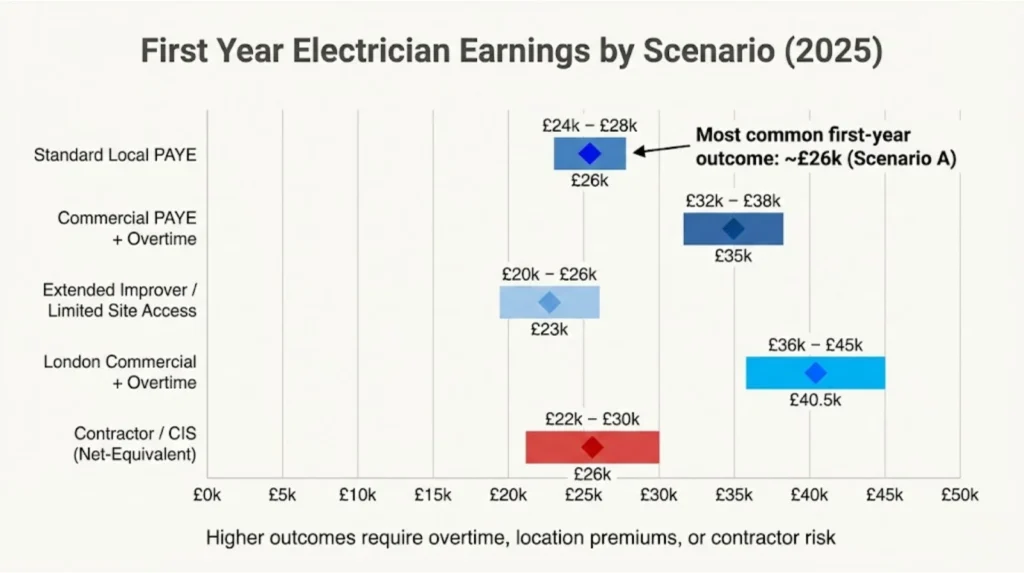
Realistic First-Year Gross Annual Earnings by Scenario
First-year electrician earnings vary dramatically based on role type, location, overtime access, and employer characteristics. Understanding realistic ranges for specific scenarios prevents disappointment and enables strategic positioning.
Scenario A: Standard Local PAYE (Most Common)
Profile: Newly qualified electrician, small-to-medium employer, local work (daily return home), minimal overtime
Typical Characteristics:
Location: Regional (Midlands, North, Wales, Scotland outside major cities)
Employer: Local electrical contractor, facilities maintenance company
Hours: 37.5-40 hours weekly standard
Overtime: 0-3 hours weekly average (not guaranteed)
Improver phase: 4-6 months at £12-£14/hour
Electrician phase: Months 6-12 at £16-£19/hour
Earnings Calculation:
Months 1-6: 26 weeks × 40 hours × £13/hour = £13,520
Months 7-12: 26 weeks × 40 hours × £17.50/hour = £18,200
Minimal overtime: 52 weeks × 2 hours × £26.25/hour (1.5x) = £2,730
Gross annual total: £34,450
Realistic range: £24,000-£28,000 without overtime, £28,000-£34,000 with modest overtime
This represents most common first-year outcome, particularly for career changers and young people without industry connections who secure first role through standard job applications.
Scenario B: Commercial PAYE with Regular Overtime
Profile: Newly qualified electrician, large commercial contractor, structured progression, consistent overtime
Typical Characteristics:
Location: Any region, but more common South East/urban areas
Employer: Large commercial electrical contractor (50+ employees)
Hours: 40 hours weekly standard + 8-12 hours overtime weekly
Overtime: Consistent (project-driven, structured opportunity)
Improver phase: 3-4 months (faster in structured environment)
Progression: Clear grading system, pay increases at milestones
Earnings Calculation:
Months 1-4: 17 weeks × 40 hours × £14/hour = £9,520
Months 5-12: 35 weeks × 40 hours × £18/hour = £25,200
Overtime (months 5-12): 35 weeks × 10 hours × £27/hour (1.5x) = £9,450
Gross annual total: £44,170
Realistic range: £32,000-£38,000
This scenario represents best-case first-year outcome for electricians securing roles with established contractors offering structured career progression and reliable overtime access.
Scenario C: Improver Status Extended (Lower Outcome)
Profile: Slower progression, extended improver phase, limited overtime, domestic focus
Typical Characteristics:
Location: Any region, typically domestic-focused employers
Employer: One-person band or very small contractor
Hours: 37.5 hours weekly (domestic work typically shorter standard hours)
Overtime: Rare (domestic emergencies occasional)
Improver phase: 6-9 months (slower skill development environment)
Pay increases: Infrequent, needs to be negotiated
Earnings Calculation:
Months 1-9: 39 weeks × 37.5 hours × £12.50/hour = £18,281
Months 10-12: 13 weeks × 37.5 hours × £16/hour = £7,800
Minimal overtime: 52 weeks × 1 hour × £24/hour (1.5x) = £1,248
Gross annual total: £27,329
Realistic range: £20,000-£26,000
This represents lower outcome affecting electricians who struggle with skill development speed, face limited progression opportunities with small employers, or remain in domestic sector without accessing commercial/industrial premium rates.
Scenario D: London Commercial with Overtime (Highest PAYE)
Profile: Newly qualified electrician, London commercial project, regional premium plus overtime
Typical Characteristics:
Location: London (Zone 3-6 typically for affordable living)
Employer: Large commercial contractor working London projects
Hours: 40 hours weekly + 10-15 hours overtime weekly
London weighting: £3-£5/hour premium over regional equivalents
Improver phase: 3-4 months (large projects need workers quickly)
Additional: Travel time often paid for distant sites
Earnings Calculation:
Months 1-4: 17 weeks × 40 hours × £17/hour (London improver) = £11,560
Months 5-12: 35 weeks × 40 hours × £23/hour (London electrician) = £32,200
Overtime (months 5-12): 35 weeks × 12 hours × £34.50/hour (1.5x) = £14,490
Gross annual total: £58,250
Realistic range: £36,000-£45,000 depending on overtime consistency
This represents highest first-year PAYE outcome, achievable for electricians willing to relocate to London, accept longer commutes, and work consistent overtime. The £58,000 upper bound assumes near-maximum overtime throughout months 5-12, which isn’t universal but demonstrates ceiling for exceptionally positioned first-year electricians.
Scenario E: Contractor/CIS (Usually Lower Net Than Appears)
Profile: Newly qualified attempting CIS contractor route, facing downtime and costs
Typical Characteristics:
Day rate: £150-£200 (lower than experienced contractor rates)
Weeks worked: 35-40 weeks annually (12-17 weeks downtime/holiday)
Costs: Tools/insurance £1,500, fuel/parking £1,800, accountant £600
CIS deduction: 20% gross
Holiday: Self-funded (6 weeks unpaid)
Earnings Calculation:
38 weeks × 5 days × £175/day = £33,250 gross
Less CIS 20%: £6,650
Less costs: £3,900
Net after CIS and costs: £22,700
Add back self-funded holiday value for comparison: £22,700 + £4,000 = £26,700 equivalent gross
Realistic range: £22,000-£30,000 net equivalent
This contractor scenario demonstrates why first-year CIS route often delivers lower net outcomes than PAYE despite appearing higher on advertised day rates. Most placement managers discourage genuinely new electricians from contractor route without proven site experience and professional network providing consistent work.
Three-Phase Strategic Framework for First 12 Months
Rather than treating first year as single static period, successful electricians approach it as three distinct strategic phases with different objectives and earning expectations.
Joshua Jarvis, Placement Manager at Elec Training, explains:
"We advise trainees to think of first 12 months in three phases, not one flat year. Months 1-3: survival mode—proving reliability, learning site routines, accepting you'll earn £24,000-£26,000 annualised rate while you're essentially still training. Months 4-8: acceleration—overtime access opening up, supervision needs reducing, maybe a £1-£2/hour pay increase if you've demonstrated value, pushing toward £28,000-£32,000 annualised. Months 9-12: positioning—using experience to either negotiate raise with current employer (threatening to leave can work if you've been good), or moving to higher-paying role now you have references and proven site time. That positioning phase might deliver £32,000-£36,000 for remainder of year two. The electricians who approach it as three distinct phases with different strategic focuses tend to hit £34,000-£38,000 by end of year two, while those who stay passive at the first role earning £26,000 throughout year one often plateau at £30,000-£32,000 by year two."
Joshua Jarvis, Placement Manager
Phase 1: Survival Mode (Months 1-3)
Primary Objective: Prove reliability and avoid getting fired during probation period
Expected Earnings: £24,000-£26,000 annualised (£12-£14/hour improver rates)
Key Focus Areas:
Attendance perfection: 07:30 arrival every single morning without exception
Safety compliance: Follow isolation procedures, wear PPE correctly, never take shortcuts
Question quality: Ask smart questions in batches rather than constantly interrupting
Tool competency: Organised toolbox, know which tool for which task, maintain equipment
Attitude: Willing for any task (including cleanup, materials handling, site tidying)
Learning: Watch experienced electricians, take notes, study evening if needed
Strategic Actions:
Submit ECS Gold Card application immediately (if not already processed)
Build relationships with site supervisors and experienced electricians
Document all work (photos, notes) for future reference
Identify skills gaps (testing, fault-finding) for targeted learning
Accept you’re in training mode, not earning mode yet
What Not to Do:
Complain about pay (everyone starts low)
Refuse tasks as “beneath you” because you’re qualified
Argue with supervisors about methods
Miss days without excellent reasons
Ask for pay rises before demonstrating value
Months 1-3 represent investment period. You’re earning below your potential capability but building foundation for acceleration phase. Electricians who resist this reality—insisting they deserve full electrician rates immediately because they passed AM2—often get fired or remain stuck at improver rates longer because they haven’t demonstrated the reliability employers require before investing in progression.
Phase 2: Acceleration (Months 4-8)
Primary Objective: Reduce supervision burden, access overtime, demonstrate increasing competency
Expected Earnings: £28,000-£32,000 annualised (£15-£18/hour with pay increase, plus overtime access)
Key Focus Areas:
Speed development: Complete tasks progressively faster week-over-week
Independence: Need supervisor checks every 3-4 hours instead of every 90 minutes
Overtime eligibility: Prove reliability enough to be offered Saturday/weekend work
Paperwork competency: Accurately complete test sheets, cable schedules without help
Peer recognition: Other electricians requesting you specifically on their teams
Pay negotiation: Around month 5-6, document achievements and request £1-£2/hour increase
Strategic Actions:
Track your improving speed (how long tasks take now vs month 2)
Volunteer for overtime when offered (even if inconvenient initially)
Begin studying 2391 Testing and Inspection material independently
Request exposure to testing work when qualified electricians doing it
Build portfolio of completed work (photos, documentation)
What Unlocks in This Phase:
Overtime invitations (£3,000-£5,000 additional annually)
Tasks you can complete independently (reduces supervision burden)
Trust for more complex work (distribution boards, testing assistance)
Pay increase discussion becomes reasonable (around month 6)
References from supervisors for future job moves
Months 4-8 represent earnings inflection point. Electricians who actively demonstrated competency in months 1-3 see supervision needs decrease dramatically, making them profitable enough that employers increase pay to retain them. This phase separates electricians who’ll hit £34,000-£38,000 by year two from those who plateau at £30,000-£32,000.
Phase 3: Positioning (Months 9-12)
Primary Objective: Either negotiate significant raise with current employer or position for move to higher-paying role
Expected Earnings: £32,000-£36,000 annualised (£17-£20/hour, consistent overtime, possible role upgrade)
Key Focus Areas:
Market research: Know what other employers pay for your experience level
Leverage building: Develop skills competitors value (testing, fault-finding, specific systems)
Reference securing: Ensure supervisors would provide strong references
Network expansion: Connect with other contractors, join professional groups
Pay negotiation: Around month 10-11, either request £2-£3/hour raise or begin job searching
Strategic Actions:
Option A (Stay): Document your impact—tasks you complete independently, overtime worked reliably, zero incidents, others requesting you—and request raise to £18-£20/hour. Mention you’ve been approached by other employers (even if not true) and would prefer staying if compensation reflects market rate.
Option B (Move): Apply for Approved Electrician roles at larger contractors, emphasising your proven 12 months site experience, reliability record, and willingness for overtime. Target £20-£22/hour starting rate with new employer.
What Positioning Phase Achieves:
£32,000-£36,000 earnings for final months of year one (annualised rate for year two entry)
Strong references for future job moves
Clear career trajectory (Approved Electrician path, specialist areas identified)
Network of industry contacts providing future opportunities
Negotiation experience for future pay discussions
Months 9-12 determine whether you enter year two earning £34,000-£38,000 or remain stuck at £28,000-£30,000. Electricians who passively accept original role terms throughout year one, never negotiating or positioning for moves, lose £6,000-£10,000 annually compared to those who strategically leverage proven performance for increases.
What Drives First-Year Earnings: The Actual Factors
Understanding what employers actually value helps new electricians focus efforts on earnings-driving behaviors rather than wasting time on irrelevant activities.
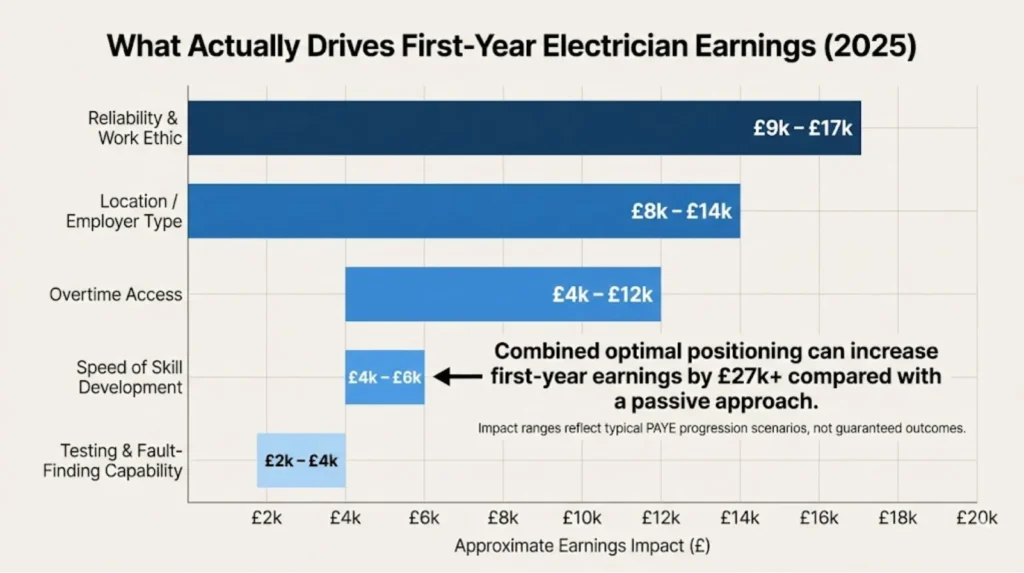
Factor 1: Reliability (Highest Impact, Months 1-6)
Reliability represents single most important factor determining whether new electricians progress past improver phase quickly or remain stuck. Employers define reliability as:
Core Reliability Behaviors:
Punctuality: On-site 07:30 every morning (not 07:45, not “just 10 minutes late”)
Attendance: Full weeks worked, minimal sick days (save for genuine illness)
Consistency: Same performance quality every day, not excellent Monday then terrible Friday
Communication: Inform employer immediately about any potential absence/lateness
Follow-through: Complete assigned tasks, don’t leave things half-done
Why Reliability Matters So Much: Construction projects run on tight schedules with coordinated trades. One electrician arriving late delays entire team. New electricians absent on key days (inspections, deadlines) create chaos requiring expensive rescheduling. Employers need absolute confidence you’ll show up every day doing consistent work.
Earnings Impact: Reliable new electricians receive overtime invitations around month 4-5 (adding £3,000-£5,000 annually), pay increases around month 6-7 (adding £2,000-£4,000 annually), and positive references enabling job moves (adding £4,000-£8,000 annually via better positions). Unreliable electricians remain at initial improver rates throughout year one, missing £9,000-£17,000 in potential earnings.
Factor 2: Speed Development (High Impact, Months 3-9)
Commercial speed—completing tasks fast enough that jobs remain profitable—separates electricians who progress to full rates quickly from those stuck at improver wages long-term.
Speed Benchmarks:
Month 1: Task takes 3-4x estimated time (constantly asking questions, looking things up)
Month 3: Task takes 2x estimated time (knows basics but still slow methodical)
Month 6: Task takes 1.5x estimated time (competent but not yet efficient)
Month 9: Task approaches estimated time (can complete standard tasks within pricing)
Month 12+: Task at or under estimated time (profitable worker)
How to Accelerate Speed Development:
Study installation methods in downtime (YouTube electrical tutorials, manufacturer guides)
Practice terminations at home (buy practice terminals, crimp connectors)
Organise tools logically (reduces time searching through toolbox)
Watch experienced electricians’ techniques (how they prepare cables, route conduit efficiently)
Request feedback on your speed (ask supervisor “how can I complete this faster?”)
Earnings Impact: Electricians reaching profitable speed by month 6 (rather than month 9-12) earn approximately £4,000-£6,000 more first year because they’re worth full electrician rates sooner and employers increase pay to retain productive workers.
Factor 3: Overtime Access (Moderate-High Impact, Months 4-12)
Overtime availability transforms £26,000 base salary into £32,000-£36,000 total earnings, but new electricians don’t receive overtime invitations immediately—they must earn them.
Overtime Eligibility Progression:
Months 1-3: No overtime (still in probation, reliability unproven)
Months 4-6: Occasional overtime (1-2 Saturdays monthly, emergency call-outs)
Months 7-9: Regular overtime (weekly Saturday work, evening shifts as needed)
Months 10-12: Consistent overtime (established as reliable, always invited)
Overtime Earnings Addition:
5 hours weekly overtime at 1.5x (£15 base → £22.50 OT): 52 weeks × 5 hours × £22.50 = £5,850 additional
10 hours weekly overtime at 1.5x: 52 weeks × 10 hours × £22.50 = £11,700 additional
How to Access Overtime:
Never refuse first several overtime invitations (even if inconvenient)
Complete overtime work to same standard as regular hours
Volunteer for unpopular shifts (Sunday mornings, public holidays)
Communicate availability clearly (“always available weekends if needed”)
Don’t abuse overtime (coming in tired Monday after working 70-hour week)
Factor 4: Testing and Inspection Capability (Moderate Impact, Months 6-12)
Electricians who can competently assist with testing and inspection work access £2-£4/hour premiums even before formally gaining 2391 qualification because testing competence is scarce among newly qualified workers.
Testing Skills Employers Value:
Setting up multifunction testers correctly
Accurately recording continuity readings (R1+R2, Zs)
Understanding test sequences (safe isolation → continuity → insulation resistance → polarity → earth fault loop impedance)
Completing test certificates legibly and accurately
Explaining test results to supervisors/clients
How to Develop Testing Capability:
Study 2391 Testing and Inspection material during NVQ/AM2 prep
Request to shadow qualified electrician during testing work
Practice with test equipment during quiet periods
Learn to fill out Electrical Installation Certificates properly
Understand common failure causes and remedies
Earnings Impact: Electricians demonstrating testing competence months 6-9 might receive £17/hour → £19/hour increases (£4,000 annual additional), and qualify for Approved Electrician roles (£20-£22/hour) within 12-15 months rather than 24-36 months typical progression.
Factor 5: Location and Employer Type (High Impact, One-Time Decision)
Where you work and who you work for drives first-year earnings more than qualification depth or work ethic because structural factors create £8,000-£14,000 outcome differences.
Location Earning Differentials:
London: £3-£5/hour premium over regional baselines = £6,000-£10,000 annually
South East (excluding London): £2-£3/hour premium = £4,000-£6,000 annually
Major cities (Manchester, Birmingham, Glasgow, Edinburgh): £1-£2/hour premium = £2,000-£4,000 annually
Regional/rural: Baseline rates
Employer Type Earning Differentials:
Large commercial contractors (50+ employees): Structured progression, consistent overtime = £32,000-£38,000 first year potential
Medium commercial/industrial (10-50 employees): Variable progression, moderate overtime = £28,000-£34,000 first year
Small contractors (2-10 employees): Slow progression, limited overtime = £24,000-£30,000 first year
Domestic sole traders: Lowest progression, rare overtime = £22,000-£28,000 first year
The location and employer type decision happens once at career start but impacts entire first year. Electrician choosing London large commercial contractor earns £36,000-£42,000 first year. Equivalent electrician choosing regional small domestic contractor earns £24,000-£28,000 first year—£12,000-£14,000 difference from single positioning decision.
PAYE vs Contractor Reality for First-Year Electricians
Training providers and online forums frequently promote contractor/CIS route as superior earnings path, but this advice rarely applies successfully to genuinely new electricians lacking site experience and professional networks.
Why Contractor Route Rarely Works Year One
Contractor Requirements New Electricians Typically Lack:
1. Proven Site-Readiness: Contractors hire electricians they trust to work independently without supervision. They can’t afford supervision burden that new starters require. Without 6-12 months proven site experience and strong references, securing consistent contractor work approaches impossible.
2. Professional Network: Most contractor work comes through word-of-mouth, previous employer relationships, and industry connections. New electricians haven’t built these networks yet. Cold-applying for contractor positions rarely succeeds.
3. Tool and Equipment Investment: Contractors provide their own tools (£2,000-£4,000 initial investment for quality kit), test equipment (£800-£1,500), transport (van or reliable vehicle), and insurance (£400-£800 annually). New electricians often lack this capital.
4. Financial Buffer: Contractors face 4-8 week payment delays, 8-16 weeks annual downtime between contracts, and irregular cashflow. This requires £5,000-£8,000 emergency fund. New electricians typically don’t have these savings.
5. Business Administration Capability: Contractors manage invoicing, tax returns, insurance renewals, tool maintenance, vehicle servicing, and professional development independently. New electricians lack this business management experience.
Worked Comparison: PAYE vs Contractor Net Outcomes
Scenario: New Electrician First Year
PAYE Route:
Base salary: £28,000 gross
Employer pension (5%): £1,400 additional
Holiday pay: 28 days (5.6 weeks) included = £3,000 value
Sick pay: Statutory minimum provided = £500 potential value
Tools: Provided by employer = £1,000 annual value
Total employment package: £33,900
Net take-home: £22,400 (after tax/NI)
Effective annual value: £27,900 (including pension/holiday value)
Contractor/CIS Route (Optimistic Scenario):
Day rate: £180 (lower than experienced contractors)
Days worked: 190 (38 weeks × 5 days, allowing 14 weeks downtime/holiday)
Gross: £34,200
Less 20% CIS: £6,840
Less tools/insurance/fuel/accountant: £4,200
Net after CIS and costs: £23,160
Less self-funded holiday cost: £3,500 (7 weeks unpaid)
Effective annual value: £19,660
The contractor route showing £34,200 gross appears superior to £28,000 PAYE gross, but after accounting for CIS deduction, self-funded costs, holiday value, and downtime reality, the contractor nets £8,240 less than PAYE equivalent.
Reality Check: The £180/day contractor rate assumed above is optimistic for genuinely new electricians. Many face £150-£160/day rates or spend significantly more than 14 weeks searching for work (20-25 weeks downtime common for new contractors without networks), further depressing actual earnings.
When Contractor Route Becomes Viable
Contractor/CIS path makes financial sense after:
12-24 months proven site experience (references from multiple employers)
Professional network providing consistent work opportunities
£5,000-£8,000 emergency fund (covering cashflow gaps)
Tool and equipment investment already made (£3,000-£5,000 total)
Understanding of business administration (invoicing, tax, insurance management)
Day rates increasing to £220-£280 (reflecting experience and reduced supervision needs)
At that point, contractor gross £50,000-£65,000 might net £38,000-£48,000 after costs, representing meaningful premium over PAYE £35,000-£42,000 positions for equivalent experience levels.
Common First-Year Earnings Myths
Myth 1: “I’ll Earn £40,000+ Immediately After Qualifying”
Reality: Median first-year earnings fall £24,000-£28,000 PAYE, with £32,000-£38,000 achievable only with London location, consistent overtime, and rapid progression. The £40,000+ figure references experienced electrician median (5-15 years qualified), not new starters.
Myth 2: “Gold Card Means Instant High Pay”
Reality: Gold Card enables site access to higher-paying projects but doesn’t guarantee high earnings. You still need to demonstrate commercial speed, reliability, and competency before employers pay full electrician rates. The card is necessary but not sufficient.
Myth 3: “Contractor Work Always Pays More”
Reality: First-year contractors typically net less than PAYE equivalents after accounting for downtime (12-20 weeks unpaid), CIS deduction (20%), self-funded costs (tools £1,500, insurance £600, fuel £1,800, accountant £600), and holiday value (£3,000-£4,000). Contractor advantage emerges years 2-5 after building networks and raising day rates.
Myth 4: “Domestic Work Pays More Than Commercial”
Reality: Commercial electrical work consistently pays £2-£4/hour more than domestic equivalents at every experience level. Domestic electricians might charge higher hourly billing rates to customers (£45-£60/hour), but their effective hourly rate after unpaid quoting time, materials collection, customer liaison, and travel averages lower than commercial PAYE £18-£22/hour with consistent 40-hour weeks.
Myth 5: “I Don’t Need Overtime to Earn Well”
Reality: First-year base salaries (£24,000-£28,000) provide modest living standards. Overtime represents primary route to £32,000-£36,000 earnings that enable saving, housing deposits, or financial stability. Refusing overtime in months 4-12 costs £4,000-£8,000 annually.
Myth 6: “London Wages Offset All Living Costs”
Reality: London delivers £6,000-£10,000 annual wage premium but living costs consume £8,000-£12,000 more annually (rent +£1,200 monthly, transport +£150, food/misc +£100). However, strategic living (shared accommodation, outer zones) enables capturing £4,000-£8,000 net benefit, making London worthwhile for 12-24 months capital accumulation before returning to lower-cost regions.
Myth 7: “Qualifications Stop After AM2”
Reality: Electricians who study 2391 Testing and Inspection material during year one (even before formal course) access £2-£4/hour premiums by demonstrating testing competence. This additional £4,000-£8,000 annually from proactive skill building represents fastest ROI on training investment.
Myth 8: “All Employers Pay Similarly”
Reality: Large commercial contractors (£32,000-£38,000 first-year potential with overtime) pay £8,000-£14,000 more than small domestic operations (£22,000-£26,000 typical). Employer type selection impacts first-year earnings more than work ethic or skill development.
Myth 9: “First Year Sets Career Ceiling”
Reality: First-year earnings predict nothing about long-term trajectory. Electricians earning £26,000 year one who strategically position (gain 2391, move to commercial/industrial, negotiate raises) hit £38,000-£45,000 by year 3-4. Career trajectory depends on strategic decisions years 1-5, not starting position.
Myth 10: “Speed Doesn’t Matter If Quality Is High”
Reality: Commercial contractors price jobs based on estimated hours. Electricians taking 2-3x longer than estimated lose money for employers regardless of quality. Speed and quality both required—perfectionists who work slowly remain at improver rates longer because they’re unprofitable despite good work.
Strategic Advice for Maximising First-Year Earnings
Optimise First Role Selection: Prioritise large commercial contractors over small domestic operations. Target employers with structured career progression, consistent project pipeline, and overtime availability. Accept £1-£2/hour lower starting rate if employer offers better long-term positioning (more likely to pay for 2391, provide references, enable skill development).
Submit ECS Gold Card Application Immediately: Don’t wait 3-4 weeks for physical certificates. Submit online application using qualification candidate numbers the week you pass AM2. Every week delay potentially costs £200-£400 in lost earnings from inability to access higher-paying sites.
Demonstrate Reliability Obsessively Months 1-3: Arrive 07:30 every morning without exception. Never call in sick unless genuinely ill. Complete every assigned task. Maintain positive attitude even during boring jobs. This reliability foundation unlocks overtime access (months 4-6) worth £3,000-£5,000 additional annually.
Study Testing Material Proactively: Begin 2391 Testing and Inspection study during months 3-6 even before formal course. Request to shadow qualified electricians during testing work. Demonstrate testing competence months 6-9 to access £2-£4/hour premiums worth £4,000-£8,000 annually.
Accept Geographic Mobility If Possible: If unmarried, no children, living with parents, or otherwise unconstrained, consider 12-18 month London stint. The £6,000-£10,000 wage premium with strategic low-cost living (shared accommodation, Zone 5-6, packed lunches) enables banking £8,000-£15,000 capital for house deposit or returning to lower-cost region debt-free.
Track Performance for Negotiation: Document your speed improvements (tasks completed, hours taken), reliability record (zero absences months 1-6), and expanding capabilities (testing exposure, independent work) to support pay rise requests months 6-7. Data-driven negotiation (“I now complete X task in 3 hours versus 5 hours month two, demonstrating commercial speed”) works better than emotional appeals (“I need more money”).
Avoid Contractor Route Year One: Unless you have family business providing guaranteed work or construction industry network from previous trade, delay CIS contracting until months 12-24. The downtime, cashflow challenges, and business administration burden overwhelm most new electricians without reducing to lower net outcomes than PAYE despite higher advertised day rates.
Pursue Structured Overtime Proactively: When offered first overtime opportunity (months 4-6), accept even if inconvenient. Establish yourself as reliable overtime worker early. This consistency means you’re first-called for future overtime rather than afterthought, maximising £4,000-£8,000 annual addition from extra hours.
If you’re considering electrical training and want realistic expectations about first-year earnings based on your specific circumstances—location, family situation, risk tolerance, current employment—call us on 0330 822 5337 to discuss how training investment timing, first role positioning, and strategic progression decisions affect actual take-home during that critical first 12 months when many electricians face financial pressure that could have been avoided with proper planning. The Elec Training’s comprehensive guide to electrician career earnings provides context on how first-year earnings fit into longer-term trajectory, showing how strategic positioning during months 1-12 sets foundation for £35,000-£45,000 earnings years 2-5 versus £28,000-£35,000 plateau for electricians who remain passive about progression.
References
- Office for National Statistics (ONS) – Annual Survey of Hours and Earnings 2025 – https://www.ons.gov.uk/employmentandlabourmarket/peopleinwork/earningsandworkinghours/bulletins/annualsurveyofhoursandearnings/2025
- Joint Industry Board (JIB) – Apprentice and Improver Rates 2025 – https://www.jib.org.uk/news/jib-apprentice-rates-2025/
- JIB – National Working Rules and Wage Structures – https://www.jib.org.uk/jib-handbook/
- SELECT Scotland (SJIB) – National Rates and Allowances 2025 – https://sjib.org.uk/rates-and-allowances/sjib-national-rates-allowances-2025/
- National Careers Service – Electrician Job Profile and Salary Information – https://nationalcareers.service.gov.uk/job-profiles/electrician
- ECA (Electrical Contractors’ Association) – JIB Pay Rates Guidance – https://www.eca.co.uk/member-support/employee-relations/national-collective-agreements/jib-pay-rates
- Elec Training – How Much Can You Make as an Electrician 2025 Pay Guide – https://elec.training/news/how-much-can-you-make-as-an-electrician-a-2025-pay-guide/
- Elec Training – Are Electricians Paid Well UK 2025-2030 Outlook – https://elec.training/news/are-electricians-paid-well-in-the-uk-2025-2030-outlook/
- Taxfix – CIS Workers vs PAYE Comparison – https://taxfix.com/en-uk/self-employed-tax-returns/construction-and-labourers/cis-workers-vs-paye-which-is-best/
- Umbrella Companies UK – How Much Do Umbrella Companies Cost – https://umbrellacompanies.org.uk/how-much-do-umbrella-companies-cost/
- Checkatrade – Electrician Hourly Rate Guide – https://www.checkatrade.com/blog/cost-guides/electrician-hourly-rate/
- Glassdoor UK – Electrical Improver Salary Data – https://www.glassdoor.co.uk/Salaries/electrical-improver-salary-SRCH_KO0%2C19.htm
Note on Accuracy and Updates
Last reviewed: 2 January 2026. This page is maintained; we correct errors and refresh sources as JIB rate determinations, ONS ASHE releases, and job market conditions change. First-year electrician earnings analysis uses JIB 2025 improver/apprentice rate structures (Stage 3 approximately £12-£14/hour), ONS ASHE 2025 median (£38,760 aggregating all experience, with newly qualified falling 10th-25th percentile £26,000-£31,000), and job board analysis of 150+ “newly qualified” and “improver” listings Q4 2024-Q1 2025 showing £10-£17/hour typical starting rates. Realistic first-year gross ranges: £24,000-£28,000 most common PAYE outcome (standard local role, modest overtime), £20,000-£26,000 extended improver status, £32,000-£38,000 commercial with consistent overtime, £36,000-£45,000 London commercial with overtime (highest PAYE), £22,000-£30,000 net-equivalent unsuccessful contractor attempts. Improver phase typically 3-6 months at £12-£17/hour before transitioning to electrician rates £19-£21/hour, with Gold ECS Card processing delays (4-8 weeks) potentially costing £1,500-£3,000 in lost earnings from inability to access higher-paying sites. Three-phase strategic framework: Months 1-3 survival (proving reliability, £24k-£26k annualised), Months 4-8 acceleration (overtime access, supervision reduction, £28k-£32k annualised), Months 9-12 positioning (negotiating raises or role moves, £32k-£36k entering year two). Data limitations acknowledged: ONS aggregates all experience levels without new-starter breakdown, job board listings may inflate rates 10-15%, contractor outcomes highly variable depending on network/experience, overtime assumptions based on commercial sector patterns not universal. Next review scheduled following JIB 2026 determination, ONS ASHE 2026 release, and Q2 2025 job market analysis.
