

Reeves’ £820m Youth Guarantee: What It Means for Young People Considering Electrical Training

- Technical review: Thomas Jevons (Head of Training, 20+ years)
- Employability review: Joshua Jarvis (Placement Manager)
- Editorial review: Jessica Gilbert (Marketing Editorial Team)
- Last reviewed:
- Changes: Initial publication following Budget 2025 Youth Guarantee announcement

Introduction
Chancellor Rachel Reeves announced an £820 million Youth Guarantee in Budget 2025, targeting 18-21 year-olds who’ve been claiming Universal Credit for 18 months or longer while not in education, employment, or training. That’s 946,000 young people across the UK, roughly one in eight of all 16-24 year-olds, facing an 18-month wait before accessing guaranteed support.
The policy offers paid work placements (6 months, minimum wage covered by government), fully funded apprenticeships, training courses, or intensive job-search support. It’s delivered through DWP Jobcentres, local authorities, and FE colleges, with early rollout in eight “trailblazer” regions including Liverpool City Region, West Midlands, and Tees Valley.
For young people considering electrical work, the Youth Guarantee intersects with existing pathways. Apprenticeships for under-25s at small businesses are now fully funded (zero employer contribution for training costs). The question is whether 6-month work placements lead to proper qualifications like NVQ Level 3 electrical qualification, or whether they’re just short-term fixes that leave people without recognised credentials.
Here’s what the policy actually means, who it helps, what the risks are, and how it affects young people looking at skilled trades like electrical installation.
What the Youth Guarantee Actually Offers
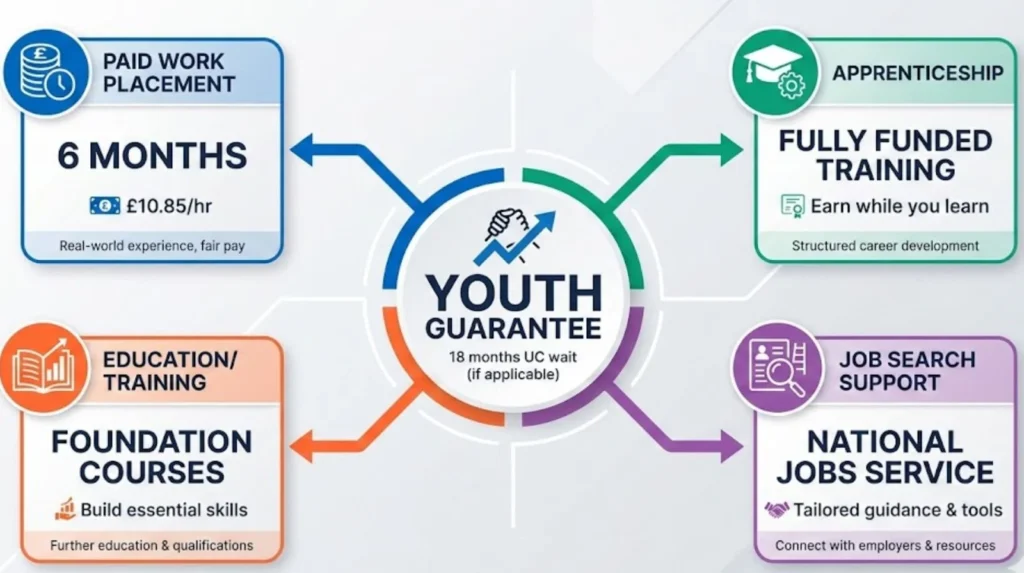
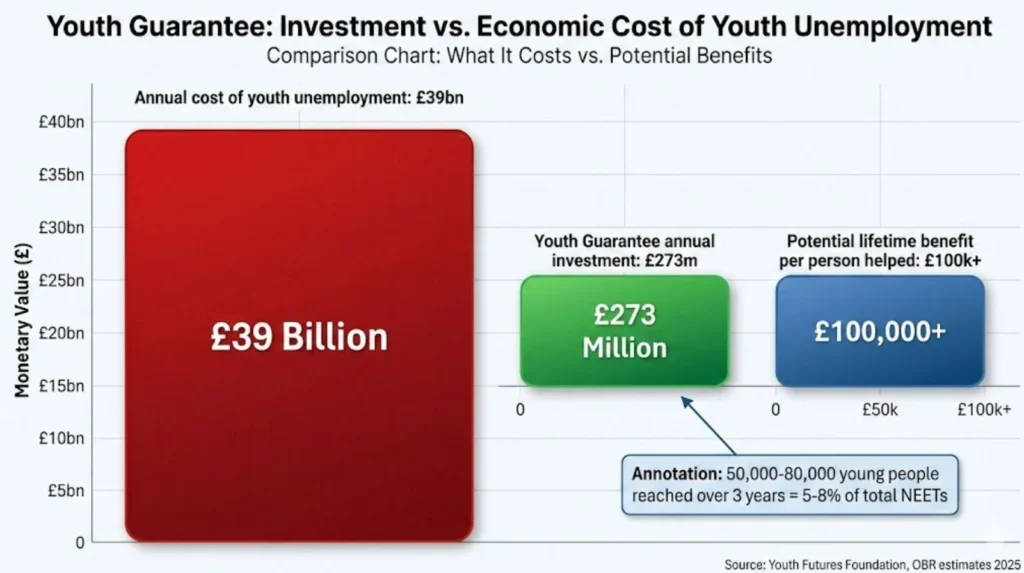
The £820 million runs from 2025 through 2028, which works out at roughly £273 million per year. It targets 18-21 year-olds who’ve been claiming Universal Credit for at least 18 months without being in education, employment, or training. That’s a specific group: not all NEETs, just those on UC long-term.
The Four Options. Young people in this cohort get offered one of four tracks. First, a guaranteed paid work placement lasting 6 months, typically 30+ hours per week, paid at National Minimum Wage for their age group (£10.00 for 18-20s from April 2025, rising to £10.85 in 2026). The government covers 100% of the wage cost for employers, essentially making it free labour for businesses willing to participate.
Second, a fully funded apprenticeship. This ties into the separate announcement that apprenticeship training for under-25s at SMEs (small and medium enterprises) is now free. Employers pay zero contribution for off-the-job training costs. They still pay the apprentice’s wage (minimum £7.55 per hour as of April 2025), but training and assessment are covered.
Third, access to education or skills training. This could be college courses, vocational qualifications, or foundation programmes to build basic skills like English and Maths GCSEs.
Fourth, intensive personalised job-search support through the new National Jobs and Careers Service, which is being rolled out to replace traditional Jobcentre functions.
Conditionality: The Stick Behind the Carrot. The Youth Guarantee comes with mandatory participation rules. If you refuse what’s deemed a “suitable” placement, apprenticeship, or training opportunity, you face Universal Credit sanctions. That starts with reductions (40-100% of your standard allowance for 4 weeks), escalating to full benefit stoppage for repeated refusals. Exemptions exist for severe health conditions, disabilities, lone parents with children under 3, and other specific circumstances assessed case-by-case.
The policy is framed as a guarantee of help, but it’s also a guarantee of consequences if you don’t engage. That balance between support and compulsion sits at the heart of the criticism from welfare and youth advocacy groups.
The Scale of Youth Unemployment: One in Eight
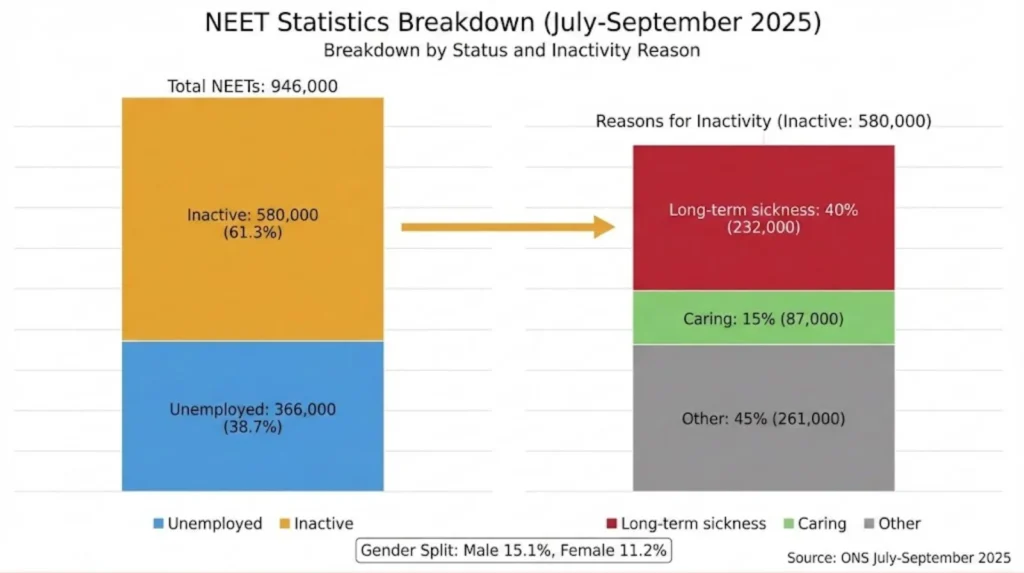
The latest ONS data (July-September 2025) shows 946,000 young people aged 16-24 are not in education, employment, or training. That’s 12.8% of the entire age group. To put that in context, it’s near an 11-year high, though not quite matching the post-2008 financial crisis peak of 1.2 million.
The breakdown matters. Of those 946,000 NEETs, 366,000 are unemployed (actively looking for work but can’t find it), while 580,000 are economically inactive (not seeking work). Inactivity has become the dominant form of NEET status, which is a shift from historical patterns where unemployment drove the numbers.
Why Aren’t They Looking for Work? The reasons for inactivity reveal the complexity. Forty percent of inactive NEETs cite long-term sickness as their primary reason, and the vast majority of that is mental health related. Fifteen percent cite caring responsibilities (disproportionately young women). The remaining 45% fall into “other reasons,” which includes waiting for opportunities, skills gaps, or simply not knowing where to start.
The mental health component is critical. The proportion of NEETs reporting mental health conditions has nearly doubled since 2012. Today, roughly one in six NEETs cites anxiety, depression, or other mental ill-health as a barrier to work or education. That’s 150,000+ young people whose unemployment is directly linked to health, not just lack of jobs.
Gender and Age Patterns. Young men currently have higher NEET rates than young women (15.1% vs 11.2%), driven primarily by unemployment rather than inactivity. Young women show higher inactivity rates due to caring responsibilities, particularly among the 18-21 age group. The 22-24 cohort shows more entrenched long-term issues, with many having been NEET for multiple years rather than months.
The Youth Guarantee’s 18-month eligibility threshold means it targets the more entrenched cases, not the short-term unemployed who cycle in and out of NEET status quickly. That’s roughly 400,000 people in the 18-21 bracket, though not all will be on Universal Credit or meet the specific criteria.
Free Apprenticeships for Under-25s: The Training Component
Buried within the Youth Guarantee announcement is a significant change to apprenticeship funding. Apprenticeship training for under-25s at small and medium enterprises is now fully funded by the government. Previously, non-levy paying SMEs contributed 5% of training costs. That 5% co-investment is now abolished for this age group.
What does that mean practically? The employer pays the apprentice’s wage (legally they must pay at least £7.55 per hour for apprentices, rising to higher age-appropriate rates as the apprentice progresses). The government covers the cost of the training provider, assessment, and qualification. For a typical Level 3 electrical apprenticeship, that training cost runs £12,000-£18,000 depending on provider and location. The employer now pays zero.
The funding comes from restricting Growth and Skills Levy usage for large employers, specifically removing funding for Level 7 (Master’s degree equivalent) apprenticeships for existing employees. That money gets redirected to youth apprenticeships.
Foundation Apprenticeships: Bridging the Gap. The government also announced “Foundation Apprenticeships,” which are shorter pre-apprenticeship programmes designed for young people who aren’t ready for full Level 3 apprenticeships. These address the barrier Thomas Jevons, our Head of Training, identifies:
"Many young people who've been out of education and employment for 18 months lack basic Level 2 qualifications. They might not have GCSEs in English and Maths. That's the barrier stopping them accessing proper apprenticeships. The Youth Guarantee needs to address foundation skills first, otherwise we're setting people up to fail entry requirements before they even start."
Thomas Jevons, Head of Training
The reality is that many long-term NEETs don’t have the foundation qualifications needed for apprenticeships. Four out of five young people out of work due to ill health have no qualifications above GCSE. That’s the actual starting point for a significant portion of the Youth Guarantee’s target cohort. Foundation Apprenticeships, if delivered properly, could address this. But only if they lead to full apprenticeships, not dead-end short courses.
How This Affects Electrical Training. Electrical apprenticeships are one of the skilled trades with genuine demand. The UK electrical workforce has declined 26% since 2018, and by 2032 we need an additional 100,000 qualified electricians to meet net zero targets. That creates real opportunity for young people entering through apprenticeships, provided they complete the full pathway: Level 2 and 3 installation qualifications, NVQ portfolio, 18th Edition, AM2 assessment, leading to JIB Gold Card status.
The Youth Guarantee funding makes it financially easier for small electrical contractors to take on apprentices. The question is whether 6-month placements become an alternative to apprenticeships (employers using subsidised temporary labour without committing to full training), or whether they act as stepping stones into apprenticeships for young people who need work experience before being ready for the full commitment.
For young people who don’t fit traditional apprenticeship routes, there are alternatives to become an electrician without an apprenticeship, including Experienced Worker Assessment and adult education pathways. But these still require foundation skills and genuine commitment.
The Sanctions Question: Support or Compulsion?
The Youth Guarantee includes mandatory participation backed by Universal Credit sanctions. Refuse a suitable placement and you face benefit reductions starting at 40% of your standard allowance for 4 weeks, escalating to 100% for repeated refusals. For an 18-20 year-old on UC, that’s losing roughly £265 per month initially, potentially the entire £668 monthly allowance later.
The government’s position is that this prevents people gaming the system, taking the support without genuine engagement. The counter-argument from welfare advocates, disability groups, and youth charities is that sanctions disproportionately harm vulnerable people who have legitimate reasons for refusing placements that might appear “suitable” on paper but aren’t in practice.
Joshua Jarvis, our Placement Manager, explains the practical risk:
"Threatening benefit sanctions if someone refuses a placement sounds tough, but what if the placement is genuinely unsuitable? What if someone has social anxiety and the role requires constant public interaction? What if travel costs make it financially impossible? The risk is vulnerable young people get sanctioned for legitimate reasons, which pushes them deeper into poverty and further from work, not closer to it."
Joshua Jarvis, Placement Manager
The Mental Health Factor. Remember that 40% of inactive NEETs cite long-term sickness, predominantly mental health. These are young people with anxiety, depression, PTSD, or other conditions that genuinely affect their ability to work. Standard UC rules include exemptions via work capability assessments, but historically these assessments have been criticised for being too harsh, failing to recognise fluctuating conditions, and pushing vulnerable people into inappropriate work or sanctions.
The Youth Guarantee policy documents mention “tailored support” and exemptions for health conditions. Implementation will determine whether that means genuine wraparound support (mental health services, adjusted expectations, gradual progression) or whether it becomes a tick-box exercise that fails to catch people falling through gaps.
Evidence from Past Schemes. Kickstart, the Covid-era predecessor to Youth Guarantee, had high deadweight (employers hiring people they would have hired anyway) and variable quality. The schemes that worked best included wraparound support: coaching, mental health access, and structured progression plans. Without that, young people churned through placements without gaining skills or confidence, returning to unemployment within months.
The Future Jobs Fund (2009-2011) had better outcomes precisely because it focused on quality placements with progression, not just getting people into “any job.” Success rates for sustained employment hit 40% when roles included training, support, and pathways to permanent positions. When schemes prioritised speed over quality, outcomes collapsed.
What It Costs and Who It Reaches
The £820 million sounds substantial until you compare it to the scale of the problem. With 946,000 NEETs, if the funding were spread evenly, that’s roughly £867 per young person over three years, or £289 per year. Obviously it won’t be spread evenly because not all NEETs meet the eligibility criteria (18-21, UC claimants, 18+ months unemployed), but it gives a sense of the mismatch.
The Office for Budget Responsibility estimates the Youth Guarantee might move 50,000-80,000 young people into work over three years. That’s 5-8% of the total NEET population, or roughly 12-20% of the eligible 18-21 UC cohort. The remaining 80-88% either don’t get reached, don’t take up the offer, or the funding runs out before everyone gets access.
The Cost of Youth Unemployment. Youth unemployment and inactivity costs the UK economy an estimated £39 billion annually in lost output, welfare payments, and reduced tax revenue. Long-term NEETs earn 20-30% less over their lifetime compared to peers who were continuously employed or in education. That lifetime earnings penalty translates to roughly £100,000-£150,000 per person in lost productivity.
From that perspective, investing £820 million to prevent even 50,000 young people from becoming long-term NEETs is cost-effective. Quality apprenticeships boost lifetime earnings by about 15% on average. Early intervention (getting someone into work or training within 6-12 months rather than letting them drift for 18+ months) adds roughly £100,000 in productivity per person over a career.
The counterargument from think tanks like the Resolution Foundation and Institute for Fiscal Studies is that £820 million is inadequate relative to the problem’s scale. They point out that youth unemployment rose by 195,000 between 2023-2025, driven by post-Covid economic slowdown and the mental health crisis. Addressing that properly requires sustained investment over decades, not a three-year programme.
Employer Costs and Minimum Wage. From April 2025, the minimum wage for 18-20 year-olds rises to £10.00 per hour (up 16.3% from £8.60), projected to hit £10.85 in 2026. That’s the biggest increase on record for this age group. Employer groups like the CBI and FSB warn that combining higher wages with increased employer National Insurance contributions makes hiring young people more expensive, potentially offsetting the Youth Guarantee subsidies.
Small electrical contractors, for example, might be willing to take on an apprentice at £7.55 per hour with government covering training costs. But if they’re asked to hire an 18-20 year-old on a 6-month placement at £10.85 per hour (even with the government covering it), they still face the cost of supervision, tools, insurance, and the risk the person isn’t ready for the work. That’s where the quality of matching and support becomes critical.
What Success Actually Looks Like
The Youth Guarantee succeeds if it moves young people from long-term unemployment into sustained work or education that builds skills and earnings potential. It fails if it becomes a revolving door of 6-month placements that lead nowhere, or if sanctions push vulnerable young people deeper into poverty without providing genuine support.
Quality Over Quantity. Evidence from the Lancaster University Work Foundation and past scheme evaluations shows that “any job” isn’t always better than no job. Low-quality, short-term placements with no progression create a cycle where young people return to unemployment after 6 months, only now they’ve lost confidence and believe the system doesn’t work for them. That’s worse than staying unemployed if it means they disengage entirely.
Success requires placements that include training, clear progression pathways, wraparound support for mental health and practical barriers (transport costs, childcare, basic skills gaps), and employer commitment beyond the subsidy period. The electrical sector can deliver this through structured apprenticeships leading to recognised qualifications. A 6-month placement at an electrical contractor works if it transitions into a full apprenticeship. It fails if the contractor uses subsidised labour for 6 months then moves on to the next subsidised worker.
Measuring Outcomes. The government will measure success by how many young people enter placements and how many remain in work 6 months after the placement ends. That’s a reasonable metric, but it needs to be paired with qualification outcomes. Did they gain a recognised credential? Did earnings increase? Are they on a pathway to career progression or just in another temporary role?
For electrical training specifically, success means young people completing the complete electrician pathway: foundation skills (if needed), Level 2/3 installation qualifications, NVQ portfolio, 18th Edition, AM2 assessment, leading to JIB Gold Card status and genuine employability as qualified electricians. That takes 18 months to 3 years, not 6 months. The Youth Guarantee works if the 6-month placement is step one of that journey, not the entire journey.
Regional Inequality. The Youth Guarantee is delivered locally via trailblazer regions initially (Liverpool City Region, West Midlands, Tees Valley, South Yorkshire, North East, Greater Manchester, West Yorkshire, East Midlands). Young people in these areas get earlier access. Those in non-trailblazer regions wait for national rollout, creating a postcode lottery.
Additionally, the scheme only works if local labour markets have opportunities. A young person in Manchester or Birmingham can access placements with electrical contractors, construction firms, care providers, logistics companies. A young person in a coastal town with few employers and declining industries faces limited options regardless of how much government support exists.
The electrical sector has nationwide demand, which creates opportunities across regions. But training infrastructure (colleges, apprenticeship providers, assessment centres) isn’t evenly distributed. Rural areas, coastal towns, and post-industrial regions often lack the training capacity needed to deliver the Youth Guarantee effectively.
What To Do Now If You're 18-21 and Considering Electrical Training
If you’re in the Youth Guarantee’s target group (18-21, claiming UC, unemployed for months or more), here’s what matters practically.
If You’re Already Unemployed for 18+ Months. You’ll be contacted by your local Jobcentre about accessing the Youth Guarantee. Be clear about what you want. If you’re interested in electrical work, ask specifically about apprenticeships, not just short placements. Ask what happens after the 6-month placement ends. Is there a progression route to a full apprenticeship? What qualifications will you gain?
Foundation skills matter. If you don’t have GCSEs in English and Maths, mention that upfront. Ask about Foundation Apprenticeships or pre-apprenticeship programmes that build basic skills while introducing you to electrical work. Don’t agree to placements you’re not ready for just to avoid sanctions. Ask for support that addresses your actual barriers.
If You’re Under 18 Months Unemployed. You don’t qualify for Youth Guarantee yet, but don’t wait. Look for local apprenticeship opportunities now. With training fully funded for under-25s at SMEs, small electrical contractors have financial incentive to hire apprentices. Contact local training providers, ask about entry requirements, and start building foundation skills if you have gaps.
If you have mental health challenges or other barriers, seek support early. Many training providers and employers offer adjusted programmes, flexible start dates, and pastoral support. It’s easier to address these before starting than after you’ve struggled and potentially dropped out.
If You’re Concerned About Sanctions. Understand your rights. If a placement is genuinely unsuitable (location, hours, type of work conflicting with health conditions or caring responsibilities), you can challenge it. Use the DWP’s formal dispute process. Get advice from welfare rights organisations or Citizens Advice if needed. The system is meant to be flexible for legitimate barriers, but you need to advocate for yourself.
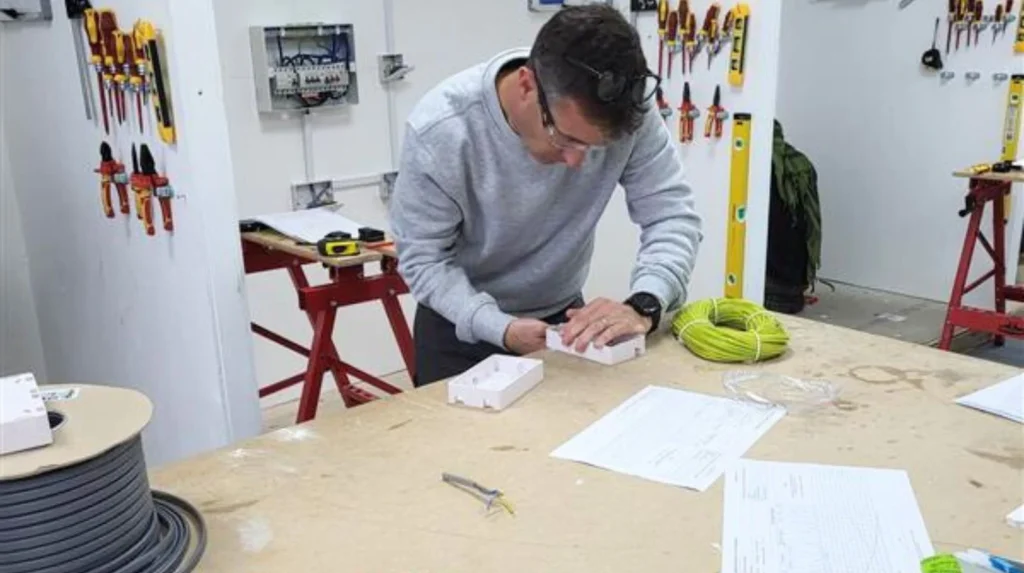
What Electrical Training Actually Requires. Becoming a qualified electrician takes commitment. The full pathway includes classroom learning (Level 2 and 3 installation qualifications), on-site experience (NVQ portfolio building over 12-24 months), technical assessments (18th Edition regulations, AM2 practical exam), and ultimately JIB Gold Card application. That’s 18 months to 3 years depending on whether you’re full-time or part-time, and whether you have foundation skills gaps to address first.
The good news is demand exists. The UK electrical workforce shortage means qualified electricians find work relatively easily, with median earnings around £30,000-£35,000 for employed roles and £40,000-£50,000+ for self-employed or specialist work. It’s a genuine career with progression, not a dead-end temporary job.
The Youth Guarantee can be a stepping stone if used strategically: get the 6-month placement, gain work experience, demonstrate reliability, then transition into a full apprenticeship with that employer or another. Use the placement to prove you’re ready for the commitment, not as an alternative to proper qualifications.
What To Do Next
The Youth Guarantee offers financial support and opportunities that didn’t exist before for long-term unemployed young people. For those considering electrical training, it potentially removes financial barriers to apprenticeships through fully funded training for under-25s at SMEs. But it only works if the pathways are genuine, not just short-term fixes.
What we’re not going to tell you:
- That 6-month placements are equivalent to full apprenticeships
- That the Youth Guarantee reaches all 946,000 NEETs
- That sanctions won’t affect vulnerable young people
- That temporary work experience guarantees permanent employment
- That you can become a qualified electrician in 6 months
What we will tell you:
- Apprenticeship training for under-25s at small businesses is now fully funded (zero employer contribution)
- Electrical work has genuine demand with 100,000 additional electricians needed by 2032
- The full pathway to qualified electrician status takes 18 months to 3 years
- Foundation skills (English, Maths) matter for apprenticeship access
- 6-month placements can be stepping stones if they lead to proper apprenticeships
- Mental health support and adjustments are available if you ask for them
- Electrical apprenticeships lead to recognised qualifications (NVQ Level 3, 18th Edition, AM2, JIB Gold Card)
- Qualified electricians earn £30,000-£50,000+ depending on experience and specialism
Call us on 0330 822 5337 to discuss electrical training pathways for young people, including how Youth Guarantee funding interacts with apprenticeships. We’ll explain entry requirements, foundation skills support, and realistic timelines for becoming a qualified electrician. We work with young people who’ve been long-term unemployed, and we understand the barriers around mental health, confidence, and practical challenges.
The Youth Guarantee offers an opportunity, but only if it leads to proper qualifications and sustained careers, not just 6-month temporary fixes.
References
- HM Treasury – Budget 2025 Speech (Rachel Reeves, 26 November 2025) – https://www.gov.uk/government/speeches/budget-2025-speech
- HM Treasury – Budget 2025 Red Book (26 November 2025) – https://assets.publishing.service.gov.uk/media/6926eb222a37784b16ecf526/Final_print_HMT_Budget_2025_TEXT_PRINT_NEW.pdf
- Office for National Statistics – Young people not in education, employment or training (NEET), UK (21 August 2025) – https://www.ons.gov.uk/employmentandlabourmarket/peoplenotinwork/unemployment/bulletins/youngpeoplenotineducationemploymentortrainingneet/august2025
- UK Parliament – Youth unemployment statistics (Research briefing, 11 November 2025) – https://researchbriefings.files.parliament.uk/documents/SN05871/SN05871.pdf
- GOV.UK – National Minimum Wage and National Living Wage rates (Updated November 2025) – https://www.gov.uk/national-minimum-wage-rates
- GOV.UK – New youth guarantee for eligible young people (29 September 2025) – https://www.gov.uk/government/news/new-youth-guarantee-for-eligible-young-people-and-funding-for-libraries-in-all-primary-schools
- Association of Colleges – AoC Chief Executive David Hughes comments on today’s budget (26 November 2025) – https://www.aoc.co.uk/news-campaigns-parliament/aoc-newsroom/aoc-chief-executive-david-hughes-comments-on-todays-budget
- Youth Futures Foundation – Youth Futures Foundation responds to the Autumn Budget (26 November 2025) – https://youthfuturesfoundation.org/news/youth-futures-foundation-responds-to-autumn-budget-2/
- UK Youth – Budget Offers Some Hope, But Long-Term Support for Youth Work Must Follow (26 November 2025) – https://www.ukyouth.org/2025/11/budget-offers-some-hope-but-long-term-support-for-youth-work-must-follow/
- Lancaster University Work Foundation – Young people not in education, employment, or training remains stubbornly close to one million (20 November 2025) – https://www.lancaster.ac.uk/work-foundation/news/neets-november-2025
- Resolution Foundation – False starts (Report on NEET rise and policy, 21 October 2025) – https://www.resolutionfoundation.org/publications/false-starts/
- Joseph Rowntree Foundation – Unlocking the potential of young people furthest from the labour market (6 May 2025) – https://www.jrf.org.uk/work/unlocking-the-potential-of-young-people-furthest-from-the-labour-market
- FE Week – Budget 2025: Free training extended to under 25 apprentices in SMEs (26 November 2025) – https://feweek.co.uk/budget-2025-free-training-extended-to-under-25-apprentices-in-smes/
- Youth Futures Foundation – Balancing act: Youth apprenticeships and the case for a flexible skills levy (20 May 2024, updated 2025) – https://youthfuturesfoundation.org/publication/balancing-act-youth-apprenticeships-and-the-case-for-a-flexible-skills-levy/
- ONS – Labour market overview, UK: November 2025 (11 November 2025) – https://www.ons.gov.uk/employmentandlabourmarket/peopleinwork/employmentandemployeetypes/bulletins/uklabourmarket/november2025
- Youth Futures Foundation – Youth Employment 2025 Outlook (4 November 2025) – https://youthfuturesfoundation.org/wp-content/uploads/2025/11/Report_Youth-Employment-2025-Outlook_Youth-Futures-Foundation_November-2025.pdf
Note on Accuracy and Updates
Last reviewed: 11 December. This page is maintained; we correct errors and refresh sources as Youth Guarantee implementation progresses and policy guidance develops. Figures cited reflect Budget 2025 announcements (26 November 2025), ONS NEET data (July-September 2025), and minimum wage rates confirmed for April 2025 with projections for 2026. Youth Guarantee rollout begins in trailblazer regions late 2025 with national expansion through 2026-2028. Next review scheduled following early implementation data and DWP delivery guidance updates.
