

Retraining for a Trade After Redundancy: Why Many Adults Choose Electrical Work (UK)

- Technical review: Thomas Jevons (Head of Training, 20+ years)
- Employability review: Joshua Jarvis (Placement Manager)
- Editorial review: Jessica Gilbert (Marketing Editorial Team)
- Last reviewed:
- Changes: New comprehensive article examining why redundant adults specifically choose electrical work over other trades, covering demand signals, professional identity factors, income reality versus marketing, qualification barriers, funding changes, and scam vulnerability
Introduction
Redundancy doesn’t feel like opportunity. It feels like crisis. The notice period starts, redundancy pay calculations begin, and suddenly you’re facing decisions about mortgage payments, family obligations, and what comes next whilst processing job loss. This pressure creates a specific mindset: urgency combined with fear of making wrong choices.
In this state, many adults turn to trade retraining. Not gradually, not as long-term career exploration, but as immediate response to employment loss. Electrical work consistently appears among the most chosen options for redundant adults, alongside plumbing and gas engineering. Understanding why requires examining what redundancy actually does psychologically and financially, and how electrical work’s specific characteristics meet needs that emerge in that moment.
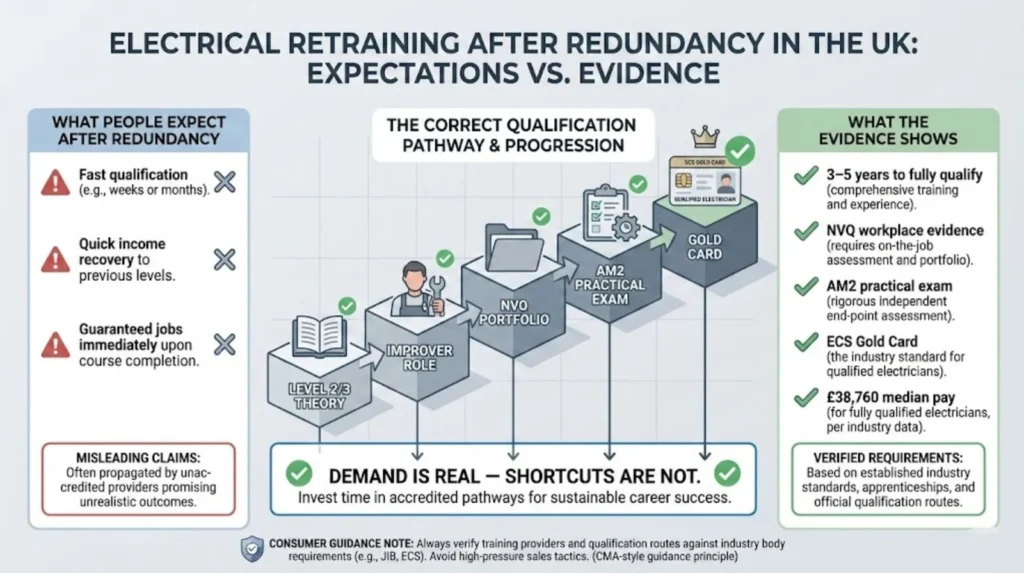
The attraction isn’t mysterious. Electrical work offers visible demand signals (shortage headlines, electrification trends, infrastructure projects), formal qualification pathways (NVQ Level 3, AM2 assessment, ECS Gold Card), regulated professional status (BS 7671 compliance requirements), and median earnings above UK average (£38,760 according to ONS data). These factors create perception of security, structure, and income recovery that appeals after sudden job loss.
However, perception differs from pathway reality. Adults choosing electrical work after redundancy face 3 to 5 years minimum from training start to qualified electrician status. Financial pressure intensifies during this period as apprentice wages start £15,000 to £16,000 annually, improver roles pay £24,000 to £30,000, whilst mortgages and family costs continue at levels based on previous £35,000 to £45,000 salaries. The qualification structure that creates professional appeal also creates entry barriers that extend timelines beyond what redundancy financial pressure comfortably accommodates.
This article examines why redundant adults specifically choose electrical work, what evidence supports or contradicts common beliefs about the pathway, where most adults struggle or fail, and how funding changes affect post-redundancy retraining decisions. For detailed information on the complete qualification framework from Level 2 through Gold Card status, see our comprehensive electrician qualification pathway guide for UK adults.

The Demand Signal: Why Electrical Work Looks "Future-Proof"
The perception of high electrical demand rests on multiple converging factors that adults researching post-redundancy options encounter repeatedly.
Shortage Headlines and Labour Market Signals
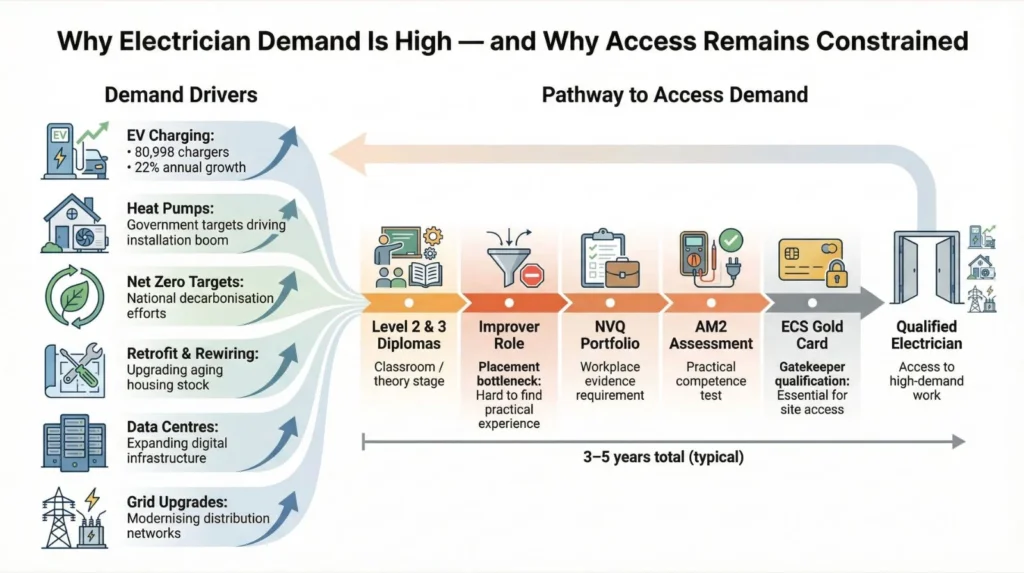
Industry forecasts project shortfall of approximately 100,000 electricians by 2032 to meet infrastructure needs, housing targets, and Net Zero commitments. Construction sector reports indicate 49% to 65% of electrical firms struggling to recruit qualified electricians. Government announcements reference 400,000 clean energy jobs by 2030 including significant electrical installation component. Job boards show consistent electrical vacancies across UK regions.
These signals create strong perception that electrical work offers employment security. For someone just made redundant, seeing widespread shortage reporting reduces fear of retraining into saturated market. The question “will there be work?” feels answered before qualification begins.
However, demand context matters. Shortages exist for qualified electricians holding NVQ Level 3, AM2 passes, and ECS Gold Cards with proven site experience. Demand doesn’t extend to people holding Level 2 and Level 3 diplomas without workplace competence evidence. The shortage coexists with adults unable to secure improver roles because they lack the very experience they need employment to gain. High demand doesn’t remove qualification barriers or accelerate competence timelines.
Electrification Trends as Pull Factor
EV charging infrastructure expanded to 80,998 public chargers in 2025, up 22% year-on-year, with government targets of 300,000 chargers by 2030. Heat pump installations are accelerating under Boiler Upgrade Scheme funding. Grid reinforcement projects require electrical contractors. Retrofit programmes target energy efficiency improvements in existing housing stock. Data centres and industrial electrification drive commercial electrical demand.
These trends feel different from general construction work. Electrification appears permanent shift rather than cyclical demand. Adults researching career changes after redundancy seek “future-proof” options. Electrical work connected to climate policy, transport transformation, and energy infrastructure feels more secure than trades dependent on housing market cycles or discretionary spending.
Joshua Jarvis, our Placement Manager, explains:
"Adults choose electrical work believing it's future-proof due to EV charging, heat pumps, and Net Zero targets. That perception isn't wrong. Electrification is driving real demand. However, those roles still require full NVQ Level 3 and AM2 competence first. You can't shortcut to EV installation work without fundamental electrical qualification. The specialization comes after baseline competence, not instead of it."
Joshua Jarvis, Placement Manager
The pull factor is real. The pathway to accessing that demand remains unchanged: 3 to 5 years training and evidence gathering, NVQ portfolio completion, AM2 practical assessment, Gold Card acquisition. Demand validates the direction but doesn’t simplify the journey.
Measured Outcomes vs Perception
ONS data shows electrician vacancies remain elevated but below peak shortage levels. Some regions experience tighter labour markets than others. Qualification bottlenecks (NVQ evidence gathering, AM2 failure rates) mean shortage persists alongside unemployed people who’ve completed theory training but can’t demonstrate workplace competence.
The demand signal is sufficient to justify electrical work as viable retraining direction. It’s insufficient to guarantee employment outcomes for everyone who starts training. Evidence supports cautious optimism, not certainty.
Professional Identity: Why Adults Gravitate Toward Electrics Over Other Trades
Post-redundancy identity crisis influences trade selection beyond practical considerations of pay or demand.
Formal Qualifications as Status Markers
Electrical work requires:
BS 7671:2018+A2:2022 (18th Edition Wiring Regulations): Current UK electrical safety standard. 3 to 5 day course plus exam. Referenced constantly in installation work. Creates clear regulatory framework distinguishing qualified from unqualified work.
NVQ Level 3 (e.g., City & Guilds 2357): Workplace competence qualification. Portfolio-based assessment over 12 to 18 months of site work. Mandatory for full electrician recognition.
AM2 / AM2S / AM2E Assessment: Independent practical exam. 2 to 3 days covering installation, testing, fault-finding. Pass required for qualified status.
ECS Gold Card: Industry-standard site access card. Issued based on verified qualifications. Recognized across all UK construction sites, agencies, main contractors.
These qualification markers create professional structure. When explaining career change to family, former colleagues, or new contacts, saying “I’m training as electrician, working toward NVQ Level 3 and Gold Card” communicates formal pathway. Compare to less regulated trades where competence boundaries are vaguer, training less standardized, certification less universal.
Adults who’ve lost professional office roles often resist trades they perceive as “lower skilled” or “just manual work.” Electrical work’s qualification structure and regulatory requirements create perception of technical professionalism that makes the identity shift more psychologically acceptable.
Regulatory Framework as Competence Proof
BS 7671 compliance isn’t suggestion, it’s legal requirement under Electricity at Work Regulations 1989. Installations must meet safety standards. Testing procedures are specified. Fault-finding follows systematic approaches. Installation certificates document compliance.
This regulatory burden increases entry friction (longer training, more assessment, higher barriers). However, it also creates clear competence thresholds that protect against undercutting from unqualified competition. You cannot legally perform electrical installation work without demonstrable competence. That protection matters to adults investing £5,000 to £9,000 and 3 to 5 years in retraining.
Compare to painting and decorating, where skill matters but legal barriers to entry don’t exist. Anyone can buy equipment and advertise services. Quality distinguishes professionals, but lack of formal certification allows price competition from unskilled workers. For redundant adults seeking stable income replacement, regulatory protection feels more secure.
The Trade-Off: Professionalism Creates Entry Barriers
The same factors creating professional appeal extend qualification timelines. BS 7671 requires learning. NVQ portfolios demand diverse workplace evidence. AM2 assessment tests practical competence under timed conditions. ECS cards need verification processes.
Adults at 35, 45, or 55 with families, mortgages, and financial obligations face different pressures than 18-year-olds starting apprenticeships. The 3 to 5 year timeline from redundancy to qualified status at reduced income feels different when you’ve lost a £35,000 to £40,000 job versus graduating school. Professional structure that attracts adults is also what makes electrical work demanding to enter mid-career.
Income Reality: What the Evidence Actually Shows
Marketing creates expectations that evidence doesn’t fully support.
ONS Data vs Marketing Claims
Office for National Statistics Annual Survey of Hours and Earnings (ASHE) 2024 reports median electrician earnings: £38,760 annually. This represents typical qualified electrician with several years experience working standard hours. Regional variation exists: South-East and London higher (£42,000 to £48,000), North-East and Wales lower (£34,000 to £38,000).
However, course marketing and recruitment advertising frequently reference £50,000 to £80,000 earning potential. These higher figures are achievable but require specific circumstances:
Substantial overtime: Working 48 to 60 hours weekly including evenings and weekends. Overtime rates typically 1.5x to 2x standard hourly. Sustainable for short periods, exhausting long-term.
Self-employment with consistent client base: Gross revenue £60,000 to £80,000 possible. After business expenses (tools, vehicle, insurance, materials, unpaid admin time, void periods), net income closer to £40,000 to £55,000.
Shift work with unsociable hours premiums: Industrial roles, data centres, hospitals requiring 24/7 coverage. Night shift premiums add 20% to 30% above standard rates. Health impacts and lifestyle constraints significant.
Specialist roles requiring additional qualifications: Inspection and testing (2391), design work, supervisory positions. Typically require 5 to 10 years post-qualification experience before accessing these positions.
The £38,760 median is realistic expectation for qualified electrician working standard 37.5 to 40 hour weeks in employed position. Higher earnings exist but aren’t automatic or guaranteed.
Early-Stage Income During Training
The timeline from redundancy to median electrician earnings involves extended period at significantly reduced income:
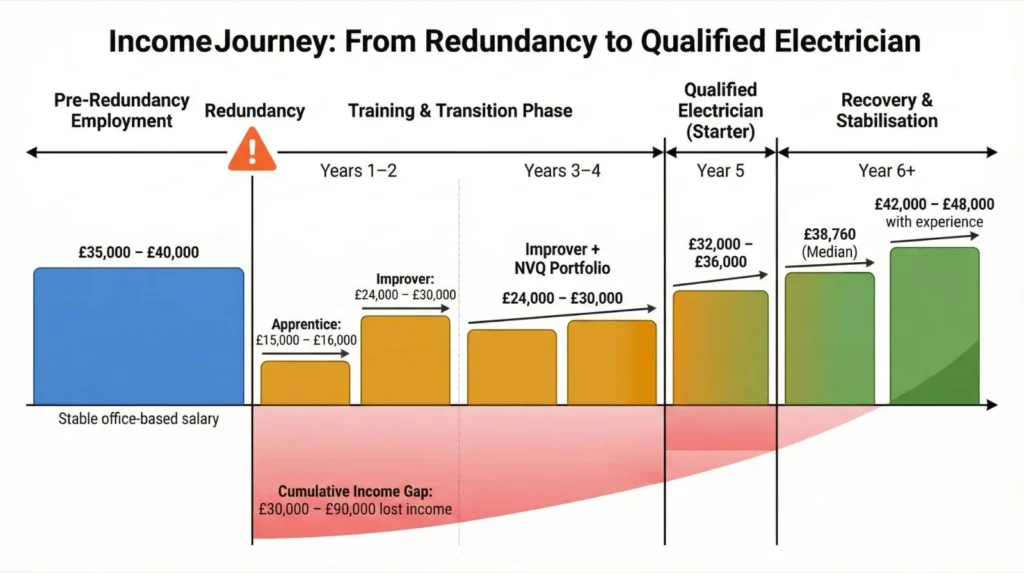
Months 0 to 12: If pursuing apprenticeship, Year 1 wage £15,000 to £16,000 (£7.55/hour minimum). If self-funding Level 2 and Level 3 diplomas whilst maintaining current employment, no immediate income change but course costs £4,000 to £6,000.
Months 12 to 36: Securing improver or mate roles to build NVQ portfolio evidence. Typical improver wages £24,000 to £30,000. This is £5,000 to £16,000 below previous £35,000 to £40,000 office salaries redundant adults held.
Months 36 to 60: Completing NVQ, passing AM2, obtaining Gold Card, securing first qualified electrician position. Starting qualified wage approximately £32,000 to £36,000 depending on region and experience.
Year 5+: Moving toward median £38,760 as experience develops. Reaching £42,000 to £48,000 with additional years or specializations.
For redundant adult at age 40 earning £38,000, electrical retraining means 3 to 5 years at £15,000 to £30,000 before recovering to similar income level. That financial gap represents £30,000 to £90,000 cumulative lost income during retraining period. Savings, redundancy pay, working partner, or reduced expenses become essential. Many cannot sustain this pressure.
Regional and Route Variation
London and South-East: Higher wages but also higher training costs, living expenses, competition for positions.
Scotland, Wales, Northern regions: Lower median wages but also lower costs, potentially better improver role access in less saturated markets.
Self-employed domestic installers: Can begin earning 6 to 12 months faster than full Gold Card pathway. However, scope permanently restricted to residential work, earnings capped typically £30,000 to £40,000 gross.
Route choice significantly affects income timeline and ceiling. Fast entry domestic routes sacrifice long-term earning potential. Full Gold Card pathways delay income but enable complete scope including higher-paying commercial and industrial work.
The Real Pathway: From Redundancy to Competence
Understanding actual progression timeline prevents unrealistic expectations.
Phase 1: Redundancy Notice and Initial Planning (Weeks 0 to 8)
Statutory redundancy notice: Minimum 1 week per year of service up to 12 weeks maximum. Redundancy pay for 2+ years service: Half week’s pay per year under age 22, 1 week’s pay ages 22 to 40, 1.5 weeks’ pay age 41+. Capped at £700/week, maximum £21,000 total.
This period involves benefits advice (Universal Credit if eligible), mortgage payment holidays negotiation, immediate job searching whilst assessing retraining options. Career advisors through Jobcentre Plus, Citizens Advice, or Acas provide redundancy support and retraining guidance.
Adults research trade options during notice period. Electrical work appears repeatedly due to visible demand, formal qualifications, professional structure. Initial contact with training providers, preliminary course research, funding eligibility checks occur during these weeks.
Phase 2: Funding Applications and Course Selection (Weeks 8 to 16)
Adult Skills Fund (ASF): Covers Level 2 and Level 3 electrical courses for adults 19+ in England meeting residency requirements. Fully funded for unemployed or low-income individuals. Changes in August 2025 simplified residency rules and expanded Level 3 flexibility.
Advanced Learner Loans: Available for Level 3+ qualifications. Loan amounts £3,000 to £11,000 depending on course. Repayment begins only when earning above threshold (currently £27,295 annually), similar to student loans. No credit checks. Write-off after 30 years.
Adult Apprenticeships: No age limit. Minimum duration reduced from 12 months to 8 months in 2025 for those with significant prior experience. Funding: 95% to 100% for small employers, co-investment from large employers. Wage: £7.55/hour minimum Year 1, National Living Wage (£12.21/hour) from Year 2 for ages 21+.
Route decision: Full apprenticeship (3 to 4 years, minimal cost, employed throughout, lowest income), self-funded diploma+NVQ (18 months to 3 years, £5,000 to £9,000 cost, flexibility to study part-time), or domestic-only (4 to 12 weeks training, £2,500 to £4,000, restricted scope permanently).
Most redundant adults with savings or redundancy pay choose self-funded route for speed and flexibility. Those who can accept income drop pursue apprenticeships. Those under immediate financial pressure often mistakenly choose domestic-only thinking it’s faster pathway to full qualification.
Phase 3: Theory Training (Months 4 to 18)
Level 2 Electrical Installation (C&G 2365-02): Basic electrical science, safety, hand tools, simple circuits. Duration: 3 to 6 months full-time, 12 to 18 months part-time evenings/weekends. Cost: £1,500 to £2,500.
Level 3 Electrical Installation (C&G 2365-03): Advanced installation theory, three-phase systems, testing procedures, BS 7671 application. Duration: 4 to 8 months full-time, 12 to 18 months part-time. Cost: £2,000 to £4,000.
18th Edition (BS 7671:2018+A2:2022): Current wiring regulations. 3 to 5 days intensive course plus exam. Cost: £400 to £600. Required component but insufficient alone for competence.
Theory training is straightforward. Classroom delivery, clear assessment criteria, predictable progression. Adults often handle theory learning well due to study skills from previous education and work experience. This is NOT where failure occurs.
Phase 4: The “Mate/Improver Gap” (Months 12 to 30)
After completing Level 2 and Level 3, adults must secure employment providing supervised electrical work to build NVQ portfolio evidence. This transition is primary failure point.
Electrical mate: Entry-level site role. Assisting qualified electricians, cable pulling, fixing containment, basic terminations. Wages £22,000 to £26,000. Provides workplace access but may not offer sufficient variety for complete NVQ evidence.
Electrical improver: More responsibility than mate. Installing circuits under supervision, using testing equipment, fault-finding support. Wages £26,000 to £32,000. Better NVQ evidence gathering opportunity.
However, securing these positions is highly competitive. Employers prefer:
Apprentices they’ve trained from start
Younger candidates without family commitments affecting availability
People with existing site experience from construction backgrounds
Candidates willing to work anywhere in region including long travel
Redundant adults at 35, 45, or 55 with mortgages, families, geographic constraints, and wage expectations higher than entry-level compete poorly. Many complete £4,000 to £6,000 theory training then spend 6 to 18 months unable to secure positions providing NVQ-qualifying work.
Phase 5: NVQ Portfolio Building (Months 18 to 42)
Once employed, NVQ Level 3 enrolment: Cost £1,500 to £3,000 for assessment and portfolio support. Duration: 12 to 18 months gathering evidence covering:
Installation work: Cables, containment, terminations across various circuit types Testing procedures: Continuity, insulation resistance, earth loop impedance, RCD operation Fault diagnosis: Identifying and resolving installation faults Safe isolation: Proving circuits dead before work Three-phase systems: Distribution boards, motors, industrial installations Documentation: Installation certificates, test results, risk assessments
Assessor visits verify evidence every 8 to 12 weeks. Portfolio stalls if employment provides repetitive single-task work without variety. Evidence must demonstrate breadth across NVQ unit requirements.
Phase 6: AM2 Assessment (Month 36 to 48)
Once NVQ portfolio nears completion, candidates book AM2 (Experienced Workers take AM2E variant). Assessment at National Electrotechnical Training (NET) centre.
Duration: 2 to 3 days including installation task, testing procedures, fault-finding under timed conditions. Pass requirements: Installation to BS 7671, correct testing sequence, accurate fault diagnosis, safe working throughout.
First-attempt pass rate: 60% to 70% for well-prepared candidates with genuine site experience. 30% to 40% failure rate even among people who’ve worked as mates for years. Common failures: Fault-finding under time pressure, testing sequence errors, installation quality issues.
Thomas Jevons, our Head of Training with 20+ years experience, states:
"AM2 isn't a formality. It's a rigorous 2 to 3 day practical assessment covering installation, testing, and fault-finding under timed conditions. First-attempt failure rates run 30% to 40% even for people who've worked as mates for years. Adults assume life experience compensates for hands-on electrical training. The assessment proves it doesn't. Competence must be demonstrated, not assumed."
Thomas Jevons, Head of Training
Retake cost: Full assessment fee again (£800 to £1,000) plus additional preparation time.
Phase 7: ECS Gold Card and Qualified Status (Month 42 to 60)
After AM2 pass, apply for ECS Gold Card through Electrotechnical Certification Scheme. Requirements verified: NVQ Level 3, AM2 pass, 18th Edition current, health and safety training. Card issued within 4 to 6 weeks.
Gold Card enables:
Site access on commercial and industrial projects
Agency registration as qualified electrician
Main contractor subcontractor approval
Full scope electrical work across all sectors
Supervision of others
Higher wage positions
Starting qualified electrician wage: £32,000 to £38,000 depending on region and experience level. Progression toward median £38,760 occurs over subsequent 2 to 4 years as competence and site experience develop.
Total timeline: 3 to 5 years from redundancy notice to qualified electrician status earning comparable income to lost office role.
The NVQ Wall: Where Most Adults Struggle
Portfolio evidence gathering creates barrier that classroom theory doesn’t prepare adults for.
Why Site Access Matters More Than Classroom Performance
Adults who excelled in Level 2 and Level 3 theory, passed exams with high marks, understood BS 7671 thoroughly, still fail at NVQ stage. The competence standard is different. NVQ assesses workplace capability: Can you safely isolate circuits? Can you terminate correctly under site conditions? Can you diagnose faults in real installations? Can you produce compliant test results? Can you work across various installation types?
Answers must be demonstrated through documented evidence from actual electrical work, verified by qualified assessors visiting workplaces. Cannot be simulated in classroom. Cannot be substituted with exam scores. Cannot be rushed.
The Employment Paradox
NVQ requires workplace evidence → Workplace evidence requires employment → Employment requires existing competence demonstration → Competence demonstration requires NVQ.
Circular dependency traps adults. Employers hiring improvers ask “Do you have site experience?” Adults reply “No, I just finished Level 3 diploma.” Employer thinks “Then you’re not ready for improver role, try mate positions.” Mate positions often provide repetitive basic tasks (cable pulling, materials handling) insufficient for diverse NVQ evidence.
Small contractors cannot afford to carry improvers for 12 to 18 months whilst they build portfolios. Large contractors have graduate schemes and apprenticeship programmes but limited capacity for mid-career retrainers. Agencies require existing site experience and CSCS/ECS cards before registration. The gap between theory completion and NVQ enrolment stretches for many adults into 6 to 18+ months of unsuccessful job hunting or inadequate mate roles.
Financial Pressure During Evidence Gathering
Improver wages £26,000 to £32,000 sound reasonable until compared against previous £38,000 to £42,000 office salaries. Adults already 2 to 3 years into retraining, having spent £4,000 to £6,000 on courses, face continuing mortgage payments, family expenses, vehicle costs at reduced income. Pressure mounts to accelerate progress.
However, NVQ cannot be rushed. Assessors verify evidence meets requirements. Installations must be completed. Testing procedures must be documented. Fault-finding must occur naturally in workplace. If your employer only does domestic rewires, you won’t gather three-phase system evidence. If your role is purely maintenance, installation evidence suffers. If work is repetitive, breadth requirement fails.
Adults under financial pressure sometimes change employers seeking faster evidence gathering, losing continuity. Or they pursue multiple assessors hoping for easier standards, wasting time. Or they consider domestic-only routes to start earning immediately, sacrificing long-term scope. These responses to financial pressure often extend timelines further rather than resolving them.
AM2 as Ultimate Evidence Filter
Even adults who build portfolios, complete assessor visits, receive sign-offs face 2 to 3 day AM2 assessment testing everything under timed conditions. 30% to 40% fail first attempt.
Common failures include:
Fault-finding under time pressure (typically 90 to 120 minutes for complex fault diagnosis)
Testing sequence errors (proving dead, testing, re-energising protocol violations)
Installation quality (terminations, cable routing, labelling standards)
Safe working violations (isolation procedure failures, PPE lapses)
Adults who sailed through classroom exams discover practical competence under assessment pressure is different. Retake costs £800 to £1,000 plus additional preparation time. Some adults fail multiple attempts before passing. Others give up after second failure, abandoning entire retraining pathway.
The NVQ wall isn’t about difficulty. It’s about structure requiring genuine workplace competence that theory learning doesn’t provide and that adults struggle to access without employers willing to support evidence gathering across 12 to 18 months.
Funding and Route Choices After Redundancy
Policy changes in 2025 affected adult retraining accessibility and flexibility.
Adult Skills Fund (ASF) Changes
Formerly Adult Education Budget (AEB), simplified in August 2025:
Residency requirements relaxed: Previous 3 year continuous UK residency reduced to more flexible eligibility allowing recent arrivals to access funding.
Level 3 flexibility increased: Expanded range of Level 3 qualifications fully funded for adults 19+ including electrical installation diplomas.
Geographic coverage: England only (devolved to Scotland via Scottish Funding Council, Wales via ReAct+, Northern Ireland separate system).
Eligibility: Unemployed individuals, low-income workers, benefit recipients qualify for 100% funded courses. Others face co-payment or full fees.
For redundant adults claiming Universal Credit or using Jobseeker’s Allowance during notice period, full funding for Level 2 and Level 3 electrical courses removes upfront cost barrier. Must still budget for tools (£300 to £500), PPE (£150 to £200), transport, living expenses during study.
Advanced Learner Loans
Alternative to ASF for those ineligible or preferring private training providers:
Loan amounts: £3,000 to £11,000 depending on qualification level and duration.
Repayment: Only after earning above £27,295 annually. Deducted automatically at 9% of income above threshold, similar to student loans.
Write-off: After 30 years or age 65, whichever comes first.
No credit checks: Cannot be refused due to previous debt, poor credit history, bankruptcy.
For redundant adults with savings wanting to train quickly with private providers offering intensive schedules, loans provide access without depleting redundancy pay entirely. However, adds debt burden during already financially pressured period.
Adult Apprenticeships: Minimum Duration Reduced
Policy change 2025: Apprenticeship minimum duration reduced from 12 months to 8 months for learners with significant prior experience or relevant qualifications. Applies to Installation and Maintenance Electrician standard (ST0152).
However, “significant prior experience” typically means construction sector work or technical roles related to electrical systems. Adults transitioning from completely unrelated fields (retail, hospitality, office administration) still face full 3 to 4 year apprenticeship durations.
Funding remains 95% to 100% for small employers (fewer than 50 employees), co-investment from large employers. No upper age limit. However, wage requirements create employer hesitancy: Apprentice minimum £7.55/hour Year 1, National Living Wage £12.21/hour from Year 2 for ages 21+. This makes adult apprentices approximately 60% more expensive than younger apprentices after Year 1.
Devolved Variations
Scotland: Similar funding through Skills Development Scotland and Scottish Funding Council. Modern Apprenticeships available all ages.
Wales: ReAct+ scheme provides up to £1,500 grants for redundant workers pursuing retraining. Combines with general further education funding.
Northern Ireland: Department for the Economy manages apprenticeship funding and adult education programmes with separate eligibility criteria.
Adults must check specific requirements for their region. Funding structures, eligibility rules, and course availability vary. England provides most comprehensive resources but others offer targeted redundancy support.
For specific age-related considerations around mid-career transitions into electrical work, particularly challenges and advantages at milestone ages, see our guide on career change to electrician at 40.
Why Electrical Work Beats Other Trades for Some Adults (And Not for Others)
Trade selection depends on individual circumstances rather than universal “best choice.”
Electrical vs Gas Engineering
Gas engineering shares similar professional structure: Gas Safe registration required, competence assessments, formal qualifications. Entry barriers comparable. However:
Advantages electrical: Broader scope (domestic, commercial, industrial). More specialization pathways (EV, renewables, testing). Less immediate safety risk perception (though electrical work is dangerous, gas explosions feel more catastrophic to public).
Advantages gas: Potentially faster competence timeline for narrower domestic scope (18 to 24 months vs 3 to 5 years). Higher emergency call-out income for self-employed. Less physical crawling through lofts in extreme heat.
Disadvantage gas: Fossil fuel phase-out concern. Heat pump rollout replacing gas boilers creates uncertainty about long-term demand. Transitioning to heat pump work requires electrical skills anyway.
For redundant adults, electrical feels more “future-proof” due to electrification trends. Gas feels potentially vulnerable to policy changes phasing out fossil fuels over next 15 to 20 years.
Electrical vs Plumbing
Plumbing requires less regulatory burden than electrical. No equivalent to NVQ Level 3 or AM2 for basic competence. Faster entry into self-employment possible.
Advantages electrical: Higher median wages (£38,760 vs £33,285 plumbers according to government data). More formal qualification structure creating professional identity. Broader career pathways into industrial electrical, building services, controls.
Advantages plumbing: Faster competence timeline (18 to 24 months typical). Lower entry barriers. More immediate self-employment viability. Less mathematical/physics demands (appeals to some adults, disadvantage to others).
For redundant adults valuing formal qualifications and professional structure, electrical work provides clearer competence markers. For those needing fastest possible income restoration, plumbing offers quicker path to earning.
Electrical vs Carpentry
Carpentry is skill-based trade with minimal regulatory requirements. Apprenticeships available but also possible to learn through employment without formal qualifications.
Advantages electrical: Formal qualifications providing clearer competence proof. Less vulnerability to economic cycles (electrical work required in maintenance even during construction downturns). Higher median wages. Indoor work majority of time.
Advantages carpentry: Lower entry barriers. Faster skill development possible. More creative/aesthetic component appeals to some personalities. Self-employment viable earlier. Tools and equipment less expensive (£1,000 to £2,000 quality carpentry kit vs £2,000 to £4,000 electrical testing equipment plus tools).
Average qualified carpenter earnings: £45,482 according to Nationwide data, though regional variation significant and includes high-end specialist joiners. Electrical median £38,760 more consistent across regions and skill levels.
For redundant adults seeking fastest employment restoration, carpentry offers lower barriers but also less structured pathway. Electrical provides clearer qualification route but demands longer timeline.
Electrical vs Painting and Decorating
Painting has virtually no entry barriers. Anyone can purchase equipment and advertise services. Skill distinguishes professionals but no formal competence requirements exist.
Advantages electrical: Significantly higher wages. Regulatory protection preventing undercutting from unqualified competition. Career progression pathways. Professional status.
Advantages painting: Fastest possible entry (immediate to 6 months skill development). No qualification costs. Lower physical demands than other trades. Suitable for older adults or those with limitations preventing heavy manual work.
Painter median earnings approximately £28,000 to £32,000, though highly variable based on speed, quality, client base. Electrical £38,760 median more stable and higher.
For redundant adults prioritizing income replacement speed at any cost, painting offers immediate earning possibility. For those able to sustain 3 to 5 years timeline for higher long-term income, electrical work provides better return on investment.
Trade Selection Framework
Choose electrical if:
Value formal qualifications and professional structure
Can sustain 3 to 5 years reduced income during training
Physically capable of sustained manual work including lofts, ladder work, confined spaces
Comfortable with mathematics, electrical science, technical regulations
Seeking career with clear specialization pathways and long-term demand
Consider alternatives if:
Need income restoration within 6 to 18 months maximum
Cannot sustain multi-year training timeline financially
Physical limitations prevent demanding installation work
Prefer skill-based learning over classroom theory
Want fastest possible self-employment option
No single “best trade” exists. Electrical work attracts redundant adults specifically for professional structure, demand visibility, and income potential. However, those advantages come with extended timelines and entry barriers that not everyone can accommodate post-redundancy.
The Scam Problem: Why Redundant Adults Are Vulnerable
Financial pressure and urgency make post-redundancy period high-risk for misleading training claims.
Why Redundancy Creates Vulnerability
Time pressure: Notice period running out, income ending soon, need to “do something” immediately.
Financial anxiety: Mortgage payments, family obligations, erosion of savings create desperation for fastest solution.
Lack of industry knowledge: Adults from non-construction sectors don’t know NVQ requirements, AM2 significance, portfolio evidence needs. Rely on provider claims without verification ability.
Status loss: Recently redundant people often feel failure, seeking to rebuild professional identity quickly. Susceptible to claims about “prestigious” or “guaranteed” pathways.
Isolation: Making major career decisions alone, without industry contacts who could provide reality checks on timeline or cost claims.
These factors make redundant adults prime targets for misleading course marketing that exploits urgency and knowledge gaps.
Most Common Misleading Claims
“Become a fully qualified electrician in 8 to 12 weeks”: Refers to domestic installer courses. Technically you can register with Competent Person Scheme (NICEIC, NAPIT) for residential self-certification after short training. However, this is NOT “fully qualified electrician” in industry terms. Cannot obtain ECS Gold Card. Cannot work commercial or industrial sites. Cannot supervise others. Scope permanently restricted unless you later complete full NVQ and AM2 anyway.
“Guaranteed employment after course completion”: Legally unenforceable. Employment depends on competence demonstration, site experience, employer willingness, regional demand, timing. Training providers cannot guarantee third-party hiring decisions.
“Earn £50,000 to £80,000 immediately”: Median qualified electrician earnings £38,760. Higher figures require years of experience, substantial overtime, self-employment with business development skills, or specialist roles requiring additional qualifications. Starting qualified wages £32,000 to £38,000. Trainee/improver wages much lower.
“No experience needed”: True for enrolment in Level 2 courses. False for competence achievement. NVQ requires 12 to 18 months workplace experience across diverse installation types. AM2 requires practical capability built through site work. Can’t skip experience requirement through classroom intensity.
“Fast-track to Gold Card”: ECS Gold Card requires NVQ Level 3 (workplace competence over 12 to 18 months), AM2 pass (practical assessment testing real capability), 18th Edition current, health and safety training. No legitimate fast-track exists. Shortest possible timeline approximately 18 to 24 months for experienced workers using AM2E route, 3 to 5 years for career changers without electrical background.
Red Flags Indicating Misleading Providers
Urgency language: “Limited spaces”, “Enroll now before deadline”, “This week only” creating artificial pressure.
Absolute guarantees: Any claim guaranteeing employment, earnings, or speed without caveats.
Vague qualification details: Not specifying which exact City & Guilds qualification, whether NVQ is included, AM2 preparation provided, ECS card application supported.
Hidden costs: Advertised price doesn’t include assessment fees, equipment, retake costs, mandatory additional courses discovered later.
Testimonials without verification: Success stories lacking specific details (names, companies, timelines, verifiable outcomes) or using stock photos.
Unregistered with awarding bodies: Legitimate training must be City & Guilds approved centres, EAL centres, or other recognized awarding body affiliates. Registration numbers should be publicly verifiable.
Pressure tactics: Sales calls, high-pressure meetings, discounts for immediate payment, reluctance to provide written terms before commitment.
How to Verify Legitimate Training
Check City & Guilds centre directory: Verify centre number matches provider claims.
Request detailed course breakdown: Exact qualifications awarded, assessment methods, NVQ portfolio support included, AM2 preparation provided, costs itemized including retakes.
Ask about employment support: Realistic description of job-seeking assistance, not guarantees. Evidence of employer partnerships, placement rates, graduate outcomes.
Read CMA guidance: Competition and Markets Authority published consumer protection guidance for vocational training after investigations into misleading practices.
Seek independent advice: Citizens Advice, National Careers Service, industry forums where qualified electricians discuss training routes honestly.
Compare timelines: If provider claims significantly faster completion than industry standard 3 to 5 years for career changers, investigate what’s being omitted (usually NVQ and AM2 requirements).
The legitimate pathway to qualified electrician status with Gold Card takes 3 to 5 years including theory training, site experience, NVQ portfolio, and AM2 assessment. Any provider claiming substantially faster completion without restricting scope to domestic-only is misrepresenting qualification requirements.
For context on how physical factors including vision-related considerations affect electrical work eligibility and what accommodations exist, see our guide on electricians with colour blindness and practical workplace adjustments.
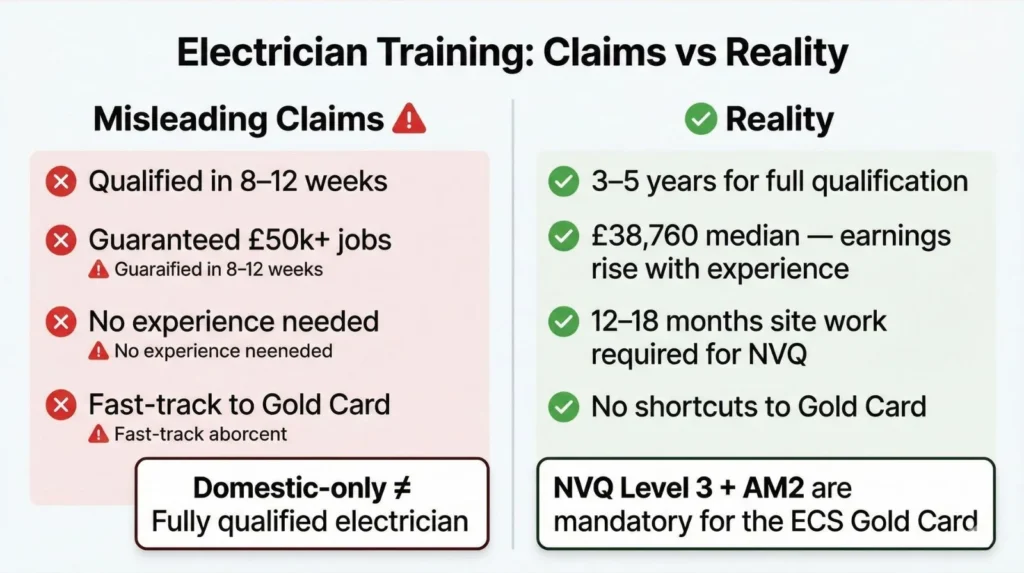
Myth vs Reality: Clearing the Biggest Misunderstandings
Myth: “You can become a fully qualified electrician in 8 to 12 weeks”
Reality: Short courses cover theory components (Level 2, Level 3, 18th Edition) compressed into intensive blocks. You receive certificates proving course completion. However, “fully qualified electrician” requires NVQ Level 3 workplace competence (12 to 18 months site work building evidence portfolio), AM2 practical assessment (independent testing of installation capability), and ECS Gold Card (industry recognition for site access and employment). Fast courses provide theory knowledge, not workplace competence. Total timeline 3 to 5 years including all components.
Verdict: False for industry-recognized qualified status. True only for theory certificate completion.
Myth: “18th Edition certification makes you an electrician”
Reality: 18th Edition (BS 7671:2018+A2:2022) is 3 to 5 day course teaching current UK wiring regulations. Essential component of electrical qualification but insufficient alone. Proves regulatory knowledge, not practical competence. Still requires NVQ Level 3 (workplace evidence across installations, testing, fault-finding), AM2 assessment (practical exam demonstrating capability), and 18th Edition combined for full qualification. 18th Edition alone enables exactly zero independent electrical work legally.
Verdict: False. 18th Edition is mandatory component, not complete qualification.
Myth: “Domestic installer qualification equals ECS Gold Card electrician”
Reality: Domestic installer courses (4 to 12 weeks training) enable registration with Competent Person Schemes (NICEIC, NAPIT, ELECSA) for residential electrical work self-certification under Building Regulations Part P. This allows legitimate business installing house wiring, consumer units, lighting circuits. However, scope permanently restricted to domestic properties. Cannot access commercial sites (requires ECS Gold Card). Cannot work industrial installations. Cannot supervise others. Cannot perform testing and inspection work across sectors. Domestic installer and Gold Card electrician are different qualification levels with different scopes and earning potentials (£30,000 to £40,000 domestic vs £38,000 to £50,000+ full scope).
Verdict: False. Different qualifications entirely. Domestic-only is restricted subset, not equivalent status.
Myth: “Apprenticeships are only for young people under 25”
Reality: No upper age limit exists for apprenticeships in UK. Government funding explicitly supports adult apprenticeships. Installation and Maintenance Electrician standard (ST0152) accepts applicants all ages. Adults over 25 represent significant proportion of current apprenticeship starts. However, practical barriers exist: National Living Wage requirement from Year 2 for ages 21+ makes adult apprentices more expensive for employers (£12.21/hour vs £7.55/hour younger apprentices). Small contractors often prefer younger candidates due to wage economics. But legal eligibility has no age restriction.
Verdict: False. Age discrimination in apprenticeships is unlawful. Access difficulty differs from prohibition.
Myth: “AM2 assessment is just a formality if you’ve completed NVQ”
Reality: AM2 is rigorous 2 to 3 day independent practical exam testing installation work, testing procedures, and fault-finding under timed conditions at NET assessment centres. First-attempt pass rates: 60% to 70% for well-prepared candidates with genuine site experience. 30% to 40% fail even after completing NVQ portfolios and working as mates for years. Common failures: fault diagnosis under time pressure, testing sequence errors, installation quality issues. Retake costs full assessment fee (£800 to £1,000). Some candidates require multiple attempts. AM2 is competence filter, not administrative formality.
Verdict: False. AM2 is demanding practical assessment with significant failure rates.
Myth: “Training providers guarantee employment after course completion”
Reality: Employment depends on demonstrated competence (NVQ completion, AM2 pass, Gold Card acquisition), regional labour market conditions, employer hiring decisions, candidate presentation and reliability. Training providers can offer job-seeking support, CV guidance, employer introductions, interview preparation. Cannot control third-party hiring decisions. Claims of “guaranteed employment” are unenforceable and often indicate misleading provider. CMA investigations have targeted vocational training marketing making unrealistic employment promises.
Verdict: False. Support is possible, guarantees are not.
Planning Electrical Retraining After Redundancy
Redundancy forces career decisions under pressure. Adults researching electrical work encounter compelling demand signals, professional qualification structure, and income potential that make the pathway attractive. However, attraction must be balanced against timeline reality, financial capacity, and competence requirements.
The evidence is clear on several points. Electrical work offers genuine demand driven by electrification trends, infrastructure investment, and skills shortages creating approximately 100,000 electrician deficit by 2032. Median qualified earnings of £38,760 exceed UK average income. Formal qualifications (NVQ Level 3, AM2, ECS Gold Card) provide professional recognition and regulatory protection unavailable in less structured trades. These factors justify electrical work as viable retraining direction for redundant adults.
However, the timeline from redundancy to qualified status is 3 to 5 years minimum including theory training, site experience for portfolio evidence, NVQ completion, and AM2 assessment. This extended duration occurs whilst earning significantly reduced income: £15,000 to £16,000 apprentice wages Year 1, £24,000 to £30,000 improver wages during portfolio building, eventually reaching £32,000 to £38,000 qualified starting wages. Adults transitioning from £35,000 to £45,000 office salaries face cumulative income loss of £30,000 to £90,000 over retraining period before recovering to similar earnings level.
The primary failure point isn’t classroom theory. Adults typically handle Level 2 and Level 3 diplomas competently, drawing on previous education and study skills. The barrier is securing site-based employment providing diverse electrical work needed for NVQ portfolio evidence. Employers prefer apprentices they’ve trained, younger candidates without family constraints, or people with existing construction sector experience. Redundant adults at 35, 45, or 55 with mortgages, families, and wage expectations compete poorly for limited improver positions. Many complete £4,000 to £6,000 theory training then spend 6 to 18 months unable to progress because they cannot access workplace evidence opportunities.
Funding improvements in 2025 (Adult Skills Fund flexibility, Advanced Learner Loans availability, reduced apprenticeship minimums for experienced workers) reduce upfront cost barriers. However, funding covers courses, not living expenses during years at reduced wages. Financial capacity to sustain extended timeline matters more than course fee funding for most redundant adults.
Compared to other trades, electrical work offers higher long-term earning potential and more structured career progression than painting, decorating, or carpentry. However, it requires longer competence timelines than plumbing and faces similar regulatory barriers to gas engineering. The professional structure that attracts adults is also what creates extended qualification periods. Trade selection depends on individual circumstances: ability to sustain multi-year income reduction, physical capability for demanding manual work, comfort with mathematics and technical regulations, valuation of formal qualifications versus fastest possible earning restoration.
The scam vulnerability is real. Redundant adults under financial pressure are prime targets for courses promising “fully qualified in weeks” or “guaranteed employment” without disclosing that domestic-only registration differs from ECS Gold Card qualification, that NVQ requires 12 to 18 months workplace evidence providers cannot guarantee access to, and that AM2 failure rates run 30% to 40% even for experienced candidates. Legitimate pathway to Gold Card electrician status takes minimum 3 to 5 years for career changers. Substantially faster claims indicate restricted scope (domestic-only) or misleading qualification descriptions.
For redundant adults considering electrical retraining, honest assessment matters more than urgency. Can you sustain 3 to 5 years at £15,000 to £30,000 income with mortgage and family obligations? Do you have redundancy pay, savings, working partner, or reduced expenses enabling this timeline? Can you physically handle sustained manual work including lofts, ladder work, confined spaces over potentially 20 to 30 year career? Are you comfortable with mathematics, electrical science, and technical regulations? Can you secure employment or placements providing NVQ evidence access?
If answers are yes, electrical work offers structured pathway to qualified status with good long-term prospects. If answers are no or uncertain, consider alternatives with faster earning restoration or seek additional financial planning before committing to multi-year retraining timeline.
Call 0330 822 5337 to discuss realistic electrical training pathways after redundancy. We’ll assess your current circumstances including redundancy timeline and financial capacity, explain which routes (apprenticeship, self-funded diploma+NVQ, or domestic-only) match your situation, clarify actual qualification requirements including NVQ evidence gathering and AM2 assessment demands, outline honest timelines without fast-track promises, and discuss how our network of 120+ contractor partners can support securing improver placements for portfolio completion. No misleading claims about instant qualification. No guarantees about employment we cannot control. Just evidence-based guidance on recognized pathways, real barriers requiring planning, and what full electrician qualification actually demands over 3 to 5 years from redundancy to qualified earning comparable income to lost position.
References
- GOV.UK – Clean Energy Jobs Announcement and Net Zero Targets – https://www.gov.uk/government/news/clean-energy-jobs-boom-to-bring-thousands-of-new-jobs
- GOV.UK – Redundancy Rights and Statutory Pay Calculations – https://www.gov.uk/redundancy-your-rights
- GOV.UK – Become an Apprentice (Age and Eligibility) – https://www.gov.uk/become-apprentice
- GOV.UK – Universal Credit for Job Seekers – https://www.gov.uk/universal-credit
- Office for National Statistics (ONS) – Annual Survey of Hours and Earnings (ASHE) 2024 – https://www.ons.gov.uk/
- National Careers Service – Electrician Job Profile and Entry Requirements – https://nationalcareers.service.gov.uk/job-profiles/electrician
- City & Guilds – 2365 Level 2/3 Electrical Installation Diplomas – https://www.cityandguilds.com/
- City & Guilds – 2357/5357 NVQ Diploma in Installing Electrotechnical Systems – https://www.cityandguilds.com/
- Electrotechnical Certification Scheme (ECS) – Card Types and Requirements – https://www.ecscard.org.uk/
- National Electrotechnical Training (NET) – AM2 Assessment Information – https://www.netservices.org.uk/am2/
- JIB (Joint Industry Board) – Grading and Registration – https://www.jib.org.uk/
- NCFE – Adult Skills Fund Guidance and Eligibility – https://www.ncfe.org.uk/adult-education-and-training/funding/
- Student Loans Company – Advanced Learner Loans Information – https://www.gov.uk/advanced-learner-loan
- Competition and Markets Authority (CMA) – Consumer Protection in Vocational Training – https://www.gov.uk/cma-cases
- NICEIC – Competent Person Schemes and Domestic Installer Registration – https://niceic.com/
- HSE – Electricity at Work Regulations 1989 – https://www.hse.gov.uk/pubns/books/hsr25.htm
- Skills Development Scotland – Modern Apprenticeships – https://www.skillsdevelopmentscotland.co.uk/
- Welsh Government – ReAct Programme for Redundant Workers – https://gov.wales/
- Institute for Apprenticeships – Installation and Maintenance Electrician Standard (ST0152) – https://www.instituteforapprenticeships.org/
Note on Accuracy and Updates
Last reviewed: 20 December 2025. This page is maintained; we correct errors and refresh sources as redundancy support policies, Adult Skills Fund eligibility, apprenticeship regulations, ECS requirements, and labour market data change. Redundancy pay calculations reflect current statutory rules. Funding information reflects August 2025 Adult Skills Fund changes and current Advanced Learner Loan thresholds. Training costs reflect December 2025 market pricing from FE colleges and private providers. Wage data from ONS ASHE 2024 and National Minimum Wage rates effective April 2025. AM2 pass rate data from industry sources 2024/25. Job market analysis reflects December 2025 vacancy data and employer surveys. Next review scheduled following Adult Skills Fund policy updates (April 2026), apprenticeship funding changes, or significant changes to NVQ/AM2 requirements.
