
Short Electrical Courses (1–5 Days) – What They’re Actually Worth

- Technical review: Thomas Jevons (Head of Training, 20+ years)
- Employability review: Joshua Jarvis (Placement Manager)
- Editorial review: Jessica Gilbert (Marketing Editorial Team)
- Last reviewed:
- Changes: Updated short course landscape following increased EV charge point and solar PV training provision, clarified Ofqual regulation verification requirements, expanded mis-selling pattern documentation
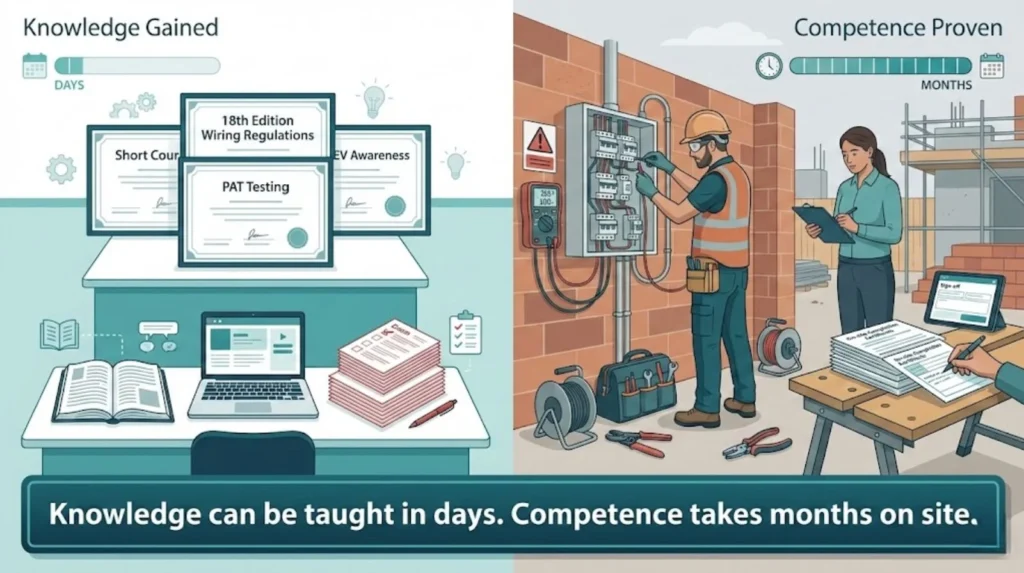
Short electrical courses lasting one to five days dominate online training advertising, aggressive social media marketing, and career change promotional content targeting working adults seeking rapid entry into electrical trades without abandoning current employment or investing years in qualification pathways, with providers marketing intensive weekend workshops, evening intensive blocks, and compressed delivery promising substantial skill development and career advancement in days rather than months or years required for traditional electrical qualifications.
The appeal is immediate and powerful. Complete 18th Edition BS 7671 wiring regulations course in three days gaining certificate with “Level 3” designation creating impression of advanced qualification achievement. Add two-day PAT testing course, weekend domestic installer package, perhaps EV charge point awareness workshop, accumulate collection of certificates from recognized awarding bodies like City & Guilds demonstrating initiative, professional development commitment, and electrical knowledge acquisition whilst maintaining full-time employment and regular income throughout.
Marketing language reinforces progression narrative using phrases like “professional electrician training,” “fast-track electrical qualifications,” “career change pathway,” “industry-recognized certification,” “employer-valued credentials” creating impression these short courses either constitute complete qualification pathway themselves or represent modular building blocks stacking toward qualified electrician status through accumulated achievements over manageable timeframe compatible with working adult constraints.
However, fundamental gap exists between short course marketing narratives and actual qualification requirements for electrician work in UK, with critical distinction between supplementary specialist training (legitimate short course value) versus foundational competence assessment (cannot be delivered in days regardless of intensity) creating expensive traps where learners invest thousands of pounds accumulating certificates that neither progress them toward NVQ Level 3 and AM2 requirements nor enable electrical employment despite impressive-sounding course titles and recognized awarding body certifications.
The accumulation trap manifests when career changers spend £1,500-£3,000 collecting short courses—18th Edition, PAT testing, domestic installer package, EV awareness, perhaps inspection and testing—believing these combine into electrician credentials or at minimum demonstrate substantial qualification progress to employers. Discovery comes through job application rejections when “qualified electrician” positions require NVQ Level 3, AM2 pass, and ECS Gold Card that short course collections cannot satisfy, or when attempting ECS card application and learning accumulated certificates don’t meet competence verification requirements regardless of how many certificates or how much investment.
The advanced-course-too-early trap catches improvers and ambitious beginners who invest £800-£1,200 in City & Guilds 2391 Inspection and Testing believing advanced certification accelerates qualification pathway, discovering too late they lack foundational knowledge making course content incomprehensible, fail examinations or barely pass without genuine understanding, then cannot apply qualification without NVQ competence they don’t hold making expensive certification worthless for employment purposes.
Short electrical courses have legitimate, valuable applications—qualified electricians maintaining regulatory currency through 18th Edition updates, adding specialist capabilities like EV charge point installation expanding business opportunities, updating knowledge on emerging technologies like solar PV and battery storage. For complete beginners or diploma holders without workplace competence, these same courses represent expensive dead-end spend purchasing knowledge they cannot legally apply or certificates that don’t progress qualification pathway despite appearing to demonstrate professional development commitment.
This article clarifies what short electrical courses legitimately deliver (focused knowledge transfer, specialist awareness, regulatory updates) versus what they cannot replace (NVQ workplace competence, AM2 independent assessment, qualified electrician credentials), identifies course-by-course value propositions for different learner starting points, exposes common accumulation and advanced-too-early traps, explains regulated versus non-regulated course distinction affecting industry recognition, provides verification checklist preventing expensive mistakes, and prevents misconceptions about short courses constituting pathways to qualified status when actually they’re supplementary to qualification requirements not substitutes for them.
What Short Courses Actually Deliver vs What Marketing Implies
Understanding realistic short course capabilities prevents expensive misunderstandings about qualification pathways.
What Short Courses Legitimately Deliver
Focused knowledge transfer on specific topics:
Wiring regulations updates (18th Edition BS 7671)
Specialist equipment operation (EV charge points, solar PV systems)
Safety compliance procedures (PAT testing, emergency lighting)
Advanced testing methodologies (inspection and testing, fault diagnosis)
Regulatory requirement awareness (Part P, building regulations)
Delivery characteristics:
Compressed timeframe: 1-5 days contact hours
Classroom or online teaching formats
Focused curriculum on single subject area
Examination or assessment at completion (if regulated)
Certificate issued upon successful completion
What short courses enable:
Knowledge acquisition on specific technical topics
Awareness of specialist equipment or procedures
Regulatory compliance updates for qualified professionals
CPD (Continuing Professional Development) evidence
Specialist capability addition for established electricians
What Short Courses Absolutely Cannot Deliver
Workplace competence verification:
NVQ Level 3 requires 12-24 months portfolio evidence from real installations
Cannot be simulated in classroom over days regardless of intensity
Assessors must observe sustained performance in actual workplace
Portfolio breadth demands diverse project types over extended timeline
Short courses provide knowledge without competence assessment
Independent practical assessment:
AM2 examination is 2.5-day practical test after NVQ completion
Requires substantial site experience before successful completion likely
Tests installation speed, testing accuracy, fault-finding, independent work
Approximately 70-85% pass rate indicates rigorous standards
Short courses don’t prepare for or substitute AM2 assessment
Qualified electrician credentials:
ECS Gold Card requires NVQ Level 3 + AM2 + 18th Edition + health/safety assessment
Cannot be obtained through short course accumulation regardless of quantity
Represents complete qualification pathway verification
Employers and construction sites recognize Gold Card as qualified status proof
Short courses contribute regulatory updates (18th Edition) but don’t replace competence requirements
Employment readiness for electrical work:
Unsupervised electrical installations require proven competence (NVQ + AM2)
Employers hiring “qualified electricians” demand complete credentials
Mate or improver positions may accept knowledge qualifications (diplomas)
Short course certificates alone rarely satisfy employment requirements
Exception: specialist additions for already-qualified electricians
What Marketing Language Often Implies (Without Explicitly Stating)
“Professional Electrician Training”:
Implies: Complete pathway to professional electrician status
Reality: Professional development for existing electricians, or awareness for beginners
“Fast-Track Electrical Qualification”:
Implies: Condensed route to qualified status in weeks
Reality: Single qualification certificate, not complete electrician credentials
“Industry-Recognized Certification”:
Implies: Employers recognize this as qualification for electrical work
Reality: Awarding body is recognized, but certificate doesn’t prove competence
“Career Change Pathway”:
Implies: Route from current career into electrical work
Reality: May be first step, but years of additional training required
“Employer-Valued Credentials”:
Implies: Improves employment prospects for electrical positions
Reality: Valued as supplement for qualified electricians, insufficient alone for beginners
The Critical Distinction:
Short courses deliver knowledge (understanding of topics, awareness of procedures, regulatory information).
Electrician qualifications require knowledge (achievable via short courses or diplomas) PLUS competence (provable only through NVQ workplace portfolio and AM2 independent assessment over 12-24+ months).
Knowledge without competence = Cannot work as electrician Knowledge + Competence = Qualified electrician status
Short courses provide the knowledge component efficiently but cannot provide competence component regardless of quality, intensity, or awarding body recognition.
Course-by-Course Value Analysis: Who Benefits, Who Wastes Money
Different short courses serve different purposes with value highly dependent on learner’s starting qualification level.
18th Edition BS 7671 Wiring Regulations (3-5 Days)
What it covers:
Current UK wiring regulations (BS 7671:2018+A2:2022)
Protective measures and earthing arrangements
Special locations (bathrooms, swimming pools, medical locations)
Regulation navigation and application to installation scenarios
Updates from previous editions (for qualified electricians maintaining currency)
Assessment: Open-book examination, typically 2 hours, multiple choice and scenario questions.
Regulated: Yes, City & Guilds 2382-22, EAL equivalent, Ofqual-registered.
Cost: £300-£600 including examination.
Who benefits:
Qualified electricians updating from 17th Edition (mandatory for continued work)
Improvers with Level 3 Diploma needing regulatory knowledge for NVQ
Electrical contractors ensuring staff compliance
Assessors and supervisors maintaining professional currency
Who wastes money:
Complete beginners with no electrical foundation (content assumes prior knowledge)
Career changers believing this alone enables electrical work
Learners thinking “Level 3” on certificate means Level 3 qualified electrician
Anyone expecting this to replace NVQ or diploma requirements
Employment impact:
Essential for all working electricians (Gold Card requirement)
Strengthens applications when combined with NVQ + AM2
Insufficient alone for any electrical employment
Employers expect 18th Edition alongside complete qualifications, not instead of them
Why marketing creates confusion: Certificate states “Level 3” and course completes in 3-5 days creating impression substantial qualification achieved rapidly. Reality: it’s regulations knowledge only, essential but supplementary to installation competence.
Inspection & Testing (City & Guilds 2391-52 or Equivalent, 3-5 Days)
What it covers:
Initial verification testing procedures
Periodic inspection and testing methodology
EICR (Electrical Installation Condition Report) preparation
Coding defects (C1, C2, C3, FI classification)
Testing equipment operation and results interpretation
Assessment: Written examination and practical testing exercises.
Regulated: Yes, Ofqual-registered qualification.
Cost: £800-£1,200.
Prerequisites: Substantial electrical knowledge (Level 3 Diploma minimum), preferably installation experience.
Who benefits:
Qualified electricians expanding into inspection work
Experienced improvers building NVQ evidence
Contractors developing supervisory capabilities
Electricians pursuing higher-level certifications
Who wastes money:
Complete beginners without foundational electrical knowledge
Learners who’ve only completed Level 2 Diploma
Anyone without testing equipment access or experience
Career changers expecting this accelerates qualification pathway
Thomas Jevons, Head of Training:
"Inspection and testing short courses—City & Guilds 2391 or equivalent—frequently attract improvers who believe this advanced certification will accelerate their pathway to qualified status. The problem is these courses assume substantial prior knowledge and experience that beginners don't have. You need to understand circuit design, protection coordination, earthing arrangements, testing equipment operation, fault diagnosis, BS 7671 requirements in considerable depth before inspection and testing content makes sense. Without foundation, you'll struggle with complex testing sequences, results interpretation, coding decisions for EICR certificates. Learners pay £800 to £1,200 for inspection and testing courses, fail the examination or barely pass without proper understanding, then discover the qualification is worthless without NVQ competence to apply it. This is expensive mistake—completing advanced short courses without adequate foundation doesn't skip qualification steps, it wastes money on content you're not ready to learn effectively."
Thomas Jevons, Head of Training
Employment impact:
Valuable addition for qualified electricians seeking inspection contracts
Insufficient alone without NVQ + AM2 + ECS Gold Card
Some employers require for senior electrician positions
Cannot replace foundational qualifications despite “advanced” designation
PAT Testing (Portable Appliance Testing, 1-2 Days)
What it covers:
Portable electrical equipment safety inspection
Visual examination procedures
Electrical testing using PAT testing equipment
Record keeping and labeling requirements
Frequency of testing for different equipment types
Assessment: Often non-assessed attendance certificate, some providers offer City & Guilds 2377 regulated version.
Regulated: Depends—verify if City & Guilds 2377 or non-regulated in-house certificate.
Cost: £200-£500.
Who benefits:
Facilities maintenance workers adding safety compliance skill
Electricians offering PAT testing services to existing clients
H&S officers needing equipment testing capability
Property managers maintaining compliance
Who wastes money:
Beginners believing this represents electrical qualification
Career changers thinking PAT testing leads to electrician work
Anyone expecting this contributes to NVQ portfolio evidence
Learners paying for non-regulated version when cheaper alternatives exist
Employment impact:
Useful for facilities maintenance and H&S roles
Minimal value for electrician career progression
Separate skill from electrical installation work
Employers may request as additional capability, not primary qualification
Why it’s oversold: Marketed as “electrical training” creating impression it’s part of electrician qualification pathway when actually it’s narrow equipment testing skill separate from installation work.
EV Charge Point Installation (1-3 Days)
What it covers:
EV charging technology overview
Installation requirements and regulations
Testing and commissioning procedures
Building regulations compliance (Part P)
Grant scheme requirements
Assessment: Varies by provider, some offer practical assessment.
Regulated: Not always—some are awareness courses, others are NAPIT/NICEIC recognized training.
Cost: £400-£800.
Prerequisites: CRITICAL—Must be qualified electrician to legally install EV charge points.
Who benefits:
Qualified electricians expanding into EV installation market
Electrical contractors adding service offerings
Gold Card holders seeking specialist income streams
Established businesses diversifying
Who wastes money:
Complete beginners who cannot legally install charge points
Diploma holders without NVQ competence
Anyone without ECS Gold Card
Learners believing this enables electrical work without prior qualifications
Employment impact:
Excellent addition for qualified electricians (growing market, premium rates)
Completely useless for non-qualified learners (cannot install without qualified status)
Employers offering EV installation seek qualified electricians with EV training, not EV training alone
Major marketing problem: Advertised without clear prerequisite disclosure, attracting beginners who pay £400-£800 for knowledge they cannot legally apply.
Solar PV Installation Awareness (1-3 Days)
What it covers:
Solar photovoltaic system components
Installation principles and best practices
MCS (Microgeneration Certification Scheme) requirements
Battery storage integration
Maintenance and commissioning
Assessment: Usually awareness-level, not formally assessed.
Regulated: Typically no, awareness training.
Cost: £300-£600.
Prerequisites: Qualified electrician status for actual installation work.
Who benefits:
Qualified electricians entering renewable energy market
Electrical contractors assessing solar PV viability
Maintenance electricians supporting solar installations
Gold Card holders exploring green technology opportunities
Who wastes money:
Beginners without electrical qualifications
Diploma holders believing this enables solar work
Anyone expecting employment without NVQ + AM2
Learners thinking renewable energy shortcuts qualification requirements
Employment impact:
Valuable specialism for qualified electricians (expanding market)
Insufficient alone for employment in solar installation
Employers seek qualified electricians with solar knowledge, not solar knowledge alone
Domestic Installer Packages (3-10 Days, Various Providers)
What it covers (varies significantly):
Basic electrical theory (condensed)
Domestic installation overview
Testing procedures introduction
Part P Building Regulations awareness
Sometimes includes 18th Edition
Assessment: Varies—some regulated components, some in-house only.
Regulated: Mixed—components may be regulated (18th Edition), overall package often not.
Cost: £1,500-£3,000 for “complete” packages.
Who benefits:
Possibly useful as awareness before committing to Level 2 Diploma
May suit learners testing electrical career interest
Could provide foundation knowledge for mate positions
Who wastes money:
Anyone expecting this enables unsupervised domestic electrical work
Learners believing this equals qualified electrician status
Career changers thinking this alone enables employment
Anyone not planning immediate progression to full NVQ pathway
Employment impact:
Rarely sufficient for employment as domestic electrician
May help secure electrical mate position with some employers
Does not satisfy Competent Person Scheme registration requirements alone
Employers typically prefer Level 2/3 Diploma holders or apprentices
Marketing problem: Packages marketed as “Domestic Electrician Course” or “Become a Domestic Installer” implying complete qualification when actually it’s condensed awareness insufficient for unsupervised work or scheme registration.
Introductory “Taster” Courses (1-3 Days)
What it covers:
Very basic electrical principles
Safety awareness
Tool familiarization
Career pathway overview
Workshop introduction
Assessment: None, attendance certificate only.
Regulated: No.
Cost: £150-£400.
Who benefits:
Complete beginners testing career interest before major investment
School leavers exploring electrical trades
Career changers wanting exposure before commitment
Anyone needing clarity on qualification pathways
Who wastes money:
Anyone expecting qualification progress or credentials
Learners believing this contributes to electrician pathway
Career changers paying premium prices for basic awareness
Employment impact:
Zero—purely awareness level
May help inform decision about pursuing electrical training
No employer recognition or credential value
Appropriate use: Cheap exploration before committing thousands to diplomas, not marketed as qualification component.
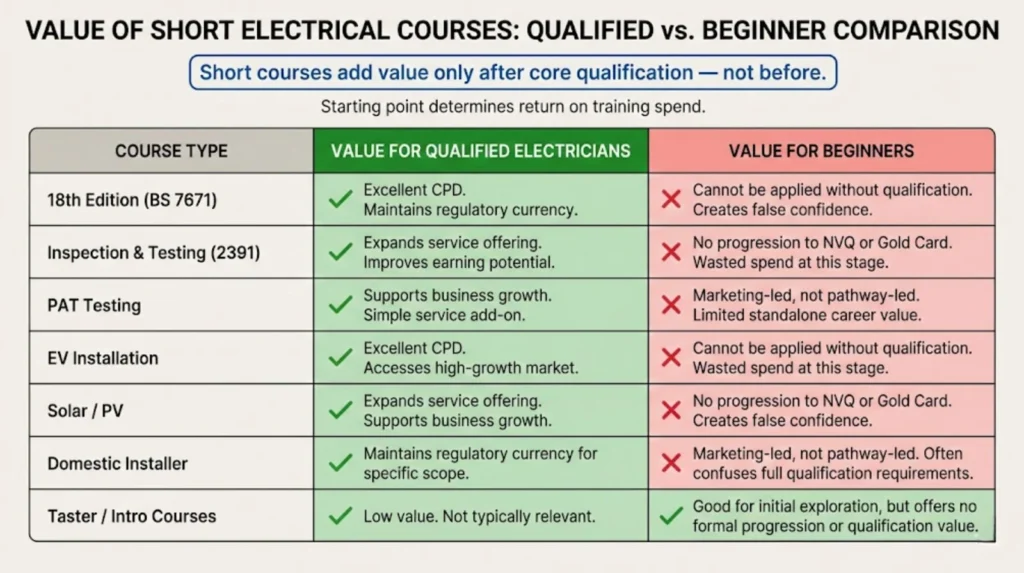
| Course Type | Duration | Cost | Ideal For | Wasted On | Employment Value |
| 18th Edition | 3-5 days | £300-£600 | Qualified electricians updating | Complete beginners | Essential for qualified, useless for non-qualified |
| Inspection & Testing | 3-5 days | £800-£1,200 | Experienced improvers/qualified | Beginners, Level 2 only | Valuable addition for qualified, premature for others |
| PAT Testing | 1-2 days | £200-£500 | Facilities staff, side income | Career changers expecting electrician progression | Useful for specific roles, not electrician pathway |
| EV Charge Points | 1-3 days | £400-£800 | Qualified electricians only | Anyone not yet qualified | Excellent for qualified, useless without qualifications |
| Solar PV | 1-3 days | £300-£600 | Qualified electricians | Non-qualified learners | Valuable specialism for qualified, wasted otherwise |
| Domestic Installer | 3-10 days | £1,500-£3,000 | Testing interest before diploma commitment | Expecting it enables unsupervised work | Limited, possibly helps secure mate role |
| Intro Tasters | 1-3 days | £150-£400 | Exploring before committing | Expecting credential value | None, pure awareness |
Understanding complete electrical qualification pathways in UK includes recognizing short courses as supplements to NVQ and AM2 requirements, not substitutes for them, regardless of awarding body recognition or course titles.
The Accumulation Trap: Why Multiple Short Courses Don't Stack Into Qualifications
One of most expensive misconceptions surrounding short electrical courses is belief they combine into qualification pathway.
The Modular Pathway Myth
Career changers and working adults attracted to short courses often conceptualize qualification building as modular accumulation:
Complete 18th Edition → Gain regulations knowledge
Add PAT testing → Acquire equipment testing skills
Include domestic installer package → Learn installation basics
Finish with EV charging → Add modern technology capability
Result: Collection of certificates demonstrating comprehensive electrical knowledge
The logic appears sound: Each course from recognized awarding body, each covers legitimate electrical topic, combined investment £1,500-£3,000 represents substantial commitment, accumulated certificates create impressive portfolio demonstrating initiative and professional development, total knowledge spans regulations, testing, installation, and specialist equipment.
The reality is devastating:
Joshua Jarvis, Placement Manager:
"We see expensive pattern where career changers spend £1,500 to £3,000 accumulating short courses—18th Edition, PAT testing, domestic installer package, maybe EV awareness—believing they're building toward qualification through modular approach. After several courses totaling thousands of pounds, they discover these don't combine into electrician credentials, don't contribute to NVQ portfolio evidence, don't enable ECS card application, don't satisfy employer requirements for qualified positions. Each individual course might be legitimate regulated qualification, but they don't stack into pathway to qualified status because electrician credentials require NVQ workplace competence assessment and AM2 independent examination, neither of which short courses provide or substitute for. This isn't fraud—providers clearly state what each course delivers if you read carefully—but marketing emphasis on 'professional development' and 'career advancement' creates impression pathway exists when actually you're accumulating certificates with no progression route to the qualification employers actually require."
Joshua Jarvis, Placement Manager
Why Short Courses Don't Stack Into Qualifications
Reason 1: Knowledge vs Competence Fundamental Difference
Short courses deliver knowledge (understanding topics through teaching and examination).
Electrician qualifications require competence (proving workplace capability through portfolio evidence and practical assessment).
Accumulating knowledge certificates doesn’t create competence evidence because:
Knowledge is assessed through exams in training centers
Competence is assessed through portfolio from real workplace installations
No amount of classroom knowledge substitutes for 12-24 months site experience
NVQ assessors must observe sustained performance in actual employment
Reason 2: NVQ Portfolio Requirements Cannot Be Met by Coursework
NVQ Level 3 requires:
Photographic evidence of diverse installations completed on construction sites or customer properties
Electrical certificates from work signed off by qualified supervisor
Assessor observations visiting workplace
Professional discussions demonstrating application understanding
Coverage spanning multiple installation types over extended period
Short courses provide:
Classroom attendance certificates
Knowledge examination results
Theoretical understanding without workplace application
No assessor workplace observations
No installation evidence from real projects
Reason 3: AM2 Assessment Requires Site Experience, Not Course Accumulation
AM2 examination tests:
Installation speed meeting commercial productivity standards (not classroom pace)
Testing procedures under time pressure (not unlimited practice time)
Fault-finding from pattern recognition developed through diverse site problems (not standardized training scenarios)
Independent work without instructor guidance (not supervised classroom practice)
Successfully completing requires 12-18 months site experience after diploma. Accumulating short courses provides theoretical knowledge but doesn’t develop installation speed, commercial work habits, or problem-solving patterns necessary for AM2 success.
Reason 4: ECS Gold Card Requirements Are Specific, Not Modular
ECS Gold Card requires:
NVQ Level 3 Electrical Installation (specific qualification, not collection of courses)
AM2 assessment pass (independent practical examination, not classroom certificates)
18th Edition BS 7671 current (this IS short course, but insufficient alone)
ECS Health, Safety and Environmental Assessment
Cannot substitute course accumulation for NVQ regardless of how many certificates or total investment. JIB verifies specific qualifications with awarding bodies; impressive certificate collection doesn’t satisfy verification if required qualifications missing.
Real-World Outcome Pattern
Month 1-3: Learner completes 18th Edition (£400), feels accomplished with “Level 3” certificate, believes substantial progress made.
Month 4-6: Adds PAT testing (£300) and domestic installer package (£1,800), total investment £2,500, has three certificates from City & Guilds.
Month 7-9: Completes EV awareness (£500), total investment £3,000, portfolio of four recognized certificates spanning regulations, testing, domestic installation, modern technology.
Month 10: Applies for electrical positions:
“Qualified Electrician” ads reject: “We need NVQ Level 3 and Gold Card”
“Electrical Improver” ads reject: “We prefer Level 3 Diploma or apprentices”
“Electrical Mate” ads may interview but offer lower wages than expected
Month 11: Attempts ECS card application:
Discovers Gold Card requires NVQ + AM2, neither of which accumulated courses satisfy
Learns must complete 12-24 month NVQ portfolio in employment
Realizes £3,000 invested hasn’t progressed qualification pathway at all
Month 12+: Either:
Abandons electrical career, £3,000 becomes total loss
Enrolls in Level 2 Diploma starting qualification pathway properly, essentially beginning from scratch after £3,000 preliminary spend
Secures electrical mate position at entry wages, must still complete full qualification pathway (diplomas → NVQ → AM2) over next 2-3 years
Why Providers Allow This Pattern
Short course delivery is profitable:
Quick delivery (days not months)
Scalable (online or large classes)
Repeat customers (multiple courses)
Regulated certificates provide legitimacy
Individual course descriptions technically accurate
Provider business model often profits from course sales regardless of learner outcomes:
Revenue from multiple course enrollments
No employment guarantees or pathway completion tracking
Marketing emphasizes what courses cover, minimizes what they don’t enable
Learners discover limitation through employment rejection, too late for recourse
Prevention Strategy
Before accumulating short courses, verify with employers or qualified electricians:
“Will these specific certificates enable electrical employment?”
“Do these contribute to NVQ Level 3 portfolio evidence?”
“Can I apply for ECS Gold Card with these qualifications?”
Honest answers prevent expensive accumulation discovering too late certificates don’t stack into electrician credentials regardless of quantity or investment.
Regulated vs Non-Regulated: Critical Distinction for Course Value
Not all short electrical courses carry equal industry recognition or transferable value.
Ofqual-Regulated Qualifications
Characteristics:
Appear on Ofqual Register of Regulated Qualifications
Have unique qualification number (e.g., 603/3319/4 for City & Guilds 2382-22)
Awarded by recognized bodies (City & Guilds, EAL, LCL Awards)
Assessed to national standards
External quality assurance
Transferable across employers
Examples:
City & Guilds 2382-22 (18th Edition BS 7671)
City & Guilds 2391-52 (Inspection and Testing)
City & Guilds 2377 (PAT Testing)
EAL equivalents of above
Any qualification with Ofqual reference number
Verification method:
Visit register.ofqual.gov.uk
Search qualification title or number
Confirm awarding organization
Verify qualification is live (not withdrawn)
Industry value:
JIB recognizes for ECS card applications (where relevant)
Employers accept as legitimate credentials
Competent Person Schemes recognize for registration requirements
Insurance providers accept for professional indemnity
Maintains value if changing employers
Non-Regulated Training Certificates
Characteristics:
Provider-issued attendance certificates
No Ofqual registration or qualification number
May claim “accreditation” from non-official bodies
Often cheaper or more flexible delivery
Quality varies dramatically
Limited transferability
Examples:
In-house “Domestic Installer” certificates
Provider-branded “Professional Electrician” courses
Unregulated EV awareness sessions
General electrical “training certificates”
Attendance-only confirmations
Warning signs:
Cannot provide Ofqual qualification number
Claims “equivalent to” regulated qualifications
Mentions “accreditation” from unfamiliar bodies
Significantly cheaper than regulated versions
Vague about assessment requirements
Industry value:
Minimal recognition by major employers
Not accepted for ECS card applications
Insufficient for Competent Person Scheme registration
Insurance providers may reject
Limited evidence for professional competence
The “Accreditation” Confusion
Providers often claim courses are “accredited” creating impression of official regulation.
Types of accreditation:
Ofqual regulation (official, valuable): Qualification meets national standards, appears on Ofqual register, recognized by JIB/ECS
Awarding body approval (legitimate, limited scope): Provider approved to deliver specific qualifications, but doesn’t make all their courses regulated
Trade body membership (professional association): Provider member of ECA, NAPIT, NICEIC doesn’t automatically mean courses regulated
In-house “accreditation” (meaningless): Provider creates own certification without external validation
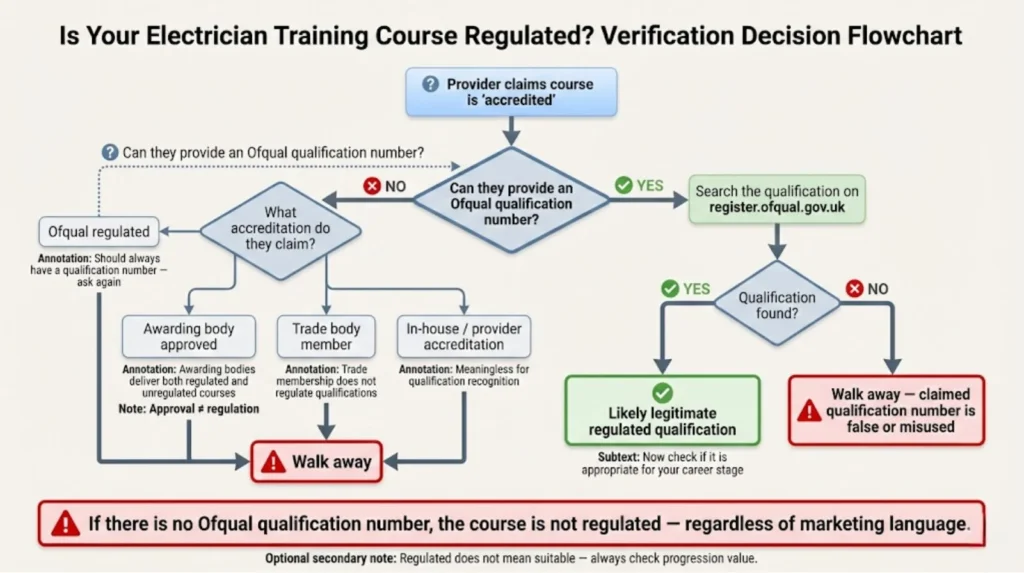
Critical question: “Is this qualification Ofqual-regulated with a qualification number I can verify on the Ofqual register?”
If answer is no or provider deflects to other “accreditations,” certificate likely has minimal industry value regardless of impressive language describing provider credentials.
Cost Doesn’t Indicate Quality or Recognition
Expensive non-regulated courses can cost more than cheaper regulated alternatives:
Provider overheads and marketing costs
Smaller class sizes or premium delivery
Included materials or equipment
Intensive scheduling or flexible timing
Paying £1,500 for non-regulated domestic installer package doesn’t make it more valuable than £400 regulated 18th Edition course. Always verify Ofqual registration before assuming price indicates quality or recognition.
Regulated Doesn’t Guarantee Appropriateness
Even Ofqual-regulated courses can be inappropriate investments:
18th Edition is regulated but useless for complete beginners
Inspection & Testing is regulated but premature without foundation
PAT testing is regulated but doesn’t progress electrician pathway
EV charging may be regulated but requires existing qualified status
Verify course is both regulated AND appropriate for your qualification level and career goals.
Verification Checklist Before Payment
Get qualification number: Ask provider for exact Ofqual qualification number
Search Ofqual register: Verify qualification exists and is live at register.ofqual.gov.uk
Confirm awarding organization: Check it’s City & Guilds, EAL, or LCL Awards (major electrical bodies)
Read qualification details: Understand what assessment involves (examination, practical, portfolio)
Verify prerequisites: Confirm you meet entry requirements before enrolling
Check ECS recognition: If relevant, verify JIB accepts this for card applications
Assess progression route: Ask how this contributes to NVQ pathway specifically
If provider cannot or will not provide Ofqual qualification number for verification, walk away regardless of marketing claims about “industry recognition” or “professional accreditation.”
Employment Reality: What Employers Actually Want vs Short Course Certificates
Understanding employer requirements prevents expensive misalignment between qualifications held and jobs available.
Employer Requirements for Different Electrical Positions
Qualified Electrician Positions (£30,000-£50,000):
Mandatory requirements:
NVQ Level 3 Electrical Installation
AM2 or AM2E assessment pass
ECS Gold Card (or equivalent JIB grading)
18th Edition BS 7671 current
Often 2+ years post-qualification experience
Beneficial additions (short courses):
Inspection & Testing (City & Guilds 2391)
EV charge point installation
Solar PV awareness
Emergency lighting, fire alarms
Specific industry sector experience
Not acceptable substitutes:
Collections of short courses without NVQ
Diploma qualifications alone
Non-regulated certificates
“Domestic installer” packages
Knowledge qualifications without competence assessment
Electrical Improver Positions (£25,000-£35,000):
Typical requirements:
Level 3 Diploma in Electrical Installation
Working toward NVQ Level 3
18th Edition desirable
Some site experience preferred
Full UK driving license often required
Beneficial additions:
18th Edition already completed
Any prior construction site exposure
Basic testing knowledge
Health and safety awareness
Not sufficient:
Short courses alone without diploma foundation
Just 18th Edition without Level 2/3 knowledge
Non-regulated training certificates
Multiple short courses instead of diploma
Electrical Mate Positions (£20,000-£28,000):
Typical requirements:
Level 2 Diploma or equivalent knowledge
Willingness to learn and develop
Basic electrical understanding
Physical capability for site work
Reliable attendance and transport
Possibly acceptable:
Some employers accept short course awareness
Domestic installer packages might demonstrate interest
Strong work ethic sometimes valued over qualifications
Transferable construction experience
Still preferred:
Level 2 Diploma over short course collection
Apprentices or those enrolling in NVQ
Candidates with clear progression commitment
Those with provider placement support
Specialist Electrical Roles (EV Installation, Solar PV, etc.):
Always require:
Qualified electrician status FIRST (NVQ + AM2 + Gold Card)
THEN specialist short course addition
Cannot access specialist roles via specialist course alone
Pattern: Employers hire qualified electricians who have EV training, not EV training holders hoping to become electricians through specialist work.
Job Advertisement Language vs Actual Requirements
Advertisement states: “Electrician required, 18th Edition essential, EV experience beneficial”
What they actually want:
Qualified electrician (NVQ + AM2 + Gold Card)
With current 18th Edition
EV experience is bonus, not substitute for qualifications
Advertisement states: “Electrical Improver, Level 3 qualification, immediate start”
What they actually want:
Level 3 Diploma holder working toward NVQ
Not Level 3 short course certificate holder
“Level 3” refers to diploma depth, not short course level designation
Advertisement states: “Domestic Installer, Part P required, good rates”
What they actually want:
Competent Person Scheme registered electrician
Usually requires NVQ competence or equivalent assessment
“Part P course” alone rarely sufficient for legitimate domestic work
Why Short Course Collections Get Rejected
From employer perspective:
Competence unproven: Short courses show knowledge acquisition, not workplace capability
Insurance requirements: Professional indemnity requires NVQ competence verification
Productivity expectations: Need electricians working at commercial speeds, not classroom-trained theorists
Quality assurance: NVQ + AM2 provides confidence in work quality
Site access: Major projects require ECS Gold Card, not certificate collections
Supervision burden: Hiring unqualified requires constant oversight reducing productivity
Liability concerns: Unsupervised work by non-qualified creates significant legal risks
From recruiter feedback patterns:
"We get many applications from people with multiple short courses but no NVQ—they don't understand these aren't qualifications for electrical work."
"18th Edition certificate on CV without NVQ or diploma is red flag showing they don't know qualification requirements."
"Short course collections suggest someone trying to shortcut the proper pathway—we prefer apprentices who understand the commitment required."
"Domestic installer certificates are marketing courses, not proper qualifications—we need Level 3 Diploma minimum for improver roles."
What Actually Improves Employment Prospects
For complete beginners:
Level 2 Diploma → Level 3 Diploma → Electrical Mate position → NVQ Level 3 → Qualified employment
NOT short course accumulation hoping for employment opportunities
For diploma holders:
Securing mate/improver position (with provider placement support)
Completing NVQ Level 3 during employment
Passing AM2 assessment
Obtaining ECS Gold Card
THEN adding short course specialists
For qualified electricians:
Maintaining 18th Edition currency (mandatory)
Adding EV charge point installation (expanding market)
Completing solar PV awareness (green technology opportunities)
Advanced Inspection & Testing (supervisory roles)
Specialist sector training (industrial, commercial, specific systems)
Short courses enhance employment when you’re already qualified. They rarely create employment when you’re not qualified regardless of how many certificates accumulated.
Understanding realistic UK electrical training and employment pathways includes recognizing employer requirements focus on NVQ competence and AM2 assessment, with short courses as valuable additions for qualified professionals but insufficient substitutes for foundational qualifications regardless of course quantity or impressive certificate collections.
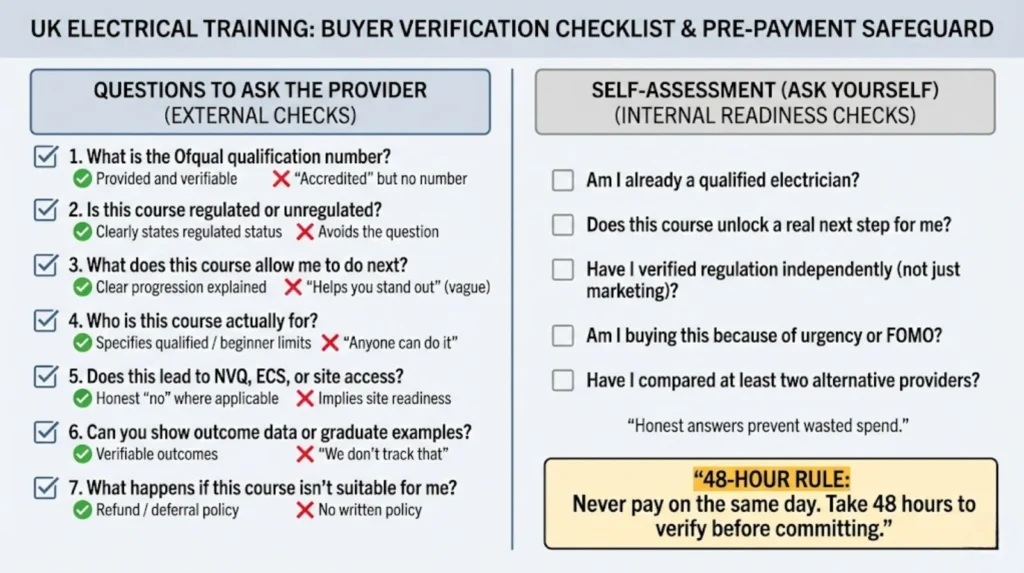
Buyer's Checklist: Questions to Ask Before Enrolling in Any Short Course
Preventing expensive mistakes requires verification before payment, not disappointment after completion.
Essential Questions for Provider
Question 1: “What is the exact Ofqual qualification number for this course?”
Acceptable answers:
Provides specific number (e.g., 603/3319/4)
Directs you to Ofqual register listing
Gives qualification title and awarding organization verifiable on register
Red flag answers:
“We’re accredited but not Ofqual regulated”
“Our qualifications are equivalent to Ofqual”
“You don’t need Ofqual regulation for this”
Cannot provide qualification number
Deflects to other “accreditations”
Action: If no Ofqual number, assume minimal industry recognition regardless of provider claims.
Question 2: “What are the prerequisites for this course, and am I appropriately qualified?”
Acceptable answers:
Clear prerequisite statement (e.g., “Requires qualified electrician status” or “Suitable for Level 3 Diploma holders”)
Honest assessment of your readiness
Recommendations for foundation courses if you’re not ready
Red flag answers:
“Anyone can take this course”
“No prerequisites needed” (for advanced topics like Inspection & Testing)
Encourages enrollment despite you lacking foundation
Minimizes importance of prior knowledge
Action: If advanced course marketed to beginners, provider prioritizes sales over learner success.
Question 3: “How does this specific course contribute to NVQ Level 3 portfolio or progression toward ECS Gold Card?”
Acceptable answers:
Explains exactly which NVQ units it supports (if applicable)
States it’s CPD for qualified electricians, not NVQ pathway component
Clarifies it’s awareness/introduction, not qualification progress
Honest about limitations for qualification pathway
Red flag answers:
Vague claims about “professional development”
“Employers value these skills” without NVQ connection
“This helps your overall progression” (non-specific)
Cannot explain exact qualification pathway contribution
Action: If provider can’t explain precise progression route, course likely doesn’t contribute to electrician qualifications.
Question 4: “What percentage of your learners who complete this course go on to work as electricians, and how long does it typically take?”
Acceptable answers:
Honest employment outcome data
Realistic timelines (years, not weeks)
Clarifies this course is part of longer pathway
Provides verifiable graduate references
Red flag answers:
“We don’t track employment outcomes”
“Most of our learners are very successful” (vague)
“You can start earning immediately” (unrealistic)
Refuses to provide outcome statistics
Action: Providers confident in learner outcomes share data transparently.
Question 5: “Can I speak with recent graduates who completed this course and now work as electricians?”
Acceptable answers:
Provides contact details for references
Connects you with alumni network
Offers testimonials with verifiable credentials
Happy to facilitate graduate conversations
Red flag answers:
“We can’t share contact details for privacy” (convenient excuse)
Only provides testimonials from people still in training
References are suspiciously enthusiastic without specific details
Refuses reference requests entirely
Action: Legitimate courses have satisfied graduates willing to share experiences.
Question 6: “What exactly does the certificate state, and can I see a sample?”
Acceptable answers:
Shows sample certificate clearly
Certificate states “Achievement” (assessed qualification)
Awarding body and qualification number visible
Clear about scope and limitations
Red flag answers:
Certificate states “Attendance” only
Provider-branded certificate without awarding body
Vague wording about “completion of training”
Refuses to show sample before enrollment
Action: Attendance certificates have minimal value compared to achievement qualifications.
Question 7: “What is your refund policy if I’m unable to complete or fail the assessment?”
Acceptable answers:
Clear written refund terms
Reasonable cancellation period
Transparent about non-refundable components
Standard consumer protection compliance
Red flag answers:
No refunds under any circumstances
Vague or verbal-only policies
Complicated conditions making refunds impossible
Aggressive enrollment pressure citing “limited spaces”
Action: Legitimate providers confident in course value offer reasonable refund terms.
Self-Assessment Questions
Before enrolling, honestly answer:
Am I qualified to take this course?
Do I have prerequisite knowledge?
Can I legally apply these skills?
Is this appropriate for my experience level?
What will I actually be able to do after completing this?
Can I work as electrician?
Can I progress toward NVQ?
Can I apply for ECS card?
Or just gain awareness?
Does this course align with my career goals?
If I want to be electrician, does this progress that pathway?
Or am I accumulating certificates without progression?
Can I verify everything the provider claims?
Ofqual registration?
Employment outcomes?
Graduate success stories?
What happens if this course doesn’t lead where I expect?
Have I researched actual qualification requirements?
Do I have backup plan?
Can I afford the financial loss if it’s dead-end?
Red Flag Summary
Walk away if provider:
Cannot provide Ofqual qualification number
Claims you’ll be “qualified electrician” after short course
Pressures enrollment without time to verify claims
Refuses to answer specific questions about outcomes
Cannot explain NVQ progression route
Has no verifiable graduate employment success
Offers unrealistic timeline promises
Uses aggressive marketing language
Green Flag Summary
Proceed if provider:
Provides Ofqual qualification number freely
Honest about course limitations and prerequisites
Explains precise qualification pathway contribution
Shares employment outcome data transparently
Connects you with successful graduates
Gives realistic timeline expectations
Respects your need to research and verify
When Short Courses Add Value vs When They Waste Money
Summarizing realistic value propositions for short electrical courses across different learner scenarios.
Short Courses Add Genuine Value When:
Scenario 1: Qualified Electrician Maintaining Currency
You hold NVQ Level 3 + AM2 + ECS Gold Card
Taking 18th Edition update (mandatory regulatory compliance)
Value: Essential for continued legal work, £400 well-spent
Outcome: Maintains Gold Card validity, satisfies employer requirements
Scenario 2: Qualified Electrician Adding Specialist Capability
You’re established electrician with 5+ years experience
Taking EV charge point or solar PV course (2-3 days)
Value: Expands business opportunities, premium rate services
Outcome: New income streams, competitive advantage, growing markets
Scenario 3: Experienced Improver Supporting NVQ Portfolio
You’re working electrically with Level 3 Diploma
Taking Inspection & Testing whilst building NVQ evidence
Value: Provides portfolio evidence, advances qualification pathway
Outcome: Contributes to NVQ completion, prepares for AM2
Scenario 4: Complete Beginner Testing Career Interest
You’re considering electrical career but uncertain
Taking 1-day intro taster (£150-£250)
Value: Inexpensive exploration before major commitment
Outcome: Informed decision about pursuing £10,000+ full pathway
Scenario 5: Facilities Worker Adding Compliance Skill
You work building maintenance, not pursuing electrician career
Taking PAT testing course (1-2 days)
Value: Adds specific capability to existing role
Outcome: Equipment testing responsibility, useful skill for current job
Short Courses Waste Money When:
Scenario 1: Beginner Expecting Qualification Progress
You’re complete beginner with no electrical background
Taking 18th Edition believing it progresses electrician pathway
Waste: £400 spent on regulations you cannot apply, no qualification progress
Outcome: Certificate with no employment value, still need diplomas + NVQ + AM2
Scenario 2: Career Changer Accumulating Certificates
You’re office worker wanting electrical career
Collecting 18th Edition + PAT + Domestic Installer (£2,000-£3,000)
Waste: Thousands invested with zero NVQ progression
Outcome: Certificate collection employers don’t recognize as qualification
Scenario 3: Diploma Holder Taking Premature Advanced Course
You’ve completed Level 2 Diploma only
Taking Inspection & Testing (£800-£1,200)
Waste: Content incomprehensible without foundation, likely fail or barely pass
Outcome: Expensive certificate you cannot use without NVQ competence
Scenario 4: Non-Qualified Taking Specialist Course
You’re not qualified electrician
Taking EV charge point installation (£600)
Waste: Cannot legally install charge points without qualified status
Outcome: Knowledge you’re prohibited from applying professionally
Scenario 5: Beginner Expecting Employment from Short Course
You’re unemployed career changer
Taking domestic installer package expecting employment (£2,000)
Waste: Insufficient for employment, doesn’t meet Competent Person Scheme requirements
Outcome: Still need Level 2/3 Diplomas + NVQ for electrical work
Decision Framework
Before enrolling in any short electrical course:
Step 1: Identify your current qualification status
Complete beginner (no electrical qualifications)
Diploma holder (Level 2 or 3 knowledge only)
Improver (working electrically, building NVQ)
Qualified electrician (NVQ + AM2 + Gold Card)
Step 2: Match course to your status
Beginners: Only intro tasters appropriate, all else premature or wasted
Diploma holders: 18th Edition useful if progressing to NVQ, specialists wasteful
Improvers: Supporting courses (I&T) valuable, others case-by-case
Qualified: CPD and specialists excellent value
Step 3: Verify qualification pathway contribution
Ask: “Does this contribute to NVQ portfolio evidence?”
Ask: “Does this help me obtain ECS Gold Card?”
Ask: “Will employers value this given my current qualifications?”
Step 4: Calculate realistic value
Qualified electrician adding EV: £600 course potentially generates £10,000+ annual additional revenue (excellent ROI)
Beginner taking 18th Edition: £400 course generates £0 income, doesn’t progress pathway (zero ROI, pure cost)
Step 5: Verify or walk away
Check Ofqual registration
Verify employment outcomes
Speak with graduates
Assess provider transparency
If anything feels wrong, don’t pay
Critical Reminders
Short courses are supplements, not pathways: They add to existing qualifications, don’t create qualifications from nothing
Multiple short courses don’t stack: £3,000 in certificates doesn’t equal £3,000 of qualification progress toward electrician status
Qualified status comes from NVQ + AM2: Not from any combination of short courses regardless of quantity or quality
Employer requirements are specific: They want NVQ Level 3 and Gold Card, not impressive-sounding certificate collections
Value depends entirely on starting point: Same course can be excellent investment for qualified electrician, complete waste for beginner
Regulated doesn’t mean appropriate: Even Ofqual-registered courses can be wrong choice for your qualification level
Marketing exploits urgency: “Fast-track” and “career change” language targets people wanting quick results, actual pathways take 2-4 years minimum
Contact Elec Training on 0330 822 5337 to discuss whether short courses are appropriate additions to your electrical qualification pathway or whether you need foundational diplomas and NVQ competence assessment first. We provide honest guidance about when short courses add genuine value (qualified electricians maintaining currency and adding specialists) versus when they represent expensive dead-end spend (beginners accumulating certificates hoping these stack into qualification pathway when actually NVQ workplace competence and AM2 independent assessment are non-negotiable requirements that short courses cannot provide or substitute for regardless of course quantity, recognized awarding bodies, or total investment). Our in-house recruitment team with 120+ contractor partnerships focuses on facilitating the workplace access necessary for NVQ completion—the actual pathway to qualified electrician status—rather than selling short courses to learners who cannot use them professionally because they lack the NVQ Level 3 and AM2 credentials employers require and ECS Gold Card applications demand. Whether you’re qualified electrician seeking CPD specialists, diploma holder working toward NVQ, or complete beginner needing pathway clarity, we’ll explain exactly what short courses can and cannot deliver for your specific qualification status preventing expensive mistakes accumulating certificates that don’t progress you toward the electrician credentials UK employers actually recognize and construction sites actually require for access.
References
- Ofqual Register of Regulated Qualifications: https://register.ofqual.gov.uk/
- City & Guilds 2382-22 (18th Edition): https://www.cityandguilds.com/
- City & Guilds 2391-52 (Inspection & Testing): https://www.cityandguilds.com/
- City & Guilds 2377 (PAT Testing): https://www.cityandguilds.com/
- EAL Electrotechnical Qualifications: https://eal.org.uk/
- LCL Awards Electrical Qualifications: https://lclawards.co.uk/
- ECS Card Requirements: https://www.ecscard.org.uk/
- NET Services AM2 Assessment: https://www.netservices.org.uk/am2/
- National Careers Service – Electrician: https://nationalcareers.service.gov.uk/job-profiles/electrician
- IET Electrical Qualifications Guide: https://electrical.theiet.org/
- NAPIT Training Courses: https://www.napit.org.uk/
- ECA Training Guidance: https://www.eca.co.uk/
- Elec Training – Electrician Pathway: https://elec.training/news/how-to-become-an-electrician-in-the-uk-2026/
- Elec Training – Short Course Failures: https://elec.training/news/why-5-16-week-electrician-courses-often-fail-employer-insights/
Note on Accuracy and Updates
Last reviewed: 5 January 2026. This article reflects short electrical course landscape, regulatory status verification requirements, and employment value assessments as of December 2025. Short course market remains highly dynamic with new courses emerging regularly (particularly in green technology areas like EV charging, solar PV, battery storage, heat pumps) whilst foundational qualification requirements (NVQ Level 3, AM2 assessment, ECS Gold Card) remain consistent. Ofqual regulation status can change as awarding bodies update qualifications or withdraw outdated versions (always verify current registration on Ofqual register before enrollment rather than relying on historical information). Provider marketing practices vary from transparent honest disclosure to aggressive mis-selling targeting career changers with unrealistic timeline promises and pathway implications. Course costs (£150-£1,200 per short course depending on type and duration) represent December 2025 market averages but significant provider variation exists with identical courses priced differently based on delivery format, location, and included materials. Employment value assessments (excellent for qualified electricians, wasteful for beginners) remain accurate across qualification levels but specific employer requirements vary by company size, sector focus, and regional demand patterns. The accumulation trap pattern (£1,500-£3,000 spent collecting certificates believing they stack toward qualification) continues affecting career changers annually despite increased awareness because marketing language creates modular pathway impression. Advanced-course-too-early mistakes (Inspection & Testing £800-£1,200 wasted without foundation) occur regularly as improvers attempt accelerating pathways through advanced certifications their knowledge level doesn’t support. Regulated versus non-regulated distinction remains critical with Ofqual-registered courses maintaining industry recognition whilst provider-issued attendance certificates carry minimal employment value regardless of impressive marketing claims or expensive pricing. Learners considering short electrical courses should verify current Ofqual regulation status for specific courses, honestly assess appropriateness given their qualification level, research employment requirements for intended electrical roles, speak with qualified electricians about course value, evaluate provider transparency regarding outcomes and progression routes, and understand NVQ Level 3 workplace competence and AM2 independent assessment represent non-negotiable requirements that no combination of short courses can satisfy or substitute for. We update content as short course market evolves, new specialist areas emerge, regulatory verification requirements change, and employment value patterns shift across different qualification levels and market sectors.
