
The Fastest LEGAL Way to Become an Electrician

- Technical review: Thomas Jevons (Head of Training, 20+ years)
- Employability review: Joshua Jarvis (Placement Manager)
- Editorial review: Jessica Gilbert (Marketing Editorial Team)
- Last reviewed:
- Initial publication
What "Fastest Legal Route" Actually Means
If you’re researching how to become an electrician quickly, you’ve probably seen claims ranging from “qualified in 4 weeks” to “3-4 years minimum.” So what’s the actual fastest legal timeline?
Here’s the uncomfortable truth: the fastest legal route depends entirely on where you’re starting from, and it’s almost certainly longer than the marketing promises suggest.
“Fastest legal” doesn’t mean “shortest classroom course.” It means the quickest pathway from your current position to holding an ECS Gold Card and being legally competent to work as a qualified electrician under UK regulations.
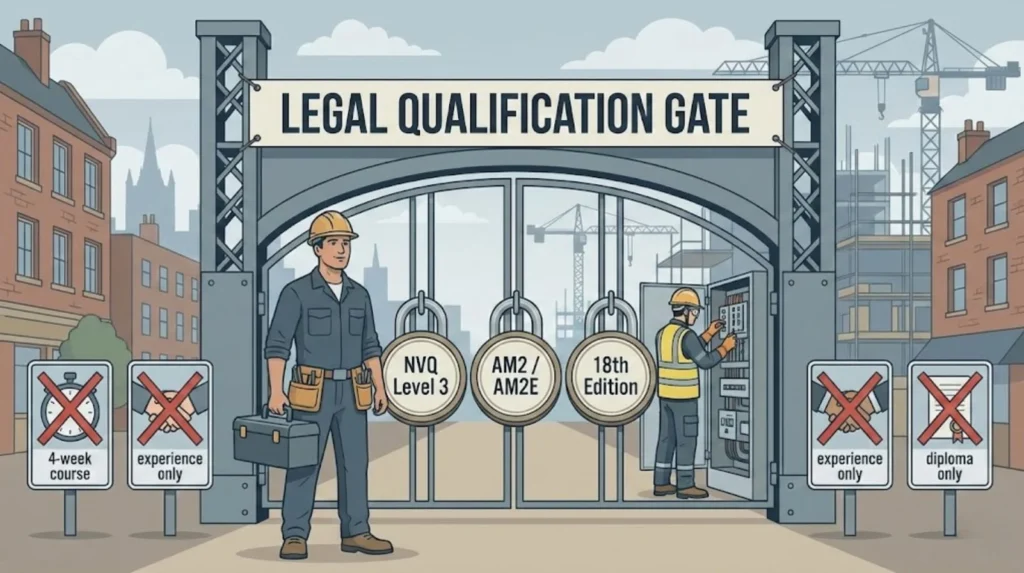
That requires three non-negotiable components:
1. NVQ Level 3 in Electrical Installation (competence qualification) Proves you can do the work safely through assessed on-site evidence across multiple installation types, testing scenarios, and fault-finding situations.
2. AM2 or AM2E assessment (independent practical exam) Three-day timed practical test at an approved NET centre demonstrating safe isolation, installation, testing, and certification without supervision.
3. 18th Edition (BS 7671:2018+A2:2022) Current wiring regulations knowledge, required for all electrical work and ECS card applications.
You cannot skip any of these. You cannot pay someone to fake them. You cannot substitute “experience” for formal assessment. Any route claiming to bypass these requirements is illegal and will leave you uninsurable, unemployable on legitimate sites, and potentially prosecuted under the Electricity at Work Regulations 1989.
The speed at which you reach full qualification isn’t determined by how fast you complete classroom diplomas. It’s determined by how quickly you can:
Secure employment that allows NVQ portfolio building
Gather diverse, verifiable evidence across all required units
Access regular assessor visits
Book and pass your AM2 assessment
Process your ECS Gold Card application
Some of these processes can be accelerated. Most cannot.
This article breaks down the actual fastest legal routes based on your starting point, explains which timescales are realistic versus which are marketing fiction, identifies the unavoidable bottlenecks you’ll face, and shows you how to avoid illegal shortcuts that waste your money and time.
For an honest timeline breakdown for different fast-track electrician routes, this guide uses official awarding body requirements, regulatory frameworks, and real completion data rather than provider marketing claims.
Understanding UK Electrical Qualification Requirements
Before we discuss speed, let’s establish what legally qualifies you to work as an electrician in the UK.
The Legal Definition of “Qualified Electrician”
According to the National Careers Service and industry regulatory bodies (JIB, ECS, NICEIC, NAPIT), a qualified electrician in the UK is someone who:
Has completed regulated qualifications demonstrating both knowledge and competence:
Level 3 knowledge qualification (e.g., City & Guilds 2365-03 Diploma)
NVQ Level 3 competence qualification (e.g., City & Guilds 2357)
18th Edition BS 7671 wiring regulations
Has passed independent end-point assessment:
AM2 (for standard route) or AM2E (for experienced workers)
Holds verification through industry schemes:
ECS Gold Card (Installation Electrician) or JIB Electrician grading
Optional but highly valuable: NICEIC/NAPIT registration for domestic work
Can legally work without direct supervision under the Electricity at Work Regulations 1989, demonstrating competence to prevent danger and injury.
This is not the same as:
Holding a Level 2 or Level 3 diploma alone (knowledge only, no competence)
Completing a “Domestic Installer” course (restricted scope, not full electrician status)
Having “5 years experience helping a mate” (unverified, unregulated)
Passing the 18th Edition exam only (regulations knowledge, not practical competence)
Knowledge vs Competence: Why This Distinction Matters
Knowledge qualifications (City & Guilds 2365-02 Level 2, 2365-03 Level 3) teach you:
Electrical theory and principles
BS 7671 regulations and design requirements
Testing procedures and fault-finding theory
Health and safety legislation
Installation methods and techniques
These are delivered through classroom learning, textbook study, and simulated practical work in training centres. They’re assessed through written exams and workshop observations in controlled environments.
What knowledge qualifications do NOT prove:
You can work safely on real installations
You can handle unexpected site conditions
You can make competent decisions under pressure
You can work without direct supervision
You meet legal competence requirements under EAWR
Competence qualifications (NVQ Level 3, verified through AM2) prove you can:
Apply your knowledge correctly in real-world installations
Work safely across varied scenarios (domestic, commercial, industrial)
Install containment, cables, and equipment to professional standards
Test, inspect, and certify work correctly
Troubleshoot faults and make sound technical decisions
Follow site procedures and work effectively with other trades
These are assessed through on-site observation by independent assessors, portfolio evidence from real projects, and the rigorous AM2 practical exam conducted under timed conditions.
The law (EAWR Regulation 16) requires competence, not just knowledge. This is why diplomas alone don’t make you a qualified electrician, and why any route skipping the competence phase is illegal.
The Electrotechnical Assessment Specification (EAS)
The EAS is an industry-agreed framework defining acceptable qualification routes for electricians. It’s maintained by the JIB and supported by major trade bodies (ECA, Unite, SELECT, NICEIC, NAPIT).
Key EAS requirements for “qualified electrician” status:
NVQ Level 3 is mandatory. Knowledge diplomas are necessary preparation but insufficient alone.
Independent assessment is required. AM2 or AM2E must be completed at approved NET centres with no provider involvement in the pass/fail decision.
Workplace evidence must be genuine and diverse. Portfolio submissions require photographic evidence, supervisor sign-offs, and assessor observations across multiple installation types.
No shortcuts permitted. Routes claiming to bypass NVQ or AM2 do not meet EAS standards and will not be recognized by employers, insurers, or regulatory bodies.
The EAS exists to prevent dangerous shortcuts. Anyone working on electrical installations without meeting these standards is breaking the law, regardless of what certificates they hold.
What Different Cards Actually Mean
ECS White Card (Apprentice/Trainee):
You’re registered on a formal training programme
You must work under constant direct supervision
You cannot sign off any work
You’re learning, not qualified
ECS Red Card (Electrical Trainee):
You’ve completed Level 2/3 diplomas (knowledge)
You’re building your NVQ portfolio
You still require supervision for all work
You’re progressing towards qualification, not qualified yet
ECS Gold Card (Installation Electrician):
You’ve completed NVQ Level 3 + AM2 + 18th Edition
You can work without direct supervision (though site-specific supervision may still apply)
You can sign off your own work if CPS registered
You’re legally a qualified electrician
JIB Grading (for those working under JIB agreements):
Labourer: No electrical qualifications
Electrician: NVQ Level 3 + AM2 + 18th Edition (Gold Card equivalent)
Approved Electrician: Electrician grade + 2+ years experience + 2391 Inspection & Testing
Technician: 5+ years + HNC/HND or equivalent advanced qualification
The card itself doesn’t make you qualified. It verifies you hold the qualifications and competence. Trying to work beyond your card level is illegal and voids your insurance.
The Mandatory Qualification Map: What Cannot Be Skipped
Let’s be clear about which qualifications are required, which can be accelerated, and why none can be skipped.
Level 2 and Level 3 Diplomas (Knowledge Foundation)
What they are:
City & Guilds 2365-02 (Level 2) and 2365-03 (Level 3), or EAL equivalents
Classroom-based theory and simulated practical work
Regulated by Ofqual, delivered by approved training centres
Can they be accelerated? Yes. Fast-track providers deliver these in 4-16 weeks intensive format. Traditional colleges deliver them over 1-2 academic years. Both are valid routes to the same qualification.
What they enable:
Entry to NVQ Level 3 programmes
Understanding of regulations and installation principles
Eligibility for ECS Red Card (Trainee status)
What they do NOT enable:
Working without supervision
Signing off your own work
Applying for ECS Gold Card
Legal competence to work as an electrician
Why they cannot be skipped: They provide the foundational theoretical knowledge required for safe electrical work. You cannot build competence (NVQ) without understanding the principles (diplomas).
NVQ Level 3 Electrical Installation (Competence Evidence)
What it is:
City & Guilds 2357 or EAL equivalent
Portfolio of evidence from real workplace installations
Independent assessor verification through site visits
Covers multiple units (installation, testing, fault-finding, maintenance)
Can it be accelerated? Limited. You can complete it faster if you:
Already work full-time on varied electrical projects
Have access to diverse installation types (domestic, commercial, industrial)
Have a reliable, responsive assessor
Work for an employer who understands and supports NVQ requirements
You cannot accelerate it if you:
Don’t have site access or employment
Work on repetitive, limited-scope projects
Can’t access assessor visits regularly
Have gaps between employment
Typical timeline:
With full-time varied work: 12-18 months
With part-time or limited work: 18-30 months
With employment gaps: 24-36+ months or incomplete
What it enables:
Demonstrating practical competence to regulatory standards
Eligibility to sit AM2 assessment
Meeting legal requirements for unsupervised work (once AM2 passed)
What it does NOT enable:
Working without AM2 completion (you need both NVQ + AM2)
Automatic ECS Gold Card (still need to apply after AM2)
Why it cannot be skipped: It’s the only way to prove you can actually do electrical work safely in real-world conditions. No insurance company, employer, or regulatory body accepts “experience” or “diplomas” as substitutes for verified NVQ competence.
AM2 or AM2E Assessment (Independent Verification)
What it is:
Achievement Measurement 2 (AM2 for standard route, AM2E for experienced workers)
Three-day practical assessment at approved NET centres
Timed installation, testing, fault-finding, and certification tasks
Pass/fail determined independently by NET, not your training provider
Can it be accelerated? No. This is a fixed-duration assessment event. You cannot:
Pay to skip it
Take a shorter version
Have your provider “sign you off” instead
Use prior experience as a substitute
Booking timeline:
Wait times: 2 weeks to 4 months depending on location and time of year
Preparation: 1-3 months recommended before booking
Results: Typically within 4-6 weeks
Resit if failed: 3-6 months additional timeline
Pass rates:
Overall first-time pass: approximately 60%
With proper preparation courses: 75-85%
Without adequate preparation: 40-50%
What it enables:
Completion of NVQ Level 3 qualification
Eligibility to apply for ECS Gold Card
Industry-recognized verification of competence
Legal status as a qualified electrician (with NVQ + 18th Edition)
What it does NOT enable:
Working without 18th Edition (you need this as well)
Automatic JIB grading or card issuance (separate applications required)
Why it cannot be skipped: It provides independent, unbiased verification of competence. This prevents training providers from simply “passing” their own students without genuine assessment, which would undermine industry standards and safety.
18th Edition (BS 7671 Current Regulations)
What it is:
BS 7671:2018+A2:2022 wiring regulations course and exam
3-5 day intensive course (or self-study with exam)
Updated periodically when regulations change (currently 18th Edition)
Can it be accelerated? Yes. This is typically a short course regardless of route. Some providers offer 3-day intensive options, others offer 5-day courses. Self-study online courses with exam booking are also available.
What it enables:
Knowledge of current UK wiring regulations
Compliance with legal requirements for electrical work
ECS card eligibility (required for all card types)
What it does NOT enable:
Qualification status alone (you need NVQ + AM2 as well)
Competence to work (it’s a regulations exam, not a practical assessment)
Why it cannot be skipped: BS 7671 is the legal standard for all electrical installations in the UK. You cannot work legally without understanding current regulations. Insurance companies, employers, and regulatory bodies all require proof of 18th Edition completion.
The Complete Qualification Pathway
Here’s what you MUST have to be a legally qualified electrician:
✅ Level 2 Diploma (2365-02 or equivalent)
✅ Level 3 Diploma (2365-03 or equivalent)
✅ NVQ Level 3 (2357 or equivalent)
✅ AM2 or AM2E assessment pass
✅ 18th Edition (BS 7671:2018+A2:2022)
✅ ECS Gold Card application (using above qualifications)
Anything less than this is not “qualified electrician” status.
Thomas Jevons, Head of Training at Elec Training, explains:
Thomas Jevons, Head of Training at Elec Training, explains: "The real speed limiter isn't how fast you learn theory. It's how quickly you can gather diverse, verifiable evidence across all NVQ units whilst working under supervision, get regular assessor visits, and secure an AM2 slot. These are fixed-duration processes. Fast-track diplomas shorten the classroom phase, but the competence phase takes exactly as long whether you did intensive or paced theory training."
Thomas Jevons, Head of Training
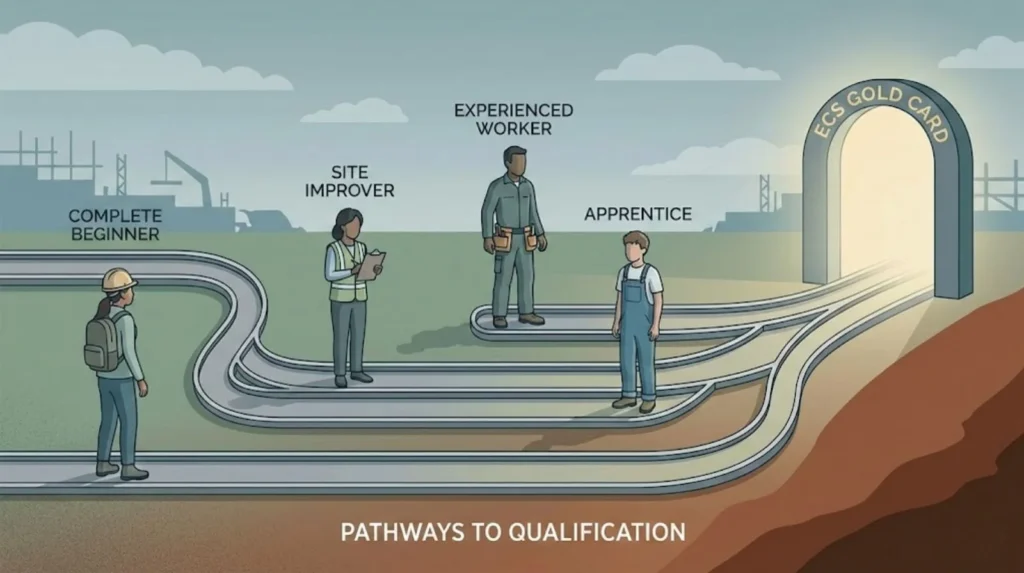
The Fastest Legal Routes by Starting Point
Your current position determines which route is genuinely fastest for you.
Route A: Complete Beginner (No Electrical Experience)
Who this applies to:
Career changers from non-electrical backgrounds
School leavers with no trade experience
Anyone starting from zero electrical knowledge
The fastest legal sequence:
Step 1: Level 2 and Level 3 Diplomas (3-6 months fast-track, or 18-20 months traditional college)
Fast-track option:
Level 2: 4-6 weeks intensive
Level 3: 8-12 weeks intensive
18th Edition: 3-5 days
Total classroom time: 4-6 months
Traditional college option:
Level 2: 1 academic year
Level 3: 1 academic year
18th Edition: Integrated or separate
Total classroom time: 18-20 months
At this point, you have knowledge qualifications. You are NOT a qualified electrician.
Step 2: Secure NVQ-Supporting Employment (1-12+ months)
This is the critical bottleneck for beginners.
You need to find an employer who will:
Hire you as an improver/mate (typically £22,000-£28,000/year)
Provide access to varied electrical work (domestic, commercial, testing)
Allow regular assessor visits for NVQ portfolio building
Understand and support your qualification progression
Timeline reality:
With strong provider placement support: 1-2 months
Without placement support: 6-12+ months of searching, often settling for non-electrical labourer work
Many never secure suitable NVQ employment and abandon the pathway
Step 3: Build NVQ Level 3 Portfolio (12-18 months minimum)
Once employed, you must:
Work on real installations under supervision
Gather photographic evidence across all required units
Have regular assessor observations (typically every 4-6 weeks)
Complete written assignments and practical demonstrations
Prove competence in containment, installation, testing, fault-finding
Timeline factors:
Full-time work on varied projects: 12-15 months
Part-time work or repetitive tasks: 18-24 months
Employment gaps or limited work variety: 24-36+ months
Step 4: AM2 Preparation and Assessment (3-6 months)
Preparation courses and revision: 1-3 months
Booking slot: 2 weeks to 4 months wait
Assessment itself: 3 days
Results: 4-6 weeks
Potential resit if failed: add 4-6 months
Step 5: ECS Gold Card Application (1-2 months)
Submit all certificates
Processing time: 4-6 weeks
Total timeline for complete beginners:
Best case (everything goes perfectly):
Fast-track diplomas: 4 months
Immediate NVQ placement: 1 month
NVQ completion: 12 months
AM2: 3 months
Gold Card: 2 months
Total: 22 months (just under 2 years)
This requires:
Provider with genuine placement infrastructure
Immediate employment after diplomas
Full-time work on varied projects
Reliable assessor with no delays
First-time AM2 pass
No personal circumstances disrupting progress
Realistic case (normal progression):
Fast-track diplomas: 5 months
Finding NVQ employment: 4 months
NVQ completion: 16 months
AM2 prep and assessment: 5 months
Gold Card: 2 months
Total: 32 months (2 years 8 months)
Challenging case (common barriers):
Fast-track diplomas: 6 months
Finding NVQ employment: 10 months
NVQ completion (limited work variety): 20 months
AM2 fail/resit: 7 months
Gold Card: 2 months
Total: 45 months (3 years 9 months)
Via apprenticeship (alternative route):
Duration: 36-48 months (3-4 years)
Earning throughout: £12,000-£22,000/year increasing annually
NVQ integrated: Built into programme from start
Employment guaranteed: Part of apprenticeship structure
Total: 42 months average, but employed from day one
Route B: Improver or Mate Already on Site
Who this applies to:
Already working as electrical mate/labourer
Employed with an electrician or electrical contractor
Gaining site experience but not yet qualified
The fastest legal sequence:
Current status check: You’re already on site doing electrical work under supervision. This solves the biggest bottleneck (employment access).
Step 1: Complete or Top-Up Diplomas (3-6 months part-time)
If you don’t already have Level 2/3:
Evening/weekend courses: 6-12 months part-time
Fast-track intensive: 3-6 months (may require time off work)
18th Edition: 3-5 days
If you already have some qualifications, identify gaps and complete only what’s missing.
Step 2: Start NVQ Immediately (no employment gap)
This is your major advantage. You can enrol in NVQ Level 3 whilst continuing your current employment, using your daily work as portfolio evidence.
Timeline: 12-18 months from NVQ start to completion
Faster than beginners because:
No employment search period
Already familiar with site procedures
Existing relationship with employer/supervisor
Work is already being done, just needs documenting
Step 3: AM2 Assessment (3-5 months)
Preparation: 1-2 months (already doing the work daily)
Booking and assessment: 2-3 months
Higher pass rates due to daily practical experience
Step 4: Gold Card Application (1-2 months)
Total timeline for improvers:
Best case:
Part-time diplomas (if needed): 6 months
NVQ (concurrent with work): 12 months
AM2: 3 months
Gold Card: 1 month
Total: 22 months
Realistic case:
Part-time diplomas: 8 months
NVQ: 15 months
AM2: 4 months
Gold Card: 2 months
Total: 29 months
Key advantage: No employment gap, no searching for placements, immediate start on competence evidence.
Route C: Experienced Worker (5+ Years Verifiable Experience)
Who this applies to:
Electricians with 5+ years documented site work
Domestic installers upgrading to full commercial qualification
Overseas-qualified electricians adapting to UK standards
Time-served workers without formal UK qualifications
The fastest legal sequence:
Experienced Worker Assessment (EWA) Route (City & Guilds 2346 or EAL equivalent)
Step 1: Skills Scan and Gap Analysis (1 day to 2 weeks)
An approved assessor reviews your:
Work history (must be verifiable, documented)
Current competence levels
Knowledge of BS 7671 and UK regulations
Gaps between your experience and UK qualification requirements
Step 2: Bridging Training (0-6 months depending on gaps)
If gaps identified:
BS 7671 knowledge update: 3-5 days
UK-specific installation methods: 1-4 weeks
Testing and inspection procedures: 1-2 weeks
Health and safety compliance: 1-3 days
If your experience is current and comprehensive, minimal bridging required.
Step 3: Portfolio Submission (1-3 months)
You compile evidence of your existing work:
Photographs of past installations
Test certificates you’ve completed
Employer references and supervisor sign-offs
Demonstrated competence across required units
This uses PAST work, not new work, making it much faster than standard NVQ.
Step 4: AM2E Assessment (2-4 months)
AM2E (Enhanced) is similar to standard AM2 but tailored for experienced workers.
Booking wait: 2 weeks to 3 months
Assessment: 3 days
Results: 4-6 weeks
Step 5: 18th Edition (if not already held)
3-5 day course
Exam at end of course
Step 6: Gold Card Application (1-2 months)
Total timeline for experienced workers (EWA route):
Best case:
Skills scan: 1 week
Minimal bridging: 2 weeks
Portfolio submission: 6 weeks
AM2E booking and assessment: 8 weeks
18th Edition: 1 week
Gold Card: 6 weeks
Total: 6 months
Realistic case:
Skills scan: 2 weeks
Bridging training: 8 weeks
Portfolio submission: 10 weeks
AM2E: 12 weeks
18th Edition: 1 week
Gold Card: 6 weeks
Total: 9-10 months
Important requirements for EWA:
You MUST have:
Minimum 5 years verifiable electrical work (some schemes require 3 years minimum, others 5)
Documented evidence (employer letters, test certificates, project records)
Current, recent experience (not 5 years worked 10 years ago)
Varied work across multiple installation types
You CANNOT use EWA if:
Your experience is unverified (“helped my mate for 5 years”)
Work was non-electrical or only electrical labouring
Experience is outdated (worked as electrician 15 years ago, not since)
You lack documentation
EWA is genuinely the fastest legal route, but only for those who legitimately qualify. Attempting to use it without proper experience will result in rejection.
Route D: Apprenticeship (Standard Route)
Who this applies to:
Those wanting structured, paid training from the start
People valuing certainty over speed
Learners preferring integrated employment and training
The apprenticeship pathway:
Level 3 Electrotechnical Apprenticeship Standard
Duration: 36-48 months (3-4 years fixed)
What’s included:
Level 2 and Level 3 diplomas delivered over the apprenticeship
NVQ Level 3 portfolio building integrated throughout
18th Edition completed during apprenticeship
AM2 or AM2S (Synoptic) assessment at end-point
Employment from day one with increasing wages
Earnings during apprenticeship:
Year 1: £12,000-£16,000
Year 2: £14,000-£18,000
Year 3: £16,000-£20,000
Year 4: £18,000-£24,000
Total timeline: 42-48 months
This is NOT the fastest route for reaching Gold Card status. However, it’s:
The most structured and predictable
The lowest financial risk (earning throughout)
The most trusted by employers (time-served status)
The most comprehensive training (sustained mentoring over years)
When apprenticeship makes sense over fast-track:
You’re under 25 and can access apprenticeship opportunities
You want earnings from the start
You value long-term employer relationships
You prefer paced learning over intensive cramming
You want zero debt exposure
For a complete analysis of accelerated qualification pathways and realistic completion times, the apprenticeship route delivers identical qualifications but takes 12-24 months longer than optimized adult fast-track routes with strong placement support.
Time Constraints You Absolutely Cannot Bypass
Regardless of which route you choose, these timescales are fixed and unavoidable.
Workplace Evidence Collection Cannot Be Rushed
The reality:
NVQ Level 3 requires evidence of competence across multiple units:
Containment installation (trunking, conduit, cable tray systems)
Cable installation (SWA, T&E, FP200, multicore)
Accessories and equipment (sockets, switches, lighting, distribution boards)
Testing and inspection (continuity, insulation resistance, earth fault loop, RCD)
Fault-finding (identifying and rectifying installation faults)
Three-phase systems (commercial and industrial applications)
You physically cannot complete this in weeks because:
Your employer’s work schedule determines when you access different installation types. If they only do domestic socket changes for 3 months, you wait 3 months to access commercial trunking work required for your portfolio.
Assessors must observe you doing the work in real installations. You cannot fake this, speed it up, or substitute theory for practice.
Varied evidence requires varied projects. If your employer only works on one type of installation, your portfolio will take longer as you search for opportunities to demonstrate broader competence.
Typical evidence gathering timeline:
Full-time on varied commercial/domestic projects: 12-15 months minimum
Full-time on limited/repetitive work: 18-24 months
Part-time work: 20-30 months
This cannot be shortened by:
Paying more money
Doing intensive courses
Working longer hours (unless it gives you access to more varied work)
Switching providers (you still need the same evidence)
Joshua Jarvis, Placement Manager at Elec Training, explains:
"When employers ask 'How long does fast-track actually take?', the honest answer is: 18-24 months from classroom start to Gold Card if placement support is immediate and strong, 30-36 months if placement takes time to secure, or never completing if no placement support exists. The 'fast' part only applies to the classroom diplomas. The qualification itself (NVQ plus AM2) takes the same time regardless of how you learned the theory."
Joshua Jarvis, Placement Manager
Assessor Verification Has Fixed Schedules
The process:
Independent NVQ assessors visit your workplace to:
Observe you carrying out tasks
Review your photographic evidence
Check supervisor sign-offs
Verify your work meets required standards
Sign off completed units
Typical assessment schedule:
Visits every 4-6 weeks
Each visit: 2-4 hours on site
Reviews work completed since last visit
Identifies next evidence requirements
This process cannot be rushed because:
Assessors have capacity limits. They manage multiple candidates across different sites. You cannot demand daily visits.
Evidence must be generated between visits. Each visit reviews work done since the last assessment. Without sufficient new evidence, the visit is wasted.
Quality checks are mandatory. Assessors must thoroughly verify competence, not rubber-stamp incomplete work.
Independent verification prevents fraud. The assessor doesn’t work for your training provider, preventing conflicts of interest.
Timeline impact:
Minimum 8-12 assessor visits required for full NVQ completion
At 4-6 week intervals: 32-72 weeks (8-18 months)
This timeline is largely fixed regardless of provider or route
AM2 Assessment Booking and Completion
The AM2 process:
Booking:
Available at approved NET centres across the UK
Wait times: 2 weeks to 4 months depending on location and time of year
London and South-East: Typically 2-8 weeks wait
Northern England, Scotland, Wales: Sometimes 8-16 weeks wait
Popular periods (post-NVQ completion seasons): Longest waits
Assessment itself:
Day 1: Installation tasks (containment, cables, accessories)
Day 2: Testing, inspection, fault-finding
Day 3: Completion, final checks, certification
Total assessment time: Approximately 16-17 hours over 3 days
Results:
Typically released 4-6 weeks after assessment
Pass/fail only (no grades)
Pass rate: Approximately 60% first time
If you fail:
Rebook assessment (another 2-16 week wait)
Additional preparation recommended (1-3 months)
Repeat fee: £800-£1,000
Total delay: 3-6 months for resit
This timeline cannot be shortened by:
Paying extra fees
Using different providers (NET controls all AM2 assessments)
Rushing preparation (increases failure risk)
Claiming prior experience (everyone takes the same assessment)
Best practice to minimize delays:
Book AM2 well in advance (as soon as NVQ nears completion)
Invest in quality preparation courses (improves first-time pass rate)
Choose less busy assessment periods if possible
Prepare thoroughly rather than rushing to book
ECS Card Processing Times
Application requirements:
Completed NVQ Level 3 certificate
AM2 pass certificate
18th Edition certificate
Level 2 and Level 3 Diploma certificates
Completed application form
Passport-style photo
Application fee (approximately £40-£50)
Processing timeline:
Standard processing: 4-6 weeks
During peak periods: 6-8 weeks
Expedited service: Not typically available for first-time Gold Card applications
Common delays:
Missing or incorrect certificates
Application errors or incomplete information
Certificate verification with awarding bodies
Photo not meeting requirements
This timeline is fixed. You cannot bypass ECS processing by using alternative cards or schemes. The ECS Gold Card is the industry standard for qualified electrician status.
The Cumulative Effect of Fixed Timescales
Adding up the unavoidable minimums:
For a complete beginner with perfect conditions:
Diplomas (fast-track): 4 months
NVQ evidence gathering: 12 months (absolute minimum)
Assessor visits: Built into 12-month NVQ timeline
AM2 booking and completion: 2 months (best case)
ECS card processing: 1.5 months
Total absolute minimum: 19.5 months
This assumes:
Immediate employment after diplomas (no gap)
Full-time work on highly varied projects from day one
Perfectly scheduled assessor visits with no cancellations
Immediate AM2 slot availability
First-time AM2 pass
No personal circumstances causing delays
No administrative errors or certificate issues
In reality, 99% of beginners take 24-36 months due to normal delays in employment access, work variety, assessor scheduling, and AM2 booking.
Anyone claiming you can become a qualified electrician in under 18 months is either:
Referring to diploma-only status (not qualified electrician)
Using the Experienced Worker route (requires 5+ years prior experience)
Lying
What Is Marketed as Fast but Isn’t Legal
Let’s be clear about common shortcuts that are either illegal, invalid, or misleading.
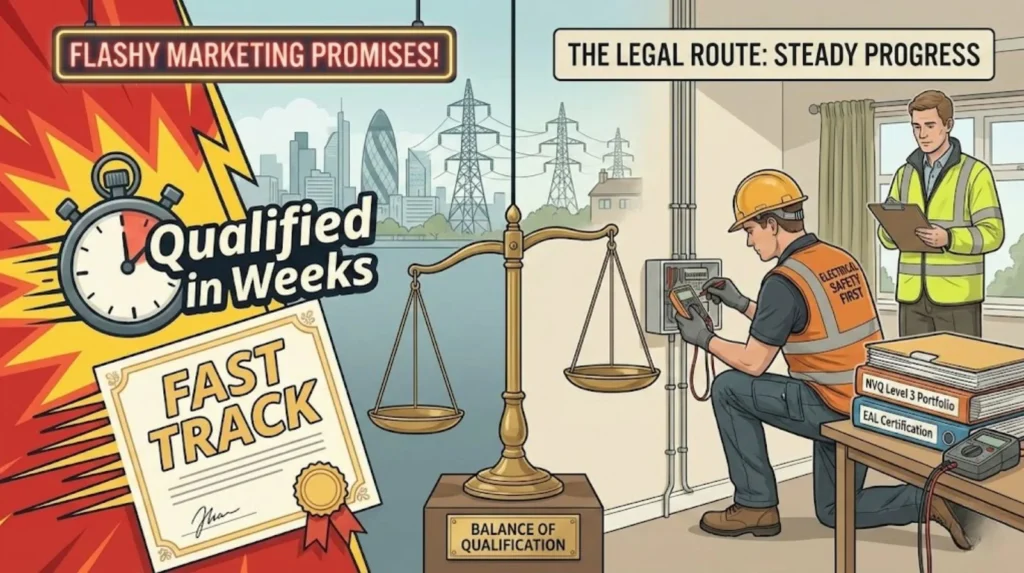
“Qualified in 4-16 Weeks” Fast-Track Courses
What they actually deliver:
Level 2 and Level 3 diplomas (knowledge qualifications)
Possibly 18th Edition
Total duration: 4-16 weeks intensive classroom and workshop training
What they do NOT deliver:
NVQ Level 3 competence qualification
AM2 assessment
ECS Gold Card
Legal status as a qualified electrician
Ability to work without supervision
CPS registration capability
Why this is misleading:
The marketing uses “qualified” to mean “completed our course,” not “legally qualified to work as an electrician.”
Ofqual, JIB, ECS, and all regulatory bodies define “qualified electrician” as someone holding NVQ Level 3 + AM2 + 18th Edition.
After a 4-16 week course, you have knowledge qualifications only. You’re legally a “trainee” requiring supervision, not a “qualified electrician.”
What happens to learners who believe this claim:
They finish the course expecting to work as electricians immediately.
They discover no legitimate employer will hire them without NVQ + AM2.
They’re stuck with £5,000-£12,000 debt and partial qualifications.
They spend 6-12+ months searching for NVQ-supporting work or abandon the pathway entirely.
How to identify this misleading marketing:
Claims like:
“Become a qualified electrician in 16 weeks”
“Fully qualified in 4 months”
“Fast-track to electrician status”
“Complete your electrician training in weeks”
Red flags:
No mention of NVQ or AM2 in the course description
Course duration under 12 months for complete beginners
Price too low (under £3,000 for “complete” qualification)
No discussion of workplace placement requirements
18th Edition as Standalone “Qualification”
What it actually is:
BS 7671:2018+A2:2022 wiring regulations course
3-5 day theory course covering current UK electrical standards
Exam testing knowledge of regulations
What marketing claims:
“18th Edition makes you qualified”
“Legal to work after completing 18th Edition”
“All you need to start electrical work”
The reality:
18th Edition is ONE component of electrician qualification.
It proves you understand the regulations. It does NOT prove you can apply them safely in practice.
You cannot work as an electrician with 18th Edition alone. You still need NVQ Level 3 + AM2 + Level 2/3 diplomas.
Legitimate use of 18th Edition:
Updating existing qualified electricians when regulations change
Part of complete qualification pathway (alongside diplomas, NVQ, AM2)
Refresher for experienced workers
Why this misleads learners:
They think regulations knowledge equals practical competence.
They believe passing the 18th Edition exam grants legal working rights.
They attempt to work independently and discover they’re uninsured and illegal.
"Domestic Installer" Courses as Full Qualification
What Domestic Installer status actually means:
Competent Person Scheme (CPS) registration for domestic work only:
NICEIC Domestic Installer
NAPIT Domestic Installer
ELECSA Domestic Installer
Scope:
Domestic properties only (houses, flats)
Notifiable work in dwellings (consumer units, new circuits, bathrooms)
Cannot work on commercial or industrial installations
Cannot work on three-phase systems
Cannot carry out commercial EICRs
Requirements for Domestic Installer:
Level 3 Award in Domestic Installation (typically 2-4 weeks)
Initial verification assessment by CPS scheme
Annual re-assessment
Insurance and competence maintained
How it’s marketed:
“Become an electrician in 3 weeks” “Domestic Installer qualification” “Work as an electrician from home”
The problems:
Domestic Installer is NOT the same as qualified electrician (NVQ Level 3 + AM2).
Your work scope is severely restricted (domestic only, no commercial).
Employers reject Domestic Installer status for commercial/industrial roles.
CPS schemes are tightening requirements, increasingly requiring full NVQ Level 3 for new entrants.
Building Safety Act 2022 is restricting who can work on domestic installations, favoring fully qualified electricians.
The reality for Domestic Installers:
Income ceiling: £25,000-£40,000/year (versus £38,000-£60,000+ for commercial electricians)
Limited career progression (cannot move into commercial, industrial, testing, or specialist roles)
Increasing regulatory pressure requiring upgrade to full qualification
Market saturation (many Domestic Installers competing for limited domestic work)
When Domestic Installer makes sense:
You’re already a qualified electrician and want domestic-only registration
You’re doing very limited scope work (e.g., rental property maintenance)
You never intend to work commercially
When it doesn’t make sense:
You’re a beginner wanting full electrician career
You want commercial/industrial opportunities
You want maximum earning potential
You want career flexibility
Portfolio-Free or “Fast-Track NVQ” Claims
Legitimate NVQ requirements:
Workplace evidence:
Photographs of installations you’ve completed
Supervisor sign-offs verifying your work
Test certificates showing competence
Written accounts of tasks performed
Assessor verification:
Site visits observing you working
Review of evidence authenticity
Competence questioning and assessment
Independent sign-off of completed units
Red flag claims:
“NVQ without site work” “Complete your NVQ portfolio from home” “We provide evidence for you” “Fast-track NVQ in 6 weeks”
Why these are fraudulent:
NVQ stands for National Vocational Qualification. The “vocational” part means it MUST be based on real workplace activity.
Ofqual regulations require independent assessment of genuine work.
Any provider offering to complete your portfolio without you doing real electrical work is committing fraud.
Any NVQ obtained this way will be invalidated when discovered.
Consequences of fraudulent NVQ:
ECS card revoked when fraud discovered.
Potential prosecution for misrepresentation.
Uninsured for any work completed (massive liability exposure).
Unemployable when background checks reveal invalid qualifications.
Awarding body penalties including permanent bans from obtaining legitimate qualifications.
How to identify legitimate NVQ providers:
They require you to be employed or have guaranteed work placements.
They explain assessor site visit requirements clearly.
They cannot promise completion timescales (depends on your work access).
They’re registered with City & Guilds, EAL, or other Ofqual-approved awarding bodies.
They discuss evidence requirements in detail before you enrol.
“Experience Replaces Formal Qualifications” Myth
The claim:
“I’ve worked as an electrician for 10 years, I don’t need qualifications” “Experience is better than paperwork” “I can do the job, why do I need certificates?”
The legal reality:
Under the Building Safety Act 2022 and EAWR 1989:
You must prove competence through regulated qualifications, not just claim experience.
Insurance companies require verified qualifications (NVQ + AM2), not self-declared experience.
Employers on regulated sites require ECS cards, which require formal qualifications.
Competent Person Schemes require assessment, not just experience claims.
How experience IS recognized legally:
Through the Experienced Worker Assessment (EWA) route, which requires:
Documented, verifiable experience (5+ years)
Skills scan by approved assessor
Portfolio of past work with evidence
AM2E assessment
Formal qualification awarded after assessment
Experience doesn’t replace qualifications. It allows you to use a faster route TO qualifications (EWA instead of standard NVQ).
Why unverified experience is rejected:
Anyone can claim experience without proof.
“Helping a mate” or “DIY work” doesn’t meet professional standards.
Skills may be outdated or non-compliant with current regulations.
Safety-critical work requires verified competence, not unverified claims.
Employer Recognition Reality
What do employers actually accept, and what do they reject?
Commercial and Industrial Employers
Standard requirements for qualified electrician roles:
✅ ECS Gold Card (Installation Electrician)
✅ NVQ Level 3 in Electrical Installation
✅ AM2 pass certificate
✅ 18th Edition (BS 7671:2018+A2:2022)
✅ Typically 2-5+ years post-qualification experience
Additional preferences:
2391 Inspection and Testing qualification
Three-phase and industrial system experience
Commercial installation portfolio
Clean driving license
CSCS or SSSTS cards for supervisory roles
What they reject:
❌ Diploma-only qualifications (Level 2/3 without NVQ)
❌ Domestic Installer status for commercial roles
❌ Unverified experience claims
❌ Training-in-progress status (Red Card trainees)
❌ Fast-track courses without NVQ completion
Why commercial employers are strict:
Insurance requirements mandate NVQ Level 3 + AM2 for unsupervised work.
Health and safety regulations require proven competence on commercial sites.
Client contracts specify qualified electrician requirements.
Project insurance and liability depend on worker qualifications.
Poor work or accidents create massive financial and legal liability.
Domestic and Small Contractor Employers
More flexible but still require:
Minimum: ECS Gold Card or equivalent NVQ Level 3 + AM2 for independent work.
For supervised improver roles: May accept diploma-holders building towards NVQ.
Preferences:
Local reputation and references
Practical competence demonstrated in trial period
Willingness to work varied hours and locations
Own tools and transport
What they still reject:
Claims of qualification without certificates
Incomplete training without clear progression plan
Domestic Installer attempting commercial work
Why even small employers need qualified staff:
Part P compliance requires CPS registration or Building Control notification.
Insurance coverage requires verified qualifications.
Poor work damages reputation and creates costly callbacks.
Legal liability for substandard or dangerous installations.
Agencies and Recruitment Firms
Binary filter system:
✅ ECS Gold Card = eligible for roles
❌ No Gold Card = rejected regardless of experience claims
Why agencies use this filter:
They place hundreds of workers weekly. They cannot individually verify experience claims.
Client sites require ECS cards for access. No exceptions.
Insurance and liability transfer requires verified qualifications.
Gold Card is the industry-standard proof of qualification. It’s quick, easy to verify, and universally accepted.
How this affects different routes:
Fast-track with completed NVQ + AM2: Accepted (you have Gold Card)
Traditional college with completed NVQ + AM2: Accepted (you have Gold Card)
Experienced worker via EWA with Gold Card: Accepted
Diploma-only from any route: Rejected (no Gold Card)
Domestic Installer status: Rejected for commercial roles
Claims of experience without card: Rejected
Where Qualifications, Cards, and Experience Intersect
The hierarchy employers actually use:
Tier 1 (Most Employable):
NVQ Level 3 + AM2 + 18th Edition + Gold Card + 5+ years experience
Additional qualifications (2391, EV, solar)
Commercial and industrial experience
Clean record, references, reliability
Tier 2 (Employable for Most Roles):
NVQ Level 3 + AM2 + 18th Edition + Gold Card + 0-3 years experience
Willing to learn and take on varied work
Good attitude and work ethic
Tier 3 (Employable for Supervised/Improver Roles):
Level 2/3 Diplomas + 18th Edition (Red Card trainee)
Currently building NVQ portfolio
Supervised work only
Lower wages (£22,000-£28,000)
Tier 4 (Unemployable for Electrical Roles):
Diploma-only with no progression plan
Domestic Installer attempting commercial work
Unverified experience claims
No ECS card
The reality:
Speed to diploma completion doesn’t matter. Speed to Gold Card status matters.
How you got your qualifications doesn’t matter (fast-track, college, apprenticeship, EWA). Having the qualifications matters.
Years of unverified experience don’t matter. Verified competence (NVQ + AM2) matters.
Claims about how good you are don’t matter. Certificates and cards matter.
For a transparent comparison of fast-track training providers and actual qualification timelines, the employer perspective is clear: show us your Gold Card and relevant experience, or we cannot hire you.
Common Myths About Fast Routes
Let’s address the most persistent misconceptions.
Myth 1: “You Can Be Qualified in Weeks”
Reality: You can complete DIPLOMAS in weeks. You cannot become a QUALIFIED ELECTRICIAN in weeks.
Qualification requires NVQ Level 3 + AM2 + 18th Edition, which takes 18-48 months depending on your starting point and employment access.
Myth 2: “Experience Replaces NVQ”
Reality: Unverified experience doesn’t count. Experience must be verified through the Experienced Worker Assessment route, which still requires portfolio submission and AM2E.
Myth 3: “Fast-Track Equals Legal Qualification”
Reality: Fast-track refers to classroom speed only. Legal qualification requires the same NVQ + AM2 competence assessment regardless of how fast you learned theory.
Myth 4: “18th Edition Makes You an Electrician”
Reality: 18th Edition is a regulations knowledge course. It’s ONE component of qualification, not a standalone license to practice.
Myth 5: “Domestic Installer Is the Same as Qualified Electrician”
Reality: Domestic Installer is restricted-scope registration for domestic work only. It’s not equivalent to NVQ Level 3 + AM2 qualified electrician status.
Myth 6: “Apprenticeships Are Always Slowest”
Reality: Apprenticeships (3-4 years) are slower than optimized adult routes for those with immediate employment access (18-24 months), but faster than adult routes without placement support (30-48+ months or incomplete).
Myth 7: “You Can DIY Your Way to Qualification”
Reality: Self-study can help with theory, but NVQ requires workplace evidence and independent assessor verification. You cannot DIY assess yourself.
Myth 8: “Online NVQs Are Faster”
Reality: NVQ still requires real workplace evidence regardless of whether admin is online or paper-based. The timeline is determined by site work access, not paperwork method.
Myth 9: “Assessment Centres Can Sign You Off Quickly”
Reality: Independent assessment cannot be rushed. AM2 is a fixed three-day event. NVQ assessors must verify genuine workplace evidence over months.
Myth 10: “Cards Equal Qualification”
Reality: ECS cards verify you hold qualifications. They’re not qualifications themselves. The card without the underlying NVQ + AM2 is worthless.
Decision Framework: Choosing Your Fastest Legal Route
Based on everything above, here’s how to choose the genuinely fastest legal route for your situation.
Step 1: Assess Your Starting Point Honestly
Complete beginner with no electrical experience:
Fastest route: Fast-track diplomas (3-6 months) + immediate NVQ placement + 12-18 month portfolio + AM2
Total realistic timeline: 24-36 months
Critical factor: Provider must have genuine placement infrastructure
Verification: Ask for recent graduate employment data and contractor partnerships
Improver already working on sites:
Fastest route: Part-time diplomas (6-12 months) + concurrent NVQ building + AM2
Total realistic timeline: 18-24 months
Critical factor: Your current employer must support NVQ progression
Verification: Confirm employer will allow assessor visits before enrolling
Experienced worker (5+ years verifiable):
Fastest route: Experienced Worker Assessment (EWA)
Total realistic timeline: 6-12 months
Critical factor: You must have documented, recent, varied experience
Verification: Skills scan with approved assessor before committing to route
Career changer with transferable skills:
Fastest route: Same as complete beginner (fast-track diplomas + NVQ pathway)
Transferable skills (construction, plumbing, engineering) may help with employment but don’t shorten qualification timeline
Total realistic timeline: 24-36 months
Step 3: Understand What You’re Actually Buying
When you pay for fast-track diplomas, you’re buying:
✅ Level 2 and Level 3 knowledge qualifications
✅ 18th Edition course and exam
✅ Workshop access for simulated practical training
✅ Preparation for NVQ readiness
You are NOT buying:
❌ Qualified electrician status
❌ Guaranteed employment
❌ NVQ completion (this requires separate work placement)
❌ AM2 pass (separate assessment and fee)
❌ Gold Card (separate application after NVQ + AM2)
Make sure the provider is clear about this distinction.
Step 4: Plan for the Full Timeline and Cost
Realistic budget for complete beginner reaching Gold Card:
Diplomas (fast-track): £3,000-£8,000 NVQ support (if not included): £1,500-£3,000 AM2 fee: £800-£1,000 AM2 preparation course: £500-£1,200 (optional but recommended) 18th Edition: £200-£400 (if not included in diploma package) PPE and initial tools: £500-£800 ECS Gold Card application: £40-£50 Living costs during training: Variable (budget for 3-6 months if full-time intensive)
Total realistic cost: £6,500-£15,000+
Realistic timeline:
Classroom phase: 3-6 months
Finding NVQ employment: 1-12 months (depends on placement support)
NVQ completion: 12-18 months
AM2 preparation and assessment: 3-6 months
Gold Card processing: 1-2 months
Total: 20-44 months (1.5 to 3.5+ years)
Budget accordingly for longer timelines if employment access is uncertain.
Step 5: Recognize Compliant vs Non-Compliant Providers
Compliant providers:
✅ Clearly separate knowledge qualifications (diplomas) from competence qualifications (NVQ)
✅ Explain NVQ requires workplace evidence and cannot be completed in classroom
✅ Discuss employment support infrastructure specifically (not vaguely)
✅ Provide verifiable awarding body registration
✅ Give honest timelines (18-36 months total for beginners)
✅ Transparent about what’s included vs excluded in pricing
✅ Willing to provide graduate outcome data
Non-compliant red flags:
❌ Claim “qualified electrician in weeks”
❌ Promise guaranteed employment without infrastructure to deliver
❌ Cannot explain NVQ requirements clearly
❌ Pressure tactics (“limited spaces,” “enrol today,” “price going up”)
❌ Refuse to provide awarding body registration details
❌ No clear breakdown of included vs additional costs
❌ Cannot connect you with recent successful graduates
Step 6: Understand the EWA Route Properly
Experienced Worker Assessment is the genuinely fastest route, but ONLY if you qualify.
You qualify if:
✅ 5+ years of verified electrical installation work (some schemes accept 3+ years)
✅ Documented evidence (employer letters, test certificates, photos of installations)
✅ Recent experience (within last 2-3 years, not 10 years ago)
✅ Varied work across domestic, commercial, or industrial installations
✅ Knowledge of UK BS 7671 regulations (or willing to complete bridging training)
You do NOT qualify if:
❌ Your experience is as electrical labourer or mate (assisting only, not independent work)
❌ Experience is unverified (“helped my uncle for 5 years”)
❌ Work was overseas and you have no UK-transferable documentation
❌ Experience is outdated (worked 15 years ago, not since)
❌ You only have limited-scope experience (e.g., only domestic socket changes)
How to verify you qualify:
Book a skills scan with an EWA-approved provider (typically £100-£300).
They’ll review your evidence and tell you honestly whether EWA is appropriate or whether you need the standard NVQ route.
Don’t waste money on EWA programs if you don’t genuinely qualify. You’ll be rejected and need to start the standard route anyway.
The fastest legal route to becoming an electrician depends entirely on your starting point and access to NVQ-supporting employment.
For complete beginners:
The fastest realistic timeline is 18-24 months with perfect conditions (immediate placement, full-time varied work, first-time AM2 pass). Most complete in 24-36 months. Without placement support, 36-48+ months or never completing.
Fast-track diplomas (3-6 months) are faster than traditional college (18-20 months) for the classroom phase. But the overall timeline to Gold Card depends on NVQ access, which is identical regardless of how you learned theory.
For improvers already on site:
The fastest timeline is 18-24 months because you skip the employment search and start building NVQ evidence immediately whilst doing part-time diplomas.
For experienced workers (5+ years verified):
The fastest timeline is 6-12 months via the Experienced Worker Assessment route, but this genuinely requires documented, recent, varied experience. Don’t attempt EWA if you don’t qualify. You’ll waste time and money.
The critical factor for ALL routes:
NVQ portfolio building requires 12-18 months minimum of diverse, supervised site work with regular assessor visits. This timeline cannot be shortened regardless of classroom route.
AM2 assessment is a fixed-duration event with 2-16 week booking waits.
ECS card processing takes 4-8 weeks.
These fixed timescales mean the absolute minimum for complete beginners is approximately 18-20 months, and realistic timelines are 24-36 months.
Anyone claiming faster routes is either:
Referring to diploma-only status (not qualified electrician)
Using misleading language about “qualified”
Targeting experienced workers who already have the site experience
Lying
At Elec Training, we’re transparent about realistic timelines. Our fast-track diplomas take 3-6 months. Our NVQ support with placement through our recruitment team and 120+ partner contractor network helps students reach Gold Card in 18-24 months total from classroom start, provided they engage with our placement process and demonstrate work-readiness.
We don’t claim “qualified in weeks” because it’s false. We provide the full pathway support from classroom to Gold Card that most fast-track providers don’t offer.
Call us on 0330 822 5337 to discuss the fastest legal route for your specific situation. We’ll assess your starting point, explain realistic timelines, clarify what our placement support actually involves, and give you honest answers about whether fast-track suits you or whether alternative routes (apprenticeship, college, EWA) make more sense. No false promises. No misleading claims. Just practical guidance about the genuinely fastest legal pathway from where you are now to qualified electrician status.
References
Regulatory and Qualification Standards:
- Ofqual – Regulated Qualifications Framework, qualification register
- City & Guilds – 2365 (Level 2/3), 2357 (NVQ Level 3), 2346 (EWA) specifications
- EAL – Alternative awarding body qualification specifications
- NET (National Electrotechnical Training) – AM2 and AM2E assessment standards
- IET – Electrotechnical Assessment Specification (EAS)
- JIB – Joint Industry Board qualification and grading requirements
- ECS – Electrotechnical Certification Scheme card requirements
Legal and Safety Framework:
- HSE – Electricity at Work Regulations 1989 (EAWR), competence requirements
- GOV.UK – Building Regulations Part P, Building Safety Act 2022
- BS 7671:2018+A2:2022 – IET Wiring Regulations (18th Edition)
Industry Guidance:
- National Careers Service – Electrician career pathways
- ECA (Electrical Contractors’ Association) – Training standards
- SELECT (Scotland) – Qualification guidance
- NICEIC – Competent Person Scheme requirements
- NAPIT – Domestic and commercial installer standards
Employment and Market Data:
- Indeed, Reed, Totaljobs – Job advertisement analysis for qualification requirements
- JIB – Wage rates and grading structure 2025
Learner Experience and Forum Analysis:
- Reddit (r/UKElectricians) – Learner experiences, timeline discussions, route comparisons
- ElectriciansForums – Training provider discussions, qualification pathway experiences
- Trustpilot – Training provider reviews (multiple providers analyzed)
Note on Accuracy and Updates
Last reviewed: 1 January 2026. This guide is maintained and updated as regulatory requirements, qualification standards, and industry practices evolve. Information is based on official awarding body requirements (City & Guilds, EAL, NET), government regulations (EAWR, Building Regulations), industry body guidance (JIB, ECS, EAS), and real learner experiences from forums and verified reviews (2023-2025). Timeline estimates are conservative and evidence-based rather than marketing optimistic. If you spot inaccuracies, have training route experiences to share, or need clarification on fastest legal routes for your specific situation, contact us at charanjit@elec.training.
