
UK Apprenticeship Levy: £3.3 Billion Returned to Treasury Since 2019 (What This Means for Your Electrical Training)

- Technical review: Thomas Jevons (Head of Training, 20+ years)
- Employability review: Joshua Jarvis (Placement Manager)
- Editorial review: Jessica Gilbert (Marketing Editorial Team)
- Last reviewed:
- Changes: Initial publication analysing apprenticeship levy unspent funds data from multiple sources
Introduction
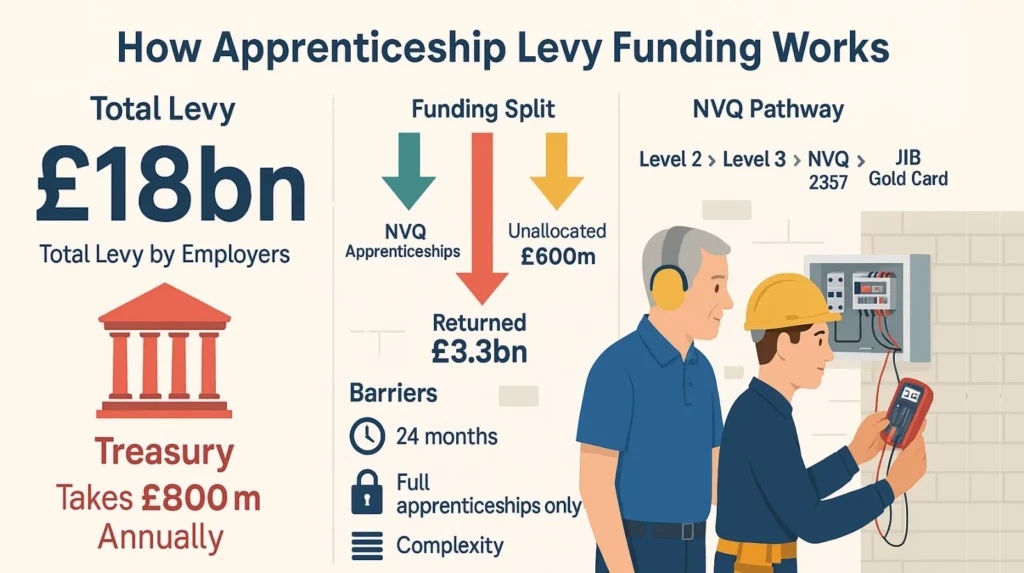
Since the apprenticeship levy launched in 2017, large UK employers have paid over £18 billion into the system. That’s £18 billion meant to fund proper apprenticeships, build skilled workforces, and create genuine career pathways.
Here’s the uncomfortable bit: more than £3.3 billion of that money has been returned to the Treasury since 2019 under the “use it or lose it” rule. Funds expire if not spent within 24 months. The Association of Employment and Learning Providers (AELP) estimates around £600 million currently sits unallocated, projected to rise to £800 million as wages increase.
If you’re considering electrical training at Elec Training, understanding how the levy works matters. It affects funding availability, employer willingness to take on NVQ learners, and ultimately your pathway to qualified electrician status. The money exists. The question is whether it’s being used properly.

What the Numbers Actually Show
The scale of unspent levy funding is substantial, though sources differ on exact figures. Since 2017, large employers have contributed over £18 billion total. What’s happened to that money varies depending on which analysis you read.
Industry body AELP reports that more than £3.3 billion in levy funds have been returned to the Treasury since 2019. Manufacturing organisation Make UK confirms the same £3.3 billion figure for funds returned since 2019. Meanwhile, think tank Policy Exchange calculated £4.3 billion raised by the levy between 2017-22 but not spent on apprenticeships.
The Treasury itself takes approximately £800 million annually through top-slicing before funds even reach employers. Public-sector employers alone have allowed over £300 million in unspent funds to lapse. Around 48% of levy-paying businesses return unspent funds each year.
Currently, as of late 2025, AELP analysis suggests £600 million sits unallocated, with projections showing this rising to £800 million as wages (and therefore levy contributions) increase.
Key Figures: Who's Saying What
Different sources report different totals, which tells you something about transparency in the system. Here’s what we know from published analyses:
Industry Analysis (AELP): £600 million currently unallocated in 2025, projected to rise to £800 million. Over £18 billion paid into levy since 2017. More than £3.3 billion returned to Treasury since 2019 under expiry rules. Around 48% of levy-paying businesses return unspent funds annually.
Industry Commentary (Make UK): £3.3 billion unspent returned to Treasury since 2019. In 2021-22 specifically, £3.21 billion raised by levy, with apprentice budget of £2.93 billion and underspend of £280 million.
Think Tank Analysis (Policy Exchange): £4.3 billion raised between 2017-22 but not spent on apprenticeships, returned to Treasury. In 2021-22, £750 million more raised than Department for Education’s Apprenticeship Budget. Unused funds could theoretically fund additional 490,000 apprenticeships.
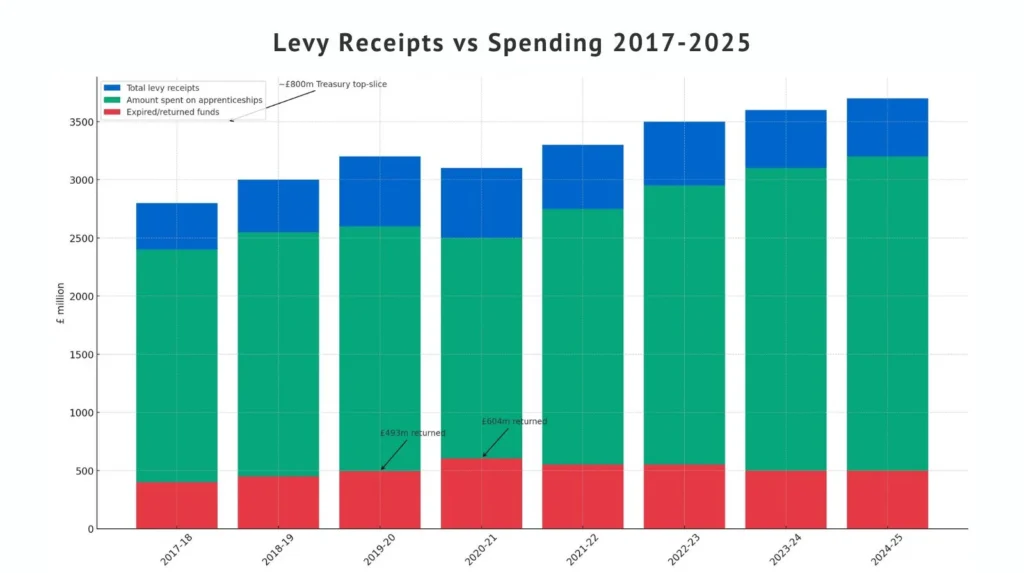
Official Government Data (DfE via Freedom of Information): Over £2 billion surrendered since 2017, representing 23% of DfE’s total ring-fenced apprenticeship budget between 2017-2021. Annual breakdowns show steady increases: £424 million (2017-18), £493 million (2018-19), £550 million (2019-20), £604 million (2020-21).
Treasury Top-Slicing: Approximately £800 million taken annually from levy receipts before distribution to employers.
Public Sector Waste: Over £300 million in unspent funds lapsed by public-sector employers specifically.
Contradictions in the Data (And Why They Matter)
The fact that different reputable sources report different figures isn’t just interesting, it’s a symptom of the system’s opacity. Here’s where the numbers diverge:
£3.3 billion vs £4.3 billion total unspent. AELP and Make UK both cite £3.3 billion returned since 2019. Policy Exchange calculates £4.3 billion unused between 2017-22. The discrepancy likely reflects different time periods and whether “unused” means expired-and-returned versus simply-not-spent-yet.
£600 million vs historical £2 billion in surrendered funds. AELP’s £600 million currently unallocated figure represents money sitting unused right now, while the DfE’s historical £2 billion figure covers cumulative surrendered funds from 2017-2021. Both can be true, but they measure different things.
Annual underspend variations. Make UK reports £280 million underspent in 2021-22 after consequentials. Policy Exchange reports £750 million more raised than spent in the same year. The gap reflects whether you count Treasury top-slicing (£800m annually) as “spending” or not.
Recycled vs returned funds. DfE data notes some unspent funds get recycled for small business apprenticeships rather than automatically returning to Treasury. This explains why total surrendered amounts don’t always match what appears to leave the system.
What this opacity means for someone considering NVQ training: the money exists, but navigating who can access it and under what conditions remains complicated. Employers often struggle to use funds because levy rules restrict spending to full apprenticeships, not shorter vocational courses.
Why Funds Go Unspent: The Structural Problems
Understanding why billions go unused matters if you’re planning electrical training, because these structural issues affect employer willingness to take on NVQ learners.
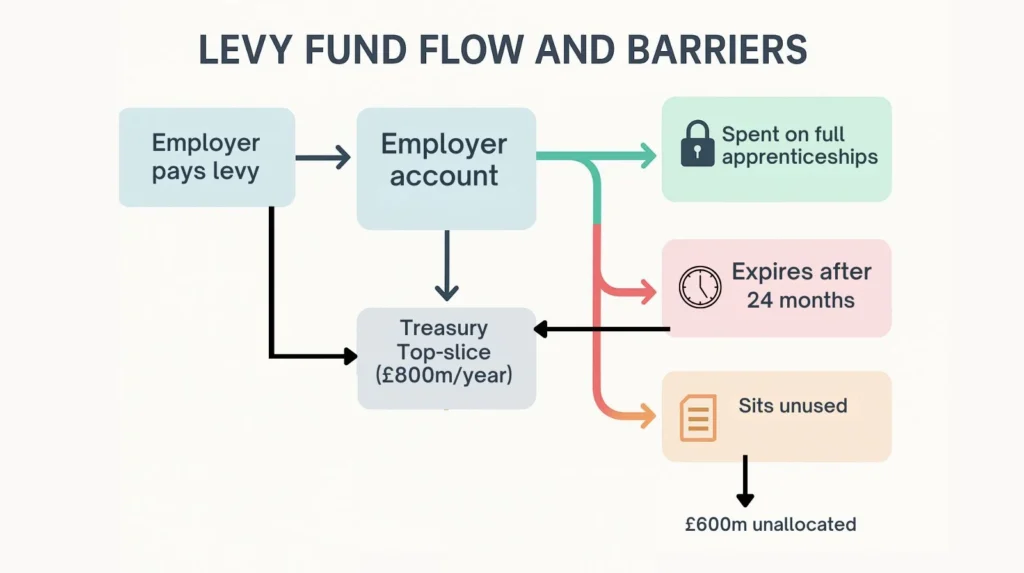
The 24-month expiry rule. Levy funds expire if not spent within 24 months of entering an employer’s account. For smaller levy-paying employers, this creates pressure to spend quickly rather than strategically. For larger employers with established training programmes, it creates administrative burden tracking expiry dates.
Levy can only fund full apprenticeships. This is the critical limitation. Employers can’t use levy funds for shorter courses like 18th Edition or Level 2 qualifications. They can fund NVQ Level 3 apprenticeships, but only if they meet all apprenticeship framework requirements including 20% off-the-job training time. Many employers want skilled workers but can’t commit to full apprenticeship structures.
Rigid spending rules. Levy funds can’t be used for assessment-only routes, can’t always cover sector-specific certifications (EV, solar, inspection & testing courses often fall outside scope), and can’t fund training for workers who don’t meet apprenticeship eligibility criteria (such as career changers over certain ages in some frameworks).
Treasury top-slicing reduces available funds. Before employers see any money, the Treasury takes approximately £800 million annually from total levy receipts. This reduces the pool available for actual training.
Administrative complexity. Employers need to navigate the Digital Apprenticeship Service, coordinate with training providers, manage evidence requirements, and ensure compliance with funding rules. For construction firms focused on delivering projects, this administrative burden often means funds sit unused.
Thomas Jevons, our Head of Training with 20 years’ experience, puts it plainly:
"The levy was meant to increase apprenticeships. Instead, it's created a system where employers pay in but struggle to use funds for the training their actual workforce needs. We see contractors wanting to upskill existing electricians in EV or solar work, but levy rules make that nearly impossible unless it fits an apprenticeship framework."
Thomas Jevons, Head of Training
What This Means for Electrical Training
Here’s where the levy system intersects with your decision about electrical qualifications. Elec Training works with employers navigating these funding rules daily, and the patterns are clear.
NVQ Level 3 qualifications fit apprenticeship frameworks. If you’re doing a full 2357 NVQ Level 3 in Electrical Installation, that qualifies for levy funding because it meets apprenticeship standards. Employers can use their levy to fund your training, which makes them more willing to take you on.
Shorter courses don’t qualify. Want to do 18th Edition on its own? Testing and inspection (2391)? EV charging installation? Solar PV? These don’t fit apprenticeship frameworks, so employers can’t use levy funds. They pay out of pocket, which makes them more selective about who they train.
The “use it or lose it” pressure helps you. Employers with levy funds expiring have incentive to take on apprentices. We’ve seen a spike in placement enquiries from levy-paying contractors in Q4 each year as they rush to commit funds before the 24-month deadline. If you’re ready to start NVQ training, timing your entry for when employers have expiring funds works in your favour.
Public sector opportunities. Remember that £300 million public-sector waste figure? Local authorities, NHS trusts, universities all pay the levy but historically struggle to use funds. There’s growing recognition this needs fixing. Public sector electrical work (maintenance, installations, upgrades) could absorb more apprentices if organisations get better at accessing their own levy funds.
Specialist skills sit outside the levy. Once you’re qualified, career progression often means specialist courses: EV charging installation, solar PV, heat pump systems, advanced inspection and testing. These don’t fit apprenticeship frameworks, so levy funds can’t cover them. Thomas Jevons, our Head of Training, explains the limitation:
"The levy doesn't cover everything electrical. We have qualified sparks wanting EV charging training, solar PV, heat pump installation. Those courses sit outside apprenticeship frameworks, so employers pay out of pocket. It makes sense for career progression, but the levy structure wasn't designed for upskilling existing workers."
Thomas Jevons, Head of Training
Joshua Jarvis, our Placement Manager, notes the practical reality:
"Employers with unused levy funds are more likely to take on NVQ learners because the government is effectively subsidising the training. The 24-month clock creates urgency. We match learners with employers who have funds expiring, which speeds up placement times and means learners get site experience faster."
Joshua Jarvis, Placement Manager
The Realistic Route to Qualified Electrician Status
Understanding levy funding helps you see why the full NVQ route makes sense, even though it takes longer than short courses. The levy system is built around apprenticeships, which means employers can access funding for proper qualifications but not shortcuts.
Here’s the actual pathway to JIB Gold Card status that qualifies for levy funding:
1. Level 2 Installation (2365-02) – 4 weeks covering electrical fundamentals, safe isolation, basic installation work. Theory and practical combined.
2. Level 3 Installation (2365-03) – 8 weeks covering advanced installation, design principles, inspection and testing theory. Builds on Level 2.
3. 18th Edition BS 7671:2018+A2:2022 – 5 days dedicated to current UK Wiring Regulations. Essential for legal compliance.
4. NVQ Level 3 Electrical Installation (2357) – 12-24 months portfolio of evidence from real site work across Units 102-111. This is what qualifies for levy funding because it’s a full apprenticeship.
5. AM2 Assessment – 3-day practical exam at an approved centre proving competency in installation, testing, fault-finding, and certification.
6. JIB Gold Card Application – Requires NVQ, 18th Edition, AM2 pass, and verifiable site experience. This is what employers actually want to see.
Total realistic timeframe: 18 months fast-track with guaranteed placements, or up to 3 years part-time. Total cost for our complete NVQ package: £10,000 (excludes PPE, tools, and AM2 fee which is additional).
The levy doesn’t fund the short courses. It funds the NVQ. That’s why proper training providers focus on getting learners through the full pathway rather than selling quick certifications that don’t lead to employment.
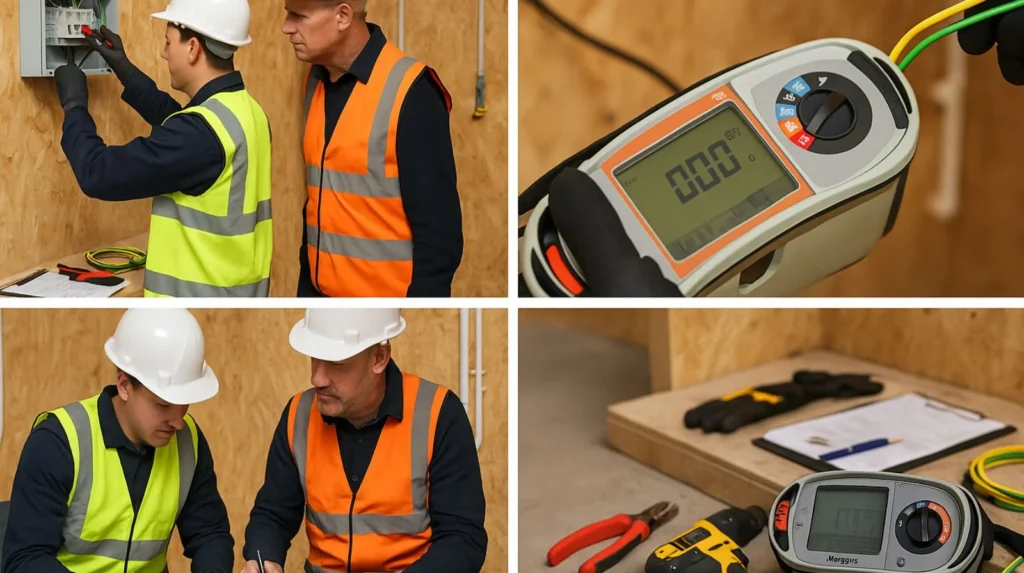
Government Response: Where Things Might Change
Labour’s £1 billion boost for apprenticeships and skills announced in 2025 signals some recognition that the system isn’t working optimally. Several reforms are under discussion that could affect electrical training access:
Greater flexibility in levy spending. Proposals include allowing levy funds for shorter qualifications, modular training, and upskilling existing workers (not just new apprentices). This would help electricians access specialist courses like EV charging, solar PV, and heat pump installation.
Extended expiry windows. Some voices argue for 36-month or 48-month expiry periods instead of 24 months, giving employers more time to strategically use funds without the rush.
Reduced Treasury top-slicing. If that £800 million annual top-slice was reduced or eliminated, more money would reach actual training. Whether this happens depends on Treasury priorities.
Better public sector utilisation. Specific initiatives targeting the £300 million waste in public sector, encouraging local authorities and NHS trusts to take on more apprentices.
Adult learner focus. Explicit recognition that levy funds should support career changers, not just school leavers. This benefits people in their 30s, 40s, 50s looking to retrain as electricians.
What’s realistic? Some flexibility is likely. The structural issues around 24-month expiry and apprenticeship-only spending probably remain. Any changes will be gradual. For someone considering training now, plan around current rules rather than hoping for reform.
What To Do Next
If you’re considering electrical training and wondering how levy funding affects your options, here’s what actually matters:
The levy system favours full NVQ apprenticeships over short courses. That’s not going to change quickly. Employers with levy funds to spend have real incentive to take on apprentices because the government subsidises training. The 24-month expiry creates urgency that can work in your favour if you time your entry right.
What we’re not going to tell you:
That levy reforms will make everything easier soon
That 5-week courses are equivalent to NVQ apprenticeships
That the system is simple or fair
That you don’t need proper qualifications
What we will tell you:
The full NVQ pathway takes 18 months to 3 years
It costs £10,000 for our complete package (excludes PPE, tools, AM2)
NVQ Level 3 qualifies for apprenticeship levy funding
Our in-house recruitment team works with 120+ contractors to secure placements
Many of these contractors have unused levy funds expiring
Proper qualifications lead to JIB Gold Card status that employers actually want
With £3.3 billion returned to Treasury, the issue isn’t lack of funding, it’s accessing it properly
The levy system particularly benefits career changers looking for a stable, skilled trade. Joshua Jarvis, our Placement Manager, notes:
"The levy system benefits career changers in their 30s and 40s because employers see mature learners as lower risk. Someone with project management or customer service experience brings transferable skills. If they're on a levy-funded apprenticeship, the employer gets quality training and reliability without bearing full cost."
Joshua Jarvis, Placement Manager,
Call us on 0330 822 5337 to discuss how apprenticeship levy funding could support your electrical training. We’ll explain which qualifications attract levy funding, how to find employers with funds to spend, and what the realistic timeline looks like. We work with contractors navigating the levy system daily, and we can match you with placements where funding is already secured.
Visit www.elec.training for full course details, pricing, and information about our in-house recruitment team’s approach to securing levy-funded placements.

References
- Association of Employment and Learning Providers (AELP) – Apprenticeship Levy Analysis 2025 – https://www.aelp.org.uk/
- The Observer – Treasury Apprenticeship Levy Reporting November 2025 – https://www.theguardian.com/observer
- Make UK – Apprenticeship Levy Impact Report 2021-2022 – https://www.makeuk.org/
- Policy Exchange – Apprenticeship Levy Efficiency Analysis 2017-2022 – https://policyexchange.org.uk/
- Department for Education (DfE) – Freedom of Information Response on Surrendered Levy Funds 2017-2021 – https://www.gov.uk/government/organisations/department-for-education
- FE Week – Historical Apprenticeship Levy Data via FOI Requests – https://feweek.co.uk/
- City & Guilds 2357 NVQ Level 3 Electrical Installation Specification – https://www.cityandguilds.com/
- JIB/ECS – Gold Card Requirements and Apprenticeship Routes – https://www.jib.org.uk/
- IET Wiring Regulations BS 7671:2018+A2:2022 – https://www.theiet.org/
Note on Accuracy and Updates
Last reviewed: 10 December 2025. This page is maintained; we correct errors and refresh sources as apprenticeship levy policy and spending data changes. Figures cited represent the most recent publicly available data from AELP (November 2025), Make UK (2021-22 reporting), Policy Exchange (2017-22 analysis), and DfE Freedom of Information responses (2017-2021). Next review scheduled following any significant apprenticeship levy policy announcements or updated DfE spending data releases.
