
Understanding Electrical Course Codes: What 2365, 2357, 2382 & EAL Equivalents Actually Mean

- Technical review: Thomas Jevons (Head of Training, 20+ years)
- Employability review: Joshua Jarvis (Placement Manager)
- Editorial review: Jessica Gilbert (Marketing Editorial Team)
- Last reviewed:
- Changes: Updated qualification codes following EAS 2024/25 framework implementation and Ofqual register verification
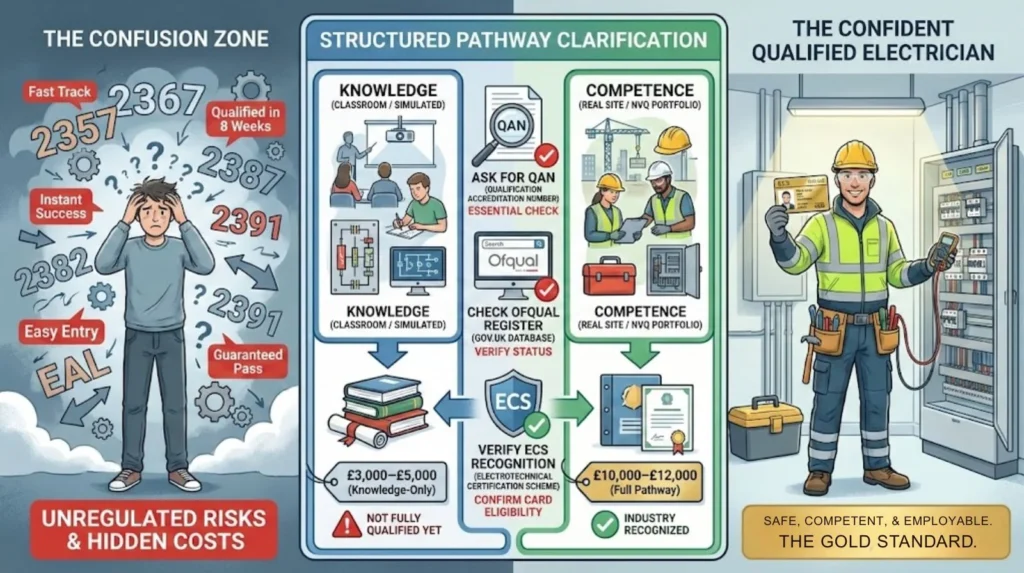
UK electrical qualification codes create confusion that costs learners thousands of pounds in misdirected training investments and delayed career progression. Course codes like “2365,” “2357,” “2382,” and “2391” appear constantly in training provider marketing, job advertisements, and industry discussions, often presented as if their meanings are self-evident when reality is considerably more complex.
The fundamental problem: these alphanumeric codes mean different things to different audiences. Training providers use them as marketing shorthand. Awarding bodies employ them as internal reference systems. Employers reference them assuming shared understanding. Learners attempting to decode qualification pathways frequently misinterpret what codes represent, which qualifications progress to which outcomes, and critically, which certificates actually enable professional electrical work versus which merely provide theoretical knowledge.
This confusion isn’t accidental. Some training providers deliberately exploit learners’ lack of familiarity with qualification frameworks, marketing “electrician courses” using legitimate City & Guilds codes whilst delivering non-regulated alternatives that don’t progress to ECS (Electrotechnical Certification Scheme) cards or employment. Others genuinely use codes as convenient shorthand without recognizing learners interpret “2365 Level 3” as meaning “qualified electrician” when it actually means “theoretical foundation requiring substantial additional qualifications.”
The financial consequences are severe. Learners invest £3,000-£5,000 completing knowledge-based qualifications believing they’re qualified to work, then discover employers require competence-based NVQ portfolios they don’t possess. This necessitates additional £8,000-£10,000 investment in workplace assessment routes, placement support, and AM2 end-point assessment, effectively doubling total qualification costs through preventable misunderstanding.
This article decodes the UK electrical qualification code system, explains what major codes actually represent, distinguishes knowledge qualifications from competence assessments, provides 5-minute verification process protecting against non-regulated alternatives, and translates how codes appear in job advertisements versus what employers actually require. Understanding this system before enrollment prevents expensive detours and ensures training investments progress efficiently toward qualified electrician status.
The UK Qualification Framework: Why Codes Exist
UK electrical qualifications operate within Regulated Qualifications Framework (RQF) administered by Ofqual in England, Qualifications Wales, and CCEA in Northern Ireland. The framework standardizes qualifications by assigning levels (Entry through Level 8) based on complexity, autonomy requirements, and skill demonstration expected.
RQF Levels Relevant to Electrical Work:
Level 1: Basic electrical principles, unsuitable for professional work
Level 2: Foundation electrical installation knowledge, entry point for training
Level 3: Advanced installation theory and practical competence, required for qualified electrician status
Level 4+: Higher technical, design, and management qualifications
Within this framework, awarding bodies (City & Guilds, EAL, LCL Awards) create specific qualifications addressing industry needs. Each qualification receives unique Qualification Accreditation Number (QAN) from Ofqual, appearing on official register as definitive identifier proving regulation and national recognition.
However, awarding bodies also use internal reference codes for administrative convenience. City & Guilds employs 4-digit codes (2365, 2357, 2391) grouping qualification families. EAL uses different alphanumeric systems, often referencing QAN directly. LCL Awards frequently markets under descriptive titles rather than numeric codes. This creates situation where same qualification type has multiple identifiers depending on which awarding body delivers it and whether you’re referencing internal code or official QAN.
The critical distinction learners must understand: course codes are administrative shorthand; QANs are legal identifiers. A training provider advertising “City & Guilds 2365 course” should provide the specific QAN (e.g., 600/5498/0 for Level 2, 601/6299/5 for Level 3) proving you’re enrolling in actual regulated qualification rather than non-regulated training using City & Guilds branding without authorization.
"Course codes like 2365 or 2391 are City & Guilds' internal reference numbers—useful shorthand for the industry but not legally regulated identifiers. The Qualification Accreditation Number assigned by Ofqual is what actually matters. Every regulated qualification has a unique QAN you can verify on the Ofqual register proving it meets national standards and progresses to recognized outcomes. When providers can't give you the QAN or dodge the question by only mentioning course codes, that's an immediate red flag the 'qualification' may be non-regulated training with a certificate that doesn't progress anywhere. Always demand the QAN before enrolling."
Thomas Jevons, Head of Training
Knowledge Qualifications vs Competence Qualifications
The most expensive misunderstanding in electrical training stems from conflating knowledge qualifications with competence qualifications. These are fundamentally different assessment types with distinct purposes in qualification pathways.
Knowledge Qualifications (Diplomas):
Assess theoretical understanding and simulated practical work in training environments
Delivered primarily through classroom teaching and workshop practice on training rigs
Examinations, written assignments, and controlled practical tasks in training centers
Examples: City & Guilds 2365, EAL Level 2/3 Diplomas
Purpose: Foundation for progression to workplace competence assessment
Do NOT qualify you as electrician capable of unsupervised work
Competence Qualifications (NVQs):
Assess actual workplace performance through portfolio evidence from real installations
Requires employment or placement with electrical contractor providing supervised site access
Documentation of genuine installations, testing, certification, fault diagnosis on actual projects
Examples: City & Guilds 2357/5357, EAL NVQ equivalents
Purpose: Prove capability to work safely and competently as professional electrician
Combined with AM2 assessment, enables ECS Gold Card application
The confusion arises because both types can be “Level 3” qualifications. City & Guilds 2365 Level 3 Diploma and City & Guilds 2357 Level 3 NVQ are both Level 3, but first is knowledge-only whilst second requires workplace competence demonstration. Completing 2365 alone doesn’t make you qualified electrician despite being advanced Level 3 qualification.
Understanding this distinction before enrollment prevents investing thousands in knowledge qualifications whilst believing you’re qualifying for immediate employment.
Major City & Guilds Course Codes Explained
City & Guilds dominates UK electrical training market, making their codes most frequently encountered. Understanding what each major code represents is essential for decoding training pathways and job requirements.
City & Guilds 2365: Level 2 and Level 3 Diplomas in Electrical Installations
What it is: Knowledge-based diploma covering electrical theory, installation principles, testing procedures, and regulations through classroom teaching and workshop practice on training rigs.
QAN Numbers:
Level 2: 600/5498/0 (454 Guided Learning Hours)
Level 3: 601/6299/5 (480 Guided Learning Hours)
Assessment Type: Written examinations (often closed-book multiple choice and short answer), practical assignments completed in training workshops on simulated installations, synoptic assessments combining multiple units.
What it enables: Foundation knowledge for electrical work, progression to NVQ routes, eligibility for ECS Trainee card (white card, limited site access under supervision).
What it does NOT enable: Unsupervised electrical work, ECS Gold Card application, professional electrician status, Competent Person Scheme registration.
Typical pathway position: First qualification for career changers starting from zero electrical knowledge, often delivered over 12-16 weeks intensive or 1-2 years part-time.
Common misconception: “I’ve completed 2365 Level 3 so I’m now a qualified electrician.” Reality: 2365 provides theoretical foundation but requires NVQ workplace competence and AM2 assessment for qualified status.
City & Guilds 2357: Level 3 NVQ Diploma in Installing Electrotechnical Systems
What it is: Workplace competence qualification requiring portfolio evidence from actual electrical installations completed on real construction sites or maintenance projects under supervision.
QAN Number: 600/6297/1
Assessment Type: Portfolio documentation including photographs, test certificates, design calculations, risk assessments from genuine installations you’ve completed. Workplace observation by qualified assessor verifying installation, testing, and certification competence. Knowledge assessments integrated into workplace tasks.
What it enables: Combined with 18th Edition and AM2 completion, enables ECS Gold Card application and JIB Electrician grading. Demonstrates workplace competence to employers.
What it requires: Employment or placement with electrical contractor providing site access. Typically 12-24 months portfolio development depending on hours worked and installation variety encountered.
Typical pathway position: Follows knowledge foundation (2365 or equivalent), runs concurrently with employment/placement, assessed over extended period as evidence accumulates.
Common misconception: “I can do an NVQ in 6 weeks through intensive course.” Reality: NVQ is workplace assessment requiring real installation evidence accumulated over months of site work.
City & Guilds 5357: Level 3 Electrotechnical Qualification (Installation/Maintenance)
What it is: Integrated apprenticeship qualification combining knowledge components from 2365 with competence units from 2357 into single qualification pathway.
QAN Number: 601/6298/3
Assessment Type: Combination of examinations, practical assessments, workplace portfolio, and synoptic end-point assessment integrating all components.
What it enables: Complete pathway from beginner to qualified electrician status when combined with 18th Edition and AM2. Standard apprenticeship route qualification.
Relationship to other codes: Contains units from both 2365 (knowledge) and 2357 (competence). Apprentices following 5357 route don’t separately complete 2365 and 2357 as standalone qualifications.
Typical pathway position: Apprenticeship-only route, requires employer sponsorship, typically 3-4 years duration.
Common misconception: “5357 has replaced 2357 entirely.” Reality: 5357 is specifically for apprenticeship delivery, whilst 2357 remains for adult learners, experienced workers, and non-apprenticeship competence routes.
City & Guilds 2382: Level 3 Award in Requirements for Electrical Installations BS 7671
What it is: Standalone course on BS 7671:2018+A2:2022 wiring regulations covering design, installation, testing, and certification requirements.
QAN Number: 603/3430/7 (35 Guided Learning Hours)
Assessment Type: Written examination testing knowledge of wiring regulations, design principles, and compliance requirements.
What it enables: Current knowledge of BS 7671 regulations required for all practicing electricians. Commonly known as “18th Edition,” essential component of ECS card applications and renewals.
What it does NOT enable: Any installation, testing, or certification capability. Proves you can read and interpret regulation book, not perform electrical work.
Typical pathway position: Usually completed early in qualification journey, required alongside (not instead of) NVQ and AM2 for Gold Card. Requires periodic updating when new BS 7671 editions release.
Common misconception: “18th Edition qualifies me as electrician.” Reality: 18th Edition is CPD (Continuing Professional Development) on regulations, not vocational qualification enabling employment.
City & Guilds 2391: Level 3 Award in Initial Verification and Periodic Inspection & Testing
What it is: Specialist qualification focusing on inspection, testing, and certification of electrical installations to BS 7671 standards.
QAN Numbers (various pathways):
2391-52 (Combined Initial & Periodic): 603/1273/9
Other variants for specific testing routes
Assessment Type: Written examination covering testing procedures and BS 7671 requirements, practical assessment demonstrating testing competence and certification accuracy.
What it enables: Competence in inspection and testing work, often required for Competent Person Scheme approval, enables certification authority for electrical installation condition reports.
What it requires: Prior Level 3 electrical knowledge (typically 2365 Level 3 or equivalent). Not entry-level qualification.
Typical pathway position: Post-qualification specialist development, often pursued after achieving NVQ and initial employment experience.
Common misconception: “2391 is for testers only, installation electricians don’t need it.” Reality: Most electrical contractors expect electricians to hold 2391 for condition report work, though specialized testing roles exist.
EAL and LCL Awards Equivalent Codes
EAL (Excellence, Achievement & Learning) and LCL Awards (formerly Logic Certification) offer qualifications functionally equivalent to City & Guilds routes but using different reference systems.
EAL Equivalents to Major City & Guilds Codes
EAL typically references qualifications by full title or QAN rather than short numeric codes, creating translation requirement when comparing to City & Guilds system.
EAL Level 2 Diploma in Electrical Installation
Equivalent to: City & Guilds 2365 Level 2
QAN: 600/6724/X (various pathways)
GLH: Minimum 370 hours
Assessment style: Theory examinations (often open-book or referenced), practical assignments, portfolio elements
Key difference: EAL allows consultation of Wiring Regulations and reference materials during some assessments, mirroring real-world practice more closely than City & Guilds closed-book approach
EAL Level 3 Diploma in Electrical Installation
Equivalent to: City & Guilds 2365 Level 3
Assessment: Holistic synoptic practical tasks combining multiple competencies
Recognition: Identical to City & Guilds for progression to NVQ and ECS Trainee card
EAL Level 3 NVQ Diploma in Installing Electrotechnical Systems
Equivalent to: City & Guilds 2357
QAN: 600/9331/6
Assessment: Workplace portfolio, site-based evidence, assessor verification
No meaningful difference: Both lead to same ECS Gold Card eligibility when combined with 18th Edition and AM2
EAL Level 3 Award in Requirements for Electrical Installations BS 7671
Equivalent to: City & Guilds 2382 (18th Edition)
QAN: 603/3298/0
Identical outcome: Both versions recognized equally by ECS and employers
EAL Inspection & Testing Awards
Equivalent to: City & Guilds 2391
QAN: 601/5321/5 (various pathways)
Assessment format differs slightly: EAL may use different practical assessment approach but leads to equivalent competence recognition
The critical point: EAL qualifications at equivalent RQF levels provide identical progression pathways and professional recognition as City & Guilds counterparts. The assessment methodology differences (open-book vs closed-book, synoptic vs modular) affect learner experience but not final qualification value for ECS cards, JIB grading, or employer recognition.
LCL Awards Reference System
LCL Awards (formerly Logic Certification, established initially for gas qualifications) often markets qualifications under descriptive titles rather than numeric codes, focusing heavily on domestic installation and renewable energy sectors.
LCL Awards Level 3 Award in Requirements for Electrical Installations BS 7671
Equivalent to: City & Guilds 2382, EAL 18th Edition
QAN: 603/3298/0 (shares same QAN as EAL version)
Recognition: Identical acceptance for 18th Edition requirements
LCL Awards Domestic Electrical Installer (Part P)
Not directly equivalent to single City & Guilds code: Bundles domestic-focused units
QAN: Various depending on specific components
Scope limitation: Domestic installations only, narrower than full 2365/2357 commercial routes
Suitable for: Electricians certain they want domestic-only careers
LCL Awards Inspection & Testing qualifications
Equivalent to: City & Guilds 2391 for domestic scope
Commercial limitation: Some LCL testing awards focus specifically on domestic rather than commercial/industrial installations
Key LCL distinction: Portfolio emphasizes domestic installation and renewable energy (solar PV, EV charging, battery storage) more heavily than City & Guilds or EAL, with streamlined routes for experienced domestic workers but fewer comprehensive commercial/industrial pathways.
Translation Table: Finding Equivalents Across Awarding Bodies
| Qualification Type | City & Guilds Code | EAL Reference | LCL Awards | QAN Examples |
| Level 2 Knowledge Foundation | 2365-02 | Level 2 Diploma in Electrical Installation | Limited offering | C&G: 600/5498/0, EAL: 600/6724/X |
| Level 3 Knowledge Advanced | 2365-03 | Level 3 Diploma in Electrical Installation | Limited offering | C&G: 601/6299/5 |
| Level 3 NVQ Competence | 2357 | Level 3 NVQ Diploma in Installing Electrotechnical Systems | Not offered (domestic routes only) | C&G: 600/6297/1, EAL: 600/9331/6 |
| Apprenticeship Integrated | 5357 | EAL equivalent apprenticeship routes | Not applicable | C&G: 601/6298/3 |
| 18th Edition BS 7671 | 2382 | Level 3 Award in Requirements (BS 7671) | Level 3 Award (BS 7671) | 603/3430/7 (C&G), 603/3298/0 (shared) |
| Inspection & Testing | 2391 | Initial Verification & Periodic Inspection awards | Inspection & Testing awards (domestic focus) | Various by pathway |
Understanding these equivalences prevents confusion when encountering different awarding body references in job advertisements, training provider materials, or qualification discussions.
Legacy Codes: Understanding Historical Qualifications
Electricians who qualified years ago often hold qualifications under superseded code systems, creating confusion about whether historical certificates remain valid and how they map to current frameworks.
City & Guilds 2360 (Superseded by 2365)
The 2360 suite represented previous framework for electrical installation qualifications before current 2365 system. Qualified electricians holding 2360 Level 2 and Level 3 certificates possess valid historical qualifications still recognized by ECS for card routes.
Status: Valid for demonstrating underpinning knowledge, accepted by ECS legacy qualification routes, still referenced in some experienced worker assessment pathways.
Progression: Electricians with 2360 qualifications don’t need to retake 2365 equivalents. However, if pursuing AM2 or formal NVQ assessment, verify current requirements with ECS as some legacy qualifications may require supplemental assessments bridging to current frameworks.
City & Guilds 2330 (Superseded by 2365)
Earlier iteration of electrical installation qualifications, particularly common for electricians qualified 10-15+ years ago.
Status: Remains valid historical qualification, recognized for experienced worker routes and underpinning knowledge requirements.
Limitation: May not include content from more recent BS 7671 amendments (particularly 18th Edition requirements), potentially requiring supplemental 18th Edition certification even for experienced electricians.
City & Guilds 2351 (Withdrawn)
Older competence qualification route no longer available but held by many practicing electricians.
Status: Valid historical competence qualification, recognized by ECS for legacy card routes.
Other Legacy Codes: 236, 2400 series, and various historical City & Guilds electrical qualifications remain valid for proving historical training and competence provided held when current.
The Legacy Code Rule: If you qualified under previous framework and hold valid ECS card, your historical qualifications remain acceptable for card renewals and employment. You don’t need to “requalify” under current codes. However, you may need current 18th Edition (2382 or equivalent) for card renewals, and if pursuing additional specialist qualifications (like 2391 testing), ensure prerequisites reference legacy code equivalence.
Verifying Legacy Qualification Value
Electricians uncertain whether historical qualifications progress to current requirements should:
Contact ECS directly with specific qualification details
Request equivalence confirmation in writing
Verify 18th Edition currency (most common additional requirement)
Check if experienced worker assessment (2346/EAL equivalent) provides most efficient route to updating credentials
Legacy qualifications aren’t worthless—they’re valid historical credentials requiring context-specific verification of how they map to current frameworks.
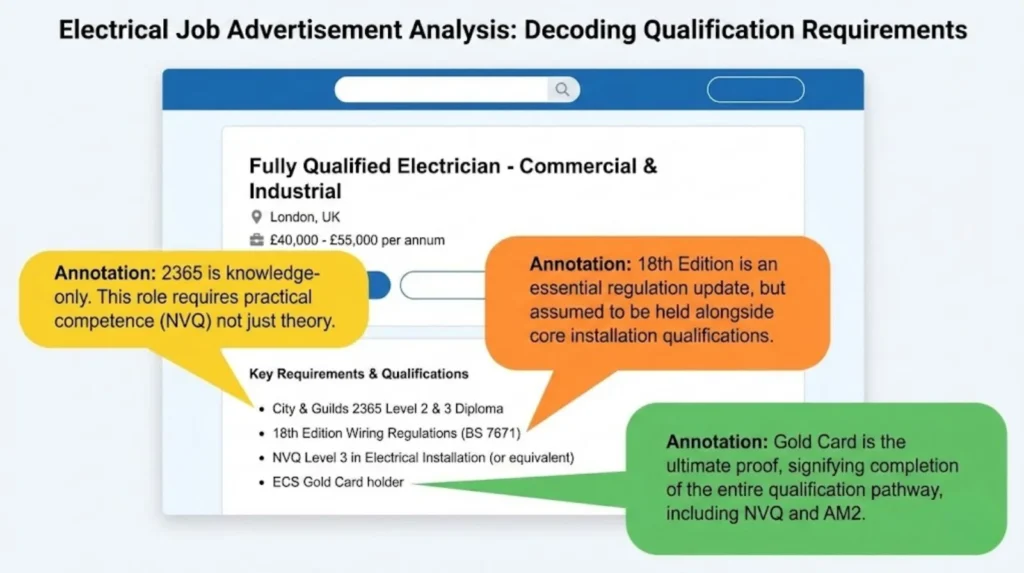
How Course Codes Appear in Job Advertisements (And What Employers Actually Mean)
Employers use qualification codes inconsistently in job specifications, creating interpretation challenges for applicants assessing whether they meet requirements.
Common Job Advertisement Patterns:
Pattern 1: “City & Guilds 2365 Level 3 or equivalent required”
What it literally says: Knowledge-based diploma qualification.
What employers usually mean: They expect full qualification pathway including NVQ competence, not just 2365 knowledge diploma. They’re using 2365 as shorthand for “electrically qualified” whilst actually requiring complete credentials.
How to interpret: If job involves unsupervised electrical work, site installations, or responsibilities beyond apprentice/improver level, assume employer expects NVQ Level 3 plus AM2 completion regardless of mentioning only 2365. Contact employer to clarify if uncertain.
Pattern 2: “18th Edition essential”
What it literally says: BS 7671 regulations knowledge required.
What employers usually mean: Table stakes requirement alongside comprehensive qualifications. They assume applicants understand 18th Edition alone doesn’t constitute electrical qualification but is mandatory component all electricians must hold.
How to interpret: If advertisement lists only 18th Edition without mentioning NVQ or other competence qualifications, it’s either poorly written specification or role has very limited scope (perhaps electrical materials sales, admin, or support). For actual electrician positions, 18th Edition is assumed alongside NVQ Level 3.
Pattern 3: “NVQ Level 3 and 18th Edition required, 2391 preferred”
What it literally says: Competence qualification and regulations knowledge mandatory, inspection/testing qualification advantageous.
What employers actually mean: This is accurately written specification. They want proven workplace competence (NVQ), current regulations knowledge (18th Edition), and view inspection/testing capability (2391) as beneficial but not essential for initial application.
How to interpret: If you hold NVQ Level 3 and 18th Edition, apply even without 2391. Include 2391 status in applications if held. If lacking NVQ despite holding 2365, don’t apply until competence route completed.
Pattern 4: “Qualified electrician with JIB/ECS Gold Card”
What it literally says: Industry-standard qualified electrician status.
What employers actually mean: NVQ Level 3, 18th Edition, AM2 completion, valid ECS Gold Card. They’re not specifying awarding body codes because they care about end result (proven qualified electrician status) not specific qualification pathway.
How to interpret: This is outcome-based specification. Doesn’t matter if you qualified via City & Guilds 2365+2357, EAL equivalents, or apprenticeship 5357 route. Gold Card proves you met requirements.
Pattern 5: “Apprentice-trained electrician preferred”
What it literally says: Preference for apprenticeship route qualification.
What employers usually mean: They value structured progression through apprenticeship (knowledge + competence + extended workplace experience) but may consider adult learners with equivalent credentials.
How to interpret: If you qualified through adult learning routes (2365+2357+AM2) rather than apprenticeship, still apply but emphasize any substantial workplace experience demonstrating equivalent depth to apprenticeship training.
"We regularly encounter learners who've invested significant money and time in electrical training but can't progress to employment because they misunderstood which codes they needed. Common scenario: someone completes 2365 Level 2 and Level 3, assumes they're qualified, applies for electrician positions, then discovers employers want NVQ evidence they don't have. They've spent perhaps £3,000-£5,000 on knowledge qualifications but still need another £8,000-£10,000 for the competence route including NVQ portfolio development and AM2 assessment. Had they understood the code differences upfront, they could have pursued integrated apprenticeship routes or planned the complete pathway rather than discovering halfway through they're only partially qualified."
Joshua Jarvis, Placement Manager
Translating Employer Requirements:
When reviewing job specifications mentioning course codes:
Identify whether codes referenced are knowledge (2365, EAL diplomas) or competence (2357, EAL NVQ)
Assume unsupervised work roles require competence qualifications even if only knowledge codes mentioned
Treat 18th Edition as assumed requirement for all electrical roles
Contact employers directly if specification seems unclear or contradictory
Don’t assume knowledge qualifications alone meet “qualified electrician” requirements
Understanding this translation prevents wasting application time and reveals when your current qualifications genuinely match versus when additional credentials are needed.
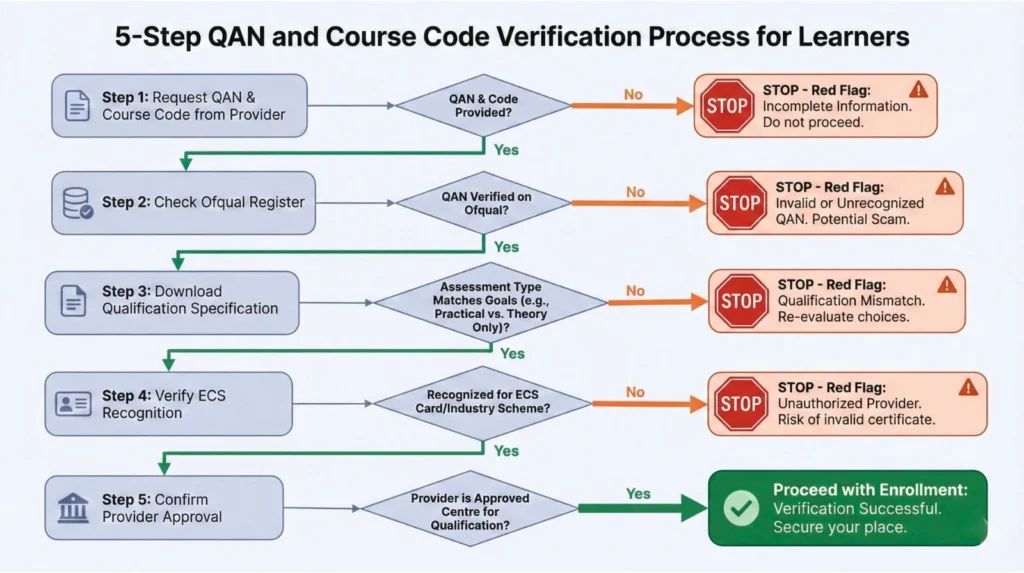
The 5-Minute Course Code Verification Process
Before enrolling in any electrical training using course codes in marketing, spend 5 minutes verifying you’re receiving regulated qualification progressing to your goals rather than non-regulated alternative.
Step 1: Demand the Qualification Accreditation Number (QAN)
Contact training provider and specifically request the QAN for the course you’re considering. Do not accept vague responses referencing only course codes.
What to ask: “What is the Ofqual Qualification Accreditation Number for this course?”
Acceptable answer: Specific 8-digit or longer alphanumeric code (e.g., “600/5498/0” for City & Guilds 2365 Level 2).
Red flags:
“We use City & Guilds 2365” (code only, no QAN)
“It’s equivalent to City & Guilds 2365” (equivalent claims without QAN proof)
“We’re waiting for Ofqual approval” (non-regulated course)
Dodging the question or changing subject
If provider cannot or will not provide QAN, assume the course is non-regulated training that won’t progress to ECS cards or employment despite marketing suggesting otherwise.
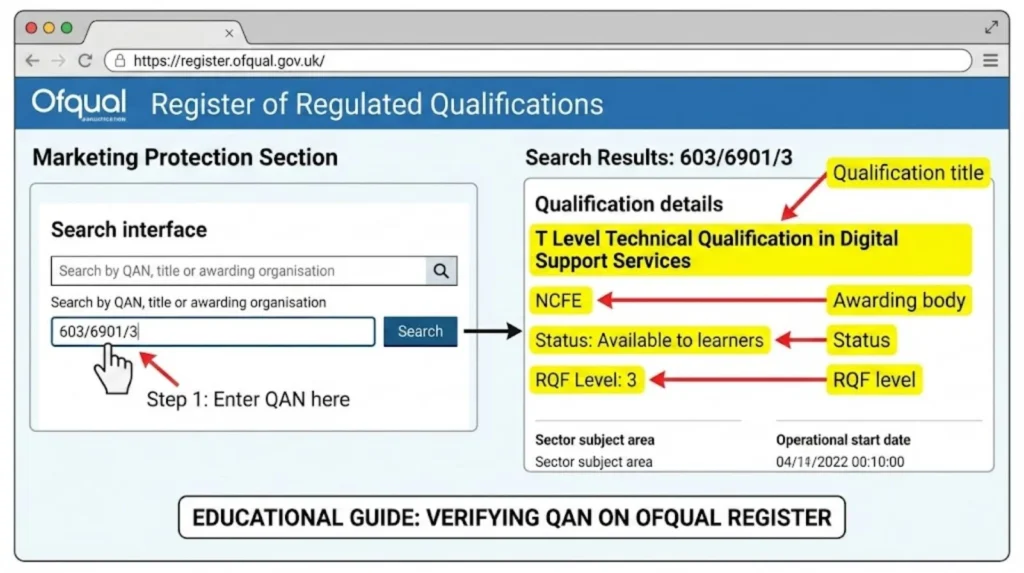
Step 2: Verify QAN on Ofqual Register
Visit register.ofqual.gov.uk and search using the QAN provider gave you.
What to verify:
Qualification appears on register (proves regulation)
Status shows “Available to learners” (proves current validity)
Awarding body matches provider’s claim (e.g., City & Guilds, EAL, LCL Awards)
Level matches course marketing (Level 2, Level 3)
Title matches what provider described
Red flags:
QAN doesn’t exist on register (non-regulated course)
Status shows “No longer available to learners” (superseded qualification)
Awarding body doesn’t match provider’s claim (potential fraud)
Title significantly differs from marketing description
If QAN doesn’t verify, contact provider demanding explanation before proceeding.
Step 3: Download Qualification Specification
Visit awarding body’s official website (cityandguilds.com, eal.org.uk, lclawards.co.uk) and locate specification document for the QAN.
What to check:
Assessment type (exam, practical, portfolio, workplace evidence)
Guided Learning Hours (GLH) or Total Qualification Time (TQT)
Prerequisites (what you need before enrolling)
Progression pathways (what this qualification enables next)
Critical assessment type verification:
If specification only lists:
“Online multiple choice exam”
“Practical assignments in training center”
“Simulated workshop tasks”
You’re looking at knowledge-only qualification that won’t enable independent electrical work without additional competence routes.
If specification includes:
“Workplace portfolio evidence”
“Site-based assessment”
“Supervised installation documentation”
“Real-world competence demonstration”
You’re looking at competence qualification (NVQ) that contributes to qualified electrician status when combined appropriately.
Step 4: Cross-Reference ECS Card Requirements
Visit ecscard.org.uk and check which qualifications lead to your target card level.
For ECS Gold Card (Electrician):
NVQ Level 3 (various QANs from approved awarding bodies)
18th Edition BS 7671
AM2 or AM2E completion
Health and safety qualification
Critical check: Does the QAN you’re verifying appear on ECS’s recognized qualifications list? If it’s knowledge-based diploma (2365 equivalent), it won’t directly lead to Gold Card but may progress to NVQ routes that do.
Step 5: Verify Training Provider Approval
Confirm training provider is approved center for the specific awarding body whose qualification they’re offering.
How to verify:
City & Guilds: Use center finder at cityandguilds.com
EAL: Check approved centers at eal.org.uk
LCL Awards: Verify on lclawards.co.uk
Red flag: Provider claims to offer City & Guilds 2365 but doesn’t appear on City & Guilds’ approved center list. This indicates they’re either:
Using “City & Guilds” branding without authorization
Offering non-regulated preparation training for City & Guilds exams
Providing certificates that aren’t actual City & Guilds qualifications
This 5-minute process protects against thousands of pounds wasted on non-regulated courses masquerading as legitimate qualifications.
Common Expensive Mistakes to Avoid
Understanding frequent misunderstandings about course codes prevents costly qualification detours.
Mistake 1: Believing 2365 Level 3 Equals Qualified Electrician
The misconception: Completing City & Guilds 2365 Level 3 Diploma means you’re qualified to work as professional electrician.
The reality: 2365 Level 3 is knowledge-based diploma providing theoretical foundation. You’ve proven understanding of electrical principles, installation methods, and testing procedures in classroom/workshop contexts. You have NOT demonstrated workplace competence on real installations.
The consequence: Spending £2,000-£4,000 on 2365 qualifications, applying for electrician jobs, getting rejected or only offered apprentice/improver positions despite completing Level 3.
The correction: 2365 Level 3 enables progression to NVQ routes, not immediate employment. You still need NVQ Level 3 portfolio (12-24 months workplace evidence), AM2 assessment (3-day practical exam), and 18th Edition for qualified status. Total investment typically £10,000-£12,000 including all components.
Mistake 2: Thinking 18th Edition Alone Qualifies You
The misconception: Passing 18th Edition (City & Guilds 2382 or equivalent) makes you qualified electrician because job ads always mention it.
The reality: 18th Edition is 35-hour CPD course on BS 7671 wiring regulations. It proves you can interpret regulation book. It does NOT prove installation capability, testing competence, fault diagnosis skill, or safe working practices.
The consequence: Completing 18th Edition course (cost £150-£300), believing you can now work electrically, discovering no employer will hire you without NVQ competence.
The correction: 18th Edition is mandatory component of complete qualification pathway but represents perhaps 3% of total requirements. Think of it as “highway code” – necessary for driving but doesn’t mean you can actually drive vehicle.
Mistake 3: Confusing NVQ Marketing With Actual NVQ Delivery
The misconception: Enrolling in training provider’s “NVQ course” means you’ll complete NVQ qualification through their classroom teaching.
The reality: NVQ is workplace competence assessment requiring portfolio evidence from real site installations. Training providers can deliver knowledge components and portfolio guidance, but actual NVQ completion requires employer/placement providing supervised access to genuine electrical work.
The consequence: Paying £4,000-£6,000 for “NVQ course,” attending classroom sessions, then discovering you still need workplace placement to build portfolio before NVQ can be awarded. Some learners never complete NVQ because they can’t secure placements.
The correction: Verify whether “NVQ course” includes guaranteed placement providing site access for portfolio development, or whether it’s just classroom preparation requiring you to independently arrange employment/placement for actual NVQ completion.
Mistake 4: Assuming EAL or LCL Are “Second-Class” Qualifications
The misconception: City & Guilds codes are “proper” qualifications whilst EAL or LCL are inferior alternatives employers don’t recognize.
The reality: EAL and LCL Awards are Ofqual-regulated awarding bodies offering qualifications with identical RQF levels and recognition. ECS, JIB, and employers accept equivalent Level 3 NVQ qualifications regardless of awarding body provided they meet criteria.
The consequence: Limiting training provider choices or paying premium for City & Guilds courses when equivalent EAL qualifications offered locally at better value or with superior teaching quality.
The correction: Focus on qualification type (knowledge vs competence), RQF level, and provider quality rather than obsessing over awarding body brand. Verify ECS recognition for your target pathway regardless of which awarding body delivers it.
Mistake 5: Believing Legacy Codes Are Worthless
The misconception: Holding historical qualifications under superseded codes (2360, 2330, 2351) means you need to requalify under current frameworks.
The reality: Legacy codes remain valid for electricians who held them when current. ECS recognizes historical qualifications for card routes. You don’t need to “update” to 2365/2357 unless pursuing new qualifications.
The consequence: Experienced electricians unnecessarily enrolling in 2365 courses believing their 2360 qualifications are invalid, wasting money duplicating credentials they already hold.
The correction: Verify legacy qualification recognition with ECS directly. Most commonly, you only need current 18th Edition alongside historical qualifications for card renewals, not complete requalification.
Mistake 6: Overlooking AM2 as Separate Requirement
The misconception: Completing NVQ Level 3 qualifies you as electrician without additional assessment.
The reality: AM2 (Electrotechnical Assessment of Occupational Competence) is independent 3-day practical examination testing installation, fault-finding, testing, and certification competence. Administered by NET (National Electrotechnical Training), not awarding bodies. Required for ECS Gold Card alongside NVQ and 18th Edition.
The consequence: Completing expensive NVQ portfolio development, believing you’re finished, then discovering AM2 requirement adds £800-£1,000 additional cost plus 3-day assessment.
The correction: When planning complete qualification pathway, budget includes NVQ portfolio development, AM2 assessment booking and fee, potential AM2 preparation courses, and travel/accommodation for assessment center attendance.
Mistake 7: Accepting Non-Regulated “Equivalents”
The misconception: Training provider’s claim their “Professional Electrician Certificate” is equivalent to City & Guilds 2365 without needing Ofqual regulation.
The reality: Non-regulated training certificates have no recognition for ECS cards, JIB grading, or Competent Person Schemes regardless of marketing claims about equivalence.
The consequence: Spending £2,000-£5,000 on impressive-looking certificates that employers and ECS don’t recognize, requiring complete retraining with regulated qualifications.
The correction: Always verify QAN on Ofqual register before enrolling. If provider cannot provide QAN or dismisses its importance, assume course is non-regulated regardless of marketing language about “industry recognition” or “equivalence.”
Understanding these common mistakes before enrollment prevents expensive qualification detours that add years and thousands of pounds to qualification timelines.
Planning Complete Qualification Pathways Using Code Understanding
Armed with knowledge of what course codes represent, learners can plan efficient pathways avoiding expensive redundancy and ensuring steady progression toward qualified electrician status.
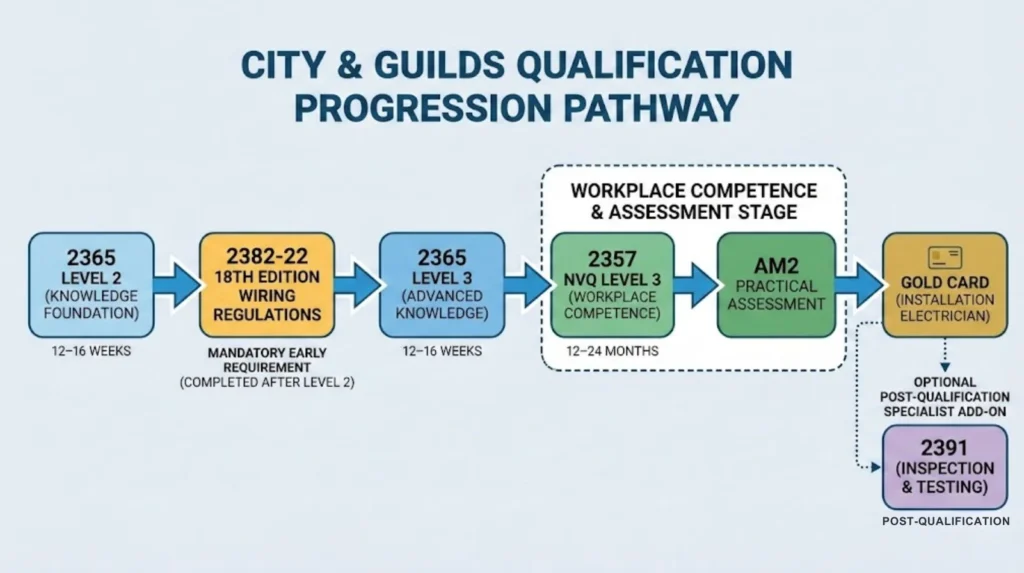
Standard Adult Learner Pathway (Career Changer)
Goal: Complete beginner to qualified electrician with ECS Gold Card
Pathway codes:
- City & Guilds 2365 Level 2 or EAL equivalent (knowledge foundation)
- City & Guilds 2365 Level 3 or EAL equivalent (advanced knowledge)
- City & Guilds 2382 or EAL 18th Edition (regulations)
- City & Guilds 2357 or EAL NVQ Level 3 (workplace competence via employment/placement)
- AM2 assessment (end-point competence verification)
Total investment: £10,000-£12,000 including all qualification fees, assessment costs, potential placement support
Timeline: 18 months to 3 years depending on full-time vs part-time study and workplace placement hours
Critical understanding: Codes 2365 and 2382 are classroom-based qualifications you can complete relatively quickly (12-20 weeks combined intensive delivery). Code 2357 requires 12-24+ months workplace evidence accumulation. Don’t expect to complete entire pathway in few months regardless of “fast-track” marketing.
Apprenticeship Pathway
Goal: School leaver or young person pursuing electrical career through apprenticeship
Pathway code:
- City & Guilds 5357 or EAL apprenticeship equivalent (integrated knowledge + competence)
- Includes 18th Edition and AM2 as apprenticeship components
Total investment: Minimal (employer-funded, apprentice receives wage)
Timeline: 3-4 years standard apprenticeship duration
Critical understanding: 5357 is specifically apprenticeship route. Adult learners without employer sponsorship cannot access 5357 and must pursue separate 2365+2357 pathway instead.
Experienced Worker Pathway
Goal: Electrician with years of site experience but lacking formal qualifications
Pathway codes:
- City & Guilds 2346 or EAL Experienced Worker Assessment (competence recognition)
- City & Guilds 2382 or EAL 18th Edition if not current
- AM2E (Experienced Worker version of AM2)
Total investment: £3,000-£6,000 depending on evidence portfolio requirements
Timeline: 6-18 months for portfolio preparation and assessment
Critical understanding: Experienced worker routes are NOT shortcuts for beginners. They’re specifically for electricians with substantial verifiable experience who can document competence through historical work evidence. Code 2346 requires proving existing capability, not learning from scratch.
Specialist Development Pathway (Post-Qualification)
Goal: Qualified electrician adding inspection/testing or other specialist credentials
Pathway codes:
- City & Guilds 2391 or EAL equivalent (inspection & testing)
- Specialist qualifications in solar PV, EV charging, etc. (various codes)
Total investment: £800-£2,000 per specialist qualification
Timeline: 1-4 weeks intensive per specialist course
Critical understanding: Code 2391 requires prior Level 3 knowledge (2365 or equivalent). You cannot take 2391 as entry-level qualification. It’s post-qualification development, not beginner route.
Recognizing UK electrical course options requires understanding which codes represent knowledge foundations versus workplace competence, ensuring complete pathways get planned rather than discovering qualification gaps halfway through training investments.
Protecting Yourself From Code-Based Marketing Manipulation
Some training providers deliberately exploit learners’ unfamiliarity with qualification codes to sell expensive courses that don’t deliver promised outcomes.
Red Flag Marketing Patterns:
“Become a Qualified Electrician in 8 Weeks – City & Guilds 2365”
The manipulation: Using legitimate City & Guilds code whilst implying 8-week timeline leads to qualified electrician status.
The reality: 2365 can be delivered intensively in 8-12 weeks, but it’s knowledge-only qualification. Qualified electrician status requires additional NVQ and AM2 taking 12-24+ months.
The protection: When seeing course duration claims, verify which specific qualification codes are delivered in that timeframe versus which are prerequisites or follow-on requirements marketed separately.
“Fast-Track to £40,000 Salary – Professional Electrician Course”
The manipulation: Using appealing salary figures and generic “Professional Electrician Course” name without clearly stating which regulated qualifications are actually delivered.
The reality: “Professional Electrician Course” is marketing name, not regulated qualification. May bundle 2365 knowledge training with non-regulated additions, requiring separate NVQ investment for actual employment.
The protection: Ignore marketing course names entirely. Demand specific QANs for each qualification component included. Verify whether advertised price delivers complete pathway to qualified status or just initial knowledge components.
“City & Guilds Approved Training Centre – Full Electrical Qualification Package”
The manipulation: Leveraging “City & Guilds Approved” status to imply all their offerings are regulated City & Guilds qualifications when they may deliver mix of regulated and non-regulated courses.
The reality: Center approval allows delivery of specific regulated qualifications. Doesn’t mean every course they offer is regulated City & Guilds certification.
The protection: Verify center approval for specific qualification codes they’re claiming to deliver. Just because provider is approved for 2365 doesn’t mean their “Advanced Installation Skills Course” is regulated City & Guilds qualification.
“Industry-Recognized Electrical Certificate – Work Immediately After Completion”
The manipulation: Using vague “industry-recognized” language suggesting employment readiness without specifying actual regulated qualification status.
The reality: Non-regulated certificates can be “recognized” by provider’s industry contacts without being recognized by ECS, JIB, or broader electrical sector for card applications or formal employment.
The protection: “Industry-recognized” is meaningless without Ofqual regulation. Demand QAN proving recognition isn’t just provider’s claim but verified regulatory status.
“ECS Gold Card Route – Complete Pathway from £4,995”
The manipulation: Advertising “complete pathway” price that sounds comprehensive whilst only delivering knowledge components.
The reality: £4,995 may cover 2365 Level 2, Level 3, and 18th Edition knowledge qualifications but exclude NVQ portfolio development (typically £4,000-£6,000), AM2 assessment (£800-£1,000), and placement support fees.
The protection: Request itemized breakdown showing which qualification codes are included in advertised price, which are additional costs, and what placement support (if any) is provided for NVQ completion.
Questions to Ask Every Training Provider:
- “What are the specific QANs for each qualification included?”
- “Which codes are knowledge-based and which are competence-based?”
- “Does the advertised price include NVQ portfolio development and placement support?”
- “Is AM2 assessment included or additional cost?”
- “What is your pass rate for complete Gold Card achievement, not just course completion?”
- “Can I see qualification specifications from awarding body website?”
- “Are you approved center for all codes you’re claiming to deliver?”
Providers giving straight answers to these questions are likely legitimate. Providers dodging, obfuscating, or pressuring you to enroll immediately without documentation are red flags for code-based marketing manipulation.
Understanding structured electrical training courses means verifying every code referenced leads to actual regulated qualification progressing efficiently toward qualified electrician status rather than expensive knowledge-only detour.
Contact Elec Training on 0330 822 5337 to discuss which qualification codes apply to your specific situation and career goals. We’ll explain the complete pathway from your current position to qualified electrician status, translate course codes into plain language progression requirements, verify which qualifications you actually need versus marketing claims you might encounter elsewhere, and provide honest timeline and cost expectations including knowledge qualifications, workplace competence assessment, and end-point evaluation requirements. We’re City & Guilds approved centre delivering regulated qualifications with verifiable QANs, guaranteed placement support for NVQ portfolio development, and transparent pricing covering complete pathways rather than partial qualification components.
References
- Ofqual – Register of Regulated Qualifications: https://register.ofqual.gov.uk/
- City & Guilds – Electrical Installation Qualifications Specifications: https://www.cityandguilds.com
- City & Guilds 2365 Diploma Specifications: Various QANs (600/5498/0 Level 2, 601/6299/5 Level 3)
- City & Guilds 2357 NVQ Specification: QAN 600/6297/1
- City & Guilds 5357 Apprenticeship Qualification: QAN 601/6298/3
- City & Guilds 2382 18th Edition: QAN 603/3430/7
- City & Guilds 2391 Inspection & Testing: QAN 603/1273/9 (2391-52)
- EAL (Excellence, Achievement & Learning) – Qualifications Search: https://eal.org.uk
- EAL Level 3 NVQ Installing Electrotechnical Systems: QAN 600/9331/6
- EAL Level 2 Diploma Electrical Installation: QAN 600/6724/X
- LCL Awards – Electrical Sector Qualifications: https://lclawards.co.uk
- ECS (Electrotechnical Certification Scheme) – Qualification Requirements: https://www.ecscard.org.uk
- ECS – JIB Recognized Electrical Theory Qualifications: https://www.ecscard.org.uk/content/jib-recognised-electrical-theory-qualifications
- JIB (Joint Industry Board) – Handbook Section 4 Grading: https://www.jib.org.uk
- NET (National Electrotechnical Training) – AM2 and AM2E Information: https://www.netservices.org.uk
- GOV.UK – Regulated Qualifications Framework: https://www.gov.uk
- IET (Institution of Engineering and Technology) – Electrical Qualifications Guide: https://electrical.theiet.org
- National Careers Service – Electrician Career Profile: https://nationalcareers.service.gov.uk
- NICEIC – Qualification Requirements for Competent Person Schemes: https://niceic.com
Note on Accuracy and Updates
Last reviewed: 30 December 2025. This article reflects UK electrical qualification frameworks, course code systems, QAN verification processes, and awarding body portfolios as of December 2025. Qualification codes occasionally update as awarding bodies revise specifications or Ofqual implements framework changes. QAN numbers provided are current at publication but learners should verify on Ofqual register before enrollment. Legacy code recognition policies may vary by individual ECS card routes and historical qualification dates. Provider approval status changes over time as centers gain or lose awarding body authorization. Job advertisement code usage represents general patterns observed in major UK recruitment platforms (Indeed, Totaljobs, CV-Library) but individual employer specifications vary. Marketing manipulation examples reflect common provider practices observed across UK electrical training sector but should not be assumed to apply to specific unnamed providers. Learners considering electrical training should always verify current QAN status, awarding body specifications, ECS recognition criteria, and provider approval independently before enrollment regardless of code references in marketing materials or third-party guidance. We update content as qualification frameworks, code systems, and regulatory requirements evolve.
