

What Does an Electrician Do? Skills, Responsibilities and the Job Reality Nobody Warns You About

- Technical review: Thomas Jevons (Head of Training, 20+ years)
- Employability review: Joshua Jarvis (Placement Manager)
- Editorial review: Jessica Gilbert (Marketing Editorial Team)
- Last reviewed:
- Changes: Full rewrite incorporating EAWR legal accountability, sector breakdowns, role evolution, and updated workforce data
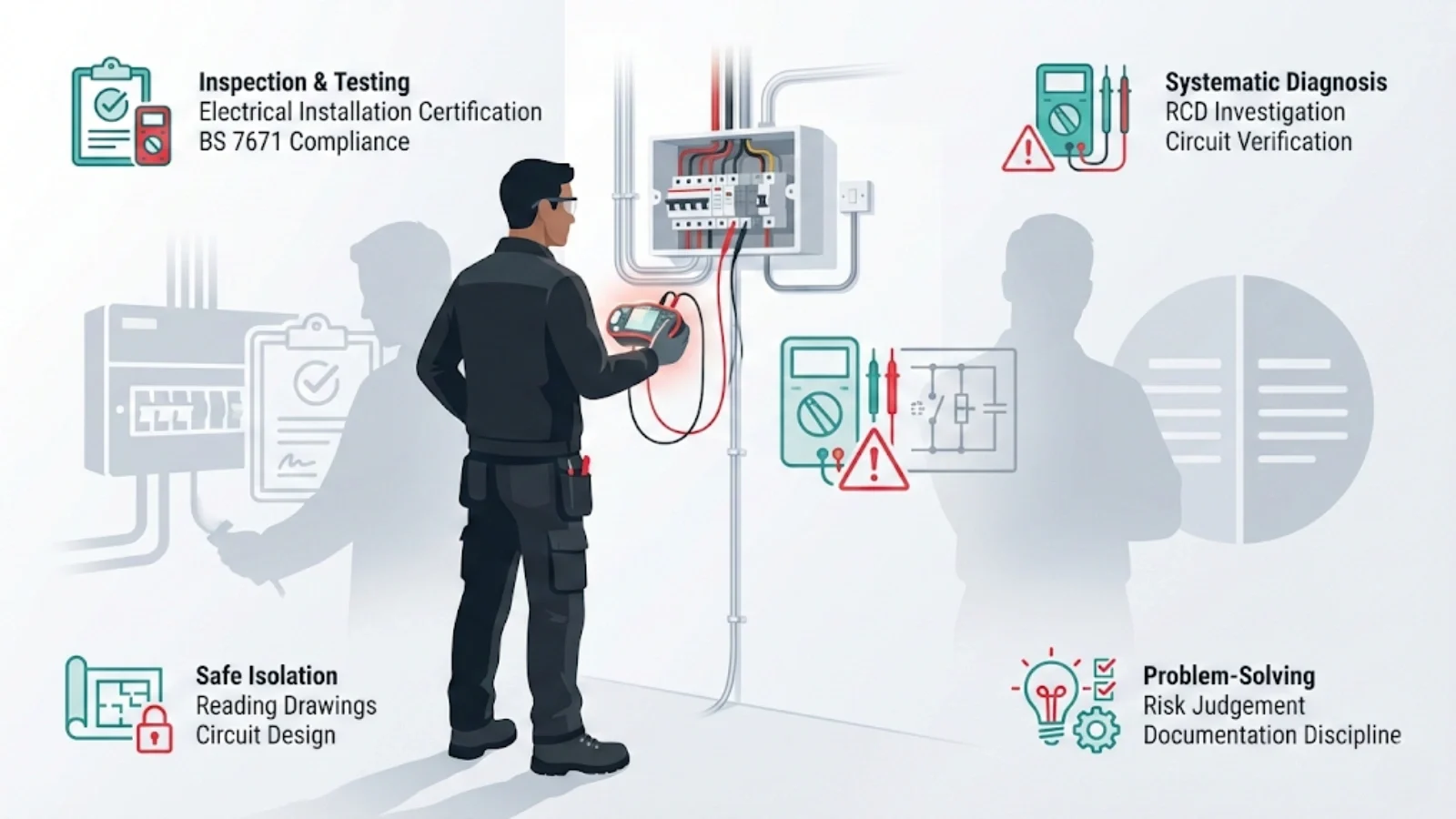
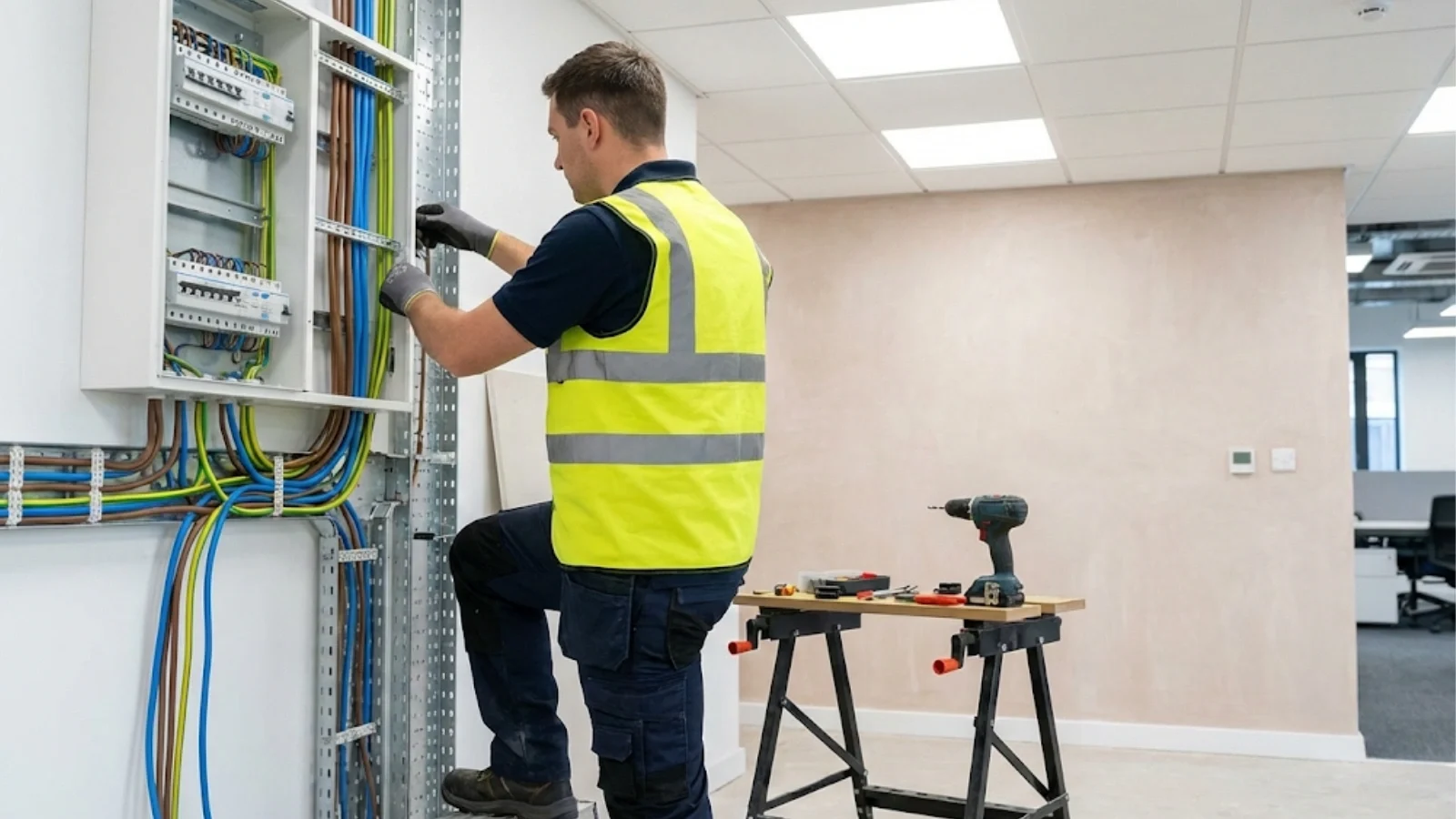
Ask most people what an electrician does and you’ll get some version of “fixes wires” or “sorts out the lights.” That’s a bit like saying a surgeon “uses sharp things.” Technically in the right postcode. Completely missing the point.
Here is what electricians actually do: they take personal legal responsibility for preventing electrical fires and electrocutions. They sign legal certificates under BS 7671:2018+A2:2022 standards declaring their work is safe, which makes them personally liable if something goes wrong. Under the Electricity at Work Regulations 1989, electricians are duty holders with statutory obligations. That is not corporate policy. That is UK law.
If you are weighing up whether electrical work is the right career, understanding the actual job before committing to training matters more than anything else. Our common training questions page covers the things most people want answered before they start, but this article deals with the role itself, what it involves day to day, how it varies by sector, and why it carries more accountability than most trades.
The Legal Accountability Most People Don't Know About
Most trades work to specifications someone else provides. Electricians do that too, but they carry something additional: personal legal accountability under the Electricity at Work Regulations 1989 for preventing electrical danger.
This plays out in three ways that tend to surprise people who are new to the industry.
You can be personally prosecuted if your work causes harm. If a circuit you installed causes a fire or electrocution due to negligence, you face personal scrutiny, not just your employer. EAWR 1989 applies to “every person on whom a duty is placed,” which includes individual electricians regardless of employment status. HSE has prosecuted individual sparks following serious incidents. Fines can be significant. In cases involving fatalities, electricians have faced imprisonment.
You have a legal duty to refuse unsafe instructions. If someone with authority over you tells you to energise a circuit you believe is unsafe, your professional responsibility under EAWR takes precedence. That creates difficult situations on sites, particularly for people early in their careers, but it is the legal reality.
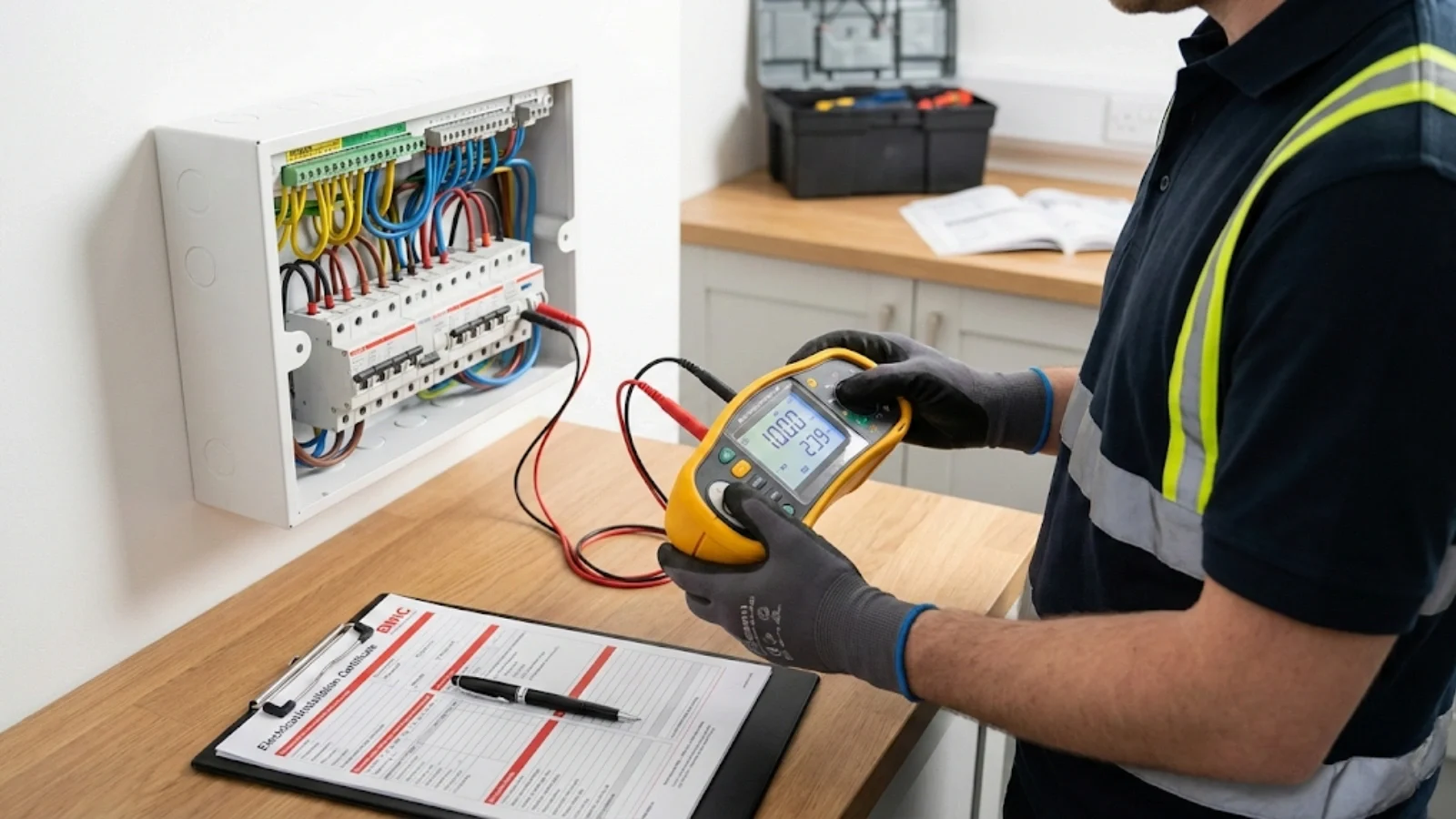
Signing an Electrical Installation Certificate is a legal declaration. Completing an EIC or Minor Works certificate means you are declaring the installation complies with BS 7671 and is safe for use. It is not admin. Signing off work you have not properly tested or designed correctly constitutes fraud and creates personal liability if problems arise.
Thomas Jevons, Head of Training at Elec Training, covers this ground on day one with every cohort:
"Safe isolation isn't a step you do when you remember. It's the non-negotiable first action before any work on any circuit, every time. The prove-test-prove sequence exists because voltage testers fail. Skipping it is how electricians get killed."
Thomas Jevons, Head of Training
What Electricians Actually Spend Their Time Doing
The physical tasks vary heavily by sector, which we will come to, but some responsibilities apply across all of them.
Verification and certification takes longer than most people expect. After installing a circuit, electricians test insulation resistance, continuity, earth loop impedance, RCD operation, and polarity. Each test has acceptance criteria from BS 7671. Results go on certificates that are legal declarations. For commercial and industrial work, the documentation layer gets considerably thicker: cable schedules, circuit diagrams, test result schedules, and sometimes integration with building management systems.
Risk judgement happens constantly. Can this cable route safely share space with heating pipework? Does this existing consumer unit have enough capacity for an additional circuit? Is this damaged cable sheath a cosmetic issue or an immediate danger? Does this modification trigger Building Regulations notification? These are not yes or no questions with clear regulatory answers. They require technical knowledge applied to specific, changing conditions.
Fault-finding is applied logic, not guesswork. A tripping RCD could be dozens of things: insulation breakdown, a wiring error in a new appliance, moisture ingress, a neutral-earth fault, or a genuine overcurrent. Tracing the cause when cables are hidden inside walls and under floors requires systematic diagnostic thinking, not just trying things until something works.
Coordination with other trades creates friction. First fix cable installation must happen after structural work but before plastering. Second fix fitting must coordinate with decorating. Cable routes must avoid plumbing, avoid structural members, and stay accessible for future maintenance. On construction sites, electricians spend meaningful time in coordination meetings and marking up drawings with what was actually installed versus what the design showed.
Domestic, Commercial, Industrial: Three Very Different Jobs
People outside the industry treat “electrician” as one role. It is not.
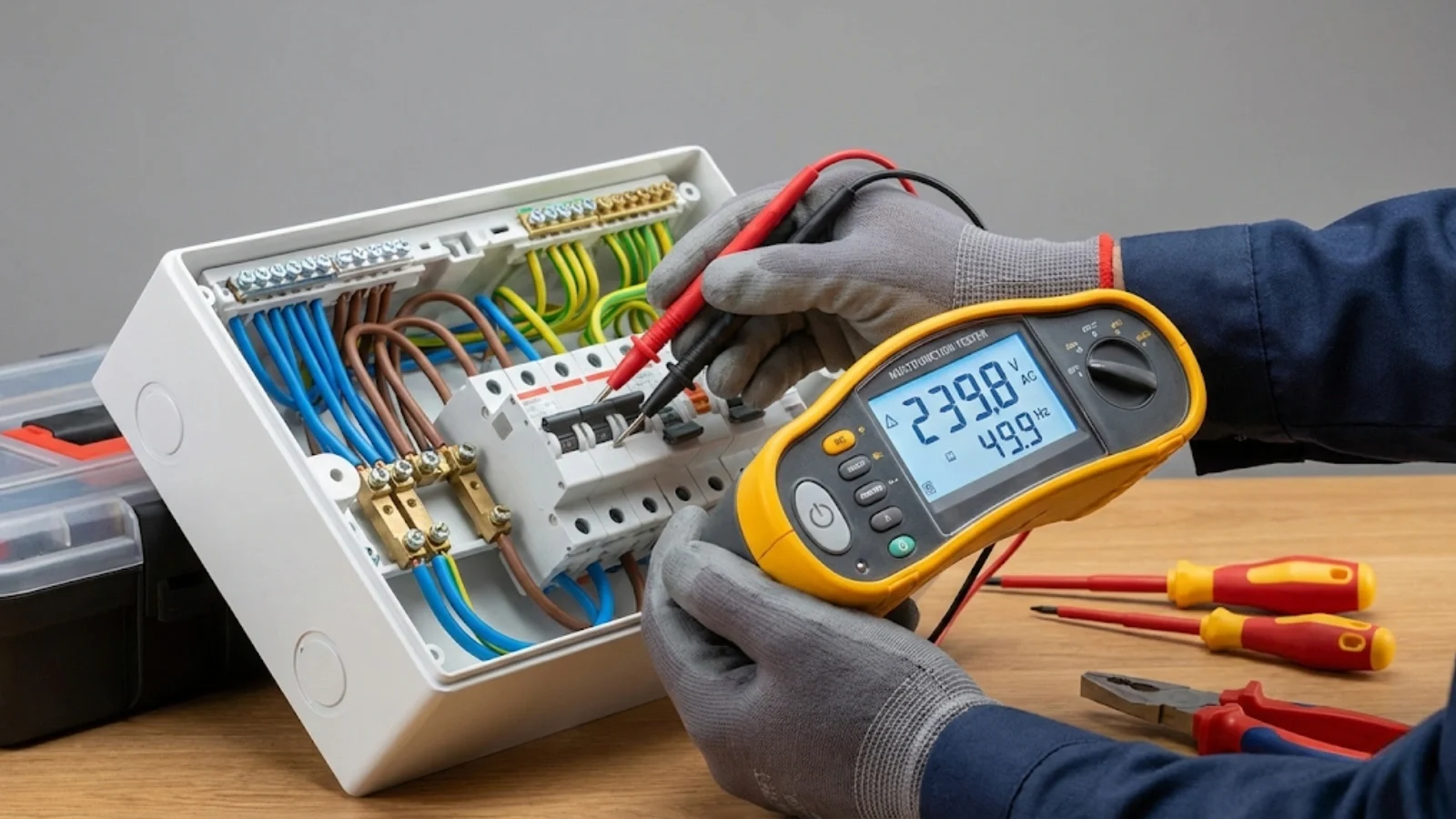
Domestic work involves single-phase systems, typically 230V, in occupied homes. Rewires, consumer unit upgrades, adding circuits, EV charger installation. The complexity comes from legacy wiring left by previous owners or well-meaning DIY, no documentation to start from, and working around people’s furniture and daily lives. Customer communication is a bigger part of the job than most people anticipate. Explaining to a homeowner why their consumer unit needs replacing and what that actually involves is a skill in itself.
Commercial work covers offices, retail, schools, healthcare facilities. Three-phase systems become standard. Cable management gets more complex: steel wire armoured cables, metal trunking, containment systems designed for easy future modification. Emergency lighting, fire alarm integration, and compliance with specific building regulations that apply to public and workplace environments. Work is often scheduled around building occupancy, which means early starts or out-of-hours access.
Industrial work is the highest-stakes environment: factories, data centres, utilities, industrial processing plants. Heavy-duty containment, motor control gear, PLCs, 400V systems and above. Hazardous area classifications (ATEX environments) apply in certain sectors. Health and safety documentation requirements are extensive. The potential consequences of errors are greater, and sites demand corresponding levels of competence evidence.
The JIB (Joint Industry Board) grading system reflects these distinctions. Different grades correspond to different levels of verified competence, and commercial and industrial sites typically require higher grades with proof of relevant experience, not just a qualification certificate.
The Skills That Actually Define a Good Electrician
Technical knowledge is the entry requirement. What separates competent electricians from genuinely good ones is a combination of skills that do not feature prominently in job descriptions.
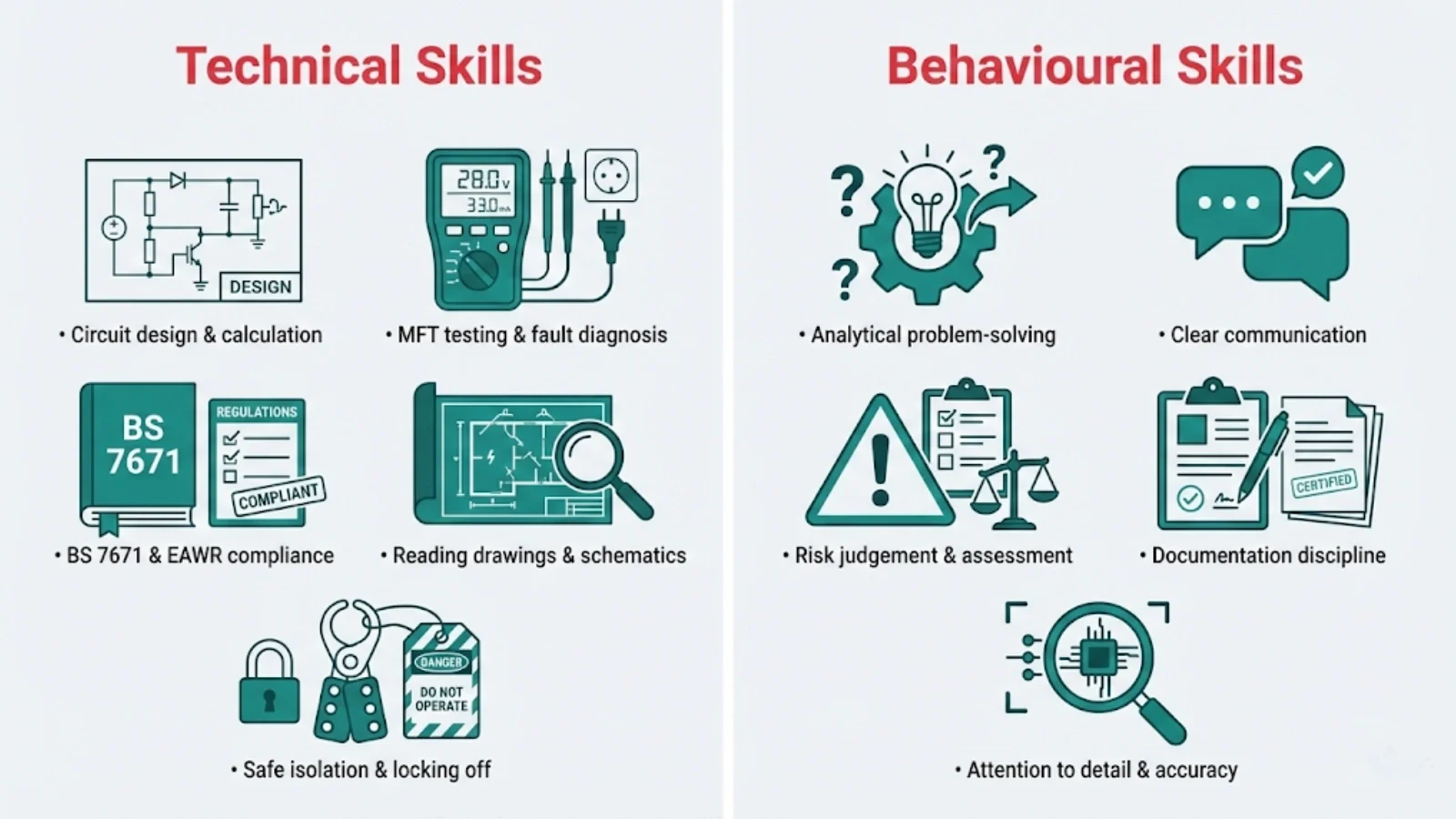
Circuit design and calculation requires understanding load characteristics, cable sizing, voltage drop calculations, and protective device selection. This is applied physics, not rule-following. Get it wrong and cables overheat, protection fails to trip under fault conditions, or installations fail inspection.
Reading technical drawings matters more the further up the commercial and industrial ladder you go. Interpreting circuit diagrams, schematic drawings, and site plans is how you understand what should be there before you start testing what actually is.
Problem-solving under pressure is what separates people who are good in training bays from people who are good on site. Buildings are not tidy. Previous work is not always done correctly. Conditions change between design and installation. The ability to adapt systematically rather than reactively determines the quality of the outcome.
Communication goes in both directions. Explaining technical safety issues to non-technical clients. Reporting concerns to site managers or building owners in writing, accurately, because verbal conversations disappear and documentation protects you legally.
Our training to employment pathway page explains how Elec Training builds these broader competencies alongside technical qualification, including how our in-house recruitment team prepares learners for placement environments rather than just delivering classroom content.
How the Role Is Changing
The “prosumer” shift is the biggest structural change in the industry right now. Electricians are moving from installing power to integrating energy systems.
EV charging has gone from a niche specialism to a standard competency requirement. Part S of Building Regulations now mandates charge point provision in new builds and certain non-residential buildings with parking. Installing a home charger correctly requires understanding dedicated circuit design for continuous high loads, appropriate RCD types for DC fault current, DNO notification processes, and earthing arrangements that standard domestic installations do not require.
Solar PV and battery storage installations are rising sharply. Connecting generation and storage equipment to existing installations without creating unsafe interactions requires understanding inverter protection, export limiting, grid connection rules, and how these systems interact with the rest of a building’s electrical supply.
Inspection demand is growing, not shrinking. Ageing housing stock requires Electrical Installation Condition Reports (EICRs) at increasing frequency. Retrofit projects for energy efficiency require pre-work electrical assessment. The Building Safety Act 2022 has raised the competence bar for work in Higher Risk Residential Buildings specifically.
Digitalisation adds another layer: digital certificates through platforms like NICEIC and NAPIT apps, Bluetooth-connected test equipment, and AI-assisted fault-finding tools. These help, but they do not replace the electrician making the judgement call about whether a reading indicates a problem.
What the Research Gets Wrong About the Role
The UK electrician workforce stood at around 222,800 in 2025 according to ONS data. The Construction Industry Training Board forecasts a need for around 50,000 additional construction workers annually through to 2028, with electricians consistently among the most in-demand trades. EngineeringUK reports an ageing workforce with around 30% aged 50 and over, which means a significant wave of retirements is coming regardless of demand growth.
But here is what those numbers do not tell you: the shortage is a shortage of properly qualified people, not just bodies willing to do the work. JIB data shows 54% of employers expecting increased demand for qualified electricians over the next two to three years, and employers specify Gold Card status as a requirement for most commercial and industrial site access.
Joshua Jarvis, Placement Manager at Elec Training, sees this distinction play out in real placements every week:
"What makes someone placement-ready isn't finishing their classroom hours. It's being able to walk onto a site, understand the environment, and work safely without constant supervision. That's what we prepare people for, and it's what employers tell us they actually need."
Joshua Jarvis, Placement Manager
The workforce data matters, but it is not a shortcut. An ECS Gold Card requires NVQ Level 3 (2357), the 18th Edition Wiring Regulations, a pass at the AM2 practical assessment, and verifiable site experience. There is no version of that pathway that skips the portfolio or the AM2.
Getting Started: The Honest Pathway
If this article has made the role sound demanding, that is because it is. It is also a trade that offers genuine job stability, strong earning potential once qualified, and work that is structurally resistant to automation and offshoring.
The full pathway to qualified electrician status (ECS JIB Gold Card) runs:
- Level 2 (2365-02)– 4 weeks, electrical installation fundamentals
- Level 3 (2365-03)– 8 weeks, advanced theory and practical skills
- 18th Edition– 5 days, BS 7671:2018+A2:2022 Wiring Regulations
- NVQ Level 3 (2357)– portfolio of site evidence, 12 to 24 months
- AM2 assessment– 3 days, practical end-point examination
- ECS JIB Gold Card– application with full qualification evidence
Total realistic timeframe: 18 months on a fast-track route with guaranteed placements, or up to 3 years part-time around existing work commitments.
Elec Training’s full NVQ package starts from £10,000, which includes placement support through our in-house recruitment team. That team makes over 100 calls per student to secure contractor placements across our 120-plus active partner network. If you are based in Herefordshire or the surrounding counties, our electrical training in Hereford page sets out exactly what is available and how the course structure works locally.
Call us on 0330 822 5337 to talk through whether electrical training is the right fit and what the pathway from where you are now to qualified electrician actually looks like. We will be honest about the timeframe, the commitment involved, and what our placement team can do to bridge the gap between training completion and first paid site work. No shortcuts. No hype. Just a practical conversation.
FAQs
What does an electrician actually do day to day in the UK?
Electricians in the UK typically install, maintain and repair electrical systems in buildings, working to BS 7671:2018+A2:2022. Day-to-day tasks often include wiring circuits, fitting sockets and switches, fault-finding, and carrying out testing on site. They may work across domestic, commercial or industrial environments. The role also involves safety checks, certification and coordination with other trades, so it’s a mix of hands-on work and compliance responsibilities.
What personal legal responsibilities do electricians carry under the Electricity at Work Regulations 1989?
Under the Electricity at Work Regulations 1989 (EAWR), electricians must ensure their work does not create electrical danger. They are personally responsible for working safely, using suitable tools and protective equipment, and identifying or reporting unsafe conditions. The regulations place a clear duty on the individual, not just the employer, so electricians must remain competent and vigilant on site at all times.
Why is signing an Electrical Installation Certificate considered a serious legal declaration?
Signing an Electrical Installation Certificate confirms that the installation complies with BS 7671:2018+A2:2022 and is safe for service at the time of certification. It is a formal legal declaration that may be relied upon in disputes or investigations. Because of this, electricians must ensure inspections and tests are fully completed and accurately recorded before signing. Incorrect certification can expose the electrician to professional and legal risk.
How much of an electrician’s time is spent on testing, verification and paperwork compared with installation?
In practice, many electricians spend roughly 20–30% of their time on testing, verification and documentation, although this varies by job type. Larger commercial or compliance-heavy projects typically involve more paperwork, while smaller install jobs may involve less. This time is essential for demonstrating compliance with BS 7671 and protecting both the electrician and the client.
What is the real difference between domestic, commercial and industrial electrician roles?
- Domestic electricians mainly work in homes, installing consumer units, lighting and socket circuits. Customer interaction and quick turnaround jobs are common.
- Commercial electricians work in offices, shops and public buildings, dealing with larger distribution systems, lighting schemes, fire alarms and data infrastructure.
- Industrial electricians typically operate in factories or heavy environments, working with motors, control panels, three-phase systems and production equipment where downtime is critical.
Each environment requires different levels of system knowledge, planning and risk management.
Which technical and behavioural skills separate a competent electrician from an average one?
Strong electricians combine solid technical ability with professional behaviours. Key technical strengths include accurate testing, correct interpretation of BS 7671, and the ability to read schematics and diagnose faults properly. Behaviourally, attention to detail, clear communication, and structured problem-solving make a major difference on site. True competence shows when electricians can handle unfamiliar or complex situations safely and methodically.
Why is fault-finding considered one of the hardest parts of the electrician’s job?
Fault-finding requires systematic diagnosis of problems that are often hidden within live or complex systems. It demands experience, logical thinking and accurate interpretation of test results. Unlike installation work, there is rarely a clear starting point. Time pressure, safety risks and incomplete information can make the process challenging. It is a skill that typically develops through years of hands-on experience rather than classroom learning alone.
How is the electrician role changing with EV charging, solar PV and battery storage?
The role is expanding beyond traditional AC installation work. Electricians are increasingly expected to install EV charge points, solar PV systems and battery storage, which introduces:
- DC system knowledge
- Inverter integration
- Load management planning
- Additional protection requirements under BS 7671
This shift reflects the UK’s move toward electrification and net zero, meaning modern electricians need broader system awareness than in the past.
Why is there still a shortage of properly qualified electricians despite strong interest in the trade?
The main issue is the time and experience required to reach full competence. While interest in training is high, progressing from initial qualifications to fully competent status takes several years of site experience. High demand in construction, retrofit and renewables continues to outpace supply. The physical nature of the work and irregular hours can also contribute to drop-off rates, which keeps pressure on the skilled labour market.
What is the realistic qualification pathway to becoming a fully qualified electrician in the UK?
The typical pathway is:
- Level 2 Diploma in Electrical Installation
- Level 3 Diploma in Electrical Installation
- On-site experience leading to NVQ Level 3 (2357)
- AM2 end-point assessment
- ECS Gold Card application
- Ongoing CPD to stay current with BS 7671 updates
For most learners, this journey takes around three to four years when combining college learning with real workplace experience.
References
- ONS Annual Survey of Hours and Earnings 2024 (SOC 5241 – Electricians and electrical fitters): https://www.ons.gov.uk/employmentandlabourmarket/peopleinwork/earningsandworkinghours/bulletins/annualsurveyofhoursandearnings/2024
- Electricity at Work Regulations 1989 (EAWR): https://www.legislation.gov.uk/uksi/1989/635/contents
- IET Wiring Regulations BS 7671:2018+A2:2022: https://www.theiet.org/
- ECS Gold Card requirements (JIB/ECS): https://www.ecscard.org.uk/card-types/electrotechnical/installation-electrician
- CITB Construction Skills Network Outlook 2024-2028: https://www.citb.co.uk/about-citb/construction-industry-research-reports/search-our-construction-industry-research-reports/construction-skills-network-industry-outlook-2024-2028
- EngineeringUK Workforce Update October 2024: https://www.engineeringuk.com/media/x1tlmcah/the-engineering-and-technology-workforce-update-engineeringuk-october-2024.pdf
- JIB Labour Market Commentary 2024: https://www.jib.org.uk/wp-content/uploads/2023/10/JIB-Direct-Employment-Report.pdf
- HSE Electricity at Work guidance: https://www.hse.gov.uk/electricity
- City & Guilds 2357 NVQ Level 3 Electrical Installation: https://www.cityandguilds.com/
- Building Regulations Approved Document S (EV charge points): https://www.gov.uk/government/publications/infrastructure-for-charging-electric-vehicles-approved-document-s
Note on Accuracy and Updates
Last reviewed: 21 February 2026. This page is maintained. We correct errors and refresh sources as workforce data, qualification requirements, and regulatory guidance changes.
