

Who Gains the Most From the 2026 Pay Rise? Apprentices, Electricians or Approved?

- Technical review: Thomas Jevons (Head of Training, 20+ years)
- Employability review: Joshua Jarvis (Placement Manager)
- Editorial review: Jessica Gilbert (Marketing Editorial Team)
- Last reviewed:
- Changes: Initial publication analyzing differential economic impact of 2026 JIB pay rise across graded operatives (Electrician, Approved Electrician, Technician) and apprentices using multiple analytical frameworks including absolute monetary gains, percentage increases, real-terms purchasing power adjustments, overtime amplification effects, and statutory minimum wage interactions
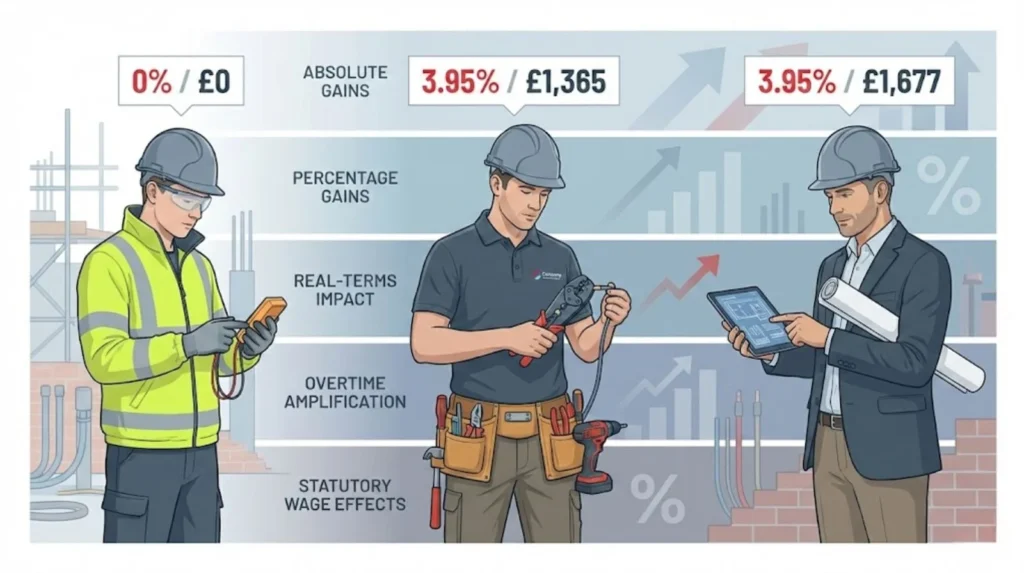
The 2026 JIB pay rise effective 5 January 2026 distributes economic benefits unevenly across the electrotechnical workforce in England, Wales, and Northern Ireland, raising a straightforward question with mathematically complex answers: who gains the most from this year’s wage determination – apprentices, electricians, approved electricians, or technicians? The immediate response appears obvious when examining headline figures showing graded operatives receiving 3.95% increases while apprentices receive 0% from the JIB agreement, but this surface-level interpretation obscures substantial variation in actual economic impact depending on analytical framework, working patterns, age-related statutory wage obligations, and how “gains” are defined when comparing nominal percentages against real purchasing power erosion from projected 2-3% inflation.
Economic impact analysis requires distinguishing between five separate dimensions producing different winners depending on measurement criteria: absolute monetary gains where higher base rates create larger sterling increases favouring Technicians (£1,677 annually) over Electricians (£1,365), percentage gains where the uniform 3.95% increase applies equally to all graded operatives but apprentices receive nothing, real-terms purchasing power where inflation at 2.5-3% reduces the effective benefit to 0.95-1.45% genuine improvement while apprentices experience -2.5% to -3% erosion, overtime amplification where premium multipliers (time-and-a-half 1.5×, double-time 2×) compound base rate increases disproportionately for higher grades working extended hours, and statutory minimum wage interactions where adult apprentices aged 21+ may receive larger effective percentage increases than qualified electricians through National Living Wage compliance requirements despite zero JIB negotiated uplift.
This article examines the 2026 JIB Industrial Determination’s differential impact across workforce segments using transparent calculations, explains why the wage structure produces these disparities through retention logic and compounding mathematics rather than preferential treatment, distinguishes between collectively bargained increases and legally mandated top-ups that operate independently of JIB agreements, and identifies which workforce segments benefit most under each analytical lens while acknowledging that single-year pay rise comparisons matter substantially less for lifetime earnings than qualification progression from initial electrical training through NVQ Level 3, AM2 assessment, inspection and testing qualifications enabling grade advancement from Electrician to Approved to Technician status delivering permanent income step-changes (£3,315-5,109 annually) that exceed multiple years of 3.95% increases compressed into qualification completion.
What the 2026 JIB Pay Rise Actually Is
The 2026 pay determination represents the first year of a three-year Industrial Determination covering 2026-2028, negotiated between the Electrical Contractors’ Association (ECA) representing employers and Unite the Union representing workers, establishing minimum wage rates for electrical operatives employed under Joint Industry Board National Working Rules across England, Wales, and Northern Ireland (Scotland operates under separate SJIB agreement with aligned but distinct rates and negotiation timelines).
Effective Date and Coverage
Effective: Monday, 5 January 2026
Geographic scope: England, Wales, Northern Ireland only (SJIB rates for Scotland negotiated separately, typically 4-6% higher than JIB equivalents with similar percentage increases)
Employment basis: JIB signatory electrical contractors employing graded operatives and apprentices under JIB National Working Rules with standard 37.5-hour working week, paid holidays, sick pay, and employer pension contributions
The Split Treatment Structure
The 2026 determination applies differential treatment to graded operatives versus apprentices, creating the economic disparity examined throughout this analysis:
Graded operatives (Electrician, Approved Electrician, Technician):
Headline increase: 3.95% applied to all grades uniformly
Effective date: 5 January 2026
Applies to all bands (National, London) and transport arrangements (Transport Provided, Own Transport)
Apprentices (Stages 1-4):
JIB increase: 0% (rates frozen at 2025 levels)
Rationale: 2025 saw substantial apprentice increases (Stage 1 rose ~26%) creating strategic “pause” for employer cost absorption in 2026
Future increases: 2% scheduled for January 2027, additional increase for 2028
Effective 2026 rate: Unchanged from 2025 across all stages and bands
Important Clarification: The “2% Apprentice Increase” Confusion
Some secondary sources and early ECA/Unite announcements mentioned a 2% apprentice increase for 2026, creating confusion when rate tables in the final JIB Industrial Determination 2026-2028 document show zero change for apprentice rates between 2025 and 2026. The authoritative source – the official rate tables published July 2025 – confirms apprentice rates remain frozen in 2026 with the 2% increase deferred to January 2027. This article uses published rate tables as definitive source, not preliminary announcements that proved inaccurate.
Why This Matters for Comparative Analysis
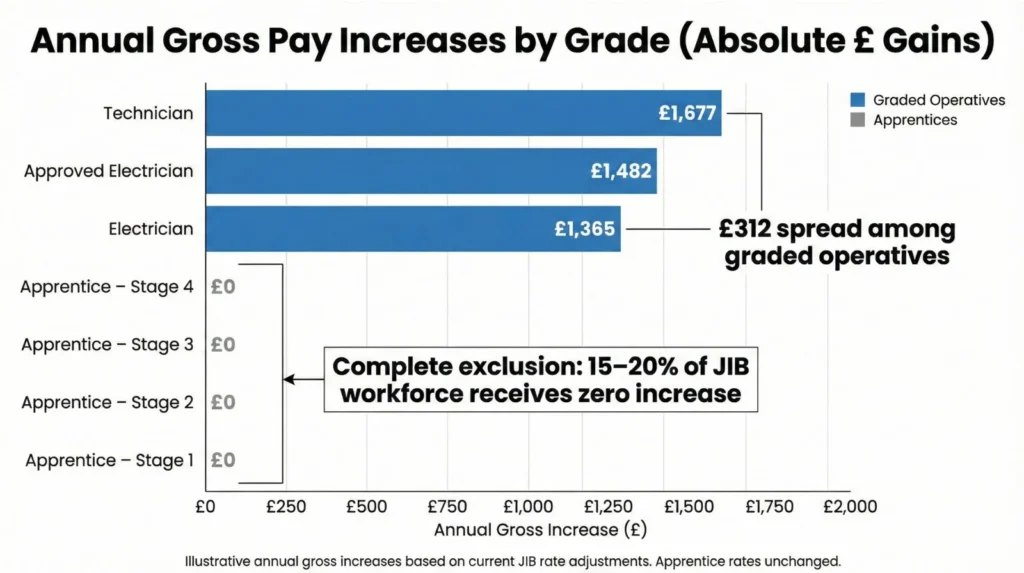
The split treatment means any analysis of “who gains most” must acknowledge that one entire workforce segment (apprentices representing approximately 15-20% of JIB-covered electrical workers) receives zero negotiated benefit from the 2026 pay determination, though some apprentices may experience effective pay increases through statutory minimum wage compliance examined separately below. This creates four-tier outcome structure: Technicians gain most in absolute terms, Approved Electricians gain moderately, Electricians gain least among graded operatives, and apprentices gain nothing from the JIB agreement itself.
Headline Rate Changes: 2025 to 2026
Understanding differential economic impact requires examining actual hourly rate changes across all workforce grades using National Transport Provided rates as industry benchmark (London, Own Transport, and Shop Employed variants follow identical percentage increases producing similar relative outcomes).
Complete Rate Comparison (National TP)
| Grade | 2025 Rate | 2026 Rate | Absolute Gain | Percentage Gain |
| Technician | £21.84/hr | £22.70/hr | £0.86/hr | 3.95% |
| Approved Electrician | £19.32/hr | £20.08/hr | £0.76/hr | 3.95% |
| Electrician | £17.68/hr | £18.38/hr | £0.70/hr | 3.95% |
| Apprentice Stage 4 | £14.03/hr | £14.03/hr | £0.00/hr | 0.00% |
| Apprentice Stage 3 | £13.05/hr | £13.05/hr | £0.00/hr | 0.00% |
| Apprentice Stage 2 | £10.60/hr | £10.60/hr | £0.00/hr | 0.00% |
| Apprentice Stage 1 | £8.16/hr | £8.16/hr | £0.00/hr | 0.00% |
Why National TP Serves as Benchmark
Transport Provided (TP) represents the most common band for site-based electrical work where employers provide company vehicles or arranged transportation, with Own Transport (OT) rates adding approximately £1.10-1.20/hour to compensate personal vehicle use and London rates adding £2.20-2.77/hour for geographic cost differentials. Using National TP as baseline simplifies comparative analysis while maintaining proportional relationships: a Technician earning 23.4% more than an Electrician under National TP maintains the same 23.4% premium under London OT (£26.70 versus £21.89), making band selection irrelevant for determining relative winners across the workforce hierarchy.
The Immediate Pattern
The table reveals three critical features driving differential economic impact:
Feature 1 – Compounding on higher base rates: The uniform 3.95% increase produces £0.16/hour spread between Technician gains (£0.86) and Electrician gains (£0.70) because percentages applied to larger numbers yield larger absolute results – basic compounding mathematics creating structural advantage for senior grades independent of negotiation favoritism.
Feature 2 – Graded operative uniformity: Electricians, Approved Electricians, and Technicians all receive exactly 3.95% with zero variation, distinguishing this determination from historical patterns where senior grades sometimes received additional percentage points (e.g., 4.5% Technicians versus 4.0% Electricians) to enhance retention incentives.
Feature 3 – Complete apprentice exclusion: All four apprentice stages remain frozen at 2025 levels representing 0% negotiated increase and creating -2.5% to -3% real-terms purchasing power erosion when projected inflation is factored, examined comprehensively in real-terms analysis section below.
Who Gains the Most in Real Cash Terms
Absolute monetary gains represent the simplest analytical lens: who receives the largest sterling increase in weekly and annual gross pay at standard working patterns, independent of percentage calculations or inflation adjustments.
Annual Gains at Standard Hours (37.5h/52w)
Using standard JIB employment assumptions (37.5-hour working week, 52 paid weeks annually including holiday pay), the annual gross increase calculation multiplies hourly gains by 1,950 hours (37.5 × 52):
Technician:
Hourly increase: £0.86
Weekly increase: £32.25 (£0.86 × 37.5)
Annual increase: £1,677 (£32.25 × 52)
Approved Electrician:
Hourly increase: £0.76
Weekly increase: £28.50
Annual increase: £1,482
Electrician:
Hourly increase: £0.70
Weekly increase: £26.25
Annual increase: £1,365
All Apprentices:
Annual increase: £0
The absolute ranking is unambiguous: Technicians gain the most with £1,677 annually, followed by Approved Electricians at £1,482, then Electricians at £1,365, with a £312 spread between highest and lowest graded operative gains. Apprentices receive nothing.
Why Higher Grades Gain More: The Compounding Effect
The reason Technicians gain £312 more annually than Electricians despite receiving the identical 3.95% percentage increase is straightforward mathematics: percentages compound on base rates, making larger bases produce larger absolute results.
Mathematical demonstration:
Electrician base: £17.68/hour × 3.95% = £0.698/hour (rounds to £0.70)
Technician base: £21.84/hour × 3.95% = £0.863/hour (rounds to £0.86)
Differential: £0.863 – £0.698 = £0.165/hour (£322 annually at 1,950 hours)
This £0.16/hour compounding differential isn’t preferential treatment or negotiation advantage – it’s the inevitable mathematical outcome of applying uniform percentages to stratified base rates. A 3.95% increase will always produce larger sterling gains for higher-paid workers regardless of industry, occupation, or negotiation structure.
Alternative Calculation: 46.4 Worked Weeks
Some analysts prefer calculating using 46.4 “worked weeks” (52 weeks minus approximately 5.6 weeks for 22 days annual leave plus 8 bank holidays), showing income from worked time only rather than including paid holidays:
46.4-week calculation:
Technician: £1,496 (versus £1,677 at 52 weeks)
Approved Electrician: £1,324 (versus £1,482)
Electrician: £1,219 (versus £1,365)
The 46.4-week approach reduces figures by approximately 11% but maintains identical rankings and relative spreads. This article uses 52-week calculations throughout as standard for JIB employment where holiday pay is contractually guaranteed, making 52 weeks the actual annual income received.
Verdict: Absolute Monetary Gains
Winner: Technicians (£1,677 annually)
Rationale: Higher base rates compound into larger sterling increases when uniform percentages apply. The £312 annual advantage over Electricians reflects structural mathematics, not negotiation favoritism. Apprentices excluded entirely create binary outcome: graded operatives gain varying amounts, apprentices gain nothing from JIB determination.
Percentage Gain vs Practical Reality
Percentage gains provide standardized comparison methodology independent of base rate variations, but require distinguishing between negotiated percentages from collective bargaining and effective percentages resulting from statutory wage floor enforcement.
Negotiated Percentage: The JIB Agreement
From the collective bargaining perspective examining what the ECA and Unite negotiated:
Graded operatives: 3.95% uniform across Electrician, Approved Electrician, and Technician grades with zero variation by seniority, experience, or specialization
Apprentices: 0.00% with rates frozen at 2025 levels
The negotiated percentage creates a tie among all graded operatives at 3.95% regardless of absolute monetary gains examined above. An Electrician and Technician both receive 3.95% increases despite the Technician gaining £312 more annually – the percentage is identical, the sterling outcome differs.
Statutory Wage Floor: The Legal Complication
The picture becomes substantially more complex when examining adult apprentices aged 21+ where National Living Wage obligations override JIB rates, creating effective percentage increases that exceed graded operative gains despite zero JIB negotiated uplift.
National Living Wage context:
April 2025: £12.21/hour for workers aged 21+
April 2026 (projected): £12.71/hour (4.1% increase from Low Pay Commission recommendations)
Apprentice Stage 2 scenario (21+ years old):
JIB rate (2025 and 2026): £10.60/hour
Required NLW top-up (April 2026): £12.71/hour
Effective hourly rate: £12.71/hour (£2.11 above JIB)
Effective increase: £12.71 – £12.21 = £0.50/hour (April 2025 to April 2026)
Effective percentage: 4.1% (exceeding graded operatives’ 3.95%)
Apprentice Stage 1 scenario (21+ years old):
JIB rate: £8.16/hour
Required NLW top-up: £12.71/hour
Gap from JIB to legal minimum: £4.55/hour (£8,874 annually at 37.5h/52w)
Effective percentage increase: 4.1% (same as Stage 2)
Critical Distinction: Negotiated vs Mandated Increases
The adult apprentice effective percentage increase of 4.1% exceeding graded operatives’ 3.95% creates misleading impression that apprentices “win” the percentage comparison. This interpretation is fundamentally incorrect because:
What actually happened:
JIB negotiated 0% for apprentices (collective bargaining delivered nothing)
Government mandated NLW increase to £12.71 (statutory compliance requirement independent of JIB)
Employers must top up to legal minimum regardless of JIB rates (obligation exists with or without JIB agreement)
Why this matters: The apprentice “increase” is legal compliance, not a pay award. Employers paying adult apprentices aren’t rewarding them through collective bargaining – they’re avoiding breaking the law. The JIB delivered nothing; the Low Pay Commission delivered 4.1%. Attributing this to JIB negotiation success would be categorically false.
Under-21 Apprentices: True Zero Increase
For apprentices under 21 years old, the JIB rates already exceed statutory minimums:
Stage 1 (under 19 or first year):
JIB: £8.16/hour
Apprentice minimum wage (2026): £7.55/hour
Gap: JIB exceeds statutory by £0.61/hour
Effective increase: £0.00 (JIB rate sufficient, no top-up required)
Stage 2-4 (ages 18-20):
JIB rates: £10.60-14.03/hour
18-20 NMW (2026): £10.00/hour
Gap: JIB exceeds statutory
Effective increase: £0.00
Under-21 apprentices represent the only workforce segment receiving genuinely zero effective increase in 2026, experiencing full -2.5% to -3% real-terms erosion examined in inflation analysis below.
Verdict: Percentage Gains
Negotiated winner: Electricians, Approved Electricians, and Technicians (tied at 3.95%)
Effective winner: Adult apprentices aged 21+ (4.1% through NLW compliance, not JIB negotiation)
Genuine loser: Under-21 apprentices (0% with JIB rates exceeding statutory minimums, no legal top-up triggered)
Caveat: Describing adult apprentices as “winners” is technically correct for effective percentage but misleading for economic impact analysis as the increase derives from government policy, not collective bargaining, and masks the JIB’s complete exclusion of apprentices from 2026 determination.
Inflation Lens: Who Actually Gets Better Off
Real-terms purchasing power analysis distinguishes nominal percentage increases from actual household budget improvements after accounting for inflation eroding the value of sterling through rising costs for housing, energy, food, transport, and other household expenses.
Real-Terms Formula and Inflation Context
Real increase = Nominal increase – Inflation rate
Example: 3.95% wage increase – 2.5% CPIH inflation = 1.45% real purchasing power gain
2026 inflation context:
Office for Budget Responsibility forecast: 2.1-2.5% CPIH for Q1 2026
Bank of England projection: 2.0-2.5% CPI for early 2026
Consensus forecast: 2.5% CPIH used for base case analysis
Sensitivity range: 2.0-4.0% examining optimistic to challenging scenarios
Graded Operatives Real-Terms Outcomes
| Inflation Scenario | Nominal Increase | Inflation Rate | Real Increase | Annual Real Gain* |
| Optimistic | 3.95% | 2.0% | +1.95% | £426-556 |
| Base Case | 3.95% | 2.5% | +1.45% | £317-413 |
| Moderate | 3.95% | 3.0% | +0.95% | £207-271 |
| Challenging | 3.95% | 4.0% | -0.05% | -£11 to -£14 |
*Annual real gain calculated as real percentage × 2026 annual gross pay for Electrician-Technician range
Base case interpretation (2.5% inflation):
Electricians gain 1.45% real purchasing power = approximately £317 additional annual spending power after inflation
Technicians gain 1.45% real = approximately £413 additional spending power
Translation: £6-8 additional weekly spending power after rent/mortgage, utilities, food, and transport costs increase
The 1.45% real gain represents modest but genuine improvement – sufficient for electricians to feel marginally better off (perhaps an extra tank of fuel monthly, or £15-20 additional discretionary spending weekly) rather than merely maintaining existing living standards against rising costs.
Challenging scenario (4.0% inflation): If inflation exceeds forecasts and reaches 4%, even graded operatives experience -0.05% real erosion, meaning the 3.95% wage increase barely maintains purchasing power with household budgets effectively stagnant. Electricians would receive £1,365 more gross annually but find costs increased by £1,376, creating net -£11 annual real loss in spending power.
Apprentices Real-Terms Catastrophe
With zero JIB increase and 2.5% inflation base case, apprentices experience substantial purchasing power erosion:
| Stage | Annual Gross 2025-26 | Inflation at 2.5% | Real-Terms Loss | Weekly Impact |
| Stage 4 | £27,359 | 0% nominal | -2.5% real | -£684 annually (-£13.15/week) |
| Stage 3 | £25,448 | 0% nominal | -2.5% real | -£636 annually (-£12.23/week) |
| Stage 2 | £20,670 | 0% nominal | -2.5% real | -£517 annually (-£9.94/week) |
| Stage 1 | £15,912 | 0% nominal | -2.5% real | -£398 annually (-£7.65/week) |
Impact interpretation: A Stage 4 apprentice earning £27,359 annually experiences £684 purchasing power loss over 2026, equivalent to £13.15 weekly reduced spending capacity as rent, utilities, food, and transport costs increase 2.5% while wages remain frozen. This makes household budgeting substantially tighter during training years, particularly affecting adult apprentices (21+) with independent living expenses versus under-21 apprentices often living with family providing cost subsidies.
Adult apprentice NLW top-up caveat: Adult apprentices aged 21+ receiving NLW top-ups to £12.71/hour (examined in percentage section above) experience 4.1% nominal increase through statutory compliance, creating 1.6% real gain at 2.5% inflation (4.1% – 2.5%). However, this applies only to Stages 1-2 where JIB rates fall below NLW; Stage 3-4 adult apprentices earning £13.05-14.03/hour exceed NLW and receive zero increase, experiencing full -2.5% real erosion.
Historical Context: Three-Year Recovery Pattern
The 2026 pay determination continues recovery from 2022-2023 real-terms erosion when inflation spiked 8-11% while JIB increases lagged at 4-5%:
2024: 7% nominal – 4% inflation = 3% real gain (substantial recovery)
2025: 5% nominal – 3% inflation = 2% real gain (continued recovery)
2026: 3.95% nominal – 2.5% inflation = 1.45% real gain (consolidation phase)
Cumulative 2024-2026: Approximately 6.5% real purchasing power recovery
This three-year pattern restores graded operative purchasing power to approximately 2021 levels but does not deliver sustained real wage growth beyond inflation compensation, representing recovery rather than advancement.
Verdict: Real-Terms Purchasing Power
Winner: Technicians (£413 real annual gain at 2.5% inflation base case, highest absolute real improvement)
Moderate winners: Approved Electricians and Electricians (£365 and £317 real gains respectively, genuine but modest improvement)
Substantial losers: All apprentices (-2.5% real erosion = £398-684 annual purchasing power loss, household budgets tighten significantly)
Exception: Adult apprentices Stage 1-2 (1.6% real gain through NLW compliance, only apprentice segment avoiding erosion)
Critical insight: Real-terms analysis reveals that graded operatives experience modest genuine improvements enabling slightly better household budgets, while most apprentices face substantial purchasing power losses making training years financially harder independent of longer-term completion wage jump incentives.
Overtime Amplification: The Hidden Winner
Overtime premium rates (time-and-a-half 1.5×, double-time 2×) compound base rate increases, creating disproportionate additional gains for electricians regularly working extended hours common in commercial construction, industrial maintenance, and infrastructure projects.
JIB Overtime Structure (Unchanged in 2026)
Time-and-a-half (1.5× base rate):
First overtime hours after 37.5-hour weekly threshold
Typical application: Monday-Friday work beyond 7.5 daily hours
Saturday morning work (before 1:00pm in standard agreements)
Double-time (2× base rate):
Saturday work from 1:00pm onwards (varies by agreement)
All Sunday work
Bank holidays
Night shift work (after 8:00pm weekdays in some patterns)
The 2026 pay rise applies to base rates; overtime multipliers then apply to increased base rates, creating compound effect where the pay rise itself receives the 1.5× or 2× premium.
Overtime Amplification Mechanics
Thomas Jevons, Head of Training at Elec Training, explains the mathematical compounding:
"When overtime is paid at time-and-a-half, the pay rise multiplies by 1.5 as well. A Technician's £0.86/hour increase becomes £1.29/hour for overtime work. An Electrician's £0.70 becomes £1.05. Over a year with consistent 7.5 hours weekly overtime, that's an additional £670 for Technicians versus £546 for Electricians - a £124 differential purely from overtime amplification. Electricians working significant overtime should understand their actual annual gain exceeds the base rate calculation by 30-40%."
Thomas Jevons, Head of Training
Worked Example: 45-Hour Week (37.5 + 7.5 OT at 1.5×)
Electrician:
Base hours increase: £0.70 × 37.5 = £26.25/week
Overtime hours increase: £0.70 × 7.5 × 1.5 = £7.88/week
Total weekly increase: £34.13 (£26.25 + £7.88)
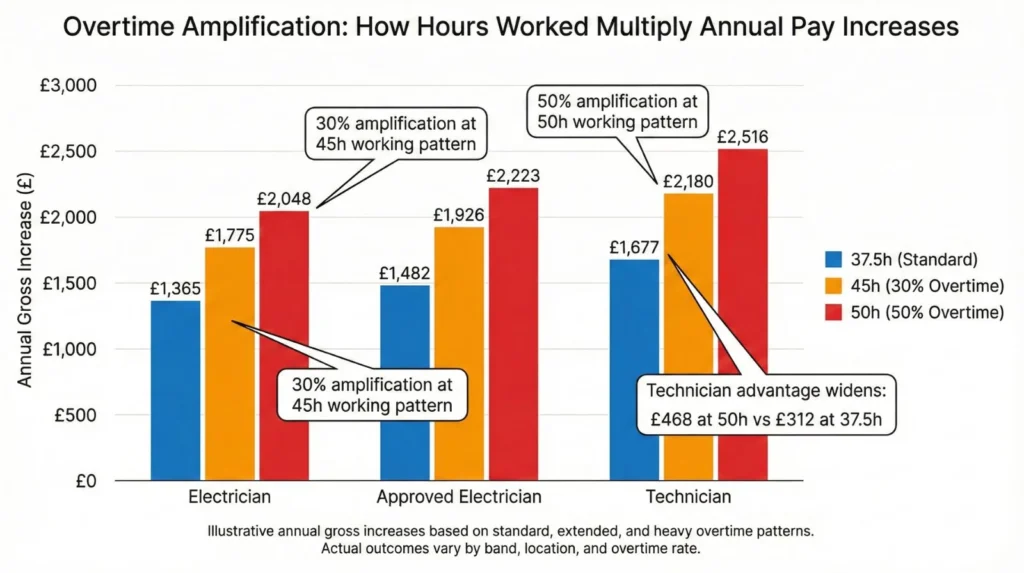
Annual increase: £1,775 (52 weeks)
Amplification: +30% over standard 37.5-hour calculation (£1,775 vs £1,365)
Approved Electrician:
Base: £28.50/week
Overtime: £8.55/week (£0.76 × 7.5 × 1.5)
Total: £37.05/week
Annual: £1,926
Amplification: +30% (£1,926 vs £1,482)
Technician:
Base: £32.25/week
Overtime: £9.68/week (£0.86 × 7.5 × 1.5)
Total: £41.93/week
Annual: £2,180
Amplification: +30% (£2,180 vs £1,677)
Overtime Differential: Why Technicians Benefit Most
The overtime scenario amplification creates £405 annual spread between Technician and Electrician gains (£2,180 vs £1,775) compared to only £312 spread at standard hours (£1,677 vs £1,365), representing 30% larger differential purely from overtime premium compounding on higher base rates.
Breaking down the Technician advantage:
Standard hours differential: Technician gains £312 more annually than Electrician (£1,677 – £1,365)
Overtime hours differential: Technician gains £93 more from overtime amplification than Electrician (£503 – £410 overtime component)
Combined differential: £405 (£312 + £93)
The higher the base rate, the more valuable each overtime hour becomes when premium multipliers apply. A Technician earning £22.70/hour receives £34.05/hour for time-and-a-half overtime (1.5 × £22.70) while an Electrician earning £18.38/hour receives £27.57/hour – a £6.48/hour overtime rate differential that compounds rapidly across weekly overtime hours.
Extended Overtime: 50-Hour Week Scenario
For electricians working 50 hours weekly (37.5 standard + 12.5 overtime at 1.5×):
Technician:
Base: £32.25/week
Overtime: £16.13/week (£0.86 × 12.5 × 1.5)
Total: £48.38/week
Annual: £2,516
Amplification: +50% over standard hours (£2,516 vs £1,677)
Electrician:
Base: £26.25/week
Overtime: £13.13/week
Total: £39.38/week
Annual: £2,048
Amplification: +50% (£2,048 vs £1,365)
Differential: £468 annually between Technician and Electrician at 50-hour pattern (£2,516 – £2,048), representing 50% larger spread than standard hours due to overtime amplification compounding.
Apprentice Overtime: Zero Amplification
Apprentices receiving zero base rate increase experience zero overtime amplification – there’s nothing to compound when the base change is £0.00. An apprentice working 45 or 50 hours weekly receives identical pay rise to an apprentice working 37.5 hours: £0 annually regardless of overtime pattern.
Overtime Availability Reality Check
The overtime amplification calculations assume consistent extended hours throughout the year. Real electrical work involves:
Sector variation:
Commercial construction: 45-50 hour weeks during installation phases (8-12 week projects), reverting to 37.5 hours between contracts
Industrial maintenance: More consistent overtime for shutdown coverage and preventive maintenance schedules
Infrastructure projects: Extended hours common during commissioning phases or deadline-driven completion
Seasonal patterns:
March-October: Higher overtime availability (longer daylight, better weather, project scheduling)
November-February: Reduced overtime (construction slower, shorter days, holiday periods)
Individual variation:
Health constraints, family obligations, or personal preferences limiting overtime acceptance
Employer project pipeline reliability affecting consistent overtime availability
Economic conditions creating feast-or-famine patterns rather than steady extended hours
Electricians should view overtime amplification as ceiling estimate rather than guaranteed outcome, with actual annual gains somewhere between standard-hours calculation (conservative floor) and overtime-amplified calculation (optimistic ceiling) depending on overtime hours actually worked.
Verdict: Overtime Amplification
Substantial winner: Technicians (£2,180 annually at 45h, £2,516 at 50h, largest absolute gains and largest differentials over other grades)
Moderate winners: Approved Electricians and Electricians (both experience 30-50% amplification over standard hours, genuine additional benefit)
Complete losers: All apprentices (zero base increase = zero overtime amplification regardless of hours worked)
Critical insight: Overtime patterns disproportionately favor higher grades through compounding mathematics, making the Technician advantage over Electricians grow from £312 at standard hours to £468 at extended hours – a 50% larger differential purely from premium multipliers applying to larger base rate increases.
Clear Verdicts: Who Gains Most Under Each Lens
Synthesizing the five analytical frameworks examined across this article produces distinct winners depending on measurement criteria and definition of “gains.”
Absolute Monetary Gains (Raw Sterling)
Winner: Technicians – £1,677 annually at standard 37.5h/52w employment
Runner-up: Approved Electricians – £1,482 annually
Third: Electricians – £1,365 annually
Last: All apprentices – £0 annually
Reasoning: Higher base rates compound into larger absolute increases when uniform percentages apply, creating £312 spread among graded operatives purely from mathematical compounding independent of negotiation favoritism.
Percentage Gains (Negotiated)
Winner: Electricians, Approved Electricians, Technicians (tied at 3.95%)
Last: All apprentices (0%)
Reasoning: The JIB agreement applies identical 3.95% to all graded operatives with zero variation by seniority, making percentage gains uniform despite absolute monetary differences.
Percentage Gains (Effective Including Statutory)
Winner: Adult apprentices aged 21+ (Stage 1-2) – 4.1% through NLW compliance
Runner-up: Electricians, Approved, Technicians – 3.95% through JIB agreement
Last: Under-21 apprentices (all stages) – 0% (JIB rates exceed statutory minimums)
Critical caveat: Adult apprentice “win” derives from government NLW increase, not JIB negotiation. Attributing 4.1% to collective bargaining success is categorically false – it’s statutory compliance independent of JIB determination.
Real-Terms Purchasing Power (After Inflation)
Winner: Technicians – 1.45% real gain (£413 annual purchasing power improvement at 2.5% inflation base case)
Runner-up: Approved Electricians – 1.45% real (£365 improvement)
Third: Electricians – 1.45% real (£317 improvement)
Substantial losers: Most apprentices – (-2.5%) real erosion (£398-684 annual purchasing power loss)
Exception: Adult apprentices Stage 1-2 – 1.6% real gain through NLW (£208-267 improvement)
Reasoning: Graded operatives all experience modest genuine purchasing power gains at projected 2.5% inflation. Most apprentices face significant household budget erosion with zero nominal increase unable to maintain pace with rising costs.
Overtime Amplification (Extended Hours)
Substantial winner: Technicians – £2,180 annually at 45h pattern (+30% over standard), £2,516 at 50h (+50%)
Moderate winners: Approved and Electricians – Both experience 30-50% amplification over standard hours
Complete losers: All apprentices – Zero amplification (no base increase to compound)
Reasoning: Premium multipliers (1.5×, 2×) apply to base rate increases, disproportionately benefiting higher grades. Technician advantage over Electricians grows from £312 at standard hours to £468 at 50h purely from compounding mathematics.
Overall Assessment: Multi-Dimensional Winners and Losers
Consistent winner across most lenses: Technicians
Highest absolute gains (£1,677 standard, £2,516 with overtime)
Tied percentage gains (3.95%)
Highest real-terms improvement (£413 purchasing power)
Largest overtime amplification (£2,516 at 50h)
Only exception: Lose effective percentage lens to adult apprentices through statutory NLW (irrelevant for practical impact)
Moderate winners: Approved Electricians and Electricians
Substantial absolute gains (£1,365-1,482)
Tied percentage gains (3.95%)
Modest real-terms improvement (£317-365 purchasing power)
Significant overtime amplification (30-50% over standard)
Substantial losers: Apprentices (most segments)
Zero absolute gains from JIB
Zero percentage gains from JIB
Severe real-terms erosion (-£398 to -684 purchasing power)
Zero overtime amplification
Exception: Adult Stage 1-2 avoid erosion through NLW compliance but still receive nothing from collective bargaining
Nuanced outcome: Adult apprentices Stage 1-2
Zero from JIB negotiation
4.1% effective through NLW compliance
1.6% real purchasing power gain
Economic outcome similar to graded operatives despite JIB exclusion
But: Gain derives from government policy, not union representation
Why the Deal Is Structured This Way
Understanding differential treatment requires examining retention logic, cost management strategies, and evolving statutory wage floor interactions that shape JIB negotiation priorities independently of fairness considerations.
The 2025 Apprentice Correction and 2026 Pause
Apprentices received substantial increases in 2025 to maintain differentials above rapidly rising National Living Wage:
2024-2025 apprentice increases:
Stage 1: ~26% increase (£6.48 to £8.16)
Stage 2: ~21% increase (£8.76 to £10.60)
Stage 3: ~18% increase (£11.06 to £13.05)
Stage 4: ~16% increase (£12.10 to £14.03)
These increases created significant employer cost spikes, particularly for firms training multiple apprentices simultaneously. The 2026 freeze represents strategic pause allowing employers to absorb 2025 costs before resuming apprentice wage progression in 2027 (2% scheduled) and 2028.
Negotiation logic:
Unite prioritized maintaining apprentice rates above NLW thresholds in 2025
ECA agreed to substantial 2025 increases on condition of 2026 freeze
2027-2028 modest increases (2-2.5%) resume progression without recreating 2025 cost shock
Structure front-loads apprentice costs in 2025, provides employer relief in 2026
Retention Logic for Senior Grades
Electrical contractors face significant retention challenges at Approved Electrician and Technician levels where experienced electricians possess options including:
Self-employment: Approved Electricians with inspection and testing qualifications can establish domestic installation businesses charging £40-60/hour (£22-30/hour net after overheads), potentially exceeding JIB Approved rates
Agency/umbrella work: Experienced electricians command £300-350/day (£25-30/hour equivalent) with flexibility advantages despite benefit trade-offs
Specialist subcontracting: Solar, EV charging, data centre, and industrial automation specialists negotiate premium rates above standard JIB minimums
Competitor poaching: Non-JIB contractors offering above-minimum rates to attract experienced talent
The 3.95% increase applying uniformly to all graded operatives maintains competitive positioning against these alternatives. While Technicians gain most in absolute terms (£1,677), this reflects their higher market value – contractors must match competitive rates to prevent senior talent departure, making the compounding effect on higher bases economically rational rather than preferential.
Joshua Jarvis, Elec Training’s Placement Manager, explains total compensation context:
"The comparative pay rise analysis focuses on JIB rates, but Technicians often receive additional benefits beyond hourly wages: company vehicles reducing personal vehicle costs, enhanced pension contributions (8-10% employer versus 5-8% for Electricians), professional development allowances, and first access to specialist training (solar, EV, SCADA). When calculating who 'gains most,' the pay rise percentage is just one component of total compensation packages that increasingly favor senior grades as retention tools."
Joshua Jarvis, Placement Manager
Statutory Floors vs Collective Bargaining
The diverging treatment of apprentices versus graded operatives reflects fundamental shift in wage determination mechanisms:
Graded operatives:
JIB rates substantially exceed NLW (Electrician £18.38 versus £12.71 = 44% premium)
Market wages determined entirely through collective bargaining
No statutory floor relevance
Union representation essential for wage improvements
Apprentices:
JIB rates increasingly approach or fall below NLW for adult apprentices
Stage 1: £8.16 JIB versus £12.71 NLW = £4.55/hour gap requiring top-up
Stage 2: £10.60 JIB versus £12.71 NLW = £2.11/hour gap requiring top-up
Statutory floors provide safety net independent of JIB negotiations
Adult apprentice wages determined by government Low Pay Commission, not union representation
This creates paradox: adult apprentices may receive larger effective percentage increases than experienced Technicians through NLW rises exceeding JIB determinations, yet this reflects declining collective bargaining relevance for apprentice wages rather than negotiation success. The JIB effectively ceded adult apprentice wage-setting to statutory policy, focusing negotiation priorities on graded operatives where collective bargaining remains determinative.
Why Uniform 3.95% Across Graded Operatives
Historical JIB determinations occasionally provided additional percentage points for senior grades (e.g., Technicians 4.5%, Electricians 4.0%) to enhance retention. The 2026 uniform 3.95% reflects:
Simplification: Easier administration and communication with single percentage applying across grades
Fairness optics: Avoids perception of favoring senior workers during cost-of-living pressures affecting all segments
Mathematical reality: Compounding on higher bases already creates absolute differential (£312 Technician advantage) without requiring additional percentage points
Cost management: Additional senior grade percentages compound employer costs without substantially improving retention beyond uniform increase
The uniform percentage acknowledges that absolute monetary differences created through compounding sufficiently recognize senior grade market value without explicit percentage differentiation.
Apprenticeship Levy and Training Cost Pressures
The apprentice wage freeze occurs amid broader training cost pressures:
Apprenticeship Levy context:
Large employers (£3M+ payroll) pay 0.5% levy funding apprenticeship programs
Small employers access £18,000 government funding per apprentice (unchanged since 2018, 15% real erosion)
Employer NI increase April 2025 (13.8% to 15% rate, £9,100 to £5,000 threshold) adds £700-900 per employee
SME apprentice training economics:
Direct costs: JIB wages (£15,912-27,359 annually depending on stage) + NI + pension
Indirect costs: Assessor time, mentor supervision, equipment, reduced productivity during training
Adult apprentice NLW top-ups: Additional £3,705-8,874 annually for Stage 1-2 aged 21+
The 2026 apprentice freeze reflects employer cost resistance amid rising training expenses and statutory wage obligations, prioritizing cost control over apprentice wage growth when government policies rather than JIB rates increasingly determine actual apprentice pay for adult learners.
What the Numbers Don't Capture
Comprehensive limitations acknowledgment protects credibility and compliance by identifying what comparative analysis cannot determine from JIB rate tables alone.
Employer Top-Ups Above JIB Minimums
JIB rates establish contractual minimums that signatory contractors cannot pay below. Many electrical employers exceed JIB minimums through:
Site premiums: £1-3/hour additional for specific projects (data centres +£2-3/hour, nuclear facilities +£3-4/hour, offshore wind +£2-3/hour, underground/tunneling +£1.50-2.50/hour)
Specialist premiums: Additional rates for certified specialisms (High Voltage switching +£2/hour, SCADA/PLC programming +£1.50-3/hour, solar PV +£1-1.50/hour, EV rapid charging +£1-2/hour)
Regional market rates: Firms in high-demand areas pay £2-5/hour above JIB minimums to attract talent (London £3-5/hour typical, South-East £2-4/hour, Scotland £2-3/hour)
Individual negotiation: Experienced electricians with niche skills command personal rates exceeding JIB by £3-6/hour
How top-ups affect 2026 impact: If an Approved Electrician currently earns £23/hour (JIB £19.32 + £3.68 employer premium) and the employer maintains the fixed premium, the 2026 increase becomes £24/hour (JIB £20.08 + £3.68 maintained), delivering the full £1,482 JIB increase plus £58 from premium application to higher base.
If the employer maintains percentage premium (19% above JIB in example), the 2026 rate becomes £23.90 (£20.08 × 1.19), creating £1,902 total increase (£1,482 JIB + £420 from percentage premium).
Conversely, if the employer absorbs the JIB increase by reducing their premium (£24 – £0.76 = £23.24 premium maintained at constant £4/hour total), the electrician receives only £240 effective increase despite £1,482 JIB determination.
Reality: Comparative analysis using JIB minimums cannot account for employer-specific top-up structures, making actual 2026 impact highly variable across firms and individuals beyond rate table predictions.
Project-Specific Premium Schemes
Major infrastructure and industrial projects often operate under agreements exceeding standard JIB rates:
NAECI (National Agreement for Engineering Construction Industry):
Applies to petrochemical, power generation, nuclear, and large industrial projects
Typically 15-25% above JIB rates
Example: NAECI Technician ~£27-29/hour versus JIB £22.70/hour
Blue Book (Offshore Industry):
Offshore oil, gas, and wind installations
Premiums 30-50% above JIB
Example: Offshore Electrician £28-32/hour versus JIB £18.38/hour
Project-specific agreements:
Hinkley Point C, HS2, major data centre builds negotiate site-specific rates
Often 10-20% above JIB with additional allowances
Electricians working under these agreements receive pay rises determined by project-specific negotiations, not JIB determinations. Comparative analysis based on JIB rates excludes potentially 20-30% of electrical workforce on premium-rate projects where 2026 increases follow different patterns.
Real Overtime Prevalence and Patterns
Overtime amplification calculations assume consistent 45-50 hour weeks throughout the year. Actual overtime patterns vary dramatically:
Sector patterns:
Commercial construction: Intensive overtime during installation phases (8-12 weeks at 50+ hours) followed by standard hours between projects (potentially 40-60% of year)
Industrial maintenance: More consistent overtime for planned shutdowns and emergency callouts (averaging 42-45 hours year-round)
Infrastructure/civil: Project-dependent with deadline-driven peaks (50-60 hour weeks) and quiet periods (35-40 hours)
Domestic/light commercial: Typically 37.5-42 hours with occasional overtime rather than sustained extended patterns
Seasonal variation:
March-October: Higher overtime availability (longer daylight, better weather, accelerated project timelines)
November-February: Reduced overtime (construction slower, Christmas/New Year shutdowns, adverse weather delays)
Individual factors:
Health constraints, family obligations, or personal preferences limiting overtime acceptance
Some electricians maximize overtime for income; others prioritize work-life balance
Age patterns: Younger electricians more likely to accept extended hours; older electricians (45+) often reduce overtime
The overtime amplification analysis provides ceiling estimate showing maximum additional gains if consistent 45-50 hour patterns sustained year-round. Actual annual increases likely fall between standard-hours floor (£1,365-1,677) and overtime ceiling (£1,775-2,516) depending on individual circumstances impossible to predict from rate tables alone.
London Allowance and Band Timing
London rates provide 12-14% premium over National rates (Approved Electrician: £22.48 London versus £20.08 National = £2.40/hour, 12% premium). The 2026 pay rise applies identical 3.95% percentage to London rates, maintaining proportional relationships.
Unverified London specifics:
Whether London premium differential adjusts separately from base rate increases
Timing of any London-specific cost-of-living adjustments beyond JIB determination
M25 boundary interpretation and enforcement for borderline postcodes
Shop employed rates and their London equivalents
Comparative analysis uses National TP as benchmark with London following parallel patterns, but cannot verify London-specific adjustments finalized closer to 5 January 2026 effective date.
Individual Contract and Employer Variation
Two Approved Electricians both covered by JIB agreements may experience substantially different 2026 outcomes based on:
Contract type:
Permanent PAYE: Receive full JIB increase on effective date
Fixed-term contracts: May require renegotiation beyond JIB minimums
Zero-hours contracts: JIB rates apply but hours variability creates income uncertainty
Employer characteristics:
Large contractors (50+ electricians): Typically apply JIB rates precisely with transparent implementation
SME contractors (2-10 electricians): More variation in interpretation, potential delays, informal arrangements
Specialist firms: May prioritize market rates over JIB minimums, creating hybrid structures
Benefits packages:
Company vehicles, enhanced pensions, private medical insurance, training allowances vary substantially
Total compensation differential may exceed hourly rate comparisons
CMA Compliance Acknowledgment
This analysis compares minimum rates under JIB agreements for educational purposes. Actual individual earnings vary substantially based on:
Employer-specific top-ups and premiums
Project-specific agreements (NAECI, Blue Book, bespoke)
Overtime actually worked versus theoretical scenarios
Benefits packages and total compensation
Geographic location and local market conditions
Individual negotiation and specialized skills
No electrician should assume their 2026 income increase will precisely match JIB rate table calculations. The analysis provides framework for understanding structural patterns, not personal income predictions.
The 2026 JIB pay rise effective 5 January 2026 distributes economic benefits unevenly across electrical workforce segments through structural mathematics (compounding on higher base rates), negotiation priorities (graded operative focus with apprentice exclusion), and statutory wage interactions (NLW compliance creating effective increases independent of collective bargaining) that produce distinct winners and losers depending on analytical framework applied. Technicians gain the most under multiple measurement criteria including absolute monetary gains (£1,677 annually at standard hours, £2,180-2,516 with overtime), real-terms purchasing power improvement (£413 at 2.5% inflation), and overtime amplification effects (50% larger differential over Electricians at extended hours versus standard patterns), with the uniform 3.95% percentage creating £312-468 annual spread over Electricians purely through mathematical compounding on higher £21.84/hour base rate rather than preferential negotiation treatment or additional percentage points reserved for senior grades.
Graded operatives (Electricians, Approved Electricians, Technicians) all experience modest but genuine purchasing power gains at projected 2.5% inflation delivering 1.45% real improvement translating to approximately £317-413 additional annual spending power after accounting for rising costs in housing, energy, food, and transport – sufficient for marginally improved household budgets (£6-8 weekly discretionary spending increase) rather than transformational income growth, continuing three-year recovery pattern (2024-2026 cumulative ~6.5% real gain) that restores purchasing power to approximately 2021 levels following substantial 2022-2023 erosion when inflation spiked to 9%+ while JIB increases lagged at 4-5%, representing consolidation phase maintaining competitive positioning against self-employment, agency work, and specialist subcontracting alternatives that threaten contractor retention of experienced Approved Electricians and Technicians.
Apprentices represent the substantial losers under most analytical frameworks experiencing zero JIB negotiated increase across all four stages creating -2.5% to -3% real-terms purchasing power erosion at projected inflation translating to £398-684 annual loss in household budget capacity (£7.65-13.15 weekly reduced spending power) making training years financially harder particularly for adult apprentices (21+) with independent living expenses, though adult Stage 1-2 apprentices receive 4.1% effective increase through National Living Wage compliance requiring mandatory top-ups from £8.16-10.60 JIB rates to £12.71 statutory minimum creating £3,705-8,874 additional annual employer costs. This adult apprentice “win” in effective percentage terms (4.1% exceeding graded operatives’ 3.95%) derives from government Low Pay Commission policy rather than collective bargaining success, masking the JIB’s complete exclusion of apprentices from 2026 determination and reflecting fundamental shift where statutory wage floors increasingly determine apprentice pay independent of union representation while graded operative wages remain entirely dependent on JIB negotiations.
Overtime patterns disproportionately amplify Technician advantages through premium multipliers (time-and-a-half 1.5×, double-time 2×) applying to base rate increases and compounding higher base rates into larger overtime premium gains: Technicians working 45-hour weeks gain £2,180 annually (+30% over standard hours) compared to Electricians’ £1,775 (+30%), with the differential growing from £312 at standard hours to £405 with 7.5 weekly overtime hours purely from mathematical compounding, while 50-hour patterns create 50% amplification (£2,516 Technicians versus £2,048 Electricians, £468 differential) demonstrating that extended hours common in commercial construction and industrial maintenance magnify structural advantages for senior grades beyond base rate comparisons, though actual overtime availability varies dramatically by sector, season, and employer project pipeline making amplification calculations ceiling estimates rather than guaranteed outcomes.
The structural design reflects retention logic prioritizing graded operative competitive positioning against self-employment and agency alternatives that threaten contractor workforce stability, cost management strategies including 2026 apprentice freeze following substantial 2025 increases (~26% Stage 1, ~21% Stage 2) creating strategic pause for employer cost absorption before resuming modest progression in 2027-2028, and evolving statutory wage interactions where adult apprentice costs increasingly determined by National Living Wage policy rather than JIB negotiations reducing collective bargaining relevance for 20-30% of apprentice workforce aged 21+ while maintaining union representation as determinative for graded operatives earning 44% above NLW (Electrician £18.38 versus £12.71) where market wages depend entirely on JIB determinations. Total compensation packages increasingly favor Technicians beyond hourly rates through company vehicles, enhanced pension contributions (8-10% employer versus 5-8% for Electricians), professional development allowances, and first access to specialist training (solar, EV, SCADA) making pay rise percentages only one component of retention strategies employing graduated benefit structures to prevent senior talent departure.
However, comparative analysis of single-year pay rise distribution matters substantially less for lifetime earnings than qualification progression strategies from initial NVQ Level 3 completion through AM2 assessment and advanced inspection and testing qualifications (2391 Testing & Inspection, 18th Edition amendments) enabling grade advancement from Electrician to Approved to Technician status delivering permanent income step-changes: Electrician to Approved progression provides £1.70/hour or £3,315 annually (2.2 times larger than entire 2026 Electrician pay rise), Approved to Technician advancement delivers £2.62/hour or £5,109 annually (3.4 times larger than Approved pay rise), and apprentice completion jump from Stage 4 (£14.03/hour) to qualified Electrician (£18.38/hour) represents £4.35/hour or £8,494 annually (6.2 times larger than Electrician pay rise) making qualification investment returns exceed multiple years of 3.95% annual increases compressed into single grade progression achievements. Electricians focusing exclusively on annual JIB percentage headlines miss fundamental income growth strategy: completing inspection and testing qualifications within 18-24 months delivers permanent £3,315 annual increase dwarfing any single-year determination, while apprentices prioritizing completion speed over waiting for better apprentice rates gain £8,494 immediately upon qualification versus zero from JIB negotiations during training years.
Call us on 0330 822 5337 to discuss how qualification pathways integrate with JIB grading structures affecting lifetime earning trajectories beyond single-year pay rise comparisons, what realistic timelines look like for progressing from Electrician to Approved status through inspection and testing qualifications delivering £3,315 permanent annual increases, how our in-house recruitment team helps NVQ learners secure JIB employment with contractors offering above-minimum rates and consistent overtime opportunities amplifying base pay rise benefits by 30-50%, and what actual take-home income looks like across grades accounting for tax, National Insurance, employer top-ups, project premiums, and total compensation packages rather than gross JIB minimum rate headlines alone.
References
- JIB (Joint Industry Board for the Electrical Contracting Industry) – Industrial Determination 2026-2028 – https://www.jib.org.uk/wp-content/uploads/2025/06/JIB-Industrial-Determination-062025.pdf
- JIB – Handbook 2025 (2025 rates baseline for comparison) – https://www.jib.org.uk/wp-content/uploads/2025/01/JIB-Handbook-2025.pdf
- JIB – New Wage Agreement from 2026 to 2028 (announcement with clarifications) – https://www.jib.org.uk/news/new-wage-agreement-from-2026-to-2028/
- GOV.UK – National Minimum Wage and National Living Wage rates – https://www.gov.uk/national-minimum-wage-rates
- Low Pay Commission – National Living Wage and National Minimum Wage recommendations 2025-26 – https://www.gov.uk/government/publications/low-pay-commission-report-2024
- Office for Budget Responsibility – Economic and Fiscal Outlook November 2025 (CPIH forecast) – https://obr.uk/efo/economic-and-fiscal-outlook-november-2025/
- Bank of England – Monetary Policy Summary and Minutes December 2025 (inflation projections) – https://www.bankofengland.co.uk/monetary-policy-summary-and-minutes/2025/monetary-policy-summary-and-minutes-december-2025
- ONS (Office for National Statistics) – Consumer Price Inflation including owner occupiers’ housing costs (CPIH) – https://www.ons.gov.uk/economy/inflationandpriceindices
Note on Accuracy and Updates
Last reviewed: 24 December 2025. This page is maintained; we correct errors and refresh sources as JIB Industrial Determinations, inflation data, minimum wage rates, and comparative analysis methodologies are published. 2026 rates sourced from confirmed JIB Industrial Determination 062025 effective 5 January 2026. 2025 baseline rates from JIB Handbook 2025 effective 6 January 2025. Apprentice rates confirmed as unchanged in 2026 despite secondary sources mentioning 2% increase – official rate tables show zero change with 2% deferred to January 2027. CPIH inflation projections use Office for Budget Responsibility November 2025 forecast (~2.5%) and Bank of England December 2025 guidance (2.0-2.5% CPI), acknowledging actual January 2026 CPIH will be published February 2026 and may vary from forecasts based on energy prices, wage growth, and economic conditions. National Living Wage projections use Low Pay Commission 2024 recommendations (£12.71/hour for 21+ from April 2026), subject to final Treasury confirmation. Real-terms calculations assume 2.5% CPIH base case with sensitivity analysis 2.0-4.0% range; actual purchasing power changes determined by final inflation publication. Overtime amplification calculations assume consistent weekly patterns (45h, 50h) applying JIB premium multipliers (time-and-a-half 1.5×, double-time 2×); actual overtime varies by sector, season, project, and individual circumstances creating range between standard-hours floor and overtime ceiling. Employer top-ups, project premiums (NAECI, Blue Book), and total compensation packages vary substantially beyond JIB minimum rates; comparative analysis provides structural framework, not personal income predictions. Adult apprentice NLW top-up calculations (£3,705-8,874 annually for Stage 1-2 aged 21+) use projected April 2026 NLW £12.71/hour and assume standard 37.5h/52w employment; actual top-ups depend on individual age, stage, hours worked, and employer compliance. Grade progression income gains (Electrician to Approved £3,315, Approved to Technician £5,109, Apprentice Stage 4 to Electrician £8,494) use 2026 National TP rates at standard hours; London and Own Transport variants produce proportionally similar gains. Next review scheduled following January 2026 CPIH publication (expected February 2026) for real-terms validation and April 2026 NLW confirmation for adult apprentice top-up verification.
