

Why Electrician Apprenticeships Remain the Gold Standard (Despite What Short Courses Promise)

- Technical review: Thomas Jevons (Head of Training, 20+ years)
- Employability review: Joshua Jarvis (Placement Manager)
- Editorial review: Jessica Gilbert (Marketing Editorial Team)
- Last reviewed:
- Changes: Updated for JIB 2026 wage rates, Youth Guarantee funding details, and ONS ASHE 2025 earnings data
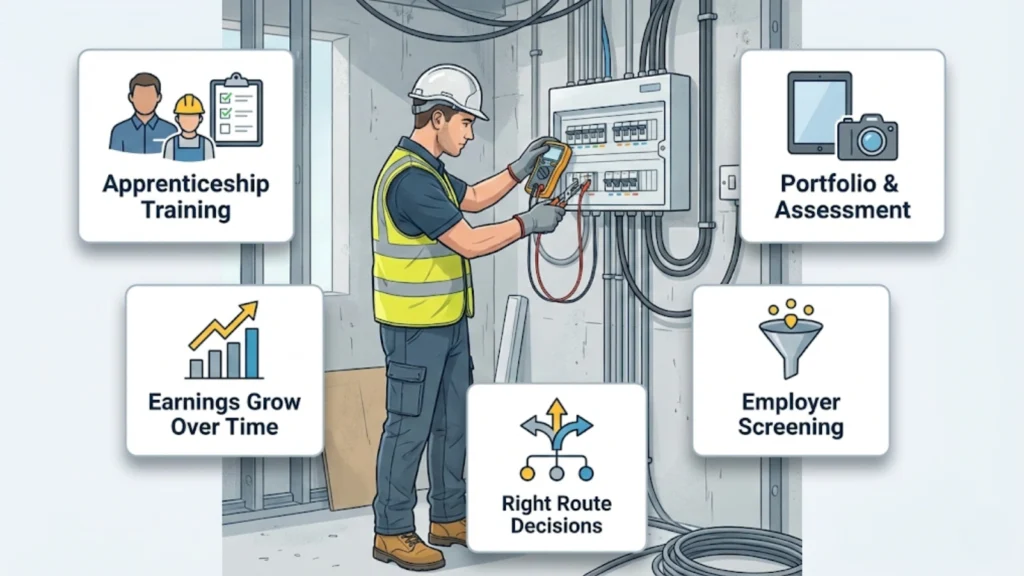
“Qualified in 16 weeks.”
“Fast-track to £40,000 salary.”
“Skip the apprenticeship, start earning now.”
You’ve seen these promises from private training providers marketing electrical courses. They make apprenticeships sound unnecessarily long, financially punishing, and outdated compared to “modern” alternatives. Understanding what short electrical courses actually deliver helps clarify why apprenticeships remain the primary route to employment, as theory knowledge alone doesn’t satisfy employer requirements for competence verification.
Here’s what those courses don’t advertise: Approximately 90% of large electrical contractors won’t interview candidates without apprenticeship-backed NVQ Level 3 and an ECS Gold Card. The “16 weeks” covers theory, not the 3,000+ hours of supervised site experience employers actually require for competence verification. And the electricians earning £40,000+ almost universally completed apprenticeships—it’s the qualification pathway employers trust.
The Installation and Maintenance Electrician standard (ST0152) remains the UK’s gold standard for electrical training because it delivers what employers need: verified practical competence, not just theoretical knowledge. It takes 42-48 months because developing the judgment to work safely on live electrical systems actually requires years of supervised practice.
This isn’t nostalgia for traditional pathways. It’s recognition that electrical work carries genuine safety risks, that competence requires extensive hands-on experience, and that employers filter candidates by credentials that prove supervised training—credentials apprenticeships provide automatically.
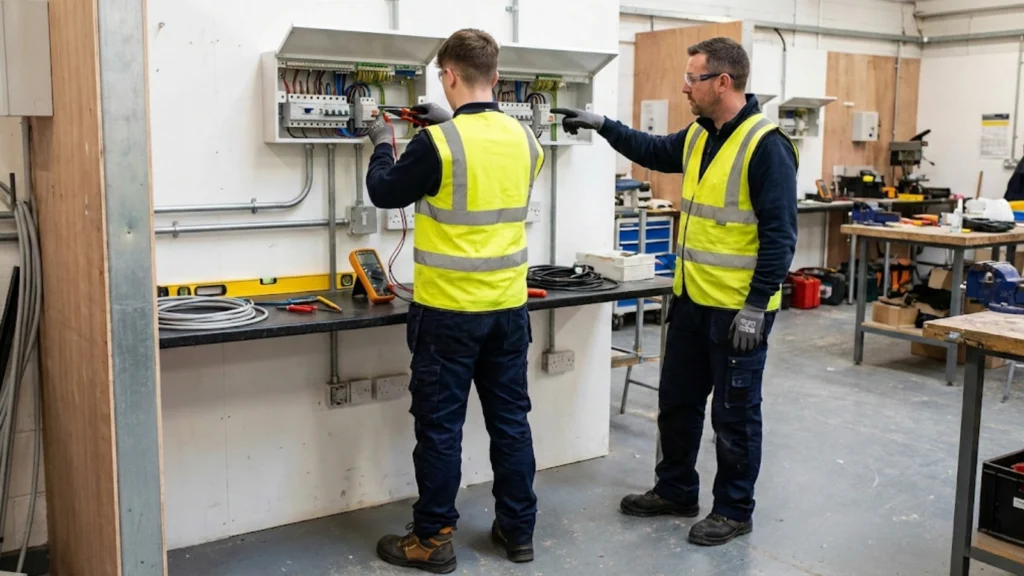
What an Electrician Apprenticeship Actually Delivers
involves.
The structure:
80% on-the-job training with an employer. You’re installing electrical systems, maintaining equipment, fault-finding, and testing circuits on real sites under supervision. This is paid employment from day one.
20% off-the-job learning. Typically one day per week at college or a training center covering theory, regulations (BS 7671), safety procedures, and technical knowledge.
Duration: 42-48 months standard. Some providers advertise 36 months, but completion data shows 42-48 months is realistic for most learners.
What you actually achieve:
Level 3 Electrotechnical Qualification: City & Guilds or equivalent, covering installation principles, inspection and testing, electrical science, and wiring regulations.
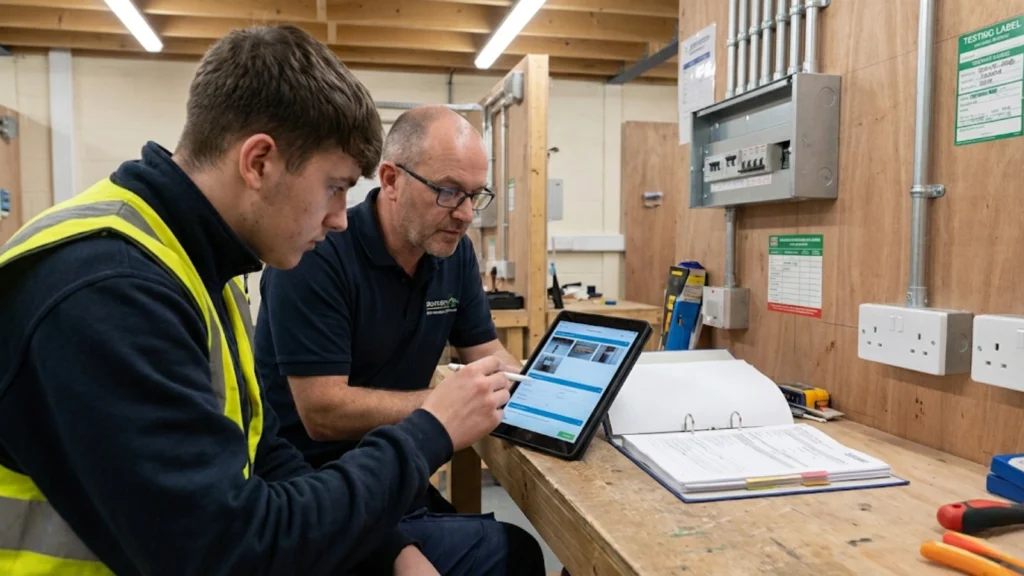
NVQ Level 3 Diploma: Portfolio of workplace evidence demonstrating competence in installing, maintaining, testing, and certifying electrical systems. This is competence verification, not just knowledge assessment.
AM2/AM2E End-Point Assessment: Three-day practical examination where you install circuits, fault-find, inspect, test, and certify work independently. Pass this and you’ve proven you can do the job safely without supervision.
Functional Skills Level 2: English and maths if you don’t already hold GCSEs at grade 4 or above.
18th Edition Wiring Regulations: BS 7671:2018+A2:2022 qualification, mandatory for all electrical work.
The outcome:
ECS Gold Card eligibility. This is your industry passport—without it, you cannot work unsupervised on most commercial sites, sign off electrical work, or be employed as a qualified electrician by major contractors.
The cost to you:
£0 if you’re 16-18. Fully government-funded.
£0 if you’re 19-24 (from April 2026 onwards under Youth Guarantee provisions).
Approximately £500 co-investment if you’re 25+ (5% of training cost, though many employers waive this).
You’re paid throughout. Minimum apprentice wage is £6.40/hour for under-19s or first-year apprentices, but JIB rates for electrical apprenticeships start higher: £8.16/hour Stage 1, rising to £15.81/hour by Stage 4.
Why the Timeline Matters (It's Not Just Bureaucracy)
42-48 months sounds long compared to “16-week qualified electrician” marketing. There’s a reason for the difference.
"The 42-48 month apprenticeship timeline isn't arbitrary. You need approximately 3,000-4,000 hours of supervised site experience to develop the judgment that keeps you and others safe. You learn to recognize problems before they become dangerous, understand why certain installations failed, and develop the muscle memory for quality work. That takes time you can't shortcut."
Thomas Jevons, Head of Training
What those 3,000-4,000 hours actually teach:
Pattern recognition: After terminating hundreds of cables, you recognize when connections aren’t secure before testing reveals it. After fault-finding dozens of circuits, you develop systematic troubleshooting approaches that short-course theory can’t replicate.
Professional judgment: Knowing when to escalate problems beyond your competence level. Understanding which “textbook” solutions don’t work in specific real-world constraints. Recognizing safety risks from visual inspection before formal testing.
Physical competence: Cable termination quality comes from muscle memory—knowing the right amount of force, recognizing when strands are damaged, feeling when connections are secure. This develops through repetition over years, not weeks.
Site protocols: Working safely around other trades. Understanding permit-to-work systems. Navigating site hierarchies and communication chains. Managing time under deadline pressure while maintaining quality standards.
Equipment familiarity: Testing equipment varies by manufacturer. Installation techniques differ between domestic, commercial, and industrial settings. Materials behave differently under various conditions. You learn this through exposure, not study.
The 16-week courses cover the theory that underpins all of this. They don’t provide the experience that makes the theory useful in practice. That’s why employers filter for apprenticeship-backed NVQ Level 3—they know what 3,000+ supervised hours delivers.
Apprenticeship vs Alternative Routes (The Honest Comparison)
Let’s compare what different pathways actually deliver.
Apprenticeship (42-48 months):
Cost: £0 (or £500 for 25+, often waived)
Income: £15,000-£18,000 year one, rising to £25,000-£30,000 by year four (JIB rates)
Site experience: 3,000-4,000 hours supervised, documented, and assessed
Qualification outcome: Level 3 Electrotechnical + NVQ Level 3 + AM2 pass = ECS Gold Card eligibility
Employer view: Preferred route. Proven competence. No additional verification needed.
Employment probability: High. Many apprentices receive job offers from training employer before completion.
Fast-track courses (5-16 weeks):
Cost: £6,000-£12,000
Income: £0 during training (you’re paying to attend)
Site experience: None provided. You must find employers willing to supervise portfolio building after course completion.
Qualification outcome: City & Guilds Level 2 or Level 3 diploma (theory only). No NVQ. No AM2. No ECS Gold Card.
Employer view: Theory knowledge acknowledged, but competence unproven. Requires extended probation with supervision before independent work.
Employment probability: Low without existing industry connections. Approximately 10% of short-course graduates progress to qualified electrician status according to industry data.
College diploma (1-2 years part-time):
Cost: £0-£3,000 depending on age and funding
Income: £0 during evening/weekend study (unless you maintain separate employment)
Site experience: None, or minimal workshop simulations
Qualification outcome: City & Guilds Level 2/3 diploma. No NVQ. No AM2. No ECS Gold Card.
Employer view: Good theoretical foundation, but you’re essentially starting from zero regarding competence. Need to find employer willing to supervise NVQ building.
Employment probability: Medium if you already work in construction or have industry contacts. Low for complete career changers.
Self-funded NVQ route (6-18 months if you find employment):
Cost: £2,000-£4,000 for NVQ assessment + AM2 (approximately)
Income: Depends on employment arrangement (typically mate wages £20,000-£25,000)
Site experience: You must find employer willing to hire you as trainee and provide supervision for portfolio evidence
Qualification outcome: NVQ Level 3 + AM2 if you complete = ECS Gold Card eligibility
Employer view: Respects the initiative, but quality varies dramatically. Some employers exploit learners as cheap labor without proper training support.
Employment probability: Medium to high if you successfully complete, but finding the initial employment and maintaining it through completion is the challenge.
The pattern:
Apprenticeships provide structure, funding, guaranteed supervision, and employer commitment. Alternative routes place the burden on you to find employers willing to support competence development, often while you’re paying for training or accepting reduced wages without formal training contracts.
The Earnings Reality (From Apprentice to Qualified)
Let’s be specific about what you actually earn throughout an apprenticeship and beyond.
Apprenticeship earnings (JIB rates 2026):
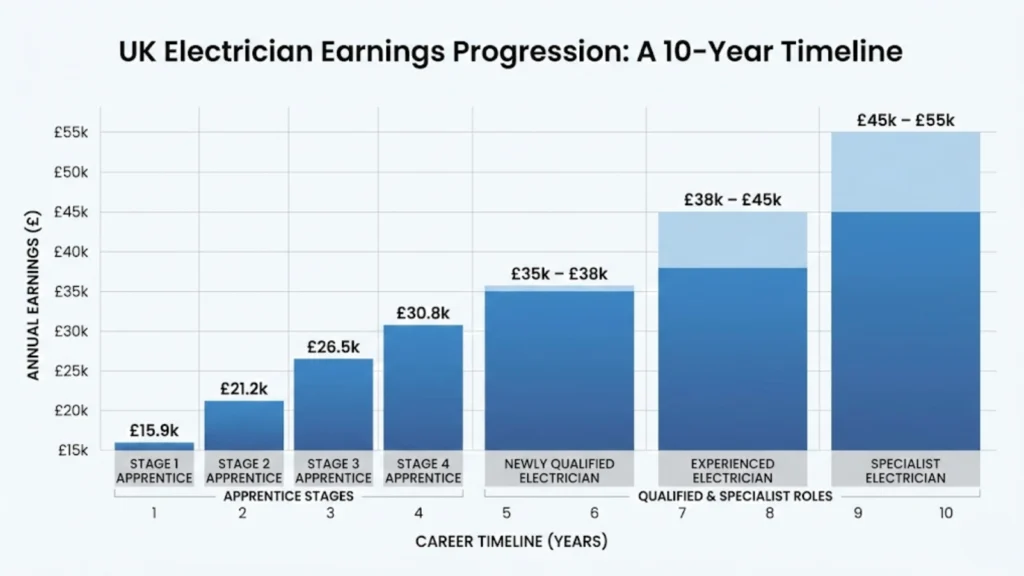
Stage 1 (Year 1): £8.16/hour = approximately £15,912 annually (assuming 37.5 hours/week, 52 weeks)
Stage 2 (Year 2): £10.89/hour = approximately £21,236 annually
Stage 3 (Year 3): £13.61/hour = approximately £26,543 annually
Stage 4 (Year 4): £15.81/hour = approximately £30,831 annually
Note: Adult apprentices (21+) are legally entitled to National Living Wage (£12.71/hour in 2026) after their first year, which exceeds Stage 2 rates.
Qualified electrician earnings (ONS ASHE 2025 data):
UK median: £39,039 annually
UK mean: £39,249 annually
West Midlands median: £36,500 annually (slightly below national but lower cost of living)
London median: £45,000-£50,000 annually
Specialist roles (renewables, industrial automation): £48,000+ annually
Progression timeline:
Years 1-4: Apprentice wages (£15,900 to £30,800)
Year 5 (newly qualified): £35,000-£38,000 typically
Years 5-10 (experienced): £38,000-£45,000
10+ years (specialist or supervisory): £45,000-£55,000+
The investment: You earn approximately £95,000 total during the four-year apprenticeship (cumulative from all years). A fast-track course costs £6,000-£12,000, provides no income during training, and leaves you searching for employment with unproven competence.
Adult Apprenticeships (The Career Changer Reality)
Adult apprenticeships (25+) are increasingly common—approximately 30% of new electrical apprentice starts in 2025 were adults switching careers.
The financial challenge:
"Adult apprentices face a genuine financial challenge in year one—you're potentially earning £15,000-£18,000 after previously making £25,000-£30,000 in another field. But by year three, you're back at your previous income level, and by qualification you're exceeding it. The employers willing to hire adult apprentices understand this and often adjust wages above minimum where possible."
Joshua Jarvis, Placement Manager
When adult apprenticeships make sense:
You’re currently in a job you dislike with limited progression potential (retail, hospitality, admin roles without advancement).
You have financial cushion to survive reduced income for 18-24 months (savings, partner income, reduced housing costs).
You’re willing to commit 4 years to retraining because you want a long-term skilled trade career.
You value structured learning with guaranteed supervision over the uncertainty of self-funded NVQ routes. Adult-focused training programs, particularly in areas like Wolverhampton and the West Midlands, offer part-time and intensive pathways that can complement employment, though these still ultimately require NVQ portfolio building through supervised work experience.
When adult apprenticeships are challenging:
You’re the primary household earner with dependents and no financial buffer.
You’re currently earning £30,000+ in a stable role and cannot afford the income reduction.
You need flexibility that apprenticeship employment contracts don’t provide.
You’re older than 40 and calculating whether 4 years of reduced earnings make financial sense for remaining career length.
The alternative for adults:
Some adults pursue fast-track theory courses (16 weeks) while maintaining current employment, then negotiate trainee positions (mate roles) with employers to build NVQ portfolios. This spreads financial impact but extends total qualification timeline to 3-5 years.
The honest assessment: Adult apprenticeships work well for motivated career changers who can manage temporary income reduction. They’re financially difficult for primary earners without cushion. The structured pathway and guaranteed supervision justify the sacrifice for many adults, but it’s not universally viable.
What Employers Actually Look For (The Hiring Filter)
Understanding employer hiring criteria clarifies why apprenticeships remain the gold standard.
The primary filter:
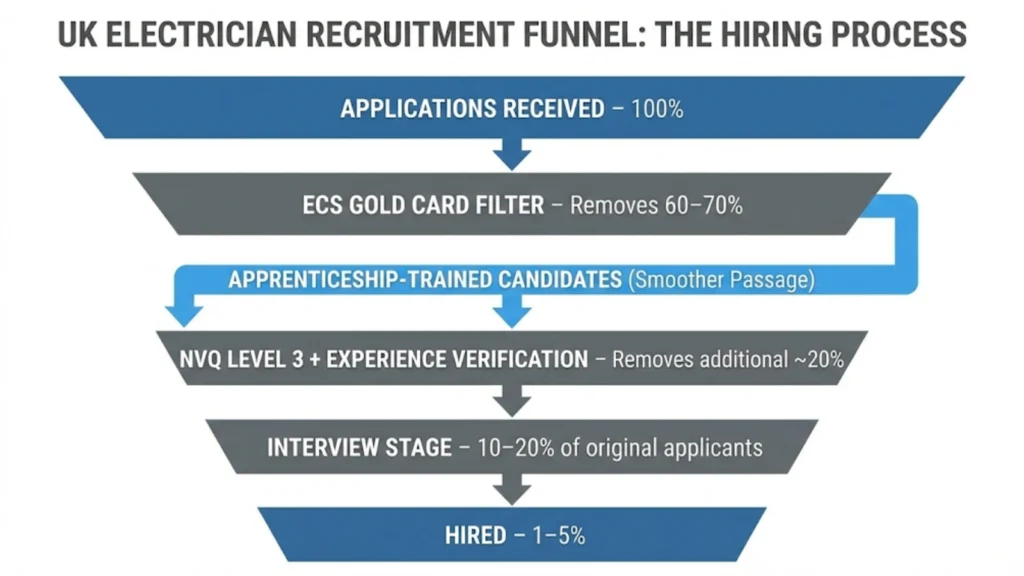
ECS Gold Card (or demonstrable eligibility). This immediately proves NVQ Level 3 + AM2 + 18th Edition qualification. Without it, your application typically gets rejected before interview stage.
The secondary filters:
Years of experience post-qualification. Newly qualified electricians face “1-2 years experience required” barriers despite holding Gold Cards. Apprenticeship-trained candidates have advantage here because their 3,000+ hours count as experience.
Site-specific requirements (CSCS cards for construction sites, DBS checks for schools/hospitals, driving licenses for service/maintenance roles).
Specialist qualifications (EV charging, inspection and testing 2391, fire alarm systems). These are add-ons after core qualification.
What job advertisements actually say:
“NVQ Level 3 required” appears in approximately 85% of electrician job postings in Birmingham/West Midlands (LinkedIn/Indeed analysis).
“ECS Gold Card essential” appears in approximately 90% of commercial electrical roles.
“Apprenticeship-trained preferred” appears explicitly in 30-40% of job advertisements, implicitly expected in most others.
Why employers prefer apprenticeship-trained electricians:
Proven site exposure. They know apprentices have years of supervised installation experience, not just classroom knowledge.
Lower insurance risk. Apprenticeship completion demonstrates verified competence through independent assessment (AM2).
Cultural fit. Apprentices learned workplace protocols, communication expectations, and professional behavior during training.
Reliability signals. Completing a 4-year apprenticeship demonstrates commitment, persistence, and ability to meet long-term goals.
The mate role trap:
Many short-course graduates end up as mates (assistants) earning £20,000-£25,000, unable to progress without NVQ Level 3 and Gold Card. They’re stuck fetching materials and doing basic tasks indefinitely because they lack the credentials employers require for independent work.
Apprenticeships prevent this trap by ensuring credentials are built into the program, not something you chase afterward.
Common Misconceptions About Apprenticeships
Let’s address the myths that discourage people from pursuing apprenticeships.
Myth: “Apprenticeships take too long compared to fast-track courses.” Reality: The 42-48 month apprenticeship timeline reflects the actual time needed to develop competence that employers recognize. Fast-track courses cover theory in 16 weeks, but then you spend 2-4 years searching for employment, negotiating NVQ supervision, and building portfolios without structured support. Total time to ECS Gold Card via alternative routes often exceeds apprenticeship duration.
Myth: “Apprentice wages are exploitative.” Reality: JIB Stage 1 rates (£8.16/hour) are low, yes. But you’re earning £15,900 annually while training, accruing no debt, and building toward £35,000-£40,000 qualified earnings. Fast-track alternatives cost £6,000-£12,000 upfront, provide no income during training, and offer no employment guarantee afterward. Which is more exploitative?
Myth: “I’m too old for an apprenticeship at 30+.” Reality: Approximately 30% of new electrical apprentice starts are adults 25+. Employers value maturity, life experience, and commitment. The challenge is financial (reduced income), not age discrimination. If you can manage the income reduction, adult apprenticeships work well.
Myth: “Short courses are equivalent to apprenticeships if you add on NVQ later.” Reality: Finding employers willing to supervise NVQ portfolio building for someone with no work contract is extremely difficult. Apprenticeships provide guaranteed supervision and employment throughout. Post-course NVQ building often fails due to lack of employer support.
Myth: “You don’t need formal qualifications if you have experience.” Reality: You cannot work unsupervised on commercial sites without ECS Gold Card, which requires NVQ Level 3 and AM2. You cannot sign off electrical work legally without proper certification. “Experience” alone isn’t legally sufficient in the UK electrical industry.
Myth: “Apprenticeships are only for school leavers with no other options.” Reality: Apprenticeships attract career changers, graduates from unrelated fields, ex-military personnel, and mature learners seeking skilled trades. The stereotype of apprenticeships as “fallback” options is outdated. Many apprentices hold degrees or previous professional experience.
Myth: “Fast-track then get experience is the smart way to avoid low apprentice wages.” Reality: This sounds logical but fails in practice because employers won’t hire unproven electricians for anything except mate roles. You end up as a £20,000-£22,000 mate for years anyway, but without the structured pathway to qualification that apprenticeships provide.
Regional Focus: West Midlands and Birmingham Opportunities
The West Midlands offers particularly strong apprenticeship opportunities due to regional economic drivers.
Why demand is high:
Transport manufacturing (Jaguar Land Rover, automotive supply chains) requires industrial electricians for production line maintenance and automation systems.
Battery manufacturing hubs (Coventry, Wolverhampton corridor) need electricians with high-voltage DC experience for emerging technologies.
Infrastructure projects (HS2, Birmingham Big City Plan, tram network expansion) create sustained demand for commercial electricians.
Net-zero transition (heat pump installation, EV charging infrastructure, solar PV expansion) drives residential and commercial electrical work.
Training provider density:
Birmingham has excellent apprenticeship provider coverage: JTL Birmingham, BMET College (Birmingham Metropolitan College), Halesowen College, and Sandwell College all deliver electrical apprenticeships with strong employer links.
West Midlands Combined Authority actively supports apprenticeship funding and employer matching services.
Wage expectations:
West Midlands median for qualified electricians: £36,500 (slightly below UK national median of £39,039)
However, cost of living is lower than London/South East, making real-term purchasing power favorable.
Industrial electrician roles in manufacturing often exceed regional median, reaching £40,000-£45,000 for experienced workers.
Vacancy patterns:
149 electrician vacancies in West Midlands listed on LinkedIn (January 2026 snapshot).
Approximately 85% of these specify “NVQ Level 3 and ECS Gold Card required.”
High proportion of industrial electrical roles compared to national average, reflecting regional manufacturing strength.
The regional advantage:
Strong apprenticeship infrastructure, high employer demand, and lower cost of living create favorable conditions for electrical career development in the West Midlands. Completion rates and progression opportunities are strong.
Government Support and Funding Changes (Youth Guarantee Impact)
Recent policy changes strengthen apprenticeship accessibility, particularly for young people.
Youth Guarantee (£820m funding package):
From April 2026, all 18-21 year-olds are guaranteed a full apprenticeship or high-quality training place.
Funding changes: 100% funding for apprenticeships for anyone under 25 (previously 16-18 only). This eliminates the 5% co-investment requirement for employers hiring 19-24 year-old apprentices. The £820m Youth Guarantee represents substantial government investment in making apprenticeships financially accessible for young people, eliminating previous funding barriers that deterred some employers from hiring 19-24 year-old apprentices.
Impact for electrical apprenticeships:
Lower employer costs for hiring 19-24 year-old apprentices increases availability of positions.
More funding flows to electrical trades, recognized as priority area for net-zero transition.
Enhanced careers guidance in schools and job centers to promote apprenticeship pathways.
Skills England (launched 2025):
New executive agency consolidating skills policy, identifying critical shortage areas (electrical trades highlighted), and coordinating training provision nationally.
Focus on employer engagement to increase apprenticeship starts in technical trades.
Apprenticeship Levy reforms:
The Growth and Skills Levy (replacing Apprenticeship Levy) allows more flexible use of funds, including shorter modular courses for existing workers to upskill.
Larger employers can now use levy funds for pre-apprenticeship training, helping recruit candidates from non-traditional backgrounds.
What this means practically:
Apprenticeship positions should increase as funding barriers decrease. Young people (18-24) face fewer financial obstacles. Employers have stronger incentives to hire and train apprentices rather than recruiting experienced workers.
The policy environment increasingly favors apprenticeships as the primary electrical training pathway, reinforcing their status as the gold standard route.
When Apprenticeships Make the Most Sense
Apprenticeships aren’t universally optimal for everyone. Here’s when they’re most valuable.
Strong fit for:
School leavers (16-18): Structured entry into skilled trade career with zero debt, guaranteed supervision, and progressive responsibility. No better option exists for this age group interested in electrical work.
Young adults (19-24): Full funding under Youth Guarantee eliminates previous cost barriers. Earn-while-learn model superior to university debt for those uninterested in academic routes.
Career changers with financial cushion: Adults switching from unsatisfying careers who can manage temporary income reduction. Structured pathway and guaranteed NVQ supervision justify the financial sacrifice.
Ex-military personnel: Disciplined work ethic and structured environment familiarity makes apprenticeship model natural fit. Many employers actively seek ex-military apprentices.
People seeking long-term stability: Electrical work offers job security, progressive earnings, and aging workforce creates sustained demand. 42-48 month investment in apprenticeship yields decades of stable employment.
More challenging for:
Primary earners with dependents and no financial buffer: £15,000-£18,000 first-year income may not cover essential living costs.
Adults 40+ with established careers: 4-year apprenticeship at reduced wages may not make financial sense for remaining career length (individual assessment needed).
People needing immediate income: Apprenticeships require acceptance of below-market wages during training period.
Those unable to commit 4 years: Life circumstances requiring flexibility or uncertainty about location/employer compatibility.
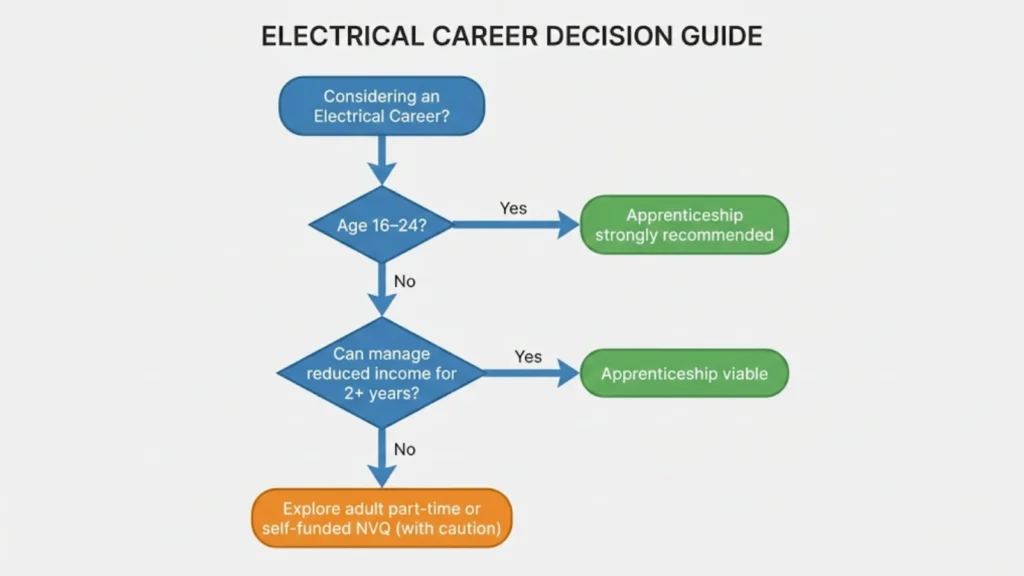
The decision framework:
Can you manage the income during training (years 1-2 particularly)? If yes, apprenticeship is strong option. If no, explore alternatives cautiously—they carry different risks.
Do you value structured learning and guaranteed supervision? If yes, apprenticeships excel. If you’re extremely self-motivated and have industry connections, self-funded NVQ routes might work.
Are you entering the trade for long-term career or short-term income? Apprenticeships favor long-term commitment. Short-term income seekers struggle with 4-year timeline.
Is electrical work your genuine interest or just “a job”? Apprenticeships require commitment and engagement. Those viewing it purely transactionally often drop out.
Ready to Explore Apprenticeship Pathways?
Call us on 0330 822 5337 to discuss electrical apprenticeship options, understand what the 42-48 month timeline actually involves, and explore whether apprenticeships or alternative routes suit your circumstances.
What we’re not going to tell you:
- That 16-week courses will get you qualified faster than apprenticeships
- That you can skip NVQ Level 3 and AM2 requirements
- That apprentice wages stay low throughout the entire four years
- That employers don’t care about apprenticeship credentials
What we will tell you:
- Why the 42-48 month timeline reflects genuine competence development requirements (3,000-4,000 supervised hours)
- How JIB apprentice wages progress from £15,900 in Stage 1 to £30,800 in Stage 4
- Why 90% of large electrical contractors filter for apprenticeship-backed NVQ Level 3
- What adult apprenticeships involve financially (£15,000-£18,000 year one vs previous earnings)
- Why ECS Gold Card eligibility requires apprenticeship pathway or equivalent site-supervised NVQ building
- How Youth Guarantee funding eliminates costs for 18-24 year-olds from April 2026
No fast-track promises that don’t reflect reality. No overselling alternatives that leave you as a £20,000 mate indefinitely. Just honest guidance on why apprenticeships remain the most reliable route to qualified electrician status and when other pathways might be appropriate despite their limitations.
References
Primary Official Sources
- IfATE Installation and Maintenance Electrician Standard (ST0152): https://www.instituteforapprenticeships.org/apprenticeship-standards/installation-electrician-and-maintenance-electrician-v1-0
- Skills England National Skills Strategy 2025/26: https://skillsengland.education.gov.uk/apprenticeship-standards/st0152
- DfE Apprenticeship Achievement Rates 2024/25: https://www.gov.uk/government/publications/qualification-achievement-rates-2024-to-2025/qualification-achievement-rates-2024-to-2025
- ONS Annual Survey of Hours and Earnings (ASHE) 2025: https://www.ons.gov.uk/employmentandlabourmarket/peopleinwork/earningsandworkinghours/bulletins/annualsurveyofhoursandearnings/2025
- Ofqual Register NVQ Level 3 Electrotechnical: https://submit-learner-data.service.gov.uk/find-a-learning-aim/LearningAimSearchResult/RedirectToDetails?academicYear=2324&learnAimRef=50116058
Industry Body Reports and Standards
- ECA Skills for the Future Report 2025: https://www.eca.co.uk/taking-action/skills-for-the-future
- NICEIC Electrotechnical Skills Shortage Analysis: https://niceic.com/views/the-electrotechnical-skills-shortage
- ECS Card Requirements and Standards: https://www.ecscard.org.uk/card-types/electrotechnical/installation-electrician
- National Careers Service Electrician Profile: https://nationalcareers.service.gov.uk/job-profiles/electrician
Training and Employment Data
- Hays Salary Guide 2026: https://www.hays.co.uk/salary-guide/digital-guide
- Adzuna Electrician Job Market Analysis: https://www.adzuna.co.uk/jobs/electrician
- West Midlands Combined Authority Skills Plan 2025: https://www.cw-chamber.co.uk/media/d1bj4aga/west-midlands-and-warwickshire-local-skills-improvement-plan-progress-report-2025-final.pdf
Market and Qualitative Signals
- LinkedIn West Midlands Electrician Jobs: https://uk.linkedin.com/jobs/electrician-jobs-west-midlands
- ElectriciansForums UK Apprenticeship Discussions: https://www.electriciansforums.net/threads/apprenticeship-vs-evening-course.188859
- Reddit UK Electricians Community: https://www.reddit.com/r/ukelectricians/comments/1qlnlct/unpopular_opinion_apprenticeship_isnt_always
Note on Accuracy and Updates
Last reviewed: 02 February 2026. This page is maintained; we correct errors and refresh sources as apprenticeship standards, funding policies, and wage agreements evolve. JIB 2026 wage rates (Stage 1 £8.16/hour through Stage 4 £15.81/hour), Youth Guarantee funding provisions (100% funding for under-25s from April 2026), and ONS ASHE 2025 earnings data (median £39,039) reflect current published information. Installation and Maintenance Electrician standard (ST0152) details are accurate to IfATE specifications. Next review scheduled following any significant changes to apprenticeship levy reforms or JIB wage agreement updates.
FAQs
What does an electrician apprenticeship give you that short courses can’t?
An electrician apprenticeship provides structured, supervised on-the-job training that leads to full occupational competence, not just knowledge. Apprentices work toward an NVQ Level 3 in Installing Electrotechnical Systems and Equipment, supported by real site experience and formal assessment.
Crucially, apprentices complete the AM2 or AM2E practical assessment, proving they can safely install, test, and fault-find under real-world conditions. They also build thousands of hours of supervised site experience, developing judgement, problem-solving ability, and industry awareness that short courses cannot replicate.
Short courses usually focus on theory or limited workshop tasks. They do not deliver the depth of experience required for safe, compliant work under BS 7671, nor do they prepare learners for unsupervised roles. Apprenticeships support long-term employability and progression to JIB-approved electrician status, whereas short courses often leave gaps that increase safety, legal, and insurance risks.
Why do employers trust apprenticeship routes more than fast-track training?
Employers trust apprenticeships because they combine theory, supervision, and extensive site experience over time. Apprentices complete NVQ Level 3, pass the AM2 assessment, and demonstrate up-to-date knowledge of the 18th Edition Wiring Regulations, giving employers confidence in their competence.
Fast-track training may deliver knowledge quickly, but it lacks the 2,500–3,000 supervised site hours that employers rely on to reduce risk. In commercial and industrial environments, mistakes carry legal and financial consequences, so employers favour candidates with proven, audited competence.
Apprenticeship routes align with industry frameworks such as JIB grading and expectations from scheme bodies, whereas fast-track routes are often viewed as incomplete and requiring significant additional supervision.
What are the mandatory components of a UK electrician apprenticeship?
A UK electrician apprenticeship includes several non-negotiable elements:
- NVQ Level 3 in Electrotechnical Services, built from real workplace evidence
- AM2 or AM2E practical assessment, testing installation, testing, and fault-finding
- BS 7671 (18th Edition) Wiring Regulations, including amendments
- Functional Skills Level 2 in maths and English (if not already held)
These components ensure both knowledge and competence. The apprenticeship typically lasts 42–48 months, combining college learning with employer-led site work, and meets End-Point Assessment standards set by national bodies.
Why does it usually take 42–48 months to qualify through an apprenticeship?
The timeframe exists to allow progressive competence development, not delay. Apprentices usually spend one day per week in college and four days on site, gradually building a diverse NVQ portfolio.
This period allows apprentices to:
- Apply BS 7671 safely across different environments
- Gain confidence in high-risk, real-world conditions
- Accumulate 2,500–3,000 supervised hours
- Develop safe working habits that reduce long-term risk
Shortening this process increases the likelihood of errors, accidents, and non-compliance. The duration reflects the complexity of electrical systems and the safety-critical nature of the trade.
How many supervised site hours do apprentices complete, and why does it matter?
Most UK electrician apprentices complete 2,500–3,000 supervised site hours. These hours expose them to varied scenarios such as domestic installs, commercial fit-outs, and industrial systems.
This matters because classroom knowledge alone does not prepare someone for real-world variables like live environments, coordination with other trades, or unexpected faults. Employers rely on supervised experience to protect safety, insurance validity, and project quality.
These hours also underpin NVQ assessment and are strongly linked to AM2 success and eligibility for ECS Gold Card status.
Do short courses qualify you as an electrician, or only teach theory?
Short courses primarily deliver knowledge-based learning, not full qualification. While they may award certificates or diplomas, they do not include the NVQ Level 3 competence portfolio or the AM2 assessment.
Without these, learners are not considered fully qualified electricians and cannot work unsupervised or access many regulated roles. Marketing claims suggesting qualification in weeks are misleading. Most employers view short-course graduates as assistants rather than competent tradespeople.
What is the ECS Gold Card, and why does it matter for getting hired?
The ECS Gold Card confirms that an electrician has completed:
- NVQ Level 3
- AM2 or AM2E
- Current BS 7671 knowledge
It signals approved electrician status and allows unsupervised work on many sites. Employers often require it for compliance, safety assurance, and insurance reasons.
Gold Card holders typically earn more and gain access to a wider range of roles, including self-certification routes. Without it, opportunities are limited to supervised or labouring positions.
How do apprentice wages progress, and what do qualified electricians earn?
Apprentice wages usually start around £10,000–£15,000 in year one and rise annually as skills increase. By year four, earnings often reach £25,000–£30,000, depending on region and employer.
After qualification, electricians commonly earn £30,000–£40,000, with higher earnings for experience, overtime, or specialist work. Self-employed electricians may earn daily rates, though costs must be deducted. Regional variation is significant, with London and the South East paying more.
Are adult apprenticeships worth it for career changers?
Adult apprenticeships can be worthwhile for career changers seeking a stable, skilled trade. They offer a recognised route to qualification without age limits and are often supported by government funding.
The main trade-off is short-term income reduction during training. However, long-term earning potential and job security often outweigh this. Faster alternatives rarely deliver equivalent employability or recognition.
What are the biggest red flags in “qualified in weeks” or “skip the apprenticeship” claims?
Common red flags include:
- No NVQ Level 3 or AM2 included
- Vague claims of “industry recognised” without ECS or JIB clarity
- Unrealistic earnings promises
- Hidden costs for essential add-ons
- Lack of employer or scheme recognition
True qualification requires time, supervised experience, and independent assessment. Claims that bypass these steps are usually marketing-driven and can lead to limited, uninsurable roles.
