

Why Fast Track Appeals to Adults (Motivation, Time, Money Pressures)

- Technical review: Thomas Jevons (Head of Training, 20+ years)
- Employability review: Joshua Jarvis (Placement Manager)
- Editorial review: Jessica Gilbert (Marketing Editorial Team)
- Last reviewed:
- Changes: Initial publication

Why Adults Choose Fast-Track Over Traditional Routes
If you’re researching electrical training in your 30s, 40s, or 50s, you’ve probably noticed fast-track courses dominate the search results whilst apprenticeships seem aimed at teenagers.
That’s not an accident.
Fast-track providers specifically target adult career changers because they understand something traditional colleges don’t: adults face completely different pressures than 18-year-olds.
You’re not choosing between “fast college” and “slow college.” You’re choosing between “can I afford to retrain at all” versus “do I stay in a job I hate for another decade.”
The appeal of fast-track isn’t just about speed. It’s about the intersection of three constraints that define adult life: time poverty, financial pressure, and risk aversion.
When you’re juggling a mortgage, childcare, maybe a redundancy notice, the promise of “qualified in 12 weeks” hits different than it does for a school leaver living at home rent-free.
But here’s the uncomfortable reality: what fast-track providers are selling and what adults think they’re buying are often two completely different things.
This article breaks down why fast-track appeals so strongly to adults, what psychological and financial pressures drive these decisions, what adults actually get versus what they believe they’re getting, and how to make genuinely informed choices when you’re under the kind of pressure that clouds rational decision-making.
For a comprehensive analysis of why fast-track electrical training appeals to adult career changers, we need to be honest about both the legitimate advantages fast-track offers and the significant gaps in what most providers actually deliver.
The Economic Reality Driving Adult Career Changes
Let’s start with the numbers that explain why electrician training looks so attractive right now.
Wage Stagnation and Household Pressure
According to ONS data (April 2025), median weekly earnings in the UK sit at £766.60. Real household disposable income growth is projected at just 0.4% annually through 2026 according to Institute for Fiscal Studies forecasts.
Translation: wages aren’t keeping pace with living costs.
Meanwhile, the Household Costs Index rose 3.9% year-on-year to June 2025. Energy debt has tripled in the last decade according to Resolution Foundation research. Average UK household budgets are running at approximately £2,900 monthly.
If you’re earning £25,000-£35,000 in retail, hospitality, public sector, or office admin roles, you’re watching your purchasing power erode year after year.
Then you see job adverts for electricians: “£35,000-£40,000 average earnings, £45,000-£60,000+ for experienced commercial sparks, self-employed rates £250-£400 daily.”
The income gap is real. The appeal is rational.
Redundancy Shock and Job Insecurity
Redundancy figures surged to pandemic-era highs by late 2025 according to ONS labour market statistics. Unemployment sits at 5.1%. Adult long-term unemployment (over 12 months) reached 270,000 in mid-2025.
CIPD research shows 27% of workers are actively seeking better job satisfaction, with 35% prioritising higher pay in their next role. Job insecurity is pushing career reconsideration across age groups.
If you’ve just been made redundant from a £32,000 office job, electrician training isn’t just about learning a trade. It’s about regaining control over your earning potential in an economy where white-collar middle management roles are disappearing whilst trades remain consistently in demand.
The Apprenticeship Wage Problem for Adults
Here’s where the appeal of fast-track becomes crystal clear.
A Level 3 Electrotechnical Apprenticeship pays approximately:
Year 1: £12,000-£16,000
Year 2: £14,000-£18,000
Year 3: £16,000-£20,000
Year 4: £18,000-£24,000
If you’re currently earning £30,000 with a mortgage of £1,200 monthly, childcare costs of £600 monthly, and household bills of £1,100 monthly, you physically cannot afford a 50% pay cut for four years.
The maths doesn’t work.
Fast-track promises a different equation: pay £6,000-£12,000 upfront, complete diplomas in 3-6 months, get back into income-generating work faster, build NVQ whilst earning improver wages (£22,000-£28,000), reach Gold Card status within 18-24 months total.
For an adult with fixed financial commitments, that looks like the only viable pathway.
The “Portable Skills” Appeal
CIPD and OECD research on adult learning highlights that job insecurity drives demand for transferable, portable skills that aren’t tied to one employer or sector.
An electrician qualification offers:
Work anywhere in the UK (portable)
Self-employment options (autonomy)
Consistent demand regardless of economic cycles (security)
Income ceiling controlled by your effort, not employer pay scales (earning potential)
If you’ve spent 15 years in retail management watching your role gradually automated or outsourced, the idea of a skill that cannot be replaced by software or offshored to cheaper markets is powerfully appealing.
The Identity Crisis Factor
Academic research on mid-life career transitions (University of Warwick, Tandfonline studies) identifies a strong psychological component: the shift from “unskilled/precarious worker” to “tradesman” represents an identity upgrade.
There’s genuine status attached to being a qualified electrician. You’re solving real problems, working with your hands, creating tangible value. For adults burned out on abstract corporate roles or minimum-wage service jobs, that identity shift is a significant motivator.
Fast-track appeals because it promises that identity transformation quickly. “Become an electrician in 12 weeks” isn’t just about the qualification. It’s about becoming someone different.
The Constraint Triangle: Time, Money, Risk
Adults don’t choose training pathways in a vacuum. They’re optimising within three interconnected constraints that teenagers simply don’t face.
Time Poverty: The Scarcity No One Talks About
The reality of adult schedules:
You’re working 37-45 hours weekly. You’ve got childcare pick-ups, eldercare responsibilities, maybe a side hustle to make ends meet. Your “discretionary time” for education is the gaps between work and family commitments.
A traditional FE college course runs one day per week over two academic years (36-40 weeks per year, so 72-80 weeks total, approximately 18-20 months). Classes are 9am-4pm, clashing with work hours. Many colleges are populated primarily by 16-19-year-olds, creating an age gap that makes adult learners feel out of place.
You physically cannot attend.
Fast-track compresses the same content into consecutive weeks. You can:
- Use annual leave to attend full-time intensive courses (2-4 weeks)
- Attend evening/weekend programmes over 8-12 weeks
- Study theory online at your own pace and attend practical workshops flexibly
- Complete the classroom phase during a redundancy notice period
The time poverty calculation:
Traditional route: 18-20 months part-time attendance = impossible to fit around full-time work
Fast-track route: 12-16 weeks intensive = manageable if you plan it strategically
For adults, “fast” doesn’t mean “easier.” It means “the only option that fits my life.”
OECD research confirms that time scarcity and scheduling inflexibility are primary barriers to adult learning participation. Fast-track removes that barrier for the classroom phase.
Financial Pressure: The Opportunity Cost Crisis
What adults are actually calculating:
When you compare routes, you’re not just comparing course fees. You’re calculating total opportunity cost.
Apprenticeship financial reality (4 years):
Current earnings: £30,000/year Apprentice earnings Year 1: £14,000 Annual shortfall: £16,000 Total 4-year opportunity cost: £16,000 + £14,000 + £12,000 + £8,000 = £50,000 in lost earnings (assuming gradual wage increases toward normal electrician rates)
Add living costs you still must cover: £2,900 monthly x 48 months = £139,200 total household budget needs over 4 years
You cannot sustain a £16,000 annual income gap whilst maintaining a £35,000/year lifestyle. The maths forces you out.
Fast-track financial reality (18-24 months):
Course fees: £6,000-£12,000 (diplomas, possibly NVQ support) Time out of current job: 3-6 months (intensive classroom phase) Earnings during this period: £0 (or savings drawdown) Improver wages once employed: £22,000-£28,000 (building NVQ portfolio) Timeline to Gold Card: 18-24 months Opportunity cost: 3-6 months at £0 + 12-18 months at reduced wage versus full qualification timeline
The adult calculation:
Pay £8,000 upfront and sacrifice 6 months earnings versus sacrifice 4 years at drastically reduced wages.
When you’ve got a mortgage, the choice isn’t even close. Fast-track is the only financially survivable option.
IFS research confirms that UK households have zero “slack” for long-term income reduction. Adults optimise for shortest period of financial vulnerability, even if upfront costs are higher.
Risk Aversion: The Mid-Life Fear Factor
What drives adult risk assessment:
Psychological studies on career transitions show that adults become more risk-averse with age, particularly regarding time investment. They fear:
Wasting time more than wasting money. If a 4-year apprenticeship doesn’t work out, you’ve lost 4 years you cannot get back. If a £6,000 fast-track course doesn’t work out, you’ve lost money but only 6 months of time.
Life disruptions derailing long-term plans. Over 4 years, anything can happen: illness, family crisis, job market changes, housing moves. Adults with experience know this. A 6-month intensive feels like “getting it done” before life intervenes.
Employer commitment evaporating. What if the apprenticeship employer makes you redundant in year 2? You’ve sacrificed 2 years of proper earnings and don’t have the qualification yet. Fast-track puts qualification control in your hands, not an employer’s.
Age discrimination in hiring. A 35-year-old completing a 4-year apprenticeship will be 39 when qualified. A 35-year-old completing fast-track diplomas then NVQ could be Gold Card qualified by 37. Two years matters when you’re competing against younger workers.
The cognitive load factor:
When you’re making this decision whilst:
- Under redundancy notice
- Watching savings dwindle
- Dealing with family responsibilities
- Searching for alternative employment
- Researching unfamiliar qualification systems
Your cognitive capacity for rational analysis is severely reduced. Fast-track appeals because it offers a simple, clear, immediate action you can take right now to regain control.
Resolution Foundation research shows households under financial stress make suboptimal long-term decisions because they’re optimising for immediate crisis survival. That’s not irrational. That’s human psychology under pressure.
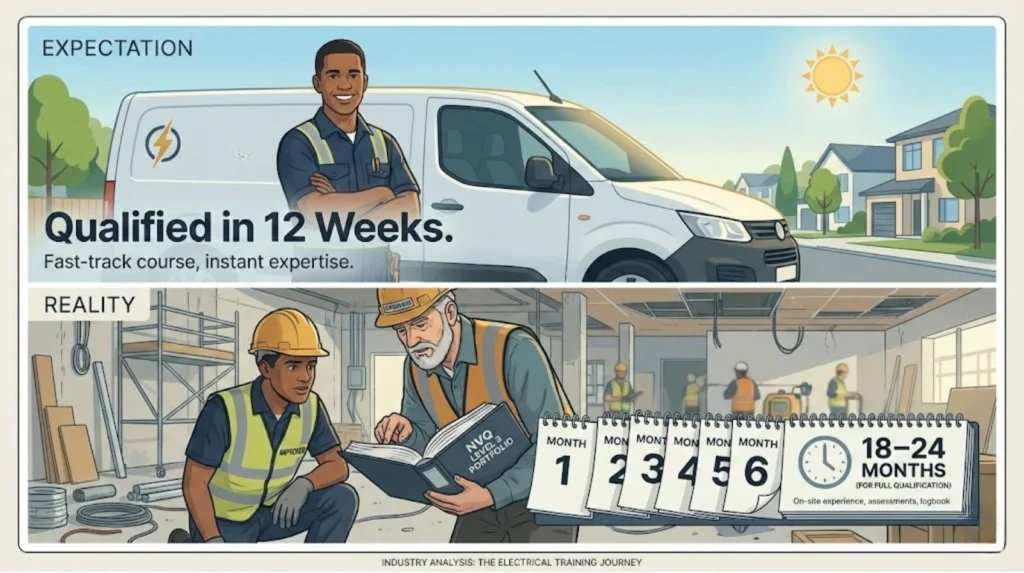
What Adults Think They're Buying vs What They Actually Get
This gap between perception and reality is where most adult fast-track students encounter serious problems.
Misconception 1: “I’ll Be a Qualified Electrician in 12-16 Weeks”
What adults believe:
The marketing says “become an electrician in 12 weeks” or “fast-track to qualified status in 4 months.” Adults under financial pressure read this as: “I can be earning electrician wages in 3-4 months.”
What’s actually delivered:
Level 2 and Level 3 diplomas (knowledge qualifications) 18th Edition (regulations exam) Total duration: 12-16 weeks intensive classroom and workshop training
What this does NOT include:
NVQ Level 3 (workplace competence portfolio) AM2 assessment (independent practical exam) ECS Gold Card status Legal qualification to work as an electrician without supervision
The reality gap:
After 12-16 weeks, you have trainee status. You need supervision for all electrical work. You cannot sign off your own installations. You’re not earning £35,000-£40,000 electrician wages. You’re earning £22,000-£28,000 improver wages, IF you can find NVQ-supporting employment.
Thomas Jevons, Head of Training at Elec Training, explains:
"The biggest misunderstanding I see with adult learners is thinking Level 2 and Level 3 diplomas equal 'qualified electrician' status. They don't. Those certificates prove you understand electrical theory and BS 7671 regulations. What they don't prove is that you can safely install a consumer unit, test a ring final, or fault-find a three-phase system in a real building under time pressure. That's why NVQ Level 3 and AM2 exist. They verify you can actually do the work, not just explain it."
Thomas Jevons, Head of Training
Why this misconception is so damaging
Adults budget for 3-4 months out of work, expecting to return at higher wages. When they discover they’re actually 18-24+ months from full qualification and face 6-12 months searching for NVQ-supporting employment, the financial plan collapses. Savings run out. Debt accumulates. They’re forced to take non-electrical work to survive, abandoning the pathway entirely.
Misconception 2: “The Provider Will Find Me a Job”
What adults believe:
Fast-track marketing often includes phrases like “job support,” “employer partnerships,” “placement assistance,” or “career services.” Adults interpret this as: “I’ll finish the course and they’ll connect me with electrical contractors who will hire me.”
What’s actually delivered:
CV writing workshop Interview tips session List of local electrical contractors (basically a Google search) Maybe introductions to 2-3 firms who’ve agreed to receive CVs (not guaranteed interviews)
What this does NOT include:
Legal employment guarantees Actual job offers NVQ workplace access Employer commitment to support your portfolio building
The reality gap:
You finish diplomas and then you’re on your own, searching for electrical trainee positions in a competitive market, trying to convince contractors to hire a 38-year-old with zero site experience over a 20-year-old who’s cheaper and has more years of productive work ahead.
Many adults spend 6-12+ months in this employment search phase, often settling for electrical labourer roles that don’t actually provide NVQ-appropriate work or taking non-electrical jobs to pay bills whilst searching.
Why this misconception is so damaging:
The employment gap between diploma completion and NVQ commencement is the single biggest cause of qualification abandonment. Adults run out of financial runway. They cannot afford to keep searching. They return to their previous sector or take any available work, viewing the £6,000-£8,000 course fee as a sunk cost and failed investment.
Misconception 3: “I Can Start My Own Business Immediately”
What adults believe:
Marketing often emphasises self-employment potential. “Be your own boss,” “set your own rates,” “work when you want.” Adults see this as a fast path to £40-£50k+ annual earnings doing domestic installations.
What’s actually available after diplomas:
Ability to register as a Domestic Installer with a Competent Person Scheme (NICEIC, NAPIT, ELECSA) after initial assessment
Scope: Domestic properties only (houses, flats) Work allowed: Notifiable domestic work (consumer units, new circuits, bathroom installations) Insurance: Required but often expensive for newly qualified individuals
What this does NOT enable:
Commercial or industrial electrical work Three-phase installations Working as a subcontractor on construction sites (requires Gold Card) Competitive day rates (£150-£250+ typically requires 3-5+ years experience)
The reality gap:
Domestic Installer status allows very limited scope. You’re competing with thousands of other Domestic Installers and fully qualified Gold Card electricians for domestic work. Without experience or reputation, you’re charging £120-£180 daily to compete, out of which you pay insurance (£800-£1,500 annually), van costs, tools, marketing, accountancy, and tax.
Your actual take-home is significantly lower than employee improver wages, and you’re carrying all the business risk yourself whilst still lacking the competence that comes from varied site experience.
Why this misconception is so damaging:
Adults quit employment expecting to immediately self-employ at £40k+. They discover domestic work is saturated, margins are thin without experience, insurance is expensive, and they lack the fault-finding competence that only comes from years of varied installations. They’re forced back into employment, often having burned bridges with previous employers and damaged their professional reputation.
Misconception 4: “Experience Replaces Formal Assessment”
What adults believe:
“I’ve done DIY electrical work for 20 years” or “I helped my uncle wire houses for 5 years” means they can skip straight to qualification without the full training pathway.
What the regulations actually require:
Even via the Experienced Worker Assessment (EWA) route, you need:
Documented, verifiable work history (employer letters, test certificates, project records)
Skills scan by approved assessor
Portfolio of evidence from past installations
AM2E independent practical assessment
Proof of current, recent, varied experience
Unverified DIY work or informal “helping” doesn’t meet these standards.
The reality gap:
Adults enrol in fast-track courses thinking they’ll breeze through because of prior experience, only to discover that undocumented work doesn’t count, the assessment standards are rigorous, and they actually need to start from the beginning like everyone else.
Why this misconception is so damaging:
Time and money wasted enrolling in inappropriate routes. Frustration when they discover their experience doesn’t grant exemptions. Some attempt to fraudulently claim documented experience, which can result in permanent bans from qualification bodies when discovered.
Adult Learner Archetypes: Who Succeeds and Who Struggles
Not all adults are equally suited to fast-track routes. Success patterns cluster around specific profiles.
Archetype 1: The Redundant Professional (Age 40-50)
Profile:
Suddenly lost £35,000-£50,000 office/management role
Mortgage, family, school-age children
Redundancy payout of £10,000-£30,000 creating short-term financial buffer
Wants rapid reinvention into “recession-proof” trade
What drives them:
Income urgency (bills don’t stop) Identity crisis (from respected professional to unemployed) Desire for tangible, hands-on work after years of desk jobs Fear of age discrimination in returning to corporate roles
Common misunderstanding:
Believes classroom theory = site competence. Expects to be earning electrician wages within 6 months. Underestimates physical demands and the psychological adjustment to being “the new guy” on site at age 45.
Success factors:
Willingness to accept trainee status psychologically Financial runway to support 18-24 month qualification timeline Realistic expectations about earnings progression Transfers project management and communication skills to site coordination
Failure factors:
Runs out of redundancy money before NVQ completion Cannot handle identity shift to junior status Expects instant respect based on age/experience rather than earning it through competence Gives up when reality doesn’t match the “qualified in 12 weeks” promise
Realistic outcome:
Those with strong financial buffers, realistic timelines, and willingness to learn can successfully transition. Typically takes 24-36 months from redundancy to Gold Card. Final earning potential £35,000-£45,000 employed or £40,000-£55,000 self-employed after 3-5 years building reputation.
Archetype 2: The Site Improver (Age 25-35)
Profile:
Already working as electrical mate, labourer, or general construction worker
Earning £20,000-£26,000
Wants formal qualifications to progress to proper electrician rates
Has site access and understands construction culture
What drives them:
Pay progression (£8,000-£15,000 annual increase with Gold Card) Respect and status on site (tired of being “just the labourer”) Clear pathway to supervisory roles Job security (qualified electricians have more options)
Common misunderstanding:
Assumes their existing experience means they can skip assessments or that NVQ will be rubber-stamped quickly because “I already do this work.”
Success factors:
This is the HIGHEST SUCCESS archetype because they already have the critical component: workplace access.
They can build NVQ portfolio using their current employment. They understand site culture and physical demands. They have realistic timelines because they see qualified sparks on site every day. They can complete fast-track diplomas part-time whilst continuing to earn.
Realistic outcome:
12-18 months from fast-track diploma enrolment to Gold Card completion. Immediate pay rise to £28,000-£35,000 upon Gold Card. Progression to £38,000-£48,000+ within 3-5 years with 2391 qualification and commercial experience. This archetype has the smoothest transition because they’re formalising existing competence rather than starting from zero.
Archetype 3: The Career Pivot (Public Sector/Retail/Hospitality)
Profile:
Age 28-45
Burned out in customer service, teaching, healthcare, or retail
Earning £22,000-£32,000
Wants career with clear progression, autonomy, physical work
Often motivated by “work with hands” appeal after years of dealing with difficult customers/patients
What drives them:
Escape from customer-facing burnout Desire for tangible, measurable outcomes (fix problem, problem stays fixed) Control over earnings (self-employment appeal) Respect (tradesperson status versus service worker stigma)
Common misunderstanding:
Underestimates physical toll (working in lofts, crawling under floors, heavy lifting) Overestimates ease of “learning a trade” (assumes it’s simpler than office work) Expects fast progression without understanding the “experience gap” between theory and real-world competence
Success factors:
Strong work ethic and reliability from service sector experience Good customer communication skills (valuable for domestic work) Realistic financial planning with savings buffer Accepts starting at bottom and earning progression through competence
Failure factors:
Cannot handle physical demands (injuries, exhaustion) Underestimated time to competence (expected 6 months, reality is 24+ months) Financial pressure forces return to previous sector before completing qualification Struggles with construction site culture after corporate/professional environments
Realistic outcome:
Mixed. Those who thoroughly research, visit sites before committing, build 12+ months financial buffer, and have supportive families succeed at similar rates to other career changers (approximately 60-70% completion to Gold Card in 24-36 months). Those who jump in without research tend to abandon within 6-12 months.
Archetype 4: The Ex-Forces/Emergency Services Leaver
Profile:
Age 30-50
Leaving military, fire service, police after 8-22 years
Disciplined, structured, comfortable with hierarchy
Often has resettlement funding or pension support
Seeking civilian trade with transferable technical skills
What drives them:
Structured transition pathway (fast-track mimics military training intensity) Technical work using problem-solving skills Clear qualifications and career progression (familiar concept) Recession-proof skill (job security)
Common misunderstanding:
Assumes prior technical knowledge (military electrics, fire alarm systems) directly transfers to civilian BS 7671 requirements. It doesn’t always. Different standards, different testing procedures, different regulations.
Success factors:
Exceptionally high discipline and time management Comfortable with intensive training environments Good at following procedures and safety protocols Often has financial support (pension, resettlement grants) providing runway Transfers leadership and communication skills to site coordination
Challenges:
Civilian site culture very different from military hierarchy (more informal, less respect for rank/age) May struggle with “shortcut culture” on some sites (civilians sometimes less safety-rigorous) Needs to adapt technical knowledge to civilian standards rather than assuming equivalence
Realistic outcome:
Very high success rates (75-85% completion to Gold Card) because they have discipline, structure, financial support, and are comfortable with intensive training. Timeline typically 18-24 months from start to Gold Card. Progress well into supervisory and project management roles due to leadership experience.
Archetype 5: The Overseas-Qualified Worker
Profile:
Age 25-50
Qualified electrician in home country (EU, Australia, Middle East, Africa)
Needs UK qualification recognition
May or may not speak fluent English
What drives them:
Economic opportunity (UK wages higher than home country) Family migration (spouse working in UK) UK citizenship pathway Escape from political/economic instability
Common misunderstanding:
Assumes overseas qualifications automatically transfer or that EWA route is guaranteed. Reality: qualifications must be verified, mapped to UK standards, and often require bridging training plus AM2E assessment.
Success factors:
Genuine competence from home country work Language skills sufficient for technical communication and BS 7671 study Realistic expectations about needing to prove UK compliance Financial support to complete bridging requirements
Challenges:
BS 7671 regulations differ significantly from other countries’ standards (particularly earthing systems, RCD requirements, testing procedures) Language barriers in technical terminology Cultural adjustment to UK site practices Credentials verification can be slow and bureaucratic
Realistic outcome:
Those with verifiable qualifications and good English complete via EWA route in 6-12 months. Those with unverifiable experience or language barriers need full standard pathway (24-36 months). Success rate varies widely by home country qualification quality and documentation.
The Marketing Pressure Points That Exploit Adult Vulnerabilities
Let’s be direct about how fast-track marketing specifically targets adult psychological and financial pressure points.
Pressure Point 1: Compressed Timelines
The language:
“Become an electrician in 12 weeks” “Fast-track to qualified status in 4 months” “Start earning in weeks, not years”
Why it works on adults:
Time poverty makes speed appealing. Adults under redundancy notice or financial pressure need solutions NOW, not in 4 years.
What it actually means:
You can complete DIPLOMAS in 12-16 weeks. You cannot become a QUALIFIED ELECTRICIAN (Gold Card status) in 12 weeks. That requires NVQ + AM2, adding 12-18+ months.
The psychological exploit:
Adults under stress focus on the immediate problem (unemployed, low income) and latch onto fast solutions. The fine print about NVQ requirements gets glossed over because the brain is seeking relief from current pain, not analysing long-term pathway logistics.
Pressure Point 2: Earnings Promises
The language:
“Electricians earn £35,000-£60,000+” “Charge £250-£400 daily as self-employed” “Be earning within weeks of course completion”
Why it works on adults:
Adults are income-focused because they have bills. Showing high earnings addresses their immediate financial anxiety.
What it actually means:
QUALIFIED electricians with 3-5+ years experience earn those rates. Trainees with diplomas earn £22,000-£28,000. It takes 18-24 months minimum to reach Gold Card status, then another 2-4 years of experience to command top rates.
The psychological exploit:
Adults in financial crisis engage in “wishful timeline compression.” They see “electricians earn £40k” and “qualified in 12 weeks” and unconsciously merge these into “I’ll be earning £40k in 12 weeks.” The provider never explicitly says this, but the marketing is designed to encourage that mental leap.
Pressure Point 3: Social Proof and Urgency
The language:
“Join 500+ successful graduates” “Limited spaces available” “Course starting soon, book now” “Last chance for 2025 enrolment”
Why it works on adults:
Adults facing job insecurity fear missing opportunities. FOMO (fear of missing out) combines with risk aversion to create pressure to act immediately rather than research thoroughly.
The psychological exploit:
When decision-making capacity is already reduced by stress, artificial urgency prevents rational analysis. You book immediately to “secure your place” rather than spending 2-4 weeks comparing providers, checking awarding body registration, speaking to graduates, or consulting National Careers Service.
Pressure Point 4: “No Experience Needed”
The language:
“Complete beginners welcome” “No prior experience required” “Start from scratch” “We’ll teach you everything”
Why it works on adults:
Career changers from non-technical backgrounds feel intimidated by trades. “No experience needed” removes that barrier and makes electrical work seem accessible.
What it actually means:
No experience needed for CLASSROOM THEORY. But you’ll need workplace experience for NVQ, which you have to arrange yourself (or hope the provider has genuine placement support).
The psychological exploit:
Adults from white-collar backgrounds often underestimate skilled trades, assuming physical work is “simpler” than office work. “No experience needed” reinforces this misconception, preventing them from realistically assessing the gap between classroom theory and site competence.
Pressure Point 5: Bundled “Packages”
The language:
“Complete Gold Card Package” “Everything You Need to Become an Electrician” “All-Inclusive Electrician Training”
Why it works on adults:
Adults facing cognitive load from stress prefer simple, all-in-one solutions. Evaluating multiple qualification components separately is exhausting. A “package” feels comprehensive and eliminates decision fatigue.
What it actually means:
Often includes: Level 2/3 diplomas, 18th Edition, maybe Part P Domestic Installer, possibly EV charging or solar training.
Often EXCLUDES: NVQ Level 3 support, AM2 fee (£800-£1,000), assessor visit costs, workplace placement assistance.
The psychological exploit:
“Complete Package” implies nothing else is needed. Adults don’t ask “What’s NOT included?” because they’re already overwhelmed. They assume comprehensive means comprehensive. Then they finish the course and discover they still need NVQ and AM2, which aren’t included, adding £2,000-£4,000 to the total cost.
Reality Check: What Can and Cannot Be Accelerated
To make genuinely informed decisions, adults need to understand exactly which parts of electrician qualification can legitimately be compressed and which parts have fixed timescales regardless of money spent or motivation level.
CAN Be Accelerated: Classroom Knowledge Delivery
What this covers:
Level 2 Electrical Installation (2365-02 or equivalent) Level 3 Electrical Installation (2365-03 or equivalent) 18th Edition BS 7671:2018+A2:2022 Testing and inspection theory Electrical theory, circuit design, regulations knowledge
Traditional timeline:
FE college part-time: 18-20 months (one day weekly over 2 academic years)
Fast-track timeline:
Intensive full-time: 8-16 weeks consecutive Evening/weekend: 10-20 weeks part-time Online theory + practical workshops: 12-24 weeks flexible
Why this is legitimate acceleration:
Knowledge acquisition can be intensive if you have the time and focus. There’s no regulatory requirement for these diplomas to be delivered slowly. The exams are the same regardless of delivery speed. City & Guilds and EAL don’t distinguish between 16-week intensive diplomas and 20-month college diplomas on your certificates.
Success requirement:
You need to actually learn the material, not just attend. Fast-track requires intense focus and self-discipline. If you’re working full-time whilst doing evening fast-track, you need strong time management.
CAN Be Accelerated: Study Pace for Theory
What this covers:
How quickly you personally study regulations, electrical theory, circuit calculations, testing procedures.
Why this matters:
Some adults learn faster than teenagers due to better focus, study skills, and motivation. If you’re highly motivated and have good learning discipline, you can cover material faster than classroom pace through self-study combined with workshop sessions.
Limitation:
You still need to pass the same exams. Faster study only helps if you actually retain and understand the material.
CANNOT Be Accelerated: NVQ Workplace Evidence
What this requires:
Portfolio of evidence from real electrical installations across multiple scenarios:
Containment systems (trunking, conduit, cable tray)
Cable installation (T&E, SWA, FP200, multicore)
Accessories (sockets, switches, lighting, distribution boards)
Testing and inspection (continuity, insulation resistance, earth loop, RCD)
Fault-finding (diagnosing and rectifying installation faults)
Three-phase systems (commercial/industrial work)
Why it cannot be compressed:
You need ACCESS to these varied installation types through real employment. If your employer only does domestic socket changes, you’ll wait months to access commercial trunking work or three-phase systems required for portfolio completion.
You need TIME to demonstrate competence repeatedly, not just once. One cable installation doesn’t prove competence. Assessors need to see you’ve done it multiple times across different scenarios.
You need ASSESSOR CAPACITY. Independent assessors visit every 4-6 weeks to observe and verify work. This schedule cannot be compressed even if you’re highly motivated.
Realistic timeline:
Full-time work on varied projects: 12-15 months minimum Part-time work or limited scope: 18-24 months Employment gaps: 24-36+ months or incomplete
This timeline is IDENTICAL whether you did fast-track diplomas or traditional college diplomas. The classroom route doesn’t affect NVQ timeline. Workplace access affects NVQ timeline.
CANNOT Be Accelerated: AM2 Assessment Readiness
What this requires:
Practical mastery of:
Safe isolation procedures
Installation to BS 7671 standards
Testing and inspection competence
Fault-finding under time pressure
Correct certification completion
Why it cannot be compressed:
These skills develop through repetition over months/years. You cannot cram practical competence the way you can cram theory knowledge.
AM2 has approximately 60% first-time pass rate overall. Fast-trackers with limited site experience have lower pass rates (40-50%) because they lack the “muscle memory” that comes from daily hands-on work.
The preparation timeline:
With daily site work building competence: 12-18 months from NVQ start to AM2 readiness
With limited site exposure: 24-36+ months or never genuinely ready (leading to fails/resits)
This cannot be shortened by:
Paying for expensive preparation courses (they help refine existing skills but cannot replace experience) Higher motivation (you need time to build physical competence) Studying harder (it’s practical work, not theory)
CANNOT Be Accelerated: Assessor Observation Schedules
What this involves:
Independent NVQ assessors must:
Visit your workplace to observe you working
Review photographic evidence
Verify supervisor sign-offs
Check your work meets standards
Sign off completed units
Typical schedule:
Visits every 4-6 weeks Each visit: 2-4 hours on site Reviews work completed since last visit
Why it cannot be compressed:
Assessors manage multiple candidates across different locations. You cannot demand daily visits.
Work must be generated between visits. If your last visit was 2 weeks ago and you’ve done no new electrical work since, there’s nothing to assess.
Quality assurance requires thorough verification. Assessors cannot rubber-stamp incomplete or rushed work just because you’re motivated.
Timeline impact:
Minimum 8-12 assessor visits for full NVQ completion At 4-6 week intervals: 32-72 weeks (8-18 months)
This timeline is largely fixed regardless of provider, route, or payment.
Elec Training’s approach to supporting adult learners through both classroom diplomas and workplace NVQ progression recognises this reality: we can accelerate your diplomas to 12-16 weeks through intensive delivery, but we cannot accelerate the NVQ phase beyond what workplace evidence generation and assessor schedules allow. What we CAN do is significantly reduce the employment gap between diplomas and NVQ through our in-house recruitment team and 120+ partner contractor network, which is where most adults without placement support get stuck.
CANNOT Be Accelerated: AM2 Booking and Assessment
What this involves:
AM2 is conducted at approved NET centres Assessment is 3 days (approximately 16-17 hours) Fixed format covering installation, testing, fault-finding Pass/fail determined independently
Current realities:
Booking wait times: 2 weeks to 4 months depending on location and season London/South-East: 2-8 weeks typically Northern regions: 8-16 weeks sometimes Peak periods (post-NVQ completion seasons): Longest waits
Why it cannot be compressed:
Limited assessment centre capacity Fixed assessment duration (you cannot do AM2 faster than 3 days) Independent scheduling (not controlled by your training provider)
Timeline impact:
Factor 2-4 months from “ready for AM2” to “completed AM2 and received results.”
If you fail (40% of fast-trackers without strong site experience), add 4-6 months for resit preparation and rebooking.

Decision Framework for Adults Considering Fast-Track
If you’re under financial or time pressure, use this framework to make genuinely informed decisions.
Step 1: Verify What You’re Actually Buying
Ask the provider these specific questions:
Question 1: “After I complete your course, will I hold an ECS Gold Card and be legally qualified to work as an electrician without supervision?”
Acceptable answer: “No. Our course provides Level 2/3 diplomas and 18th Edition. You’ll then need to complete NVQ Level 3 through workplace employment and pass AM2 assessment. We can support this through [specific placement process], which typically adds 12-18 months.”
Red flag answer: “Yes, you’ll be qualified” or vague promises about “full qualification” without specifying NVQ/AM2 requirements.
Question 2: “What percentage of your students who complete diplomas go on to achieve their ECS Gold Card within 24 months?”
Acceptable answer: Specific percentage with timeline (e.g., “68% of our diploma graduates achieved Gold Card within 24 months, 84% within 36 months”)
Red flag answer: “Most students” or “we don’t track that” or refusal to provide completion data.
Question 3: “How exactly does your placement support work? Do you have employment contracts with firms who guarantee NVQ positions, or is it job search assistance?”
Acceptable answer: Detailed explanation (e.g., “Our recruitment team contacts you in Week 8, introduces you to contractors from our 120+ partner network, arranges interviews, follows up post-placement, and our NVQ assessors visit you on-site”)
Red flag answer: “We help with CVs and have employer contacts” without specifics about guarantees or process.
Question 4: “What is included in the course fee and what are additional costs I should budget for?”
Acceptable answer: Transparent breakdown showing:
Included: Diplomas, 18th Edition, workshop access, theory materials
Additional: NVQ assessor visits (£X), AM2 fee (£800-£1,000), PPE (£200-£400), tools (£300-£500)
Total realistic budget: £X
Red flag answer: “Everything’s included” without breakdown, or hidden fees revealed after enrolment.
Question 5: “Can you connect me with 2-3 graduates who completed their full qualification (Gold Card) through your programme within the last 12 months?”
Acceptable answer: Provides contact details (with graduate consent) or arranges calls
Red flag answer: “Privacy policy prevents this” or only provider-controlled testimonials
Step 2: Assess Your Personal Constraint Triangle
Be brutally honest about your situation:
Time constraint assessment:
How many hours weekly can you realistically dedicate to training?
Full-time intensive (35-40 hours): Requires leave from current job or unemployment period
Evening/weekend (10-15 hours): Requires 10-20 weeks for diplomas
Very limited (5-8 hours): May need 6-12 months for diploma phase
Can you sustain this for 3-6 months (diplomas) PLUS 12-18 months (NVQ building)?
Financial constraint assessment:
Current monthly essential costs: £______ Current monthly income: £______ Savings available: £______ Financial runway (months savings will last at zero income): ______
Course fees: £______ Living costs during training: £______ Total upfront cost: £______
Months until complete financial failure if no income: ______
Can you survive 3-6 months at reduced/zero income for diplomas, PLUS 12-18 months at improver wages (£22,000-£28,000)?
Risk constraint assessment:
What happens if this doesn’t work out?
Can I return to previous employer/sector? (Yes/No)
Will I have burned bridges by leaving? (Yes/No)
Can I afford to “waste” £6,000-£12,000 if I don’t complete? (Yes/No)
What’s my backup plan? (Specific answer required)
Step 3: Calculate Realistic Timeline and Budget
Use this worksheet:
Timeline:
Diploma phase: ______ weeks (12-16 weeks realistic) Employment search: ______ months (1-12 months depending on placement support) NVQ building: ______ months (12-18 months with good work access) AM2 preparation and assessment: ______ months (3-6 months) Gold Card processing: ______ months (1-2 months)
Total timeline: ______ months (24-36 months realistic for complete beginners)
Budget:
Course fees: £______ Time out of work: ______ months @ £0 income = £_______ living costs from savings Improver wages: ______ months @ £24,000/year = £2,000/month (versus current income £) Additional costs (AM2, PPE, tools, assessor fees): £
Total investment: £______ Total opportunity cost: £______ Combined total cost: £______
Can you actually afford this?
Step 4: Verify Provider Legitimacy
Check these specific points:
Ofqual registration:
Go to register.ofqual.gov.uk
Search for provider name
Verify they’re an approved centre for City & Guilds or EAL
Check their centre number is valid
Awarding body approval:
City & Guilds centre search: www.cityandguilds.com/find-a-centre
EAL centre search: www.eal.org.uk
Verify the provider is listed and approved for electrical qualifications
Realistic content:
Website clearly separates diplomas from NVQ/AM2
Honest about timelines (18-24+ months total for complete beginners)
Transparent about what is/isn’t included
No “guaranteed job” claims
Specific about placement support process
Consumer protections:
14-day cooling-off period (Consumer Contracts Regulations)
Clear refund policy
Written contract specifying deliverables
Complaints procedure
Step 5: Consider Alternative Routes
Be open to the possibility that fast-track might NOT be the best option for your specific situation:
When traditional apprenticeship makes more sense:
You’re under 25 and can access apprenticeship opportunities You can afford 4 years at £15,000-£24,000 wages (living at home, partner’s income supporting you, etc.) You want maximum employer support and gradual learning You prefer job security over speed
When college part-time makes more sense:
You can attend one day weekly for 18-20 months You want to maintain current employment whilst studying Your employer might support day release You prefer slower, less intensive learning pace
When you should delay training:
Your financial runway is under 12 months You don’t have £8,000+ available for course fees You haven’t resolved current employment/housing instability You’re making this decision under extreme stress (wait until you can think clearly)
Joshua Jarvis, Placement Manager at Elec Training, explains:
"From an employability perspective, adults face a different challenge than school leavers. A 19-year-old apprentice is expected to need training. A 35-year-old career changer is expected to already have transferable skills and work maturity. Employers will hire adult trainees, but they're looking for reliability, initiative, and the ability to learn quickly. The advantage adults have is life experience and work ethic. The disadvantage is they often can't afford to work at apprentice wages whilst building their NVQ, so they need faster progression to improver rates."
Joshua Jarvis, Placement Manager
The Honest Adult Fast-Track Assessment
Fast-track electrical training genuinely serves a valuable purpose for adults, but only when:
The provider is honest about what’s delivered:
Diplomas in 12-16 weeks: Legitimate and achievable Full qualification in 12-16 weeks: Impossible and fraudulent
The provider offers genuine placement infrastructure:
Not just “job search tips” but actual contractor partnerships, recruitment team making introductions, follow-up support securing NVQ-appropriate employment.
The adult has realistic expectations:
Understanding that diplomas are step 1 of a 18-24+ month pathway, not the complete qualification.
Budgeting for 12-18 months at improver wages (£22,000-£28,000), not expecting electrician wages (£35,000-£40,000+) immediately after course completion.
Accepting they’re starting at the bottom technically, regardless of previous career status.
The adult has adequate financial runway:
Can survive 3-6 months at reduced/zero income for intensive diploma phase, PLUS 12-18 months at £22,000-£28,000 whilst building NVQ, without falling into crisis.
The adult has transferable skills that ease transition:
Work discipline and reliability from previous employment Communication skills (particularly valuable for domestic installations) Problem-solving abilities Professional customer interaction experience
When these conditions align, fast-track works:
Adults complete diplomas in 12-16 weeks (saving 12-14 months versus traditional college) Secure NVQ-supporting employment within 1-3 months (with strong placement support) Build portfolio whilst earning £22,000-£28,000 over 12-18 months Pass AM2 within 18-24 months of starting training Achieve Gold Card status 20-30 months from beginning Progress to £30,000-£38,000 within 12 months of Gold Card Reach £38,000-£50,000+ within 3-5 years with experience and additional quals
Total timeline: 18-30 months from start to Gold Card, 4-6 years to £40k+ earnings
This is FASTER than 4-year apprenticeships, more FINANCIALLY VIABLE for adults with fixed costs, and delivers IDENTICAL qualifications.
But when conditions don’t align, fast-track creates disasters:
Adults pay £6,000-£12,000 for diplomas believing they’ve bought full qualification Discover they still need NVQ and AM2 after course completion Spend 6-12+ months unemployed searching for NVQ-supporting work Run out of savings and financial runway Forced to abandon pathway and return to previous sector View training investment as failed sunk cost Harbour resentment toward training industry
The difference is placement support infrastructure.
At Elec Training, we’re transparent about this reality. Our fast-track diplomas take 12-16 weeks. We never claim that makes you a “qualified electrician.” What we do claim is that our in-house recruitment team actively works to secure your NVQ placement with our 120+ partner contractors, which is the make-or-break factor most providers completely ignore.
We start placement discussions in Week 8 of your training, not after you graduate. We make introductions whilst you’re still in the classroom. We follow up post-placement to ensure the work environment supports your NVQ building. We coordinate with our assessors to visit you on-site regularly.
That infrastructure is what separates successful adult fast-track completion (18-24 months to Gold Card) from failed attempts (30-48+ months or abandonment).
Call us on 0330 822 5337 to discuss whether fast-track suits your specific situation as an adult learner. We’ll assess your time constraints, financial runway, employment status, and motivation level honestly. We’ll explain exactly what our diplomas include and don’t include, what our placement support actually involves (not vague promises), and whether your timeline expectations are realistic or need adjustment. We’ll also tell you if we think apprenticeship or college would serve you better, because our goal is successful qualification completion, not just course enrolment.
For realistic guidance on navigating fast-track training as an adult with financial and time constraints, the most important question isn’t “How fast can I finish the course?” It’s “How strong is the placement support infrastructure, and does my financial situation allow me to survive the 18-24 month pathway to Gold Card without crisis?” Answer that honestly, and you’ll make the right decision.
References
Tier 1 (Official Data):
- ONS – Annual Survey of Hours and Earnings 2025, UK Labour Market Statistics December 2025, Household Costs Indices Q2 2025
- GOV.UK – Further Education and Skills Statistical First Release, Household Costs Indices Q3 2025
- House of Commons Library – Research Briefings on Unemployment and Labour Market
- National Careers Service – Electrician job profile and entry routes
- Resolution Foundation – Labour Market Outlook Q4 2025
- Learning and Work Institute – Labour Market Analysis September 2025
- Nimblefins – Average UK Household Budget data
Tier 2 (Strong Secondary Research):
- Institute for Fiscal Studies – Autumn Budget 2025 analysis, Further Education and Skills funding
- Resolution Foundation – Living Standards Outlook 2025, household energy debt research
- CIPD – Lifelong Learning in the Reskilling Era report 2025, career change motivation research
- OECD – Education at a Glance 2025, adult learning participation trends
- NESTA – What Drives Adults in Work to Learn New Skills
- Academic research – Tandfonline (career transitions), Warwick University (mid-life guidance), ResearchGate (mature student motivations)
- Standout CV – Career Change Statistics UK
Tier 3 (Market Observations):
- Elec Training – How to Become an Electrician UK 2026, Are Fast-Track Courses Worth It
- Indeed UK – Immediate start electrical jobs, electrician job advertisements
- Electrical Careers – Overseas qualification recognition
Note on Accuracy and Updates
Last reviewed: 5 January 2026. This analysis is based on official ONS employment and household cost data (2025), IFS and Resolution Foundation economic forecasts, CIPD and OECD adult learning research, and observed provider marketing patterns. Adult motivations and constraints reflect documented psychological research on career transitions, financial decision-making under stress, and mid-life reskilling drivers. Timeline estimates for fast-track completion (18-24 months with placement support, 30-48+ months without) are evidence-based rather than marketing-optimistic. Financial calculations use current wage data for electricians (£35,000-£40,000 average) versus improver rates (£22,000-£28,000) and typical household costs (£2,900 monthly average). The placement support distinction (provider infrastructure versus job search advice) reflects real learner experience patterns documented in forums and reviews. If you’re an adult considering fast-track and need honest assessment of whether your specific situation makes this pathway viable, contact us at charanjit@elec.training or call 0330 822 5337.
