Why Supporting Engineers Means Supporting the Whole Profession

  • Technical review: Thomas Jevons (Head of Training, 20+ years)
  • Employability review: Joshua Jarvis (Placement Manager)
  • Editorial review: Jessica Gilbert (Marketing Editorial Team)
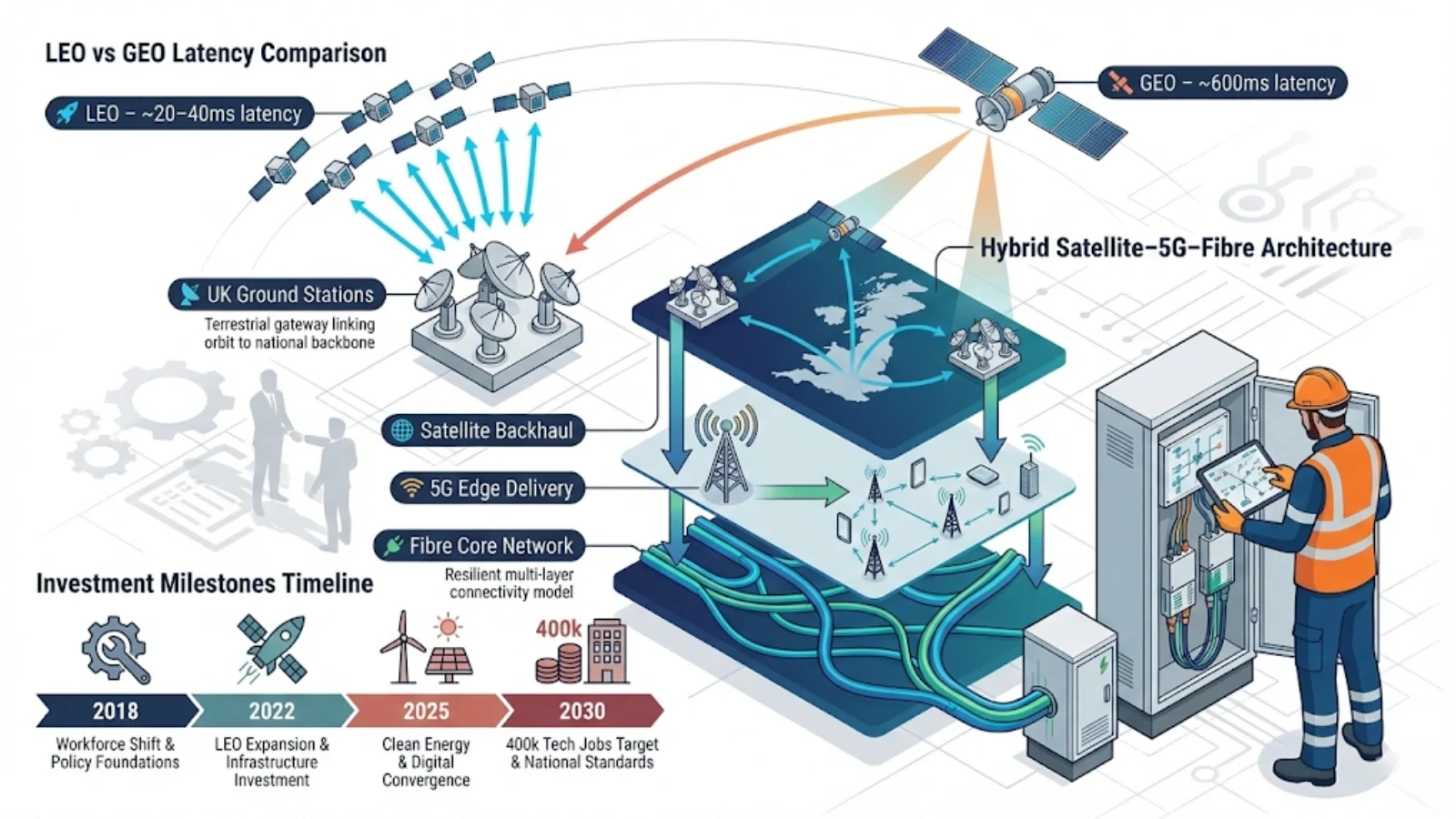
Illustrated hybrid UK network infrastructure showing satellite ground stations, LEO vs GEO latency comparison, 5G and fibre architecture, investment milestones
Integrated UK connectivity model combining satellite ground infrastructure, LEO–GEO latency dynamics, hybrid satellite–5G–fibre architecture, and strategic investment milestones anchored by real-world onsite engineering deployment

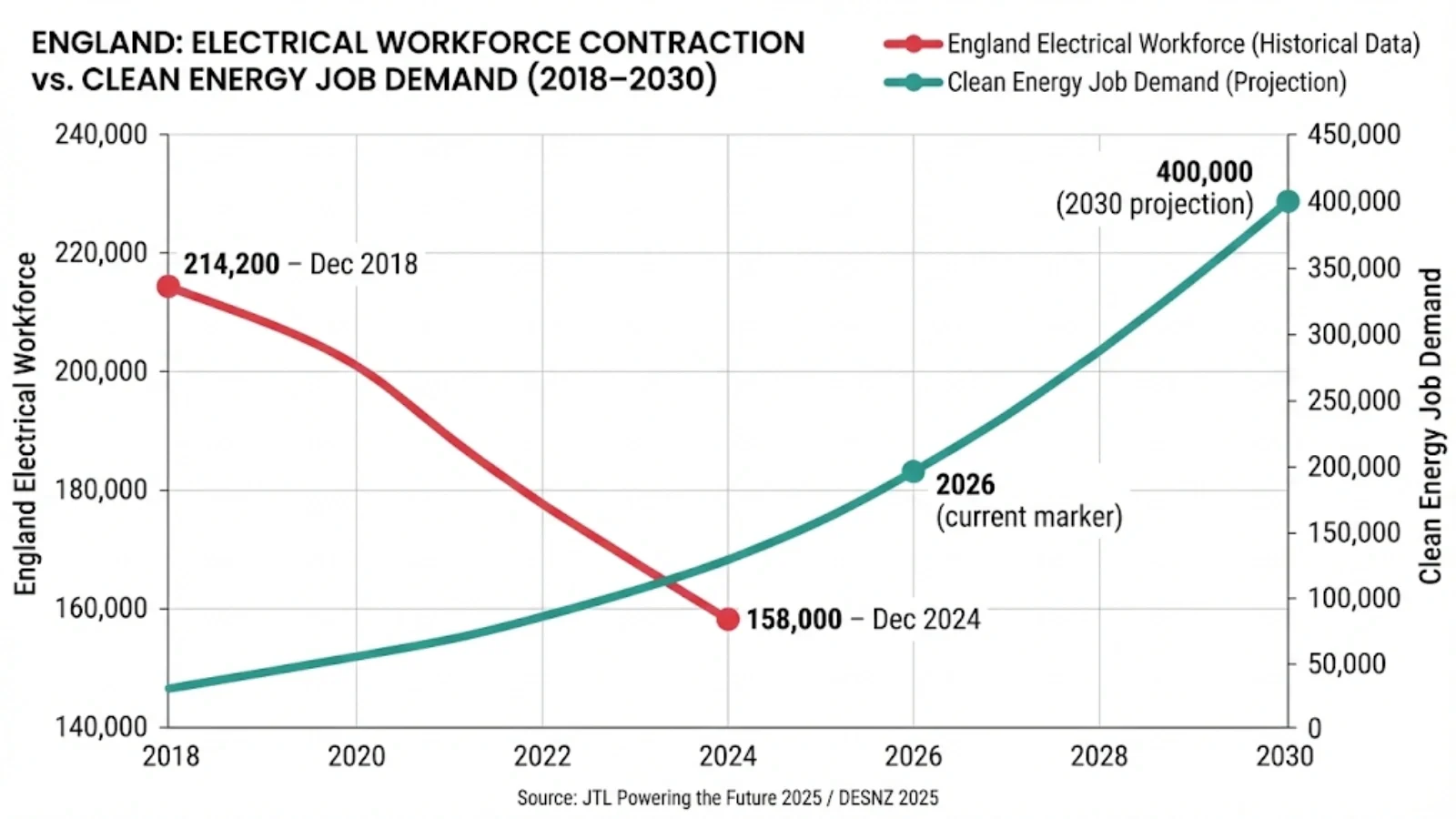
England’s electrical installation workforce has contracted by 26.2% since December 2018. That’s not a statistic buried in a footnote somewhere. That’s 214,200 practitioners down to 158,000 in six years, while the demand side of the equation has moved in exactly the opposite direction. Clean energy targets, housing programmes, and infrastructure pipelines are all pulling harder on a workforce that keeps shrinking. 

So when people talk about “supporting engineers,” the conversation sometimes drifts toward the charitable end of things, the benevolent fund territory, the pastoral care framing. That matters. But there’s a harder, more structural argument that doesn’t get made often enough: how you support people entering this trade doesn’t just affect those individuals. It sets the standard that everyone in the sector has to live with. The BMS electrician training pathways question gets at this well. As electrical work expands into building intelligence and integrated systems, the entry-level quality problem compounds into a sector-wide skills problem fast. 

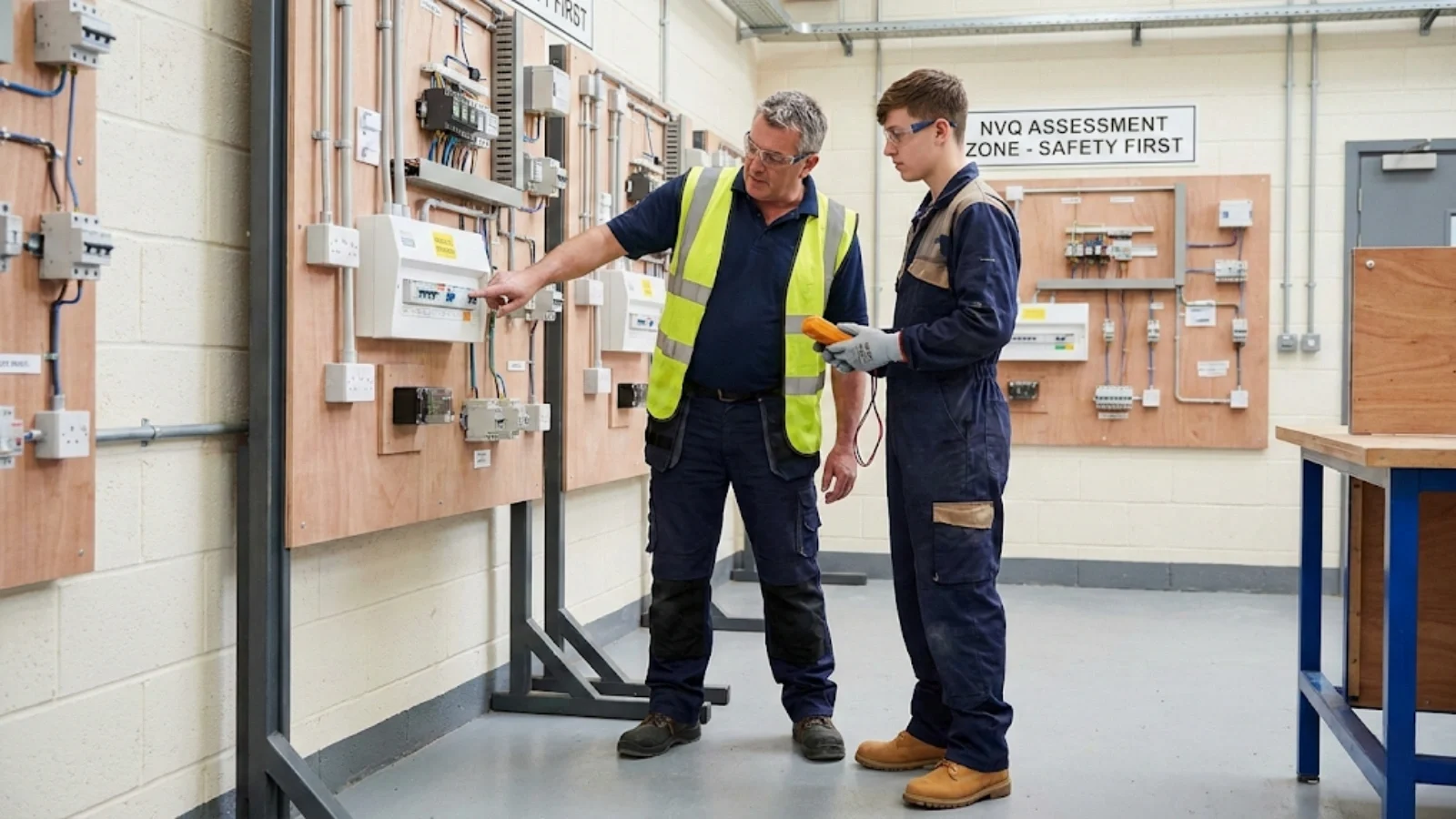
Experienced electrician mentoring an apprentice during NVQ training assessment
Supporting early-career engineers is both a legal duty and a long-term investment in sector-wide standards

The Numbers Behind a Workforce in Decline

The JTL Powering the Future report models it plainly. Without intervention, England’s electrical workforce could contract by a further 32% by 2038 under current apprenticeship volumes. Annual apprenticeship starts average around 7,540. You need north of 10,000 just to stabilise workforce size, before accounting for any growth in demand. The Construction Industry Training Board puts the net additional requirement for the wider construction sector at 47,860 workers per year through to 2029. Electrical installation trades sit inside that number, and the gap between what’s coming in and what’s needed keeps widening. 

Meanwhile, government commitments to clean power by 2030 and the Warm Homes Plan are projecting 400,000 clean energy jobs by that date. Electricians are a priority occupation in every serious modelling exercise. The workforce isn’t remotely positioned to deliver that without a substantial improvement in how people are supported from enrolment through to qualification and employment. 

The Valley of Death Is a Real Place

ECA data identifies what they call a “structural imbalance” at the entry end of the trade. Around 26,000 learners enrol in classroom-based electrical courses in any given year. Fewer than one in five secure an apprenticeship or meaningful skilled employment off the back of that. 

That gap isn’t mostly down to learner quality or motivation. It’s down to what happens, or rather what doesn’t happen, between completing classroom theory and securing site experience. The portfolio-based NVQ route requires real employment. The AM2 assessment requires preparation that employer supervision makes possible. When employers don’t engage, when they treat the learner as cheap labour rather than a developing tradesperson, the pathway stalls. 

The DfE’s own apprenticeship data for 2023/24 shows a 62.5% achievement rate for the Installation and Maintenance Electrician standard. That’s an improvement on previous years, but it still means roughly one in three starters doesn’t complete. Industry commentary consistently points to inconsistent employer engagement with portfolio sign-off and assessment preparation as the primary barrier, not learner capability. 

Standards Are Collective Property 

This is the part of the conversation that tends to get lost when “support” is framed as something optional or generous. The standards that make this trade worth entering are not maintained by a regulator filing reports. They’re maintained by the cumulative behaviour of practitioners on site, the quality of work going in, the safety culture being modelled for people earlier in their careers. 

Thomas Jevons, our Head of Training with over 20 years on the tools, puts it directly: 

"When poorly supported people enter the workforce and start cutting corners, that doesn't stay contained to one job. It sets expectations. Other people see it, prices adjust, standards adjust downward. It's cumulative damage to the whole sector."

The HSE’s definition of competence is useful here, and often misunderstood. Competence isn’t a certificate. It’s the combination of knowledge, skill, experience, and judgement sufficient to prevent danger. A Level 3 qualification demonstrates that someone has met a standard at a point in time. It doesn’t prove ongoing ability to apply that standard safely under varying site conditions. That part requires mentorship, supervision, and genuine employer investment. Where those are absent, the qualification and the competence start to diverge, and sector standards erode from the bottom up. 

Chart showing England electrical workforce declining from 214,200 to 158,000 while clean energy demand grows toward 400,000 jobs
Data sources: JTL Powering the Future Report 2025; Department for Energy Security and Net Zero, October 2025

What Employers Actually Owe Their Learners

The framing of “support” as optional generosity doesn’t hold up against the legal framework. The Electricity at Work Regulations 1989 require employers to ensure that only competent persons undertake electrical work, and to provide adequate supervision to those who are not yet fully competent. This is a duty, not a courtesy. 

The Health and Safety at Work Act 1974 and the Provision and Use of Work Equipment Regulations (PUWER) both require employers to ensure staff are adequately trained for the risks they face. More recently, the Building Safety Act 2022 has sharpened the focus on individual competence rather than just organisational accreditation. Employers who treat training as an overhead and supervision as an inconvenience are taking on legal exposure alongside the broader sector damage. 

The NVQ portfolio isn’t a bureaucratic hurdle either. It’s auditable evidence of safe, competent performance in real-world settings, tied to unit outcomes and assessed independently. The AM2 and AM2E are the gatekeeper assessments: 16.5 hours of independent evaluation where nobody prompts, nobody catches errors, and nobody signs off until safe independent working is demonstrated. Preparing someone properly for that isn’t a favour. It’s a professional obligation. 

Pay, Progression, and the Cost of Cutting Corners 

There’s a practical argument here too, one that connects directly to the financial realities of the trade. The 2026 electrician pay rise delivers the greatest benefit to those who completed the full pathway and hold the correct JIB card grade. Operators who shortcut the route, whether through inadequate supervision, gaps in the NVQ portfolio, or bypassing the AM2, end up at a lower card grade with corresponding pay implications. That compounds over time. 

Joshua Jarvis, our Placement Manager, captures what this looks like across the sector: 

"Every time someone completes the full pathway correctly, gets their Gold Card, and works to standard, it raises the floor for the whole industry. Every time someone skips steps, it lowers it. Our placement network sees both, and the difference in long-term outcomes is significant."

The IET’s 2025 skills survey puts 76% of engineering employers reporting difficulty filling key roles. That’s not a shortage of people wanting to enter the trade. The ECA’s own data shows 26,000 classroom enrolments. It’s a shortage of people who’ve been given the support to reach the end of the pathway in a state that employers can actually use. The demand is there. The pipeline is where it breaks. 

NVQ Level 3 portfolio evidence showing unit completion and assessor sign-off
Portfolio evidence for the NVQ Level 3 (2357) must demonstrate safe, competent practice across all assessed units. Elec Training's assessment team, Wolverhampton, February 2026

The Full Pathway and How to Navigate It

The dominant UK route to qualified electrician status is the Level 3 Installation and Maintenance Electrician standard (IfATE ST0152), typically 48 months and requiring off-the-job qualification, NVQ portfolio, and independent end-point assessment. There are also NVQ-only routes for those with existing site experience, and the Experienced Worker Route for mature entrants seeking recognition of prior competence. 

What all of them share is this: the ECS Gold Card is the professional marker that employers, contractors, and the public can rely on. It’s not a courtesy credential. It’s evidence that the full framework has been met. Understanding the different ECS Gold Card routes available matters practically, because the path to it differs depending on your starting point, age, and prior experience. 

For an ageing workforce, the demographic signals are straightforward. CITB data shows 28% of construction workers are aged 45 and over, with 6% aged 60-plus. The experience concentration is real, and the retirement horizon is visible. Supporting the next generation of entrants isn’t forward-thinking policy. It’s the immediate structural requirement of the sector. 

What To Do Next

Elec Training’s approach is built around the gap that undermines most training routes: the space between classroom completion and genuine employment. Our in-house recruitment team works with 120+ partner contractors, making over 100 calls daily to secure placements for learners building their NVQ portfolio. Guaranteed placement support comes as standard with the full package. 

What the full NVQ package includes: 

  • Level 2 (2365-02): 4 weeks 
  • Level 3 (2365-03): 8 weeks 
  • 18th Edition (2382): 5 days 
  • NVQ Level 3 (2357): portfolio plus supervised on-site assessment 
  • AM2 exam: 3 days 
  • ECS JIB Gold Card application support 
  • 2391 Inspection and Testing: optional but strongly recommended 

Call us on 0330 822 5337 to discuss the fastest route to qualified status. We’ll tell you exactly what qualifications you need, how long each stage takes, and what our placement team can do to secure your site hours. No shortcuts around the standards. No false timelines. Just a complete pathway with the support behind it that the standards demand and employers actually need. 

Qualified electrician with ECS Gold Card working on commercial installation
ECS Gold Card status confirms that the full NVQ pathway and AM2 assessment have been completed to industry standard

FAQs 

Why has England’s electrical workforce fallen by 26.2% since 2018, and what does that mean for the profession?

 Workforce modelling based on ONS Annual Population Survey data shows England’s electrical workforce declined from around 214,200 in December 2018 to approximately 158,000 in December 2024 — a contraction of 26.2%. 

Annual attrition of roughly 7% has exceeded the inflow of newly qualified electricians through apprenticeships and experienced-worker routes. Contributing factors include: 

  • An ageing workforce 
  • Limited progression from classroom-only routes 
  • Restricted employer capacity to provide site placements 
  • Commercial pressures reducing supervision availability 

For the profession, this means: 

  • Increased workload on existing electricians 
  • Higher risk of project delays in housing, infrastructure and net-zero programmes 
  • Growing reliance on uncertified or partially trained labour 
  • Upward pressure on wages and safety risks 

Reversing the decline requires sustained expansion of structured trainee pathways and employer-supported supervision.

How do apprenticeship start numbers compare to the volume needed to stabilise the workforce?

England averages around 7,500 electrical apprenticeship starts per year. Modelling indicates that over 10,000 starts annually are required simply to stabilise the workforce at current levels, before accounting for additional demand from housing and clean-energy targets. 

This creates an annual shortfall of approximately 3,000 starts. Without closing that gap, attrition will continue to outpace qualification output. Expanding employer placement capacity — particularly among SMEs — is essential to stabilise supply.

What is the “valley of death” between classroom enrolment and qualified employment?

The “valley of death” refers to the gap between high classroom enrolment — around 25,000–26,000 learners annually on publicly funded electrical courses — and the much smaller number who secure apprenticeships or site-based employment. 

Fewer than one in five classroom starters progress to a work-based route within 12 months. Classroom learning delivers theory but cannot replace supervised, real-site experience required to complete an NVQ portfolio and pass the AM2 assessment. 

Without employer placements, learners remain technically trained but not occupationally competent. This results in wasted public investment and ongoing workforce shortages. 

Why does inadequate employer supervision undermine NVQ completion and AM2 success?

The NVQ Level 3 requires authentic workplace evidence across a range of installation, testing and fault-finding activities. Poor supervision restricts access to varied tasks and limits portfolio depth. 

When candidates reach the AM2 end-point assessment, gaps become evident in areas such as: 

  • Safe isolation 
  • Wiring systems 
  • Inspection and testing 

This leads to lower pass rates, extended training times and increased drop-out. Structured mentoring and proper task allocation are therefore essential to produce fully qualified electricians meeting JIB and ECS standards. 

Regulation 16 requires that anyone working on electrical systems is competent to prevent danger. Regulation 3 places duties on employers to ensure systems are safe. 

The Health and Safety at Work etc. Act 1974 further requires adequate instruction, training and supervision. Supporting trainees is therefore not optional — it is part of meeting statutory obligations. 

Allowing partially trained individuals to work unsafely risks enforcement action and liability. Investment in structured supervision protects both employers and the wider profession.

Why are professional standards in electrical installation a collective responsibility?

Electrical work is safety-critical. A sub-standard installation can affect entire buildings and damage public trust. 

Regulatory frameworks place shared duties on employers, supervisors and individuals. Schemes such as: 

  • JIB grading 
  • ECS Gold Card 
  • NICEIC oversight 

exist to maintain consistent sector standards. 

Failing to supervise or properly train new entrants affects the entire supply chain. Supporting trainees strengthens competence density and protects the profession’s reputation and insurability.

How do shortcuts in training affect JIB grading, ECS Gold Card status and long-term pay?

To achieve JIB Electrician grade, an individual must complete: 

  • NVQ Level 3 
  • AM2 assessment 
  • 18th Edition qualification 

Weak supervision delays NVQ completion and AM2 success, blocking progression. Without full qualification, operatives remain on improver or labourer rates rather than Electrician grade. 

Progression to Approved Electrician or Technician status requires further competence and experience. Structured training pathways directly influence earning potential, site access and long-term career mobility. 

What role do workforce projections from CITB, JTL and DESNZ play?

Labour-market intelligence consistently projects sustained demand growth from: 

  • Housebuilding targets 
  • Grid reinforcement 
  • EV rollout 
  • Heat pump installation 
  • Clean-energy expansion 

Modelling shows that without higher apprenticeship throughput, workforce contraction will continue. These projections quantify the consequences of inaction — including delayed infrastructure delivery and compliance risks — making trainee support a strategic sector priority.

Why is employer engagement the critical factor in turning learners into competent electricians?

Electrical competence is built in live working environments. Only employers can provide: 

  • Real installations 
  • Supervised responsibility 
  • Exposure to varied site conditions 
  • Health and safety culture 

Classroom learning alone cannot meet NVQ evidence requirements or prepare candidates for AM2. Progression data consistently shows apprenticeship success depends heavily on workplace quality and duration. 

Employer engagement converts theoretical learners into site-ready electricians.

How does investing in structured pathways protect sector-wide standards?

Structured training pathways ensure new entrants meet competence thresholds set by: 

  • Electricity at Work Regulations 1989 
  • Building Safety Act 2022 
  • JIB grading 
  • ECS standards 

Placement support guarantees supervised experience and successful qualification. This reduces reliance on uncertified labour, stabilises workforce supply and protects public safety. 

In a market under net-zero and housing delivery pressure, structured trainee investment safeguards both individual careers and the long-term integrity of UK electrical standards.

References

Note on Accuracy and Updates

Last reviewed: 26 February 2026. This page is maintained; we correct errors and refresh sources as workforce data and regulatory guidance changes. CITB workforce projections cited cover 2025-2029. 

Learners are Studying level 2 Electrician Course

Guaranteed Work Placement for Your NVQ

No experience needed. Get started Now.

Prefer to call? Tap here

Learners are Studying level 2 Electrician Course

Guaranteed Work Placement for Your NVQ

No experience needed. Get started Now.

Prefer to call? Tap here

Learners are Studying level 2 Electrician Course

Guaranteed Work Placement for Your NVQ

No experience needed. Get started Now.

Prefer to call? Tap here

Learners are Studying level 2 Electrician Course

Guaranteed Work Placement for Your NVQ

No experience needed. Get started Now.

Prefer to call? Tap here

Enquire Now for Course Information