


- Technical review: Thomas Jevons (Head of Training, 20+ years)
- Employability review: Joshua Jarvis (Placement Manager)
- Editorial review: Jessica Gilbert (Marketing Editorial Team)
- Last reviewed:
- Changes: New comprehensive guide covering all 40+ ECS card variants across electrical, FESS, network, BMS, HV/industrial, and management sectors including requirements, restrictions, salary impacts, site access rules, progression pathways, and 2025-2027 policy changes
Table of Contents

Introduction
The question comes up constantly on sites, in forums, and from learners approaching qualification: “Which ECS card do I actually need?” Followed immediately by: “What’s the difference between a Gold Card and Domestic Installer?” and “Can I use my CSCS card for electrical work?” Honestly, the confusion is understandable because the ECS scheme includes a wide range of card types across electrotechnical, FESS, network infrastructure, BMS and related specialist occupations.
Here’s the thing. ECS cards aren’t interchangeable. An Installation Electrician Gold Card identifies the holder as having the relevant occupational competence for electrical installation work. A Domestic Installer limits you to homes only and gets rejected on commercial sites. A Black Card sounds senior but it’s managerial, not craft. A Labourer card might get you on some sites but you cannot perform electrical work. An Experienced Worker Assessment card is provisional for 18 months, not instant Gold Card status. Taking three years to qualify via NVQ then discovering your card doesn’t match employer expectations wastes time and money.
The UK construction and electrical sectors are operating with significant workforce gaps. A 15,000 to 30,000 electrician shortfall is projected by 2030, a 26% workforce decline since 2018, and apprenticeship starts are down 9,600 annually. What that means is there’s strong demand for qualified workers, but employers are strict about which ECS cards they accept. Some employers and sites specify a particular ECS occupation or grade for certain roles. Requirements vary according to the work, client, contractor and site rules. Industrial sites reject Labourer cards outright. Fire and security work requires FESS-specific cards, not electrical Gold Cards. Network infrastructure needs EU Skills pathways. The card you hold determines site access, salary bracket, and career progression within the comprehensive UK electrician qualification framework.
The catch is that myths dominate discussions. “CSCS is enough for electrical work” is false. “Level 3 diploma makes you fully qualified” is false. “Domestic Installer equals Gold Card” is false. “Any degree gives you a White AQP card” is false. The ECS system is widely used to evidence electrotechnical competence, training status and health and safety requirements, although individual site and employer requirements vary. Understanding which card you need, what qualifications map to each variant, and how progression works prevents wasted training costs and career delays.
This guide explains the ECS card types across all industries including core electrical cards from Labourer through Gold Card to Approved Electrician. Management and non-craft cards including Black Card and professional variants, high voltage and industrial specialist cards, network infrastructure cards for data and telecoms, FESS cards for fire, emergency, and security systems, building controls and BMS cards, and other recognised disciplines from highways to marine work. For each card type, we cover entry requirements and mandatory qualifications, training pathways and timelines, renewal periods and H&S requirements, work scope allowed and restrictions, whether unsupervised work is permitted, whether it leads to Gold or advanced cards, JIB grading and NICEIC/NAPIT recognition, typical job titles and salary ranges, and common controversies or misunderstandings. We also address sector-specific breakdowns explaining why each card type exists and how they differ from general CSCS cards, salary and career progression data by sector, real-world experiences from forums and social media, myths and misconceptions debunked with evidence, and policy changes from 2025 to 2027 affecting card availability and requirements.
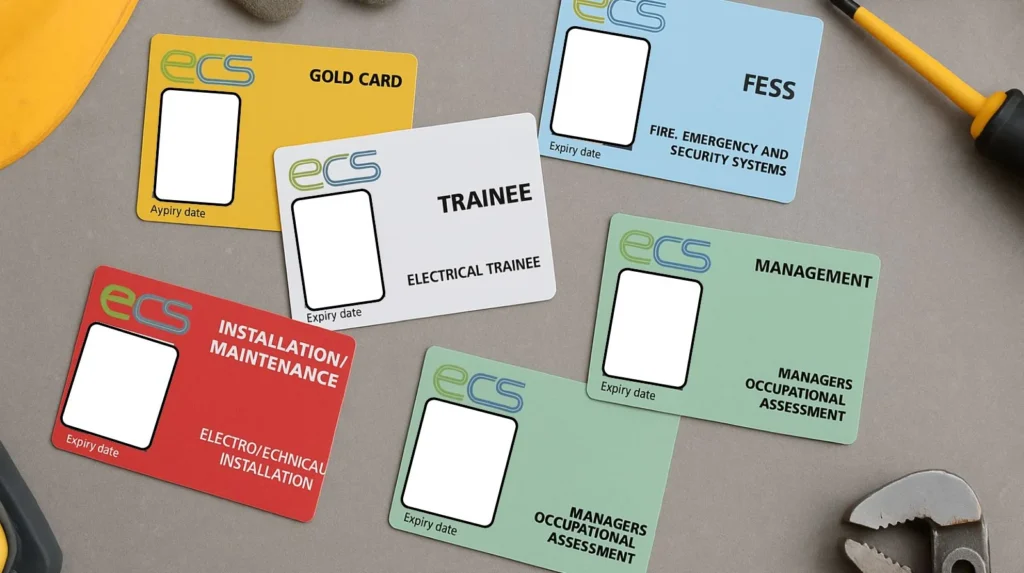
Complete ECS Card Catalogue Across All Industries
The ECS scheme includes a wide range of card types across electrotechnical, FESS, network infrastructure, BMS and related specialist occupations. Understanding which sector your role sits within determines which card you need and what qualifications are required.
Core Electrical Cards
The core electrical sector cards certify competence in electrical installation and maintenance work under BS 7671 Wiring Regulations. These are the cards most people think of when discussing ECS, ranging from entry-level support through to advanced supervision roles.
Labourer and Electrical Labourer. These are supervised support roles assisting electricians with tasks such as cable pulling, material handling, and site preparation. The Electrical Labourer card is for supervised support work. It does not demonstrate electrician occupational competence and should not be presented as permission to undertake electrician craft work independently. No formal electrical qualifications are required for the support role, but the applicable ECS Health, Safety & Environmental requirements must be met. Work is carried out under appropriate supervision and does not provide independent electrician craft rights. JIB recognises these roles at labourer grade. NICEIC and NAPIT do not accept them for electrician scheme entry. Strict commercial and industrial sites may reject labourer cards where craft electrical competence is required.
Trainee, Apprentice, and Adult Trainee. These cards are for individuals on formal industry training programmes leading to qualified status. The Trainee Electrician ECS card is for individuals on a formal industry training programme leading to an ECS Gold Card. Eligibility depends on the applicable trainee stage, training agreement, employer support and ECS Health, Safety & Environmental requirements. Apprentice cards specifically cover those on the 5357 Installation and Maintenance Electrician Standard via registered apprenticeships. Adult Trainee cards serve mature entrants following similar pathways. All require the applicable ECS requirements and permit supervised training work only. Unsupervised work is not allowed. They lead directly to Gold Card status upon NVQ and AM2 completion. JIB recognises them. NICEIC and NAPIT do not accept trainee status for scheme entry. Common issues: applications get rejected if JIB registration isn’t confirmed, foreign qualifications don’t map cleanly to UK frameworks, and strict supervision requirements limit site access.
Installation Electrician Gold Card. This is the primary qualification most electricians aim for. It certifies Level 3 competency for installation work. Entry requires completion of NVQ Level 3 Diploma in Installing Electrotechnical Systems and Equipment (qualification 2357 or equivalent) and passing the AM2 practical assessment. You must also hold 18th Edition BS 7671 certification and pass ECS Health and Safety assessment. The card renews every 3 years. Work scope includes unsupervised electrical installation work on domestic, commercial, and industrial sites. Unsupervised work is permitted. It’s the baseline Gold Card status, not leading to higher variants but potentially progressing to Approved Electrician with additional experience and qualifications. JIB recognises it for electrician grading. NICEIC and NAPIT accept it for scheme entry. Common issue: confusion between having a Level 3 diploma (theory only) versus completing the full NVQ portfolio and AM2 assessment required for the card.
Maintenance Gold Card. Similar to Installation Electrician Gold Card but focused on maintenance tasks rather than new installations. Entry requires Level 3 competency, NVQ Level 3 completion, AM2 pass, and BS 7671 knowledge. ECS Health and Safety assessment is mandatory. Renewal is every 3 years. Work scope covers unsupervised maintenance work including testing, inspection, fault-finding, and repairs on existing installations. Unsupervised work is permitted. JIB recognises it. NICEIC and NAPIT accept it. Common issue: non-UK qualifications face increased scrutiny, with assessors requiring additional evidence of competence compared to UK-trained candidates.
Approved Electrician. Approved Electrician is a higher JIB/ECS grade with additional qualification and experience requirements. Requirements depend on the applicable route and may include relevant Level 3 qualifications, AM2 or equivalent assessment, and appropriate experience. ECS Health, Safety & Environmental requirements also apply. It may support progression into more senior roles, although actual duties depend on the employer and position. JIB recognises the grade within its applicable grading structure. NICEIC and NAPIT recognition depends on the relevant scheme and competence requirements.
Domestic Installer. This card certifies competence limited strictly to domestic electrical installations in dwelling properties. Entry requires domestic-specific training and completion of NVQ Level 3 (domestic pathway). ECS Health and Safety assessment mandatory. Renewal every 3 years. Work scope is restricted to domestic properties only, covering consumer units, lighting circuits, socket outlets, and domestic appliances. Unsupervised work is permitted within domestic settings. However, it does not lead to full Gold Card status and is limited to domestic applications. JIB does not recognise it for full electrician grading. NICEIC and NAPIT accept it for domestic installer schemes but not full approved contractor status. Critical issue: widespread myth that Domestic Installer equals Installation Electrician Gold Card. It does not. Some commercial and industrial employers or sites may not accept a Domestic Installer card where a different ECS occupation or grade is specified for the role. If your career goal includes commercial work, you need the full Installation Electrician Gold Card, not the domestic-only variant.
Technician. This card covers advanced technical roles beyond standard installation and maintenance. Requirements vary by sector but typically include Level 3 or higher qualifications in electrotechnical disciplines. ECS Health and Safety assessment required. Renewal every 3 years. Work scope includes technical work such as design, advanced testing and inspection, project management, and specialist system work. Unsupervised work permitted. JIB recognises it. NICEIC and NAPIT accept it. The card varies significantly depending on whether you’re in electrical, FESS, network, or BMS sectors.
Experienced Worker Route. Candidates registered on an approved Experienced Worker Assessment may be eligible for an ECS Experienced Worker card while completing the qualification requirements. Some Experienced Worker cards have limited validity and cannot be renewed, so candidates should check the current ECS criteria for their route. The route recognises existing experience while the candidate completes the applicable qualification and assessment requirements. Card eligibility, work scope and progression depend on the specific Experienced Worker route and current ECS requirements.
Joshua Jarvis, our Placement Manager, explains the employment challenge this creates:
"The biggest employment challenge we see with EWA candidates is explaining to employers that the card is provisional, not Gold Card status. Some candidates assume EWA grants full electrician rights and apply for roles requiring Gold Card. Employers reject them because provisional cards don't meet insurance, competence, or certification requirements. The 18-month time pressure then creates anxiety. Candidates need to understand EWA is a stepping stone requiring AM2E completion, not the end destination."
Joshua Jarvis, Placement Manager
Management and Non-Craft Cards
Management and non-craft cards certify roles involving oversight, administration, and professional functions rather than hands-on electrical work. These cards are often misunderstood, with holders sometimes assumed to have craft competence when they don’t.
Site Support. This card covers administrative and support roles on construction sites. No formal qualifications specified beyond ECS Health and Safety assessment. Renewal every 3 years. Work scope is administrative support, material coordination, documentation, and site logistics. Unsupervised work permitted within support context. Does not lead to craft cards. Not JIB-recognised for craft grading. Not accepted by NICEIC or NAPIT for scheme entry. Common issue: misunderstood as a craft card when it’s strictly non-hands-on support.
Site Supervisor. This card certifies supervisory non-craft roles overseeing site operations without performing hands-on work. Entry requires supervisory training and typically Level 3 or 4 qualifications in construction management or similar. ECS Health and Safety assessment required. Renewal every 3 years. Work scope includes site supervision, coordination, health and safety oversight, but not craft tasks. Unsupervised work permitted in supervisory capacity. Does not lead to craft cards. Not JIB-recognised. Not accepted by NICEIC or NAPIT. The card is for oversight roles, not hands-on electrical work.
Site Manager. This card certifies management of site operations at a senior level. Entry requires management qualifications, typically Level 4 or higher in construction management, project management, or similar. ECS Health and Safety assessment required. Renewal every 3 years. Work scope covers site management, resource allocation, contractor coordination, compliance, but not craft work. Unsupervised work permitted managerially. Does not lead to craft progression. Not JIB-recognised for craft. Not accepted by NICEIC or NAPIT for craft schemes. The card is entirely managerial and non-hands-on.
Black Card (Manager). This is a senior managerial card often confused with advanced electrician status. Entry requires senior management courses and qualifications, typically a degree or Level 5 in management, business, or construction. ECS Health and Safety assessment required. Renewal every 3 years. Work scope is entirely managerial including strategic oversight, business operations, contractor management, compliance. Unsupervised work permitted managerially. Does not lead to craft cards. Not JIB-recognised for craft grading. Not accepted by NICEIC or NAPIT for craft schemes. Critical myth to debunk: Black Card does not indicate senior electrician or master electrician status. It’s a managerial card with no hands-on electrical qualifications required. Black Card holders cannot perform electrical craft work based on the card alone. If you see job adverts for “Black Card electrician,” they’re likely confused or using incorrect terminology.
Thomas Jevons, our Head of Training with 20 years experience, clarifies this persistent misconception:
"The reality is that Black Card indicates senior management qualifications, typically a degree or Level 5 in construction management, with no hands-on electrical requirements. From an assessor's perspective, we see confusion where people assume Black Card holders can supervise electrical work or perform craft tasks. They can't, based on the card alone. Management cards certify oversight competence, not electrical installation or testing competence."
Thomas Jevons, Head of Training
White AQP (Academically Qualified Person). This card certifies degree-holders working in non-hands-on professional roles within electrotechnical industries. Entry requires a relevant degree in electrical engineering, electrotechnical systems, or closely related fields. Not any degree qualifies. ECS Health and Safety assessment required. Renewal every 3 years. Work scope includes professional non-hands-on roles such as design, consultancy, project engineering, technical sales, but not installation or maintenance work. Unsupervised work permitted professionally. Does not lead to craft cards. Not JIB-recognised. Not accepted by NICEIC or NAPIT for craft schemes. Common misconception: any university degree qualifies for White AQP. False. The degree must be relevant to electrotechnical disciplines.
Grey PQP (Professionally Qualified Person). This card certifies professionally qualified personnel holding chartered status with recognised professional bodies like the IET (Institution of Engineering and Technology) or similar. Entry requires chartered engineer status or equivalent professional qualification. ECS Health and Safety assessment required. Renewal every 3 years. Work scope includes professional roles such as consulting engineering, chartered engineer responsibilities, technical authority, but not hands-on craft work. Unsupervised work permitted professionally. Does not lead to craft progression. Not JIB-recognised for craft. Not accepted by NICEIC or NAPIT for craft schemes. The card recognises professional standing, not craft competence.
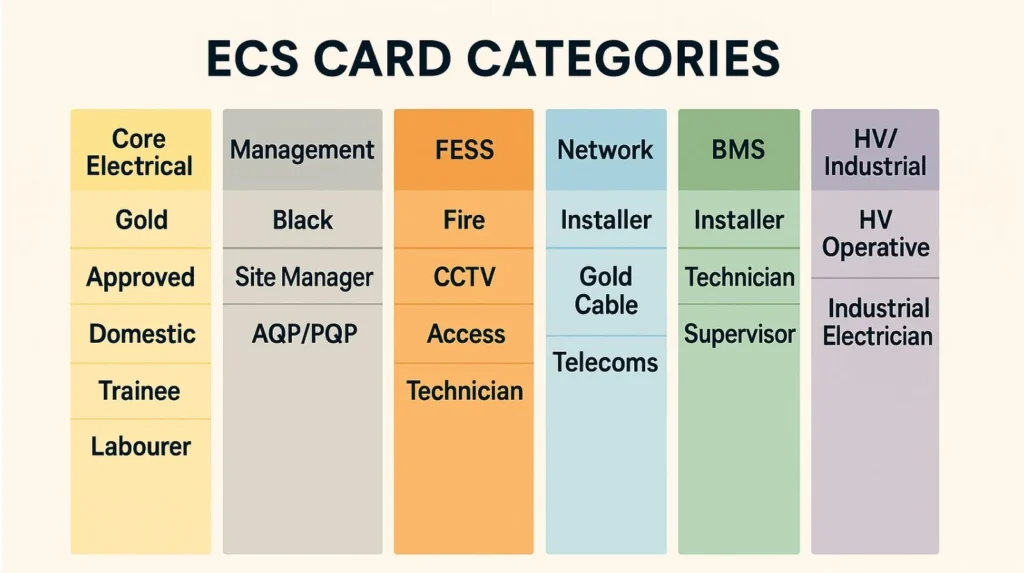
High Voltage and Industrial Specialist Cards
High voltage and industrial cards certify competence in specialist electrical work involving increased risk, complex systems, or industrial environments beyond standard domestic and commercial installation.
HV Operative. This card certifies high voltage operations work. Entry requires specialist HV training and qualifications beyond standard Level 3. ECS Health and Safety assessment plus additional HV-specific health and safety requirements are mandatory. Renewal every 3 years. Work scope covers high voltage operations, switching, isolation, and maintenance on HV systems typically above 1000V AC or 1500V DC. Unsupervised work is limited due to high risk and often requires authorised person supervision depending on voltage levels and site rules. Leads to further HV specialist roles. JIB recognises it for industrial grading. NICEIC and NAPIT generally do not cover HV work as it’s outside standard domestic/commercial scope. The card carries high risk restrictions and requires ongoing competence demonstration.
Industrial Electrician. This card certifies electrical work in industrial settings including factories, manufacturing plants, and process industries. Entry requires NVQ Level 3 plus industrial-specific experience and training. ECS Health and Safety assessment required. Renewal every 3 years. Work scope includes industrial electrical installation, maintenance, machinery supplies, control panels, three-phase systems, and industrial lighting. Unsupervised work permitted. Leads to advanced industrial roles. JIB recognises it for industrial grading. NICEIC and NAPIT accept it but primarily focus on domestic/commercial schemes. The work is sector-specific, often involving industrial control systems and machinery electrical supplies.
Electrical Fitter. This card covers assembly and fitting work in industrial contexts, focusing on panel building, machinery wiring, and equipment assembly rather than fixed installations. Entry requires relevant qualifications and training in electrical fitting. ECS Health and Safety assessment required. Renewal every 3 years. Work scope includes panel wiring, control gear assembly, machinery electrical fitting, and workshop-based electrical work. Unsupervised work typically permitted. JIB may recognise it depending on specific role. The card is industrial-focused rather than construction site installation work.
Engineering Maintenance. This card certifies maintenance work on engineered electrical systems in industrial, commercial, or infrastructure settings. Entry requires Level 3 qualifications plus maintenance-specific training. ECS Health and Safety assessment required. Renewal every 3 years. Work scope covers planned and reactive maintenance, fault-finding, system testing, and equipment servicing. Unsupervised work permitted. Leads to senior maintenance or engineering roles. JIB recognises it for maintenance grading.
Instruments Mechanic. This card certifies work on process engineering instrumentation involving electrical control and measurement systems. Entry requires specialist qualifications in instrumentation and process control. ECS Health and Safety assessment required. Renewal every 3 years. Work scope includes instrumentation installation, calibration, maintenance, and process control systems. Unsupervised work permitted. The card is highly specialist, typically in process industries like oil and gas, chemical plants, or utilities.
Distribution Networks Electrician. This card certifies work on electrical distribution networks including overhead lines, underground cables, and substation work. Entry requires specialist distribution network training and qualifications. ECS Health and Safety assessment plus network-specific safety training required. Renewal every 3 years. Work scope covers distribution network installation, maintenance, jointing, and live line work depending on authorisation. Unsupervised work limited by authorisation levels. The card is for network operators and distribution companies rather than general contractors.
Network Infrastructure Cards
Network Infrastructure is the current route for data cabling, telecommunications, and digital network occupations. Current categories may include Network Infrastructure Trainee, Network Infrastructure Installer, Advanced Installer, Supervisor, Manager, and Designer. These routes provide the appropriate progression structure for network infrastructure work and should be treated separately from core electrical installation cards.
Network Infrastructure Trainee. This route is intended for learners developing competence in network infrastructure and data communications work under appropriate supervision.
Network Infrastructure Installer. This route covers network infrastructure installation work, including structured cabling and related digital infrastructure. Work scope and supervision requirements depend on the applicant’s competence and the specific role.
Advanced Installer. This route recognises more advanced network infrastructure installation competence and supports progression into higher-responsibility technical work.
Supervisor. This route is intended for experienced network infrastructure professionals responsible for supervising installation teams, coordinating work, and overseeing site activities.
Manager. This route covers management responsibilities within network infrastructure projects, including planning, coordination, resource management, and operational oversight.
Designer. This route covers network infrastructure design responsibilities, including technical planning and the development of network infrastructure solutions.
These current Network Infrastructure categories should be treated as the primary routes for new applicants working in data, cabling, telecommunications, and related network infrastructure occupations. Former Datacomms card structures should not be presented as equivalent current routes.
Fire, Emergency, and Security Systems (FESS) Cards
FESS cards certify competence in fire alarm systems, emergency lighting, CCTV, access control, and security systems. These cards follow FIA (Fire Industry Association) and SSAIB (Security Systems and Alarms Inspection Board) standards rather than electrical NVQ pathways.
Fire Alarm. This card certifies fire alarm system installation and maintenance work. Entry requires FIA or SSAIB certifications and specialist fire alarm training. Not NVQ-based. ECS Health and Safety assessment required. Renewal every 3 years. Work scope includes fire detection and alarm system installation, commissioning, maintenance, and servicing. Unsupervised work permitted for qualified installers. Leads to FESS Technician level. Not JIB-recognised for electrical grading. Accepted by NICEIC and NAPIT specifically for FESS schemes, not general electrical schemes. The card is fire systems-specific and requires knowledge of BS 5839 fire detection standards.
CCTV. This card certifies closed-circuit television and surveillance system work. Entry requires SSAIB certifications or equivalent training in CCTV systems. ECS Health and Safety assessment required. Renewal every 3 years. Work scope includes CCTV camera installation, recording equipment, monitoring systems, and IP surveillance networks. Unsupervised work permitted. Leads to FESS Technician. Accepted by NICEIC and NAPIT for FESS schemes. Common myth: CCTV engineers don’t need ECS cards for site access. False. Site access often requires ECS certification even for low-voltage CCTV work.
Access Control. This card certifies security access control system work. Entry requires specialist courses and certifications in access control technologies. ECS Health and Safety assessment required. Renewal every 3 years. Work scope includes door access systems, card readers, biometric systems, and integrated security platforms. Unsupervised work permitted. Leads to FESS Technician. Accepted by NICEIC and NAPIT for FESS schemes. The card follows FESS standards compliance.
Door Entry. This card certifies door entry system installation and maintenance. Entry requires specialist training in door entry technologies. ECS Health and Safety assessment required. Renewal every 3 years. Work scope includes audio and video door entry systems, intercom systems, and access communication systems. Unsupervised work permitted. Follows FESS standards.
Emergency Lighting. This card certifies emergency lighting system work. Entry requires specialist courses in emergency lighting design, installation, and testing. ECS Health and Safety assessment required. Renewal every 3 years. Work scope includes emergency lighting installation, testing to BS 5266 standards, and certification. Unsupervised work permitted. Accepted for FESS schemes.
FESS Operative. This is an entry-level FESS card for individuals working within the fire, emergency and security systems sector. FESS has its own ECS card structure and qualification requirements. The relevant route depends on the occupation and level of responsibility, and should be checked against the current ECS FESS requirements. Work scope and supervision arrangements depend on the specific occupation, qualification and employer requirements.
FESS Technician. This card identifies a qualified FESS occupational route. FESS has its own ECS card structure and qualification requirements. The relevant route depends on the occupation and level of responsibility, and should be checked against the current ECS FESS requirements. The duties associated with the card depend on the relevant qualification, competence, employer, position and site requirements.
FESS Manager. This card relates to management-level responsibilities within the FESS sector. FESS has its own ECS card structure and qualification requirements. The relevant route depends on the occupation and level of responsibility, and should be checked against the current ECS FESS requirements. Duties and responsibilities depend on the employer, position, qualification and project requirements.
Building Controls and BMS Cards
BMS (Building Management Systems) cards certify competence in building automation, controls, and management systems. These cards follow BESA (Building Engineering Services Association) standards.
BMS Technician. This card certifies building management systems technical work. Entry requires Level 3 qualifications in BMS or building controls, often including NVQ or BESA-approved training. ECS Health and Safety assessment required. Renewal every 3 years. Work scope includes BMS installation, programming, commissioning, maintenance, and fault-finding on HVAC controls, lighting controls, and integrated building systems. Unsupervised work permitted. Leads to BMS Supervisor roles. Not JIB-recognised for electrical grading. Not typically accepted by NICEIC or NAPIT as they focus on electrical installation rather than controls. The card emphasises BESA standards for building controls and automation.
BMS Installer. This is the entry-level BMS card. Entry requires Level 3 training in BMS installation. ECS Health and Safety assessment required. Renewal every 3 years. Work scope includes installation of BMS components, sensors, actuators, control panels, and wiring of control systems. Unsupervised work typically permitted for installation tasks. Leads to BMS Technician with further experience. The card follows BESA installation standards.
BMS Supervisor. This is the supervisory BMS card. Entry requires Level 4 qualifications in BMS supervision or management. ECS Health and Safety assessment required. Renewal every 3 years. Work scope includes overseeing BMS projects, supervising BMS teams, compliance, commissioning oversight, but typically less hands-on than technician roles. Unsupervised work permitted in supervisory capacity. Not JIB-recognised. The card is non-hands-on supervision within building controls.

Other ECS-Recognised Specialist Disciplines
Beyond the main sectors, ECS recognises specialist disciplines covering niche electrical roles, temporary entry pathways, and sector-specific work.
Wireman and Panel Builder. This card certifies panel assembly and wiring work in industrial and manufacturing contexts. Entry requires relevant certifications and training in panel building. ECS Health and Safety assessment required. Renewal every 3 years. Work scope includes control panel wiring, switchgear assembly, and electrical equipment construction typically in workshops rather than on construction sites. Unsupervised work permitted. JIB may recognise it depending on context. The card is industrial and manufacturing-focused.
HEA Highways Electrical (ECS HERS Card). This card certifies highways electrical work including street lighting, traffic signals, and roadside electrical infrastructure. Entry requires application through HEA (Highways Electrical Association) and specialist highways training. Specialist health and safety requirements beyond standard ECS H&S. Renewal every 3 years. Work scope includes highways electrical installation and maintenance including street lighting columns, traffic control systems, and roadside cabinets. Unsupervised work permitted with appropriate authorisation. Not JIB-recognised for general electrical grading. The card is managed by HEA specifically for highways infrastructure work.
Marine Electrician. This card certifies electrical work in marine environments including boats, ships, offshore platforms, and marine facilities. Entry requires NVQ Level 3 with marine-specific training and experience. ECS Health and Safety assessment required. Renewal every 3 years. Work scope includes marine electrical installation and maintenance following marine electrical standards. Unsupervised work permitted. JIB may recognise it. Offshore work has additional restrictions and often requires further certifications beyond ECS. The card is marine environment-specific.
Auto Electrician. This card certifies automotive electrical work on vehicles. Entry requires NVQ Level 3 in auto electrical systems or equivalent. ECS Health and Safety assessment required. Renewal every 3 years. Work scope includes vehicle electrical systems, auto electrical diagnostics, installation of vehicle electronics, and automotive wiring. Unsupervised work permitted. The card is vehicle-specific and not interchangeable with building installation work.
Electrical Product Service Engineer. This card certifies servicing of electrical products and equipment. Entry requires Level 3 qualifications and training in electrical product servicing. ECS Health and Safety assessment required. Renewal every 3 years. Work scope includes customer-facing service work, product installation, maintenance, and repair of electrical appliances and equipment. Unsupervised work permitted. The card is customer service and product-focused.
Electrical Winder. This card certifies machine winding work including motor rewinding, transformer winding, and coil winding. Entry requires specialist winding qualifications and training. ECS Health and Safety assessment required. Renewal every 3 years. Work scope includes winding of electrical machines, motors, transformers, and specialist electrical equipment typically in workshops. Unsupervised work permitted. The card is industrial and workshop-based, highly specialist.
Radio and Television Electrician. This card certifies broadcast equipment electrical work. Entry requires Level 3 qualifications in broadcast systems or similar. ECS Health and Safety assessment required. Renewal every 3 years. Work scope includes broadcast equipment installation, maintenance, and studio electrical systems. Unsupervised work permitted. Some view this card as increasingly obsolete given changes in broadcast technology, but it remains recognised for legacy systems and specialist broadcast work.
Pre-Apprentice. This is a probationary entry card for trial work before committing to full apprenticeship. Entry requires induction and enrolment in pre-apprenticeship programmes. ECS Health and Safety assessment required. Renewal: 12 months only, non-renewable. Work scope is trial work under close supervision to assess suitability for apprenticeship. Unsupervised work not permitted. Does not lead directly to higher cards but provides pathway to Apprentice status. The card is short-term only, designed for assessment periods.
Industry Placement (Work Experience). This card certifies students on industry placements including T-Level students and similar work experience programmes. Entry requires enrolment in education programmes alongside industry placement. ECS Health and Safety assessment required. Renewal every 3 years. Work scope is experience gain only under supervision. No unsupervised work permitted. Does not lead directly to cards but supports educational pathways that may lead to qualifications. The card is for learners gaining workplace experience as part of formal education.
Requirements, Work Scope, and Access Restrictions by Card Type
Understanding what each card identifies the holder as, what occupational scope it covers, what restrictions apply, and what level of supervision may be appropriate is critical to avoiding site rejections and compliance issues. Many ECS cards are valid for three years, but validity depends on the card type. Trainee, Experienced Worker, Apprentice and other temporary cards have different expiry and renewal rules. Always check the current ECS requirements for the specific card.
Entry-level cards (Labourer, Electrical Labourer, Pre-Apprentice, Industry Placement) do not demonstrate electrician occupational competence or provide independent craft electrical rights. Work scope is strictly assistance, support, or supervised experience gain. These cards get rejected on many commercial and industrial sites for craft electrical roles. They serve as entry points but require qualification progression to access higher-level work.
Trainee and apprentice cards (Trainee all stages, Apprentice 5357, Adult Trainee) identify individuals undertaking supervised training towards occupational competence. Their work is undertaken within the supervision and training arrangements applicable to their programme, and these cards do not demonstrate independent electrician competence or installation certification competence. JIB registration is mandatory for acceptance. Foreign qualification holders often face rejection if qualifications don’t map to UK NVQ frameworks. These cards are transitional routes within formal industry training programmes leading towards ECS Gold Card status, subject to completion of the applicable training, workplace requirements, assessments and ECS eligibility criteria.
Gold Cards (Installation Electrician, Maintenance Electrician, and applicable Network Infrastructure routes) identify holders as having the relevant occupational competence associated with their specific scope. The duties and level of independence associated with a role depend on the individual’s competence, employer, position and site requirements. Installation Electrician Gold Card covers domestic, commercial, and industrial installation work. Maintenance Gold Card covers testing, inspection, fault-finding, and repairs. Cable Installer Gold Card covers advanced network cabling but not electrical power installation. All require Level 3 competency, NVQ completion, and relevant end-point assessments (AM2 for electrical, equivalent for network). These cards can support access to roles and progression opportunities where the relevant competence and ECS status are specified by the employer, client or site.
The Domestic Installer card identifies the holder as being qualified for the applicable domestic installation scope. Work undertaken depends on the individual’s competence, employer or business arrangements, and the requirements of the particular project. The card is rejected for commercial and industrial sites. It does not lead to full Gold Card status. This is a critical limitation often misunderstood by learners who assume Domestic Installer equals Installation Electrician Gold Card. It does not. If you pursue Domestic Installer pathway, your career is limited to domestic work. Commercial contractors will not accept the card.
Approved Electrician is a higher JIB/ECS grade with additional qualification and experience requirements. It may support progression into more senior roles, although actual duties depend on the employer and position. The responsibilities associated with an Approved Electrician grade should therefore be considered alongside the specific job description, employer requirements and applicable competence arrangements.
Experienced Worker candidates may be eligible for an ECS Experienced Worker card while completing the applicable qualification requirements. Some Experienced Worker cards have limited validity and cannot be renewed, so candidates should check the current ECS criteria for their specific route. The card should not be treated as an automatic Gold Card; progression depends on completing the required qualification and assessment requirements for the applicable route.
Management cards (Site Support, Site Supervisor, Site Manager, Black Card) identify holders with management, supervisory or support roles rather than hands-on electrical craft competence. Work scope is administrative, supervisory, or managerial. These cards do not permit hands-on electrical installation, testing, or maintenance. Black Card holders cannot perform electrical work based on the card alone. The widespread myth that Black Card indicates senior electrician status is false. It’s a senior management card with no hands-on electrical qualifications required.
Professional cards (White AQP, Grey PQP) recognise academic or chartered professional status. They do not provide craft work rights. Work scope is professional roles such as design, consultancy, engineering authority, but not installation or maintenance. The cards are non-hands-on and do not lead to craft progression.
Specialist sector cards (FESS, Network Infrastructure, BMS, HV/Industrial) relate to their respective occupational areas and have their own qualification and competence requirements. FESS has its own ECS card structure, and the relevant route depends on the occupation and level of responsibility. Candidates should check the current ECS requirements for the specific sector and role rather than assuming that progression follows the Installation Electrician route.
ECS cards and Competent Person Scheme registration serve different purposes. ECS relates to individual electrotechnical competence and occupation, while schemes such as NICEIC or NAPIT relate to registered businesses or individuals meeting the requirements of the relevant certification scheme. ECS card status should therefore not be treated as equivalent to NICEIC or NAPIT scheme registration, and meeting the requirements for one does not automatically establish registration with the other.
JIB grading recognition applies primarily to core electrical cards. Installation Electrician, Maintenance Electrician, Approved Electrician, and Technician cards align with JIB electrician grading determining pay scales. Trainee and apprentice cards align with trainee grading. Labourer cards align with labourer grading. Management, FESS, network, and BMS cards typically do not have direct JIB grading equivalents as JIB focuses on electrical contracting grading structures.
Salary, Job Access, and Career Progression by Sector
Understanding how different ECS cards affect site access and career progression helps learners make informed training and qualification decisions.
Salary and Pay Considerations
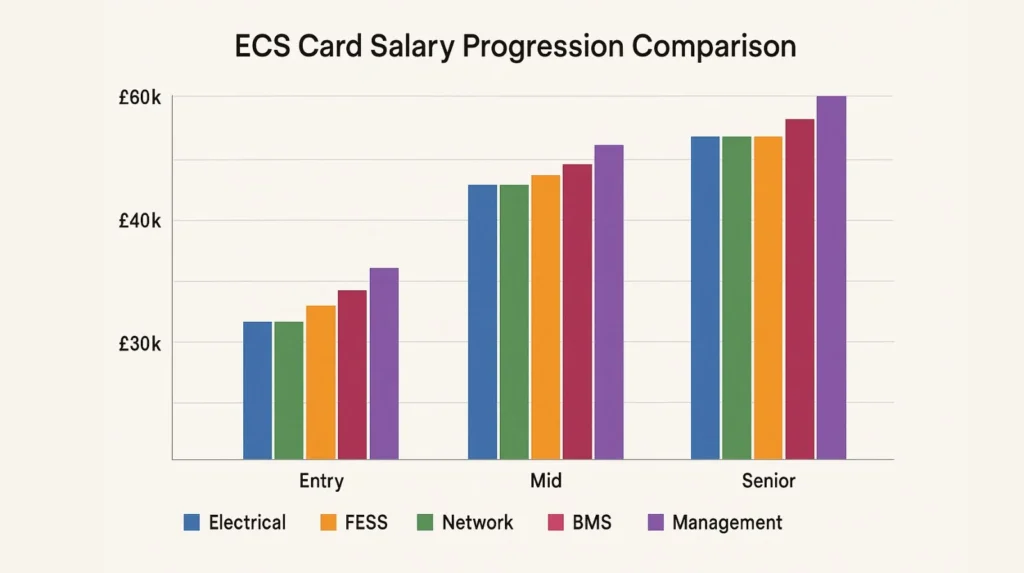
ECS cards demonstrate the qualifications and competence associated with a particular occupation or training status. Pay is determined separately by factors such as JIB grading, employer, location, sector, experience, employment status and the type of work being carried out.
An ECS card should therefore not be treated as a fixed salary band or automatic indicator of earnings. Two people holding cards associated with the same occupation may receive different pay depending on their grading, responsibilities, employer, location, contract arrangement and experience. Salary expectations should be assessed against the specific role and employment terms rather than the ECS card alone.
Cross-Sector Job Access Rules
Commercial and industrial sites require minimum Gold Card status for electrical work. FESS Technician minimum for fire and security work. BMS Technician for building controls work. Cards commonly rejected include Labourer and Electrical Labourer for craft work, Domestic Installer for commercial and industrial sites, FESS Operative for unsupervised advanced work, lower-level Network Infrastructure routes where the role requires advanced infrastructure competence and all management cards for hands-on craft work.
Cards requiring supervision include all trainee variants, apprentices, adult trainees, FESS Operative for limited work, Pre-Apprentice, and Industry Placement. Employers and site operators may verify card status at site induction. Whether a particular ECS card is required depends on the employer, client, site and role requirements.
Myths and Misconceptions Debunked with Evidence
Misconceptions about ECS cards waste money, time, and cause career delays. Here are the most common myths debunked with evidence from official sources.
Myth 1: CSCS is enough for electrical work. False. A general CSCS card does not demonstrate electrotechnical competence. Electrical workers should hold the ECS card appropriate to their occupation and site role where ECS evidence is required.
Myth 2: Level 3 diploma makes you fully qualified. False. Level 3 diploma in electrical installation (qualification 2365) is theory-only coursework. It proves theoretical knowledge of electrical principles, regulations, and design but does not assess practical competence. To achieve Installation Electrician Gold Card status, you need NVQ Level 3 (practical competence portfolio), AM2 practical assessment pass, 18th Edition BS 7671 certification, and ECS Health and Safety pass. Learn Trade Skills confirms diploma alone is insufficient for competence proof or Gold Card eligibility. Diploma holders cannot work unsupervised or certify electrical installations without completing NVQ and AM2 requirements.
Myth 3: Domestic Installer equals Gold Card. False. Domestic Installer card certifies competence strictly for domestic electrical work in dwelling properties. It is limited to homes, flats, and domestic outbuildings. Installation Electrician Gold Card certifies competence for domestic, commercial, and industrial electrical work across all building types. The cards are not interchangeable. ECS official specifications confirm the distinction. Domestic Installer cards are rejected on commercial construction sites, industrial facilities, and large-scale projects. If your career goal includes commercial electrical work, you must pursue Installation Electrician Gold Card via full NVQ 2357 and AM2 route, not the domestic-only pathway.
Myth 4: Black Card is senior electrician status. False. Black Card is a senior management card certifying construction site management and business operations. Entry requires management qualifications, typically a degree or Level 5 in management, business, or construction management. No hands-on electrical qualifications are required for Black Card. COSAC and ECS confirm Black Card is managerial and non-craft. Black Card holders cannot perform electrical installation, testing, or maintenance based on the card alone unless they also hold separate craft cards. The card provides managerial site access, not craft work rights. For senior electrician or master electrician status in terms of hands-on competence, you need Approved Electrician or Technician cards, not Black Card.
Myth 5: AM2 is optional. False. AM2 (Assessment Method 2) is the mandatory practical end-point assessment for achieving Installation Electrician Gold Card status. The assessment lasts 2.5 days and tests safe isolation, installation tasks, inspection and testing, fault-finding, and online knowledge. You cannot achieve Gold Card without passing AM2. NET Services and Learn Trade Skills confirm AM2 is non-negotiable. Completing NVQ Level 3 portfolio without passing AM2 does not grant Gold Card eligibility. The assessment proves practical competence under exam conditions and is required by JIB, NICEIC, and NAPIT for electrician recognition.
Myth 6: Fire and security engineers don’t need ECS. False. FESS (Fire, Emergency, and Security Systems) workers require ECS cards for site access. FESS cards certify competence via FIA (Fire Industry Association) and SSAIB (Security Systems and Alarms Inspection Board) standards. ECS official guidance confirms FESS card requirements for site access. Employers demand FESS Operative or FESS Technician cards matching work scope. The myth likely stems from confusion about low-voltage system work, but regardless of voltage, site access and competence certification require appropriate ECS cards.
Myth 7: Any degree gives White AQP card. False. White AQP (Academically Qualified Person) card requires a relevant degree in electrical engineering, electrotechnical systems, electronic engineering, or closely related fields. Not any university degree qualifies. ECS specifications state the degree must be relevant to electrotechnical disciplines. A degree in history, business, or unrelated subjects does not qualify for White AQP status. The card is for professionally qualified personnel working in non-hands-on electrotechnical roles, requiring specific academic background.
Myth 8: EWA instantly gives Gold Card. False. Experienced Worker Assessment (EWA 2346) provides a provisional 18-month ECS card, not Installation Electrician Gold Card. The provisional card permits limited electrical work whilst you complete the AM2E (Assessment Method 2, Experienced Worker) practical assessment. ECS confirms EWA is provisional only. You must pass AM2E within 18 months to convert to Gold Card status. If you fail AM2E or don’t complete within the 18-month period, the card expires and you do not achieve Gold Card. Additionally, the EWA 2346 pathway is being withdrawn post-2026, creating urgency for candidates currently on this route.
Myth 9: Labourer cards provide electrician competence. False. Labourer and Electrical Labourer cards are for supervised support work only. They do not demonstrate electrician occupational competence and should not be presented as permission to undertake electrician craft work independently. Work scope is limited to support activities such as cable pulling, material handling, and site preparation under appropriate supervision. They do not authorise independent terminations, testing, installation, or certification. Strict commercial and industrial sites reject labourer cards for electrical-specific tasks due to lack of craft qualifications. To perform supervised electrical work as a learner, you need Trainee or Apprentice card minimum, requiring enrolment in formal training programmes.
Myth 10: Management cards demonstrate craft status. False. Site Manager, Black Card, Site Supervisor, and other management cards identify management, supervision, and oversight roles rather than hands-on electrical craft competence. Management card holders cannot perform electrical installation, testing, or maintenance based on management cards alone. ECS specifications separate management from craft cards. If you need both management and craft capabilities, you must hold separate cards for each, such as Installation Electrician Gold Card for craft work and Site Manager or Black Card for management functions.
Real-World Experiences from Forums, Reddit, and Social Media
Forum discussions, Reddit threads, and X (Twitter) posts reveal consistent patterns in ECS card experiences, highlighting application delays, site rejections, and qualification confusion.
Application delays and processing issues. X user complaints consistently mention weeks-long delays in application processing. Paraphrased quote:
"Applied for new card a month ago, not looked at until yesterday, on hold due to out-of-date H&S, now can't get on site. JIB takes the piss." Another user asked: "Site having problems at the minute?"
referencing ECS portal access issues. Payment processing problems including EMI bounce issues affecting CIBIL scores were reported, blocking card applications. IT system delays acknowledged by official ECS account note applications on hold for weeks due to technical problems and missing documentation.
Card rejection experiences. Labourer cards face rejection on strict commercial sites due to no craft qualifications, resulting in site access denial. Contractors insist on trainee minimum for any electrical work involvement. Trainee application rejections occur when JIB registration isn’t confirmed, paperwork is incomplete, or foreign qualifications don’t map to UK NVQ frameworks. Domestic Installer limitations cause frequent frustrations. Forum quote:
"Domestic Installer myth leads to commercial rejections."
Learners pursue domestic pathway assuming it equals Installation Electrician Gold Card, then face commercial site rejections discovering the limitation too late. Foreign qualification issues persist with non-UK qualifications facing scrutiny, mapping difficulties to UK NVQ framework, additional assessments required, and verification delays.
Mis-sold qualification issues. AM2 and AM2E confusion causes learners to be unclear which assessment they need, with training providers mis-selling route requirements. This results in wasted cost and time on wrong pathways. Level 3 diploma mis-selling occurs when courses are marketed as “fully qualified electrician” status. Reality is theory only, requiring NVQ plus AM2 for Gold Card. Expectations are not met upon completion. EWA provisional status confusion happens when the route is sold as “instant Gold Card pathway.” Reality is 18-month provisional requiring AM2E completion. Withdrawal post-2026 isn’t always explained, leaving candidates unaware of time pressure.
Employer requirement issues in job adverts. Some employers and sites specify a particular ECS occupation or grade for certain roles. Requirements vary according to the work, client, contractor and site rules. Trainee and other developing-worker routes may also have specific supervision or training requirements depending on the position. JIB grading expectations vary. ECS cards and Competent Person Scheme registration serve different purposes. ECS relates to individual electrotechnical competence and occupation, while schemes such as NICEIC or NAPIT relate to registered businesses or individuals meeting the requirements of the relevant certification scheme. Site-specific access rules see certain sites reject labourer cards entirely. High-security sites require specific card types. Management cards are misunderstood as providing craft access, causing application confusion.
Positive experiences noted. Some workers report improved access to roles after gaining the appropriate ECS card, but individual employment and pay outcomes vary. FESS Technician progression can provide access to specialist work and recognition in the fire and security sector. Approved Electrician status can support progression into supervision and senior roles where the appropriate experience and competence are required.
Recent ECS Changes and Current Developments
The ECS card structure continues to evolve as occupational standards and competence requirements are updated. The most relevant current developments include the transition from legacy Datacomms cards to Network Infrastructure cards, the current Experienced Worker routes, Electrician Plus as a post-qualification upskilling framework, and updated revalidation requirements for certain occupations.
Legacy Datacomms transition to Network Infrastructure
The former Datacomms card structure has been replaced by the Network Infrastructure card structure. ECS states that the Network Infrastructure occupations were introduced to reflect the changing nature of the sector, which now covers data cabling, hardware, software systems and other network infrastructure technologies. The Network Infrastructure structure includes routes such as Trainee, Installer, Advanced Installer, Supervisor, Manager and Designer. Former Datacomms cards are no longer the primary route for new applicants, and applicants should use the current Network Infrastructure requirements for the relevant occupation.
Current Experienced Worker card arrangements
ECS currently provides Experienced Worker cards for candidates completing recognised Experienced Worker Assessment routes. The electrical Experienced Worker structure includes a White Card with Brown Stripe for eligible applicants with recognised Level 3 technical knowledge who have not yet completed the full industry qualification, and a White Card with Gold Stripe for people registered with a training provider to complete an Experienced Worker Assessment. Both of these electrical Experienced Worker cards have an 18-month validity period and cannot be renewed. Candidates should check the current ECS criteria and the requirements of their particular occupation before applying.
Experienced Worker Assessment routes are also available in other occupations, including Network Infrastructure and Building Controls. The applicable card, assessment and qualification requirements depend on the occupation and route.
Electrician Plus and low-carbon technology upskilling
Electrician Plus is an industry framework for qualified electricians who want to add recognised competence in low-carbon technologies. Current recognised areas include solar PV, electric vehicle charging and electrical energy storage systems. The model is intended to support qualified electricians in developing additional competence rather than replacing the underlying route to an Installation Electrician ECS Gold Card.
JIB and TESP continue to support Electrician Plus as a post-qualification upskilling approach. Approved low-carbon qualifications can provide additional recognised competence and can be recorded through the relevant ECS processes. Qualified electricians should check the current approved qualifications and ECS requirements for the specific technology they intend to work with.
Revalidation developments from 2027
ECS has confirmed new revalidation requirements from 1 January 2027 for operative-level and above renewals in FESS, Network Infrastructure and LV Cabling and Jointing occupations. For affected cardholders, renewal will require either a recognised qualification in the occupational area completed within the previous five years or a relevant role-specific knowledge and technical assessment. These requirements are intended to demonstrate continuing competence and ongoing professional development.
These changes apply to the specified occupational areas and should not be treated as a blanket new renewal rule for every ECS card. Cardholders should check the current ECS renewal criteria for their specific occupation and card before expiry.
Checking current ECS requirements
ECS card structures and requirements can change as occupational standards are updated. Before applying for a new card, renewing an existing card or selecting a training route, candidates should check the current ECS card catalogue and the requirements for the specific occupation. The MyECS account should also be used where applicable for current card information, application requirements and recorded qualifications.
What To Do Next
If you’re planning your electrical training or confused about which ECS card you need, here’s what actually works based on how the system operates.
Identify which sector you’re entering. Are you pursuing core electrical installation and maintenance work, fire and security systems, network and data cabling, building management systems, high voltage or industrial work, or management and non-craft roles? Your sector determines which card pathway you follow and which qualifications are required. Don’t assume cards are interchangeable. An Installation Electrician Gold Card doesn’t grant FESS work rights. A FESS Technician card doesn’t cover general electrical installation. Choose your sector first, then pursue the correct qualifications.
Match your training to the card you need. For Installation Electrician Gold Card: Complete Level 2 and Level 3 diplomas (2365), enrol in NVQ 2357 programme, build portfolio with workplace evidence, pass 18th Edition BS 7671, pass ECS Health and Safety, complete AM2 practical assessment. For FESS Technician: Complete FIA or SSAIB courses in fire alarm, CCTV, access control, or other FESS disciplines, gain FESS-specific qualifications (not electrical NVQ), pass ECS Health and Safety. For Network roles: Follow EU Skills pathways for data cabling, complete structured cabling certifications, pursue NVQ Level 2 or 3 in network installation. For BMS roles: Complete BESA-approved training, gain Level 3 BMS qualifications, pursue building controls certifications.
Avoid common pitfalls. Don’t pursue Domestic Installer if you want commercial work. The pathway limits you to homes only. Don’t assume Level 3 diploma alone makes you qualified. You need NVQ plus AM2 for Gold Card. Don’t believe EWA provides instant Gold Card. It’s provisional for 18 months requiring AM2E completion. A general CSCS card does not demonstrate electrotechnical competence. Electrical workers should hold the ECS card appropriate to their occupation and site role where ECS evidence is required. Don’t assume Black Card provides craft status. It’s managerial only.
Verify card requirements with employers before training. Check job adverts in your target sector. Note which cards employers demand. Some employers and sites specify a particular ECS occupation or grade for certain roles. Requirements vary according to the work, client, contractor and site rules. Check current job descriptions and site requirements before choosing a training or card route. Understanding employer expectations before training prevents wasted time and money on wrong qualifications.
Plan for upcoming policy changes. If you’re pursuing an approved Experienced Worker Assessment route, check the current ECS criteria for your specific card, including its validity period, renewal position and qualification or assessment requirements. If you’re a qualified electrician looking to expand your skills, consider Electrician Plus as a way to add recognised competence in low-carbon technologies such as EV charging, solar PV and electrical energy storage systems. If you hold existing cards, prepare for five-year revalidation cycles from 2027 requiring competence reassessment, not just renewal. Budget for price increases affecting renewals from January 2025. Ensure your ECS Health and Safety certification remains current to avoid application holds.
Call us on 0330 822 5337 to discuss which ECS card matches your career goals and training requirements. We’ll clarify whether your target role requires core electrical Gold Card, FESS specialist card, network infrastructure card, or other variant, explain qualification pathways including NVQ 2357 for electrical, FIA/SSAIB for FESS, and EU Skills for network routes, assess realistic timelines from starting training through to card achievement, outline which ECS cards are commonly used as evidence of the relevant occupational status and competence for commercial, industrial, domestic, or specialist work and explain how our in-house recruitment team supports newly qualified workers securing first roles across 120+ contractor partnerships. For comprehensive context on how ECS cards fit within UK electrical and electrotechnical qualification frameworks including NVQ pathways, apprenticeships, and career progression routes, see our ECS Gold Card.
You’ve got strong industry demand supporting you with 15,000 to 30,000 electrician shortfall projected by 2030. You’ve got multiple entry pathways depending on your starting point and career goals. The question is ensuring you pursue the right card for your target role, avoid misconceptions that waste time and money, and understand site access rules that affect employment opportunities. The ECS system is specific and strictly enforced. Taking time to understand which card you need before starting training prevents discovering limitations too late.
References
- ECS (Electrotechnical Certification Scheme) – Official Card Information – https://www.ecscard.org.uk/
- JIB (Joint Industry Board) -Grading and Card Requirements – https://www.jib.org.uk/
- NAPIT – Electrician Scheme Entry Criteria – https://www.napit.org.uk/
- FIA (Fire Industry Association) – FESS Standards – https://www.fia.uk.com/
- SSAIB (Security Systems and Alarms Inspection Board) – FESS Certifications – https://www.ssaib.org/
- BESA (Building Engineering Services Association) – BMS Standards – https://www.thebesa.com/
- Construction Industry Training Board (CITB) – Workforce Projections – https://www.citb.co.uk/
- NET Services – AM2 Assessment Information – https://www.netservices.org.uk/
Note on Accuracy and Updates
Last reviewed: 17 August 2026. This page is maintained; we correct errors and refresh sources as ECS card structures, requirements, and policy changes evolve. Card information reflects ECS official specifications as of November 2025. Salary data reflects typical UK rates across sectors from Indeed, Glassdoor, and Reed as of Q4 2025. Policy changes reflect confirmed updates from TESP, JIB, ECS, and industry bodies for 2025-2027 period. EWA withdrawal timeline reflects post-2026 phase-out confirmed by industry sources. Electrician Plus is an industry framework for adding recognised low-carbon technology competence to existing occupational competence. Next review scheduled following publication of updated ECS card specifications (estimated Q2 2026) or significant policy changes affecting card types, requirements, or availability.
