

Technically Reviewed By Thomas Jevons
Electrical Training, Assessing & Quality Assurance Expert

Employability Review By Joshua Jarvis
Careers, Employment & Learner Placement Expert
- Last reviewed:
- Changes: Complete rewrite expanding practical examples, evidence requirements, unit-by-unit guidance, and photographic evidence standards with real-world scenarios

Table of Contents
So, you’ve done your Level 2, Level 3, 18th Edition and now you’re ready to complete the second-to-last stage: the 2357 NVQ (please note AM2 is still needed after this stage).
The 2357 NVQ portfolio is one of the most searched and least explained parts of becoming a qualified electrician. You have searched high and wide trying to find examples of what you need and how it should look.
Fear not, we’ve got you covered. Each unit comes with a downloadable PDF that gives you a working example of how it should look and what’s needed in each unit so you can build your evidence correctly from the start rather than having work sent back.
Don’t have your Level 2 or 3? We can help with a Fast Track Diploma.
What Is the NVQ?
The NVQ is a practical portfolio build which is in place to help you demonstrate your workplace competence. If you’re ready to get started, you can begin your NVQ Level 3 electrical course today.
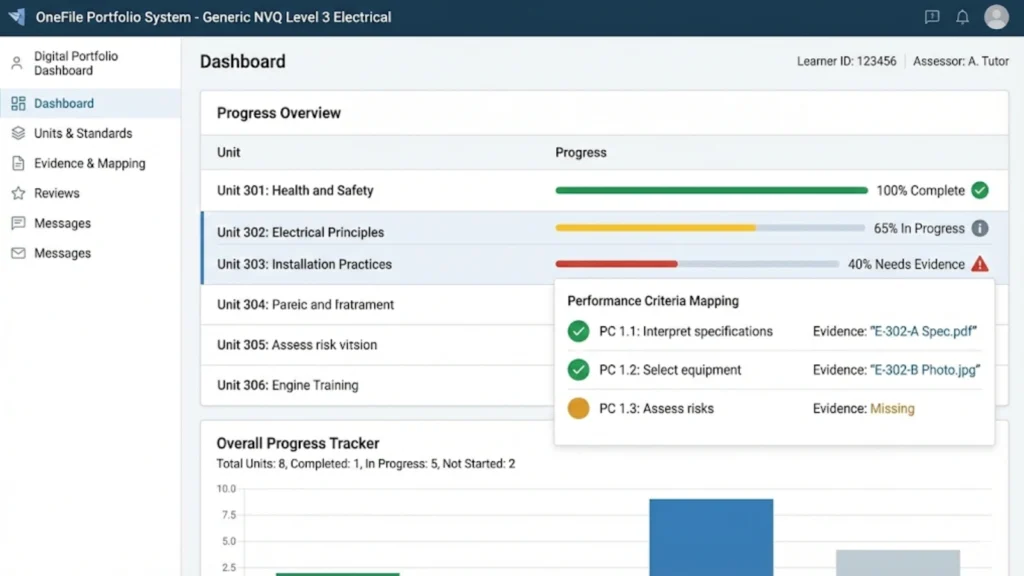
Most training providers use an online file management system such as OneFile, Smart Assessor or VQManager.
We use the OneFile management system.
How Long Will My NVQ Take?
It can take anything from 6 months to 36 months to complete. The timeline depends on how active you are, on site and off.
For the wider route before and after the NVQ, compare how long it takes to train as an electrician in the UK
Get a personalised estimate based on your current situation
Most learners take around 6 to 9 months to secure a job or placement before their NVQ portfolio really gets started. That's completely normal, but it's also pressure you don't need to carry on your own.
Our guaranteed work placement programme is built specifically to remove that job-hunting pressure. Rather than spending months searching on your own, we work to find you a paid placement so you can start collecting real site hours and building your NVQ portfolio.
Enrol on our NVQ Level 3 course with guaranteed placementWhy Do I Need to Do the NVQ?
What’s Involved in the NVQ?
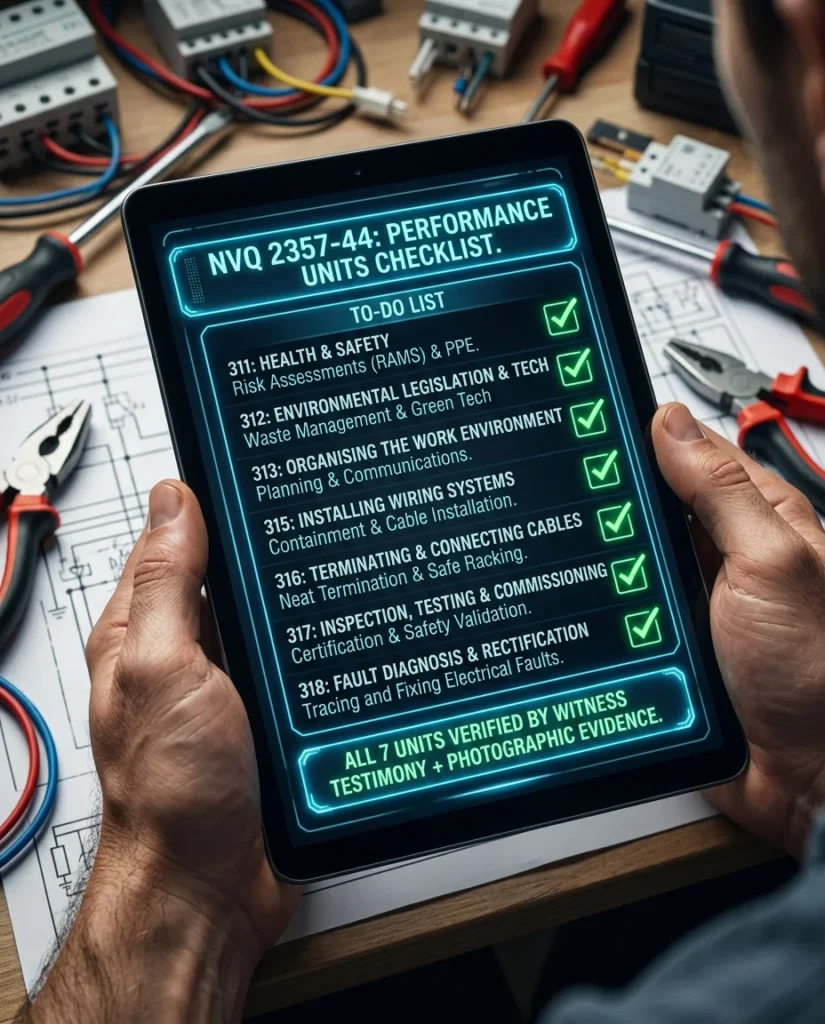
The Seven Practical Units to Success
There are Seven Practical Units to complete:
- 311: Health & Safety
- 312: Environment
- 313: Overseeing and Organising the Work Environment
- 315: Installing Wiring Systems and Enclosures
- 316: Terminating and Connecting Conductors, Cables and Flexible Cords
- 317: Inspecting, Testing, Commissioning and Certificating Electrical Systems
- 318: Diagnosing and Correcting Electrical Faults
Unit 311 – Health & Safety Unit
Also, you should be wearing the correct PPE as per your Risk Assessment/Method Statement.
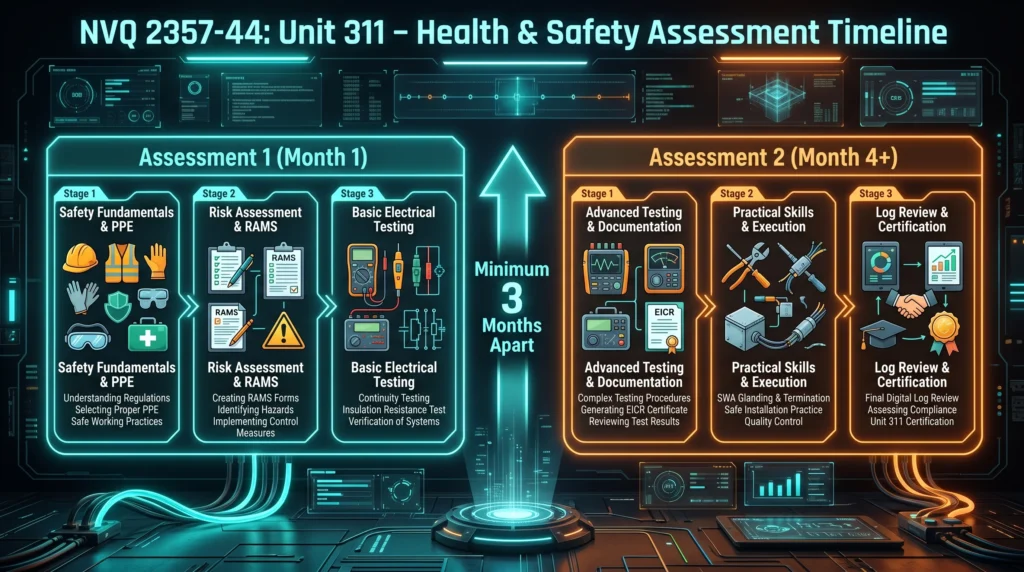
Recap — The three essentials:
- Correct PPE selection based on site-specific risk assessment
- Safe isolation procedure demonstrated in stages
- Controlled work areas with appropriate signage
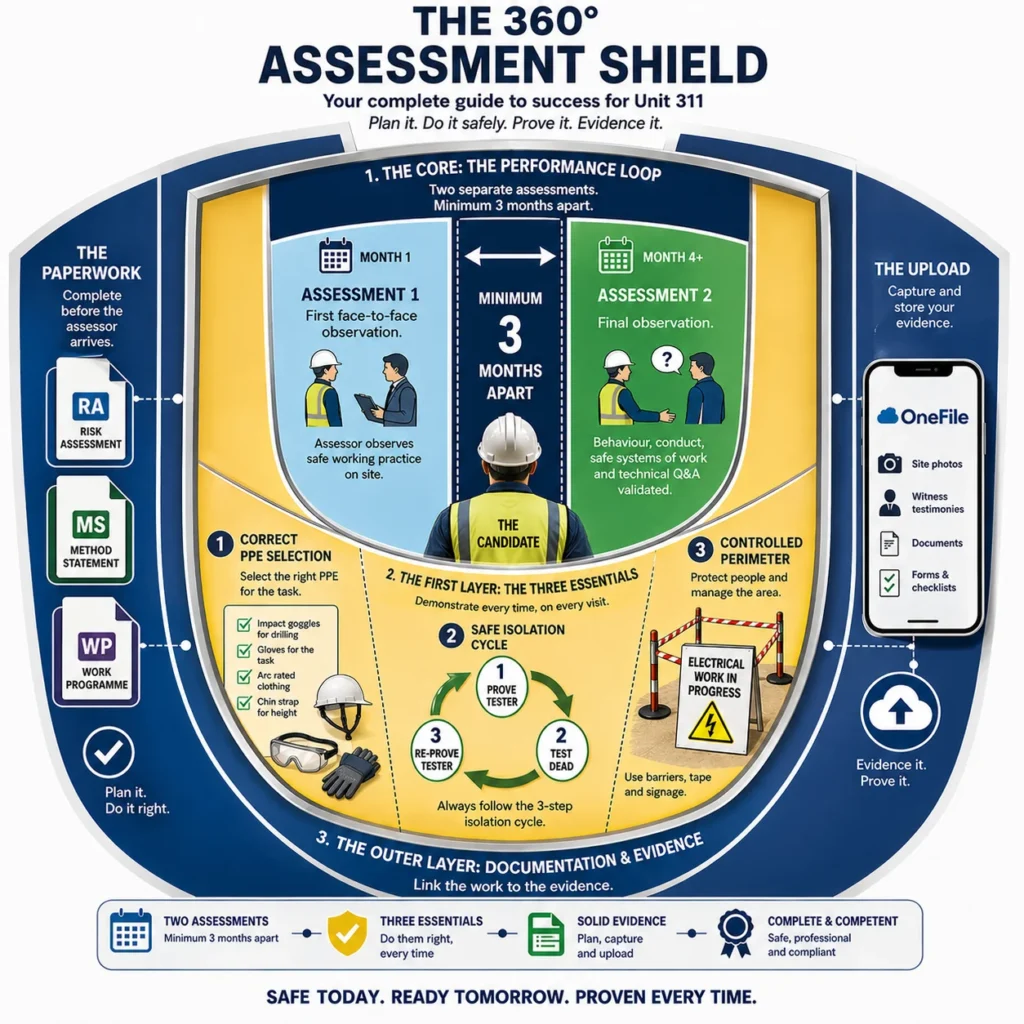
Here is a working example:
Unit 312 – Environmental & Technologies
This unit is a written project, it’s split into two sections. The first section covers the environmental section where you will need to produce a written project about the use of hazardous materials and products in reference to jobs you have worked on:
- Environmental Protection Act
- Hazardous Waste Regulations
- Control of Pollution Act
- Control of Noise at Work Regulations
- Packaging (Essential Requirements) Regulations 2015
- Environmental Act 1995
- WEEE Regulations
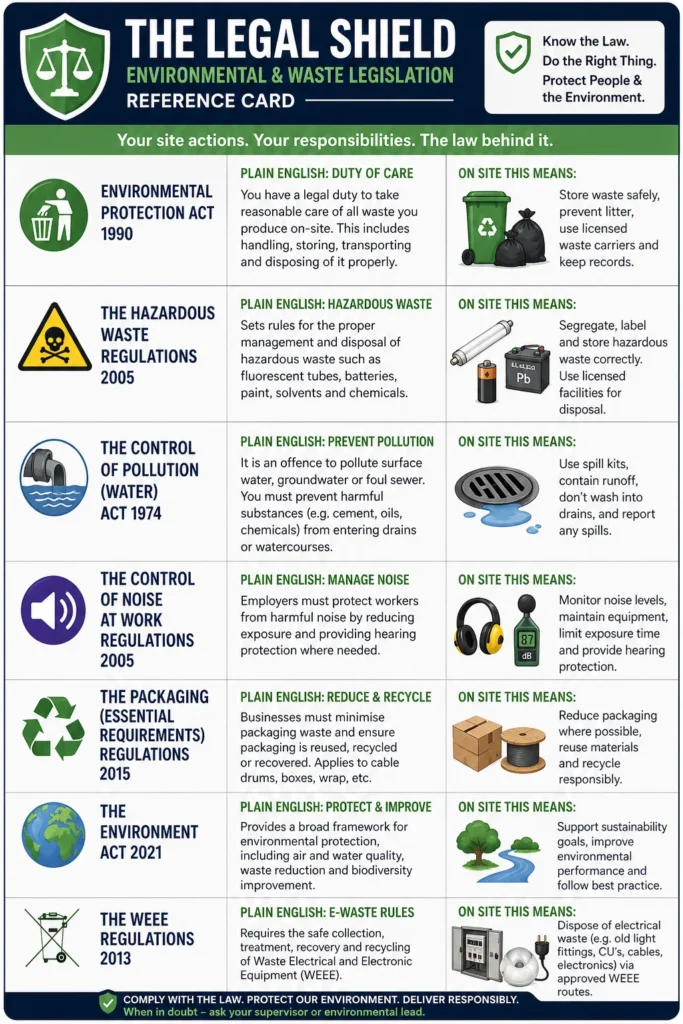
The second part focuses on the technology that you might have used during the install.
Seeing solar PV, micro hydro, biomass and CHP on the same list can feel overwhelming but just remember you don’t need all of them. This section only requires evidence from technologies you have genuinely worked with. If your experience is limited to one or two of these, that’s fine. Talk to your advisor about what you have, and they’ll guide you on how to present it.
- Solar photovoltaic
- Wind Energy
- Micro Hydro
- Heat Pumps
- Grey Water Recycling
- Rainwater Harvesting
- Biomass Heating
- Solar Thermal Hot Water Heating
- Combined Heat & Power including Micro CHP
A typical example can be found below:
Unit 313 – Overseeing Work
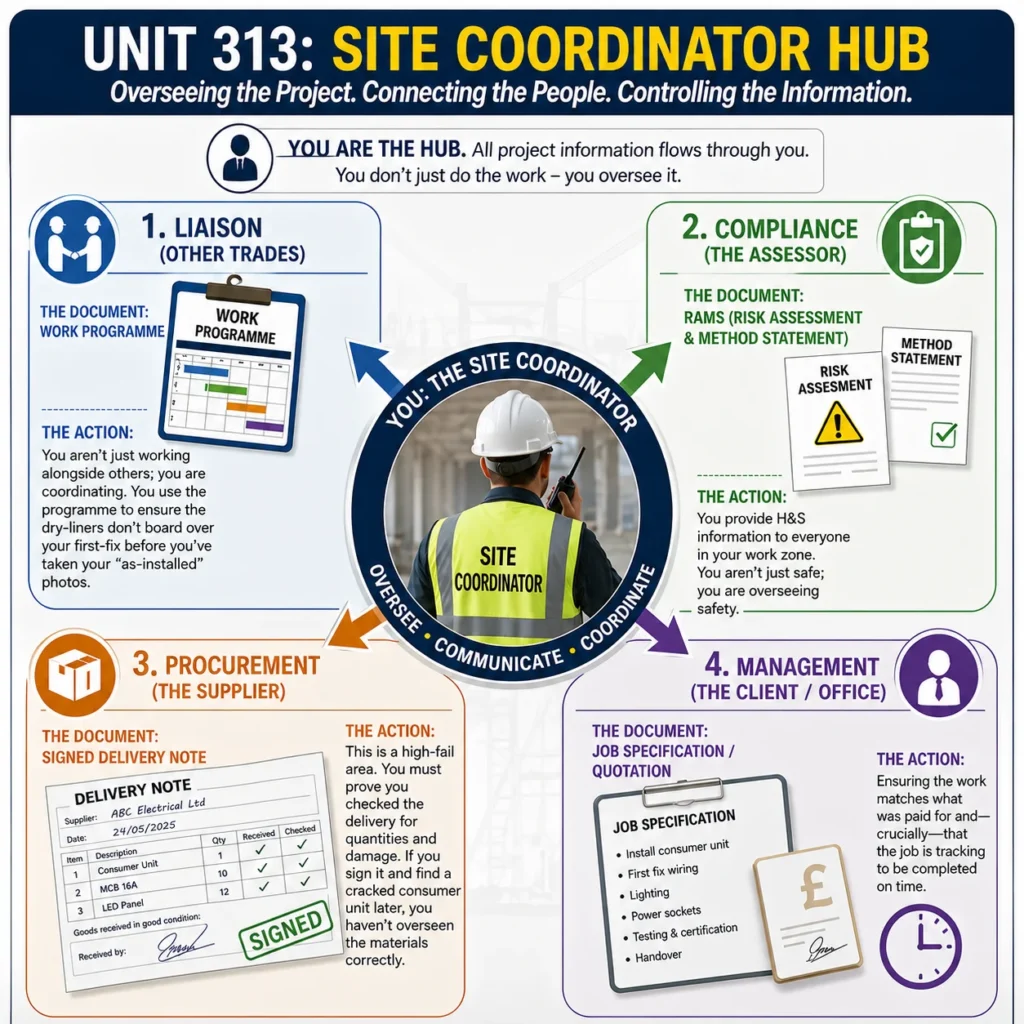
This unit is about providing H&S information, details of the work activity you’re carrying out (e.g. job specification/quotation), how you liaise with other trades on site, and how you ensure the job is completed on time.
- Produce a Work Programme showing liaison with other tradespeople.
- Produce a Risk Assessment and Method Statement.
- Provide information on tools and equipment used.
- Materials collected or delivered to site – use of Delivery Note to check for correct quantities and to check that no materials are damaged.
Parts of this unit can be assessed during the face-to-face site assessment by direct questioning.
Download the Unit 313 Assessment Example.
Please note there is no Unit 314 for the NVQ 2357.
Unit 315 – Planning, Preparing & Installing
This unit is similar to Overseeing Work; in addition, you will need to provide information about how you make sure any equipment installed is safe to use.
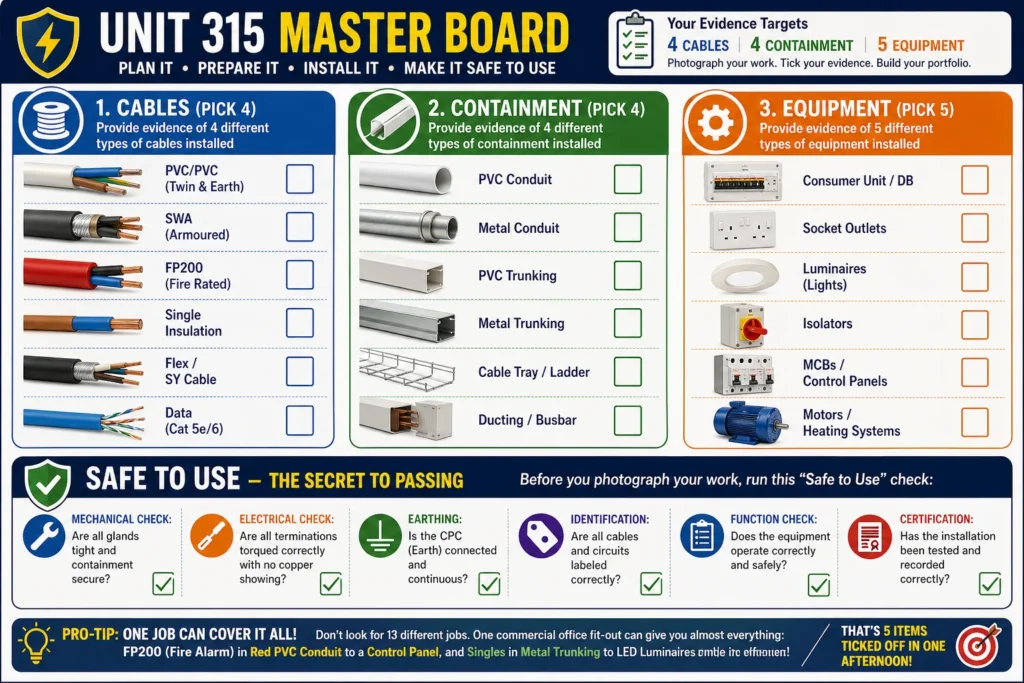
Provide evidence of four different types of cables you have installed:
- PVC/PVC cable (T&E)
- SWA cable
- FP200 cable (fire resistance)
- Single insulation cable
- Flexes
- SY cable
- Data cable (e.g. Cat 5e)
Provide evidence of four different types of containment you have installed:
- PVC conduit
- Metal conduit
- PVC trunking
- Metal trunking
- Cable tray
- Ladder systems
- Ducting
- Busbar systems
- Modular wiring systems
Provide evidence of five different types of equipment you have installed:
- Isolators
- Socket outlets
- DBs (Distribution Boards)
- Consumer unit
- Luminaires
- MCBs
- Earth terminals
- Control panels
- Electric motors and control equipment
- Heating systems
- Data sockets
Unit 316 – Terminations & Connections

Provide information/evidence that you have connected four types of equipment (as above).
Provide evidence of the use of three types of connections:
- Screwing
- Crimping
- Soldering
- Non-screw compression (Wagos)
Unit 317 – Inspection & Testing
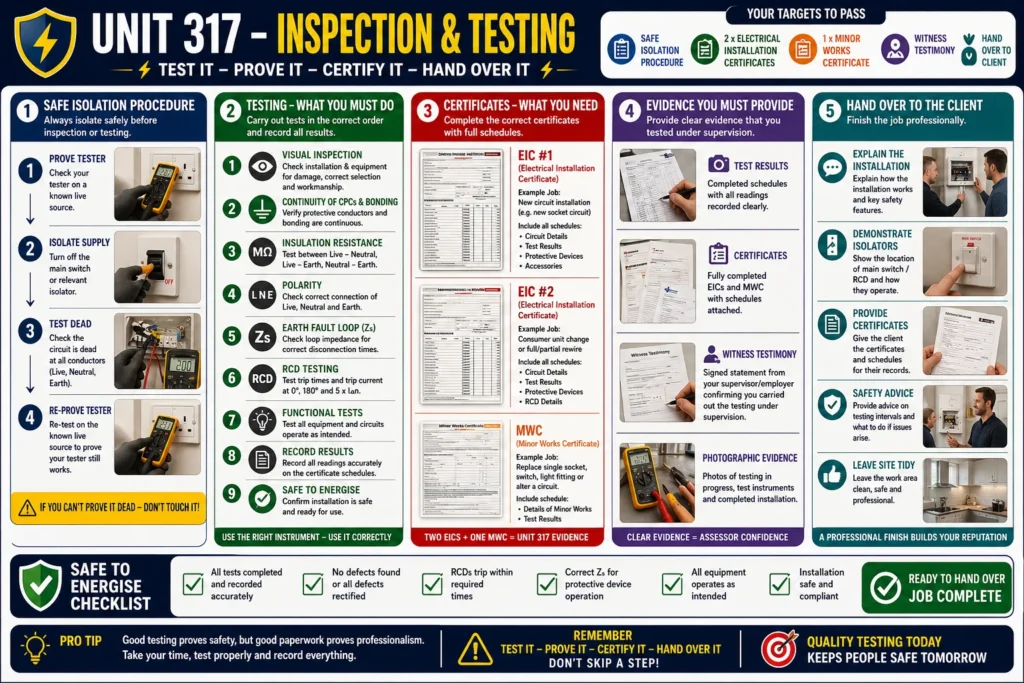
You will need to provide information on how you carried out the Safe Isolation Procedure.
- Complete 2 Electrical Installation Certificates complete with the schedules (use the On-Site Guide to assist you) for 2 jobs you have tested under supervision.
- Complete a Minor Works Certificate for a job where you carried out alterations to a circuit or replaced an accessory.
- Provide a Witness Testimony from your Work Supervisor/Employer that you carried out the testing under supervision.
- Provide information on how you handed over the installation to the customer/client.
Unit 318 – Fault Finding
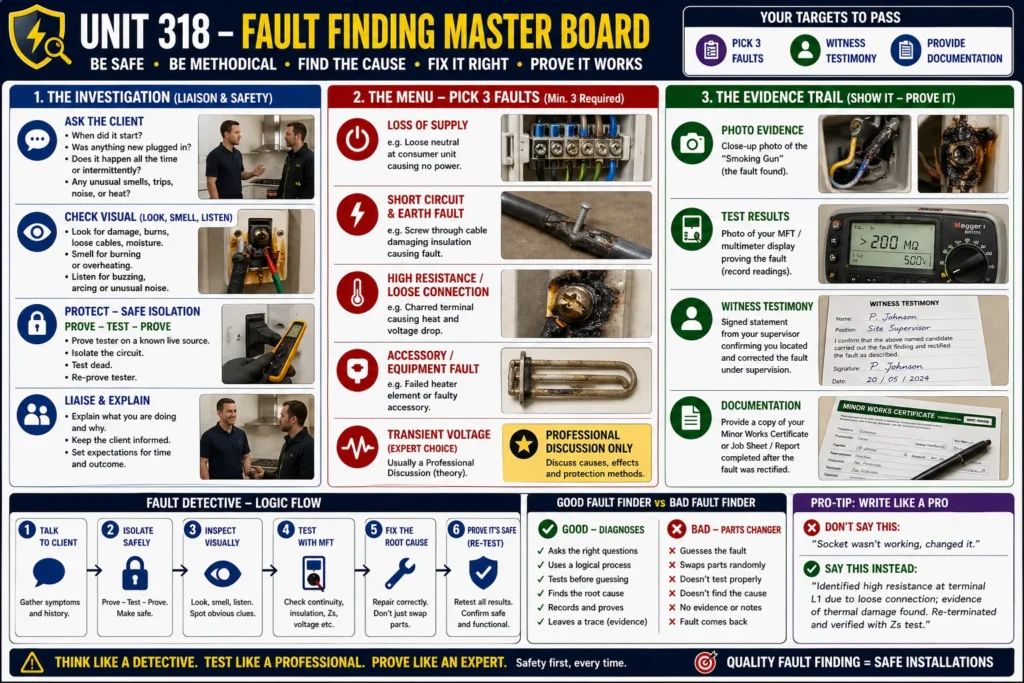
One of the most important parts that students get wrong is demonstrating/providing information on how you carried out the Safe Isolation Procedure prior to fault finding. This part is essential to show you can work safely.
Other parts covered in this unit:
- Liaise with the customer/client prior to starting the fault finding.
- Provide information on 3 different types of faults you have rectified from this list:
- Loss of supply
- Overload
- Short circuit and earth fault
- Transient voltage (Professional Discussion)
- High resistance joints/loose connection
- Incorrect phase rotation
- Accessory/equipment faults
For the faults above you will need to provide evidence of the tools and test instruments used.
- Provide a Witness Testimony from your Work Supervisor/Employer that you located and corrected the faults.
Provide evidence of documentation you provided after the fault finding.
*Witness testimony is a written statement from a competent person, usually a qualified supervising electrician, confirming they have seen you carry out the work. It should explain what task you completed, where and when it was done, and confirm that you worked safely and competently.
Unit 399 – AM2
The AM2 is not delivered as a normal portfolio unit. It is a separate, externally assessed competence test that you must complete at an approved NET AM2 Centre.
Once you have completed the seven practical units, we will support you with applying to an approved AM2 Centre to sit your AM2 assessment. This is an additional cost.
The AM2 is a practical assessment carried out over approximately two and a half days. It is designed to test your occupational competence and includes key areas such as installation, inspection and testing, fault diagnosis, safe isolation and understanding of electrical working practices.
From April 2026, the NET recommended fee is £885. Budget for this separately, it is not included in your course fees.
You can find further information at: www.netservices.org.uk
Once you have passed the AM2, your portfolio can then be completed and signed off by City & Guilds. When you receive your 2357-44 NVQ, you will then be able to apply to ECS for your ECS JIB Gold Card.
Completing an NVQ does not automatically register a business; our guide explains the current NICEIC routes for domestic installers and qualified supervisors.
Summary of Documentation Required to be Completed
At Elec Training this is what we expect from students:
- 2 Risk Assessments
- 2 Method Statements
- 2 Work Programmes
- 2 Electrical Installation Certificates
- 1 Minor Works Certificate
- 2 Witness Testimonies for the Inspection/Testing and completion of Electrical Installation Certificates (Unit 317)
- 1 Witness Testimony for Fault Finding (Unit 318)
Use of Photographic Evidence
One of the biggest problems we see with students every week is incorrect photographic evidence. It’s literally two ends of the scale: either 50 photos when only three are needed, or post-completion photos only.
If you are using photos as evidence for a task you are working on or have completed, you should provide a minimum of three photos: before, during and after.
Example
Before
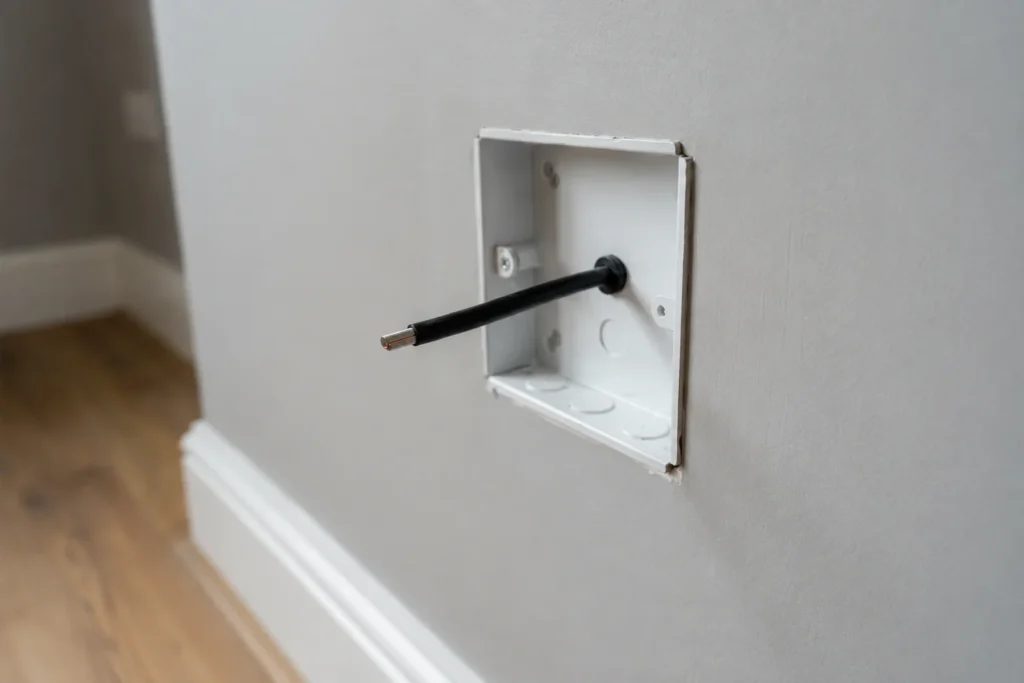
This task was to terminate a TV point using the screwed method.
During
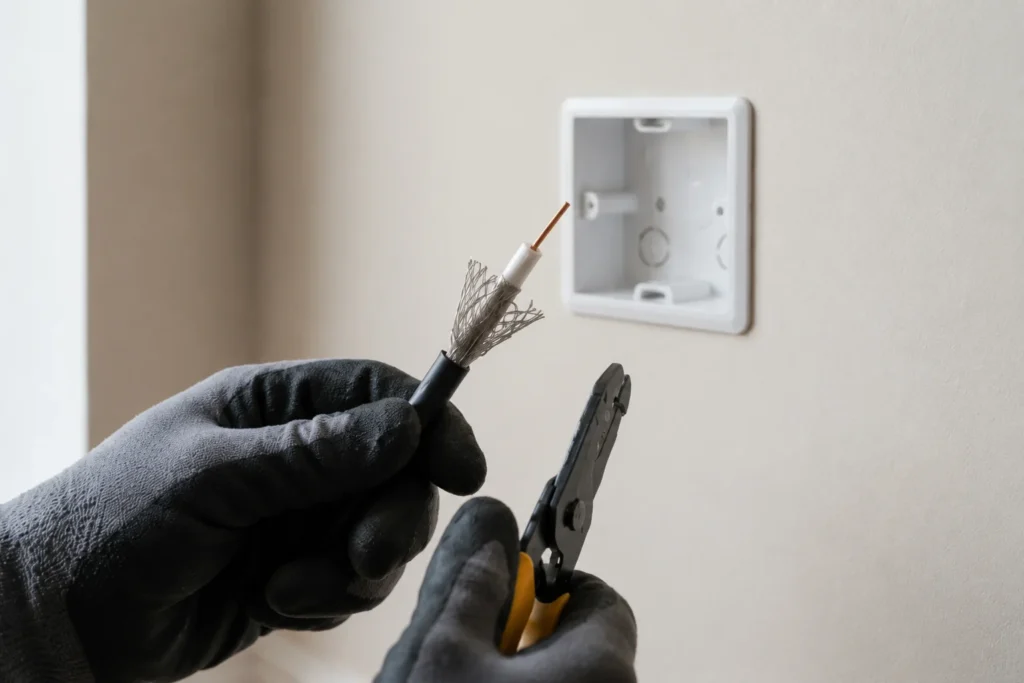
Strip back the outer sheathing, exposing the braided cable, which is to be connected to the clamp on the back of the plate.
After
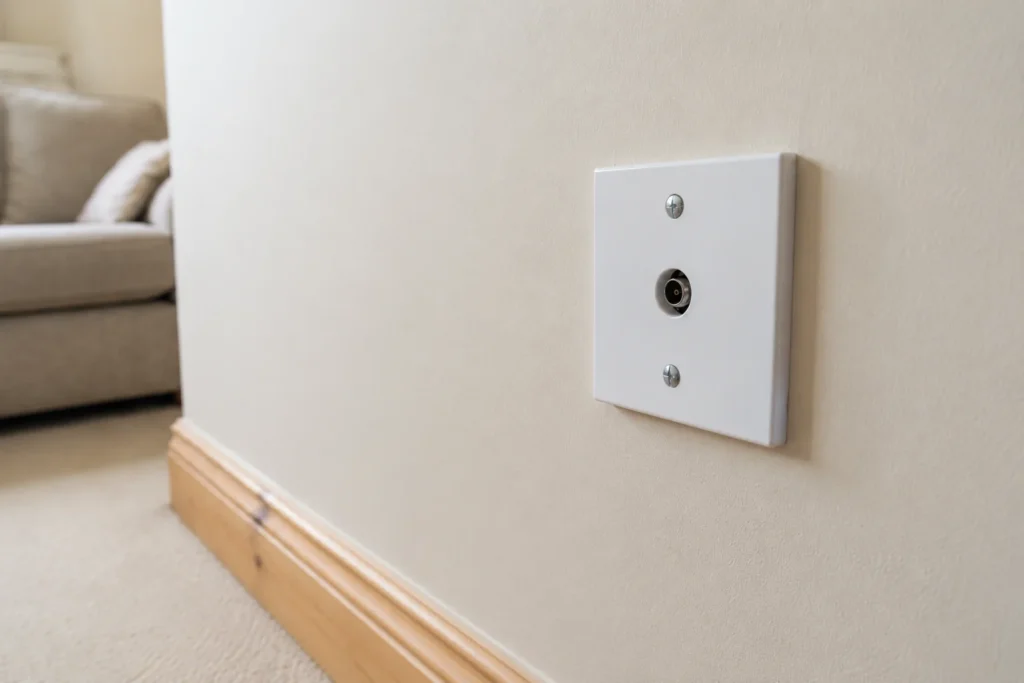
Completed installation of the terminated TV point, with the plate securely fitted and the cable connection enclosed neatly behind the faceplate.
Struggling to get site experience?
For many learners, the hardest part of the 2357 NVQ is getting access to genuine electrical site work where the evidence can actually be collected.
To complete the NVQ, you need real workplace evidence across the seven practical units. That means you need to be working on suitable electrical tasks, taking before, during and after photos, collecting witness testimony, completing site paperwork, and being observed by an assessor where required.
Elec Training supports learners with this through our electrical paid work placement route. Our recruitment team works with contractors to help suitable learners access real site opportunities and start building the evidence needed for their NVQ portfolio.
This support is a major part of the Elec Training route. We understand that adult learners and career changers often do not already have electrical contacts, which can make the NVQ feel difficult to start. Our placement process is designed to help our enrolled students bridge that gap by helping learners become more employable, more prepared for site, and better positioned to complete their NVQ evidence.
Still not sure what to do next? We can help!
Enquire Now

By Charanjit Mannu
Director, Elec Training
Based on real training delivery, learner outcomes, and current UK electrical regulations.
- City & Guilds Approved
- 4.8★ Google Reviews
- 1000+ Electricians Trained


Prefer a callback?
- City & Guilds
- 4.8 Trustpilot
- JIB Recognized
- 1,000+ Trained
