

- Technical review: Thomas Jevons (Head of Training, 20+ years)
- Employability review: Joshua Jarvis (Placement Manager)
- Editorial review: Jessica Gilbert (Marketing Editorial Team)
- Last reviewed:
- Changes: Initial publication covering JIB grading structure and pay band progression
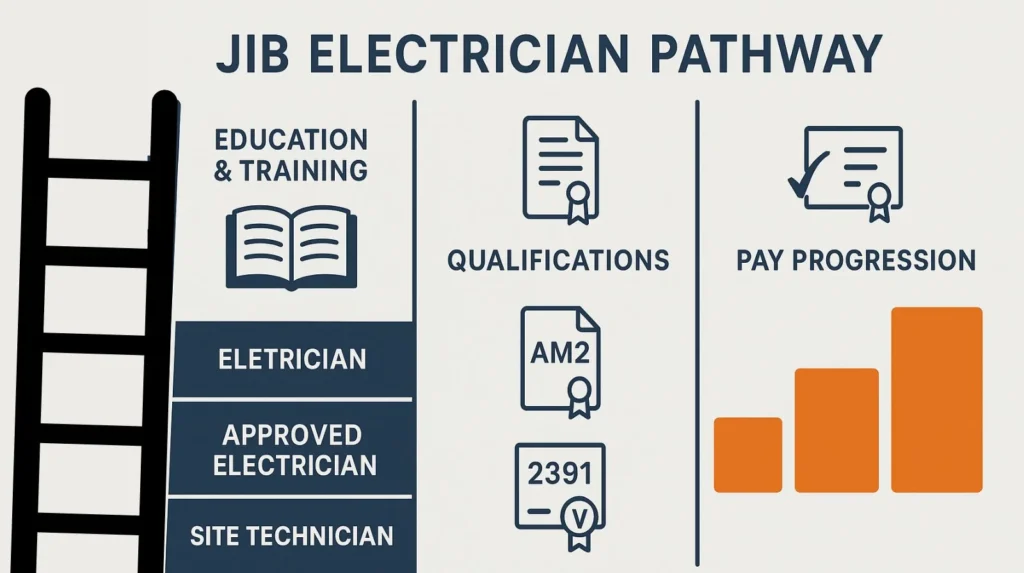
Why JIB Pay Bands Matter in the Real World
If you’ve spent any time on ElectriciansForums or Reddit’s r/ukelectricians, you’ve seen the arguments. “Does a Gold Card mean you’re Approved or Technician?” “Can you skip straight to Approved with a 2391?” “I’ve got 10 years on the tools, why am I still graded as a Labourer?”
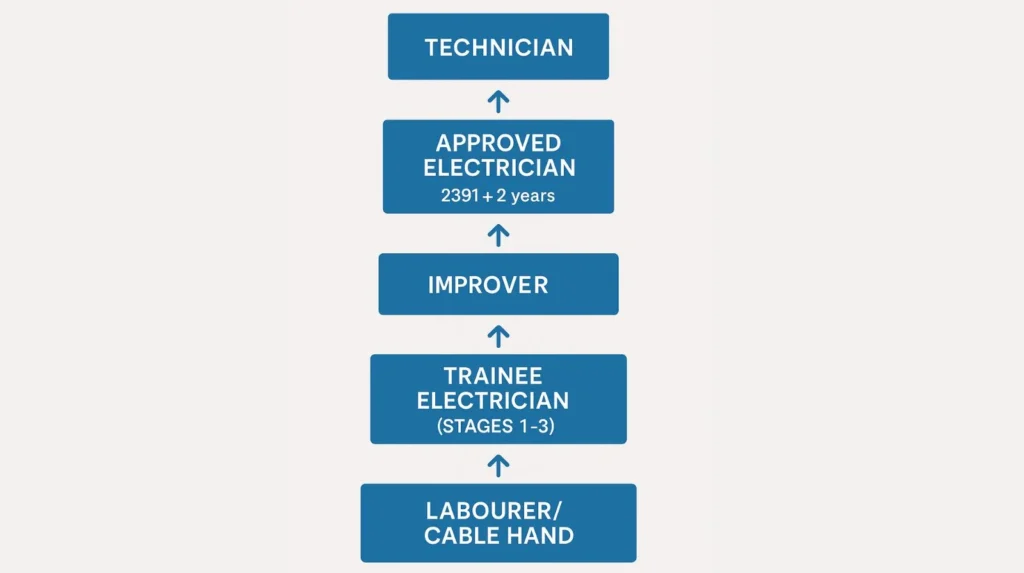
Here’s the thing: JIB grading is the system that controls what you’re paid, what you’re entitled to (sick pay, lodging allowance, mileage), and what level of work you’re legally allowed to do on JIB sites. It runs from Labourer at the bottom through Trainee Electrician, Improver, Electrician, Approved Electrician, and finally Technician at the top. Each grade has specific qualification, experience, and competence requirements. You can’t skip steps. Years on the tools don’t replace formal assessments.
Understanding jib electrician rates starts with understanding where you actually sit on this ladder, not where you think you sit based on forum advice or what your mate told you down the pub.
The confusion is real. Domestic installers think they’re automatically graded Electrician. Improvers believe they’re equivalent to Electricians. People with NVQ Level 3 assume they’re Approved. Self-employed sparks wonder if JIB grading even matters to them. And the number of electricians stuck on Labourer grade despite having theory qualifications is genuinely frustrating.
Thomas Jevons, our Head of Training with 20 years on the tools, sees this confusion daily:
"The JIB grading system isn't arbitrary. Each grade from Labourer through to Technician has specific qualification and experience requirements laid out in the JIB Handbook. You can't skip steps or assume years on the tools replace formal assessments like the AM2 or NVQ Level 3."
Thomas Jevons, Head of Training
That’s what this article does. We’re walking through the entire JIB ladder, grade by grade, using official JIB definitions and ECS criteria, so you know exactly where you sit, what you need to progress, and what you should be getting paid.
The Entire JIB Ladder in Plain English
Let’s map the full hierarchy before we dive into each grade. The JIB grading structure exists to ensure electricians are paid according to their qualifications, experience, and the level of responsibility they carry. It’s not about how long you’ve been in the trade. It’s about what you can prove you’re competent to do.
The grades, bottom to top:
Labourer / Cable Hand. Unskilled work under supervision. Assisting qualified electricians with cable installation, tray work, and material handling. No craft work. Limited to a ratio of one Labourer per four skilled JIB-graded operatives.
Trainee Electrician (Stages 1-3). Formal developmental grade for apprentices and trainees on structured JIB training schemes. Stage 1 is entry-level, Stage 3 is near completion of the apprenticeship. Pay increases at each stage.
Electrical Improver. Specific grade for apprentices who achieved NVQ Level 2 but didn’t complete Level 3. Not a universal grade for anyone with partial qualifications. Designed to keep people in the industry while they work toward full qualification.
Electrician. Fully qualified to NVQ Level 3 (or equivalent: 2357, 2330, 2365 routes plus AM2). Can carry out electrical installation work efficiently under BS 7671, the Electricity at Work Regulations, and Construction Industry Safety Regulations. Works with minimal supervision.
Approved Electrician. Must have met all Electrician requirements, plus two years’ post-training experience as an Electrician, plus a recognised Inspection and Testing qualification (2391-52, NET AAC, or equivalent). Can work independently, supervise others, set out jobs from drawings, requisition materials, and take responsibility for job completion.
Technician (Site Technician or Installation Technician). Must have met all Approved Electrician requirements, plus five years as Approved (with at least three years in a supervisory capacity for Site Technician), plus a Level 4 qualification (HNC, BS 7671 design and verification, or equivalent). This is a technical and managerial elite grade. Not common.
Each grade corresponds to specific pay bands, which vary by region (National vs London), transport provision (employer-provided vs own transport), and sector (standard electrical, highway lighting, network infrastructure, etc.). We’ll cover the 2025 rates where the data allows, but the principle is simple: higher grade equals higher pay, plus better sick pay, lodging allowances, and benefits.
Labourer / Cable Hand: What This Grade Really Is
Let’s be clear: Labourer (sometimes called Cable Hand or Electrical Mate) is an unskilled grade. According to the JIB Handbook, Labourers assist skilled electrical operatives with cable installation, fixing brackets, clipping cables, and erecting tray work. They do no craft work. They work under supervision. And there’s a ratio limit: no more than one Labourer per four skilled JIB-graded operatives.
The pay reflects this. From the 2025 JIB tables, Labourers on National Standard rates with transport provided earn £15.09/hour, or £12.59/hour with own transport. London rates are slightly higher: £16.91/hour (transport provided) or £14.12/hour (own transport).
Here’s where the confusion starts. If you’ve completed theory qualifications like the City & Guilds 2365 Level 2 or Level 3, or the 2330, you might assume that automatically bumps you out of Labourer grade. It doesn’t. The JIB recognises only the health and safety element of those qualifications for a Labourer card. To progress beyond Labourer, you need structured training with practical performance assessments (NVQ portfolio work, AM2, or Experienced Worker Assessment).
Forum posts regularly show frustration with this: “I’ve got Level 2 and 3, why am I still a Labourer?” The answer is that theory alone doesn’t meet the competence criteria for Electrician grade. You need the full NVQ Level 3 with workplace assessments, or an equivalent route like the Experienced Worker Assessment (EWA) with AM2E.
How to progress from Labourer: Register on a JIB training scheme (apprenticeship or adult trainee route), work toward NVQ Level 3, log your site hours properly, and complete your AM2 or equivalent practical assessment. That’s what gets you to Electrician grade.
Trainee Electrician (Stages 1-3) & Improver: The Most Misunderstood Part of the Ladder
Trainee Electrician is a formal grade for people undertaking JIB-registered training schemes. You progress through Stage 1, Stage 2, and Stage 3 as you complete parts of your apprenticeship or adult training programme. Each stage brings a pay increase.
Looking at 2025 National Standard rates (transport provided), the progression looks like this:
- Stage 1: £15.09/hour
- Stage 2: £16.95/hour
- Stage 3: £17.86/hour
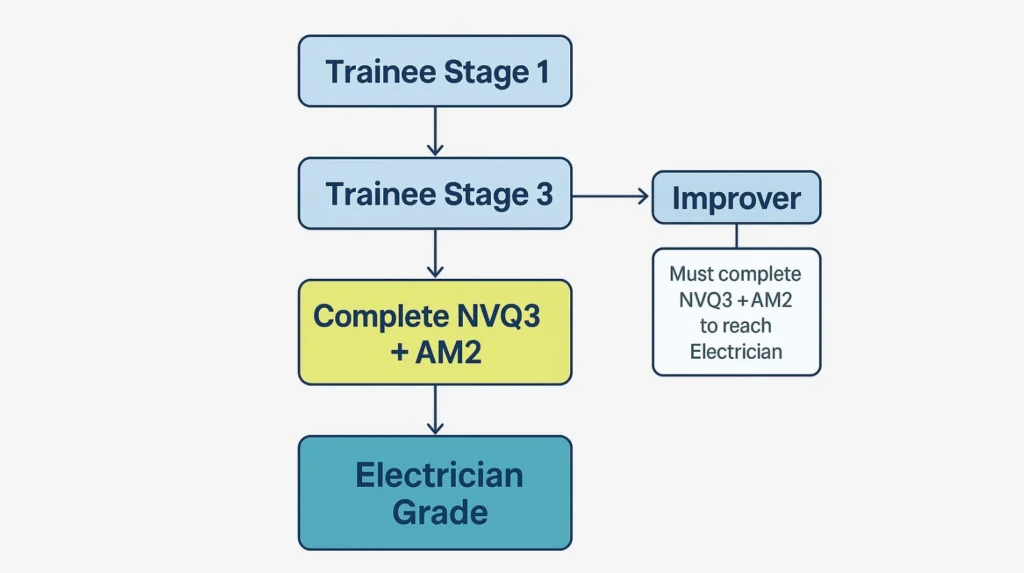
London rates are higher across the board. As you complete theory modules, gain site experience, and log evidence in your NVQ portfolio, you move up the stages. Once you’ve completed NVQ Level 3 and passed your AM2, you’re eligible for Electrician grade.
Improver is different. According to the JIB, Improver exists specifically for apprentices who achieved NVQ Level 2 but didn’t complete Level 3. It’s designed to keep them in the industry while they work toward full qualification. It’s not a universal grade for anyone with partial quals. It’s not “Electrician Lite.”
Here’s where employers sometimes get it wrong. We’ve seen forum posts from people saying
"My employer calls me an Improver but I do Electrician work."
If you’re doing Electrician-level work (installing, testing, certifying), you should be graded and paid as an Electrician. Improver is a stepping-stone grade with specific limitations, and Improver rates (2025: £16.95/hour National Standard with transport) reflect that.
Domestic Electrician confusion: If you’ve qualified as a Domestic Electrician through an Experienced Worker route or domestic apprenticeship, you’re not automatically graded as Electrician. To reach full Installation Electrician status (which is what Approved Electrician grading requires), you need to complete the Domestic Electrician bridging assessment. That bridging covers the skills missing from the domestic-only route.
Electrician: What You Must Actually Have
Right. Electrician grade. This is where you’re recognised as a fully qualified, competent operative who can carry out electrical installation work efficiently and in accordance with BS 7671, the Electricity at Work Regulations, and Construction Industry Safety Regulations.
To be graded as Electrician, you must meet one of the following:
Option 1: Successfully completed a registered apprenticeship in electrical installation, with practical training and workplace experience.
Option 2: Obtained NVQ Level 3 in Electrotechnical Services (Electrical Installation Buildings & Structures), the Level 3 NVQ Diploma in Installing Electrotechnical Systems and Equipment, or the Level 3 Electrotechnical Qualification (Installation) Apprenticeship Standard, plus the AM2 assessment.
Option 3: Completed the JIB Mature Candidate Assessment including AM2, or the Level 3 Electrotechnical Experienced Worker Qualification including AM2E.
Notice what’s missing from that list: “10 years on the tools.” Years of experience without the formal qualifications don’t meet the criteria. The NVQ Level 3 (or equivalent) and the AM2 (or AM2E for Experienced Workers) are non-negotiable.
From the 2025 JIB pay tables, Electricians on National Standard rates with transport provided earn £18.80/hour. With own transport, that drops to £16.31/hour. London rates are £21.06/hour (transport provided) or £18.28/hour (own transport).
Here’s the common myth that needs addressing: NVQ Level 3 does not automatically make you Approved. It makes you an Electrician. To reach Approved, you need additional qualifications and experience (we’ll cover that next).
Another myth: “I can skip to Approved if I’ve got the 2391.” No. The 2391 (Inspection and Testing) is a requirement for Approved, but you still need to have been graded as Electrician first, with at least two years’ post-training experience in that grade before applying for Approved.
Understanding the detailed breakdown of electrician wages by grade and region helps you see where Electrician grade sits in the broader pay structure and how progression to Approved affects your total package.
Approved Electrician: The Step People Get Wrong
Approved Electrician is where the real confusion starts. This is the grade most electricians aspire to, because it comes with higher pay, more responsibility, and recognition that you can work independently without supervision. But the requirements are strict, and people regularly misunderstand them.
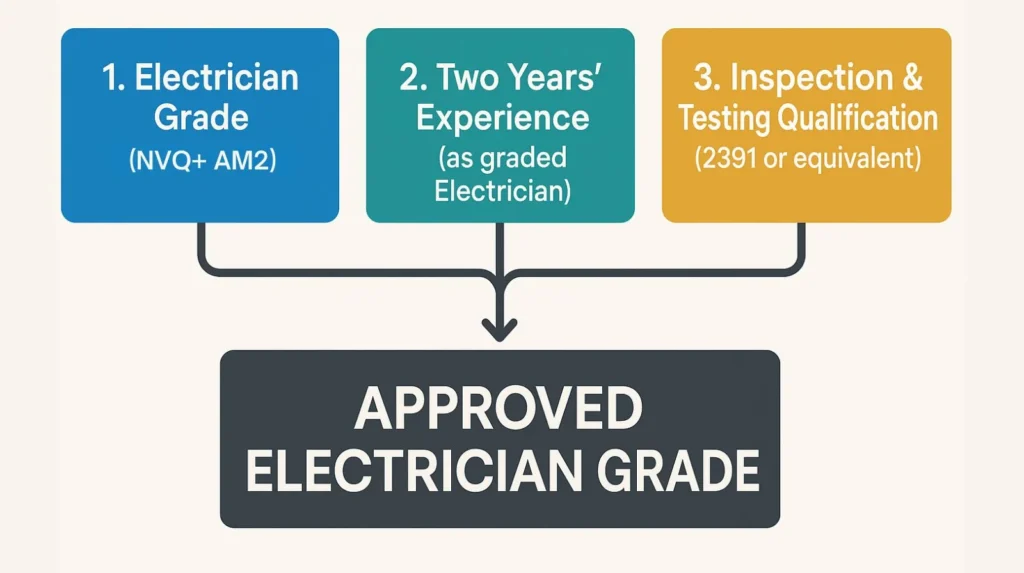
To be graded as Approved Electrician, you must meet ALL of the following:
1. Fully met the requirements for Electrician grade. That means NVQ Level 3 (or equivalent) plus AM2. You must already be graded as an Electrician (or be applying for both grades simultaneously if you meet all criteria).
2. Two years’ experience working as an Installation or Maintenance Electrician subsequent to completing your training and immediately prior to applying for Approved grade. Not two years on the tools as a Labourer or Improver. Two years as a graded Electrician.
3. Demonstrated competence in Inspection and Testing by obtaining one of the following:
- NET Advanced Assessment of Competence (AAC)
- Level 3 Certificate in the Certification of Electrical Installations (inspection, testing and certification)
- Both the Level 3 Award in Initial Verification and the Level 3 Award in Periodic Inspection, Testing and Certification
- C&G 2391-52 Level 3 Award in Inspection and Testing
- EAL or LCL Awards equivalents (full list in JIB Handbook)
The 2391 (or equivalent) is mandatory. You cannot be graded Approved without it. Forum posts sometimes claim otherwise, but the JIB Handbook is explicit: competence in Inspection and Testing is a requirement.
Here’s the good news: if you work for a JIB member company and you meet the other requirements (Electrician grade plus two years’ experience), your employer is required to fund your first attempt at the Inspection and Testing qualification without cost to you. That’s in the JIB National Working Rules.
Approved Electrician pay (2025): National Standard rates with transport provided are £20.38/hour. With own transport: £17.90/hour. London rates: £22.83/hour (transport provided) or £20.04/hour (own transport).
Compare that to Electrician rates (£18.80/hour National Standard with transport), and you’re looking at an extra £1.58/hour or roughly £3,300 annually if you’re working full-time. Add in higher sick pay (£210/week for Approved vs £200/week for Electrician) and the potential for responsibility money (50p-£2/hour if you’re supervising others), and the financial jump is significant.
What Approved Electricians do: Work independently without immediate supervision. Set out jobs from drawings and specifications. Requisition materials. Accept responsibility for proper completion of jobs. Supervise other operatives (excluding apprentices and trainees for responsibility money purposes). Must have thorough working knowledge of BS 7671, Electricity at Work Regulations, Construction Industry Safety Regulations, and relevant British Standards.
The myth about Gold Cards: Having an ECS Gold Card does not mean you’re Approved. The Gold Card shows your occupation (e.g., Installation Electrician). Your JIB grade (Electrician, Approved, Technician) is shown separately on the card. They’re not the same thing. You can hold a Gold Card as an Electrician without being Approved.
Technician: The Highest Grade (But NOT What Most Think)
Technician is the top of the JIB grading ladder. It’s a technical and managerial grade that requires extensive experience, higher-level qualifications, and proven supervisory ability. It is not a common grade. Most electricians never reach Technician, not because they’re not good at their jobs, but because the criteria are demanding and specific.
To be graded as Technician, you must meet ALL of the following:
1. Fully met all Approved Electrician requirements. That’s NVQ Level 3, AM2, two years as Electrician, plus Inspection and Testing qualification.
2. Five years’ experience working as an Approved Electrician subsequent to completing training and immediately prior to applying for Technician grade.
3. A higher technical qualification: City & Guilds “C” Course Certificate, a Level 4 technical certificate in Building Services Engineering with electrical bias (such as an HNC or approved equivalent), or a recognised BS 7671 course in Design and Verification of Electrical Installations.
4. Meet the criteria for one of two Technician categories:
Site Technician: Must have at least three years in a supervisory capacity in charge of electrical installations of such complexity and dimension as to require wide technical experience and organisational ability.
Installation Technician: Must have, with employer support, exceptional technical skill, ability and experience beyond that expected of an Approved Electrician, such that their value to the employer is equivalent to a Site Technician.
Let’s be explicit about the common mistake: NVQ Level 3 plus 2391 does not make you a Technician. It doesn’t even make you Approved. Technician requires you to have already been Approved for five years, with at least three of those in a supervisory role (for Site Technician), plus a Level 4 qualification like an HNC or design course.
Technician pay (2025): National Standard rates with transport provided are £22.96/hour. With own transport: £20.43/hour. London rates: £25.69/hour (transport provided) or £22.89/hour (own transport).
That’s a significant jump from Approved rates (£20.38/hour National Standard with transport). Over a full year, that’s an extra £5,400+ annually before you factor in higher sick pay (£220/week for Technician vs £210/week for Approved).
What Technicians do: Possess knowledge of the most economical and effective layout of electrical installations. Achieve high levels of productivity in the work they control. Apply thorough working knowledge of all relevant regulations, British Standards, and Codes of Practice. Supervise complex installations requiring wide technical experience and organisational ability.
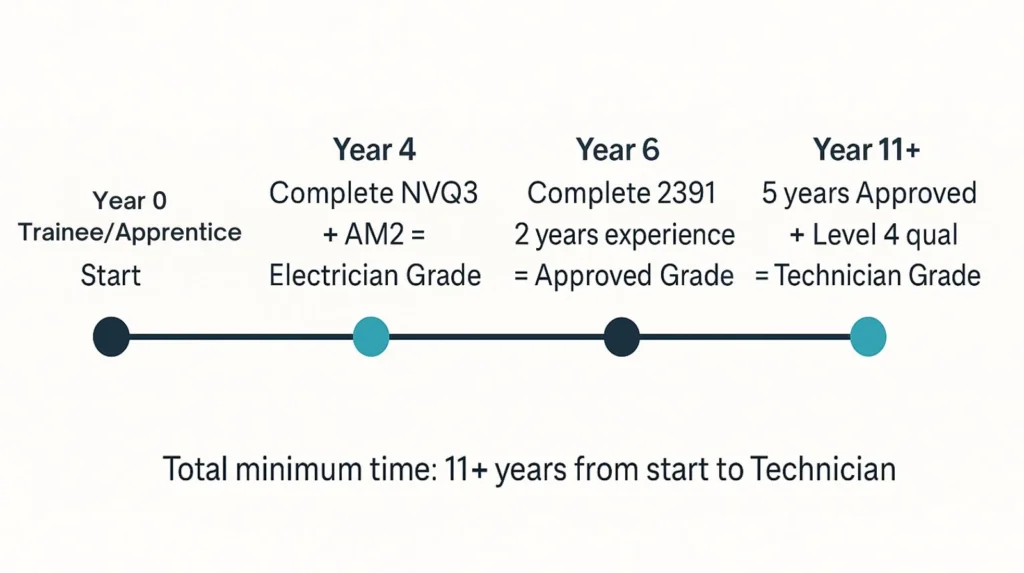
Technician is an elite grade. If you’re aiming for it, you need to plan for a long career progression: Electrician → 2 years → Approved → 5 years (including 3+ supervisory) → Technician. That’s a minimum of 7 years post-qualification, plus Level 4 study, plus employer endorsement.
How Pay Bands Sit Behind These Grades (2025 Context)
We’ve mentioned specific 2025 rates throughout, but let’s clarify how pay bands actually work. Each JIB grade corresponds to a pay band, and that band varies by:
Region: National Standard vs London (London pays more).
Transport: Employer-provided transport vs own transport (own transport pays less because you’re claiming mileage separately).
Sector: Standard electrical contracting, highway lighting, network infrastructure, onshore oil and gas, etc. (each has slightly different rate tables).
Band: Within some grades (particularly Approved Electrician), there are sub-bands (Band 5, Band 6, Band 7) based on seniority and complexity of work.
From the 2025 data we have:
Labourer: £15.09/hour (National, transport provided) to £16.91/hour (London, transport provided)
Trainee Stage 1: £15.09/hour (National) to £16.91/hour (London)
Trainee Stage 2: £16.95/hour (National) to £18.96/hour (London)
Trainee Stage 3 / ECS Experienced Worker: £17.86/hour (National) to £20.01/hour (London)
Improver: £16.95/hour (National) to £18.96/hour (London)
Electrician: £18.80/hour (National) to £21.06/hour (London)
Approved Electrician: £20.38/hour (National) to £22.83/hour (London)
Technician: £22.96/hour (National) to £25.69/hour (London)
Those are the with transport provided rates. If you’re using your own vehicle, deduct roughly £2-£3/hour depending on grade and region, because you’ll be claiming mileage separately at 12p per mile (up to 15 miles) or 22p per mile (beyond 15 miles).
The higher your grade, the bigger the difference between bands. Moving from Labourer to Electrician is a jump of £3.71/hour (National, transport provided). Moving from Electrician to Approved is an extra £1.58/hour. Electrician to Technician (skipping Approved, which you can’t actually do) would be £4.16/hour, or roughly £8,700 annually.
But pay is only part of the package. Higher grades also get:
Better sick pay: Technician gets £220/week (weeks 3-24), Approved gets £210/week, Electrician gets £200/week, others get £190/week. That matters if you’re off sick for more than two weeks.
Responsibility money: Approved Electricians supervising others (excluding apprentices/trainees) get an additional 50p-£2/hour as determined by the employer. That’s on top of your basic rate.
Lodging and mileage allowances: Same across grades, but the higher your base rate, the more valuable the package becomes when you’re working away from home.
Progression pathway clarity: Once you’re graded Approved or Technician, you’re recognised industry-wide as someone who’s met strict criteria. That opens doors with other contractors and gives you negotiating power if you’re looking to move.
How People Actually Move Up (Step-by-Step Based on the Data)
Let’s map the actual progression routes based on JIB rules:
Labourer → Trainee Electrician / Electrician
If you’re on Labourer grade and want to progress, you need to register on a JIB training scheme. That’s either:
- An apprenticeship (typically 4 years, progressing through Trainee Stages 1-4)
- An adult trainee route (faster, but still requires NVQ Level 3 + AM2)
- An Experienced Worker Assessment (if you’ve got significant site experience already)
You can’t jump straight from Labourer to Electrician without the qualifications. Theory courses (2365, 2330, 2360) help, but they don’t replace the NVQ portfolio and AM2 practical assessment.
Trainee → Electrician
Complete NVQ Level 3 in Electrotechnical Services (Electrical Installation) or equivalent. Pass your AM2 assessment. Once you’ve got both, you’re eligible for Electrician grade. Your employer or the JIB will issue your ECS Gold Card showing Installation Electrician as your occupation and Electrician as your grade.
Improver → Electrician
If you’re graded Improver (meaning you got NVQ Level 2 but didn’t complete Level 3), your route forward is clear: complete NVQ Level 3 and pass AM2. There’s no shortcut. Improver exists to keep you in the industry while you finish your qualifications, not as a permanent alternative to Electrician.
Electrician → Approved Electrician
Work as a graded Electrician for at least two years. During that time, gain experience across a range of installation work. Then complete your Inspection and Testing qualification (2391-52 or equivalent). Once you’ve got both the two years and the 2391, apply for Approved grading through the JIB. If you work for a JIB member company, they’re required to fund your first 2391 attempt.
Approved Electrician → Technician
Work as Approved for at least five years, with at least three years in a supervisory capacity (for Site Technician) or demonstrate exceptional technical skill beyond Approved level (for Installation Technician). Complete a Level 4 qualification (HNC, BS 7671 design and verification, or equivalent). Apply for Technician grading with employer endorsement.
Domestic Electrician → Approved Electrician
If you’ve qualified via a Domestic Electrician apprenticeship or Experienced Worker Assessment, you’ll need to complete the Domestic Electrician bridging assessment to reach full Installation Electrician standard. Only then can you work toward Approved grading (which still requires the two years as Electrician plus 2391).
Pain points the data shows:
People with years of experience but no NVQ staying stuck on Labourer or Improver.
Confusion about whether the 2391 alone bumps you to Approved (it doesn’t, you need the two years as Electrician first).
Electricians assuming they’re Approved because they’ve got a Gold Card (the card shows occupation, not necessarily grade).
Domestic installers unaware that bridging is required for Approved eligibility.
Common Myths & Misunderstandings
Let’s kill the myths that show up repeatedly in forums and social media:
Myth: “Gold Card = Approved or Technician.”
Reality: Your ECS Gold Card shows your occupation (Installation Electrician, Maintenance Electrician, etc.) and your JIB grade (Electrician, Approved, Technician) separately. Having a Gold Card means you’re qualified in that occupation. Your grade depends on your experience and additional qualifications (like the 2391 for Approved). You can hold a Gold Card as an Electrician without being Approved.
Myth: “You can jump from Improver to Approved.”
Reality: No. Improver is for people with NVQ Level 2 only. To reach Approved, you need NVQ Level 3 + AM2 (which gets you to Electrician), then two years as Electrician, then the 2391. You can’t skip grades.
Myth: “NVQ Level 3 makes you a Technician.”
Reality: NVQ Level 3 makes you an Electrician. Technician requires NVQ Level 3, plus AM2, plus two years as Electrician, plus 2391 (to become Approved), plus five more years as Approved (including three years supervisory), plus a Level 4 qualification. Minimum 11+ years from start to Technician.
Myth: “Testing & Inspection (2391) is optional for Approved.”
Reality: It’s mandatory. The JIB Handbook explicitly states you must demonstrate competence in Inspection and Testing by obtaining the 2391-52, NET AAC, or equivalent. Without it, you can’t be graded Approved, regardless of your experience.
Myth: “Self-employed sparks get JIB pay bands.”
Reality: JIB pay bands apply to PAYE employees working for JIB member contractors under the collective agreement. Self-employed electricians negotiate their own day rates. However, understanding JIB grading and having the correct ECS card helps when negotiating rates or working on sites that require specific card types.
Joshua Jarvis, our Placement Manager, sees this confusion regularly:
"There's confusion around self-employed electricians and JIB grading. Self-employed sparks don't automatically get JIB rates or need JIB grading to work, but having a proper ECS Gold Card with the correct occupation and understanding your grade helps when you're negotiating day rates or working on sites that require specific card types."
Joshua Jarvis, Placement Manager
Myth: “Domestic Installer is the same as Electrician.”
Reality: Domestic Electrician is a separate occupation with a narrower scope (domestic settings only). To reach Approved Electrician grade (which requires Installation or Maintenance Electrician status), Domestic Electricians must complete the bridging assessment to gain the missing competencies.
Myth: “Years on the tools = automatic progression.”
Reality: JIB grading is based on qualifications, formal assessments, and documented experience. Ten years on the tools without NVQ Level 3 and AM2 doesn’t qualify you as an Electrician under JIB rules. The system prioritises proven competence over time served.
What This Means for You (Practical Takeaways)
Let’s make this actionable based on where you currently sit:
If you’re a Labourer:
Your path forward requires structured training. NVQ Level 3 plus AM2 (or Experienced Worker Assessment with AM2E) gets you to Electrician grade. Theory qualifications like the 2365 help, but they don’t replace practical assessments. Speak to your employer about registering on a JIB training scheme, or look at adult trainee routes if you’re not on an apprenticeship.
If you’re a Trainee or Improver:
Focus on completing NVQ Level 3 and passing AM2. That’s your route to Electrician grade and the pay jump that comes with it (from £16.95/hour Improver to £18.80/hour Electrician on National Standard rates). Don’t get stuck thinking Improver is “good enough.” It’s a stepping-stone, not a destination.
If you’re an Electrician:
To reach Approved, you need two things: two years’ experience as a graded Electrician, and the 2391 (or equivalent) Inspection and Testing qualification. If you work for a JIB contractor, they’re required to fund your first 2391 attempt once you meet the other criteria. Approved grade brings a pay increase (£20.38/hour vs £18.80/hour National Standard), higher sick pay, and the ability to supervise others for responsibility money.
If you’re Approved:
Technician is the next step, but it requires five years as Approved (with three years in a supervisory role for Site Technician), plus a Level 4 qualification (HNC or BS 7671 design and verification). Not everyone needs to aim for Technician. Many electricians stay at Approved level throughout their careers and earn well, especially if they specialise (EV charging, solar, industrial maintenance, inspection and testing).
If you’re a Domestic Electrician:
To reach Approved status, you’ll need to complete the Domestic Electrician bridging assessment first. That gets you to Installation Electrician standard. Then you can work the two years as Electrician and complete the 2391 to apply for Approved grading.
If you’re self-employed:
JIB grading doesn’t directly control your rates, but having the correct ECS card and understanding where you’d sit in the JIB structure helps when negotiating with contractors or working on sites that require specific qualifications. Many self-employed electricians use JIB rates as a baseline, then negotiate above that to account for tax, tools, van, insurance, and the lack of PAYE benefits.
For a complete picture of how grades, regions, and sectors affect your earning potential, Elec Training’s comprehensive guide to JIB pay and progression covers the 2024-2028 wage agreements, apprentice rates, and how completing qualifications before key dates maximises your earnings.
References
- JIB official publications: JIB Handbook (Section 4: Grading Definitions) and JIB National Working Rules (https://www.jib.org.uk/)
- ECS (Electrotechnical Certification Scheme): JIB Grading guidance and card type requirements (https://www.ecscard.org.uk/)
- JIB-PMES: Plumbing and mechanical engineering rates and grading structures (https://www.jib-pmes.org/)
- SJIB (Scotland): Scottish JIB grading and rates comparison (https://sjib.org.uk/)
- ECA: Electrical Contractors’ Association JIB rates and terms (https://www.eca.co.uk/)
- Reddit r/ukelectricians: Community feedback on JIB rates and grading (https://www.reddit.com/r/ukelectricians/)
Note on Accuracy and Updates
Last reviewed: 03 December. This page is maintained; we correct errors and refresh sources as JIB grading definitions and pay rates change. The 2025 figures reflect the January 2025 rates under the 2024-2025 JIB agreement. Grading requirements are based on the current JIB Handbook and ECS card criteria. Always verify your specific grade and pay with the JIB or your employer, as individual circumstances may vary. .