


- Technical review: Thomas Jevons (Head of Training, 20+ years)
- Employability review: Joshua Jarvis (Placement Manager)
- Editorial review: Jessica Gilbert (Marketing Editorial Team)
- Last reviewed:
- Changes: Initial publication covering JIB apprentice pay rates from 2010-2025 and future outlook

Why Understanding JIB Apprentice Rates Matters
If you’re starting an electrical apprenticeship in the UK, or you’re already a few months into Stage 1 wondering why your payslip is so tight, here’s what you need to know: JIB apprentice rates are mandatory minimums for employers who are members of the Joint Industry Board. They’re structured across four stages, they vary by region (National Standard vs London), and from 2025 onwards, the system changed significantly.
But here’s the reality that doesn’t get talked about enough: apprentice pay is low. Stage 1 rates have historically hovered just above statutory minimums. National Minimum Wage has increased by 100% since 2010, while JIB rates have risen by roughly 60%. In 2025, the JIB had to align apprentice rates with NMW for compliance, not generosity. And when you’re trying to cover rent, transport, and food on £8.16/hour, understanding exactly what you’re entitled to matters.
This article walks through the complete guide to UK electrician wages and JIB pay structures, focusing specifically on apprentice rates from 2010 through to 2025, what changed in the 2025 system overhaul, and what’s coming in 2026-2028. We’re using official JIB announcements, ECA/Unite statements, and National Minimum Wage data. Where figures are missing, we’ll say so explicitly and point you to the JIB Handbook.
The goal isn’t to sugarcoat it. Apprentice wages are tight, especially in the first two years. But knowing what you’re legally entitled to, how the stages work, and what the progression looks like helps you plan realistically and spot if you’re being underpaid.

How JIB Apprentice Pay Works (Stages 1-4, National vs London)
JIB apprenticeships follow a four-stage framework under the 2017 Apprenticeship Scheme. Each stage represents progression through your training, and your pay increases at each stage. Here’s how it breaks down:
Stage 1: Entry level. You’re starting your apprenticeship, completing basic theory at college, and beginning on-site work under supervision. This is where pay is lowest.
Stage 2: You’ve completed initial qualifications and theory modules. You’re progressing through NVQ Level 2 or 3 coursework and gaining more hands-on site experience.
Stage 3: Advanced site work. You’re working toward completing NVQ Level 3, logging practical evidence in your portfolio, and taking on more responsibility under supervision.
Stage 4: Final year. You’re preparing for your AM2 assessment, finishing your NVQ portfolio, and getting ready to transition from apprentice to qualified Electrician.
Important: You only become an Electrician under JIB grading after you’ve completed Stage 4, plus NVQ Level 3, plus passed your AM2 assessment, plus obtained your ECS Gold Card. There are no shortcuts. Completing Stage 3 doesn’t automatically upgrade you to Electrician grade.
National Standard vs London rates: JIB sets two regional pay structures. National Standard rates apply across England, Wales, and Northern Ireland. London rates include a differential, typically £1.50-£2.00/hour higher at each stage to account for higher living costs.
At Work vs At College (pre-2025): Before 2025, apprentices were paid differently depending on whether they were on-site (“At Work”) or attending college (“At College”). The At College rate was lower by roughly 10-15%, which caused frustration because college days are mandatory training. From January 2025, this distinction was removed. At Work and At College rates merged into a single rate per stage.
Scotland (SJIB): Scotland operates a separate but similar system through SJIB. The rates align closely with JIB, but funding structures and some allowances differ slightly. This article focuses on JIB (England, Wales, NI), but SJIB apprentices will see comparable figures.
Current Apprentice Rates for 2024-2025 (National & London)
Let’s look at what apprentices are actually paid in 2024 and 2025, broken down by stage and region.
2024 Rates (Effective January 2024)
National Standard:
- Stage 1: £6.40/hour (At Work), £5.73/hour (At College)
- Stage 2: £8.60/hour (At Work), £7.49/hour (At College)
- Stage 3: £12.40/hour (At Work), £11.35/hour (At College)
- Stage 4: £13.32/hour (At Work), £12.09/hour (At College)
London:
- Stage 1: £7.90/hour (At Work), £7.23/hour (At College)
- Stage 2: £10.10/hour (At Work), £8.99/hour (At College)
- Stage 3: £13.90/hour (At Work), £12.85/hour (At College)
- Stage 4: £14.82/hour (At Work), £13.59/hour (At College)
The differential between At Work and At College rates created real frustration. If you were attending college two days a week, you’d see your weekly pay drop compared to weeks when you were on-site full-time.
2025 Rates (Effective January 6, 2025)
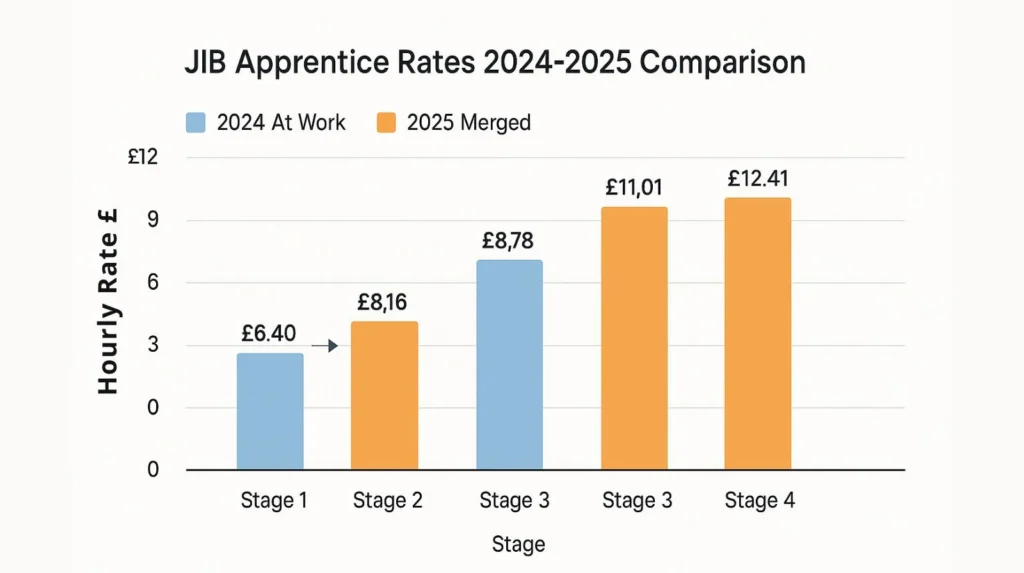
From January 2025, the JIB merged At Work and At College into a single rate for each stage:
National Standard:
- Stage 1: £8.16/hour
- Stage 2: £10.00/hour
- Stage 3: £12.21/hour
- Stage 4: £13.55/hour
London:
- Stage 1: £9.66/hour
- Stage 2: £11.50/hour
- Stage 3: £13.71/hour
- Stage 4: £15.05/hour
Key changes:
Stage 1 National jumped from £6.40 to £8.16 (a £1.76/hour increase, or roughly 27.5%). That’s significant for a first-year apprentice trying to cover living costs.
Stage 2 National at £10.00/hour now aligns exactly with the 18-20 age band National Minimum Wage for 2025. That’s not coincidence, it’s compliance.
London Stage 4 at £15.05/hour puts fourth-year apprentices closer to qualified Electrician rates (£21.06/hour London for Electricians), though there’s still a notable gap.
The removal of the At College differential means apprentices now get paid the same rate whether they’re on-site or in the classroom. This addresses fairness concerns, though it doesn’t change the fact that Stage 1 and Stage 2 rates remain tight for covering rent and bills.
How Apprentice Pay Has Changed Over Time (2010-2025 Timeline)
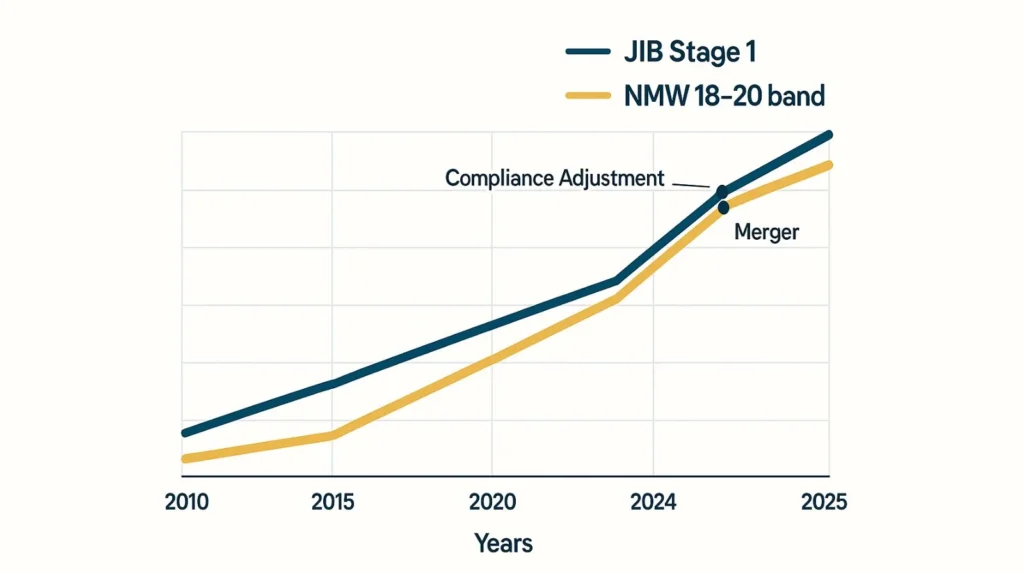
JIB apprentice pay hasn’t risen steadily. There have been long periods of stagnation, followed by adjustments driven by National Minimum Wage compliance and union negotiations. Here’s what the data shows:
2008-2010: The post-2008 financial crash led to wage freezes across the construction industry. Apprentice rates were tied to percentages of qualified Electrician pay (typically 35-40% for Stage 1). With Electrician rates frozen, apprentice pay stagnated.
2010: Stage 1 National was roughly £4.92/hour, aligning with the 18-20 age band NMW. The apprentice-specific NMW at the time was only £2.50/hour, so JIB rates were well above statutory minimums for apprentices in their first year.
2010-2015: Minimal increases. The dataset doesn’t show full year-by-year tables for this period, but forum commentary and union records suggest Stage 1 crept up to around £5.35/hour by 2015. That’s a 9% increase over 5 years, far below inflation.
2017: The JIB formalized the four-stage apprenticeship structure. This replaced older systems and created clearer progression pathways, but didn’t immediately result in significant pay jumps.
2020: Stage 1 National At Work was £5.73/hour. NMW for under-18s was £4.55, and the apprentice NMW was £4.15. JIB rates remained above statutory minimums, but not by much.
2022-2023: A two-year deal covering 7% (2024) and 5% (2025) increases was agreed between Unite the Union and the ECA. Apprentice rates were included in these uplifts.
2024: Stage 1 National At Work rose to £6.40/hour, matching the apprentice NMW exactly. This was the first clear signal that JIB rates were being adjusted primarily for statutory compliance rather than genuine wage growth.
2025: The big reset. Stage 1 jumped to £8.16/hour, Stage 2 aligned with 18-20 NMW at £10.00/hour, and the At College differential was removed entirely. JIB announcements explicitly stated this was about “alignment with National Minimum Wage” to ensure fairness and compliance.
The pattern: Apprentice pay has risen by roughly 60% from 2010 to 2025 (£4.92 to £8.16 for Stage 1). National Minimum Wage for the 18-20 age band rose by approximately 100% over the same period (£4.92 to £10.00). That gap explains why so many apprentices and unions express frustration. JIB apprentice rates have lagged behind broader wage growth, and it shows in the data.
Thomas Jevons, our Head of Training with 20 years in the industry, puts it bluntly:
JIB apprentice rates being aligned to National Minimum Wage in 2024 and 2025 isn't a sign of generosity, it's compliance. The rates had to be adjusted to meet statutory minimums, which highlights how apprentice pay has lagged behind broader wage growth over the past decade."
Thomas Jevons, Head of Training
How JIB Apprentice Pay Compares to National Minimum Wage
Let’s look at the relationship between JIB apprentice rates and statutory minimum wage year by year. This matters because NMW sets the legal floor, and JIB rates must stay above it.
2010:
- NMW (Under 18): £3.64
- NMW (18-20): £4.92
- NMW (Apprentice): £2.50
- JIB Stage 1: £4.92 (matched 18-20 band, well above apprentice NMW)
2015:
- NMW (Under 18): £3.87
- NMW (18-20): £5.30
- NMW (Apprentice): £3.30
- JIB Stage 1: £5.35 (slightly above 18-20 band)
2020:
- NMW (Under 18): £4.55
- NMW (18-20): £6.45
- NMW (Apprentice): £4.15
- JIB Stage 1: £5.73 (below 18-20 band, but well above apprentice NMW)
2023:
- NMW (18-20): £7.49
- NMW (21-22): £10.18
- NMW (Apprentice): £5.28
- JIB Stage 1: £6.40 (below 18-20 band, above apprentice NMW)
2024:
- NMW (18-20): £8.60
- NMW (21+): £11.44
- NMW (Apprentice): £6.40
- JIB Stage 1: £6.40 (matched apprentice NMW exactly)
2025:
- NMW (18-20): £10.00
- NMW (21+): £12.21
- NMW (Apprentice): £7.55
- JIB Stage 1: £8.16 (above apprentice NMW)
- JIB Stage 2: £10.00 (matched 18-20 band exactly)
Key takeaways:
JIB Stage 1 has consistently stayed above the statutory apprentice NMW, which is the legal baseline for apprentices in their first year or under 19.
However, JIB Stage 1 has fallen below the 18-20 age band NMW in several years (2020, 2023, 2024). This is technically legal because apprentices under 19 or in their first year fall under the apprentice NMW, not the age-based bands.
The 2025 adjustments brought JIB Stage 1 and Stage 2 back in line with age-based NMW rates. Stage 2 at £10.00 now matches the 18-20 NMW exactly, and Stage 3-4 sit well above the 21+ band (£12.21).
What this means: There are no confirmed years where JIB apprentice rates fell below statutory minimums. Adjustments were made when needed to maintain compliance. But the fact that adjustments were necessary at all shows how apprentice wage growth has struggled to keep pace with rising living costs and broader NMW increases.
Apprentice Pay Announcements (2010-2025)
Official JIB and union announcements give context for why apprentice rates changed when they did. Here’s what was said publicly:
January 2024: “JIB Rates of Pay 2024 – Apprentice Rate Updates” (jib.org.uk)
The JIB explicitly stated: “The JIB Apprentice rates will be aligned to the National Minimum Wage for 2024.”
Justification: Compliance and fairness. The announcement acknowledged that statutory NMW had risen faster than JIB rates, and adjustments were needed to ensure JIB members weren’t paying below legal minimums.
December 2024: “JIB Apprentice Rates 2025” (jib.org.uk)
Key change: “From 2025, At College and At Work rates are the same.”
This was framed as simplifying the system and ensuring apprentices weren’t penalized financially for attending mandatory training. The merger also aligned rates more closely with NMW bands.
July 2023: “New Wage Agreement for Industry” (jib.org.uk, ECA, Unite)
The two-year deal covering 7% (2024) and 5% (2025) increases included specific language about apprentice uplifts. The announcement linked pay increases to skills shortages, noting that the UK needs 12,000+ electrical apprentices per year to meet demand, but was only recruiting around 8,000 annually.
Quote from Unite: “Improvements to apprentice pay are essential to attract and retain the next generation of electricians, especially with the low-carbon transition requiring 15,000 newly qualified electricians per year over the next five years.”
July 2025: “New Wage Agreement from 2026 to 2028” (Electrical & Electrotechnical News)
Confirmed apprentice increases: 3% in 2026, 2% in 2027, 3% in 2028.
Justification: Retention, NMW alignment, and addressing the apprentice shortfall threatening the UK electrical sector.
Pre-2015 announcements: The dataset doesn’t show specific apprentice-focused bulletins from 2010-2015. This period was dominated by post-crash wage freezes and slow recovery, with limited public communication about apprentice pay specifically.
How JIB Apprentice Pay Compares to SJIB & JIB-PMES
JIB isn’t the only wage-setting body for apprentices in the UK construction sector. SJIB (Scotland) and JIB-PMES (plumbing and mechanical) have their own structures. Here’s how they compare:
SJIB (Scotland) 2024-2025:
SJIB rates align very closely with JIB. For 2024-2025:
- Stage 1: £8.16 (same as JIB National)
- Stage 4: £13.55 (same as JIB National)
SJIB follows the same 2026-2028 uplifts (3%/2%/3%). The main difference is funding: Scottish apprentices receive approximately £23,000 per apprentice in government funding vs higher amounts in England, which affects employer uptake and training quality. Union commentary notes SJIB funding is lower, but rates themselves are comparable.
JIB-PMES (Plumbing & Mechanical) 2024-2025:
JIB-PMES covers plumbing, heating, and mechanical apprentices. Rates for 2024-2025:
- 1st Year: £7.44 (2024), £7.81 (2025)
- 4th Year: £11.86 (2024), £12.45 (2025)
JIB electrical apprentices earn more in Stages 3-4 compared to JIB-PMES. For example, JIB Stage 4 in 2025 is £13.55 vs JIB-PMES 4th Year at £12.45 (a £1.10/hour difference).
However, JIB-PMES includes clearer travel time allowances for apprentices. Daily travel allowances vary by distance (20-30 miles, 30-40 miles, etc.), with 3rd and 4th year apprentices receiving higher allowances than 1st and 2nd years. JIB has similar mileage rules, but the structure is less explicit in published materials.
Lodging and subsistence: JIB-PMES specifies a £50.12/night lodging allowance (subject to HMRC rules). JIB apprentices are eligible for similar lodging allowances when working away from home, but the exact figures aren’t always broken out separately in apprentice-specific documents.
Forum sentiment: Some apprentices argue plumbing pays slightly better in early stages (comparing 1st Year JIB-PMES to Stage 1 JIB electrical). The data doesn’t fully support this, especially after the 2025 JIB uplift, but perceptions persist.
The Full Package: Travel, Lodging, Sick Pay & Benefits
Apprentice pay isn’t just the hourly rate. JIB apprentices are entitled to additional benefits, though the details vary and some benefits are pro-rated based on stage.
Mileage and Travel Time Allowances:
Apprentices are eligible for mileage reimbursement when travelling to sites beyond a certain distance (typically 15 miles each way). Rates are 12p per mile for the first 15 miles, then 22p per mile beyond that.
Travel time allowances (daily payments for long commutes) apply to apprentices, though 1st and 2nd year apprentices may receive lower pro-rated amounts compared to 3rd and 4th years. Exact apprentice-specific travel time tables aren’t fully detailed in the dataset, but JIB-PMES shows a clear structure (e.g., 1st/2nd year: £2.37 for 20-30 miles, 3rd/4th year: £3.80 for the same distance).
Lodging Allowance:
If you’re working away from home and need accommodation, you’re entitled to lodging allowance. The nightly rate is typically £46-£51.29 (tax-free), the same as qualified operatives. JIB-PMES confirms apprentices are eligible, and the same applies under JIB rules.
Sick Pay:
Apprentices are covered by the JIB Benefits Scheme (ECIS – Electrical Contracting Industry Scheme). After the first two weeks of illness (which are unpaid or covered by Statutory Sick Pay), apprentices receive JIB sick pay.
The rates are banded, with qualified operatives receiving £190-£220/week (weeks 3-24) depending on grade. Apprentice sick pay is typically £190/week (the lowest band), though specific apprentice tables aren’t always published separately. This is still significantly better than Statutory Sick Pay alone (£116.75/week as of 2025).
Overtime:
Apprentices receive overtime at multiplied rates, the same as qualified operatives:
- 1.5x for hours worked beyond 37.5 hours/week
- 2x for hours worked after 12 noon on Saturday
If you’re on Stage 1 at £8.16/hour National, overtime on Saturday afternoon would be £16.32/hour. That’s where apprentices can boost earnings if contractors offer weekend or extended-hours work.
Holiday Pay:
Apprentices are entitled to 28 days paid holiday per year (including bank holidays), paid at your normal rate. This is statutory and non-negotiable.
Call-Out Allowance:
If you’re called out for emergency work outside normal hours, you’re entitled to a call-out payment. For apprentices, this is £7.50 for a single call-out and £3.50 for second and subsequent call-outs (vs £20.00/£10.00 for graded operatives).
What’s not specified: Distinct apprentice-specific breakdowns for some benefits. If you’re unsure about your entitlements, check the JIB Handbook Section 2 (National Working Rules) or speak to your employer or union rep.
What Apprentices Say Online (Real Sentiment)
Let’s look at what actual apprentices and electricians say about JIB apprentice pay on forums, Reddit, and social media. This is user sentiment, not official data, but it reflects real-world frustrations and perspectives.
"Can't live on Stage 1 pay."
Reddit, 2024
Common theme. With Stage 1 at £6.40/hour pre-2025, apprentices in cities struggled to cover rent, transport, and bills. Even at £8.16/hour in 2025, that’s roughly £15,800 annually before tax if you’re working 37.5 hours/week. After tax and National Insurance, take-home is closer to £14,500. That doesn’t stretch far in London or other high-cost areas.
"Big jump from Stage 1 to Stage 2."
Reddit, 2023
Positive sentiment. Moving from £6.40 to £8.60 (2024 rates) or £8.16 to £10.00 (2025 rates) represents a 27-32% pay increase. For apprentices, that jump makes Stage 2 feel like real progress.
"Stage 4 still isn't enough considering rent."
ElectriciansForums, 2024
Stage 4 at £13.55/hour National (2025) is roughly £26,300 annually before tax. That’s better than Stage 1-2, but still below what you’d earn as a fully qualified Electrician at £18.80/hour (£36,500 annually). The gap between Stage 4 and Electrician pay is significant, and apprentices nearing the end of their training often express frustration that they’re doing near-Electrician work for apprentice wages.
"Nearly £17 an hour for a 4th-year apprentice."
Reddit, 2025, discussing 2026 rates
Positive reaction to the confirmed 2026-2028 uplifts. With a 3% increase in 2026, Stage 4 National would rise to roughly £13.96/hour, and with London weighting, 4th years could be earning close to £17/hour. That’s seen as progress.
Historical nostalgia: "JIB apprentice wages were £35 per week."
X/Twitter, 2024
A user referencing starting as an apprentice decades ago. Adjusted for inflation, £35/week in the 1980s or 1990s would be worth far more than current Stage 1 pay in real terms. This reinforces the sentiment that apprentice wages haven’t kept pace with living costs.
"A good self-employed Electrician can do £60,000/year."
X/Twitter, 2025
Used as a counterpoint to apprentice wage complaints. The implication is that apprentice pay is low, but the long-term earning potential once qualified justifies the investment. Understanding the full breakdown of how JIB grading and pay bands work across all levels helps apprentices see where they’re headed once they’ve completed Stage 4 and gained their Electrician grading.
Real-World Comparisons (Retail, Warehouse, Other Trades)
How does JIB apprentice pay stack up against other entry-level jobs and trades? Let’s be honest about the comparisons:
Retail and warehouse work:
Entry-level retail jobs (supermarkets, high street shops) typically pay £10-£11/hour for 18-20 year olds, aligned with NMW. Warehouse roles (Amazon, DPD, etc.) often start at £11-£12/hour, sometimes with shift premiums pushing it to £13-£15/hour for night shifts or weekends.
JIB Stage 1 at £8.16/hour is lower than many retail and warehouse roles. Stage 2 at £10.00/hour matches retail, but still lags warehouse rates. This is the comparison apprentices make when deciding whether to commit to a four-year training programme.
Plumbing apprenticeships (JIB-PMES):
As covered earlier, plumbing 1st Year pays £7.81/hour (2025), which is £0.35/hour less than JIB Stage 1 electrical (£8.16). However, in later years, plumbing 4th Year at £12.45 is behind JIB Stage 4 at £13.55. The perception that plumbing pays better early on isn’t fully supported by the data post-2025.
Other construction trades:
Carpentry, bricklaying, and general construction apprenticeships vary widely by employer, but many are on similar JIB-style frameworks with staged pay. No trade pays spectacularly well in the apprentice years. The electrical sector is competitive with other trades, though not ahead.
Annual earnings comparison:
- JIB Stage 1 (£8.16/hour, 37.5 hours/week): ~£15,800/year (gross)
- Retail (£10/hour, 37.5 hours/week): ~£19,500/year
- Warehouse (£12/hour, 37.5 hours/week): ~£23,400/year
- JIB Stage 4 (£13.55/hour, 37.5 hours/week): ~£26,300/year
The gap is real. Apprentices in Stage 1-2 earn less than they would in retail or warehouse work, with the understanding that completing the apprenticeship leads to Electrician pay (£18.80+/hour, £36,500+/year) and beyond.

The Most Common Myths About JIB Apprentice Pay
Let’s clear up misconceptions that show up repeatedly in forums and apprentice questions:
Myth: “JIB apprentices can be paid just the statutory apprentice minimum wage, JIB rates don’t matter.”
Reality: If your employer is a JIB member, they must pay JIB apprentice rates as a minimum. JIB rates are above statutory apprentice NMW in most cases (£8.16 JIB Stage 1 vs £7.55 apprentice NMW in 2025). JIB membership isn’t optional for rates, it’s mandatory under the collective agreement.
Myth: “At college you don’t get paid at all.”
Reality: Pre-2025, you were paid a lower “At College” rate (e.g., £5.73 vs £6.40 Stage 1 At Work in 2024). From 2025 onwards, At College and At Work rates merged into a single rate. You’re paid your normal Stage rate for college days, because college is mandatory training, not optional.
Myth: “Stage 4 apprentice is basically paid the same as an Electrician.”
Reality: Stage 4 National is £13.55/hour (2025). Electrician grade is £18.80/hour (2025 National Standard with transport). That’s a £5.25/hour gap, or roughly £10,200 annually. Stage 4 is about 72% of Electrician pay. You’re closer, but not equivalent.
Myth: “Once you hit Stage 3, you’re automatically graded as Electrician.”
Reality: You only become an Electrician under JIB grading after completing Stage 4, NVQ Level 3, AM2 assessment, and obtaining your ECS Gold Card. Stage 3 completion doesn’t trigger automatic grading. You’re still an apprentice until all requirements are met.
Myth: “If your boss says you’re an apprentice, JIB rules don’t apply.”
Reality: If your employer is a JIB member contractor, JIB rules absolutely apply. The JIB Handbook is the legally binding framework for wages, stages, and progression. If your employer claims JIB doesn’t apply to you, check whether they’re actually a JIB member. If they are, and they’re not paying JIB rates, that’s a breach of the collective agreement.
Myth: “Adult apprentices (over 25) get a completely different JIB rate.”
Reality: JIB rates are by stage, not age. A 25-year-old in Stage 1 earns £8.16/hour, the same as an 18-year-old in Stage 1. However, if the age-based NMW (£12.21 for 21+ in 2025) is higher than the JIB stage rate, employers may need to top up to meet NMW compliance. In practice, this rarely happens because Stage 2+ rates already exceed 21+ NMW.
Joshua Jarvis, our Placement Manager, sees this issue frequently:
"Adult apprentices over 25 with families face the toughest financial reality. JIB rates are by stage, not age, so someone with a mortgage and kids is earning the same Stage 1 or Stage 2 rate as a school leaver. That's why we work hard to find contractors who can offer additional support or accelerated progression for mature learners."
Joshua Jarvis, our Placement Manager
Policy, Negotiations & Future Outlook (2026-2028 and Beyond)
What’s coming next for JIB apprentice pay? Here’s what’s confirmed and what’s being discussed:
Confirmed 2026-2028 uplifts:
As part of the three-year JIB deal agreed in 2025, apprentice rates will increase by:
- 3% in 2026 (effective January)
- 2% in 2027 (effective January)
- 3% in 2028 (effective January)
Applying those increases to 2025 rates:
Stage 1 National:
- 2025: £8.16
- 2026: £8.40 (3% increase)
- 2027: £8.57 (2% increase)
- 2028: £8.83 (3% increase)
Stage 4 National:
- 2025: £13.55
- 2026: £13.96
- 2027: £14.24
- 2028: £14.67
London Stage 4:
- 2025: £15.05
- 2026: £15.50
- 2027: £15.81
- 2028: £16.28
These are based on straight percentage calculations. Exact figures will be confirmed in JIB promulgations closer to each year.
Working groups and ongoing reviews:
ECA, Unite the Union, and the JIB have established working parties to review “low-paid classifications,” which includes apprentices. The pressure is on to ensure Stage 1 and Stage 2 rates remain competitive with NMW and don’t fall behind again. Forum commentary and union statements suggest future negotiations will focus on retention and ensuring apprentices can afford to complete their training.
Skills shortages driving policy:
The UK electrical sector needs 12,000-15,000 new apprentices per year to meet demand, particularly for the low-carbon transition (solar, EV charging, heat pumps, net-zero infrastructure). Currently, the sector recruits around 8,000 apprentices annually. The shortfall is partly attributed to low pay in early stages, which deters young people and career changers.
Government funding exists (£3 billion allocated for 120,000 apprenticeship spots across all sectors), but if electrical apprentice pay remains unattractive compared to other trades or non-trade roles, those spots won’t fill.
Union commentary:
Unite the Union has stated: “In terms of apprenticeship rates, Unite secured a pay uplift for thousands of electrical apprentices.” The emphasis is on fairness, retention, and ensuring the skills pipeline supports net-zero targets.
Future speculation (not confirmed):
Some forum discussions and union meetings suggest pressure to:
- Further increase Stage 1-2 rates above NMW minimums to make the early stages more financially viable
- Introduce regional weighting beyond London (e.g., South-East differential)
- Review adult apprentice support mechanisms (financial hardship grants, accelerated progression pathways)
None of this is confirmed. What is confirmed is that apprentice pay will continue to be reviewed annually or biannually as part of broader JIB wage negotiations.
For comprehensive overview of JIB wages from apprentice through to technician and how the 2026-2028 deal affects all grades, the full picture helps apprentices see where they’re headed and what progression looks like financially.
References
- JIB official publications: JIB Handbook (Section 2: National Working Rules, Section 8: Apprentice Training Schemes), JIB rate announcements (https://www.jib.org.uk/)
- ECA: Electrical Contractors’ Association wage agreement statements and JIB rate updates (https://www.eca.co.uk/)
- GOV.UK: National Minimum Wage rates 2010-2025 (https://www.gov.uk/)
- SJIB: Scottish Joint Industry Board rates and comparisons (https://sjib.org.uk/)
- JIB-PMES: Plumbing and mechanical engineering apprentice rates (https://www.jib-pmes.org/)
- Electrical & Electrotechnical News: 2026-2028 wage agreement coverage (https://electrotechnicalnews.com/)
- Reddit r/ukelectricians: User discussions on apprentice pay and living costs (https://www.reddit.com/r/ukelectricians/)
- ElectriciansForums.net: Apprentice wage queries and employer compliance questions (https://www.electriciansforums.net/)
Note on Accuracy and Updates
Last reviewed: 03 December 2025. This page is maintained; we correct errors and refresh sources as JIB apprentice rates and National Minimum Wage data change. The 2025 figures reflect the January 2025 rates under the two-year JIB agreement. The 2026-2028 increases are confirmed percentages; exact hourly figures will be published by the JIB closer to each implementation date. Always verify your specific entitlements with the JIB Handbook or your employer if you believe you’re being underpaid.
