


- Technical review: Thomas Jevons (Head of Training, 20+ years)
- Employability review: Joshua Jarvis (Placement Manager)
- Editorial review: Jessica Gilbert (Marketing Editorial Team)
- Last reviewed:
- | Changes: New analysis of JIB-PMES 2026-2027 wage agreement, apprentice NMW conflict, market rate comparison
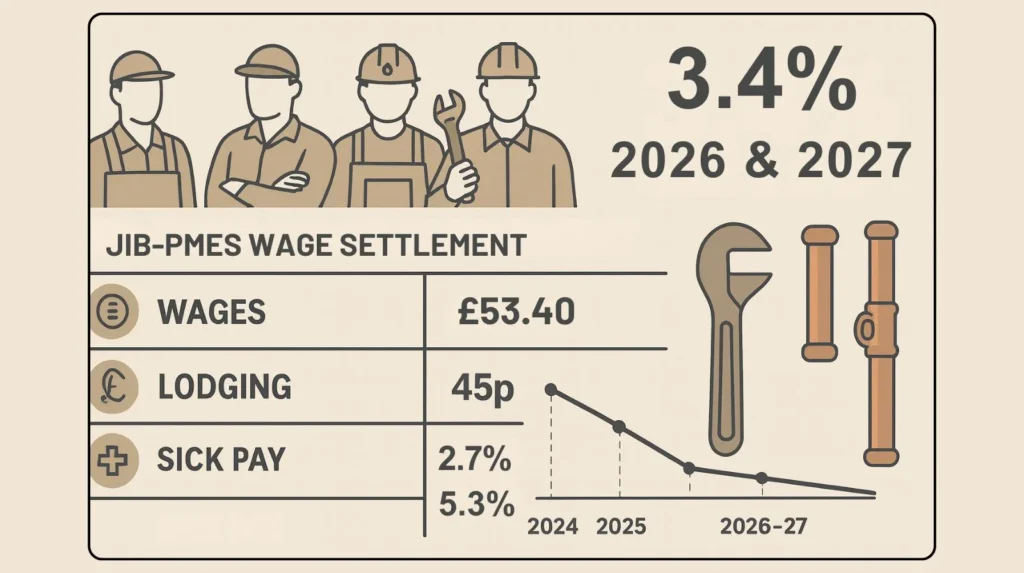
The Joint Industry Board for Plumbing Mechanical Engineering Services (JIB-PMES) has confirmed a two-year wage settlement covering 2026 and 2027. All operatives employed under the National Working Rule Agreement (NWRA) will receive a 3.4% increase to wages and allowances from 5 January 2026, followed by another 3.4% increase from 4 January 2027.
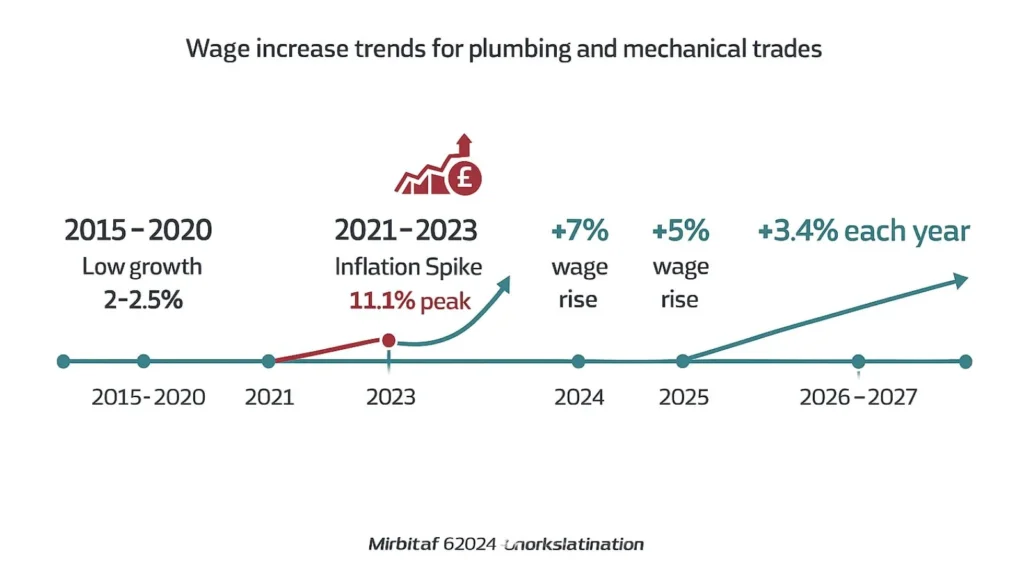
The agreement applies to plumbers, pipefitters, gas engineers, HVAC operatives, and low-carbon heating specialists working under NWRA terms. The settlement represents a significant moderation from the high single-digit rises seen in 2024 (+7%) and 2025 (+5%), reflecting employer pressure for predictable cost modelling and a shift away from inflation-driven volatility.
HMRC has confirmed that lodging allowances will increase from £51.59 to £53.40 per night from January 2026. Sick pay will rise by 2.7% in 2026 and 5.3% in 2027, prioritising worker security and retention alongside wage growth.
However, the uniform 3.4% increase creates structural tensions. Market rates for specialist mechanical skills (coded welders, commercial pipefitters, heat pump installers) far exceed the NWRA baseline, and apprentice pay now conflicts with statutory National Minimum Wage requirements for 18-20 year olds. The NWRA rate increasingly functions as a floor rather than a competitive market salary.
For a direct UK comparison, see electrician pay versus plumber, gas engineer and carpenter pay.
Official JIB-PMES Announcement: Key Details
The JIB-PMES announced the agreement on 26 November 2025, confirming that the industrial parties (employers and unions) had reached consensus on wage and allowance increases for the next two years.
Core Agreement Terms:
- 5 January 2026: All NWRA wages and allowances increase by 3.4%
- 4 January 2027: All NWRA wages and allowances increase by 3.4%
- Lodging allowance: Increases from £51.59 to £53.40 per night (January 2026)
- Sick pay: Increases by 2.7% (2026) and 5.3% (2027)
- Mileage allowance: 45p per mile (existing rate, aligned with HMRC tax-free limit)
- Welding supplement: 66p per hour (2025), subject to 3.4% uplift
The agreement has been circulated to all JIB-PMES participating employers and contractors. Updated NWRA handbooks reflecting the new rates will be issued in early 2026.
Important Note on Rates:
JIB-PMES has not yet published full hourly rate tables for 2026 and 2027. The rates shown throughout this article are estimates based on applying the 3.4% increase to published 2025 figures. Employers should refer to official JIB-PMES documentation when finalising payroll.
Why the Rates Increased: Economic and Industry Context
The 3.4% settlement reflects a deliberate shift towards predictability after years of inflation-driven wage volatility.
Post-Inflation Moderation
2024 saw a 7% wage increase under the JIB-PMES agreement, a crucial catch-up mechanism to restore real wages lost during the 2023-2024 inflation spike. 2025 followed with a 5% increase as inflation began to moderate but remained elevated.
The 3.4% rise for 2026 and 2027 represents a return to more sustainable, predictable annual growth. UK inflation (CPI) stood at 3.6% in October 2025, meaning the wage rise roughly matches current inflation but provides minimal real-terms growth.
Employer Pressure for Predictable Costs
Major mechanical contractors (involved in commercial, industrial, and infrastructure M&E projects) require long-term cost certainty when tendering for multi-year contracts. The two-year agreement at a fixed 3.4% allows employers to model labour costs accurately, reducing the risk of budget overruns on contracts awarded in 2025-2026.
For employers, this stability is essential. For workers, it means wage growth is capped even if inflation remains sticky or accelerates unexpectedly in 2026-2027.
Skills Shortages and Labour Market Pressure
Despite the moderate wage settlement, the mechanical sector faces acute skills shortages. High-demand specialties include:
- Coded welders (6G certification, industrial and defence sectors)
- Commercial pipefitters (London, South East, major infrastructure)
- HVAC operatives (air conditioning, ventilation, commercial buildings)
- Heat pump installers (MCS-certified, low-carbon heating rollout)
- Gas Safe engineers (boiler servicing, domestic and commercial)
These shortages are structural, not cyclical. The UK government’s Net Zero targets require electrification of heating (heat pumps replacing gas boilers), expanded EV charging infrastructure, and grid upgrades. All of these transitions demand qualified plumbers, pipefitters, and HVAC specialists.
Electrical work faces similar pressures; our guide explains the shortage of skilled electricians in the UK.
Migration Policy Constraint
UK immigration rules changed in mid-2025, raising the Skilled Worker visa threshold to RQF Level 6 (degree level) and above. This policy effectively restricts the ability of UK employers to import non-graduate skilled tradespeople, including pipefitters and welders who traditionally filled labour supply gaps.
With domestic training pipelines taking 2-3 years to produce qualified operatives, and migration routes now closed for most mechanical trades, wage pressure for scarce skills is guaranteed to intensify through 2027 and beyond.
Market Reality vs NWRA Baseline
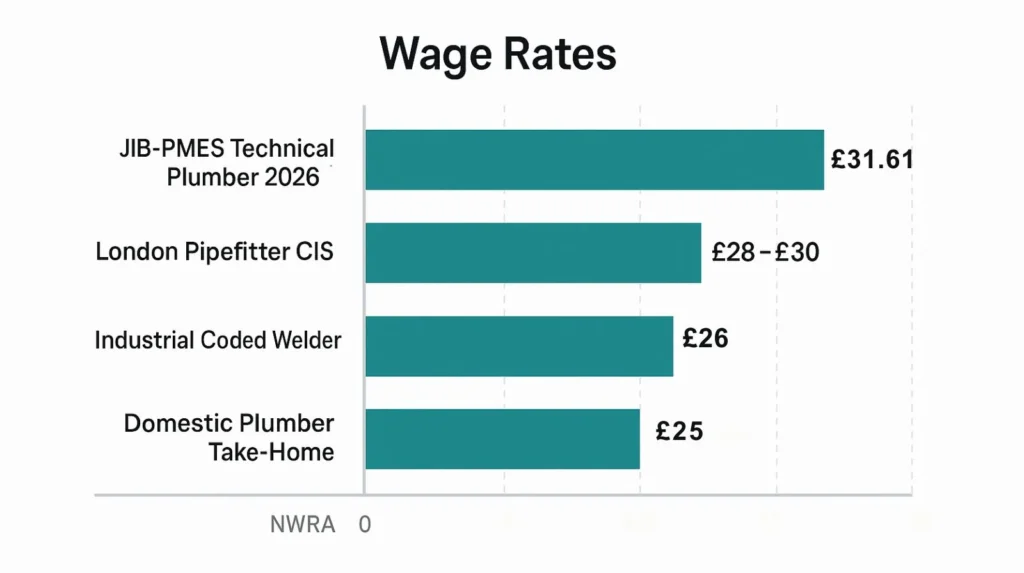
The 3.4% NWRA increase provides a formal baseline, but actual market rates far exceed it. Commercial pipefitters in London command £225-£240 per day (CIS basis), translating to £28-£30 per hour. Coded welders on industrial or defence sites earn up to £32 per hour (PAYE/Umbrella equivalent).
The NWRA rate functions as a floor, not a ceiling. Employers who adhere strictly to JIB-PMES terms struggle to recruit specialist labour, forcing them to use CIS contracts, non-PAYE models, or pay substantial premiums above the NWRA baseline.
Historical PMES Wage Trends (2015-2025)
The 3.4% settlement must be assessed against a decade of wage stagnation, followed by sharp corrective rises in the post-pandemic period.
2010-2020: Low Growth Era
Following the 2008 financial crisis, construction wages across all sectors experienced prolonged stagnation. Between 2010 and 2020, PMES wage increases typically averaged 2-2.5% annually, often failing to keep pace with inflation and cost-of-living increases.
During this period, real wages (adjusted for inflation) declined for many tradespeople. Apprentice pay remained particularly low, with starting rates well below the income needed to cover transport, accommodation, and basic living costs in major urban areas.
2021-2023: Inflation Spike
Post-pandemic inflation reached 11.1% (CPI peak, October 2022), driven by supply chain disruptions, energy price shocks, and labour shortages. Construction material costs surged, and wage pressure intensified across all trades.
2024-2025: Corrective High Rises
The JIB-PMES responded with significant wage increases:
- 2024: +7% (restoring lost real wages)
- 2025: +5% (continuing correction as inflation moderated)
These high rises were essential to retain workers who had seen their purchasing power eroded by inflation. However, they also created cost pressures for employers, particularly SMEs operating on thin margins.
2026-2027: Return to Moderation
The 3.4% settlement for 2026 and 2027 signals a return to predictable, moderate growth. While this benefits employers who need cost certainty, it exposes workers to real-terms wage erosion if inflation remains above 3.4% or accelerates unexpectedly.
Over the past 11 years (2015-2026), PMES wages have increased by approximately 135% nominally. However, after accounting for cumulative inflation of around 30%, the real-terms increase is closer to 81%, demonstrating that much of the wage growth simply restored purchasing power lost to inflation.
Estimated PMES Hourly Rates (2025 → 2026 → 2027)
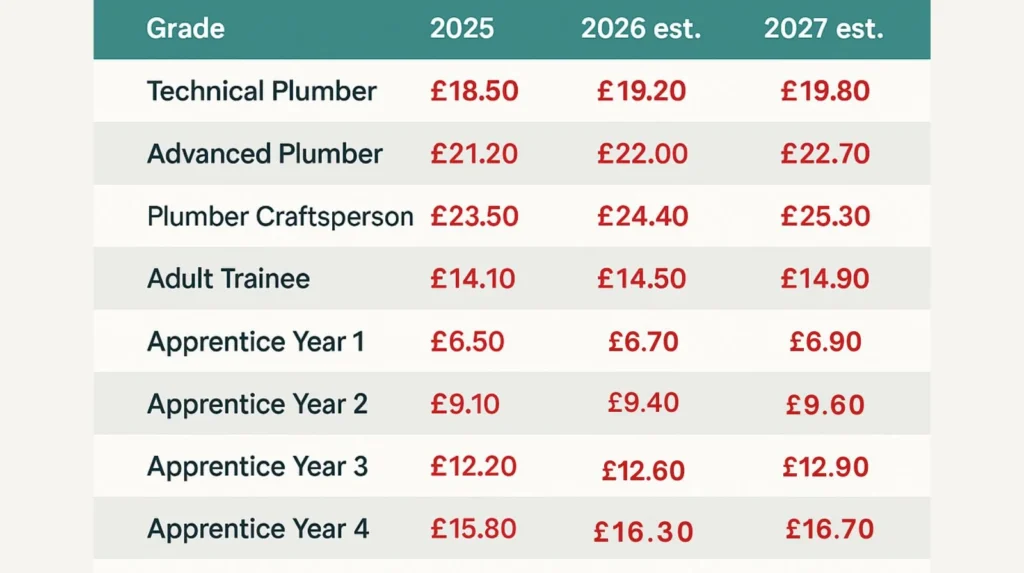
Based on the 3.4% increase applied to published 2025 rates, the projected NWRA standard hourly rates for graded operatives (using own transport, which includes a travel element) are as follows:
Technical and Advanced Grades
Technical Plumber / MPF / Gas Engineer / Low-Carbon Heating Engineer:
- 2025: £20.90/hour
- 2026 (est.): £21.61/hour
- 2027 (est.): £22.34/hour
Advanced Plumber / MPF / Gas Engineer / Craftsperson:
- 2025: £18.82/hour
- 2026 (est.): £19.46/hour
- 2027 (est.): £20.12/hour
Plumber / MPF / Gas Fitter / Craftsperson:
- 2025: £16.16/hour
- 2026 (est.): £16.71/hour
- 2027 (est.): £17.28/hour
Adult Trainees
Adult Trainee (3rd 6 months of Employment):
- 2025: £14.07/hour
- 2026 (est.): £14.55/hour
- 2027 (est.): £15.05/hour
Adult Trainee (2nd 6 months of Employment):
- 2025: £13.51/hour
- 2026 (est.): £13.97/hour
- 2027 (est.): £14.45/hour
Adult Trainee (1st 6 months of Employment):
- 2025: £12.01/hour
- 2026 (est.): £12.42/hour
- 2027 (est.): £12.84/hour
Apprentices
Apprentice (4th Year of Training):
- 2025: £12.45/hour
- 2026 (est.): £12.87/hour
- 2027 (est.): £13.31/hour
Apprentice (3rd Year of Training):
- 2025: £10.04/hour
- 2026 (est.): £10.38/hour
- 2027 (est.): £10.74/hour
Apprentice (2nd Year of Training):
- 2025: £8.98/hour
- 2026 (est.): £9.28/hour
- 2027 (est.): £9.59/hour
Apprentice (1st Year of Training):
- 2025: £7.81/hour
- 2026 (est.): £8.07/hour
- 2027 (est.): £8.35/hour
These rates apply to operatives using their own transport. The “own transport” rate includes a travel element, reflecting the expectation that mechanical operatives will use personal vehicles to travel between sites, carry tools, and transport materials.
Employers must ensure they apply age-appropriate National Minimum Wage rates where statutory minimums exceed the NWRA rates (see Apprenticeship Impact section below).
See the equivalent JIB rates for electricians by grade for the electrical side of the industry.
Allowances and Benefits: Travel, Lodging, Sick Pay
The JIB-PMES NWRA includes several allowances and benefits designed to support mobile mechanical operatives who work across multiple sites and regions.
Lodging Allowance
From 5 January 2026: £53.40 per night (up from £51.59)
The lodging allowance is a tax-free payment (confirmed by HMRC) to cover accommodation costs for operatives required to work away from home. This equates to £267 per week (5 nights, Monday-Friday) or £373.80 per week if working 7 days.
However, the allowance often falls short of actual accommodation costs, particularly in London and the South East where hotel or B&B rates can easily exceed £60-£80 per night. Operatives frequently subsidise their own living costs or accept substandard shared accommodation to stay within budget.
Mileage Allowance
Current rate: 45p per mile
The JIB-PMES mileage allowance is set at the maximum HMRC tax-free rate of 45p per mile. This is significantly more generous than other construction sector agreements and reflects the high degree of vehicle reliance in mechanical contracting.
Mechanical operatives routinely:
- Travel between multiple sites in a single day
- Transport tools, equipment, and materials
- Cover wide geographical areas (particularly in commercial and industrial work)
The 45p rate helps offset fuel, insurance, maintenance, and vehicle depreciation costs. However, it only benefits operatives who can afford to run a vehicle. Apprentices and trainees relying on public transport receive no equivalent support, creating a significant financial barrier in the early years of training.
Welding Supplement
2025 rate: 66p per hour (for possession of Gas AND Arc welding certificates)
The welding supplement is added to the operative’s basic pay for premium calculations (overtime, sick pay, etc.). It rises in line with the 3.4% NWRA increase, bringing it to approximately 68p per hour in 2026.
This supplement recognises the additional skill and certification required for coded welding work, but it represents only a modest financial uplift compared to the market scarcity value of qualified welders.
Sick Pay Increases
The agreement includes disproportionate increases to sick pay, demonstrating a strategic focus on worker security:
- 2026: +2.7% increase to sick pay (all operative grades)
- 2027: +5.3% increase to sick pay (all operative grades)
The 5.3% sick pay increase in 2027 substantially exceeds the 3.4% wage rise, signalling that unions prioritised long-term worker security and retention over maximising headline pay figures.
Sick pay under the JIB-PMES typically covers weeks 3-24 of absence (following statutory sick pay in weeks 1-2), providing crucial income protection for operatives unable to work due to illness or injury.
Responsibility Payments
Advanced Craftspersons may be required to supervise other operatives. JIB National Working Rule 6.3 defines specific responsibility payments for supervisory roles, which are applied in addition to the standard hourly rate.
Apprenticeship Impact and National Minimum Wage Conflict
The JIB-PMES apprenticeship structure faces a critical structural problem: the 3.4% wage rise does not keep pace with aggressive statutory minimum wage increases for young workers.
The NMW Collision
From April 2026, the UK government will implement the following minimum wage rates:
- Apprentice Minimum Wage: £8.00/hour (for under-19s and first-year apprentices of any age)
- 18-20 Year Old NMW: £10.85/hour (8.5% increase from 2025)
- 21+ National Living Wage: £12.71/hour (4.1% increase)
The JIB-PMES 1st Year apprentice rate (estimated at £8.07/hour from January 2026) sits just 7p above the statutory apprentice minimum. This marginal surplus offers almost no financial incentive to choose a JIB-PMES apprenticeship over other entry-level roles.
More critically, the JIB-PMES 2nd Year apprentice rate (estimated at £9.28/hour) falls £1.57 per hour below the statutory NMW for 18-20 year olds.
Employer Compliance Issue
Under UK employment law, employers must pay whichever rate is higher: the contractual rate (JIB-PMES) or the statutory minimum (NMW). This creates two immediate problems:
1. Financial Burden on Employers
Employers must pay 18-20 year old apprentices in Year 2 onwards the statutory NMW (£10.85/hour), not the JIB-PMES rate (£9.28/hour). This represents an unanticipated cost increase of approximately £3,265 annually per apprentice (based on 37.5 hours/week, 52 weeks).
Small and medium-sized enterprises (SMEs) operating on thin margins may reduce apprentice recruitment to manage costs, directly undermining the training pipeline.
2. Retention and Drop-Out Risk
Apprentices aged 18-20 quickly realise they can earn £10.85/hour in unskilled retail, hospitality, or warehouse roles with no training commitment. The financial incentive to abandon a mechanical apprenticeship and take immediate higher-paying work in an unrelated sector is substantial.
Research shows that 38% of apprentices cite travel costs as a major challenge, and up to 47% report financial pressure as a primary reason for dropping out. Low apprentice pay, combined with high commuting costs and the inability to afford a vehicle for the 45p mileage benefit, creates a perfect storm for retention failure.
Comparative Advantage vs JIB Electrical
The JIB Electrical agreement stipulated a 0% increase to apprentice rates in 2026, meaning PMES apprentices received a relative advantage with the full 3.4% uplift.
However, this advantage is undermined by the statutory NMW conflict. Both electrical and mechanical apprenticeships now face the same structural problem: apprentice pay lags behind the statutory minimum for 18-20 year olds, creating identical retention pressures across both sectors.
Long-Term Pipeline Threat
The apprenticeship structure is designed to produce the next generation of qualified plumbers, pipefitters, and HVAC operatives. If financial pressures cause high drop-out rates in Years 1-2, the long-term skills pipeline collapses.
Given that mechanical trades already face severe shortages (pipefitters, coded welders, heat pump installers), the failure to retain apprentices through to qualification represents a strategic failure that will exacerbate labour shortages through the late 2020s.
Industry Conditions and Skill Shortages
The JIB-PMES 3.4% wage settlement operates in an environment of acute, structural skills shortages across multiple mechanical specialties.
High-Demand Mechanical Skills
Coded Welders (6G Certification)
Coded welders capable of welding pipe joints in all positions (6G certification) are in severe shortage. Demand is driven by:
- Industrial and petrochemical projects
- Defence sector (submarines, naval vessels at Barrow-in-Furness and Portsmouth)
- Carbon Capture, Utilisation, and Storage (CCUS) infrastructure
- Nuclear and energy sector shutdowns
Market rates for coded welders are 30-50% above the JIB-PMES Technical Plumber rate, reflecting extreme scarcity.
Commercial Pipefitters
Large-scale commercial and infrastructure projects (data centres, hospitals, office buildings, transport hubs) require experienced pipefitters capable of installing complex HVAC, water, and drainage systems.
London and South East demand for pipefitters has pushed CIS day rates to £225-£240, equivalent to £28-£30 per hour gross. This represents a 38% premium over the JIB-PMES Technical Plumber NWRA rate.
Heat Pump Installers (MCS-Certified)
The UK government’s Net Zero targets require widespread adoption of heat pumps to replace gas boilers. The heat pump workforce must expand significantly by 2030, but the skills required (plumbing, pipefitting, electrical knowledge, refrigerant handling) overlap heavily with existing shortage occupations.
Approximately 9,000 individuals completed heat pump training in 2024, but the required workforce expansion is far greater. The competition for operatives qualified in both traditional plumbing and low-carbon heating systems intensifies wage pressure.
HVAC and Refrigeration Operatives (F-Gas Certified)
Air conditioning and refrigeration work requires F-Gas certification (handling refrigerants under EU/UK regulations). Demand is driven by:
- Commercial buildings (offices, retail, hospitality)
- Industrial cold storage and process cooling
- Data centres (critical temperature control)
HVAC operatives with F-Gas certification and commercial experience command significant premiums over the NWRA baseline.
Migration Policy Constraint
The July 2025 immigration policy change raised the Skilled Worker visa threshold to RQF Level 6 (degree level or equivalent). This effectively closes the migration route for most mechanical trades, which are typically RQF Level 3 (NVQ Level 3, advanced apprenticeship).
Historically, UK construction relied on imported skilled labour from EU countries (pre-Brexit) and Commonwealth nations to fill shortages. With migration now restricted to graduate-level roles, domestic wage pressure is guaranteed to accelerate.
The Temporary Shortage List previously included many mechanical trades, but the RQF Level 6 threshold removes the ability to sponsor non-graduate skilled workers, regardless of shortage severity.
Green Energy Rollout Demand
Net Zero policy creates sustained, structural demand for mechanical skills. Key drivers include:
- Heat pump installations: Replacing 23 million gas boilers with heat pumps by 2050
- EV charging infrastructure: Electrical and mechanical installation work
- Grid upgrades: Substation and distribution work requiring electrical and mechanical operatives
- Renewable energy: Wind, solar, and battery storage projects
These transitions are not optional. They are legally mandated by the Climate Change Act and reinforced by government policy. The mechanical workforce must expand significantly, but training pipelines take 2-3 years to produce qualified operatives, and apprentice retention remains poor.
Real-World Market Rates vs JIB-PMES Baseline
The NWRA rates provide a formal baseline, but market realities reveal substantial premiums for specialist skills and mobile labour.
London Commercial Pipefitters
Market rate: £225-£240 per day (CIS basis)
Equivalent hourly rate: £28.13-£30.00 (based on 8-hour day)
JIB-PMES Technical Plumber (2026 est.): £21.61/hour
Premium: 30-38% above NWRA
Commercial pipefitting in London involves large-scale HVAC, water, and drainage installations in office buildings, hospitals, data centres, and infrastructure projects. The day rate reflects high cost-of-living, congestion charges, parking costs, and the scarcity of qualified operatives willing to work in Central London.
Industrial and Defence Welders
Market rate: £32.12/hour (PAYE/Umbrella equivalent)
JIB-PMES Technical Plumber (2026 est.): £21.61/hour
Premium: 49% above NWRA
Coded welders working on industrial sites (petrochemical, nuclear, defence) or shutdown maintenance projects command the highest premiums in mechanical trades. The work requires:
- 6G welding certification (all positions)
- Pressure vessel and pipe welding qualifications
- Site-specific safety training (CCNSG, COMPEX)
- Willingness to work away from home (often remote locations)
Non-local welders (travelling 50+ miles) receive additional allowances for lodging, subsistence, and travel time, pushing total compensation well above £40,000 annually for experienced operatives.
Domestic and Maintenance Plumbers
Chargeable rates: £50/hour average, £180-£700/day
Take-home rate (after business costs): £25-£40/hour
Self-employed plumbers focusing on domestic repairs, maintenance, boiler servicing, and small installations charge customers directly. While chargeable rates are high, they must cover:
- Vehicle costs (fuel, insurance, maintenance, depreciation)
- Tools and equipment
- Liability insurance
- Accountancy and admin
- Marketing and customer acquisition
- Periods without work
Net take-home rates are lower than gross charges, but still typically exceed JIB-PMES PAYE rates, particularly for experienced operatives with established customer bases.
The NWRA as a Floor, Not a Ceiling
Thomas Jevons, Head of Training at Elec Training, explains the market disconnect:
"The 3.4% rise brings a Technical Plumber to around £21.61 per hour under the NWRA, but that's the JIB baseline, not what the market actually pays. Commercial pipefitters in London are commanding £225 to £240 per day on CIS contracts, and coded welders on industrial sites can earn £32 per hour or more. The NWRA rate is a floor, not a ceiling, and employers who stick rigidly to it will struggle to fill specialist roles."
Thomas Jevons, Head of Training
This confirms that compliant JIB-PMES contractors operate at a structural disadvantage when competing for scarce labour. The NWRA rates are administratively useful for tendering and payroll, but they do not reflect the actual cost of securing specialist mechanical skills in 2026-2027.
Forum Sentiment and Worker Commentary
Trade forums and professional community groups reveal practical frustrations with the JIB-PMES wage structure and the gap between NWRA rates and market realities.
Workers Report NWRA Rates Lag Market Realities
Experienced mechanical operatives frequently report “holding out for more” than official JIB rates. The sentiment is that compliant employers operating strictly within NWRA terms struggle to hire experienced staff, forcing them to operate below capacity or use subcontracted CIS labour.
The benefits of the JIB package (sick pay, pension contributions, formalised agreement) are often outweighed by the immediate financial necessity of higher gross hourly rates offered by non-compliant competitors or CIS self-employment.
Apprentices Express Financial Strain
Apprentices cite low pay combined with high operational costs as primary barriers. Travel costs are explicitly mentioned in nearly 40% of drop-out cases, particularly for learners relying on public transport or facing long commutes.
The 45p mileage allowance only benefits those who can afford to run a vehicle. For apprentices earning £8.07/hour in Year 1, purchasing, insuring, and maintaining a car is financially impossible, leaving them dependent on expensive public transport or parental support.
Undergrading and Travel Pay Disputes
Forum discussions reveal ongoing disputes about:
- Undergrading: Operatives believe their experience and qualifications warrant Advanced or Technical Plumber status, but employers classify them at lower grades to reduce payroll costs
- Travel payments: Disagreements about whether travel time between sites during the working day should be paid at standard rates or treated as unpaid time
- Lodging adequacy: Complaints that £53.40 per night does not cover realistic accommodation costs in major cities
These disputes reflect structural tensions between NWRA compliance and the financial realities of mobile mechanical work.
CIS Preference Among Experienced Operatives
Many experienced plumbers and pipefitters report moving to CIS contracts or self-employment once qualified. The gross income difference (20-40% higher on CIS day rates) outweighs the loss of sick pay, pension, and holiday entitlement, particularly for operatives with established customer bases or contractor relationships.
This migration from PAYE to CIS undermines the NWRA’s role as the sector standard and forces compliant employers to compete with higher-paying, non-compliant competitors.
Shape
Comparison With JIB Electrical (Clearly Marked)
Note: This section compares JIB-PMES (mechanical trades) with JIB Electrical (electrical trades) for context only. The two agreements cover separate sectors and should not be confused.
JIB Electrical Secured Higher Compounding Rises
The JIB Electrical agreement, covering 2026-2028, secured a three-year compounding wage deal:
- 2026: +3.95%
- 2027: +4.6%
- 2028: +4.85%
By contrast, JIB-PMES secured:
- 2026: +3.4%
- 2027: +3.4%
By the end of 2027, the compounding effect of the Electrical deal will have widened the existing pay gap between the two sectors.
Electrical Rates Remain 8-17% Higher
Comparing projected 2026 hourly rates (using own transport):
| JIB Electrical Grade | 2026 Rate | JIB-PMES Equivalent | 2026 Est. | Difference | % Premium |
| Site/Installation Technician | £23.87 | Technical Plumber/MPF | £21.61 | £2.26 | +10.5% |
| Approved Electrician | £21.19 | Advanced Plumber/MPF | £19.46 | £1.73 | +8.9% |
| Electrician/Craftsperson | £19.54 | Plumber/Craftsperson | £16.71 | £2.83 | +16.9% |
| Apprentice (Stage 1) | £8.16 | Apprentice (Year 1) | £8.07 | £0.09 | +1.1% |
The most significant disparity is at the Craftsperson level, where electricians earn nearly 17% more than plumbers of equivalent grade. This creates internal friction on mixed M&E sites and challenges PMES contractors’ ability to attract high-calibre recruits.
Apprentice Treatment Differs
JIB Electrical stipulated a 0% increase to apprentice rates in 2026, while JIB-PMES apprentices received the full 3.4% uplift. This gives PMES a marginal competitive advantage for initial recruitment.
However, both agreements now face the same structural problem: apprentice pay conflicts with statutory NMW for 18-20 year olds, undermining retention in Years 2-3.
Allowances: PMES Mileage Advantage
The JIB-PMES mileage allowance (45p per mile) is substantially more generous than JIB Electrical (22p per mile over 15 miles each way). This reflects the higher vehicle reliance and geographical mobility required in mechanical contracting.
Lodging allowances are near parity: JIB-PMES £53.40/night, JIB Electrical similar.
Why the Disparity Matters
The persistent wage premium for electrical trades reinforces the perception that electrical work is more lucrative than mechanical work, influencing career choices among school leavers and career changers. This makes it harder for the mechanical sector to attract new entrants, exacerbating existing skills shortages.
For compliant PMES contractors, the lower NWRA rates provide a cost advantage when tendering, but this advantage is immediately negated by the necessity of paying market premiums to secure specialist labour.
Policy Intersections: How UK Government Decisions Affect PMES Wages
The JIB-PMES wage settlement does not exist in isolation. Multiple UK policy decisions in 2025-2027 directly impact the real-terms value of PMES wages and apprenticeship viability.
National Minimum Wage and Living Wage Increases
The most volatile external factor is aggressive statutory minimum wage increases:
- Apprentice Minimum Wage: £8.00/hour (April 2026)
- 18-20 Year Old NMW: £10.85/hour (8.5% increase, April 2026)
- 21+ National Living Wage: £12.71/hour (4.1% increase, April 2026)
The 18-20 NMW increase far exceeds the PMES 3.4% wage rise, creating the structural conflict described earlier. Employers must absorb unanticipated costs to remain compliant with statutory minimums.
Income Tax Threshold Freeze (Fiscal Drag)
The UK government has frozen the personal income tax threshold at £12,570 until 2028. As wages rise nominally (due to the 3.4% PMES increase), more workers are pulled into higher tax bands, reducing net take-home pay.
This fiscal drag erodes the real-terms benefit of wage increases, particularly for Technical Plumbers and Advanced Plumbers earning £40,000-£45,000 annually.
Transport Costs and Rail Fare Policy
UK rail fares are regulated, and any above-inflation increases directly impact apprentices and operatives who rely on public transport. The JIB-PMES mileage allowance benefits vehicle owners, but those without cars face rising commuting costs that the 3.4% wage rise may not fully offset.
Government decisions to freeze rail fares (as announced in Autumn 2024) provide marginal relief, but do not fundamentally address the affordability gap for low-paid apprentices.
Energy Bill Reductions and Household Costs
The UK government’s £150 energy bill reduction (effective April 2026) provides indirect support to household budgets by reducing electricity and gas costs. This helps operatives manage cost-of-living pressures, but the benefit is modest compared to the cumulative impact of inflation on food, housing, and transport.
Skills Pipeline and Apprenticeship Funding
Net Zero targets require rapid expansion of the mechanical workforce, but apprenticeship funding remains constrained. Training providers face frozen funding bands while wage costs rise, creating financial pressure that threatens training quality and provider viability.
The Youth Guarantee scheme (guaranteeing 18-21 year olds access to education, training, employment, or apprenticeships) aims to reduce NEETs (Not in Education, Employment, or Training) but does not address the financial viability of apprenticeships when pay falls below statutory minimums or living costs.
Heat Pump and Net Zero Incentives
Government grants for heat pump installations (Boiler Upgrade Scheme) and proposed mandates for new-build homes to install heat pumps create sustained demand for MCS-certified plumbers and HVAC operatives. This policy-driven demand should, in theory, push wages higher through scarcity.
However, the NWRA’s uniform 3.4% increase does not differentiate between operatives with specialist low-carbon certifications and those without, failing to capture the scarcity value of heat pump installation skills.
Required Data in Context: Real-Terms Wage Change
To understand whether the 3.4% rise represents genuine wage growth, we must compare it to inflation and cost-of-living increases.
Inflation Context (2024-2026)
- 2024: UK CPI inflation averaged 2.5-3%
- 2025: UK CPI inflation 2.4-3.6% (moderating but still elevated)
- 2026 (forecast): UK CPI inflation expected to remain around 2.5-3%
If inflation averages 3% in 2026 and 2027, the 3.4% PMES wage rise provides only 0.4% real-terms growth per year, barely keeping pace with cost-of-living increases.
If inflation remains at or above 3.4% (or spikes unexpectedly due to energy costs, supply chain issues, or geopolitical events), PMES wages will stagnate or decline in real terms.
Cumulative Wage Growth (2015-2026)
Over the past 11 years, PMES wages have increased approximately 135% nominally. However, cumulative inflation over the same period was around 30%, meaning the real-terms increase is closer to 81%.
Much of the wage growth simply restored purchasing power lost to inflation, rather than providing genuine pay increases above cost-of-living.
Purchasing Power Comparison
A Technical Plumber earning £20.90/hour in 2025 has an estimated annual income of £40,755 (37.5 hours/week, 52 weeks). After the 3.4% rise in 2026, this becomes £42,140.
However, if inflation is 3%, the real purchasing power in 2025 terms is £40,874, representing only £119 of real annual income growth.
For apprentices earning £8.07/hour (£15,733 annually), the real-terms benefit of the 3.4% rise is negligible, and the conflict with statutory NMW for 18-20 year olds means the NWRA rate is functionally irrelevant for mid-stage apprentices.
Contradictions Presented Neutrally
The JIB-PMES settlement reflects competing interests and structural tensions. Below are the key contradictions, presented without judgement:
Employers:
- Want predictable costs for multi-year contract tendering
- Say 3.4% is manageable and provides financial stability
- Struggle to recruit specialist skills when adhering strictly to NWRA rates
- Face unanticipated costs from apprentice NMW conflicts
Workers:
- Say 3.4% does not match real cost-of-living increases
- Report market rates far exceed NWRA baseline for specialist skills
- Appreciate sick pay and mileage allowances but prioritise gross hourly rate
- Increasingly move to CIS self-employment for higher take-home pay
Apprentices:
- Say pay is too low to cover travel, accommodation, and living costs
- Face financial strain in Year 1-2, leading to high drop-out rates
- Benefit from 3.4% rise vs electrical 0%, but still earn below statutory NMW for 18-20 year olds
- Struggle without vehicle ownership, unable to access 45p mileage benefit
Unions:
- Accepted 3.4% for industrial stability and certainty
- Prioritised sick pay increases (5.3% in 2027) and benefits security
- Recognise long-term retention requires higher wages but faced employer resistance
- Likely to push for larger rises in 2028 negotiations if skills shortages persist
Market Reality:
- Specialist CIS rates (pipefitters, welders) exceed NWRA by 30-50%
- Self-employed plumbers earn £40-£60/hour chargeable rates
- Heat pump and Net Zero demand drives scarcity but NWRA does not reflect this
- Migration restrictions guarantee domestic wage pressure will intensify
Policy:
- Government NMW increases for 18-20 year olds conflict with JIB-PMES apprentice structure
- Net Zero targets require workforce expansion but training funding is constrained
- Income tax threshold freeze erodes real-terms benefit of wage rises
- Skills pipeline cannot respond quickly enough to demand, ensuring shortages persist
These contradictions highlight that the 3.4% settlement provides short-term stability but fails to address long-term structural problems in apprentice retention, skills shortages, and market competitiveness.
What Happens Next
The JIB-PMES agreement covers 2026 and 2027, with the next negotiation cycle beginning in late 2027 for implementation in 2028.
Likely Developments:
1. Continued Market Wage Premiums
The structural skills shortages (pipefitters, welders, HVAC, heat pump installers) will persist through 2027 and beyond. Employers will continue to pay substantial premiums above NWRA rates to secure specialist labour, reinforcing the perception that the JIB-PMES baseline is uncompetitive.
2. Apprentice Retention Crisis
If the NMW conflict is not resolved, apprentice drop-out rates will remain high. The mechanical sector’s training pipeline will fail to produce sufficient qualified operatives to meet Net Zero workforce demands, exacerbating shortages and pushing wages higher in the long term.
3. Union Leverage in 2028 Negotiations
By 2028, unions will have accumulated significant leverage. The widening pay gap with JIB Electrical, combined with persistent skills shortages and the successful rollout of heat pump technology, will likely result in aggressive pay claims seeking real-terms increases to restore competitiveness.
4. Migration Policy Impact
With migration routes closed for non-graduate skilled trades, domestic wage pressure will intensify. The NWRA’s moderate 3.4% increases will be insufficient to address scarcity-driven wage inflation, forcing employers to deviate further from compliant rates.
5. Heat Pump Workforce Expansion
Government policy mandates heat pump adoption to replace gas boilers. The mechanical workforce must expand significantly, but training takes 2-3 years. This guaranteed demand should drive wages higher, but the NWRA’s uniform structure does not differentiate operatives with specialist low-carbon certifications.
Joshua Jarvis, Placement Manager at Elec Training, highlights the retention challenge:
"From a placement perspective, mechanical trades offer strong opportunities, but retention depends on more than just the hourly rate. Travel costs, lodging adequacy, and progression pathways all matter. The JIB-PMES lodging allowance is £53.40 per night, but accommodation in or near major cities often exceeds that. Operatives who are required to work away from home find themselves subsidising their own living costs, which impacts retention, particularly for younger workers still establishing their careers."
Joshua Jarvis, Placement Manager
This confirms that wage increases alone will not solve retention problems if allowances fail to cover realistic operational costs.
If you’re training for plumbing, pipefitting, HVAC, or low-carbon heating installation, understanding the JIB-PMES wage structure matters. The NWRA rates provide a baseline, but market realities for specialist skills far exceed it. Proper qualifications (NVQ Level 3, Gas Safe, MCS for heat pumps, F-Gas for refrigeration, coded welding tickets) are essential to access the higher-paying commercial, industrial, and specialist roles. Visit www.elec.training to explore mechanical and electrical training pathways that lead to genuine employment in the UK construction and M&E sectors.
If you are comparing career options rather than pay alone, these reasons to become an electrician cover demand, progression and day-to-day variety.
References
- JIB-PMES Official Announcement (26 November 2025): https://www.jib-pmes.org
- JIB-PMES National Working Rule Agreement Handbook: https://www.jib-pmes.org
- Office for National Statistics (ONS) Labour Market Statistics: https://www.ons.gov.uk/employmentandlabourmarket
- UK Government Net Zero Strategy: https://www.gov.uk/government/publications/net-zero-strategy
- Low Pay Commission (LPC) 2026 Minimum Wage Recommendations: https://www.gov.uk
- Department for Business, Energy & Industrial Strategy (BEIS) Clean Energy Skills Assessment: https://www.gov.uk
- Construction Industry Training Board (CITB) Skills Forecasts: https://www.citb.co.uk
- Heat Pump Association (HPA) Workforce Reports: https://www.heatpumps.org.uk
- JIB Electrical Wage Agreement 2026-2028 (for comparison only): https://www.jib.org.uk
Note on Accuracy and Updates
Last reviewed: 4 December 2025. This article is based on the JIB-PMES official announcement of 26 November 2025 and estimated projections of 2026-2027 hourly rates based on applying the 3.4% increase to published 2025 figures. Official JIB-PMES rate tables for 2026-2027 will be published in updated NWRA handbooks in early 2026. Employers should refer to official JIB-PMES documentation for payroll implementation. We correct errors and refresh sources as wage agreements and labour market conditions change.
