


- Technical review: Thomas Jevons (Head of Training, 20+ years)
- Employability review: Joshua Jarvis (Placement Manager)
- Editorial review: Jessica Gilbert (Marketing Editorial Team)
- Last reviewed:
- Changes: Comprehensive 2026 update covering all qualification routes, EAS 2024 compliance requirements, NET AM2/AM2S/AM2E fee structures, JIB wage rates 2025-2028, funding rules (ESFA/AEB/SAAS), adult career change barriers, and NVQ placement realities.
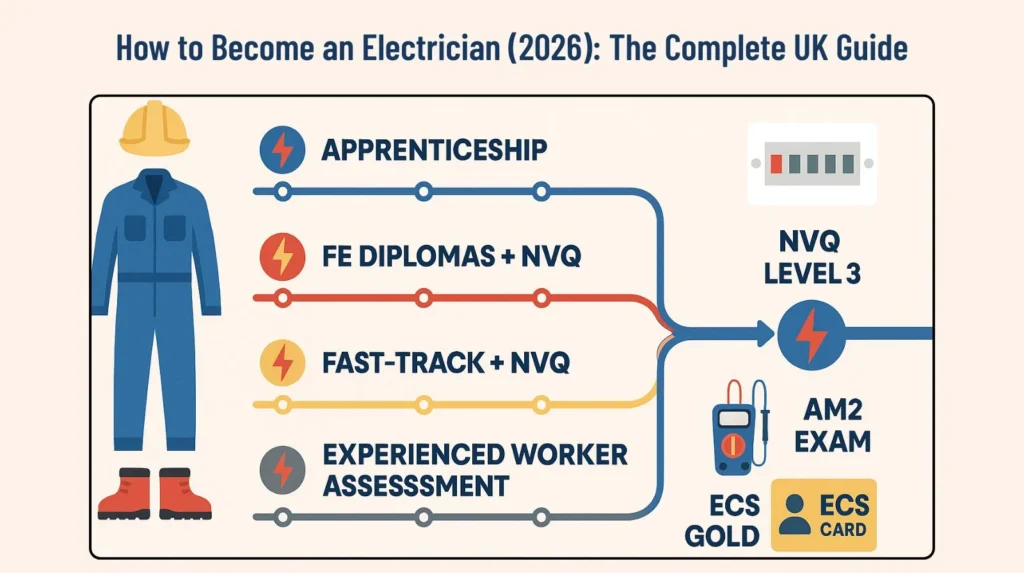
Abstract: Your Complete Guide to UK Electrician Qualification Routes
Becoming a qualified electrician in the UK in 2026 requires demonstrating both theoretical knowledge and occupational competence through a structured qualification pathway leading to the ECS Gold Card, the industry-recognized proof of competence required by most major employers and construction sites.
For our most detailed, practical guide to becoming an electrician, including a day-in-the-life breakdown and a personalised route finder tool, see our complete how to become an electrician guide.
There are four main routes to achieving qualified electrician status, each suited to different circumstances, ages, and existing experience levels.
Route 1: Electrical Apprenticeship (3-4 years) combines paid employment with structured training, covering 80% on-site work and 20% college-based learning. This route leads to Level 3 Electrotechnical Qualification, NVQ Level 3, and AM2S assessment. It suits school leavers aged 16-20 with strong Maths and English GCSEs who can manage apprentice wages (£8.16-£14.03/hour rising through stages) and have family support during the training period. Entry is competitive, with employers strongly preferring younger candidates due to government funding structures (100% funded for 16-18s vs co-funding for 19+). The apprenticeship remains the gold standard route, producing electricians with comprehensive site experience and no training debt.
Route 2: FE College Diplomas followed by NVQ (3-5 years) involves completing Level 2 and Level 3 Diplomas in Electrical Installation at Further Education colleges (1-3 years classroom learning), then securing employment as an Improver or Electrical Mate to gather the site evidence required for NVQ Level 3 portfolio completion (1-2 years). This route suits adults who need part-time or evening study options while maintaining current employment during the classroom phase. The critical challenge is the transition from knowledge-only diplomas to securing paid work for the NVQ competence component. Many learners become stuck at diploma level without employer contacts or placement support.
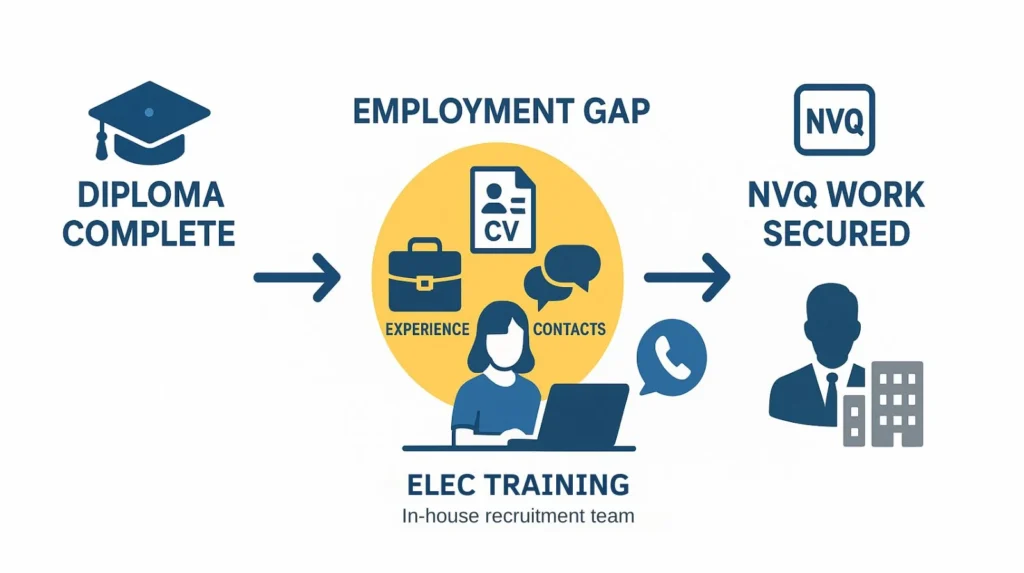
Route 3: Fast-Track Private Training with NVQ Placement (1.5-3 years) accelerates the classroom component, completing Level 2 and Level 3 Diplomas plus 18th Edition in 12-16 weeks through intensive block courses. This route suits career changers aged 25+ who need rapid knowledge acquisition and cannot afford 3-4 years at apprentice wages. However, the qualification pathway is identical to Route 2, the speed advantage applies only to classroom learning. Learners must complete sufficient authenticated workplace evidence across the required NVQ performance units, with completion time varying according to their role, site access, range of work and evidence-gathering speed. The primary risk is the NVQ placement bottleneck, where providers offer diplomas but no structured employment support, leaving learners responsible for securing improver positions independently. Training providers with in-house recruitment teams placing students into paid work address this critical gap.
Route 4: Experienced Worker Assessment (6-18 months) recognizes existing occupational competence for electricians with 5+ years of continuous, verifiable experience across domestic, commercial, and industrial installations. This route uses the C&G 2346-03 qualification, requiring candidates to build retrospective portfolios demonstrating competence, complete gap training (typically 18th Edition and Inspection & Testing if not already held), and pass the AM2E assessment. This route suits experienced tradespeople who have worked in the electrical trade for years but lack formal qualifications. The eligibility criteria are strictly enforced, awarding bodies reject applications from candidates with limited sector experience or those who worked primarily as mates rather than practicing electricians.
Key decision factors influencing route selection include age (apprenticeships favor 16-20, EWA requires 5+ years experience), financial circumstances (apprentice wages £15,000-£27,000 annually vs maintaining current employment during diplomas), time available (3-4 years structured vs 1.5-3 years accelerated), existing qualifications (GCSEs required for apprenticeships and FE colleges), and critically, access to employment for NVQ portfolio work.
Costs range from zero for apprenticeships (employer-funded) to £2,000-£5,000 for FE college routes (often subsidized via Adult Education Budget for eligible 19+ learners), £6,000-£15,000+ for private fast-track packages depending on provider and package inclusions, and £2,500-£5,000 for EWA routes. All routes require AM2/AM2S/AM2E assessment fees (£700-£1,300), tools and PPE (£500-£1,000), and ECS card application costs.
Barriers include high competition for apprenticeship places (especially for 19+ applicants), GCSE Maths and English requirements (minimum Grade 4 or Functional Skills Level 2), the NVQ employment bottleneck affecting diploma-trained candidates, age bias favoring younger applicants, and geographic limitations (vacancy concentrations in major cities and construction hubs).
Additional pathways exist as stepping stones rather than complete routes to qualified status. Traineeships and pre-apprenticeships (6-12 months) combine work experience with basic training, helping learners secure full apprenticeship positions. T-Levels in Building Services Engineering Electrotechnical Pathway (2-year courses for 16-18 year olds) provide theoretical foundation equivalent to 3 A-Levels plus industry placement, leading to employment, apprenticeships, or higher technical study. Level 1 Diplomas in Electrical Installation provide entry-level knowledge for those without GCSEs, preparing learners for Level 2 progression. These stepping stones address skills gaps and build foundation knowledge but do not replace the requirement for Level 3 NVQ, AM2 assessment, and ECS Gold Card for qualified electrician status.
Explore each route in comprehensive detail below, including realistic timelines, employer expectations, funding options, common pitfalls, and evidence-based strategies for successfully navigating the qualification pathway regardless of your starting position.
Table of Contents
Introduction: Why Becoming an Electrician Matters in 2026
The UK electrical trade faces sustained skills shortages projected to intensify through 2030, driven by simultaneous pressures from net-zero transition targets, electric vehicle infrastructure rollout, renewable energy installations, construction sector growth, and the retirement of experienced electricians without sufficient new entrants to replace them.
Government projections estimate the UK requires 725,000 additional workers across low-carbon sectors by 2050 to meet net-zero commitments, with electricians forming the backbone of this transition. Solar PV installations, heat pump systems, EV charging infrastructure, battery storage, and building management system upgrades all require qualified electricians with updated skills beyond traditional installation work.
Construction output continues expanding, with residential and commercial projects generating consistent demand for electrical installation and maintenance work. Major infrastructure projects including HS2, nuclear new build programs, data center expansion, and transport electrification create specialist opportunities for electricians with relevant qualifications and experience.
Simultaneously, the electrical workforce ages. Surveys indicate approximately 30% of qualified electricians are over 50, with retirement rates accelerating while apprenticeship completion numbers remain insufficient to offset exits from the trade. This creates sustained employer demand and upward wage pressure, particularly for electricians willing to specialize in emerging technologies or work in sectors experiencing acute shortages (utilities, industrial maintenance, commercial installations).
However, becoming a qualified electrician in 2026 is not straightforward. The qualification pathway is tightly regulated to ensure public safety and legal compliance under the Electricity at Work Regulations 1989, which require anyone working on electrical systems to demonstrate competence. This competence framework, defined by industry standards including the Electrotechnical Assessment Specification (EAS) 2024 and enforced through the ECS card system and Competent Person Schemes (NICEIC, NAPIT), establishes clear requirements that all electricians must meet regardless of which training route they pursue.
Understanding these requirements before committing time and money to training is essential. The UK electrical industry distinguishes sharply between knowledge-only qualifications (Level 2 and Level 3 Diplomas in Electrical Installation) and occupational competence qualifications (NVQ Level 3 in Installing Electrotechnical Systems and Equipment). Many learners complete diplomas assuming they are qualified, only to discover employers require the NVQ and relevant NET assessment. The NVQ requires sufficient authenticated workplace evidence across the required performance units. Completion time varies according to the learner’s role, site access, range of work and evidence-gathering speed.
This guide provides comprehensive, evidence-based information on all recognized routes to qualified electrician status in the UK in 2026, explaining what each route entails, who it suits, realistic timelines, costs, barriers, and critically, how to avoid common pitfalls that leave learners stuck with incomplete qualifications and significant debt.
Common Myths About Becoming an Electrician
Before exploring qualification routes in detail, addressing widespread misconceptions prevents costly mistakes and sets realistic expectations about what becoming a qualified electrician actually requires.
Myth 1: “You can become a fully qualified electrician in 5-6 weeks”
This claim appears frequently in fast-track course advertising. The reality is more complex. Fast-track providers can deliver the Level 2 and Level 3 Diplomas (knowledge-only qualifications) in 5-16 weeks through intensive block courses. However, these diplomas represent only the classroom component of electrician training.
Qualified electrician status normally requires a recognised Level 3 occupational competence qualification, the relevant NET assessment, the current BS 7671 Wiring Regulations qualification and the ECS Health, Safety and Environmental Assessment. Additional qualifications such as Inspection and Testing may be required for particular roles or grading categories. The minimum realistic timeline from starting Level 2 to holding a Gold Card is 18 months to 3 years, assuming continuous employment for NVQ portfolio work. Anyone promising faster qualification timelines is misleading applicants about industry requirements.
Myth 2: “Apprenticeships are the only way to become an electrician”
While apprenticeships remain the gold standard route, producing electricians with comprehensive site experience and no training debt, they are not the only pathway. Adult learners can achieve identical qualified status through FE college diplomas combined with NVQ work placement, fast-track training with structured employment support, or Experienced Worker Assessment for those with existing trade experience. The qualification outcome (NVQ Level 3, AM2, ECS Gold Card) is identical regardless of route. However, non-apprenticeship routes require learners to secure employment independently for the NVQ stage, which is the primary challenge many face.
Myth 3: “If you have an engineering degree, you don’t need electrical qualifications”
Academic qualifications, including degrees in electrical engineering, mechanical engineering, or construction, do not exempt candidates from the electrical installation qualification pathway. The UK electrical trade regulates occupational competence (ability to install, test, and certify electrical systems to BS 7671), not academic knowledge. Degree holders seeking to work as electricians must complete the same NVQ Level 3, AM2, and 18th Edition requirements as all other candidates. Some degree modules may count toward diploma units at the discretion of awarding bodies and training providers, potentially shortening the classroom component, but the on-site NVQ portfolio work remains mandatory.
Myth 4: “The 18th Edition qualification is enough to work as an electrician”
The 18th Edition (BS 7671:2018+A2:2022 Wiring Regulations) is a knowledge-based exam demonstrating understanding of UK electrical installation standards. It is mandatory for qualified electrician status but insufficient on its own. The 18th Edition proves you know the regulations. The NVQ Level 3 proves you can apply them correctly during installation work. The AM2 assessment proves you can install, test, fault-find, and certify work to industry standards under exam conditions. All components are required. Holding only the 18th Edition limits candidates to laboring or mate positions under direct supervision.
Myth 5: “You can qualify online without practical training”
While some theoretical components (Level 2/3 Diploma theory modules, 18th Edition exam preparation) can be completed via distance learning, the occupational competence elements cannot. The NVQ Level 3 requires verifiable evidence of installation, testing, inspection, and maintenance work performed in real work environments under qualified supervision. Complete the relevant independent NET practical assessment at a NET-approved assessment centre. The format and duration depend on whether the candidate is taking the AM2, AM2S or AM2E. These components require hands-on work and cannot be assessed remotely.
Myth 6: “Becoming an electrician is easy money with minimal effort”
Electrical work is physically demanding (working at height, confined spaces, manual handling, repetitive tasks), technically complex (BS 7671 compliance, circuit design, fault diagnosis), and carries significant responsibility (public safety, legal liability under EAWR 1989). Qualified electricians earn strong wages (£30,000-£45,000+ employed, £200-£350+ daily self-employed) reflecting these demands, but the work itself requires continuous learning, strict attention to detail, adherence to safety procedures, and physical resilience. The qualification pathway takes years, and career success depends on maintaining competence through ongoing professional development as regulations and technologies evolve.
Myth 7: “All electrical training providers are the same”
Training providers vary significantly in quality, support structures, and outcomes. Key differentiators include whether providers offer structured NVQ employment placement (actively securing work for students vs providing job boards), assessor availability and responsiveness during portfolio building, pass rates for AM2 assessments, employer recognition of qualifications, and post-qualification employment support. Providers offering only classroom diplomas without employment pathways leave students stuck at the knowledge stage, unable to progress to qualified status. Researching provider track records, speaking to former students, and verifying NVQ placement processes before enrollment prevents costly mistakes.
What "Qualified Electrician" Means in 2026
The term “qualified electrician” has specific meaning in the UK electrical industry, defined by competence to undertake electrical installation work safely and legally under Electricity at Work Regulations 1989 Regulation 16, which requires persons engaged in electrical work to possess sufficient technical knowledge, experience, and skills to prevent danger.
This legal competence framework translates into concrete qualification requirements enforced through industry standards, particularly the Electrotechnical Assessment Specification (EAS) 2024, which defines minimum competence levels for electricians seeking to join Competent Person Schemes (CPS) like NICEIC and NAPIT, and the JIB/SJIB grading system, which determines pay scales and ECS card eligibility.
Core Components of Qualified Electrician Status:
NVQ Level 3 Diploma in Installing Electrotechnical Systems and Equipment (Buildings, Structures and the Environment)
This competence-based qualification (City & Guilds 2357, 5357, or EAL equivalents) requires learners to demonstrate occupational competence through verifiable workplace evidence gathered in real installation environments. The NVQ portfolio covers installation planning, safe isolation procedures, cable selection and installation, circuit protection, earthing and bonding, testing and inspection, fault diagnosis, certification, and compliance with BS 7671.
Evidence must be gathered under supervision of a qualified electrician with minimum 3 years post-qualification experience, authenticated by an approved NVQ assessor, and verified by the awarding body. The NVQ requires sufficient authenticated workplace evidence across the required performance units. Completion time varies according to the learner’s role, site access, range of work and evidence-gathering speed.
AM2, AM2S, or AM2E End-Point Assessment
Learners must complete the NET assessment relevant to their route: AM2 for the standard NVQ route, AM2S for the current apprenticeship-standard route and AM2E for the Experienced Worker Assessment route. These assessments test installation, inspection, testing, and fault-finding skills under controlled conditions. Candidates receive project specifications and must design, install, test, certify, and present electrical installations meeting BS 7671 requirements within strict time limits.
AM2S (Apprenticeship Standard version) applies to apprenticeship completers. AM2E (Experienced Worker version) applies to EWA candidates. Assessment fees for 2025-2026 are £1,300 (AM2S) and £1,200 (AM2E). Pass rates vary but typically range 70-85% on first attempt. Failures require expensive resits and delay qualification significantly.
18th Edition Wiring Regulations (BS 7671:2018+A2:2022)
This knowledge qualification demonstrates understanding of the UK national standard for electrical installations. The City & Guilds 2382 exam tests application of BS 7671 requirements for design, installation, inspection, testing, and certification of electrical systems up to 1000V AC.
The 18th Edition is mandatory for ECS Gold Card applications and CPS membership. While BS 7671 itself is not statutory law, compliance is considered the industry standard method of satisfying legal duties under Electricity at Work Regulations and Building Regulations Part P (England and Wales).
Initial Verification / Inspection and Testing (City & Guilds 2391 or equivalent)
This qualification proves ability to inspect and test electrical installations, complete certification accurately, and verify compliance with BS 7671. The 2391 is essential for electricians seeking to become Qualified Supervisors for Competent Person Scheme membership, which allows businesses to self-certify notifiable electrical work rather than notifying Local Authority Building Control.
While not always required for initial Gold Card applications, the 2391 significantly expands employment opportunities and is considered mandatory for self-employment or progression to supervisory roles.
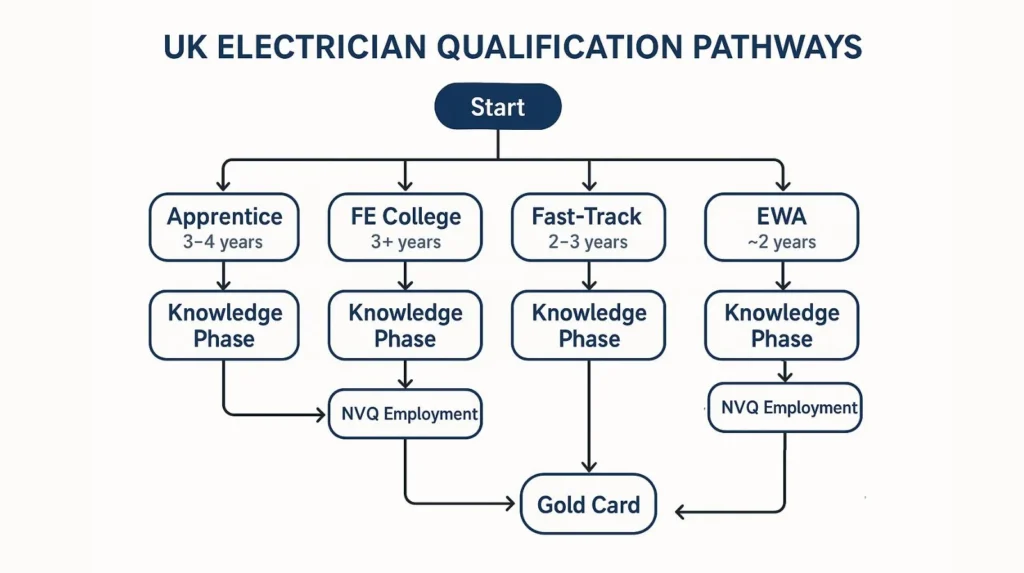
ECS Gold Card (Installation Electrician / Maintenance Electrician)
The ECS (Electrotechnical Certification Scheme) Gold Card is the physical proof of qualified electrician status, required for site access by most major contractors and construction projects. Gold Card eligibility requires the appropriate Level 3 occupational competence qualification, the relevant NET assessment for the learner’s route, the current 18th Edition Wiring Regulations qualification, and successful completion of the ECS Health, Safety & Environmental assessment.
The card must be renewed every five years, requiring evidence of continuing professional development and updated qualifications if regulations have changed. JIB (Joint Industry Board) grading as Electrician or Approved Electrician determines pay scales for employed electricians working under JIB agreements.
Clarifying Common Role Distinctions:
Qualified Electrician vs Domestic Installer: Qualified electricians hold the relevant Level 3 occupational competence qualification and the NET assessment applicable to their route, and can work across domestic, commercial, and industrial installations. Domestic installers complete shorter qualification routes (often Level 3 Diploma only without NVQ) and are limited to domestic work scope. Domestic installers cannot join full-scope CPS and must have their work inspected and certified by qualified electricians or notify Local Authority Building Control.
Qualified Electrician vs Improver: Improvers have completed Level 2 and/or Level 3 Diplomas (knowledge) but are actively working toward NVQ Level 3 by gathering portfolio evidence. They work under supervision and cannot sign off installations or hold Gold Cards.
Qualified Electrician vs Electrical Mate: Mates are unqualified assistants supporting qualified electricians with manual tasks (containment installation, cable pulling, site cleanup). They require direct supervision and cannot perform electrical connection work.
Installation Electrician vs Maintenance Electrician: Installation electricians focus on new build installations, refurbishments, and alterations. Maintenance electricians focus on fault-finding, repairs, testing, and ongoing maintenance. Both roles require identical qualifications (NVQ Level 3, AM2) but emphasize different skills.
Legal Standing and Competence:
Regulation 16 of the Electricity at Work Regulations 1989 does not specify qualifications explicitly but requires competence defined as sufficient knowledge, experience, and skills to prevent danger. HSE guidance indicates the industry-standard interpretation of competence for unsupervised electrical work is NVQ Level 3, AM2, and relevant experience.
Employers, insurers, and courts consider the ECS Gold Card and CPS membership as evidence of meeting this competence standard. Working without appropriate qualifications creates legal liability for both the individual and their employer if incidents occur.
Route 1: Electrical Apprenticeship
The electrical apprenticeship remains the gold standard pathway to qualified electrician status, combining paid employment with structured training to produce electricians with comprehensive site experience, broad technical knowledge, and industry-recognized credentials without training debt.
Structure and Duration:
Electrical apprenticeships in England, Wales, and Northern Ireland follow the Level 3 Installation and Maintenance Electrician Standard (C&G 5357-03 or equivalent), typically lasting 42-48 months plus 3-6 months End-Point Assessment period.
The program divides into 80% on-the-job training (working on real installations under qualified supervision) and 20% off-the-job training (college attendance, typically one day per week or block release periods). This structure ensures apprentices develop both theoretical knowledge and practical competence simultaneously.
Training covers first-fix installation (containment, cables, backboxes), second-fix work (accessories, consumer units, distribution boards), testing and inspection, fault diagnosis, safe isolation procedures, BS 7671 compliance, and certification processes across domestic, commercial, and industrial settings.
Qualifications Achieved:
Apprenticeship completion leads to Level 3 Electrotechnical Qualification (knowledge), NVQ Level 3 in Installing Electrotechnical Systems and Equipment (competence portfolio), 18th Edition Wiring Regulations, and AM2S End-Point Assessment. Upon successful completion, apprentices are eligible for ECS Gold Card application and JIB grading as Electrician (pay grade progressing from Apprentice Stage 1-4 to qualified Electrician rates).
Entry Requirements:
Most apprenticeship providers and employers require:
Age 16+ (no upper age limit legally, but practical barriers exist for older applicants)
GCSE Maths and English at Grade 4 (C) or above, or Functional Skills Level 2
Aptitude tests (numeracy, comprehension, spatial reasoning, mechanical understanding)
Satisfactory references and interview performance
Right to work in UK
DBS checks for certain sectors (education, healthcare, secure facilities)
Some providers accept lower GCSE grades if candidates commit to achieving Functional Skills Level 2 during the first year of apprenticeship.
Funding and Wages:
Apprenticeship funding operates through the Apprenticeship Levy (0.5% of payroll for employers with £3 million+ payrolls) and government co-funding for smaller employers. The apprentice pays no course fees. Employers pay apprentice wages and contribute to training costs based on company size and apprentice age.
JIB apprentice wage rates for 2025-2026 are:
Stage 1 (Year 1): £8.16/hour (approximately £15,912 annually at 37.5 hours/week)
Stage 2 (Year 2): £10.60/hour (approximately £20,670 annually)
Stage 3 (Year 3): £13.05/hour (approximately £25,448 annually)
Stage 4 (Year 4): £14.03/hour (approximately £27,359 annually)
Wages vary by employer. Some pay above JIB minimums, particularly in London (10-20% regional uplift) or specialist sectors (utilities, rail, industrial). National Minimum Wage for apprentices is significantly lower (£6.40/hour first year, rising to age-appropriate minimum wage in subsequent years), but most electrical employers follow JIB scales.
Employer Expectations:
Employers recruiting apprentices prioritize reliability, punctuality, attitude, and willingness to learn over prior experience. Successful apprentices demonstrate:
Consistent attendance and timekeeping
Ability to follow instructions without question
Physical capability for manual work (lifting, working at height, confined spaces)
Respect for site safety rules and supervision
Proactive engagement with college work and portfolio building
Professional behavior representing the employer on customer sites
Employers invest significant time and money training apprentices (£20,000-£30,000 total over four years including wages, training fees, supervision time). They expect loyalty, effort, and commitment in return.
Advantages:
The apprenticeship route offers multiple benefits making it the preferred pathway for those who can access it:
Earn while you learn: Apprentices receive wages throughout training, avoiding the debt burden of private training fees or need to maintain separate employment during studies.
Comprehensive experience: Four years on varied sites provides exposure to domestic, commercial, and industrial work, building diverse portfolio evidence and practical skills employers value.
Guaranteed employment: Apprentices are employees from day one, with employment rights, holiday pay, and continuity of work ensuring NVQ portfolio completion.
Structured support: College tutors, workplace mentors, and NVQ assessors provide guidance throughout, with clear progression milestones and formal checkpoints preventing learners from becoming stuck.
Employer preference: Electricians trained via apprenticeship are consistently preferred by employers recruiting for qualified positions due to verified competence and work ethic.
No debt: Completing the route leaves apprentices fully qualified with four years’ earnings rather than £7,000-£15,000 training debt.
Challenges:
Despite being the gold standard, apprenticeships present significant barriers:
High competition: Popular apprenticeship schemes (JTL, SECTT, major contractors, utilities) receive 30-50+ applications per position. Entry standards and assessment rigor increase proportionally.
Age discrimination: While legally open to all ages, employers strongly prefer 16-20 year olds due to:
Lower wage costs (apprentice minimum wage vs age-appropriate minimum wage for 19+)
Better government funding (100% for 16-18 vs 95% requiring 5% employer contribution for 19+)
Perceived longevity (40+ year careers vs 20-30 years for older starters)
Cultural assumptions about trainability and adaptation to workplace norms
Applications from candidates 25+ face rejection rates exceeding 90% at large employers, though small contractors occasionally accept mature apprentices who demonstrate exceptional commitment.
Financial constraints: Apprentice wages (£15,912-£27,359 over four years) are insufficient for candidates with mortgages, families, or significant financial obligations. The route suits school leavers living with family support, not adults with established financial commitments.
Limited flexibility: Apprenticeships require full-time commitment (typically 7:30am-4:30pm Monday-Friday plus college attendance). Part-time apprenticeships exist but are rare in electrical trades. Candidates with caring responsibilities or other commitments struggle with the inflexibility.
Location constraints: Apprenticeship vacancies concentrate in major cities and construction hubs (London, Birmingham, Manchester, Glasgow, Leeds, Bristol). Rural areas and smaller towns have far fewer opportunities, requiring relocation for many applicants.
Who This Route Suits:
Apprenticeships are ideal for:
School leavers aged 16-20 with strong GCSE results who can manage apprentice wages
Candidates with family support (living at home, minimal financial obligations)
Those seeking comprehensive training without debt
Individuals willing to commit 4 years to structured employment
Applicants in or near major cities with strong apprenticeship markets
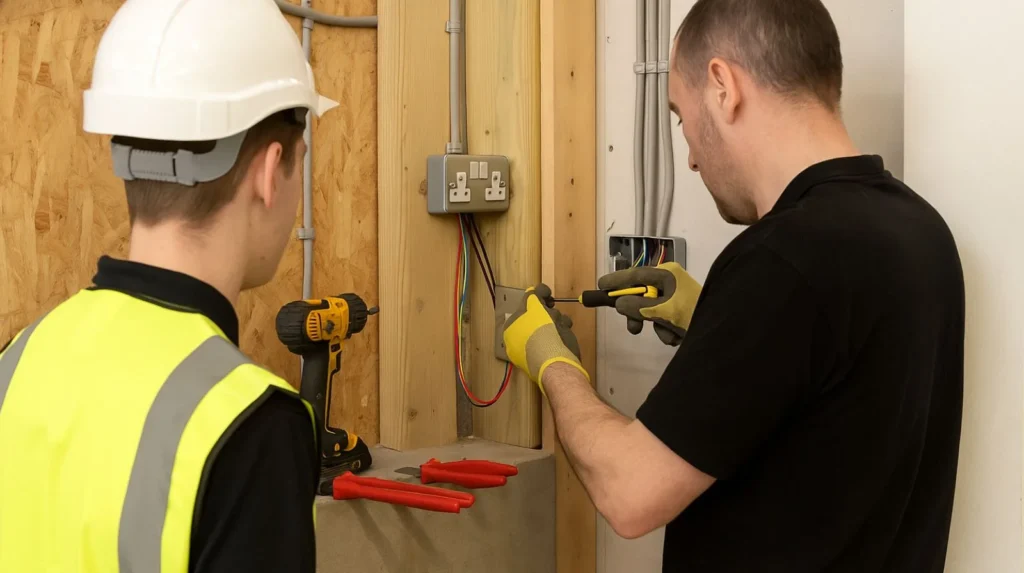
Route 2: FE College Diplomas Plus NVQ
The Further Education college route separates knowledge acquisition (diplomas) from occupational competence development (NVQ), allowing flexible study while maintaining other employment but requiring learners to independently secure the work placement essential for qualification completion.
Structure and Duration:
This pathway progresses through:
Stage 1: Level 2 Diploma in Electrical Installation (C&G 2365-02 or 8202 equivalent)
Duration: 1 year full-time or 2 years part-time (evening/weekend classes)
Content: Electrical science, health and safety, safe isolation, basic installation principles, wiring systems, environmental technology
Assessment: Theory exams and practical assessments in college workshops
Outcome: Foundation knowledge suitable for Electrical Mate positions
Stage 2: Level 3 Diploma in Electrotechnical Technology (C&G 2366-03 or 8202 equivalent)
Duration: 1-2 years full-time or 2-3 years part-time
Content: Circuit design, BS 7671 application, inspection and testing principles, fault diagnosis, environmental and energy systems
Assessment: Theory exams and practical assessments
Outcome: Advanced knowledge suitable for Improver positions
Stage 3: 18th Edition Wiring Regulations – City & Guilds 2382-26
- Duration: five days through Elec Training. The course covers the current requirements of BS 7671 and the amendments included within the current qualification.
- Assessment: Multiple-choice exam
- Outcome: Regulatory knowledge required for Gold Card
Stage 4: NVQ Level 3 Diploma in Installing Electrotechnical Systems and Equipment
Duration: Varies according to the learner’s role, site access, range of work and evidence-gathering speed
Content: Verifiable workplace evidence across installation, testing, inspection, maintenance, fault-finding
Assessment: Portfolio submission reviewed by approved assessor and awarding body
Outcome: Occupational competence recognition
Stage 5: AM2 Assessment
Duration: 3 days at NET assessment center
Content: Practical installation, testing, fault-finding, certification under exam conditions
Assessment: Performance assessment by NET examiners
Outcome: Final proof of competence for Gold Card eligibility
Total duration: 3-5 years from starting Level 2 to achieving Gold Card, with significant variability based on study mode (full-time vs part-time) and NVQ employment access.
Costs and Funding:
FE college fees vary significantly by region and eligibility:
16-18 year olds: Tuition typically free through government funding for full-time courses 19-23 year olds: May qualify for free or subsidized tuition if pursuing first Level 2 or Level 3 under Adult Education Budget (AEB) eligibility rules 24+ adults: Tuition fees £2,000-£5,000 per level, though AEB funding available for unemployed or low-income learners in some regions
Advanced Learner Loan: Available for 19+ learners to cover Level 3 Diploma fees (£3,000-£4,500 typical loan), repayable only when earning £27,295+
Additional costs include:
- NVQ assessment and registration: £1,500-£3,000
- AM2 assessment: £700-£1,000
- 18th Edition course and exam: £400-£600
- Tools and PPE: £500-£1,000
- Total additional costs: £3,100-£5,600
The NVQ Employment Challenge:
The critical transition point in this route is securing employment for NVQ portfolio work. Colleges provide knowledge qualifications but cannot guarantee work placements. Learners completing Level 2 and Level 3 Diplomas must independently find employers willing to:
Hire them as Improvers or Electrical Mates (typically £20,000-£26,000 annually)
Provide sufficient variety of work for portfolio evidence gathering
Allow access to qualified supervision and NVQ assessors
Maintain employment for sufficient time to gather the authenticated workplace evidence required for portfolio completion
Many learners struggle with this transition. Job boards show Improver positions requiring “NVQ already in progress” or “verifiable site experience,” creating a catch-22 where employment requires NVQ enrollment but NVQ enrollment requires employment.
Success strategies include:
Completing Level 2 first to demonstrate commitment before approaching employers
Accepting Electrical Mate positions initially to gain site access and build relationships
Direct approach to 50-100+ local electrical contractors via phone, email, and in-person visits
Networking through trade counters (CEF, Edmundson, Rexel) where electricians collect materials
Leveraging college tutor contacts who may recommend students to employer partners
Advantages:
Flexible study: Part-time and evening options allow learners to maintain current employment and income during diploma stages, only requiring wage reduction when transitioning to Improver work for NVQ.
Lower upfront costs: FE college fees are substantially lower than private fast-track providers, particularly with AEB funding eligibility. Many adults complete diplomas for £500-£2,000 total rather than £7,000-£15,000.
Local availability: FE colleges exist in most towns and cities, reducing travel and accommodation costs compared to residential block courses.
Academic support: College environments provide structured timetables, tutor support, library resources, and peer learning opportunities beneficial for learners who thrive with traditional education formats.
Established pathways: FE colleges have decades of experience delivering electrical qualifications with proven curriculum, experienced tutors, and well-equipped workshops.
Disadvantages:
Extended duration: Three to five years from start to Gold Card is significantly longer than apprenticeships (3-4 years) and competitive with fast-track routes that include structured employment support (1.5-3 years).
NVQ placement risk: Without guaranteed employment pathways, many learners complete diplomas but cannot progress to qualified status, leaving them with knowledge-only credentials employers view as incomplete.
Motivation challenges: Extended part-time study over multiple years without clear employment outcomes tests commitment and leads to dropout rates exceeding 40% at some colleges.
Credential inflation: Employers increasingly discount diploma-only candidates, viewing them as theoretically trained but practically unproven, particularly if significant time gaps exist between diploma completion and securing Improver work.
Who This Route Suits:
FE college routes work best for:
Adults who need to maintain current employment during knowledge acquisition stages
Learners who prefer structured classroom environments and traditional education formats
Those eligible for AEB funding or Advanced Learner Loans reducing financial barriers
Candidates with strong local employer networks or family connections in the electrical trade facilitating NVQ employment access
Individuals willing to invest 3-5 years with understanding that NVQ placement is self-directed rather than guaranteed
Route 3: Fast-Track Private Training with NVQ Placement
Let’s talk money. Fast-track courses aren’t cheap.
Typical fees:
£2,500 to £4,000 for basic Level 2/3 diploma packages
£4,000 to £6,000+ for “full” packages including 18th Edition, Inspection and Testing, and sometimes Part P
Some providers charge £6,090 for bundles with financing options
Finance options:
0% credit or instalment plans (e.g., £200/month)
Commercial loans (some at higher interest rates)
“Pay later” schemes
Some learners are eligible for government-funded options (like Skills Bootcamps or free Level 3 courses if you don’t already have a Level 3 qualification), but these aren’t always advertised as prominently as the paid fast-track packages.
Comparison with alternatives:
College routes: Part-time Level 2/3 courses can be free or heavily subsidised for eligible adults, but they take 1 to 3 years
Apprenticeships: Free to the learner, and you earn whilst you train. But they’re harder to access as an adult
Skills Bootcamps: DfE-funded, usually free for eligible adults, 12 to 16 weeks, and designed to feed into NVQ or EWA routes
Value complaints: Trustpilot and forum reviews show mixed feedback. Positive reviews highlight good teaching and helpful tutors. Negative reviews focus on cost vs outcome: “Spent £5k and I’m no closer to being an electrician than when I started” is a recurring theme.
The value equation depends on what you’re comparing against, and whether you have other options. If you’re paying £5k for a fast-track course that leaves you needing another 2 years of supervised work (unpaid or low-paid), that’s a significant financial commitment with no guaranteed return.
The NVQ Placement Bottleneck:
The primary risk of fast-track training is the employment gap. Private providers excel at delivering intensive classroom education but vary dramatically in NVQ employment support:
Job boards only: Many providers conclude service after diploma delivery, providing access to job boards listing electrical companies but offering no active placement support. Learners independently apply for hundreds of positions, facing rejection due to lack of experience, age, or oversupplied local markets.
Promised “career support”: Vague commitments to “help with job searching” or “CV advice” without concrete placement guarantees leave learners stuck at diploma stage indefinitely.
Structured placement programs: A minority of providers operate in-house recruitment teams actively contacting employers, negotiating Improver positions, and placing students into paid work for NVQ completion. Elec Training’s nvq level 3 electrical package addresses this bottleneck through guaranteed placement support.
How Elec Training Addresses the Bottleneck:
Elec Training operates a guaranteed NVQ placement model differentiating it from providers offering classroom training only:
In-house recruitment managers: Dedicated staff call 100+ electrical contractors daily, building relationships with 120+ partner employers actively hiring Improvers and Mates across the UK.
Guaranteed placement: Students completing Level 2, Level 3 and 18th Edition are placed into paid Improver or Mate positions (£18,000-£26,000 annually) to begin gathering NVQ portfolio evidence.
Staged approach: Rather than completing all classroom training before employment, students complete Level 2 → secure placement → build experience → complete Level 3 → advance to better placement → complete NVQ portfolio. This progression matches skill development to employment opportunities.
Assessor coordination: NVQ assessors work directly with placed students and their employers, ensuring portfolio evidence meets awarding body requirements and addressing issues proactively.
Timeline: 18 months to 3 years from enrollment to Gold Card for students who engage fully with placement support and demonstrate reliability to employers.
Cost: Elec Training’s complete Gold Card training package costs £8,208.33 excluding VAT (£9,849.99 including VAT). The independent AM2 assessment is booked and paid for separately.
Return on Investment: Gold Card electricians in the South-East routinely invoice £45 per hour. Even at 30 chargeable hours per week (allowing for quotes, travel, administration), annual revenue reaches £70,000 before business overheads. For employed electricians, median wages are £35,000-£42,000. Payback on training investment occurs within a few months of achieving qualified status.
Costs and Funding:
Private fast-track course fees range £6,000-£15,000+ depending on provider, location, and package inclusions. Costs typically cover:
Level 2 Diploma tuition, materials, and exams
Level 3 Diploma tuition, materials, and exams
18th Edition course and exam
Some packages include Initial Verification/Inspection & Testing
Additional costs remain learner responsibility:
NVQ assessment and registration: £1,500-£3,000 (if provider doesn’t include)
AM2 assessment: £700-£1,000
Tools and PPE: £500-£1,000
Accommodation during block courses if traveling: £500-£2,000
Finance options: Many providers offer payment plans, often through third-party finance companies charging 9-15% APR. Total repayment costs can exceed £10,000 for £7,000 borrowed. Learners should compare provider financing against personal loans, which may offer lower interest rates.
Funding availability: Fast-track private courses typically do not qualify for government funding (Apprenticeship Levy, AEB, Advanced Learner Loans), as these schemes fund apprenticeships or regulated FE college provision. Private training is self-funded or financed.
Advantages:
Speed of knowledge acquisition: Completing diplomas in 12-16 weeks rather than 2-3 years appeals to career changers who cannot commit years to part-time study.
Intensive learning environment: Block courses provide immersive education without competing commitments (work, family) during training weeks, potentially improving retention and focus.
Career change enablement: Adults with financial reserves or partner support can retrain rapidly, transitioning careers without multi-year part-time study commitments.
Flexible timing: Block courses run throughout the year with multiple start dates, unlike FE colleges tied to academic calendars (September/January starts).
Structured with placement support: When providers include guaranteed NVQ placement, the route offers speed advantage over FE colleges while maintaining quality outcomes comparable to apprenticeships.
Disadvantages:
High upfront costs: £7,000-£15,000 fees plus tools, assessment costs, and living expenses during training create significant financial barriers, particularly if financed at high interest rates.
Placement risk without guarantees: Providers offering diplomas only leave learners responsible for securing employment, with many failing to progress beyond knowledge qualifications.
Compressed learning: Intensive delivery over weeks rather than years reduces time for knowledge consolidation and practice, potentially leaving gaps in understanding.
Employer skepticism: Some employers discount fast-track credentials, viewing them as “certificate mills” producing diploma holders without genuine competence, though this bias diminishes once NVQ and AM2 are achieved.
Variable quality: Private training market includes excellent providers and predatory operators. Due diligence researching provider track records, former student outcomes, and complaints/regulatory actions is essential.
Who This Route Suits:
Fast-track training with structured NVQ placement works for:
Career changers aged 25+ who cannot access apprenticeships due to age bias
Adults with savings, redundancy packages, or partner income supporting retraining
Those unable to commit to part-time evening study over multiple years due to family/work demands
Learners prioritizing rapid knowledge acquisition followed by work placement over extended FE college timelines
Candidates selecting providers with verified NVQ placement track records and in-house recruitment support
The route is unsuitable for:
Those without sufficient funds or affordable financing to cover the cost of private fast-track training
Candidates expecting to become fully qualified in weeks rather than years
Learners unable to manage potential wage reductions during Improver stage (£20,000-£26,000)
Those unwilling to relocate if local NVQ placement opportunities are limited
For detailed course structures and current availability, visit Elec Training’s electrician course page.
Route 4: Experienced Worker Assessment
The Experienced Worker Assessment (EWA) route recognizes existing occupational competence for electricians who have worked in the trade for years without formal qualifications, offering the fastest pathway to Gold Card status for eligible candidates but enforcing strict eligibility criteria that exclude most applicants.
Structure and Duration:
The EWA process via C&G 2346-03 Level 3 NVQ Diploma in Installing Electrotechnical Systems and Equipment (Buildings, Structures and the Environment) – Experienced Worker Route involves:
Stage 1: Initial Skills Scan (2-4 hours) Assessment center staff interview candidates about their electrical experience, review employment history, and evaluate whether experience meets minimum requirements. Candidates provide:
Detailed employment history covering dates, employers, job roles, and work scope
Examples of installations completed (domestic, commercial, industrial)
Evidence of continuous electrical work (not intermittent or as a mate/assistant)
Proof of existing qualifications (if any)
Stage 2: Portfolio Building (3-12 months) Candidates compile retrospective evidence demonstrating competence across NVQ unit outcomes, including:
Photographs of completed installations showing design, installation, testing phases
Testimonials from employers or clients confirming work scope and quality
Copies of electrical certificates for installations signed off
Work logs documenting types of installations, dates, locations, and complexity
Assessor observation of current work if candidate is still employed in trade
This stage timeline depends on how well-organized candidates are and whether they have retained installation photographs, certificates, and employment records.
Stage 3: Gap Training (Variable) Assessment identifies knowledge or competence gaps requiring additional training before AM2E. Common gaps include:
18th Edition Wiring Regulations (if not held or outdated)
Inspection & Testing (C&G 2391 if not held)
Specific unit outcomes not covered by candidate’s experience (e.g., three-phase installations if experience is domestic-only)
Gap training costs and duration vary. 18th Edition: £400-£600, 3-5 days. Inspection & Testing: £1,000-£1,500, 5-7 days.
Stage 4: AM2E Assessment (3 days) The AM2 Experienced Worker version tests identical competencies to standard AM2 but acknowledges candidates have existing experience. Practical assessment at NET centers covering installation, testing, fault-finding, and certification. Fee: £1,200 (2025-2026).
Stage 5: ECS Gold Card Application Upon AM2E pass and NVQ completion, candidates apply for ECS Gold Card using C&G 2346-03 qualification, AM2E certificate, 18th Edition, and Health, Safety & Environmental test pass.
Total duration: 6-18 months from skills scan to Gold Card, depending on portfolio preparation efficiency and gap training requirements.
Eligibility Requirements:
The Experienced Worker Assessment is intended for experienced electricians who can demonstrate substantial, recent and relevant occupational experience. Eligibility is confirmed through the awarding body’s skills scan and evidence requirements.
Domestic installations (rewires, consumer unit changes, circuits, testing)
Commercial installations (offices, retail, distribution boards, emergency lighting)
Industrial installations (three-phase systems, motors, control panels)
Verifiable employment history: Candidates must prove continuous employment through:
P60s or payslips covering the 5-year period
Employer references confirming job role and scope of work
HMRC records for self-employed candidates
Company registration documents if operating own business
Evidence of installations completed: Retrospective portfolio requires:
Photographs of installations at various stages (rough-in, terminations, final)
Electrical Installation Certificates or Minor Works Certificates
Client testimonials or contractor confirmations
Work logs or job sheets documenting installations
Existing qualifications (preferred): While not mandatory, holding any of the following strengthens applications:
Older electrical qualifications (C&G 236 Part 1/2, C&G 2360, AM1)
Level 2 Electrical Installation
16th or 17th Edition (though 18th Edition will be required for Gold Card)
Domestic-Only Experience Limitation:
Candidates with domestic-only experience should confirm their eligibility and appropriate route with the awarding body. The suitable pathway depends on the candidate’s existing experience, evidence and the awarding body’s assessment requirements.
Costs:
EWA route costs vary by provider and gap training needs:
Skills scan and portfolio support: £500-£1,000 NVQ registration and assessment: £1,500-£2,500 Gap training (if required):
18th Edition: £400-£600
Inspection & Testing 2391: £1,000-£1,500 AM2E assessment: £1,200 Total typical costs: £3,600-£6,800
Significantly cheaper than apprenticeships (opportunity cost of low wages) or fast-track routes (£10,000-£15,000), but only available to candidates already possessing years of experience.
Advantages:
Fastest route for eligible candidates: Six to eighteen months from skills scan to Gold Card is substantially faster than any other pathway.
Recognition of existing competence: Electricians who learned through informal routes (working with family members, on-site training without formal apprenticeships, overseas qualifications) can formalize credentials.
Cost-effective: Total costs of £3,600-£6,800 are lower than fast-track or FE routes while maintaining identical qualification outcome.
Maintains employment: Candidates continue working in their current roles throughout the process, building portfolios from ongoing work rather than requiring separate employment.
Disadvantages:
Strict eligibility: The 5-year continuous, multi-sector experience requirement excludes the majority of applicants. Those with 3-4 years experience or single-sector backgrounds do not qualify.
Evidence burden: Building retrospective portfolios is challenging. Candidates who did not photograph installations, retain certificates, or document work thoroughly struggle to provide sufficient evidence.
Rejection risk: Awarding bodies reject applications lacking adequate breadth or quality of evidence, wasting candidates’ time and initial assessment fees (£500-£1,000).
Variable quality of experience: Years worked does not guarantee competence. Candidates with 5 years of poorly supervised or limited-scope work may fail AM2E despite meeting time requirements.
Who This Route Suits:
EWA is ideal for:
Experienced electricians who can demonstrate substantial, recent and relevant occupational experience across the work they have undertaken
Those who trained informally or via overseas qualifications not recognized in UK
Older tradespeople who entered the industry before NVQ systems existed
Ex-military electrical trades seeking civilian credentials
Self-employed electricians operating without formal qualifications who want CPS membership
The route is unsuitable for:
Electrical Mates or assistants without independent installation experience
Candidates who cannot demonstrate the substantial, recent and relevant occupational experience required by the awarding body
Candidates whose existing experience or evidence does not meet the awarding body’s requirements for the Experienced Worker Assessment
Anyone lacking verifiable employment records and installation evidence
Stepping Stone Pathways
Several qualification routes function as stepping stones toward full electrician status rather than complete pathways themselves, helping learners build foundational knowledge, secure entry-level positions, or transition into apprenticeships.
Traineeships and Pre-Apprenticeships (6-12 months)
Traineeships combine basic electrical knowledge with work experience placements, targeting 16-24 year olds who lack the qualifications or readiness for direct apprenticeship entry.
Structure:
Functional Skills in Maths and English (if not already held at Level 2)
Introduction to Electrical Installation (taster sessions, health and safety, hand tools)
Work experience placement with local electrical contractors (2-8 weeks)
Interview skills, CV writing, and workplace behavior training
Outcome: Improved employability and preparation for apprenticeship applications. Many traineeship graduates secure apprenticeships with the employers who provided their work placements.
Who it suits: School leavers with weak GCSEs or no clear career direction who need time to develop basic skills and workplace readiness before committing to full apprenticeships.
T-Levels in Building Services Engineering (Electrotechnical Pathway) (2 years)
T-Levels are technical qualifications for 16-18 year olds, combining classroom learning (80%) with industry placement (20%, minimum 45 days), introduced as alternatives to A-Levels for students pursuing technical careers.
Structure:
Core knowledge: design principles, building systems, health and safety, maths and science for construction
Occupational specialism: electrotechnical systems including installation, testing, and maintenance principles
Industry placement: minimum 315 hours (approximately 45 days) with electrical contractors or construction companies
Outcome: Qualification equivalent to 3 A-Levels. T-Level holders can progress to:
Electrical apprenticeships (often at advanced stage, reducing overall duration)
Employment as Electrical Mates or Improvers while pursuing NVQ
Higher National Certificates/Diplomas (HNC/HND) in Electrical Engineering
Foundation degrees or full degree programs
Who it suits: Students aged 16-18 interested in electrical careers who prefer technical education over academic A-Levels and want to keep options open for further study or employment.
Limitations: T-Levels do not replace NVQ Level 3, AM2, or Gold Card requirements. They provide strong foundational knowledge but still require occupational competence demonstration through NVQ portfolio work.
Level 1 Diploma in Electrical Installation (1 year)
Level 1 qualifications provide basic introduction to electrical installation for learners without GCSE Maths and English or those exploring electrical trades before committing to Level 2.
Structure:
Basic electrical science (voltage, current, resistance, Ohm’s Law)
Hand tools and equipment identification
Health and safety in construction
Safe isolation principles (simplified)
Introduction to wiring systems
Outcome: Foundation knowledge allowing progression to Level 2 Diploma. Does not qualify learners for any employment beyond basic laboring.
Who it suits: Adults or school leavers without GCSEs who need entry-level qualifications before progressing, or those uncertain about electrical trades who want low-risk exploration.
Why These Are Stepping Stones, Not Routes:
None of these pathways lead directly to qualified electrician status. They prepare learners for the four main routes (apprenticeships, FE diplomas + NVQ, fast-track + NVQ, EWA) but do not replace the requirement for NVQ Level 3, AM2, 18th Edition, and ECS Gold Card.
Their value lies in:
Addressing skills gaps (Functional Skills, basic knowledge)
Building confidence and workplace readiness
Providing industry exposure helping learners make informed career decisions
Improving competitiveness for apprenticeship or Improver positions
Offering lower-risk entry points for uncertain learners
Learners should view stepping stone pathways as preparation phases, not alternatives to the main qualification routes.
How Long Does It Really Take?
Realistic timelines from starting training to achieving ECS Gold Card status vary significantly by route, individual circumstances, and employment access, with advertised durations often understating true completion times.
Electrical Apprenticeship: 3.5-4 years
Standard timeline:
42-48 months structured training (on-the-job + college)
3-6 months End-Point Assessment period (portfolio finalization, AM2S preparation and completion)
Total: 45-54 months (3.75-4.5 years)
Variables affecting duration:
Employer provides full range of work (domestic, commercial, industrial) enabling complete portfolio evidence vs limited work scope requiring extended time
College attendance consistency (illness, employer release issues, college strikes can delay progression)
AM2S pass on first attempt vs resits adding 2-6 months per failure
Assessment center availability (regional variations, peak demand periods)
Apprenticeships have the most predictable timelines due to structured progression, employer commitment, and clear milestones.
FE College Diplomas + NVQ: 3-5 years
Variable timeline components:
Diploma phase (1-3 years):
Level 2: 1 year full-time or 2 years part-time
Level 3: 1-2 years full-time or 2-3 years part-time
18th Edition: 3-5 days full-time or 6-8 weeks evening
Minimum diploma total: 2 years full-time or 4 years part-time
NVQ phase (1-2 years):
Securing Improver employment: 0-12 months (highly variable)
Portfolio evidence gathering: 12-24 months in employment
NVQ assessment and verification: 2-4 months
AM2 preparation and assessment: 1-3 months
Minimum NVQ total: 15-27 months assuming immediate employment
Overall timeline: 3.25-6+ years depending on study mode and employment access speed.
The critical variable is NVQ employment. Learners securing Improver positions immediately after diplomas complete within 3-3.5 years. Those struggling to find work face indefinite delays, with forum discussions documenting 2-3 year gaps between diploma completion and NVQ enrollment.
Fast-Track + NVQ: 1.5-3 years
Classroom phase (3-4 months):
Level 2 Diploma: 4 weeks
Level 3 Diploma: 8 weeks
18th Edition: 3-5 days
Inspection & Testing: 5-7 days (if included)
Total: 12-16 weeks
NVQ phase (12-30 months):
Securing employment: 0-12 months (provider-dependent)
Portfolio building: Completion time varies according to the learner’s role, site access, range of work and evidence-gathering speed
AM2 assessment: 1-3 months preparation and completion
Total: 13-39 months
Overall timeline: 16-43 months (1.3-3.6 years)
Access to suitable work can substantially affect how quickly a learner completes the NVQ. Learners without consistent workplace access may take longer to collect the required evidence.
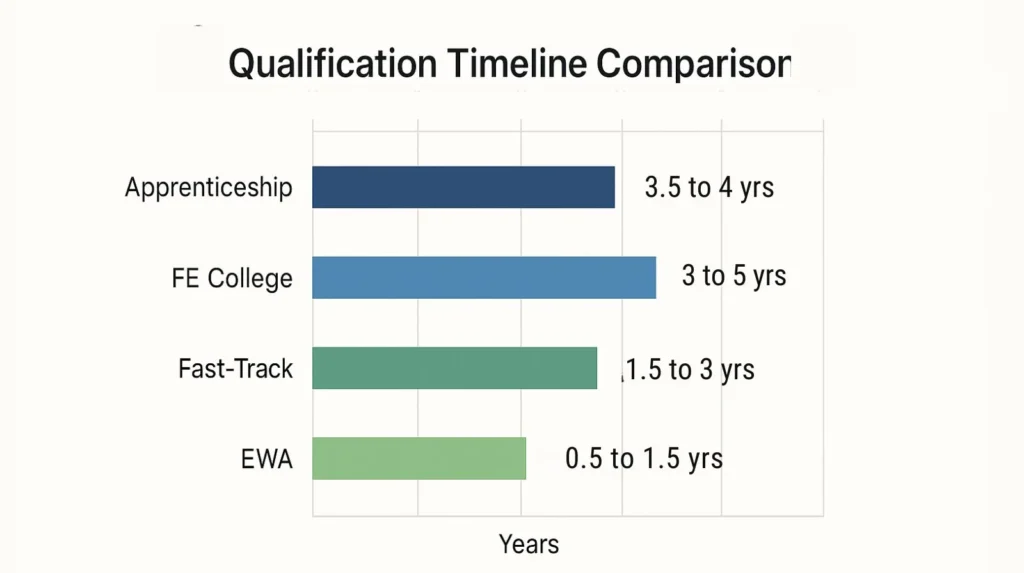
Experienced Worker Assessment: 6-18 months
Portfolio building: 3-12 months (depends on organization and evidence availability) Gap training: 0-3 months (depends on existing qualifications) AM2E preparation and assessment: 1-3 months Total: 4-18 months, averaging 9-12 months
This route is the fastest but only available to candidates already possessing 5+ years experience. The “fast” timeline recognizes existing competence rather than accelerating learning.
Factors Causing Delays Across All Routes:
NVQ assessor availability: Shortage of qualified NVQ assessors in some regions creates waiting lists for portfolio reviews and observations, adding 2-6 months to timelines.
AM2 assessment scheduling: NET centers operate at capacity during peak periods (spring/summer when apprentices complete). Booking slots 2-3 months in advance is common, with fails requiring rescheduling adding further delays.
Employment interruptions: Learners losing Improver positions mid-portfolio (company closures, redundancies, contract end) must find new employment before resuming evidence gathering, potentially adding 3-12 months.
Life circumstances: Illness, family emergencies, childcare disruptions, and financial pressures cause training interruptions extending timelines significantly.
Realistic Planning:
Learners should plan timelines using maximum estimates rather than minimum:
Apprenticeship: 4 years
FE + NVQ: 4-5 years (part-time study)
Fast-track + NVQ: 2-3 years (with placement support)
EWA: 12-18 months
Providers advertising faster timelines should be questioned about whether NVQ and AM2 are included in quoted duration.
Costs, Funding and Earning Potential
Understanding the complete financial picture, available funding, and realistic earnings helps learners make informed decisions about which qualification route aligns with their circumstances.
Total Qualification Costs by Route:
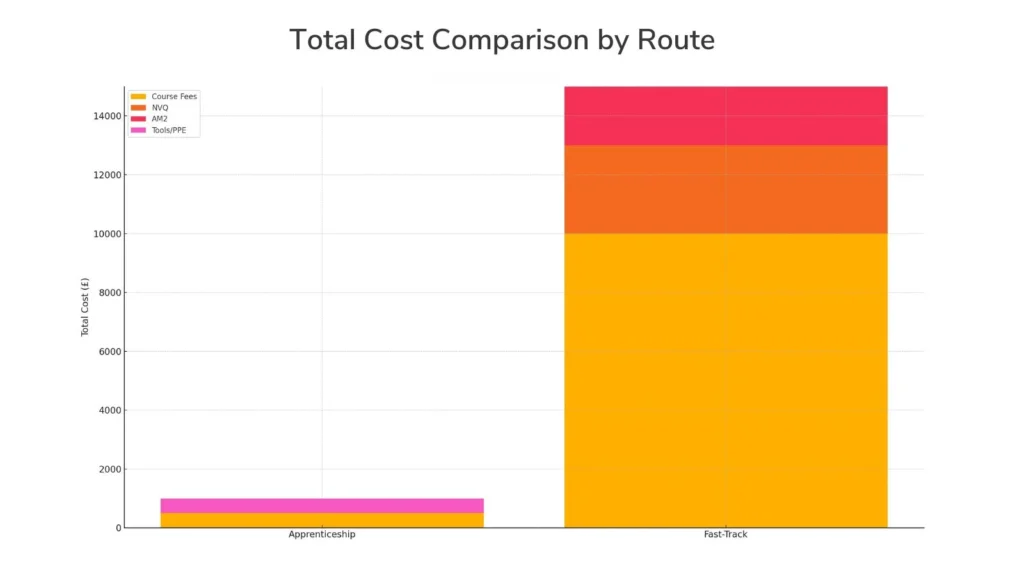
Apprenticeship:
Course fees: £0 (employer-funded)
AM2S assessment: £1,300 (often employer-paid)
Tools/PPE: £500-£1,000 (apprentice responsibility)
18th Edition/Testing: Included in apprenticeship program
Total apprentice cost: £500-£1,000
Opportunity cost: Apprentice wages (£15,912-£27,359 over 4 years) vs potential earnings in other careers
FE College Route:
Level 2 tuition: £0-£2,500 (age and funding-dependent)
Level 3 tuition: £0-£3,500 (age and funding-dependent)
18th Edition: £400-£600
NVQ assessment: £1,500-£3,000
AM2: £700-£1,000
Tools/PPE: £500-£1,000
Total: £3,100-£12,100 (wide range based on funding eligibility)
Fast-Track Route:
- Private fast-track course package: £6,000-£15,000+ depending on provider and package inclusions
- NVQ assessment: £1,500-£3,000 (if not included)
- Relevant NET assessment: booked and paid for separately where not included
- Tools/PPE: £500-£1,000
- Total cost varies by provider and package inclusions
Experienced Worker Route:
Skills scan and portfolio support: £500-£1,000
NVQ assessment: £1,500-£2,500
Gap training (18th Ed/2391 if needed): £0-£2,100
AM2E: £1,200
Tools/PPE: £500-£1,000 (usually already owned)
Total: £3,700-£7,800
UK Funding Options:
Funding eligibility varies by age, location, prior qualifications, employment status and training route. Apprenticeship, college and learner-loan rules can change, so applicants should check current guidance from GOV.UK, their local authority, college or training provider before enrolling.
Wage Expectations:
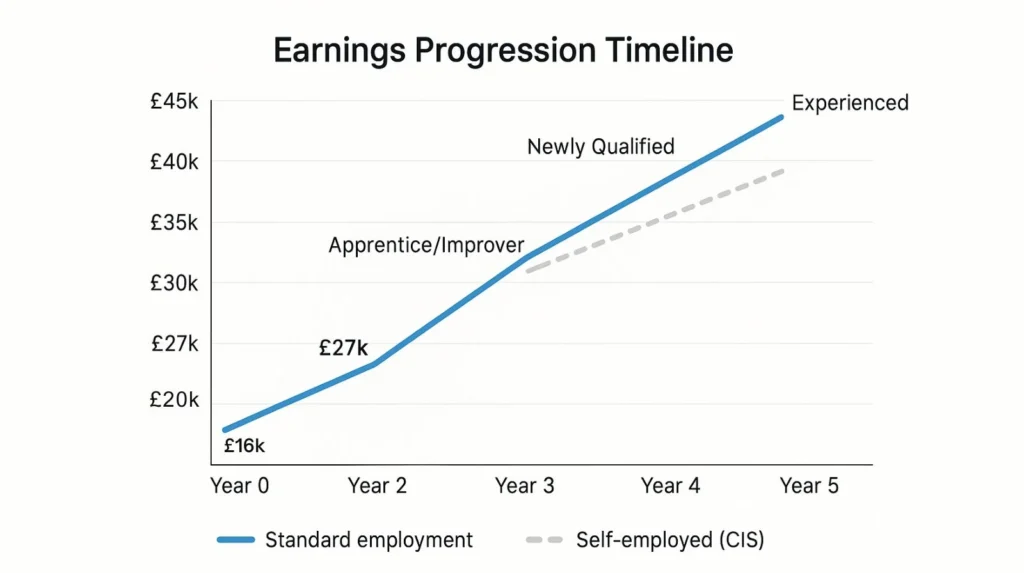
Apprentice Wages (JIB 2025-2026):
Stage 1: £8.16/hour (£15,912/year)
Stage 2: £10.60/hour (£20,670/year)
Stage 3: £13.05/hour (£25,448/year)
Stage 4: £14.03/hour (£27,359/year)
Improver/Mate Wages:
Electrical Mate: £18,000-£24,000/year (£9.23-£12.31/hour)
Improver: £22,000-£28,000/year (£11.28-£14.36/hour)
Newly Qualified Electrician (JIB 2025-2026):
JIB Electrician grade: £18.38/hour base (£35,841/year at 37.5 hours/week)
London weighting: (£20.58/hour total, £40,131/year)
Actual earnings with overtime: £35,000-£42,000/year typical
Experienced Electrician (2-5 years post-qualification):
Employed: £38,000-£48,000/year depending on sector and region
Specialist roles (industrial automation, utilities, data centers): £45,000-£60,000/year
Self-Employed CIS Electrician:
Day rates: £180-£300+ depending on location, specialism, and market conditions
Annual revenue at £220/day average, 230 working days: £50,600 gross
After business costs (van, tools, insurance, accountancy, materials): £35,000-£45,000 net typical
Regional Variations:
- London: +15-25% premium over national rates
- South-East (outside London): +10-15%
- Scotland (utilities): +5-10%
- North-East, Wales, rural areas: at or slightly below national averages
Return on Investment:
Apprenticeship: Zero training debt plus £88,887 total earnings over 4 years (assuming mid-range wages). Learner emerges with Gold Card, 4 years’ experience, and no debt. ROI is immediately positive.
FE College (with AEB funding): £3,100-£5,000 total cost (NVQ, AM2, tools) spread over 3-5 years. First year qualified earnings (£35,000) provide rapid payback. ROI positive within 2-3 months of employment as qualified electrician.
Fast-Track: Costs vary by provider and package inclusions. Elec Training’s complete Gold Card training package costs £8,208.33 excluding VAT (£9,849.99 including VAT). The independent AM2 assessment is booked and paid for separately. Qualified earnings £35,000-£42,000. Payback depends on the total training investment, employment outcome and earnings after qualification.
EWA: £3,700-£7,800 cost. Immediate earnings increase from unqualified to qualified rates (£8,000-£12,000 annual increase typical). Payback within 6-12 months.
Earning Potential Drivers:
Specializations increasing value:
Inspection & Testing (2391): +£3,000-£5,000 annually
EV Charging installation: +£2,000-£4,000 annually
Solar PV and battery storage: +£3,000-£6,000 annually
Industrial automation and PLC programming: +£8,000-£15,000 annually
High-voltage switching (utilities): +£10,000-£18,000 annually
Self-employment: Qualified electricians with CPS membership (NICEIC/NAPIT) and business skills consistently earn 20-40% more than employed equivalents but face additional costs (vehicle, tools, insurance, tax complexity, irregular income).
Barriers and How to Overcome Them
Multiple barriers prevent learners from successfully navigating electrical qualification pathways. Understanding these obstacles and proven mitigation strategies improves success rates significantly.
Age-Related Barriers:
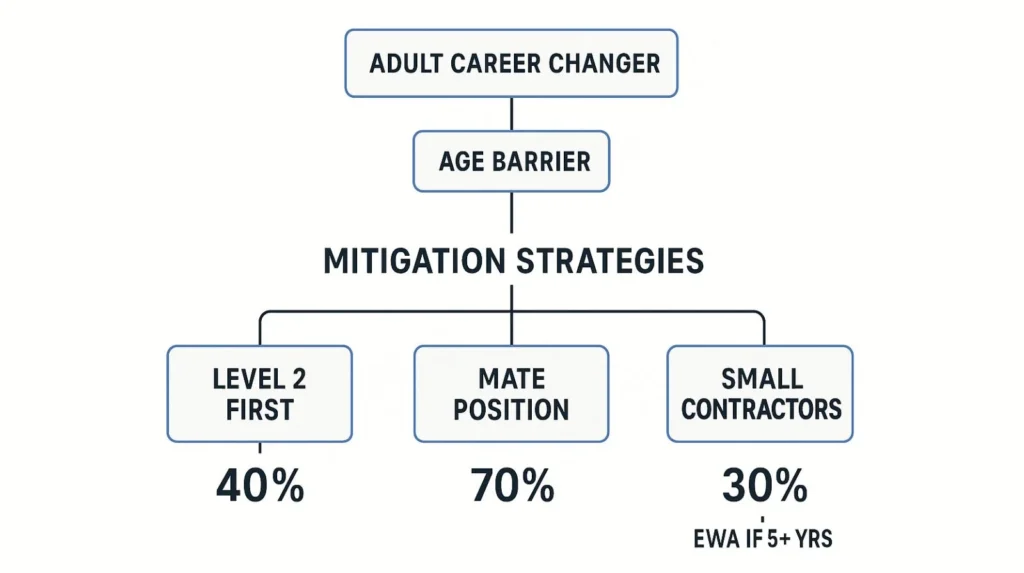
Barrier: Employers prefer 16-20 year olds for apprenticeships and Improver roles due to:
Lower wage expectations
Better government funding (100% vs 95%)
Perceived longer career duration
Assumptions about adaptability and work ethic
Evidence: Apprenticeship recruitment data shows 16-18 year olds receive 70-80% of available places despite no upper age limits. Improver job advertisements often specify “recent college leavers” or “under 25s preferred.”
Mitigation strategies:
Pursue Level 2 Diploma first, demonstrating commitment before approaching employers
Accept Electrical Mate positions initially to prove reliability and work ethic
Emphasize transferable skills from previous careers (project management, customer service, reliability)
Target small contractors (1-10 employees) who make individual hiring decisions rather than large companies with HR policies favoring youth
Consider EWA route if 5+ years electrical experience exists (even if informal/undocumented)
Select training providers with structured NVQ placement services removing age bias from equation
GCSE and Academic Barriers:
Barrier: Apprenticeships and FE colleges require GCSE Maths and English at Grade 4 (C) or Functional Skills Level 2. Candidates without these qualifications cannot enroll.
Evidence: Entry requirements are non-negotiable for regulated apprenticeships and government-funded college courses. Approximately 30% of UK adults lack Level 2 Maths and English equivalents.
Mitigation strategies:
Complete Functional Skills Level 2 Maths and English before applying (8-16 weeks at most FE colleges, often free for adults)
Enroll on Level 1 Diploma in Electrical Installation while simultaneously pursuing Functional Skills
Some private providers accept learners without Maths/English if they commit to achieving Functional Skills during training
Online Functional Skills courses allow flexible self-paced study
NVQ Employment Bottleneck:
Barrier: Completing Level 2 and Level 3 Diplomas does not guarantee employment. Many learners become stuck at knowledge-only stage, unable to progress without Improver work.
Evidence: Forum discussions consistently report diploma holders spending 6-18 months seeking employment without success. Job board analysis shows Improver positions requiring “NVQ in progress” or “verifiable site experience,” creating catch-22 situations.
Mitigation strategies:
Select training providers with guaranteed NVQ placement (in-house recruitment teams actively placing students)
Network extensively with local electrical contractors before completing diplomas (50-100 direct approaches via email, phone, in-person visits)
Accept Electrical Mate positions at lower wages (£18,000-£22,000) to gain site access and build employer relationships
Leverage college tutor connections to employer networks
Consider unpaid work experience (1-2 weeks) proving capability before formal employment offers
Complete Level 2 before Level 3, using Level 2 completion to secure mate work, then progress to Improver role after demonstrating value
Geographic Limitations:
Barrier: Apprenticeship and Improver vacancies concentrate in major cities and construction hubs (London, Birmingham, Manchester, Glasgow, Leeds, Bristol). Rural areas and smaller towns have limited opportunities.
Evidence: Job board analysis shows 60-70% of electrical vacancies in top 10 UK cities despite these areas representing <40% of population. Candidates in rural Scotland, Wales, Cornwall, and northern England face severe opportunity shortages.
Mitigation strategies:
Relocate temporarily or permanently to higher-opportunity regions if financially viable
Pursue FE college part-time route maintaining current employment in home area while building qualifications
Travel extended distances for apprenticeships or Improver work (1-2 hours each way, potentially staying in accommodation during week)
Target smaller local contractors who may have vacancies not advertised nationally
Consider self-employment pathway post-qualification (rural areas often underserved by electricians)
Financial Constraints:
Barrier: Apprentice wages (£15,912-£27,359 over 4 years) and Improver wages (£18,000-£28,000) are insufficient for adults with mortgages, families, or significant financial obligations. Fast-track training costs (£7,000-£15,000) create debt burdens.
Evidence: 53% of construction apprentices do not complete programs, with financial pressures cited as primary reason. Adult learners report inability to manage wage reductions required for Improver positions.
Mitigation strategies:
Build savings buffer (£5,000-£10,000) before starting training to supplement reduced earnings during Improver stage
Negotiate partner income covering household costs during retraining period
Pursue FE college evening/weekend route maintaining current full-time employment during diploma phase
Utilize AEB funding if eligible (unemployed or low-income) reducing or eliminating tuition costs
Consider part-time Improver work combined with part-time current employment (70-80 hour weeks temporarily)
Relocate to lower cost-of-living areas if possible (reducing housing costs by £300-£500/month significantly improves sustainability)
Gender Barriers:
Barrier: Electrical trades remain male-dominated (97-98% male), creating cultural barriers for women including:
Workplace culture (banter, facilities, assumptions)
Employer hesitancy hiring women for physical site roles
Lack of visible role models and mentors
Site facilities not designed for mixed-gender workforces (toilets, changing areas)
Evidence: Women comprise only 2-3% of qualified electricians in UK. Industry surveys report women face higher attrition rates during training and early career stages due to workplace culture issues.
Mitigation strategies:
Seek employers committed to diversity (larger contractors, public sector, companies with formal diversity policies)
Connect with women-in-trades networks for mentoring and support (WES – Women’s Engineering Society, WISE – Women Into Science and Engineering)
Address facilities concerns proactively during interviews (ensure employers provide appropriate facilities)
Document harassment or discrimination, reporting through formal channels (ACAS, trade unions)
Focus on employers who have successfully retained women electricians (requesting to speak with current female employees during recruitment)
Success Factors Across All Barriers:
Research and industry evidence identify consistent success factors:
Persistence: Successful career changers report making 100-500+ employer contacts over 6-18 months before securing NVQ placement. Early rejections are normal, not indicators of futility.
Networking: Personal connections outperform online applications. Attending trade shows, visiting trade counters, and leveraging existing contacts all improve success rates.
Demonstrated commitment: Completing Level 2 first, volunteering for site experience, self-funding tools, and accepting entry-level wages all signal commitment to employers, overcoming age/experience bias.
Realistic expectations: Understanding the qualification pathway requires 1.5-5 years and cannot be shortened prevents disillusionment and premature abandonment.
Provider selection: Training providers with active placement support (not passive job boards) achieve 60-80% NVQ completion rates vs 20-40% for diploma-only providers.
Progression After Qualification
Achieving ECS Gold Card status opens career progression opportunities, with additional qualifications and specializations significantly increasing earning potential and expanding employment options.
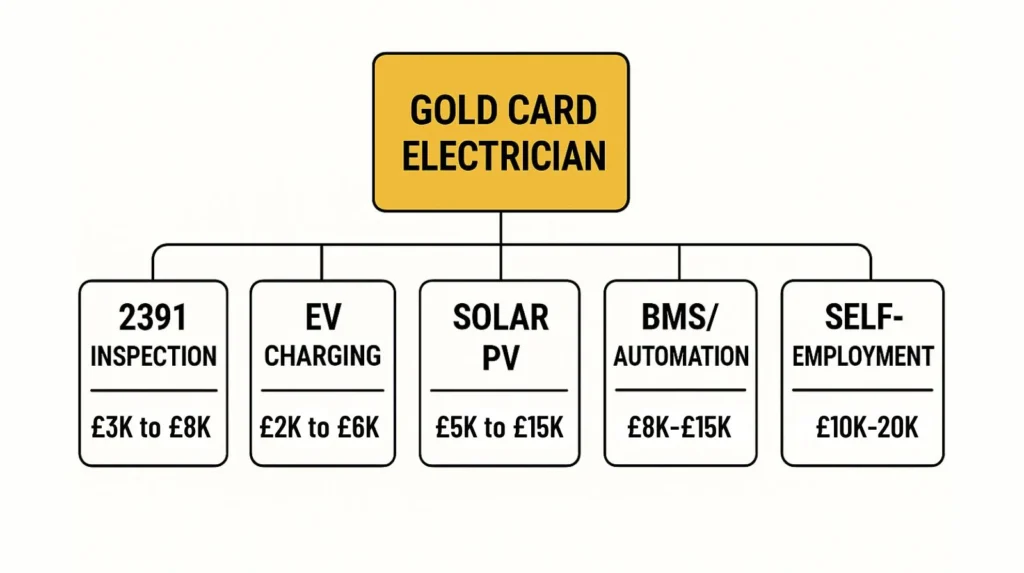
Inspection and Testing (City & Guilds 2391)
The Level 3 Award in the Requirements for Electrical Installations proves ability to inspect and test electrical systems, complete certification accurately, and verify BS 7671 compliance. This qualification is essential for:
Qualified Supervisor status: Required for CPS (Competent Person Scheme) membership with NICEIC, NAPIT, or ELECSA, allowing businesses to self-certify notifiable electrical work under Building Regulations Part P rather than notifying Local Authority Building Control (saving £100-£300 per notification).
Periodic inspection work: Testing existing installations for safety, generating EICRs (Electrical Installation Condition Reports) required for landlords, property sales, and insurance purposes. EICR demand is high and growing due to regulatory requirements.
Higher pay grades: JIB Approved Electrician grade (requiring 2391 + experience) earns £20.08/hour vs £18.38/hour for standard Electrician grade, representing £3,315 additional annual earnings.
Self-employment viability: Without 2391 and CPS membership, self-employed electricians must subcontract all testing and certification, reducing profit margins significantly.
Course duration: 5-7 days intensive or 10-12 weeks evening classes
Cost: £1,000-£1,500
ROI: Additional £3,000-£8,000 annual earnings, payback within 2-6 months
EV Charging Installation (City & Guilds 2921)
Electric vehicle charging infrastructure rollout creates sustained demand for qualified EV installers. The Level 3 Award in Electric Vehicle Charge Point Installation with Electricity Supply Equipment Installation covers domestic and commercial EV charging installation, commissioning, and certification.
Government grants (OZEV – Office for Zero Emission Vehicles) and net-zero targets drive rapid expansion of charging infrastructure. Electricians with EV qualifications access:
Domestic installations: Homeowners installing EV chargers (£800-£1,500 per installation, 4-6 hours work)
Commercial installations: Workplace and public charging points (£2,000-£8,000 per project depending on scale)
Fleet installations: Delivery companies, taxi firms, local authorities installing multiple charging points (ongoing contract work)
Course duration: 2-3 days
Cost: £600-£900
Additional earnings: £2,000-£6,000 annually depending on workload specialization
Solar PV and Battery Storage
Renewable energy installations (solar photovoltaic panels, battery storage systems, inverters) represent high-growth sector driven by:
Government net-zero targets
Energy cost increases driving homeowner investment
MCS (Microgeneration Certification Scheme) requirements
Feed-in tariffs and smart export guarantees
Qualifications include various Level 3 Awards in Solar PV Installation from City & Guilds, EAL, and specialist providers. Training covers:
Solar panel installation and positioning
DC circuit design and installation
Inverter selection and installation
Battery storage integration
Grid connection and G99 compliance
MCS certification requirements
Course duration: 3-5 days
Cost: £800-£1,200
Project earnings: £3,000-£8,000 per domestic installation (2-3 days work), commercial projects significantly higher
Additional earnings: £5,000-£15,000 annually for electricians dedicating 20-30% of workload to solar
Fire Alarms and Emergency Lighting
Commercial and industrial buildings require fire detection and emergency lighting systems designed, installed, tested, and maintained to British Standards (BS 5839, BS 5266). Specialist qualifications (City & Guilds 4347, 7267) cover:
Fire alarm system design
Installation and commissioning
Testing and certification
Emergency lighting design and testing
This specialization suits electricians preferring commercial/industrial work over domestic. Demand is consistent due to regulatory requirements for ongoing testing (quarterly, annually) creating repeat business.
Course duration: 5-10 days depending on level
Cost: £1,200-£2,000
Contract value: Maintenance contracts £500-£2,000 annually per building, installation projects £5,000-£50,000+ depending on building size
Building Management Systems (BMS) and Industrial Automation
Advanced specialization in automated building systems, PLC (Programmable Logic Controller) programming, SCADA (Supervisory Control and Data Acquisition) systems, and industrial control panels. These roles bridge electrical installation and IT/programming, requiring:
HNC/HND in Electrical Engineering
PLC programming courses (Siemens, Allen-Bradley, Mitsubishi platforms)
BMS-specific training (Tridium, Schneider Electric, Honeywell systems)
Networking and communications protocols understanding
This pathway represents highest earning potential within electrical trades, with roles in:
Data centers (24/7 operations requiring highly skilled staff)
Industrial automation (manufacturing, food processing, pharmaceutical)
Smart buildings (commercial offices, hospitals, universities)
Qualification timeline: 1-3 years part-time study (HNC/HND)
Cost: £2,000-£6,000
Earnings: £45,000-£70,000 employed, day rates £300-£500 contract work
Self-Employment and Business Development
Qualified electricians with Gold Cards, 2391, and CPS membership can establish self-employed businesses. Requirements include:
CPS membership: NICEIC, NAPIT, or ELECSA registration (£500-£1,000 annually) allowing self-certification of notifiable work
Public liability insurance: £2 million-£10 million cover (£300-£800 annually)
Professional indemnity insurance: £500,000-£2 million cover (£400-£1,000 annually)
Business registration: Sole trader or limited company formation
Tools and equipment: Van, testing equipment, hand tools, ladders (£8,000-£15,000 initial investment)
Marketing: Website, business cards, local advertising, online presence
Self-employed electricians report 20-40% higher earnings than employed equivalents but face irregular income, business administration burdens, and sole responsibility for winning work.
High Voltage (HV) Utility Pathways
Electricians seeking progression into utilities sector (National Grid, UK Power Networks, SSE, Scottish Power) require additional HV switching and authorization qualifications. Utility work involves:
Substation maintenance
High-voltage cable installation and jointing
Overhead line work
Protection and control systems
Entry typically requires existing Gold Card plus extensive safety training and authorization processes. Roles offer:
Salaries £40,000-£65,000
Defined benefit pensions
Job security (critical infrastructure)
Overtime opportunities (emergency callouts command premium rates)
Qualification requirements: Utility-specific training programs (6-24 months), company authorization schemes
Entry route: Direct application to utilities or contractors working on utility networks
Risks, Red Flags and Industry Warnings
The electrical training market includes reputable providers and predatory operators exploiting learners’ lack of knowledge. Understanding risks and warning signs prevents costly mistakes.
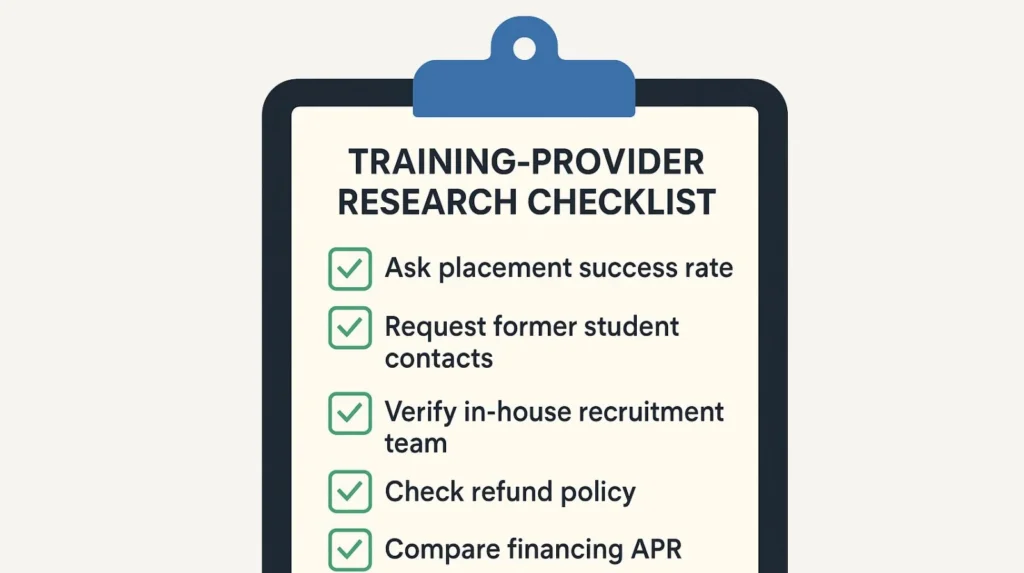
Fast-Track Qualification Claims:
Red flag: Advertising claiming “become a fully qualified electrician in 5 weeks” or “Gold Card guaranteed in 12 weeks.”
Reality: These timelines refer to diploma completion (knowledge only), not qualified electrician status. The NVQ requires sufficient authenticated workplace evidence across the required performance units, and completion time varies according to the learner’s role, site access, range of work and evidence-gathering speed.
Risk: Learners enroll expecting rapid qualification, discover afterward they need additional 1-2 years employment for NVQ, creating significant time and financial waste.
Mitigation: Ask providers explicitly: “Does this course include NVQ Level 3 and the relevant NET assessment, and how do you support learners in obtaining the workplace evidence required for the NVQ?” Legitimate providers with placement systems explain their process clearly. Providers offering diplomas only avoid the question or provide vague answers.
“Qualified on Paper but Unemployable”:
Issue: Diploma-only candidates lacking site experience face employer skepticism. Multiple forum discussions document electricians with Level 2, Level 3, 18th Edition, and 2391 unable to secure employment because they lack NVQ and practical competence.
Employer perspective: Contractors report diploma-only applicants often:
Cannot perform basic tasks (safe isolation, cable terminations, testing procedures)
Lack awareness of site culture, pace, and safety expectations
Require extensive supervision despite holding qualifications
Represent liability risks due to theoretical knowledge without practical application
Evidence: Career discussions within the UK electrical trade community frequently note that learners completing fast-track courses often begin as electrician’s mates or improvers to develop practical competence.
Mitigation: Prioritize routes providing guaranteed site work (apprenticeships, providers with placement teams, EWA for experienced workers). If pursuing diploma-only training, secure employment commitments from contractors before enrolling.
NVQ Placement “Support” That Isn’t:
Red flag: Providers promising “career support” or “job placement assistance” without specifying what this entails.
Reality: Many providers define “career support” as:
Access to job boards listing electrical companies
CV writing templates
Generic interview advice
Contact details for recruitment agencies
This passive support does not constitute structured placement. Learners remain responsible for securing employment, facing identical challenges as if they pursued FE college route independently.
Mitigation: Request specific details:
“How many students did you place into NVQ employment in the last 12 months?”
“Do you have in-house recruitment staff calling employers daily?”
“What happens if I complete my diplomas but cannot find NVQ work?”
“Can I speak with former students about their employment outcomes?”
Providers with genuine placement systems provide concrete answers and verifiable track records. Evasive responses indicate passive support models.
High-Interest Financing Traps:
Issue: Private training providers partner with finance companies offering payment plans at 9-15% APR. Learners borrowing £8,000 over 4 years repay £10,000-£11,500 total. If the learner cannot complete NVQ due to placement failures, they carry significant debt with incomplete qualifications.
Risk amplification: Finance agreements often include clauses preventing cancellation if learners become unemployed or unable to continue, leaving them paying for training they cannot use.
Mitigation:
Compare provider financing against personal loans from banks/credit unions (often 3-7% APR)
Calculate total repayment amount before signing agreements
Verify cancellation and refund policies if employment cannot be secured
Consider saving for training costs to avoid interest entirely
Investigate whether family members can provide low-interest or interest-free loans
CPS and Part P Misunderstandings:
Confusion: Some learners believe 18th Edition and 2391 alone qualify them for CPS membership and legal domestic installation work.
Reality: CPS membership (NICEIC, NAPIT) as Qualified Supervisor requires:
NVQ Level 3 (not just diplomas)
AM2 pass
18th Edition
Initial Verification/Inspection & Testing (2391)
ECS Gold Card
Public liability insurance
Business registration
Assessment visit demonstrating competence
Diploma-only candidates cannot join CPS and cannot legally self-certify notifiable electrical work under Part P Building Regulations (England and Wales). Their work must be inspected by qualified electricians or notified to Local Authority Building Control (£100-£300 per notification).
Mitigation: Understand the complete qualification pathway before starting training. CPS membership requires full Gold Card competence, not individual certificates.
Industry Warnings and Regulatory Concerns:
Competition and Markets Authority (CMA): Investigated electrical training advertising for misleading claims about qualification speed and employment outcomes. Providers making unrealistic promises risk enforcement action.
Electrotechnical Assessment Specification (EAS) 2024: Updated competence requirements for CPS membership, tightening standards and reducing routes accepting short courses without NVQ.
NET (National Electrotechnical Training): AM2 assessment body warns against training routes bypassing practical competence development. Pass rates for candidates with limited site experience are significantly lower than apprenticeship-trained candidates.
Joint Industry Board (JIB): Consistently emphasizes apprenticeship route as gold standard, expressing concerns about fast-track routes producing diploma holders without occupational competence.
Employer Sentiment:
Forum analysis and employer surveys reveal consistent themes:
Preference for apprenticeships: 70-80% of employers recruiting qualified electricians prefer apprenticeship-trained candidates due to verified competence and work ethic.
Skepticism of fast-track: 40-60% of employers report negative experiences hiring fast-track graduates, citing poor practical skills and unrealistic wage expectations.
Value of site experience: Employers universally prioritize verifiable work history over qualification speed. Candidates with 2+ years as Improvers or Mates before NVQ completion are valued higher than rapid diploma completers.
NVQ as differentiator: The NVQ Level 3 and AM2 are viewed as essential proof of competence. Diploma-only candidates are not considered qualified regardless of other certificates held.
Frequently Asked Questions
Yes, though routes and challenges differ significantly from younger entrants. Adults aged 25+ face barriers accessing apprenticeships due to employer preferences for younger candidates (better funding, lower wages, longer career duration). However, multiple pathways remain viable:
30-40 year olds: Best routes are fast-track training with guaranteed NVQ placement (if willing to manage 1.5-3 year timeline and £10,000-£15,000 investment) or FE college evening/weekend diplomas combined with proactive employer networking for NVQ work. EWA route applies if 5+ years existing electrical experience. Success requires demonstrating exceptional commitment (completing Level 2 first, accepting mate positions initially, persistent networking with small contractors).
40-50 year olds: EWA route is primary option if 5+ years experience exists. Alternative routes face increased age bias. Realistic strategies include accepting significant wage reductions during retraining, targeting small family-run contractors making individual hiring decisions, and emphasizing transferable skills from previous careers. Physical fitness for demanding site work becomes consideration at this age.
50+ year olds: EWA route only realistic option unless exceptional circumstances (family business, guaranteed employer, specialist experience valued by niche sectors). Standard apprenticeships and Improver positions face near-universal rejection due to longevity concerns.
Forum evidence confirms adults at all ages successfully qualify, though rates decrease with age and require increasingly exceptional circumstances or commitment.
No. The 18th Edition (BS 7671:2018+A2:2022 Wiring Regulations) is a knowledge-based qualification demonstrating understanding of UK electrical installation standards. It proves you know the regulations but not that you can apply them competently during installation work.
Qualified electrician status and ECS Gold Card eligibility require:
- NVQ Level 3 (occupational competence demonstrated through 12-24 months verifiable site work)
- AM2/AM2S/AM2E assessment (three-day practical exam)
- 18th Edition (regulatory knowledge)
- Initial Verification/Inspection & Testing (ability to test and certify installations)
The 18th Edition is one component of five required qualifications. Holding only 18th Edition limits employment to laboring or mate positions under direct supervision.
Yes. Multiple routes lead to identical qualified status (NVQ Level 3, AM2, ECS Gold Card):
- FE college diplomas followed by NVQ work placement (3-5 years)
- Fast-track private training with NVQ placement (1.5-3 years)
- Experienced Worker Assessment for those with 5+ years existing experience (6-18 months)
The qualification outcome is identical regardless of route. Apprenticeships offer advantages (structured progression, guaranteed employment, no debt) but are not the only pathway. Non-apprenticeship routes require learners to secure employment independently for NVQ portfolio work, which is the primary challenge.
No. While theoretical components (Level 2/3 Diploma theory modules, 18th Edition exam preparation) can be completed via distance learning, occupational competence elements cannot.
The NVQ Level 3 requires verifiable evidence of installation, testing, inspection, and maintenance work performed in real work environments under qualified supervision. This evidence cannot be fabricated or simulated, it must represent actual electrical installations completed to BS 7671 standards.
The AM2 assessment is a three-day practical exam at NET assessment centers, physically testing installation skills, safe isolation procedures, testing accuracy, fault-finding abilities, and certification competence. This assessment cannot be completed remotely.
Online learning can support knowledge acquisition but does not replace the mandatory on-site work experience and practical assessment requirements.
Qualified Supervisor status for full-scope CPS membership (allowing businesses to self-certify all domestic electrical work under Part P) requires:
- NVQ Level 3 in Installing Electrotechnical Systems and Equipment (or recognized equivalent)
- AM2/AM2S/AM2E pass
- 18th Edition Wiring Regulations
- Initial Verification/Inspection & Testing (City & Guilds 2391 or equivalent)
- ECS Gold Card
- Public liability insurance (minimum £2 million)
- Employer’s liability insurance (if employing staff)
- Business registration (sole trader or limited company)
Diploma-only routes (Level 2/3 without NVQ) do not meet CPS requirements. Domestic Installer routes lead to restricted-scope registration limited to specific work categories, not full Qualified Supervisor status.
NICEIC and NAPIT conduct assessment visits evaluating technical competence, workmanship quality, and business practices before granting membership. Simply holding qualifications does not guarantee acceptance, competence must be demonstrated.
Realistic timelines from starting training to achieving ECS Gold Card:
- Apprenticeship: 3.5-4 years (most predictable timeline due to structured progression)
- FE college full-time + NVQ: 3-4 years (assuming immediate NVQ employment after diplomas)
- FE college part-time + NVQ: 4-5 years (evening/weekend study while maintaining employment)
- Fast-track with guaranteed placement: 1.5-3 years (12-16 weeks classroom, 12-24 months NVQ work)
- Fast-track without placement support: 2-5+ years (indefinite if employment cannot be secured)
- Experienced Worker Assessment: 6-18 months (only for candidates with 5+ years existing experience)
Variables affecting timeline:
- NVQ employment access speed (immediate vs 6-12 month search)
- Portfolio building efficiency (organized evidence gathering vs delays)
- AM2 pass on first attempt vs resits (failures add 2-6 months)
- Assessment center and assessor availability (regional variations)
Providers advertising faster qualification timelines refer to diploma completion only, not Gold Card achievement. The NVQ and AM2 components require minimum 12-24 months regardless of diploma speed.
Learners completing diplomas without employment support face several options:
Independent job search: Apply directly to 50-100+ local electrical contractors via phone, email, and in-person visits. Target small companies (1-10 employees) who hire based on individual assessment rather than formal recruitment processes. Emphasize completion of Level 2 first to demonstrate commitment.
Accept mate positions: Start as Electrical Mate (£18,000-£24,000) to gain site access and build employer relationships, then request progression to Improver role once value is demonstrated.
Network strategically: Visit trade counters (CEF, Edmundson, Rexel) where electricians collect materials, introduce yourself to electricians, explain your situation, and ask about opportunities. Leverage college tutor contacts who may recommend students to employer partners.
Change providers: Enroll NVQ with providers offering structured placement support. This adds cost (£1,500-£3,000 NVQ assessment fees) but addresses employment bottleneck.
Consider volunteering: Offer unpaid work experience (1-2 weeks) to electrical contractors to prove capability and work ethic, potentially converting to paid employment.
Reality: Success rates for independent placement are approximately 30-40% within 6 months, 50-60% within 12 months. Many learners abandon qualification pursuit after 12-18 months without employment, representing significant wasted investment.

Becoming a qualified electrician in the UK requires navigating complex qualification pathways, understanding industry standards, avoiding predatory training practices, and securing the critical employment component necessary for NVQ completion. No single route suits all circumstances. School leavers with family support benefit from apprenticeships’ structured progression and zero debt. Adults with financial reserves and commitments benefit from fast-track routes offering rapid knowledge acquisition combined with guaranteed NVQ placement. Experienced workers with years of informal electrical experience benefit from EWA recognition of existing competence.
The consistent requirement across all routes is NVQ Level 3 occupational competence demonstrated through verifiable site work, AM2 practical assessment, 18th Edition regulatory knowledge, and ECS Gold Card industry recognition. Shortcuts bypassing these requirements produce diploma holders without employment prospects, not qualified electricians.
Sustained demand for qualified electricians driven by net-zero transitions, construction growth, and workforce aging creates strong career prospects for those who complete proper qualification pathways. Median earnings of £35,000-£42,000 for employed electricians and £45,000-£60,000 for self-employed specialists, combined with job security and diverse progression options, reward the 1.5-5 year qualification investment significantly.
Success depends on realistic expectations, thorough provider research, strategic route selection matching individual circumstances, and persistence through inevitable barriers and setbacks. Those who understand the qualification framework, select providers with verifiable track records of NVQ placement success, and commit to multi-year timelines achieve qualified status and career stability. Those seeking shortcuts or believing misleading advertising face debt, incomplete qualifications, and wasted years.
For personalized guidance on which qualification route best suits your circumstances, including honest assessment of barriers and access to guaranteed NVQ placement support, call Elec Training on 0330 822 5337. Experienced advisors provide realistic timelines, cost breakdowns, and frank discussions about whether electrical trades align with your situation, helping you make informed decisions about career investment and avoid the common pitfalls that prevent qualification completion.
References
- Joint Industry Board (JIB), National Working Rules and Grading Definitions: https://www.jib.org.uk
- NET (National Electrotechnical Training), AM2/AM2S/AM2E Assessment Information and Fee Structure 2025-2026: https://www.netservices.org.uk
- GOV.UK, Assessment of Priority Skills to 2030: https://www.gov.uk/government/publications/assessment-of-priority-skills-to-2030
- City & Guilds, Electrical Installation Qualifications Catalogue: https://www.cityandguilds.com
- Elec Training, Electrician Salary UK 2026, How Much Do Electricians Make?: https://elec.training/news/how-much-can-you-make-as-an-electrician/
- Elec Training, What is the Experienced Worker Assessment (EWA)?: https://elec.training/news/what-is-the-experienced-worker-assessment-ewa-2346/
- ECA (Electrical Contractors’ Association), Industry Wage Agreements and Skills Reports: https://www.eca.co.uk
- Energy UK, Building the Workforce for Our Future Energy System: https://www.energy-uk.org.uk/publications/building-the-workforce-for-our-future-energy-system/
Note on Accuracy and Updates
Last reviewed: 15 August 2026. This comprehensive guide is maintained and updated regularly to reflect current qualification standards, funding rules, JIB wage rates (updated annually in January), EAS competence requirements, and NET assessment structures. Electrical training regulations, apprenticeship standards, and industry requirements are subject to change. Always verify current requirements with training providers, awarding bodies, and employers before making decisions. This guide provides evidence-based information for planning purposes but cannot replace professional advice tailored to individual circumstances. Contact Elec Training on 0330 822 5337 for personalized guidance on route selection, realistic timelines, and guaranteed NVQ placement support addressing the employment bottleneck preventing many diploma holders from progressing to qualified status.
