


- Technical review: Thomas Jevons (Head of Training, 20+ years)
- Employability review: Joshua Jarvis (Placement Manager)
- Editorial review: Jessica Gilbert (Marketing Editorial Team)
Introduction
The question comes up constantly from electricians who’ve been working for years without formal qualifications: “Can I get my Gold Card without doing a full apprenticeship?” or “I’ve got 8 years experience but no NVQ, what are my options?” The answer is the Experienced Worker Assessment, but the confusion around what it actually involves is massive.
Here’s the thing. The City & Guilds Level 3 Electrotechnical Experienced Worker Qualification (2346-03) is not a training course. It’s not a fast-track NVQ. It’s not easier than an apprenticeship. It’s a rigorous competence assessment designed for practising electricians with a minimum of 5 years documented experience who never completed formal Level 3 qualifications but can prove they work to the same standard.
The electrical industry continues to need skilled and occupationally competent electricians, and formal recognition can become increasingly important when applying for roles, site access or grading that requires recognised competence.
The catch is that the assessment is strict. You need genuine breadth of experience across domestic, commercial, and industrial work. You need documented evidence of installation, maintenance, testing, and fault-finding. You need witness statements, authenticated workplace photographs and supporting records, job sheets, and testing certificates. And you need to pass the AM2E practical assessment under timed exam conditions. It’s not a tick-box exercise. It’s proving you meet the same Electrotechnical Occupational Competence standard as someone who completed a full NVQ Level 3 electrical qualification, just via recognition of prior learning rather than structured training.
This guide explains exactly what the EWA 2346-03 is and who it’s for, minimum eligibility requirements including the 5-year experience threshold, what counts as adequate experience and what doesn’t, how the EWA differs from the NVQ 2357 and other electrical qualifications, mandatory units you must prove competence across, how the portfolio works including specific evidence requirements, assessor visits and what they check, the AM2E assessment structure and pass rates, realistic timelines based on forum experiences, costs and funding, salary impact of achieving Gold Card status, and the myths that waste people’s time and money.
What the EWA 2346-03 Actually Is
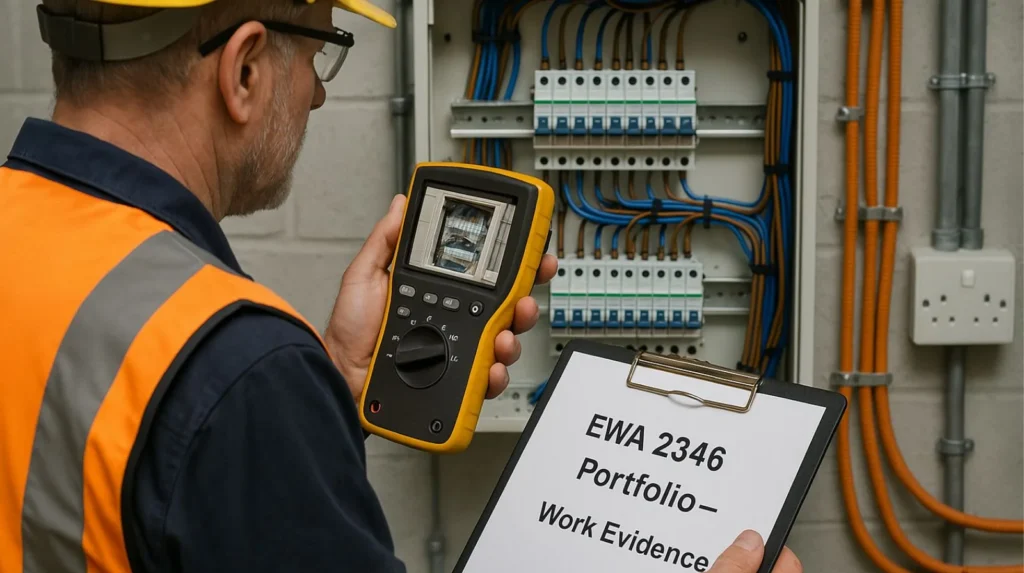
The City & Guilds Level 3 Electrotechnical Experienced Worker Qualification (2346-03) is a competence-based qualification, not a training programme. It recognises existing skills and experience rather than teaching new knowledge. Think of it as proving you already work to the same standard as someone who completed an NVQ 2357, but via documented evidence of your career rather than structured workplace learning.
It’s mapped to the Electrotechnical Occupational Competence standard covering installation and maintenance work. This means you must prove competence in installing wiring systems and equipment, maintaining electrotechnical installations, inspecting and testing to BS 7671, diagnosing and rectifying faults, and working safely in compliance with health and safety regulations.
The qualification is specifically designed for practising electricians aged typically 25+ who entered the industry without apprenticeships, worked under supervision for years, and now face career ceilings because they lack formal Level 3 qualifications. It provides a route to ECS Gold Card status without requiring you to complete a full 4-year apprenticeship or 2-year adult NVQ that duplicates skills you already possess.
The City & Guilds Level 3 Electrotechnical Experienced Worker Qualification (2346-03) is the full electrotechnical route, covering the activities and performance criteria required by the qualification. A separate Domestic Electrician Experienced Worker route is also available for candidates whose occupational experience is focused on dwellings. This follows different qualification and assessment requirements and leads to the appropriate domestic competence route rather than the Installation Electrician Gold Card. Candidates should complete the relevant skills scan before choosing between the domestic and installation-and-maintenance routes.
City & Guilds, EAL, and other awarding bodies offer equivalent EWA pathways. They all align with the same competence standards and lead to ECS/JIB Gold Card eligibility. NICEIC, NAPIT, ECA, and SELECT all accept the EWA 2346-03 for certification purposes. NICEIC specifically notes it fulfils Electrician Plus entry requirements, which is the current industry competence benchmark.
Experienced Worker qualification requirements continue to evolve, so candidates should check the latest City & Guilds and TESP guidance before enrolling.
To be fair, the EWA isn’t a shortcut. It’s a recognition route. You’re proving you meet the standard, not learning it for the first time. That’s why eligibility requirements are strict and portfolio evidence demands are high. The qualification exists to remove barriers for competent electricians, not to bypass competence requirements.
Who the EWA 2346 Is For (Eligibility Requirements)
You cannot start the City & Guilds Level 3 Electrotechnical Experienced Worker Qualification (2346-03) without meeting the relevant eligibility criteria. These exist to prevent misuse of the qualification as a shortcut and ensure only genuinely experienced electricians access the route.
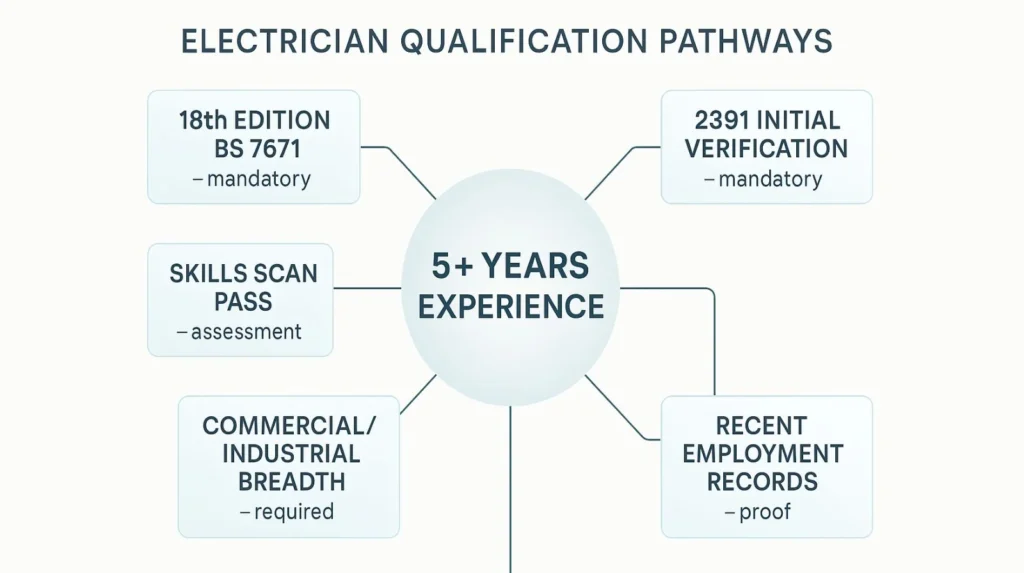
Minimum 5 years experience as a practising electrician. This is an entry requirement, not automatic proof of competence or guaranteed acceptance. Candidates must still meet the current Skills Scan, qualification, and workplace evidence requirements. This means 5 years working in electrotechnical installation and maintenance roles, not 5 years as a labourer or mate doing basic tasks. The experience must be recent and documented. Assessors need proof via employment records, job sheets, invoices (for self-employed), or employer references.
What “5 years experience” actually means. Candidates must be able to demonstrate sufficient current workplace experience across the activities and performance criteria required by the qualification. The Skills Scan completed before enrolment is used to identify whether the candidate has the necessary breadth of competence or has gaps that need addressing.
Candidates whose occupational experience is focused on dwellings should consider the separate Domestic Electrician Experienced Worker route. This follows different qualification and assessment requirements and leads to the appropriate domestic competence route rather than the Installation Electrician Gold Card. Candidates should complete the relevant skills scan before choosing between the domestic and installation-and-maintenance routes.
18th Edition Wiring Regulations (BS 7671) is mandatory. You must hold a recognised current Wiring Regulations qualification that meets the Experienced Worker route requirements. Without this, you cannot register for EWA because you lack proof of current regulatory knowledge.
Candidates must meet the current Level 3 Initial Verification requirement for the Experienced Worker route. The training provider should check whether the candidate’s existing inspection and testing qualification is accepted or whether additional training is required.
Skills Scan self-assessment is mandatory. Providers require you to complete a Skills Scan before registration, assessing whether your knowledge and experience align with Level 3 standards. This checks your understanding of electrical science, BS 7671 regulations, testing procedures, and fault-finding approaches. If you fail the Skills Scan, providers recommend completing Level 3 theory (2365) before attempting EWA.
New EWA Entry Tests apply for candidates with 10+ years experience. Some providers waive Level 2 requirements if you pass entry tests demonstrating strong foundational knowledge. This acknowledges that electricians with a decade of experience don’t need formal Level 2 certificates if they can prove competence through practical assessment.
If you do not yet have the experience required for the Experienced Worker Assessment, explore our electrician courses
Joshua Jarvis, our Placement Manager, explains the reality facing many experienced electricians:
"We speak to electricians earning £28,000 to £32,000 as mates despite having 8 or 10 years experience. The moment they achieve Gold Card status through EWA, they're accessing £38,000 to £45,000 roles. The qualification removes an artificial ceiling that was blocking progression."
Joshua Jarvis, Placement Manager
EWA 2346 vs Other Electrical Qualifications
Understanding where the EWA sits within UK electrical qualifications prevents confusion and wasted time pursuing the wrong pathway.
EWA 2346-03 vs NVQ 2357. The NVQ 2357 is for apprentices and adult learners with fewer than 5 years experience. It’s a structured competence qualification typically taking 2 to 4 years, involving regular assessor visits throughout your employment, building a portfolio as you learn. The EWA 2346-03 is for electricians with 5+ years who’ve already developed competence. It’s an assessment of existing skills, not a learning programme. Both lead to the same outcome (Gold Card eligibility), but EWA is faster for experienced workers because you’re proving competence you already have.
Candidates following the standard NVQ route instead can view our NVQ Level 3 Electrical Installation and Maintenance course
EWA 2346-03 vs 2365 Level 2/3 diplomas. The 2365 qualifications are technical certificates proving theoretical knowledge. They’re classroom-based, theory-focused, and don’t assess practical competence. They’re prerequisites for the NVQ 2357 but don’t replace it. The EWA 2346-03, in contrast, is entirely competence-based. You don’t need Level 2 or Level 3 diplomas if you pass the Skills Scan and Entry Tests, because the EWA assesses practical ability, not classroom knowledge.
EWA 2346-03 vs apprenticeship standard 5357. The Level 3 Installation and Maintenance Electrician Standard (5357) is the current apprenticeship framework replacing older NVQ routes. It includes structured training, on-site learning, and the AM2S end-point assessment. It’s designed for 16 to 24 year olds entering the industry with no experience, taking 3 to 4 years. The EWA 2346-03 is for mature electricians with existing careers who need formal recognition, not training.
EWA 2346-03 vs 2347 domestic-only route. The 2347 is for electricians with 3+ years experience limited to domestic installations. It leads to a Domestic Installer ECS card, not the full Installation Electrician Gold Card. If you’ve only done domestic work (rewires, consumer units, sockets, lighting), the 2347 may be your only option. The 2346-03 requires commercial and industrial breadth.
EWA 2346-03 vs T Levels and 8202. T Levels and the 8202 qualification are entry-level pathways for school leavers or career changers. They provide foundational knowledge but don’t grant competence or Gold Card eligibility without subsequent NVQ completion. The EWA 2346-03 is for experienced professionals, not beginners.
If you are changing careers or do not yet have the required industry experience for the EWA, our fast-track electrician course provides a structured route through the qualifications and workplace experience needed to progress towards becoming fully qualified.
Clarification on “shortcut” misconceptions. The EWA is not easier than the NVQ 2357. It assesses the same competence standards. The difference is that you’re proving skills you’ve already developed over 5+ years rather than learning them for the first time under structured supervision. TESP (The Electrical Safety Partnership) and NICEIC both emphasise this point in official guidance. The EWA is a conversion route, not a shortcut. If your skills are insufficient, you’ll fail the portfolio assessment and AM2E regardless of how many years you’ve worked.
Mandatory Units and What You Must Prove
The EWA 2346-03 comprises 7 mandatory units totalling the equivalent of 104 credits. These map to the Electrotechnical Occupational Competence standard and cover all aspects of installation and maintenance work.
- Apply Practices and Procedures for Maintenance
- Apply Health, Safety and Environmental Considerations
- Organise and Oversee the Electrical Work Environment
- Apply Design and Installation Practices and Procedures
- Terminate and Connect Conductors
- Inspect, Test and Commission Electrical Systems
- Apply Fault Diagnosis and Rectification
Performance units vary by specialism (installation vs maintenance), but typically include installation of wiring systems and enclosures (containment like cable tray, trunking, conduit; first-fix and second-fix wiring; consumer units; distribution boards), testing, commissioning, and certification (dead tests including continuity, insulation resistance, polarity, earth continuity, R1+R2; live tests including earth fault loop impedance Ze and Zs, RCD operation, functional testing), and maintenance and fault diagnosis (planned maintenance tasks, fault identification using testing equipment, repairs, and system recommissioning). Evidence requires before-and-after photos, job completion records, witness statements, completed electrical installation certificates, test results, maintenance logs, and fault-finding records.
The AM2E assessment unit is the practical end-point assessment proving competence under timed exam conditions. It’s mandatory and cannot be bypassed.
Installation vs maintenance specialisms. Some candidates focus portfolios on installation work (new builds, extensions, commercial fit-outs), others on maintenance (testing existing installations, fault-finding, planned maintenance). Both are valid, but breadth across both improves portfolio strength and speeds completion.
Thomas Jevons, our Head of Training with 20 years experience, clarifies a common misconception about the assessment:
"From an assessor's perspective, we need to see breadth of experience. Domestic socket changes and consumer unit swaps don't prove competence in containment design, three-phase systems, or commercial testing procedures. EWA is for electricians who've worked across domestic, commercial, and industrial environments, not those who've done five years of narrow domestic work."
Thomas Jevons, Head of Training
How the EWA Portfolio Actually Works (The Hardest Part)
The portfolio is where theory meets reality. It’s the proof of your 5+ years experience, and it’s where most candidates struggle, get delayed, or fail entirely if evidence quality is poor.
For practical guidance on collecting workplace evidence, photographs, witness statements and assessor observations, read our guide on how to build your NVQ Level 3 electrical portfolio.
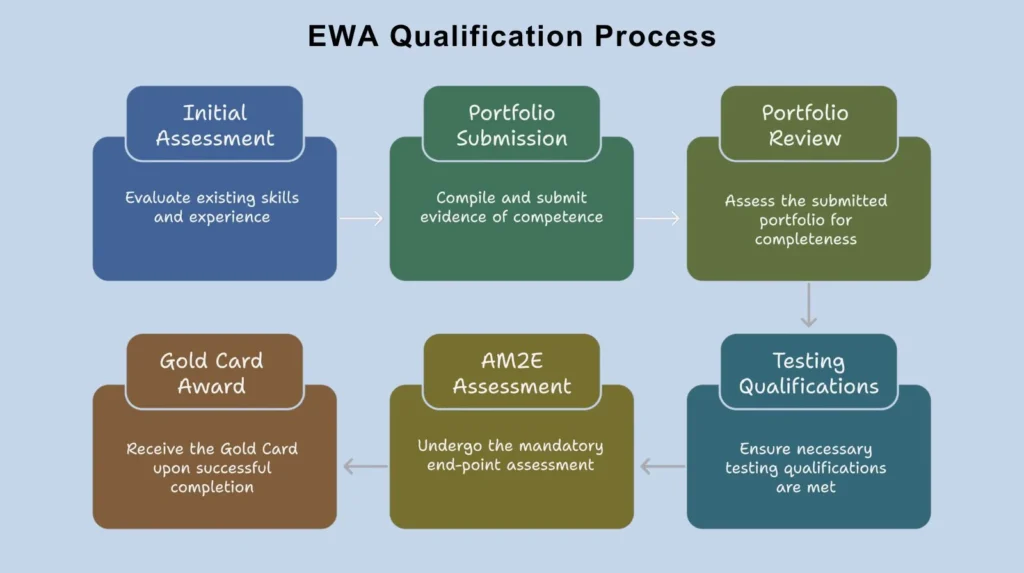
Portfolio structure follows the 7 mandatory units. For each unit, you must provide evidence meeting performance criteria on at least two separate occasions. City & Guilds doesn’t specify exact job numbers, but realistically you need 3 to 6 varied jobs to demonstrate competence across all criteria.
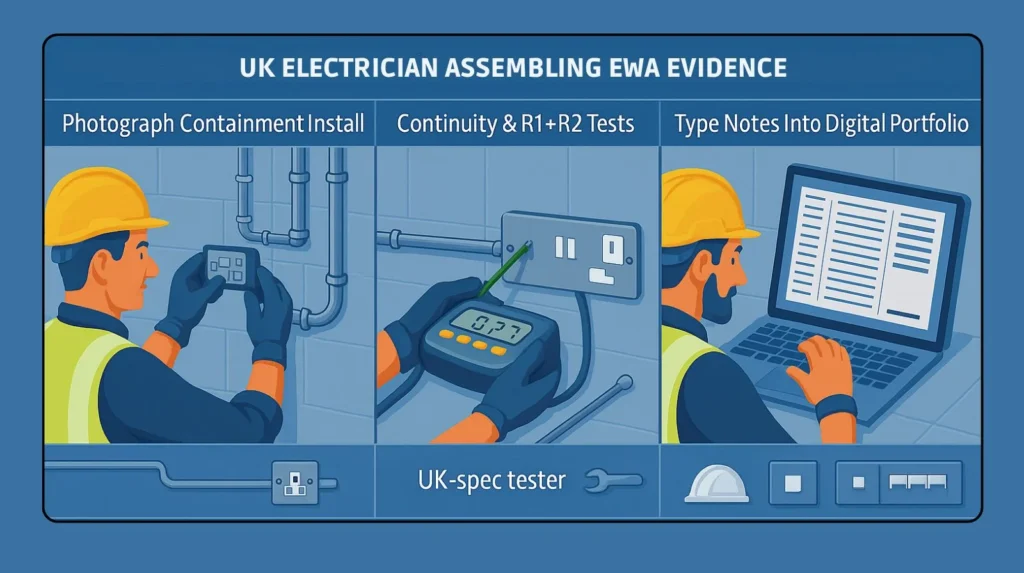
Evidence categories required include safe isolation procedures (photos and videos showing prove-dead-prove sequences, lock-off procedures, isolation at source, and testing before work begins, supported by workplace records), containment systems (before-and-after photos of cable tray, trunking, and conduit installations; assessors expect varied containment types, not just one method), first-fix and second-fix wiring (cable runs, clipped direct installations, cables in containment, terminations at accessories, consumer unit wiring showing neat, compliant work meeting BS 7671 standards), circuit installations (ring finals, radials, lighting circuits, SWA terminations, three-phase installations; domestic-only candidates often lack SWA and three-phase evidence, causing portfolio rejection), testing and inspection (dead tests including continuity, insulation resistance, polarity, earth continuity, and R1+R2 values; live tests including earth fault loop impedance, RCD operation times, and functional testing with completed electrical installation certificates and EICR reports), fault-finding evidence (diagnostic testing identifying issues with documentation of fault identification, corrective action, and retesting), commissioning and handover (final checks, client demonstrations, completion documentation, handover certificates), and commercial and industrial tasks (work beyond domestic properties including office lighting systems, retail shop fit-outs, distribution board upgrades, factory machinery supplies, three-phase motors, control panels, industrial lighting).
Evidence formats accepted include photographs (authenticated workplace photographs and supporting records; showing candidate in frame where safe; minimum 50 to 100 photos per unit according to provider checklists; before-and-after sequences showing your work process), witness statements from qualified electricians (Gold Card holders ideally; statements must confirm you carried out the work competently under their supervision or observation), job sheets and completion records (detailing tasks performed, equipment used, tests conducted, and outcomes), electrical installation certificates and EICR reports (proving you test and certify work correctly), risk assessments and method statements (demonstrating safe working practices and planning), and written descriptions (explaining what you did, why, how it complies with BS 7671, and what challenges you overcame).
Platforms used for portfolio submission are typically OneFile or similar digital systems. You upload evidence, map it to unit criteria, and add descriptions. Assessors review remotely, flagging gaps or requesting clarification.
Common reasons portfolios get rejected include being too domestic-heavy (five years of domestic rewires doesn’t prove commercial competence; assessors reject portfolios lacking tray systems, SWA, three-phase, or industrial evidence), not enough testing evidence (many electricians do installation work but don’t hold 2391 or conduct full testing sequences; without documented IR, continuity, Zs, RCD results across multiple jobs, portfolios fail), missing diagrams and schematics (assessors need to see circuit diagrams, board schedules, and design documentation, not just installation photos), no fault-finding proof (if all evidence shows new installations with no diagnostic work, competence in fault-finding isn’t proven), self-employed evidence lacking third-party verification (self-certified work without witness statements or client confirmations is often rejected because it’s impossible to verify authenticity), and photographs not being authenticated or supported by appropriate workplace records (assessors need evidence that you carried out the work, not just photographs of completed installations that could be anyone’s work).
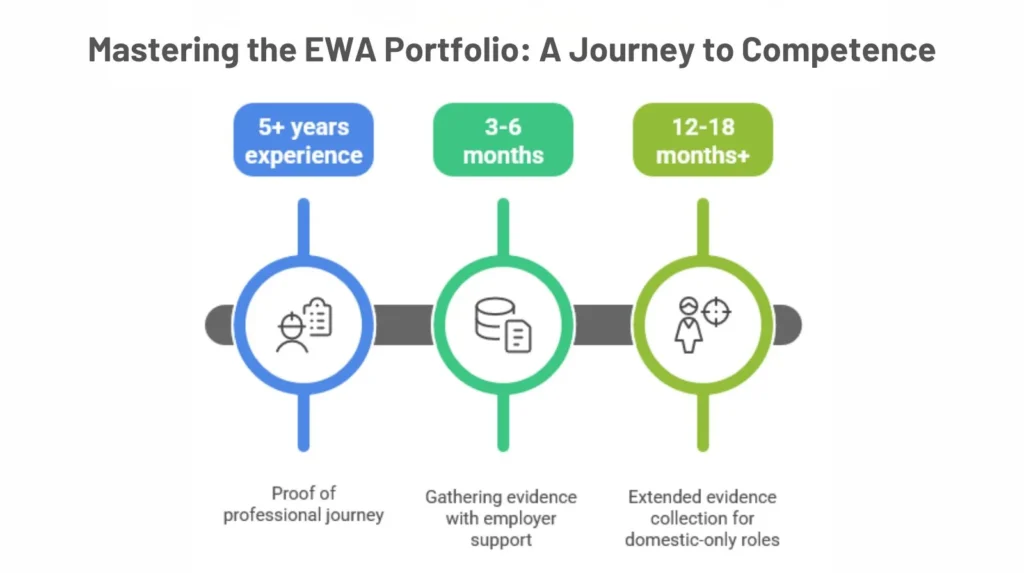
Realistically, gathering adequate evidence takes 3 to 6 months if you’re actively working on varied projects with good employer support. Candidates working domestic-only roles or with limited testing access stretch this to 12 to 18 months or longer as they seek opportunities to gather commercial and testing evidence.
On-Site Assessments and Verification
Portfolio submission is only part of the EWA process. Assessors conduct on-site assessments to verify evidence authenticity and observe your practical competence.
Assessor observations. The assessor must observe the candidate carrying out work in the workplace on at least one occasion. Additional observations may be required depending on the evidence available and the assessor’s assessment plan.
What assessors observe. During visits, assessors watch you perform electrical tasks under working conditions. This might include safe isolation procedures, installation work (second-fix wiring, consumer unit connections), testing sequences (IR, continuity, Zs, RCD), and fault-finding on live installations. Assessors sample your work rather than observing every task in your portfolio. They might verify 20% to 50% of evidence through direct observation, with the remainder verified through documentation review.
Assessor questioning. Visits aren’t just observation. Assessors ask technical questions to verify your understanding. Why did you select this cable size? What’s the maximum Zs for this circuit? How would you diagnose low IR readings? What BS 7671 regulations apply to this installation? You’re proving understanding, not just practical ability to follow instructions.
Remote vs in-person assessments. Post-COVID, many providers allow remote assessments via video conference (Zoom, Teams) for professional discussions and knowledge verification. However, practical observations (watching you isolate, test, or install) typically require in-person visits. Remote assessments increased accessibility for self-employed electricians and those in rural areas where assessor travel is costly and time-consuming.
Sampling rules. City & Guilds guidelines allow assessors to sample evidence rather than verifying every piece. They typically check one-third of portfolio evidence directly, relying on documentation and witness statements for the remainder. If your portfolio is well-organised with strong witness statements, authenticated workplace photographs, and supporting records, fewer visits are needed.
Extra costs. Additional assessor visits beyond the package allowance cost £200 to £300 each. If your evidence has gaps, poor quality photos, or lacks variety, expect multiple extra visits adding £600 to £900 to total costs. This is why portfolio quality matters.
Common learner complaints from forums include inconsistent assessor quality (some are supportive and clear, others nitpicky and vague), scheduling delays (2 to 4 weeks between requesting visits and assessor availability), and poor communication from training providers about what evidence is acceptable. ElectriciansForums reports frustration with assessors rejecting photos for minor issues (not geo-tagged, candidate not visible, insufficient angle to verify compliance), requiring resubmission and additional visits.
The assessor’s role is gatekeeping industry standards. They’re ensuring the EWA isn’t used as a shortcut by electricians with inadequate competence. Strict assessment protects the qualification’s credibility and ensures Gold Card holders genuinely meet required standards.
The AM2E Assessment: Proving Competence Under Exam Conditions
The AM2E (Assessment Method 2, Experienced Worker) is the practical end-point assessment required for EWA completion and Gold Card eligibility. You cannot bypass it. It’s mandatory and tests competence under timed conditions.
AM2E structure. The assessment lasts 16.5 to 17 hours across 2.5 days. It’s divided into sections including an online theory component (1 hour, multiple-choice questions covering BS 7671 regulations, testing procedures, and fault diagnosis, testing regulation book navigation under time pressure), composite installation tasks (timed wiring circuits, terminating SWA, installing containment, completing consumer unit connections, installing accessories; tasks are timed strictly and overrun means failure), inspection and testing (timed, conducting full test sequences on installed circuits including IR, continuity, polarity, R1+R2, Zs, RCD operation, recording results on official test sheets with correct calculations), and fault-finding (timed, diagnosing faults on pre-installed circuits using testing equipment to identify issues, rectifying faults and retesting; this section has the highest failure rate).
Differences between AM2, AM2S, and AM2E. AM2 is for NVQ 2357 candidates (adult learners and traditional apprentices). AM2S is for apprentices on the 5357 standard (includes more structured supervision and slightly different task emphasis). AM2E is for experienced workers on the 2346 route, assuming mature candidates with prior hands-on experience. The difficulty and pass standards are equivalent. The myth that AM2E is easier is false. TESP and City & Guilds confirm AM2E assesses the same competence standards as AM2.
Thomas Jevons addresses the AM2E misconception directly:
"AM2E isn't easier than AM2. It assesses the same competence standards under the same time pressure. Experienced electricians who've never worked to exam timings struggle with fault-finding sections just as much as younger candidates. Preparation courses matter."
Thomas Jevons, Head of Training
Preparation can help candidates become familiar with the assessment structure and identify areas that need additional practice, but it does not guarantee a pass.
Misconceptions to correct. The AM2E is not optional. It’s not easier than AM2. It’s not a formality. It’s a rigorous practical exam proving you can work safely, correctly, and efficiently under pressure. Forums debunk the “AM2E is a tick-box” myth repeatedly, emphasising that failures are common and resits cost £800 to £1,200 each.
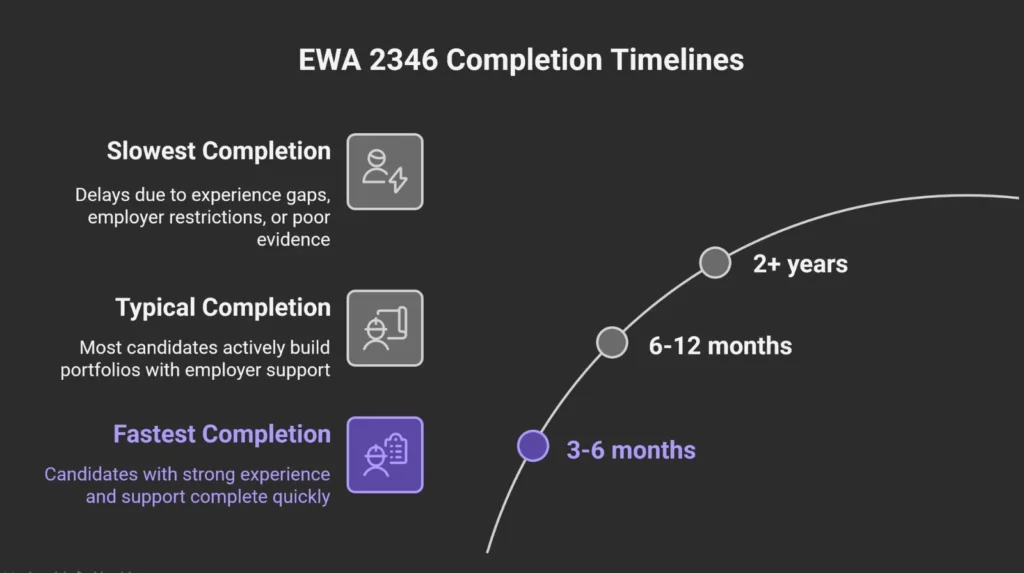
How Long the EWA 2346 Actually Takes
Timelines vary dramatically depending on your existing experience breadth, employer support, and evidence quality.
Fastest completions: 3 to 6 months. This happens when candidates have strong commercial or industrial backgrounds, already hold 2391 qualifications, have documented evidence from recent projects, and work for supportive employers who provide varied tasks and witness statements. Forum members report 4-month completions when evidence was pre-organised and assessors had minimal queries.
Typical completions: 6 to 12 months. Most candidates fall into this range. Six months is realistic if you’re actively gathering evidence and your employer supports portfolio building. Twelve months is common if you need to seek additional work opportunities to fill evidence gaps (e.g., securing commercial projects to supplement domestic experience, or gaining testing access if your role doesn’t usually involve inspection work).
Slowest completions: 2+ years. Delays occur when candidates lack commercial or testing experience, work for employers who restrict task variety, face assessor scheduling delays, or submit poor-quality evidence requiring multiple resubmissions. ElectriciansForums reports candidates taking 18 to 30 months when domestic-only backgrounds required them to seek additional commercial work and complete 2391 qualifications mid-portfolio.
Provider quotes vs reality. Training providers advertise 6-month completion times, but Reddit and forum discussions reveal 9 to 18 months is more realistic for most candidates. The gap between marketing and reality stems from providers assuming you already have perfect evidence, supportive employers, and no gaps in experience. Few candidates meet this ideal.
Common delay factors include no testing experience or 2391 qualification (without testing qualifications and documented testing evidence, portfolios stall; candidates must complete 2391, costing £500 to £700 and taking 3 to 5 days, and gather testing evidence from multiple jobs before portfolios can progress), limited commercial experience (domestic electricians struggle to gather commercial evidence; some take on part-time commercial work or subcontract for commercial contractors to fill gaps, adding months to timelines), assessor scheduling issues (providers with limited assessors face 2 to 4 week waits between evidence submission and assessor review; multiple rounds of queries and resubmissions add months), employer restrictions (employers who won’t provide witness statements, restrict access to varied tasks, or don’t allow time for portfolio documentation slow progress significantly; self-employed candidates sometimes switch to employed roles temporarily to secure better evidence and supervision), and poor documentation habits (candidates who don’t photograph work systematically must redo jobs to generate portfolio-ready evidence, wasting time and opportunities).
The timeline reality is that EWA is faster than a 4-year apprenticeship or 2-year adult NVQ, but it’s not a 3-month shortcut. Expect 6 to 12 months of active portfolio building if you’re well-prepared, longer if evidence gaps exist.
Costs and Funding: What You'll Actually Pay
Self-funding the EWA 2346-03 and AM2E costs £2,200 to £3,500 total depending on provider, extras, and whether you need retakes.
Breakdown includes EWA 2346-03 registration, assessment, and portfolio support (£1,300 to £2,000), NET publishes different recommended fees depending on the version of AM2E the candidate is taking. For assessments between 1 April 2026 and 31 March 2027, the recommended full-assessment fee is £965 for the earlier AM2E and £1,235 for AM2E v1. Candidates should confirm which version applies to them and check the current fee directly with their NET-approved assessment centre., 18th Edition BS 7671 if not current (£300 to £500), 2391 Inspection and Testing if needed (£500 to £700), extra assessor visits beyond package (£200 to £300 each), and AM2E resit if failed (£800 to £1,200). The total cost depends on the training provider, qualifications already held, any gap training required, workplace assessment arrangements and the applicable AM2E assessment fee. Candidates should obtain a written breakdown before enrolling.
If you need 18th Edition, 2391, extra assessor visits, and an AM2E resit, costs can reach £5,000 to £6,000, which is comparable to full NVQ packages. This is why getting evidence right first time matters.
Funding options include employer sponsorship (the most common route; contractors who want to formalise employees’ competence often pay EWA costs, viewing it as retention investment; if you’re employed, negotiate with your employer before self-funding), tax deductions for self-employed (EWA costs, AM2E fees, and related courses including 18th Edition and 2391 are tax-deductible business expenses if you’re self-employed; claim them on self-assessment returns to recover 20% to 40% depending on tax bracket), no apprenticeship levy funding (unlike NVQ 2357 or apprenticeships, the EWA doesn’t qualify for apprenticeship levy funding because it’s an assessment, not a training programme), no Advanced Learner Loans (loans typically cover classroom courses, not work-based assessments; EWA doesn’t qualify), and limited local authority funding (some local authorities fund EWA through Adult Education Budget schemes for unemployed or low-income learners, but availability is limited and varies by region).
Warnings about cheap providers. Forums warn against training centres charging under £1,000 for EWA packages. Cheap often means poor assessor support, long delays, vague feedback, and hidden extra costs. Reputable providers charge £1,300 to £2,000, reflecting proper assessor support and portfolio guidance. Paying £1,000 to save £500 but then facing 18-month delays and £600 in extra visit fees is false economy.
Achieving the appropriate ECS Gold Card may widen access to roles that require recognised occupational competence, but salary and contract rates vary by employer, region, sector, experience and employment status.
Salary Impact and Career Progression
The EWA 2346 and subsequent Gold Card unlock significant career and financial progression for experienced electricians stuck without formal qualifications.
Pre-Gold Card earnings. Electricians working without NVQ Level 3 or Gold Card status typically earn £30,000 to £35,000 annually. Mate and improver roles pay £18,000 to £26,000. Without Gold Card, you’re limited to working under supervision, can’t certify your own installations, and face restricted job opportunities.
Post-Gold Card earnings. Qualified electricians with Gold Card status earn £38,000 to £45,000 annually on average. The ONS reports median electrician salary at £38,760. Experienced electricians with 5 to 10 years post-qualification earn £40,000 to £52,000 depending on region and sector.
Self-employed earnings will vary depending on the type of work undertaken, location, experience, workload and employment status.
Regional variations. London electricians earn £40,000 to £55,000 employed, with 20% to 30% premiums over national averages. The Midlands and North West sit at £35,000 to £45,000. Rural areas and lower-demand regions pay £30,000 to £38,000.
Employability transformation. Job adverts reveal stark differences. Roles requiring Gold Card status offer £38,000 to £52,000. Roles accepting mates or improvers pay £18,000 to £26,000. The qualification unlocks access to commercial, industrial, and maintenance contracts that weren’t available before. Forum discussions note 80%+ of qualified electrician job adverts specify NVQ Level 3 and Gold Card as essential criteria.
Career ceiling removal. Without formal qualifications, electricians face permanent career limitations. You can’t certify installations, can’t apply for Approved Electrician roles (requiring 2391 plus Gold Card), can’t work unsupervised on commercial sites, and can’t access high-value contracts. The EWA removes these barriers, enabling progression towards inspection roles, project management, or business ownership.
Industry demand context. EV infrastructure rollout, solar PV and heat pump installation, and continued demand for skilled electrical work are increasing the importance of recognised occupational competence. Employers may require Gold Card status for certain roles, site access or grading requirements.
Reported earnings and contract rates vary considerably, so individual experiences should not be treated as a guaranteed financial outcome.
Real Experiences: What Forums and Social Media Say
The following themes are anecdotal and are drawn from online discussions. They should not be treated as representative statistics or official qualification guidance.
Forum discussions, Reddit threads, and social media posts reveal consistent patterns in EWA experiences, highlighting both successes and frustrations.
Success stories emphasise speed and career transformation.
"Completed EWA in 4 months with commercial background. Already had 2391 and varied evidence. Gold Card doubled my job opportunities overnight." X (Twitter): "From mate stuck at £28k to qualified spark at £40k in 8 months via EWA. Best investment I made."
Reddit:
"EWA recognised my 10 years experience. AM2E passed first time. Now working industrial maintenance at £45k."
ElectriciansForums:
Common frustrations centre on evidence gathering.
"Testing evidence was the hardest part. Had to do 2391 mid-portfolio and seek testing work to fill gaps. Added 6 months."
"Domestic-only experience rejected twice. Had to find commercial subcontracting to gather tray and SWA evidence."
“Assessor kept requesting better photos. Ended up redoing jobs just to get geo-tagged images with me in frame.”
"Employer wouldn't provide witness statements. Had to switch to a contractor who understood NVQ requirements."
Fears and anxieties dominate search intent
"Am I experienced enough? I've done 5 years domestic but worried it's not varied enough."
"What if assessors reject my evidence? I've been working 8 years but all self-employed with no witnesses."
"Is AM2E harder than AM2? I'm nervous about fault-finding under pressure."
"Do employers respect EWA or see it as lesser than apprenticeships?"
Failure cases reveal common patterns
AM2E failures on fault-finding sections due to time pressure and diagnostic errors. Mis-sold "fast-track NVQ" courses that promised EWA completion in 6 weeks, leading to dropouts when candidates realised portfolio demands. Scam training providers offering cheap EWA packages (£800 to £1,000) but providing no assessor support, causing candidates to abandon portfolios after 12+ months with no progress.
TikTok and YouTube content highlights domestic sparks struggling with commercial requirements. Videos titled
"Why domestic electricians fail EWA" explain containment and three-phase gaps. Self-employed electricians discuss witness statement challenges, often filming jobs to provide video evidence when written statements aren't available.
Age and career stage patterns emerge.
Typical EWA candidates are 30 to 50 years old, mid-career, motivated by hitting career ceilings or facing redundancy threats due to lack of qualifications. Many entered the industry via informal routes (helping family, working for small contractors) and developed competence without structured training. The EWA formalises skills they've held for years but couldn't prove.
Social media insights reveal motivation stems from career blocks.
"Couldn't apply for jobs requiring Gold Card despite 12 years experience."
"Lost contracts to younger sparks with NVQ even though I had more experience."
"Employer threatened redundancy if I didn't formalise qualifications."
Forum discussions show that some candidates struggle to complete the route where their workplace experience does not cover the required performance criteria or where evidence is difficult to authenticate.
Myths and Misconceptions About the EWA 2346
Misconceptions about the EWA waste time and money. Here’s what’s actually true.
Myth 1: The EWA is a shortcut to Gold Card. False. TESP (The Electrical Safety Partnership) and NICEIC both emphasise the EWA assesses the same competence standards as NVQ 2357. It’s not easier, faster, or less rigorous. It’s a recognition route for experienced workers, not a bypass of competence requirements.
Myth 2: The EWA is easier than the NVQ 2357. False. Both assess identical competence standards. The difference is that EWA assesses existing skills accumulated over 5+ years, whilst NVQ 2357 assesses skills developed during structured training. If your skills are insufficient, you fail regardless of pathway.
Myth 3: Domestic-only experience automatically qualifies for full 2346-03. False. Candidates must demonstrate sufficient current workplace experience across the activities and performance criteria required by the qualification. The Skills Scan completed before enrolment is used to identify whether the candidate has the necessary breadth of competence or has gaps that need addressing.
Myth 4: You don’t need testing qualifications for EWA. False. Candidates must meet the current Level 3 Initial Verification requirement for the Experienced Worker route. The training provider should check whether the candidate’s existing inspection and testing qualification is accepted or whether additional training is required.
Myth 5: AM2E is optional for Gold Card. False. AM2E is the mandatory end-point assessment. You cannot achieve Gold Card status without passing AM2E. It’s non-negotiable.
Myth 6: Self-employed electricians can’t do EWA. False. Self-employed candidates are accepted, but they must provide witness statements from qualified electricians (clients, subcontractors, or peers) verifying competence. Self-certified evidence alone is insufficient.
Myth 7: You can complete EWA in a month. False. Minimum realistic timeline is 3 to 6 months for candidates with perfect evidence and strong commercial backgrounds. Typical completions take 6 to 12 months. Anyone promising 1-month completion is mis-selling the qualification.
Myth 8: EWA grants automatic supervision rights. False. The Gold Card proves you’re competent to work independently and certify installations, but supervising apprentices or improvers requires additional experience and, in some contexts, further qualifications or contractor licensing.
Myth 9: You get Gold Card regardless of competence if you have 5 years experience. False. The 5 years is an entry threshold, not a guarantee. If your skills are inadequate or evidence doesn’t prove competence, you fail portfolio assessment and AM2E regardless of how long you’ve worked.
TESP, NICEIC, and City & Guilds materials consistently debunk these myths, emphasising that EWA equivalence to apprenticeships depends on rigorous assessment, not relaxed standards.
What To Do Next
If you have at least five years’ experience as a practising electrician but never completed an industry apprenticeship or equivalent Level 3 competence qualification, the Experienced Worker Assessment may provide a route to formal recognition.
Eligibility should be confirmed through the current skills scan before enrolment, as the route requires workplace evidence across the relevant performance units and successful completion of the applicable AM2E assessment.
If you do not yet meet the EWA experience requirement, explore our electrician courses or our fast-track electrician course to compare alternative routes.
Candidates following the standard NVQ route can view our NVQ Level 3 Electrical Installation and Maintenance course, while our guide on how to build your NVQ Level 3 electrical portfolio explains the workplace evidence and portfolio process in more detail.
References
- City & Guilds – 2346-03 Experienced Worker Assessment – https://www.cityandguilds.com/
- The Electrical Safety Partnership (TESP) – EWA Standards and Guidelines – https://www.the-esp.org.uk/
- ECS (Electrotechnical Certification Scheme) – Gold Card Requirements – https://www.ecscard.org.uk/
- JIB (Joint Industry Board) – Grading and Qualifications – https://www.jib.org.uk/
- NAPIT – Approved Contractor Schemes – https://www.napit.org.uk/
- Construction Industry Training Board (CITB) – Electrical Workforce Projections 2024-2029 – https://www.citb.co.uk/
- NET Services – AM2E Assessment Information – https://www.netservices.org.uk/
- ElectriciansForums.net – EWA Portfolio Discussions – https://www.electriciansforums.net/
- Reddit r/UKElectricians – EWA Experiences – https://www.reddit.com/r/UKElectricians/
Note on Accuracy and Updates
This article was last reviewed on 15 August, 2026. Experienced Worker Assessment requirements can change, so candidates should check the latest City & Guilds, TESP, ECS and NET guidance before enrolling or booking an assessment.
