


- Technical review: Thomas Jevons (Head of Training, 20+ years)
- Employability review: Joshua Jarvis (Placement Manager)
- Editorial review: Jessica Gilbert (Marketing Editorial Team)
- Last reviewed:
- Changes: Initial publication analysing domestic, commercial, and industrial electrician pay differences using ONS ASHE 2025, JIB 2025 rates, and 200+ job listings, showing industrial pays most (£40k-£55k PAYE median) but within-sector employment model variation exceeds between-sector differences
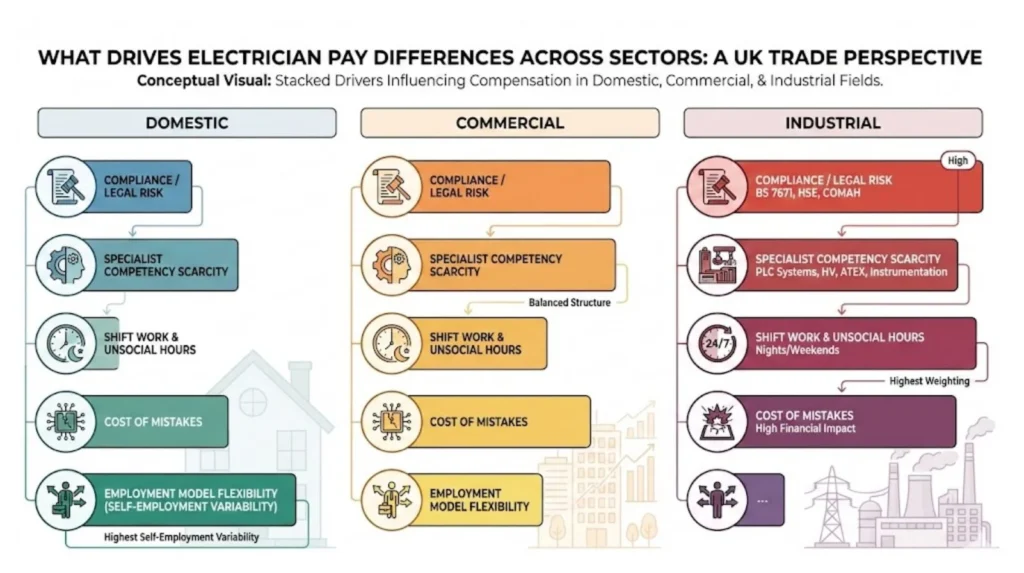
Electrician salary varies more by sector than many electricians realise when starting their careers. Domestic electricians working in residential properties, commercial electricians in offices and retail spaces, and industrial electricians in factories and manufacturing plants face fundamentally different working patterns, compliance requirements, technical demands, and pay structures. The assumption that “industrial always pays most” holds true for PAYE medians but obscures substantial variation within each sector driven by employment model, qualifications, and regional positioning.
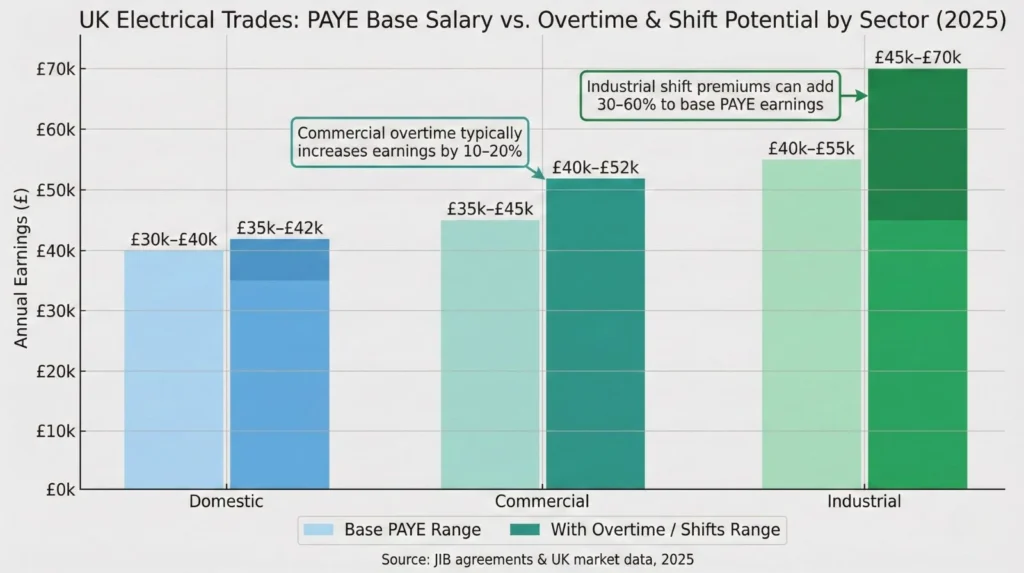
ONS ASHE 2025 data shows median full-time electrician earnings of £38,760 across all sectors combined, but this aggregation masks sector-specific patterns. Job board analysis of 200+ advertised roles from Q4 2024 to Q1 2025 suggests domestic PAYE roles cluster around £30,000-£40,000 (median approximately £36,000), commercial PAYE at £35,000-£45,000 (median £42,000), and industrial PAYE at £40,000-£55,000 (median £47,000). These medians reflect different employment structures: domestic work skews heavily self-employed (approximately 60-70% of domestic electricians operate as sole traders), commercial mixes PAYE employment with CIS contracting, and industrial leans towards direct PAYE employment with large facilities management firms or manufacturers.
However, comparing PAYE medians alone creates misleading conclusions about which sector “pays best.” A self-employed domestic electrician billing £60/hour appears to earn £124,800 annually (£60 × 40 hours × 52 weeks), dwarfing industrial PAYE medians. Reality includes substantial non-billable time: quoting jobs that don’t convert (10-15 hours weekly typical), travel between residential addresses (often unpaid), material procurement and returns, customer liaison, warranty callbacks, accounts administration. Effective billable hours drop to 25-30 weekly out of 50-hour working weeks, reducing effective hourly rate to £30-£40 before overheads (vehicle, tools, insurance, training, professional indemnity) consume another £8,000-£12,000 annually.
Industrial electricians earning £45,000-£55,000 PAYE receive this as base salary before shift premiums (nights and weekends add 30-60% uplifts), overtime at 1.5x rates, and working-away allowances that push total annual gross to £55,000-£70,000+ for those willing to work unsocial patterns. Commercial electricians occupy middle ground: £35,000-£45,000 base with moderate overtime potential (10-20% uplift typical) creating £40,000-£52,000 total gross.
The sector choice question isn’t simply “which pays most” but “which combination of sector, employment model, working pattern, and technical specialty creates optimal earnings for your situation.” An industrial contractor on £400 CIS day rates grosses £88,000+ annually (220 working days) but faces 8-12 weeks unpaid downtime between projects, works nights and 12-hour shifts, lives away from home for weeks at a time, and operates in confined spaces, at height, or around hazardous chemicals. A commercial PAYE electrician earning £42,000 with 10 hours weekly overtime reaching £48,000 works predictable Monday-Friday site hours, receives 28 days paid holiday, employer pension contributions, sick pay, and returns home nightly. A self-employed domestic electrician grossing £62,000 manages their own schedule, builds long-term customer relationships, avoids site politics, but absorbs 100% business risk, funds own holiday and sick cover, handles all administration, and faces seasonal demand fluctuations.
This article breaks down what electricians actually earn across domestic, commercial, and industrial sectors under PAYE employment, CIS contracting, and self-employed models, then explains the structural drivers creating pay differences: compliance and legal accountability (highest in industrial under Electricity at Work Regulations 1989 and HSE requirements), technical competency scarcity (only 5% of electricians hold CompEx hazardous area or high-voltage authorisations), shift patterns and unsocial hours (industrial 24/7 operations create 1.5-2x shift premiums), cost of mistakes (domestic errors cost hundreds, industrial errors cost millions in production downtime), and employment model flexibility (domestic favours self-employment, commercial favours CIS, industrial favours PAYE).
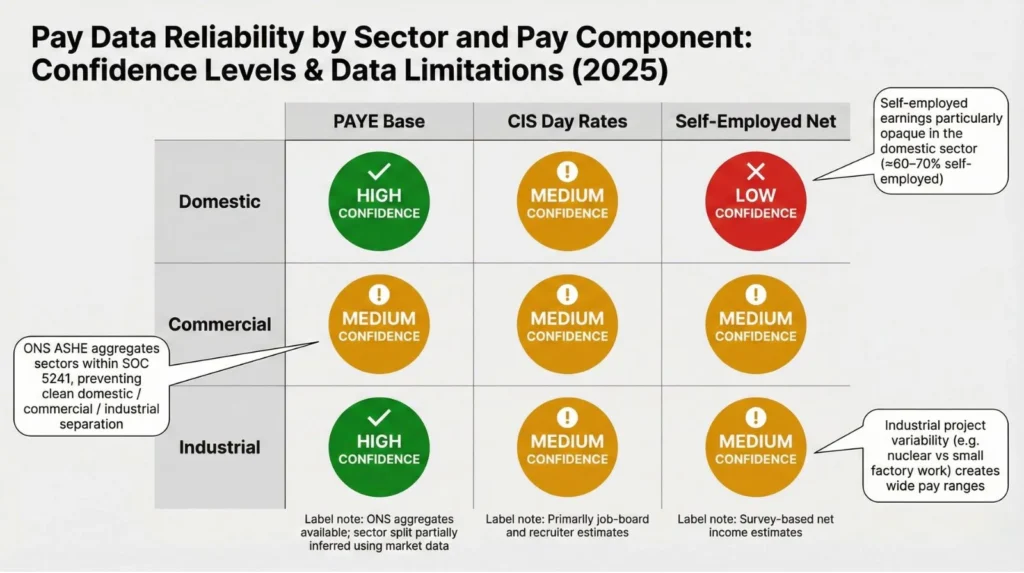
Understanding sector pay differences requires acknowledging that official ONS statistics aggregate all electricians in SOC 5241 without sector breakdown, meaning domestic social housing maintenance electricians earning £32,000 PAYE and industrial high-voltage technicians earning £58,000 PAYE are averaged together to produce the £38,760 median. Job board advertised salaries represent asking prices not necessarily paid rates, often inflated 10-20% to attract applicants. Self-employed earnings rely on trade surveys subject to self-reporting bias (successful sole traders more likely to participate) and lack official HMRC verification at granular sector levels.

PAYE Employee Earnings by Sector: Official and Market Data
ONS Annual Survey of Hours and Earnings provides aggregate electrician data (SOC 5241: Electricians and Electrical Fitters) without sector-specific breakdowns, reporting median £38,760 for 2025 based on 1% sample of HMRC payroll records covering approximately 12,000-15,000 electrician employee jobs. This represents PAYE employment only, excluding self-employed sole traders and CIS contractors who comprise 35-40% of the electrical workforce.
Job board analysis of advertised PAYE roles from Indeed, Reed, Totaljobs, and Jobsite (approximately 200 roles reviewed Q4 2024 to Q1 2025) provides market signals distinguishing sectors, though these represent asking prices potentially inflated 10-20% above typical paid rates to attract applicants in competitive labour markets.
Domestic Electrician PAYE Earnings
Advertised PAYE range: £30,000-£40,000 annually
Estimated median: £36,000
Hourly equivalent: £15-£20 (based on 37.5-40 hour weeks)
With overtime (rare in domestic PAYE): £35,000-£42,000
Typical employers: Social housing providers, local authorities, facilities management for residential portfolios
Domestic PAYE electrician roles are relatively uncommon because most domestic electrical work operates via self-employed sole traders or small firms employing 1-3 staff. Where PAYE domestic roles exist, they’re predominantly social housing maintenance (council housing departments, housing associations) or facilities management contracts for large residential portfolios (student accommodation, retirement communities, property management companies).
Social housing maintenance electricians typically earn £32,000-£38,000 depending on region and employer size, performing reactive repairs (fault-finding on lighting circuits, socket replacements, consumer unit faults), periodic electrical safety inspections (EICRs on void properties), and minor installations (additional sockets, lighting alterations). Working patterns are Monday-Friday 08:00-16:30 with occasional emergency call-out rotas (burst pipes affecting electrical systems, power outages).
Domestic PAYE roles rarely offer substantial overtime because workload matches standard hours, unlike commercial construction or industrial maintenance where project deadlines or 24/7 operations create overtime demand. Annual earnings progression is limited beyond annual pay reviews (typically 2-4% matching inflation) unless moving into supervisory roles (coordinating teams of 3-5 electricians, managing schedules and material procurement, liaising with housing officers) which add £3,000-£5,000.
The domestic PAYE range (£30,000-£40,000) sits below commercial and industrial because compliance requirements focus on Part P Building Regulations compliance for domestic installations and periodic inspection under Electrical Safety Standards in the Private Rented Sector Regulations 2020, not the HSE-mandated competence frameworks and higher-stakes accountability required in commercial and industrial environments.
Commercial Electrician PAYE Earnings
Advertised PAYE range: £35,000-£45,000 annually
Estimated median: £42,000
Hourly equivalent: £17-£22
With overtime (common, 10-20% uplift): £40,000-£52,000
Typical employers: Electrical contractors on commercial construction, facilities management firms, building services companies
Commercial PAYE roles dominate the middle pay range, reflecting the sector’s position as largest employer of qualified electricians. Work includes office fit-outs, retail refurbishments, schools and hospitals maintenance, warehouse and distribution centre electrical systems, and leisure facilities. Technical demands exceed domestic work: containment systems (trunking, conduit, cable tray), 3-phase distribution boards, fire alarm and emergency lighting systems, data cabling infrastructure, and compliance with BS 7671 alongside CDM Regulations and site-specific safety protocols.
JIB (Joint Industry Board) grading structures commercial electrician pay formally. JIB Electrician grade earns £17.54/hour base in 2025 (£36,403 annually for 37.5-hour weeks), rising to £18.38/hour (£38,149) in January 2026. JIB Approved Electrician grade earns £19.01/hour base in 2025 (£39,461), rising to £20.08/hour (£41,666) in 2026. JIB Technician grade (requires additional qualifications and supervisory responsibility) earns £21.52/hour in 2025 (£44,666), rising to £22.70/hour (£47,123) in 2026.
However, many employers pay “JIB plus” premiums above these minimums to attract and retain staff in competitive markets, particularly London and South East. Commercial electricians in London typically earn £38,000-£48,000 base, with Midlands and North at £35,000-£42,000.
Overtime is common in commercial construction due to project deadlines, client requirements, and shift patterns. Ten hours weekly overtime at 1.5x base rate adds approximately £6,000-£8,000 annually (£42,000 base becomes £48,000-£50,000 total). Some commercial contracts include regular Saturday working (often mandatory rather than optional) adding further premiums.
Commercial PAYE progression paths include moving to Approved Electrician grade (requires 2391 Testing and Inspection qualification, adds £2,000-£4,000 to base salary), Technician grade (supervision of installation teams, liaison with main contractors, adds £4,000-£6,000), or specialist roles (fire alarm design and installation, emergency lighting commissioning, BMS integration) commanding premiums.
Industrial Electrician PAYE Earnings
Advertised PAYE range: £40,000-£55,000 annually
Estimated median: £47,000
Hourly equivalent: £20-£27
With shifts and overtime: £45,000-£70,000+
Typical employers: Manufacturing plants, utilities, pharmaceutical facilities, food processing, automotive, aerospace, chemical plants
Industrial electricians command the highest PAYE medians due to technical complexity (motor control, PLC systems, high-voltage switching, hazardous area electrical work), legal accountability under Electricity at Work Regulations 1989 (failures risk prosecution), and scarcity of qualified personnel (only 5% of electricians hold CompEx or HV authorisations).
Base salaries for industrial maintenance electricians start around £40,000-£42,000 for standard 40-hour weeks, but total earnings increase substantially through shift premiums and overtime. Industrial facilities operate 24/7 requiring rotating shift patterns: 4-on/4-off (four 12-hour shifts followed by four days off), continental shifts (early/late/night rotation), or Panama shifts (alternating day/night every two weeks).
Night shift premiums add 30-50% to hourly rates (£22 base becomes £29-£33 for nights), creating £8,000-£15,000 additional annual income for electricians on permanent night shifts or regular rotation. Weekend working adds further premiums (Saturday 1.5x, Sunday 2x). An industrial electrician earning £45,000 base on rotating shifts with night and weekend premiums typically grosses £55,000-£65,000 total.
Working-away allowances for industrial projects (power station maintenance shutdowns, factory expansion projects, offshore platform rotations) add £150-£300 daily tax-free accommodation and subsistence allowances, creating further uplifts for electricians willing to spend weeks away from home.
Industrial specialisms command higher ranges within the sector: high-voltage authorised persons (competent to isolate and work on HV systems above 1000V) earn £50,000-£60,000 base; CompEx-qualified electricians for hazardous areas (ATEX zones in chemical plants, oil and gas facilities) earn £48,000-£58,000; automation and robotics specialists maintaining production line PLCs and sensors earn £52,000-£62,000.
The industrial premium reflects compliance burden and legal exposure. Industrial electricians sign off electrical systems where failures cause millions in production downtime (automotive plant stopped for 8 hours costs £2-5 million), risk injury or death (electrical systems in pharmaceutical cleanrooms, chemical hazard areas), and face prosecution under Electricity at Work Regulations 1989 for negligence. Domestic electricians sign minor works certificates or electrical installation certificates for residential circuits; industrial electricians certify complex 3-phase motor control systems, high-voltage distribution networks, and safety-critical instrumentation.
CIS Contractor and Self-Employed Earnings by Sector
Construction Industry Scheme contractors and self-employed sole traders often report higher gross incomes than PAYE equivalents, but net after-tax income, overheads, downtime, and self-funded benefits narrows gaps substantially. Sector determines employment model prevalence: domestic work predominantly self-employed (60-70%), commercial mixes CIS contracting (40-50%) with PAYE, industrial leans PAYE (60-70%) with specialist CIS contractors filling skills gaps.
Domestic Self-Employed: The Effective Hourly Rate Reality
Typical billing rates: £40-£80/hour (£300-£400 day rate typical for established operators)
Gross annual turnover: £50,000-£70,000 (established businesses, 5+ years operating)
Net after overheads: £38,000-£52,000
Effective hourly rate: £24-£35 (accounting for all working hours including non-billable)
Self-employed domestic electricians represent the majority of domestic electrical workforce, operating as sole traders under their own business names providing residential rewires, consumer unit upgrades, additional circuits, fault-finding, and periodic inspection services. Advertised hourly rates of £50-£70 suggest annual turnover of £104,000-£145,600 (£60 average × 40 hours × 52 weeks), but reality involves substantial non-billable time reducing effective earnings.
Non-billable time breakdown (typical):
Quoting jobs: 10-15 hours weekly (many quotes don’t convert to paid work, conversion rates 30-50% typical)
Travel between jobs: 8-12 hours weekly (short domestic jobs require multiple daily trips)
Material procurement: 3-5 hours weekly (wholesaler runs, returns, sourcing specialist items)
Customer liaison: 2-4 hours weekly (phone calls, emails, scheduling, warranty issues)
Accounts and admin: 2-3 hours weekly (invoicing, bookkeeping, tax preparation)
Total non-billable: 25-40 hours weekly out of 50-55 hour working weeks
Billable hours drop to 15-30 weekly (averaging 25), meaning £60 hourly rate generates £1,500 weekly income (£78,000 annually) not £120,000. This represents gross turnover before overheads.
Annual overhead costs (typical):
Vehicle (lease, fuel, insurance, maintenance): £5,000-£8,000
Tools and equipment: £2,000-£3,000
Insurance (public liability, professional indemnity, tools): £1,500-£2,500
Training and certification updates: £800-£1,200
Accountancy fees: £800-£1,500
Marketing (website, advertising, trade body membership): £500-£1,000
Phone, software, subscriptions: £500-£800
Total overheads: £11,000-£18,000 annually
A self-employed domestic electrician grossing £65,000 deducts £14,000 overheads leaving £51,000 before personal tax and National Insurance. After 20% basic rate income tax and NI (simplified), net drops to approximately £40,000-£42,000. This compares to a commercial PAYE electrician earning £42,000 gross (£32,000-£34,000 net after tax/NI/pension) who receives 28 days paid holiday (value £3,200), employer pension contributions (£1,260 at 3%), and sick pay, bringing total package value to £36,500-£38,500 net-equivalent.
The self-employed premium exists but is smaller than gross comparisons suggest: approximately 10-15% higher net income in exchange for absorbing 100% business risk, volatile income (£70,000 one year might become £55,000 next due to economic conditions), no paid holiday or sick leave, and 25-40 hours weekly unpaid administrative burden.
Successful self-employed domestic electricians (those grossing £75,000-£95,000) typically operate mature businesses (7-10+ years established) with repeat customer bases minimising quoting time, efficient operations reducing non-billable hours to 20-25 weekly, and premium pricing supported by reputation and specialist services (home automation, EV charger installations, solar PV integration).
Commercial CIS Contractors
Typical day rates: £250-£400 (varies by region, project type, and contractor qualifications)
Annual gross (220 working days): £55,000-£88,000
Net after CIS deduction and business costs: £40,000-£65,000
Downtime: 4-8 weeks annually between contracts typical
Commercial construction projects engage CIS contractors to scale labour forces rapidly during intensive installation phases (fit-out periods lasting 8-16 weeks) without committing to permanent employment. CIS contractors submit invoices, contractors deduct 20% tax at source, and contractors receive 80% of gross with the 20% remitted to HMRC against the contractor’s annual self-assessment tax liability.
Day rates cluster around £280-£320 for standard commercial installation work (offices, retail units, schools), rising to £350-£400 for specialist roles (data centre infrastructure, fire alarm design and installation, BMS integration, testing and commissioning). London and South East command 15-25% premiums (£280 becomes £320-£350).
However, CIS contractors face unpaid gaps between projects. After completing a 12-week fit-out contract, securing the next contract takes 2-6 weeks typically (agencies matching contractors to projects, main contractors tendering and awarding subcontracts, mobilisation periods). Annual working days drop to 200-230 rather than 260 full-time equivalent, reducing annual gross by 10-20%.
A commercial CIS contractor earning £300 day rate working 220 days grosses £66,000. CIS deduction (20%) reduces immediate payment to £52,800, from which contractor pays business expenses (vehicle £4,000, tools £1,500, insurance £1,200, accountancy £1,000, phone and subscriptions £600, total £8,300), leaving £44,500 before additional personal tax liability and Class 2/4 National Insurance contributions. Final net drops to approximately £38,000-£42,000.
This compares to commercial PAYE electrician earning £42,000 gross (£32,000-£34,000 net) with benefits (holiday, pension, sick pay value £4,500-£5,500), creating net-equivalent of £36,500-£39,500. CIS contractor nets £2,000-£5,000 more but absorbs downtime risk, funds own benefits, and handles tax compliance administrative burden.
The sector-by-sector breakdown of electrician earnings across domestic, commercial, and industrial work shows how employment model choices create variation within sectors often exceeding the between-sector median differences.
Industrial CIS Contractors and Specialists
Typical day rates: £320-£500 (specialist skills, hazardous areas, HV work)
Annual gross (220 working days): £70,000-£110,000
Net after deductions and costs: £50,000-£75,000
Downtime: 8-12 weeks annually (project-based industrial work is episodic)
Industrial contractors access the highest day rates but face longest downtime between contracts and most demanding working conditions. Rates reflect specialist competencies: CompEx (hazardous area electrical work in chemical plants, oil and gas facilities) commands £380-£450 day rates, high-voltage authorisation £400-£500, PLC and automation specialists £350-£420, industrial commissioning and testing £380-£450.
Industrial contracts often run intense periods (power station maintenance shutdowns lasting 4-8 weeks with 12-hour days, 7-day working), followed by extended gaps waiting for next shutdown or project award. Annual working days vary substantially: 180-240 typical depending on specialisation and contractor networking.
An industrial contractor earning £400 day rate working 220 days grosses £88,000. CIS deduction (20%) yields £70,400 immediate payment, from which contractor deducts business costs (vehicle £5,000, specialist tools and test equipment £3,000-£5,000, insurance £2,000, training and competency renewals £1,500, accountancy £1,200, accommodation for working away £6,000-£8,000, total £18,700-£22,700), leaving £47,700-£51,700 before additional tax and NI. Net drops to approximately £42,000-£48,000.
However, industrial contractors willing to work permanent nights or hazardous environments access shift premiums even on day rates (£400 standard becomes £520-£600 for night shifts or shutdown premium rates), pushing gross to £100,000-£130,000 for 220 working days at premium rates. Net after deductions reaches £65,000-£85,000, substantially exceeding PAYE equivalents but requiring lifestyle sacrifices (permanent nights, weeks away from home, confined spaces, extreme temperatures, chemical hazards).
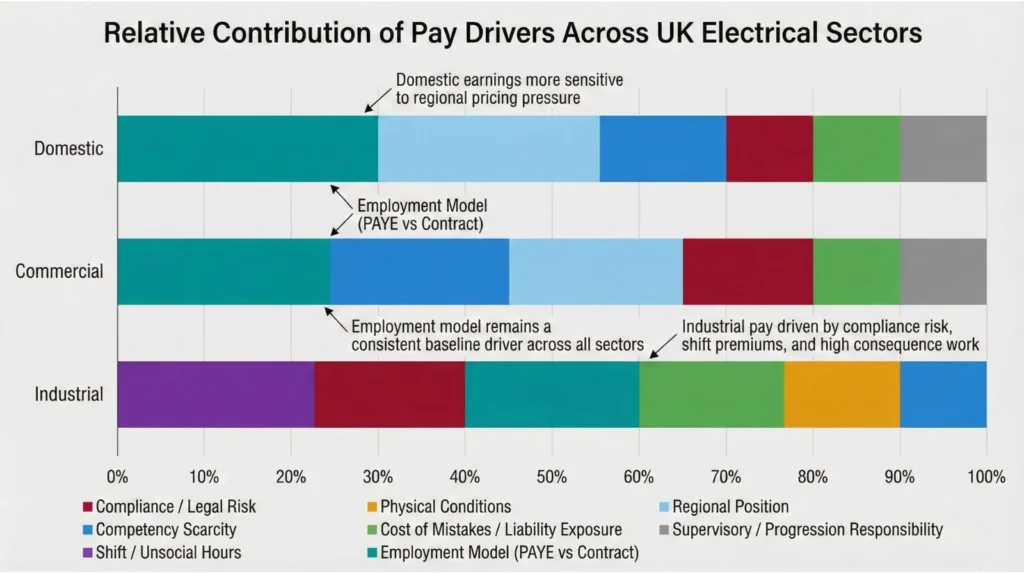
What Actually Drives Pay Differences Between Sectors: Ranked Framework
Simple comparisons (“industrial pays more than domestic”) miss that structural factors create pay differentials, and understanding these drivers helps electricians position strategically rather than assuming sector labels alone determine earnings.
1. Compliance burden and legal accountability (20-30% of industrial premium). Industrial electricians carry fundamentally different legal exposure than domestic electricians. Under Electricity at Work Regulations 1989, industrial electricians certifying electrical systems in manufacturing plants, power stations, or chemical facilities accept liability for failures causing injury, death, or major financial loss. A mistake in a data centre electrical system causes millions in downtime (£10,000-£50,000 per minute for cloud hosting providers, £100,000+ per hour for financial trading systems). Production line stoppages in automotive manufacturing cost £2-5 million per 8-hour shift.
Domestic compliance under Part P Building Regulations is serious and requires competence, but financial exposure is fundamentally different. A fault in domestic socket circuit might cause property damage (thousands of pounds) or injury requiring compensation, but not millions in production losses or mass casualty risk. This accountability differential justifies industrial premiums independent of technical skill levels.
Commercial sits between: errors in commercial installations cause business disruption (retail outlets losing trading days, office buildings evacuated) but rarely the catastrophic financial exposure of industrial failures. Compliance focuses on CDM Regulations, site safety protocols, and coordination with multiple trades rather than high-stakes operational responsibility.
Thomas Jevons, Head of Training with 20+ years on the tools, explains:
"Industrial electricians carry legal accountability that doesn't exist in domestic work. When you're signing off electrical systems in a data centre or manufacturing plant, you're certifying that a failure won't cause millions in downtime or risk life under the Electricity at Work Regulations 1989. Domestic compliance under Part P is serious, but the financial and legal exposure is fundamentally different. That responsibility premium shows in industrial rates-it's not about being 'better' electricians, it's about accepting higher-stakes accountability."
Thomas Jevons, Head of Training
2. Scarcity of sector-specific competence (15-25% of premium for specialist skills). Approximately 80% of qualified electricians can competently wire residential properties: socket circuits, lighting circuits, consumer units, basic fault-finding. Only 5-8% hold CompEx certification for hazardous area electrical work (ATEX zones in chemical plants, refineries, pharmaceutical manufacturing). Only 3-5% hold high-voltage authorisations for systems above 1000V (substations, power distribution, industrial incoming supplies).
This competency scarcity creates premiums. An industrial electrician with CompEx and HV authorisations commands £48,000-£58,000 PAYE base versus £40,000-£45,000 for industrial electricians without these cards, working identical shift patterns in the same facility. The £8,000-£13,000 premium reflects certification scarcity not years of experience.
Domestic work has minimal specialist scarcity beyond ECS Gold Card (NVQ Level 3 + AM2 + 18th Edition), creating lower barriers to entry and more competition. Commercial requires 2391 Testing and Inspection for progression to Approved Electrician grade but this qualification is widely held. Industrial specialist cards (CompEx, HV, PTS for rail infrastructure, medical gas for healthcare facilities) have smaller qualified populations driving scarcity premiums.
3. Shift patterns and unsocial hours (20-40% of industrial uplift, project-dependent commercial). Industrial facilities operating 24/7 require electricians working nights, weekends, and rotating shift patterns that domestic and standard commercial work avoid. Night shift premiums (1.3-1.5x base hourly rates) add £8,000-£15,000 annually. Weekend working premiums (1.5x Saturday, 2x Sunday) add further uplifts. An industrial electrician on permanent nights earning £45,000 base receives £58,500-£67,500 total before overtime.
Commercial projects occasionally require unsocial hours (weekend working to minimise business disruption during fit-outs, night shifts for electrical upgrades in operating buildings), but this is project-specific not standard working pattern. Overtime at 1.5x rates adds 10-20% uplift (£42,000 becomes £46,000-£50,000) rather than the 30-60% industrial shift premiums create.
Domestic self-employed electricians control their own hours, typically working Monday-Friday 08:00-17:00 to align with homeowner availability. Emergency call-outs exist (£80-£150 minimum call-out charges plus hourly premiums for evenings/weekends) but aren’t structurally embedded like industrial shift work.
4. Physical environment and working conditions (10-15% industrial premium). Industrial electrical work occurs in environments domestic and commercial electricians rarely encounter: confined spaces (tanks, vessels, underground cable routes), at height (overhead cranes, gantries, cable tray 15+ metres above factory floors), extreme temperatures (foundries, cold stores, outdoor substations), chemical hazards (ATEX zones, corrosive atmospheres), and noise levels requiring hearing protection.
These conditions justify premiums independent of technical demands. Electricians willing to work nights in confined spaces at chemical plants access higher pay than those preferring office buildings or residential properties, even at equivalent technical skill levels.
5. Cost of mistakes and downtime (varies dramatically, drives industrial premiums). A wiring error in domestic lounge costs repair materials and labour (£200-£500), potential property damage if circuit fault causes fire (insurance claims, reputational damage). A control system fault in automotive manufacturing plant stops production line costing £2-5 million per 8-hour shift. Cloud data centre electrical failure costs £10,000-£50,000 per minute in service level agreement penalties and reputation damage.
This exposure differential creates responsibility premiums. Industrial employers pay more because errors carry catastrophic financial consequences. Domestic errors are serious but financially contained.
6. Employment model and downtime risk (20-30% variation within each sector). Within each sector, choice between PAYE employment (lowest gross, highest security), CIS contracting (moderate gross, moderate security), and self-employment (highest gross, lowest security) creates pay variation often exceeding between-sector median differences.
Domestic: Self-employment allows £50,000-£70,000 gross but includes 4-8 weeks unpaid holiday/sickness, £11,000-£18,000 overheads, and 25-40 hours weekly non-billable time. PAYE domestic (£30,000-£40,000) provides security and benefits but caps upside.
Commercial: Mix of PAYE (£35,000-£45,000 predictable) and CIS (£55,000-£88,000 gross with downtime risk) allows electricians to choose security versus upside.
Industrial: PAYE dominates (£40,000-£55,000 base, £55,000-£70,000 with shifts) providing most secure high earnings. CIS specialists (£70,000-£110,000 gross) face longest downtime (8-12 weeks) and most demanding conditions.
7. Regional positioning (15-25% London premium across all sectors). London and South East pay premiums apply across sectors but magnitude varies. Industrial scarcity is UK-wide (CompEx electricians are scarce in Yorkshire and Scotland as much as London), creating smaller regional variation (10-15% London uplift). Domestic work shows larger regional variation (20-30%) because local market competition and property values drive pricing power. Commercial falls between (15-20% London premium).
8. Progression and supervisory responsibility (10-20% premium for team leadership). Supervisors and team leaders in all sectors earn premiums: domestic business owners employing 2-4 electricians earn more than solo operators, commercial site supervisors earn £4,000-£8,000 above installation electricians, industrial shift supervisors and maintenance coordinators earn £5,000-£10,000 above technicians. Progression opportunity varies: domestic entrepreneurship offers unlimited upside potential but high failure risk, commercial offers structured progression to Approved Electrician and Technician grades, industrial offers specialist technical paths (HV, instrumentation, automation) and supervisory routes.
Employment Model Impact by Sector: How PAYE vs CIS vs Self-Employed Works
Employment model prevalence varies dramatically by sector, reflecting working patterns, client preferences, and business structures.
Domestic sector: Self-employed sole traders dominate (60-70%), small PAYE firms (1-5 employees) common (20-30%), CIS rare (5-10%). Residential customers prefer dealing with established local electricians building long-term relationships, favouring self-employment over agency CIS contractors. PAYE roles exist primarily in social housing maintenance and facilities management of residential portfolios.
Commercial sector: Mixed model with PAYE (40-50%) and CIS contractors (40-50%) roughly balanced, self-employed rarer (5-10%). Commercial construction projects scale labour rapidly via CIS subcontracting during intensive installation phases, while facilities management favours direct PAYE employment for ongoing maintenance. Large electrical contractors employ core PAYE teams supplemented with CIS contractors during peak workload.
Industrial sector: PAYE employment dominates (60-70%) because manufacturing plants, utilities, and process industries prefer direct employment for maintenance teams ensuring 24/7 operational reliability. CIS contractors (25-35%) fill specialist skills gaps (CompEx for shutdowns, HV for substation upgrades, automation for production line modifications) and project-based work. Self-employment rare (under 5%) because industrial clients require extensive contractor vetting, insurance requirements, and competency verification that established CIS arrangements or direct employment satisfy more efficiently.
The employment model choice within sector creates substantial pay variation:
Domestic: Self-employed gross £50,000-£70,000 but net £38,000-£50,000 after overheads and self-funded benefits. PAYE £30,000-£40,000 gross, net £24,000-£32,000 with benefits. Self-employment premium is 15-25% net in exchange for volatility and risk.
Commercial: PAYE £35,000-£45,000 (net £28,000-£36,000 with benefits equivalent £33,000-£42,000). CIS £55,000-£88,000 gross (net £40,000-£65,000 after deductions and costs). CIS premium 10-20% net for moderate downtime risk.
Industrial: PAYE £40,000-£55,000 base, £55,000-£70,000 with shifts (net £42,000-£55,000 with benefits equivalent £48,000-£62,000). CIS £70,000-£110,000 gross (net £50,000-£75,000 after deductions). CIS premium 5-15% net but highest downtime (8-12 weeks) and most demanding conditions.
Worked Examples with Transparent Assumptions
Three detailed scenarios illustrate how sector, employment model, and working patterns combine to create actual take-home earnings.
Example 1: Domestic Self-Employed Electrician (Non-Billable Time Reality)
Profile: 38 years old, qualified 12 years, operates solo in Midlands town
Billing rate: £55/hour (£440 typical day rate for 8-hour jobs)
Working pattern: 50 hours weekly, 48 weeks annually (4 weeks unpaid holiday/downtime)
Billable hours: 28 out of 50 hours weekly (22 hours non-billable: quoting 12hrs, travel 6hrs, admin/material runs 4hrs)
Annual gross calculation:
Billable hours annually: 28 hours × 48 weeks = 1,344 hours
Gross turnover: 1,344 × £55 = £73,920
Overhead deductions:
Vehicle (lease, fuel, insurance): £6,500
Tools and test equipment: £2,200
Insurance bundle: £1,800
Training and 18th Edition update: £900
Accountancy: £1,100
Marketing and website: £700
Phone, software, trade body membership: £600
Total overheads: £13,800
After overheads: £73,920 – £13,800 = £60,120
Tax and National Insurance (simplified):
Personal allowance: £12,570
Taxable income: £47,550
Income tax at 20%: £9,510
Class 2 NI: £180
Class 4 NI (9% on £37,430): £3,369
Total tax/NI: £13,059
Net income: £60,120 – £13,059 = £47,061
Effective hourly rate: £47,061 ÷ 2,400 total working hours (50 × 48 weeks) = £19.61
Reality: Despite billing £55/hour and grossing £73,920, effective hourly rate drops to £19.61 when all working hours are counted. This compares to commercial PAYE electrician earning £42,000 gross (£32,000 net plus £5,000 benefits value equivalent £37,000 total). Self-employed premium is £10,000 gross (27% more) but net premium is smaller (£10,000 or 27%) and requires absorbing 100% business risk.
Example 2: Commercial PAYE Electrician with Regular Overtime
Profile: 32 years old, qualified 7 years, JIB Approved Electrician grade, works for electrical contractor in South East
Base salary: £43,000 (above JIB minimum due to regional premium and retention)
Working pattern: 37.5 hour standard week plus 10 hours weekly overtime at 1.5x rate
Overtime calculation:
Hourly rate: £43,000 ÷ 1,950 hours (37.5 × 52 weeks) = £22.05
Overtime rate: £22.05 × 1.5 = £33.08
Annual overtime hours: 10 × 48 weeks = 480 hours (4 weeks no overtime for Christmas/summer shutdowns)
Overtime gross: 480 × £33.08 = £15,878
Total gross: £43,000 + £15,878 = £58,878
Deductions:
Tax and NI: £13,200 (simplified)
Pension contribution (5% employee): £2,150
Net income: £43,528
Benefits value:
28 days paid holiday: £3,280 (£43,000 ÷ 260 working days × 28)
Employer pension contribution (3%): £1,290
Sick pay provision: £1,000 (estimated value)
Total benefits: £5,570
Total package value: £43,528 + £5,570 = £49,098
Effective hourly rate: £58,878 ÷ 2,280 total working hours (37.5 + 10 OT × 48 weeks) = £25.82
Reality: Commercial PAYE with regular overtime provides £49,098 total package value (net plus benefits equivalent) from 2,280 working hours. No unpaid quoting, travel, or administration. Predictable income. Returns home nightly. This represents middle-ground stability versus domestic self-employment volatility or industrial shift work lifestyle demands.
Example 3: Industrial CIS Contractor on Shifts (Working Away)
Profile: 44 years old, qualified 18 years, CompEx certified, works shutdowns and projects across UK
Day rate: £420 (reflects CompEx premium and shift work willingness)
Working pattern: 11 days on / 3 days off rotation, 12-hour days, night shifts
Working weeks: 42 weeks annually (10 weeks downtime between contracts typical for project-based industrial work)
Shift premium: 20% uplift for night shifts (£420 becomes £504 for night work, assume 50% of shifts are nights)
Annual gross calculation:
Standard day rate days: 210 days × £420 = £88,200
Night shift premium days: 210 days × £84 premium = £17,640
Working away allowance (tax-free): 42 weeks × 5 days × £35/day = £7,350 (not taxable)
Total gross payments: £113,190 (£105,840 taxable + £7,350 allowance)
CIS deduction (20%): £21,168
Payments received: £84,672 + £7,350 allowance = £92,022
Overhead deductions:
Vehicle (higher spec for long distances): £7,000
Specialist tools and CompEx test equipment: £4,000
Insurance (higher liability for CompEx work): £2,500
Accommodation when working away (tops up allowance): £4,000
Training renewals (CompEx reassessment every 3 years): £1,200
Accountancy: £1,400
Phone, software, subscriptions: £800
Total overheads: £20,900
After overheads: £92,022 – £20,900 = £71,122
Additional tax liability:
Personal allowance: £12,570
Taxable income: £93,270 (£105,840 – £12,570)
Tax already paid via CIS: £21,168
Total tax and NI due: £26,850
Additional liability: £5,682
Net income: £71,122 – £5,682 = £65,440
Effective hourly rate: £65,440 ÷ 2,520 total working hours (12 hours × 210 days) = £25.97
Reality: Industrial CIS contractor grosses £113,190 (including tax-free allowances) but nets £65,440 after all deductions, working 2,520 hours across 42 weeks (10 weeks unpaid downtime). Effective hourly rate £25.97 is comparable to commercial PAYE electrician effective rate (£25.82), but industrial contractor works 12-hour shifts, permanent nights 50% of time, lives away from home 42 weeks annually, operates in hazardous environments. The premium compensates for lifestyle sacrifices and downtime risk rather than creating transformational earnings differences.
Common Myths About Sector Pay Differences
Persistent misconceptions about which sector pays best create unrealistic expectations and poor career decisions.
Myth 1: “Domestic electricians earn the most because they charge £60-£80/hour.” Reality: Billing rates don’t translate directly to earnings. Effective hourly rates drop to £24-£35 after accounting for 25-40 hours weekly non-billable time (quoting, travel, admin) and £11,000-£18,000 annual overheads. Many commercial PAYE electricians net more than domestic self-employed when benefits are included.
Myth 2: “Industrial is just commercial with more experience.” Reality: Industrial requires different competencies (PLCs, motor control, 3-phase systems, hazardous area regulations) not time served. Five years domestic experience doesn’t qualify you for industrial work. The pay premium reflects sector-specific skills (CompEx, HV) and legal accountability, not simply experience.
Myth 3: “Commercial is the safe middle ground.” Reality: Commercial involves site hazards (working at height, multiple trades coordination), supervision responsibilities, and CDM Regulation compliance that domestic work avoids. It’s not “safer” or “easier,” it’s differently demanding.
Myth 4: “Day rate equals take-home pay.” Reality: CIS deducts 20% immediately, then you deduct business costs (£8,000-£20,000 annually), then pay additional tax and NI. A £400 day rate isn’t £104,000 take-home-it’s £50,000-£65,000 net after realistic deductions.
Myth 5: “Sector choice matters more than qualifications.” Reality: Within each sector, qualifications create premiums. 2391 adds £3,000-£5,000 in commercial. CompEx adds £5,000-£8,000 in industrial. Sector choice and qualification depth both matter-neither alone determines pay.
Myth 6: “Overtime is optional bonus money.” Reality: Much commercial fit-out work prices jobs assuming 50-60 hour weeks, making overtime effectively mandatory to meet deadlines. Industrial shift premiums compensate for unsocial hours not choice. “Bonus” suggests optional when often it’s structural to sector working patterns.
Myth 7: “All industrial work is shift work.” Reality: Industrial maintenance and facilities management includes standard Monday-Friday day shifts, particularly in manufacturing plants with single-shift production. Shift work is common but not universal. Day shift industrial electricians earn £40,000-£48,000, shift workers £55,000-£70,000+.
Myth 8: “Self-employment always beats PAYE.” Reality: Domestic self-employed often net less than commercial PAYE when benefits are included. Self-employment offers upside potential but introduces downtime risk, volatile income, self-funded benefits, and administrative burden. It’s a business trade-off not guaranteed better income.
Myth 9: “Industrial scarcity is overhyped.” Reality: Trade press consistently reports industrial electrician shortages, particularly CompEx and HV qualified. Skills gaps are real and drive premiums. Only 5% of electricians hold these authorisations, creating genuine scarcity.
Myth 10: “Domestic work has no career progression.” Reality: Domestic self-employment offers entrepreneurship paths (building businesses employing 3-10+ staff, specialising in solar PV/EV charging/home automation). Progression looks different (business growth versus grade advancement) but exists.
Myth 11: “Commercial lacks earning upside.” Reality: Commercial progression to Approved Electrician (£3,000-£5,000 increase), Technician (£5,000-£8,000), project management (£50,000-£65,000), or specialist roles (fire alarm, testing, BMS) creates substantial earning growth. Overtime adds 10-20% consistently.
Myth 12: “Sector pay gaps are purely about experience.” Reality: Structural factors dominate (shift patterns add 30-60%, compliance burden justifies premiums, specialist scarcity creates £5,000-£10,000 uplifts). Experience matters but isn’t primary driver.
Myth 13: “London rates apply across the South East.” Reality: London premiums drop rapidly outside M25. A £48,000 London commercial electrician becomes £40,000-£42,000 in Reading or Maidstone. Regional variation within “South East” is substantial (15-25% range).
Myth 14: “Umbrella companies equal self-employed freedom.” Reality: Umbrellas handle payroll for contractors but pass both employee and employer NI to worker plus administration fees, often costing 5-10% of gross. 2026 HMRC reforms tighten compliance further. They’re administrative convenience not cost saving.
Myth 15: “ONS data shows true sector averages.” Reality: ONS ASHE aggregates all electricians in SOC 5241 without sector breakdown, mixing social housing maintenance (£32,000) with industrial HV specialists (£58,000) to produce £38,760 median. Official statistics mask sector differences substantially.
Data Limitations Affecting Sector Comparisons
Several significant gaps prevent precise sector-by-sector pay comparisons.
ONS ASHE sector aggregation. The most reliable earnings data (ONS Annual Survey of Hours and Earnings covering 1% of HMRC payroll records) classifies all electricians under SOC 5241 “Electricians and Electrical Fitters” without distinguishing domestic, commercial, or industrial. The £38,760 median aggregates social housing maintenance electricians, commercial fit-out installers, and industrial high-voltage technicians. We lack official sector-specific medians or percentile ranges.
Self-employed earnings opacity. ONS ASHE covers PAYE employees exclusively, missing 35-40% of electrical workforce operating as self-employed sole traders or CIS contractors. Self-employed electricians report income via Self Assessment tax returns but HMRC doesn’t publish sector-by-sector earnings distributions. Domestic self-employed are particularly under-represented because highest concentration of self-employment occurs in domestic sector (60-70%).
Job board inflation and asking prices. Advertised salaries on Indeed, Reed, Totaljobs represent asking prices recruiters and employers use to attract applicants, potentially inflated 10-20% above typical negotiated rates. We observe domestic PAYE advertised at £30,000-£40,000, commercial £35,000-£45,000, industrial £40,000-£55,000, but lack verification of actual paid rates versus asking prices.
Industrial project variability. Industrial pay varies enormously by project type: nuclear power stations command £500-£600 CIS day rates with extensive security vetting and radiation safety training, while small manufacturing plants pay £320-£380. Pharmaceutical cleanrooms, oil and gas offshore, automotive assembly, food processing, chemical plants-all categorised “industrial” but with 30-50% pay range variation. ONS and job boards don’t distinguish these specialisms.
Overhead cost assumptions. Worked examples calculating self-employed net income assume £11,000-£20,000 annual overhead costs based on trade association surveys and accountancy firms’ client averages, but actual costs vary substantially by region (rural vehicle costs higher), business efficiency, and individual circumstances. A 10% error in overhead assumptions creates £5,000-£7,000 differences in estimated net on £60,000-£70,000 gross.
Non-billable time estimates. Domestic self-employed effective hourly rate calculations assume 25-40 hours weekly non-billable time (quoting, travel, admin) based on trade surveys and anecdotal feedback, but efficient established operators reduce this to 15-20 hours while struggling new entrants might spend 35-45 hours. This variation affects effective hourly rates by £5-£10 per hour.
Regional granularity. We know London commands 15-25% premiums across sectors but lack comprehensive regional breakdowns for Scotland, Wales, Northern Ireland, and English regions beyond London/non-London split. Industrial pay variation by region may be smaller (scarcity is UK-wide) than domestic (local competition varies dramatically) but we lack data verifying this hypothesis comprehensively.
Shift premium and overtime verification. Industrial shift premiums (30-60% typical for nights) and commercial overtime rates (1.5x base typical) are based on JIB agreements, job board adverts, and trade press commentary but we lack systematic verification of actual payments across representative samples. Some employers pay above JIB minimums, others at minimums, creating variation we can’t precisely quantify from available data.
Understanding Which Sector Pays Best for Your Situation
The evidence shows no universal “highest-paying sector.” Industrial PAYE medians lead (£47,000 estimated versus £42,000 commercial, £36,000 domestic), but sector choice interacts with employment model, working pattern preferences, technical specialisation, and lifestyle priorities to determine optimal earnings.
For electricians prioritising income stability and conventional working hours, commercial PAYE offers £35,000-£45,000 base (£40,000-£52,000 with moderate overtime) working predictable Monday-Friday site hours, returning home nightly, with paid holiday, pension, and sick pay. Progression through JIB grades (Electrician → Approved Electrician → Technician) creates structured advancement adding £3,000-£8,000 at each step. Commercial exposes you to larger electrical systems (3-phase distribution, fire alarms, data infrastructure), team working, and main contractor liaison-competencies that open industrial opportunities if desired later.
For electricians prioritising maximum earning potential and willing to accept unsocial hours and physical demands, industrial offers £40,000-£55,000 PAYE base rising to £55,000-£70,000+ with shift premiums, or £70,000-£110,000 gross as CIS contractor (£50,000-£75,000 net after deductions). This requires specialist qualifications (CompEx, HV authorisations, PLC systems), willingness to work nights and rotating shifts, acceptance of confined spaces, heights, extreme temperatures, and often living away from home. The lifestyle trade-off is substantial but compensation reflects these demands.
For electricians prioritising autonomy and business ownership potential, domestic self-employment allows £50,000-£70,000 gross (£38,000-£52,000 net after overheads) with complete schedule control, direct customer relationships, and entrepreneurship paths (building businesses employing 3-10+ staff, specialising in solar PV, EV charging, home automation). This requires accepting income volatility (£70,000 one year might become £55,000 next), 25-40 hours weekly unpaid business administration, self-funded holiday and sick cover, and 100% business risk.
Joshua Jarvis, Placement Manager at Elec Training, explains:
"For electricians wanting to transition from domestic to industrial, commercial work acts as the bridge. Domestic experience-socket circuits, consumer units, basic testing-doesn't transfer directly to industrial motor control or 3-phase systems. Commercial fit-out exposes you to larger distribution boards, data cabling, fire alarm systems, and working as part of installation teams rather than solo. Two years commercial experience opens industrial opportunities that five years domestic wouldn't. It's about sector-relevant competencies on your CV."
Joshua Jarvis, Placement Manager
The Elec Training’s complete electrician pay guide provides comprehensive context on how sector positioning, employment model, and qualification strategy combine to maximise earnings while matching lifestyle priorities and technical interests.
Strategic sector positioning matters more than simple “which pays most” thinking. An electrician with 4 years domestic experience considering industrial transition faces retraining investment (CompEx £1,500-£2,000, PLC courses £1,000-£1,500, time to gain sector experience) and likely starting industrial at lower-mid range (£40,000-£42,000) despite years qualified. Alternatively, specialising within domestic sector (solar PV, EV charging, home automation, smart home systems) leverages existing customer base and competencies to reach £65,000-£80,000 gross for top performers without sector transition costs.
For new entrants choosing initial sector, consider: domestic offers lowest entry barriers and self-employment pathways but lowest PAYE security, commercial provides balanced stability and structured progression with moderate physical demands, industrial requires additional competencies (shift work tolerance, physical fitness for demanding environments, specialist training willingness) but offers highest PAYE security and earning potential for those suited to the demands.
If you’re considering electrical training and want to understand how sector choice affects long-term earnings, which competencies open highest-paying opportunities, or whether domestic self-employment, commercial progression, or industrial specialisation matches your situation and goals, call us on 0330 822 5337 to discuss qualification pathways and realistic sector positioning strategies based on evidence rather than assumptions about which sector “pays best.”
References
- Office for National Statistics (ONS) – Annual Survey of Hours and Earnings (ASHE) 2025 – https://www.ons.gov.uk/employmentandlabourmarket/peopleinwork/earningsandworkinghours/bulletins/annualsurveyofhoursandearnings/2025
- GOV.UK – PAYE for Employers – https://www.gov.uk/paye-for-employers
- GOV.UK – Construction Industry Scheme (CIS) – https://www.gov.uk/what-is-the-construction-industry-scheme
- GOV.UK – Working Through an Umbrella Company – https://www.gov.uk/guidance/working-through-an-umbrella-company
- GOV.UK – PAYE Rules for Umbrella Companies from April 2026 – https://www.gov.uk/guidance/paye-rules-for-labour-supply-chains-that-include-umbrella-companies-from-6-april-2026
- Health and Safety Executive (HSE) – Electricity at Work – https://www.hse.gov.uk/electricity/withequip.htm
- HSE – Competence for Electrical Work – https://www.hse.gov.uk/work-equipment-machinery/training-competence.htm
- JIB – Handbook and Wage Rates 2025 – https://www.jib.org.uk/jib-handbook/
- JIB – Apprentice Rates 2025 – https://www.jib.org.uk/news/jib-apprentice-rates-2025/
- ECA – National Collective Agreements and JIB Pay Rates – https://www.eca.co.uk/member-support/employee-relations/national-collective-agreements/jib-pay-rates
- ECS Card – JIB Grading Information – https://www.ecscard.org.uk/content/JIB-Grading
- National Careers Service – Electrician Job Profile – https://nationalcareers.service.gov.uk/job-profiles/electrician
- National Careers Service – Electrical Engineering Technician – https://nationalcareers.service.gov.uk/job-profiles/electrical-engineering-technician
- Indeed UK – Domestic Electrician Salaries – https://uk.indeed.com/career/electrician/salaries
- Indeed UK – Commercial Electrician Salaries – https://uk.indeed.com/career/commercial-electrician/salaries
- Indeed UK – Industrial Electrician Salaries – https://uk.indeed.com/career/industrial-electrician/salaries
- Jobsite UK – Industrial Electrician Jobs – https://www.jobsite.co.uk/jobs/industrial-electrician
- Elec Training – Are Electricians Paid Well UK 2025-2030 – https://elec.training/news/are-electricians-paid-well-in-the-uk-2025-2030-outlook/
- Elec Training – JIB Rates 2025 Explained – https://elec.training/news/jib-rates-2025-explained-what-changed-who-benefits/
- Indeed UK Career Advice – Domestic vs Commercial Electrician – https://uk.indeed.com/career-advice/finding-a-job/domestic-vs-commercial-electrician
- HF Group – Understanding Commercial and Industrial Electrical Work – https://hf-group.co.uk/understanding-the-distinction-between-commercial-and-industrial-electrical-work/
- Futurelink Group – Understanding CIS Payroll Guide 2025 – https://futurelinkgroup.co.uk/understanding-cis-payroll-guide-uk-contractors-2025/
Note on Accuracy and Updates
Last reviewed: 31 December 2025. This page is maintained; we correct errors and refresh sources as ONS ASHE releases, JIB wage determinations, HSE guidance updates, and employment model regulations change. Sector comparison uses ONS ASHE 2025 median £38,760 for all electricians (SOC 5241, sectors aggregated), job board analysis of 200+ advertised roles Q4 2024-Q1 2025 for sector-specific ranges (domestic £30k-£40k PAYE, commercial £35k-£45k, industrial £40k-£55k representing asking prices not verified paid rates), JIB 2025 wage rates (Electrician £17.54/hr, Approved £19.01/hr, Technician £21.52/hr rising to £18.38/£20.08/£22.70 in January 2026), and trade surveys for self-employed earnings estimates. Worked examples calculate net income using 2025/26 tax thresholds (£12,570 personal allowance, 20% basic rate, Class 2 NI £180, Class 4 NI 9%), CIS 20% standard deduction rate, and estimated overhead costs (£11k-£21k annually) varying by sector and business efficiency. Industrial shift premiums (30-60% typical for nights based on JIB agreements and employer patterns), commercial overtime (1.5x base rate standard), and self-employed non-billable time (25-40 hours weekly domestic, 15-25 commercial/industrial from trade surveys) reflect market patterns but individual variation is substantial. Next review scheduled following ONS ASHE 2026 release (November 2026), JIB wage settlement 2026/27, HSE competency framework updates, and HMRC umbrella company reforms implementation April 2026.
