


- Technical review: Thomas Jevons (Head of Training, 20+ years)
- Employability review: Joshua Jarvis (Placement Manager)
- Editorial review: Jessica Gilbert (Marketing Editorial Team)
- Last reviewed:
- Changes: New comprehensive article addressing part-time and evening electrical training feasibility while working full-time, covering knowledge qualifications (Level 2/3 diplomas, 18th Edition) deliverable via flexible evening/weekend timetables, competence qualifications (NVQ Level 3, AM2) requiring workplace access during standard working hours creating unavoidable constraints, the diploma-completion trap where adults finish theory but cannot progress due to workplace access barriers, employer perspective on diploma-only candidates without site experience, strategic timing for securing mate/improver employment (before or during Level 3 study, not after), scenario analysis by current employment situation, AM2 scheduling requiring weekday daytime commitment, funding mechanisms for adult learners, lowest-risk planning sequence prioritizing workplace access early, and why Elec Training's guaranteed work placement through 120+ contractor partnerships solves the workplace access barrier that typically stalls part-time career changers
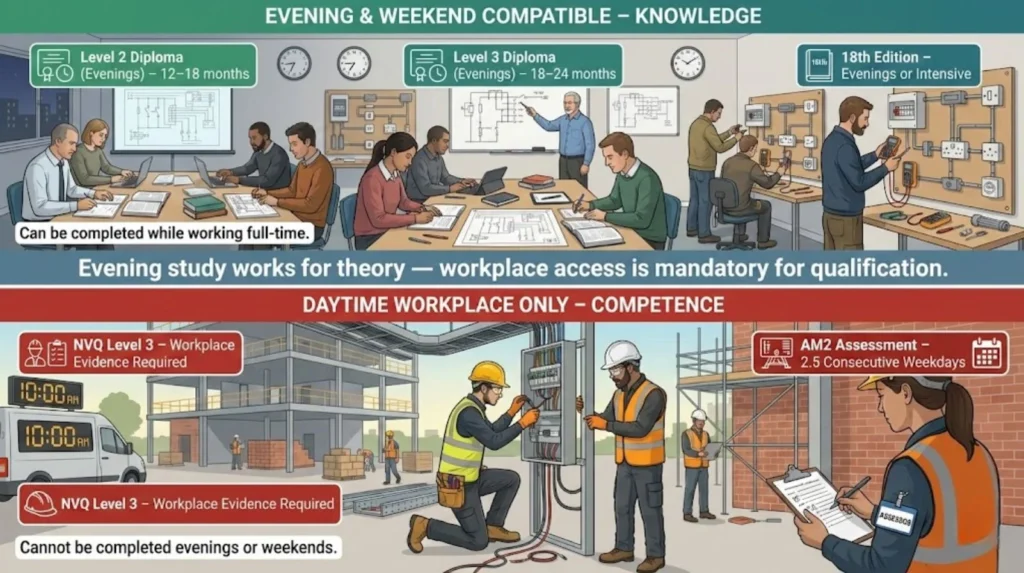
Yes, you can complete knowledge-based electrical qualifications (Level 2 and Level 3 diplomas, 18th Edition Wiring Regulations) via evening or weekend classes while working full-time. These theory and workshop practical components are genuinely compatible with flexible delivery timetables offered by Further Education colleges and some private training providers.
However, you cannot become a fully qualified electrician solely through evening study. The UK qualification structure splits into knowledge (classroom-based, flexible timing) and competence (workplace-based, inflexible timing). The latter creates unavoidable barriers for part-time learners.
Specifically: NVQ Level 3 requires portfolio evidence from actual electrical installations in real working environments under qualified supervision. Assessors must visit you on live sites during working hours. AM2 practical assessment runs over 2.5 consecutive days at approved centres, typically weekdays only, requiring annual leave or unpaid time off work. Both represent mandatory daytime commitments separate from any evening study completed previously.
The critical challenge isn’t accessing theory education while working. Multiple pathways exist for that. The critical challenge is securing workplace access to complete competence qualifications, which determine whether part-time training successfully progresses to qualified electrician status or stalls permanently after diploma completion.
Understanding how to become an electrician requires recognizing this fundamental knowledge-competence split and planning strategically for workplace access timing, not just course enrollment decisions.
Understanding the Knowledge-Competence Split
UK electrical qualification structure divides learning into two distinct categories with different delivery feasibilities.
Knowledge Qualifications (Classroom-Based)
What they cover: Electrical theory, calculations, regulations knowledge (BS 7671), fault-finding principles, design fundamentals, health and safety requirements, simulated workshop practicals in controlled training environments.
Examples: City & Guilds 2365 Level 2 Diploma in Electrical Installations, City & Guilds 2365 Level 3 Diploma in Electrical Installations, 18th Edition Wiring Regulations (BS 7671) qualification.
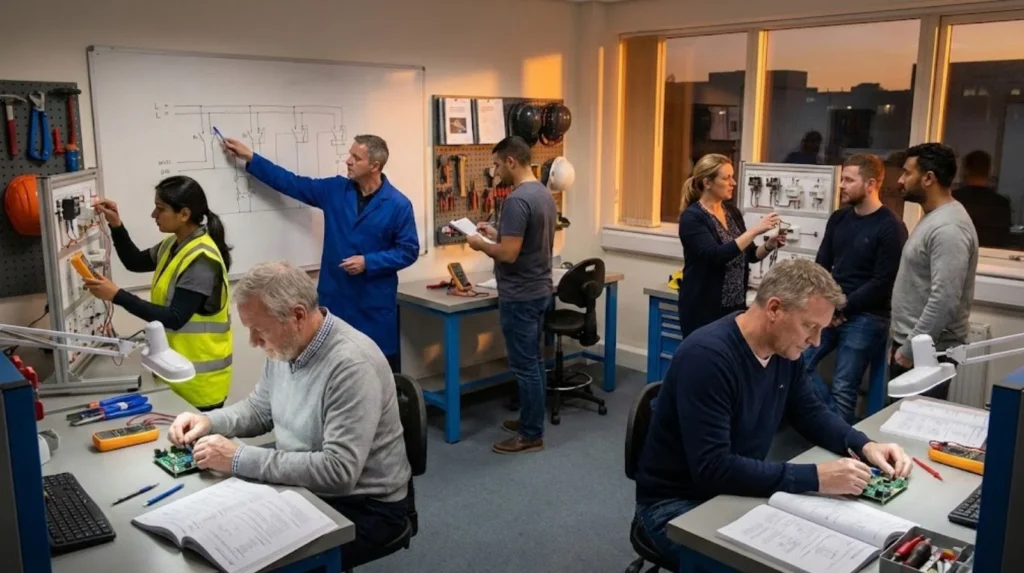
Delivery flexibility: Highly flexible. Further Education colleges commonly offer evening classes (typically 2 evenings per week, 6pm to 9pm) or weekend sessions. Some private providers offer intensive block delivery (1 week on, 3 weeks off pattern). Online learning with periodic practical assessments increasingly available.
Assessment methods: Written exams, multiple choice tests, practical assessments in college workshops using training rigs and simulated installations, assignments and coursework completed at home.
Working hours requirement: Minimal. Attend scheduled evening/weekend sessions (typically 4 to 6 hours weekly). Complete homework and revision in personal time. Practical assessments occur during class sessions in college workshops, not requiring external site access.
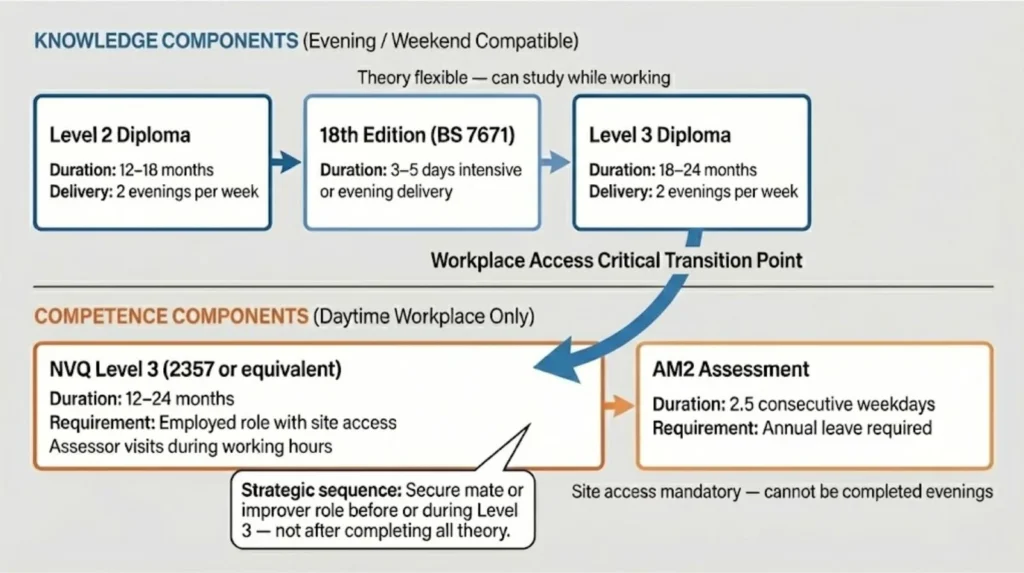
Typical duration part-time: Level 2 diploma 12 to 18 months (2 evenings weekly), Level 3 diploma 18 to 24 months (2 evenings weekly), 18th Edition 3 to 5 days (can be evenings or intensive).
Cost range: Level 2 £1,500 to £2,500, Level 3 £2,000 to £4,000, 18th Edition £300 to £500. Advanced Learner Loans available for Level 3+ courses covering tuition fees (adults 19+).
Critical limitation: Knowledge qualifications prove you understand electrical principles, regulations, and safe working practices. They do NOT prove you can perform electrical installations competently in real working environments. Employers distinguish clearly between “knows theory” and “can do the work reliably under commercial conditions.”
Competence Qualifications (Workplace-Based)
What they require: Portfolio evidence from actual electrical installations in real working environments, photographic documentation of completed work, witness testimonies from qualified supervisors confirming task performance, direct assessor observations of you performing installations on live sites, coverage of diverse installation types (domestic, commercial, industrial contexts where possible).
Examples: NVQ/SVQ Level 3 Diploma in Installing Electrotechnical Systems and Equipment (e.g., City & Guilds 2357, EAL qualification equivalents), AM2/AM2E Achievement Measurement practical assessment (final competence gatekeeper).
Delivery flexibility: Extremely limited or non-existent. NVQ is workplace-based by regulatory design. Cannot be completed in evening college workshops or simulated environments. Requires employment or regular site access in electrical installations role.
Assessment methods: Portfolio submission including photographs, job sheets, test certificates from actual installations completed. Assessor site visits observing you perform installations in real time (typically quarterly visits, 2 to 4 hours each, during working hours when sites operational). Witness testimonies from qualified supervisors (your employer or qualified electrician overseeing your work).
Working hours requirement: HIGH. Must be working in electrical installations role during standard business hours when construction sites operate, commercial premises accessible, and qualified supervisors available. Assessors visit sites during working hours (typically 9am to 5pm weekdays). Cannot generate evidence evenings or weekends when sites closed and supervision unavailable.
Typical duration: NVQ Level 3 12 to 24 months once workplace access secured and portfolio evidence collection begins. Requires minimum logged working hours and task coverage breadth. Cannot be accelerated significantly beyond 12 months even with full-time site access due to assessment scheduling and portfolio development requirements.
AM2 specific constraints: 2.5 consecutive days (approximately 16.5 hours total assessment time) at approved centre. Typically scheduled weekdays (Monday to Wednesday or similar). Very few centres offer weekend or evening slots. Requires booking 3 to 6 months advance. Must arrange annual leave or unpaid time off work. Travel to assessment centre (limited UK locations). Accommodation potentially required if distant from centre.
Cost range: NVQ assessment fees £800 to £1,500 (employer sometimes covers if supporting training), AM2 assessment £600 to £800, additional costs for portfolio development support, photographs, test equipment if not employer-provided.
Critical limitation: Competence qualifications cannot circumvent workplace access requirement regardless of motivation, prior knowledge, or willingness to pay. The regulatory framework mandates real working environment evidence. No evening course, intensive programme, or private provider removes this constraint.
Thomas Jevons, our Head of Training, explains the fundamental distinction:
"Level 2 and Level 3 diplomas cover electrical theory, calculations, regulations knowledge, and simulated workshop practicals in controlled training environments. These knowledge components are entirely compatible with evening or weekend delivery models. However, the NVQ Level 3 requires portfolio evidence from real electrical installations in actual working environments under qualified supervision. You cannot generate this evidence at 8pm in a college workshop. The knowledge-competence split is fundamental to UK electrical qualification structure. Evening classes handle the former excellently. They cannot address the latter at all."
Thomas Jevons, Head of Training
What You Can Actually Do While Working Full-Time
Breaking down qualification components by genuine evening/weekend compatibility.
Fully Compatible with Evening/Weekend Study
Level 2 Diploma (City & Guilds 2365-02): Theory covering basic electrical principles, Ohm’s Law, circuit types, cable selection, earthing and bonding fundamentals, health and safety regulations. Workshop practicals installing containment, wiring accessories, basic fault-finding on training boards. Assessment via written exams and practical tasks in college workshops.
Typical delivery: 2 evenings weekly (6pm to 9pm) over 12 to 18 months, or weekend intensive blocks, or blended online theory with periodic practical sessions.
Level 3 Diploma (City & Guilds 2365-03): Advanced theory including three-phase systems, motor control, complex calculations, design principles, inspection and testing theory, fault diagnosis. Workshop practicals on more complex installations and testing procedures.
Typical delivery: 2 evenings weekly over 18 to 24 months following Level 2 completion.
18th Edition Wiring Regulations (BS 7671): Regulations knowledge covering electrical installation requirements, protective measures, special locations, certification procedures. Exam-based assessment only.
Typical delivery: 3 to 5 consecutive days intensive course, or 5 to 8 evening sessions, or home study with online exam.
Building Regulations Part P: Short supplementary course on legal requirements for electrical work in dwellings (England and Wales).
Typical delivery: 1 to 2 days or 3 to 4 evening sessions.
Requires Partial Daytime Commitment
Practical assessments within knowledge qualifications: While theory can be studied evenings, some Level 2/3 practical assessments may be scheduled during college workshop daytime sessions depending on centre policy and equipment availability. Verify timetabling before enrollment.
Requires Full Daytime Commitment (Cannot Be Done Evenings)
NVQ Level 3 portfolio evidence collection: Must be working in electrical installations role during standard business hours. Assessor site visits occur during working hours when sites operational. Cannot generate authentic workplace evidence outside employment context.
AM2/AM2E practical assessment: 2.5 consecutive days at approved centre, typically Monday to Wednesday or similar weekday pattern. Centres operate standard working hours. Must book annual leave or arrange unpaid time off.
The Critical Timing Question
Part-time learners often ask: “Can I complete everything via evening classes, then find electrical work afterwards?”
Answer: No. This sequence leads to the diploma-completion trap where adults finish Level 2 and Level 3 theory but cannot progress to NVQ stage because they lack workplace access and employers won’t hire diploma-only candidates without site experience.
Strategic sequence: Secure workplace access (mate or improver position) before or during Level 3 study, not after completing all theory. Use Level 2 diploma to help secure mate employment. Work while studying Level 3 in evenings. Gather NVQ evidence simultaneously through employment. This sequence prevents qualification pathway stalling.
The Diploma-Completion Trap
Most common failure pattern for part-time career changers attempting electrical training while working full-time.
The Pattern
Stage 1 (Months 0-18): Adult working office job enrolls in Level 2 Diploma evening course. Attends classes 2 evenings weekly. Studies theory, completes workshop practicals in college. Passes exams. Receives Level 2 qualification certificate.
Stage 2 (Months 18-42): Continues in office employment. Enrolls in Level 3 Diploma evening course. Attends classes 2 evenings weekly. Studies advanced theory, regulations, calculations. Completes college workshop practicals. Passes exams. Receives Level 3 qualification certificate. Also completes 18th Edition course (3 to 5 days).
Investment to this point: £3,000 to £6,000 in course fees, 3.5 years part-time study, hundreds of hours evening attendance and home study. Holds City & Guilds Level 2 Diploma, Level 3 Diploma, 18th Edition certificate.
Stage 3 (Months 42+): Attempts to progress to NVQ Level 3 and AM2 to become qualified electrician. Discovers NVQ requires workplace access with electrical employer. Applies for mate and improver positions to gain site access for portfolio evidence.
The Problem: Employers hiring mates and improvers prioritize reliability, physical capability, and site behavior over classroom qualifications. They prefer candidates with general construction labor experience over electrical students with zero practical exposure. Diploma-only candidate with no site hours represents unknown behavioral quantity despite holding Level 2 and Level 3 certificates.
Rejections accumulate: “No experience,” “We need someone who can start immediately without supervision,” “Looking for someone who’s worked on sites before,” “Can’t take on trainees currently.”
Stage 4 (Ongoing): Qualification pathway stalls. Adult has invested significant money and time completing knowledge components but cannot access competence stage. Some persist applying for mate positions months or years. Some accept significant pay cuts moving from £25,000 to £35,000 office roles to £18,000 to £22,000 mate wages (if they secure employment at all). Some abandon electrical career progression entirely, viewing diplomas as sunk cost.
Why This Happens Repeatedly
Training provider marketing emphasizes flexibility and accessibility of evening courses. Providers accurately state Level 2 and Level 3 diplomas can be completed part-time while working. However, marketing often omits or minimizes the workplace access barrier for NVQ progression.
Learners reasonably assume completing diplomas improves employability sufficiently to secure mate/improver work for NVQ evidence gathering. In practice, diploma credentials without site experience often provide minimal employment advantage because employers hiring mates prioritize behavioral reliability over theoretical knowledge.
Joshua Jarvis, our Placement Manager, explains employer perspective:
"Adults holding Level 2 or Level 3 diplomas without site experience often struggle securing even mate positions. Employers hiring mates prioritize reliability, physical capability, and site behavior over classroom qualifications. They prefer candidates with general construction laborer experience over electrical students with zero practical exposure. The diploma doesn't guarantee mate employment. It might help secure interview, but employers assess whether you'll increase or decrease their qualified electrician's productivity. Diploma-only candidate represents unknown quantity. Former construction worker with minimal electrical knowledge represents known behavioral reliability."
Joshua Jarvis, Placement Manager
The Missing Component: Guaranteed Workplace Access
Elec Training’s approach specifically addresses this barrier through guaranteed work placement support for learners progressing to NVQ stage. This isn’t optional value-add. It’s recognition that workplace access determines whether part-time qualification pathways complete successfully or stall permanently.
How guaranteed placement changes outcomes:
120+ active contractor partnerships: Established relationships with electrical contractors across UK regions who regularly accept Elec Training learners for NVQ portfolio development and mate/improver roles.
In-house recruitment team: Dedicated placement managers (like Joshua) making 100+ employer contact calls per learner to secure site access opportunities. Not passive job board reliance. Active recruitment on learner’s behalf.
Employer matching: Assessment of learner circumstances (location, availability, sector preferences) matched to appropriate contractor requirements and culture. Increases placement success probability and retention rates.
Pre-placement preparation: Interview coaching, site readiness verification, employer expectations briefing reducing early dismissal risk from behavioral misunderstandings or unpreparedness.
This infrastructure specifically solves the problem causing diploma-completion trap: lack of workplace access preventing NVQ progression. Evening classes handle knowledge components excellently. Guaranteed placement support handles the competence component barrier that typically stalls career changers.
Strategic Planning to Avoid the Trap
DO: Secure workplace access before or during Level 3 study. Use Level 2 diploma credential to help secure mate position. Accept lower wages temporarily for site access. Study Level 3 in evenings while working as mate. Gather NVQ evidence simultaneously through employment.
DON’T: Complete all theory first assuming employment will materialize easily afterwards based on diploma credentials alone. Underestimate employer preference for behavioral reliability over theoretical knowledge when hiring mates. Expect diploma certificates to significantly differentiate you from other candidates without site experience.
Route Feasibility by Qualification Component
Detailed assessment of genuine evening/part-time compatibility for each UK electrical qualification element.
Level 2 Knowledge Qualification (C&G 2365-02)
Can it be done evenings/part-time? Yes, fully compatible.
Typical delivery patterns: Evening classes 2 nights per week (6pm to 9pm) over 12 to 18 months. Weekend courses (typically Saturdays, 9am to 4pm) over 12 to 15 months. Blended learning with online theory modules and periodic practical workshops (some providers).
Key constraints: Practical assessments require attendance at training centre workshop for hands-on tasks (installing containment, wiring accessories, testing on training boards). These typically occur during scheduled evening/weekend sessions. Guided Learning Hours approximately 360 hours must be completed, including practical attendance.
What you must have in place: Course fees £1,500 to £2,500 (self-funded or Advanced Learner Loan if 19+ and Level 2+ course). Basic tools often provided initially by centre. Transport to evening classes. Time commitment 6 to 8 hours weekly including attendance and home study.
Common marketing misconceptions: “Level 2 makes you a qualified mate” (false, it’s knowledge-only certificate). “Employers will hire you immediately after Level 2” (possible but not guaranteed, depends on local market and your other attributes). “You can start electrical work right away” (false, requires supervision and employment context, not just certificate).
Level 3 Knowledge Qualification (C&G 2365-03)
Can it be done evenings/part-time? Yes, fully compatible.
Typical delivery patterns: Evening classes 2 nights per week over 18 to 24 months following Level 2 completion. Some providers offer 1-week intensive blocks with 3-week gaps (less compatible with standard 9-to-5 jobs requiring annual leave for each block). Weekend delivery over 20 to 24 months.
Key constraints: Requires prior Level 2 completion or equivalent electrical qualification/experience. Advanced theory exams covering complex calculations, three-phase systems, design principles. Practical assessments including fault diagnosis and testing procedures in college workshops. More demanding mathematically than Level 2.
What you must have in place: Course fees £2,000 to £4,000 (Advanced Learner Loan available for adults 19+). Level 2 certificate or equivalent. Stronger mathematics capability (GCSE Level 2 Maths or Functional Skills Level 2 often required). Time commitment 8 to 10 hours weekly including evening attendance, revision, and coursework.
Common marketing misconceptions: “Level 3 qualifies you to work independently” (false, lacks competence evidence from NVQ). “You can set up your own electrical business after Level 3” (false, requires NVQ Level 3, AM2, appropriate insurance, and business registrations). “Employers view Level 3 diploma as nearly qualified” (partially false, employers recognize it as theory knowledge but not competence proof).
18th Edition Wiring Regulations (BS 7671)
Can it be done evenings/part-time? Yes, fully compatible.
Typical delivery patterns: 3-day intensive course (typically Monday to Wednesday, 9am to 5pm, requires annual leave for office workers). 5 to 8 evening sessions (typically 6pm to 9pm). Home study with online exam (self-paced, exam scheduled separately at test centre).
Key constraints: Exam-based qualification only. Must pass multiple-choice exam (typically 60 questions, 2 hours, 60% pass mark). Requires access to current BS 7671 regulations book (commonly called “the red book”) costing approximately £90 to £120. Updates every few years requiring renewal course (Amendment 2 currently valid until next edition).
What you must have in place: Course fee £300 to £500. BS 7671:2018+A2:2022 regulations book. Electrical theory knowledge (Level 2 standard minimum) for understanding context. Exam fee included in most course prices.
Common marketing misconceptions: “18th Edition makes you a qualified electrician” (completely false, it’s regulations knowledge certificate only, not competence qualification). “This is all you need for domestic electrical work” (false, requires competence qualifications NVQ/AM2 for professional work). “Short course equals quick qualification” (false, it’s ONE component of multi-year pathway to qualified status).
NVQ Level 3 Competence Qualification
Can it be done evenings/part-time? No, requires workplace access.
Typical delivery patterns: Workplace-based portfolio development over 12 to 24 months in electrical installations employment. Assessor conducts quarterly site visits (typically 2 to 4 hours each during working hours) observing installations and reviewing portfolio evidence. Employer or qualified supervisor provides ongoing mentorship and witnesses task completion.
Key constraints: Must be employed in electrical installations role or have regular supervised site access. Cannot be completed through evening college attendance or simulated environments. Portfolio must include photographic evidence, witness testimonies, job sheets, and test certificates from actual installations covering diverse tasks (containment, wiring, testing, commissioning). Assessor visits occur during standard working hours when sites operational and supervisors available. Minimum working hours logged (requirements vary by awarding body, typically hundreds of hours across portfolio development period).
What you must have in place: Employment as mate, improver, or apprentice with electrical contractor willing to support NVQ assessment. Qualified supervisor willing to sign witness testimonies and allow assessor site access. Diverse installation types for portfolio breadth (domestic, commercial where possible). NVQ assessment fees £800 to £1,500 (sometimes employer-funded, otherwise self-funded). Camera/smartphone for evidence photography. Assessor coordination and appointment scheduling.
Common marketing misconceptions: “NVQ can be done part-time in evenings” (completely false, requires workplace during working hours). “You can do NVQ on your own house or friends’ properties” (false, requires qualified supervision and commercial context). “Private providers can fast-track NVQ without employment” (false, regulatory framework mandates workplace evidence). “Distance learning NVQ available” (misleading, portfolio submission may be remote but evidence must still come from actual workplace).
AM2 / AM2E Practical Assessment
Can it be done evenings/part-time? No, requires weekday daytime commitment.
Typical delivery patterns: 2.5 consecutive days (approximately Monday 9am to Wednesday 3pm) at approved assessment centre. Fixed scheduling determined by centre capacity. Booking required 3 to 6 months advance. Limited UK centre locations (travel and potentially accommodation required).
Key constraints: Timed practical assessment totaling approximately 16.5 hours across 2.5 days. Tasks include installation work, fault-finding, inspection and testing, documentation completion. Must complete all stages to required standard within time limits. Very few centres offer weekend or evening assessments (effectively none for standard AM2). Must arrange annual leave or unpaid time off work. Cannot be split across non-consecutive days.
What you must have in place: Prior completion of Level 2/3 theory qualifications. NVQ Level 3 portfolio substantially complete or finished. 18th Edition certificate. Assessment fee £600 to £800. Personal toolkit and testing equipment (comprehensive requirements list provided by centre). Transport to assessment centre (accommodation if required). Annual leave approved or employment gap to attend.
Common marketing misconceptions: “AM2 is just a simple practical test you can do anytime” (false, rigorous 16.5-hour assessment requiring extensive preparation and fixed weekday scheduling). “Centres run assessments evenings and weekends regularly” (false, effectively weekday-only scheduling). “You can book AM2 whenever ready” (partially false, requires 3 to 6 months advance booking due to centre capacity).
For comprehensive understanding of qualification requirements and progression pathways, see Elec Training’s complete electrician training guide covering all components from entry through Gold Card status.
Scenario Analysis: Which Part-Time Route Fits You?
Assessing feasibility by current employment and circumstances.
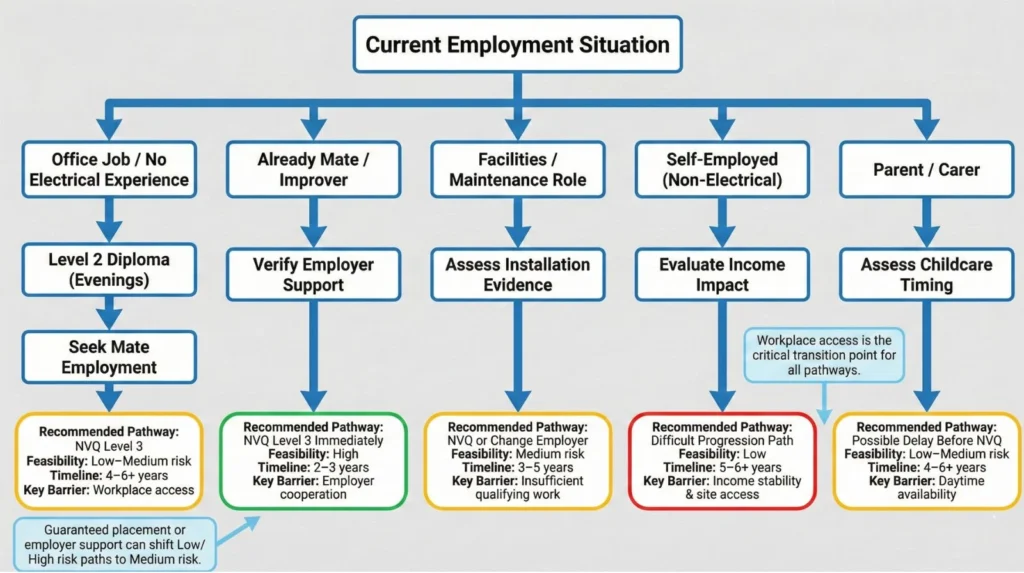
Scenario 1: Office Job, No Site Access, Career Changer
Current situation: Working standard 9-to-5 office job, no construction or electrical experience, interested in complete career change to electrical work.
Best-fit approach:
Step 1 (Months 0-18): Enroll in Level 2 Diploma evening course at local Further Education college (2 evenings weekly). Continue office employment for income stability. Study theory and complete workshop practicals in evenings. Obtain ECS Labourer card using Level 2 enrollment/completion as qualification basis. Complete CSCS Health and Safety test (basic site access credential).
Step 2 (Months 12-18): While completing Level 2, begin applying for electrician’s mate positions. Use Level 2 enrollment/completion to demonstrate electrical interest and basic knowledge. Emphasize reliability, willingness to learn, physical capability. Accept that mate wages (£18,000 to £24,000 typically) represent significant reduction from office salary but provide critical site access.
Step 3 (Months 18-24): If mate employment secured, consider whether to continue Level 3 Diploma in evenings or request employer-supported day release. Some employers may fund Level 3 once you’ve proven reliability as mate. If mate employment not secured by Level 2 completion, continue applying while potentially starting Level 3 evenings (higher risk, see diploma-completion trap section).
Step 4 (Months 24-48): With mate employment providing site access, enroll in NVQ Level 3 through training provider with employer coordination. Gather portfolio evidence from actual work. Complete 18th Edition if not done previously. Study Level 3 theory if needed. Work toward AM2 readiness.
Step 5 (Month 48+): Once NVQ portfolio substantially complete and all theory current, book AM2 assessment (2.5 days, requires annual leave). Pass AM2, obtain ECS Gold Card, progress to qualified electrician wages and responsibilities.
Risk notes: High risk of pathway stalling if mate employment not secured. Office-to-mate wage reduction (£10,000 to £15,000 annually) creates financial stress potentially preventing career change completion. Extended timeline (4+ years) tests commitment. No guarantee of mate employment despite Level 2 completion. Why Elec Training’s guaranteed placement changes this scenario: Active recruitment on your behalf specifically addresses the mate employment barrier preventing progression. 120+ contractor partnerships and 100+ employer calls per learner significantly increase probability of securing site access needed to complete pathway rather than stalling after diploma completion.
Scenario 2: Already Working as Mate or Improver
Current situation: Currently employed as electrician’s mate or improver with contractor, receiving supervision from qualified electrician, exposed to varied electrical installations.
Best-fit approach:
Step 1: Verify employer willingness to support NVQ assessment (assessor site visits, supervisor witness testimonies, portfolio evidence collection). If employer supportive, immediately enroll in NVQ Level 3 with provider coordinating assessor visits to your workplace. If employer unsupportive or uncertain, address concerns or consider changing employers before committing to NVQ enrollment fees.
Step 2: If Level 2/3 diplomas not completed, enroll in evening courses while working. This maintains income while completing knowledge components. If already holding Level 2/3, verify 18th Edition current (within 3 years typically, though no formal expiry, industry standard for currency).
Step 3: Focus portfolio development on current work. Photograph installations, obtain witness testimonies from supervisor, organize evidence systematically. Coordinate quarterly assessor visits with employer scheduling.
Step 4: Complete 18th Edition if not current. Continue gathering diverse portfolio evidence. Some NVQ units require specific installation types (commercial systems, three-phase, testing procedures) that may need intentional exposure request from employer.
Step 5: Once NVQ portfolio substantially complete, book AM2 assessment. Request annual leave 3 to 6 months advance notice to employer. Pass AM2, obtain Gold Card, negotiate qualified electrician wages and responsibilities with current employer or move to higher-paying qualified role elsewhere.
Risk notes: Employer support variability. Small contractors or sole traders may lack capacity for assessor visits or diverse installation types needed for complete NVQ portfolio. Some domestic-only contractors provide insufficient commercial exposure for portfolio breadth. Limited task variety may prolong portfolio completion. However, significantly lower risk than career changer scenario because workplace access already secured. Pathway completion depends on maintaining employment and employer cooperation, not securing new employment from zero experience starting point.
Scenario 3: Working in Facilities Management or Maintenance with Electrical Exposure
Current situation: Employed in facilities management, building maintenance, or similar role involving some electrical work (testing, minor repairs, planned preventative maintenance) but not electrical installations contractor.
Best-fit approach:
Step 1: Assess whether current employer will support NVQ qualification. Facilities and maintenance sectors sometimes support upskilling for staff retention. However, reactive maintenance and testing work may not provide sufficient new installation evidence required for standard NVQ Level 3 (which emphasizes installation competence, not just maintenance).
Step 2: If employer supportive and work includes sufficient installation tasks, pursue NVQ directly. If work primarily testing/maintenance without new installations, consider either: (a) requesting installation project exposure, (b) supplementing with evening volunteer work or side installations under qualified supervision, (c) changing to electrical installations contractor for portfolio breadth.
Step 3: Complete Level 2/3 diplomas and 18th Edition via evening courses if not already done. These credentials plus existing electrical work exposure position you better for potential employer change to installations contractor if needed for NVQ evidence.
Step 4: Pursue NVQ qualification via whichever route provides adequate installation evidence (current employer if supportive and work suitable, or new employer if needed). Complete AM2 when portfolio developed.
Risk notes: Facilities/maintenance sector work often doesn’t provide comprehensive installation evidence required for standard NVQ Level 3. May need employer change mid-qualification. Supervisor qualifications matter (must be qualified electrician for witness testimonies, not just facilities manager). Some learners find facilities work provides testing/inspection evidence well but lacks first-fix and containment installation breadth. Alternative: Consider testing-focused qualifications (2391 Inspection and Testing) as specialization rather than full installation route.
Scenario 4: Self-Employed in Another Trade (Time Constraints, Evidence Access)
Current situation: Working as self-employed plumber, carpenter, builder, or other trade. Variable working hours but income dependent on continuous work. Limited availability for evening classes due to exhausted from physical work or irregular schedules.
Best-fit approach:
Step 1: Realistically assess whether electrical retraining compatible with self-employment demands. Self-employed workers often have less schedule flexibility than assumed because client commitments and income needs prevent regular evening class attendance. Consider whether reducing self-employed hours to part-time creates sufficient income for living costs plus course fees.
Step 2: If proceeding, enroll in Level 2 evening course attempting to maintain self-employed work alongside. This tests commitment and feasibility before larger investment. Consider intensive block courses (if available and affordable) using earned time off from self-employment rather than weekly evening commitment.
Step 3: For NVQ stage, must secure supervised electrical work. Options: (a) partnering with qualified electrician willing to supervise installations while you build portfolio (challenging to arrange, requires relationship and mutual benefit), (b) accepting employment with electrical contractor even if temporary income reduction from self-employed earnings, (c) combining self-employed other-trade work with part-time electrical mate work if contractor accepts arrangement.
Step 4: NVQ evidence must come from supervised electrical installations, not self-employed work in other trade. Cannot substitute carpentry or plumbing work for electrical portfolio requirements even if related (installing back boxes, running cables for own plumbing work, etc.).
Risk notes: Self-employment income dependency often prevents schedule flexibility needed for both evening courses and subsequent mate employment at lower wages. Extended qualification timeline (potentially 5+ years due to interrupted study and delayed workplace access) tests financial viability. Difficulty finding qualified electrician willing to supervise portfolio development without formal employment relationship. Some self-employed tradespeople discover electrical retraining incompatible with self-employment maintenance and abandon pathway or pause indefinitely.
Scenario 5: Parent or Carer with Limited Weekday Availability
Current situation: Primary childcare responsibilities during daytime hours. Available evenings after childcare duties (approximately 7pm onwards) or weekends when partner/family can provide childcare coverage.
Best-fit approach:
Step 1: Level 2 and Level 3 diplomas via evening or weekend courses at local FE college. Verify course timing compatible with childcare arrangements (courses typically 6pm to 9pm, may conflict with young children’s bedtime routines, school-age children potentially more manageable).
Step 2: For workplace access stage (mate employment for NVQ evidence), challenge becomes daytime site work conflicting with childcare responsibilities. Potential solutions: (a) childcare arrangements enabling daytime mate work (expensive, may negate mate wages financially), (b) seeking part-time mate work if available (rare, most contractors need full-time availability), (c) delaying NVQ stage until children school-age enabling daytime work, (d) partner providing childcare during mate employment years accepting reduced household income temporarily.
Step 3: AM2 assessment presents specific challenge: 2.5 consecutive days weekdays requiring childcare coverage. Must plan and budget for childcare costs during assessment period plus travel/accommodation if required.
Risk notes: Childcare costs potentially exceed mate wages in early years, making career change economically unviable until children older. Employers hiring mates expect full-time availability and may not accommodate part-time or school-hours-only requests. Extended qualification timeline (potentially 6+ years if delaying workplace access stage until childcare demands reduce) risks qualification currency and commitment sustainability. Some parents discover electrical retraining practical only when children reach secondary school age (11+) enabling more flexibility.
Funding and Costs for Adult Learners
Understanding financial mechanisms and realistic investment required for part-time electrical training.
Advanced Learner Loans
Eligibility: Adults aged 19+ (no upper age limit) studying approved Level 3, 4, 5, or 6 qualifications. UK resident for 3+ years before course start. No upper income limit (unlike undergraduate student finance). Not means-tested.
What it covers: Tuition fees for approved courses (Level 3 diplomas typically covered). Does NOT cover living costs, travel, accommodation, materials, tools, PPE, exam fees separate from tuition.
How it works: Loan paid directly to training provider covering tuition. Repayment begins after course completion only if earning above income threshold (currently £27,295 annually for Plan 4 loans, as of 2024/25, subject to change). Repayment rate 9% of income above threshold. Written off after 30 years or at age 65 (whichever comes first) if not repaid.
Application: Via GOV.UK Student Finance services. Apply typically 2 to 3 months before course start. Requires course/provider details, personal financial information, proof of UK residency.
Limitations: Only covers approved Level 3+ courses with approved providers. Does NOT cover Level 2 (below threshold). Does NOT cover NVQ assessment fees typically (classified separately from diploma tuition). Does NOT cover 18th Edition, AM2, or other short courses. Cannot use if already holding equivalent level qualification (e.g., cannot use loan for Level 3 electrical diploma if already holding Level 3 qualification in another subject, though some exceptions apply for retraining, verify eligibility).
Free Adult Education and Skills Funding
Eligibility: Varies by English region and individual circumstances. Generally available for adults 19+ earning below specific income thresholds, unemployed, or receiving certain benefits. First full Level 3 qualification may be funded if no prior Level 3 qualifications held (Free Courses for Jobs scheme in England, subject to eligibility and funding availability).
What it covers: Tuition fees for approved Level 2 and potentially first Level 3 qualification if eligible. Restrictions on course types, provider approvals, eligibility verification requirements.
Limitations: Funding availability limited and varies by region/year. Eligibility complex and changes periodically. Many adults ineligible due to prior qualifications (A-Levels, degrees) even if unrelated to electrical work. Not guaranteed even if appears eligible, subject to funding availability and provider capacity.
Employer-Supported Funding
Apprenticeship Levy: Employers paying apprenticeship levy (typically large companies with £3 million+ annual payroll) can use levy funds for apprenticeship training including adult apprenticeships. If securing employer willing to hire you as apprentice (including adult apprentice 19+, even mature career changer 30+, 40+, 50+), employer may fund training through levy. Apprentice wages apply (Apprentice Minimum Wage year 1, National Minimum Wage for age years 2+). Four-year commitment typically.
Direct employer funding: Some employers fund Level 3 diplomas or NVQ assessment for existing staff (particularly mate progressing to improver, or improver completing NVQ). Employer assesses business benefit (retaining trained staff, reducing recruitment needs, developing workforce capability). Not guaranteed, depends on employer size, financial capacity, workforce planning.
Self-Funding Typical Costs
Level 2 Diploma: £1,500 to £2,500 tuition (evening FE college typically lower end, private providers higher).
Level 3 Diploma: £2,000 to £4,000 tuition (FE colleges often £2,000 to £2,500, private providers £3,000 to £4,000+).
18th Edition: £300 to £500 including exam.
NVQ Level 3 assessment: £800 to £1,500 assessor fees, site visits, portfolio support (sometimes employer-funded, otherwise self-funded).
AM2 assessment: £600 to £800 assessment fee.
Additional costs: ECS card applications £35 to £45 per card. CSCS Health and Safety test £21.50 (2024/25). BS 7671 regulations book £90 to £120. Personal toolkit for improver/qualified work £500 to £2,000 depending on quality/comprehensiveness. PPE (hard hat, hi-vis, boots, gloves) £100 to £200 initial investment. Test equipment (multimeters, voltage testers, proving unit) £200 to £500 for basic kit, more for professional grade.
Total self-funded investment estimate: £5,200 to £9,300 for complete beginner to Gold Card (tuition, assessments, cards, books only, excluding tools/PPE/ongoing costs). Plus £800 to £2,700 for tools and PPE. Grand total: £6,000 to £12,000 depending on provider choices, funding access, and equipment quality.
Hidden costs of extended timeline: Opportunity cost of 3 to 5 years at reduced income if changing from office work to mate wages. Cumulative income difference potentially £40,000 to £60,000 over qualification period compared to remaining in previous career at £25,000 to £35,000 annually versus mate wages £18,000 to £24,000 annually. This isn’t argument against retraining, but reality check about total economic investment beyond course fee sticker prices.
For detailed breakdown of qualification requirements and progression, see the full UK electrician qualification pathway including NVQ and AM2 requirements covering complete route from entry through qualified status.
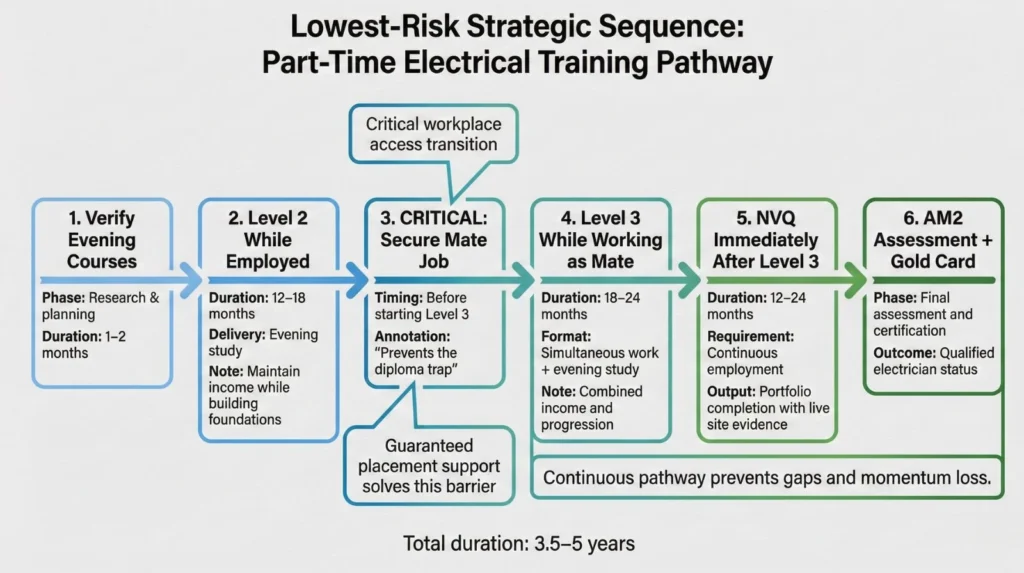
If You Can Only Study Evenings: Lowest-Risk Planning Sequence
Strategic step-by-step approach minimizing qualification pathway failure risk for full-time workers pursuing electrical training part-time.
Step 1: Verify Local Evening Course Availability (Before Any Financial Commitment)
Action: Research Further Education colleges within travel distance offering Level 2 Diploma evening courses specifically. Private providers often market “flexible delivery” but actually offer intensive weekday blocks requiring annual leave (verify exact timetabling before paying).
What to check: Actual class schedule (confirm 2 evenings weekly 6pm-9pm pattern or whatever timing fits your availability). Course start dates and duration. Total cost including all fees (tuition, exam, materials). Whether Advanced Learner Loan accepted for payment. Classroom location and parking/public transport access. Pass rates and reputation (check reviews, ask current/former students if possible).
Why this matters: Evening course availability varies substantially by geographic location. Large cities (London, Birmingham, Manchester, Glasgow) typically offer multiple FE college options. Rural areas or small towns may have zero evening electrical courses locally, requiring relocation consideration or abandoning part-time approach. Discovering this before financial commitment or career change plans prevents wasted investigation.
Step 2: Complete Level 2 Diploma While Maintaining Current Employment
Action: Enroll in Level 2 Diploma evening course. Attend classes consistently (2 evenings weekly typical commitment plus 4 to 6 hours weekly home study). Complete workshop practicals and theory exams over 12 to 18 month duration. Maintain full-time employment for income stability during this foundational stage.
What this achieves: Demonstrates commitment to electrical career path before larger investment. Provides foundational electrical theory and basic practical skills. Qualifies you for ECS Labourer card (basic site access credential). Positions you competitively for mate employment applications versus candidates with zero electrical training. Tests whether electrical work genuinely interests you before committing to full career change and income reduction.
Why this sequence: Completing Level 2 first while employed provides qualification credential to support mate employment applications without requiring career change before proving electrical training viability. If you discover electrical theory uninteresting or practically challenging during Level 2, you can withdraw having invested only £1,500 to £2,500 and several months study, not having abandoned career and committed to multi-year pathway.
Step 3: Secure Mate Employment BEFORE Enrolling in Level 3 (Critical Timing)
Action: Using Level 2 completion credential, apply extensively for electrician’s mate positions. Emphasize reliability, willingness to learn, physical capability, and Level 2 qualification showing electrical commitment. Accept that mate wages (£18,000 to £24,000 typically) represent income reduction from many office or professional roles. Begin mate employment and demonstrate reliability for initial 3 to 6 month probationary period.
Why critical timing: This step prevents diploma-completion trap. Many adults complete Level 2 AND Level 3 diplomas before seeking mate employment, then discover diploma credentials without site experience provide minimal employment advantage. Employers prefer behavioral reliability over theoretical knowledge when hiring mates. Level 2 completion provides sufficient qualification signal. Securing mate employment at Level 2 stage rather than after Level 3 completion prevents qualification pathway stalling and multi-year diploma investment becoming sunk cost if mate employment doesn’t materialize.
What if mate employment doesn’t secure: This reveals workplace access barrier before further financial/time investment in Level 3. Options: (a) Continue applying mate positions over extended period (months), accepting extended timeline, (b) Pursue general construction laborer work to gain site experience first, improving mate employability subsequently, (c) Reconsider electrical career viability given employment barriers, potentially cutting losses at Level 2 stage rather than proceeding to Level 3 and stalling later at higher investment.
Why Elec Training’s approach addresses this barrier: Guaranteed work placement support through 120+ contractor partnerships and in-house recruitment team making 100+ employer contact calls per learner specifically solves the mate employment barrier at this critical transition point. This infrastructure transforms what would be individual job search challenge (often failing, leading to pathway abandonment) into supported placement securing site access needed to progress. Not everyone succeeds finding mate employment independently despite Level 2 credential. Guaranteed placement support significantly increases progression probability.
Step 4: Study Level 3 in Evenings WHILE Working as Mate
Action: Once mate employment secured and initial probation period passed demonstrating reliability, enroll in Level 3 Diploma evening course. Continue mate employment for income and site experience. Study Level 3 theory in evenings over 18 to 24 months. Some employers may support Level 3 tuition costs or provide day-release once you’ve proven commitment and reliability as mate (not guaranteed, employer discretion).
What this achieves: Combines income from mate work with continued theoretical education. Provides site experience simultaneously with Level 3 study, improving practical context for theory learning. Positions you for NVQ enrollment immediately following Level 3 completion since you already have workplace access and employment, not needing to secure these separately.
Why simultaneous rather than sequential: Maintaining mate employment during Level 3 study prevents income gap and maintains site access continuity. If completing Level 3 before seeking mate employment, you face potential prolonged unemployment gap between qualification completion and employment start, creating financial stress and potentially forcing abandonment of electrical pathway to return to previous career for income needs.
Step 5: Enroll in NVQ Level 3 Immediately Upon Level 3 Diploma Completion
Action: Using current mate employment for workplace access, enroll in NVQ Level 3 with training provider coordinating assessor visits to your worksite. Verify employer supportive (allowing assessor site access, providing supervisor witness testimonies, enabling diverse installation exposure for portfolio breadth). Begin portfolio evidence collection from actual mate work. Complete 18th Edition course if not done already (3 to 5 days, can often schedule during annual leave or intensively).
What this achieves: Leverages existing employment for NVQ evidence without requiring job change or employment gap. Progresses toward qualified electrician status with continuous pathway rather than qualification stage gaps creating momentum loss.
Why immediate enrollment matters: Gap between Level 3 diploma completion and NVQ enrollment creates risk of: qualification currency concerns (regulations update, theory retention decreases), employment loss or change interrupting site access, commitment fade over extended timeline, competitive employment market making mate position less secure.
Step 6: Complete AM2 Assessment, Obtain Gold Card, Progress to Qualified Role
Action: Once NVQ portfolio substantially complete (typically 12 to 24 months portfolio development), book AM2 assessment at approved centre. Request annual leave 3 to 6 months advance notice (assessment requires 2.5 consecutive weekdays). Attend assessment, complete practical tasks, pass evaluation. Apply for ECS Gold Card using NVQ Level 3, 18th Edition, and AM2 pass as qualification basis. Negotiate qualified electrician wages with current employer or apply for qualified electrician positions elsewhere at market rates (£25,000 to £35,000 typically, varies by region and sector).
Total realistic timeline: 3.5 to 5 years from complete beginner (starting Level 2 evening course) to qualified electrician (Gold Card obtained). This assumes no significant gaps, consistent employment as mate during Level 3 and NVQ stages, first-time AM2 pass, and continuous evening study commitment throughout.
Common Myths About Part-Time Electrical Training
Evidence-based corrections to frequently marketed or assumed misconceptions.
Myth: “Evening courses make you fully qualified electrician”
Reality: Evening courses deliver knowledge components (Level 2/3 diplomas, 18th Edition) excellently. They do NOT deliver competence qualifications (NVQ Level 3, AM2) which require workplace access during standard working hours. You become qualified electrician through completing BOTH knowledge and competence elements. Evening study handles only the former.
Verdict: False. Evening courses provide partial pathway only, not complete qualification.
Myth: “NVQ can be done without workplace”
Reality: NVQ Level 3 is competence qualification requiring portfolio evidence from actual electrical installations in real working environments under qualified supervision. Regulatory framework mandates workplace-based assessment. Cannot be completed through evening college attendance, simulated environments, private property installations, or distance learning regardless of provider claims. Must be employed as mate/improver or have regular supervised site access.
Verdict: Completely false. No exceptions or workarounds exist for NVQ workplace requirement.
Myth: “You can do NVQ portfolio on your own house or friends’ properties”
Reality: NVQ evidence must be gathered under qualified electrician supervision in commercial or domestic contracting context, not DIY work on personal property. Must include witness testimonies from qualified supervisors, job sheets showing commercial/client work, diverse installation types, assessor observations on live work sites. Own house renovations don’t meet evidence requirements even if electrically complex.
Verdict: False. Personal property work doesn’t substitute for supervised commercial/domestic installation evidence required.
Myth: “18th Edition equals electrician qualification”
Reality: 18th Edition is short course (3 to 5 days) covering BS 7671 Wiring Regulations knowledge. It’s ONE mandatory component of qualification pathway but represents perhaps 5% of total training required. Does not prove installation competence, testing capability, practical skills, or design ability. Often confused with complete qualification due to marketing emphasis and accessibility.
Verdict: Completely false. 18th Edition is single theory certificate, not electrician qualification.
Myth: “Part-time training is always cheaper than apprenticeship”
Reality: Self-funded part-time route costs £6,000 to £12,000 direct expenses (tuition, assessments, tools, cards, materials) plus £40,000 to £60,000 opportunity cost if changing from £25,000 to £35,000 office job to £18,000 to £24,000 mate wages over 3 to 5 years timeline. Total economic impact £46,000 to £72,000. Standard apprenticeship provides wages throughout (£15,000 to £25,000 progressing over 4 years), employer-funded training (zero tuition costs), and completed qualified status. Part-time route potentially more expensive economically despite seeming cheaper on course fee comparison alone.
Verdict: False. Part-time often more expensive when including opportunity cost and extended timeline.
Myth: “You can skip Level 2 and go straight to Level 3 if motivated”
Reality: Level 3 diplomas require prior Level 2 completion or equivalent electrical qualification/significant electrical work experience for entry. Awarding bodies enforce entry requirements. Level 2 covers foundational electrical theory, mathematics, safety knowledge that Level 3 assumes as prerequisite. Attempting Level 3 without foundation creates high failure risk and wasted investment.
Verdict: False. Level 2 prerequisite enforced except for specific experienced worker routes with verified prior experience.
Myth: “Fast-track courses qualify you quickly”
Reality: “Fast-track” typically refers to intensive block delivery of Level 2/3 diplomas (completing theory components in 6 to 12 months versus 24 to 36 months part-time). However, NVQ Level 3 still requires minimum 12 to 24 months portfolio development in workplace regardless of theory completion speed. AM2 requires comprehensive preparation. Cannot compress competence qualification timeline significantly. Total pathway still requires 2 to 4+ years minimum even with intensive theory study.
Verdict: Misleading. “Fast-track” accelerates knowledge components only, not complete pathway to qualified status.
Myth: “Online/distance learning is fastest way to qualify”
Reality: Online/distance learning may deliver some theory content flexibly (readings, videos, assignments). However, practical assessments still require centre attendance, NVQ still requires workplace access during working hours, AM2 still requires centre attendance for 2.5 consecutive days. Online delivery doesn’t remove structural constraints. Often slower than campus-based part-time due to reduced accountability, isolation, and difficulty arranging practical assessments remotely.
Verdict: False. Online delivery doesn’t accelerate pathway and often increases completion time.
Myth: “Employers prefer older career changers”
Reality: Employers value maturity, reliability, and work ethic common in older career changers (30+, 40+, 50+). However, they simultaneously prefer younger apprentices due to lower wage costs (Apprentice Minimum Wage versus National Minimum/Living Wage for adults 19+, 21+). Employer hiring preferences vary by individual circumstances. Age brings advantages (maturity, commitment) and disadvantages (higher wage costs, fewer career years remaining) creating mixed employer responses, not universal preference.
Verdict: Partially false. Adult career changers have both advantages and disadvantages in hiring decisions, not universal preference.
Myth: “Gold Card just requires Level 3 Diploma”
Reality: ECS Gold Card requires: NVQ Level 3 completion, AM2 practical assessment pass, 18th Edition certificate, and often minimum supervised working hours documented (typically 2+ years). Level 3 Diploma alone insufficient. Confusion arises from providers marketing Level 3 diplomas without clearly distinguishing from NVQ Level 3 (different qualifications with same level number).
Verdict: Completely false. Gold Card requires multiple qualifications including workplace-based competence assessments, not just classroom diploma.
Myth: “Private providers offer evening courses widely”
Reality: Private training providers predominantly offer intensive weekday block delivery requiring annual leave from standard employment. True evening delivery (2 nights weekly, 6pm-9pm pattern) primarily available through Further Education colleges, not private providers. Private provider marketing about “flexible delivery” often means intensive blocks with gaps (e.g., 1 week on, 3 weeks off), not genuine evening compatibility with 9-to-5 jobs.
Verdict: Partially false. Evening delivery availability concentrated in FE colleges; private providers rarely offer true evening schedules.
Data Gaps and Realistic Expectations
Acknowledging limitations in available data and setting honest expectations.
What We Cannot Verify from National Data
Part-time completion rates: No comprehensive UK statistics track completion rates specifically for part-time adult learners pursuing electrical qualifications versus apprenticeship completion rates. Apprenticeship data published annually (e.g., 60-70% completion rates for Level 3 apprenticeships generally) but doesn’t disaggregate part-time adult study pathways. Anecdotal evidence suggests part-time adult pathways have lower completion rates than apprenticeships due to workplace access barriers, extended timelines testing commitment, financial pressures from income reduction, but precise figures unavailable.
Time-to-completion variability: Official data doesn’t capture realistic timelines for part-time routes. Course duration statistics show diploma delivery hours but not extended calendar timelines due to evening-only attendance. NVQ completion timelines vary by individual workplace access, evidence gathering pace, assessor scheduling, making national averages meaningless. 3 to 5 years estimate based on pathway component durations, not national tracking data.
Employment outcomes by training route: Labour Force Survey and similar datasets track qualified electrician employment/earnings but don’t distinguish apprenticeship-trained versus adult part-time route qualified electricians. Cannot verify whether part-time route produces equivalent employment outcomes, wage progression, or career longevity compared to apprenticeship route from available national data.
Geographic availability variations: No national database catalogs which FE colleges offer evening electrical courses in which terms. Offering changes annually based on enrollment demand, staffing, facility availability. Geographic lottery exists where major cities provide multiple options but rural areas potentially zero evening courses requiring relocation or abandoning part-time approach entirely.
Employer receptiveness data: No systematic tracking of employer willingness to hire diploma-only candidates versus experienced mates, or employer support rates for NVQ assessment among existing employees. Placement difficulty anecdotal based on training provider experience and learner reports, not quantified national statistics.
What We Can State Confidently
Qualification structure: Knowledge-competence split is regulatory fact documented in qualification specifications (City & Guilds, EAL, other awarding bodies). NVQ workplace requirement mandatory, not provider discretion.
Assessment constraints: AM2 centre-based assessment timing confirmed via NET (National Electrotechnical Training) published procedures. Weekday-only scheduling verified across assessment centre network. 2.5-day consecutive requirement standard.
Funding mechanisms: Advanced Learner Loan eligibility, repayment terms, income thresholds published via GOV.UK Student Finance. Free adult education funding rules published via Skills Funding Agency/relevant education authorities.
Typical costs: Course fee ranges reflect market research across FE colleges and private providers for 2024/25 academic year. Variation by provider type, region, delivery model acknowledged.
Employment requirements: Mate and improver hiring preferences reflect placement manager experience (Joshua), employer feedback to training providers, industry forum discussions, job advertisement analysis. Behavioral reliability prioritization over diploma credentials consistent pattern, though individual employer exceptions exist.
Setting Realistic Expectations
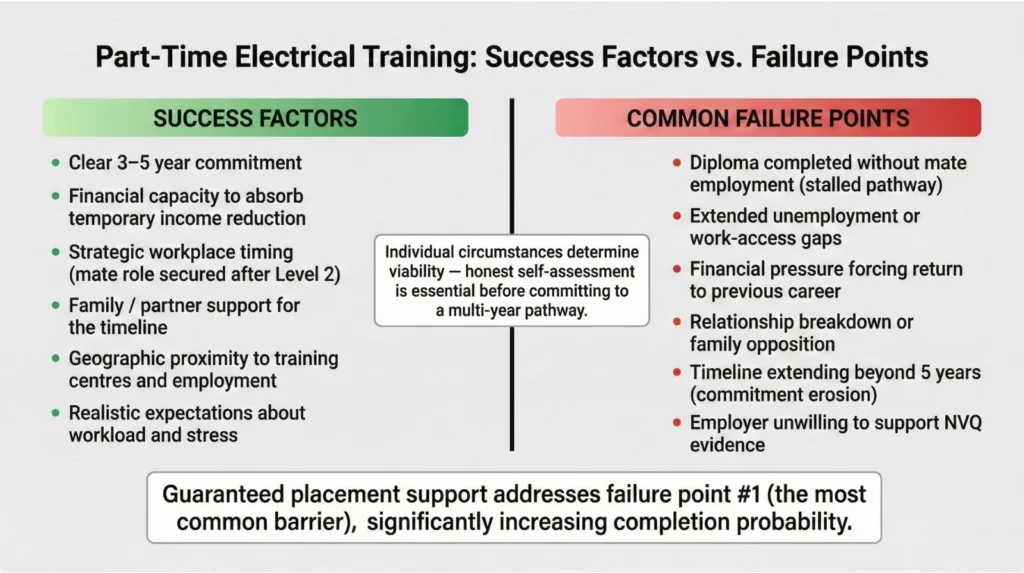
Success factors: Completion probability highest for learners with: Clear commitment to 3 to 5 year timeline and associated financial investment. Realistic understanding of income reduction when transitioning to mate employment. Strategic workplace access timing (securing mate role after Level 2, not after Level 3). Family/partner support for extended training period and temporarily reduced income. Geographic proximity to evening course providers and electrical employment market.
Common failure points: Pathway abandonment typically occurs at: Diploma completion without securing mate employment (qualification stalls, sunk cost). Extended unemployment gap between training stages creating financial pressure forcing return to previous career. Relationship breakdown or family opposition to income reduction and time commitment. Extended timeline (beyond 5 years) eroding commitment and causing qualification currency concerns. Employer unwillingness to support NVQ assessment creating portfolio development barrier.
Not appropriate for everyone: Part-time electrical training viable for some adults, unviable for others. Honest self-assessment of financial capacity, timeline commitment, family circumstances, geographic location, and employment market access essential before committing. No shame in determining apprenticeship route, career change to different trade, or remaining in current career more appropriate for individual circumstances than part-time electrical pathway. Training provider should help assess viability, not oversell accessibility universally.
Part-time electrical training while working full-time is genuinely feasible for knowledge components but structurally constrained for competence qualifications. Success requires strategic planning around the workplace access barrier, not just course enrollment decisions.
Critical understanding: Evening classes can deliver Level 2/3 diplomas and 18th Edition excellently. They cannot remove NVQ workplace requirement or AM2 daytime assessment constraints. The pathway completion depends on securing electrical employment (mate/improver role) at strategic timing, typically after Level 2 but before Level 3 completion, not after finishing all theory.
Why timing matters: Adults completing diplomas before securing workplace access face the diploma-completion trap where significant investment yields qualification certificates but no viable progression route to NVQ and AM2 stages. Employers hiring mates prioritize behavioral reliability and site experience over diploma credentials, making diploma-only candidates less competitive than candidates with construction labor background despite electrical knowledge gap.
Where Elec Training differs: Guaranteed work placement support through 120+ contractor partnerships and in-house recruitment team making 100+ employer contact calls per learner specifically addresses the workplace access barrier that typically stalls part-time career changers. This infrastructure transforms what would be individual job search challenge (often failing) into supported placement securing the site access needed for NVQ progression.
Not just offering evening courses. Many providers deliver evening diplomas. The differentiator is solving the employment barrier preventing NVQ completion after diploma investment. Without workplace access support, evening diploma route carries high pathway abandonment risk. With guaranteed placement infrastructure, evening diploma route becomes viable complete pathway rather than dead-end qualification collection.
Call 0330 822 5337 to discuss whether part-time electrical training fits your specific circumstances and timeline. We’ll provide honest assessment of: feasibility for your geographic location (evening course availability, electrical employment market), financial reality including total investment and opportunity cost over multi-year timeline, workplace access strategy and how guaranteed placement support applies to your situation, realistic timeline expectations from starting point to qualified status, alternative pathways if part-time route unviable (apprenticeship, intensive full-time, different electrical specialization). No overselling part-time accessibility to everyone. No dismissing genuine barriers you’ll face. Just evidence-based guidance helping you determine whether committing to 3 to 5 year part-time pathway makes sense for your individual circumstances, or whether alternative approach better matches your situation.
References
- City & Guilds – 2365 Level 2 Diploma in Electrical Installations – https://www.cityandguilds.com/
- City & Guilds – 2365 Level 3 Diploma in Electrical Installations – https://www.cityandguilds.com/
- City & Guilds – 2357 NVQ Level 3 Electrotechnical Technology – https://www.cityandguilds.com/
- NET (National Electrotechnical Training) – AM2/AM2E Assessment – https://www.netservices.org.uk/
- IET (Institution of Engineering and Technology) – 18th Edition BS 7671:2018+A2:2022 – https://www.theiet.org/
- GOV.UK – Advanced Learner Loans – https://www.gov.uk/advanced-learner-loan
- GOV.UK – Advanced Learner Loan Eligibility – https://www.gov.uk/advanced-learner-loan/eligibility
- National Careers Service – Electrician Job Profile – https://nationalcareers.service.gov.uk/job-profiles/electrician
- JIB (Joint Industry Board) – Grading Definitions – https://www.jib.org.uk/
- ECS (Electrotechnical Certification Scheme) – Card Types and Requirements – https://www.ecscard.org.uk/
- CITB (Construction Industry Training Board) – Construction Skills and Training – https://www.citb.co.uk/
- ECA (Electrical Contractors’ Association) – Training and Skills – https://www.eca.co.uk/
- Reddit r/ukelectricians – Community Discussions on Part-Time Training – https://www.reddit.com/r/ukelectricians/
- Electricians Forums – Part-Time Training Discussions – https://www.electriciansforums.net/
- Elec Training – How to Become an Electrician in the UK – https://elec.training/news/how-to-become-an-electrician/
- Elec Training – Courses Overview – https://elec.training/courses/
Note on Accuracy and Updates
Last reviewed: 31 December 2025. This page is maintained; we correct errors and refresh sources as qualification specifications, funding mechanisms, assessment procedures, and training provider delivery models change. Knowledge qualification delivery flexibility (evening/part-time) reflects current FE college and private provider offerings but varies by geographic location and changes annually based on enrollment demand and provider capacity. Competence qualification constraints (NVQ workplace requirement, AM2 weekday scheduling) reflect regulatory frameworks and assessment body procedures unlikely to change fundamentally but subject to procedural updates. Cost ranges represent 2024/25 academic year market research across FE colleges and private providers; fees increase periodically. Advanced Learner Loan income threshold (£27,295 for Plan 4 loans) subject to annual government review. Mate/improver wage ranges reflect 2024/25 market conditions varying substantially by region, sector, and employer. Timeline estimates (3 to 5 years beginner to qualified) assume continuous progression without significant gaps; individual timelines vary widely by circumstances, commitment, workplace access success, and assessment scheduling. Diploma-completion trap pattern based on training provider placement manager experience and learner outcome tracking, not published national statistics. Guaranteed placement support infrastructure (120+ contractor partnerships, 100+ employer calls per learner) reflects Elec Training’s current operational model subject to evolution and expansion. Next review scheduled following significant changes to: qualification specifications affecting delivery flexibility, funding mechanism reforms, assessment procedure updates, or substantial shifts in adult learner completion rate data availability.
