
ECS vs CSCS Card: What’s the Difference and Which One Do Electricians Need?

- Technical review: Thomas Jevons (Head of Training, 20+ years)
- Employability review: Joshua Jarvis (Placement Manager)
- Editorial review: Jessica Gilbert (Marketing Editorial Team)
- Last reviewed:
- Changes: Updated ECS card requirements following JIB grading framework changes and Build UK partner scheme recognition guidance
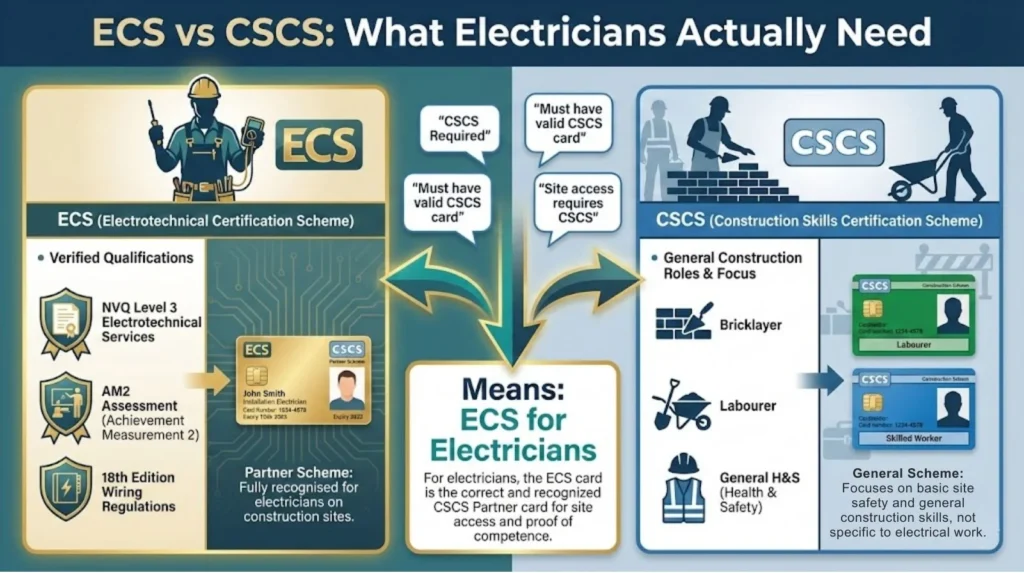
UK electricians encounter persistent confusion distinguishing between ECS (Electrotechnical Certification Scheme) and CSCS (Construction Skills Certification Scheme) cards, often resulting from contradictory information in job advertisements, inconsistent site access policies, and recruitment agents using terminology interchangeably despite fundamental differences between schemes.
The confusion creates practical consequences beyond mere administrative inconvenience. Electricians invest £36 for three-year card validity expecting site access, only to face challenges from security staff unfamiliar with partner scheme arrangements. Apprentices and electrical labourers purchase wrong cards thinking CSCS Green Labourer suffices for electrical work, then discover contractors require ECS-specific cards demonstrating electrical pathway progression. Qualified electricians read job advertisements stating “CSCS card required” and worry their ECS Gold Card won’t be accepted, potentially missing employment opportunities due to misunderstanding recruiter shorthand.
The financial waste compounds when learners purchase both cards believing redundancy improves employability, spending approximately £72 every three years maintaining dual certification that provides no practical advantage for electrical careers. Training providers occasionally compound confusion by inadequately explaining scheme differences, leaving learners to discover incompatibility issues only when attempting site access or job applications.
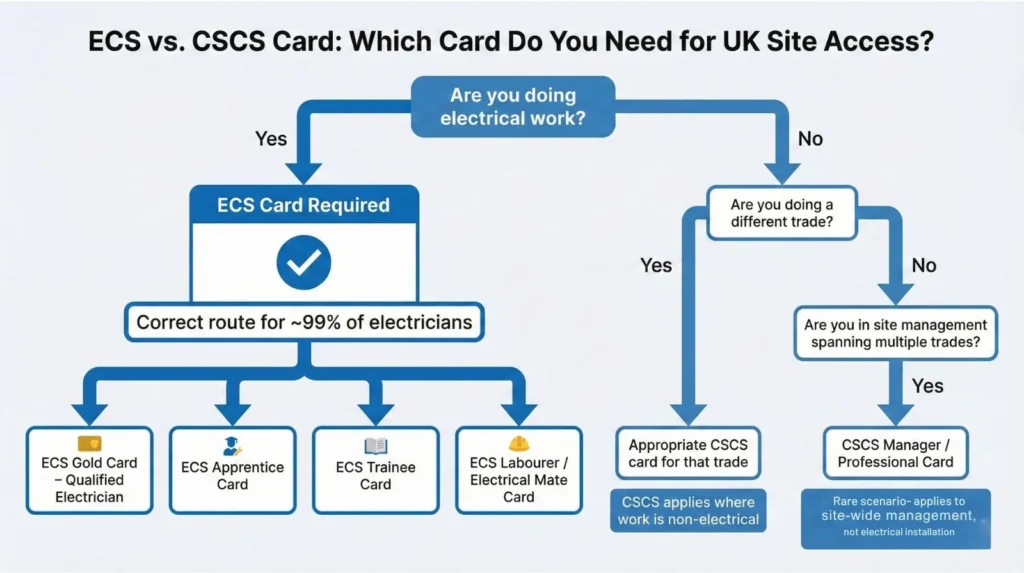
The fundamental distinction is straightforward despite widespread confusion: CSCS is the general construction industry skills card scheme covering trades like bricklayers, carpenters, and labourers. ECS is the specialist partner scheme specifically for electrotechnical workers including electricians, electrical apprentices, electrical labourers, and related electrical specialists. Electricians need ECS cards proving electrical competence and qualification verification, not CSCS cards validating only general construction health and safety knowledge.
This article explains the structural differences between ECS and CSCS, clarifies which card electricians actually need for various roles, translates confusing job advertisement language, addresses site access reality versus official policy, and prevents expensive mistakes purchasing wrong cards or redundant dual certification.
What ECS and CSCS Actually Are (And Why They're Different)
Understanding scheme purposes and governance structures clarifies why electricians need ECS rather than CSCS despite job advertisements frequently conflating them.
CSCS: Construction Skills Certification Scheme
CSCS is the umbrella skills certification scheme for UK construction industry, administered by CSCS Ltd (not-for-profit organization owned by construction industry bodies including Construction Industry Training Board). Established to improve construction site standards and safety, CSCS provides portable evidence that workers hold appropriate training and qualifications for their construction roles.
CSCS scope covers: Bricklayers, carpenters, scaffolders, plant operators, general construction labourers, site managers, and numerous other construction occupations excluding specialist electrotechnical roles.
CSCS assessment requirements: CITB Health, Safety and Environment Test covering general construction hazards (working at height, manual handling, site welfare, PPE requirements), plus trade-specific qualifications appropriate to card level (NVQs, SVQs, or equivalent credentials for skilled worker and supervisor cards).
CSCS card colours indicate progression:
Green: Construction Site Operative (labourer level, basic health and safety only)
Blue: Skilled Worker (NVQ Level 2 equivalent in construction trade)
Gold: Advanced Craft/Supervisor (NVQ Level 3 equivalent plus management or supervisory qualifications)
Black: Manager cards for various management levels
White: Related occupations and professionals (architects, surveyors, academically qualified roles)
What CSCS does NOT cover: Electrical installation competence, electrical testing and inspection, BS 7671 wiring regulations compliance, electrical fault diagnosis, or any other electrotechnical skills. CSCS explicitly excludes occupations covered by partner card schemes, of which ECS is the designated scheme for electrotechnical workers.
ECS: Electrotechnical Certification Scheme
ECS is the specialist skills certification scheme for UK electrotechnical industry, administered by Joint Industry Board (JIB) for England, Wales, and Northern Ireland, and by SELECT in Scotland. Designed specifically to validate electrical qualifications, competence, and health and safety knowledge for electrical workers at all levels from apprentices to experienced electricians.
ECS scope covers: Installation electricians, maintenance electricians, domestic installers, electrical apprentices, electrical labourers/mates, fire alarm specialists, security systems technicians, and other electrotechnical roles across commercial, industrial, and domestic sectors.
ECS assessment requirements: Electrical qualifications mapped to National Occupational Standards for electrotechnical industry (NVQ Level 3 for qualified electricians, plus AM2 or AM2E practical competence assessment, plus 18th Edition BS 7671 current wiring regulations certification), combined with ECS Health, Safety and Environmental Assessment specifically addressing electrical hazards (isolation procedures, voltage testing, protection against electric shock, emergency electrical incident response).
ECS card colours indicate qualification level and work scope:
Gold: Fully qualified electricians (Installation Electrician, Maintenance Electrician, Domestic Installer, Approved Electrician) – NVQ Level 3 plus AM2
Gold with brown stripe: Experienced Worker route during competence assessment period
White: Related electrical disciplines and academically qualified roles
Green: ECS Trainee (learners in structured training programs)
Blue: ECS Apprentice (formal apprenticeship enrollment)
Yellow/Amber: ECS Electrical Labourer (mates assisting qualified electricians)
Critical distinction: ECS card eligibility requires verified electrical qualifications checked directly by JIB with awarding bodies. You cannot obtain ECS Gold Card without proving NVQ Level 3 completion, AM2 assessment pass, and current 18th Edition certification. CSCS Green Labourer cards require only health and safety test without any trade qualification verification.
The Partner Scheme Relationship
ECS is designated CSCS “Partner Card Scheme” for electrotechnical occupations. This means:
ECS cards carry CSCS logo (typically top right corner) confirming official affiliation
ECS cards are recognized as CSCS equivalents for site access purposes
CSCS does not issue cards for occupations covered by ECS
Sites requiring “CSCS cards” should accept ECS cards from electrical workers due to partner scheme status
However, this official partnership doesn’t prevent practical confusion at site level, leading to occasional challenges despite ECS being entirely appropriate for electricians.
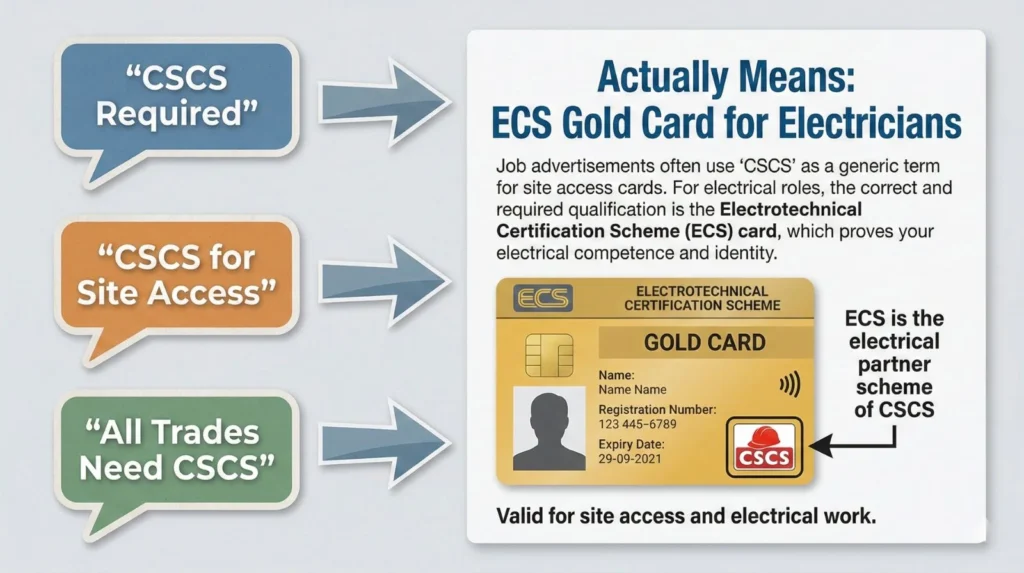
Why Job Advertisements Say "CSCS Required" When Electricians Actually Need ECS
The single most confusing aspect of the ECS vs CSCS distinction is recruitment language creating impression electricians must hold CSCS cards when the opposite is true.
Pattern 1: Generic “CSCS Card Required” in Electrician Job Ads
Example headline: “Electrician Required – CSCS Card Essential – London Construction Sites”
What it literally states: CSCS card is mandatory requirement.
What recruiters actually mean: “Valid construction skills card appropriate for electrical work” – which is ECS.
Why the confusion occurs: Recruitment agents receive instructions from main contractors stating “all workers must have CSCS cards” referring to general site policy that workers must hold recognized skills cards. Agents input “CSCS required” into job advertisement templates without recognizing that for electricians, ECS is the specialist equivalent satisfying that requirement.
The keyword problem: Recruitment software and job board filters often use “CSCS” as blanket search term for construction roles, making it technically difficult for agents to exclude electrician positions from automated CSCS requirement language.
How electricians should interpret: If job advertisement is specifically for electrical role (installation, maintenance, testing), ECS Gold Card is appropriate despite headline mentioning CSCS. If uncertain, contact recruiter to confirm – legitimate electrical contractors understand ECS is correct card.
Pattern 2: Mixed-Discipline Site Requirements
Example specification: “Large commercial project requires all trades – electricians, plumbers, carpenters. CSCS cards mandatory for site access.”
What it literally states: Everyone needs CSCS.
What employers actually enforce: Specialist trades should hold their appropriate partner scheme cards (ECS for electricians, JIB-PMES for plumbers, etc.) whilst general trades hold CSCS.
Why the confusion occurs: Principal contractors write blanket site policies using “CSCS” as umbrella term encompassing partner schemes, but documentation doesn’t always explicitly state “CSCS or approved equivalent.”
How electricians should interpret: ECS satisfies this requirement due to partner scheme status. If site documentation seems unclear, request clarification from main contractor rather than purchasing inappropriate CSCS card.
Pattern 3: Incorrect Skill Requirements
Example text: “Site electrician needed. Must hold CSCS Green Labourer card for site access.”
What it literally states: Green CSCS Labourer card is acceptable.
What this actually indicates: Recruiter or employer fundamentally misunderstands electrical industry requirements, likely confusing electrical labourer role with general construction labourer.
The warning sign: Any employer specifying CSCS Green for electrical work demonstrates ignorance of electrical competence requirements. CSCS Green proves only basic health and safety without any trade qualification. For electrical assistant/labourer roles, ECS Electrical Labourer card is appropriate requirement. For qualified electrical work, ECS Gold is mandatory.
How electricians should interpret: Contact employer to clarify whether they actually mean ECS Electrical Labourer or if they’re unfamiliar with electrical card requirements. If they insist on CSCS Green for electrical work, this raises red flags about their understanding of electrical standards and may not be suitable employer.
Pattern 4: Agency Misunderstanding
Example conversation: Agency: “I see you have ECS Gold, but the site requires CSCS. Can you get CSCS Blue or Gold instead?”
What agent is suggesting: Obtaining CSCS card to replace ECS.
What this actually demonstrates: Agency recruiter doesn’t understand ECS is specialist card for electrical work, not interchangeable alternative to CSCS.
The correction needed: Explain that ECS is CSCS partner scheme specifically for electricians, carries CSCS logo, and is recognized as equivalent. If site genuinely won’t accept ECS despite partner scheme status, that’s unusual site policy worth questioning with main contractor directly.
The Translation Rule
When reading job advertisements for electrical roles:
“CSCS required” = Actually means valid electrical skills card (ECS)
“CSCS or equivalent” = Explicitly includes ECS
“All trades must have CSCS” = Specialist trades use partner schemes (ECS for electrical)
“CSCS card for site access” = ECS satisfies this for electrical workers
Only if advertisement specifically states “CSCS, not ECS” or “No partner scheme cards accepted” should electricians consider this unusual requirement worth questioning with employer.
Which ECS Card Electricians Need for Different Roles
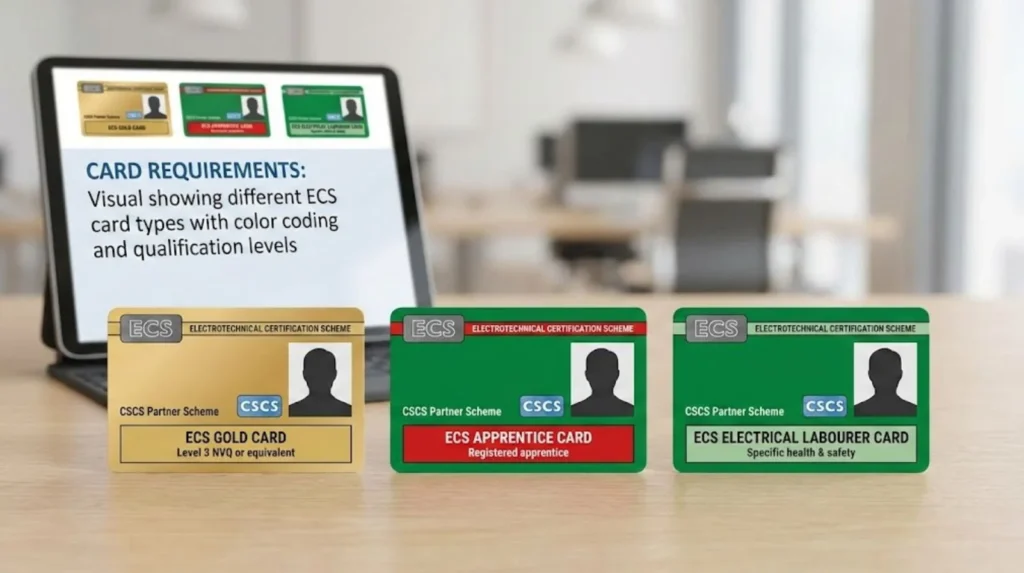
ECS card requirements vary by qualification level and work scope, with distinct cards for each electrical career stage.
ECS Gold Card: Installation Electrician
Who needs it: Fully qualified electricians working unsupervised on electrical installations in commercial, industrial, or domestic settings.
Qualification requirements:
NVQ Level 3 Diploma in Installing Electrotechnical Systems and Equipment (City & Guilds 2357, EAL equivalent, or apprenticeship qualification like 5357)
AM2 (Assessment of Occupational Competence) or AM2E (Experienced Worker version) practical examination pass
18th Edition BS 7671:2018+A2:2022 current wiring regulations certification
ECS Health, Safety and Environmental Assessment pass
Work scope enabled: Design, installation, testing, certification, and fault-finding on electrical installations. Can work unsupervised as competent person. Eligible for Competent Person Scheme registration (Part P domestic work, commercial electrical contractor schemes).
Card validity: 3 years, renewable with updated health and safety assessment and continued professional development evidence.
Cost: Approximately £36 for three-year validity (JIB members may receive discounts).
Why this card specifically: Proves to employers, site managers, and regulatory inspectors that you hold verified NVQ Level 3 competence, have passed independent practical assessment (AM2), and maintain current regulations knowledge. Cannot be obtained without actual qualification verification checked by JIB with awarding bodies.
Thomas Jevons, Head of Training:
"The ECS card colour system directly maps to qualification levels and work scope. ECS Gold Card for Installation Electricians proves you hold NVQ Level 3, have completed AM2 practical assessment, and can work unsupervised on electrical installations. ECS Apprentice or Trainee cards are for learners progressing toward full qualifications with strictly limited lifespans tied to training completion timelines. ECS Electrical Labourer card is for mates assisting qualified electricians but not performing electrical work themselves. This hierarchy is qualification-based—you can't get ECS Gold Card without proving competence through formal assessment. That's fundamentally different from CSCS where Green Labourer cards require only health and safety test without trade-specific qualification verification."
Thomas Jevons, Head of Training
ECS Gold Card: Approved Electrician
Who needs it: Experienced electricians with additional qualifications beyond basic Installation Electrician status, often including inspection and testing credentials and substantial time served.
Additional requirements beyond Installation Electrician:
Inspection and Testing qualification (City & Guilds 2391 or EAL equivalent)
Typically 5+ years post-qualification experience
May include additional specialist qualifications (solar PV, EV charging, etc.)
Work scope enabled: Everything Installation Electrician can do, plus recognized competence for inspection, testing, and condition reporting. Often required for site supervisor or lead electrician roles.
Distinction from standard Gold: Some JIB grading structures distinguish Approved Electrician as higher grade affecting pay rates, though card appearance may be identical to standard Installation Electrician Gold Card.
ECS Apprentice Card (Blue)
Who needs it: Electrical apprentices enrolled in formal apprenticeship programs (typically 3-4 years duration) combining employment, workplace training, and qualification assessment toward NVQ Level 3.
Requirements:
Enrollment in recognized electrical apprenticeship (employer-sponsored)
Registration with JIB as apprentice
ECS Health, Safety and Environmental Assessment pass (often arranged through apprenticeship provider)
Work scope enabled: Supervised electrical work as part of structured training program. Cannot work unsupervised. Must work under direction of qualified electrician.
Card validity: Limited to apprenticeship duration (typically 3-4 years) with expectation of progressing to ECS Gold upon qualification completion.
Critical limitation: Card expires when apprenticeship completes or employment ends. Must provide evidence of qualification completion for Gold Card upgrade or demonstrate continued apprenticeship enrollment for renewal.
ECS Trainee Card (Green)
Who needs it: Adult learners or young people in structured electrical training programs (not formal apprenticeships) working toward electrical qualifications.
Requirements:
Enrollment in recognized training program leading to electrical qualifications
Evidence of progression toward NVQ Level 3
ECS Health, Safety and Environmental Assessment pass
Work scope enabled: Limited supervised electrical work as part of training. More restricted than Apprentice card. Primarily for accessing training facilities and placements supporting qualification completion.
Card validity: Time-limited to training program duration with renewal requiring evidence of continued progress or upgrade to Gold upon qualification.
Distinction from Apprentice card: Trainee status typically applies to adult learners in classroom-heavy programs with placement components, whilst Apprentice cards are for employment-based training with day-release education.
ECS Electrical Labourer Card (Yellow/Amber)
Who needs it: Mates and helpers assisting qualified electricians with physical tasks, cable pulling, containment installation, and general support without performing actual electrical connections or testing.
Requirements:
ECS Health, Safety and Environmental Assessment pass
Employment or intent to work in electrical support role
No electrical qualifications required (this is helper/assistant role)
Work scope enabled: Assistance with electrical projects under direct supervision of qualified electrician. Cannot terminate conductors, test circuits, or perform work requiring electrical competence. Typically involves cable preparation, equipment movement, basic containment installation, site preparation.
Why this specific card matters: Distinguishes electrical support workers from general construction labourers (CSCS Green), signaling to site managers and contractors that individual is specifically supporting electrical work and is supervised appropriately.
Joshua Jarvis, Placement Manager:
"The distinction between CSCS Green Labourer card and ECS Electrical Labourer card matters significantly for mates and helpers on electrical jobs. CSCS Green Labourer proves basic construction health and safety but doesn't indicate any electrical knowledge or that you're working under supervision of qualified electrician. ECS Electrical Labourer specifically identifies you as supporting electrical work, which tells site managers and inspectors you're appropriately supervised and working within electrical scope. Electrical contractors strongly prefer hiring mates with ECS Electrical Labourer cards because it demonstrates understanding you're in electrical pathway rather than general construction labourer who might be assigned to any trade."
Joshua Jarvis, Placement Manager
Cards Electricians Should Avoid
CSCS Green Labourer: Not appropriate for electrical assistants/mates. Use ECS Electrical Labourer instead.
CSCS Blue Skilled Worker: Validates non-electrical construction trades. Does not prove electrical competence.
CSCS Gold Advanced Craft: For supervisors in non-electrical trades. Does not validate electrical qualifications despite “Gold” designation.
The qualification verification distinction is critical. ECS cards require JIB to verify your actual electrical qualifications with awarding bodies. CSCS cards (except specialist levels) require health and safety test only without checking trade-specific qualifications with awarding bodies. This is why electricians need ECS – the qualification verification proves genuine competence rather than just test-passing.
| Role | Correct Card | Qualification Requirements | Work Scope | Wrong Card to Avoid |
| Fully Qualified Electrician | ECS Gold (Installation Electrician) | NVQ Level 3 + AM2 + 18th Edition | Unsupervised electrical work | CSCS Blue or Gold (no electrical validation) |
| Experienced/Approved Electrician | ECS Gold (Approved Status) | Above plus 2391 + time served | Inspection/testing/supervision | CSCS Gold (validates supervision of non-electrical trades only) |
| Apprentice Electrician | ECS Apprentice (Blue) | Apprenticeship enrollment | Supervised training work | CSCS Trainee or Green (no electrical progression tracking) |
| Adult Learner in Training | ECS Trainee (Green) | Training program enrollment | Limited supervised placements | CSCS Green (suggests general labouring not electrical training) |
| Electrical Mate/Labourer | ECS Electrical Labourer (Yellow/Amber) | Health and safety only | Assisting under supervision | CSCS Green (doesn’t identify electrical supervision requirements) |
Site Access Reality: Official Policy vs Practical Experience
Understanding gap between official partner scheme recognition and practical site access experiences helps electricians prepare for potential challenges.
Official Policy: ECS as Recognized Equivalent
Build UK—consortium representing UK’s largest construction contractors including Balfour Beatty, BAM, Kier, Laing O’Rourke, and other Tier 1 companies—publishes guidance explicitly stating cards from CSCS partner schemes satisfy their requirements. ECS is designated partner scheme for electrotechnical occupations.
Construction (Design and Management) Regulations 2015 require principal contractors to ensure workers possess “skills, knowledge, and experience” appropriate for their work. ECS cards demonstrating electrical qualification verification and electrical-specific health and safety assessment satisfy this legal requirement for electrical workers.
CSCS official documentation confirms partner scheme cards are recognized equivalents, with ECS specifically listed as the scheme for electrotechnical industry. The CSCS logo appearing on ECS cards visually confirms this partnership status.
Practical Reality: Occasional Site Challenges
Despite official recognition, some electricians experience site access challenges:
Challenge 1: Security Staff Unfamiliarity Security personnel or site administrators unfamiliar with partner scheme arrangements may initially challenge ECS cardholders expecting to see “CSCS” prominently displayed as primary scheme name. ECS cards display “ECS” prominently with CSCS logo as secondary element, which can create momentary confusion.
Resolution: Request to speak with site manager, electrical supervisor, or HSE coordinator who will understand ECS legitimacy. Most challenges resolve within minutes once someone with construction industry knowledge reviews situation.
Challenge 2: Blanket “CSCS Only” Site Policies Some principal contractors implement documented policies stating “CSCS cards required for all site personnel” without explicitly mentioning partner scheme acceptance in writing.
Resolution: Reference Build UK guidance and Construction (Design and Management) Regulations proving ECS satisfies competence requirements for electrical workers. Main contractor HSE departments typically confirm ECS acceptance when questioned formally.
Challenge 3: Subcontractor Misunderstanding Occasional situations where subcontractor site supervisors (themselves holding CSCS cards for non-electrical trades) don’t recognize ECS validity and insist electricians need CSCS instead.
Resolution: Educate subcontractor using JIB documentation proving ECS is qualification-verified scheme specifically for electricians. If resistance continues, escalate to principal contractor for clarification.
Challenge 4: Administrative Database Issues Some site induction software systems have “CSCS card number” as mandatory field without accommodating ECS card numbers using different format.
Resolution: Site administrators typically create workaround entering ECS number in CSCS field with note explaining partner scheme status. Technical problem, not rejection of ECS validity.
What Electricians Should Carry for Site Access
To minimize challenges and expedite site access verification:
Valid ECS card (obviously)
JIB membership card or documentation if JIB member
Printed ECS partner scheme confirmation from ecscard.org.uk
Photo of CSCS logo on ECS card (zoomed in showing affiliation)
Build UK guidance stating partner schemes accepted (optional but helpful)
Most electricians never encounter challenges, but having documentation ready prevents delays when unfamiliar site staff question ECS validity.
The “Should I Get CSCS Too?” Question
Learners occasionally ask whether obtaining CSCS card alongside ECS card eliminates site access hassles. The answer is almost always no for several reasons:
Cost redundancy: ECS costs approximately £36 for three years, CSCS costs similar amount. Maintaining both means double renewal costs (approximately £24 per year combined) with no practical benefit.
Test redundancy: ECS requires ECS Health, Safety and Environmental Assessment. CSCS requires separate CITB HS&E Test. Maintaining both means re-testing twice every three years on different examination content covering overlapping material.
Qualification impossibility: To obtain CSCS Blue (Skilled Worker) or Gold, you’d need qualifications in non-electrical construction trade—defeating the purpose of electrical qualification investment. CSCS Green Labourer requires only health and safety test but signals you’re unskilled labourer, which contradicts your actual electrical qualification status.
Problem doesn’t solve: Sites that don’t understand ECS validity likely won’t improve acceptance just because you hold CSCS. The issue is their lack of knowledge about partner schemes, not your card selection. Education fixes this, not redundant certification.
Exception scenario: If you genuinely work mixed roles—qualified electrician who also performs substantial carpentry, brickwork, or other non-electrical trades—both cards might apply. However, this is extremely rare situation not applicable to typical electrical career paths.
Understanding complete electrical training pathways includes recognizing ECS card as essential component for qualified electrician status, not optional alternative to CSCS but rather specialist requirement specifically for electrical competence verification.
The Health and Safety Assessment Difference
ECS and CSCS require different health and safety examinations reflecting the distinct hazards in electrical work versus general construction work.
CSCS: CITB Health, Safety and Environment Test
The CITB (Construction Industry Training Board) HS&E Test covers general construction site hazards encountered across multiple trades:
Working at height (scaffolding, ladders, mobile platforms)
Manual handling and lifting techniques
Personal protective equipment selection and use
Site welfare facilities and requirements
Hazardous substances (COSHH)
Fire safety and emergency procedures
Noise and vibration control
General site rules and induction requirements
Format: 50 multiple-choice questions, 45-minute duration, pass mark 45/50 (90%)
Validity: Typically 3-5 years depending on card type
Electrical coverage: Minimal. Some questions address basic awareness of electrical hazards but do not assess electrical-specific safety procedures in detail.
ECS: Health, Safety and Environmental Assessment
The ECS assessment specifically addresses electrical hazards and safe electrical working practices essential for electrotechnical workers:
Safe isolation procedures (prove dead before work)
Lock-off and tag-out systems preventing re-energization
Voltage testing and verification methods
Protection against electric shock (RCDs, earthing, bonding)
Arc flash hazards and PPE requirements
Emergency response to electrical incidents
Electrical fire risks and suppression methods
BS 7671 safety requirements integration
Test equipment selection and calibration
Working near live conductors (when unavoidable)
Format: Varies by assessment route, typically multiple-choice with scenario-based questions
Validity: 3 years renewable
Why the difference matters: Electrical work presents unique hazards not comprehensively covered in general construction health and safety. Electric shock can be fatal from voltages well below levels that seem “dangerous” to non-electrical workers. Arc flash incidents cause severe burns. Incorrect isolation procedures lead to electrocution. The ECS assessment ensures electrical workers understand these specific risks and appropriate control measures rather than relying on general construction safety awareness.
This specialized assessment requirement is precisely why electricians need ECS cards rather than CSCS. The competence and safety verification are tailored to electrical work’s specific requirements.
When Might Electricians Encounter CSCS Requirements (Rare Scenarios)
While electricians almost always need only ECS cards, exceptional circumstances exist where CSCS might be relevant.
Scenario 1: Career Change From Electrical to Non-Electrical Trade
If qualified electrician decides to retrain into completely different construction trade (carpentry, bricklaying, plumbing), eventual CSCS card for new trade would be appropriate. However, during this transition, ECS card remains valid for any electrical work performed whilst learning new trade.
Scenario 2: Site Management Roles Spanning Multiple Trades
Electricians progressing into site management, project management, or HSE coordination roles overseeing multiple trades (not just electrical) might obtain CSCS Black Manager card alongside ECS qualifications. This signals management authority across all site disciplines rather than electrical-specific supervision only.
Scenario 3: Unusually Strict Principal Contractor Policies
Extremely rare situations where principal contractors mandate CSCS for absolutely all site personnel without exception, even for partner scheme trades. This contradicts Build UK guidance and Construction (Design and Management) Regulations but individual contractors have autonomy setting site rules.
Response: Rather than purchasing CSCS redundantly, challenge the policy explaining ECS is designated partner scheme. If contractor refuses accommodation despite official recognition, assess whether working for contractor with such policies aligns with career goals.
Scenario 4: International Work in Countries Not Recognizing ECS
Electricians pursuing construction work in countries without ECS equivalence might encounter sites requiring CSCS as proxy for “UK construction competence.” However, electrical work internationally typically requires country-specific electrical licensing rather than UK skills cards.
The Overwhelming Rule
These scenarios are exceptions proving the rule: electricians working in UK electrical roles need ECS cards, not CSCS. Fewer than 1% of electrical careers encounter situations where CSCS becomes relevant, and even then, ECS remains the primary essential card.
Applying for ECS Cards: Requirements and Process
Understanding application requirements prevents delays and ensures correct card issuance.
ECS Gold Card Application (Installation Electrician)
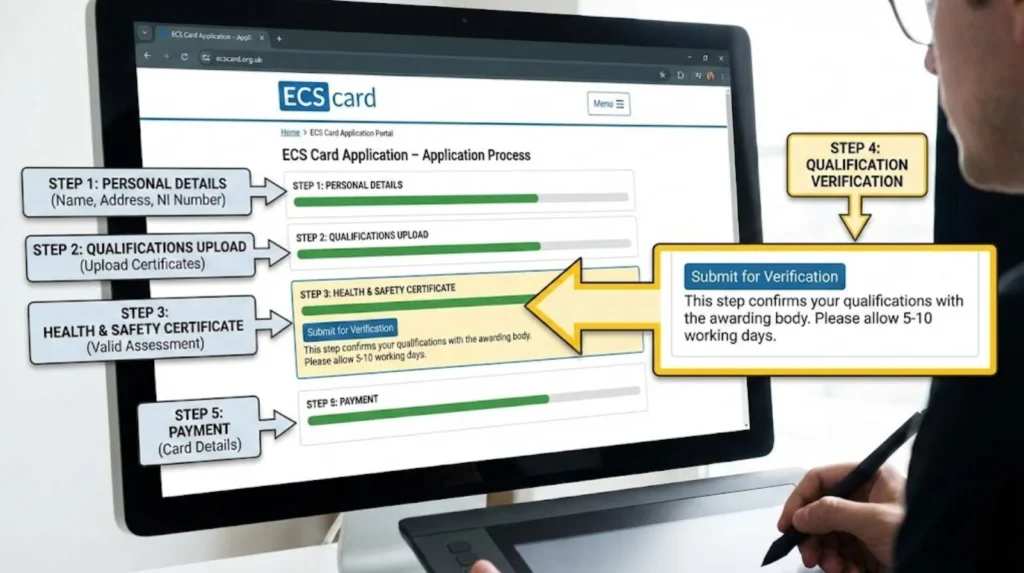
Step 1: Verify Qualification Eligibility
Before applying, confirm you hold all required qualifications:
NVQ Level 3 Diploma in Installing Electrotechnical Systems (City & Guilds 2357, EAL 600/9331/6, or apprenticeship qualification like 5357)
AM2 or AM2E assessment certificate proving practical competence
18th Edition BS 7671:2018+A2:2022 certificate current within past 3 years
Note: JIB verifies qualifications directly with awarding bodies, so certificates must be genuine from recognized awarding organizations
Step 2: Complete ECS Health, Safety and Environmental Assessment
Book and pass ECS-specific health and safety examination (not CITB test). Available through various approved centers, typically £25-£35 fee, valid 3 years.
Step 3: Complete JIB/ECS Application
Apply through ecscard.org.uk online portal or paper application:
Personal details and contact information
Employment details if applicable
Qualification certificates uploaded or submitted
Health and safety assessment certificate
Photo meeting passport standards (digital upload or physical)
Payment of card fee (approximately £36 for three-year validity)
Step 4: Await Verification
JIB contacts awarding bodies verifying qualification authenticity. Process typically takes 2-4 weeks for standard applications, potentially longer if qualification records require additional verification.
Step 5: Receive Card
Card arrives by post with expiry date clearly marked (3 years from issue). Activate card and confirm details correct before first site use.
ECS Apprentice or Trainee Card Application
Requirements:
Evidence of apprenticeship enrollment or training program registration
Employer or training provider confirmation letter
Health and safety assessment pass
Application fee
Process: Similar to Gold Card but verification focuses on training program legitimacy rather than qualification completion.
ECS Electrical Labourer Card Application
Requirements:
Health and safety assessment pass only (no electrical qualifications required)
Employment verification or intent to work in electrical support role
Application fee
Simplified process: Fastest ECS card issuance since no qualification verification required, typically 1-2 weeks from application to receipt.
Common Application Problems
Qualification not recognized: Ensure qualifications are from Ofqual-regulated awarding bodies (City & Guilds, EAL, LCL Awards) with proper QAN numbers. Non-regulated course certificates won’t be accepted.
Out-of-date 18th Edition: Cards require current BS 7671 certification. If your 18th Edition is older than 3 years or superseded by newer regulation edition, update before applying.
Wrong health and safety test: Submitting CITB HS&E test certificate when ECS requires ECS-specific assessment causes rejection. Complete correct examination.
Incomplete qualification pathway: Applying for Gold Card with only 2365 knowledge diplomas but missing NVQ and AM2 causes rejection. Complete full pathway before applying.
Expired qualifications: Some historical qualifications have limited validity periods. Verify currency before application.
Renewal Process
Three months before card expiry:
Complete updated ECS Health, Safety and Environmental Assessment
Verify 18th Edition remains current (renew if expired)
Submit renewal application with updated health and safety certificate
Pay renewal fee (approximately £36)
Receive renewed card maintaining same qualification status
Renewal does NOT require re-taking AM2 or NVQ assessments provided you maintain card currency without letting it expire. If card expires before renewal application submitted, full qualification re-verification may be required.
Avoiding Expensive Mistakes With Skills Cards
Understanding common errors prevents wasting money on wrong cards or redundant certification.
Mistake 1: Purchasing CSCS Card as Electrical Trainee
The error: Adult learners or young people starting electrical training purchase CSCS Green Labourer card believing it enables site access during training placements.
Why it’s wrong: CSCS Green signals general construction labourer without trade-specific training. Doesn’t provide pathway tracking toward electrical qualification or indicate you’re in supervised electrical training.
The consequence: Electrical contractors prefer or require ECS Trainee cards specifically identifying electrical training progression. Wasting £36-£40 on inappropriate CSCS card that doesn’t support your actual training pathway.
The correction: Apply for ECS Trainee card through your training provider, ensuring proper electrical pathway documentation and progression tracking.
Mistake 2: Thinking CSCS Blue Validates Electrical Skills
The error: Misunderstanding that CSCS Blue Skilled Worker card proves electrical competence because it’s blue colored “skilled” designation.
Why it’s wrong: CSCS Blue validates non-electrical construction trades at NVQ Level 2 equivalent. Does not assess or verify any electrical qualifications whatsoever.
The consequence: Holding CSCS Blue whilst working electrically gives false impression of competence verification when you lack proper electrical qualification validation. Creates insurance and liability issues if incidents occur.
The correction: Obtain ECS Gold Card proving actual NVQ Level 3 electrical competence, AM2 completion, and qualification verification by JIB.
Mistake 3: Maintaining Both ECS and CSCS Cards Redundantly
The error: Paying for both ECS and CSCS cards believing dual certification improves employability or eliminates site access challenges.
Why it’s wrong: ECS card satisfies all requirements for electrical work including site access due to partner scheme status. CSCS card provides no additional benefit for electrical careers.
The consequence: Spending approximately £72 every three years (£24 annually) on redundant certification, plus double health and safety testing requirements, with zero practical employment advantage.
The correction: Maintain only ECS card appropriate to your qualification level. If you encounter rare site that insists on CSCS despite ECS validity, challenge the policy rather than purchasing redundant card.
Mistake 4: Getting CSCS Green as Electrical Mate
The error: Electrical labourers/mates obtaining CSCS Green Labourer card instead of ECS Electrical Labourer card.
Why it’s wrong: CSCS Green signals general construction labourer potentially assigned to any trade. Doesn’t indicate electrical supervision requirements or that you’re in electrical pathway progression.
The consequence: Electrical contractors strongly prefer ECS Electrical Labourer cards identifying workers specifically supporting electrical activities. CSCS Green may result in rejection for electrical assistant positions or confusion about supervision requirements on site.
The correction: Apply for ECS Electrical Labourer card proving you’re working specifically within electrical scope under qualified electrician supervision.
Mistake 5: Applying for ECS Gold Before Completing Qualifications
The error: Attempting ECS Gold Card application after completing 2365 knowledge diplomas but before finishing NVQ and AM2.
Why it’s wrong: ECS Gold requires complete qualification pathway: NVQ Level 3 + AM2 + 18th Edition. Knowledge diplomas alone don’t satisfy requirements.
The consequence: Application rejected, wasting application fee and time. Creates frustration and confusion about why rejection occurred.
The correction: Complete full qualification pathway including workplace competence assessment before applying for Gold Card. During training, hold ECS Trainee or Apprentice card instead.
Mistake 6: Letting ECS Card Expire Before Renewal
The error: Allowing ECS card to expire completely before submitting renewal application.
Why it’s wrong: Significant expiry periods (6+ months) may require full re-verification of qualifications rather than simple renewal process. Creates site access gaps if working.
The consequence: Extended application processing, potential requirement for updated qualification evidence, complete health and safety re-testing, and possible site access denial during renewal period.
The correction: Begin renewal process 2-3 months before expiry. Complete updated health and safety assessment in advance, submit application well before expiration, ensure seamless transition to renewed card.
Understanding UK electrical training routes includes recognizing ECS card requirements appropriate to each qualification stage, from trainee cards during learning phases through gold card status upon completing NVQ Level 3 and AM2 assessment.
Cutting through confusion to provide clear guidance on skills card requirements for electrical careers.
For qualified electricians: ECS Gold Card (Installation Electrician) is the essential, non-optional requirement for professional electrical work. This proves NVQ Level 3 competence, AM2 completion, 18th Edition currency, and electrical-specific health and safety knowledge. CSCS cards are not appropriate for electrical work and should not be pursued as alternatives or supplements.
For apprentices: ECS Apprentice Card (blue) specific to electrical apprenticeship enrollment. Not CSCS Trainee, not CSCS Green Labourer. The ECS Apprentice card tracks electrical qualification progression and identifies you as working toward electrical competence under supervision.
For adult learners in training: ECS Trainee Card (green) proving enrollment in structured electrical training program. Enables access to training facilities and work placements supporting qualification completion. Different from CSCS Green which signals unskilled general labouring.
For electrical mates/labourers: ECS Electrical Labourer Card (yellow/amber) identifying you as supporting electrical work under supervision. Not CSCS Green which suggests general construction labouring without trade-specific pathway.
Regarding job advertisements stating “CSCS required”: For electrical positions, interpret this as “valid construction skills card” which ECS satisfies due to partner scheme status. Contact recruiter if uncertain, but legitimate electrical employers understand ECS is correct card.
Regarding site access challenges: Carry ECS card with confidence knowing it’s officially recognized equivalent to CSCS for electrical workers. If challenged, request site manager or HSE coordinator review. Most challenges resolve immediately once knowledgeable person examines situation.
Regarding whether to hold both cards: No. ECS alone suffices for electrical careers. Maintaining both wastes approximately £24 annually with zero employment benefit. Exception scenarios are so rare they don’t justify routine dual certification.
The qualification verification difference: ECS cards require JIB to verify your actual electrical qualifications with awarding bodies before issuance. CSCS cards (except specialist levels) require only health and safety test without checking trade qualifications. This fundamental difference is why electricians need ECS – it proves genuine competence through verified credentials, not just test-passing ability.
Understanding these distinctions before investing in training and certification prevents expensive mistakes like purchasing wrong cards, believing CSCS validates electrical competence, or redundantly maintaining dual certification that provides no practical advantage for electrical career progression.
Contact Elec Training on 0330 822 5337 to discuss complete electrical qualification pathways including ECS card requirements appropriate to your training stage. We’ll explain which ECS card you need for your current situation (trainee, apprentice, or working toward qualified status), how ECS integrates with NVQ and AM2 qualification progression, why job advertisements stating “CSCS” actually mean ECS for electricians, and how our placement support through 120+ contractor partnerships ensures you gain the workplace experience required for ECS Gold Card eligibility. We provide clear guidance on skills card requirements as integrated component of complete electrical training pathway, not confusing separate concern.
References
- ECS (Electrotechnical Certification Scheme) Official Website: https://www.ecscard.org.uk
- ECS Card Types and Requirements: https://www.ecscard.org.uk/card-types
- CSCS (Construction Skills Certification Scheme) Official Website: https://www.cscs.uk.com
- CSCS About Partner Card Schemes: https://www.cscs.uk.com/about/
- JIB (Joint Industry Board) Official Website: https://www.jib.org.uk
- HSE Construction: https://www.hse.gov.uk/construction/
- Construction (Design and Management) Regulations 2015: GOV.UK
- ECS Registered Electrician Information: https://www.ecscard.org.uk/content/overview-of-ecs-changes
- SELECT (Electrical Contractors Association Scotland): SELECT official website
- CITB (Construction Industry Training Board): https://www.citb.co.uk
- Elec Training – ECS vs CSCS Analysis: https://elec.training
Note on Accuracy and Updates
Last reviewed: 31 December 2025. This article reflects UK construction skills card schemes (ECS and CSCS), qualification requirements, site access policies, and partner scheme recognition as of December 2025. Card requirements occasionally change as JIB implements grading framework updates or qualification pathways evolve. Site access policies vary by principal contractor, with Build UK guidance representing major contractor consensus but not legally mandating acceptance. Job advertisement language represents patterns observed across major UK recruitment platforms (Indeed, Reed, CV-Library, Totaljobs) but individual advertiser phrasing varies. Health and safety assessment requirements reflect current ECS and CITB standards but may be updated periodically. Card costs represent approximate December 2025 pricing but fees change occasionally. Learners planning electrical careers should verify current ECS card requirements on ecscard.org.uk, confirm qualification prerequisites with JIB directly, and check site-specific access policies with principal contractors when relevant. We update content as ECS requirements, CSCS partnership arrangements, and construction industry card recognition policies change.