

Electrical Installation Condition Report & Certificate (EICRs)
- Last reviewed:
- Changes: Initial publication covering EICR requirements, costs, validity periods, and qualification pathways for England, Wales, Scotland, and Northern Ireland
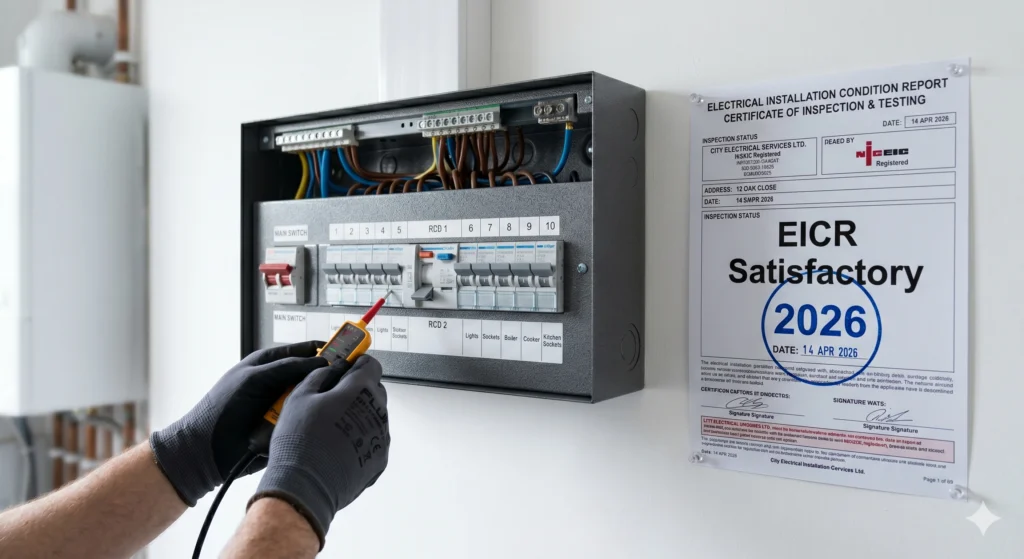
Table of Contents
Everything you need to know about a Electrical Installation Condition Report called an (EICR), when you need one, when you don’t need one, what happens if you need one but don’t have one, and most importantly what, when and how to do it.
What is an EICR?
If your searching for EICR most likely you have all ready come across the term, it stands for – Electrical Installation Condition Report, 99.9% of the UK would not know what is actually involved, speak to most sparkies and even they will struggle to do one, as it’s a specialist area of being an electrician.
So Why is it so important now?
Its always been important, it hit the spotlight in 2020 when it became a legal requirement for private landlords and now in 2026 1st of may it becomes a legal requirement for social landlords.
How long is an EICR valid for?
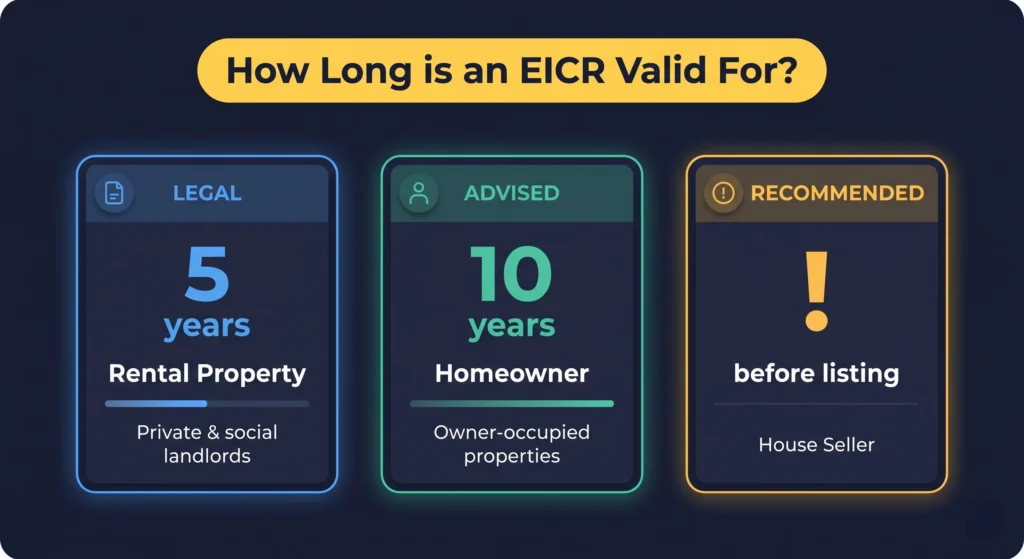
The certificate is normally valid for 5 years, unless its stated otherwise on the certificate by the electrician (the legal standing is that a rented property must have a EICR done every 5 years). Home owners are advised to have one done every 10 years, and most estate agents recommend house sellers to get one done before listing their property.
What does an EICR provide and what does it tell me?
I have always compared a EICR for a property to being the equivalent of an MOT for a car (fun fact MOTS come into play in 1960), like an MOT, the EICR is their to tell you, is the property fit for use, and if its not what is needed.
What will be checked, inspected and tested?
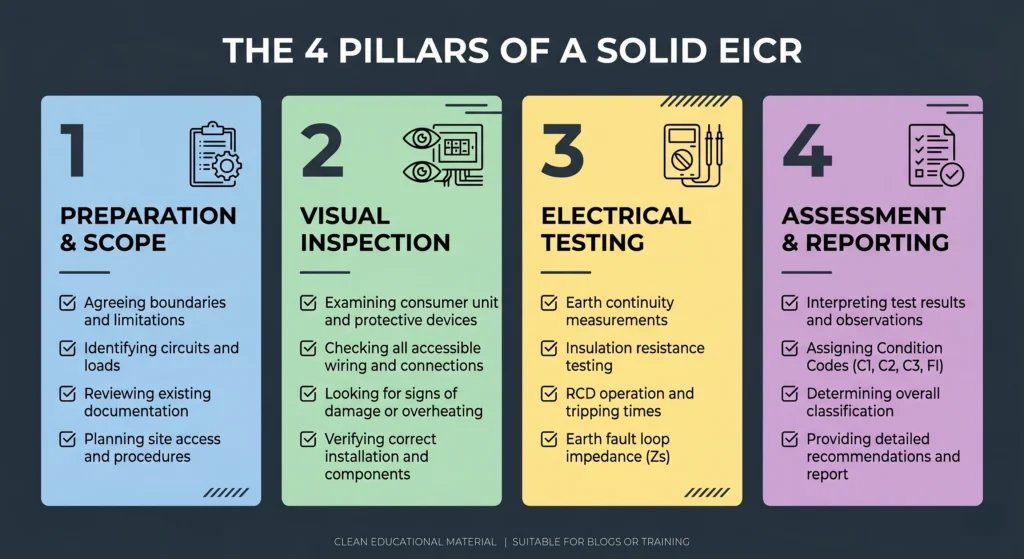
As I would call it – the 4 pillars, this is what I would say make a solid EICR.
- The Consumer Unit (Fuse Board)
- The Wiring (Insulation)
- Damage/Wear and Tear
- Earthing and Bonding
What standard should an electrical installation meet?
The UK sets out that all electrical installations should hit certain safety standards, the gold standard has always been linked to BS 7671 (The IET Wiring Regulations) or as I would say the 18th edition. The confusing part, the BS 7671 is not a legal requirement but Electricity at Work Regulations 1989 and the 2020/2025 Rental Regulations are a legal requirement, and the only way to show your adhering to the law is by following what is set out by the BS 7671, yep its confusing.
What is the Purpose of an EICR? (Electrical Installation Condition Report)
Its simple, to save lives.
One of the biggest causes of house fires in the UK is electrical faults or faulty electrical items, this year alone house fires took 279 lives in the UK [1].
To me one life lost is one life to many.
How do EICRs differ from visual inspection reports?
The best way I can explain it, the difference is the same as someone walking around your car and kicking the tyres whilst checking the paint work, compared to a trained mechanic opening the car and doing a full MOT.
A visual inspection report, literally is that, they normally do not focus on:
- Any kind of testing
- Fault Finding
The biggest problem, it does not cover you for legal compliance, its sometimes used for peace of mind when in-between checks.
Do I have to get an EICR?
If you’re a landlord, social or private you need an EICR by law.
Now we will cover the grey area, do business need an EICR? no, but they still need to adhere to Electricity at Work Regulations 1989 Act, and guess what, the easiest way to show you adhere to this is by getting a EICR done.
The accidental landlord, a friend calls you, they need some where to stay for a few nights, you don’t charge them rent but they buy you a pint to say thank you. In the eyes of the law this could be seen as financial payment, you just become and accidental landlord.
The good news and the not so good news, if they live with you in your private residence you do not legally need a EICR, the bad news, if that dodgy light you have had for 3 years electrocutes them they could take you to court under a civil charge.
Is an EICR a legal requirement in Wales?
Yes, it is, and in Scotland and Northern Ireland.
Private landlords.
| Country | Started | Full Compliance | Legislation |
|---|---|---|---|
Scotland First in the UK to legislate | Dec 2015 | Dec 2016 | Housing (Scotland) Act 2006 |
England Triggered by Grenfell-era safety reforms | Jul 2020 | Apr 2021 | Electrical Safety Standards Regs 2020 |
Wales Broadest tenancy reform in devolved history | Dec 2022 | Dec 2023 | Renting Homes (Wales) Act 2016 |
Northern Ireland Most recent — rolling out now | Apr 2025 | Dec 2025 | Private Tenancies Act (NI) 2022 |
What happens during an EICR?
A normal EICR can take anything from 1-2 hours and then 1-2 hours to do the paper work (average 3 bedroom property), most will do the paperwork after the days done, this then reduces the amount of time they are in the property.
Will happen in the check?
They will normally focus on the first 3 points whilst in the house, and the 4th one normally done after the visit.
- Visual inspection
- Testing of circuits
- Recording the results
- Issuing the report
Expect the power to be turned off during a large portion of the inspection.
Initial Visual Inspection
They will have a quick walk around to see if there is any visual signs of degraded or damaged electrical circuits, the telltale signs normally include but not limited to:
- Cracked sockets
- Overheating Marks
- Discoloured Sockets
- Buzzing or cracking sounds
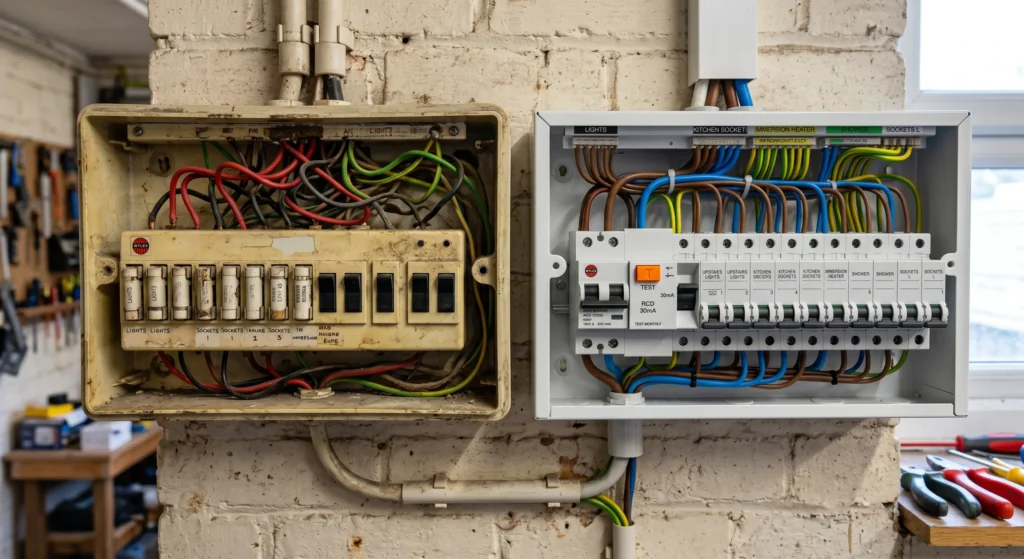
- Fuse Board layout and material (general rule of thumb it should have a button on it saying test.)
Testing of circuits
This is broken down into two sections, whilst the power is off and then live testing.
So the first part is what we call dead testing, as the name says, its done when all power is turned off at source. They will send a small tiny pulse and measure how much stays inside the wire, if you have leaks it will show up (leaks normally indicate damaged wiring, which is one of the biggest risks that start house fires).
Live Testing, for me this is so important (long story short, I got electrocuted as a 7 year old),
Once the power is back on the electrician will use a tester to push a small amount of electricity to the earth, this mimics a person touching a bare wire or faulty plug/appliance etc. If its working the way it should, it should trigger a shut down with 40 milliseconds (fun fact, 40 milliseconds are faster than a blink of an eye and quick enough to stop the electricity disrupting your hearts natural beat.)
Recording the results
This is typically what the electrician will use to write down the results.
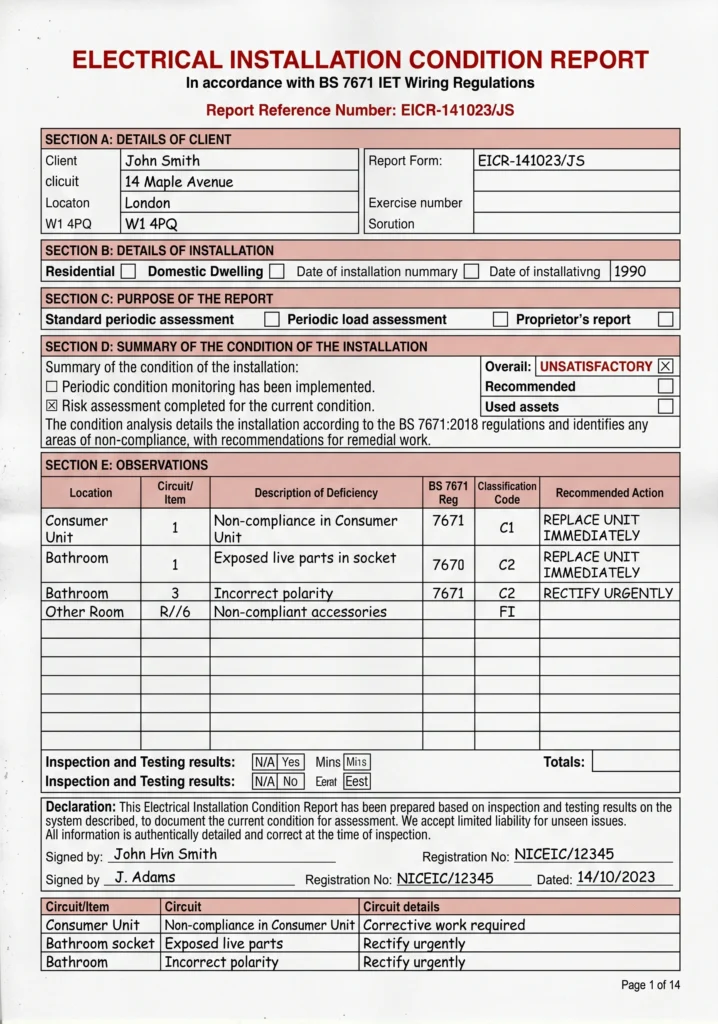
What does a report include?
Every circuit needs to be documented, this could include but not limited to:
- lighting circuits
- cooker circuits
- shower circuits
- socket circuits
- Outbuildings
- Hard wired smoke/fire alarms
Remedial work for electrical installations or equipment
Understanding what to do once you have your report is as important as getting the report done in the first place.
The only time nothing is better than anything, most reports will give you a pass, a rank, or letter, or even a *, thumbs up something, to say well done. Not the EICR report. Each section will have a code section, if its blank, it normally means good news. If it has a code, then there is work to be done.
C1 – Danger Present

– danger danger said the robot (lost in spaSce analogy), but all jokes aside the electrician should make this safe there and then, as a C1 indicates a direct risk health.
C2 Potentially Dangerous
This is a fail and needs correcting within 28 days, failure to correct may result in further action taken.
C3 Improvement Recommended
This is a pass, a bit like an MOT advisory it needs looking at as sooner or later it will be a problem, a bit like your tires, when the MOT says its passed but they are running low on the tread.
FI Further Investigation
Something was found but they are not sure what it is, they need to or you need to hire someone to dig deeper, this also counts as an unsatisfactory result until it’s cleared.
What if remedial works to an electrical installation cannot be completed within 28 days?
In an ideal world, I would say this should never happen, but it does, landlords blame tenants, the government blames landlords and some where in between everyone gets tarnished with some brush or another.
So for years tenants knew that a valid EICR was needed to serve a section 21 eviction notice, so tenants would not allow an electrician in to do the EICR, so in essence making it much more difficult to evict them.
The other side of the coin, landlords would blame tenants for not giving accesses, as landlords knew that their electrics were either dated, or not suitable for use, so a full house wire might be needed (this can cost anything from £4,500 and £8,000 for a 3 bed house).
In the eyes of the law, all work must be completed within 28 days or sooner. The law states landlords must demonstrate all responsible steps to get the work done.
Here is where the grey area comes in.
If a landlord genuinely can’t get accesses to the property, and the tenant is non-compliant (please keep a record and seek legal advice).
If the part a landlord needs is on a back order (please keep a record and seek legal advice). [2]
Which homes do the regulations apply to?
| Property Type | Is it Legal? | Frequency |
|---|---|---|
| Private Rental | Yes (Mandatory) | Every 5 Years |
| Social Housing | Yes (Mandatory from 2026) | Every 5 Years |
| HMOs (Shared Houses) | Yes (Mandatory) | Every 5 Years |
| Owner-Occupied | Recommended | Every 10 Years |
Across the UK its now mandatory.
What checks are required for specialist items such as solar photovoltaic equipment or battery storage systems?
No specialists checks are not needed, normal checks as if they were normal circuits, the electrician will understand these will be live tests.
Does inspection and testing need to be undertaken if it is a new build home or there are new electrical installations?
| Feature | EIC (New Work) | EICR (Existing Work) |
|---|---|---|
| Purpose | To certify brand-new wiring. | To check the “health” of old wiring. |
| When you get it | Immediately after the job is done. | Every 5 years (for rentals). |
| Landlord Legal? | Yes, it counts as a pass for 5 years. | Yes, it is the standard pass. |
FeatureEIC (New Work)
PurposeTo certify brand-new wiring.
When you get itImmediately after the job is done.
Landlord Legal?Yes, it counts as a pass for 5 years.
FeatureEICR (Existing Work)
PurposeTo check the “health” of old wiring.
When you get itEvery 5 years (for rentals).
Landlord Legal?Yes, it is the standard pass.
A brand new house will be issued with a EIC certificate which is valid for 5 years, please check with your legal team if you are unsure.
Do the regulations apply to communal areas in blocks of flats or communal areas within the premises?
| Area | Frequency | Why? |
|---|---|---|
| Corridors & Stairs | 5 Years | To ensure safe exit routes and lighting. |
| Lifts & Risers | 5 Years | To prevent entrapment and electrical fires. |
| External Lighting | 5 Years | To prevent shocks in wet outdoor conditions. |
| Emergency Lighting | Monthly/Annual |
Separate dedicated testing for battery backup. |
Simple answer is yes if you’re the owner of the block/managing agent.
What does it mean for landlords?
Simple, get it done, get it right. There is no way around it, take your responsibility seriously when it comes to keeping tenants safe.
Does an EICR need to be undertaken before each new tenancy if a valid report or record already exists?
No it does not unless stated on the last report.
Will a tenant be entitled to compensation if they have been living in a home with faulty electrics?
Yes they can depending on the situation, at this point please seek legal advice.
What if the landlord is the local council?
Councils fall under the social landlord banner.
Enquire Now
Do you need a professional to install an EICR test?
Yes you do, the person needs to be belong to a government approved competence scheme such as NICEIC, NAPIT, or SELECT.
Please note from 1st of October 2026 these schemes will require electricians to have passed the C&G 2391-52 Electrical Inspection & Testing Course or an equivalent.
How does a landlord find a qualified person?
Just type EICR Certificates and lots of companies offer their service the ones I would recommend can be found at the registered competent person electrical website [3].
Financial penalties
I would always advice doing it properly so you never fall into this bracket.
What happens if I don’t have an EICR or don’t get the issues fixed?
| Category | Is it Mandatory? | Frequency | Primary Penalty |
|---|---|---|---|
| Private Landlord | YES | Every 5 Years | Up to £40,000 fine + Rent Repayment |
| Social Landlord | YES | Every 5 Years | Mandatory by May 1st, 2026 |
| Business / Commercial | YES (De Facto) | 1–5 Years* | Unlimited H&S fines / Void Insurance |
| HMO (3+ tenants) | YES | Every 5 Years | £40,000 fine + Loss of License |
| Resident Landlord (1–2 Lodgers) | NO | Recommended | Civil liability if injury occurs |
| Homeowner | NO | 10 Years (Rec) | Possible insurance claim rejection |
| Selling a Home | NO | Upon Sale | Often requested by buyers/lenders |
| Stage | Name | What Happens | Your Action/Deadline |
|---|---|---|---|
| Stage 1 | Alleged Breach | The council identifies a potential failure (e.g., no EICR on file or a tenant complaint). | Ensure your records are organized and ready. |
| Stage 2 | Notice of Intent | The council sends a formal letter stating they intend to issue a financial penalty. | 28 Days to submit “Representations” (your evidence/defense). |
| Stage 3 | Final Notice | The council reviews your defense. If they reject it, they issue a formal demand for payment. | Payment is now legally due unless you choose to appeal. |
| Stage 4 | Formal Appeal | You lodge a case with the First-tier Tribunal if you believe the fine is unfair or legally wrong. | 28 Days from the Final Notice to lodge the appeal. |
| Stage 5 | Tribunal Decision | An independent judge hears the case and makes a final ruling on the penalty. | The fine is either upheld, reduced, or cancelled entirely. |
References
Note on Accuracy and Updates
Last reviewed: 27 April 2026. This page is maintained regularly. We correct errors and refresh sources as electrical safety regulations and guidance change. EICR legal requirements updated following Social Housing (Regulation) Act 2023 implementation. BS 7671 references current as of 18th Edition Amendment 2 (2022). Costs and market expectations reviewed quarterly based on industry data. Next review scheduled: April 2026 following any regulatory changes.

By Charanjit Mannu
Director, Elec Training
Based on real training delivery, learner outcomes, and current UK electrical regulations.
- City & Guilds Approved
- 4.8★ Google Reviews
- 1000+ Electricians Trained


Prefer a callback?
- City & Guilds
- 4.8 Trustpilot
- JIB Recognized
- 1,000+ Trained
