

Electrician Pay vs Plumber vs Gas Engineer vs Carpenter: Which UK Trade Actually Pays More?

- Technical review: Thomas Jevons (Head of Training, 20+ years)
- Employability review: Joshua Jarvis (Placement Manager)
- Editorial review: Jessica Gilbert (Marketing Editorial Team)
- Last reviewed:
- Changes: Initial publication comparing electrician, plumber, gas engineer, and carpenter earnings using ONS ASHE 2025 data, showing within-trade variation (sector, employment model, region) exceeds between-trade differences
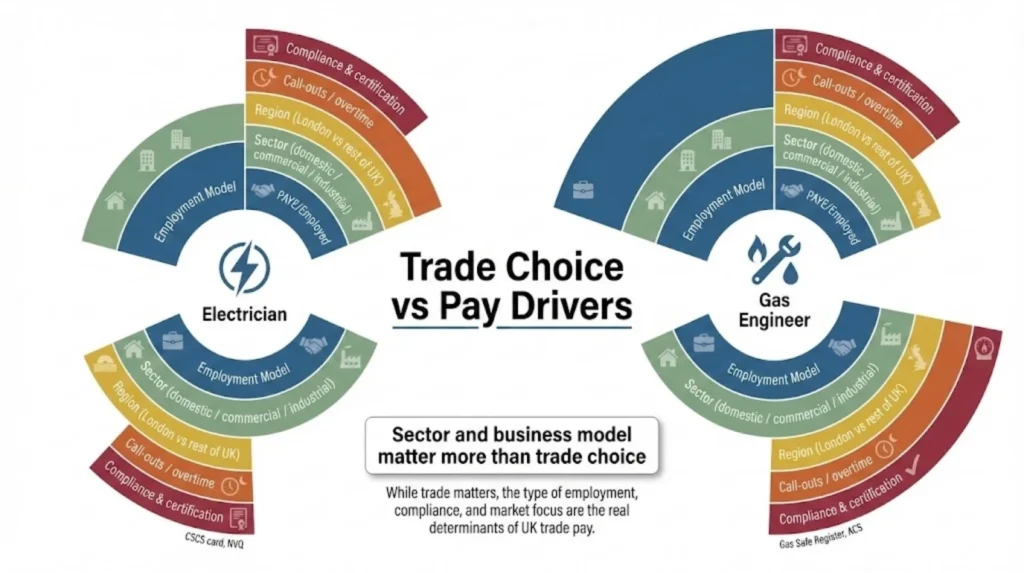
Questions like “how much do electricians make compared to plumbers?” or “do gas engineers earn more than carpenters?” assume simple answers. They don’t exist. ONS data for 2025 shows median full-time earnings of approximately £38,760 for electricians, £35,000-£38,000 for plumbers, £40,000-£45,000 for gas engineers (often bundled with plumbers in official statistics), and £32,000-£35,000 for carpenters. At first glance, gas engineers appear to earn most, carpenters least, with electricians and plumbers in between.
These aggregated medians hide more than they reveal. A self-employed gas engineer in London can gross £80,000-£100,000 annually, while a PAYE gas engineer in the Midlands earns £38,000-£42,000. That’s a £40,000-£60,000 gap within the same trade, driven by business model and region, not trade choice. Similarly, a commercial electrician working industrial maintenance with regular overtime earns £48,000-£55,000, while a domestic electrician doing residential rewires earns £32,000-£38,000. The sector matters more than the trade.
Comparing “electrician versus plumber” pay ignores that employment model (PAYE versus CIS contractor versus self-employed sole trader), sector (domestic versus commercial versus industrial), region (London versus Midlands versus North), qualifications (basic NVQ versus advanced certifications like 2391 for electricians or Gas Safe for gas work), and working patterns (call-outs, overtime, shift premiums) create pay variations within each trade that exceed the differences between trades. A PAYE electrician and PAYE plumber working equivalent commercial roles in the same region earn similar money. A self-employed electrician and self-employed plumber in the same town face similar challenges with quoting overhead, customer management, and seasonal demand fluctuations.
This article breaks down what electricians, plumbers, gas engineers, and carpenters actually earn across different employment structures (PAYE employee, CIS contractor, self-employed), sectors (domestic, commercial, industrial), and regions, then explains why the question “which trade pays more?” has no universal answer. You’ll see what creates pay premiums in each trade (compliance responsibilities for gas and electrical, call-out patterns for plumbing and gas, specialist certifications across all trades), where the highest earners cluster (self-employed gas engineers in London and South East, industrial electricians with supervisory roles, high-end specialist carpenters), and why strategic positioning within your chosen trade matters more than switching trades entirely.
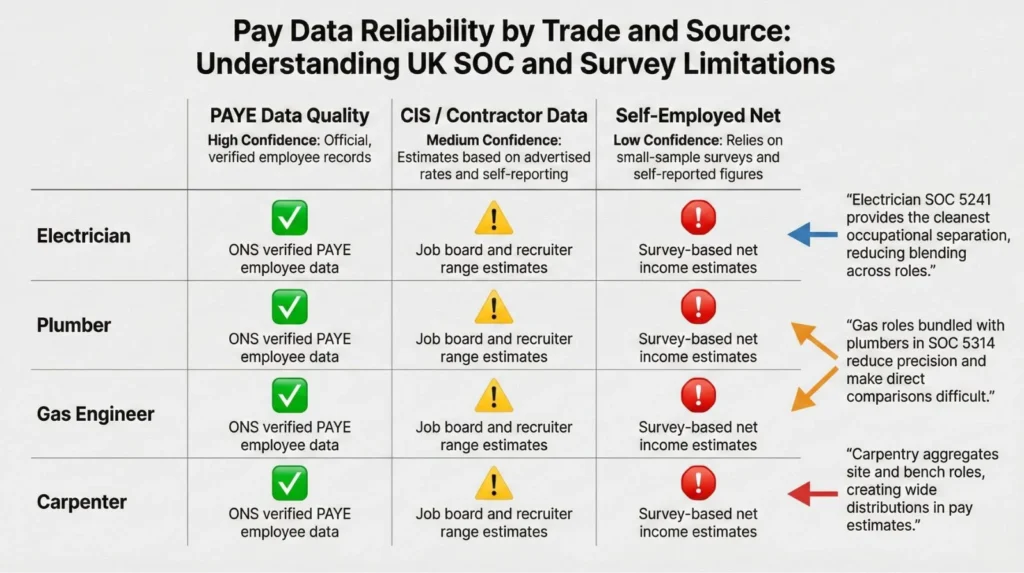
Understanding trade pay comparisons requires understanding that official ONS statistics measure PAYE employees only, missing the substantial self-employed populations in all four trades where earnings skew higher but with greater volatility. Gas engineers are often bundled with plumbers in SOC code 5314 (“Plumbers and Heating and Ventilating Engineers”), making it impossible to separate gas-specific pay from general plumbing without relying on lower-quality job board data and trade surveys. Carpenters and joiners are aggregated in SOC 5315, combining site carpenters (often higher-earning) with bench joiners (typically lower-earning workshop roles). These data limitations mean precise trade-versus-trade comparisons rely partly on market signals rather than purely official statistics.

PAYE Employee Earnings: The Official Baseline
ONS Annual Survey of Hours and Earnings provides the most reliable comparison for PAYE employees across trades, based on 1% sample of HMRC tax records covering approximately 180,000 employee jobs. This excludes self-employed workers and CIS contractors (covered separately), representing only employed staff with standard payroll deductions.
Electricians (SOC 5241)
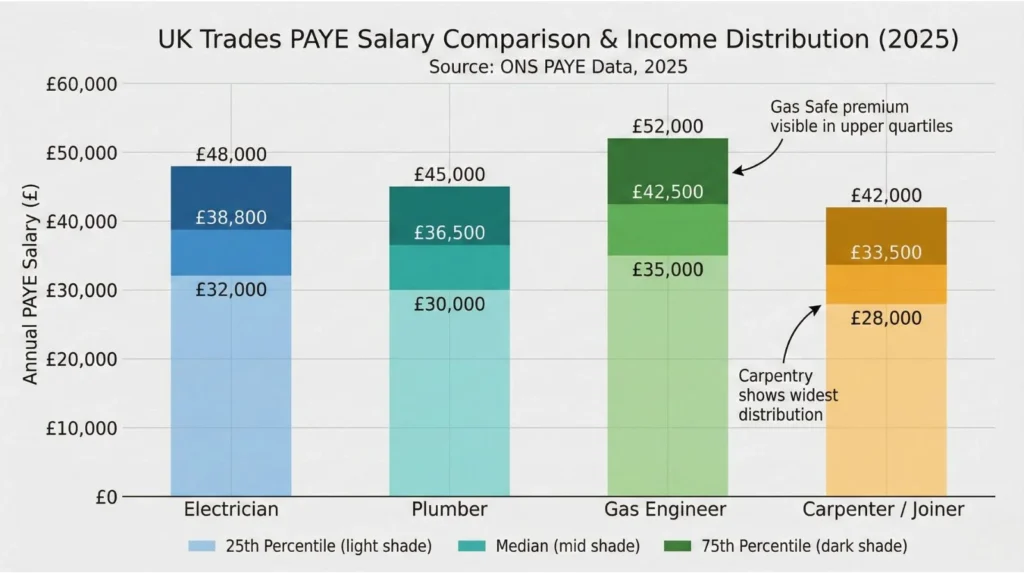
Median annual gross: £38,760 (2025 ASHE data)
Percentile range: £32,000 (25th percentile) to £48,000 (75th percentile)
Hourly equivalent: £18-£23 (based on 37.5-40 hour standard weeks)
With overtime/shift premiums: £42,000-£55,000 gross annually (assuming 10 hours weekly overtime at 1.5x JIB rates or shift allowances in commercial/industrial roles)
The electrician median of £38,760 reflects a trade with relatively tight distribution compared to others – the regulatory requirements (NVQ Level 3, 18th Edition, AM2 assessment, ECS Gold Card) create a higher floor but JIB-style collective agreements cap PAYE progression unless moving into project management or Technician grades. Electricians in commercial fit-out, facilities management, and industrial maintenance cluster towards the upper percentiles (£44,000-£48,000) while domestic maintenance and social housing roles cluster lower (£32,000-£38,000).
Overtime access varies significantly by employer and sector. Facilities management contracts often guarantee 5-10 hours weekly overtime, adding £6,000-£10,000 annually. Industrial maintenance with shift patterns and callout rotas adds £8,000-£15,000. Domestic-focused PAYE electrician roles (rare beyond social housing or local authorities) rarely offer consistent overtime, limiting total earnings to base salary ranges.
Plumbers (SOC 5314, includes heating engineers)
Median annual gross: £35,000-£38,000 (2025 estimates, bundled with heating/gas in official data)
Percentile range: £30,000 (25th) to £45,000 (75th)
Hourly equivalent: £17-£22
With overtime/call-outs: £40,000-£52,000 gross annually (call-out premiums add 15-25% in domestic service contracts)
The plumber median is complicated by ONS bundling “Plumbers and Heating and Ventilating Engineers” in SOC 5314, mixing general plumbing with gas-qualified heating engineers who typically earn premiums. Isolating plumbers without Gas Safe registration likely shows medians closer to £33,000-£36,000, with the higher figures (£38,000-£42,000) representing gas-qualified plumbers or those in commercial pipefitting roles.
Plumbers benefit from emergency call-out work more than electricians. Burst pipes, leaking radiators, and blocked drains create urgent demand year-round, particularly in winter. PAYE plumbers in service and maintenance contracts with call-out rotas can add £8,000-£12,000 annually through unsocial hours premiums (evenings, weekends) and call-out fees, pushing total earnings above baseline medians significantly.
Sector mix matters enormously for plumbers. “Service and repair” plumbers in domestic or light commercial work earn towards median ranges (£35,000-£40,000), while industrial pipefitters in manufacturing, utilities, or construction earn £42,000-£50,000 due to complexity of systems and formal apprenticeship requirements for pipefitting qualifications.
Gas Engineers (bundled in SOC 5314, isolated estimates)
Median annual gross: £40,000-£45,000 (estimated from trade surveys and job board patterns, not separately verified in ONS)
Percentile range: £35,000 (25th) to £52,000 (75th, estimated)
Hourly equivalent: £19-£24
With call-outs/standby: £45,000-£60,000 gross annually (call-out premiums substantial, standby allowances common)
Gas engineers command premiums over general plumbers due to Gas Safe registration requirements, scarcity of qualified engineers (particularly for commercial gas work), and the compliance burden of certifying gas appliances. Domestic gas engineers servicing boilers, installing new heating systems, and responding to emergency breakdowns typically earn £38,000-£45,000 PAYE, with those on emergency call-out contracts reaching £48,000-£55,000 through winter demand and unsocial hours premiums.
Commercial gas engineers working on larger heating plants, industrial gas systems, or medical gas installations earn higher ranges (£45,000-£55,000 PAYE) due to additional certifications required and scarcity of engineers qualified for these systems. The Gas Safe register shows acute shortages of commercial gas engineers, driving employer premiums to attract and retain qualified staff.
The “boiler cycle”-mandatory annual servicing of domestic boilers creates steadier revenue and employment patterns for gas engineers compared to trades reliant on one-off installations or reactive repairs. This stability shows in lower unemployment rates and more consistent overtime/call-out access throughout the year rather than seasonal peaks and troughs.
Carpenters and Joiners (SOC 5315)
Median annual gross: £32,000-£35,000 (2025 ASHE data)
Percentile range: £28,000 (25th) to £42,000 (75th)
Hourly equivalent: £15-£20
With overtime (project-dependent): £35,000-£45,000 gross annually
Carpenters show the widest distribution of any trade analysed, reflecting the breadth of roles aggregated under “Carpenters and Joiners.” Bench joiners working in workshop environments manufacturing doors, windows, staircases, or furniture typically earn £28,000-£32,000 (lower quartile), while site carpenters on commercial construction, particularly those on price-work arrangements or specialist roles (oak framing, high-end fit-out, heritage restoration), reach £38,000-£48,000 (upper quartile).
This wide distribution means the median (£32,000-£35,000) is less representative of “typical carpenter earnings” than for other trades. A newly qualified carpenter entering bench joinery might earn £26,000-£28,000, while a site carpenter with five years’ experience on commercial projects earns £36,000-£42,000-both are “carpenters” but in fundamentally different labour markets.
Carpenters have minimal regulatory compliance requirements compared to electrical and gas trades. No national licensing system exists for carpentry (unlike Gas Safe for gas or certification schemes for electrical). CSCS cards prove basic health and safety competence for site access but don’t verify carpentry skill. NVQ Level 2 or 3 demonstrates competency but isn’t legally mandatory to practice. This lower barrier to entry creates more competition at the lower end of the market, pulling medians down, while specialist high-end work commands premiums similar to other trades.
Overtime in carpentry is project-dependent rather than contractual. Large commercial construction projects often offer weekend work and extended hours during critical phases, but this is sporadic. Domestic carpentry rarely includes overtime because most self-employed carpenters control their own hours, and employed carpenters in joinery workshops typically work standard 40-hour weeks.
CIS Contractor and Self-Employed Earnings: Where Gross Figures Mislead
Construction Industry Scheme contractors and self-employed sole traders often advertise or report higher gross incomes than PAYE employees, but effective hourly rates and net take-home after overheads, downtime, and self-funded benefits narrow the gaps substantially. Market data for contractors comes from job board advertised day rates (asking prices, not necessarily paid rates) and trade surveys (subject to self-reporting bias), making them lower confidence than ONS employee data.
Electricians: CIS and Self-Employed
Typical CIS day rate: £220-£350 (varies by region, sector, and qualifications)
Effective hourly rate: £20-£30 (assuming 8-hour billable days, 10-20% downtime between contracts, overhead deductions)
Self-employed domestic gross: £35,000-£60,000 (wide range based on client base, marketing effectiveness, pricing strategies)
Self-employed domestic net: £28,000-£48,000 (after 20-25% overheads: van, tools, insurance, training, accountancy, holiday provision)
CIS electrician day rates cluster around £250-£280 for standard commercial work in most UK regions, rising to £300-£350 for industrial maintenance, specialist roles (data centres, critical infrastructure), or London/South East locations. However, these gross day rates mislead when calculating annual earnings because contractors face unpaid downtime between contracts (typically 4-8 weeks annually for established contractors, 8-12 weeks for newer contractors), travel time to sites (often unpaid), and must fund their own holiday, sick pay, and pension from gross income.
A contractor earning £280 day rate working 48 weeks annually grosses £67,200 (£280 × 5 days × 48 weeks). After 20% CIS tax deduction (£13,440), the contractor receives £53,760, from which they must deduct business overheads (£8,000-£12,000 annually for vehicle, fuel, tools, equipment calibration, insurance, training, accountancy) and provide for holiday/sick pay they don’t receive (equivalent £4,000-£6,000 annually). Effective net becomes £36,000-£42,000, compared to a PAYE electrician earning £38,000-£42,000 with paid holidays, sick pay, and employer pension contributions. The contractor earns more but not transformationally so when realistic costs are factored.
Self-employed domestic electricians (sole traders operating under their own business names) face different challenges. Rather than day rates, they charge hourly (£40-£60/hour typical) or fixed job prices. However, substantial time is non-billable: quoting new work (10-20% of working hours, many quotes don’t convert), admin and bookkeeping (5-10%), material procurement and returns (5-10%), customer liaison and problem-solving (5-10%). An electrician charging £50/hour might bill only 25-30 hours weekly out of a 45-hour working week, creating effective hourly earn of £28-£35 when all hours are counted.
Successful self-employed electricians gross £50,000-£70,000 in established businesses with repeat client bases and efficient operations, but this typically requires 5-7 years building reputation and eliminating inefficiencies. First-year self-employed electricians often gross £30,000-£40,000 while working 50-55 hour weeks, creating effective hourly rates below PAYE equivalents until the business matures.
Plumbers: CIS and Self-Employed
Typical CIS day rate: £170-£350 (wide variation based on sector, pipefitting versus domestic plumbing)
Effective hourly rate: £18-£28 (8-hour days, 15% downtime, overheads)
Self-employed domestic gross: £50,000-£70,000
Self-employed domestic net: £35,000-£50,000 (after 20-30% overheads and non-billable time)
CIS plumber day rates vary more than electricians because “plumber” encompasses distinct markets. Domestic service plumbers (unblocking drains, fixing leaks, installing bathrooms) command £200-£250 day rates via agencies or subcontracting to larger firms. Commercial pipefitters on construction sites earn £220-£280. Specialist plumbers with Unvented Hot Water certification or working on commercial mechanical services reach £280-£350 in London and South East.
The lower end of the CIS range (£170-£200) typically represents plumbers without gas qualifications working on water systems only, limiting their market. Gas-qualified plumbers access boiler installations and servicing, dramatically increasing available work and pushing day rates towards £220-£260 minimum.
Self-employed plumbers benefit from emergency call-out work more than self-employed electricians. Burst pipes, boiler breakdowns, and blocked drains create urgent demand customers will pay premiums to resolve quickly. Call-out fees of £80-£150 plus hourly charges of £60-£90 for emergency work (evenings, weekends) supplement regular installation and servicing income. Established self-employed plumbers often gross £55,000-£75,000, with top performers in high-demand areas reaching £80,000-£90,000.
However, plumbing overheads match or exceed electrical work: vehicle (plumbers often carry stock, requiring larger vans), tools, parts inventory (many plumbers hold common components to complete jobs without returns), public liability insurance, professional indemnity, gas liability insurance (if Gas Safe registered), Gas Safe annual fees, training updates. Total overheads typically reach 25-30% of turnover (£12,000-£21,000 on £60,000-£70,000 gross).
Non-billable time for domestic plumbers is substantial: quoting (many customers request multiple quotes for bathroom refits or boiler replacements), emergency call-outs that are quick fixes (£100 call-out but only 15 minutes actual work), travel between small jobs (domestic plumbers often complete 3-5 jobs daily, spending significant time driving), parts procurement, warranty administration for installed boilers. Effective billable hours are often 25-30 out of 50-hour working weeks.
Gas Engineers: CIS and Self-Employed
Typical CIS day rate: £200-£260 (narrower range than electricians or plumbers, driven by Gas Safe scarcity)
Effective hourly rate: £20-£26 (8-hour days, 10% downtime, overheads)
Self-employed domestic gross: £70,000-£100,000 (highest of trades analyzed for established self-employed)
Self-employed domestic net: £50,000-£70,000 (after overheads, higher gross base maintains better net)
Gas engineers show the highest self-employed earnings of trades compared, reflecting Gas Safe registration scarcity and mandatory annual boiler servicing creating stable demand. CIS day rates cluster tightly around £220-£260 regardless of region (unlike electricians where London premiums are substantial), suggesting gas engineer shortages are UK-wide rather than concentrated in specific areas.
Self-employed gas engineers grossing £70,000-£100,000 typically operate mature businesses (5-10 years established) with substantial boiler servicing contracts. Annual servicing contracts provide recurring revenue that electricians and general plumbers don’t access-a gas engineer with 400 annual service customers at £80-£100 per service generates £32,000-£40,000 annually before any installation or repair work. This stable base allows higher total gross than trades reliant purely on reactive or project work.
The complete comparison of UK trade salaries by sector and employment model shows how gas, electrical, plumbing, and carpentry earnings vary more by business structure and market positioning than by trade choice.
Gas engineer overheads are comparable to plumbers: vehicle, extensive tool kit (gas analyzers, flue gas testers, manometers cost £2,000-£5,000), parts stock for common boiler repairs, multiple insurance policies, Gas Safe registration and annual fees (£300-£500), mandatory ongoing training for ACS reassessment (every 5 years, £1,000-£2,000). Total overheads reach £10,000-£15,000 annually but are proportionally smaller against higher gross income (15-20% versus 25-30% for plumbers or electricians).
Emergency call-outs in winter (boiler breakdowns during cold periods) create income spikes but also stress and long hours. Gas engineers report 60-70 hour working weeks in December-February responding to emergency calls, often working evenings and weekends, before reverting to 35-45 hour weeks in summer when demand drops. This seasonal pattern affects work-life balance but drives annual earnings above PAYE equivalents significantly.
Carpenters: CIS and Self-Employed
Typical CIS day rate: £150-£275 (widest variation, sector and specialty dependent)
Effective hourly rate: £16-£24 (8-hour days, 20% downtime risk from weather and project delays)
Self-employed domestic gross: £30,000-£45,000 (lower than other trades due to competition and lower hourly rates)
Self-employed domestic net: £22,000-£35,000 (after overheads, lower gross base creates tighter margins)
Carpenter day rates show the widest variation of any trade, reflecting the diversity of roles. “Standard” site carpenters on commercial construction earn £180-£220 day rates. Specialist carpenters (oak framing, heritage work, high-end joinery) command £240-£280. Bench joiners transitioning to site work or domestic “handyman” carpenters might accept £150-£180 to secure work.
The lower end of carpentry rates creates challenges for self-employed viability. At £35-£40/hour billing rates (typical for domestic carpentry in many regions), achieving £50,000+ gross requires 30-35 billable hours weekly consistently. Many self-employed carpenters struggle to maintain this volume due to quoting overhead, seasonal slowdowns (winter weather affects external work and new-build construction), and competition from other carpenters willing to work for lower rates.
Successful self-employed carpenters often specialise: kitchen fitting (£45,000-£60,000 gross typical for established fitters), decking and external structures (seasonal but high-margin), loft conversions (requires partnership with other trades but allows project management margins), or heritage restoration (specialist skills command premiums). Generalist carpenters doing “whatever comes in” tend to earn lower totals (£30,000-£42,000 gross) due to pricing pressure and difficulty establishing market position.
Carpenter overheads are lower than electrical or gas trades in some areas (no regulatory fees, insurance cheaper due to lower risk profile) but higher in others (tool replacement and sharpening costs substantial, vehicle wear from transporting materials, waste disposal costs). Total overheads typically reach 20-25% of turnover (£6,000-£11,000 on £30,000-£45,000 gross).
Downtime risk for carpenters is highest of trades analyzed. Weather delays outdoor work and halts construction sites (affecting site carpenters), clients delay decisions on bespoke joinery projects, economic downturns reduce discretionary spending on kitchen refits and extensions. Carpenters report 20-25% of potential working weeks lost to these factors, compared to 10-15% for electricians or gas engineers whose work is less weather-dependent and more essential (electrical faults and heating failures create urgent demand regardless of economic conditions).
Thomas Jevons, Head of Training with 20+ years on the tools, explains:
"Testing and Inspection capability creates similar pay premiums across trades. Electricians with 2391 earn more than installation-only electricians. Gas engineers who can commission and certify complex heating systems earn more than gas fitters doing basic appliance installs. Plumbers with Unvented Hot Water certification access work their non-certified colleagues can't touch. The pattern is consistent: verification and certification authority commands premiums regardless of which trade you're in."
Thomas Jevons, Head of Training
What Actually Drives Pay Differences Between Trades: Ranked Factors
Simple trade comparisons (“electricians earn more than carpenters”) miss that pay differences within each trade exceed differences between trades. Understanding what creates pay premiums helps identify whether changing trades, changing sectors within your trade, or changing employment models offers better returns.
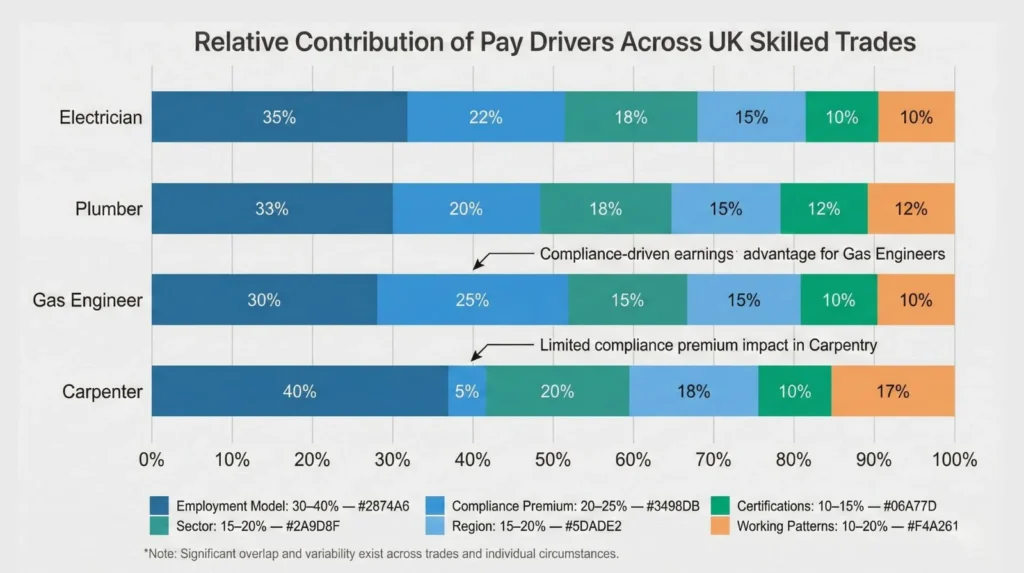
1. Employment model and business structure (30-40% of variation). The choice between PAYE employment, CIS contracting, or self-employed sole trading creates larger pay differences than trade choice. A PAYE plumber earning £36,000 and a self-employed plumber grossing £65,000 represent a £29,000 gap-far larger than the £3,000-£7,000 typical difference between PAYE electrician and PAYE plumber medians. However, this gross advantage narrows after overheads and benefits are factored. Self-employment offers pricing power and higher gross potential (20-50% above PAYE equivalents) but introduces 100% of business risk, volatile income, and self-funded benefits.
2. Compliance and regulatory requirements (20-25% of baseline differentials). Trades with mandatory registration requirements earn premiums reflecting legal risk and scarcity. Gas Safe registration is mandatory for any gas work, creating absolute scarcity that drives £3,000-£8,000 premiums over non-gas plumbers at equivalent experience levels. Electrical certification schemes (NICEIC, NAPIT, ECA) aren’t legally mandatory but are practically essential for self-certification of domestic work, creating softer scarcity that adds £2,000-£5,000 versus uncertified electricians. Carpentry has no equivalent regulatory barrier, reducing scarcity premiums and enabling more market entry at the lower end.
This compliance premium reflects employers and clients paying for risk mitigation. When a gas engineer certifies a boiler installation is safe, they’re accepting legal liability under Gas Safety Regulations. When an electrician signs an Electrical Installation Certificate under BS 7671, they’re confirming compliance with building regulations. Carpenters rarely sign off structural safety for domestic work (that’s typically structural engineers or building control). The legal accountability creates pay differentials.
3. Sector and work environment (15-20% of within-trade variation). Commercial and industrial roles pay 10-20% more than domestic work across all trades. An industrial electrician earns £42,000-£52,000 PAYE while a domestic electrician earns £32,000-£38,000. A commercial pipefitter earns £38,000-£46,000 while a domestic plumber earns £33,000-£38,000. The pattern is consistent-commercial and industrial clients have larger budgets, value minimising downtime highly, and often work through main contractors who add margins that enable higher subcontractor rates.
Within domestic work, service and repair generates more consistent income than new-build installation for plumbers and gas engineers (boiler servicing and repairs occur year-round, new installations cluster in spring/summer). For electricians and carpenters, the pattern reverses-new-build offers more volume and steadier work than reactive domestic repairs.
4. Regional positioning (15-20% of baseline variation). London and South East command 20-30% premiums over Midlands and North across all trades. A £35,000 Midlands PAYE electrician becomes £42,000-£45,000 in London. A £33,000 Northern carpenter becomes £40,000-£42,000 in South East. However, cost of living differences (particularly housing and commuting) consume most of this uplift. The premium is more significant for self-employed workers who can charge London rates while living outside the capital and traveling in for higher-paying jobs.
Regional scarcity also varies by trade and specialty. Yorkshire and North East show electrician shortages in industrial maintenance, driving premiums there. London and South East have acute gas engineer shortages. Scotland has carpentry shortages in heritage restoration. These localised imbalances create opportunities for workers willing to relocate or travel to shortage areas.
5. Certification and qualification depth (10-15% premiums for advanced certifications). Within each trade, advanced qualifications command premiums. Electricians with 2391 Testing and Inspection earn £3,000-£5,000 more than installation-only electricians. Gas engineers qualified for commercial gas (not just domestic) earn £4,000-£8,000 more. Plumbers with Unvented Hot Water certification access work non-certified plumbers cannot touch, adding £2,000-£4,000 annually. Carpenters with specialist skills (historic restoration, advanced CNC machining, structural timber framing) command £3,000-£6,000 premiums over generalist site carpenters.
These certification premiums exist within each trade independently-the premium for advanced qualifications is similar across trades, suggesting the mechanism (scarcity of qualified workers, increased responsibility, access to higher-value work) operates similarly regardless of which trade you’re in.
6. Working patterns and unsocial hours (10-20% uplifts for call-out/shift work). Gas engineers and plumbers benefit most from emergency call-out patterns, adding 15-25% to annual earnings through unsocial hours premiums and call-out fees. Electricians access shift allowances in industrial and commercial maintenance (adding 10-20%) but rarely have emergency call-out work in domestic markets. Carpenters generally work standard hours with occasional weekend or overtime availability on commercial projects, adding 5-10% when available.
The call-out premium isn’t just hourly rate uplifts-it’s also minimum call-out charges (£80-£150 typical for gas/plumbing emergencies) that improve effective hourly rates dramatically for short jobs. A gas engineer charging £100 call-out plus £60/hour who fixes a boiler fault in 20 minutes earns £120 for 20 minutes work (equivalent £360/hour), though travel time reduces this effective rate.
7. Experience and reputation (5-10% baseline progression after qualification). Years of experience create pay progression primarily in first 5 years post-qualification across all trades. From years 5-10, experience adds minimal pay without accompanying sector moves, qualification advancement, or business development. This pattern is trade-independent-a carpenter with 15 years and an electrician with 15 years both earn similar money to 8-year equivalents without strategic progression.
However, reputation creates premiums for self-employed workers that experience alone doesn’t. An established self-employed gas engineer with 400 servicing customers and strong local reputation can charge £10-£20/hour more than a newer engineer with equivalent technical competence, reflecting customers’ willingness to pay for known reliability.
8. Market scarcity and skills gaps (variable, 5-15% premiums in shortage areas). Temporary scarcity in specific trades, regions, or specialisms creates premiums above baseline rates. Current UK skills gaps show acute shortages in gas engineers (particularly commercial), industrial maintenance electricians, and specialist carpenters (heritage, timber framing). These shortages create 5-15% pay uplifts while they persist, but they’re not permanent features of the trades.
Joshua Jarvis, Placement Manager at Elec Training, observes:
"Scarcity premiums differ by location and specialty, not just by trade. London has gas engineer shortages driving premiums; Yorkshire has electrician shortages in industrial maintenance. Comparing 'electrician versus plumber' nationally misses that regional demand imbalances create opportunities. An electrician considering relocation to follow industrial projects might earn more than staying local and switching to plumbing. Market positioning beats trade switching for most career decisions."
Joshua Jarvis, Placement Manager
Common Myths About Trade Pay Comparisons
Several persistent misconceptions about which trades earn more create unrealistic expectations and poor career decisions.
Myth 1: “Gas engineers always earn the most.” Reality: Gas engineers show the highest PAYE medians (£40,000-£45,000) and self-employed gross (£70,000-£100,000), but a specialist industrial electrician or high-end carpenter can out-earn a domestic gas engineer significantly. The trade matters less than the sector, employment model, and individual positioning. Gas Safe scarcity creates premiums, but they’re not universal across all gas engineers.
Myth 2: “Electricians earn more than plumbers everywhere.” Reality: PAYE medians show electricians £3,000-£6,000 ahead of plumbers, but this reverses in self-employed domestic markets where plumbers’ call-out work and emergency repairs create premium income electricians don’t access. In commercial sectors, electricians and plumbers at equivalent experience levels earn similar money. The “electrician versus plumber” comparison is meaningless without specifying sector and employment model.
Myth 3: “Carpenters are the lowest paid trade.” Reality: Median PAYE earnings are lowest (£32,000-£35,000), but this aggregates bench joiners earning £28,000-£32,000 with specialist site carpenters earning £40,000-£50,000. Top-quartile carpenters match or exceed median electricians. The distribution is wider, not universally lower. Comparing medians hides that upper-quartile carpenter earnings are competitive with other trades.
Myth 4: “Self-employed always beats PAYE for every trade.” Reality: Self-employment offers higher gross income (20-50% above PAYE) but net after overheads, non-billable time, and self-funded benefits is often only 30-40% higher than PAYE equivalent. For carpenters, the gap can be smaller (15-25%) due to lower hourly rates and higher competition. PAYE provides security, predictable income, and benefits that self-employment requires you to fund from gross. The “better” model depends on risk tolerance and business capability, not just gross figures.
Myth 5: “Day rates equal take-home pay.” Reality: A £280 electrician day rate looks like £72,800 annually (260 days) but actual take-home after 20% CIS tax, 8 weeks downtime, overheads (£8,000-£12,000), and holiday/sick provision (£4,000-£6,000) nets approximately £38,000-£45,000. Day rates must be discounted 30-40% to reach realistic net comparable to PAYE gross figures.
Myth 6: “All trades have the same regional differences.” Reality: London premiums vary by trade based on scarcity. Gas engineers see 25-30% London uplifts (£40,000 Midlands becomes £52,000-£55,000 London) because shortages are acute. Electricians see 20-25% (£38,000 becomes £46,000-£48,000). Carpenters see smaller 15-20% uplifts because London competition is higher. Regional variation isn’t uniform across trades.
Myth 7: “Qualifications alone determine which trade pays best.” Reality: An electrician with NVQ Level 3 and a gas engineer with ACS qualifications represent baseline competency in their respective trades, earning similar median pay (£38,000-£42,000 PAYE). Pay diverges based on whether you gain advanced certifications (2391 for electrical, commercial gas for gas work, Unvented for plumbing), move sectors (domestic to commercial to industrial), or develop business skills (PAYE to self-employed).
Myth 8: “Overtime opportunities are similar across trades.” Reality: Gas engineers and plumbers access emergency call-out work year-round, adding 15-25% to annual earnings. Electricians access overtime in commercial/industrial PAYE roles but rarely in domestic self-employment. Carpenters have least consistent overtime access (project-dependent, weather-affected). Working pattern differences create £5,000-£12,000 annual variations within trades that simple base pay comparisons miss.
Myth 9: “Switching trades is the best way to increase earnings.” Reality: Switching trades requires retraining from apprenticeship-equivalent level (1-2 years), earning trainee wages during qualification, then building experience and reputation in the new trade. This creates 2-4 years of reduced earnings before reaching qualified status. For most workers beyond year 3 in their current trade, sector moves within the trade (domestic to commercial, PAYE to contractor, gaining advanced certifications) deliver faster earnings increases than complete trade switching.
Myth 10: “Trade comparisons from official data are definitive.” Reality: ONS ASHE covers PAYE employees only, missing substantial self-employed populations where electricians, plumbers, gas engineers, and carpenters often earn most. Gas engineers are bundled with plumbers in SOC 5314, making isolation impossible. Carpenters aggregate bench joiners and site carpenters. The official data provides baselines but understates high-end earnings and obscures within-trade variation.
Data Limitations and Why Precise Comparisons Are Impossible
Several significant gaps in available data prevent definitive “which trade pays more” answers.
Self-employed earnings opacity. ONS ASHE covers PAYE employees exclusively, capturing approximately 60-70% of electricians, 50-60% of plumbers and gas engineers, and 40-50% of carpenters (estimates based on trade body registrations versus employee counts). Self-employed workers in all trades report income via Self Assessment tax returns, but this data isn’t published by trade or analyzed for median/percentile distributions. Trade surveys and job board day rates provide market signals but are subject to self-reporting bias (successful self-employed workers more likely to participate) and lack verification.
The result is we know PAYE medians relatively precisely (electricians £38,760, plumbers £35,000-£38,000, gas £40,000-£45,000, carpenters £32,000-£35,000) but can only estimate self-employed ranges (electricians £35,000-£60,000, plumbers £50,000-£70,000, gas £70,000-£100,000, carpenters £30,000-£45,000) with low confidence. The self-employed estimates come from advertised hourly rates multiplied by assumed billable hours minus estimated overheads-substantial assumptions at each step.
SOC code aggregation issues. ONS groups occupations into Standard Occupational Classification codes that bundle distinct roles. SOC 5314 combines “Plumbers, Heating and Ventilating Engineers” meaning general plumbers and Gas Safe-registered gas engineers are aggregated, making it impossible to isolate gas engineer-specific pay from official data. SOC 5315 combines “Carpenters and Joiners” mixing site carpenters (typically higher-earning) with bench joiners (typically lower-earning workshop roles). Only electricians have relatively clean separation in SOC 5241, though even this includes everything from domestic maintenance to high-voltage specialists.
This aggregation means the plumber “median” of £35,000-£38,000 likely understates gas engineer-specific medians (estimated £40,000-£45,000) and the carpenter “median” of £32,000-£35,000 may understate site carpenter medians while overstating bench joiner medians. We lack official data to verify these distinctions.
Regional and sector breakdowns. ASHE provides UK-wide medians and London versus non-London splits, but doesn’t granularly break down electrician pay in industrial sectors versus domestic sectors, or plumber pay in commercial pipefitting versus domestic service. These sector distinctions create 15-25% pay differences but aren’t captured in published statistics. We can infer patterns from job board data and JIB/trade body rates, but these are asking prices (what employers advertise) not necessarily paid rates.
Contractor day rate verification. Advertised CIS day rates on job boards represent what agencies or contractors are willing to pay to attract applicants, potentially inflated 10-20% above typical paid rates. We observe electrician day rates advertised at £220-£350, plumber £170-£350, gas £200-£260, carpenter £150-£275, but lack verification of what rates are actually negotiated and paid. Trade surveys asking self-employed workers what they charge face similar issues-respondents may report aspirational rates rather than average achieved rates.
Non-billable time and overhead cost variations. Worked examples in this article assume 20-30% non-billable time and 20-30% overhead costs for self-employed trades based on industry feedback and trade association guidance, but actual figures vary enormously by individual business efficiency, region (vehicle costs higher in rural areas requiring longer travel), and trade (gas engineers carry expensive diagnostic equipment, carpenters carry more diverse tool sets). These assumptions affect net income calculations significantly-a 5% error in overhead percentage creates £2,000-£5,000 differences in estimated net on £60,000 gross.
Qualification premium isolation. We know electricians with 2391 earn more than those without, gas engineers with commercial qualifications earn more than domestic-only, plumbers with Unvented earn more than those without. However, isolating the precise premium (£3,000? £5,000? £8,000?) is difficult because these qualifications correlate with experience, sector, and employment model. An electrician with 2391 likely has 5+ years experience and works commercial sector-is the premium from 2391 specifically or from experience and sector combined?
Survivorship bias in self-employed data. Self-employed workers who struggle or earn below PAYE equivalents often return to employment within 18-36 months, disappearing from self-employed statistics. Trade surveys and registration databases capture successful continuing self-employed workers, potentially overstating typical self-employed earnings. The PAYE data doesn’t suffer this bias (employees earning below median still appear in statistics), making PAYE versus self-employed comparisons potentially skewed towards showing self-employment more favourably than reality for average workers.
Understanding Which Trade Actually Pays More for Your Situation
The evidence shows no universal “highest-paying trade.” PAYE medians suggest gas engineers earn most (£40,000-£45,000), followed by electricians (£38,760), plumbers (£35,000-£38,000), and carpenters (£32,000-£35,000), but these aggregate figures hide that sector, employment model, region, and qualifications create larger pay variations within each trade than exist between trades.
For workers considering trade choice or career changes, the relevant question isn’t “which trade pays most” but “which combination of trade, sector, employment model, and region creates optimal earnings for my situation.” A PAYE electrician in industrial maintenance earning £45,000-£52,000 with predictable hours and benefits might have better quality-of-life-adjusted earnings than a self-employed gas engineer grossing £85,000 but working 60-hour weeks in winter with volatile income. A self-employed carpenter specialising in high-end joinery earning £50,000 net might match a PAYE plumber earning £38,000 plus benefits when total value is compared.
Strategic positioning matters more than trade switching. An electrician with five years’ experience considering career change faces a choice: spend 2-3 years retraining as a gas engineer (reduced earnings during training, starting new trade from low base) or pursue sector advancement within electrical work (gain 2391 qualification, move from domestic to commercial or commercial to industrial, transition to contracting if business-capable). For most workers, the within-trade advancement delivers faster earnings growth because it leverages existing competencies and reputation rather than starting from zero.
However, for individuals early in training or career (under 2 years in current trade), trade selection based on earnings potential is worth considering. Gas engineering offers the highest self-employed ceiling (£70,000-£100,000 for established operators) but requires Gas Safe compliance and dealing with emergency call-outs. Electrical work offers strong PAYE progression (£38,000-£55,000 range) and industrial contractor opportunities (£300-£350 day rates). Plumbing balances steady PAYE work (£35,000-£45,000) with good self-employed potential (£50,000-£70,000). Carpentry has the widest distribution (£28,000-£50,000+) requiring careful specialisation and market positioning.
The Elec Training’s comprehensive electrician salary guide provides detailed context on how electrical trade earnings compare across PAYE, contractor, and self-employed models, showing sector and qualification strategies that maximise earning potential regardless of which trade you ultimately choose.
If you’re considering electrical training and want to understand realistic earnings progression compared to other trades, how sector positioning affects long-term income, or whether the investment in electrical qualifications delivers competitive returns versus gas, plumbing, or carpentry routes, call us on 0330 822 5337 to discuss qualification pathways and career development strategies based on evidence rather than trade stereotypes.
References
- Office for National Statistics (ONS) – Annual Survey of Hours and Earnings (ASHE) 2025 – https://www.ons.gov.uk/employmentandlabourmarket/peopleinwork/earningsandworkinghours/bulletins/annualsurveyofhoursandearnings/2025
- GOV.UK – PAYE for Employers – https://www.gov.uk/paye-for-employers
- Gas Safe Register – Becoming a Gas Safe Registered Engineer – https://www.gassaferegister.co.uk/help-and-advice/becoming-a-gas-safe-registered-engineer/
- National Careers Service – Electrician Job Profile – https://nationalcareers.service.gov.uk/job-profiles/electrician
- National Careers Service – Plumber Job Profile – https://nationalcareers.service.gov.uk/job-profiles/plumber
- JIB – Apprentice Rates 2025 – https://www.jib.org.uk/news/jib-apprentice-rates-2025/
- SNIJIB – Graded Rates Agreement 2025-2026 – https://snijib.org/wp-content/uploads/2025/01/SNIJIB-2025.1-Graded-rates-of-wages-and-allowances-agreement-2025-2026-v2.pdf
- NJCECI – National Agreement – https://www.njceci.org.uk/national-agreement/
- CIJC – Pay Promulgation 2024-25 – https://cijcemployers.co.uk/wp-content/uploads/2024/05/CIJC-Pay-Promulgation-2024-25-V1-1.pdf
- Indeed UK – Temporary Electrician Jobs London – https://www.indeed.co.uk/Temporary-Electrician-jobs-in-London
- Indeed UK – Plumber Pipefitter Jobs – https://www.indeed.co.uk/Plumber-Pipefitter-jobs
- Totaljobs – Gas Engineer Heating and Plumbing Engineer – https://www.totaljobs.com/job/gas-engineer-heating-and-plumbing-engineer/get-staffed-online-recruitment-job106298952
- Indeed UK – CIS Joiner Jobs – https://www.indeed.co.uk/Cis-Joiner-jobs
- Elec Training – Are Electricians Paid Well UK 2025-2030 – https://elec.training/news/are-electricians-paid-well-in-the-uk-2025-2030-outlook/
- MyJobQuote – How Much Do Plumbers Make – https://www.myjobquote.co.uk/tradesadvice/how-much-do-plumbers-make
- MJK Loss Carpentry – Carpentry Statistics UK – https://mjklosscarpentry.co.uk/35-carpentry-statistics-for-the-uk/
- Employment Hero – North Leads UK Wage Growth June 2025 – https://employmenthero.com/uk/news/the-north-leads-uk-in-wage-growth-job-report-june-2025/
- Tradesman Web – 2025 UK Tradesperson Report – https://www.tradesmanweb.co.uk/blog/2025-uk-tradesperson-report
Note on Accuracy and Updates
Last reviewed: 31 December 2025. This page is maintained; we correct errors and refresh sources as ONS ASHE releases, trade body wage agreements, and regulatory requirements are updated. Trade comparison uses ONS ASHE 2025 median earnings for electricians (£38,760, SOC 5241), plumbers (£35,000-£38,000 estimated from SOC 5314 which bundles heating/gas engineers), gas engineers (£40,000-£45,000 isolated estimates from SOC 5314 subset and trade surveys), and carpenters (£32,000-£35,000, SOC 5315 combining site and bench roles). CIS contractor day rates based on advertised ranges from approximately 150+ job listings across Indeed, Reed, Totaljobs analysed Q4 2024 to Q1 2025 representing asking prices not verified paid rates. Self-employed gross ranges estimated from trade surveys (Staffs Training, TradesmanWeb, MyJobQuote) with acknowledged limitations regarding survivorship bias and regional variation. Net self-employed figures calculated using 20-30% assumed overhead costs and 20-30% non-billable time based on trade association guidance. Next review scheduled following ONS ASHE 2026 release (November 2026), updates to Gas Safe registration requirements, JIB/SNIJIB/CIJC wage determinations 2026-2027, and any significant changes to regulatory frameworks affecting trade scarcity and compliance premiums.
