

How Colour Blind Electricians Work Safely: Mitigations and Real-World Practice

- Technical review: Thomas Jevons (Head of Training, 20+ years)
- Employability review: Joshua Jarvis (Placement Manager)
- Editorial review: Jessica Gilbert (Marketing Editorial Team)
- Last reviewed:
- Changes: Initial publication covering verification protocols, mitigations, BS 7671 alternatives, sector-specific controls, and systematic working practices for colour vision deficient electricians.
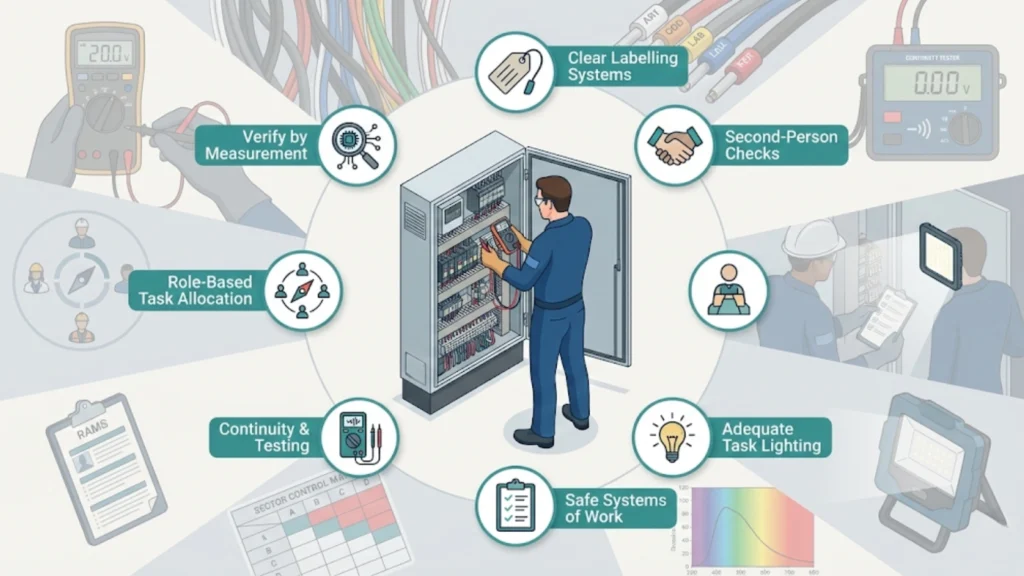
If you’re researching how colour blind electricians actually do the work, you’re asking the right question. Here’s the thing: colour vision matters in electrical work, the industry doesn’t pretend it doesn’t. Conductors are colour-coded for a reason, phase identification relies on visual cues, indicator lights use red-green-amber systems. But here’s what matters more: electrical safety in the UK (and internationally) is built on verification, not assumption. The fundamental principle that keeps people alive isn’t “identify the brown wire by looking at it,” it’s “test to confirm what you’re working on before you touch it.” That distinction is everything. Colour vision deficient electricians work safely because they’ve systematized what everyone should be doing anyway: labelling conductors, testing with multimeters, cross-checking identifications, working to documented procedures, using adequate lighting, and never, ever assuming a wire is what it looks like without confirming. This isn’t about heroic adaptation or special accommodations (though some exist). It’s about understanding that competence under the Electricity at Work Regulations 1989 is defined by preventing danger through knowledge and practice, not by having perfect colour perception. BS 7671, the UK wiring regulations, explicitly permits identification methods beyond colour coding because the drafters understood that verification by testing is the actual safety control. This article explains how colour vision deficient electricians manage the real challenges (cable identification in poor light, indicator lights, faded installations), what mitigations are used across domestic, commercial, and industrial settings (labelling systems, multimeter confirmation, second-person verification, task lighting, role allocation), and how employer and site controls layer safety through RAMS, permit systems, and supervision. No testimonials. No hype. Just the systematic approaches that make electrical work safe regardless of colour vision.
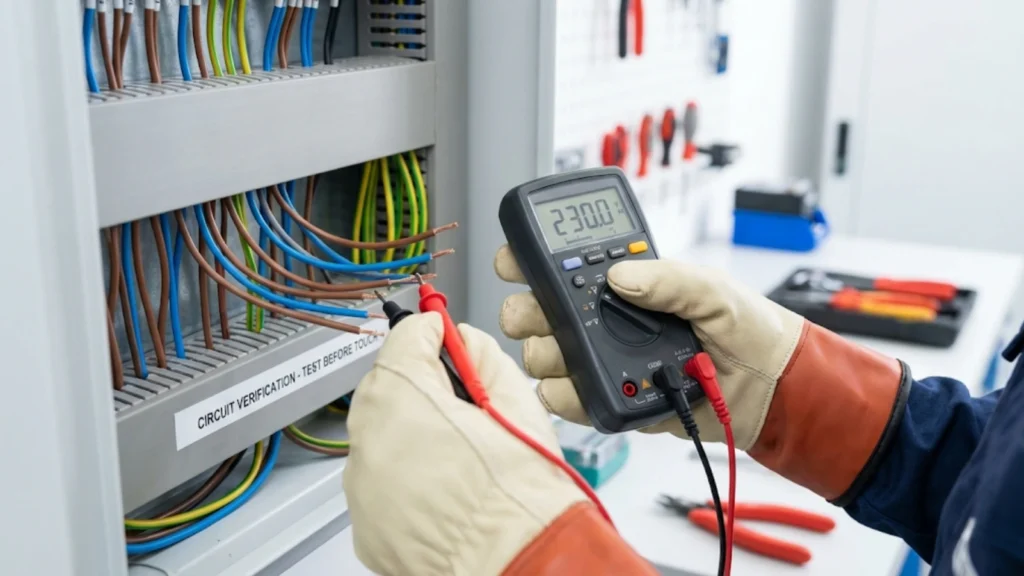
Why Colour Vision Matters (And Why It's Not The Only Thing That Matters)
Let’s be honest: colour coding exists for good reasons. BS 7671:2018+A3:2024 specifies brown for line conductors, blue for neutral, green-yellow for protective earth in the UK (with variations for three-phase systems using brown, black, grey). These standardized colours create quick visual recognition, reducing cognitive load when you’re working in ceiling voids, consumer units, or control panels. In theory, an electrician glances at a wire and knows its function. In practice, that’s not how safe work happens.
The challenges colour vision deficient electricians face are real and worth acknowledging:
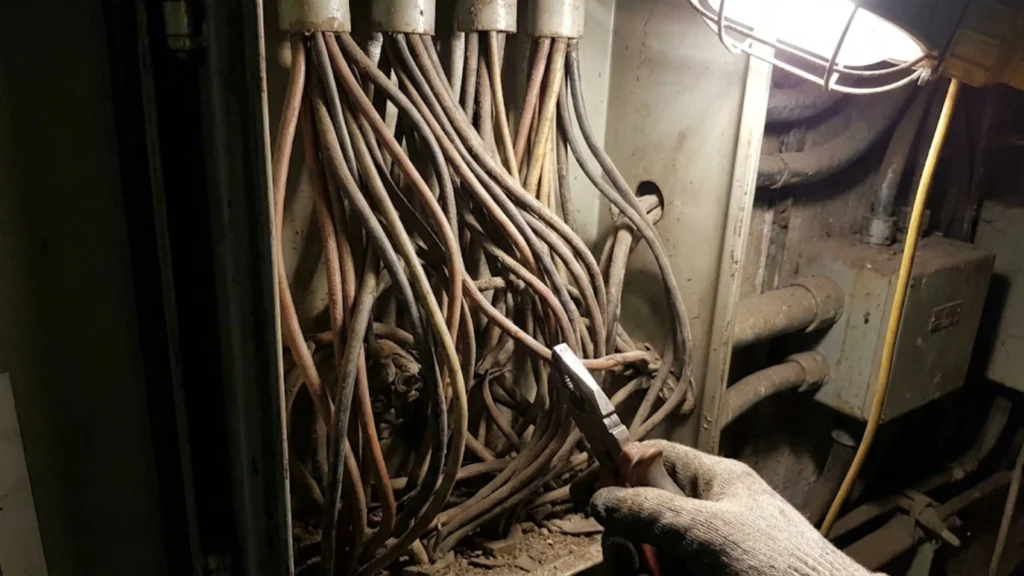
Cable identification in poor lighting. Attics, under-floor voids, plant rooms, these environments have terrible natural light. Even with torches, distinguishing brown from blue from grey when cables are dusty, old, or viewed through access hatches requires more than just functional colour vision. Add in legacy installations with pre-2004 colour schemes (red for line, black for neutral, green for earth), and you’ve got potential confusion even for people with perfect vision.
Indicator lights on panels and equipment. Control systems, fire alarm panels, machinery, generator sets, these use red-green-amber LED indicators to show status. “Red means fault/danger/live,” “green means safe/operational,” “amber means caution/standby.” If you can’t reliably distinguish red from green, particularly on older faded displays or in bright ambient light that washes out LED contrast, you’ve got a safety-critical challenge.
Faded or degraded insulation. Cables that have been exposed to heat, UV light, environmental contamination, or just age, lose colour saturation. What was once clearly brown might appear grey-brown. Blue might look grey-blue. Green-yellow might look dirty yellow. This affects everyone, but it’s worse if you’re starting from reduced colour discrimination.
Multi-core cables in industrial settings. Control panels, three-phase distribution, instrumentation, these involve bundles of similar-diameter cables where colour is often the primary visual differentiator. Grey, black, brown, blue, white, when you’ve got 20 cores in a bundle and they all look similar shades of dark under poor lighting, identification becomes challenging.
Temporary installations and extension leads. On construction sites, temporary power uses colour-coded cables and connectors. If extensions are old, dirty, or generic rather than properly marked, colour becomes the only identification method unless you systematically label everything yourself.
Here’s why colour vision matters less than people think: BS 7671 doesn’t mandate colour as the sole identification method. Regulation 514.3.1 explicitly permits alternatives, alphanumeric marking, numbered ferrules, printed labels. The regulation exists because the IET (Institution of Engineering and Technology) understands that relying on visual cues alone creates risk for everyone, not just those with colour vision deficiency. The industry has developed verification cultures in high-risk environments specifically because colour coding fails under operational conditions, cables get dirty, lighting is inadequate, time pressure causes mistakes, fatigue reduces attention.
Thomas Jevons, Head of Training with over 20 years’ experience, explains the regulatory foundation:
"Competence under the Electricity at Work Regulations 1989 is about preventing danger through knowledge and practice, not about having 20/20 vision or perfect colour perception. A colour vision deficient electrician who labels everything, tests everything, and works to documented procedures is demonstrably more competent than someone with perfect vision who makes assumptions and skips verification steps."
Thomas Jevons, Head of Training
The challenges are real. The mitigations are systematic. The outcome is that colour vision deficient electricians work across domestic, commercial, and industrial settings by implementing verification protocols that should be standard practice anyway.
Mitigation 1: Labelling and Numbering Systems
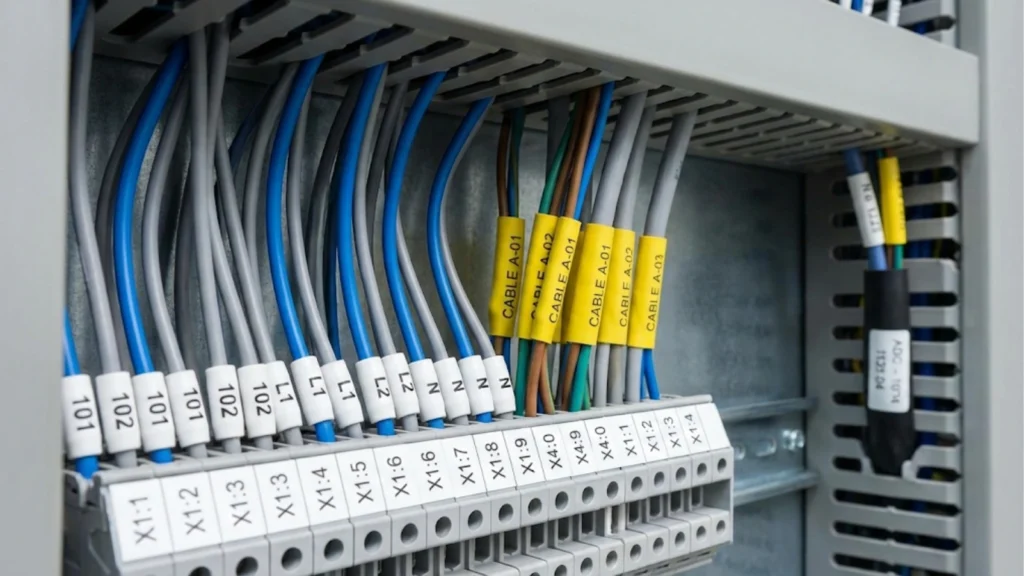
This is the most fundamental mitigation and it’s not specific to colour vision deficiency. Alphanumeric marking, numbered ferrules, printed cable markers, heat-shrink labels, these are standard practice in competent electrical work. The difference is that colour vision deficient electricians don’t treat labelling as optional or only for complex installations, they systematize it for everything.
What it involves: Applying identification to every conductor at every termination point. In domestic consumer units, this might mean labelling each circuit at the board end (“Kitchen Ring,” “Upstairs Lights,” “Shower”). In industrial control panels, it means numbered ferrules on every wire matching the circuit diagram (L1, L2, L3, N, E, or alphanumeric codes for specific functions). In commercial installations, it involves printed markers on multi-core cables identifying each core’s function.
Where it’s used: Universal in industrial and commercial settings where BS 7671 and good practice demand it. Increasingly common in domestic work as consumer units become more complex with RCBOs, surge protection, and multiple circuits. The electricians who don’t label are typically working in simple domestic scenarios or relying on “I know this installation because I did it,” which breaks down when someone else needs to work on it later.
Why it works: Labelling creates a non-chromatic identifier that’s verifiable, permanent, and unambiguous. If a terminal is marked “L1” and the cable arriving at it is marked “L1,” you’ve confirmed identification without any colour judgment. If the marking disagrees with the colour (which can happen with reused cables or errors), the labelling takes priority and you investigate why there’s a discrepancy before proceeding.
Types of labelling systems:
- Numbered ferrules: Small plastic or metal sleeves that slide onto wire ends with printed numbers or letters. Standard in industrial control panels. Available in different sizes for different cable gauges. Reusable in some formats, one-time in others.
- Heat-shrink markers: Printed labels that shrink onto cables when heated, creating permanent identification that doesn’t slip or degrade. Used for marking at multiple points along a cable run, not just terminations.
- Adhesive cable labels: Printed or handwritten labels wrapped around conductors, often laminated for durability. Common in temporary installations or retrofit work where ferrules aren’t practical.
- Terminal block markers: Printed strips that clip into terminal blocks showing what each position connects to. Creates a visual schedule at the termination point.
- Colour-coded (ironically) sleeving with printed text: Uses both colour and text, so if you can’t see the colour you can read the text. Common in three-phase work where brown/black/grey sleeving also has “L1″/”L2″/”L3” printed on it.
The discipline required: Labelling isn’t complicated, but it requires discipline. Every wire, every time, before you make connections. For colour vision deficient electricians, this becomes non-negotiable rather than aspirational. The challenge is maintaining the system under time pressure, when you’re doing “just a quick fix” or “it’s obvious what this wire is,” because those are the moments where errors happen.
BS 7671 backing: Regulation 514.3.1 states that identification can be by colour, alphanumeric marking, or other means, and specifically notes that colour alone is acceptable but not mandatory. Regulation 514.5 covers labelling requirements for circuits. The regulations support labelling as a primary identification method, not just a backup for colour.
Mitigation 2: Verification by Measurement, Not Visual Assumption
Here’s the fundamental principle that makes colour vision less critical than people think: you never trust what a wire looks like, you test what it does. This is the “prove-test-prove” methodology for safe isolation, but it applies to identification too.
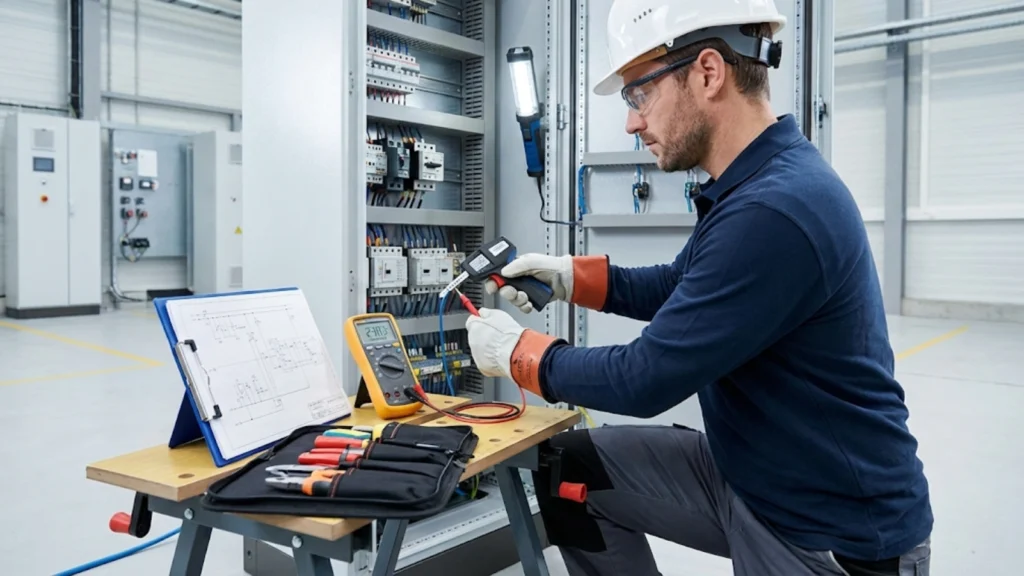
What it involves: Using electrical testing instruments, multimeters, continuity testers, voltage indicators, to confirm a conductor’s function rather than assuming based on visual appearance. If you need to identify the line conductor in a lighting circuit, you test for voltage. If you need to confirm a cable run connects where the drawing says it does, you test continuity from one end to the other. Colour tells you what something probably is. Testing tells you what it actually is.
Where it’s used: Everywhere. BS 7671 Section 612 requires initial verification of new installations through inspection and testing. BS 7671 Section 643 requires periodic inspection and testing. The Electricity at Work Regulations 1989, Regulation 4, requires systems to be constructed and maintained to prevent danger, which inherently requires verification that systems are correctly identified and connected. This isn’t optional, it’s legal requirement.
Why it works for colour vision deficiency: Testing instruments provide non-visual confirmation. A multimeter measuring 230V between a conductor and earth tells you it’s a line conductor regardless of what colour the insulation appears. A continuity tester showing zero ohms between two ends of a cable tells you it’s the same cable regardless of whether you can distinguish its colour from adjacent cables. Testing removes colour from the decision-making process entirely.
Common testing methods:
- Voltage testing: Confirming presence or absence of voltage using a voltage indicator or multimeter. Standard practice before touching any conductor. Tells you if something is live (line conductor) or dead (neutral, earth, or isolated line).
- Continuity testing: Sending a test current through a conductor and measuring resistance. Used to confirm cable runs, identify which conductor is which when you’ve got multiple cables in a bundle, and verify earth continuity. If you short two conductors together at one end and test for continuity at the other end, you’ve identified those specific conductors regardless of colour.
- Polarity testing: Confirming that line and neutral are connected correctly at accessories. Prevents situations where the neutral is connected to the switch rather than the line, which could leave a fitting live when switched off. Testing confirms correct connections regardless of wire colour.
- Insulation resistance testing: Measuring resistance between conductors and earth to confirm insulation integrity. While this doesn’t identify conductors directly, it’s part of the verification culture that replaces visual assumptions with measured confirmation.
The “ring out” technique: This is particularly valuable for identifying conductors in multi-core cables or where you’ve got multiple similar cables. At one end, you temporarily short (connect together) two specific conductors. At the other end, you test continuity to see which pair shows zero resistance. Those are your identified conductors. You label them, disconnect the temporary short, move to the next pair. Repeat until all conductors are confirmed and labelled. Colour is irrelevant to this process.
Digital vs analogue instruments: Older analogue multimeters with colour-coded dials or needle positions could present challenges for colour vision deficient users. Modern digital instruments display numerical values on LCD screens, eliminating colour interpretation. Most electricians use digital instruments anyway due to accuracy and ease of reading, but for colour vision deficient electricians, digital readouts are non-negotiable.
The culture shift: Training emphasizes “test don’t assume” from day one. For colour vision deficient apprentices, this isn’t just about safe isolation (though that’s critical), it’s about every identification decision. The apprentice who tests everything, documents everything, and labels everything isn’t being cautious or slow, they’re demonstrating competence. The one who says “it’s obviously the brown wire, I can see it” without testing is failing competence standards regardless of whether their visual identification was correct.
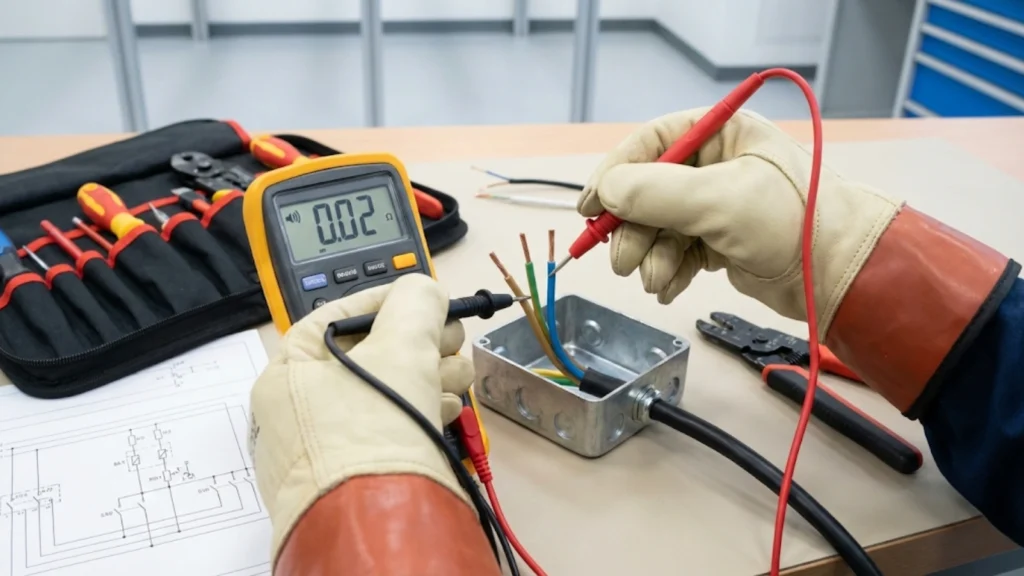
Mitigation 3: Cross-Checking and Second-Person Verification
In high-risk environments, verification isn’t done alone. Second-person checks, peer review, structured sign-offs, these create safety barriers that don’t rely on any individual’s perception or judgment.
What it involves: Having a colleague verify your identification before proceeding with safety-critical work. This might be formal (required by permit-to-work systems, documented in RAMS) or informal (asking a mate to confirm before you energize a circuit). The principle is eliminating single-point failure, if one person makes an identification error, the second person catches it before consequences happen.
Where it’s used: Standard practice in industrial settings for high-voltage work, three-phase connections, generator paralleling, circuit energization after maintenance. Common in commercial projects during testing and commissioning. Less formalized in domestic work but still encouraged for complex installations like solar PV integration, EV charger installations, or consumer unit upgrades.
Why it works: Two sets of eyes using different verification methods (one person checks colour and labelling, another confirms with testing) create redundancy. If one person has colour vision deficiency, the other might verify visually while the first confirms by testing. If both use testing and labelling, colour becomes completely irrelevant to the verification process.
Joshua Jarvis, Placement Manager, explains the team benefit:
"Second-person verification isn't just for colour vision deficiency, it's standard practice in high-risk tasks. When you're energizing a new installation, connecting generators, working on three-phase distribution, you want a colleague checking your identifications. Teams with colour vision deficient members often have stronger verification cultures because they've normalized asking for confirmation rather than treating it as admitting weakness."
Joshua Jarvis, Placement Manager
Types of verification:
- Formal permit sign-offs: Industrial sites use permit-to-work systems requiring multiple signatures confirming isolation, identification, and safety measures. One person performs the work, another independently verifies it before authorization to proceed. This creates documented accountability and forces verification.
- Commissioning checks: When new installations are energized for the first time, at least two people should be present, one operating switches/controls, another monitoring for correct operation and unexpected issues. This catches identification errors (wrong phase connected, polarity reversed) before equipment damage or injury occurs.
- Informal peer checks: “Mate, can you confirm this is the line conductor before I connect it?” is professional practice, not weakness. Normalizing these requests, especially for safety-critical connections, reduces errors across teams regardless of colour vision.
- Supervisor verification: Apprentices and trainees have their work checked by qualified supervisors. This serves training purposes but also catches errors before they become dangerous. For colour vision deficient apprentices, supervisors might initially verify every identification until the apprentice demonstrates systematic labelling and testing habits.
Cultural resistance: Some electricians view asking for verification as admitting incompetence. “I’ve been doing this 20 years, I don’t need someone checking my work” is a mindset that causes accidents. Teams that normalize verification, where everyone checks everyone regardless of experience level, are safer. Colour vision deficient electricians often help shift this culture because their need for verification is obvious and non-threatening, which makes it acceptable for others to ask as well.
Documentation value: Written verification (someone signs a checklist confirming identifications are correct) creates accountability and forces conscious review rather than automatic actions. This benefits everyone by interrupting habitual patterns where errors creep in.

Mitigation 4: Environmental Controls and Task Lighting
You can’t identify colours you can’t see clearly. Environmental mitigations improve contrast, reduce shadows, and eliminate the visual degradation that makes conductor identification difficult for everyone.
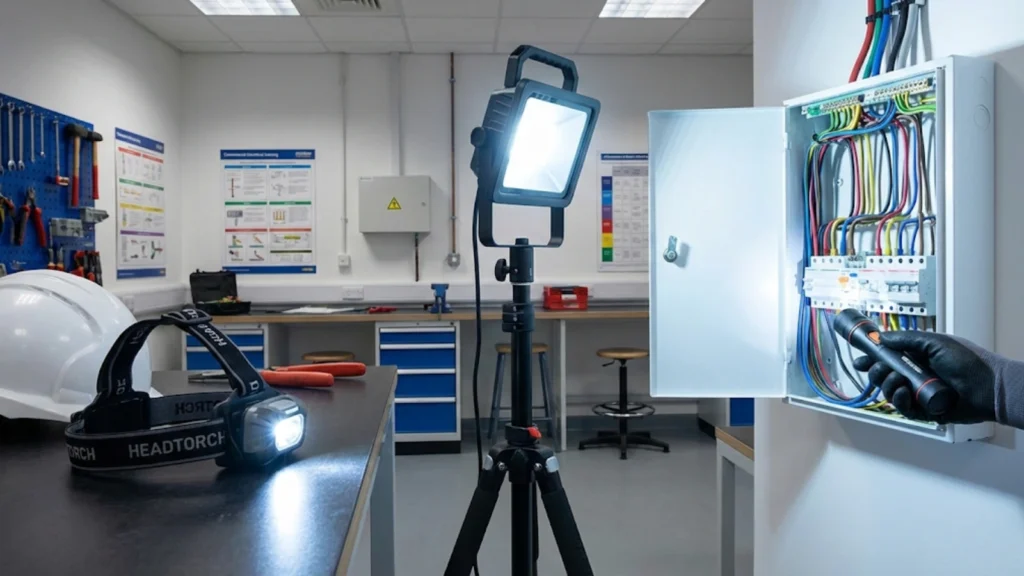
What it involves: Using task-specific lighting to illuminate work areas beyond general ambient lighting. This includes LED headtorches (5000K+ colour temperature for high colour rendering), portable work lights, inspection torches, and in some cases, permanent installation of improved lighting in frequently-accessed areas like plant rooms or consumer unit locations.
Where it’s used: Essential in domestic work (loft spaces, under-floor voids, cupboards housing consumer units). Standard in commercial and industrial maintenance where working in plant rooms, cable trays above false ceilings, or machinery enclosures. Temporary site lighting for construction electrical work.
Why it works: Adequate lighting increases contrast between colours, making brown, blue, and grey more distinguishable. High colour rendering index (CRI) lighting reveals true colours rather than shifting them (cheap LED lights can make everything look washed out or shifted toward blue/green, even for people with normal colour vision). Eliminating shadows reduces the “is this cable brown or is it just in shadow?” ambiguity.
Colour rendering index (CRI) explained: Standard metric for how accurately a light source reveals colours compared to natural daylight. CRI of 100 is perfect (natural sunlight). CRI of 80+ is considered good for general use. CRI of 90+ is high-quality for colour-critical work. Cheap LED lights might have CRI of 70 or below, which distorts colours significantly. For electrical work, particularly for colour vision deficient electricians, using 90+ CRI lighting reduces colour ambiguity.
Types of task lighting:
- LED headtorches: Hands-free lighting that follows your field of view. Modern versions offer adjustable brightness, flood/spot beam options, and 5000K+ colour temperature. These are standard equipment for any electrician working in ceiling voids or under floors, but colour vision deficient electricians prioritize high-CRI models.
- Portable LED work lights: Battery or mains-powered lights providing 1000+ lumens for illuminating work areas. Useful for lighting entire consumer units, panel interiors, or cable termination points during installation and testing.
- Inspection torches: Small, bright, focused lights for close-up examination of specific conductors, particularly in dense cable bundles or control panels. Medical-grade inspection torches with 95+ CRI are available though typically expensive.
- Fixed installation improvements: In industrial settings, improving permanent lighting in electrical rooms, switchgear areas, and cable routing corridors reduces reliance on portable lighting and ensures consistent visibility for all maintenance work.
Environmental housekeeping: Cleaning dust and grime from cables before identification helps everyone. Colour vision deficient electricians might be more systematic about this, using a cloth to wipe conductors before confirming identity, because they’re aware that environmental factors (dust, paint overspray, cable lubricant residue) further reduce their already-limited colour discrimination.
The limitation: Lighting helps but doesn’t eliminate colour vision challenges. If you genuinely cannot distinguish red from green due to absent cone receptors (protanopia or deuteranopia), no amount of lighting will create colour perception that doesn’t exist. Lighting is a supplementary mitigation that improves identification in conjunction with labelling and testing, not a standalone solution.
Mitigation 5: Work Allocation and Role-Based Task Design
Not all electrical work presents the same colour-critical challenges. Matching tasks to capabilities, while maintaining overall competence, is legitimate risk management rather than discriminatory exclusion.
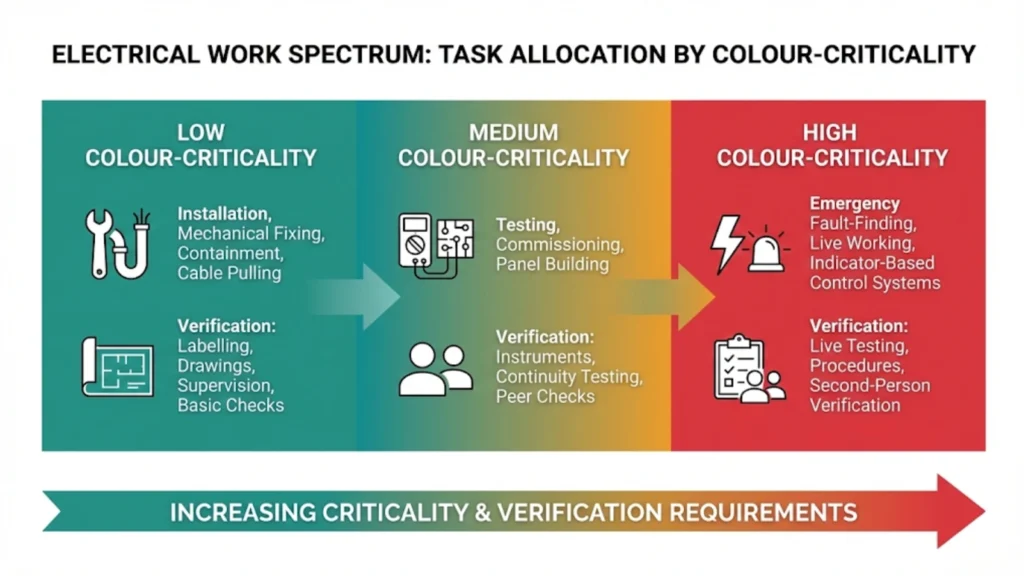
What it involves: Structuring work assignments so that colour-critical tasks under time pressure with poor lighting are handled by team members who can perform them with confidence, while colour vision deficient electricians focus on tasks where systematic verification is practical and preferred. This doesn’t mean relegating colour vision deficient electricians to only “easy” work, it means recognizing that emergency fault-finding in a dark plant room with a production line down is different from methodical installation where you can label, test, and verify at your own pace.
Where it’s used: Team-based industrial environments where work is allocated by supervisors or project managers. Commercial projects with multiple electricians where tasks naturally divide (some do rough-in installation, others do terminations and testing, others do commissioning and fault-finding). Less relevant in solo domestic work where the electrician handles all aspects, though even there some tasks are more colour-critical than others.
Why it works: Safety-critical decisions under time pressure require confidence. If an industrial electrician needs to identify which of three similar-looking cables is feeding a fault and production is stopped waiting for resolution, colour confidence matters. If that same electrician is installing new cable runs with time to label, test, and verify systematically, colour becomes largely irrelevant. Matching tasks to strengths is efficient risk management.
Examples of role allocation:
- Installation-focused roles: Pulling cables, making mechanical fixings, installing containment, rough-in work. These typically occur during daylight, can be labeled systematically, and don’t involve making safety-critical identifications under pressure. Colour vision is minimally relevant.
- Testing and commissioning: Methodical work following documented procedures, usually with good lighting and time to verify. Initial energization involves careful checking regardless of colour vision. Periodic testing follows the same verify-everything approach. Suitable for colour vision deficient electricians who work systematically.
- Maintenance and fault-finding: This is where colour-critical challenges peak. Identifying which cable in a bundle has failed, tracing faults in control circuits, emergency repairs under production pressure, these combine poor lighting, time constraints, and reliance on visual cues. Some colour vision deficient electricians handle this fine with lighting and labelling, others acknowledge this isn’t their strength and focus on installation or planned maintenance.
- Design and documentation: Creating circuit diagrams, calculating load requirements, specifying equipment, compliance documentation. Zero colour-vision requirement. Some electricians transition to more design-focused roles as they gain experience, which can be natural career progression for those who prefer systematic work over emergency reactive maintenance.
The ethical line: Work allocation becomes problematic when it’s used to exclude rather than optimize. “You have colour vision deficiency so you can only do basic installation work forever” is discrimination. “Given your systematic approach and preference for methodical work, we’ll have you focus on installations and planned maintenance while Steve handles the emergency call-outs because he’s faster at fault-finding” is legitimate allocation based on demonstrated performance, not diagnosis.
Solo domestic work: Self-employed domestic electricians control their own task allocation. Colour vision deficient electricians in this sector often avoid certain work types (emergency fault-finding, fire alarm maintenance where indicator interpretation is critical) and focus on installation, consumer unit upgrades, testing and inspection where systematic verification is practical. This is business decision-making, not medical restriction.
Layered Site and Employer Controls: How Systems Create Safety
Individual mitigations matter, but they exist within larger safety management systems. Risk in electrical work is managed through layered controls, documented procedures, supervision, and structured verification that reduce dependence on any individual’s visual perception.
Risk Assessments and Method Statements (RAMS): These documents outline how specific work will be done safely. A RAMS for panel modification might specify: (1) obtain and review circuit diagrams before starting, (2) label all existing conductors before disconnection, (3) test all conductors for voltage using calibrated instrument, (4) use numbered ferrules on all new connections, (5) have second person verify connections before energization. These steps incorporate verification at multiple points, making colour vision largely irrelevant to safe completion. RAMS exist for high-risk tasks and get reviewed before work starts, creating conscious planning rather than habitual working.
Permit-to-Work Systems: Common in industrial environments (manufacturing, utilities, petrochemical, food processing), permits authorize and control specific high-risk tasks. A permit for working on electrical systems might require: isolation confirmed by authorized person, warning signs posted, lock-out/tag-out applied, testing completed, identifications verified and signed off by supervisor, work authorized by electrical engineer. These create formal verification gates where work cannot proceed without documented checks. The system doesn’t care about colour vision, it cares about verifiable confirmation that identifications are correct.
Supervision and Competence Assessment: Apprentices and trainees work under supervision, with qualified electricians checking their work before it’s energized or left in service. For colour vision deficient apprentices, supervisors verify that systematic approaches (labelling, testing, documentation) are being used correctly. Over time, as the apprentice demonstrates competence, supervision reduces. The assessment isn’t “can you see colours,” it’s “do you make safe, verifiable identifications.”
Documented Procedures: Industrial facilities often have site-specific electrical safety procedures beyond generic RAMS. These might specify exact testing sequences, required labelling formats, sign-off requirements for particular equipment types. Following documented procedures removes decision-making about “how should I identify this,” you follow the written method. Colour vision becomes one input among many, not the primary decision factor.
Equipment and Circuit Schedules: Panel schedules, circuit diagrams, “as-built” drawings, these provide the authoritative reference for what should be where. If the drawing shows terminal 5 should have the brown line conductor from cable 23, you verify that cable 23 is indeed connected to terminal 5 (by label and testing), not by assuming the brown-looking wire is correct. Documentation becomes the source of truth, physical installation gets verified against it.
Lock-Out/Tag-Out (LOTO) Systems: Before working on equipment, isolation is applied and locked. Tags identify who applied the lock and why. The tag system often uses colour (red tags for danger), but also includes text, numbers, and standardized positions. Reading the tag text (“Danger: Do Not Operate, John Smith 3/2/26”) provides information regardless of whether you can see that it’s red.
Role Allocation at Site Level: Large industrial sites allocate work based on competence and authorization levels. Not every electrician is authorized to work on high-voltage systems. Not every electrician is permitted to perform live working. These allocations are based on training, experience, assessment, and risk factors, which might include colour vision for specific roles but aren’t solely about it. The framework exists to match capabilities to requirements.
The Cultural Element: Verification culture varies by employer. Some companies normalize “test everything, label everything, ask if uncertain.” Others have cultures of “experienced electricians know what they’re doing, don’t need checks.” The former is safer for everyone and particularly supports colour vision deficient electricians by making systematic verification expected rather than optional. The latter creates pressure to work fast and rely on visual confidence, which excludes those who can’t do that safely.

Sector Differences: Domestic, Commercial, and Industrial Controls
How colour vision deficiency is managed differs significantly across sectors because the risk profiles, working methods, and control structures vary.
Domestic Electrical Work
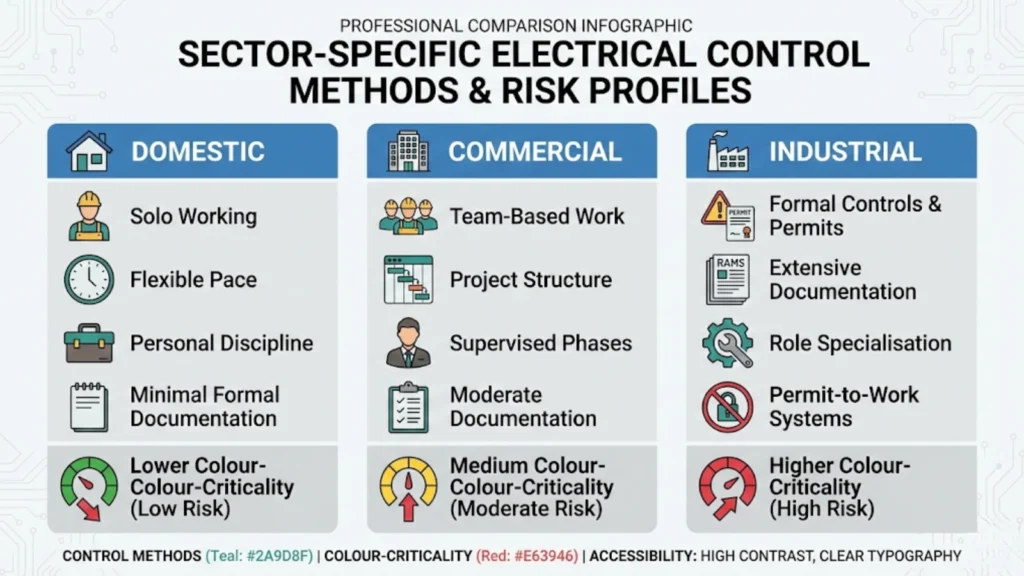
Characteristics: Solo or small-team work, electrician controls their own environment and pace, direct client relationships, work scope from minor repairs to full rewires, less formal documentation and supervision, reliance on personal verification tools and discipline.
Colour-critical challenges: Identifying cables in loft spaces and under floors with poor lighting, working with old installations (pre-2004 colours plus decades of modifications), determining which circuit is which when consumer unit labeling is missing or incorrect, fault-finding in occupied homes where you can’t spend unlimited time testing.
Controls available: Personal labelling discipline (marking every conductor you work on), bringing adequate lighting (LED headtorch, work lights), systematic testing before making assumptions, taking photos of existing installations before modification as reference, spending the time to trace circuits properly rather than rushing.
What works well: Domestic electricians set their own pace. If you need extra time to label and test, you can take it without production pressure. Clients generally don’t care how long verification takes as long as the work is safe and correct. Work can be scheduled during daylight hours if needed. You have complete control over your verification methods.
What’s challenging: Working alone means no second-person verification unless you bring a colleague. Emergency call-outs create time pressure (client’s heating is off, they want it fixed now, not after you’ve spent an hour methodically testing). Fault-finding in occupied properties requires speed that might conflict with systematic verification. Older installations often lack documentation, forcing you to trace everything from scratch.
Who succeeds: Colour vision deficient electricians in domestic work tend to specialize in installation and testing rather than emergency repairs. They build reputations for thoroughness and systematic approach, which clients value. They might avoid certain work types (fire alarm maintenance, security system fault-finding where indicator interpretation is critical) and focus on rewires, consumer unit upgrades, solar PV, EV chargers where methodical work is expected. Honestly, if earnings vary across electrical sectors, domestic work offers flexibility but requires self-discipline in verification when there’s no external structure enforcing it.
Commercial Electrical Work
Characteristics: Project-based work with defined scope and timelines, team environments with task allocation, more documentation (plans, specifications, inspection requirements), client representatives and main contractors providing oversight, variety from office fit-outs to retail to leisure facilities.
Colour-critical challenges: Working in partially-occupied buildings during fit-outs (poor lighting, dusty conditions), coordinating with other trades who might disturb your work, temporary installations that get modified frequently, three-phase distribution and sub-mains requiring confident phase identification, control systems for HVAC, access, and lighting with multiple similar cables.
Controls available: Team-based verification where colleagues can confirm identifications, documented installation plans and circuit schedules to verify against, supervision from project electricians or site managers, structured testing phases before handover, opportunity to label systematically during installation because it’s new work.
What works well: Commercial projects have structure, timelines, and documentation that support systematic verification. You’re rarely working alone, so peer checks are natural. New installations allow labelling from the start rather than dealing with unlabeled existing work. Testing and commissioning are expected phases, not rushed additions, giving time for thorough verification.
What’s challenging: Project timelines create pressure to work at pace. If you’re slower than team members because you’re being more systematic about verification, it might cause tension or scheduling issues. Working in occupied buildings (schools during term time, retail overnight, offices on weekends) creates time constraints where methodical verification might conflict with access windows. Fault-finding in newly-installed but not-yet-documented systems requires confidence.
Who succeeds: Colour vision deficient electricians in commercial work often focus on installation and first-fix rather than fault-finding and modifications. Their systematic labelling during installation creates better documentation for everyone, which project managers and clients value. Team environments allow natural task allocation where colour-confident electricians handle the urgent reactive work while systematic electricians focus on quality installation.
Industrial Electrical Work
Characteristics: Highly structured environments with formal safety systems, work on production machinery, control systems, high-voltage distribution, permit-to-work requirements, dedicated electrical teams with role specialization, extensive documentation and drawings, supervision and authorization hierarchies.
Colour-critical challenges: Complex control panels with hundreds of similar cables, working in operational plant rooms with machinery running nearby, poor lighting in cable trenches and risers, time pressure when production equipment fails, three-phase and high-voltage systems where identification errors have severe consequences, legacy installations with mixed old and new colour schemes.
Controls available: Comprehensive RAMS and permit systems mandating verification steps, second-person verification as standard practice, circuit diagrams and “as-built” drawings as authoritative references, numbered ferrule systems universal in control panels, supervision and authorization limiting who can work on what systems, formal competence assessments before authorization to work on critical equipment.
What works well: Industrial environments provide the most structured controls that support colour vision deficient electricians. The permit system prevents rushing. Documentation provides authoritative reference beyond visual judgment. Team-based working with formal verification is normal, not accommodation. Specialization allows focusing on roles that match strengths (planned maintenance, installation, testing) rather than being expected to do everything (emergency fault-finding).
What’s challenging: Access to roles might require medical clearance, and some industrial sites have stricter colour vision standards than others. Emergency maintenance creates pressure despite formal controls. Working on legacy equipment with degraded labelling or missing documentation forces more reliance on visual identification. The expectation of multi-competence (electricians should handle HV, LV, control systems, instrumentation) might push colour vision deficient electricians toward areas they find challenging.
Who succeeds: Colour vision deficient electricians in industrial settings often specialize in installation, planned maintenance, or testing rather than emergency fault-finding. They benefit from the structured systems that make verification mandatory rather than optional. Their systematic approach to labelling and documentation makes them valuable for project work and upgrades where quality matters more than speed.
Success Through Systematic Practice: What Actually Works
Colour vision deficient electricians work across all sectors of the electrical industry. Their success isn’t about overcoming disability or heroic adaptation, it’s about systematizing verification practices that should be standard anyway. Here’s what the evidence shows works:
Treating labelling as non-negotiable, not aspirational. Every conductor, every termination, every time. Using numbered ferrules in control panels, heat-shrink labels on multi-core cables, written circuit identifiers at consumer units. This discipline eliminates most colour-dependent decisions and creates documentation that benefits everyone working on the installation later.
Testing for confirmation, not just for compliance. Using multimeters and continuity testers to verify what conductors are, not just whether they meet resistance thresholds. The “ring out” technique to identify specific conductors in bundles. Voltage testing before and after isolation to confirm both that circuits are dead and which conductor was the line. Testing provides non-visual confirmation that overrides colour ambiguity.
Normalizing verification requests. Asking colleagues to confirm identifications, especially in safety-critical contexts (energization, three-phase connections, high-voltage work). Teams that treat verification as professional practice rather than weakness create environments where everyone checks everyone, reducing errors across the board regardless of colour vision.
Using adequate lighting without compromise. Investing in high-CRI LED headtorches and work lights rather than cheap alternatives. Treating lighting as essential equipment, not optional. Taking time to position lighting properly before making identification decisions. Cleaning cables and components before examining them. These environmental controls improve identification for everyone.
Specializing strategically. Understanding which work types play to your strengths and which present genuine challenges. Installation and planned maintenance work suits systematic verification better than emergency fault-finding under time pressure. Some colour vision deficient electricians build entire careers in installation and testing, others handle all aspects by adapting their methods. Both are valid, the key is knowing your capabilities and working within them or developing methods to expand them.
Working to documented procedures. Following RAMS, using circuit diagrams as authoritative reference, completing testing schedules systematically. Documentation removes the “I think this wire is…” decision-making and replaces it with “the drawing shows this should be… and testing confirms it is…” verification. This benefits everyone but particularly supports those who can’t rely on visual confidence.
Maintaining verification discipline under pressure. The biggest risk is shortcuts, “just this once,” “it’s obviously this wire,” “no time to test properly.” Colour vision deficient electricians who succeed maintain systematic verification even when pressured to rush. Sometimes this means declining work that can’t be done safely within their verification methods. That’s professional judgment, not limitation.
The competence framework: Electrical qualification pathways and requirements emphasize competent practice, which BS 7671 and EAWR 1989 define as preventing danger through knowledge, experience, and procedure. Colour perception isn’t listed as a competence requirement. Systematic verification, testing, and documentation are. The electricians who master these, regardless of colour vision, demonstrate competence. Those who rely on visual shortcuts, regardless of how good their colour vision is, create risk.
What doesn’t work: Pretending colour vision doesn’t matter and hoping to get by on luck. Avoiding systematic verification because it takes longer. Working beyond your verified capabilities because you don’t want to admit limitations. Relying solely on accommodations from others rather than developing your own verification systems. These approaches create risk and ultimately limit career options more than systematic competence does.
Myths vs Reality: Workplace and Training Misconceptions
Myth: Electricians rely on colour to do everything in electrical work.
Reality: Identification uses multiple methods, and BS 7671 Regulation 514.3.1 explicitly allows labelling and alphanumeric marking as alternatives to colour. Risk is managed through verification by testing, not colour alone. Competent practice requires confirming identifications through measurement, not assuming based on visual appearance.
Myth: Colour blindness means unsafe work in all electrical roles.
Reality: Risks are controlled through systematic approaches like multimeter confirmation, labelling, peer verification, and documented procedures. Practitioners across domestic, commercial, and industrial sectors work successfully with colour vision deficiency by implementing verification systems that should be standard practice anyway.
Myth: You can ignore colour vision testing and just not tell anyone.
Reality: HSE guidance recommends risk-based colour vision assessment for safety-critical roles where colour identification is essential. Some employers and schemes (JIB apprenticeships, certain industrial sites) require testing. However, the assessment should focus on functional ability (can you identify conductors using available verification methods?) not just screening results. Competence is about overall safe practice, not perfect colour vision.
Myth: If you pass electrical training, you automatically pass employment medical clearance.
Reality: Training providers assess competency against qualification standards, which don’t include medical requirements. Some employers, particularly in heavy industry, conduct separate occupational health assessments that may include colour vision testing. JIB apprenticeship standards include colour vision requirements. However, training completion and employment fitness are separate gatekeeping processes, and passing one doesn’t guarantee the other.
Myth: Colour codes are the only way to identify wires in electrical work.
Reality: BS 7671 permits numbering, lettering, and printed labels as primary identification methods. Verification tools (multimeters, continuity testers) confirm conductor functions without any colour judgment. The “ring out” technique identifies specific conductors in bundles regardless of colour. Modern practice emphasizes test-to-confirm over visual assumption for everyone.
Myth: All electrical roles are equally colour-critical in their demands.
Reality: Installation work with good lighting and time for labelling presents minimal colour challenges. Emergency fault-finding in poor lighting under time pressure is highly colour-critical. Industrial work often has more documentation and structured verification than domestic. Sectors and roles vary in how much they depend on colour identification, allowing specialization based on capabilities.
Myth: Colour vision deficient people can’t read circuit diagrams or understand electrical theory.
Reality: Circuit diagrams use symbols, line styles, and labels, not colour-dependent information. Electrical theory (Ohm’s law, power calculations, circuit analysis) doesn’t involve colour. The intellectual and theoretical aspects of electrical work are completely unaffected by colour vision. The challenge is physical identification of conductors, not understanding electricity.
Myth: Modern installations with good labelling eliminate all colour challenges.
Reality: Even well-labeled installations require initial identification to apply labels. Fault-finding involves determining which cable among many is faulty, often before labels are visible. Indicator lights, status LEDs, and control panels use colour coding that labels don’t replace. Labelling is a major mitigation but not complete elimination of colour relevance.
Myth: You need special expensive equipment to work with colour blindness.
Reality: Standard professional equipment works fine. Digital multimeters (which most electricians use anyway) display numerical values. LED headtorches with high CRI cost £30-50, similar to standard models. Ferrules and labels are normal installation materials. The “special equipment” is just high-quality versions of what competent electricians use already.
Myth: Colour blind electricians are limited to basic domestic work only.
Reality: Colour vision deficient electricians work in industrial control panel building, commercial installations, testing and inspection, solar PV, EV charging infrastructure, and other sectors. Role allocation within sectors matters more than sector exclusion. Some work in all sectors, others specialize based on where their systematic verification approach is most valued.
Myth: Training providers exclude colour blind people from electrical courses.
Reality: Most training providers (Elec Training and others) assess competency, not medical fitness. You can complete electrical qualifications, apprenticeships, and degrees with colour vision deficiency. Exclusions happen at employment stage by specific employers with safety-critical requirements, not at training stage by awarding bodies.
Myth: BS 7671 regulations require perfect colour vision for electrical work.
Reality: BS 7671 specifies colour coding as one identification method but permits alternatives (Regulation 514.3.1). The regulations focus on verification through testing (Section 612 for initial verification, Section 643 for periodic inspection). Competence under EAWR 1989 is about preventing danger through knowledge and procedure, not vision quality.
FAQs
How do colour blind electricians identify cables safely in practice?
Through systematic verification combining multiple methods: labelling every conductor with numbered ferrules or printed markers, testing with multimeters to confirm functions electrically (voltage testing for line identification, continuity testing to trace specific cables in bundles), cross-checking against circuit diagrams and documentation, using adequate task lighting (high-CRI LED headtorches and work lights), and requesting peer verification for safety-critical connections. The principle is test-don’t-assume, confirming identifications through measurement rather than visual judgment. BS 7671 Regulation 514.3.1 permits alphanumeric identification as an alternative to colour, supporting this approach.
Can colour blind people work in industrial electrical roles?
Yes, though it varies by employer and specific role. Industrial environments often provide the most structured controls, permit-to-work systems, mandatory second-person verification, comprehensive documentation, numbered ferrule systems in control panels, all of which reduce colour dependence. Some industrial sites have stricter colour vision testing in medical clearance, but many assess functional ability (can you identify conductors using available methods?) rather than applying rigid screening thresholds. Success often involves specializing in installation, planned maintenance, or testing rather than emergency fault-finding, matching systematic verification strengths to role requirements.
Do electricians actually rely on colour codes alone in real work?
No, competent practice requires verification beyond visual appearance. Safe isolation procedures mandate voltage testing, not assuming a wire is dead because it “looks like neutral.” Polarity testing confirms correct connections regardless of colour. Continuity testing identifies specific conductors in bundles by electrical properties, not insulation colour. RAMS and permit-to-work systems specify verification steps that don’t rely on colour. The electricians who work solely by colour are taking shortcuts that create risk for everyone, not following proper verification protocols.
What happens if you fail a colour vision test during electrical training?
Most training providers don’t require colour vision testing for course enrollment or qualification completion. They assess competency against educational standards, which focus on knowledge, skills, and safe practice, not medical fitness. Some JIB apprenticeship programs include colour vision testing as part of entry requirements, and failure might result in not being accepted or being directed to non-electrical trades. However, this is employer/scheme-specific, not universal across electrical training. Medical gatekeeping typically happens at employment stage, not training stage.
Are some electrical tasks more colour-critical than others?
Absolutely. Emergency fault-finding in poor lighting with production down creates time pressure and reliance on quick visual identification. Working on three-phase distribution requires confident phase identification. Fire alarm and security system maintenance involves interpreting indicator lights. These are high colour-critical tasks. In contrast, new installation with good lighting allows systematic labelling from the start. Testing and commissioning follows documented procedures with time for verification. Design and documentation work has zero colour requirement. Role allocation within the trade allows focusing on tasks that match verification capabilities.
How does verification culture differ between domestic and industrial work?
Domestic work relies on personal discipline, you set your own verification standards, provide your own lighting, decide how much time to spend testing. There’s no external structure enforcing systematic practice, but also no pressure to rush if you choose not to. Industrial work has formal controls, permit systems mandate verification steps, RAMS specify exact procedures, supervision checks compliance. The structure supports verification but also creates environments where failure to follow procedures has consequences. Commercial work sits between, with project structure and team oversight but less formality than industrial permits.
Can you use special glasses to pass colour vision tests?
Colour-correcting glasses (EnChroma, Pilestone) improve colour discrimination for some people with red-green deficiency, but they don’t restore normal colour vision. Most employers prohibit their use during colour vision testing because they’re assessing unaided functional ability. More importantly, relying on glasses in operational work creates risk if they’re lost, damaged, dirty, or you forget them. Industrial sites might prohibit them as creating dependency on equipment that can fail. They’re not a reliable mitigation for safety-critical electrical work, though some people use them for personal tasks.
What role do multimeters play in safe conductor identification?
Multimeters provide electrical verification that’s completely independent of colour. Voltage testing confirms whether a conductor is live (line) or dead (neutral/earth). Continuity testing with temporary shorting identifies specific conductors in multi-core cables by measuring which pairs show zero resistance. Polarity testing confirms correct line/neutral connections regardless of wire colour. Resistance testing verifies earth continuity. Modern digital multimeters display numerical values on LCD screens, eliminating any colour interpretation. They’re the primary verification tool that makes colour vision less critical than people assume.
How is risk managed in low-light electrical environments?
Through multiple controls: adequate task lighting (LED headtorches 5000K+ colour temperature, portable work lights providing 1000+ lumens, high-CRI lighting that renders colours accurately), labelling conductors before working in poor light where possible, testing for verification rather than relying on visual identification, second-person checks where lighting cannot be improved, and environmental improvements like installing better permanent lighting in frequently-accessed plant rooms or electrical cupboards. Some work is rescheduled to daylight hours if possible. The combination of lighting, labelling, and testing manages risk for everyone, not just those with colour vision deficiency.
Does BS 7671 require colour vision for electrical competence?
No. BS 7671 specifies colour coding as one conductor identification method but Regulation 514.3.1 explicitly permits alternatives including alphanumeric marking, numbered ferrules, and printed labels. The regulations emphasize verification through testing (Section 612 initial verification, Section 643 periodic inspection), not visual assessment. Competence is defined by ability to prevent danger through knowledge and safe practice (EAWR 1989), not vision quality. An electrician who systematically labels, tests, and verifies demonstrates competence regardless of colour perception. One who makes visual assumptions without testing doesn’t, regardless of perfect vision.
What are the real, day-to-day tasks where colour vision deficiency can create risk for electricians, and why?
Colour vision deficiency can create risk in tasks that rely on visual conductor identification, particularly:
- Identifying live, neutral, and earth conductors during wiring, fault-finding, or termination
- Phase identification (brown, black, grey) in three-phase systems
- Inspection of older, faded, or contaminated insulation
Misidentification can lead to electric shock, reversed polarity, short circuits, fire risk, or motor damage. Poor lighting, dust, and ageing installations increase the likelihood of error.
Example:
When terminating a consumer unit in low light, confusing blue (neutral) with grey (phase) can result in reversed polarity. This risk is controlled by verifying with test instruments before energising, rather than relying on colour alone.
What does “test, don’t assume” look like in real work, and how does it reduce reliance on colour identification?
“Test, don’t assume” means verifying conductor function using instruments, not colour codes.
In practice this includes:
- Safe isolation
- Proving dead with approved voltage indicators
- Continuity testing to confirm conductor routes
- Polarity testing before energisation
This approach aligns with BS 7671 and removes reliance on visual identification.
Example:
During a lighting circuit upgrade, an electrician “rings out” conductors with a continuity tester to confirm switch-to-lamp connections, rather than assuming colours are correct. This prevents faults when power is restored.
Which BS 7671-compliant alternatives to colour coding are most used on site, and when should they be applied?
BS 7671 permits alternative identification methods, including:
- Labelling (tags, engraved plates)
- Numbering systems
- Ferrules marked L1, L2, L3, N, etc.
These should be applied:
- During initial installation
- During alterations or upgrades
- Wherever colour alone is insufficient or unreliable
Example:
In a commercial panel upgrade, ferrules marked L1/L2/L3 are fitted to phase conductors before termination, allowing identification without colour discrimination and supporting traceability for future work.
How do colour-blind electricians safely identify conductors in poor lighting, dusty environments, or older installations?
Safe practice relies on visibility improvement and verification, not eyesight alone:
- Task lighting (headlamps, work lights)
- Cleaning insulation to expose markings
- Temporary labelling before testing
- Continuity and voltage testing as the primary control
Example:
In a dusty factory retrofit with faded 1970s wiring, an electrician uses task lighting, applies temporary labels, and confirms each conductor’s path with continuity testing before termination.
What are the most reliable verification tools and methods for confirming conductor function and polarity?
The most reliable tools are:
- Two-pole voltage indicators (GS38-compliant)
- Digital multimeters (voltage, resistance, continuity)
- Dedicated continuity testers
Methods include:
- Isolate → prove dead → test
- Ringing out conductors end-to-end
- Polarity verification with probe reversal
Example:
When installing a socket, an electrician rings out live and neutral conductors using continuity mode, confirming correct polarity without relying on brown/blue colours.
How do electricians handle red/green/amber indicator lights when red–green discrimination is reduced?
Electricians rely on non-colour cues, such as:
- Physical position of indicators
- Text labels (“Fault”, “Run”, “Trip”)
- Flashing patterns or sequences
- Audible alarms for critical states
Example:
In an industrial control cabinet, labels are applied next to LEDs (“Overload”, “Run”), and fault simulations are used to confirm indicator function without relying on colour recognition.
What “double-check” processes are used in safety-critical tasks, and when is second-person verification required?
Double-check processes include:
- Self-verification using instruments
- Documented test results
- Second-person verification for high-risk tasks
Second-person checks are appropriate where errors could cause injury, major outages, or equipment damage, in line with Electricity at Work Regulations 1989.
Example:
Before energising a new distribution board, one electrician completes testing, and a second competent person independently repeats checks and signs off the permit-to-work.
How do mitigations differ between domestic, commercial, and industrial settings, and which are least forgiving?
Mitigations scale with risk:
- Domestic: Testing and basic labelling
- Commercial: Supervision, documentation, structured verification
- Industrial: Lock-out/tag-out, ferrules, permits, second-person checks
Industrial environments are least forgiving due to higher power levels, complex systems, and continuous operations.
Example:
An industrial shutdown may mandate ferrules on all conductors and signed verification before re-energising, whereas a domestic rewire may rely on solo testing.
Which site or employer controls most often make colour vision deficiency manageable?
Effective controls include:
- RAMS identifying colour-related hazards
- Permit-to-work systems
- Supervision and peer verification
- Task allocation favouring testing and verification roles
These controls ensure compliance with Electricity at Work Regulations 1989 and maintain safety.
Example:
On a commercial fit-out, RAMS require numbered ferrules and supervisor verification of terminations, with paired inspections where colour discrimination may be a factor.
If an electrician suspects they may be colour blind, what practical steps should they take?
Practical steps include:
- Obtain a professional colour vision assessment
- Inform the employer to enable reasonable adjustments
- Adopt strict “test, don’t assume” practices
- Use consistent labelling and documentation
- Choose roles emphasising testing, inspection, design, or supervision
Example:
An electrician incorporates routine second-person verification for conductor identification during fault-finding, ensuring compliance with BS 7671 while continuing safely in testing-focused roles.
Colour vision matters in electrical work. Pretending it doesn’t creates risk. But colour vision is one input in a multi-layered safety system, not the foundation everything else rests on. Electrical safety in the UK and internationally is built on verification, testing to confirm rather than assuming based on appearance, working to documented procedures, using labelling and numbering for permanent identification, requesting peer checks for safety-critical work, and stopping if you cannot positively verify what you’re working on.
Colour vision deficient electricians work successfully across domestic, commercial, and industrial sectors by systematizing these verification practices. The challenges are real, identifying cables in poor light, distinguishing similar colours in dense bundles, interpreting indicator lights, working with faded or degraded installations. The mitigations are systematic, comprehensive labelling, multimeter confirmation for every identification decision, adequate task lighting, cross-checking with colleagues, working to RAMS and permit procedures that mandate verification steps, and specializing in roles where methodical verification is valued over speed.
What makes an electrician competent isn’t colour perception. It’s the discipline to label everything, test everything, and work to procedures that eliminate assumptions. Thomas Jevons puts it clearly: “Competence under the Electricity at Work Regulations 1989 is about preventing danger through knowledge and practice, not about having 20/20 vision or perfect colour perception. A colour vision deficient electrician who labels everything, tests everything, and works to documented procedures is demonstrably more competent than someone with perfect vision who makes assumptions and skips verification steps.”
The sector you work in, the roles you take on, the verification methods you develop, these determine success more than diagnosis. Domestic work offers flexibility but requires self-discipline. Commercial work provides project structure and team support. Industrial work has formal controls that mandate verification. Within each sector, specialization allows matching strengths to requirements, installation and planned maintenance suit systematic verification better than emergency fault-finding, testing and commissioning provide time for thorough checking, design and documentation eliminate colour requirements entirely.
If you’re considering electrical work and have colour vision deficiency, understand that qualification is separate from employment fitness. Training providers assess competency, not medical fitness. You can complete electrical qualification pathways and requirements successfully. Some employers conduct medical assessments that include colour vision testing, and outcomes vary from full clearance to role-specific restrictions to exclusion in rare cases. Research sector-specific requirements before investing in training. Develop systematic verification habits from day one. Understand that verification discipline is your competitive advantage, not a weakness requiring accommodation.
The electricians who struggle with colour vision deficiency aren’t those with the most severe deficiency, they’re those who haven’t developed systematic verification approaches or who try to work like electricians with normal colour vision rather than adapting methods to their capabilities. The ones who succeed treat labelling as non-negotiable, testing as primary verification, documentation as authoritative reference, and peer checks as professional practice rather than admitting weakness. They understand that BS 7671 permits alternatives to colour, EAWR 1989 defines competence as preventing danger through knowledge and practice, and safe electrical work depends on verification systems, not perfect vision.
Call us on 0330 822 5337 to discuss electrical training pathways and realistic working methods for colour vision deficient electricians. We’ll explain qualification routes, sector differences, verification approaches, and honest guidance about which electrical specializations align with systematic verification strengths. No hype. No false promises. Just practical information from people who’ve trained hundreds of electricians across domestic, commercial, and industrial sectors.
References
UK Regulations & Standards
- BS 7671:2018+A3:2024 Wiring Regulations – https://electrical.theiet.org/bs-7671/
- BS 7671 Regulation 514.3.1 Identification Methods – https://electrical.theiet.org/bs-7671/
- Electricity at Work Regulations 1989 – https://www.hse.gov.uk/electricity/information/law.htm
- HSE Electrical Safety Guidance – https://www.hse.gov.uk/pubns/books/l25.htm
- HSE Colour Vision Examination Guidance – https://www.hse.gov.uk/pubns/web03.htm
- HSE Medical Aspects Occupational Health – https://www.hse.gov.uk/pubns/ms7.htm
- IET Colour Vision in the Workplace – https://www.theiet.org/media/9460/colour-vision-in-the-workplace.pdf
Industry Guidance & Standards
- Electrical Safety First Best Practice – https://www.electricalsafetyfirst.org.uk/professional-resources/best-practice-guides/
- ECS Health Safety Environment Guide – https://www.ecscard.org.uk/getmedia/de93d845-059b-47aa-882c-f5e0c0a556db/ECS034-H-S-E-Revision-Guide.pdf
- Colour Blindness Awareness Careers – https://ccsbestpractice.org.uk/entries/colour-blindness-awareness
- SGSA Colour Vision Deficiency Guidance – https://sgsa.org.uk/document/guidance-on-colour-vision-deficiency-colour-blindness
Occupational Health & Safety
- Pathways Occupational Health Vision Assessments – https://pathwaysoccupationalhealth.co.uk/vision-assessments-for-safety-critical-jobs
- Safety Forward Employer Guide – https://safetyforward.co.uk/the-employers-guide-to-colour-blindness
- Managing Safely Course Workplace Accidents – https://managingsafelycourse.co.uk/could-your-employees-colour-blindness-be-causing-workplace-accidents
- LinkedIn Colorblindness Occupational Safety – https://www.linkedin.com/pulse/impact-colorblindness-occupational-safety-ensuring-oviedo-asp-ehs-bs
Practical Guidance & Case Studies
- Elec Training Colour Blind Electricians – https://elec.training/news/can-you-become-an-electrician-if-youre-colour-blind/
- Tradesman Saver Analysis – https://www.tradesmansaver.co.uk/tradesman-insights/does-being-colourblind-stop-you-being-an-electrician
- Hallam-ICS Electrical Field Guide – https://www.hallam-ics.com/blog/can-colorblind-people-work-in-the-electrical-field
- EHS Leaders Case Study – https://ehsleaders.org/2014/10/the-case-of-the-color-blind-electrician-sleuthing-out-safe-disability-accommodations
- Universal OSGB Color Blindness Working Life – https://universalosgb.com/en/blog/color-blindness-in-working-life-risks-and-precautions-to-be-taken
- Electrical Times Assumptions Article – https://www.electricaltimes.co.uk/the-five-most-common-assumptions-about-electricians-but-how-true-are-they
Forum Discussions & Practitioner Insights
- r/ukelectricians Colourblindness Discussion – https://www.reddit.com/r/ukelectricians/comments/1glu7bm/colourblindness
- r/electricians Color Blind Electricians – https://www.reddit.com/r/electricians/comments/13a4zv9/color_blind_electricians
- r/electricians Colorblind Apprentice – https://www.reddit.com/r/electricians/comments/1jtljth/apprentice_who_is_colorblind
- r/IBEW Colorblind Electrician – https://www.reddit.com/r/IBEW/comments/1nz178o/colorblind_electrician
- r/AskElectricians Colorblind Career – https://www.reddit.com/r/AskElectricians/comments/136lt19/im_colorblind_is_electrician_off_the_table
- Electricians Forums Colour Blindness – https://www.electriciansforums.net/threads/colour-blindness.89118
- Electrician Forum UK Discussion – https://electricianforum.co.uk/threads/colour-blindness.54652
- Mike Holt Forums Colorblind Electricians – https://forums.mikeholt.com/threads/colorblind-electricians.41243
- Electrician Talk Forum – https://www.electriciantalk.com/threads/about-colorblind.2311
- Quora Can Color Blind Work – https://www.quora.com/Can-color-blind-individuals-work-as-electricians
Additional Resources
- St Andrews University Electrical Safety – https://www.st-andrews.ac.uk/staff/policy/healthandsafety/publications/electricalsafety
- BSC Croneri Electrical Safety Management – https://bsc.croneri.co.uk/topics/electrical-safety-management/indepth?topic=3314
- HSE Electricity FAQ – https://www.hse.gov.uk/electricity/faq.htm
- NPSA Security Lighting Guidance – https://www.npsa.gov.uk/system/files/documents/9f/fc/Security-lighting-guidance.pdf
Note on Accuracy and Updates
Last reviewed: 5 February 2026. This article addresses practical working methods for colour vision deficient electricians based on current UK regulations (BS 7671:2018+A3:2024, EAWR 1989), industry practice, and verification protocols as of early 2026. Regulatory standards, particularly BS 7671 amendments and HSE guidance, are subject to periodic updates. Employer-specific requirements vary significantly even within sectors. This guidance provides general information on systematic verification approaches; specific medical fitness assessments and role-specific requirements are determined by individual employers. We correct errors and refresh sources as regulations and industry practice evolve. For medical advice about colour vision deficiency, consult an optometrist or ophthalmologist with occupational health expertise.
