


Technically Reviewed By Thomas Jevons
Electrical Training, Assessing & Quality Assurance Expert

Employability Review By Joshua Jarvis
Careers, Employment & Learner Placement Expert
- Last reviewed:
- Updated June 2026 with current JIB rates, regional salary data, and specialist earning projections.
Table of Contents
If you’re looking or searching for “how much electricians make”, then there is a likelihood you’re at the start of your career or doing the initial research before a career change.
Your income will depend heavily on the route you take and what you decide to do once your fully qualified.
This guide covers everything from day one no experience working as an electricians mate to running your own company (if you decide to) or more specialist roles that pay over £65,000.00 a year.
Not sure how to become an electrician? We got you covered with our 2026 guide.
Electrician Salary Calculator: Hourly, Weekly, Monthly and Annual Pay
Use our electrician salary calculator to estimate your hourly, weekly, monthly and annual earnings. The calculator adjusts the estimate according to your qualification level, employment status, UK region, specialist skills, overtime and night work.
Electrician Earnings Calculator
Get a personalised earnings estimate based on your situation
Electrician Salary per Hour, Week and Month
Electrician salaries are usually advertised as annual earnings, but the calculator also converts the estimate into hourly, weekly and monthly pay. The figures are based on the working hours selected and are gross estimates before tax, National Insurance and self-employed business expenses.
| Annual salary | Monthly gross | Weekly gross | Hourly at 37.5 hours |
|---|---|---|---|
| £30,000 | £2,500 | £577 | £15.38 |
| £35,000 | £2,917 | £673 | £17.95 |
| £40,000 | £3,333 | £769 | £20.51 |
| £45,000 | £3,750 | £865 | £23.08 |
| £50,000 | £4,167 | £962 | £25.64 |
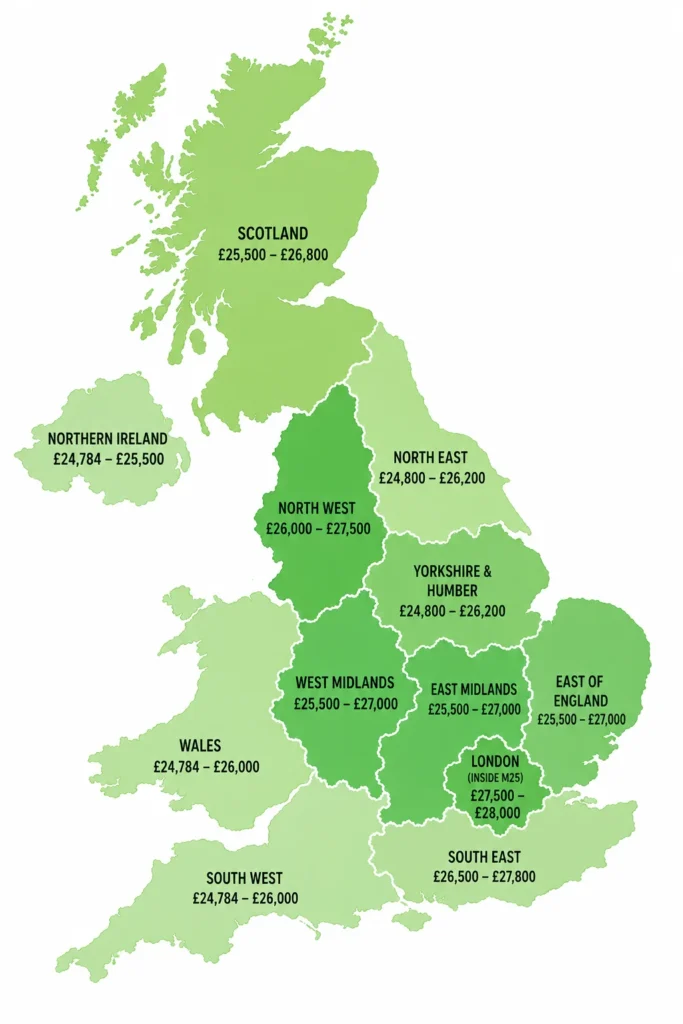
UK Electrician Starting Salaries by Region (2026) | What Beginners Actually Earn
| Region | Expected Range (Annual) |
|---|---|
| London (Inside M25) | £27,500 – £28,000 |
| South East / M4 Corridor | £26,500 – £27,800 |
| North West (Manchester) | £26,000 – £27,500 |
| Midlands (Birmingham) | £25,500 – £27,000 |
| Scotland (SJIB Central) | £25,500 – £26,800 |
| Yorkshire & North East | £24,800 – £26,200 |
| Wales & SW England | £24,784 – £26,000 |
| Northern Ireland | £24,784 – £25,500 |
Electrician salaries can normally be split into 4 pillars or sections. The four earning tiers, beginner, advanced, qualified, and specialist.
The next major influencer is whether you’re employed or working for yourself followed by reginal factors. All these are covered in more detail below.
Average UK Electrician Salary 2026
Average UK Electrician Salary 2026
These earnings are based on a standard 37.5-hour week and current 2026 JIB rates. These are employed figures (self-employed earnings are covered further down):
- Beginner: £25,000 – £28,000
- Advanced: £28,000 – £33,000
- Qualified: £39,100 – £46,000
- Specialist: £44,000 – £65,000+
Apprenticeship rates work differently and are covered in their own section below.
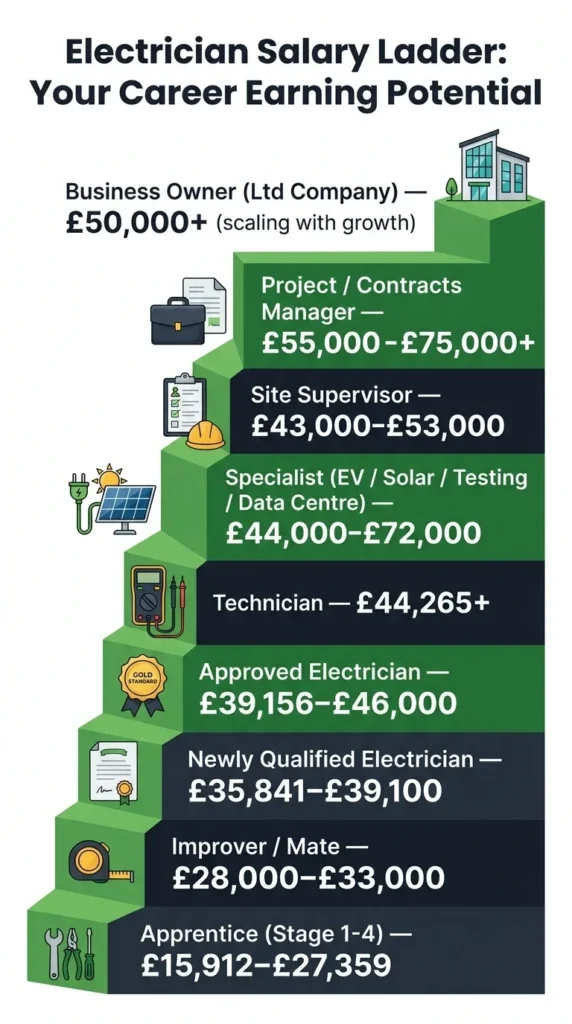
Electrician Salary by Experience Level
Stage | Typical Earnings |
Apprentice (Stage 1-4) | £15,912 – £27,359 |
Improver / Mate | £28,000 – £33,000 |
Newly Qualified Electrician | £35,841 – £39,100 |
Approved Electrician | £39,156 – £46,000 |
Technician | £44,265+ |
Specialist (EV / Solar / Testing / Data Centre) | £44,000 – £72,000 |
Site Supervisor | £43,000 – £53,000 |
Project / Contracts Manager | £55,000 – £75,000+ |
Business Owner (Ltd Company) | £50,000+ (scaling with growth) |
Important Note:
Two official data points frame UK electrician pay. The Office for National Statistics’ Annual Survey of Hours and Earnings (ASHE) puts the 2025 median salary for electricians and electrical fitters at £39,039 a year [1]. The JIB’s 2026 rates set minimum hourly pay by grade: £18.38 for a qualified Electrician, £20.08 for Approved Electrician, and £22.70 for Technician, the highest standard JIB grade [2]. The ONS figure reflects what electricians take home across the whole workforce, including overtime and regional variation, while JIB rates are the negotiated minimum for JIB-member employers specifically.
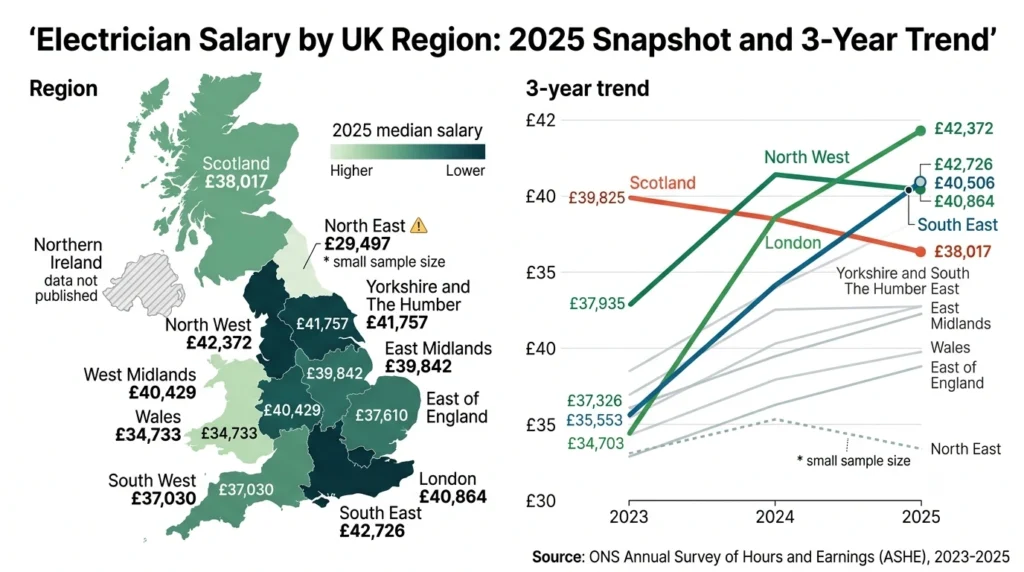
Regional Variations in Electrician Salaries
| Region | 2023 | 2024 | 2025 | 3-Year Change |
|---|---|---|---|---|
| North West | £34,703 | £38,946 | £42,372 | +£7,669 |
| South East | £37,326 | £40,506 | £42,726 | +£5,400 |
| Yorkshire & Humber | £35,128 | £38,075 | £41,757 | +£6,629 |
| West Midlands | £35,553 | £37,829 | £40,429 | +£4,876 |
| East Midlands | £34,020 | £38,517 | £39,842 | +£5,822 |
| London | £37,935 | £41,312 | £40,864 | +£2,929 |
| South West | £34,272 | £35,129 | £37,030 | +£2,758 |
| Wales | £34,326 | £37,389 | £34,733 | +£407 |
| Scotland | £39,825 | £39,162 | £38,017 | -£1,808 |
| East of England | £37,950 | £38,051 | £37,610 | -£340 |
| North East | £29,946 | £34,050 | £29,497 | -£449 (unreliable,
see notes) |
What the Three-Year Trend Shows
The North West has seen the strongest regional growth over the past three years, rising from £34,703 in 2023 to £42,372 in 2025, an increase of £7,669, or 22%.
The West Midlands, home to our Wolverhampton and Birmingham centres, has grown steadily every year rather than in a single jump: £35,553 in 2023, £37,829 in 2024, and £40,429 in 2025.
London and the South East have swapped positions. London held the highest regional median in 2023 and 2024, but the South East overtook it in 2025, £42,726 against London’s £40,864. This is a genuine multi-year pattern in the data, not a single-year fluctuation.
Scotland is the one region where the median has fallen since 2023, from £39,825 down to £38,017. This doesn’t necessarily mean electricians in Scotland are being paid less, SJIB rates have risen over the same period, it more likely reflects a change in the mix of who was surveyed year to year. With a relatively small regional sample size, this kind of movement can happen without underlying pay actually falling.
A note on North East figures: ONS flags the underlying sample size for the North East as too small to be fully reliable in all three years of data (2023, 2024, and 2025). We’ve included the published figures for completeness, but they should be treated with more caution than the other regions, and shouldn’t be read as a firm year-on-year trend.
Self-Employed vs. Employed Divide
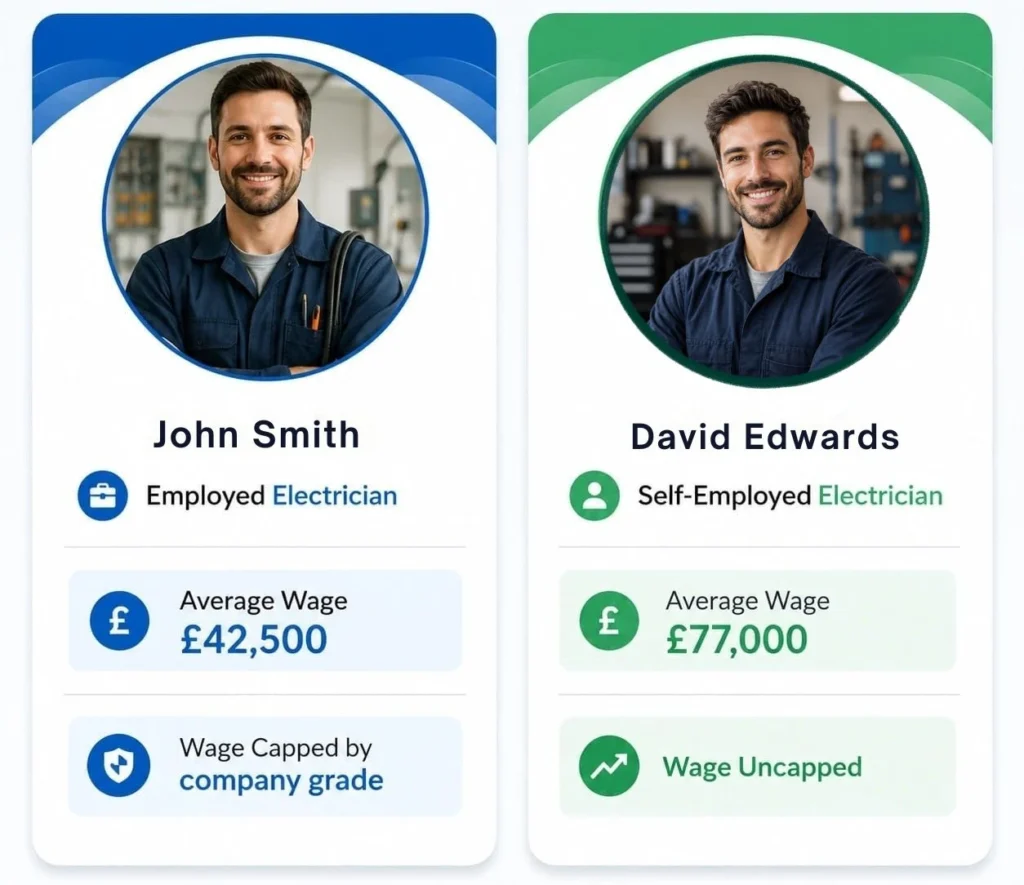
John Smith — Employed, £42,500 gross
Amount | |
Gross salary | £42,500 |
Income Tax | -£5,986 |
National Insurance | -£2,394 |
Take-home | ≈£34,120 |
David Edwards — Self-Employed, £77,000 gross revenue
Amount | |
Gross revenue | £77,000 |
Business running costs (from table below) | -£14,400 |
Net profit before tax | £62,600 |
Income Tax | -£12,484 |
Class 4 National Insurance | -£2,509 |
Take-home | ≈£47,600 |
David’s £77,000 is revenue, not profit. Running a self-employed electrical business comes with overheads: a van, fuel, insurance, tool replacement, competent person scheme membership, accountancy, and more.
A realistic breakdown looks like this:
Item | Annual Cost |
Gross revenue (220 days x £350) | £77,000 |
Van (lease/finance + running costs) | -£5,200 |
Fuel | -£4,200 |
Public liability & tools insurance | -£550 |
NICEIC/NAPIT competent person scheme membership | -£650 |
Tools & equipment (replacement/maintenance) | -£1,500 |
Test equipment calibration | -£350 |
Accountancy fees | -£700 |
CPD & course renewals | -£450 |
Phone, admin & software | -£420 |
Marketing/website | -£350 |
Net profit before tax | £62,600 |
These figures are illustrative averages based on typical costs and 2026/27 tax rates, and actual take-home pay will vary depending on individual circumstances, business expenses, and location. This is not financial or tax advice. Anyone making decisions about self-employment or business structure should consult a qualified accountant.
What Other Factors Can Determine an Electrician’s Earning Potential?
Work Flexibility
Small changes equalling massive differences.
- JIB rules indicate that a working night shift must be paid a premium of +33%, this could top up your wage from £39,156 to over £52,000 for the exact same number of hours by incorporating night shifts into your working hours.
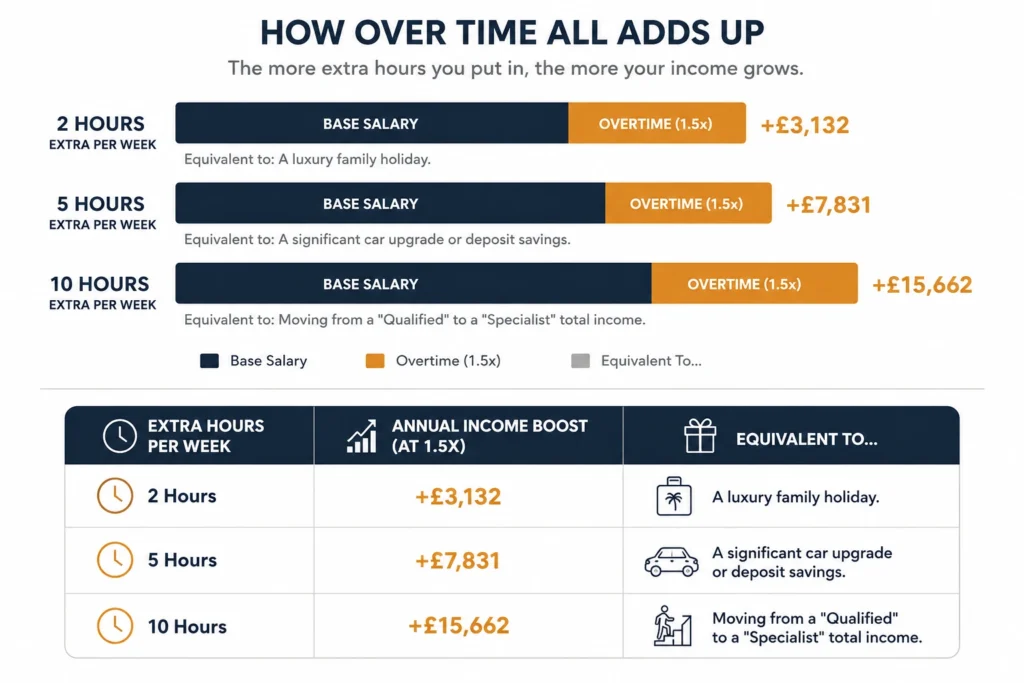
- Overtime all adds up, it’s common for the industry to pay anything between 1.5x and 2x, doing 5 hours a week could potentially increase your income by £7800 a year.
Additional Responsibility
- Senior/manager roles – JIB rates directly reflect enhancements as you progress into supervisory roles. Overseeing a small team of 2–5 people could increase your hourly wage by £1–£1.50.
- Site Supervisors can typically see an increase between £4000 to £7000 a year, also it’s not unheard of a company laptop, vehicle and company perks at this level.
- Project Manager this may require additional training or qualifications, but if you decide to make the jump salaries can range from £55,000 to £75,000 plus.
Transferable Experience
I don’t think this is highlighted enough, but we get direct feedback from our employer partners (120+ across the UK) and our employment managers, that a lot of transferable skills exist that potential sparkies are not aware of. The most common ones overlooked are:
- Other trade experience – carpentry, bricklaying, general construction and plumbing.
- Customer Service – especially in roles that are customer facing.
- Office skills – as you progress into more specialist roles these skills become so valuable especially when looking at project management roles, smart homes and data centres.
Is Becoming an Electrician a Wise Career Move?
It’s hard to be impartial especially as we train electricians, but what we can look at is the last 5-year industry trends and demands and furthermore forecast the next 5 years, this will give you a more balanced approach.
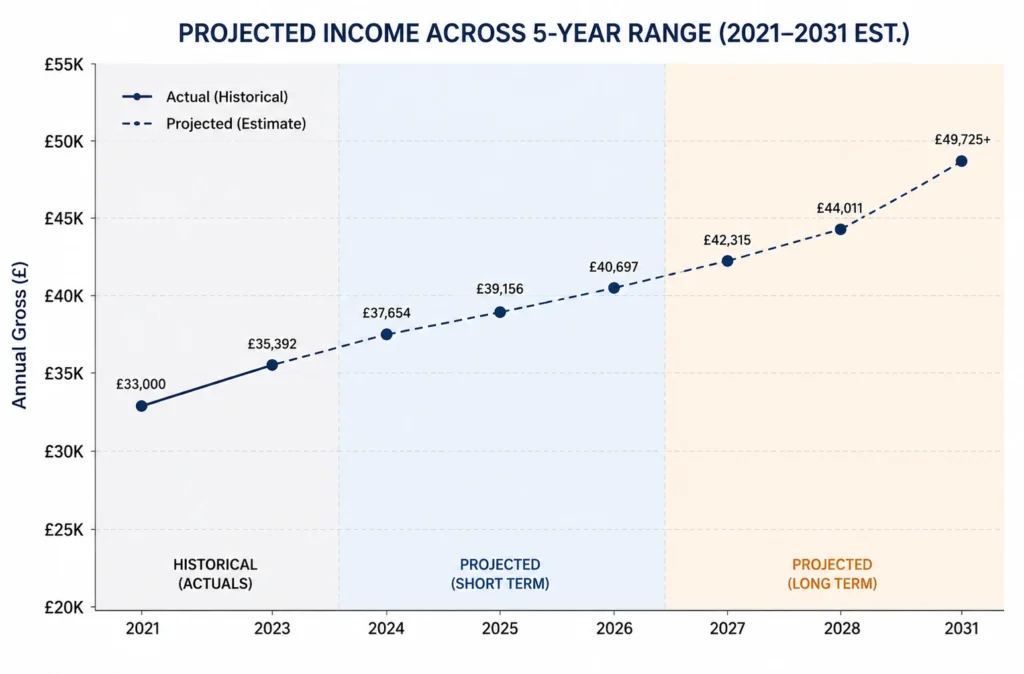
Please note that JIB rates have been frozen for the next three years to stabilise what has been a period of rapidly rising wages in the sector, also take into consideration this is the minimum with a majority of employers paying above the base rate due to workforce shortages.
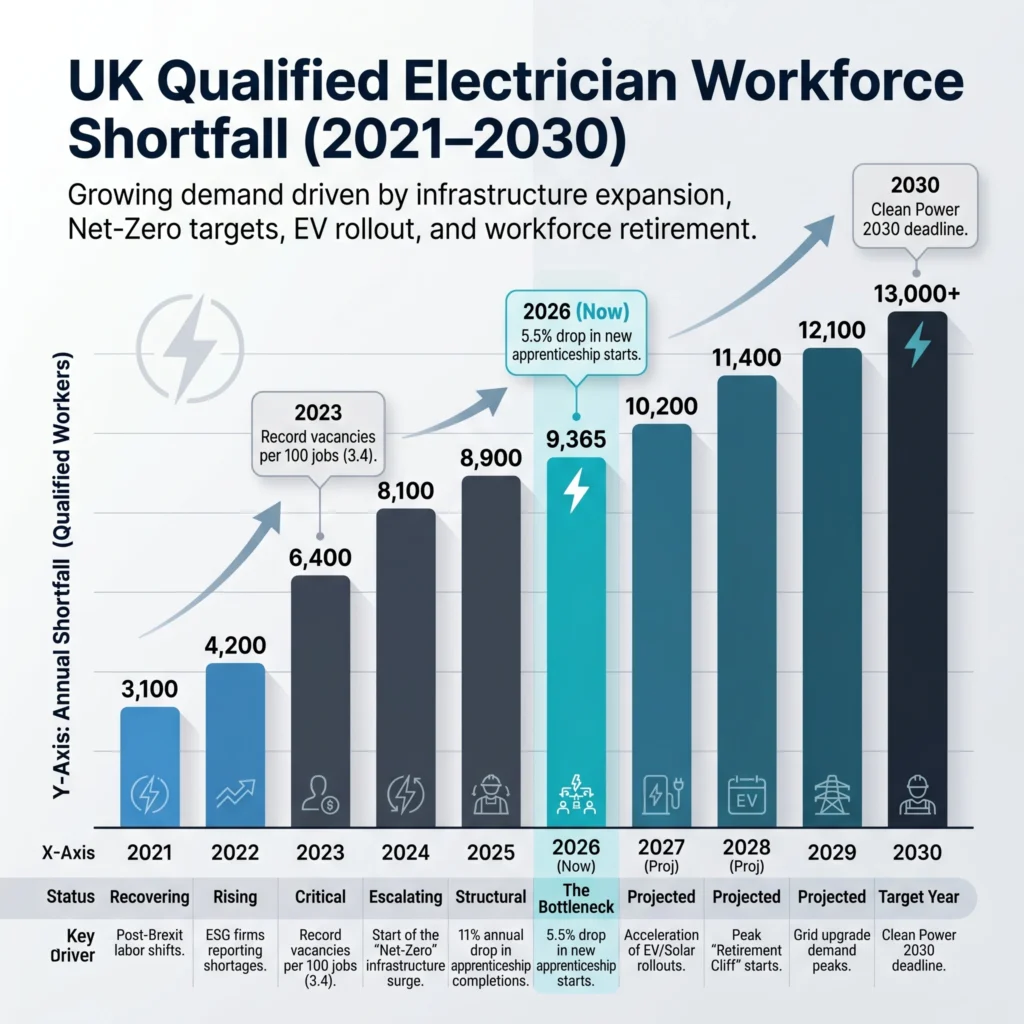
As you can see, a perfect storm is being created:
- Stretched workforce which is 9,365 electricians short (2026)
- Above inflation rise in 2024
- Three-year JIB pay deal locks operative rises at 4–5% a year through 2028, despite shortage pressure
- Companies ignoring the cap and paying what they claim to be market rate
This data does not take into consideration the unprecedented growth of AI, and AI data centre infrastructure.
So, all in all, I would say it’s a good time to train to become a fully qualified electrician.
Experience and Qualifications
You need both, you can’t become a fully qualified electrician without experience, all four routes in the UK involve getting on the tools.
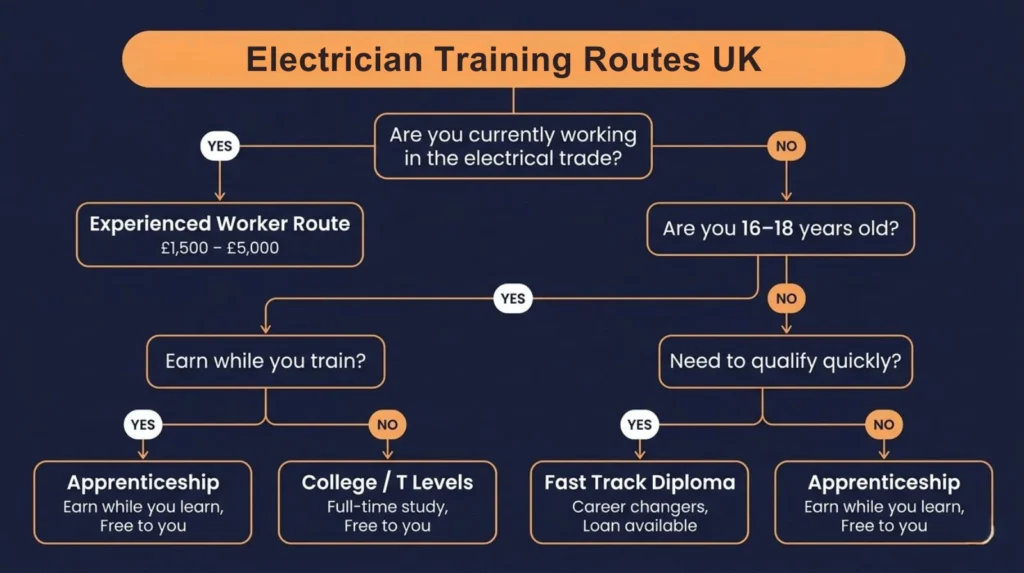
The other side of the coin, you have five, ten, fifteen years on the tools, but without a qualification, you’re not recognised as fully qualified in the UK. The Experienced Worker Qualification is the fastest route from experienced to fully qualified.
Still not sure what to do next? We can help!
Enquire Now
Apprenticeship Wages
This has a whole section by itself, as it’s more suited to younger learners i.e. 16-21, due to the salary constraints.
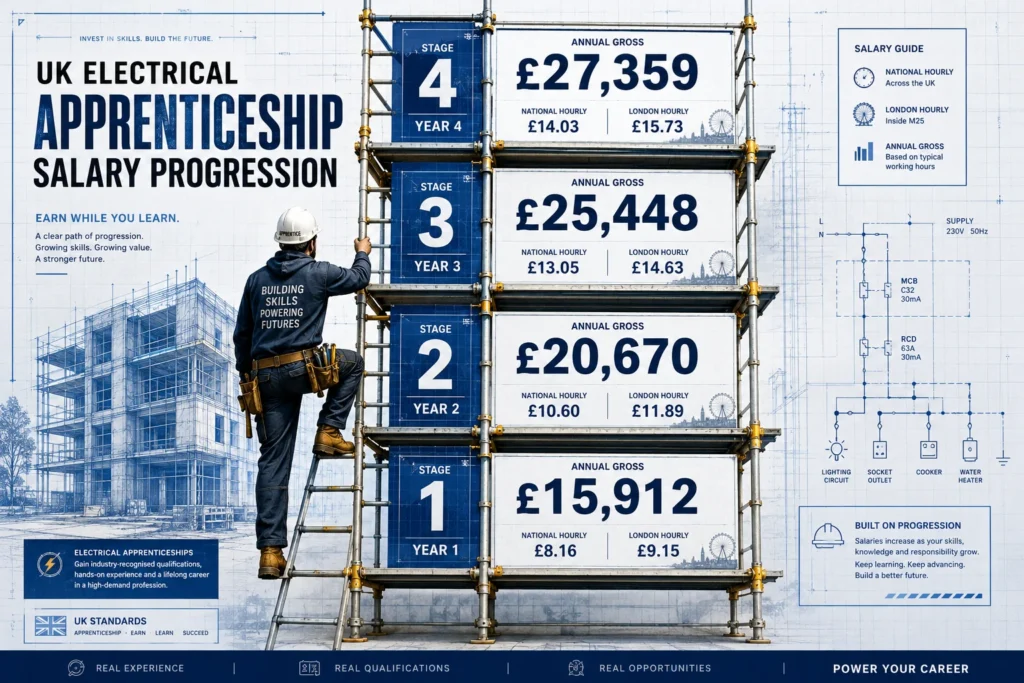
Please note if you’re a 21+ Apprentice the second year you should be paid the National Living Wage (£12.71).
Apprentice rates are confirmed to go up by 2% in 2027 and 3% in 2028.
Most career changers would struggle to survive on the JIB Stage 1 apprentice rate of £8.16 an hour (£15,912 annually), hence why a lot opt for the faster and more financially feasible route which is the Fast Track Diploma.
What Is the Average Salary of an Electrician Compared to Other Trades?
Each one below is based on 2026 data and being fully qualified. [6]
| Trade | Average Annual Salary | Typical Day Rate |
|---|---|---|
| Electrician | £42,500–£54,000 | £300–£500 |
| Plumber / Gas Engineer | £38,000–£48,000 | £320–£480 |
| Carpenter & Joiner | £33,000–£44,000 | £240–£360 |
| Bricklayer | £30,000–£42,000 | £240–£320 |
| Plasterer | £28,000–£39,000 | £220–£300 |
| Painter & Decorator | £26,000–£35,000 | £180–£280 |
The 5 Year Gap
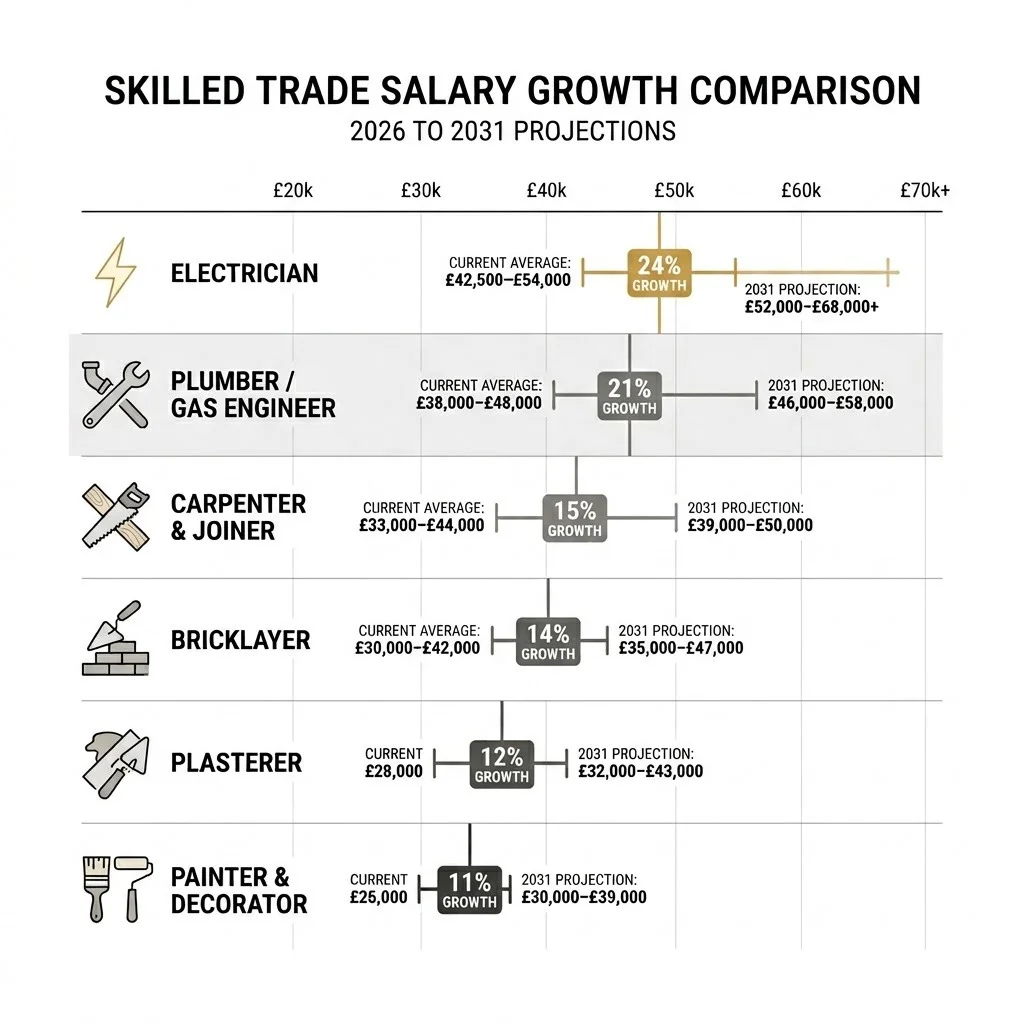
*Projected increase based on 2026 data.
Electrician comes out on top, the data is massively supported by government policy and the drive to net zero.
How to Supercharge Your Income as an Electrician
Once you’re fully qualified there are multiple avenues to increase your earning potential, this section is for anyone who wants to know the 3-year, 5 year and 10-year plan.
Career Progression Opportunities for Electricians
Where is the money? Or where is the stability, career progression all depends on what is your key driving factors, money, security, travel, or a combination of them all.
Electrician Salary Based on Specialisation
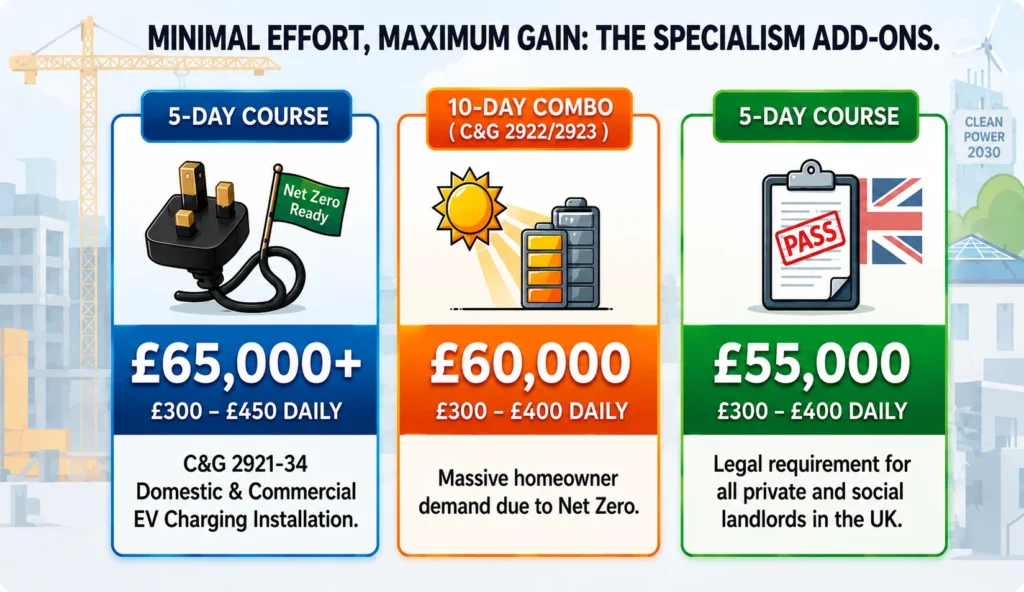
The no-brainer add-ons that add another arm to your earning potential with continued growth projected for the next 5-10 years.
EV Charge Point Installer
Average yearly wage of £45,000 – £65,000, that works out to be a daily rate of between £300 – £450.
The push to net zero is in full swing, this is a nice little add on with minimal time training needed (5 days needed for the C&G 2921-34 Domestic & Commercial EV Charging Installation Course).
Solar PV & Battery Storage
Average yearly wage of £48,000 – £60,000, that works out to be a daily rate of £300 – £400.
With energy prices going through the roof, the UK is consistently looking at more renewable options, solar and battery has been the go-to for UK homeowners for several years now.
The two courses you would need are Small Solar Photovoltaic Systems (2922) and Small Electrical Energy Storage Systems 2923.
Inspection & Testing
Average yearly wage of £42,000 – £55,000, that works out to be a daily rate of £300 – £400.
Since 2020, every privately rented property in England has needed a valid EICR every five years. From 1 May 2026, the same requirement extends to existing social housing tenancies in England — and the original 2021 wave of EICR certificates is now hitting its five-year renewal point at the same time. Two demand spikes landing in the same year.
The course you need to be able to do this is C&G 2391-52 Electrical Inspection & Testing Course.
Demand for all three is set to rise sharply, and it’s down to one regulatory change.
From 1 October 2026, the updated Electrotechnical Assessment Specification (EAS) requires every electrician carrying out EICRs, EV charge point installs, solar PV, or battery storage work to hold an individual Level 3 qualification plus two years of recorded experience in that work category.
The old model — where a single Qualified Supervisor could sign off the work of a whole team of less-qualified operatives — no longer applies. Each electrician must now be individually qualified and individually competent.
What that means in practice: from October 2026, the pool of electricians legally allowed to carry out the three highest-growth jobs in the trade shrinks overnight. If you hold the right Level 3 qualifications (2391-52, 2921-34, 2922 and 2923), you’re on the right side of that shift. If you don’t, you’re locked out of the work that’s paying £300–£450 a day.
The Other Big Four
| Specialisation | 2026 “Top Tier” Potential | Additional Training / Certification Required |
|---|---|---|
| Data Centre (AP) | £72,000 | AP (Authorised Person) LV/HV, C&G 2391, & Site-Specific UPS/Generator Certs |
| Industrial / PLC | £68,000 | PLC Programming (Siemens S7/Allen Bradley), & Industrial Control Wiring (C&G 2396) |
| HV Specialist | £65,000 | DNO Authorisation, HV Jointing Level 4, & SSSTS/SMSTS |
| Smart Home | £58,000 | Manufacturer Training (Lutron, Loxone, Control4), & Home Networking (CEDIA) |
Data Centre Electricians focus on:
- Preventive Maintenance
- Continuous System Monitoring
- Critical Infrastructure Testing
Industrial & PLC Electricians focus on:
- Safety System Integration
- Control Panel Wiring
- Automated System Maintenance
HV Specialist Electricians focus on:
- Substation Maintenance
- Implementing Safe Systems of Work
- HV Cable Jointing & Termination
Smart Home Electricians focus on:
- Climate & Energy Management
- Whole-Home Integration
- Smart Security & Access Control
Electrician Work That Rewards Travel
Depending on your situation will determine if this is suitable for you. If you’re happy to travel and work shifts (normally 2 weeks on, 2 weeks off, 12 hours a day). Then offshore electrician work is for you.
Just be aware it’s not for the faint hearted. I have worked with people that have worked offshore, and it’s hard and more dangerous than domestic work.
With the extra responsibility, comes extra pay:
| Offshore Specialism | Average Annual Salary (Projected 2026) |
|---|---|
| Wind Turbine Technician | £48,000–£65,000 |
| Platform Electrician (Oil/Gas) | £55,000–£75,000+ |
Please note the following are essential to work offshore.
Oil and Gas Companies Require:
- BOSIET (CA-EBS)
- MIST
- CompEx
- OEUK Medical
Wind Turbine Companies Require:
- GWO BST
- CompEx
- OEUK Medical
Please do your research as these courses can set you back 1000s.
Becoming Self-Employed or Starting a Limited Company
This all depends on where you are in the journey. If you’re at the start of your journey, here’s what we’ve found helps most when securing your first electrician’s mate role:
- ECS Electrical Labourer Card
- Register with HMRC as Self-Employed
- Register with the Construction Industry Scheme (CIS)
Normally our students have their 2365-02 and 18th edition at this stage.
We are aware of employers taking on mates without these qualifications, it’s just harder.
The reason why this helps you getting your foot through the door is based on the reduced risk for potential employers, giving you a 3-day subby contract allows them to see your work ethic and work experience with minimal risk.
Years ago individuals at this stage would set up their own company and employ themselves so they could complete their 2357 NVQ this loophole was quickly shut down.
If you’re fully qualified, then other options do come into play. (We’d always recommend speaking to an accountant before making any decisions about business structure). Below are some general guidelines:
| Business Milestone | Status | Decision Factor |
|---|---|---|
Stage 1: Electrician’s Mate (sole trader) | ECS Card, no prior experience | Get on site as a subcontractor (subby). |
Stage 2: Domestic Sparky (sole trader) | Profit £20k–£45k | Lower admin costs than a company. |
Stage 3: Expanding Business (Company) | Profit £50,000+ | Corporation Tax (19%) becomes more efficient than 40% Income Tax. |
Stage 4: Moving to Commercial (Company) | Working with commercial clients | Many companies mandate an LTD for liability and insurance. |
Stage 5: High-Risk Work (Company) | EV, Industrial, HV, Data Centres | Need to separate personal assets from business. |
So you are now fully qualified and decided to set up on your own, how do you generate work, how do you price it, and what are some of the issues you will run into.
Ensuring a Good Reputation = Sustained Demand
Years ago, all you needed was a good reputation and a premium listing in the yellow pages and that gave you all the work you needed.
I don’t believe much has changed. You still need the two above but in a different way.

How consumers judge a business reputation has evolved, it has moved from word of mouth to digital, here are a few sites that are essential as a tradesman for reputation management:
- Checkatrade
- Google Maps
- Trustpilot
- Nextdoor
Secondary factors:
- Social Media presence
- Past work examples
- Video testimonials
- Website
Yellow pages premium has changed to Google Ads, Meta Ads, paper ads, offline marketing. To cover all the options would take another 5/10 articles, at this stage I would recommend doing more research on what could work for you and also what you’re comfortable doing, for me due to my background, I would focus on Google Maps and organic.
Get the above right, and your company will flourish and your income/profit will match.
Responding to Emergency Call-outs
This is a strange one, over the years I know electrical companies that only want to do this kind of work, and then I know some that would not touch it with a barge pole.
I can see both sides, some want steady work between 9-5, Monday to Friday, whilst other companies thrive on the chaos and unpredictability.
Electricians’ Emergency Hourly Rate
The table below shows the earning potential, it’s split into regions and what I would call the three-tier pricing.
- Green Zone – Normal working hours
- Amber Zone- Social Emergency Hours
- Red Zone – Dead Zone Hours
| Region | Green Zone (09:00 – 17:00) | Amber Zone (17:00 – 22:00) | Red Zone (22:00 – 06:00) |
|---|---|---|---|
| London & M25 | £120 (1st hr) / £84ph | £180 (1st hr) / £126ph | £264 (1st hr) / £168ph |
| South East / Commuter | £96 (1st hr) / £72ph | £144 (1st hr) / £108ph | £216 (1st hr) / £144ph |
| Midlands & North West | £78 (1st hr) / £60ph | £120 (1st hr) / £90ph | £180 (1st hr) / £120ph |
| North East & Scotland | £72 (1st hr) / £54ph | £108 (1st hr) / £78ph | £168 (1st hr) / £108ph |
| Wales & South West | £72 (1st hr) / £54ph | £102 (1st hr) / £78ph | £144 (1st hr) / £108ph |
Over the last two years we have seen a growth of companies offering a 10-minute diagnostic video call option (normally done over WhatsApp).
How it works:
- Client deposits £20-£30 (normally done via credit card charge)
- Company video-calls the client to diagnose issue
- If the issue is resolved the company keeps the deposit
- If the issue needs more investigation, the call out fee is charged and electrician organised
Clients prefer this model due to lower initial costs, also acts as a funnel for bigger jobs for the company.
Pricing on the Job (POA)
I have seen companies lose money due to this. Data from 2025 and early 2026 shows that 80% of customers want some kind of baseline [7]. I feel at this point its also a good filtering system, nothing worse than going to price a job and the client thinks they can get a full house rewire for £1000.00.
So, let’s play it safe:
- A two bedroom rewire from £3,900
Sounds better than:
- A two bedroom rewire (POA)
Data backs this up.
Electricians’ Pricing Recommendations
Hands down this is the most difficult part to write, prices vary massively depending on the regions you operate, also being VAT registered influences pricing [8].

Common Electrical Jobs and Their Average Costs
| Job Description | Typical Price Range | Average Duration |
|---|---|---|
| New Double Socket (Added to existing circuit) | £80 – £150 | 1 – 2 Hours |
| Replacement Consumer Unit (RCBO/SPD type) | £500 – £850 | 4 – 6 Hours |
| EICR Safety Certificate (2–3 Bed House) | £150 – £250 | 3 – 4 Hours |
| EV Home Charger Installation (Standard) | £850 – £1,350 | 3 – 5 Hours |
| Fault Finding (Initial diagnostic call-out) | £100 – £250 | 1 – 2 Hours |
| Light Fitting Swap (Like-for-like) | £50 – £100 | 1 Hour |
| Outdoor Security Light (Supply & Fit) | £150 – £280 | 1 – 2 Hours |
Please note the above does not include VAT [9].
Electrician Salary by Training Route: 5-Year Net Position
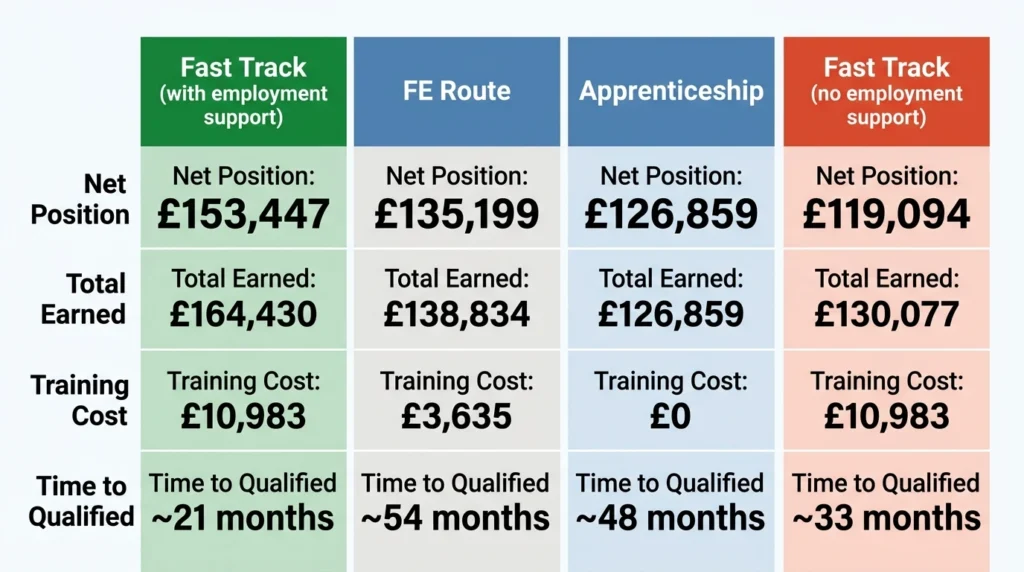
The figures above represent net financial position over a 5-year period, total earnings minus training costs, for four different routes into the electrical trade.
All four routes lead to the same outcome: a fully qualified electrician with an ECS Gold Card. The difference is how quickly you get there, what it costs upfront, and what you earn along the way.
The key finding: employment support during the NVQ portfolio stage matters more than which route you choose. Fast Track training with guaranteed employment support produces the strongest 5-year position of any route, but the exact same course, at the exact same cost, without that support drops to the weakest position of all four.
Assumptions used in this comparison:
- Improver wage: £30,500 a year
- Newly qualified wage: £37,470 a year
- NVQ Level 3 portfolio duration: 18 months
- Unsupported job search (FE Route and Fast Track without support): 12 months, a realistic average based on industry reporting of 6 to 18 months for learners without employer connections
- Apprenticeship wages based on verified 2026 JIB Stage 1 to 4 rates
- Fast Track training cost of £10,983 covers Level 2, 18th Edition, Level 3, NVQ registration and assessments, and AM2
Important: these are illustrative figures based on average wages, typical timelines, and 2026 rates. Actual earnings and timelines will vary depending on region, specialism, individual circumstances, and how much site work is available. This is not a guarantee of income or employment outcome.
FAQs
How much does a fully qualified electrician earn in the UK?
A fully qualified electrician on JIB 2026 rates earns from £18.38 an hour as an Electrician, £20.08 as Approved Electrician, or £22.70 as Technician, working out to roughly £35,800 to £44,300 a year on standard hours before overtime, allowances, or specialist work are added.
How much do electricians earn in Scotland?
Scotland runs on SJIB rather than JIB rates. A newly qualified electrician in Scotland typically starts around £25,500 to £26,800, with SJIB Technician rates reaching £21.24 an hour (Shop) to £23.87 an hour (Travel) in 2026 [10], broadly in line with the rest of the UK.
How much does an electrician make in Northern Ireland?
Northern Ireland falls under the same JIB National Working Rules as England and Wales, so rates match the National figures: £18.38 to £22.70 an hour depending on grade. Starting salaries for newly qualified electricians typically sit around £24,784 to £25,500.
How much do offshore electricians earn?
Offshore work pays significantly more than standard site work to reflect the demands of the job. Wind turbine technicians typically earn £48,000 to £65,000 a year, while platform electricians in oil and gas can earn £55,000 to £75,000 or more, usually on a rotational schedule such as two weeks on, two weeks off.
What's the average annual salary for an electrician in the UK?
The ONS puts the 2025 median at £39,039 a year across the whole workforce. In practice this ranges from around £25,000 to £28,000 for beginners, up to £39,100 to £46,000 for fully qualified electricians, and £44,000 to £65,000 or more for specialists.
How much do sparkies make a year?
“Sparky” is just the informal UK term for an electrician, so the same figures apply: roughly £25,000 to £28,000 starting out, £39,100 to £46,000 once fully qualified, and £44,000 to £65,000 or more in specialist or senior roles.
How much do electricians earn in London?
London commands a premium across every JIB grade. Qualified Electricians earn from £20.58 an hour in London compared to £18.38 nationally, rising to £25.47 an hour for Technician grade (Transport Provided), around £49,700 a year before overtime. Beginners typically start around £27,500 to £28,000, roughly £2,000 to £2,500 above the national average.
What's the average hourly rate for an electrician?
On JIB 2026 rates, hourly pay ranges from £18.38 for a qualified Electrician up to £22.70 for Technician grade, depending on experience and responsibility. Self-employed electricians typically charge £300 to £500 a day rather than working hourly, which works out considerably higher once you account for reduced overheads on smaller jobs.
How long does it take to become a fully qualified electrician?
Most people take around 18 months to 3 years to go from starting training to holding a full ECS Gold Card, depending on the route chosen and how much site experience is available along the way. See our complete guide to becoming an electrician for the full breakdown by pathway.
Do electricians get paid more for overtime?
Yes. Under JIB rules, overtime is typically paid at 1.5 times the standard hourly rate on weekdays, rising to double time on weekends in many cases. Even a modest 5 hours of overtime a week can add roughly £7,800 a year to an Electrician’s income at JIB rates.
What does an electrician's career progression look like year by year?
Most electricians qualify within 18 months to 3 years, depending on route, then spend the next couple of years building experience as a Newly Qualified or Approved Electrician. By year 5, many have moved into Technician grade, taken on a specialism like EV or solar, or started working towards self-employment. Progression speed varies by individual, but earnings typically rise steadily at each stage, see our full salary breakdown by experience above.
References
ONS, Annual Survey of Hours and Earnings (ASHE) 2025, SOC 5241 Electricians and Electrical Fitters
- ONS, Annual Survey of Hours and Earnings (ASHE) Table 15, 2025 provisional edition, SOC5241
- ONS, Annual Survey of Hours and Earnings (ASHE) Table 15, 2024 edition, SOC 5241
- ONS, Annual Survey of Hours and Earnings (ASHE) Table 15, 2023 revised edition, SOC 5241
- How much do tradespeople cost in 2026?
- Checkatrade: What’s new autumn 2025
- How much do tradespeople cost in 2026?
- Electrician hourly rates and day rates: 2026 cost guide
- SJIB Handbook 2026-2028, Section B: National Working Rules – Hours, Wages and Travel
Get Started on Your Training as an Electrician Today
Enquire Now

By Charanjit Mannu
Director, Elec Training
Based on real training delivery, learner outcomes, and current UK electrical regulations.
- City & Guilds Approved
- 4.8★ Google Reviews
- 1000+ Electricians Trained


Prefer a callback?
- City & Guilds
- 4.8 Trustpilot
- JIB Recognized
- 1,000+ Trained
