

Lot 20 and Electricians: Why Energy Efficiency Rules Matter More Than Ever (7 Years On)

- Technical review: Thomas Jevons (Head of Training, 20+ years)
- Employability review: Joshua Jarvis (Placement Manager)
- Editorial review: Jessica Gilbert (Marketing Editorial Team)
- Last reviewed:
- Changes: Updated 7-year market evolution analysis, 2025 normalization data, post-Brexit UKCA marking requirements, current EPC rating implications
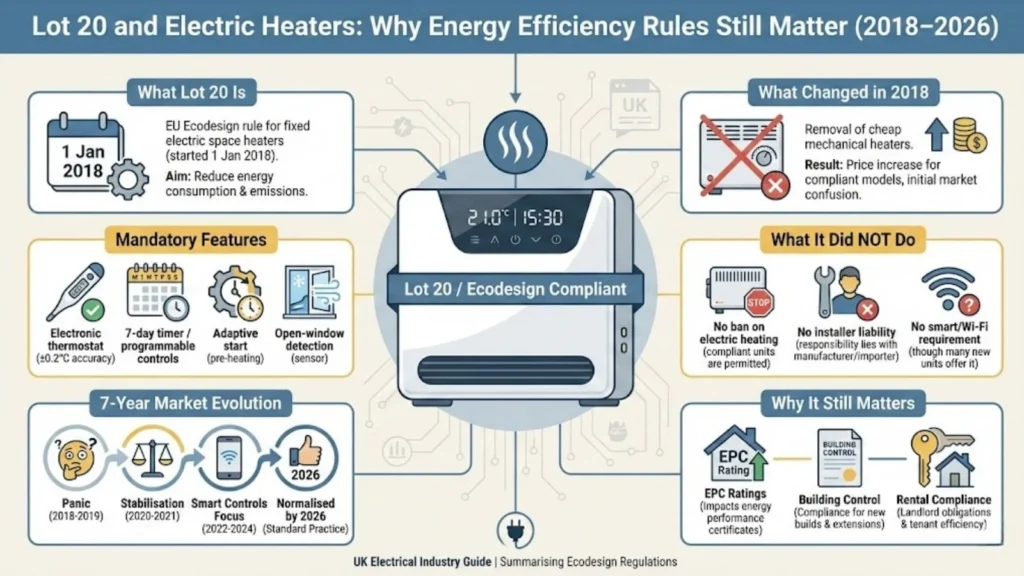
In January 2018, a regulation called Lot 20 came into force across the EU and UK, setting minimum energy efficiency standards for electric heaters. Electricians panicked. Landlords received scare-tactic sales calls. Forums filled with theories about Trading Standards raiding van stocks for non-compliant heaters.
Seven years later, in 2026, Lot 20 has become invisible. The features that were premium in 2018 (electronic thermostats, 24/7 programming, adaptive start controls, open-window detection) are now baseline expectations. The heaters that disappeared from wholesaler catalogues (basic £40 panel heaters with mechanical dials) are forgotten. And the enforcement raids that never happened have stopped being discussed entirely.
Here’s the thing about Lot 20. It changed what electricians could specify, not how they installed heaters. It removed inefficient products from the market without banning electric heating. And it laid the groundwork for the energy efficiency standards that now affect EPC ratings, Building Control sign-offs, and client expectations in 2026.
This article covers what Lot 20 actually was, what it changed when it arrived in 2018, how the market adapted over seven years, what electricians experienced on the ground, why it still matters for rental properties and new builds today, and the myths that caused unnecessary panic back when nobody understood what was actually happening.
Let’s start with what actually changed.
What Lot 20 Actually Was (and When It Started)
Lot 20 is part of the EU Ecodesign Directive, specifically Commission Regulation (EU) 2015/1188, which set minimum energy performance standards for local space heaters. Local space heaters means fixed electric radiators, panel heaters, and similar products used for heating individual rooms or zones. It doesn’t cover central heating systems, portable plug-in heaters used occasionally, or radiant infrared panels (which fell under different criteria).
The regulation came into force on 1 January 2018. From that date, manufacturers could no longer place non-compliant heaters on the market. The legal responsibility sat entirely with manufacturers and importers, not with electricians or installers.
The core requirement was a minimum seasonal space heating energy efficiency rating, calculated using a formula that factored in the heater’s power consumption, heat output, and the presence of specific control features. For fixed electric heaters, the baseline efficiency threshold was typically 38%, though the exact figure varied by product type.
To meet that threshold, heaters needed to include:
Electronic thermostats with ±0.2°C accuracy: Mechanical dials with low accuracy didn’t meet the standard. Digital room temperature control became mandatory.
24/7 programmable timers: The ability to set different heating schedules for each day of the week, allowing users to heat rooms only when occupied.
Adaptive start control: The heater pre-calculates how long it takes to reach the target temperature and starts heating earlier in colder conditions, reducing wasted energy.
Open-window detection: If the room temperature drops suddenly (indicating an open window), the heater automatically reduces output or switches off temporarily to avoid heating the outside.
These weren’t optional features. They were the minimum requirements to achieve the efficiency rating needed for legal sale in the UK and EU. Heaters without them couldn’t be sold after 1 January 2018.
Enforcement responsibility fell to the Office for Product Safety and Standards (OPSS) in the UK, which focused on manufacturers and importers. Trading Standards had powers to remove non-compliant products from retail shelves, but the target was always the supply chain, not end-users or installers.
Here’s what Lot 20 did not do. It didn’t ban electric heating. It didn’t make existing installations illegal. It didn’t require electricians to certify the energy efficiency of heaters they fitted. And it didn’t mandate smart technology like Wi-Fi control (though many manufacturers added it once they’d already integrated digital controllers for compliance).
The regulation applied to new products being placed on the market. Retailers were allowed to sell through existing stock that predated the 1 January 2018 deadline, which created a transition period lasting into 2019 where both compliant and non-compliant heaters were available simultaneously. That overlap caused confusion, particularly for landlords and property developers trying to understand which products they should be specifying.
Understanding what Lot 20 actually required, and what it didn’t require, is essential for seeing why the market reaction in 2018 was disproportionate compared to the actual impact by 2025. And understanding how broader industry changes like the 2026 JIB wage deal affect electricians’ work patterns helps contextualize why Lot 20 became just one of many regulatory shifts electricians had to navigate.
What Changed When Lot 20 Arrived (2018-2019)
The immediate impact in 2018 was a culling of entry-level products. Cheap £20-£40 panel heaters with basic mechanical thermostats or simple on/off switches disappeared from wholesaler catalogues. The replacement products, with electronic controls and efficiency features, cost £120-£200. That price jump created panic among landlords managing HMO properties and social housing providers working to tight budgets.
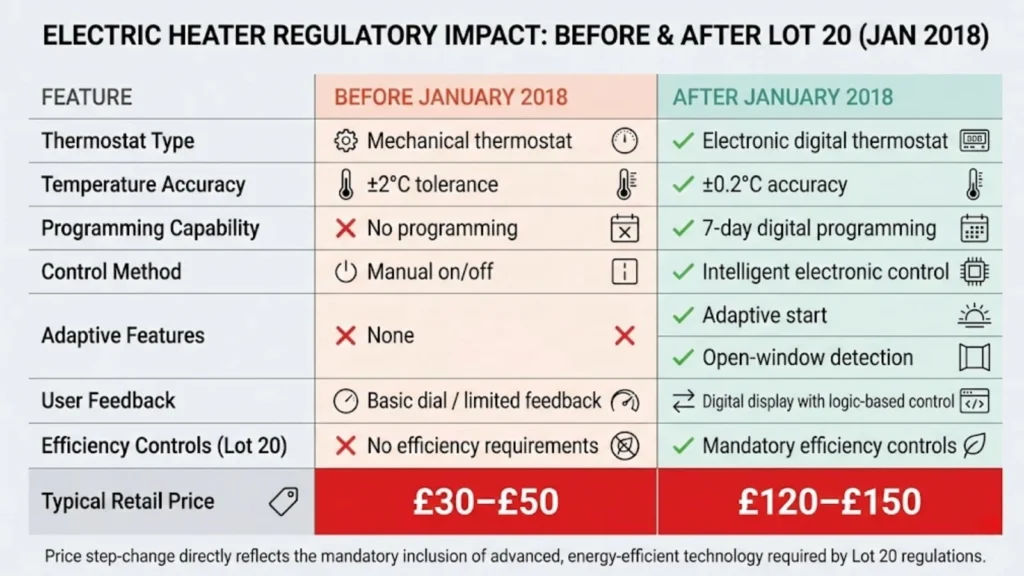
Here’s what the market looked like before and after:
Before January 2018:
Basic panel heaters with mechanical thermostats (low accuracy, ±2°C tolerance)
Manual on/off operation, no programming
Simple feedback loops, no adaptive control
Widely available at £30-£50 for standard sizes
No mandatory efficiency controls
After January 2018:
Electronic thermostats with ±0.2°C accuracy became mandatory
7-day digital programming required on all compliant heaters
Adaptive start and open-window detection standard
Entry price jumped to £120-£150 for equivalent output
All new products required efficiency controls to meet 38% threshold
Manufacturers responded differently. Large UK and European brands (Dimplex, Elnur, Electrorad) had invested heavily in R&D ahead of the deadline and launched compliant ranges in late 2017. They marketed Lot 20 compliance as a premium feature, emphasizing energy savings and reduced running costs. Their products were ready, tested, and available on day one.
Smaller manufacturers and importers of cheap heaters struggled. Many couldn’t afford the redesign costs to integrate digital controls and efficiency features. Their products simply vanished from the UK market. This cleared out the bottom end of the market, removing the £20-£40 heaters that had been standard in rental properties and temporary installations.
Installers experienced this as sudden product unavailability. Electricians who’d been fitting basic panel heaters for years found their go-to products discontinued. Wholesaler catalogues changed almost overnight. The replacement products cost three to four times more and came with instruction manuals explaining programming features that tenants and landlords didn’t understand.
Client conversations became more complex. Landlords asked why a heater replacement that used to cost £40 now cost £150. Electricians had to explain Lot 20, energy efficiency regulations, adaptive start controls, and why the old heaters weren’t available anymore. Many didn’t understand the regulation themselves at that point, leading to confusion and misinformation.
The fear narrative peaked in early 2018. Rumours circulated that Trading Standards would raid electricians’ vans for non-compliant heaters. Forum discussions debated whether fitting old stock was illegal. Some sales companies exploited the confusion, telling landlords their existing heating systems were non-compliant and needed immediate replacement.
Joshua Jarvis, Placement Manager at Elec Training, recalls the chaos:
"Sales companies used Lot 20 as a scare tactic in 2018-2019, telling landlords their entire heating system was illegal and needed replacing immediately. Completely false. Lot 20 only applied to new products being sold, not existing installations. The myth that electric heating was 'banned' caused unnecessary panic and wasted money on premature replacements."
Joshua Jarvis, Placement Manager
The reality was far less dramatic. Existing installations were unaffected. Electricians could continue fitting old stock legally until it ran out. And enforcement never targeted installers at all.
Thomas Jevons, Head of Training at Elec Training with 20+ years of experience, explains what actually happened with enforcement:
"There was panic in 2018 about Trading Standards raiding van stocks for non-compliant heaters. Never happened. Enforcement targeted manufacturers and importers at the supply chain level, not electricians fitting products. The OPSS focused upstream, where they could catch thousands of units, not downstream where they'd catch one heater at a time."
Thomas Jevons, Head of Training
By late 2019, the initial panic had subsided. Old stock had sold through. Compliant heaters were the only option available. Prices began stabilizing as manufacturers achieved economies of scale with the new control components. And electricians adapted to specifying and explaining the new generation of products.
Market Adaptation: 7 Years On (2018-2025)
By 2025, the market has completely normalized. The features that were premium in 2018 are now standard chips costing manufacturers pennies. The price premium for Lot 20 compliance has largely disappeared. And the products that dominated in 2018 (basic compliant heaters with mandatory controls) have evolved into smart, app-controlled systems that integrate with home automation platforms.
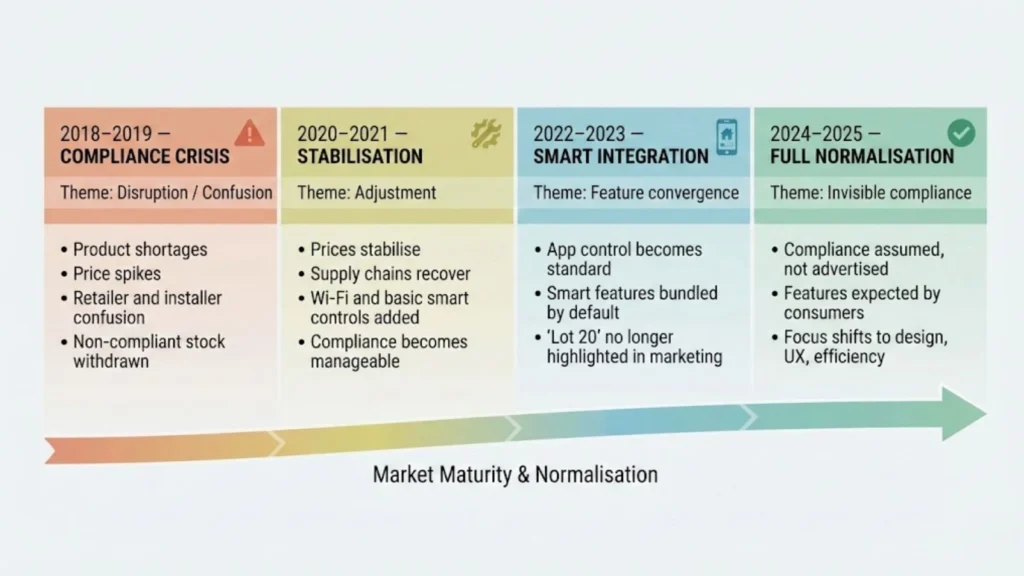
Here’s how the market evolved across seven years:
2018-2019: Compliance Crisis
Product shortages as non-compliant heaters withdrew
Prices spiked due to supply constraints and manufacturer R&D costs
Confusion about enforcement and legal requirements
Fear-driven sales tactics by some suppliers
Installers navigating client questions without clear guidance
2020-2021: Stabilization
Compliant products became market standard
Prices stabilized as component costs dropped through economies of scale
Manufacturer competition increased, driving innovation beyond minimum compliance
Wi-Fi connectivity added to many heater ranges (not mandated, but commercially viable once digital controls were standard)
Client acceptance of higher upfront costs offset by energy savings
2022-2023: Smart Integration
App-controlled heaters became common across mid-range products
Manufacturers treating Lot 20 compliance as baseline, not selling point
Integration with home automation systems (Alexa, Google Home, Apple HomeKit)
Energy monitoring features added to differentiate products
Lot 20 stops being mentioned in marketing, compliance assumed
2024-2025: Full Normalization
Non-compliant heaters no longer exist in mainstream supply chains
Electricians don’t think about Lot 20 when specifying heaters
Features like adaptive start and open-window detection are expected, not premium
Pricing comparable to pre-2018 levels when adjusted for inflation and added functionality
Regulation invisible, embedded in product design standards
The market shift benefited established manufacturers who’d invested in compliance early. Companies like Dimplex, which spent heavily on R&D before the deadline, now have a protected market where low-quality imports can’t compete on price alone. This created an indirect barrier to entry for cheap manufacturers, which improved overall product quality but reduced budget options for cost-sensitive projects.
Wholesaler catalogues reflect this evolution. In 2018, products were marketed with prominent “Lot 20 Compliant” labels. By 2020, that labeling had become standard. By 2025, it’s disappeared entirely because compliance is assumed. The focus shifted to differentiating features like smart control, energy monitoring, and design aesthetics.
Consumer tech literacy accelerated the transition. In 2018, many landlords and tenants struggled with 7-day programmable timers. By 2025, clients expect app control, remote programming, and integration with smart home systems. The technology that seemed complex in year one became normal by year seven.
One unintended consequence: complexity gap for certain user groups. Elderly tenants and people unfamiliar with digital controls sometimes struggle with the programming features required for compliance. This led to heaters being left in manual override mode, defeating the energy-saving purpose entirely. Installers increasingly spend time on handover, explaining controls in detail to ensure clients actually use the efficiency features.
What Actually Changed for Electricians on the Ground
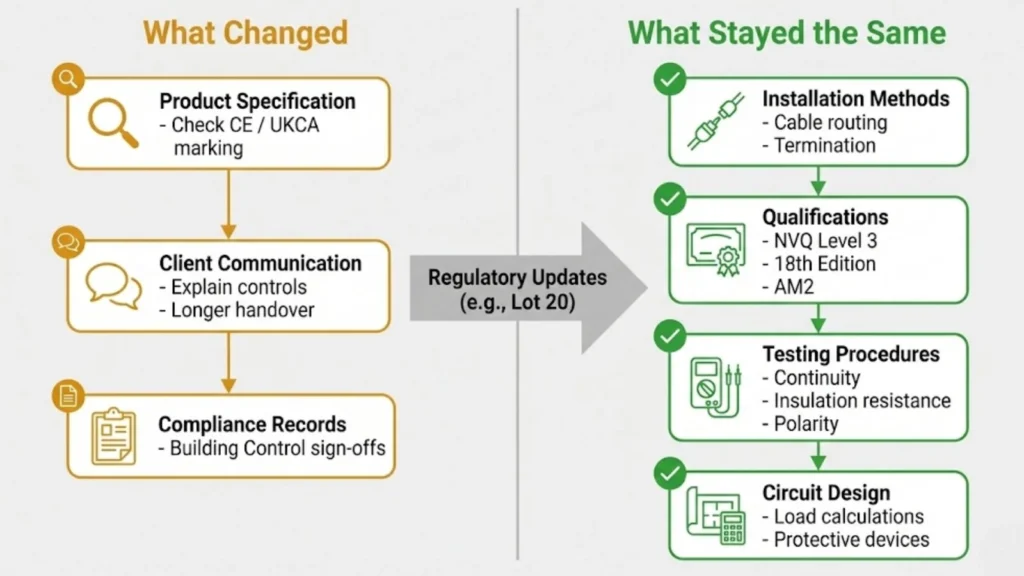
For electricians, Lot 20 changed specification, not installation. The process of running a cable from a fused spur to a heater remained identical. Circuit design, cable sizing, protective device selection, testing procedures stayed the same. What changed was which products were available to specify and how much time was required for client handover.
Specification Changes: Electricians became responsible for selecting compliant products. This required checking for CE or UKCA marking (post-Brexit), verifying that products included the mandatory efficiency controls, and understanding which heaters were suitable for specific applications (domestic vs. commercial, primary vs. secondary heating, accessible vs. inaccessible locations).
In practice, this meant using wholesaler catalogues that only stocked compliant products by 2019. The specification responsibility shifted from “pick a heater with the right wattage” to “pick a compliant heater with the right wattage, control features appropriate for the client, and programming complexity they can manage.”
Client Communication: The biggest practical change was explaining why costs increased and why specific features were included. Landlords wanted to know why replacement heaters cost £150 instead of £40. Tenants needed instruction on programming 7-day timers, setting adaptive start parameters, and understanding open-window detection.
This extended job times. A straightforward heater replacement that previously took 90 minutes (disconnection, installation, testing) now took 2 hours with the additional 15-20 minutes spent on handover and programming instruction. For installations involving multiple heaters (HMO properties, new builds), this handover time multiplied.
Paperwork and Compliance: While electricians didn’t become responsible for certifying energy efficiency (that remained a manufacturer obligation), they did need to ensure products were properly marked. Checking for CE or UKCA markings became part of the specification process. Keeping records of product compliance, particularly for Building Control sign-offs on new builds or major renovations, became standard practice.
Domestic Retrofit Work: In retrofit scenarios, particularly social housing and HMO properties, the shift was more pronounced. Electricians moved from “fitting heaters” to “setting up heating systems.” This involved programming multiple units, configuring zoning strategies, and explaining control systems to property managers who’d be responsible for tenant support.
For those considering careers in electrical work, understanding how qualification pathways prepare you for these regulatory shifts shows why proper training matters when products and standards evolve so rapidly.
What Didn’t Change:
Core electrical installation methods (cable routing, termination, testing)
Required qualifications (NVQ Level 3, 18th Edition, AM2)
Circuit design principles (load calculations, protective device selection)
Testing procedures (continuity, insulation resistance, polarity)
Legal responsibilities around safe installation and certification
Electricians install heaters to BS 7671 standards. Product efficiency compliance is a manufacturer responsibility. This distinction was often misunderstood in 2018, with some installers believing they needed new qualifications or certifications to fit Lot 20 heaters. They didn’t. The regulation didn’t create new electrical installation requirements.
Post-Brexit Reality: Did Lot 20 Survive?
Brexit raised questions about whether the UK would maintain, modify, or abandon Lot 20 requirements. The answer: maintain, with only administrative changes.
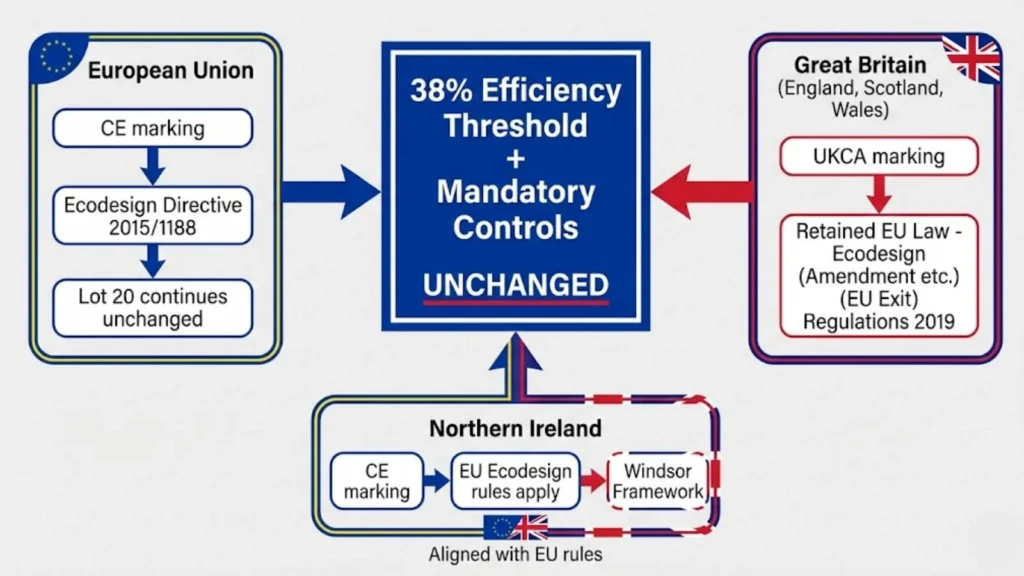
The UK government retained Lot 20 rules through the Ecodesign for Energy-Related Products and Energy Information (Amendment) (EU Exit) Regulations 2019. This statutory instrument incorporated EU ecodesign measures into UK domestic law, ensuring continuity after 31 December 2020 when the Brexit transition period ended.
Technical Requirements: The 38% minimum efficiency threshold, the mandatory control features, the seasonal efficiency calculation method stayed identical. Products compliant with EU Lot 20 remained compliant in the UK. There was no divergence in the underlying technical standards.
Marking Changes: CE marking was replaced by UKCA (UK Conformity Assessed) marking for products placed on the Great Britain market. Manufacturers had a transition period allowing continued use of CE marking until certain deadlines, but new products eventually required UKCA marking to demonstrate compliance with UK standards.
Northern Ireland Exception: Northern Ireland remained under EU Ecodesign rules via the Windsor Framework, which maintained alignment with EU product standards to avoid a regulatory border on the island of Ireland. In practice, this meant manufacturers serving the UK market maintained single product lines meeting both EU and UK requirements, as creating separate versions for Great Britain and Northern Ireland wasn’t economically viable.
Enforcement Continuity: The Office for Product Safety and Standards (OPSS) continued oversight, with powers equivalent to those previously exercised under EU regulations. Trading Standards retained authority to remove non-compliant products. The enforcement approach (targeting manufacturers and importers rather than installers) remained unchanged.
Future Divergence Potential: While the UK government has the power to modify or remove Lot 20 requirements, there’s been no political will to do so. The regulation is viewed as successful, with cross-party support for maintaining energy efficiency standards. Industry lobbying from manufacturers who invested in compliance actively opposes any weakening of standards, as it would reopen the market to cheap imports.
For electricians, Brexit’s impact on Lot 20 was administrative rather than practical. The heaters available in 2019 remained available in 2021. UKCA marking replaced CE marking on product labels, but the underlying compliance requirements didn’t change. Installers experienced no workflow disruption from Brexit-related modifications to ecodesign standards.
Why Lot 20 Still Matters in 2025-2026
Seven years after implementation, Lot 20 remains relevant for several reasons that directly affect electricians’ daily work:
EPC Ratings and Rental Property Compliance: The UK government is progressively tightening minimum Energy Performance Certificate (EPC) requirements for rental properties. In England, landlords must achieve at least EPC E (with plans to raise this to EPC C). Scotland and Wales have similar trajectories. Installing non-compliant heaters, or using old stock from before 2018, actively harms a property’s EPC rating.
Building assessors calculate EPC ratings based on the installed heating system’s efficiency. Heaters without the control features mandated by Lot 20 score poorly. For landlords working to meet EPC C targets, specifying compliant heaters with proven efficiency features is essential. Electricians advising on heating upgrades need to understand this connection between product specification and EPC outcomes.
Building Control Sign-Offs: For new builds and major renovations requiring Building Control notification, inspectors increasingly check for CE or UKCA marking and evidence of integrated efficiency controls. While Building Regulations don’t explicitly reference Lot 20 by name, Part L (Conservation of Fuel and Power) requires reasonable provision for energy efficiency. Compliant heaters with adaptive controls and programming meet this requirement more easily than basic products.
Electricians submitting completion certificates need to ensure specified products have proper compliance markings. Installing unmarked or non-compliant heaters can cause delays in Building Control sign-offs, particularly for new builds where the heating system contributes significantly to SAP (Standard Assessment Procedure) calculations.
Client Expectations and Professional Standards: By 2026, clients expect heaters to include digital controls, programming capabilities, and efficiency features as standard. An electrician specifying or installing a basic heater without these features (assuming they could even source one) would appear unprofessional or out of date.
Consumer awareness of energy efficiency has increased significantly since 2018, driven by rising energy costs and climate change concerns. Clients ask about running costs, programmability, and smart home integration. The features introduced by Lot 20 are now baseline expectations, not optional extras.
Net Zero Alignment: While Lot 20 predates the UK’s 2019 Net Zero commitment, it aligns with the broader electrification of heat required to decarbonize buildings. As heat pumps become more common for primary heating, efficient electric heaters serve as supplementary or zonal heating solutions in highly insulated properties.
The regulation ensured that electric resistance heating, often criticized as wasteful, wasn’t inherently inefficient by design. Adaptive start, presence detection, and open-window sensing reduce energy consumption in ways that benefit both grid load management and household bills. This positions compliant electric heaters as viable options in the transition to Net Zero, rather than as outdated technology to be replaced entirely.
Supply Chain Normalization: The complete removal of non-compliant products from legitimate supply chains means electricians don’t need to actively police compliance. Wholesalers only stock compliant heaters. Manufacturer catalogues assume compliance. The regulation succeeded by becoming invisible, embedded in product design standards that now feel natural rather than imposed.
This normalization benefits electricians by removing a decision point. You don’t need to check whether a heater meets Lot 20 requirements if non-compliant heaters don’t exist in the supply chain. The regulatory burden shifted entirely to manufacturers, where it was always intended to sit.
What Lot 20 Didn't Do (Myth-Busting the 2018 Panic)
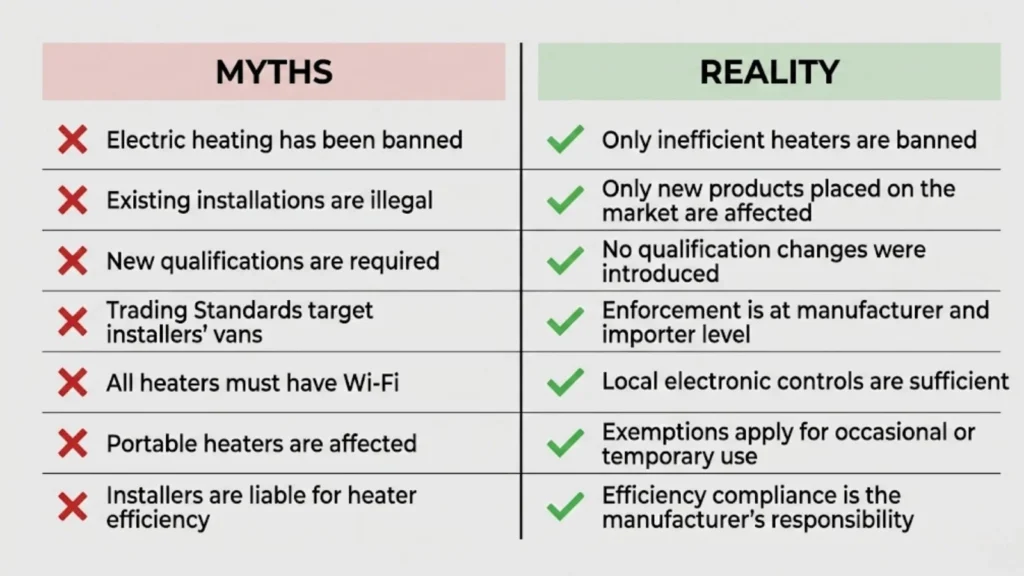
Several myths emerged in 2018 that caused unnecessary confusion and cost. Seven years later, it’s worth clarifying what Lot 20 didn’t do:
Myth 1: Lot 20 Banned Electric Heating Reality: Lot 20 banned inefficient electric heaters, not electric heating itself. Products meeting the efficiency threshold remained perfectly legal. The confusion arose because media coverage and some sales tactics used language like “electric heater ban” to create urgency. Electric heating is still widely used in 2026, but the products are more efficient.
Myth 2: Existing Installations Became Illegal Reality: Lot 20 applied to new products being placed on the market, not existing installations. If you had a non-compliant heater installed before January 2018, it remained legal to use. The regulation didn’t require landlords or homeowners to replace functioning heaters. This myth caused wasteful premature replacements driven by scare tactics rather than genuine compliance requirements.
Myth 3: Electricians Needed New Qualifications Reality: No new electrical qualifications were required. Electricians didn’t need Lot 20-specific certifications or training to install compliant heaters. The installation process remained identical to previous products. This myth arose from confusion about where compliance responsibility sat (manufacturers, not installers).
Myth 4: Trading Standards Would Target Electricians Reality: Enforcement focused on manufacturers and importers at the supply chain level. Trading Standards had powers to remove non-compliant products from retailer shelves, but no enforcement action targeted electricians fitting products. The OPSS strategy was to catch thousands of units upstream rather than individual installations downstream.
Myth 5: All Electric Heaters Needed Wi-Fi or Smart Control Reality: Lot 20 mandated local controls (electronic thermostat, 24/7 timer, adaptive start, open-window detection). It didn’t mandate internet connectivity or smart home integration. Many manufacturers added Wi-Fi because the digital control platform was already in place, but it wasn’t legally required. Basic compliant heaters without smart features exist and meet all regulations.
Myth 6: Portable Heaters Were Affected Reality: Portable heaters (small plug-in units for occasional use) were largely exempt from the strictest requirements. Lot 20 targeted local space heaters (fixed installations used for primary or secondary heating). The small fan heaters people use temporarily in offices or spare rooms weren’t subject to the same efficiency thresholds.
Myth 7: Lot 20 Created Installer Liability for Efficiency Reality: Manufacturers remain legally responsible for product compliance. Electricians are responsible for safe installation to BS 7671 and selecting products appropriate for the application. If a heater doesn’t meet efficiency standards, that’s a manufacturer compliance failure, not an installer fault. Electricians specify products assuming compliance; they don’t certify efficiency themselves.
Understanding these myths matters because similar patterns emerge with new regulations. The 2018 Lot 20 panic provides lessons for how to respond to future changes without overreacting or making costly decisions based on misinformation.
Lessons Learned: What the Lot 20 Journey Teaches Us
Seven years from implementation to normalization offers insights for how regulations affect the electrical industry:
Lesson 1: Product Regulations Don’t Change Installation Methods Lot 20 proved that product-level regulations can transform markets without requiring new installation techniques or qualifications. Electricians adapted to specifying different products, but the core skillset remained unchanged. Future regulations targeting product efficiency (EV chargers, heat pumps, smart controls) will likely follow this pattern: changed specifications, not changed installation methods.
Lesson 2: Enforcement Upstream Is More Effective Than Downstream Targeting manufacturers and importers caught thousands of non-compliant units before they reached installers. This proved more effective than trying to police individual installations. The OPSS strategy succeeded by focusing resources where they had maximum impact. Future regulations can learn from this approach.
Lesson 3: Initial Cost Increases Normalize Over Time The £40 to £150 price jump in 2018 felt dramatic. By 2025, adjusted for inflation and added functionality, compliant heaters cost roughly what basic heaters did pre-2018. Economies of scale, component cost reductions, and manufacturer competition stabilized pricing. Short-term panic about affordability proved unfounded once the market adjusted.
Lesson 4: Client Education Takes Longer Than Product Changeover The technology shifted faster than user understanding. Seven years later, some tenants still struggle with programming features. Handover time and client support remain larger practical challenges than product availability or installation complexity. Future smart home integrations and control systems will face similar adoption curves.
Lesson 5: Invisible Regulations Succeed By 2025, electricians don’t think about Lot 20 because it’s embedded in product standards. The most successful regulations disappear from consciousness once compliance becomes baseline. This contrasts with regulations that create ongoing administrative burden or require active verification at every installation.
Lesson 6: Industry Benefits From Eliminating Low-Quality Products Removing the bottom end of the market improved overall product quality and created a level playing field for manufacturers investing in R&D. While electricians lost access to ultra-cheap options for cost-sensitive projects, the professional reputation of the industry improved by standardizing around higher-quality products.
Lesson 7: Brexit Didn’t Disrupt Product Standards Despite political rhetoric about regulatory freedom, the UK retained Lot 20 because it worked. This pragmatic approach avoided market disruption and maintained supply chain continuity. Future Brexit-related regulatory divergence seems unlikely for successful product standards with broad industry support.
For electricians training now or considering entering the trade, understanding how proper qualifications prepare you for regulatory changes demonstrates why foundational skills matter more than short-term product knowledge. Regulations come and go, products evolve, but competent electricians adapt by applying core principles to new contexts.
Seven years after implementation, here’s what still matters:
Check Product Marking: Verify that heaters carry CE or UKCA marking (depending on when they were placed on the GB market). This confirms manufacturer compliance. For new builds or major renovations requiring Building Control notification, inspectors check markings during sign-offs.
Understand EPC Implications: When advising landlords on heating upgrades, explain that compliant heaters improve EPC ratings. Non-compliant or old stock heaters harm energy performance assessments. This is particularly relevant for landlords working toward EPC C requirements.
Budget Extra Time for Handover: Programming and explaining control features takes 15-20 minutes per heater. Factor this into job quotes and schedules. Clients who don’t understand the controls won’t use the efficiency features, defeating the purpose and potentially blaming the electrician for high running costs.
Don’t Overthink Compliance: By 2026, compliance is assumed. Wholesaler catalogues only stock compliant products. You don’t need to become an expert in seasonal efficiency calculations or adaptive start algorithms. Select appropriate products from reputable suppliers, check for compliance markings, and install to BS 7671. Manufacturers handle the rest.
Explain Running Cost Benefits: Clients expect justification for the cost of compliant heaters. Explain how adaptive start prevents overheating, open-window detection stops energy waste, and 7-day programming allows heating only when rooms are occupied. These features pay back through reduced consumption, typically within 12-18 months.
Stay Current on UKCA Requirements: Post-Brexit marking requirements continue evolving. The government periodically updates deadlines for mandatory UKCA marking. Keep up to date with these changes to ensure specified products have correct markings for their placement date.
Don’t Source Non-Compliant Products: Avoid cheap imports or old stock from secondary markets (eBay, Amazon Marketplace) that may not meet compliance requirements. Even if available, fitting non-compliant heaters looks unprofessional, harms EPC ratings, and risks client complaints about high running costs.
The key message: Lot 20 is now baseline, not a compliance hurdle. Treat it as normal product specification rather than a special regulatory requirement.
References
- Commission Regulation (EU) 2015/1188 on Ecodesign Requirements for Local Space Heaters – https://energy-efficient-products.ec.europa.eu/product-list/local-space-heaters_en
- GOV.UK: Placing Energy-Related Products on the UK Market – https://www.gov.uk/guidance/placing-energy-related-products-on-the-uk-market
- Office for Product Safety and Standards (OPSS) Guidance – https://www.gov.uk/
- BEAMA Technical Guidance on Lot 20 Compliance – https://www.beama.org.uk/
- Dimplex: Lot 20 Ecodesign Changes – https://www.dimplex.co.uk/topics/lot20
- Professional Electrician: Lot 20 Arrived, What You Need to Know – https://professional-electrician.com/features/lot-20-arrived-need-know/
Note on Accuracy and Updates
Last reviewed: 15 January 2026. This page is maintained regularly. We update market evolution data, UKCA marking requirements, EPC rating implications, and enforcement patterns as regulations and standards evolve. Lot 20 requirements remain stable, but their interaction with broader energy efficiency policies (EPC minimums, Building Regulations Part L, Net Zero strategies) continues developing.
FAQs
What is Lot 20, and what did it actually regulate when it came into force in January 2018?
Lot 20 refers to the EU Ecodesign Commission Regulation (EU) 2015/1188, which came into force on 1 January 2018. It regulated the energy efficiency of local space heaters placed on the market in the UK and EU, focusing on new products rather than existing installations. The regulation aimed to reduce energy consumption by setting minimum efficiency standards and requiring specific control features.
This applied to electric heaters, storage heaters, and underfloor systems sold after that date, but did not affect heaters already in use or installed before 2018. Manufacturers were required to ensure compliance before products reached retailers. By 2026, Lot 20 continues to influence the availability of efficient heating options, supporting wider UK energy objectives under Part L of the Building Regulations.
Did Lot 20 ban electric heating, or did it only remove certain types of heaters from sale?
Lot 20 did not ban electric heating. Instead, it removed certain inefficient types of local space heaters from sale starting in January 2018, targeting products that failed to meet new energy efficiency requirements. This mainly affected basic panel heaters without advanced controls, while compliant and efficient models remained available.
The regulation applied only to new products entering the market and did not affect existing electric heating systems. Electricians and users could continue installing or using pre-2018 stock until supplies were exhausted, and compliant alternatives quickly replaced withdrawn models. In 2026, electric heating remains widely used, with Lot 20 ensuring only energy-efficient products are sold, supporting emissions reduction goals without restricting the technology itself.
Who was legally responsible for Lot 20 compliance, manufacturers, importers, retailers, or electricians?
Legal responsibility for Lot 20 compliance sat with manufacturers and importers, who were required to ensure products met the regulation before being placed on the market from January 2018. Enforcement was carried out by the Office for Product Safety and Standards, focusing on supply chain compliance rather than end users.
Retailers were required to sell only compliant products, but primary accountability rested with those designing and importing heaters. Electricians were not legally responsible for compliance, as their role is installation rather than product certification. This clarified early confusion around liability. In 2026, this framework remains unchanged, allowing electricians to focus on safe installation under BS 7671 without bearing compliance responsibility.
What control features became effectively mandatory under Lot 20, and why were they required?
From January 2018, Lot 20 required local space heaters to include electronic thermostats accurate to within 0.5 degrees Celsius, a seven-day timer, adaptive start control, and open-window detection. These features ensure heaters operate only when needed, reducing unnecessary energy consumption.
Adaptive start allows the heater to anticipate demand, while open-window detection switches the unit off when rapid temperature drops indicate ventilation. These requirements stemmed from EU ecodesign objectives to cut energy waste and greenhouse gas emissions. By 2026, these controls are standard in new heaters, supporting improved energy management and compliance with UK building and efficiency standards.
Why did electric heater prices jump in 2018, and what changed by 2025 to normalise the market?
Electric heater prices increased in 2018 due to the cost of incorporating Lot 20 mandatory features such as advanced thermostats and programmable timers. Manufacturers redesigned products and introduced new components, passing some of these costs on to consumers. Early price increases of 20 to 50 percent were most noticeable on basic models as non-compliant stock was removed.
By 2025, the market stabilised as more manufacturers entered the compliant space. Production efficiencies, increased competition, and economies of scale reduced costs. By 2026, compliant heaters are available across a wide range of price points, delivering energy efficiency benefits without ongoing cost pressure.
What changed for electricians on the ground because of Lot 20, and what stayed exactly the same?
Lot 20 changed the specification stage for electricians, requiring confirmation that heaters selected from January 2018 onward were compliant and correctly marked. Handover processes also evolved, with more emphasis on explaining control features such as timers and adaptive start to clients.
What did not change were installation methods or qualifications. Electrical work remained governed by BS 7671, with no new certifications introduced specifically for Lot 20. Circuit design, testing, and safety requirements stayed the same. By 2026, these adjustments are routine, allowing electricians to provide better energy advice without altering core trade skills.
What were the biggest myths and scare stories around Lot 20 in 2018, and what was the reality?
Common myths in 2018 included claims that Lot 20 banned all electric heating, forced replacement of existing systems, or exposed electricians to fines for installing non-compliant heaters. Some reports suggested prices would permanently double, making electric heating unaffordable.
In reality, Lot 20 applied only to new products placed on the market, not existing installations. Compliance responsibility lay with manufacturers and importers, not electricians, and was enforced upstream. Price increases were temporary and stabilised as compliant products became standard. By 2026, electric heating remains widespread, with Lot 20 proven to improve efficiency without the disruption originally feared.
After Brexit, did the UK keep Lot 20 rules, and what did UKCA marking change in practice?
Following Brexit, the UK retained Lot 20 requirements as assimilated EU law, maintaining identical energy efficiency standards for local space heaters in Great Britain. Northern Ireland continues to align under the Windsor Framework, ensuring consistency across markets.
UKCA marking replaced CE marking for Great Britain from 2021, but this represented a change in labelling rather than substance. Product design and performance requirements remained the same. Many manufacturers adopted dual marking for EU and UK markets. In 2026, UKCA marking confirms compliance without affecting installation, use, or performance expectations.
How does Lot 20 affect EPC ratings and landlord energy efficiency obligations in 2026?
In 2026, Lot 20-compliant heaters contribute positively to Energy Performance Certificate assessments by reducing modelled energy demand through advanced controls. Features such as adaptive start and open-window detection improve calculated efficiency, helping properties achieve higher EPC bands.
For landlords, this supports compliance with Minimum Energy Efficiency Standards, which require rented properties to meet EPC band E or above. Lot 20 also aligns with Part L requirements for conservation of fuel and power during refurbishments. While existing non-compliant heaters do not have to be replaced, compliant upgrades can reduce tenant bills and improve property appeal.
What practical checks should electricians and landlords make today when specifying electric heaters?
Electricians and landlords should confirm that heaters carry the UKCA mark and meet Lot 20 requirements in 2026. Check energy labels and product documentation to ensure mandatory features such as electronic thermostats, seven-day timers, adaptive start, and open-window detection are included.
Products should be sourced from reputable manufacturers or retailers to avoid non-compliant imports. Documentation should include ecodesign declarations relevant to UK requirements. When EPC performance matters, select models that support Part L objectives. These checks ensure regulatory compliance, energy efficiency, and long-term performance without affecting installation practices.
