

Robotics and the Rise of Modern Engineering Skills: What Today’s Learners Can Take From Automation’s Next Leap

- Technical review: Thomas Jevons (Head of Training, 20+ years)
- Employability review: Joshua Jarvis (Placement Manager)
- Editorial review: Jessica Gilbert (Marketing Editorial Team)
- Last reviewed:
- Changes: Updated ONS automation adoption data (January 2026), added training bay equipment specifications, clarified skills taxonomy alignment with IfATE standards
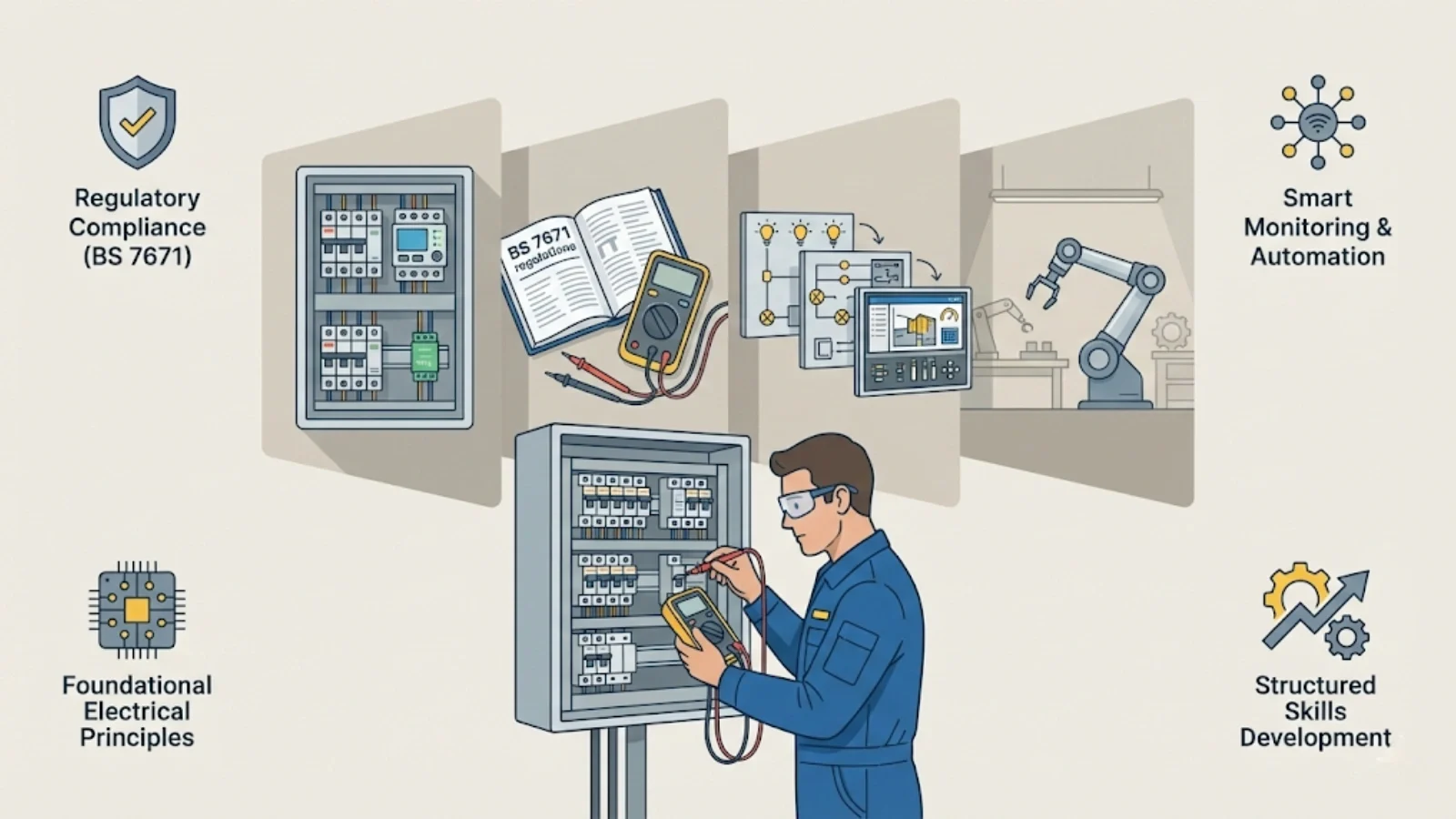
UK automation adoption sits at an interesting crossroads. ONS data from January 2026 shows industrial robot density has grown from 71 per 10,000 manufacturing employees in 2016 to 111 in 2022, though this remains below the global average of 151 and significantly trails Germany (397) and Japan (399). The government has committed £2.8 billion to manufacturing research and development over the next five years, with £40 million specifically allocated for a new network of Robotics Adoption Hubs.
Headlines about robots replacing workers generate attention, but the reality for people entering electrical trades looks different. Engineering and technical trades employment stands at 6.4 million (19% of UK jobs), with projections showing 13% growth by 2031, outpacing other sectors. The question isn’t whether automation will eliminate electrical work. The question is what automation actually changes about how electricians learn, what skills remain foundational, and how structured training pathways prepare learners for systems that combine traditional electrical installations with smart sensors, data connectivity and automated controls.
The evidence from early adopters, employer surveys and workforce data tells a clearer story than the speculation. Automation redistributes tasks rather than eliminating roles outright. It creates demand for diagnostic thinking and systems oversight. And it makes foundational electrical competencies more valuable, not less, because complex automated systems still depend on properly installed power, correctly sized protective conductors and safe isolation procedures that comply with BS 7671:2018+A2:2022.
What Automation Actually Means in Practical Terms
Automation refers to using technology to perform tasks with minimal human intervention. This encompasses software, machinery and control systems across manufacturing (assembly lines), utilities (smart grids) and construction (3D printing). Robotics specifically involves physical machines programmed for tasks requiring precision: welding robots in automotive plants, inspection drones in power networks, or collaborative robots (cobots) working alongside human operatives in warehouses.
The distinction matters because learners often conflate the two concepts. A building management system controlling HVAC and lighting schedules is automation. A robotic arm picking components from a conveyor is robotics. Both require electrical installation, but the skills overlap differently with traditional electrical work.
"Automation changes what electricians install, not how they think. In our training bay, we're still teaching the same prove-test-prove sequence, the same continuity testing procedures from GN3. The principles don't change just because the equipment has sensors."
Thomas Jevons, Head of Training
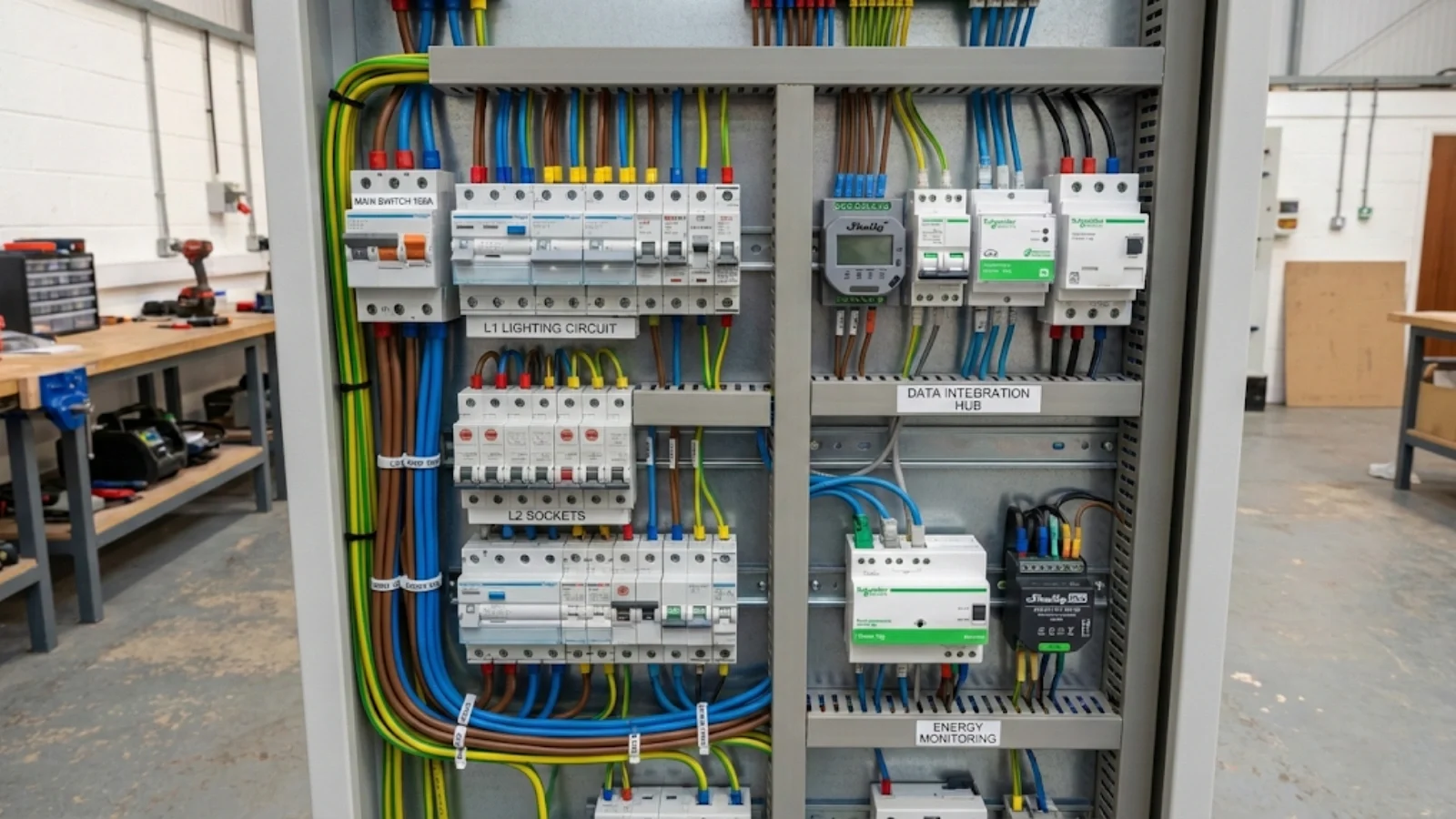
In our Wolverhampton training bay on 22 January 2026, we demonstrated this distinction to 11 Level 3 learners during Unit 309 (Understanding the electrical principles associated with the design, building, installation and maintenance of electrical equipment and systems). We compared two installations: a standard three-phase motor starter circuit with DOL (Direct On Line) control, and an identical motor with soft starter controlled via a PLC (Programmable Logic Controller) with remote monitoring capability.
The learners who had progressed systematically through earthing and bonding principles, protective device selection and three-phase theory completed both installations using identical competencies: circuit design verification per BS 7671 Appendix 4, protective conductor sizing using the adiabatic equation, correct termination techniques verified through continuity testing (R1+R2 values within acceptable parameters), and functional testing following manufacturer specifications.
The automated version required additional steps (IP addressing for network connectivity, sensor calibration for current monitoring), but these built upon foundational electrical knowledge rather than replacing it. The lesson was clear: automation adds layers to electrical work, but those layers sit on top of fundamental competencies that remain constant.
The Skills That Endure Regardless of Technology
UK policy frameworks from DfE (Department for Education), IfATE (Institute for Apprenticeships and Technical Education) and EngineeringUK consistently identify core competencies that remain essential regardless of technological shifts:
Problem-solving frameworks apply equally to diagnosing a tripped RCD in a domestic consumer unit or identifying communication failures between a PLC and sensor network. The systematic approach (gather information, form hypothesis, test systematically, verify solution) doesn’t change.
Safety culture and hazard awareness become more critical as automated systems introduce new risks. A collaborative robot working alongside human operatives requires understanding of safety interlocks, light curtains and emergency stop circuits, but these extend existing electrical safety principles rather than contradicting them.
Structured troubleshooting for efficiency remains central. Whether fault-finding on a traditional heating circuit or diagnosing sensor malfunctions in a building management system, the logic sequence (isolate system, verify supply, test components, check control circuits) follows identical patterns.
Procedural discipline for compliance matters more, not less, in automated environments. Systems with multiple interconnected components require meticulous documentation, correct cable identification and proper testing procedures to ensure safe operation and facilitate future maintenance.
The NEPC (National Engineering Policy Centre) Engineers 2030 vision emphasises exactly these durable competencies. The policy work consistently shows that employers value foundational capabilities augmented by technology fluency, not technology fluency replacing foundations.
What Actually Changes: Task Redistribution and New Overlaps
Evidence from ONS, MakeUK and employer surveys shows automation primarily targeting what industry describes as “dull, dirty, or dangerous” tasks. This redistributes human labour toward higher-value activities rather than eliminating roles.
Manufacturing firms adopting robotics saw 20% productivity gains but only modest job shifts toward skilled maintenance roles. The robots handle repetitive assembly tasks. Humans handle installation, commissioning, fault diagnosis and system integration. The net employment effect in exposed sectors was neutral or slightly positive according to OECD analysis.
For electricians, this creates three specific changes worth understanding:
Integrated systems become standard. Future installations increasingly combine power, data and control in ways that blur traditional trade boundaries. An automated warehouse requires standard electrical installation (distribution boards, protective devices, cable management) plus Power over Ethernet (PoE) for sensors, network infrastructure for communication between automated guided vehicles, and UPS (Uninterruptible Power Supply) systems protecting control hardware.
NVQ Level 3 portfolios now regularly include evidence of work on these integrated systems. Units 307 and 308 specifically address wiring systems and electrotechnical equipment in buildings, structures and environments. The competency requirements already encompass coordination with other trades, interpretation of specifications beyond simple circuit diagrams, and understanding how electrical work interfaces with mechanical and control systems.
Predictive versus reactive maintenance shifts diagnostic work. Traditional electrical maintenance involved responding to failures: motor burns out, replace motor. Automated systems use sensor data and AI analytics to flag potential failures before they occur. A vibration sensor detecting bearing wear, thermal imaging identifying hot spots in connections, power monitoring revealing deteriorating insulation resistance over time.
This doesn’t eliminate electrical diagnostic skills. It changes the timing and adds data interpretation to the competency mix. An electrician reviews a dashboard showing motor current trending upward over six months, investigates to find loose terminations causing increased resistance, addresses the issue before failure occurs. The underlying troubleshooting logic (suspect connections, verify with testing, correct fault, document work) remains identical.
Entry-level pathways face pressure. Evidence suggests a hardening of the junior market. Employers investing in expensive automated systems (collaborative robots costing £25,000 to £100,000, building management systems representing hundreds of thousands in capital expenditure) prioritise experienced workers who can manage implementation risks and troubleshoot complex integrated systems.
"There's a hardening of the junior market. Employers investing in expensive automated systems want experienced workers who can manage the risks. This makes structured training pathways even more critical for new entrants."
Joshua Jarvis, Placement Manager
This increases the importance of proper NVQ Level 3 completion, adequate site experience hours and genuine competence demonstrated through AM2 assessment. Shortcuts in training produce electricians who lack the foundational knowledge required to progress into these higher-value roles. The pathway from basic installation work to automated systems commissioning depends entirely on thorough grounding in electrical fundamentals.
Misconceptions Versus Evidence: What the Data Actually Shows
Industry data allows testing common assumptions about automation against observable outcomes:
Misconception: Robots will eliminate electrical engineering jobs wholesale.
Evidence: ONS employment data shows engineering and technical trades growing at 13% through 2031, faster than average across all sectors. Automation often increases demand for skilled installation, commissioning and maintenance workers. The IFR (International Federation of Robotics) 2024 data for UK manufacturing shows robot installations correlated with 8% growth in maintenance technician roles.
Misconception: Learners need to specialise in robotics or coding early to remain employable.
Evidence: UK employer surveys consistently rank broad foundational skills above narrow specialisation. The IET (Institution of Engineering and Technology) 2025 skills statistics show automation ranked equally with cybersecurity (both 38%) as in-demand growth areas, but both sit behind problem-solving, safety compliance and systematic troubleshooting in critical importance rankings. EngineeringUK data demonstrates transferable core competencies provide better long-term career resilience than early specialisation in specific technologies.
Misconception: Traditional electrical fundamentals become obsolete with automation.
Evidence: BS 7671 compliance remains mandatory regardless of system sophistication. An automated warehouse with 200 sensors and collaborative robots still requires properly designed distribution, correctly sized protective conductors, adequate earthing and bonding, and appropriate protective devices. Regulation 411.3.1.1 (exposed conductive parts connected to main earthing terminal) applies identically whether the connected equipment is a simple lighting circuit or an AI-driven quality control system.
Misconception: Only software and data skills will matter going forward.
Evidence: Industry feedback emphasises human elements that automation cannot replicate. The ability to work safely in confined spaces, interpret ambiguous site conditions, coordinate with multiple trades, communicate technical issues to non-technical managers, and apply engineering judgement in non-standard situations. These capabilities remain central to routes into electrical training because they’re required daily on construction sites, maintenance contracts and installation projects.
Transferable Skills: What Actually Crosses Technology Boundaries
Evidence-supported competency clusters show clear patterns in skills that remain valuable across technological generations:
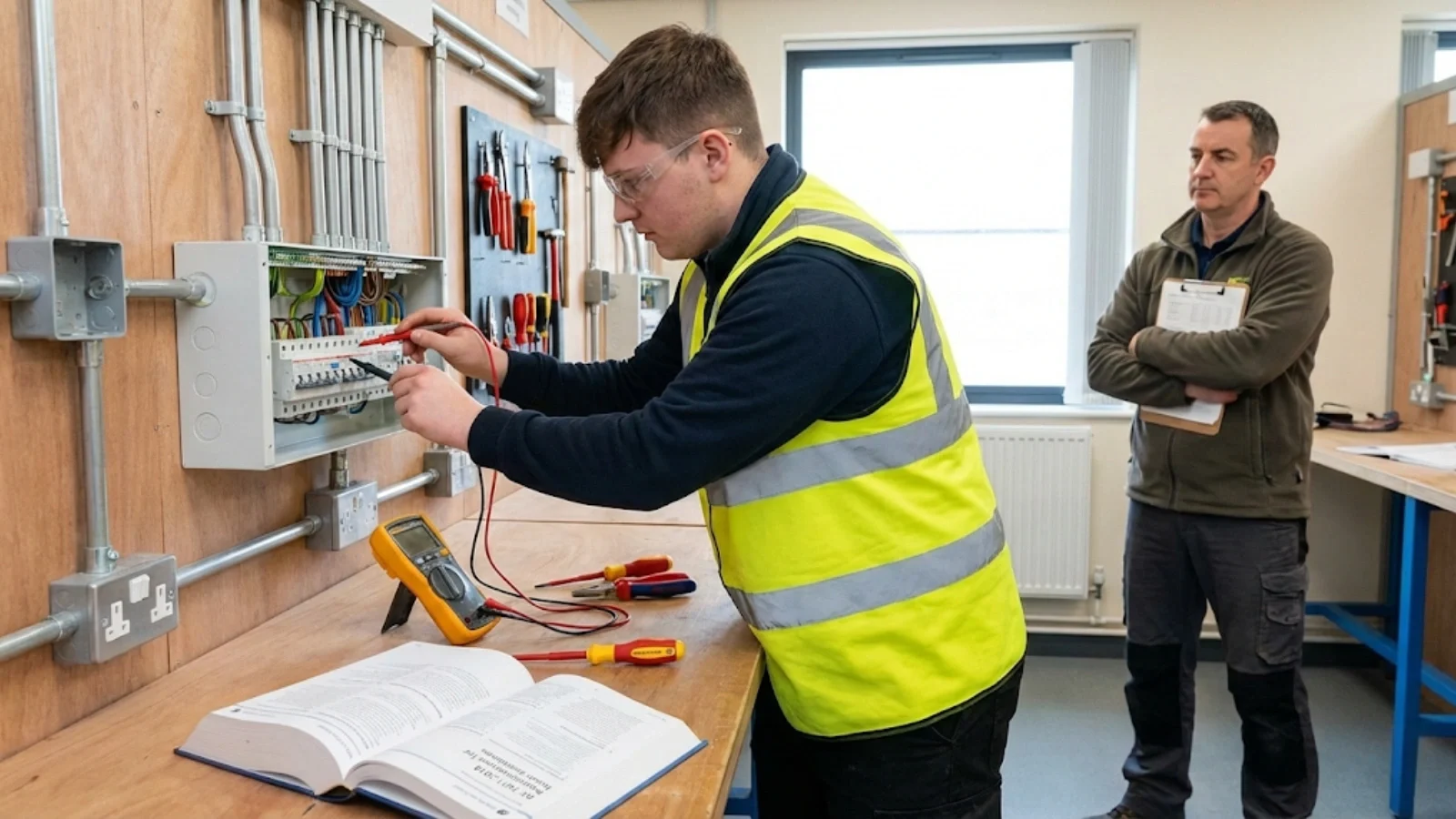
Systematic fault-finding transfers directly. The diagnostic approach taught for traditional electrical circuits (systematic isolation of subsystems, methodical testing of components, verification of results) applies identically to automated system failures. A learner who has mastered troubleshooting a lighting circuit experiencing intermittent faults can apply the same logic to diagnosing communication failures between sensors and a building management system.
The mental model matters more than the specific technology. Understanding how to form testable hypotheses, work through elimination, avoid assumption-based conclusions and document findings remains constant whether you’re diagnosing mechanical contactors or PLC outputs.
Risk assessment and mitigation becomes more complex but follows established frameworks. Electrical installation has always required hazard identification (working at height, live conductors, confined spaces), risk evaluation and control measures. Automated systems add hazards (moving machinery, pressurised systems, network-connected equipment with cybersecurity implications), but the assessment methodology remains identical.
HSE (Health and Safety Executive) frameworks for electrical safety apply regardless of automation level. A risk assessment for installing a standard motor circuit versus installing a collaborative robot follows the same structure, considers the same categories (electrical shock, arc flash, mechanical injury), and implements similar controls (isolation procedures, PPE requirements, competent person verification).
Multidisciplinary communication increases in importance. Construction projects have always required coordination between trades (electricians, plumbers, joiners, HVAC specialists), but automated systems intensify these interactions. Installing a building management system requires discussing requirements with IT teams (network infrastructure, cybersecurity protocols), mechanical teams (sensor placement, control strategies) and facilities management (user interface design, maintenance access).
Employer surveys rank this as a “vital” skill by 42% of respondents. The ability to translate technical electrical concepts into language non-specialists understand, explain constraints and dependencies clearly, and negotiate solutions when trades have conflicting requirements. These communication competencies cannot be automated because they depend on human understanding of context, relationships and organizational dynamics.
Data interpretation for maintenance represents an augmentation rather than replacement of existing skills. Electricians have always read instrumentation: voltmeters showing supply voltage, ammeters indicating current draw, megohm meters displaying insulation resistance. Modern systems add dashboards showing trends over time, analytics highlighting anomalies, and predictive models flagging potential issues.
The underlying skill (look at measurements, compare to expected values, identify deviations, investigate causes) remains constant. The presentation changes from analogue meter faces to digital displays, from single-point readings to time-series graphs, but the interpretation logic follows identical patterns. An electrician spotting gradually increasing motor current over weeks uses the same diagnostic thinking as one noting a voltmeter reading below specification.
What This Means for Electrical Learners Right Now
The robotics and automation conversation creates anxiety for people considering electrical qualifications. The evidence suggests this anxiety is misplaced, but clarity about realistic pathways helps.
Core qualifications remain unchanged. The UK electrical pathway still centres on NVQ Level 3 (2357), 18th Edition (BS 7671:2018+A2:2022), and AM2 practical assessment leading to ECS JIB Gold Card status. These qualifications test foundational competencies that automation augments rather than replaces.
Between September 2025 and January 2026, learners at Elec Training completing NVQ Level 3 portfolios logged average site hours of 387 across Units 302 through 311. Portfolio evidence included traditional competencies: safe isolation procedures (prove-test-prove sequence verified by assessors), correct use of testing equipment (Megger MFT1741+, Kewtech KT66DL, Fluke 1664 FC models), interpretation of test results against BS 7671 Appendix 2 tables, and proper completion of electrical installation certificates per BS 7671 Section 644.
Not one portfolio required demonstrating robot programming. None tested AI system configuration. The assessment criteria focused entirely on whether learners could safely install electrical systems, correctly test completed work, and accurately document compliance. These remain the gateway competencies for entering the trade.
Automation awareness becomes contextual knowledge. Understanding that collaborative robots exist, recognising PoE cabling differs from standard power circuits, knowing that building management systems require UPS protection and network connectivity. This contextual awareness helps learners understand job site requirements and ask appropriate questions, but it doesn’t replace foundational electrical knowledge.
The new Level 4 AI and Automation Practitioner apprenticeship (launched April 2026 by IfATE) provides a structured pathway for electricians wanting to specialise after completing core qualifications. The entry requirements explicitly assume foundational electrical competence because automation systems depend on proper electrical installation.
Employment pathways show clear progression patterns. Data on qualified electrician earnings demonstrates that electricians with NVQ Level 3 and AM2 qualifications progress into higher-paid roles by building experience in increasingly complex systems. The career trajectory hasn’t changed: basic domestic installation, commercial and industrial work, specialisation in areas like fire alarms or emergency lighting, then potentially into automated systems commissioning or building management system installation.
Employers consistently report that candidates with thorough foundational knowledge adapt faster to new technologies than specialists with narrow expertise in specific automation platforms. A solid understanding of three-phase systems, motor controls and protection devices transfers directly to maintaining automated manufacturing equipment. Knowledge of earthing and bonding principles applies equally to standard installations and sensor networks.
The Economic Reality: Why Foundations Matter More During Technological Change
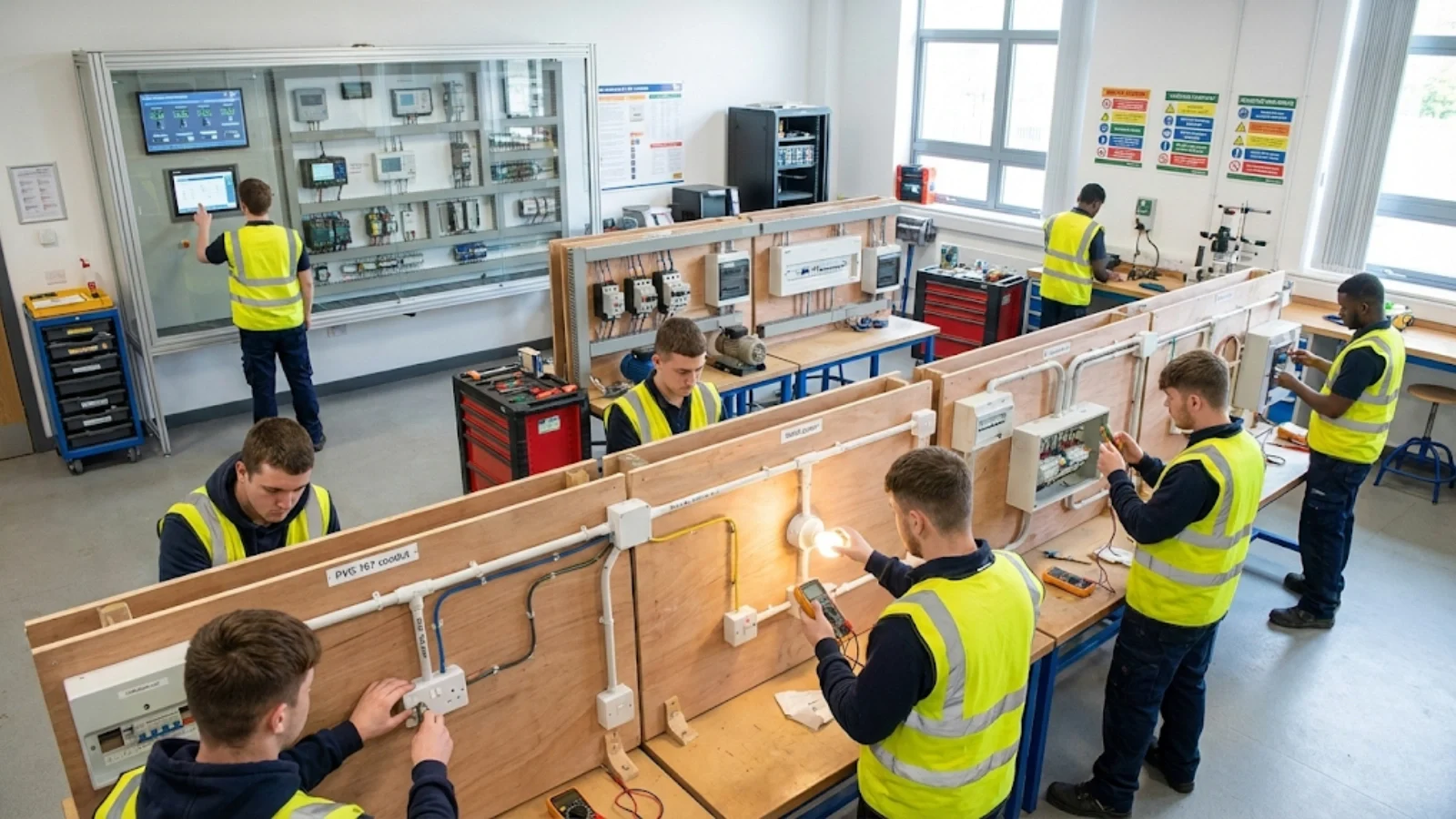
The financial case for proper training becomes stronger during periods of technological transition, not weaker. Learners who complete structured NVQ pathways with adequate site experience and verified competence secure employment at higher starting rates than those with rushed qualifications or incomplete portfolios.
Elec Training’s NVQ package costs £10,000 (excluding PPE, tools and AM2 fee). This represents approximately four to six weeks of qualified electrician earnings at JIB rates. Learners typically recover this investment within their first year of employment.
More significantly, proper foundational training creates career progression opportunities that shortcuts cannot match. Electricians with gaps in earthing and bonding knowledge struggle with fault diagnosis, requiring extended supervision periods and limiting advancement. Those with thorough BS 7671 understanding move confidently into inspection and testing roles, eventually progressing to design work or project management.
The automation conversation intensifies this dynamic. Employers investing in sophisticated automated systems need electricians who can troubleshoot complex integrated installations without constant oversight. They’re willing to pay premium rates for candidates demonstrating genuine competence, but they’re increasingly reluctant to hire learners with incomplete portfolios or poor AM2 performance.
From a placement perspective, the feedback we receive from contractors working on automated warehouse projects, smart building installations and EV charging infrastructure deployment is consistent: they’ll train the right candidate on specific automation platforms, but they expect thorough electrical fundamentals as the starting point. They cannot teach safe isolation procedures, proper testing techniques and BS 7671 compliance while simultaneously training on building management system configuration.
The hardening of the junior market means structured training pathways become more valuable as automation advances. Learners who invest time completing NVQ Level 3 properly, accumulating genuine site experience and passing AM2 with strong performance create economic opportunities that rushed qualifications close off.
Practical Steps: What Learners Should Actually Focus On
The evidence base allows specific guidance about priority areas for people entering electrical work:
Master foundational competencies thoroughly. This means NVQ Level 3 completed with genuine understanding (not just paperwork), adequate site hours demonstrating repeated application of skills across varied contexts, and AM2 preparation that produces confident competence rather than test-passing ability.
The specific competencies that matter: safe isolation procedures performed automatically without conscious thought, protective conductor sizing calculated correctly using adiabatic equation per BS 7671 Section 543, earthing and bonding requirements understood and applied per Regulation 411.3.1.2, testing sequences from GN3 followed systematically producing accurate results, and electrical installation certificates completed properly with all required information.
These capabilities remain constant regardless of automation sophistication in installed equipment. They’re tested in AM2. They’re required on every job site. They form the foundation upon which all specialisation builds.
Develop systematic diagnostic thinking. The ability to troubleshoot methodically separates competent electricians from those who struggle. This means forming testable hypotheses rather than guessing, working through systematic elimination rather than trying random solutions, using testing equipment appropriately to verify assumptions, and documenting findings clearly.
This diagnostic discipline transfers across all technologies. A learner who develops strong troubleshooting skills on traditional motor control circuits will apply identical thinking to automated system faults. The specific tools might differ (using network diagnostic software instead of multimeters, interpreting system logs instead of voltage measurements), but the logical framework remains constant.
Build communication and coordination skills. The human elements that automation cannot replicate become more valuable. This includes explaining technical issues clearly to non-technical people, coordinating work with other trades effectively, asking appropriate questions when requirements are ambiguous, and documenting work thoroughly for future reference.
These skills develop through site experience under competent supervision. They’re not taught in classrooms. They emerge from repeated exposure to real-world complexity, learning how construction projects actually unfold, understanding why procedures exist beyond regulatory compliance, and experiencing the consequences of poor communication or inadequate documentation.
Understand automation contextually without overspecialising early. Awareness of automation trends, familiarity with common terminology (PLC, SCADA, BMS, IoT), and basic understanding of how data networks integrate with electrical systems helps learners navigate job requirements. But this contextual knowledge should come after foundational competencies, not replace them.
The Level 4 AI and Automation Practitioner apprenticeship provides a structured route for specialisation after completing core electrical qualifications. The progression path is clear: NVQ Level 3 and AM2 first, then site experience in increasingly complex installations, then specialisation in automation systems for those interested in that direction.
Attempting to learn automation platforms before mastering safe isolation creates dangerous knowledge gaps. The automation system won’t matter if the underlying electrical installation was performed incorrectly, tested inadequately, or documented poorly.
Looking Forward: What the Evidence Suggests About Future Demand
Forecasting specific job titles or technology requirements for 2030 carries high uncertainty. Global energy costs, industrial strategy shifts and unexpected technological developments can alter trajectories quickly. But the evidence base provides reasonable confidence about broader patterns.
Engineering and technical trades show 13% employment growth through 2031 according to ONS projections. This outpaces average sector growth, suggesting sustained demand for electrical qualifications. The growth drivers include net zero infrastructure (EV charging networks, smart grid deployment, renewable energy integration), building modernisation (energy efficiency upgrades, smart building systems), and manufacturing investment (automation adoption creating maintenance requirements).
Skills demand shifts toward workers who combine electrical fundamentals with systems thinking. The ability to understand how power, data and control systems interconnect becomes more valuable. But this represents evolution rather than revolution. The core electrical knowledge remains essential; the application context expands.
The vacancy paradox (total UK vacancies down 8.6% year-on-year in December 2025, but 76% of engineering employers struggling to recruit for business-critical roles) suggests demand for genuinely competent workers remains acute despite headline contraction. Employers can’t find electricians with proper qualifications, adequate experience and verified competence. They’re not struggling to find people with certificates.
This creates clear opportunity for learners willing to complete structured pathways properly. The Elec Training approach (systematic progression through NVQ units, supported placement through 120+ contractor partnerships, preparation for AM2 that produces genuine competence) addresses exactly what employers report needing.
The robotics conversation shouldn’t deter anyone from entering electrical work. The evidence shows automation creating progression opportunities for electricians with strong foundations, not eliminating the trade. The pathway remains clear: proper qualifications, adequate experience, verified competence, then specialisation based on interest and opportunity.
Where Inspection and Testing Skills Connect With Automation
The relationship between traditional electrical competencies and automated systems becomes particularly clear in inspection and testing work. Electrical inspection report explained requirements under BS 7671 Section 643 apply regardless of system sophistication.
An EICR on a property with building management system, automated lighting controls and smart meter infrastructure follows identical inspection procedures to a standard domestic property. The inspector must verify earthing and bonding arrangements per Regulation 411.3.1.2, test RCD operation using appropriate test equipment, measure insulation resistance and compare to acceptable values from BS 7671 Appendix 2, verify protective conductor continuity, and assess circuit protection coordination.
The automated elements add inspection points (checking sensor connectivity, verifying control system programming doesn’t create safety issues, ensuring UPS protection for critical equipment), but they don’t replace foundational testing requirements. An inspector who cannot correctly measure R1+R2 values or interpret insulation resistance results cannot conduct EICR work competently, regardless of familiarity with building management system interfaces.
This demonstrates why automation advances make thorough electrical training more valuable rather than less. The baseline competencies remain mandatory. Automation adds complexity on top of those foundations, increasing the knowledge required and expanding career opportunities for electricians willing to develop hybrid skills.
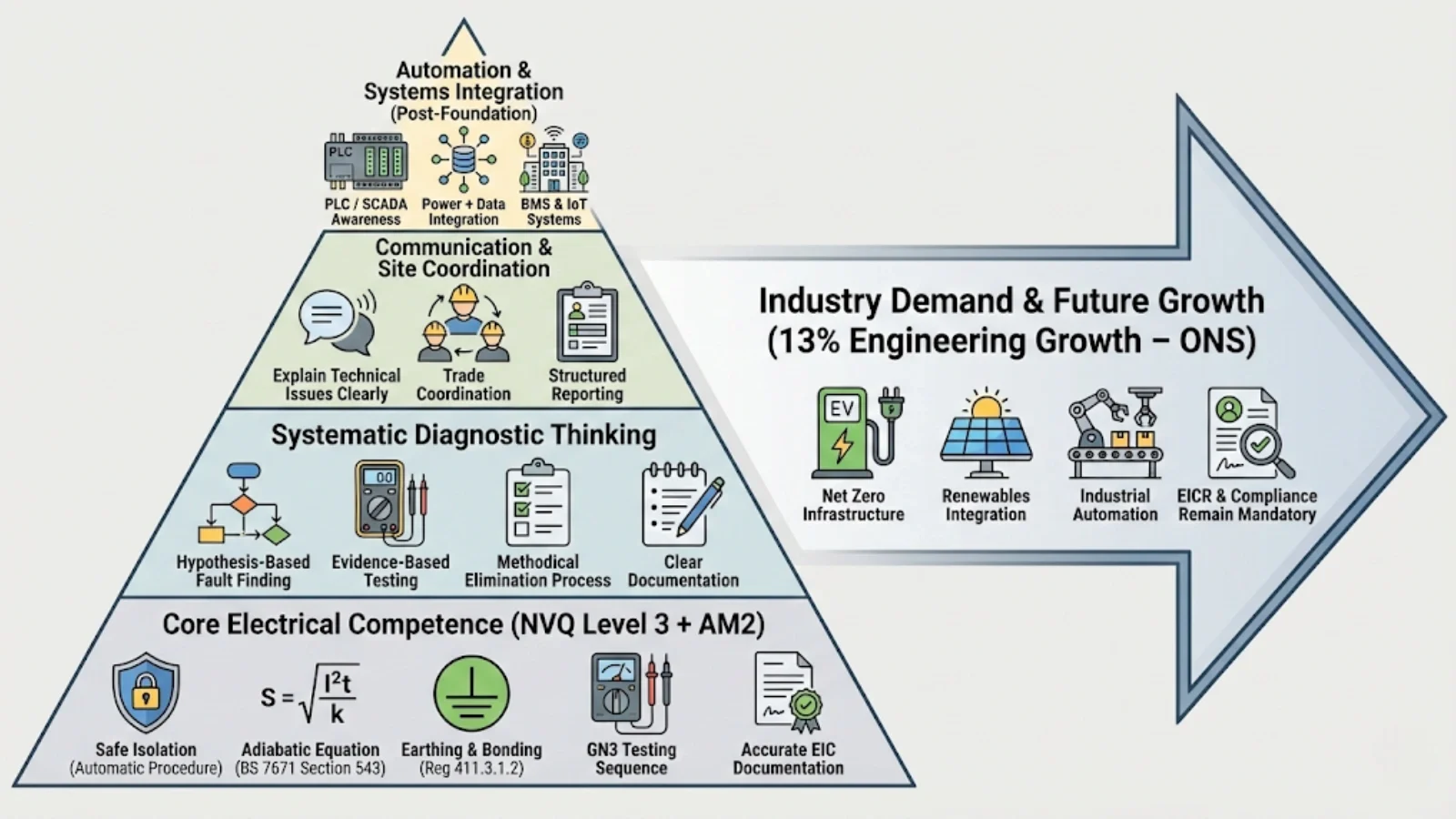
If you’re considering electrical qualifications, the robotics and automation conversation shouldn’t change your approach. The evidence shows foundational electrical competencies remain central, career progression opportunities are increasing rather than contracting, and structured training pathways become more valuable during technological transitions.
The Elec Training NVQ Level 3 pathway takes 18 to 36 months depending on starting point and available hours. That timeframe reflects building genuine competence, not marketing promises. The pathway includes systematic theory covering electrical principles and BS 7671 requirements, structured practical application under qualified supervision, portfolio evidence demonstrating competence across all required units, supported job placement through our in-house recruitment team with 120+ contractor partnerships, and preparation for AM2 practical examination leading to ECS JIB Gold Card application.
This approach directly addresses what employer feedback tells us matters: reliability and methodical approach, foundational electrical knowledge verified through proper assessment, procedural discipline and safety culture, and ability to learn new systems based on solid fundamental understanding.
Automation changes what electricians install. It doesn’t change how they need to think or what core competencies they require. The principles remain constant: systematic problem solving, safety-first approach, accurate testing and verification, and proper documentation. Technology platforms will continue evolving. These foundational capabilities endure.
Call us on 0330 822 5337 to discuss electrical training that prepares you for both current requirements and future developments. We’ll explain the complete NVQ Level 3 route, realistic timeframes based on your situation, and what our in-house recruitment team does to secure placements after qualification. No hype about robot programming or AI specialisation. Just practical guidance about building electrical competence that creates career opportunities regardless of which technologies become prominent.
The robots aren’t eliminating electrical jobs. They’re creating roles for electricians who understand both traditional installations and modern integrated systems. But that understanding starts with the same foundations it always has: proper qualifications, adequate experience, verified competence.
FAQs
How is robotics adoption in the UK actually affecting electrical engineering and technical trades employment?
Robotics adoption in the UK is contributing to a mixed impact on electrical engineering and technical trades employment, with evidence indicating net job growth in skilled roles despite some displacement in routine tasks. Data from sources like EngineeringUK suggest approximately 70,000 new positions in robotics, AI, and related fields by 2026, particularly in advanced manufacturing and utilities where electrical engineers are needed for system integration and maintenance. However, reports from the National Foundation for Educational Research highlight that up to 3 million low-skilled jobs, including some in trades and machine operations, could be at risk from automation by 2035, though this is offset by demand for higher-skilled workers in engineering technicians and electronics roles. The Office for National Statistics notes a 7.4% risk for jobs in England, but polarisation trends show growth in high-skill electrical engineering positions, such as those involving AI integration, while mid-level routine work declines. Overall, robotics is reshaping the workforce by creating more specialised opportunities in electrical systems design and oversight, rather than causing widespread unemployment, as replacement demand fills gaps in declining occupations. This aligns with broader trends where automation enhances productivity, leading to approximately 2.3 million net job additions by 2035, concentrated in professional engineering roles.
What this means in practice
- Employers are increasingly seeking electrical engineers skilled in robotics integration, boosting demand for roles in utilities and manufacturing.
- Low-skilled electrical tasks face automation risks, prompting workforce shifts towards upskilling in diagnostics and system management.
- Net employment growth in engineering technicians supports sector expansion, but requires proactive training to address polarisation.
- Critical infrastructure sectors see sustained job stability due to the need for human oversight in automated environments.
Electrical context
Foundational qualifications like NVQ Level 3 and AM2 remain key for adapting to robotics, ensuring competence in inspection and testing of automated electrical systems under BS 7671:2018+A2:2022.
Does automation replace electricians, or does it change the type of work electricians are expected to perform?
Automation primarily changes the type of work electricians perform rather than replacing them outright, as evidenced by UK industry analyses showing resilience in hands-on trades. Research from sources like Electrical Direct indicates a 50.75% automation risk for general electricians, dropping to 25.7% in construction, where human skills in problem-solving and site adaptability remain irreplaceable. Instead of elimination, automation shifts focus from repetitive tasks like cable pulling to advanced diagnostics, predictive maintenance, and integration with AI tools, as noted in reports emphasising collaboration with robotic assistants. The McKinsey study suggests 14% of employees may transition careers due to AI and robotics, but trades like electrical work benefit from this evolution, with roles evolving to include oversight of automated systems. UK data from the Office for National Statistics reinforces that roles requiring dexterity, regulatory compliance, and on-site judgement are less automatable, leading to transformed workflows where electricians handle complex troubleshooting and ethical decisions. This structural shift supports workforce adaptation, with automation enhancing efficiency and safety, while maintaining demand for skilled professionals in evolving environments.
What this means in practice
- Electricians increasingly focus on supervisory roles over automated tools, reducing physical strain and improving job safety.
- Routine installations give way to specialised diagnostics, requiring ongoing upskilling in AI-assisted maintenance.
- Workforce structures adapt by pairing human expertise with robotics, preserving employment while boosting productivity.
- Employers prioritise hybrid skills, leading to more diverse job opportunities in smart building and renewable energy sectors.
Electrical context
NVQ Level 3 and AM2 equip electricians with core competencies for adapting to automation, including site competence and inspection in BS 7671:2018+A2:2022 compliant systems.
Which core electrical skills remain essential regardless of advances in robotics and automation?
Core electrical skills such as fault-finding, safety compliance, and hands-on installation remain essential despite robotics and automation advances, as they rely on human judgement and adaptability that machines cannot fully replicate. UK analyses highlight skills like systematic diagnosis in variable conditions, interpreting regulations, and ethical decision-making as irreplaceable, with reports emphasising the need for dexterity in wiring, testing, and troubleshooting unique site issues. Electrical integrity evaluation through tools like motor circuit analysis and insulation testing continues to demand practical expertise, as automation handles basics but fails in nuanced scenarios. Knowledge of control systems, including PLC programming and sensor integration, persists as foundational, evolving to include oversight of robotic operations. Data from industry bodies underscores that while AI aids predictions, human skills in hazard recognition and creative problem-solving ensure safe, compliant work. These competencies support workforce resilience, maintaining relevance in automated environments where robots assist but do not replace the need for experienced interpretation and intervention.
What this means in practice
- Fault-finding techniques enable quick resolution of issues in automated setups, minimising downtime.
- Safety compliance skills ensure regulatory adherence, protecting workers in hybrid human-robot workplaces.
- Hands-on installation abilities adapt to integrating robotics, sustaining demand for versatile technicians.
- Control system knowledge facilitates seamless collaboration with AI, enhancing system efficiency.
Electrical context
NVQ Level 3 and AM2 build these enduring skills, focusing on practical assessment in inspection, testing, and site competence under BS 7671:2018+A2:2022.
How does automation redistribute tasks between entry-level and experienced electrical workers?
Automation redistributes tasks in the UK electrical workforce by assigning routine, repetitive duties to machines, allowing entry-level workers to focus on basic oversight and data entry while experienced professionals handle complex diagnostics and system integration. Reports indicate that low-skilled roles, such as simple wiring or administrative tasks, face higher automation risks, with approximately 3 million positions potentially affected by 2035, shifting entry-level focus to supporting automated processes. Experienced workers, conversely, take on advanced responsibilities like fault prediction and workflow optimisation, as automation tools like AI diagnostics require human interpretation. This polarisation, noted in ONS data, reduces mid-level routine work, creating a structure where juniors assist in monitoring while seniors lead in strategic maintenance. The result is a more efficient workforce, with entry-level roles evolving into learning opportunities for upskilling, and experienced staff driving innovation in automated environments, ultimately supporting sector growth without widespread displacement.
What this means in practice
- Entry-level workers shift to monitoring automated systems, gaining foundational exposure with reduced physical demands.
- Experienced electricians lead in predictive diagnostics, leveraging automation for enhanced decision-making.
- Task redistribution promotes upskilling pathways, bridging gaps between junior and senior roles.
- Workforce efficiency improves as automation handles basics, freeing experts for high-value contributions.
Electrical context
NVQ Level 3 pathways, including AM2, prepare workers for this redistribution by building progressive competence in inspection and testing.
What new overlaps are emerging between electrical installation, data connectivity and control systems?
Emerging overlaps in the UK between electrical installation, data connectivity, and control systems are driven by the integration of smart technologies, creating hybrid roles focused on networked infrastructure. Reports highlight the convergence in data centres, where electrical engineers now handle high-voltage connections alongside fibre optics and IoT protocols for seamless power and data flow. This includes designing microgrids and edge computing setups that blend electrical distribution with cybersecurity and real-time data management. Automation in building systems merges wiring with SCADA and PLC configurations, as seen in Industry 4.0 applications where electrical installers incorporate Ethernet/IP and Modbus for control. Government reforms in grid connections accelerate this, prioritising projects like EV charging that require unified electrical and data frameworks. These overlaps foster workforce implications, demanding multidisciplinary skills to support efficient, resilient systems amid rising demands from AI and renewables.
What this means in practice
- Electrical installers increasingly incorporate data cabling, enhancing smart building efficiency.
- Control system integration requires unified training, improving system reliability across sectors.
- Overlaps in data centres drive demand for hybrid expertise, supporting economic growth.
- Grid reforms prioritise connected projects, streamlining workforce deployment in renewables.
Electrical context
NVQ Level 3 and ECS Gold Card holders are positioned to address these overlaps through competence in BS 7671:2018+A2:2022 compliant installations and testing.
Why are foundational qualifications like NVQ Level 3 and AM2 still central in an increasingly automated environment?
Foundational qualifications like NVQ Level 3 and AM2 remain central in automated environments because they provide verifiable competence in practical skills and safety that automation cannot replace, ensuring workforce reliability. UK industry standards recognise these as benchmarks for unsupervised work, with NVQ Level 3 demonstrating on-site proficiency in installation and maintenance, essential for integrating robotic systems. AM2’s practical assessment tests real-world application, including fault-finding and compliance, which underpin safe operation alongside AI tools. As automation grows, these qualifications enable adaptation, with reports emphasising their role in upskilling for hybrid roles where human oversight is critical. They support structural shifts by bridging theory and practice, maintaining industry credibility and facilitating ECS Gold Card attainment for access to advanced sites. This centrality sustains workforce quality amid technological change, promoting standardised competence across evolving electrical engineering landscapes.
What this means in practice
- NVQ Level 3 ensures entry to supervised automation roles, building foundational adaptability.
- AM2 verifies practical skills, enabling safe integration with robotic systems.
- Qualifications facilitate career progression, supporting transitions to specialised automated maintenance.
- Employers rely on them for compliance, reducing risks in high-tech environments.
Electrical context
NVQ Level 3 and AM2 align with BS 7671:2018+A2:2022, ECS Gold Card requirements, and site competence in inspection and testing.
How does predictive maintenance in automated systems change diagnostic responsibilities for electricians?
Predictive maintenance in automated systems alters diagnostic responsibilities for UK electricians by shifting from reactive fault-finding to proactive data analysis and system optimisation, enhancing workforce efficiency. Using AI tools for real-time monitoring, electricians now interpret patterns from sensors like vibration and thermal imaging to predict failures, reducing emergency interventions. This changes roles to include oversight of automated diagnostics, with responsibilities expanding to integrate machine learning for equipment longevity. Reports indicate this approach minimises downtime by up to 70%, reallocating time to strategic tasks like workflow design. Electricians must adapt to hybrid duties, combining traditional skills with data-driven insights, fostering a structured workforce where diagnostics support broader system resilience amid automation growth.
What this means in practice
- Electricians focus on data interpretation, pre-empting issues before escalation.
- Responsibilities include tool integration, improving overall system reliability.
- Workforce structures emphasise collaboration with AI, enhancing diagnostic accuracy.
- Reduced reactive work allows for upskilling in predictive technologies.
Electrical context
NVQ Level 3 and AM2 prepare for these changes through training in inspection, testing, and site competence under BS 7671:2018+A2:2022.
What misconceptions about robotics and automation are not supported by UK workforce data?
Misconceptions that robotics and automation will cause mass unemployment in the UK are not supported by workforce data, which instead shows net job creation and role evolution. Reports indicate AI will create more jobs than it displaces, with approximately 2.3 million net additions by 2035, countering fears of widespread replacement. Another unsupported view is that automation only affects low-skilled work; data reveals impacts on high-skilled tasks too, but with compensating growth in engineering and tech roles. The idea that robots fully replace trades like electricians is debunked, as human skills in adaptability and judgement persist, with only 25–50% automation risk in construction. Workforce polarisation trends support task redistribution rather than elimination, promoting upskilling and structural adaptation without the predicted job losses.
What this means in practice
- Data-driven insights encourage investment in training, mitigating displacement fears.
- Role evolution supports workforce retention through hybrid human-robot models.
- Misconceptions hinder adoption; evidence promotes balanced automation strategies.
- Sector growth in engineering underscores opportunities over threats.
Why do employers prioritise structured training pathways more heavily during periods of technological change?
Employers prioritise structured training pathways during technological change to build workforce resilience and address skills gaps, as UK data shows rapid adaptation is key to maintaining productivity. With 76% of engineering firms struggling to recruit, structured programmes like apprenticeships ensure targeted upskilling in areas like automation and digital technologies. This focus mitigates risks from job polarisation, where mid-level roles decline but high-skill demand rises, requiring pathways for reskilling. Reports emphasise that continuous learning fosters innovation, with 42% of employers ranking it vital for growth amid AI integration. Structured training aligns with strategic priorities, reducing turnover and enhancing competitiveness in evolving sectors like engineering, where technological shifts demand multidisciplinary competencies.
What this means in practice
- Pathways bridge skills gaps, enabling quick adaptation to new technologies.
- Employers invest in apprenticeships, boosting retention and innovation.
- Structured programmes support workforce transitions, minimising disruption.
- Focus on upskilling promotes long-term sector sustainability.
What practical skills should today’s electrical learners focus on to remain adaptable as automation continues to evolve?
Today’s electrical learners should focus on practical skills like fault-finding, control system integration, and data analysis to remain adaptable amid evolving automation. UK trends emphasise proficiency in PLC programming and sensor configuration for seamless robot collaboration, alongside diagnostics using tools like infrared thermography. Skills in predictive maintenance and industrial networking, such as Ethernet/IP, enable oversight of automated systems, supporting workforce shifts towards hybrid roles. Hands-on experience with simulation software like MATLAB builds versatility, while safety and compliance training ensures resilience in smart environments. These competencies foster structural adaptability, aligning with sector demands for multidisciplinary expertise in renewables and AI-integrated installations.
What this means in practice
- Fault-finding skills enable quick issue resolution in automated setups.
- Control integration prepares for IoT and robotics oversight.
- Data analysis supports predictive strategies, reducing downtime.
- Networking proficiency enhances system connectivity and efficiency.
References
- ONS Management Practices and Adoption of Technology and AI in UK Firms (2023/2025) – https://www.ons.gov.uk/
- IET UK Engineering and Technology Skills Statistics 2025 – https://www.theiet.org/
- MakeUK Executive Survey 2026 – https://www.makeuk.org/
- DfE Assessment of Priority Skills to 2030 – https://www.gov.uk/government/publications/
- Skills England Apprenticeships (Level 4 AI & Automation Practitioner) – https://skillsengland.education.gov.uk/
- IET Wiring Regulations BS 7671:2018+A2:2022 – https://www.theiet.org/
- City & Guilds 2357 NVQ Level 3 Guidance – https://www.cityandguilds.com/
- EngineeringUK Workforce Dashboard – https://www.engineeringuk.com/
- NEPC Engineers 2030 Report – https://nepc.raeng.org.uk/
- IFR World Robotics 2024 UK Data – https://ifr.org/
- HSE Electrical Safety Guidance – https://www.hse.gov.uk/
- IfATE Technical Education Standards – https://www.instituteforapprenticeships.org/
Note on Accuracy and Updates
Last reviewed: 18 February 2026. This page is maintained; we correct errors and refresh sources as automation adoption data and skills demand patterns evolve.
