

Should You Become an Electrician If You’re Colour Blind?

- Technical review: Thomas Jevons (Head of Training, 20+ years)
- Employability review: Joshua Jarvis (Placement Manager)
- Editorial review: Jessica Gilbert (Marketing Editorial Team)
- Last reviewed:
- Changes: Initial publication providing balanced decision-making framework for colour vision deficient individuals considering electrical careers, covering role spectrum, training accessibility, employment realities, and sector-specific limitations.
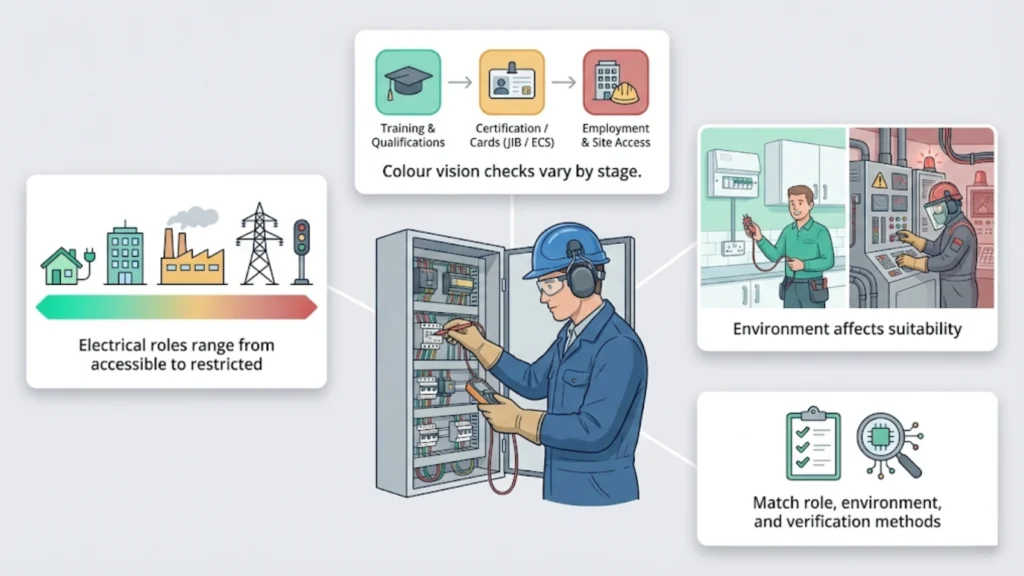
If you’re colour blind and researching whether to pursue electrical work, you’re probably encountering contradictory information. Some sources say it’s impossible. Others claim colour vision doesn’t matter at all. Forums are full of “I’ve been doing it for 20 years” stories alongside “I got rejected from training” warnings. Here’s what’s actually happening: electrical work isn’t one job, it’s a spectrum of roles with dramatically different colour-vision requirements, and the gatekeeping happens at multiple points (training, certification, employment) with different standards at each. Colour vision deficiency doesn’t automatically exclude you from becoming an electrician, but it does affect which electrical environments you can realistically access, which sectors will employ you, and how much career flexibility you’ll have across the industry. This isn’t about whether you’re capable of learning electrical theory (you are), or whether you can work safely with proper verification methods (you can in many contexts). It’s about whether the specific electrical roles you’re targeting, domestic installation, commercial maintenance, industrial control systems, high-voltage transmission, railway signalling, defence contracts, align with environments where colour vision deficiency can be managed through systematic verification, or whether they fall into safety-critical categories where instant visual identification under pressure is non-negotiable and medical boards apply strict thresholds. The decision you’re making isn’t “can I be an electrician” in abstract, it’s “given the sectors I want to work in, the career flexibility I need, and the reality of how colour vision requirements vary across employers, is electrical work a realistic investment of my time and money?” This article provides the framework to make that assessment. It explains the role spectrum (which electrical environments rely heavily on colour vs which don’t), the training-to-employment pathway (where gatekeeping happens and why), the sectors where colour vision deficiency creates genuine limitations (railway, defence, certain industrial sites with formal medical boards), the sectors that remain largely accessible (domestic, commercial, much of non-safety-critical industrial), and the questions you need to ask yourself before committing. No encouragement. No discouragement. Just the information you need to decide whether this trade makes sense for your specific situation.
The Role Spectrum: Electrical Work Is Not One Thing
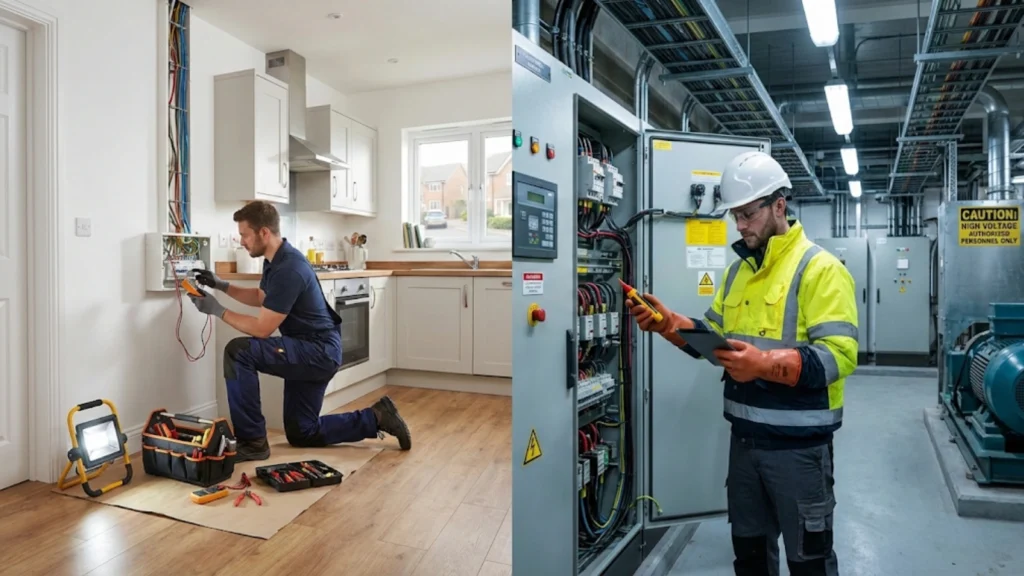
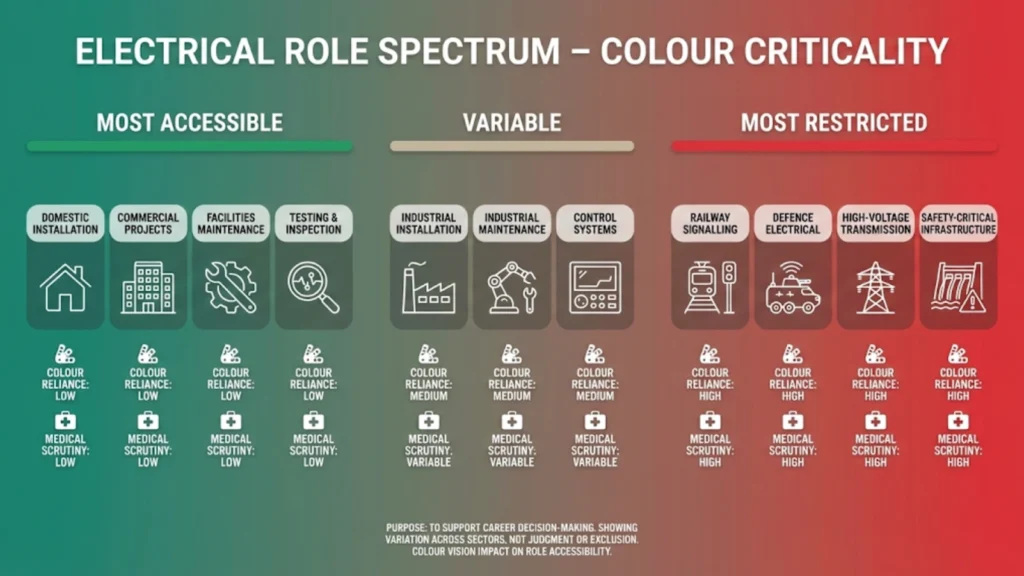
Here’s the fundamental reality that most generic career advice misses: “electrician” describes dozens of different roles across sectors with completely different working conditions, risk profiles, and colour-vision demands. Understanding this spectrum is essential before making training decisions.
Domestic Electrical Work
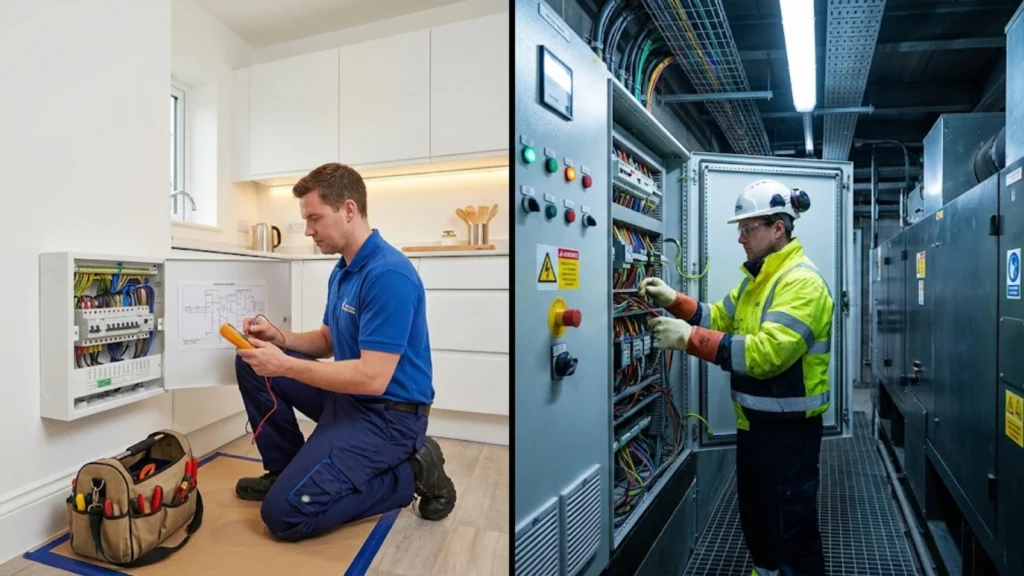
What it involves: Installing, maintaining, and repairing electrical systems in residential properties. Rewires, consumer unit upgrades, additional circuits, fault-finding in houses, flats, and small residential buildings. Working with standard UK domestic wiring (twin and earth cable, brown/blue/green-yellow conductors), lighting circuits, socket circuits, shower installations, basic inspection and testing.
Colour reliance: Moderate. You’re identifying line (brown), neutral (blue), and earth (green-yellow) conductors in relatively simple installations. Most work involves standard cable types in consumer units with decent access. Modern post-2004 colour schemes (brown/blue rather than old red/black) provide better contrast for red-green deficiency. Labelling at consumer units is standard practice. Verification with multimeters and testers is normal procedure.
Medical scrutiny: Low. Most domestic contractors don’t conduct formal occupational health assessments. Hiring decisions are based on qualifications, experience, and demonstrated competence. Small businesses prioritize getting work done safely and correctly over formal medical screening. Self-employed domestic electricians set their own standards.
Environmental factors: You largely control your working environment. You bring your own lighting (LED headtorches, work lights), you schedule work during daylight hours if needed, you have time to label and test systematically without production pressure. Access is usually reasonable (though lofts and under floors challenge everyone regardless of colour vision). You’re rarely working under emergency time pressure unless you specialize in fault-finding.
Reality check: Many electricians work entire careers in domestic without colour vision being an issue. The work suits systematic verification approaches (label everything, test everything, adequate lighting). Challenges exist (identifying cables in dark lofts, working with old unlabeled installations, distinguishing faded colours on aged cables), but they’re manageable with discipline and proper equipment. If you’re content focusing on domestic work, colour vision deficiency is less likely to be a career-blocking barrier, though individual capability varies.
Limitations: Some domestic specialists avoid emergency call-outs where fault-finding under time pressure makes systematic verification difficult. Fire alarm and security system work involves interpreting colour-coded indicator lights which some find challenging. Transitioning from domestic to other sectors later might face medical barriers you didn’t encounter initially.
Commercial Electrical Work
What it involves: Electrical installations in non-residential buildings, offices, retail, schools, leisure facilities, healthcare (non-critical areas), hospitality. Lighting systems, power distribution, emergency lighting, data cabling, access control integration, HVAC electrical connections. Mix of new installations and maintenance contracts.
Colour reliance: Moderate. Similar conductor identification to domestic but often larger scale with three-phase distribution, more complex circuits, and denser cable routing. Control systems for lighting and building management involve more multi-core cables where distinguishing similar colours in bundles becomes relevant. Commercial projects typically have better documentation (circuit drawings, schedules) than domestic.
Medical scrutiny: Low to moderate. Varies significantly by employer and client. Private sector commercial contractors often have minimal medical screening similar to domestic. Public sector sites (schools, hospitals, government buildings) might have stricter contractor vetting including health assessments. Large construction projects sometimes require medical clearance as part of site induction, though standards vary by main contractor policies.
Environmental factors: Mixed control over environment. New installations allow systematic labelling from the start. Lighting is often better than domestic (working in occupied buildings with permanent lighting). However, working around other trades creates complications, and time pressure from project schedules reduces flexibility. Retrofit work in occupied buildings (overnight in retail, term-time constraints in schools) creates time pressures similar to domestic emergency work.
Reality check: Commercial work sits between domestic and industrial in accessibility. Project-based work provides structure and team support that helps verification. Documentation and drawings reduce reliance on visual-only identification. However, the sector’s breadth means some roles are more accessible than others, installation-focused roles differ from fault-finding and maintenance. Career progression often involves increasing complexity and responsibility which might include more colour-critical tasks.
Limitations: Some commercial contexts present challenges. Data centre electrical work involves dense cable management where colour identification matters. Emergency lighting systems require interpreting indicator status. Fire alarm installation and maintenance is heavily colour-dependent for panel indicators. Building management system integration involves control circuits with many similar-coloured wires. Client-specific medical requirements (particularly in healthcare, education, or secure government facilities) might restrict access to certain contracts.
Industrial Electrical Work
What it involves: Electrical systems in manufacturing, processing, heavy industry, warehousing, logistics. Production machinery, motor control systems, PLCs (programmable logic controllers), automated systems, high-power distribution, three-phase supplies, control panels with hundreds of conductors. Mix of installation, planned maintenance, and emergency breakdown response.
Colour reliance: High in some contexts, manageable in others. Control panels with 50-200 multi-core cables require confident identification of similar shades (grey, black, brown, blue, white) in dense bundles. Legacy installations might use pre-2004 colour schemes alongside modern wiring. Indicator lights on machinery and control systems use red-green-amber status displays. However, modern industrial installations often have comprehensive documentation, numbered ferrule systems as standard, and formal verification procedures that reduce pure colour reliance.
Medical scrutiny: Moderate to high. Many industrial sites conduct occupational health assessments as part of contractor vetting or direct employment. Large manufacturers, particularly in automotive, aerospace, petrochemical, and food processing, have formal medical screening processes. Assessment rigour varies by site safety classification and insurance requirements. Some use functional assessments (can you demonstrate safe identification methods?), others apply rigid Ishihara test thresholds.
Environmental factors: Limited control. You work around operational production, often under time pressure when equipment fails and production stops. Lighting varies from excellent in modern facilities to poor in older plants. Confined spaces, cable trenches, and machine interiors create challenging conditions. Permit-to-work systems and RAMS (Risk Assessment and Method Statements) provide structure but also create formal accountability where verification errors have documented consequences.
Reality check: Industrial work is where colour vision deficiency starts creating tangible career limitations for some individuals. The sector isn’t monolithic, planned maintenance and installation roles differ from emergency breakdown response. Modern facilities with good documentation and formal verification procedures suit systematic approaches. Older plants with legacy systems and minimal documentation rely more heavily on visual confidence. Role allocation within industrial environments (installation teams vs maintenance teams vs project electricians) affects colour-vision demands. Some electricians thrive in industrial settings by focusing on strengths, others find the combination of poor lighting, time pressure, and dense cabling creates sustained challenges.
Limitations: Emergency fault-finding under production pressure is highly colour-critical. Identifying specific control wires in large bundles requires visual confidence. Some industrial sites with formal medical boards apply strict pass/fail criteria on colour vision tests regardless of functional capability. Certain heavy industries (utilities, nuclear, oil and gas, mining) have particularly stringent medical standards. Career progression to supervisory or project management roles might require broader competence including tasks you’ve previously avoided.
Safety-Critical Infrastructure: Railway, Defence, High-Voltage Transmission
What it involves: Railway electrification and signalling (Network Rail, London Underground, light rail), defence installations (military bases, secure communications), high-voltage transmission and distribution (National Grid, regional distribution network operators), aviation ground electrical systems. Work where identification errors could cause multiple casualties, infrastructure failure, or national security issues.
Colour reliance: Very high. Railway signalling uses colour-coded indicators and control systems where instant identification is essential. Control panels in substations and signal boxes involve complex wiring. Trackside work requires identifying conductors in challenging conditions. Defence systems often use colour-coded security classifications. High-voltage work involves phase identification where errors are immediately dangerous. These roles combine high colour reliance with inability to verify slowly, situations require instant confident identification.
Medical scrutiny: Strict and formal. These sectors typically use medical boards with rigid thresholds. Network Rail has specific colour vision requirements for safety-critical roles. Defence contractors often require medical clearance to MOD (Ministry of Defence) standards. High-voltage utility work involves formal occupational health assessments. Assessments typically use Ishihara tests as screening followed by functional tests (lantern tests for railway), with pass thresholds that exclude many colour vision deficient individuals regardless of systematic verification capabilities.
Environmental factors: Zero control. You work in operational infrastructure where time, access, and procedures are strictly controlled. Emergency responses require immediate action. Lighting conditions vary from adequate to terrible. Verification options are limited by operational constraints, you often cannot stop to test methodically when immediate decisions are required for safety.
Reality check: These sectors present the highest barriers to colour vision deficient electricians. Medical boards in railway, defence, and high-voltage transmission apply standards designed to eliminate risk at the screening stage rather than assess individual functional capability. The reasoning is that in safety-critical infrastructure, the consequences of misidentification are catastrophic, so they default to strict exclusion rather than case-by-case assessment. Some individuals with mild colour vision deficiency pass functional tests and gain access. Many with moderate to severe deficiency are excluded regardless of their systematic verification skills in other contexts.
Limitations: These sectors are largely inaccessible to individuals with significant colour vision deficiency. Railway signalling roles often require passing Ishihara and lantern tests. Defence electrical work needs security clearance which includes medical fitness assessments with colour vision requirements. High-voltage roles (particularly live-line work) face similar medical thresholds. Even roles that seem peripheral (maintenance electricians on railway infrastructure, electrical technicians on defence sites) often face the same medical standards as safety-critical positions due to potential exposure to colour-critical tasks.
Inspection, Testing, and Verification Roles
What it involves: Electrical Installation Condition Reports (EICRs), Portable Appliance Testing (PAT), periodic inspection and testing, certification for new installations, compliance verification, building regulation sign-offs. Work involves examining others’ installations, identifying defects, verifying correct installation to BS 7671 standards.
Colour reliance: High for initial identification, but tools and systematic approaches mitigate this. You’re visually inspecting installations which requires identifying conductors, but verification always involves electrical testing. Polarity testing, continuity testing, insulation resistance testing, RCD testing, these provide non-visual confirmation. However, you must first identify which conductors to test, which requires visual assessment or reference to documentation.
Medical scrutiny: Variable. Independent testing electricians set their own standards. Scheme providers (NICEIC, NAPIT, Stroma) assess competence against technical standards, not medical fitness. However, some clients (particularly commercial and industrial) might question testing conducted by electricians with known colour vision deficiency due to perceived reliability concerns, even if unfounded.
Environmental factors: Similar to domestic and commercial work depending on context. You’re examining existing installations in various conditions. Lighting can be controlled with portable equipment. Time pressure varies (some testing is scheduled maintenance, some is emergency certification). Documentation reference (existing certificates, drawings) helps but isn’t always available.
Reality check: Testing and inspection is accessible to colour vision deficient electricians who work systematically, but requires confidence in systematic verification. You’re certifying others’ work, which creates responsibility for accurate identification. The combination of visual inspection requirements and electrical testing provides verification layers, but initial identification challenges remain. Success depends on discipline in using testing equipment to confirm every assessment, not just defect identification but all conductor identification.
Limitations: Some contexts are challenging. Testing old installations with faded unlabeled cables requires confident identification before you can apply test leads. Emergency testing under time pressure (insurance claims, urgent certifications) reduces time for systematic verification. Commercial clients might question your competence if they’re aware of colour vision deficiency, creating business development challenges for independent testing businesses.
Training Pathway vs Job Outcomes: Where Gatekeeping Happens
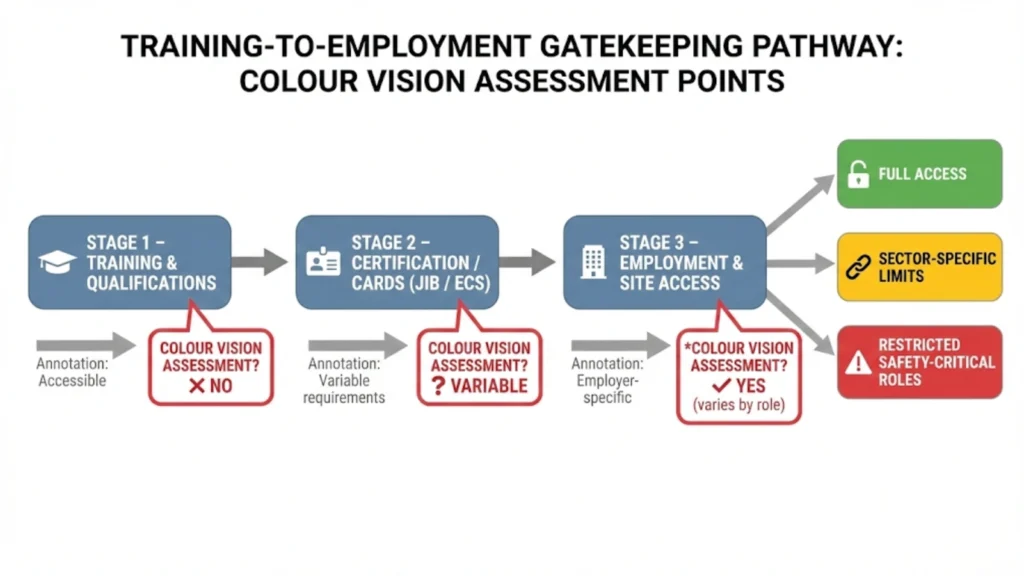
Understanding where and why colour vision becomes a factor helps avoid misplaced assumptions and wasted investment. The gatekeeping doesn’t happen in one place, it happens at multiple stages with different criteria at each.
Training Access: Generally Open
Electrical training providers in UK typically don’t impose medical restrictions on course enrollment. City & Guilds, EAL, Pearson, the major awarding bodies, assess competence against qualification standards focused on knowledge, practical skills, and safe working practices. Colour vision isn’t part of those standards. You can enroll in Level 2 Installation, Level 3 Installation, 18th Edition, Inspection and Testing courses regardless of colour vision. Practical assessments involve demonstrating safe isolation, correct installation methods, proper use of test equipment, and understanding of regulations. Colour identification is incidental to these assessments, not the focus.
Training environments support this accessibility. Classrooms and workshops have good lighting. Work is supervised. Time pressure is minimal, you can take as long as needed to verify identifications. Labelling is encouraged as good practice. Instructors can confirm your identifications if uncertain. The assessment question is “can you demonstrate competent practice under training conditions,” not “can you work safely in any electrical environment.”
Some apprenticeship schemes, particularly those linked to specific employers or sectors, might include colour vision testing as part of entry requirements. JIB (Joint Industry Board) apprenticeships have historically included colour vision assessments, though standards vary by region and employer. These are exceptions rather than rules. Most education pathways into electrical qualifications remain accessible.
The implication: if your question is “can I get qualified,” the answer for most people is yes. Colour vision deficiency rarely prevents qualification attainment. The barriers appear later.
Certification: The JIB/ECS Card Complexity
After qualification, many electricians pursue JIB Gold Cards or ECS (Electrotechnical Certification Scheme) cards which demonstrate competence to employers and provide access to construction sites. This is where some colour vision requirements appear.
JIB electrician cards have historically required colour vision testing as part of the application process. Standards have evolved, and requirements vary by card grade and route (apprentice-trained vs mature candidate). The testing serves as a gatekeeping mechanism between qualification and industry recognition, you’ve passed your exams, but the industry body adds an additional medical threshold.
ECS cards similarly involve health screening for certain grades, though again, requirements vary by specific card type and application route. Some domestic installer cards have minimal medical requirements, while approved electrician grades might require more comprehensive assessments.
The confusion this creates: you can complete your training, pass all exams, and still face barriers to card schemes that many employers require. The industry bodies justify this as safety-critical workforce screening. The practical effect is adding a medical gate after the educational gate.
The implication: research card requirements for your target sector before investing in training. If domestic work is your focus, some card schemes have lighter medical requirements. If commercial or industrial work requiring JIB Gold Card is your goal, understand their colour vision standards early. Some electricians work without JIB/ECS cards (particularly self-employed domestic), but it restricts employment options.
Employment: The Employer-Specific Reality
Even with qualifications and cards, individual employers apply their own medical standards based on their risk assessments, insurance requirements, and site-specific needs. This is where the most significant variability occurs.
Small domestic contractors: Rarely conduct formal medical assessments. Hiring decisions are based on qualifications, references, and trial work performance. If you can demonstrate competent, safe work practices during probation, colour vision is unlikely to be questioned. Self-employment removes employer gatekeeping entirely, though client confidence and insurance requirements still apply.
Large commercial contractors: Variable standards. Some have occupational health assessments for all employees including colour vision testing. Others only assess for specific roles. Main contractor requirements on large projects sometimes impose medical standards that individual subcontractors must meet, creating site-specific barriers.
Industrial employers: More likely to conduct formal occupational health screening including colour vision tests. Manufacturing, processing, utilities, these sectors have structured HR processes and insurance requirements that include medical fitness assessments. Standards vary by employer, some use functional assessments (demonstrate you can identify conductors safely), others apply rigid Ishihara pass/fail thresholds.
Infrastructure and safety-critical employers: Strict medical boards as standard. Network Rail, defence contractors, National Grid, airport infrastructure, these require passing colour vision assessments as a condition of employment regardless of qualifications or experience. The assessments are often Ishihara screening followed by functional tests (lantern tests for railway). Pass thresholds exclude significant portions of colour vision deficient individuals.
Joshua Jarvis, Placement Manager, explains the challenge:
"Even within the same sector, employers vary dramatically in their colour vision requirements. One industrial contractor might conduct functional assessments showing you can identify cables safely with your methods. Another might rigidly apply Ishihara pass/fail criteria and exclude you regardless of functional capability. There's no consistency, which makes career planning difficult. You can't predict every employer's response, but you can research general sector patterns and make informed decisions about where to focus your training investment."
Joshua Jarvis, Placement Manager
The implication: qualification opens doors, but employer-specific medical standards determine which doors stay open. Two electricians with identical qualifications face different employment opportunities based on colour vision. This isn’t discrimination in most cases, it’s employer risk assessment under health and safety law. The Equality Act 2010 requires reasonable adjustments, but employers can exclude if colour vision is genuinely essential for safe role performance and no accommodation eliminates the risk.
The Training-to-Employment Gap
This multi-stage gatekeeping creates frustration. You invest £4,000-£8,000 in training, several months or years of study, pass all assessments, gain qualifications, and then discover that some employers won’t hire you or some sectors restrict access based on medical assessments you weren’t required to pass for training. From your perspective, “why didn’t anyone tell me this before I spent the money?”
From the industry’s perspective, the stages serve different purposes. Training proves theoretical and practical competence. Certification bodies verify industry-recognized standards. Employers assess fitness for their specific working conditions. Each stage has legitimate gatekeeping criteria, they just don’t align perfectly, creating gaps where capable qualified individuals face barriers.
The honest answer: this gap exists across many trades and professions. Medical fitness for specific roles isn’t the same as academic competence. The electrical industry could improve transparency about this, making colour vision implications clearer at the training stage. But the fundamental structure, qualification doesn’t guarantee employment in all contexts, is unlikely to change because employment fitness is inherently context-specific.
Where Colour Vision Deficiency May Limit Your Options
Being honest about limitations is essential for informed decision-making. These sectors and roles present genuine barriers that systematic verification methods can’t fully overcome.
Railway and London Underground Infrastructure
Why it’s limiting: Railway electrical work involves signalling systems where colour-coded indicators are primary safety controls. Signal aspects (red/amber/green), control panel indicators, track circuit identification, overhead line work, all rely on instant colour recognition under operational conditions. Emergency fault-finding on live railway requires immediate identification without time to test methodically. Lives depend on correct interpretation.
Medical standards: Network Rail and train operating companies use formal colour vision testing for safety-critical roles. Assessments typically include Ishihara screening followed by lantern tests (Beyne lantern, Holmes-Wright lantern) which simulate railway signal identification under various conditions. Pass thresholds are strict, designed to exclude anyone with significant red-green deficiency. Recent reviews of railway colour vision standards (2024-2025) have explored more functional approaches, but current requirements remain stringent.
Examples from research: Network Rail roles explicitly state colour vision requirements in job specifications. London Underground engineering positions include occupational health assessments with colour vision testing. Contractors working on railway infrastructure must meet the same medical standards as direct employees due to safety-critical nature. Some individuals with very mild deficiency pass functional tests, but moderate to severe red-green deficiency typically results in exclusion.
Reality: If your goal is railway electrification, signalling, or trackside electrical work, colour vision deficiency will likely prevent access. This isn’t employer discrimination, it’s regulated safety-critical workforce screening under Railway Group Standards. The sector is effectively closed to most colour vision deficient electricians. Non-safety-critical roles (depot maintenance, workshop electrical work) might have slightly more flexibility, but assume railway infrastructure is inaccessible when planning your career.
Defence and Military Electrical Work
Why it’s limiting: Defence installations involve secure systems, classified equipment, high-reliability electrical systems, and potentially weapon systems electrical components. Colour coding is used for security classifications (wire colours indicate classification levels in some contexts), identification of critical systems, and complex control wiring. The consequences of errors extend beyond individual safety to operational security and national defence.
Medical standards: MOD contractors and direct military electrical roles require medical clearance including colour vision assessment. Defence medical boards apply strict standards across all security-cleared positions. The assumption is that anyone working on defence electrical systems must meet universal fitness standards regardless of specific task, because roles might expand or emergency situations might require performing any electrical task.
Examples from research: MOD-affiliated apprenticeships often include colour vision testing at entry. Contractors bidding for defence electrical work must demonstrate workforce medical fitness including colour vision. RAF, Army, and Navy technical trades with electrical components have medical standards that exclude significant colour vision deficiency. Even civilian contractors on defence sites face the same medical thresholds as military personnel due to security and safety equivalence requirements.
Reality: Defence electrical work is largely inaccessible to colour vision deficient electricians. The sector is small relative to overall electrical employment, but it represents high-paying stable work that’s effectively excluded. If you have aspirations to work on military installations, submarines, aircraft, secure communications, assume those pathways are closed and focus training on civilian sectors.
Shipyards and Marine Electrical Systems
Why it’s limiting: Marine electrical work, whether shipbuilding, repair, or offshore installations, combines multiple challenges. Confined spaces with poor lighting, complex multi-core cabling for ship systems, safety-critical equipment where failure at sea risks lives, and color-coded systems for identifying circuits across large vessels. Emergency repairs at sea or in port require confident rapid identification.
Medical standards: Major shipyards (Barrow, Rosyth, Portsmouth, Belfast, Govan, Appledore) often conduct formal medical boards for electrical trades. Assessment rigour varies by employer and contract type (naval shipbuilding stricter than commercial vessel work). Offshore wind and oil/gas platform work involves similar medical standards due to safety-critical nature and remote working conditions. Some employers conduct functional assessments, others apply rigid screening thresholds.
Examples from research: BAE Systems shipyards require medical clearance for electrical trades including colour vision assessment. Offshore wind installation contractors often specify medical fitness standards for marine electrical work. Cruise ship and commercial vessel electrical roles vary by employer and flag state regulations, but confined space and safety-critical nature often results in colour vision screening.
Reality: Marine electrical work presents significant but not universal barriers. Some shipyard employers assess functionally and might accept colour vision deficient electricians with strong systematic verification. Others exclude at medical screening. Offshore roles (wind farms, oil platforms) face similar variability. If you’re interested in marine electrical work, research specific employers early, don’t assume the sector is either fully accessible or fully closed.
High-Voltage Transmission and Distribution (Above 11kV)
Why it’s limiting: High-voltage electrical work involves potentially lethal systems where identification errors cause fatalities or major infrastructure damage. Substation work, overhead line maintenance, underground cable jointing at transmission voltages, these require confident phase identification, understanding of complex earthing systems, and ability to interpret colour-coded diagrams under site conditions. Live working at high voltage (where permitted) allows zero margin for error.
Medical standards: National Grid, regional distribution network operators (Northern Powergrid, UK Power Networks, Scottish Power, etc.), and transmission infrastructure contractors often conduct occupational health assessments including colour vision testing for roles involving high-voltage work. Assessment standards vary by employer, some assess all electrical staff uniformly, others differentiate by voltage levels (33kV different standards than 11kV). Functional assessments are more common than rigid exclusion, but standards remain rigorous.
Examples from research: National Grid apprenticeships include medical assessments with colour vision components. High-voltage authorized person (AP) roles require demonstration of visual acuity including colour perception. Contractor access to transmission substations involves medical clearance through occupational health. Some distribution network roles (11kV and below) have lighter requirements than transmission (132kV+), creating voltage-based accessibility variation.
Reality: High-voltage work presents barriers but isn’t universally closed. Low-voltage and medium-voltage electrical work (up to 1kV) rarely involves strict colour vision requirements. High-voltage work (11kV-132kV+) increasingly includes medical assessment. The strictness depends on specific employer, role, and whether work is live or dead. If you’re interested in high-voltage careers, investigate specific employers’ medical standards, be prepared for potential restrictions, but don’t assume automatic exclusion.
Certain Industrial Sites with Formal Medical Boards
Why it’s limiting: Some industrial sectors, particularly those with high safety stakes or regulatory oversight, conduct comprehensive medical screening for all electrical trades. Nuclear, petrochemical, pharmaceutical manufacturing, food processing (due to hygiene and safety regulations), aviation ground infrastructure, these often have formal medical boards applying standardized thresholds across all trades including electricians.
Medical standards: Site-specific and employer-specific. Nuclear sites (Sellafield, Hinkley Point, Sizewell) have rigorous medical standards for all trades. Petrochemical facilities often require pre-employment medical assessments. Aviation ground electrical work at airports involves CAA (Civil Aviation Authority) influenced medical standards. Large pharmaceutical sites might have comprehensive health screening due to clean room access and safety requirements. The common factor is formal occupational health process with standardized testing rather than functional assessment.
Examples from research: Nuclear industry medical standards include colour vision assessment for electrical trades due to safety-critical nature of reactor systems and control instrumentation. Major chemical sites specify medical fitness standards for contractor access. Airport electrical roles sometimes require medical clearance aligned with aviation medical principles even for ground staff. These aren’t universal, some sites in same sectors have lighter requirements, but patterns exist.
Reality: Heavy industry with high safety consequences presents increased likelihood of medical barriers. Not all industrial work requires colour vision testing, facilities management in warehouses differs from reactor electrical work at nuclear sites. But if you’re targeting the highest-paying, highest-security industrial roles, expect medical assessment to be part of the hiring process. Research specific sectors and employers before committing training investment to high-end industrial specialization.
Where Many Electrical Roles Remain Accessible
Balance requires acknowledging what remains accessible, not just limitations. Significant portions of the electrical industry have minimal colour vision barriers.
Domestic Installation and Maintenance
The largest sector of electrical employment in the UK involves residential work. Rewires, consumer unit upgrades, additional circuits, inspection and testing, fault-finding in houses and flats, EV charger installation, solar PV residential systems, these roles employ tens of thousands of electricians. Medical screening is minimal. Self-employment is common. Systematic verification approaches (labelling, testing, adequate lighting) are practical. Many colour vision deficient electricians build sustainable careers focused entirely on domestic work, which offers variety, reasonable salary expectations differ across sectors, and independence without medical gatekeeping.
The reality: if you’re content with domestic electrical work as a career, colour vision deficiency is unlikely to prevent you establishing a business or gaining employment with domestic contractors. You’ll need to develop systematic verification habits, invest in good lighting equipment, and possibly avoid certain specializations (fire alarm maintenance, some security system work), but the core domestic electrical trade remains accessible. Success depends on your functional capability (can you actually distinguish brown from blue from green-yellow in real conditions?) and discipline in verification, not whether you pass Ishihara screening.
Commercial Electrical Projects
Office fit-outs, retail electrical installations, school and healthcare facilities (non-critical areas), leisure centers, hospitality, these commercial sectors employ large numbers of electricians. Project-based work provides structure, team environments allow peer verification, documentation supports systematic identification. Medical screening varies by employer but is often minimal for non-safety-critical commercial work. Career progression from domestic to commercial is a natural pathway for many electricians.
The reality: commercial electrical work is largely accessible with same caveats as domestic. Some employers conduct medical screening, but many prioritize qualifications and competence. Systematic approaches work well in commercial environments where installations are documented and team-based verification is normal. Certain commercial specializations (data centers, critical power systems, hospital critical care electrical) might have stricter requirements, but general commercial work remains accessible.
Facilities Management and Maintenance Contracts
Ongoing electrical maintenance for commercial and industrial buildings, universities, hospitals (non-critical), retail chains, hotel groups, local authorities, these create steady employment for electricians. Work involves planned maintenance, testing, minor installations, and reactive fault-finding. Systematic approaches suit maintenance work where you’re building knowledge of specific installations over time. Employers vary from small maintenance companies to large facilities management contractors.
The reality: facilities management electrical roles often value reliability, thoroughness, and systematic approaches over speed and visual confidence. The work allows developing familiarity with specific buildings and installations, reducing reliance on colour-only identification over time. Medical screening is variable, large FM contractors might have occupational health assessments, smaller companies focus on technical competence. This sector provides stable employment without heavy medical gatekeeping for many electricians.
Testing, Inspection, and Certification
Electrical Installation Condition Reports (EICRs), periodic inspection and testing, new installation certification, these roles suit electricians who work methodically and value technical accuracy. Work combines visual inspection with comprehensive electrical testing, providing verification layers. Independent testing businesses offer self-employment opportunities without employer medical restrictions.
The reality: testing and inspection is accessible to colour vision deficient electricians who develop strong systematic verification habits. You’re using electrical testing as primary verification, with visual assessment as supporting information. Success requires discipline in testing every identification rather than relying on visual confidence. Business development might face questions from some clients, but technical competence demonstrated through thorough testing and accurate reporting builds credibility regardless of colour vision.
Industrial Installation and Planned Maintenance
Not all industrial electrical work is safety-critical high-voltage. Industrial installation teams, planned maintenance programs, electrical shutdown work, these roles often have more flexibility than emergency reactive maintenance. Modern industrial installations with good documentation, numbered ferrule systems, and formal verification procedures suit systematic approaches. Some industrial employers assess functionally and employ colour vision deficient electricians in roles where verification methods eliminate risk.
The reality: industrial work isn’t monolithic. Some industrial roles remain accessible with appropriate verification approaches. The key is matching your capabilities to role requirements and finding employers who assess functionality rather than applying rigid medical thresholds. Career progression might be limited (avoiding certain high-risk areas), but access to industrial sectors isn’t universally closed.
Questions to Ask Yourself Before Committing
These aren’t questions you answer to us, they’re reflection prompts to clarify your own thinking before investing time and money in electrical training routes and requirements.
Common Misconceptions That Distort Decision-Making
Misconception: “Colour blindness means you cannot be an electrician at all.”
Reality: Colour vision deficiency doesn’t prevent becoming an electrician in most contexts. Domestic electrical work, commercial installation, much of industrial work, testing and inspection, these remain accessible. The misconception conflates safety-critical infrastructure restrictions with the entire trade. The majority of electrical employment doesn’t involve strict colour vision medical boards. If your goals align with accessible sectors, colour vision deficiency doesn’t block the trade.
Misconception: “If I can get qualified, I can work anywhere in the industry.”
Reality: Training accessibility and employment outcomes are separate. You can complete qualifications, gain Level 3 certification, pass practical assessments, and still face employer-specific medical restrictions in certain sectors. Qualification proves competence under training conditions, not fitness for every electrical environment. This gap frustrates people, but it’s reality across many safety-critical trades, not unique to electrical work.
Misconception: “One failed medical assessment ends my electrical career permanently.”
Reality: Medical assessments are employer-specific and sector-specific. Failing a medical board for railway signalling doesn’t affect your ability to work in domestic electrical. Being restricted from high-voltage roles doesn’t prevent commercial installation employment. Employers in different sectors apply different standards. A barrier in one context doesn’t create universal exclusion.
Misconception: “All electrical work is safety-critical requiring perfect colour vision.”
Reality: Safety-critical definitions are narrow. Railway signalling, defence systems, certain high-voltage work, these meet safety-critical thresholds. Domestic rewires, commercial office fit-outs, facilities maintenance, these don’t. The term “safety-critical” has specific regulatory meaning, it doesn’t apply to all electrical work just because electricity is potentially dangerous. Most electrical employment doesn’t meet safety-critical criteria requiring strict medical screening.
Misconception: “Asking about colour vision requirements will hurt my employment chances.”
Reality: Transparency about colour vision allows finding employers who assess functionally or work in sectors where it’s not a barrier. Hiding it and facing rejection after investment in applications and interviews wastes everyone’s time. Employers who value systematic verification approaches often see colour vision deficient electricians who’ve developed strong habits as assets, not liabilities. The Equality Act 2010 requires reasonable adjustments, and many employers comply by assessing functional capability rather than applying blanket exclusions.
Misconception: “Modern electrical work doesn’t rely on colour anymore with new technology.”
Reality: BS 7671 still specifies colour as primary conductor identification method. Modern wiring uses brown-blue-green/yellow. Control panels still use colour-coded wiring. Indicator lights remain colour-coded. While alternatives exist (alphanumeric marking, testing verification, documentation), colour remains central to electrical identification in UK practice. Technology hasn’t eliminated colour reliance, it’s supplemented it with additional verification methods that help everyone including those with colour vision deficiency.
Misconception: “Colour-correcting glasses solve the problem entirely.”
Reality: EnChroma and similar glasses improve colour discrimination for some people with specific types of colour vision deficiency. They don’t work for everyone, effectiveness varies by deficiency type and severity. More importantly, most employers and medical boards don’t accept them as mitigation for safety-critical roles because they assess unaided capability. Relying on equipment that can be lost, damaged, or forgotten creates risk. Glasses might help in everyday work, but they won’t pass medical boards.
Misconception: “If other people with colour blindness work as electricians, I definitely can too.”
Reality: Colour vision deficiency varies in type (protanopia, deuteranopia, tritanopia) and severity (mild, moderate, severe). Two people with “colour blindness” might have completely different functional capabilities. Someone with mild deuteranomaly who can distinguish colours adequately in good lighting has different limitations than someone with severe protanopia who cannot distinguish red from green in any lighting. Success stories reflect individual capabilities in specific contexts, not universal applicability.
Misconception: “Employers will discriminate illegally if they know about my colour vision.”
Reality: The Equality Act 2010 prohibits discrimination but allows exclusion where medical fitness is genuinely essential for safe role performance and no reasonable adjustment eliminates the risk. Employers can legally restrict access to safety-critical roles if colour vision is demonstrably necessary. However, they must assess individually and consider adjustments before excluding. Many employers assess functionally and employ colour vision deficient electricians in roles where verification methods work. Fear of discrimination sometimes prevents people from researching actual employer practices and finding accessible opportunities.
FAQs
Can colour blindness prevent someone from becoming an electrician in the UK?
Not from becoming qualified, and not from all electrical employment. You can complete electrical qualifications (Level 2, Level 3, NVQ, apprenticeships) with colour vision deficiency because training providers assess competency, not medical fitness. Most domestic and commercial electrical work remains accessible because employers in those sectors rarely conduct formal colour vision screening. However, certain sectors (railway, defence, some heavy industry) use medical boards that may restrict or exclude based on colour vision testing. The answer is “it depends on which electrical environments you’re targeting.”
Does colour vision deficiency affect all types of electrical jobs equally?
No. Electrical work ranges from domestic installation (minimal colour vision medical screening) to railway signalling (strict colour vision requirements). Domestic and commercial sectors present fewer barriers. Industrial work varies by employer and role. Safety-critical infrastructure (rail, defence, high-voltage transmission) presents significant barriers. The sector and specific role determine whether colour vision becomes a limiting factor, not the trade as a whole.
Are there electrical roles specifically more suitable for people with colour vision deficiency?
Roles emphasizing systematic verification over rapid visual identification suit colour vision deficient electricians better. Domestic installation, commercial project work, planned maintenance, testing and inspection, these allow time for labelling, testing, and verification. Emergency fault-finding, safety-critical signalling, live high-voltage work, these require instant confident identification under pressure. Success comes from matching verification strengths to role requirements, not from roles being “specially designed” for colour vision deficiency.
Is electrical training possible with colour vision issues, or do courses exclude applicants?
Training is almost always accessible. City & Guilds, EAL, college courses, apprenticeships, these assess technical competence against educational standards that don’t include colour vision requirements. Some apprenticeships linked to specific employers (particularly those in rail or defence) might include colour vision testing at entry, but these are exceptions. Most educational pathways into electrical qualifications remain open. The barriers appear at employment stage, not training stage.
How do employers assess colour vision for electrician positions?
Assessment varies by employer and sector. Small domestic contractors often don’t assess formally, hiring is based on qualifications and competence. Large industrial employers use occupational health assessments including Ishihara plate tests or functional colour vision tests. Safety-critical sectors (railway, defence) use medical boards with strict screening thresholds including Ishihara and lantern tests. Some employers assess functionally (demonstrate you can identify cables safely using your methods), others apply rigid pass/fail criteria regardless of functional capability.
What regulations cover colour identification in UK electrical work?
BS 7671:2018+A3:2024 (IET Wiring Regulations) specifies colour coding for conductor identification but Regulation 514.3.1 explicitly permits alternatives including alphanumeric marking and numbered labels. The Electricity at Work Regulations 1989 require competent persons to prevent danger but don’t mandate colour vision. HSE guidance discusses colour vision in safety-critical contexts but doesn’t ban colour vision deficient individuals from electrical trades. Regulations support alternative identification methods, making colour vision less mandatory than commonly assumed.
Can electrical qualifications be obtained without passing colour vision tests?
Yes, for most qualification routes. Awarding bodies (City & Guilds, EAL, Pearson) assess technical competence, not medical fitness. You can pass Level 2, Level 3, NVQ qualifications, 18th Edition, 2391 Inspection and Testing without colour vision testing. However, some certification schemes (JIB cards, certain ECS grades) include colour vision requirements as part of card application after qualification. This creates a post-qualification barrier for some certification, not the qualification itself.
Do safety-critical electrical roles always require perfect colour vision?
They require passing specific colour vision tests (Ishihara, lantern tests), not “perfect” vision. Pass thresholds vary by employer and role. Some individuals with mild colour vision deficiency pass functional tests for safety-critical roles. Others with moderate to severe deficiency are excluded. The term “safety-critical” applies to specific contexts (railway signalling, defence systems, certain high-voltage work), not all electrical work. Most electrical employment doesn’t meet safety-critical definitions requiring strict medical thresholds.
How does the Equality Act 2010 apply to colour blindness in electrical employment?
Colour vision deficiency is usually not classified as a disability under the Equality Act unless it substantially impairs daily activities. However, the Act’s provisions about reasonable adjustments might apply if colour vision deficiency is considered relevant. Employers must consider adjustments before excluding candidates, but they can legally exclude if colour vision is genuinely essential for safe job performance and no reasonable adjustment eliminates the risk. This allows employer flexibility while preventing arbitrary discrimination. In practice, interpretation varies by employer.
Are there proven alternatives to colour coding in wiring regulations?
Yes. BS 7671 Regulation 514.3.1 explicitly permits alphanumeric marking, numbered ferrules, printed labels, and other non-colour identification methods. Industrial installations routinely use numbered wiring with documentation as primary identification. Testing with multimeters provides electrical verification independent of colour. Sleeving and marking systems supplement colour coding. These alternatives aren’t just accommodations, they’re standard good practice that improves safety for everyone. Colour vision deficient electricians rely on these alternatives systematically rather than optionally.
What colour vision tests are commonly used in the electrical industry?
Ishihara plate tests are most common, consisting of pseudoisochromatic plates showing numbers or patterns distinguishable by colour. Pass thresholds vary, typically allowing 2-5 errors out of 38 plates. Lantern tests (Beyne, Holmes-Wright) used in railway contexts simulate coloured lights at distance. Some employers use City University Test or Farnsworth-Munsell tests for more sophisticated assessment. Functional tests might involve identifying actual electrical cables under various lighting conditions. Assessment type and pass threshold vary dramatically by employer and sector.
Does colour vision deficiency qualify as a disability for electrician employment purposes?
Usually no under Equality Act 2010 definitions. Disability requires substantial and long-term impairment of normal day-to-day activities. Most people with colour vision deficiency function normally in daily life, so it doesn’t meet disability threshold. However, some employment tribunal cases have found specific circumstances where colour vision deficiency substantially impaired work capability, potentially qualifying for protection. Legal interpretation varies by case specifics. For most electricians, colour vision deficiency doesn’t qualify as disability requiring accommodations.
How do domestic and industrial electrician roles differ in colour reliance?
Domestic roles involve simpler installations, better lighting control, more time for verification, less formal oversight, minimal medical screening, and self-employment options. Industrial roles involve complex control systems, variable lighting, time pressure from production needs, formal documentation and permits, occupational health assessments, and employer medical standards. Colour reliance isn’t fundamentally different (both involve conductor identification), but industrial contexts combine colour challenges with factors that reduce verification flexibility, making systematic approaches harder to implement consistently.
Can colour vision deficiency impact apprenticeship entry specifically?
Some apprenticeship schemes include colour vision testing as entry requirement, particularly those linked to specific employers in rail, defence, or large industrial sectors. JIB apprenticeships historically included colour vision assessments though standards vary regionally. Most college-based or independent apprenticeships don’t test at entry. The variation means researching specific apprenticeship provider requirements before applying. General answer: some apprenticeships test, most don’t, check specific scheme requirements.
What guidance do industry bodies provide on colour blindness in electrical trades?
JIB (Joint Industry Board) includes colour vision in medical standards for certain card grades. ECS (Electrotechnical Certification Scheme) has health screening for some cards. IET (Institution of Engineering and Technology) acknowledges colour vision issues in BS 7671 by permitting non-colour identification alternatives. HSE provides general occupational health guidance but doesn’t specifically address electricians. Industry bodies recognize colour vision deficiency exists but provide limited specific guidance, leaving most decisions to individual employers and training providers.
Are there documented examples of colour-blind electricians working successfully in the UK?
Yes, though mostly qualitative. Forum discussions and practitioner accounts describe electricians with colour vision deficiency working in domestic, commercial, and some industrial roles by developing systematic verification habits. Quantitative data on prevalence and long-term outcomes is limited. Success stories typically involve individuals who: focus on accessible sectors (domestic/commercial), develop strong labelling and testing discipline, use adequate lighting systematically, and accept role limitations (avoiding certain specializations). Success exists but requires matching capabilities to suitable contexts.
Does being colour blind automatically rule you out from becoming an electrician in the UK?
No. UK regulations such as BS 7671 and the Electricity at Work Regulations 1989 (EAWR) do not automatically exclude people with colour vision deficiency. They permit alternative conductor identification methods, including labelling, numbering, or sleeving, alongside colour codes.
That said, barriers can arise at the certification and employment stages. Bodies such as the JIB or ECS may require evidence of adequate colour vision through testing. Many colour-blind electricians work safely by relying on verification practices, good lighting, and tools like multimeters.
Before committing, consult:
- an optometrist to assess your colour vision
- occupational health for job-specific guidance
How do you work out whether your colour vision deficiency is mild, moderate, or severe in real electrical conditions?
Start with a professional assessment by an optometrist, usually using screening tools such as Ishihara plates to identify the type and extent of deficiency (commonly red–green).
For electrical work, ask about functional tests, such as:
- City University test
- Colour Assessment and Diagnosis (CAD) test
These assess practical discrimination under realistic lighting and task conditions, rather than chart recognition alone. Employers or training providers sometimes use these during medicals.
Avoid online self-tests; they are not reliable and do not reflect workplace risk or BS 7671 expectations.
Which electrician roles are usually most accessible if you’re colour blind, and why?
Roles that rely on verification rather than visual assumption are often more accessible, including:
- Domestic installation and maintenance
- Some commercial environments
- Inspection, testing, and EICRs
These settings typically allow:
- conductor labelling and numbering
- ferrules and documentation
- testing before energising
- second-person checks
Self-employment in domestic work can offer additional flexibility in adapting safe systems of work. Accessibility still varies by employer and site, so requirements should always be confirmed in advance.
Which electrician roles are most likely to be restricted (rail, defence, HV), and what makes them different?
Restrictions are more common in:
- rail
- defence
- high-voltage systems
- safety-critical infrastructure
These environments often require rapid, accurate colour recognition under pressure, sometimes without the opportunity for full verification. Employer medicals may apply stricter standards, including lantern or functional signal tests.
The difference is risk exposure, not competence. In less critical roles, testing and labelling can manage risk effectively. Always seek occupational health advice for role-specific expectations.
At what points in the journey can colour vision become a barrier: training, card schemes, or employment?
Colour vision issues can arise at several distinct stages:
- Training: standalone courses rarely test, but apprenticeships often do
- Card schemes: JIB/ECS requirements vary by card type
- Employment: employer medicals may apply role-specific standards
Passing a course does not guarantee card eligibility, and holding a card does not guarantee access to every site. Understanding where each gate applies is critical before investing time or money.
Do electrical training providers and awarding bodies (City & Guilds / EAL) require colour vision tests to qualify?
Generally, no. Awarding bodies such as City & Guilds and EAL do not require colour vision testing to complete qualifications like Level 2 or Level 3 diplomas. Their focus is knowledge and practical competence under BS 7671.
However, apprenticeship providers may apply additional requirements to align with JIB expectations. Completing a qualification does not guarantee employment or card eligibility.
Always check directly with the provider offering the specific route you intend to follow.
What is the reality of JIB/ECS card requirements for colour vision, and how much does it vary by route and card type?
JIB/ECS requirements vary by route and card type.
- Apprentice and gold cards often require colour vision testing
- Tests may include Ishihara (with limited allowable errors) or CAD
- Experienced Worker routes sometimes allow functional assessment appeals
- Labourer or entry cards may have fewer requirements
Rejection is not always automatic, but criteria are guided by JIB handbooks and updated periodically. Always verify the current requirements directly with ECS/JIB before enrolling.
How do employer medicals typically assess colour vision, and what tests might be used?
Employer medicals usually begin with screening tests such as Ishihara plates. If concerns are identified, they may move to functional testing, including:
- CAD test
- City University test
- Lantern tests (for safety-critical roles)
Approaches vary by employer and site. Some apply a risk-based assessment aligned with HSE guidance, allowing adaptations in non-critical roles. Others apply strict thresholds.
Discuss expectations with occupational health before assuming an outcome.
How does the decision change if you plan to be self-employed in domestic work rather than employed on major sites?
Self-employment in domestic work can offer more control over:
- labelling systems
- documentation
- verification methods
- task selection
This can reduce reliance on employer medicals or site-specific card rules. However, clients, insurers, and assessors still expect demonstrable competence, and colour-critical limitations remain.
Major sites typically apply stricter controls. Weigh training costs against realistic access to work. If discrimination concerns arise, an employment solicitor can advise.
What practical questions should you ask employers or apprenticeship providers before committing?
Ask directly and in writing:
- What colour vision tests are required, and are functional appeals allowed?
- At what stage is vision assessed for this route?
- How are colour vision deficiencies accommodated in practice?
- Do you apply JIB/ECS standards rigidly or allow adaptations?
- What roles are unavailable if colour vision is restricted?
- For self-employment, which qualifications are sufficient without cards?
Clear answers help you make a realistic, informed decision rather than relying on assumptions.
What specific electrical sectors or environments am I targeting for employment?
Domestic work? Commercial projects? Industrial installation? High-voltage transmission? Railway signalling? Your answer determines whether colour vision deficiency affects your goals. If you’re targeting safety-critical infrastructure, limitations are significant. If you’re aiming for domestic and commercial, barriers are minimal.
Have I actually tested my colour vision functionally in electrical contexts?
Knowing you’re “colour blind” in abstract is different from understanding how it manifests in electrical work. Can you distinguish brown from blue from green-yellow under various lighting? Can you identify similar shades in cable bundles? Can you interpret red-green-amber indicator lights? Get functional assessment from an optometrist with occupational health expertise, not just online tests.
Am I prepared to work systematically with labelling and testing rather than relying on visual confidence?
Colour vision deficient electricians who succeed develop systematic verification habits, label everything, test everything, use adequate lighting, request peer checks. Are you comfortable working this way, or does it feel like excessive burden? If systematic approaches feel manageable, electrical work is more viable. If they feel constraining, reconsider.
How much career flexibility do I need across all electrical sectors?
Some electricians value having options to move between domestic, commercial, industrial, infrastructure work throughout their careers. Colour vision deficiency limits that flexibility, some sectors will be restricted or closed. Others are content specializing in accessible sectors (domestic, commercial) without needing maximum flexibility. Which describes you?
What level of medical scrutiny am I comfortable facing?
Formal medical boards assess you against standardized thresholds, sometimes excluding capable people based on screening results rather than functional ability. This creates frustration for some, acceptance for others. Are you comfortable with that reality, or does it feel unjust enough to avoid sectors where it occurs?
Have I researched actual employers and job specifications in my target sector?
Generic career advice (including this article) describes patterns, not guarantees. Individual employers vary. Look at actual job postings. Contact employers directly. Ask about medical requirements. Speak with electricians working in sectors you’re targeting. Real research beats assumptions.
Can I afford to invest in training that might restrict some employment options?
Electrical training costs £4,000-£10,000+ depending on route (apprenticeship, private training, college courses). If colour vision limits some employment, is that acceptable? Or does restricted flexibility make the investment unwise compared to alternative careers with fewer medical barriers?
Am I basing my concerns on verified information or assumptions?
Forums contain “I’ve done it for 20 years” success stories and “I was rejected” restriction stories, both true for different individuals in different contexts. Are your concerns based on researching specific employers and sectors you’re targeting, or general anxiety about worst-case scenarios? Verification reduces both false optimism and unwarranted fear.
Do I distinguish between training accessibility and employment outcomes?
You can almost certainly get qualified. That’s different from accessing all electrical employment. Confusing training accessibility with universal employment access creates unrealistic expectations. Are you clear that qualification is one stage, employment is another, with different gatekeeping at each?
What alternative career options am I comparing electrical work against?
Every career has barriers and limitations. Comparing electrical work with colour vision considerations against idealized alternative careers where “nothing will restrict me” is unrealistic. Compare against actual alternatives with their own challenges, requirements, and restrictions. In that context, how do electrical options look?
The question “should you become an electrician if you’re colour blind” has no universal answer. It depends on: which electrical sectors you’re targeting (domestic and commercial are largely accessible, railway and defence are largely not), how severe your colour vision deficiency is (mild deuteranomaly differs from severe protanopia), whether you’re willing to develop systematic verification disciplines (labelling, testing, lighting), how much career flexibility you need across all electrical sectors (restrictions limit some pathways), and whether you’re prepared for employer-specific medical variability (some assess functionally, others exclude rigidly).
Thomas Jevons, Head of Training, provides the essential framing:
"Domestic electrical work and railway signalling are not the same job, they just both involve electricity. Domestic installation gives you control over lighting, pace, and verification methods. Safety-critical signalling requires instant colour identification under pressure with no testing opportunity. Some electricians work their entire careers in domestic and commercial without colour vision ever being an issue. Others target industrial or infrastructure roles where medical boards apply stricter standards. Understanding which environments you're aiming for determines whether colour vision becomes a limitation."
Thomas Jevons, Head of Training
If your goals align with domestic installation, commercial projects, facilities maintenance, testing and inspection, colour vision deficiency doesn’t prevent establishing an electrical career. These sectors employ the majority of UK electricians, offer reasonable earnings, provide variety and challenge, and have minimal medical gatekeeping. Success requires functional capability (can you actually distinguish conductors in real conditions?), systematic verification discipline (labelling, testing, lighting), and acceptance that some specializations within these sectors might be challenging (fire alarm maintenance, some security work, emergency fault-finding under pressure).
If your goals involve railway electrification, defence electrical systems, high-voltage transmission, or safety-critical infrastructure, colour vision deficiency will likely prevent access or create significant barriers. These sectors use formal medical boards with strict thresholds designed to exclude risk at screening stage rather than assess individual capability. Some individuals with mild deficiency pass functional tests and gain access, but assume these sectors are restricted when planning your career investment.
The middle ground, general industrial electrical work, varies dramatically by employer and role. Some industrial environments assess functionally and employ colour vision deficient electricians in installation, planned maintenance, or project roles where systematic verification works. Others apply rigid medical screening excluding anyone who fails Ishihara tests regardless of functional capability. Industrial work can’t be assumed accessible or inaccessible without researching specific employers and roles.
The training-to-employment pathway involves multiple gatekeeping stages. You can almost certainly get qualified (training providers assess competence, not medical fitness). Some certification schemes (JIB/ECS cards) add medical requirements after qualification, creating barriers between qualification and industry recognition. Individual employers apply their own medical standards at hiring stage, with massive variation even within sectors. Understanding this multi-stage structure prevents unrealistic expectations that qualification guarantees universal employment access.
Before investing in electrical training, ask yourself: what specific environments am I targeting for employment? Have I functionally tested my colour vision in electrical contexts? Am I prepared to work systematically with verification rather than visual confidence? How much career flexibility do I need? Can I afford training investment that might restrict some employment options? Have I researched actual employers and job specifications? Do I distinguish training accessibility from employment outcomes? Answer honestly, research thoroughly, and make informed decisions based on your specific situation and goals rather than generic advice or forum anecdotes.
The electrical trade isn’t universally open or universally closed to colour vision deficient individuals. It’s a spectrum of opportunities and limitations. Success comes from understanding that spectrum, matching your capabilities to suitable contexts, developing systematic competencies that make colour vision less critical, and accepting that some electrical environments will remain inaccessible while others offer sustainable careers. Make decisions based on the specific electrical pathways you’re considering, not electrical work as undifferentiated whole.
Call us on 0330 822 5337 to discuss whether electrical training makes sense given your colour vision considerations and career goals. We’ll provide honest information about training accessibility, sector patterns in employment, and realistic career pathways in domestic, commercial, and industrial electrical work. No encouragement. No discouragement. Just information to help you make informed decisions about whether investing in electrical qualifications aligns with your capabilities and aspirations.
References
UK Regulations & Standards
- BS 7671:2018+A3:2024 Wiring Regulations – https://electrical.theiet.org/bs-7671/
- BS 7671 Regulation 514.3.1 Identification Methods – https://electrical.theiet.org/bs-7671/
- Electricity at Work Regulations 1989 – https://www.hse.gov.uk/electricity/information/law.htm
- HSE Colour Vision Examination Guide – https://www.hse.gov.uk/pubns/web03.htm
- HSE Electrical Safety Guidance – https://www.hse.gov.uk/pubns/books/l25.htm
- Equality Act 2010 Guidance – https://www.legislation.gov.uk/ukpga/2010/15/notes
Industry Bodies & Certification
- JIB Handbook Medical Standards – https://www.jib.org.uk/wp-content/uploads/2024/01/JIB_Handbook_2024_Section_8.pdf
- ECS Card Health Screening – https://www.ecscard.org.uk/
- IET Colour Vision in Workplace – https://www.theiet.org/media/9460/colour-vision-in-the-workplace.pdf
Career Information & Guidance
- National Careers Service Electrician Profile – https://nationalcareers.service.gov.uk/job-profiles/electrician
Sector-Specific Roles
- Indeed High Voltage Electrician Jobs UK – https://uk.indeed.com/High-Voltage-Electrician-jobs-in-Uk
- Indeed Rail Contractor Electrical Jobs – https://uk.indeed.com/q-rail-contractor-electrical-jobs.html
Safety-Critical & Medical Standards
Latus Group Safety Critical Roles – https://latusgroup.co.uk/safety-critical-roles
Pathways Occupational Health Vision Assessments – https://pathwaysoccupationalhealth.co.uk/vision-assessments-for-safety-critical-jobs
Essential Medicals Safety Critical Assessments – https://www.essentialmedicals.co.uk/services/seqohs-safety-critical-medicals
Safety Forward Employer Guide Colour Blindness – https://safetyforward.co.uk/the-employers-guide-to-colour-blindness
Practical Guidance & Analysis
- Elec Training Colour Blind Electricians – https://elec.training/news/can-you-become-an-electrician-if-youre-colour-blind/
- Tradesman Saver Analysis – https://www.tradesmansaver.co.uk/tradesman-insights/does-being-colourblind-stop-you-being-an-electrician
- Hallam-ICS Electrical Field Guide – https://www.hallam-ics.com/blog/can-colorblind-people-work-in-the-electrical-field
- Electrical Times Assumptions Article – https://www.electricaltimes.co.uk/the-five-most-common-assumptions-about-electricians-but-how-true-are-they
Legal & Disability Context
- Seashelltrust Colour Blindness Disability – https://www.seashelltrust.org.uk/is-colour-blindness-a-disability
- RNIB Employer Legal Requirements – https://www.rnib.org.uk/living-with-sight-loss/equality-and-employment/employers/what-the-law-says-employers-must-do
- Nelsons Law Colour Blindness Disability – https://www.nelsonslaw.co.uk/is-colour-blindness-a-disability
- Harper Macleod Colour Blindness Equality Act – https://www.harpermacleod.co.uk/insights/can-colour-blindness-amount-to-a-disability-for-the-purposes-of-the-equality-act
- Personnel Today Colour Blindness Tribunal – https://www.personneltoday.com/hr/colour-blindness-deemed-disability-tribunal
Occupational Health
- Colourblind Awareness Careers Guide – https://www.colourblindawareness.org/colour-blindness/living-with-colour-vision-deficiency/careers-and-the-workplace
- Ireland SOLAS Colour Vision FAQ – https://content.apprenticeship.ie/f/83224/x/11a3e964c4/solas_colour_vision_faq.pdf
Forum Discussions & Practitioner Insights
- r/ukelectricians Colourblindness – https://www.reddit.com/r/ukelectricians/comments/1glu7bm/colourblindness
- r/electricians Colour Blind Discussion – https://www.reddit.com/r/electricians/comments/1jceyno/just_wondering_is_any_electrician_on_here_colour
- Electrician Forum UK Discussion – https://electricianforum.co.uk/threads/colour-blindness.54652
- Electrician Talk Forum – https://www.electriciantalk.com/threads/about-colorblind.2311
- Money Saving Expert Forum – https://forums.moneysavingexpert.com/discussion/3864651/son-diagnosed-as-colour-blind-and-worried-about-effect-on-future-career
- The Student Room Discussion – https://www.thestudentroom.co.uk/showthread.php?t=561345
- Quora Can Color Blind Work – https://www.quora.com/Can-I-be-an-electrician-if-I-m-colour-blind
- Facebook Electricians Group – https://www.facebook.com/groups/237138492156724/posts/897565952780638
Note on Accuracy and Updates
Last reviewed: 5 February 2026. This decision-making framework addresses colour vision deficiency implications for electrical careers based on current UK industry structure, regulatory frameworks (BS 7671:2018+A3:2024, EAWR 1989), and sector-specific employment patterns as of early 2026. Employer medical standards vary significantly and change over time. Training provider policies, certification body requirements, and occupational health assessment practices evolve. This guidance provides decision-making framework based on typical patterns and available research; individual circumstances, employer policies, and sector-specific requirements must be researched independently for current accurate information. We correct errors and refresh sources as industry practice changes. For medical advice about colour vision deficiency, consult an optometrist or ophthalmologist with occupational health expertise. For legal advice about employment rights, consult a solicitor specializing in employment law.
