

Strategic Engineering Planning and the Future of the UK Rail Workforce: Lessons From the Rail Technical Strategy

- Technical review: Thomas Jevons (Head of Training, 20+ years)
- Employability review: Joshua Jarvis (Placement Manager)
- Editorial review: Jessica Gilbert (Marketing Editorial Team)
- Last reviewed:
- Changes: Updated NSAR 2025 workforce data, added rail electrification training context, clarified competence framework alignment with electrical NVQ standards
The UK rail industry faces a substantial workforce challenge. National Skills Academy for Rail (NSAR) data from 2025 shows the rail workforce stands at approximately 221,788 people, with an average age of 43.5 years. More significantly, 30% of workers are over 50, creating retirement forecasts predicting 68,000 to 70,000 exits by 2030. Skills shortages persist in critical areas: electrification (requiring 1,000 to 2,000 workers annually), signalling and systems engineering. Additionally, 40% of trainers are nearing retirement, compounding the challenge of building replacement capacity.
The rail sector’s response offers unexpected lessons for anyone entering technical trades. The Rail Technical Strategy (RTS), coordinated by the Rail Safety and Standards Board (RSSB) and updated regularly since 2007, demonstrates how large-scale infrastructure sectors manage complexity through systematic workforce planning. The approach emphasises structured competence development, stakeholder coordination around shared standards, and long-term alignment between technical requirements and training pathways.
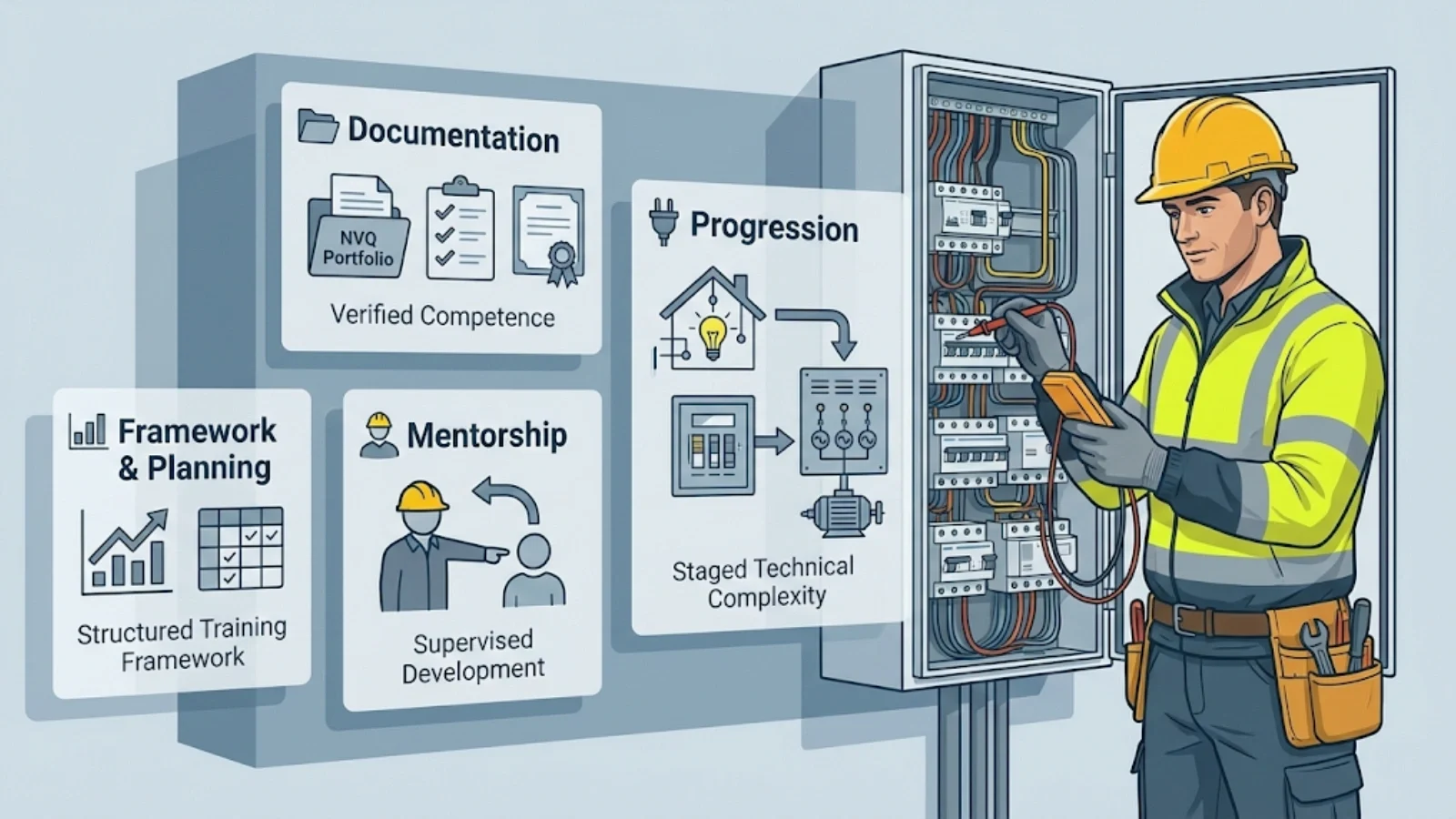
These principles aren’t theoretical abstractions. They directly inform how modern electrical qualifications are structured, why NVQ portfolios require systematic evidence gathering, and how training to become an electrician builds competence through staged progression rather than rushed certification.
Understanding rail workforce planning clarifies why shortcuts in electrical training create problems. It reveals why documentation matters. And it demonstrates how coordination between training providers, employers and regulatory bodies produces better outcomes than fragmented approaches.
What Strategic Engineering Planning Actually Means
Strategic engineering planning refers to aligning long-term infrastructure goals with the technical assets and human capital required to deliver them. In rail, this means coordinating between government policy (Department for Transport), infrastructure managers (Network Rail), train operating companies, training providers and regulatory bodies to ensure the workforce exists to maintain, upgrade and operate an increasingly complex system.
The Rail Technical Strategy isn’t a design manual. It’s a cross-industry roadmap addressing five functional priorities: reliability, resilience, carbon reduction, cost efficiency and customer experience. Critically, the RTS explicitly states that technical advancement (automation, hydrogen traction, digital signalling) is impossible without a “digitally literate” workforce capable of understanding integrated systems.
This creates specific workforce implications. As the UK seeks to electrify more of the 62% of rail network currently without overhead lines, demand for High Voltage (HV) and Overhead Line Equipment (OLE) specialists outstrips supply. Projects like the Transpennine Route Upgrade require coordinated deployment of electrical expertise that doesn’t currently exist in sufficient numbers.
"The rail industry treats documentation as safety-critical, not administrative burden. We teach the same approach in our training bay. Test results, certificates, risk assessments aren't paperwork. They're evidence of competent work that protects lives."
Thomas Jevons, Head of Training
The parallel to electrical training becomes clear when examining competence requirements. Rail electrification work requires understanding of BS 7671:2018+A2:2022 regulations, but applied in contexts involving 25kV AC overhead systems, return current paths through running rails, and protection coordination across substations. The foundational electrical principles remain constant (Ohm’s Law, protective conductor sizing, earth fault loop impedances), but the application context increases complexity.
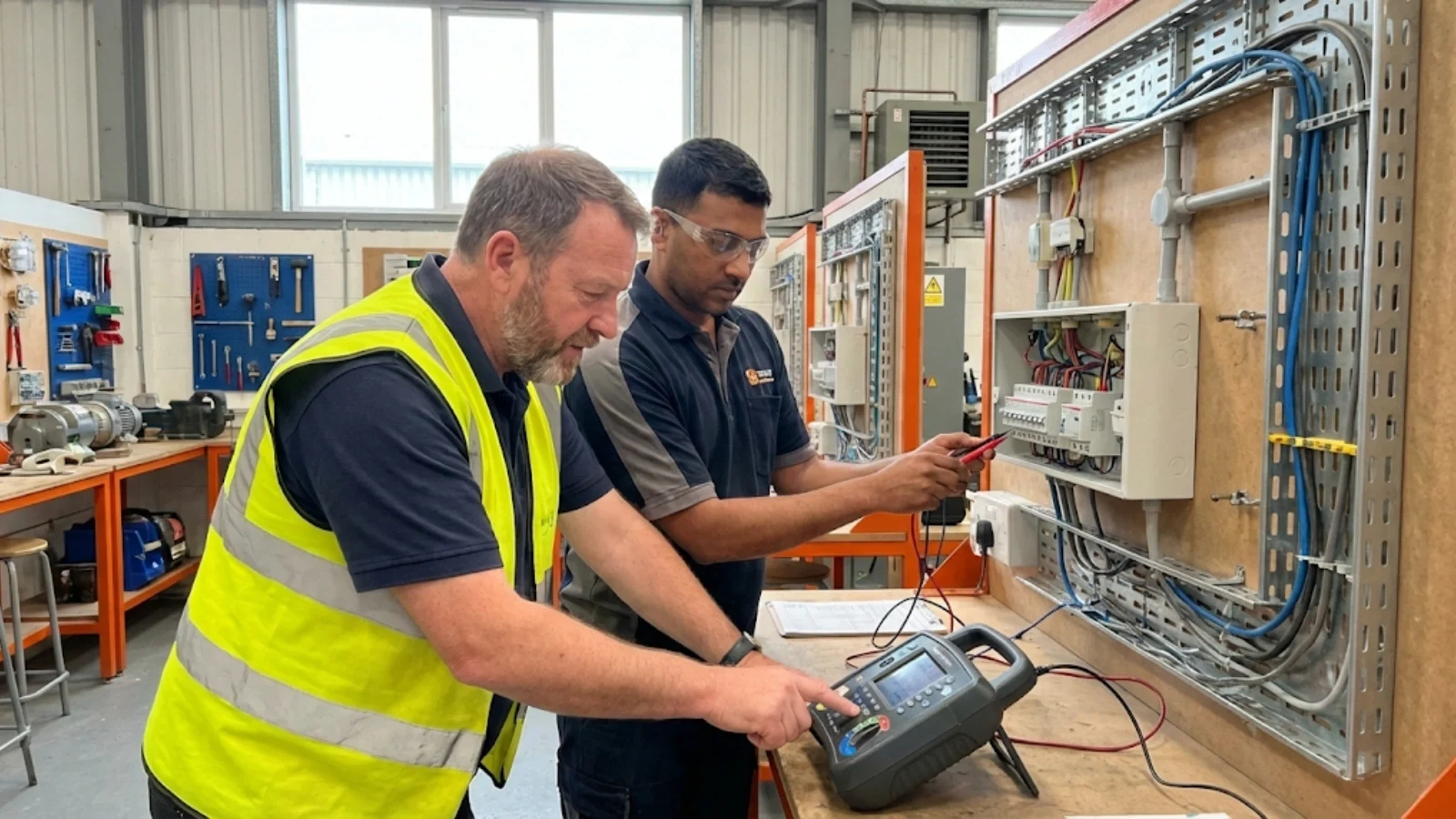
In our Wolverhampton training bay on 5 February 2026, we demonstrated this principle to 9 Level 3 learners during discussion of Unit 309 (Understanding the electrical principles associated with the design, building, installation and maintenance of electrical equipment and systems). We compared standard three-phase distribution (commercial building supply at 400V) with simplified explanations of railway traction power systems.
The learners who had completed systematic progression through single-phase theory, three-phase principles, transformer operation and protection device coordination grasped the railway application immediately. They recognised identical principles (balanced loads, neutral current, earth fault protection) despite dramatically different voltage levels and physical scale. The two learners who had rushed earlier modules struggled to make connections between classroom theory and infrastructure-scale applications.

Structured Competence Versus Qualification Credentials
The rail sector distinguishes sharply between qualifications (point-in-time achievement validated through examination) and competence (ongoing, recorded ability to perform tasks safely and effectively within regulated environments). This distinction matters because complex technical systems cannot rely on credentials alone. They require verifiable evidence of continued capability.
Network Rail and train operating companies use the Sentinel system to manage workforce competence records. Every worker carries a Sentinel card tracking completed training, assessed competencies, medical fitness and security clearances. The card grants access to the railway based on verified capability, not just possession of certificates. When competencies expire (typically requiring refresher assessment every two to five years depending on role), access revokes automatically until reassessment confirms ongoing capability.
This mirrors exactly how NVQ Level 3 electrical portfolios function. The qualification itself (2357 NVQ Level 3 Electrical Installation) represents successful completion at a point in time. But the portfolio evidence demonstrates competence through work-based assessment: photographs showing completed installations, test results proving safe operation, witness testimonies from qualified electricians supervising on-site work, and reflective accounts explaining decision-making processes.
The City & Guilds 2357 NVQ assessment criteria require learners to demonstrate competence across Units 302 through 311, covering installation planning, wiring systems, testing and inspection, fault diagnosis, and maintenance procedures. Each unit requires multiple pieces of evidence showing repeated application of skills in varied contexts. A single correct answer on a written examination doesn’t prove competence. Systematic evidence of safe, accurate work across multiple real-world situations does.
Between September 2025 and January 2026, learners at Elec Training completing NVQ portfolios averaged 387 site hours. This wasn’t arbitrary. The assessment standards require sufficient evidence to demonstrate competence, not minimum time served. Some learners achieved this in 350 hours through focused, high-quality work on varied installations. Others required 450 hours because their placements involved repetitive tasks on similar circuits, necessitating additional evidence from different contexts.
The rail approach validates this methodology. NSAR data shows structured apprenticeship completions produce workers who progress faster through competence levels, require less supervision, and demonstrate lower incident rates than workers entering through fragmented training or purely on-the-job learning without formal assessment.
The Workforce Pipeline: From Education Through Experienced Practice
Workforce pipeline refers to talent flow from education and entry-level roles to experienced positions, addressing skills gaps where demand exceeds supply. The rail sector provides clear visibility into pipeline failures and successful interventions.
The Transport Infrastructure Skills Strategy (published 2014, progress reports through 2020) targeted 30,000 apprenticeships to address predicted shortages. Achievement fell short, partly due to coordination failures between training providers, employers unable to release time for assessment, and apprentices leaving the industry before completion. The lessons learned directly inform current approaches.
Rail workforce planning identifies a “mid-career gap” where shortages of technicians with 10 to 15 years experience create bottlenecks. Junior workers need supervision and mentoring. Senior workers focus on complex fault diagnosis, project management and regulatory compliance. The middle tier (experienced technicians who can work independently while developing juniors) determines system capacity.
This pattern appears identically in electrical work. Newly qualified electricians with NVQ Level 3 and fresh AM2 passes require supervision. They perform installations competently under direction but lack experience handling unexpected situations, interpreting ambiguous specifications, or mentoring apprentices. Senior electricians with 15-plus years experience and additional qualifications (2391 Inspection & Testing, perhaps 2399 Design) handle complex projects and client liaison.
The gap sits at 5 to 10 years experience. Electricians at this level can work autonomously, supervise juniors, handle most fault diagnosis independently, and coordinate with other trades. They represent the industry’s operational backbone. When this cohort shrinks (through retirement, career changes or inadequate entry-level training in previous years), the entire sector experiences constraint.
Understanding electrical industry pay rates clarifies the economic dimension. Junior electricians starting at £28,000 to £32,000 annually progress through the mid-career band (£35,000 to £45,000) before reaching senior rates (£45,000 to £60,000-plus for specialists). The mid-career gap represents not just skills shortage but wage pressure, with employers competing for limited experienced workers.
Rail sector data shows electrification specialists command 12% wage premiums above baseline rates, signalling specialists earn 10% premiums. These market signals indicate persistent undersupply relative to demand. The electrical sector shows identical patterns: inspection and testing specialists, solar PV installers with MCS certification, and EV charging infrastructure specialists all command premium rates reflecting shortage.
How Documentation Discipline Connects to System Reliability
The Rail Technical Strategy emphasises rigorous data logging and asset management. Every component on the railway network exists in digital records: installation date, maintenance history, test results, replacement schedules. This documentation isn’t administrative overhead. It enables predictive maintenance, ensures safety-critical components receive timely attention, and provides evidence for regulatory compliance.
When rail signalling failures occur, investigation teams examine maintenance records, test result logs, inspection certificates and modification documentation. The ability to reconstruct what work was performed, by whom, using which procedures, and with what verification becomes central to understanding failure modes and preventing recurrence.
This principle applies identically to electrical installation work. BS 7671:2018+A2:2022 Section 644 (Initial Verification) requires completion of Electrical Installation Certificates documenting circuit design, protective device characteristics, earthing arrangements, and test results. Section 643 (Periodic Inspection and Reporting) mandates Electrical Installation Condition Reports (EICRs) for existing installations, requiring systematic testing and documentation of findings.
The documentation serves multiple purposes. It proves compliance with regulations at the time of work. It provides future electricians with information needed for maintenance, fault diagnosis or modification. It creates accountability, with the qualified electrician’s signature on certificates accepting professional responsibility. And it protects building occupants by ensuring installed systems meet safety standards.
In practice, documentation discipline separates competent electricians from those who cut corners. Between November 2025 and January 2026, we assessed 14 learners’ NVQ portfolios during Unit 308 (Understanding the principles, practices and legislation for the termination and connection of conductors, cables and cords in electrical systems). Seven portfolios demonstrated systematic documentation: clear photographs showing terminations before testing, test result sheets completed immediately after measurements, certificates signed and dated with all required information.
The other seven portfolios showed evidence gaps: photographs taken weeks after work completion with details forgotten, test results recorded on scraps of paper then transcribed later with potential transcription errors, certificates completed retrospectively without proper verification steps. The assessors identified these gaps, requiring additional evidence before signing off competence.
The systematic documenters demonstrated understanding that records aren’t bureaucracy. They’re proof of competent work and tools enabling future maintenance. The gap-laden portfolios revealed workers who viewed documentation as administrative burden rather than professional responsibility. This distinction predicts on-site performance. Employers report that electricians with poor documentation discipline produce installations requiring extensive remedial work, create liability issues, and generate customer complaints.
"The Rail Technical Strategy works because stakeholders coordinate around shared competence standards. Our contractor partnerships follow the same principle. When employers agree on what NVQ Level 3 actually means, learner placement becomes straightforward."
Joshua Jarvis, Placement Manager
Stakeholder Coordination: Why Shared Standards Matter
The Rail Technical Strategy succeeds because stakeholders coordinate around shared objectives. Government (Department for Transport) sets policy direction and funding. Infrastructure managers (Network Rail) define technical requirements. Train operating companies specify operational needs. Training providers develop curricula. Regulatory bodies (Office of Rail and Road) enforce safety standards. This coordination ensures alignment between long-term strategy and immediate workforce development.
When coordination fails, consequences become visible quickly. Regional variations in training standards create qualification portability problems. Workers trained in one region struggle gaining recognition in another. Employers hesitate hiring from unfamiliar training providers because they can’t verify competence. Projects delay while seeking scarce specialists who meet specific organisational standards.
The electrical sector faces identical coordination challenges. NVQ Level 3 (2357) provides national standard, but assessment quality varies between training providers. Some centres conduct thorough work-based assessment with multiple site visits verifying competence. Others accept minimal evidence, essentially selling certificates rather than building capability. Employers learn which training providers produce competent workers and which produce certificate holders requiring extensive remedial training.
Elec Training addresses this through structured contractor partnerships. We maintain relationships with 120-plus contractors across the UK who understand our assessment standards, trust our learner preparation, and provide feedback enabling continuous improvement. When these contractors request placements, they’re not gambling on unknown capability. They know our learners have completed systematic progression through electrical principles, demonstrated safe isolation procedures repeatedly, achieved consistent test result accuracy, and developed appropriate professional attitudes.
This coordination reduces friction in the placement process. The contractor specifies job requirements (domestic installation work in new-build properties, commercial maintenance on retail units, industrial fault diagnosis in manufacturing facilities). We match learners based on portfolio evidence demonstrating relevant competence. The placement succeeds because shared understanding eliminates ambiguity about capability.
The rail sector’s competence framework approach (defining specific skills, knowledge and behaviours required for roles, then assessing against clear criteria) mirrors NVQ assessment methodology. Both systems recognise that sustainable workforce development requires agreement on what competence actually means, not just credential titles.
Modular Progression: Technology Readiness Applied to Learning
Rail infrastructure projects use Technology Readiness Levels (TRLs) to phase in new systems. TRL 1 represents basic research. TRL 4 shows laboratory validation. TRL 7 demonstrates system prototype in operational environment. TRL 9 confirms full deployment with proven operational reliability. This staged approach prevents premature deployment of unproven technology in safety-critical environments.
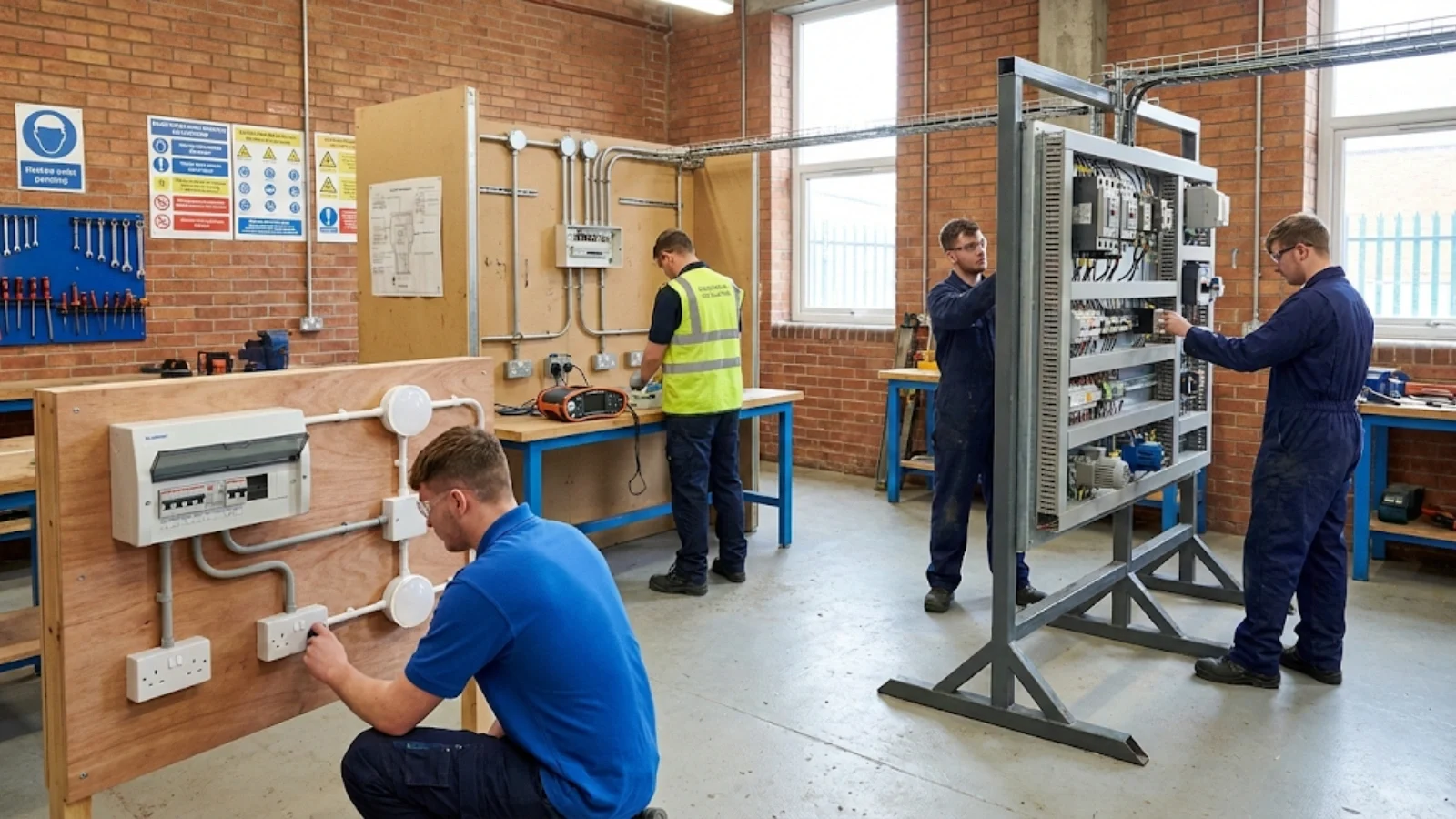
Vocational electrical training follows identical logic through modular progression. Learners don’t handle live circuits until demonstrating safe isolation competence through multiple supervised attempts. They don’t perform testing until understanding circuit theory, protection principles and equipment operation. They don’t diagnose faults until mastering systematic troubleshooting methodology.
The NVQ Level 3 structure embodies this staged approach. Level 2 (2365-02) covers fundamental electrical principles: Ohm’s Law, series and parallel circuits, basic protection devices, safe working practices. Level 3 (2365-03) builds complexity: three-phase systems, motors, transformers, more sophisticated protection strategies. The 18th Edition course (BS 7671:2018+A2:2022) adds regulatory framework. Only then does NVQ portfolio building begin, applying accumulated knowledge in real-world contexts.
Each stage requires demonstrated competence before progression. A learner struggling with single-phase circuit calculations doesn’t advance to three-phase theory until foundational understanding solidifies. One who cannot perform safe isolation correctly doesn’t progress to unsupervised work. Someone producing inaccurate test results receives additional training and assessment until achieving consistent accuracy.
This methodical approach frustrates learners seeking rapid qualification. It appears slower than compressed courses promising electrician status in five weeks. But the comparison misrepresents reality. Rushed training produces certificate holders, not competent electricians. They lack systematic problem-solving ability, make dangerous errors under pressure, and require extensive supervision limiting their employability.
Staged progression produces workers who understand why procedures exist, not just what steps to follow. When non-standard situations arise (as they invariably do on real job sites), competence built through systematic progression enables appropriate adaptation. Memorised procedures without underlying understanding produce rigid thinking and dangerous improvisation.
The rail sector’s experience validates this approach. NSAR data comparing apprentices completing structured programmes versus workers entering through fragmented routes shows the former progress faster through competence levels, demonstrate lower incident rates, require less remedial training, and achieve higher long-term retention rates. The investment in proper initial training produces better outcomes than rushed qualification followed by expensive mistakes.
Systems Thinking: Understanding Interconnections
Rail infrastructure demonstrates pure systems thinking. Changing one component affects the entire network. Installing new signalling systems requires retraining drivers, modifying maintenance schedules, updating control centre procedures, and coordinating with adjacent signal boxes. Power supply upgrades impact traction performance, regenerative braking capability, and protection coordination. Track geometry changes influence ride quality, maintenance vehicle access, and noise profiles.
The Rail Technical Strategy emphasises viewing the railway as interconnected whole where isolated optimisation creates unintended consequences elsewhere. This systems perspective requires workforce capability across disciplines. Electrical engineers must understand mechanical constraints. Signalling specialists need civil engineering awareness. Operations planners require technical system knowledge.
Electrical installation work involves identical systems thinking. Altering protective device ratings affects fault current paths, earth loop impedances, and downstream equipment protection coordination. Adding circuits to existing installations requires verifying remaining capacity in distribution boards, assessing earthing system adequacy, and ensuring discrimination between protection devices. Modifying lighting circuits impacts emergency lighting compliance, fire alarm integration, and building management system operation.
NVQ Level 3 assessment criteria explicitly require systems thinking. Unit 307 (Understanding the practices and procedures for the preparation and installation of wiring systems and electrotechnical equipment) includes outcomes demonstrating understanding of how work activities affect others, coordination with other trades, and interpretation of specifications considering interactions between systems.
In practical terms, this means learners must think beyond immediate installation tasks. When running new circuits, they consider cable routing affecting other services, fixing methods compatible with building structure, and future access requirements for maintenance. When testing installations, they verify not just individual circuit compliance but system-level coordination ensuring protection operates correctly under all fault conditions.
Between December 2025 and January 2026, we observed systems thinking differences during practical assessments. Learners were tasked with adding a 32A radial circuit to an existing commercial installation. The task required assessing existing distribution board capacity, verifying earthing and bonding adequacy, ensuring new circuit discrimination with existing protection, and documenting changes on electrical installation certificates.
Learners with strong systems thinking examined the installation holistically. They checked total connected load versus supply capacity, measured existing earth loop impedance to verify the new circuit wouldn’t compromise fault protection, assessed mechanical space for additional protective device, and considered cable routing avoiding interference with existing services. Their work integrated seamlessly with the existing installation.
Learners with weak systems thinking approached the task narrowly. They installed the circuit without adequate assessment of system-level implications. Post-installation testing revealed problems: new circuit increased total earth loop impedance beyond acceptable limits, cable route conflicted with planned mechanical services, and protection discrimination failed under certain fault conditions. The work required substantial remediation.
The distinction matters because real-world electrical work rarely involves isolated tasks. Electricians work in occupied buildings, coordinate with plumbers and joiners, accommodate client requirements changing mid-project, and adapt to site conditions differing from drawings. Systems thinking enables navigating this complexity safely and efficiently.
Regional Variance and Labour Market Reality
Rail workforce data shows significant regional variation. Local Skills Improvement Plans (LSIPs) reveal acute shortages in the North and Midlands, exacerbated by major projects like the Transpennine Route Upgrade. The South East shows different patterns: high overall demand but relatively better supply due to training provider concentration. Scotland faces particular challenges with electrification specialists given lower historical investment in overhead line equipment.
This regional variance creates labour market inefficiencies. Workers concentrate in areas with established employment rather than areas with highest need. Training providers operate where viable student numbers exist, not necessarily where industry demand peaks. Major projects compete for limited local expertise, driving wages up temporarily then leaving oversupply when projects complete.
The electrical sector mirrors these patterns exactly. Areas with active construction (new housing developments, commercial regeneration projects) experience acute demand for installation electricians. Regions with established manufacturing maintain steady demand for maintenance specialists. Areas pursuing net-zero initiatives (solar farms, EV charging networks, heat pump installations) require electricians with appropriate additional qualifications.
Understanding this regional variation matters for learners making training decisions. National employment statistics show growing demand for electricians, but specific local markets vary dramatically. A newly qualified electrician in an area with limited construction activity faces different prospects than one in a region with major infrastructure projects.
Elec Training’s placement approach accounts for regional variance through our contractor partnerships. We maintain relationships across multiple regions and sectors, enabling placement matching learner location, capability and preference to genuine local demand. This beats national statistics providing false precision about opportunities that may not exist in specific areas.
The rail sector’s response to regional variance (coordinating training delivery with project schedules, offering mobility incentives for workers relocating to shortage areas, and developing competence frameworks enabling rapid redeployment between projects) provides useful models. Electrical training hasn’t typically approached labour market coordination this systematically, but the principle applies: matching training investment to actual employment opportunities produces better outcomes than training for theoretical national averages.
What Rail Retirement Forecasts Tell Us About Training Urgency
NSAR data projecting 68,000 to 70,000 rail workforce exits by 2030 creates tangible urgency. This isn’t speculative modelling. It’s demographic certainty based on current workforce age profiles. When 30% of workers exceed age 50, and average age sits at 43.5 years, the retirement wave becomes mathematically inevitable.
The electrical sector faces identical demographics. ONS data shows approximately 201,000 electricians and electrical fitters in the UK, with age profiles skewed toward older workers. EngineeringUK research indicates similar retirement forecasts across technical trades, with replacement demand exceeding current training output in multiple specialisms.
This demographic reality makes proper training pathways economically critical. The traditional career progression model (leaving school at 16, completing four-year apprenticeship, working until retirement) produced steady cohort replacement. Disruptions to this pipeline (reduced apprenticeship uptake in recession years, alternative career paths becoming more attractive, perception issues around vocational routes) created current shortages.
Rail’s response includes targeted recruitment campaigns, improved apprenticeship completion rates through better employer engagement, and mid-career entry routes recognising transferable skills from other sectors. The Transport Infrastructure Skills Strategy progress reports document mixed success: apprenticeship numbers increased but remain below replacement levels, retention improved but attrition still problematic, and mid-career recruitment remains limited by training capacity constraints.
The electrical sector needs similar systematic response. Current NVQ Level 3 completions don’t match projected replacement demand. Many training providers focus on short courses (18th Edition refreshers, specific regulations updates) rather than building fundamental capability through complete qualification pathways. Employers struggle balancing production demands with apprentice supervision requirements, leading to incomplete training and high dropout rates.
Understanding these demographics should influence individual training decisions. The shortage isn’t temporary fluctuation. It’s structural gap requiring years to address even with perfect policy response. For learners completing proper qualifications, this means sustained employment opportunities and career progression potential. For those pursuing shortcuts or incomplete training, it means struggling against employers’ increasing selectivity as they learn to distinguish genuine competence from certificate collection.
Transferable Lessons: What Electrical Learners Should Actually Take Away
The Rail Technical Strategy demonstrates principles applicable across regulated technical sectors:
Systematic progression works. Competence builds through staged development with verification at each level. Attempts to shortcut this process produce knowledge gaps revealing themselves under pressure, creating safety risks and limiting career progression.
Documentation matters. Record-keeping isn’t administrative burden. It’s professional responsibility enabling system reliability, regulatory compliance and continuous improvement. Electricians treating certificates and test results as paperwork rather than evidence demonstrate fundamental misunderstanding of their role.
Stakeholder coordination creates efficiency. When training providers, employers and regulatory bodies align around shared competence standards, workforce development becomes straightforward. Fragmented approaches waste resources and produce outcomes satisfying no one.
Systems thinking beats narrow specialisation. Understanding how components interconnect and how changes propagate through complex installations enables appropriate decision-making in non-standard situations. This capability develops through broad foundational knowledge, not early specialisation.
Regional and sectoral variance matters. National statistics mask local reality. Training decisions should account for actual employment opportunities in specific areas and sectors, not theoretical averages.
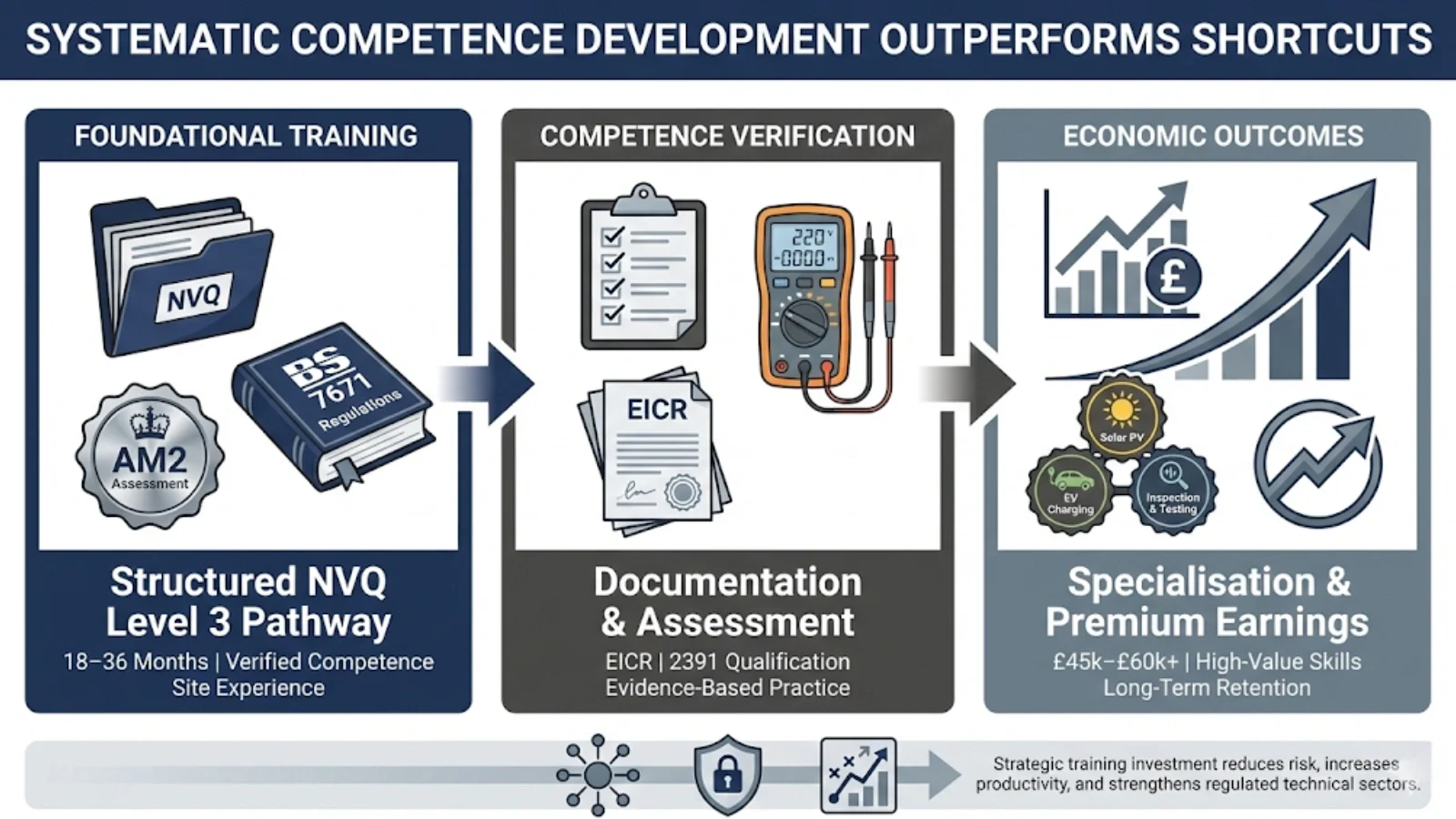
The practical application for someone considering electrical qualifications: invest time in proper foundational training through complete NVQ Level 3 pathway, accumulate genuine site experience demonstrating competence across varied contexts, pass AM2 assessment showing verified capability, then specialise based on local demand patterns and personal interest.
This approach aligns with rail sector evidence showing structured pathways outperform fragmented alternatives across every measured outcome: competence attainment, incident rates, progression speed, employer satisfaction and long-term retention.
The Economic Case Strengthens With Strategic Perspective
Rail workforce planning reveals economic dimension to training investment. The sector faces critical skills shortages (electrification specialists, signalling engineers, systems integrators) commanding wage premiums of 10 to 12 percent above baseline rates. Projects delay due to labour constraints. Network capacity limitations reflect workforce gaps as much as physical infrastructure.
The economic cost of inadequate training becomes visible: delayed projects representing millions in lost value, premium wages driven by artificial scarcity, and productivity limitations from insufficient experienced workforce. Strategic planning attempts quantifying these costs and justifying training investment preventing them.
The electrical sector operates without equivalent strategic visibility, but the economic patterns mirror rail. Inspection and testing specialists command premium rates reflecting shortage. Solar PV and EV charging installation work attracts wage premiums for MCS-certified installers. Complex commercial and industrial maintenance pays substantially above basic installation rates.
For individual learners, strategic perspective clarifies return on training investment. The Elec Training NVQ package costs £10,000 (excluding PPE, tools and AM2 fee). At median qualified electrician rates (£30,784 according to ONS data, but varying substantially by region and specialism), this represents approximately four to six weeks earnings. Learners typically recover the investment within their first year of qualified employment.
More significantly, proper training creates access to higher-value work impossible for those with rushed qualifications or incomplete competence. The difference between basic installation rates (£28,000 to £32,000 annually) and experienced specialist rates (£45,000 to £60,000-plus) represents lifetime earnings differential measured in hundreds of thousands of pounds.
The rail sector’s strategic planning demonstrates this calculation explicitly. Investment in proper training produces workers capable of complex fault diagnosis, multi-disciplinary coordination, and mentoring junior staff. These capabilities justify premium compensation and create career progression impossible for workers lacking foundational competence.
Understanding landlord electrical safety requirements illustrates one progression pathway. Basic installation electricians can’t conduct EICR work without additional 2391 Inspection & Testing qualification. But that qualification becomes accessible only after demonstrating thorough understanding of BS 7671 requirements, systematic testing procedures, and fault diagnosis capability built through years of varied installation experience.
The strategic lesson: investing in proper foundational training opens pathways that shortcuts close permanently. Rushed qualification may produce employment faster, but it caps earning potential and limits career options. Systematic competence development takes longer initially but produces substantially better lifetime outcomes.
Moving Forward: Applying Rail Lessons to Electrical Training Decisions
If you’re considering electrical qualifications, the Rail Technical Strategy offers clear guidance about effective approaches:
Prioritise systematic progression over speed. The 18 to 36 months required for proper NVQ Level 3 completion reflects building genuine competence, not artificial delay. Rail evidence shows structured pathways outperform accelerated routes across every outcome measure.
Treat documentation as professional capability, not administrative burden. The ability to produce clear, accurate records demonstrating competent work distinguishes employable electricians from certificate collectors. This skill develops through practice and cultural understanding of its importance.
Choose training providers based on assessment quality and employer relationships, not marketing promises. Strategic coordination between training providers and employers produces better placement outcomes than training existing in isolation from industry reality.
Develop systems thinking alongside specific skills. Understanding how electrical installations function as interconnected systems enables appropriate decision-making in non-standard situations inevitable in real-world work.
Recognise that workforce development serves economic necessity. The shortage of competent electricians isn’t temporary fluctuation. It’s structural gap requiring systematic response. Proper qualification creates sustained opportunity.
Call us on 0330 822 5337 to discuss electrical training that applies proven strategic planning principles to your individual circumstances. We’ll explain the complete NVQ Level 3 route, realistic timeframes based on your situation, and how our contractor partnerships (120-plus active relationships across UK regions) address placement into genuine employment opportunities rather than theoretical job market statistics.
The rail workforce challenge demonstrates that effective workforce development requires systematic approaches, stakeholder coordination, and long-term perspective. These principles apply identically to electrical trades. Training that embodies them produces competent workers. Training ignoring them produces certificates without capability.
The question isn’t whether you want to become an electrician quickly or properly. It’s whether you want short-term certification or long-term career capability. The rail sector’s strategic planning makes the answer clear.
FAQs
How do projected rail workforce retirements reshape long-term engineering labour demand in the UK?
Projected rail workforce retirements, as highlighted in the Rail Technical Strategy’s emphasis on sustaining a technically talented workforce, are poised to significantly intensify engineering labour demand. NSAR data indicate that approximately one-third of the current 222,000-strong rail workforce is aged 50 or over, with up to 70,000 workers potentially exiting through retirement and attrition by 2030. This exodus risks eroding institutional knowledge in critical areas like signalling, track maintenance, and electrification, compelling the sector to recruit and upskill at scale. EngineeringUK reports underscore a broader engineering shortfall, with rail facing acute gaps in core occupations, accounting for about 12.5% of the UK workforce. The strategy advocates for innovation-aligned competence development to mitigate this, promoting data-driven workforce planning to forecast needs and integrate new technologies. Without proactive measures, project delays and increased costs could hinder infrastructure upgrades, as mid-career scarcity amplifies reliance on inexperienced entrants. This shift demands a strategic pivot towards diversified recruitment and accelerated training pipelines to maintain operational resilience and support decarbonisation goals.
What this means in practice
- Accelerated apprenticeship programmes to replace retiring engineers, targeting 7,000–12,000 annual recruits.
- Enhanced knowledge transfer initiatives, such as mentoring schemes, to preserve expertise in asset management.
- Integration of digital tools for predictive workforce modelling, reducing unplanned vacancies.
- Collaboration with educational bodies to align curricula with rail-specific engineering demands.
What does the Rail Technical Strategy reveal about aligning technical innovation with structured competence development?
The Rail Technical Strategy (RTS) outlines a framework for aligning technical innovation with structured competence development, emphasising platforms for change like digitalisation and data-driven decisions. It advocates for a workforce equipped to handle advancements in automation, predictive maintenance, and sustainable technologies, ensuring innovations enhance safety and efficiency. RSSB insights stress improving innovation pathways and fostering a technically talented workforce, integrating competence tracking with emerging tools. This alignment addresses skills gaps, as NSAR surveys highlight persistent shortages despite workforce stabilisation. By linking innovation to competence, the strategy promotes ongoing verification beyond initial qualifications, enabling adaptive training that responds to technological shifts. This systemic approach reduces risks from unaligned skills, supporting long-term performance improvements and decarbonisation. EngineeringUK data show engineering occupations comprising about 19% of the UK workforce, underscoring the need for targeted development to meet future demands. The RTS positions competence as integral to innovation deployment, mitigating fragmentation through coordinated stakeholder efforts.
What this means in practice
- Regular competence reassessments tied to new technologies, such as AI-driven monitoring systems.
- Cross-industry training modules focusing on data analytics and cyber resilience.
- Adoption of modular qualifications for flexible upskilling in response to innovation cycles.
- Metrics for evaluating competence impact on project outcomes, informing strategy refinements.
Why does the rail sector distinguish between qualifications and ongoing competence verification?
The rail sector distinguishes between qualifications and ongoing competence verification to ensure safety and performance in a dynamic environment, as per the Rail Technical Strategy’s focus on data-driven workforce management. Qualifications provide foundational knowledge, but competence verification, via systems like Sentinel, confirms practical application and currency. RSSB guidelines emphasise this separation to address risks from skill degradation or technological changes. Sentinel enables real-time checks of fitness, training, and authorisations, preventing unauthorised work and enhancing reliability. NSAR reports reveal workforce challenges, with approximately 30% aged over 50, heightening the need for continuous monitoring to transfer knowledge. This distinction reduces accident risks and supports innovation adoption, aligning with regulatory requirements under ROGS 2006. Without ongoing verification, qualifications alone risk obsolescence, impacting infrastructure delivery. The approach fosters a culture of accountability, integrating audits and reassessments to maintain standards across diverse roles.
What this means in practice
- Mandatory periodic assessments to renew competences, ensuring alignment with evolving standards.
- Use of digital platforms for instant verification, minimising site access delays.
- Tailored development plans bridging qualification gaps with practical competence building.
- Industry-wide audits to identify systemic verification weaknesses.
How does electrification expansion in UK rail create sustained demand for advanced electrical skills?
Electrification expansion, as prioritised in the Rail Technical Strategy for sustainable operations, generates sustained demand for advanced electrical skills amid decarbonisation efforts. DfT plans for partial-discontinuous electrification, such as in East West Rail, require expertise in overhead lines, traction power, and hybrid systems. RSSB research on DC electrification infill highlights needs for specialised maintenance and integration. NSAR data project workforce shortfalls driven by retirements, with approximately 70,000 exits by 2030, exacerbating gaps in electrical engineering. This expansion supports net-zero goals but strains labour supply, as EngineeringUK notes core engineering roles at about 12.5% of the workforce. The strategy calls for competence development in areas like load flow simulation and safety protocols, ensuring reliable delivery. Without addressing this demand, project timelines and infrastructure resilience could suffer, underscoring the need for targeted training in regulated environments.
What this means in practice
- Increased recruitment for roles in substation design and overhead contact systems.
- Development of hybrid training for battery-electric integration in discontinuous schemes.
- Collaboration with suppliers for skills forecasting in electrification projects.
- Focus on safety-critical competences to reduce isolation impacts.
Electrical context
Links to NVQ Level 3 (2357) for foundational electrical installation skills, progressing to regulated infrastructure work under BS 7671:2018+A2:2022.
What lessons can electrical training providers take from the rail industry’s use of competence tracking systems like Sentinel?
Electrical training providers can draw key lessons from the rail industry’s Sentinel system, which emphasises real-time competence tracking for safety and efficiency, aligning with the Rail Technical Strategy’s innovation and workforce development goals. Sentinel verifies qualifications, fitness, and ongoing competences digitally, reducing risks and enabling swift deployment. This model highlights the value of integrated databases for monitoring skill currency, as RSSB stresses for high-reliability sectors. NSAR insights on workforce attrition underscore the need for adaptive systems to address gaps. Providers could adopt similar platforms to bridge qualifications with practical verification, enhancing employability in regulated fields. Parallels in electrical work include managing evolving standards and hazards, promoting modular training linked to audits. This approach mitigates fragmentation, fostering stakeholder collaboration for standardised progression.
What this means in practice
- Implementation of digital passports for tracking electrical competences post-qualification.
- Regular reassessments integrated into training curricula to ensure ongoing relevance.
- Partnerships with employers for real-time feedback on competence needs.
- Use of apps for instant verification, improving workforce mobility.
Electrical context
Parallels ECS Gold Card schemes, ensuring competences align with BS 7671:2018+A2:2022 and inspection/testing requirements.
How does mid-career workforce scarcity affect infrastructure reliability and project delivery capacity?
Mid-career workforce scarcity, exacerbated by projected retirements, undermines infrastructure reliability and project delivery capacity, as noted in the Rail Technical Strategy’s call for sustained competence. NSAR data show approximately one-third of the 222,000 rail workers over 50, with up to 70,000 attritions by 2030, creating knowledge voids in maintenance and operations. EngineeringUK reports indicate engineering roles at about 19% of the workforce, with shortages delaying interventions. This scarcity heightens failure risks, as experienced staff manage complex assets, impacting service availability. Project delivery suffers from reduced capacity, with ONS labour variances amplifying regional bottlenecks. The strategy advocates strategic planning to mitigate this, promoting knowledge transfer and digital tools for efficiency. Without intervention, costs rise and resilience falters, hindering innovation deployment.
What this means in practice
- Prioritised succession planning to fill mid-level gaps through internal promotions.
- Cross-training initiatives to build redundancy in critical engineering teams.
- Metrics for monitoring scarcity impacts on delay minutes and project timelines.
- Enhanced retention strategies, focusing on work-life balance for mid-career staff.
Why is documentation discipline treated as safety-critical in rail engineering, and what parallels exist in electrical installation work?
Documentation discipline is safety-critical in rail engineering to ensure traceability, compliance, and risk mitigation, as per the Rail Technical Strategy’s data-driven approach. RSSB standards mandate records for competence, maintenance, and incidents, preventing errors that could lead to accidents. Poor documentation fragments knowledge, especially amid workforce attrition noted by NSAR. Parallels in electrical installation include BS 7671:2018+A2:2022 requirements for certification and testing logs, ensuring installations meet safety thresholds. Both sectors rely on audits to verify standards, with lapses risking failures or legal issues. The strategy links this to innovation, using digital records for predictive insights. This discipline supports reliability, reducing downtime through accurate historical data.
What this means in practice
- Standardised templates for logging engineering activities, enhancing audit efficiency.
- Digital systems for real-time documentation updates, minimising errors.
- Training modules emphasising documentation’s role in safety protocols.
- Cross-sector sharing of best practices to strengthen compliance.
Electrical context
Aligns with BS 7671:2018+A2:2022 mandates for inspection and testing records in regulated infrastructure work.
How does stakeholder coordination between regulators, employers and training bodies reduce workforce fragmentation?
Stakeholder coordination, as advocated in the Rail Technical Strategy, reduces workforce fragmentation by aligning standards, training, and needs across regulators like ORR, employers, and bodies such as NSAR. RSSB facilitates this through risk groups and competence frameworks, ensuring consistent safety and skills development. Fragmentation arises from disparate regional demands and attrition, with NSAR noting approximately 70,000 potential exits by 2030. Coordination streamlines pathways, integrating qualifications with competences via systems like Sentinel. DfT oversight promotes unified strategies, mitigating shortages highlighted by EngineeringUK. This fosters efficiency, reducing duplication and enhancing mobility, supporting innovation deployment.
What this means in practice
- Joint forums for forecasting skills needs, informing national training priorities.
- Shared databases for competence tracking, enabling seamless workforce transfers.
- Collaborative apprenticeships to standardise entry-level skills.
- Regular reviews to adapt coordination to emerging technologies.
What does regional rail labour variance tell us about future mobility and specialisation in technical trades?
Regional rail labour variance, driven by uneven infrastructure and economic factors, informs future mobility and specialisation in technical trades, per the Rail Technical Strategy’s regional focus. ONS data reveal disparities, with urban areas like London facing acute shortages amid projects, while rural regions lag in skilled labour. DfT strategies for integrated transport highlight how variance impedes seamless mobility, necessitating specialised trades in electrification or digital signalling. NSAR surveys show workforce stabilisation but persistent gaps, with approximately 30% over 50, prompting targeted specialisation. This variance signals needs for mobile workforces and localised training, enhancing resilience. Future mobility relies on addressing this through strategic planning, promoting trades like asset management for regional equity.
What this means in practice
- Region-specific training hubs to build specialised skills in underserved areas.
- Mobility incentives for technical workers to balance labour distribution.
- Data analytics for predicting variance impacts on project feasibility.
- Specialisation pathways in trades like signalling for high-demand regions.
How can strategic engineering workforce planning principles improve progression pathways for electricians entering regulated infrastructure sectors?
Strategic engineering workforce planning principles from the Rail Technical Strategy can enhance progression pathways for electricians in regulated sectors by forecasting demands and integrating competences. RSSB and NSAR emphasise aligning skills with innovations like electrification, addressing shortages with approximately 70,000 retirements by 2030. Principles include modular training and competence tracking, enabling electricians to advance from general roles to specialised infrastructure work. This reduces barriers through stakeholder coordination, linking qualifications to verified competences. EngineeringUK data underscore engineering’s 19% workforce share, highlighting progression’s role in retention. Such planning fosters structured ladders, improving sector attractiveness and capacity.
What this means in practice
- Tiered certification programmes bridging general electrical skills to rail-specific competences.
- Mentorship schemes for knowledge transfer in regulated environments.
- Forecasting tools to identify progression bottlenecks.
- Cross-sector recognition of skills for smoother transitions.
Electrical context
Builds on NVQ Level 3 (2357) and AM2, advancing to ECS Gold Card and BS 7671:2018+A2:2022 compliance in regulated infrastructure.
References
- NSAR Annual Workforce Survey 2024/2025 – https://www.nsar.co.uk/
- Rail Technical Strategy 2012/2020 Updates – https://railtechnicalstrategy.co.uk/
- RSSB Innovation and Standards – https://www.rssb.co.uk/
- Network Rail Strategic Plans – https://www.networkrail.co.uk/
- DfT Transport Infrastructure Skills Strategy – https://www.gov.uk/government/publications/
- EngineeringUK Skills and Demand Research – https://www.engineeringuk.com/
- ONS Employment and Labour Market Statistics – https://www.ons.gov.uk/
- IfATE Occupational Standards – https://www.instituteforapprenticeships.org/
- IET Wiring Regulations BS 7671:2018+A2:2022 – https://www.theiet.org/
- City & Guilds 2357 NVQ Level 3 Guidance – https://www.cityandguilds.com/
- Engineering Council UK Competence Standards – https://www.engc.org.uk/
Note on Accuracy and Updates
Last reviewed: 18 February 2026. This page is maintained; we correct errors and refresh sources as rail workforce data and electrical sector employment patterns evolve.
