


- Technical review: Thomas Jevons (Head of Training, 20+ years)
- Employability review: Joshua Jarvis (Placement Manager)
- Editorial review: Jessica Gilbert (Marketing Editorial Team)
- Last reviewed:
- Changes: Comprehensive 2026 update covering Free Courses for Jobs eligibility, Skills Bootcamps expansion, Wales PLA green skills priority, NI Skill Up academies, apprenticeship funding rules 2025-2026, realistic opportunity cost calculations comparing 4-year timelines across all routes.
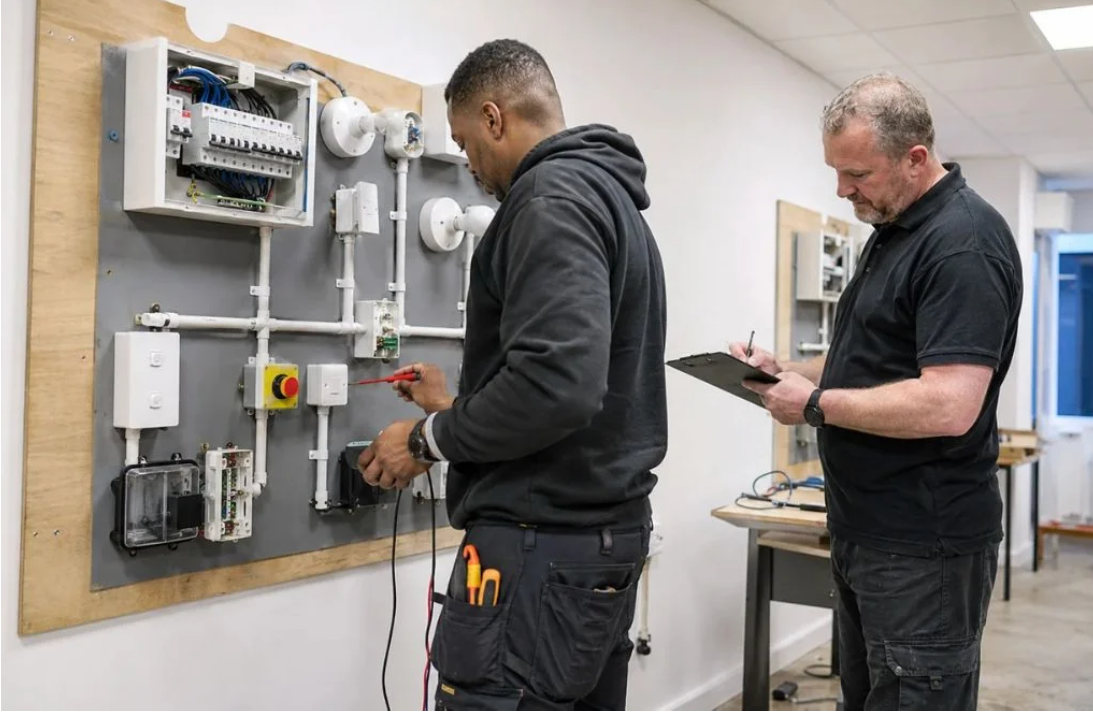
Searching online for how to become an electrician can lead UK learners towards advice about American trade schools, community colleges and journeyman licences. Although both countries require electricians to develop technical knowledge and practical skills, their qualification systems work differently. The UK places considerable emphasis on workplace competence, formal assessment and recognised industry qualifications. The US typically combines paid apprenticeships with state-specific licensing requirements. Understanding these differences can help you choose the right electrician training route and avoid confusing qualifications that sound similar but serve different purposes.
How Electricians Qualify in the UK
Becoming a fully qualified electrician in the UK generally involves technical training, workplace experience and an assessment of occupational competence. City & Guilds qualifications provide a recognised route into the industry, but completing classroom-based diplomas alone does not establish full occupational competence.
Level 2 and Level 3 Electrical Diplomas
The City & Guilds Level 2 and Level 3 Electrical Installation Diplomas provide the technical foundation for aspiring electricians. Elec Training currently offers the 2365-02 Level 2 and 2366-03 Level 3 qualifications.
The Level 2 Diploma introduces electrical science, installation technology, wiring systems, health and safety, and communication in building services engineering. It includes online multiple-choice tests and practical assignments.
The Level 3 Diploma builds on this knowledge, covering more advanced electrical science, installation methods, inspection, testing, fault diagnosis and design-related principles. It is intended for learners who have completed Level 2 training or have relevant prior knowledge.
However, neither diploma independently makes someone a fully qualified electrician. Learners generally progress towards a Level 3 National Vocational Qualification (NVQ) or an electrotechnical apprenticeship to demonstrate their competence in a working environment.
The Level 3 NVQ and AM2 Assessment
The Level 3 Electrical NVQ qualification assesses whether you can perform electrical work safely and competently on actual installations.
Unlike classroom assessments, the NVQ requires evidence from your workplace. For the electrical installation route, this includes planning and installing wiring systems, connecting equipment, inspecting and testing installations, and diagnosing faults.
Your portfolio may contain assessor observation reports, reflective accounts, expert-witness testimony, photographs and completed work records. Your assessor will observe your performance in accordance with the relevant qualification and workplace assessment requirements.
The final occupational assessment is the AM2, conducted at a National Electrotechnical Training (NET)-approved centre. It independently tests practical skills such as safe isolation, installation, inspection, testing, certification and fault diagnosis.
The AM2 is a separate requirement from ordinary classroom examinations. It helps establish whether you can perform the work expected of a competent electrician.
Additional Qualifications and ECS Recognition
Other qualifications support professional development and demonstrate knowledge in specific areas.
The City & Guilds 2382 qualification covers the 18th Edition Wiring Regulations, formally known as BS 7671. Its current version, 2382-26, covers the 2026 amendment. It assesses knowledge of electrical installation requirements rather than practical installation competence.
City & Guilds 2391 qualifications focus on initial verification, periodic inspection and testing. These are intended for people who already have relevant electrical knowledge and practical experience, rather than complete beginners.
The Electrotechnical Certification Scheme (ECS) Installation Electrician Gold Card provides recognised evidence of occupational competence. Eligibility requires an accepted Level 3 competency qualification, a current ECS Health, Safety and Environmental Assessment or recognised exemption, and a recognised BS 7671 qualification.
For someone following the conventional route, the progression is broadly:
- Level 2 and Level 3 City & Guilds Electrical Installation Diplomas.
- Level 3 Electrical NVQ qualification with workplace evidence.
- AM2 occupational competence assessment.
- Relevant BS 7671 qualification and ECS health and safety requirements.
- Application for the ECS Installation Electrician Gold Card.
For learners planning to enter the electrical trade, choosing the right training provider is an important first step. Elec Training is a City & Guilds Approved Centre focused on electrical training, with its training centre in Birmingham and UK-wide NVQ workplace assessments and employer placement support. Its specialist focus gives prospective electricians a place to explore training options as they work towards the qualifications and practical experience required by the UK industry.
How Electricians Qualify in the US
The US generally combines technical education, paid apprenticeship training and state-specific licensing examinations. Unlike the UK, there is no single national electrician licence.
Trade Schools and Apprenticeships
Aspiring American electricians may begin with a certificate or diploma programme at a trade school or community college. These programmes introduce electrical theory, wiring methods, safety procedures, blueprint reading and the National Electrical Code (NEC).
However, attending a trade school is not compulsory for every aspiring electrician. Many enter registered apprenticeship programmes directly.
According to the US Bureau of Labor Statistics, electrician apprenticeships typically take four to five years. A common four-year structure includes approximately 8,000 hours of paid on-the-job training and 576 hours of related technical instruction.
Apprentices work under experienced electricians while developing skills in installation, maintenance, troubleshooting and electrical safety. Classroom instruction complements this experience by covering electrical theory, mathematics, wiring regulations and other technical subjects.
If you want to compare American training options, Research.com’s guide to the best electrician trade schools examines US programmes, including their curricula, practical training, certifications and career outcomes.
Journeyman Examinations and State Licensing
Completing an apprenticeship does not automatically grant an electrician a licence. Most states have their own licensing requirements, which may include documented work experience, classroom instruction and a journeyman examination.
A typical pathway involves completing supervised training, meeting the relevant experience requirements, applying to the state licensing authority and passing an examination.
These examinations commonly cover the NEC, electrical calculations, grounding, bonding, wiring methods and safety requirements. Some jurisdictions also include state-specific regulations.
The NEC, published as NFPA 70 by the National Fire Protection Association, provides a widely used framework for electrical safety. However, individual states and local jurisdictions determine which edition they adopt and whether additional amendments apply.
Journeyman electricians may work independently within the limits of their licence, although some jurisdictions require supervision by a master electrician for particular activities, such as contracting or obtaining permits.
UK vs US Electrician Training: Key Differences at a Glance
The main difference between UK and US electrician training is how each system establishes professional competence and authorises electrical work.
| Comparison | United Kingdom | United States |
| Wiring regulations | BS 7671 | National Electrical Code (NEC), with local adoption |
| Technical training | City & Guilds Diplomas and other recognised qualifications | Trade schools, community colleges or apprenticeship instruction |
| Practical competence | NVQ workplace portfolio and AM2 assessment | Supervised apprenticeship experience and applicable examinations |
| Professional recognition | ECS Gold Card, subject to eligibility | State-issued licence or certificate, where required |
| Typical apprenticeship | Structured electrotechnical apprenticeship | Commonly four to five years |
| Domestic supply | Nominal 230V | Typically 120V and 240V |
The differences extend beyond terminology. UK learners must pay particular attention to completing workplace evidence and passing the required occupational assessment. American apprentices generally accumulate documented supervised work hours and related classroom instruction before meeting their state’s licensing requirements.
The electrical supply systems also differ. UK domestic installations generally use a nominal 230V supply, while typical US homes use a 120/240V split-phase system. These differences affect installation practices, equipment and the regulations electricians must understand.
Can You Use a UK Electrical Qualification in the US?
UK electrical qualifications do not automatically transfer into US journeyman licensing.
Someone moving from the UK would normally need to contact the licensing authority in the state where they intend to work. The authority determines whether previous qualifications and work experience satisfy its eligibility requirements.
Some states may recognise documented overseas experience or education towards licensing requirements. However, applicants may still need to provide evidence of their training, complete additional instruction or pass a state-approved examination.
The same principle applies when moving between US states. A licence issued in one state does not automatically grant permission to work in another, although some jurisdictions have reciprocity arrangements.
If you are considering moving to the US, check the relevant licensing board’s requirements before assuming your UK qualifications will be accepted.
What This Means If You Are Training in the UK
If your goal is to become a qualified electrician in the UK, concentrate on completing the recognised domestic qualification pathway rather than following advice written for American learners.
Start by choosing a City & Guilds Approved Centre that offers the qualifications relevant to your experience and career goals. Check whether its courses cover the Level 2 and Level 3 technical requirements and how you can progress towards the NVQ.
Workplace experience deserves particular attention. You will need access to suitable electrical installation work to build your NVQ portfolio. Before enrolling, consider how you will secure employment or supervised site experience, particularly if you are funding your training independently.
You should also understand the purpose of the AM2 assessment and prepare for it throughout your training rather than treating it as an isolated final examination.
The 18th Edition Wiring Regulations qualification can be completed earlier in the training pathway, while additional qualifications such as Inspection and Testing can support further professional development.
Frequently Asked Questions
Is There a UK Equivalent of an Electrician Trade School?
There is no exact equivalent, but UK electrical training centres offer classroom and practical programmes leading to recognised qualifications such as the City & Guilds Electrical Installation Diplomas. Learners generally progress towards an NVQ or apprenticeship to demonstrate workplace competence.
How Long Does It Take to Qualify as an Electrician in the UK Compared With the US?
There is no single completion time for either country. UK timelines depend on the training route, access to workplace experience and completion of the required assessments. The US Bureau of Labor Statistics describes typical electrician apprenticeships as lasting four to five years.
Is the AM2 the Same as a US Journeyman Examination?
No. The AM2 independently assesses occupational competence through practical tasks and applied knowledge. A US journeyman examination typically tests knowledge of the NEC, electrical theory and applicable state requirements as part of a licensing process.
Conclusion
The UK and US both offer established routes into the electrical trade, but their qualifications, assessments and licensing requirements are different. For anyone planning to become an electrician in the UK, understanding the local pathway is essential. This means building the technical knowledge, practical skills and workplace evidence needed to meet UK industry requirements.
If you are considering a career in the electrical trade or working towards your next qualification, explore the training options available at Elec Training. As a specialist electrical training provider and City & Guilds Approved Centre, Elec Training can help you identify relevant courses and understand the training steps involved in progressing towards your goals.
