

- Technical review: Thomas Jevons (Head of Training, 20+ years)
- Employability review: Joshua Jarvis (Placement Manager)
- Editorial review: Jessica Gilbert (Marketing Editorial Team)
- Last reviewed:
- Changes: Comprehensive 2026 update covering Free Courses for Jobs eligibility, Skills Bootcamps expansion, Wales PLA green skills priority, NI Skill Up academies, apprenticeship funding rules 2025-2026, realistic opportunity cost calculations comparing 4-year timelines across all routes.
Introduction: The Free Course Reality Check
Free and funded electrical training is available through a number of UK schemes, but what is included varies significantly by provider, location and funding programme.
A funded classroom course should not automatically be treated as the complete route to occupational competence. Learners should check which qualifications are included, what workplace evidence will still be required and which independent assessments must be completed separately.
The cost and overall duration of a training route depend on the learner’s circumstances, funding eligibility, classroom delivery format, access to suitable electrical work and the time required to collect valid workplace evidence.
This guide explains the main types of funded electrical training available and the additional costs or qualification stages learners may still need to consider.
What You Actually Need to Become a Qualified Electrician
Before evaluating free course options, understanding the complete qualification pathway prevents expensive mistakes and unrealistic expectations about what “free” actually delivers.
The UK Qualified Electrician Standard (2026):
Becoming occupationally competent normally requires a recognised Level 3 competence qualification, suitable workplace evidence, the NET assessment relevant to the chosen route and the current ECS requirements.
1. Level 2 and Level 3 Diplomas in Electrical Installation
These are knowledge-based qualifications (City & Guilds 2365, EAL 8202, or equivalents) covering electrical theory, health and safety, circuit design, BS 7671 application, and installation principles. They prove you understand electrical installation work conceptually but do not demonstrate occupational competence. Diplomas can be completed in FE colleges (1-3 years part-time or full-time) or through intensive courses (12-16 weeks).
2. NVQ Level 3 Diploma in Installing Electrotechnical Systems and Equipment
The NVQ requires sufficient authenticated workplace evidence across the required performance units. Completion time varies according to site access, the learner’s job role, the range of work completed and the speed at which valid evidence is collected. The NVQ portfolio demonstrates you can perform electrical installation, testing, inspection, fault-finding, and certification work safely and correctly in real work environments under supervision. This cannot be completed in classrooms or workshops, it requires actual construction sites, commercial installations, or domestic electrical work with paying clients.
3. AM2, AM2S, or AM2E Assessment
Learners must complete the NET assessment relevant to their route: AM2 for the standard NVQ route, AM2S for the current apprenticeship-standard route and AM2E for the Experienced Worker Assessment route.
4. 18th Edition Wiring Regulations – City & Guilds 2382-26
This is a knowledge exam, typically 3-5 days of study followed by a multiple-choice test. Cost: £400-£600 for course and exam.
Additional Requirements:
ECS Gold Card application: Approximately £50-£60
Tools and PPE: £500-£1,000 minimum for basic kit
BS 7671 Wiring Regulations book: £80-£99
On-Site Guide: £35
The Critical Point:
The content included in funded training varies by provider and funding scheme. Some programmes cover only a classroom diploma, while others may include additional qualifications. Learners should obtain a written breakdown of what is funded and what must be completed separately.
Only apprenticeships include all four components at zero cost to the learner, funded entirely by employer levy contributions and government co-funding.
The True Cost of a Free Course
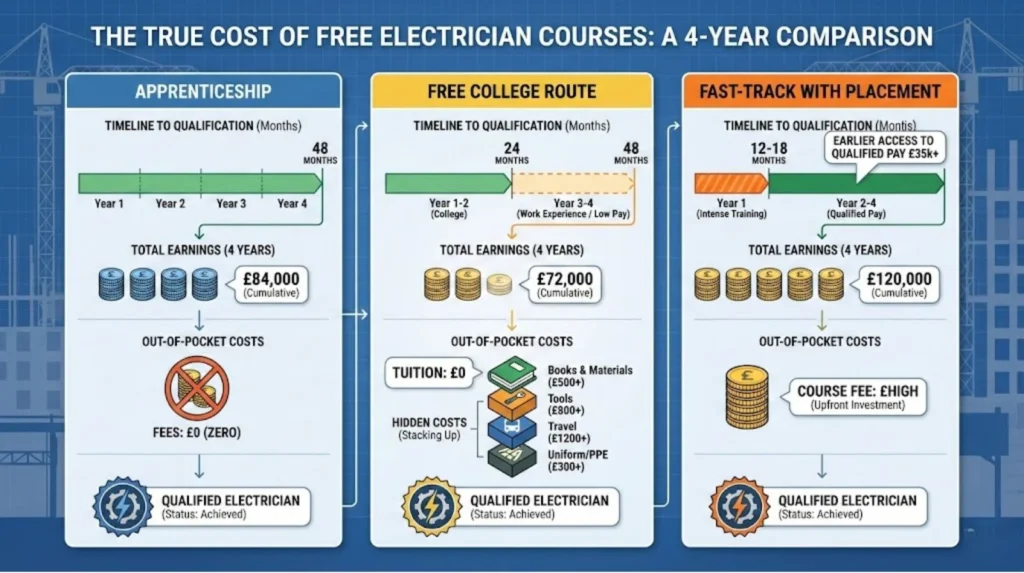
The price tag attached to a training course represents only a fraction of its true financial impact. For adults with existing income or earning potential, the opportunity cost of training time often exceeds tuition fees by tens of thousands of pounds.
A faster classroom route may reduce the time spent in formal classroom training, but qualification still depends on gaining suitable workplace evidence and completing the relevant independent assessment.
No route can guarantee a particular completion date, salary or financial return. Learners should compare course cost, delivery format, workplace access and remaining qualification requirements rather than relying on projected earnings models.
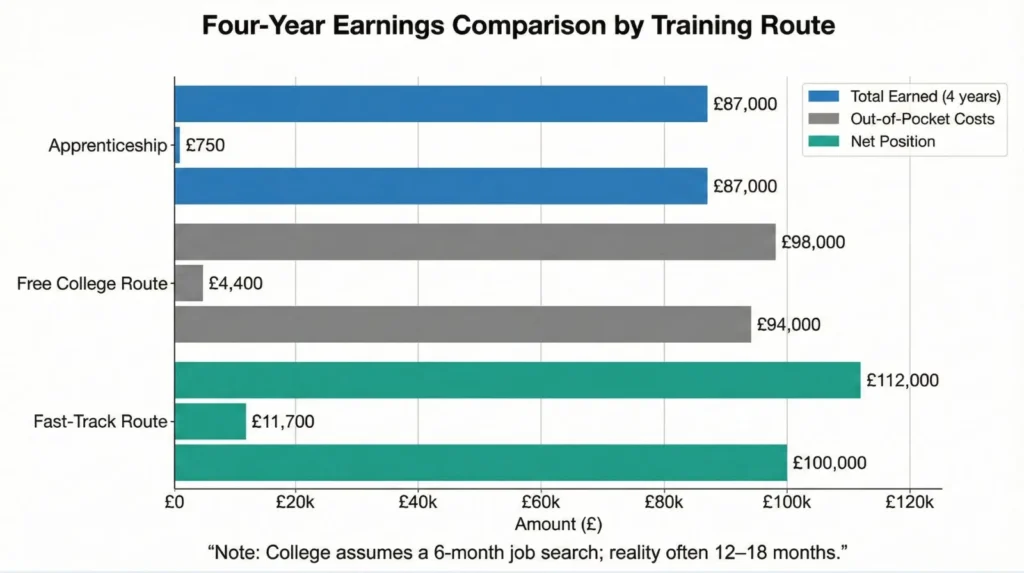
Financial Impact Summary (4-Year Comparison)
| Route | Total Earned | Out-of-Pocket | Net Position | Qualified Status at Year 4 |
| Apprenticeship | £87,887 | £750 | £87,137 | ✓ Fully Qualified |
| Free College | £98,500* | £4,400 | £94,100* | ✓ Fully Qualified |
| Fast-Track | £111,950 | £11,700 | £100,250 | ✓ Fully Qualified |
The Hidden Cost: Time at Lower Wages
The earnings comparison reveals the most expensive element of free courses: extended time at Electrical Mate or Improver wages before reaching qualified status.
Wage differential:
Electrical Mate: £18,000-£22,000 annually
Improver: £22,000-£28,000 annually
Qualified Electrician: £33,000-£42,000 annually (employed), £45,000-£70,000 (self-employed CIS)
Every month delayed reaching qualified status costs:
£1,000-£1,500 in potential earnings (qualified rate vs improver rate)
Compounding effect: Earlier qualification = earlier ability to self-employ and access highest earnings
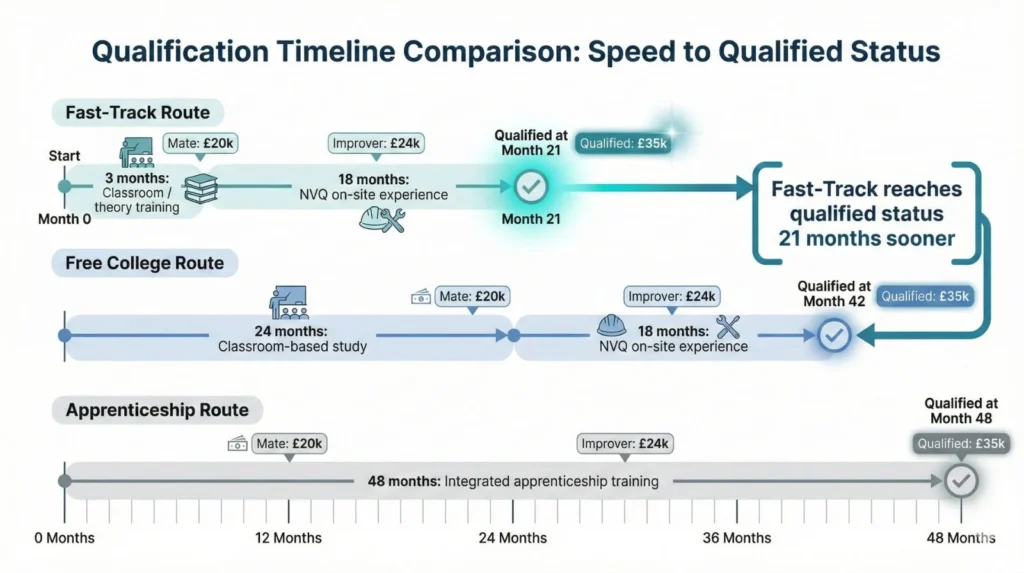
Part-time college route timeline: 24-30 months from start to improver role, followed by the time required to build sufficient authenticated workplace evidence for the NVQ and complete the relevant assessment requirements.
Fast-track timeline: 3 months classroom training, followed by the time required to build sufficient authenticated workplace evidence for the NVQ and complete the relevant assessment requirements.
Difference: 21-27 months, representing £21,000-£40,500 in additional potential earnings by reaching qualified status faster.
Thomas Jevons, Head of Training at Elec Training, explains the time cost clearly:
"Part-time Level 3 courses take 18 to 24 months when the same qualification can be delivered in 7 weeks intensive. That's not because the content is different, it's just stretched across evenings and weekends. The longer it takes, the longer you're delaying your NVQ start date, which delays your AM2, which delays your qualification. Time is the most expensive cost in training, not tuition."
Thomas Jevons, Head of Training
Free Courses in England: What's Actually Available
England offers the most comprehensive government-funded electrical training options across multiple schemes, though each comes with specific eligibility requirements and limitations.
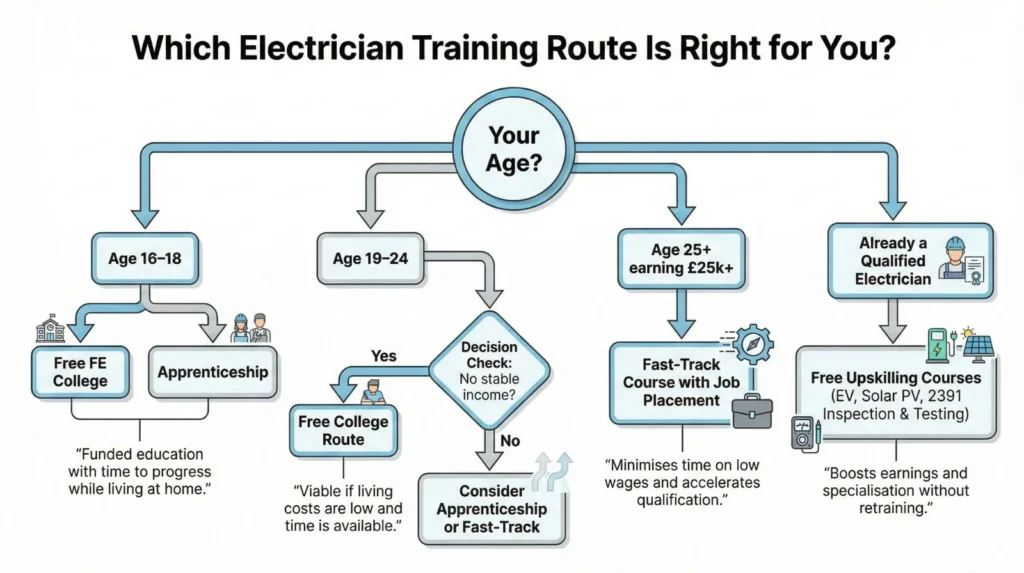
Free Courses for Jobs (Level 3 Diploma Funding)
The Department for Education’s flagship skills initiative funds over 400 Level 3 qualifications, including the City & Guilds Level 3 Diploma in Electrical Installations (2366-03), for eligible adults.
What’s free:
Full tuition for Level 3 Diploma (equivalent to A-Level)
Typically 1 year full-time, with part-time evening/weekend delivery varying by college and course structure.
Course content: Circuit design, BS 7671 application, inspection and testing principles, fault diagnosis, environmental systems
Eligibility (2025-2026 rules):
Age 19+
No existing full Level 3 qualification in any subject, OR
Hold a Level 3 but meet the applicable low-income eligibility criteria, OR
Currently unemployed
What’s NOT included:
NVQ Level 3 assessment and portfolio (£1,500-£3,000)
The relevant AM2-series assessment is delivered independently through a NET-approved assessment centre. Current fees should be confirmed directly with the selected assessment centre.
18th Edition if not bundled with diploma
Tools, PPE, books (£800-£1,200)
Employment guarantee for NVQ work
Strategic use: Complete Level 2 via Adult Education Budget (see below), then Level 3 via Free Courses for Jobs, then secure improver employment for NVQ. This requires proactive job searching and may take 6-18 months to find placement.
Availability varies by region and academic year. Search the National Careers Service course finder and contact local FE colleges directly to confirm current funded electrical courses, entry requirements and start dates.
Adult Education Budget (AEB) – Free Level 2 Courses
The Adult Skills Fund supports foundational skills training, including eligible Level 2 Electrical Installation Diplomas.
What’s free:
Level 2 Diploma in Electrical Installations (City & Guilds 2365-02)
Introduction to electrical science, safe isolation, basic installation principles, wiring systems
Qualifies learners for Electrical Mate positions
Eligibility:
Funding eligibility depends on the current rules in each UK nation, as well as the learner’s age, location, income, employment status and prior qualifications. Applicants should check the latest government guidance and confirm eligibility directly with the college or training provider before enrolling.
Timeline: 6-12 months part-time evening/weekend or 3-6 months full-time
Strategic value: Level 2 alone doesn’t qualify you as an electrician, but it demonstrates commitment to employers and prepares you for Level 3. Use AEB for Level 2, then Free Courses for Jobs for Level 3, minimizing out-of-pocket costs for the diploma stage.
Skills Bootcamps
Skills Bootcamps may offer funded short courses in selected electrical and green-technology skills. They do not automatically provide the complete qualification route required to become an occupationally competent electrician. Availability varies by region and funding round.
England offers the most comprehensive government-funded electrical training options across multiple schemes, though each comes with specific eligibility requirements and limitations.
Free Courses for Jobs (Level 3 Diploma Funding)
The Department for Education’s flagship skills initiative funds Level 3 qualifications, including the City & Guilds Level 3 Diploma in Electrical Installations (2366-03), where the qualification is available and eligible under the relevant funding scheme.
What’s free:
Full tuition for Level 3 Diploma (equivalent to A-Level)
Typically 1 year full-time, with part-time evening/weekend delivery varying by college and course structure.
Course content: Circuit design, BS 7671 application, inspection and testing principles, fault diagnosis, environmental systems
Eligibility (2025-2026 rules):
Funding eligibility depends on the current rules in each UK nation, as well as the learner’s age, location, income, employment status and prior qualifications. Applicants should check the latest government guidance and confirm eligibility directly with the college or training provider before enrolling.
What’s NOT included:
NVQ Level 3 assessment and portfolio (£1,500-£3,000)
18th Edition if not bundled with diploma
Tools, PPE, books (£800-£1,200)
Employment guarantee for NVQ work
Strategic use: Complete Level 2 via Adult Education Budget (see below), then Level 3 via Free Courses for Jobs, then secure improver employment for NVQ. This requires proactive job searching and may take 6-18 months to find placement.
Availability varies by region and academic year. Search the National Careers Service course finder and contact local FE colleges directly to confirm current funded electrical courses, entry requirements and start dates.
Adult Education Budget (AEB) – Free Level 2 Courses
The Adult Skills Fund supports foundational skills training, including eligible Level 2 Electrical Installation Diplomas.
What’s free:
Level 2 Diploma in Electrical Installations (City & Guilds 2365-02)
Introduction to electrical science, safe isolation, basic installation principles, wiring systems
Qualifies learners for Electrical Mate positions
Eligibility:
Funding eligibility depends on the current rules in each UK nation, as well as the learner’s age, location, income, employment status and prior qualifications. Applicants should check the latest government guidance and confirm eligibility directly with the college or training provider before enrolling.
Timeline: 6-12 months part-time evening/weekend or 3-6 months full-time
Strategic value: Level 2 alone doesn’t qualify you as an electrician, but it demonstrates commitment to employers and prepares you for Level 3. Use AEB for Level 2, then Free Courses for Jobs for Level 3, minimizing out-of-pocket costs for the diploma stage.
Skills Bootcamps
Skills Bootcamps may offer funded short courses in selected electrical and green-technology skills. They do not automatically provide the complete qualification route required to become an occupationally competent electrician. Availability varies by region and funding round.
Apprenticeships: The Only Fully Free Complete Route
Electrical apprenticeships (Level 3 Installation & Maintenance Electrician Standard) are the only pathway where all components, including tuition, NVQ, and AM2, cost the learner nothing.
What’s free:
Level 2 and Level 3 Diploma tuition
NVQ Level 3 portfolio assessment
AM2S End-Point Assessment
18th Edition Wiring Regulations
College attendance and materials
Funding mechanism:
Employers with £3 million+ payrolls pay 0.5% Apprenticeship Levy, creating dedicated training funds
Eligibility:
Age 16+ (subject to the current apprenticeship eligibility rules)
GCSE Maths and English Grade 4 or Functional Skills Level 2
Employment contract with participating employer
What learners still pay:
Apprentices normally do not pay the training fee themselves, although arrangements for tools, PPE, travel and other expenses vary by employer. Applicants should confirm what is covered before accepting an apprenticeship.
The trade-off: Apprentices earn below qualified rates for 4 years (£15,912-£27,359 total vs £35,000+ qualified), but emerge with zero training debt, comprehensive site experience, and strong employer relationships.
Free Courses in Scotland, Wales & Northern Ireland
Funding arrangements differ across England, Scotland, Wales and Northern Ireland and can change between academic years. Eligibility and course availability should be confirmed through the relevant national funding body and training provider before enrolling. Devolved nations operate different funding structures with varying levels of electrical training support.
Scotland: Fee Waivers and SAAS
Scottish residents access free FE college courses through fee waiver systems administered by the Scottish Funding Council, with broader eligibility than England’s means-tested approach.
What’s free:
Level 2 and Level 3 Electrical Installation Diplomas at Scottish FE colleges (e.g., Glasgow Kelvin College, Edinburgh College, Fife College)
SVQ Level 3 Electrical Installation (Scottish equivalent to NVQ)
Pre-apprenticeship programs via Skills Development Scotland
Key differences from England:
More generous income thresholds (fewer exclusions)
Stronger full-time college provision (less reliance on evening/weekend classes)
Modern Apprenticeships (Scottish apprenticeship system) more accessible to adults than English equivalent
What’s NOT free:
NVQ/SVQ assessment fees (though sometimes included in college delivery)
AM2 assessment
Tools/PPE
Wales: Personal Learning Accounts (PLA)
Wales operates a unique part-time and upskilling-focused funding model prioritizing employed workers and green skills development.
What’s free:
Priority sectors: Green technologies (EV charging, solar PV, battery storage, heat pumps), building services electrotechnical
Level 3 Electrical Installation qualifications eligible
Inspection & Testing (EAL Level 3) commonly funded
Eligibility:
Facing redundancy
self-employed with variable income
Key differences from England:
Strong part-time/evening focus (less full-time provision)
Prioritizes upskilling existing workers rather than career changers
Green technologies more generously funded than traditional electrical installation
What’s NOT free:
NVQ Level 3 assessment (rarely included)
AM2 assessment
Tools/PPE
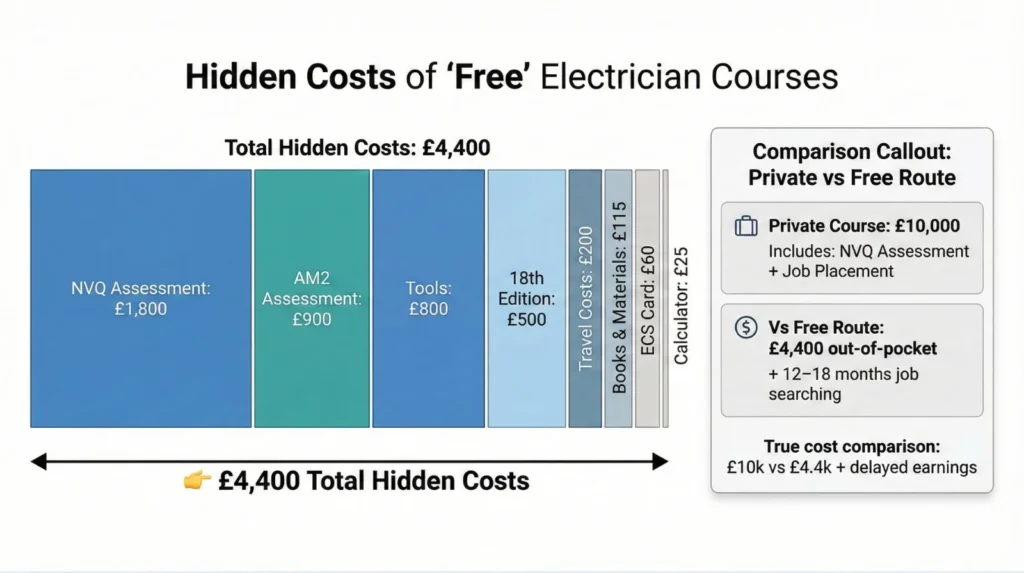
Hidden Costs Even When Tuition Is Free
“Free tuition” creates the illusion of zero-cost training, but significant expenses remain regardless of which funded scheme covers classroom delivery.
Non-Tuition Costs Breakdown
The following are broad examples only. Actual costs vary by provider, location, employer requirements, travel distance and what equipment the learner already owns.
| Item | Cost (2025-2026) | Funded? | Notes |
| BS 7671 Wiring Regulations Book | £80-£99 | No | Essential reference, required for exams and work |
| On-Site Guide | £35 | No | Practical companion to BS 7671 |
| 18th Edition Course & Exam | £400-£600 | Sometimes | Included in some college courses, separate cost in others |
| NVQ Level 3 Assessment & Registration | £1,500-£3,000 | Rarely | CITB grants cover if employer-registered pre-March 2025 |
| AM2 Assessment Fee | The relevant AM2-series assessment is delivered independently through a NET-approved assessment centre. Current fees should be confirmed directly with the selected assessment centre. | Apprentices only | User-pays for all other routes |
| AM2 Preparation Day | £175-£250 | No | Optional but recommended, improves pass rates |
| Tools & PPE Starter Kit | £500-£1,000 | No | Multimeter, hand tools, voltage tester, safety equipment |
| ECS Gold Card Application | £50-£60 | No | Health, Safety & Environmental test plus card fee |
| Travel to College | £100-£300/year | No | Public transport or fuel costs, 2-3 years part-time |
| DBS Check | £25-£45 | No | Required for some employer sectors |
| Scientific Calculator | £15-£30 | No | Casio FX-83/85 required for exams |
These costs can vary significantly depending on the learner’s circumstances and what is already included in the funded programme. They should be considered alongside any workplace evidence, independent assessments, equipment and other requirements that remain outside the funded training.
Comparing Part-Time and Intensive Classroom Training
Part-time delivery of Level 2 and Level 3 Diplomas appears convenient for adults maintaining full-time employment during study, but the extended timeline creates significant financial drag through delayed qualification.
Funded college courses may take longer to deliver than intensive private classroom training. However, the total qualification timeline for every route also depends on securing suitable work, collecting NVQ evidence and completing the relevant independent assessment.
Before choosing a route, it is worth understanding how long it takes to train as an electrician in the UK.
Learners should therefore compare both the classroom delivery schedule and the requirements that remain after the classroom stage.
The Post-Diploma Employment Gap
The second hidden cost of free college routes is the employment gap between completing diplomas and securing improver work for NVQ portfolios.
Learners completing classroom diplomas still need access to suitable electrical work to collect the workplace evidence required for the occupational competence stage.
Access to suitable work varies by learner, employer, location and labour market conditions. Learners should establish how they will obtain the required range of workplace experience before choosing a route.
How Elec Training addresses this gap:
Work placement support is available for eligible learners who need suitable employment to complete their NVQ evidence. Terms, eligibility and availability apply.
The employment gap risk is the hidden cost that makes “free” courses expensive for many learners. Without active placement support, diploma qualifications alone don’t translate to employment, creating extended periods of unemployment or underemployment that cost far more than any tuition fee savings.
When Free Courses Are Actually Worth It
Free electrical training isn’t universally bad, it’s situationally appropriate. Understanding when zero-tuition routes make financial sense versus when they represent false economy prevents costly mistakes.
"Free courses work perfectly for 16-18 year olds who aren't earning £25,000+ anyway. The opportunity cost is negligible. But for career changers at 30 with mortgages and families, the two-year timeline is financially devastating compared to intensive training with immediate placement into improver work. It's not about the tuition cost, it's about speed to qualified status."
Joshua Jarvis, Placement Manager
For Qualified Electricians Adding Specializations
Free or funded courses may provide useful upskilling opportunities for qualified electricians seeking post-qualification specializations.
High-value free upskilling options:
Inspection & Testing Refreshers (2391 CPD):
Some Skills Bootcamps include 2391 updates
Essential for maintaining Qualified Supervisor status for CPS membership
18th Edition Updates (BS 7671 revisions):
Often funded via AEB or bootcamps when amendments publish
Mandatory for ECS card renewal
Factors to Consider Before Choosing a Funded Route
A funded route may be suitable where the learner meets the eligibility criteria and the course provides the required classroom training.
Before enrolling, consider the delivery schedule, travel requirements, qualifications included, access to suitable workplace experience and any assessments or costs that remain outside the funded programme.
Marketing Traps to Avoid
Government-funded training schemes are legitimate, but marketing practices around “free” courses create traps for uninformed learners.
Trap 1: Private Provider “Free Course” Packages
Some private training companies advertise “government-funded training” while bundling free diplomas into £8,000-£15,000 packages.
How it works:
Provider enrolls learners in FE college Level 3 Diploma (actually funded by Free Courses for Jobs at zero cost)
Provider charges £8,000-£12,000 for “support services,” “career coaching,” “NVQ preparation,” “guaranteed placement”
Learner believes they’re paying for the diploma, unaware college would deliver it free if they applied directly
The deception: The government already funds the diploma. The provider is charging for ancillary services, not the core qualification. In some cases, the “support” consists of access to job boards and generic CV advice, services available free elsewhere.
How to avoid: Always check whether qualifications are on the Free Courses for Jobs list. If yes, apply directly to local FE colleges. Ask private providers: “Is the diploma itself government-funded, and if so, what am I actually paying for?”
Legitimate use of funded diplomas: Some providers legitimately bundle funded diplomas with genuinely valuable services like guaranteed NVQ placement infrastructure, dedicated assessors, intensive AM2 preparation, and active employer partnerships. This adds value beyond free college provision. The key is transparency: providers should clearly state “diploma is government-funded, you’re paying for placement support and NVQ logistics.”
Trap 2: Taster Courses Advertised as "Training"
One-day or two-day “free electrician courses” exist, usually delivered by private companies or tool manufacturers, claiming to provide “electrical installation training.”
What they actually are:
Product demonstrations (tool company showcasing equipment)
Basic DIY wiring workshops (changing sockets, fitting light fixtures)
Marketing events (collecting contact details for sales teams)
What they DON’T provide:
City & Guilds or EAL qualifications
Progression toward NVQ Level 3
Employment opportunities
Meaningful skill development
Red flags:
No qualification code (C&G 2365, EAL 8202) mentioned
Course duration under 5 days
“Introduction to wiring” or “basic electrical skills” language
Hosted at hotels, conference centers, or non-educational venues
Requires providing contact details before seeing course content
How to avoid: If it’s shorter than 1 week, it’s not meaningful training. If it doesn’t state the exact qualification code and awarding body, it’s not a recognized course.
Trap 3: Online “Electrician Courses” Claiming Qualification
Multiple websites advertise “online electrician training” with “accredited certificates” for £50-£200, implying these qualify learners for electrical work.
The reality:
MOOCs (FutureLearn, Coursera, OpenLearn) provide basic circuit theory and electrical principles
Useful for building foundational knowledge before starting real qualifications
Zero value toward NVQ Level 3, AM2, or ECS Gold Card
No online course can replace:
Physical practical assessments (City & Guilds 2365 includes hands-on testing)
On-site NVQ portfolio evidence (must be real installations on real properties)
AM2 practical assessment at a NET-approved assessment centre, with the format and duration depending on the learner’s route.
Industry position: NICEIC, NAPIT, and JIB explicitly state online-only training does not meet competence requirements under Electricity at Work Regulations 1989 Regulation 16. Practical demonstration is mandatory.
Legitimate use of online learning:
FutureLearn “Electrify” course: Excellent 6-week introduction to DC/AC circuits, UK-aligned to BS 7671 basics
IET YouTube content: Official BS 7671 guidance and updates
Open University OpenLearn: General engineering modules building maths/physics foundations
These are preparatory tools, not qualification substitutes. Use them before starting FE college or intensive courses to strengthen foundational knowledge.
Trap 4: “Guaranteed Qualification” Without NVQ Placement
Some training providers advertise “guaranteed qualification” or “fully qualified electrician” outcomes from classroom courses alone.
The deception:
Course delivers Level 2, Level 3, and 18th Edition (classroom components)
Marketing implies this equals “qualified electrician”
Omits that NVQ Level 3 and AM2 are still required
Provides no employment support for gathering NVQ evidence
Outcome: Learners complete diplomas believing they’re qualified, discover they cannot obtain ECS Gold Card, cannot join CPS (NICEIC/NAPIT), cannot self-certify installations, and employers won’t hire them without NVQ.
Regulatory action: The Competition and Markets Authority (CMA) and Advertising Standards Authority (ASA) have investigated electrical training providers for misleading qualification claims. Several providers received enforcement notices for advertising “fully qualified” outcomes from diploma-only courses.
How to avoid: Ask explicitly: “Does this course include NVQ Level 3 portfolio work, and if so, how do you provide the 18-24 months of site evidence?” If the answer is vague (“we help with job searches,” “you can build your portfolio independently”), it’s not a complete qualification package.
Elec Training’s approach: Guaranteed NVQ placement is explicitly included. In-house recruitment managers secure paid improver positions with 120+ partner contractors across the UK. Learners progress from classroom to employed site work within weeks, not months or years of independent job searching.
The Free Course Paradox
For adults seeking fastest, most reliable route to qualified electrician status:
Elec Training offers structured electrical training routes including Level 2, Level 3, 18th Edition and NVQ Level 3. Our complete Gold Card training package costs £8,208.33 excluding VAT (£9,849.99 including VAT). The independent AM2 assessment is separate.
Training costs are one part of the decision; these reasons to become an electrician set out the wider career considerations.
Work placement support is available for eligible learners who need suitable employment to complete their NVQ evidence. Terms, eligibility and availability apply.
Call us on 0330 822 5337 to discuss the electrical training routes available, the qualifications included and the costs involved. We can explain the NVQ workplace-evidence process, the independent assessments required and the support available through Elec Training.
References
- GOV.UK, Free Courses for Jobs: Guidance for Learners 2025-2026: https://www.gov.uk/guidance/free-courses-for-jobs
- Education and Skills Funding Agency, Adult Skills Fund Funding Rules 2025-2026: https://www.gov.uk/government/publications/adult-skills-fund-funding-rules
- Department for Education, Skills Bootcamps Programme: https://www.gov.uk/government/publications/esfa-skills-bootcamps
- Welsh Government, Personal Learning Accounts: https://careerswales.gov.wales/courses-and-training/funding-your-studies/personal-learning-accounts
- Student Awards Agency Scotland, Part-time Fee Grant: https://www.saas.gov.uk/
- NICEIC, Qualified Electrician Requirements: https://niceic.com/
- ECA (Electrical Contractors’ Association), Training Standards: https://www.eca.co.uk/
- Elec Training, How Much Can You Make as an Electrician? 2026 Pay Guide: https://elec.training/news/how-much-can-you-make-as-an-electrician-a-2026-pay-guide/
Last reviewed: 18 August 2026. This guide reflects 2025-2026 funding rules for Free Courses for Jobs, Adult Education Budget eligibility, Skills Bootcamps expansion, apprenticeship levy structures, and devolved nation schemes (Wales PLA, Scotland fee waivers, NI Skill Up). Funding criteria, income thresholds, and qualification lists update annually. Always verify current eligibility with training providers, FE colleges, and government funding portals before enrolling. This guide provides evidence-based financial analysis for planning purposes but cannot replace personalized advice considering individual circumstances. Contact Elec Training on 0330 822 5337 for tailored route assessment, realistic timeline guidance, and guaranteed NVQ placement support addressing the employment gap that prevents most free-course graduates from reaching qualified electrician status.
