


Written by Thomas Jevons
Electrical Training, Assessing & Quality Assurance Expert
- Last reviewed:
- Insights into how home EV chargers could increase property value and why demand for qualified installers is rising.
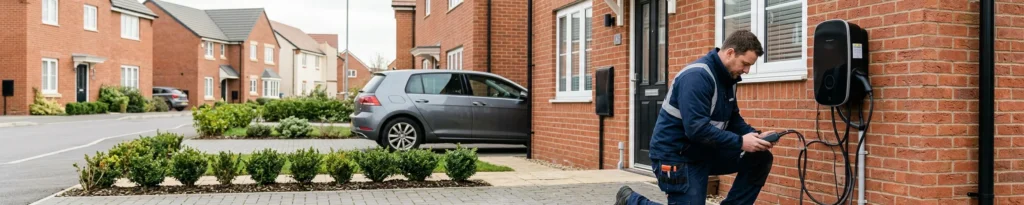
Table of Contents
An electrical training expert has revealed that fitting a home EV charger could add as much as £8,000 to a property’s value, drawing a direct comparison to the kind of uplift traditionally associated with adding an extra bathroom.
Charanjit Mannu, Director at Elec Training, a specialist electrical training centre based in Wolverhampton, said demand for EV charging qualifications has surged as homeowners and electricians alike wake up to the financial case for domestic charging infrastructure.
“What we’re seeing now is buyers actively filtering for homes with EV charging already installed,” Mannu said. “It’s no longer a nice-to-have. For a growing number of buyers, it sits in the same bracket as off-street parking or a second bathroom.”
The shift reflects a broader change in how buyers assess a property before making an offer.
Mannu explained that the value uplift linked to EV charging points mirrors what happened with double glazing and central heating in earlier decades. Features that once seemed niche become expected, and properties without them start to look dated by comparison.
“An EV charger is a relatively low-cost installation when weighed against an £8,000 bump in sale price,” he said. “For a seller, that maths is very straightforward.”
Zoopla, the UK’s leading property website, has tracked growing buyer interest in homes that already come equipped with EV charging infrastructure, reflecting a clear shift in what prospective buyers prioritise when searching for a home.
The property angle here runs deeper than a single figure. Mannu pointed out that buyers searching for homes with EV capability are often higher earners with newer vehicles, which means they tend to be more financially active participants in the market. Sellers who can tick that box are reaching a segment of buyers who are, broadly speaking, less likely to be squeezed by affordability concerns.
“You’re not just adding a feature,” Mannu said. “You’re changing who comes through the door.”
For electricians, this represents a meaningful shift in the work coming their way. Mannu said that at Elec Training, the uptake of EV charging qualifications has reflected real market demand rather than speculative interest. Learners completing EV charging courses at the centre are moving straight into installation work, with residential jobs making up a strong portion of that pipeline.
The installation process itself is not complex for a qualified electrician, but the qualification matters. A homeowner fitting a charger without certified electrical work risks problems with insurance and mortgage lenders, and that concern has pushed more people to seek out properly trained installers.
“Lenders are paying attention to this now,” Mannu said. “A charger fitted by a qualified, certificated electrician is worth something on paper. One that isn’t documented correctly can actually create problems at the point of sale.”
That distinction matters for anyone thinking about the property value argument. The £8,000 figure assumes the installation is done properly, with the right certification and compliance behind it.
Mannu added that the EV charger conversation is one that homeowners are increasingly bringing up off their own backs, rather than being led to it by an estate agent or installer.
“People are reading the same reports everyone else is reading,” he said. “They know the direction of travel. What they want to know now is how to act on it before their neighbours do.”
The window for early-mover advantage may not stay open indefinitely. As EV charging becomes a standard feature across new-build homes, the uplift attached to retrofitted chargers in older properties could narrow. For now, the gap between homes that have them and homes that do not remains wide enough to make the investment worth serious consideration.
“The electricians who’ve trained in EV installation are busy,” Mannu said. “That tells you everything about where the market is heading.”
Enquire Now
Based on real training delivery, learner outcomes, and current UK electrical regulations.
- City & Guilds Approved
- 4.8★ Google Reviews
- 1000+ Electricians Trained


Prefer a callback?
- City & Guilds
- 4.8 Trustpilot
- JIB Recognized
- 1,000+ Trained
