


- Technical review: Thomas Jevons (Head of Training, 20+ years)
- Employability review: Joshua Jarvis (Placement Manager)
- Editorial review: Jessica Gilbert (Marketing Editorial Team)
- Last reviewed:
- Changes: Initial publication
Introduction
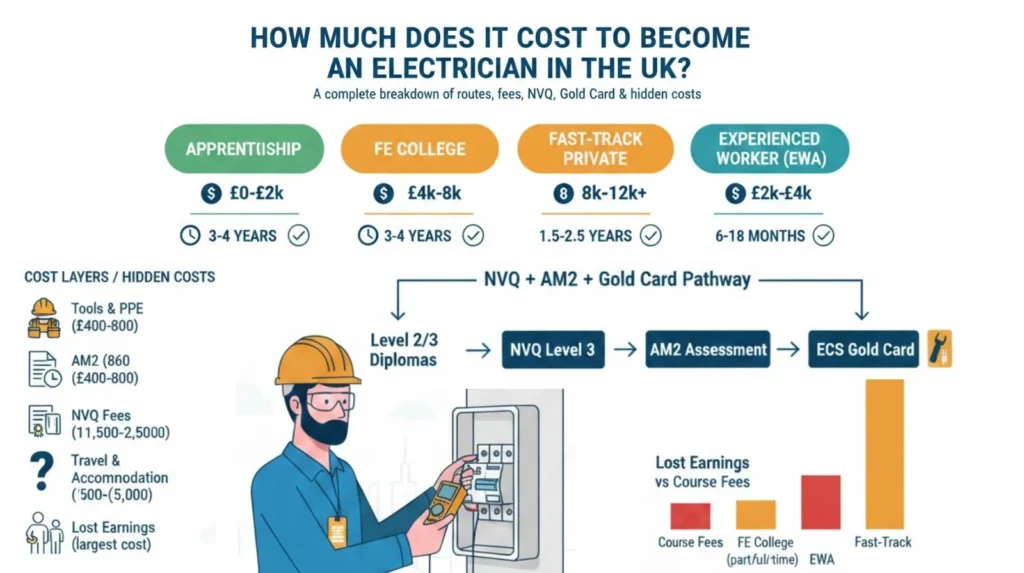
Becoming a qualified electrician in the UK requires achieving NVQ Level 3 (or equivalent), passing the AM2 practical assessment, and obtaining the ECS Gold Card that proves competence to employers and construction sites. The financial cost to reach that point varies dramatically depending on your chosen pathway, from virtually zero out-of-pocket expenses for a sponsored apprentice to over £10,000 in fees alone for an adult career changer using intensive private training.
Search “electrician training cost” and you’ll find wildly different figures. Some providers advertise “complete electrician courses from £3,000.” Others quote £8,000-£10,000 packages. Apprenticeship schemes claim “free training with wages.” The confusion is intentional in some cases, with providers advertising the cost of Level 2 and Level 3 diplomas (which don’t make you a qualified electrician) whilst obscuring the additional expenses for NVQ assessment, AM2 examination, tools, travel, and the time required to complete workplace evidence.
Adults considering career changes often underestimate the total economic cost. Course fees are visible and easy to compare. What’s harder to quantify is the opportunity cost of lost earnings whilst training full-time, the challenge of securing NVQ workplace placements, the expense of tools and test equipment, the risk of resit fees if preparation is inadequate, and the ongoing costs of professional registration once qualified.
This guide provides a realistic, evidence-based breakdown of UK electrician training costs across the four main qualification routes using data from Joint Industry Board wage rates, training provider pricing (FE colleges and private centres), NET assessment fees, Advanced Learner Loan criteria, ONS earnings statistics, and employer hiring practices. Understanding the true cost, not just the advertised price, helps you choose the route that balances your budget, timeline, and career goals realistically.
Why Understanding the True Cost Matters
The question “How much does electrician training cost?” has no single answer because the figure depends on which qualifications you’re comparing and what hidden costs you’re including.
The Qualification Target: NVQ Level 3 + AM2 + Gold Card
NVQ Level 3 Electrical Installation (City & Guilds 2357/5357 or equivalent): Performance-based qualification requiring documented workplace evidence across domestic, commercial, and industrial installations. This proves practical competence, not just theoretical knowledge.
NET assessment relevant to the route: Learners must complete the NET assessment relevant to their route: AM2 for the standard NVQ route, AM2S for the current apprenticeship-standard route and AM2E for the Experienced Worker Assessment route.
ECS Gold Card (Installation Electrician or Domestic Electrician): Industry recognition card proving you hold the qualifications above plus 18th Edition Wiring Regulations knowledge. Required for site access and employment with most contractors.
The cost confusion: Many advertised “electrician courses” cover only the Level 2 and Level 3 Diplomas (City & Guilds 2365), which are classroom-based theory and practical assessments that prepare you for the NVQ but don’t replace it. Completing 2365 makes you a trainee, not a qualified electrician. The NVQ, AM2, and Gold Card are additional expenses and time commitments that some providers downplay or exclude from advertised pricing.
What Gets Left Out of Advertised Prices
Course fees tell half the story. A £6,000 package covering Level 2, Level 3, and 18th Edition looks comprehensive until you realise it doesn’t include:
NVQ assessment fees: £1,500-£2,500 for portfolio assessment, site visits, and verification (often sold as a separate “top-up”).
The relevant AM2-series assessment is delivered independently through a NET-approved assessment centre. Fees should be confirmed directly with the assessment centre because they can vary by assessment type and location.
Tools and test equipment: £400-£800 for starter hand tools, PPE, voltage tester, proving unit, and basic multimeter. Employers often provide specialist tools later, but you need your own kit initially.
Travel and accommodation: £500-£5,000 depending on whether you’re local (daily commute) or attending block-release courses requiring hotels and long-distance travel.
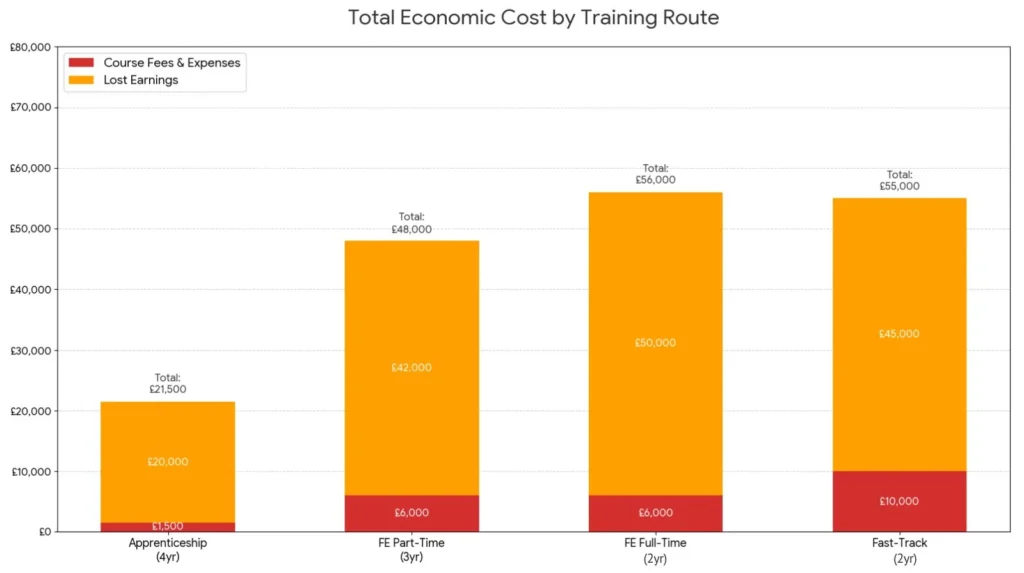
Lost earnings opportunity cost: For career changers, the biggest economic cost is often the salary you give up whilst training. Moving from a £30,000 job to full-time study for 18 months means losing £45,000, which dwarfs the £6,000 in fees.
ECS card and professional registration: £48 for initial Gold Card, then £575-£1,000 annually for Competent Person Scheme membership (NICEIC, NAPIT) if you’re self-certifying work.
Finance charges: If you’re paying by instalments or third-party loans, interest can add 10-20% to the advertised price over the repayment period.
The Four Main Routes: Cost vs Time Trade-Off
The main routes into the electrical industry have different cost structures and eligibility requirements.
Apprenticeships combine employment with structured training and normally reduce the learner’s direct training costs, although availability depends on securing a suitable employer.
College routes may offer funded or partly funded classroom training depending on the learner’s circumstances. Workplace access is still required for the occupational competence stage.
Private training normally involves higher upfront training costs but can allow the classroom stages to be completed more intensively. Completion still depends on suitable workplace evidence and the relevant independent assessment.
Experienced Worker Assessment routes are designed for people who already have substantial electrical industry experience and meet the relevant eligibility requirements.
Apprenticeship Route: Lowest Out-of-Pocket Cost
The apprenticeship pathway combines workplace employment with college-based training over 3-4 years, leading to NVQ Level 3, AM2S assessment, and ECS Gold Card eligibility. It’s the traditional route into the electrical trade and remains the most financially accessible option.
What You Pay vs What’s Funded
Apprentices normally do not pay the training fee themselves, although arrangements for tools, PPE, travel, assessment costs and other expenses vary by employer and funding route. Applicants should confirm exactly what is covered before accepting an apprenticeship.
Additional personal costs can vary depending on what the employer provides, where the learner is based and the travel required.
The Hidden Cost: Lower Wages During Training
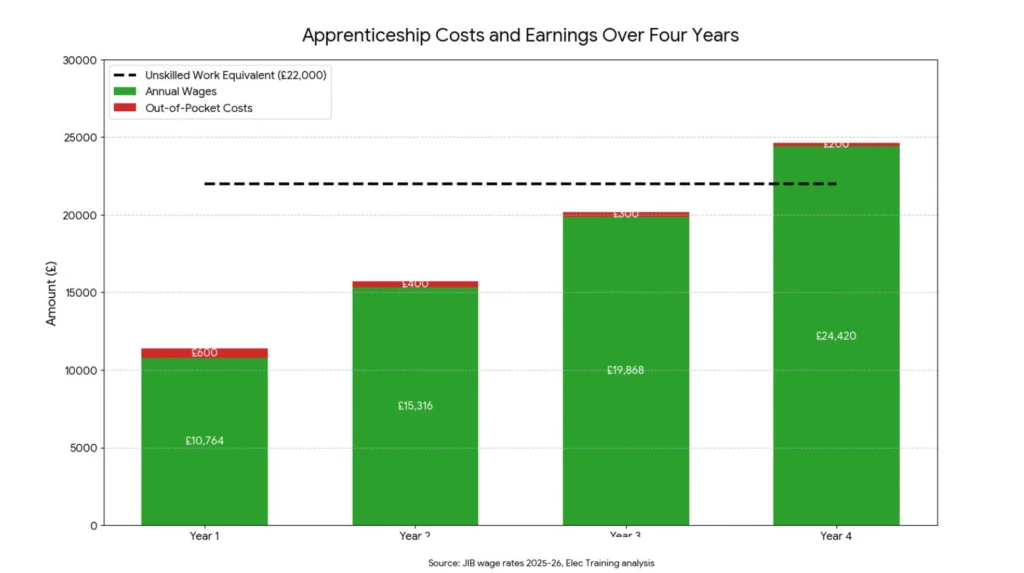
JIB apprentice wage rates (2025-2026):
Year 1: £10,764 annual (£8.16/hour based on 1,600 hour year)
Year 2: £14,112 (£10.70/hour)
Year 3: £18,624 (£14.12/hour)
Year 4: £24,420 (£18.51/hour)
Apprenticeship Availability and Competition
For 16-24 year olds: Apprenticeships are widely available through JIB-approved training providers (like JTL), large electrical contractors, and construction companies. Competition exists but positions are attainable for motivated school leavers.
For adults (25+): Adult apprenticeships are highly competitive. Contractors prefer younger apprentices due to lower wage costs and longer career runway. For every adult apprenticeship opening, there may be 50-100 applications. Whilst the financial model is ideal (near-zero cost, earn whilst learning), access is limited.
Realistic assessment: If you can secure an apprenticeship, it’s the gold standard financially. If you’re 30+ and facing stiff competition, FE college or fast-track routes become the practical alternatives despite higher costs.
FE College Adult Learner Route: Balanced Cost and Flexibility
Further Education colleges offer Level 2 and Level 3 Electrical Installation diplomas (City & Guilds 2365 or EAL equivalent) designed for adult learners over 19. This route provides structured, accredited training at moderate cost, with flexible attendance options and government funding support.
Course Fees Breakdown
Level 2 Diploma in Electrical Installations (2365-02 or equivalent):
Cost: £1,500-£4,200 depending on college and location
Duration: 12-36 weeks (full-time or part-time)
Covers: Electrical science, health and safety, installation methods, inspection and testing basics
Level 3 Diploma in Electrical Installations (2366-03 or equivalent):
Cost: £2,000-£3,200 depending on the college and funding available
Typical FE college duration: 18-40 weeks, depending on whether the course is delivered full time or part time
- Covers: Advanced installations, three-phase systems, design, complex testing procedures, BS 7671 application
18th Edition Wiring Regulations (City & Guilds 2382-26):
Cost: £200-£450
Duration: 3-5 days intensive or 8 weeks part-time
18th Edition Wiring Regulations – City & Guilds 2382-26. The course covers the current requirements of BS 7671 and the amendments included within the current qualification.
NVQ Level 3 Electrical Installation (2357/5357):
Cost: £1,500-£2,500 (assessment-only fees)
Duration: 12-24 months whilst working on site
Requires: Documented workplace evidence across domestic, commercial, industrial environments
AM2 Assessment:
The relevant AM2-series assessment is delivered independently through a NET-approved assessment centre. Fees should be confirmed directly with the assessment centre because they can vary by assessment type and location.
Total tuition costs: £6,060-£11,210
Funding and Finance Options
The FE college route offers the most funding support for adults:
Advanced Learner Loan (ALL):
Advanced Learner Loan eligibility, repayment thresholds and write-off rules can change. Learners should check the latest Student Finance England and GOV.UK guidance before relying on any funding calculation.
Eligibility for publicly funded college training depends on age, location, income, employment status, prior qualifications and the current funding rules. Applicants should confirm eligibility directly with the college or relevant funding authority.
What loans don’t cover: NVQ assessment fees, AM2 examination, tools, travel. These remain out-of-pocket expenses.
Additional Costs Beyond Tuition
The following are broad examples only. Actual costs vary by brand, location, employer requirements, travel distance and what equipment the learner already owns.
Tools and test equipment: £300-£800
VDE hand tool set: £150-£300
Multimeter: £30-£80
Voltage tester and proving unit: £80-£150
PPE (hard hat, boots, gloves, high-vis): £100-£200
Lock-off kit: £20-£40
Travel: £500-£1,500 per year
Commuting to college (part-time attendance, often 1-2 days per week)
Travel to NVQ workplace sites once employed
ECS Gold Card (upon qualification): £48
Post-qualification Competent Person Scheme registration: £575-£1,000 annually (if self-certifying electrical work through NICEIC/NAPIT)
Total out-of-pocket costs (excluding loans): £4,000-£8,000
Time Investment and Lost Earnings
Part-time route (typical for working adults):
Duration: 3-4 years from starting Level 2 to achieving Gold Card
Schedule: Evening classes or day release (1-2 days per week), plus NVQ workplace hours
Full-time route:
Duration: 2-3 years
Schedule: Classroom Monday-Friday during diploma phase, then full-time NVQ employment
The NVQ Challenge: Securing Workplace Evidence
The biggest non-financial challenge of the FE college route is securing electrical employment for your NVQ portfolio after completing Level 2/3 diplomas.
The requirement: NVQ Level 3 demands documented evidence of real installations you’ve completed under supervision across multiple environment types. This cannot be simulated. You need an electrical employer willing to take you on as an improver or trainee.
The barrier: Employers prefer apprentices (lower wages, government funding incentives) or experienced electricians over diploma-holders with zero site experience. Without connections or strong placement support, diploma graduates can spend 6-12 months searching for NVQ-suitable employment.
Cost implications: Extended job search means extended timeline to qualification, potential need to work unpaid or minimal-wage positions just to build portfolio evidence.
FE college advantage: Reputable FE colleges often have employer networks and may offer work placement support. This is less comprehensive than specialist private providers but better than being entirely self-directed.
Fast-Track Private Training: Highest Cost, Fastest Timeline
Private training providers offer intensive packages bundling Level 2, Level 3, 18th Edition, and sometimes initial testing qualifications into accelerated programmes marketed as “fast-track routes to electrician qualification.” These appeal to career changers who want the quickest possible path to earning electrician wages.
Course Package Pricing
Typical fast-track bundles include:
Level 2 Electrical Installation (2365-02 or equivalent)
Level 3 Electrical Installation (2366-03 or equivalent)
18th Edition Wiring Regulations (2382-26)
Initial Verification and Testing module (sometimes)
Access to training centre facilities and tools during course
Package costs: £5,149-£8,850 depending on provider, delivery speed (full-time block release vs part-time), and what’s bundled.
The True Cost Equation
Thomas Jevons, our Head of Training with 20+ years of experience, explains the hidden expense:
“When comparing training providers, learners should check exactly which qualifications and assessments are included and what still needs to be completed afterwards. A lower initial course fee does not necessarily cover the complete route to occupational competence.”
Thomas Jevons, Head of Training
Common pricing traps:
Before enrolling, check which qualifications are included, which assessments are separate, whether finance carries interest and what support is available for the NVQ workplace-evidence stage.
Upselling: Once enrolled, additional courses (2391 testing, EV charging, solar PV) are aggressively marketed at premium prices.
Finance availability, interest rates and repayment terms depend on the lender and the applicant’s circumstances. Learners should review the APR, repayment period and total amount repayable before entering any finance agreement.
Any finance illustration should be based on an actual current product and clearly identified as an example rather than a standard Elec Training finance rate.
Do not publish generic APRs as though they apply to Elec Training.
Speed vs Risk Trade-Off
Joshua Jarvis, our Placement Manager, explains the critical planning requirement:
“Before choosing a training route, learners should understand how they will gain suitable electrical work for their NVQ evidence. The classroom stage is only one part of the process, and access to the right workplace experience is essential for progressing through the occupational competence route.”
Joshua Jarvis, Placement Manager
Speed vs Risk Trade-Off
Block-Release Accommodation Costs
Many fast-track providers use block-release delivery: intensive 1-2 week blocks at their training centre, repeated over several months.
The following are broad examples only. Actual costs vary by brand, location, employer requirements, travel distance and what equipment the learner already owns.
If you live locally: Travel costs only (£100-£500 total)
If you live remotely: Accommodation and subsistence become major expenses:
Hotel/B&B near training centre: £50-£100 per night x 10-20 nights per block = £500-£2,000 per block
Multiple blocks (e.g., 3 blocks for full course): £1,500-£6,000 total
Meals and travel: Additional £500-£1,500
Geographic considerations: Providers are concentrated in specific locations (Midlands, North West, South East). Welsh, Scottish, and South West learners often face significant travel/accommodation costs that aren’t advertised upfront.
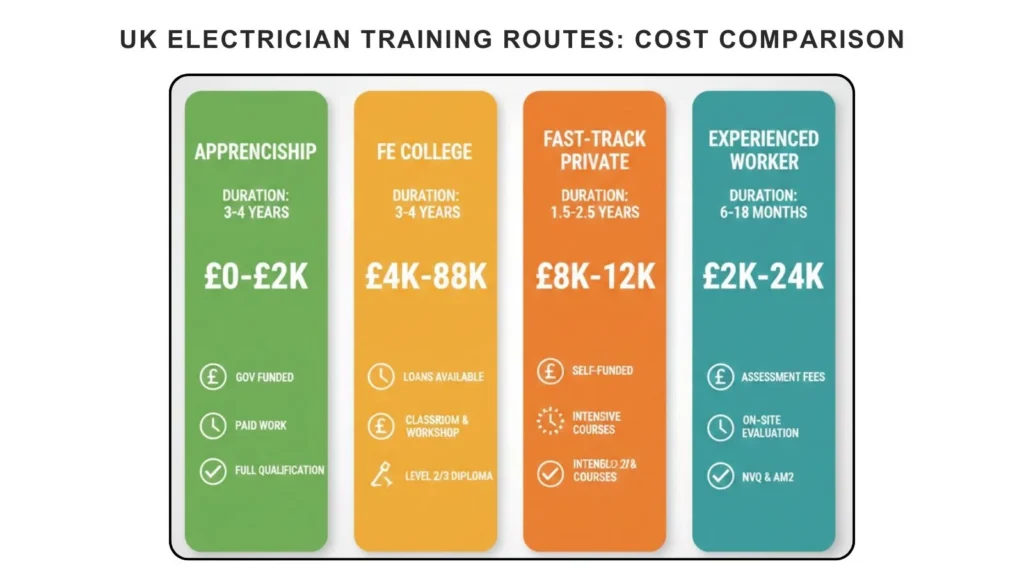
Detailed cost comparison across different electrical training pathways:
| Cost Component | Apprenticeship | FE College Adult | Fast-Track Private | Experienced Worker |
| Tuition/Course Fees | £0 (funded) | £6,000-£11,000 (or covered by ALL) | £8,000-£10,500 | £1,500-£2,000 (EWA) |
| NVQ Assessment | Included | £1,500-£2,500 | £1,500-£2,500 (often extra) | Included in EWA |
| AM2 Examination | £0 (employer-paid) | £860 | £860 | £935-£1,440 (AM2E) |
| 18th Edition | Included | £200-£450 | Included in package | £200-£450 (if gap) |
| Tools & PPE | £200-£500 | £300-£800 | £400-£700 | £100-£300 (minimal, already owned) |
| Travel | £500-£1,500/year | £500-£1,500/year | £500-£5,000 (inc. accommodation) | £200-£500 |
| ECS Card | £20-£48 | £48 | £48 | £48 |
| Total Out-of-Pocket | £1,000-£2,500 (over 4 years) | £4,000-£8,000 (or £3,000-£6,000 with ALL) | £9,000-£12,000+ (inc. finance) | £2,500-£4,000 |
| Duration to Gold Card | 3-4 years | 3-4 years | 1.5-2.5 years (ideal) / 3-4 years (if NVQ delayed) | 6-18 months |
| Lost Earnings Risk | Lower wages (£10k-£24k) but earning throughout | Part-time: Minimal. Full-time: £20k-£60k | Full-time: £30k-£80k over 1.5-2 years | Minimal (working throughout) |
Experienced Worker Assessment Route: Lowest Cost for Trade Veterans
The Experienced Worker Assessment (EWA) pathway, offered through City & Guilds 2346-03 or 2347, is designed for people who’ve worked in electrical installation for 5+ years but lack formal NVQ Level 3 qualifications. It’s a portfolio-based route that formalises existing competence without repeating classroom training.
Who Qualifies for EWA
Eligibility criteria:
5+ years of documented electrical installation work (electrician’s mate, improver, or unqualified worker roles)
Evidence of domestic, commercial, or industrial installations completed
Current employment or access to electrical work for assessment purposes
Already holds 18th Edition (or completes it before EWA registration)
Typical candidates:
Electrician’s mates who’ve worked under qualified supervision for years
Family business workers who learned on the job without formal apprenticeship
Military veterans with electrical roles in Armed Forces
Workers from countries with different qualification systems
Not suitable for:
People with zero electrical site experience
Those who’ve only completed classroom diplomas
Career changers without years of documented trade work
EWA Assessment Costs
City & Guilds 2346-03 or 2347 registration and portfolio assessment:
Cost: £1,500-£2,000
Includes: Assessor visits to workplace, portfolio verification, competence sign-off
Duration: 6-18 months depending on how quickly you compile evidence
Gap training (if needed):
18th Edition: £200-£450 (if you don’t already hold it)
2391 Inspection & Testing: £995 (sometimes required for EWA portfolio)
Additional short courses: £300-£1,000 depending on gaps in knowledge
Total EWA costs: £2,735-£5,000
This is dramatically less than starting from scratch via apprenticeship, FE college, or fast-track routes, but only available if you’ve already put in years of unpaid or low-paid electrical work building experience.
The Economic Reality of EWA
Hidden Costs That Catch People Out
Beyond advertised course fees and obvious expenses, several costs surprise learners during their qualification journey.
Tool Kit Reality Check
Starter tool kits advertised at £150-£300 seem affordable until you realise:
VDE insulated tools are mandatory for live electrical work. Cheap non-insulated tools from general DIY stores aren’t safe or acceptable. Proper VDE screwdrivers, pliers, wire strippers, and side cutters from brands like Wiha, Wera, or Knipex cost £200-£400 for a basic set.
Test equipment standards: Your voltage tester and proving unit must comply with GS38 (HSE safety standard). Budget £80-£150 for quality Martindale or Fluke testers. Cheap imports without proper certification create safety risks and aren’t accepted on professional sites.
Multifunction testers (MFTs): These cost £500-£1,500 (Megger, Kewtech, Fluke brands). Most employers provide MFTs, but if you’re self-employed or need one for NVQ portfolio work, it’s a significant expense.
Tool replacement: Budget £100-£200 annually for wear, tear, loss, and damage. Tools are working investments that require ongoing replacement.
Realistic first-year tool budget: £500-£800 (starter VDE kit, voltage tester, proving unit, PPE, lock-off kit, basic multimeter).
Resit Fees and Failure Rates
Resit arrangements and fees vary depending on the assessment and the NET-approved assessment centre. Learners should confirm current resit terms directly with the centre.
Post-Qualification Professional Costs
Achieving Gold Card status isn’t the end of electrical qualification costs. Ongoing professional expenses include:
ECS Gold Card renewal: £38.50 every 5 years (initial card £47.50)
Competent Person Scheme membership (if self-certifying work):
NICEIC Domestic Installer: £575 annually
NAPIT Domestic Installer: £580 annually
Full Scope schemes: £800-£1,000 annually
Includes: Assessments, insurance provisions, notification services, technical support
Continuing Professional Development (CPD):
18th Edition updates when amendments published: £200-£450
Specialist courses (EV charging, solar PV, heat pumps): £300-£995 each
Online CPD platforms: £100-£300 annually
Finance Charges and Loan Interest
Finance can increase the overall cost of training. The amount depends on the lender, APR, repayment term and individual agreement. Learners should compare the total amount repayable rather than the monthly payment alone.
Lost Earnings: The Biggest Hidden Cost
Training can affect income differently depending on whether the learner studies full-time, part-time or alongside employment. The financial impact depends on the learner’s current income, course schedule, funding arrangements and when suitable electrical employment becomes available. These factors should be considered individually rather than treated as a guaranteed cost or return.
Key Misconceptions About Electrician Training Costs
Understanding what certain qualifications and courses do and don’t include prevents expensive mistakes.
“The Diploma Alone Makes You a Qualified Electrician”
The claim: Complete Level 2 and Level 3 diplomas (£4,000-£7,000) and you’re qualified to work as an electrician.
The reality: Level 2/3 diplomas (City & Guilds 2365, EAL equivalent) are classroom and training centre qualifications covering electrical theory, regulations knowledge, and basic practical skills. They prove you’ve learned the fundamentals but don’t demonstrate workplace competence.
What you actually need for qualified electrician status:
NVQ Level 3 (workplace evidence of real installations)
AM2 practical assessment (industry competence verification)
18th Edition (BS 7671 regulations knowledge)
ECS Gold Card (industry recognition)
“Fast-Track Guarantees Quick Employment”
The claim: Complete intensive 8-16 week course, start earning electrician wages immediately.
The reality: Fast-track courses deliver diplomas quickly but cannot deliver the NVQ component, which requires 12-24 months of workplace evidence on actual installations. Without NVQ, you have no Gold Card. Without Gold Card, no electrician employment.
The employment gap: This can take 6-18 months depending on local job market, connections, and placement support quality.
“Advanced Learner Loans Cover Everything”
The claim: Use ALL to fund your electrician training with zero upfront cost.
The reality: Advanced Learner Loan eligibility, repayment thresholds and write-off rules can change. Learners should check the latest Student Finance England and GOV.UK guidance before relying on any funding calculation.
“Apprenticeships Are Always Available”
The claim: Just apply for an apprenticeship and avoid all costs.
The reality: Apprenticeships are the gold standard financially (near-zero cost, earn whilst learning), but availability is limited and competition is intense.
For 16-24 year olds: Apprenticeship places are available but competitive. Employers receive hundreds of applications for each position. You need good attitude, decent GCSEs (especially maths and English), reasonable interview performance, and often some demonstration of interest in the trade (related work experience, family background, technical courses).
For adults 25+: Adult apprenticeships exist but are extremely rare. Employers strongly prefer younger apprentices due to lower wage costs (apprentice minimum wage vs adult minimum wage) and longer career runway. Adult applicants face 50-100+ competitors per position. Most adults cannot realistically rely on securing apprenticeships and must consider FE or fast-track routes.
Geographic variation: Apprenticeships are more available in areas with large electrical contractors and construction activity (major cities, industrial regions). Rural areas and regions with less construction activity have fewer opportunities.
“Cheap Courses Are Good Value”
The claim: £3,000 electrical course is better value than £7,000 course because it’s cheaper.
The reality: Course cost only matters relative to what it includes and whether it leads to employable qualification.
Value assessment: Training providers should be compared on the qualifications included, transparency of pricing, practical training, NVQ support and the terms of any workplace-placement support.
Choosing the Right Route for Your Budget and Circumstances
No single pathway suits everyone. The optimal choice depends on your age, current employment, savings, ability to access funding, family circumstances, and risk tolerance.
When Apprenticeship Makes Sense
Choose apprenticeship if:
Age 16-24 with time available (not urgent career change)
Willing to commit 4 years to training
Cannot afford £5,000-£10,000 upfront investment
Want guaranteed employment and NVQ evidence
Comfortable with lower wages during training period
Can compete successfully in application process
Financial benefit: Lowest total cost (£20,000-£25,000 economic cost vs £45,000-£70,000 for other routes), lowest risk, highest certainty of completion.
Trade-off: Longest timeline, lowest wages during training, application competition.
When FE College Route Makes Sense
Choose FE college if:
Adult learner (25+) who cannot secure apprenticeship
Need part-time study option to preserve current income
Qualify for Advanced Learner Loan or Adult Education Budget funding
Have 3-4 years available for qualification timeline
Want structured, accredited, regulated training environment
Local FE college offers electrical courses
Financial benefit: Moderate cost (£35,000-£50,000 total economic), balanced timeline, funding support available, part-time preserves income.
Trade-off: Still requires finding NVQ placement independently (less support than private providers), 3-4 year timeline, some upfront costs even with ALL.
When Fast-Track Route Makes Sense
Private intensive training may suit learners who want to complete the classroom stages more quickly and who understand the need to secure suitable workplace evidence afterwards. The overall completion time still depends on workplace access, evidence collection and the relevant independent assessment.
When EWA Route Makes Sense
Choose EWA if:
Already working in electrical trade as mate/improver for 5+ years
Have documented evidence of domestic, commercial, or industrial installations
Employer supports qualification or you have access to work sites
The Experienced Worker Assessment route may be suitable for experienced electrical workers who already meet the relevant eligibility requirements and can provide the required workplace evidence. It is not intended as a starting route for career changers.
Making the Financial Decision: Practical Steps
Step 1: Calculate Your Real Budget
Identify:
Available savings: £X
Monthly disposable income: £Y
Access to loans: Advanced Learner Loan eligibility? Credit score for finance? Family support?
Current salary you could lose: £Z per year
Total available capital = Savings + (Monthly disposable income x 12-36 months) + Loan/finance access
Compare to route costs:
When comparing routes, consider the course fee, funding availability, travel, tools, workplace access, independent assessment costs and any finance charges that apply to your circumstances.
Step 2: Assess Your Timeline Tolerance
Completion time varies by route and by the learner’s access to suitable workplace experience. Learners should ask the provider what parts of the route are classroom-based, what workplace evidence is required and which independent assessments must still be completed.
Step 3: Evaluate NVQ Placement Options
This is the critical risk assessment:
High confidence NVQ access:
Family member runs electrical business
Current employer will support qualification in existing role
Work placement support is available for eligible learners who need suitable employment to complete their NVQ evidence. Terms, eligibility and availability apply.
Geographic area with strong electrical job market → Fast-track becomes lower risk
Moderate confidence NVQ access:
No direct connections but provider offers placement support services
Medium-sized city with electrical contractors
Willing to relocate if needed → FE college or fast-track with strong due diligence on placement support
Low confidence NVQ access:
No connections, provider offers minimal support
Rural area with limited electrical employment
Cannot relocate → Apprenticeship (includes employment) or reconsider electrical career entirely
Step 4: Research Provider Quality Thoroughly
Red flags indicating poor value:
Unclear about NVQ requirements or dismissive when asked
Advertises “qualified electrician in 6-8 weeks”
Refuses to specify AM2 pass rates or NVQ completion rates
Heavy pressure to sign finance agreements immediately
Poor reviews mentioning incomplete pathways or difficulty getting NVQ support
No physical training centre (online-only)
Green flags indicating quality:
Transparent about full pathway (Level 2/3 → NVQ → AM2 → Gold Card)
Clear breakdown of what’s included vs additional costs
Responsive to detailed questions about NVQ process
Good reviews mentioning successful Gold Card completion
Established training centre with proper facilities
Assessor team for NVQ readily available
Step 5: Get It in Writing
Before committing £5,000-£10,000:
Request written breakdown of all costs (itemised)
Confirm what qualifications are included
Request NVQ placement terms in writing (how many employers? How soon? What if they can’t place you?)
Understand refund policy
Get AM2 pass rate data
Review finance terms carefully (APR, total repayable, early settlement penalties)
Step 6: Consider Total Economic Cost, Not Just Fees
Compare more than the initial course fee. Consider which qualifications are included, whether additional assessments are required, funding availability, travel, tools, finance charges and how you will obtain suitable workplace evidence.
The cheapest initial course is not always the lowest overall cost, but the financial outcome depends on the learner’s individual circumstances and cannot be predicted from a standard earnings model.
The Bottom Line on Electrician Training Costs
The cost of becoming an electrician in the UK depends on the route chosen, the learner’s eligibility for funding, the qualifications already held and the additional costs that apply to their circumstances.
Apprenticeships can reduce direct training costs but depend on securing a suitable employer. College routes may provide access to funded or partly funded training for eligible learners. Private training usually requires a larger upfront investment but can allow classroom stages to be completed more intensively. Experienced Worker Assessment routes are intended for people who already have substantial industry experience.
Before enrolling, compare the complete route rather than the headline course fee. Check which qualifications are included, which independent assessments are separate, what workplace evidence is required, what support is available and whether additional costs such as travel, tools or finance apply.
Elec Training’s complete Gold Card training package costs £8,208.33 excluding VAT (£9,849.99 including VAT). The independent AM2 assessment is not included and must be booked and paid for separately. Work placement support is available for eligible learners who need suitable employment to complete their NVQ evidence. Terms, eligibility and availability apply.
Call us on 0330 822 5337 to discuss the electrical training routes available and the costs involved. We can explain which qualifications are included, the NVQ workplace-evidence process, the independent assessments required and the support available through Elec Training.
References
- Joint Industry Board (JIB) Electrical Industry Apprentice Wage Rates 2025-2026 – https://www.jib.org.uk/news/jib-apprentice-rates-2025/
- City & Guilds 2365 Level 2 & 3 Diplomas in Electrical Installation – https://www.cityandguilds.com/
- City & Guilds 2357/5357 NVQ Level 3 Electrical Installation – https://www.cityandguilds.com
- City & Guilds 2346-03/2347 Experienced Worker Assessment Routes – https://www.cityandguilds.com/
- Advanced Learner Loan Eligibility and Repayment Terms – https://www.gov.uk/advanced-learner-loan
- Student Loans Company (SLC) Repayment Thresholds 2025 – https://www.gov.uk/repaying-your-student-loan
- ONS Annual Survey of Hours and Earnings (ASHE) – Electrician and Electrical Fitter Salaries UK 2024 – https://www.ons.gov.uk/employmentandlabourmarket/peopleinwork/earningsandworkinghours/datasets/occupation4digitsoc2010ashetable14
- UK Government National Minimum Wage and Living Wage Rates 2025 – https://www.gov.uk/national-minimum-wage-rates
- Screwfix Community Forums – Electrician Tool Kit Costs – https://community.screwfix.com/
Note on Accuracy and Updates
Last reviewed: 17 August 2026. This page is maintained; we correct errors and refresh sources as training provider pricing, JIB wage rates, assessment fees, government funding criteria, and loan repayment thresholds change. All costs reflect December 2025 market pricing from established FE colleges, private providers, and official fee schedules (NET, ECS, JIB). Advanced Learner Loan criteria and repayment thresholds reflect 2025-26 academic year. ONS salary data reflects 2024 ASHE survey (most recent available). Next review scheduled following April 2026 JIB wage agreement updates and any changes to Advanced Learner Loan terms.
