


- Technical review: Thomas Jevons (Head of Training, 20+ years)
- Employability review: Joshua Jarvis (Placement Manager)
- Editorial review: Jessica Gilbert (Marketing Editorial Team)
- Last reviewed:
- Changes: Comprehensive comparison of Level 2 and Level 3 electrical qualifications including scope differences, assessment standards, employment implications, prerequisite requirements, salary impacts, and progression pathways to NVQ 2357 and Gold Card status
Introduction
The question comes up constantly from learners researching electrical training: “Do I need Level 2 before Level 3?” Followed immediately by: “Can I skip Level 2 and go straight to Level 3?” and “What’s actually different between them?” Honestly, the confusion makes sense because training providers market courses with varying claims about prerequisites, fast-track routes, and recognition of prior learning that blur the lines between what’s required and what’s flexible.
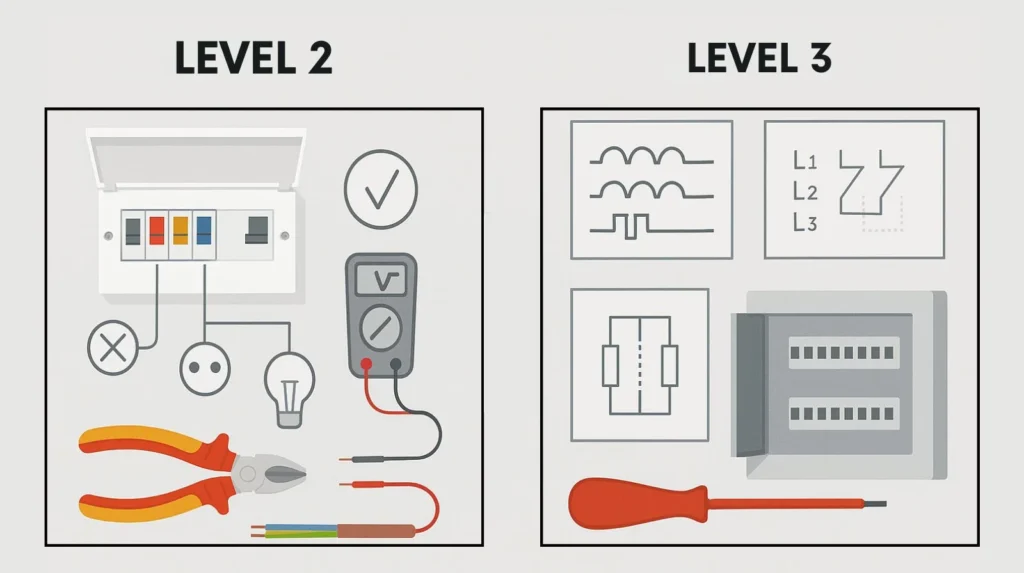
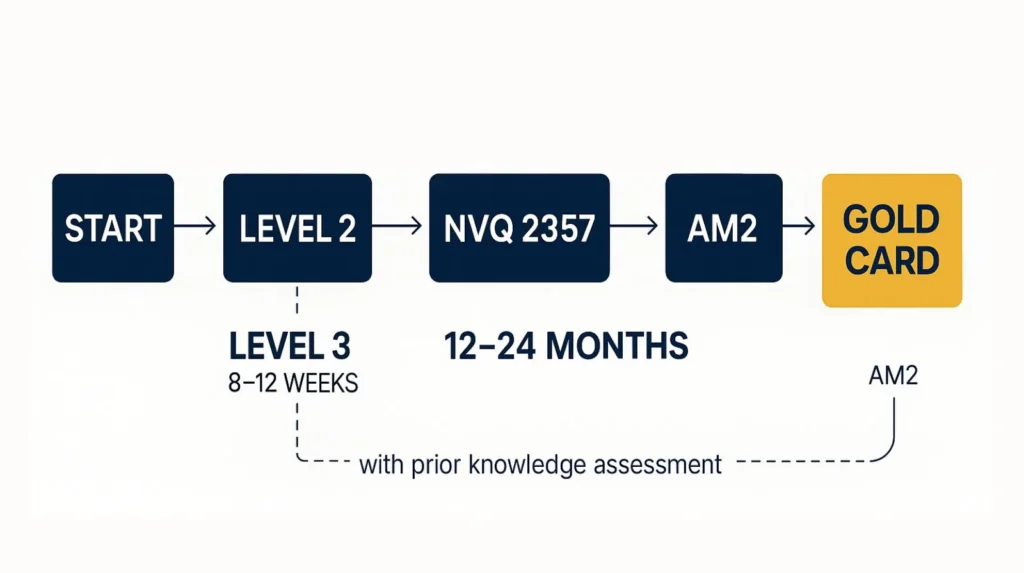
Here’s the thing. Level 2 and Level 3 are not interchangeable. They’re sequential qualifications building on each other. Level 2 (City & Guilds 2365-02) establishes foundational electrical knowledge covering single-phase domestic systems, basic calculations, safe isolation, and dead testing principles. Level 3 (City & Guilds 2366-03) builds on Level 2 with more advanced electrical knowledge and practical training, including three-phase systems, electrical design, inspection, testing and fault diagnosis. Both qualifications combine technical knowledge with practical training and assessment in a training-centre environment. However, neither on its own demonstrates the workplace occupational competence required for an Installation Electrician ECS Gold Card. Neither alone makes you a qualified electrician. For new entrants following Elec Training’s adult training route, the usual progression is Level 2 (2365-02), Level 3 (2366-03), the Level 3 NVQ 2357 and the relevant AM2 assessment. Other recognised routes, including apprenticeships and Experienced Worker pathways, may apply depending on your background.
There continues to be demand for skilled electricians, but employers and ECS grading routes distinguish between training-centre qualifications and recognised occupational competence. Commercial contractors demand Level 3 completion minimum for trainee roles. NVQ programmes require Level 3 before enrolment. For new entrants following this diploma-to-NVQ route, Level 2 and Level 3 provide the underpinning training needed before progressing to the NVQ. ECS also recognises other approved apprenticeship, competency and legacy routes. Skipping or rushing Level 2 creates knowledge gaps that surface during Level 3 assessments, NVQ portfolio building, and AM2 practical exams.
The catch is that myths dominate discussions. “Level 2 is optional for mature learners” is sometimes true but often misunderstood. “You can work as an electrician after Level 2” is false. “Fast-track means skipping Level 2” is false. “Level 2 and Level 3 are the same, just different levels” oversimplifies the significant content and assessment differences. Understanding what each qualification covers, how they differ, and which you need first prevents wasted training costs and career delays within the comprehensive NVQ Level 3 qualification pathway.
This guide explains exactly what Level 2 covers including scope, content, assessment format, and typical duration, what Level 3 covers including three-phase introduction, commercial contexts, and circuit design, how the qualifications differ in depth, complexity, and workplace application, whether you can skip Level 2 or if it’s always mandatory, recognition of prior learning rules for mature learners and career changers, what you can and cannot do with Level 2 alone versus Level 3 completion, salary and employment differences between qualification levels, how Level 2 and Level 3 fit into the full pathway to NVQ 2357 and Gold Card, and realistic timelines and costs for completing both qualifications.
What Level 2 Actually Covers
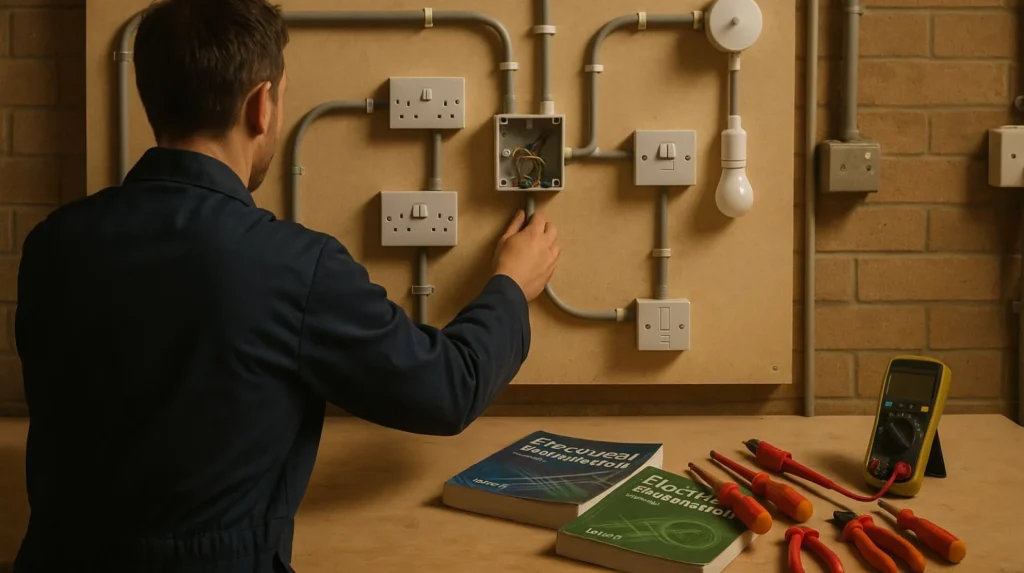
Level 2 Diploma in Electrical Installations (City & Guilds 2365-02) is the foundational theory qualification for electrical training. It’s classroom and workshop-based, covering electrical principles, regulations, and safe working practices at a domestic installation level.
Core content includes electrical science fundamentals covering voltage, current, resistance, power, Ohm’s Law, and series/parallel circuit calculations. Health and safety procedures including safe isolation, lock-off procedures, use of voltage indicators, and PPE requirements. BS 7671 Wiring Regulations introduction covering domestic installation requirements, cable selection, circuit protection, and earthing principles. Single-phase electrical systems focusing entirely on domestic 230V installations including lighting circuits, socket outlets, and radial/ring final circuits. Basic testing procedures covering dead tests including continuity, insulation resistance, polarity, and earth continuity checks. Domestic wiring systems including consumer units, circuit breakers, RCDs, cables, and accessories. Hand and power tools including safe use of drills, saws, crimpers, strippers, and installation equipment.
The qualification is split into mandatory units and optional units depending on training provider. Typical structure includes Unit 201 covering health and safety, Unit 202 covering electrical science principles, Unit 203 covering electrical installation technology, and Unit 204 covering installation, testing, and commissioning. Assessment format combines written exams testing knowledge recall and practical tasks demonstrating basic installation skills in training workshops.
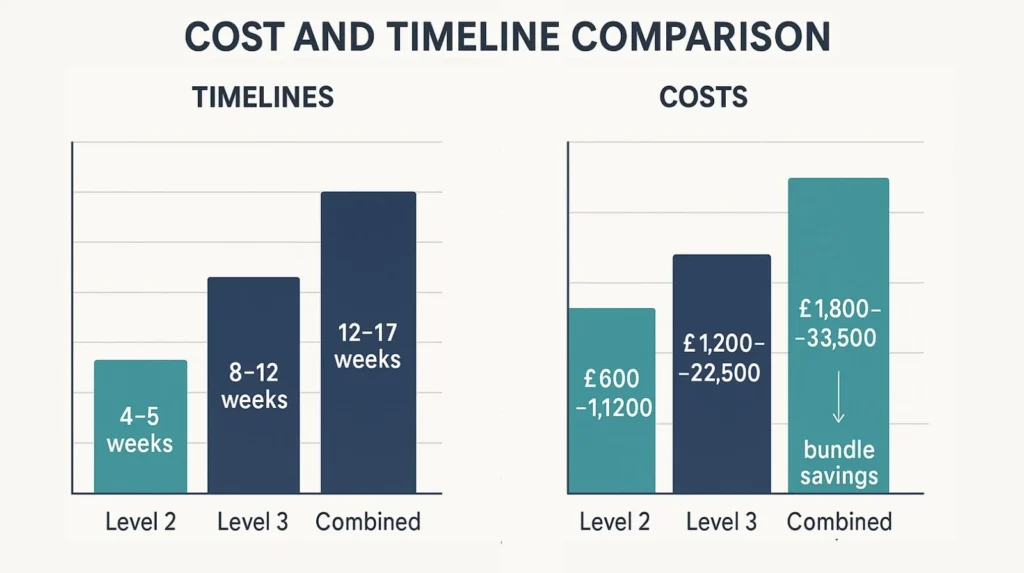
Duration is typically 4 to 5 weeks full-time or 8 to 12 weeks part-time. Some providers advertise 3-week intensive courses, but this compresses content significantly, often leading to knowledge gaps. Cost ranges from £600 to £1,200 depending on training provider, location, and course intensity.
What Level 2 does not cover: three-phase systems, commercial or industrial installations, advanced testing including live tests, circuit design from scratch, or NVQ portfolio preparation. Level 2 alone does not grant electrical work rights, Gold Card eligibility, or qualification to certify installations. It’s step one of a multi-stage pathway, not a standalone qualification for employment as an electrician.
What Level 3 Actually Covers
Level 3 Diploma in Electrical Installations (City & Guilds 2366-03) advances from Level 2 foundations to installation competence, covering commercial contexts, three-phase systems, circuit design, and live testing procedures.
Core content includes advanced electrical science covering three-phase theory, star and delta configurations, power factor correction, and balanced loading calculations. Circuit design from specification including maximum demand calculations, cable sizing with correction factors (ambient temperature, grouping, installation method), voltage drop calculations, and protection device selection. Three-phase electrical systems introducing 400V distribution, three-phase motors, sub-mains, and distribution boards. Commercial and light industrial installations covering larger-scale systems beyond domestic scope including offices, retail, warehouses, and light manufacturing. Live testing procedures including earth fault loop impedance (Ze at origin, Zs at points), RCD operation testing, and functional checks. Advanced BS 7671 application covering more complex regulations including special locations (bathrooms, outdoor installations), inspection and testing requirements, and certification procedures. Containment systems including cable tray, trunking, trunking, conduit (steel and PVC), and SWA cable terminations.
The qualification structure includes Unit 301 covering health and safety in building services, Unit 302 covering electrical science and principles (advanced), Unit 303 covering electrical installation technology (advanced), and Unit 305 covering inspection, testing, and commissioning. Assessment format combines written exams testing application of knowledge to realistic scenarios, calculations under timed conditions, and practical installation tasks in training workshops demonstrating competence beyond basic Level 2 tasks.
Elec Training’s Level 3 2366-03 course is seven weeks in-centre. Across the wider market, external providers may offer Level 3 courses over 8 to 12 weeks full-time or shorter intensive formats, depending on delivery structure. Cost ranges from £1,200 to £2,500 depending on training provider, location, and whether Level 2 and Level 3 are bundled.
What Level 3 does not cover: practical workplace experience, NVQ portfolio evidence, on-site competence assessment, or AM2 practical exam preparation. Level 3 proves theoretical knowledge and workshop-based skills. It does not grant Gold Card status, qualification to work unsupervised, or ability to certify installations independently. You need Level 3 plus NVQ 2357 plus AM2 for qualified electrician status.
Use an amps-to-watts calculation to practise basic power calculations.
Thomas Jevons, our Head of Training with 20 years experience, explains the assessment difference:
"From an assessment perspective, Level 2 exams test knowledge recall and basic calculations. Level 3 assessments demand application of knowledge to real installation scenarios. When I assess Level 3 learners, I'm looking for circuit design decisions, cable sizing justifications, and protection device selection with full calculations. Level 2 teaches you the formulas. Level 3 proves you can use them under realistic constraints including voltage drop, ambient temperature correction, and grouping factors."
Thomas Jevons, Head of Training

Key Differences Between Level 2 and Level 3
Understanding the practical differences between Level 2 and Level 3 prevents confusion about what each qualification actually achieves and prepares you for.
Scope and context. Level 2 focuses exclusively on single-phase domestic electrical installations in dwelling properties. Level 3 introduces commercial and light industrial contexts including offices, retail premises, warehouses, and multi-occupancy buildings. The installation scale increases significantly.
System complexity. Level 2 covers single-phase 230V systems only. Level 3 introduces three-phase 400V distribution, requiring understanding of phase rotation, balanced loads, neutral currents, and three-phase motor supplies. This is a major conceptual leap.
Circuit design autonomy. Level 2 teaches you to install circuits with pre-determined cable sizes and protection devices. Level 3 requires you to design circuits from specification, calculating maximum demand, selecting cable sizes with correction factors, determining voltage drop, and choosing appropriate protection. You move from following instructions to making justified design decisions.
Testing depth. Level 2 covers dead testing only including continuity, insulation resistance, polarity, and earth continuity. Level 3 adds live testing including earth fault loop impedance (Ze and Zs), RCD operation verification, and fault-finding diagnostics. Live testing introduces risk and requires deeper understanding of what results indicate.
Assessment standards. Level 2 exams test knowledge recall with straightforward questions and basic calculations. Level 3 exams demand application of knowledge to realistic scenarios, complex multi-stage calculations, and justification of design decisions. Pass rates differ accordingly, with Level 3 having higher failure rates due to increased complexity.
Containment and installation methods. Level 2 introduces basic containment including surface clipping and basic trunking. Level 3 covers cable tray systems, steel and PVC conduit installation, SWA cable terminations, and complex containment routing in commercial buildings. The practical installation skills advance significantly.
Regulation application. Level 2 applies BS 7671 to simple domestic installations with clear-cut regulation application. Level 3 requires interpreting regulations for special locations (bathrooms, outdoor areas), complex installations, and commercial contexts where multiple regulations interact.
Employment readiness. Level 2 alone may provide access to labourer or improver roles with limited electrical task involvement. Level 3 completion may improve access to trainee electrician roles and opens eligibility for NVQ 2357 programmes leading towards qualified status. Pay varies significantly by employer, location, experience and the type of work available.
NVQ and Gold Card pathway. Level 2 alone does not permit NVQ 2357 enrolment. You must complete Level 3 before accessing NVQ routes. Similarly, you cannot take AM2 practical assessment without NVQ completion, which requires Level 3. Level 2 is necessary but insufficient for progression.
Can You Skip Level 2 and Go Straight to Level 3?
The short answer is: sometimes, but not usually, and it depends on your background and the training provider’s assessment.
City & Guilds official prerequisites state that Level 3 requires “successful completion of Level 2” or “equivalent prior knowledge and experience.” The flexibility is in “equivalent prior knowledge.” Not all learners must complete formal Level 2 if they can demonstrate equivalent understanding.
Recognition of Prior Learning (RPL) allows training providers to assess whether your existing knowledge and experience meet Level 2 content standards. If you have electrically-adjacent experience in electronics, instrumentation, engineering, armed forces technical roles, or similar backgrounds, you may qualify for RPL. The provider assesses you via tests, interviews, or practical demonstrations. If you pass, you proceed directly to Level 3 without completing formal Level 2.
Mature learner provisions acknowledge that adult learners aged 25+ often bring life experience, technical backgrounds, or transferable skills. Some providers offer accelerated entry assessments for mature learners. However, you’re still assessed on Level 2 content knowledge. You’re not skipping content, you’re demonstrating you already possess it.
When skipping Level 2 is realistic: You hold relevant qualifications in electrical or electronic engineering. You have documented work experience in electrical environments (not just helping on sites, but performing electrical tasks). You can pass rigorous pre-Level 3 assessments covering single-phase theory, basic calculations, safe isolation, and BS 7671 fundamentals. Your learning is recent (within 5 years). Attempting Level 3 without these conditions creates high failure risk.
When skipping Level 2 is unrealistic: You have no electrical background whatsoever. Your experience is general construction, not electrical-specific. Your electrical knowledge is from YouTube, DIY, or informal learning without structured training. You’re relying on claims that “mature learners don’t need Level 2” without understanding RPL assessment requirements. Most career changers entering electrical work from non-electrical backgrounds need full Level 2 to Level 3 pathway.
Fast-track claims clarified. Training providers advertising “fast-track to Level 3” often mean compressed timelines (3-week Level 2, 6-week Level 3), not skipping Level 2 entirely. True fast-track via RPL requires demonstrated competence, not just willingness to pay. Be skeptical of providers guaranteeing Level 3 entry without rigorous pre-assessment.
The risk of skipping Level 2. Learners who bypass Level 2 without genuine equivalent knowledge struggle with three-phase concepts, circuit design calculations, and testing principles in Level 3. Failure rates increase. Time and money are wasted repeating Level 3 or backtracking to cover Level 2 content. Employers and NVQ assessors later identify knowledge gaps during practical work, causing competence concerns.
What You Can and Cannot Do with Each Qualification
Understanding employment rights and limitations at each qualification level prevents misunderstandings and unrealistic expectations.
With Level 2 only, you can work in labourer or electrical improver roles assisting qualified electricians under supervision. Typical tasks include cable pulling, material handling, basic first-fix work under instruction, and site preparation. You cannot perform electrical tasks independently, design circuits, conduct testing, certify installations, or work unsupervised. Employment options are limited to supportive roles. Pay varies depending on the employer, location, experience and type of work available. ECS card eligibility is Labourer or Electrical Labourer, not Trainee Electrician (which requires enrolment in NVQ or apprenticeship). NVQ enrolment is not possible without Level 3. Gold Card pathway remains inaccessible.
With Level 3 completion, you can work in trainee electrician roles under supervision of qualified electricians. Typical tasks include installation work on domestic and commercial projects, assisting with testing, basic fault-finding, and building competence towards NVQ portfolio completion. You cannot work unsupervised, certify installations independently, or take full responsibility for electrical work. Employment options expand to trainee positions with electrical contractors. Learners progressing into workplace training may be eligible for an appropriate ECS trainee or support card depending on their qualifications, employment and registration status. NVQ enrolment becomes possible, opening the pathway to Gold Card. However, Level 3 alone does not grant Gold Card or qualified electrician status.
With Level 2 plus Level 3 plus NVQ 2357 completion, you can take AM2 practical assessment. Passing AM2 supports eligibility for Installation Electrician Gold Card status. The Installation Electrician ECS Gold Card demonstrates that the holder has met the recognised Level 3 occupational competence standard for the card. Pay after achieving qualified status varies depending on the employer, location, experience and type of work available. This is the target outcome requiring the relevant prerequisite qualifications.
Why the distinction matters. Learners completing Level 2 expecting to work as electricians face reality checks when employers explain they need Level 3 minimum for trainee roles. Similarly, learners completing Level 3 expecting Gold Card status discover they still need NVQ portfolio (12 to 24 months) and AM2 assessment. Setting realistic expectations about what each qualification achieves prevents frustration and financial waste.
Joshua Jarvis, our Placement Manager, explains the employment reality:
"What we see consistently is learners asking if they can work after Level 2 to fund Level 3. The challenge is that Level 2 alone limits you to labourer or improver roles at £18,000 to £22,000 annually. Level 3 completion opens trainee electrician positions at £22,000 to £28,000. The salary jump happens at Level 3, not Level 2, because that's when employers see progression toward qualified status."
Joshua Jarvis, Placement Manager
How Level 2 and Level 3 Fit Into the Full Pathway
Level 2 and Level 3 are the first two stages of a five-stage pathway to qualified electrician status in the UK. Understanding where they sit within the complete pathway clarifies why both are necessary and what comes next.
Stage 1: Level 2 Diploma in Electrical Installations (2365-02). Duration: six weeks with Elec Training. Cost: £3,249 including VAT. Outcome: Foundational electrical knowledge covering domestic single-phase systems. Enables progression to Level 3. Does not permit electrical work or NVQ enrolment.Outcome: Foundational electrical knowledge covering domestic single-phase systems. Enables progression to Level 3. Does not permit electrical work or NVQ enrolment.
Stage 2: Level 3 Diploma in Electrical Installations (2366-03). Duration: 7 weeks in centre. Cost: £3,249 including VAT. Outcome: Advanced electrical knowledge covering three-phase and commercial systems. Enables NVQ 2357 enrolment. Opens trainee electrician employment. Does not grant Gold Card.
Stage 3: NVQ Level 3 Diploma in Installing Electrotechnical Systems and Equipment (2357). NVQ completion time varies according to workplace access, the range of evidence available and assessor progress. Cost: £1,500 to £3,000 for assessment and portfolio support.Outcome: Practical competence portfolio demonstrating on-site electrical installation, testing, and fault-finding skills. Requires employment or placement providing electrical work opportunities. Enables AM2 entry. Does not grant Gold Card without AM2 pass.
Stage 4: AM2 Practical Assessment. The relevant AM2 assessment is independently delivered through a NET-approved assessment centre. Candidates should check the current format and duration for their applicable assessment. Cost: £860 to £935. Outcome: End-point practical assessment proving safe isolation, installation, testing, and fault-finding competence under exam conditions. Pass required for Gold Card eligibility.
Stage 5: Installation Electrician Gold Card application. Cost: £50 to £100 for card plus ECS Health and Safety assessment. Outcome: ECS Gold Card demonstrating that the holder has met the recognised Level 3 occupational competence standard for the card. This is the target outcome.
Total pathway timeline: 18 months to 3 years from starting Level 2 to achieving Gold Card, depending on NVQ completion speed. Elec Training’s complete Gold Card training package costs £8,208.33 excluding VAT (£9,849.99 including VAT). The independent AM2 assessment is not included and must be booked and paid for separately. Completing the pathway may improve access to qualified electrician opportunities, but pay varies significantly by employer, location, experience and the type of work available.
Alternative pathways exist including 4-year apprenticeships combining all stages, Experienced Worker Assessment (EWA 2346) for those with 5+ years informal experience, and gap training for electricians with partial qualifications. For career changers and mature entrants following Elec Training’s adult learner route, the Level 2 to Level 3 to NVQ 2357 progression is a common pathway. Other recognised options, including apprenticeships and Experienced Worker routes, may be more appropriate depending on previous experience and qualifications. See the complete NVQ 2357 pathway overview.
Realistic Timelines and Costs
Understanding realistic timelines and financial commitments for Level 2 and Level 3 helps learners plan training and budget appropriately.
Level 2 timeline. Standard full-time delivery: 4 to 5 weeks, typically 5 days per week, 9am to 5pm. Part-time delivery: 8 to 12 weeks, typically 2 evenings per week plus occasional Saturdays. Intensive fast-track: 3 weeks compressed, higher daily intensity. Provider claims of 2-week Level 2 are unrealistic for competence building. Assessment period includes exams at end of course, results typically within 2 to 4 weeks.
Level 3 timeline. Elec Training’s Level 3 2366-03 course is seven weeks in-centre. External providers may offer Level 3 through different full-time, part-time, or intensive delivery models, so advertised durations can vary. Assessment period and results timelines also depend on the provider and awarding-body arrangements.
Combined Level 2 and Level 3 packages. Many providers bundle both qualifications. Full-time combined: 12 to 17 weeks total. Part-time combined: 24 to 36 weeks total. Prices for combined courses may vary depending on the provider, funding, delivery format and location.
Try an amps-to-kW calculation to practise how current and voltage relate to power.
Level 2 costs. Elec Training’s Level 2 course is £3,249 including VAT. External providers may charge different fees depending on location, delivery model, and what is included. Check whether tuition, course materials, exam fees, and workshop consumables are included before comparing prices.
Level 3 costs. Elec Training’s Level 3 2366-03 course is £3,249 including VAT. External providers may charge different fees depending on location, delivery model, and what is included. Check whether tuition, course materials, exam fees, and workshop consumables are included when comparing prices.
At Elec Training, the Level 2 course costs £3,249 including VAT and the Level 3 course costs £3,249 including VAT. Prices at other colleges and training providers vary according to funding, delivery format and location.
Hidden costs to budget for. Travel to training centre (fuel, public transport, parking). Accommodation if attending residential courses away from home. Food and daily expenses during training. Time off work (opportunity cost if self-funding and unable to work during training). Resit fees if failing exams (£80 to £150 per exam module).
Funding options. Self-funding is most common for adult learners. Employer sponsorship if working for electrical contractors willing to invest in your training. Some learners may be eligible for government-backed funding or loans depending on the qualification, age, location and current eligibility rules. Check the latest GOV.UK guidance before relying on funding as part of your training plan. Some local authorities offer adult education grants or bursaries for eligible learners. Apprenticeships fully fund training but require 4-year commitment and structured employment.
Completing Level 3 may improve access to trainee and improver opportunities, but pay varies significantly by employer, location, experience and the type of work available.
Common Misconceptions About Level 2 and Level 3
Misconceptions about these qualifications waste time and money. Here are the most common myths debunked with evidence.
Myth 1: Level 2 makes you a qualified electrician. False. Level 2 is foundational theory covering domestic electrical knowledge. It does not assess practical installation competence, grant work rights, or lead to Gold Card status. For most new entrants taking the adult learner route, Level 2 and Level 3 provide the foundation for progressing to NVQ 2357 and the relevant AM2 assessment. However, this is not the only recognised route into the electrotechnical industry, with apprenticeship and Experienced Worker pathways also available.
Myth 2: You can work unsupervised after Level 3. False. Level 3 proves advanced electrical theory and workshop skills. It does not grant unsupervised work rights or ability to certify installations. You need NVQ 2357 portfolio completion and AM2 pass for Gold Card, which permits unsupervised work. Level 3 holders work as trainee electricians under supervision.
Myth 3: Fast-track means skipping Level 2. False. Fast-track typically means compressed timelines (3-week Level 2, 6-week Level 3), not skipping qualifications entirely. Genuine skipping via Recognition of Prior Learning requires rigorous assessment proving equivalent knowledge. Most learners cannot skip Level 2 without relevant prior qualifications or experience.
Myth 4: Level 2 and Level 3 are the same content, just different difficulty. False. Level 2 covers single-phase domestic systems only. Level 3 introduces three-phase, commercial installations, circuit design, and live testing. The content scope expands significantly, not just difficulty of the same material.
Myth 5: You can take AM2 after Level 3. False. AM2 requires NVQ 2357 portfolio completion, which takes 12 to 24 months of workplace evidence gathering. Level 3 completion alone does not permit AM2 entry. You must enrol in NVQ programme, build competence portfolio, gain assessor sign-off, then book AM2.
Myth 6: Level 3 alone gets you Gold Card. False. Gold Card requires NVQ Level 3 (2357), AM2 pass, 18th Edition BS 7671 certification, and ECS Health and Safety pass. Level 3 diploma (2366-03) is one component of the pathway but insufficient alone. Learners completing Level 3 expecting immediate Gold Card status discover they’re 12 to 24 months away via NVQ route.
Myth 7: Mature learners don’t need formal Level 2 or Level 3. Partially false. Mature learners with relevant electrical experience may qualify for Recognition of Prior Learning, but they’re still assessed on Level 2 and Level 3 content knowledge. Most career changers without electrical backgrounds need full qualifications. Age alone doesn’t bypass competence requirements.
Myth 8: Online or distance learning Level 2/3 qualifications are equivalent. Questionable. City & Guilds 2365 qualifications require practical workshop assessments demonstrating installation skills. Purely online courses cannot assess practical competence. Employers and NVQ assessors may not recognize online-only qualifications lacking hands-on components. Verify accreditation carefully.
What To Do Next
If you’re starting electrical training or confused about whether you need Level 2, Level 3, or both, here’s what actually works based on how the system operates.
If you are comparing the different routes into the electrical industry, explore our electrician course options for adults starting from beginner level.
If you are new to electrical training, start with our City & Guilds Level 2 Electrical Installations course (2365-02).
After Level 2, you can progress to our City & Guilds Level 3 Electrical Installations course (2366-03).
Learners who want to complete the classroom stages consecutively can also explore our fast-track electrician course
Assess your starting point honestly. If you have no electrical background, plan for full Level 2 to Level 3 pathway. If you have electrically-adjacent experience (electronics, instrumentation, engineering), request Recognition of Prior Learning assessment from training providers before assuming you can skip Level 2. Provide evidence of prior knowledge including qualifications, work experience, or technical training. Most providers conduct pre-assessment tests to verify RPL eligibility.
Choose training providers carefully. Compare Level 2 and Level 3 delivery timelines. Elec Training’s Level 2 course is six weeks. The hybrid option consists of four weeks in-centre plus two weeks of online learning. Be skeptical of providers claiming 2-week Level 2 or 4-week Level 3 as content compression creates knowledge gaps. Check for bundled Level 2 plus Level 3 packages offering cost savings. Verify City & Guilds accreditation and centre approval status. Read reviews from past learners regarding exam pass rates and teaching quality.
Budget realistically for total costs. Level 2 to Level 3 completion costs £1,800 to £3,500 plus textbooks, tools, and living expenses during training. Factor in opportunity cost if unable to work during full-time courses. Elec Training’s complete Gold Card training package costs £8,208.33 excluding VAT (£9,849.99 including VAT). The independent AM2 assessment is not included and must be booked and paid for separately. The investment recovers within 12 to 18 months of achieving Gold Card status.
Plan your timeline strategically. Full-time learners complete Level 2 and Level 3 in 3 to 6 months. Part-time learners spread over 6 to 12 months whilst working. Complete both qualifications consecutively maintaining momentum rather than taking breaks between levels. Gaps of 6+ months between Level 2 and Level 3 require knowledge refreshing, wasting time and money.
Understand what comes after Level 3. Level 3 completion enables progression into workplace competence. After completing the underpinning training, learners following this route can progress to our NVQ Level 3 Electrical Installation and Maintenance course to demonstrate workplace competence, requiring employment or placement providing electrical work. Securing trainee positions before or immediately after Level 3 prevents qualification-to-employment gaps. We guarantee a work placement for your NVQ portfolio, helping you gain the site-based evidence needed to progress towards becoming fully qualified. More than 100 learners have already been placed into work through our employer network. NVQ completion time varies according to workplace access, the range of evidence available and assessor progress. Once you reach the workplace competence stage, our guide on how to build your NVQ Level 3 electrical portfolio explains the evidence process in more detail. Budget time and costs for this stage beyond Level 2 and Level 3.
Don’t fall for mis-selling. Providers claiming “qualified electrician in 12 weeks” are advertising Level 2 plus Level 3 completion, not Gold Card status. Clarify what qualification you receive at course end and what employment rights it grants. Avoid providers guaranteeing NVQ or Gold Card completion without explaining the 12 to 24 month portfolio-building requirement. If claims sound too good to be true, they are.
Call us on 0330 822 5337 to discuss Level 2 and Level 3 training options matching your background and career goals. We’ll assess whether Recognition of Prior Learning applies to your situation or if full Level 2 to Level 3 pathway is required, explain realistic timelines for full-time or part-time study, clarify total costs including training, exams, textbooks, and tools, outline what Level 3 completion enables regarding trainee electrician employment and NVQ enrolment, and explain how our in-house recruitment team supports learners securing placements for NVQ portfolio building with 120+ contractor partnerships. For comprehensive context on how Level 2 and Level 3 fit into the complete NVQ 2357, AM2, and Gold Card pathway, see our detailed NVQ Level 3 training framework.
There continues to be demand for skilled electricians, but employers and ECS grading routes distinguish between training-centre qualifications and recognised occupational competence. You’ve got clear qualification pathways from Level 2 foundations through to Gold Card status. The question is ensuring you understand what each stage achieves, avoiding myths about shortcuts or fast-tracks, and budgeting time and money realistically for the full journey. For new entrants following Elec Training’s diploma-to-NVQ route, Level 2 followed by Level 3 provides the normal progression into the workplace competence stage. Other recognised routes may apply for apprentices and experienced workers. Completing both with proper understanding of content prevents knowledge gaps surfacing later during NVQ assessments and AM2 exams.
References
- City & Guilds – 2365-02 Level 2 Diploma Specification – https://www.cityandguilds.com/
- City & Guilds – 2366-03 Level 3 Diploma Specification – https://www.cityandguilds.com/
- IET (Institution of Engineering and Technology) – BS 7671 Wiring Regulations – https://www.theiet.org/
- ECS (Electrotechnical Certification Scheme) – Card Requirements – https://www.ecscard.org.uk/
- JIB (Joint Industry Board) – Electrician Grading Standards – https://www.jib.org.uk/
- NET Services – AM2 Assessment Information – https://www.netservices.org.uk/
- Construction Industry Training Board (CITB) – Workforce Projections – https://www.citb.co.uk/
Note on Accuracy and Updates
Last reviewed: 01 December 2025. This page is maintained; we correct errors and refresh sources as Level 2 and Level 3 specifications, costs, and timelines evolve. Qualification specifications reflect City & Guilds 2365-02 and 2366-03 standards as of November 2025. Cost information reflects UK-wide training provider averages as of Q4 2025. Salary data reflects typical UK rates for labourer, improver, and trainee electrician roles from Indeed, Reed, and Glassdoor. Timeline estimates reflect standard full-time and part-time delivery models. Next review scheduled following publication of updated City & Guilds specifications (estimated Q2 2026) or significant changes to Level 2/Level 3 course structures.
