

- Technical review: Thomas Jevons (Head of Training, 20+ years)
- Employability review: Joshua Jarvis (Placement Manager)
- Editorial review: Jessica Gilbert (Marketing Editorial Team)
- Last reviewed:
- Changes: maintained comprehensive NVQ 2357 guide including structure, portfolio requirements, assessment process, and completion timelines
Introduction
The question shows up constantly in training enquiries, on Reddit, in Facebook groups: “What actually is the NVQ 2357?” Closely followed by: “Is it the same as Level 3?” and “How long does the portfolio take?” Honestly, the confusion is understandable because training providers deliberately blur the lines between technical certificates and competency qualifications.
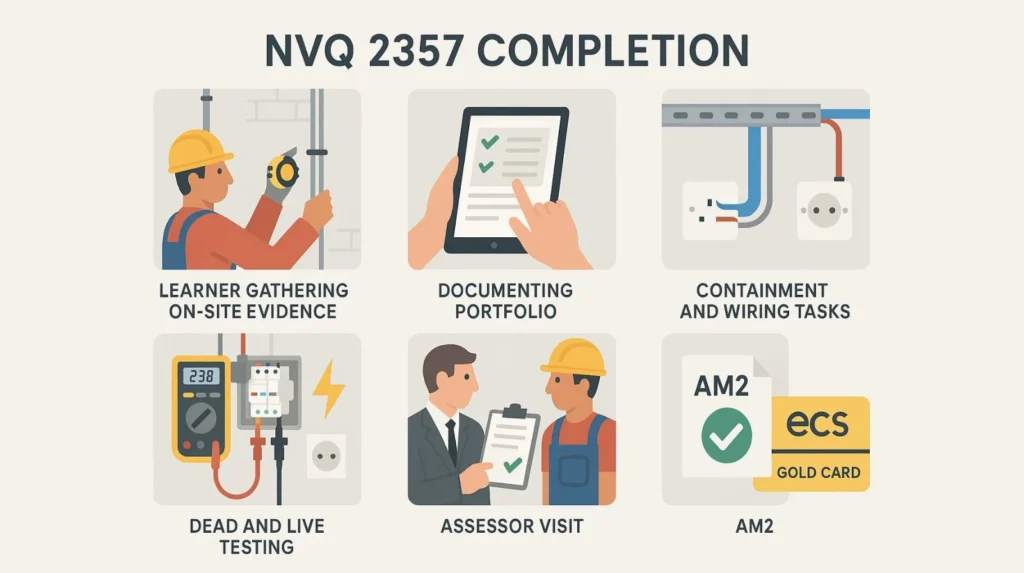
Here’s the thing. The NVQ Level 3 2357 is not a classroom qualification. It’s not something you can complete in 8 weeks or 13 weeks or any timeframe that involves only theory study. It’s a competence-based portfolio proving you can install, maintain, test, and certify electrical work safely and in accordance with BS 7671. It requires real employment on electrical sites, documented evidence across multiple installation types, assessor visits to verify your work, and completion time varies considerably and depends on access to suitable work, the range of tasks completed, assessor availability and how quickly valid evidence is collected across the required units.
The electrical industry continues to require trained and occupationally competent electricians. Employers commonly distinguish between learners who hold classroom diplomas and those who have completed a recognised Level 3 competence route.
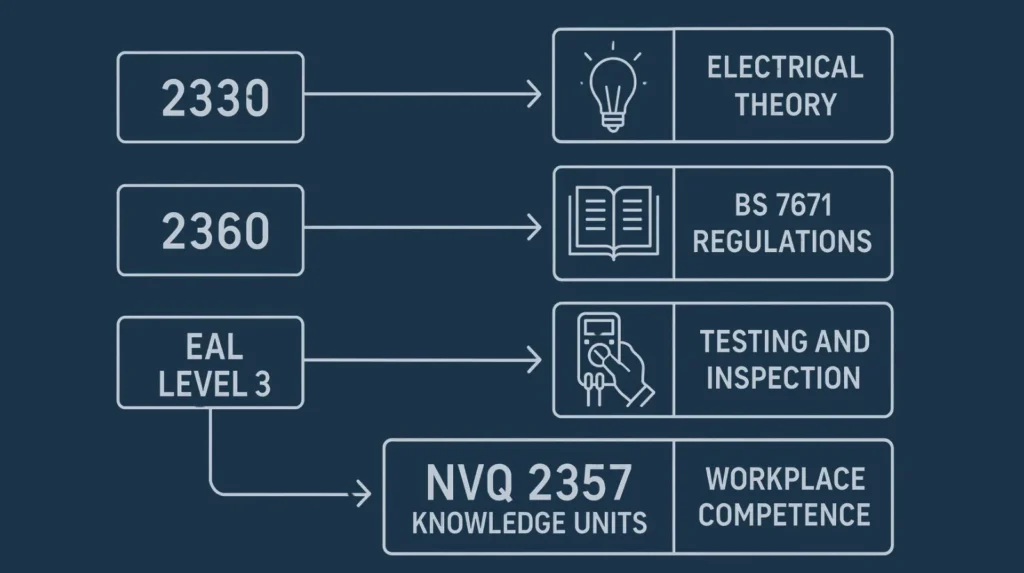
The NVQ 2357 replaced older frameworks (2330 technical certificate, 2356 NVQ) and sits distinctly above the 2365 diploma. The classroom diploma provides the underpinning technical knowledge, while the NVQ demonstrates occupational competence through workplace evidence. The precise qualifications required depend on the learner’s route, previous qualifications and the current ECS eligibility rules, but they serve completely different purposes within the NVQ Level 3 electrical qualification structure.
This guide explains exactly what the NVQ 2357 is, the difference between 2357-13 (Installing Electrotechnical Systems and Equipment) and 2357-23 (Electrotechnical Services – Electrical Maintenance), who it’s for and what entry requirements apply, all mandatory units you must complete, how the portfolio actually works including specific evidence requirements, on-site assessment processes, realistic timelines based on forum experiences, how it connects to AM2 and the Gold Card, costs and funding, and the myths that waste people’s time and money.
What the NVQ Level 3 2357 Actually Is
The NVQ Level 3 Diploma in Installing Electrotechnical Systems and Equipment (2357) is a competence-based qualification assessing your ability to perform electrical work safely, correctly, and in compliance with BS 7671. It’s not a theory exam. It’s not a short course. It’s a portfolio of evidence proving you can do the job.
City & Guilds currently lists two main 2357 pathways. The 2357-13 is the Level 3 NVQ Diploma in Installing Electrotechnical Systems and Equipment (Buildings, Structures and the Environment), while the 2357-23 is the Level 3 NVQ Diploma in Electrotechnical Services (Electrical Maintenance). The appropriate pathway depends on the type of occupational work being assessed.
The qualification replaced older frameworks. Before 2357, electricians completed 2330 (technical certificate, theory-based) and 2356 (NVQ, competence-based). The 2357 consolidated and modernised these. The 2365 diploma develops technical knowledge and practical training-centre skills, but it does not by itself demonstrate occupational competence in a real workplace. The 2357 NVQ assesses that workplace competence. Think of it this way: 2365 teaches you the regulations and principles, 2357 proves you can apply them on real installations.
A recognised Level 3 competence qualification is required for the relevant ECS Gold Card. The 2357 is one accepted route, alongside other recognised apprenticeship, legacy and Experienced Worker Assessment routes. Without it, you’re limited to lower-tier cards (Trainee, Labourer, Mate). Employers recognise this distinction clearly. Job adverts for qualified electrician roles specify “NVQ Level 3 2357 essential” or “ECS Gold Card required,” not just “Level 3 diploma.”
The 2357 is designed for improvers, apprentices, and adult learners with fewer than 5 years documented experience. Experienced electricians who have substantial, recent and relevant occupational experience may be eligible for the Experienced Worker Assessment route. Eligibility must be confirmed through the applicable skills scan and evidence requirements before enrolment.
Transition note: City & Guilds currently lists 31 October 2026 as the final registration date for the relevant 2357 qualifications. Learners considering this route should confirm with their training provider that registration remains available and that 2357 is the correct qualification for their circumstances before enrolling. Existing registered learners may continue within the awarding body’s applicable certification timescales.
Entry Requirements and Who the NVQ 2357 Is For
You cannot start the NVQ 2357 without meeting specific entry requirements. Applicants normally need suitable underpinning electrical knowledge before beginning the NVQ. This may come from recognised Level 2 and Level 3 electrical diplomas, an apprenticeship programme or accepted legacy and equivalent qualifications. The provider should check prior qualifications before enrolment, proving you understand electrical theory, BS 7671 regulations, and testing principles before attempting competence assessment.
Equivalent qualifications are accepted. Older qualifications like 2330, 2360, or EAL Level 3 certificates work if they map to the required knowledge units. Providers assess equivalence on a case-by-case basis. If you completed your Level 3 before 2015, check with your chosen NVQ centre whether your qualification still meets current entry standards.
Level 2 alone is rarely sufficient. Forums consistently report that providers reject applications from learners with only Level 2, as it doesn’t cover inspection, testing, or advanced electrical science needed for competence assessment. Level 3 is considered the baseline for NVQ entry.
The apprenticeship pathway integrates seamlessly. If you’re on a Level 3 Electrotechnical Apprenticeship Standard (5357), the NVQ component is built into your training. You complete the same portfolio evidence but under an apprenticeship framework with structured support.
Employment is non-negotiable. You must be working as an electrician’s mate, improver, or apprentice to gather portfolio evidence. Self-employment is problematic because assessors need to verify supervision and competence development under qualified electricians. Some providers reject self-employed applicants entirely. Others accept them only if they can prove supervision arrangements and access to varied work.
Details of our NVQ placement support explain how learners can seek suitable workplace opportunities for their evidence.
The typical NVQ 2357 learner is an adult improver (late 20s to 40s) who completed Level 2 and Level 3 diplomas and secured employment with a contractor willing to support portfolio building. Alternatively, it’s an apprentice on a structured pathway. Career changers from other trades (plumbing, heating, facilities maintenance) sometimes enter if they hold equivalent Level 3 qualifications and can prove electrical site access.
Simulation is minimally allowed. City & Guilds permits limited simulated evidence where real-site work isn’t accessible (for example, three-phase systems in domestic-only roles), but the majority of evidence must come from actual installations. Providers who over-rely on simulation risk portfolio rejection at final verification.
To be fair, entry requirements exist for good reasons. The NVQ proves you’re competent to work independently. Assessors need confidence that you understand what you’re doing, not just that you’ve followed instructions. That requires foundational knowledge from Level 3 and real workplace experience gathering evidence.
Mandatory Units: What You Actually Need to Complete
The NVQ 2357 comprises 18 units totalling 104 credits minimum. These split into knowledge units (theory-based, often completed via 2365 diploma recognition), performance units (practical evidence from site work), and the AM2 end-point assessment unit.
Core units apply to all pathways including
Unit 311 (Health, Safety and Welfare in Building Services Engineering)
Unit 312 (Applying Environmental Technology Systems)
Unit 313 (Organizing and Coordinating Resources)
Unit 301 (Understanding Fundamental Principles and Practices of Electrical Installation)
Unit 302 (Understanding the Practices and Procedures for Overcoming Problems in Electrotechnical Systems).
Installation-specific performance units (2357-13) include
Unit 314 (Installing Wiring Enclosures and Cable Management Systems)
Unit 315 (Installing and Connecting Electrotechnical Equipment and Components)
Unit 316 (Inspecting, Testing and Commissioning Electrotechnical Systems and Equipment)
Unit 317 (Diagnosing and Correcting Electrical Faults in Electrotechnical Systems and Equipment).
Maintenance-specific performance units (2357-23) include
Unit 318 (Maintaining Electrotechnical Systems and Equipment)
Unit 319 (Maintaining Electrical Machines and Equipment)
Unit 320 (Maintaining Electrical Panels and Assemblies)
Unit 321 (Diagnosing and Correcting Faults in Electrical Equipment and Circuits).
All pathways require employer evidence units and the AM2 assessment unit (Unit 309 or equivalent depending on route). The AM2 is an independently delivered competence assessment.
The difference between installation and maintenance matters. Installation focuses on new work (running cables, installing containment, wiring consumer units, first-fix and second-fix tasks). Maintenance focuses on existing systems (testing, fault-finding, repairs, planned maintenance schedules). If you’re working on new builds or extensions, 2357-13 suits your role. If you’re maintaining commercial or industrial sites, 2357-23 aligns better. Combined offers flexibility but demands access to both types of work.
Performance units are the challenging part. Knowledge units are usually credited from your Level 3 diploma (your training provider maps the relevant Level 3 knowledge units to the 2357 knowledge requirements). Performance units require documented site evidence, which is where most delays occur.
How the Portfolio Actually Works (Most Important Section)
This is where theory ends and reality begins. The portfolio is everything. It’s the proof of your competence, and it’s what determines whether you finish your NVQ in 12 months or 3 years.
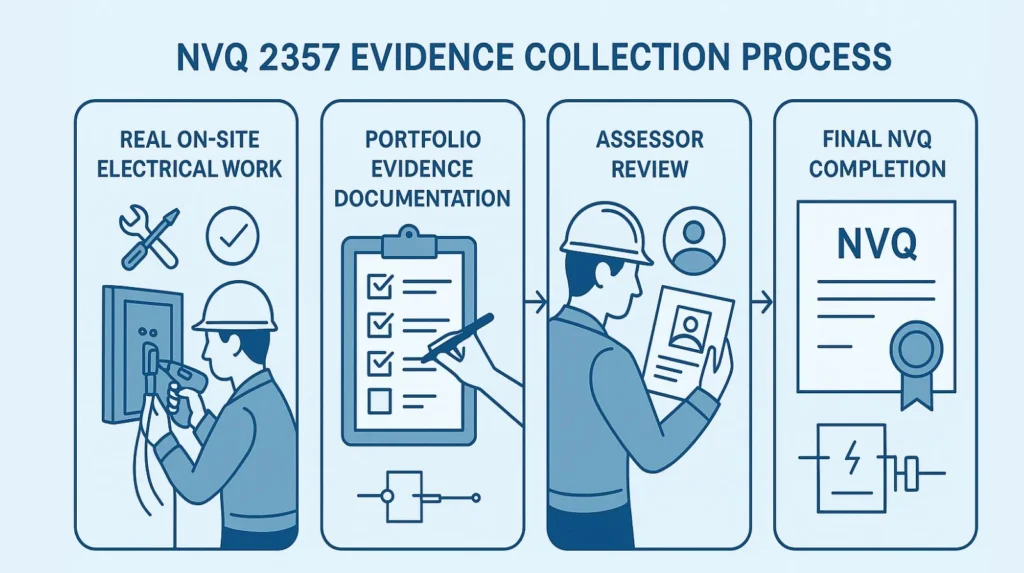
Evidence requirements are specific. For installation pathways, you need documented proof of containment systems (cable tray, trunking, conduit with 5 photos minimum each showing different installations), first-fix wiring (cables run through containment, clipped direct, in safe zones), second-fix wiring (accessories terminated, consumer units wired, circuits complete), testing sequences (dead tests including continuity, insulation resistance, polarity, earth continuity, R1+R2, and live tests including earth fault loop impedance Ze and Zs, RCD operation, functional testing), safe isolation procedures (prove dead at point of work, lock-off, test before and after), circuit alterations (additions to existing installations, board changes, cable upgrades), and fault diagnosis (identifying and rectifying faults on installations, requires access to faulty systems, often the hardest evidence to gather). Maintenance pathways add planned maintenance tasks, diagnostic procedures, and repair evidence. Combined pathways need everything.
Evidence formats accepted include photographs with references (job number, date, location, description of task), video evidence (rarely used but accepted for complex sequences), witness statements from supervising electricians (qualified to 18th Edition minimum, ideally Gold Card holders), job sheets and completion records (proving you carried out the work), risk assessments and method statements (RAMS proving safe working practices), and written descriptions explaining what you did, why, and how it complies with BS 7671.
The number of jobs required varies by provider. Forum discussions suggest 10 to 20 diverse jobs as typical. City & Guilds doesn’t specify exact numbers but requires “sufficient evidence” across all units. Providers interpret this differently. Some demand 15+ jobs with strict checklists. Others accept fewer if the evidence covers all competency criteria comprehensively.
Diversity is critical. You can’t complete an NVQ portfolio working only on domestic socket changes. Assessors need to see evidence across different installation types (domestic, commercial, industrial), different systems (lighting, power, heating controls, emergency lighting, fire alarms), different containment (tray, trunking, conduit, tray systems), different testing (routine inspection, fault-finding, commissioning new installations), and different scenarios (new builds, alterations, maintenance, repairs).
Thomas Jevons, our Head of Training with 20 years experience, clarifies portfolio quality over quantity:
"The fastest NVQ portfolios aren't the ones with the most photos; they're the ones with clear evidence mapped to unit outcomes and signed off on time. Learners who upload 200 random site photos without context waste months waiting for assessor feedback requesting proper documentation."
Thomas Jevons, Head of Training
Common failure points from forums and assessor feedback include lack of testing evidence (most common; many improvers do installation work but aren’t trusted with testing yet, and without documented test results across multiple jobs, the portfolio stalls), insufficient job variety (doing 20 domestic rewires generates repetitive evidence, not diverse competence proof), poor organisation (submitting hundreds of unlabelled photos without context frustrates assessors and delays sign-off), missing supervision evidence (assessors need proof that a qualified electrician supervised your work and verified competence), and simulated work presented as real (instant rejection if discovered).
Digital platforms like OneFile streamline portfolio submission. Most providers use online systems where you upload photos, add descriptions, and link evidence to specific unit criteria. Assessors review remotely and flag gaps or request clarification.
Joshua Jarvis, our Placement Manager, explains the employment reality:
“Learners need access to suitable electrical work to collect the evidence required for their NVQ. Our placement team supports eligible learners who need help finding appropriate employment for the workplace-evidence stage.”
Joshua Jarvis, Placement Manager
On-Site Assessments: How Verification Works
Portfolio submission is only part of the process. Assessors need to verify your evidence through on-site assessments, also called On-Site Reviews (OSRs) or performance observations.
The assessor may visit your workplace to observe you performing electrical tasks, ask questions about your work, check your understanding of BS 7671 compliance, and verify that portfolio evidence is genuine and correctly documented.
What assessors look for includes safe working practices (isolation, testing, PPE), correct application of BS 7671 regulations, understanding of why you’re doing tasks (not just following instructions), quality of work (neat terminations, appropriate cable routing, correct labelling), and ability to identify and rectify issues.
Remote observations became common post-COVID. Some providers now allow video-conference assessments where supervisors at your workplace facilitate observations whilst the assessor joins remotely. This increases accessibility for learners in rural areas or those working for small contractors who can’t easily accommodate on-site assessor visits.
The portfolio can be managed online, but the competence evidence must come from genuine workplace activity. The assessor will review submitted evidence and complete any required direct observations or professional discussions.
The number of site observations depends on the evidence already available, the range of work completed and the assessor’s judgement. Elec Training charges £250 for each on-site assessment.
Assessors use a sampling approach. They don’t observe every task in your portfolio. They select key activities that demonstrate competence across multiple units. For example, one observation of safe isolation and testing might cover evidence for Units 311 (health and safety), 316 (testing), and 317 (fault-finding) simultaneously.
Frequency varies by provider. Some schedule quarterly assessments. Others wait until learners accumulate significant evidence before arranging visits. Discuss assessment schedules with your training provider upfront to avoid surprises.
The assessor’s role isn’t just to pass or fail. They guide portfolio development, explain what evidence is missing, clarify unit requirements, and help learners understand what competence looks like in practice. Good assessors significantly speed up portfolio completion. Poor assessors frustrate learners with vague feedback and unnecessary delays.
How Long Does the NVQ 2357 Actually Take?
Timelines vary dramatically depending on your route, employment situation, and site access.
For the stages before and after the NVQ, compare the full training timeline.
Completion time varies considerably. It depends on access to suitable work, the range of tasks completed, assessor availability and how quickly the learner can collect valid evidence across all required units.
Some learners may complete within 12–24 months, while others may take more or less time. This range should be treated as a broad example rather than a fixed qualification requirement or guaranteed completion period.
Common delay causes from forums include lack of testing experience (employers won’t let improvers test installations until they’re confident in their competence, creating a catch-22; without testing evidence, portfolios stall), limited job variety (domestic rewires generate repetitive evidence; portfolios need containment, fault-finding, commercial installs, industrial maintenance, emergency lighting, fire alarms, breadth that many employers don’t offer), supervisor unavailability (witness statements require qualified electricians to sign off your work; if supervisors are too busy or unsupportive, evidence isn’t validated), poor planning (learners don’t understand evidence requirements upfront, complete jobs without documentation, and must repeat work to generate portfolio-ready evidence), and assessor delays (some training providers have limited assessors, causing scheduling bottlenecks that stretch timelines unnecessarily).
The key factor is employment quality. An improver working for a commercial contractor with multiple projects, varied electrical systems, and supportive supervisors completes portfolios faster than someone doing domestic socket changes for a one-man-band who won’t let them touch testing equipment.
How the NVQ 2357 Connects to AM2, AM2S, and AM2E
The NVQ portfolio proves competence through accumulated workplace evidence. AM2 (and its variants) proves competence under exam conditions. You need both.
The assessment is independently delivered at a NET-approved assessment centre. Its format, duration and fee depend on the relevant AM2-series assessment and the chosen centre.
Learners must complete the NET assessment relevant to their route: AM2 for the standard NVQ route, AM2S for the current apprenticeship-standard route and AM2E for the Experienced Worker Assessment route.
Before booking an assessment, compare the differences between AM2, AM2E and AM2S.
The connection to the NVQ is direct. You cannot sit AM2 until your portfolio is complete and verified by your assessor. Some training providers allow AM2 booking once the portfolio is substantially complete, scheduling the exam for a few weeks later to align with final portfolio sign-off. Others insist on full portfolio approval before AM2 registration.
AM2 is the final barrier between you and ECS Gold Card status. Passing the portfolio but failing AM2 leaves you stuck with an NVQ certificate but no industry-recognised card. The independent AM2-series assessment is not included in Elec Training’s NVQ price. Current assessment and resit fees should be confirmed directly with the NET-approved assessment centre.
Some learners choose to complete AM2 preparation before the assessment. Preparation options, duration and content vary by provider.

ECS Gold Card Requirements: Why the NVQ Matters
The ECS Gold Card is an industry-recognised card used to demonstrate that the holder has met the applicable occupational competence and ECS requirements for the relevant card type.
The 2357 is one recognised competence route, but it is not the only possible qualification pathway. Apprenticeship, legacy and Experienced Worker Assessment routes may also be accepted where they meet the applicable ECS requirements.
The distinction between Installation Electrician and Domestic Installer Gold Cards matters. The Installation Electrician route covers electrical installation work across domestic, commercial, and industrial environments, subject to the scope of the relevant qualification and card. Domestic Installer is limited to domestic properties and follows different qualification and certification routes.
Verification is strict. ECS checks qualifications against City & Guilds records. Forged certificates or misrepresented qualifications result in immediate rejection and potential industry blacklisting. Processing times can vary and applicants should check current ECS guidance when applying.
Employers recognise the difference between competency levels and card types. Job adverts for qualified electrician roles may specify “ECS Gold Card essential” or “Must hold NVQ Level 3 and AM2.” Improver roles may accept Trainee or Mate cards, while qualified roles commonly specify the relevant Gold Card or recognised competence requirements.
The NVQ 2357 is one recognised competence route that may support eligibility for the relevant ECS Gold Card, depending on the card and route being applied for. Learners should check carefully whether a course covers only classroom qualifications or includes the full occupational competence route.
Our guide to ECS cards and Gold Card routes explains the card pathway in more detail.
Costs and Funding: What You'll Actually Pay
Elec Training’s NVQ Level 3 course costs £2,249 including VAT. On-site assessments cost £250 each. The independent AM2 assessment is not included and must be booked and paid for separately.
Learners should confirm the current course price, assessment requirements and any applicable additional costs with Elec Training before enrolling. Do not assume that the NVQ course price includes the independent AM2 assessment.
Funding and payment arrangements can vary depending on the learner’s circumstances and the route being taken. Learners should check directly with the training provider and relevant funding bodies for current eligibility and availability
Real Experiences: What Forums and Reddit Actually Say
Examples of individual experiences reported in forums include:
"Can't get testing experience because my employer won't let me test until I'm qualified, but I need testing evidence to qualify" (this catch-22 appears repeatedly; solutions include asking to observe and document testing under supervision, or seeking additional part-time work with contractors who allow testing)
"Employer only does domestic socket changes, can't gather containment or fault-finding evidence" (narrow work scope delays portfolios significantly; some learners change employers mid-NVQ to access varied work)
Assessor rejected my simulated work" (providers that over-rely on simulation create problems at verification; real site evidence is non-negotiable)
"Portfolio took 3 years because I could only work weekends and my site access was limited" (part-time improvers face longer timelines unless they're extraordinarily well-supported).
Positive experiences include
"Employer paid all NVQ costs and gave me time off for assessor visits" — an individual example of employer support reported in forum discussions.
Individual forum discussions include adult improvers and career changers from a range of backgrounds. These accounts should be treated as individual experiences rather than evidence of a representative learner demographic or guaranteed outcome.
Mis-sold courses are a recurring complaint. Fast-track providers sell Level 2 and Level 3 diplomas as “electrician qualifications” without explaining the NVQ requirement. Learners complete diplomas, assume they’re qualified, then discover they still need 1 to 3 years of portfolio work to achieve Gold Card status.
Trade switchers (plumbers, heating engineers, facilities maintenance workers) report smoother NVQ experiences because they already understand site work, health and safety, and working under supervision. Their challenge is electrical-specific evidence (testing, BS 7671 compliance), not workplace professionalism.
Forum discussions include individual accounts in which site access, work variety and employer support affected portfolio progress. These experiences are useful as examples, but they do not establish a universal completion pattern for all NVQ learners.
Employer Expectations: What Job Adverts Demand
Job adverts reveal exactly what contractors want at each competency level, and the NVQ 2357 is the dividing line between improver roles and qualified electrician positions.
Electrical Mate roles require Level 2 or Level 3 diploma with 18th Edition helpful but not always required, some site experience preferred but not mandatory, with responsibilities including labouring tasks, pulling cables, drilling, fetching materials, and assisting qualified electricians.
Electrical Improver roles require Level 3 diploma, 18th Edition, working towards NVQ Level 3, with relevant site experience, responsibilities include assisting with installations, terminating under supervision, learning testing procedures, and basic fault-finding.
Qualified Electrician roles require recognised Level 3 occupational competence, the applicable AM2 assessment, 18th Edition, and the relevant ECS card, with relevant post-qualification experience. Responsibilities include electrical installation work, testing and fault-finding, with additional requirements often including a UK driving licence, own tools, and commercial or industrial experience.
Approved Electrician roles may require recognised Level 3 occupational competence, the applicable AM2 assessment, 18th Edition, and additional inspection and testing qualifications or experience. Responsibilities can include periodic inspection and testing, EICR completion, electrical installation work, and design-related duties, depending on the role.
The NVQ 2357 plus AM2 is the minimum threshold for qualified electrician roles. Without it, you’re limited to mate or improver positions regardless of how much theoretical knowledge or site experience you hold. Employers verify Gold Card status before hiring for qualified roles.
Some electrical roles require a driving licence because work may involve travelling between sites. Requirements vary by employer and role.
Myths and Misconceptions About the NVQ 2357
Misconceptions about the NVQ waste time, money, and effort. Here’s what’s actually true.
Myth 1: A classroom Level 3 diploma automatically makes me occupationally competent.
A classroom diploma provides underpinning knowledge and training-centre practical skills, but occupational competence is demonstrated through an accepted competence route. The precise qualifications required depend on the learner’s route and current ECS requirements.
Myth 2: Completing the classroom stages automatically completes the NVQ.
The NVQ is a workplace competence qualification. Classroom study may form part of the wider route, but the NVQ requires valid evidence from genuine workplace activity.
Myth 3: I can complete the NVQ entirely without suitable workplace activity.
The NVQ requires genuine occupational evidence from appropriate electrical work. The learner’s job title may vary, but the work must provide the required range of valid competence evidence.
Myth 4: Simulation counts as real evidence. Mostly false. City & Guilds allows minimal simulation where real work isn’t accessible, but the vast majority of evidence must come from actual installations. Portfolios relying heavily on simulation risk rejection.
Myth 5: AM2 is included in the classroom diploma.
The relevant AM2-series competence assessment is separate and independently delivered through a NET-approved assessment centre.
Myth 6: Experienced Worker Assessment (EWA) is a shortcut for beginners. False. The Experienced Worker Assessment route is intended for experienced electricians who can demonstrate substantial, recent and relevant occupational experience. Eligibility is assessed against the applicable route requirements rather than determined solely by a simple number of years. It is a recognition route for electricians who have relevant occupational experience, not a fast-track for career changers with no electrical background.
Myth 7: 2357 and 2346 are the same qualification. False. The 2357 and Experienced Worker Assessment routes have different eligibility requirements, assessment methods and evidence expectations, so the appropriate route depends on the learner’s qualifications, experience and circumstances.
Myth 8: I can skip the testing units if I don’t want to do testing work. False. Testing units (316 for installation, similar for maintenance) are mandatory. Without testing evidence, your portfolio cannot be signed off. There are no optional units in the core NVQ structure.
These myths typically stem from training provider marketing that blurs lines between diplomas and competency qualifications. Clarifying upfront prevents expensive mistakes.

What To Do Next
If you’re seriously considering the NVQ 2357 pathway, here’s what actually works based on what successful learners do.
Secure employment before starting the NVQ. You cannot build a portfolio without site access. Apply for electrical mate or improver roles with contractors who support NVQ learners. Ask in interviews: “Do you support NVQ portfolios? Will I have access to varied work including testing?” If the answer is vague or negative, keep looking.
Completing an NVQ does not automatically register a business; see the current NICEIC routes for domestic installers and qualified supervisors.
Complete Level 3 diploma first if you haven’t already. The NVQ requires Level 3 knowledge as entry.Before enrolling, ask the provider to check that you have suitable underpinning electrical knowledge for the NVQ route. This may come from current electrical diplomas, apprenticeship qualifications or accepted legacy/equivalent qualifications. Providers reject applications from learners without adequate theoretical foundation.
Choose your training provider carefully. Compare providers on assessor availability, portfolio support quality, AM2 preparation courses, and completion timelines. Cheap isn’t always best if it results in poor guidance and delayed portfolios. Ask for learner references or completion statistics.
Understand evidence requirements upfront. Request checklists from your provider before starting work. Know what evidence you need so you can document jobs correctly the first time. Repeating work to generate portfolio-ready evidence wastes time.
Communicate with your employer about portfolio needs. Explain that you need access to containment work, testing, fault-finding, and varied installations. Supportive employers adjust work allocation to help improvers gather diverse evidence.
Budget for the elements that apply to your route, including the NVQ fee, any on-site assessments, travel and the independent AM2-series assessment. Completion time depends on workplace access and evidence collection rather than a fixed standard period.
Some learners choose to complete AM2 preparation before the assessment. Preparation options, duration and content vary by provider.
Call us on 0330 822 5337 to discuss the NVQ Level 3 route, entry requirements, workplace-evidence equirements and the support available through Elec Training. We can explain the current NVQ fee, on-site assessment arrangements and how the independent AM2-series assessment fits into the relevant route.
You’ve got the employment if you’re working as a mate or improver. You’ve got funding options if your employer supports development. The demand exists across London, the Midlands, and the North West. The question is whether you understand the NVQ requires real competence evidence, not just theory, and whether you’re prepared to commit 12 to 24 months building a portfolio that proves you can work safely and independently. For the complete pathway from Level 2 through to ECS Gold Card including how the NVQ fits into the broader qualification structure, see our detailed NVQ Level 3 pathway breakdown.
References
- City & Guilds – 2357 NVQ Diploma in Installing Electrotechnical Systems – https://www.cityandguilds.com/
- Construction Industry Training Board (CITB) – Electrical Workforce Projections 2024-2029 – https://www.citb.co.uk/
- ECS (Electrotechnical Certification Scheme) – Card Requirements – https://www.ecscard.org.uk/
- JIB (Joint Industry Board) – Grading and Qualifications – https://www.jib.org.uk/
- NET Services – AM2 Assessment Information – https://www.netservices.org.uk/
- ElectriciansForums.net – NVQ Portfolio Discussions – https://www.electriciansforums.net/
- Reddit r/UKElectricians – NVQ Experiences – https://www.reddit.com/r/UKElectricians/
- The ESP (Electrical Safety Partnership) – Qualification Transition Information – https://www.the-esp.org.uk/
Note on Accuracy and Updates
Last reviewed: 17 August 2026. This page is maintained; we correct errors and refresh sources as NVQ structures, assessment methods, and industry requirements evolve. Electrician shortage data reflects CITB projections for 2024-2029. Entry requirements and unit structures reflect current City & Guilds 2357 specifications as of November 2025. Transition information reflects final registration deadline of 31 October 2026 for 2357 pathways. Salary data reflects typical UK rates for mate, improver, and qualified electrician roles as of Q4 2025. Next review scheduled following publication of updated CITB workforce data (estimated Q2 2026) or changes to NVQ qualification structures under new Electrotechnical standards.
